The Western Satraps were a Saka dynasty of western India in two houses, the Kshaharatas and the Kardamakas, ruling from cities that included Ujjain, Bharuch and Minnagara from c. 35 CE to 415 CE[1]. Chashtana founded the Kardamaka line, and modern scholars widely equate the start of the Saka era with his accession in 78 CE[2]. Rudradaman I, his grandson, left the Junagadh rock inscription, an early long record in mostly standard Sanskrit that also records the repair of the Sudarshana lake[3][4]. Their bust coins carried Greek-derived legends and later a three-arched hill over a river[1]. The sources differ on the end: the Indo-Scythian article gives Chandragupta II's defeat of the last satrap as 395 CE, and the Western Satraps article dates Rudrasimha III to 388–415 CE[5][1].
01Faith and deities
No clan deity is sourced. The Atlas gives no KulDevi (basis: Research). The coins show a sun, a crescent, a chaitya and a thunderbolt[1].
No KulDevi has been found for this clan yet; it is on the research list.
| Deity or tradition | Place in the clan's life | Evidence |
|---|---|---|
| Buddhism | Buddhist sites named in the sources: Karla, Nasik, Junnar, Kanheri, Devnimori, Vidisha and Sanchi | [1] |
| Brahmanas and Devas | Karla record: gifts to Brahmanas and Devas, and to ascetics 'without any distinction of sect or origin' | [1][7] |
| Vedic religion | Ushavadata is said to have followed the Vedic religion (Divatia 1993, as cited on the article) | [8] |
| Jainism | Nahapana is recorded as abdicating and becoming the Jain monk Bhutabali, in the Avasyaka Niryukti and later texts | [7] |
02Temples
The clan's best-recorded religious works are rock-cut Buddhist halls and gifts to Brahmanas. The extracts name no Hindu temple built by the clan.
Built by the clan
| Temple | Deity | Built by | When | Where |
|---|---|---|---|---|
| Karla Great Chaitya | Buddhist chaitya (no deity named) | Not named in the extracts; Nahapana's donative record is at Karla | Dedicated 120 CE | Karla, Maharashtra[7][1] |
Given patronage or grants by the clan
| Temple | Deity | What the clan gave | When | Where |
|---|---|---|---|---|
| Nasik Pandavleni Cave 10 ('Nahapana Vihara') | Buddhist Samgha | Ushavadata donated the cave to the Samgha; his wife Dakshamitra's inscription is in it | Year 42 | Nasik[8][1] |
| Manmodi Cave 7 | Not named | A record in Nahapana's name, with minister Ayama (year 46) | Year 46 | Junnar[7] |
| Devnimori stupa and viharas | Buddha images, Gandharan-influenced | Rudrasimha coins were found inside | Not dated in the extracts | Devnimori[1] |
03Languages and scripts
| Language or script | Kind | Under the clan | Evidence |
|---|---|---|---|
| Prakrit (Maharashtri) | Language of the inscriptions | Used by the Western Satraps' inscriptions | [1] |
| Sanskrit | Court language under Rudradaman | The Junagadh inscription is the first long, mostly standard Sanskrit record, a prototype of the Gupta prashastis; Ushavadata's Nasik inscription is the first known Sanskrit inscription in western India | [3][1] |
| Pali | Language listed among the satraps' languages | Listed on the Western Satraps article | [1] |
| Saka (Khotanese) | Language of the Sakas | Listed among the satraps' languages; the Indo-Scythian article equates it with Khotanese | [5][1] |
| Brahmi | Script | Coin legends and inscriptions | [1] |
| Kharoshthi | Script | Early coins; dropped from Chashtana onward | [1] |
| Greek script | Script | Coin obverse legends, which the satraps corrupted; under Rudrasimha II the Greek is corrupted | [9][1] |
04Books and literature
The clan left inscriptions and coins. The books below are other texts of the period that the extracts name in connection with the clan.
Written in the clan's lands during its era
| Work | Author | Kind | When | Link to the clan |
|---|---|---|---|---|
| Yavanajataka | Yavanesvara (translator) | Translation | c. 150 CE | [1] |
| Junagadh rock inscription | Rudradaman I | Long Sanskrit inscription | c. 150 CE | [3] |
| Nasik Cave 10 inscription | Ushavadata | Sanskrit eulogy, then a donation in Middle Indo-Aryan | Year 42 | [8] |
| Periplus of the Erythraean Sea | Not named | Names Minnagara and the trade of Barygaza | c. 70–80 CE | [5][1] |
Given patronage by the clan
Not recorded.
05Thinkers and scholars
| Name | Field | Era | Contribution |
|---|---|---|---|
| Yavanesvara | Translator | c. 150 CE | Translated the Yavanajataka c. 150 CE; the page does not name his patron[1] |
| Rudradaman I | Logic and music (a claim) | c. 130–150 CE | Bharat Discovery calls him 'तर्कशास्त्र का विद्वान्' (a scholar of logic) and 'संगीत का प्रेमी' (a lover of music), with no source given[6] |
The extracts name no other scholar of the clan.
06Art and architecture
The surviving art is coins, stone and cave work: the bust coins that the Guptas copied, the Karla and Nasik caves, and a statue at Mathura.
Painting and wall art
Not recorded.
Sculpture and temple art
| Art form | What it is | Era | Evidence |
|---|---|---|---|
| Chashtana statue | Statue found at Mathura, inscribed 'Sha-sta-na' in Middle Brahmi; often attributed to Chashtana | Not dated | Mathura[2][1] |
Temple and building architecture
| Art form | What it is | Era | Evidence |
|---|---|---|---|
| Karla Great Chaitya | Largest chaitya complex in South Asia | Dedicated 120 CE | Karla[1] |
| Nasik Pandavleni Cave 10 | Cave with 16 rooms; chaitya and umbrellas | Year 42 | Nasik[1][8] |
| Devnimori stupa and viharas | Stupa and viharas with Gandharan-influenced Buddha images | Not dated in the extracts | Devnimori[1] |
| Sudarshana lake, Girnar | Dam, channels and conduits; repaired by Rudradaman I | c. 150 CE | Girnar[10][3] |
Weaving and textiles
Not recorded.
Clothing and jewellery
Not recorded.
Coins, pottery and crafts
Not recorded.
07History
Kshaharata house, from c. 35 CE
The Western Satraps are recorded from c. 35 CE in two houses, the Kshaharatas and the Kardamakas (Bhadramukhas)[1]. Rulers named in the sources include Abhiraka (c. 35, known from coins), Bhumaka, and Nahapana[1][7].
Nahapana is styled satrap and then Mahakshatrapa[7]. His inscriptions are dated years 41 to 46; the Manmodi inscription at Junnar is year 46[7]. The sources date his reign differently: 24–70 CE, 66–71 CE, or 119–124 CE[7][1].
Kardamaka house from Chashtana, and the Saka era
Chashtana, a satrap at Ujjain, founded the Kardamaka (Bhadramukha) line[2][1]. His reign is given as 78–130 CE[2].
Modern scholars widely equate the start of the Saka era with Chashtana's accession in 78 CE[2]. The Western Satraps article notes a competing view that places the era in the Azes period[1].
Rudradaman I and the Junagadh inscription, c. 130 to 150 CE
Rudradaman I, Chashtana's grandson, took the title Mahakshatrapa c. 130 CE[1][11]. His Junagadh rock inscription is dated Saka year 72 (c. 150 CE) and records the repair of the Sudarshana lake near Girnar after a storm and floods breached its dam[3][4].
The lake had been built under Chandragupta Maurya by his governor Pushyagupta, a Vaishya, and under Ashoka the Yavana king Tushaspha added conduits[3]. The inscription says the repair was made without forced labour or extra taxes, and that the minister Suvisakha, a Pahlava, carried it out[4].
The inscription also says that Rudradaman defeated the Yaudheyas, and defeated Satakarni, lord of Dakshinapatha, twice but spared him for their close relation[3]. Rudradaman's daughter was given to Vashishtiputra Satakarni, and a Kanheri inscription records a Satavahana marriage to a Mahakshatrapa's daughter[1].
Satavahana wars and the Nasik and Karla records
The Nasik Cave 10 record gives a Satavahana defeat of the Satraps c. 105–106 CE[1]. Ushavadata, viceroy and son-in-law of Nahapana, donated Nasik Cave 10 to the Samgha in the year 42[8].
Ushavadata was viceroy of the southern Saka territories, including Nasik, Karle and Junnar[8]. Gautamiputra Satakarni appears to have defeated him, and a Nasik record of Gautamiputra's year 18 gives land once Ushavadata's to Buddhist monks[8].
Jivadaman and Rudrasimha I, the dated coins, 178 to 197 CE
Jivadaman's Saka year 100 (178 CE) is the first dated coin of the line[1]. Rudrasimha I reigned 178–197 CE, and his Setkhedi inscription is Saka year 107 (185 CE)[1].
From the Atlas: the main emblem is a three-arched hill over a river; the extracts place that hill on the later coin reverse[1].
Rudrasena II, the Ikshvaku link and Visvasena, 256 to 304 CE
The SBP museum page calls the reign of Rudrasena II (256–278 CE) the peak of the line[11]. Wikipedia links Rudrasena II with the Andhra Ikshvaku line through Rudradhara-bhattarika, and dates Visvasena's reign to 293–304 CE[1].
The SBP page names Visvasena as the last ruler, which differs from the other sources[11].
Rudrasimha II and Sridharavarman, 304 to 368 CE
Rudrasimha II reigned 304–348 CE, and his sons Yasodaman II (317–332) and Rudradaman II (332–348) are named[1]. Under Rudrasimha II the Greek legend on the coins is corrupted[1].
Sridharavarman (339–368 CE) is recorded in a Kanakerha inscription of 319 CE, and as Saka chief at Vidisha, Sanchi and Eran[1]. The Allahabad pillar of Samudragupta is said to record a Saka ruler, probably Sridharavarman, who submits to him[1].
Chandragupta II and the end of the line, from 388 CE
Rudrasimha III (388–415 CE) is the last Western Satrap[1]. Chandragupta II's Sanchi inscription is dated 412–413 CE[1].
The Indo-Scythian article says Chandragupta II defeated the last Western Satrap in 395 CE[5]. Bharat Discovery's page says Rudrasimha III was killed by Chandragupta Vikramaditya and his territory annexed to the Gupta empire[6]. The sources therefore date the end differently.
08Journey and migrations
The moves below are the ones the extracts date or name. The route of the Kshaharata and Kardamaka houses into western India is not in the extracts.
| When | From | To | Why | Evidence |
|---|---|---|---|---|
| c. 175 BCE | Ferghana and Sogdiana | Then Bactria and Afghanistan | After the Yuezhi were defeated by Modu Shanyu, the Sakas were pressed toward Ferghana and Sogdiana | [5] |
| c. 80 BCE | Afghanistan and the Indus | Gandhara and Taxila | Maues took Gandhara and Taxila, entering India by the Indus and Karakoram route | [5] |
| Not dated | Drangiana | Sakastan (Sistan) | Settled; the region took the name Sakastan, held until Bahram II (276–293 CE) | [5] |
| c. 35 CE | Not stated in the extracts | Ujjain, Bharuch and Minnagara | The Western Satraps are recorded from c. 35 CE, with Abhiraka's coins | [1] |
09Seats and lands
| Place | Role | Where today |
|---|---|---|
| Ujjain | Western capital; Ptolemy's 'Ozena-Regia Tiastani' is Chashtana's capital | Ujjain |
| Bharuch (Barygaza) | Port city; listed among the capitals; major port for trade with Rome | Bharuch |
| Minnagara | Metropolis of Syrastrene (Periplus); listed among the capitals | Not located in the extracts; the Indo-Scythian article places it on the Lower Indus |
| Dashapura | Listed among the capitals | Mandsaur |
| Govardhana | Listed among the capitals | Nasik |
| Shorparaga (Shurparaka) | Listed among the capitals | Nala Sopara |
| Malwa, southern Gujarat, northern Konkan | Lands held | Malwa; Gujarat; Konkan |
| Nasik and Poona districts, Vidarbha | Lands held | Nasik and Poona districts; Vidarbha |
| Saurashtra, Kutch, Sindh, Multan, Rajputana | Lands held | Saurashtra; Kutch; Sindh; Multan; Rajputana |
| Girnar: the Sudarshana lake | Irrigation lake repaired by Rudradaman I | Girnar (Bhavnath), Gujarat |
| Karla, Nasik Pandavleni, Junnar | Cave sites with the clan's gifts | Karla, Nasik and Junnar |
| Mathura | Statue of Chashtana found here, inscribed 'Sha-sta-na' | Mathura |
| Pauni, Vidarbha | Pillar of Rupiamma, 2nd century CE | Pauni, Vidarbha |
| Sakastan | Held until Bahram II (276–293 CE) | Sistan |
10Notable figures
| Name | Role | Era | Known from |
|---|---|---|---|
| Abhiraka | Kshaharata ruler, known from coins | c. 35 CE | [1] |
| Bhumaka | Kshaharata ruler; father of Nahapana | Not dated in the extracts | [7] |
| Nahapana | Kshaharata ruler; satrap, then Mahakshatrapa; Karla and Nasik gifts; the Jain tradition says he became the monk Bhutabali | Inscriptions dated years 41–46; reign 24–70, 66–71 or 119–124 CE (sources differ) | [7][1] |
| Dinika | Father of Ushavadata | Not dated in the extracts | [8] |
| Ushavadata (Rishabhadatta) | Viceroy of the southern Saka territories; son-in-law of Nahapana; donor of Nasik Cave 10 | Year 42 (Nasik Cave 10) | [8] |
| Dakshamitra | Nahapana's daughter and wife of Ushavadata; her inscription is in Nasik Pandavleni Cave 10 | Not dated in the extracts | [8] |
| Ayama | Minister at Junnar, of the Vatsa gotra | Year 46 (Manmodi inscription) | [7] |
| Ysamotika | Father of Chashtana, as the coin legend names him | Not dated in the extracts | [2] |
| Chashtana (Castana, Tiastanes) | Ujjain satrap; founder of the Kardamaka line; possibly the founder of the Saka era | Reign 78–130 CE | [2][1] |
| Rudradaman I | Mahakshatrapa; grandson of Chashtana; Junagadh inscription; repaired the Sudarshana lake; the name means 'garland of Rudra' | c. 130–150 CE (Saka year 72 = c. 150 CE) | [3][1][6] |
| Suvisakha | Pahlava minister who carried out the Sudarshana lake repair; son of Kulaipa | Saka year 72 (c. 150 CE) | [4] |
| Jivadaman | Ruler; first dated coins of the line | Saka 100–103 (178–181 CE) | [1] |
| Rudrasimha I | Ruler; Setkhedi inscription; coins carry Brahmi numeral dates from his reign | 178–197 CE; Setkhedi, Saka 107 (185 CE) | [1] |
| Rudrasena II | Ruler; the SBP page calls his reign the peak of the line | 256–278 CE | [11][1] |
| Bhartrdaman | Ruler (no detail given) | Not dated in the extracts | [1] |
| Visvasena | Ruler | 293–304 CE | [1] |
| Rudrasimha II | Ruler; the Greek legend on his coins is corrupted | 304–348 CE | [1] |
| Yasodaman II and Rudradaman II | Sons of Rudrasimha II | 317–332 CE; 332–348 CE | [1] |
| Sridharavarman | Ruler; Saka chief at Vidisha, Sanchi and Eran; Kanakerha inscription | Reign 339–368 CE; Kanakerha inscription 319 CE | [1] |
| Rudrasimha III | Last Western Satrap | 388–415 CE | [1] |
| Rupiamma | Donor of the Pauni pillar, Vidarbha | 2nd century CE | [1] |
11Allies, rivals and marriages
| People | Relationship | When |
|---|---|---|
| Satavahanas (Satakarni; Gautamiputra) | Rivals and in-laws. Rudradaman defeated Satakarni twice and spared him; a Kanheri inscription records a Satavahana marriage to a Mahakshatrapa's daughter. Gautamiputra's Pandavleni Cave 3 inscription claims he uprooted the Khakharata family[1][3] | c. 105–106 CE; c. 150 CE |
| Yaudheyas | Defeated by Rudradaman I (Junagadh inscription)[3] | c. 150 CE |
| Pahlavas | Minister Suvisakha, a Pahlava, carried out the lake repair. Other sources give Nahapana's ethnicity as Saka-Pahlava[4][7] | Saka year 72 (c. 150 CE) |
| Kushanas (Yuezhi) | Relation unsettled. The Rabatak inscription claims Ujjain under Kanishka; the Northern Satraps' Kharapallana and Vanaspara were Kushan feudatories[1][12] | Kanishka's 3rd year, c. 130 CE |
| Guptas | Chandragupta II defeated the last Western Satrap. The Ramagupta legend legend and the Gupta copying of the satraps' bust coins are in the other sections[5][1] | 395 CE (Indo-Scythian article); Sanchi 412–413 CE |
| Northern Satraps | Sister Saka satrapy at Mathura; Kushan vassals[12] | c. 60 BCE – 2nd century CE |
12Society and livelihood
The satraps had viceroys and ministers (Ushavadata, Ayama, Suvisakha), and Ujjain was the western capital. Their gifts to Brahmanas and Buddhist monks, and the lake repair, are the clearest records.
Government and social order
| Institution or group | What it was | Evidence |
|---|---|---|
| Satrap and Mahakshatrapa | Nahapana was satrap and then Mahakshatrapa; Rudradaman I took Mahakshatrapa c. 130 CE; the title Kshatrapa was the heir's | [7][11][1] |
| Viceroy Ushavadata | Viceroy of the southern Saka territories (Nasik, Karle, Junnar); son-in-law of Nahapana | [8] |
| Minister Ayama | Minister of the Vatsa gotra in the Manmodi inscription | [7] |
| Minister Suvisakha | Pahlava minister who carried out the Sudarshana lake repair | [4] |
| Brahmanas and Devas | Karla record: gifts to Brahmanas and Devas, with 100,000 Brahmanas fed each year | [7] |
| Buddhist monks (Samgha) | Nasik Cave 10 given to the Samgha; land once Ushavadata's given to Buddhist monks in Gautamiputra's year 18 | [8] |
| Charities of Ushavadata | 300,000 cows; 16 villages to deities and Brahmanas; daily feeding of Brahmanas; rest houses, gardens, tanks, wells and free river crossings | [8] |
Livelihood over time
| Era | Livelihood | Evidence |
|---|---|---|
| 1st century CE | Trade through Barigaza (Bharuch), a major port for trade with Rome; the Periplus names wine, copper, silk and ivory | [1] |
| Roman trade | A Lakshmi statuette from Pompeii is possibly exported via Barigaza (Pollard 2013, as cited on the article) | [1] |
| Not dated | Irrigation taxes were collected on the Sudarshana lake (Thapar 2004, as cited on the article) | [10] |
13Sub-clans and related clans
The sources name these houses, dynasties and peoples. Those with a sheet ID are linked; the rest are new clan candidates.
| Clan | Relation | Where | Size | In the Atlas | Evidence |
|---|---|---|---|---|---|
| Kshaharatas 𐨣𐨱𐨤𐨣 | Sub-clan | Bharuch to Sopara, Nasik, Karla, Junnar. The Kharoshthi form is on Nahapana's coins | ANC-172 | [1][7] | |
| Kardamaka (Bhadramukha) कार्दम वंशी | Sub-clan | Ujjain; Chashtana's line, also called Bhadramukhas | same name as ANC-191: check | [2][6] | |
| Shakas | Parent people | Ujjain; Mathura; Minnagara | ANC-119 | [5] | |
| Northern Satraps | Related people | Mathura | same name as ANC-217: check | [12] | |
| Pahlavas | Related people | Minister Suvisakha's people, in the Junagadh repair | ANC-092 | [4] | |
| Vatsas | Related people | Gotra of Ayama, minister at Junnar in the Manmodi inscription (year 46) | ANC-144 | [7] | |
| Satavahanas | Related people | Nasik and the Deccan | ANC-183 | [1][3] | |
| Guptas | Related people | The Gupta empire annexed the Saka territory (Bharat Discovery) | ANC-169 | [5][6] | |
| Kushanas | Related people | Mathura and the north-west; the Rabatak inscription claims Ujjain under Kanishka | ANC-070 | [5][1] | |
| Yaudheyas | Related people | Defeated by Rudradaman I | ANC-153 | [3] |
Clans marked "new clan candidate" are not in the Atlas yet.
14Surnames
No surname of the Western Satraps' families is in the extracts. The dynasty names (Kshaharata, Kardamaka) are used in the sources as house names.
Not recorded.
15Songs and music
No song, instrument or music of the Western Satraps is named in the extracts.
None recorded yet.
16Poems, lullabies and children's rhymes
No poem or rhyme of the clan is in the extracts.
None recorded yet.
17Stories, legends and proverbs
Stories and legends
| Story | What happens | Told by | Evidence |
|---|---|---|---|
| Ramagupta legend legend | Rudrasimha III demands Dhruvadevi, and Chandragupta II kills him | Natya-darpana fragment, as cited on the Western Satraps article | [1] |
| Aji Saka legend legend | The Western Satraps article links the Aji Saka legend to the Indian colonisation of Java; the story itself is not in the extracts | Sagar 1992, as cited on the article | [1] |
Proverbs and sayings
Not recorded.
18Festivals and fairs
Not recorded.
19Food, dress and games
Food
Not recorded.
Dress
Not recorded.
Games and martial arts
Not recorded.
Tags: living still practised · revived brought back after a break · lost known only from records · research reported but not yet confirmed from a source. Songs and poems under copyright are listed by title only; restricted or sacred material is noted without its content.
20Status today
The Western Satraps ended c. 415 CE, and the extracts name no living community as their descendants. The Saka era that modern scholars link with Chashtana is a dating system, not a living people[2][1].
Recognised heritage
| What | Recognition | Evidence |
|---|---|---|
| Saka era (78 CE) | Modern scholars widely equate its start with Chashtana's accession | [2] |
| Junagadh inscription | The first long Sanskrit record of mostly standard Sanskrit, a prototype of the Gupta prashastis | [3] |
| Coin design | Chandragupta II and Kumaragupta I copied the satraps' bust design | [1] |
No community has reviewed this page; no living community is named in the extracts.
21For children
The Saka Kings of the West
Long ago, Saka kings ruled western India from the city of Ujjain. One of them was called Chashtana. His grandson, Rudradaman, was a great king. He had a long writing cut into a rock near Junagadh. The writing tells how a big lake called Sudarshana was mended after a storm broke its dam. The lake had been made many years before, under the Maurya kings. Some of the Saka kings had coins with a king's head on them, and the Gupta kings copied those coins.
22Across the project
| Project | What carries this clan | Status |
|---|---|---|
| Atlas of the Janas | Ujjain and Bharuch are the sure places; Minnagara's site is open (see Lands) | Atlas and extracts |
| KulDevi and GrahDevi | No KulDevi in the Atlas (basis: Research); see Faith | Research |
| Planet naming | Not in the extracts | Not checked |
| Renaming and waters | The Sudarshana lake at Girnar, repaired under Rudradaman I (c. 150 CE)[3] | From the extracts |
23Open questions
- The dates of the Kshaharata line: Nahapana's reign is 24–70, 66–71 or 119–124 CE, and the Western Satraps article reckons his years 41–46 as 58–63 CE. Check against a numismatic source[7][1].
- The end of the line: 395 CE (Indo-Scythian article) against 388–415 CE for Rudrasimha III (Western Satraps article)[5][1].
- The origin of the Saka era: Chashtana in 78 CE, or the Azes-era view named on the Western Satraps article[2][1].
- Minnagara's site: a metropolis of Syrastrene (Periplus, on the Western Satraps article) and a Lower Indus city (Indo-Scythian article)[1][5].
- Sridharavarman's reign (339–368 CE) against his Kanakerha inscription of 319 CE; and the last ruler, Rudrasimha III in most sources, Visvasena on the SBP page[1][11].
- Junagadh's style: the Junagadh article calls it prose; Salomon (cited on the Western Satraps article) calls it the first extensive poetic Sanskrit record[3][1].
- The clan's deity: none is sourced, and the Atlas gives no KulDevi (basis: Research).
- Surnames, population and descendants: none is sourced.
- Whether the Kardamaka and Kshaharata houses were separate sub-clans or lines of one clan. The sheet lists the Kshaharatas as ANC-172.
- The route of the houses from Central Asia into Malwa and the Deccan is not in the extracts (see Journey).
- Pins: no coordinates are in the extracts, so the page has no map pin for Minnagara.
24Astitva
अस्तित्व · being, existence: everything by which the clan is known
The coins are the clan's best-documented marks: a bust obverse with a Greek-derived legend, Brahmi legends and numeral dates, and titles in inscriptions[1][11].
Every clan has every accessory, royal objects included. Each one says how it is known: Documented This clan's own object is recorded. · Regional tradition Recorded for the region or for peoples like this one, not for this clan. · Design Made for this project, with no historical claim. · Under research To be found for this clan from sources. Legends and titles are written in the clan's own script.
1. Seals and coins
| Accessory | For this clan | Basis |
|---|---|---|
| B1 Rajamudra · house seal Round seal with the clan emblem and a short legend in the clan's script | Not yet designed for this clan | Design |
| B2 Anguliya-mudra · signet ring Personal seal ring of the head of the house | Not yet designed for this clan | Design |
| B3 Chhapa · house stamp Ink or block stamp for letters, goods and cloth | Not yet designed for this clan | Design |
| B4 Tamrapatra · charter plate Copper-plate grant on a ring, closed with the house seal | Not yet designed for this clan | Design |
| B5 Shreni-mudra · guild or trade seal Seal for the clan's trade, craft or caravan | Not yet designed for this clan | Design |
| C1 Clan coin Emblem or deity on one side, a legend in the clan's script | Obverse: bust with a Greek-derived legend. Reverse: three hills and a river, with sun and two moons (Chashtana). Later reverse: a three-arched hill (chaitya) over a river, with crescent and sun. The Brahmi reverse legend of Chashtana's coin reads RAJNO MAHAKSHATRAPASA YSAMOTIKAPUTRASA CHASHTANASA. ΡΑΝΝΙω ΙΑΤΡΑΠAC CIASTANCA Raño Kshatrapasa Chashtana · “King and Satrap Chashtana” | Documented |
| C2 Coin die The die that strikes the coin | Not yet designed for this clan | Design |
2. Living symbols
| Accessory | For this clan | Basis |
|---|---|---|
| I1 Totem trio The tree, bird and animal the clan protects | Not yet found for this clan | Under research |
| I2 Kaval-maram · guardian tree The tree that stands at the clan's seat | Not yet found for this clan | Under research |
3. Stone and gate
| Accessory | For this clan | Basis |
|---|---|---|
| G1 Torana · gateway The built gate of the seat; the cloth Toran hangs in it | Not yet designed for this clan | Regional tradition |
| G2 Viragallu · hero stone Carved panel stone for a member who died defending the clan | Not yet designed for this clan | Regional tradition |
| G3 Kula-shila · clan stones Standing and table stones that remember the ancestors | Not yet designed for this clan | Design |
| G4 Jayastambha · victory pillar A pillar raised for a victory | Not yet designed for this clan | Design |
| G5 Sima-shila · boundary stone Marks the clan's land, with a line in the native script | Not yet designed for this clan | Design |
4. Sounds
| Accessory | For this clan | Basis |
|---|---|---|
| D1 Pancha-mahashabda · five great sounds The right to five instruments | Not yet designed for this clan | Design |
| D2 Shankha · clan conch The clan's own named war conch | Not yet designed for this clan | Design |
| D3 Murasu · house drums Three drums: war, charity and justice | Not yet designed for this clan | Design |
5. Kit: colours, metals and emblems
The clan's emblem is documented on its coins: a three-arched hill (chaitya) over a river, with crescent and sun, on the later reverse[1].
| Part of the kit | This clan |
|---|---|
| Field | Warm Red-Orange #FF6F59 |
| Accent | Deep Indigo #2A2A6B |
| Emblem colour | Charcoal Black #121214 |
| Zari metal | Gold |
| Main emblem | A three-arched hill over a river, with crescent and sun |
| Second image | — |
| Night and day | Every visual accessory has two versions: by night the emblem on the dark field, by day the clan's field colour on cloth woven from its metal. |
6. Flags
Every clan has every flag type; the type says the occasion and the colours say the clan. The outlined card is the flag the Atlas assigns.
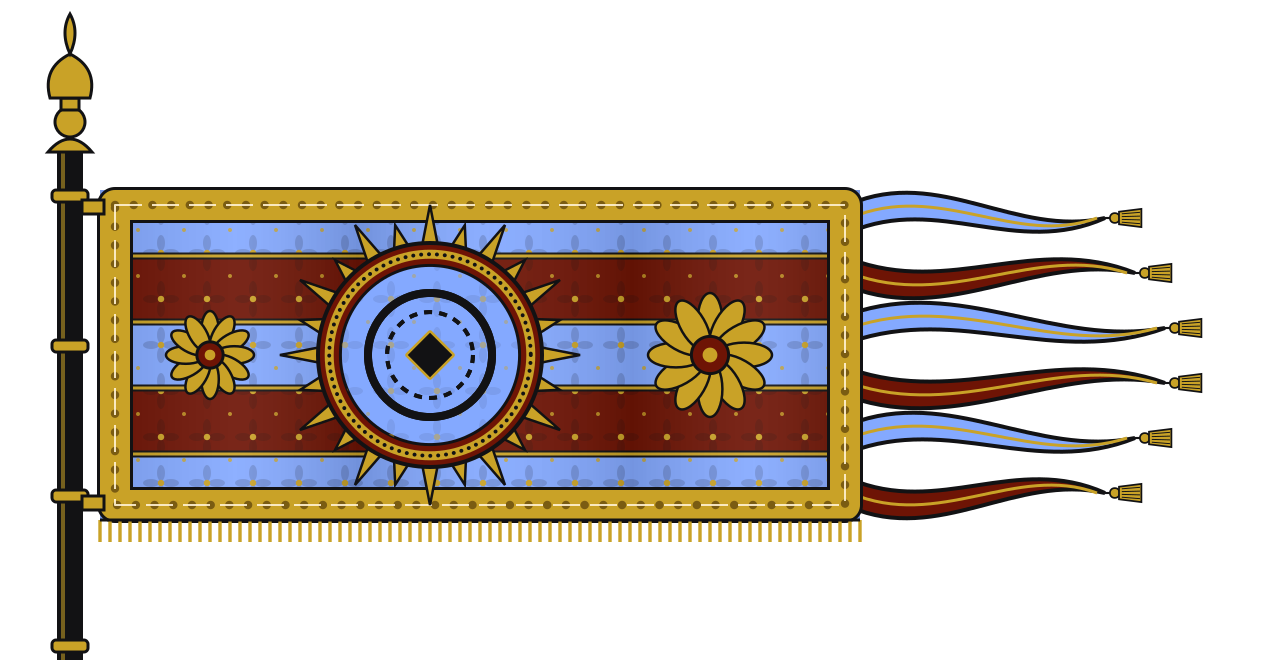
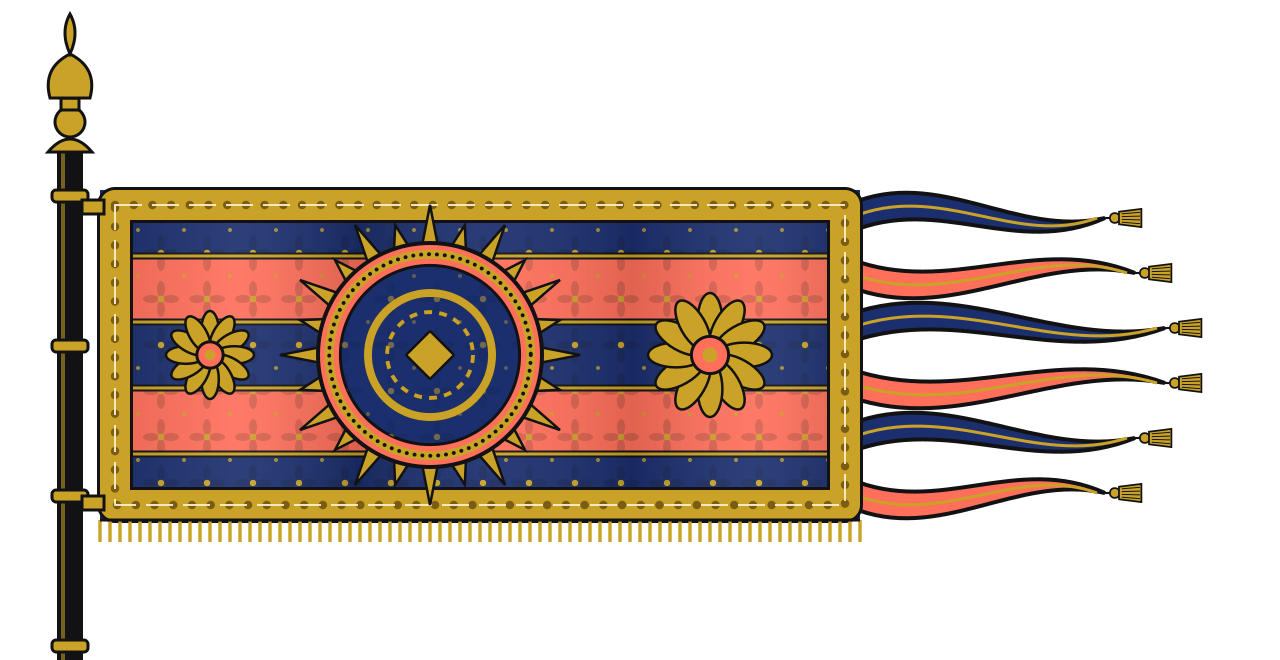
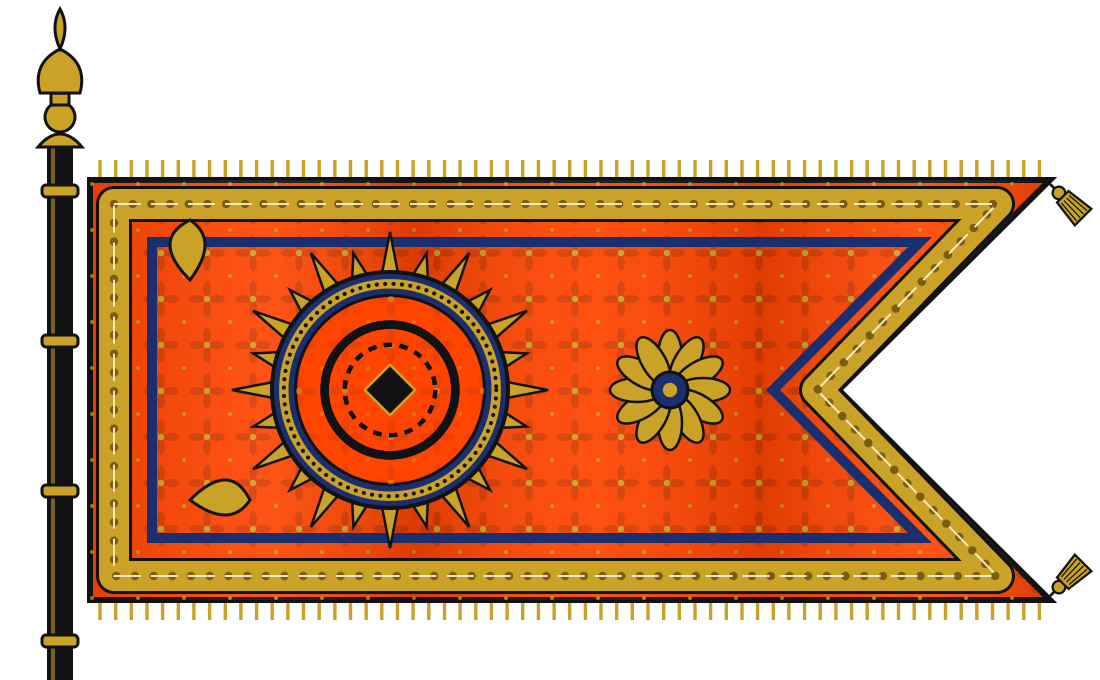
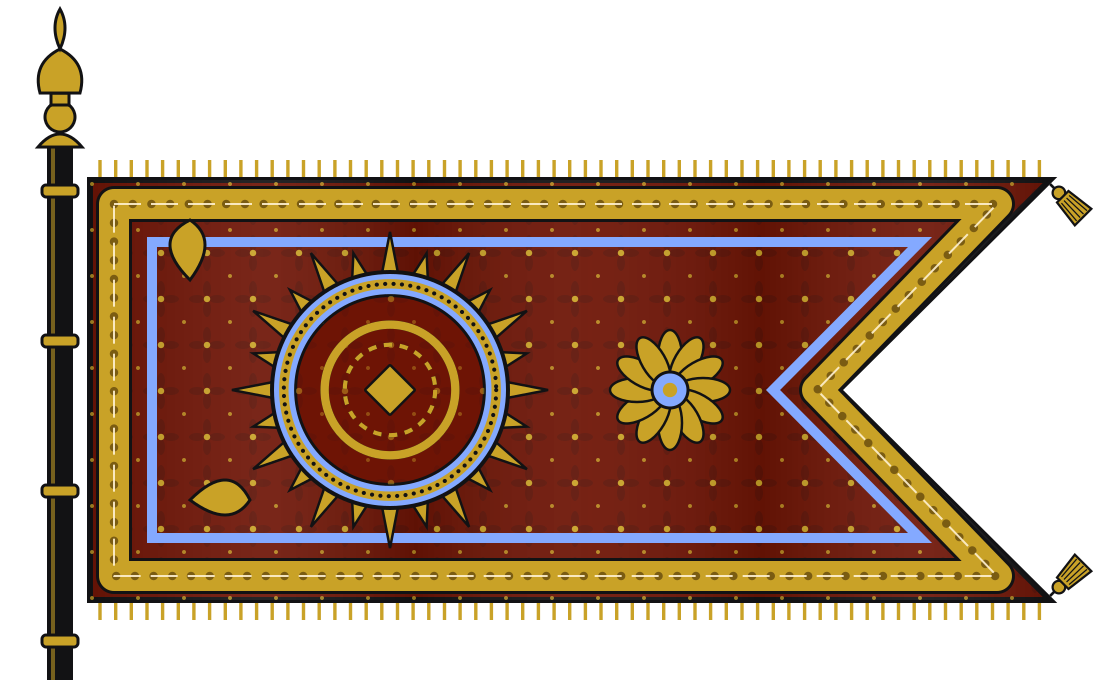
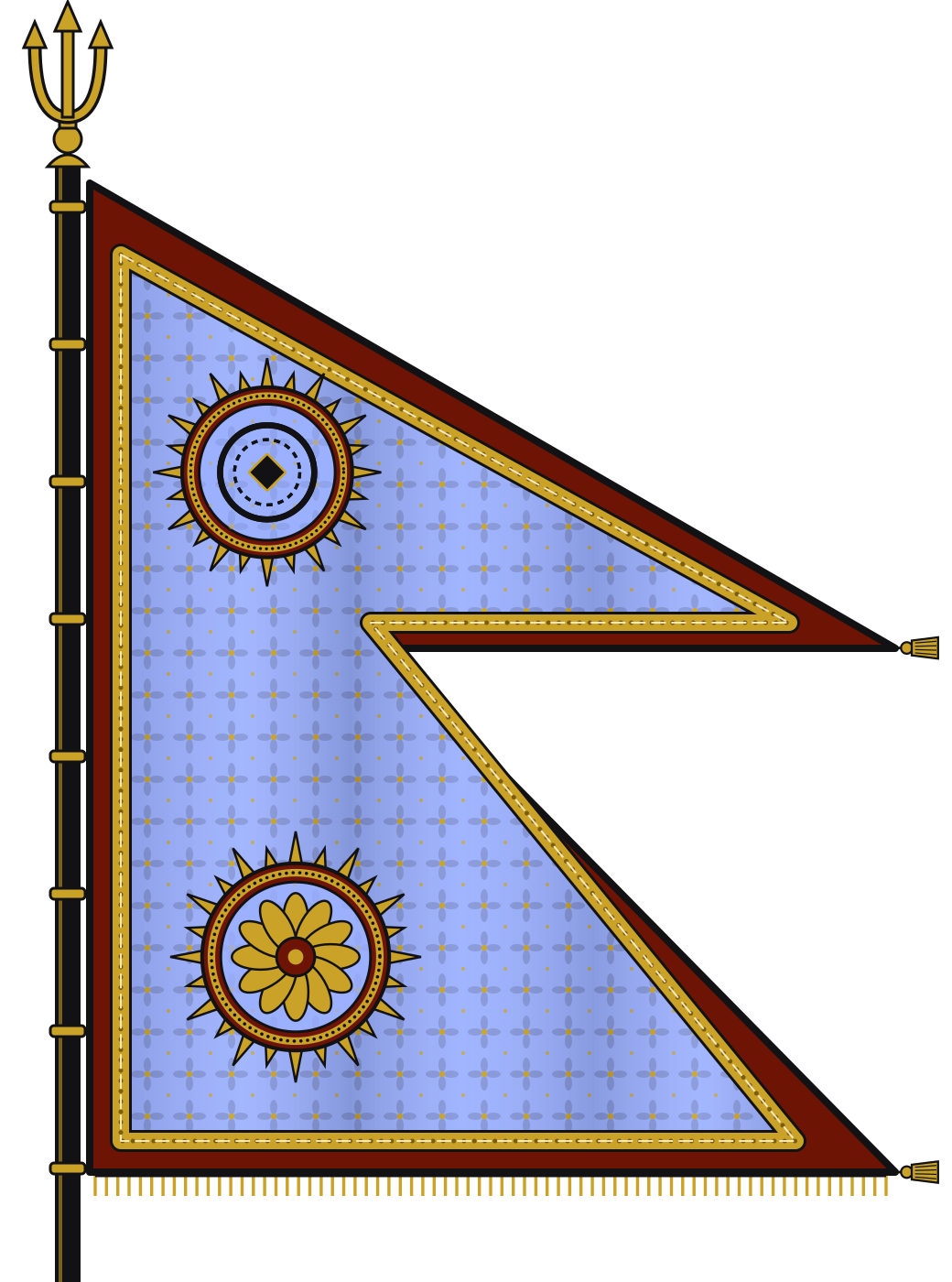
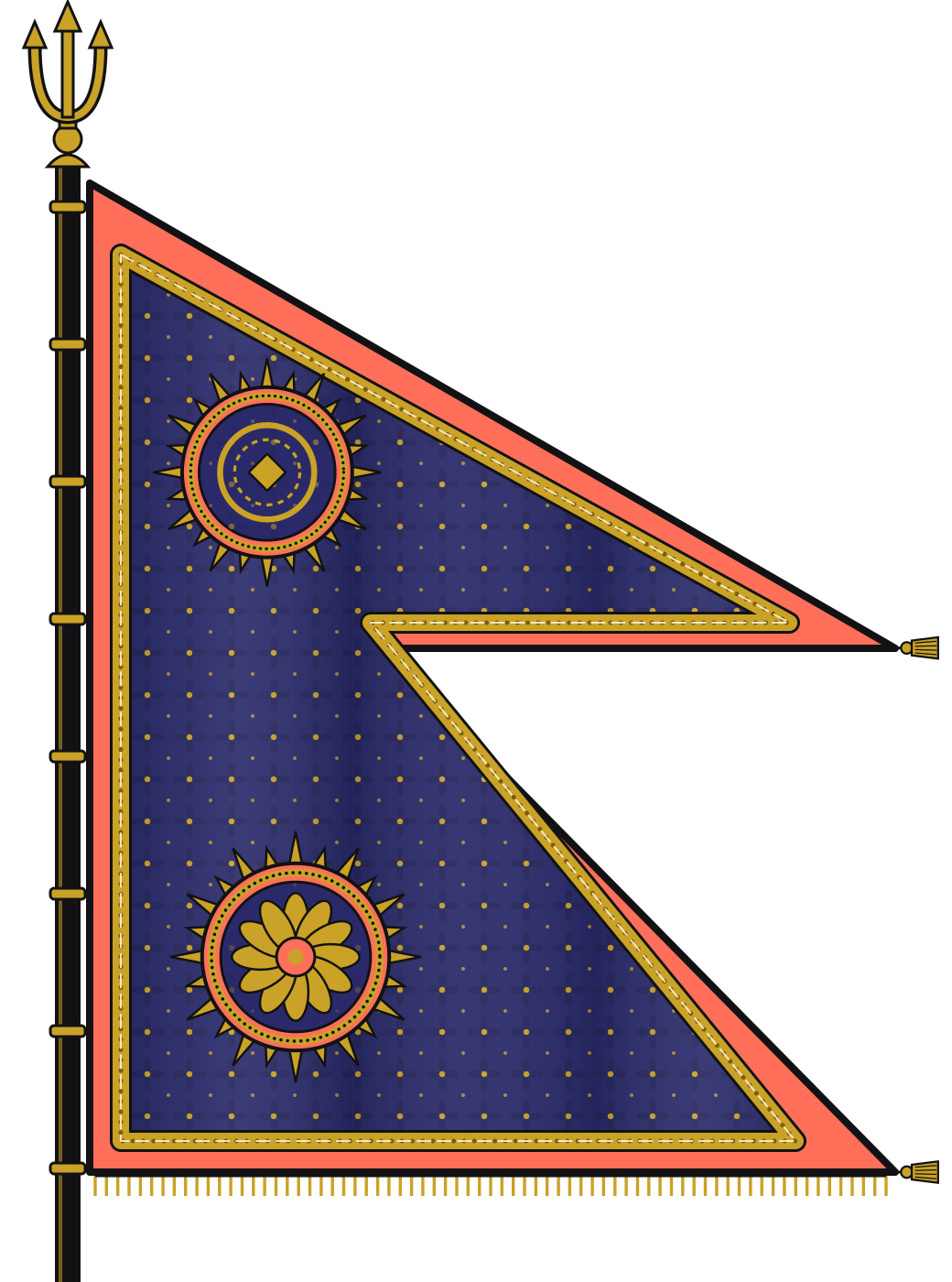

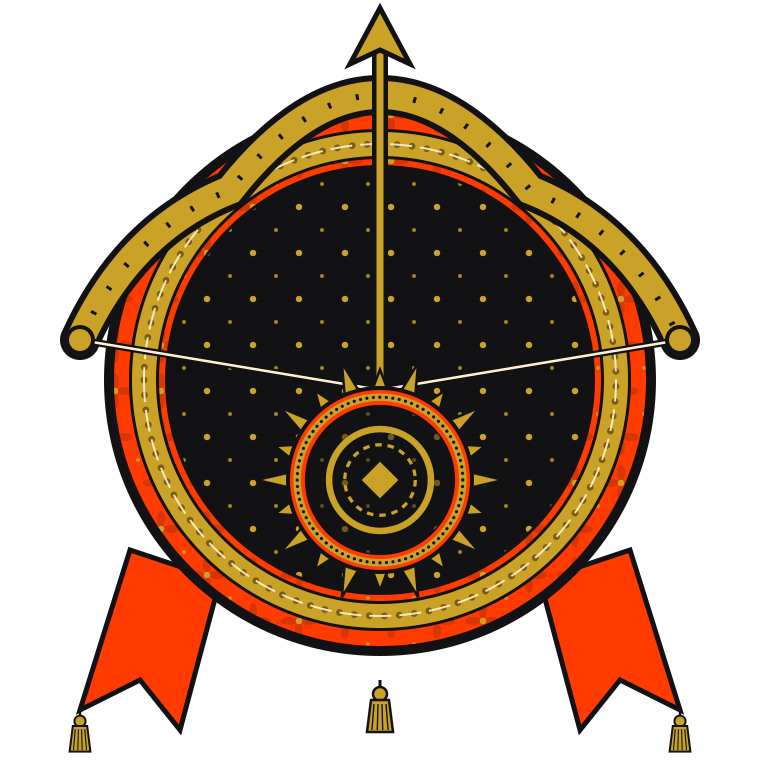
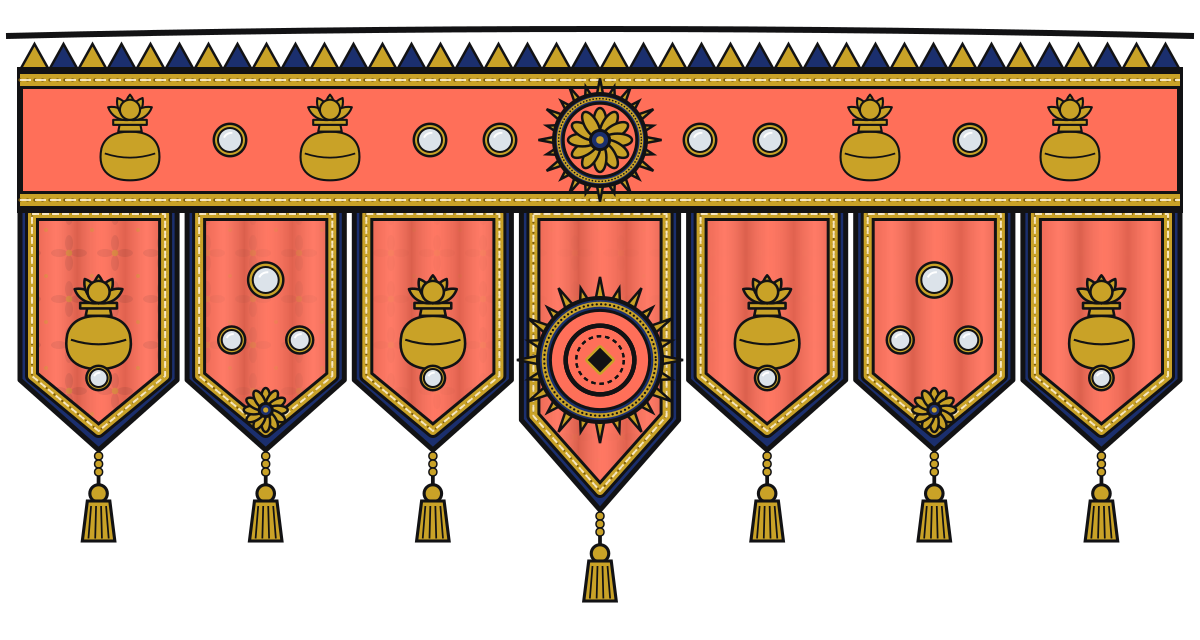

Historic banner
None recorded.
New flag types
| Accessory | For this clan | Basis |
|---|---|---|
| A9 Pota-dhvaja · ship and trade flag For ships, caravans and markets | Not yet designed for this clan | Design |
| A10 Utsava-patāka · festival flag Light, bright flag for fairs and festivals | Not yet designed for this clan | Design |
| A11 Shoka-dhvaja · mourning flag White cloth with the emblem outline in the clan's metal | Not yet designed for this clan | Design |
7. Regalia
| Accessory | For this clan | Basis |
|---|---|---|
| E1 Chhatra · house parasol The ceremonial umbrella | Not yet designed for this clan | Design |
| E2 Chamara · fly-whisks The pair of whisks beside the head of the house | Not yet designed for this clan | Design |
| E3 Danda · staff of office Staff or scepter | Not yet designed for this clan | Design |
| E4 Simhasana · seat The seat of the house, covered in clan cloth | Not yet designed for this clan | Design |
| E5 Khetaka · shield A round shield; the Changi and Dhanush are its flag forms | Not yet designed for this clan | Regional tradition |
| E6 Kula-ayudha · clan weapon The weapon the clan honours | Not yet found for this clan | Under research |
8. Worn
| Accessory | For this clan | Basis |
|---|---|---|
| F1 Kula-vastra · clan cloth The clan's woven pattern in its kit colours | Not yet designed for this clan | Design |
| F2 Kirti-vastra · honour cloth A cloth earned for a deed, not inherited | Not yet designed for this clan | Design |
| F3 Kula-mala · garland flower The flower or leaf the clan wears as a garland | Not yet found for this clan | Under research |
| F4 Chinha · house pin A metal badge with the pin emblem | Not yet designed for this clan | Design |
9. Records
| Accessory | For this clan | Basis |
|---|---|---|
| H1 Clan words A traditional line in the native script | भ्रष्ट-राज-प्रतिष्ठापक · “bhrashtarajapratisthapaka: restorer of fallen kings, the epithet of Rudradaman I in the Junagadh inscription” | Documented |
| H2 Biruda · titles The house's title or titles | Titles: Mahakshatrapa, Kshatrapa (heir), Rañō and Svami. The epithet in the native script is from the Junagadh inscription. भ्रष्ट-राज-प्रतिष्ठापक bhrashtarajapratisthapaka · “Restorer of fallen kings” | Documented |
| H3 Prashasti · praise genealogy The lineage as written at the head of a grant | The Junagadh inscription names Rudradaman's grandfather Chashtana and father Jayadaman, and praises him in lines 9–20 of the record | Documented |
| H4 Vahi · clan register The book of the clan's births, marriages and deaths | Not yet found for this clan | Under research |
| H5 Rana-ghosha · war cry The clan's cry in battle or celebration | Not yet found for this clan | Under research |
10. VishwaVit · knower of the world
Game values are design choices for this project, not historical claims.
References
- Western Satraps (Wikipedia, read 2026-10-09), citing E. J. Rapson, R. Salomon (1998), U. Singh (2008), D. C. Sircar and J. Cribb (2013).
- Wikipedia, Chashtana, read 2026-10-20, https://en.wikipedia.org/wiki/Chashtana
- Junagadh rock inscription of Rudradaman (Wikipedia, read 2026-10-09), citing F. Kielhorn (Epigraphia Indica VIII), R. Salomon, Indian Epigraphy (1998) and D. K. Chakrabarti (1999).
- P. Bhaskar Reddy, K. Muniratnam, Suchandra Ghosh, "Junagadh Inscription of Rudradaman", e-PG Pathshala (INFLIBNET) module, read 2026-10-10, PDF
- Wikipedia, Indo-Scythian Kingdom, read 2026-10-19, https://en.wikipedia.org/wiki/Indo-Scythian_Kingdom
- Bharat Discovery (Bharatkosh), रुद्रदामन, last edited 24 Apr 2018, read 2026-10-20, https://bharatdiscovery.org/india/रुद्रदामन
- Wikipedia, Nahapana, read 2026-10-19, https://en.wikipedia.org/wiki/Nahapana
- Wikipedia, Ushavadata, read 2026-10-19, https://en.wikipedia.org/wiki/Ushavadata
- Wikipedia, Legacy of the Indo-Greeks, read 2026-10-18, https://en.wikipedia.org/wiki/Legacy_of_the_Indo-Greeks
- Wikipedia, "Sudarshana Lake", read 2026-10-10, link (cites Britannica, Thapar 2004, Singh 2008/2016, Mitra 2005, Randhawa, Mahajan, Jayaswal 2001, Davis 2024)
- State Bank of Pakistan Museum, Western Kshatrapes, read 2026-10-20, https://www.sbp.org.pk/museum/western-kshatrapes
- Wikipedia, Northern Satraps, read 2026-10-19, https://en.wikipedia.org/wiki/Northern_Satraps