The Varli (Warli) are a tribe of the mountainous and coastal Maharashtra-Gujarat border, with Jawhar, Vikramgad, Mokhada, Dahanu and Talasari talukas in northern Palghar, and Valsad, Dangs, Navsari and Surat across the line[1]; Census 2011 counts 796,245 in Maharashtra and 328,194 in Gujarat[2][3], and in Gujarat most are in the Dharampur, Vansda and Umbergaon talukas of Valsad district[4]. The Atlas lists them as a Scheduled Tribe (Ministry list dated 09-07-2024). Their language, Varli, is Indo-Aryan and usually classed with Marathi[5]. They are best known for Warli painting, whose chowk of circles, triangles and squares was painted by women at weddings and harvests[1]. Under British rule from the 1870s they lost land and fell into forced labour, and between 1945 and 1947 they rose in a revolt led with the Parulekars that ended begar[1][6].
01Faith and deities
The mother goddess of fertility, painted in the Devchauk, per Wikipedia citing Tribhuwan & Finkenauer 2003[1]. The KulDevi, from the Atlas and not sourced here, is Mahalakshmi
Mahalakshmi of Dahanu, centre of the Varli fair
A recorded tie between the clan and the goddess.
| Deity or tradition | Place in the clan's life | Evidence |
|---|---|---|
| Palaghata | Mother goddess of fertility, painted in the Devchauk; male gods are unusual and often linked to spirits that took human form | [1] |
| Kansari Devi, Hirwa Dev, Naran Dev | Family deities; paddy in Kansari Devi's basket is changed at Diwali | [4] |
| Gamdev, Makherdev, Zungardev | Village deities | [4] |
| Mawli Devi, Hanumanji | Hindu-influenced deities | [4] |
| वाघ्या देव (Waghya dev) | The tiger; a stone smeared with शेंदूर is Waghya dev, worshipped on वाघबारसी | [8][9] |
| हिरवा, हिमाई, कन्सारी, नरानदेव, चेडोबा | Prayed to on बलिप्रतिपदा, with marigolds offered | [8] |
| Savari Devi group | Nature deities (Tangda, Gohra, Popta, Tumba, Ghunga Savari), each with its own tune; Vaghbaras is her festival | [7] |
| Gavdevi | Village goddess, first to receive new rice | [7] |
| The tarpa | Tarpa player Dhinda calls it his deity | [7] |
| Sanvari and Cheda | Beliefs recorded by INTACH | [9] |
| Animism with Hindu beliefs | Wikipedia: animism, many Hindu beliefs adopted by acculturation | [1] |
02Temples
No temple built or endowed by the Varli is sourced. A wooden tiger stands in the Gaondevi temple of a hamlet near Nimbavli[8].
Built by the clan
Not recorded.
Given patronage or grants by the clan
Not recorded.
03Languages and scripts
| Language or script | Kind | Under the clan | Evidence |
|---|---|---|---|
| Varli (Varali, Warali) living | Indo-Aryan, Southern Zone, Marathi-Konkani group; ISO 639-3 vav | Written in Devanagari and Gujarati; Wikipedia also calls it unwritten. About 390,000 native speakers (2011). Usually classed Marathi, sometimes Konkani or Bhil; Mahapatra (2002) places it under Bhili[5][1] | |
| Khandeshi Bhili and Marathi mix living | Dialect mix in Gujarat | TRTI describes the speech as a mix of Khandeshi Bhili and Marathi, with Gujarati and its script also used[4] |
04Books and literature
Studies about the Varli; no work in the Varli language is sourced.
Written during the clan's history
| Work | Author | Kind | When | Link to the clan |
|---|---|---|---|---|
| The Warlis | K.J. Save | Ethnography | 1945 | [5] |
| Warli of Thana (Survey of Marathi Dialects vol. 7) | A.M. Ghatage | Dialect survey | 1969 | [5] |
| Painted World of the Warlis | Dalmia | Art history | 1988 | [1] |
| The Warli Chawk | Dalmia | Art study | 1984 | [1] |
| Mythos and Logos of the Warlis | Dandekar | Study | 1998 | [1][10] |
| Warli Social History | Heredia and Dandekar | Study | 2000 | [1] |
| Adivasi Revolt: the story of Warli peasants in struggle | Godavari Parulekar (as cited) | Account of the revolt | As cited | [6] |
| Jewha Manus Jaga Hoto | Godavari Parulekar | Memoir | 1970 | [6] |
| Unique Art of Warli Paintings | Satyawadi | Art study | 2010 | [1] |
| The Dungri Warlis | Pandya | Study | 1986 | [1] |
Given patronage by the clan
Not recorded.
05Thinkers and scholars
| Name | Field | Era | Contribution |
|---|---|---|---|
| Godavari Parulekar | Writer and organiser | 20th century | Wrote on the revolt; first woman president of All India Kisan Sabha, 1986[6] |
Scholars of the Varli (Save, Ghatage, Dalmia, Pandya, Dandekar) are listed under Books.
06Art and architecture
Warli painting is the clan's popular identifier[1].
Painting and wall art
| Art form | What it is | Era | Evidence |
|---|---|---|---|
| Warli chowk | A visual vocabulary of the circle (sun, moon), triangle (mountains, trees) and square (chowk); bodies are two triangles joined at the tip. Devchauk and Lagnachauk are the ritual forms. Red-ochre ground (branches, earth, cow dung), white of rice paste, water and gum, applied with a chewed bamboo stick. Painted by women at weddings and harvests until the late 1970s | [1] | |
| Age claim | Wikipedia compares the art to the Bhimbetka rock shelters; Dalmia (1988) says 2500-3000 BCE, via Satyawadi (2010). This is a claim, not an established date | [1] | |
| Modern painting | Jivya Soma Mashe and Balu Mashe began painting for art, not ritual, in the 1970s. A Coca-Cola Diwali campaign used it in 2010 | [1] |
Sculpture and temple art
Not recorded.
Temple and building architecture
Not recorded.
Weaving and textiles
Not recorded.
Clothing and jewellery
Not recorded.
Coins, pottery and crafts
| Art form | What it is | Era | Evidence |
|---|---|---|---|
| Wall paintings, bamboo work, basketry | Household crafts in Gujarat | [4] | |
| Tarpa | Palm-leaf horn (aavaaz) with male and female bamboo pieces and a gourd; shown on an Indian postage stamp | [7] |
07History
Before the 1870s
Until the 1870s the Warlis were the primary landowners in the Umbergaon, Dhanu and Palghar talukas of Thane district[1]. The Gujarat tribal institute believes they moved from the Konkan into south Gujarat under British pressure, possibly Maratha expansion; the page gives no source for this[4].
From the 1870s: land lost, labour bonded
From the 1870s direct British control brought mahajans who took land by exploiting the Warlis' illiteracy. Begar (unpaid forced labour) and sharecropping, with more than half the crop surrendered, became usual, with public whippings and torture, and children were classed as 'Wattas' (Chattopadhyay 1996, via Wikipedia)[1]. A 1939 inquiry by magistrate David Symington found conditions of 'abysmal depth'[1].
The 1872 census, as printed in the Gazetteer of the Bombay Presidency: Thana (1882), counted 70,000 Varlis, the third largest of the early tribes after the Agris and Kolis[11].
1945-47: the Warli revolt
In January 1945 the Maharashtra Provincial Kisan Conference met at Titwala with 250 Warlis. In May about 5,000 Warlis gathered at Zari and pledged an end to begar and demanded wages[1]; Homegrown places the Zari meeting in Umbargaon (now Talasari) tehsil, mainly Adivasis from Dahanu and Talasari, with a demand of 12 annas a day, and names the later struggles against vethbigar (forced labour) and lagnagadi (marriage slavery)[12].
In October 1945 police fire at a rally of 7,000 at Talwada killed five, among them the leader Jethya Gangad. Begar was abolished and minimum wages were set; in 1946 Morarji Desai's emergency in Thane led to hundreds of arrests, and most feudal exploitation was gone by the early 1950s (Chattopadhyay 1996, via Wikipedia)[1]. The revolt is credited with laying groundwork for Communist influence in the region[12].
08Journey and migrations
Only one movement is recorded, and its source is unattributed.
| When | From | To | Why | Evidence |
|---|---|---|---|---|
| Before the 1870s or after (undated) | Konkan | South Gujarat | Under British pressure, possibly Maratha expansion; TRTI Gujarat states this as belief, unattributed | [4] |
| After the monsoon (present) | Palghar-Thane hamlets | Brick kilns, construction sites, quarries and sugar belts | Seasonal work migration described by PARI for a hamlet near Nimbavli | [8] |
09Seats and lands
| Place | Role | Where today |
|---|---|---|
| Jawhar, Vikramgad, Mokhada, Dahanu, Talasari | Core talukas, northern Palghar, Maharashtra | Palghar district[1] |
| Umbergaon, Dhanu, Palghar talukas | Primary landowners until the 1870s | Thane district (Maharashtra)[1]; Umbergaon taluka is also in Valsad district, Gujarat[4] |
| Dharampur, Vansda, Umbergaon | Largest numbers in Gujarat (Umbergaon the largest) | Valsad district, Gujarat[4] |
| Nashik, Dhule, Navapur | Smaller settlements | Maharashtra[1] |
| Dangs, Navsari, Surat | Settlements across the border | Gujarat[1] |
| Dadra and Nagar Haveli, Daman and Diu | Listed in Census 2001 tables cited by Wikipedia | Union territory[1] |
| Walvande village, Jawhar block | Home of tarpa player Bhiklya Ladkya Dhinda | Palghar[7] |
| Nashik, Thane and Dhule regions | Core areas, per Joshua Project (a missions database, not a census) | Maharashtra; some in Gujarat and the western union territories[13] |
10Notable figures
| Name | Role | Era | Known from |
|---|---|---|---|
| Jethya Gangad | Revolt leader, killed at Talwada | October 1945 | Known from[1] |
| Shamrao Parulekar | Co-led the resistance with Godavari | 1940s; died 1965 | Known from[1][6] |
| Godavari Parulekar | Led resistance from the early 1940s; author of Jewha Manus Jaga Hoto (1970); first woman president of All India Kisan Sabha, 1986 | 1940s-1980s | Known from[1][6] |
| Jivya Soma Mashe and Balu Mashe | Painters who began painting for art, not ritual, in the 1970s | 1970s on | Known from[1] |
| Bhiklya Ladkya Dhinda living | Tarpa player of Walvande; worked at the Maharaja of Jawhar's court; Sangeet Natak Akademi award 2022 | Aged 89 when PARI wrote | Known from[7] |
| Kandram Dehlyala legend | First Warli in the origin story | Legendary | Known from[7] |
11Allies, rivals and marriages
| People | Relationship | When |
|---|---|---|
| Maharaja of Jawhar's court | A Warli tarpa player, Dhinda, is said to have worked at the court[7]. The Atlas's 'subjects of the Koli kings of Jawhar' is unsourced and is kept in open questions | Undated |
| Landlords and mahajans | Exploitation by begar and sharecropping; target of the 1945-47 revolt[1] | 1870s-1940s |
| Communist Party and Kisan Sabha | Allies in the revolt; Thane district party moved to CPI(M) in 1964[1][6] | 1940s-1960s |
| Neighbouring peoples | Rajkoli, Kokna, Katkari, Thakur, Mhar and Chambhar are named; some groups refuse water touched by Warlis[7] | Present |
| Golak Brahmans | Serve as priests to Kunbis, Kolis, Varlis, Thakurs and Agris[11] | 1882 (gazetteer's account) |
| Audich households | Keep servants of the Dubla and Varli castes[11] | 1882 (gazetteer's account) |
12Society and livelihood
Traditionally semi-nomadic in small groups under a headman, and now mainly agriculturists[1].
Government and social order
| Institution or group | What it was | Evidence |
|---|---|---|
| Three divisions | Rusi or Davar, Kilwat or Murdey, Nehri; clans are exogamous within each; the coastal Davar are Pathar Warlis[4] | [4] |
| Ranks | Darvi highest, who claim descent from a Warli king; Kuor, Barat, Dobkia and Waghmaria lower, who served as soldiers (Mandal & Malhotra 1983) | [4] |
| Marriage | Mainly monogamous; polygyny if the wife is barren or insane; six types of marriage; cross-cousin marriage allowed; bride price (dej) about Rs 270 plus grain, pulses and oil | [4] |
| Headman and village | Small groups under a headman | [1] |
| Murde and Davar Varli | Sub-castes named in Wikipedia | [1] |
Livelihood over time
| Era | Livelihood | Evidence |
|---|---|---|
| 1870s-1940s | Land lost; begar and sharecropping under mahajans and landlords | [1] |
| Present (Gujarat) | Agriculture and casual labour, forest produce, charcoal, fishing; migration to Nasik, Valsad and Navsari | [4] |
| Present (Maharashtra) | Rice and wheat farming; after the monsoon work at brick kilns, construction, quarries and sugar belts | [1][8] |
13Sub-clans and related clans
TRTI Gujarat names three divisions, five ranks and 23 exogamous clans; Save (1945) counts about 200 clans and Pandya (1981) 104 gotras[4]. The lists come from Gujarat; the Maharashtra lists were not found. Sizes of individual clans are not given.
| Clan | Relation | Where | Size | In the Atlas | Evidence |
|---|---|---|---|---|---|
| Rusi or Davar | Branch | Gujarat; Davar of the coast are called Pathar Warlis | new clan candidate | [4] | |
| Kilwat or Murdey (Murde Varli) | Branch | Gujarat; also named in Wikipedia | new clan candidate | [4][1] | |
| Nehri | Branch | Gujarat | new clan candidate | [4] | |
| Darvi | Branch | Gujarat; highest rank, claim descent from a Warli king (Mandal & Malhotra 1983) | new clan candidate | [4] | |
| Kuor | Branch | Gujarat; lower rank, served as soldiers (Mandal & Malhotra 1983) | new clan candidate | [4] | |
| Barat | Branch | Gujarat; lower rank, served as soldiers (Mandal & Malhotra 1983) | new clan candidate | [4] | |
| Dobkia | Branch | Gujarat; lower rank, served as soldiers (Mandal & Malhotra 1983) | new clan candidate | [4] | |
| Waghmaria | Branch | Gujarat; lower rank, served as soldiers (Mandal & Malhotra 1983) | new clan candidate | [4] | |
| Mali | Sub-clan | Gujarat; exogamous clan named by TRTI Gujarat; the name is also used by other communities | same name as ST-197: check | [4] | |
| Bhavar | Sub-clan | Gujarat; exogamous clan named by TRTI Gujarat; the name is also used by other communities | new clan candidate | [4] | |
| Barad | Sub-clan | Gujarat; exogamous clan named by TRTI Gujarat | new clan candidate | [4] | |
| Janathiya | Sub-clan | Gujarat; exogamous clan named by TRTI Gujarat | new clan candidate | [4] | |
| Pawar | Sub-clan | Gujarat; exogamous clan named by TRTI Gujarat | new clan candidate | [4] | |
| Kachara | Sub-clan | Gujarat; exogamous clan named by TRTI Gujarat | new clan candidate | [4] | |
| Valavi | Sub-clan | Gujarat; exogamous clan named by TRTI Gujarat | new clan candidate | [4] | |
| Vasava | Sub-clan | Gujarat; exogamous clan named by TRTI Gujarat | same name as ST-514: check | [4] | |
| Vagh | Sub-clan | Gujarat; exogamous clan named by TRTI Gujarat | new clan candidate | [4] | |
| Sabar | Sub-clan | Gujarat; exogamous clan named by TRTI Gujarat | same name as ST-564: check | [4] | |
| Sambar | Sub-clan | Gujarat; exogamous clan named by TRTI Gujarat | new clan candidate | [4] | |
| Dhum | Sub-clan | Gujarat; exogamous clan named by TRTI Gujarat | new clan candidate | [4] | |
| Chauhan | Sub-clan | Gujarat; exogamous clan named by TRTI Gujarat | same name as SUB-109: check | [4] | |
| Rathod | Sub-clan | Gujarat; exogamous clan named by TRTI Gujarat | same name as ST-486: check | [4] | |
| Valma | Sub-clan | Gujarat; exogamous clan named by TRTI Gujarat | new clan candidate | [4] | |
| Khichari | Sub-clan | Gujarat; exogamous clan named by TRTI Gujarat | new clan candidate | [4] | |
| Tamadi | Sub-clan | Gujarat; exogamous clan named by TRTI Gujarat | new clan candidate | [4] | |
| Kharadia | Sub-clan | Gujarat; exogamous clan named by TRTI Gujarat | new clan candidate | [4] | |
| Kangari | Sub-clan | Gujarat; exogamous clan named by TRTI Gujarat | new clan candidate | [4] | |
| Tadavi | Sub-clan | Gujarat; exogamous clan named by TRTI Gujarat; the name is also used by other communities | new clan candidate | [4] | |
| Sapata | Sub-clan | Gujarat; exogamous clan named by TRTI Gujarat | new clan candidate | [4] | |
| Sonar | Sub-clan | Gujarat; exogamous clan named by TRTI Gujarat; the name is also used by other communities | new clan candidate | [4] | |
| Navad | Sub-clan | Gujarat; exogamous clan named by TRTI Gujarat | new clan candidate | [4] | |
| Khalho | Sub-clan | Gujarat; totem: fox (Pandya 1981, as cited by TRTI Gujarat) | same name as ST-446: check | [4] | |
| Murha | Sub-clan | Gujarat; totem: peacock (Pandya 1981, as cited by TRTI Gujarat) | same name as ST-519: check | [4] | |
| Ambar | Sub-clan | Gujarat; totem: mango tree (Pandya 1981, as cited by TRTI Gujarat) | same name as ST-433: check | [4] | |
| Dodka | Sub-clan | Gujarat; totem: turia vegetable (Pandya 1981, as cited by TRTI Gujarat) | same name as ST-385: check | [4] | |
| Naik-Patel | Sub-clan | Gujarat; named in the list of Pandya (1981) gotras | new clan candidate | [4] | |
| Gonali | Sub-clan | Gujarat; named in the list of Pandya (1981) gotras | new clan candidate | [4] | |
| Pachalkar | Sub-clan | Gujarat; named in the list of Pandya (1981) gotras | new clan candidate | [4] | |
| Dangarkar | Sub-clan | Gujarat; named in the list of Pandya (1981) gotras | new clan candidate | [4] | |
| Rajkoli | Related people | Palghar-Thane, Maharashtra; neighbouring people named by PARI | new clan candidate | [7] | |
| Kokna | Related people | Palghar-Thane, Maharashtra; neighbouring people named by PARI | same name as ST-140: check | [7] | |
| Katkari | Related people | Palghar-Thane, Maharashtra; neighbouring people named by PARI | new clan candidate | [7] | |
| Thakur | Related people | Palghar-Thane, Maharashtra; neighbouring people named by PARI | new clan candidate | [7] | |
| Mhar | Related people | Palghar-Thane, Maharashtra; neighbouring community named by PARI | new clan candidate | [7] | |
| Chambhar | Related people | Palghar-Thane, Maharashtra; neighbouring community named by PARI | same name as SUB-244: check | [7] | |
| Kolcha | Related people | Gujarat; TRTI places the Warli above Kolcha and below Dhodia, Kukna, Kunbi and Chaudhary in local rank | new clan candidate | [4] | |
| Dhodia | Related people | Gujarat; TRTI places the Warli above Kolcha and below Dhodia, Kukna, Kunbi and Chaudhary in local rank | same name as ST-067: check | [4] | |
| Kukna | Related people | Gujarat; TRTI places the Warli above Kolcha and below Dhodia, Kukna, Kunbi and Chaudhary in local rank | new clan candidate | [4] | |
| Kunbi | Related people | Gujarat; TRTI places the Warli above Kolcha and below Dhodia, Kukna, Kunbi and Chaudhary in local rank | same name as ST-165: check | [4] | |
| Chaudhary | Related people | Gujarat; TRTI places the Warli above Kolcha and below Dhodia, Kukna, Kunbi and Chaudhary in local rank | same name as ST-360: check | [4] | |
| Bhil | Related people | Grierson linked Warlis with Bhils; language sometimes classed Bhili | same name as ST-027: check | [5] | |
| Agri | Related people | Thana 1882: named with the Kolis as the two tribes larger than the Varlis in the 1872 count; the sheet's Agri entry (SUB-325, a Goa OBC caste) is not confirmed as the same group | same name as SUB-325: check | [11] | |
| Koli | Related people | Thana 1882: named with the Agris as the two tribes larger than the Varlis in the 1872 count; the sheet has several Koli entries, not matched | new clan candidate | [11] | |
| Dubla | Related people | Thana 1882: Audich households keep Dubla servants, as well as Varli; sheet also-known-as Talavia, Halpati | ST-074 | [11] | |
| Golak Brahmans | Related people | Thana 1882: priests to Kunbis, Kolis, Varlis, Thakurs and Agris | new clan candidate | [11] | |
| Chitrakathi | Related people | Thana 1882: Yadav and Jadav surnames found among them | new clan candidate | [11] |
Clans marked "new clan candidate" are not in the Atlas yet.
14Surnames
| Surname | Clan or sub-clan | Where | People with this surname | Also used by other communities |
|---|---|---|---|---|
| Yadav | Found among Varlis, Chitrakathis, Thakurs, Kathkaris and Mhars; the gazetteer calls them Rajput-origin surnames[11] | not yet counted | Yes | |
| Jadav | Found among Varlis, Chitrakathis, Thakurs, Kathkaris and Mhars; the gazetteer calls them Rajput-origin surnames[11] | not yet counted | Yes |
Counts are of everyone with the surname, from the cited source and year, not only members of this clan. A surname shared with other communities says nothing about any one person's origin.
15Songs and music
Dancing and singing mark festivals and weddings[4]. No song texts are reproduced here.
Tarpa music of Bhiklya Ladkya Dhinda living
Described by PARI; a rhyme naming Jawhar-block villages in the article is not reproduced[7]
Instruments and styles
| Instrument or style | What it is | Evidence |
|---|---|---|
| Tarpa | Palm-leaf horn with bamboo pieces and a gourd | [7] |
| Tar, bronze dish, drum, kahli | Festival and wedding instruments in Gujarat | [4] |
| Ghanghli | Played by Bhagats | [4] |
| Dances Shimga, Ranodi, Usalya, Ogalia | Dances recorded by INTACH | [9] |
16Poems, lullabies and children's rhymes
None recorded yet.
17Stories, legends and proverbs
Stories and legends
| Story | What happens | Told by | Evidence |
|---|---|---|---|
| Kandram Dehlyala, the first Warli legend | Expelled by his mother after eating curd and the buffalo's share, he settled at Walwandya | Told by tarpa player Dhinda | [7] |
| Savari Devi and Ram legend | Savari Devi is Shabari, who offered Ram her heart | Told by Dhinda | [7] |
| The plough legend | God gave the Warlis a plough when creating mankind, making them Kulambi (farmers) (Mandal & Malhotra 1983) | Recorded by TRTI Gujarat | [4] |
| Mahadev and Ganga Gouri | Folktale; text not seen | INTACH Dahanu documentation | [9] |
| The Crab and his wife | Folktale; text not seen | INTACH Dahanu documentation | [9] |
Proverbs and sayings
| Saying | Meaning | Evidence |
|---|---|---|
| मानल त्याचा देव, नाही त्याचा नाही (Belief makes the god) | A Marathi proverb quoted in the tarpa player's account; it is not shown to be Warli | [7] |
18Festivals and fairs
| Festival or fair | When | Where | What happens |
|---|---|---|---|
| Diwali: वाघबारसी, बारकी तिवली, मोठी तिवली, बलिप्रतिपदा | Four days (5-8 Nov in the year described) | Hamlet near Nimbavli, Thane district | Tiger worship on वाघबारसी; cattle decorated with गेरू and rice water; fire-jump (अग्नी पूजा) against sorcery; पानमोडी of new rice, cucumber and jaggery steamed in चाईची पाने; बोवाला lamp niche and चिरोती lamps; marigolds offered on बलिप्रतिपदा[8] |
| Vaghbaras | Savari Devi's festival | Palghar | The tarpa is carried to the hills[7] |
| Holi, Diwali, Diwaso, Akhatrij | Annual | Gujarat | Festivals listed by TRTI; marriages take place between Holi and Nagpanchami[4] |
19Food, dress and games
Food
| Item | What it is | Evidence |
|---|---|---|
| Panmodi (पानमोडी) | New rice, cucumber and jaggery steamed in leaves of the chai tree, at Diwali[8] | |
| Rice and wheat | Main crops[1] | |
| Offering foods | Chavla, karande and panmodi offered with marigolds[8] |
Dress
| Item | What it is | Evidence |
|---|---|---|
| Married women | Toe rings and necklaces[1] | |
| Marigolds | Worn in women's hair until the rains[8] |
Games and martial arts
| Item | What it is | Evidence |
|---|---|---|
| Fire-jump | Part of the Diwali fire rite against sorcery, not a game[8] |
Tags: living still practised · revived brought back after a break · lost known only from records · research reported but not yet confirmed from a source. Songs and poems under copyright are listed by title only; restricted or sacred material is noted without its content.
20Status today
The Varli are a Scheduled Tribe according to the Atlas (list dated 09-07-2024, not fetched here), with about 390,000 speakers of the language in 2011[5]. They farm and migrate for seasonal work; traditional knowledge is described as rapidly disappearing and the young prefer DJs to the tarpa[9][7].
Recognised heritage
| What | Recognition | Evidence |
|---|---|---|
| Warli painting | Popular identifier; used in a 2010 commercial campaign and shown on an Indian postage stamp (the tarpa)[1][7] | [1] |
| INTACH Dahanu documentation of the world of the Warli | Study begun in 2015 by INTACH Dahanu Chapter | [9] |
| Sangeet Natak Akademi award 2022 | To tarpa player Bhiklya Ladkya Dhinda | [7] |
Not yet reviewed by the community.
21For children
The painted circle
The Warli live in the hills and villages near the sea in western India. They grow rice and keep cattle. Women used to paint the walls of their houses at weddings and harvests, until the late 1970s. They paint circles for the sun and the moon, triangles for hills and trees, and squares for the sacred chowk. People are drawn as two triangles joined at the tip. People dance and sing at festivals and weddings, just like the dancers in the pictures.
Written for this project
Riddle: I am a circle on a Warli wall. Who am I, with my light for all? (The sun)
22Across the project
| Project | What carries this clan | Status |
|---|---|---|
| Atlas of the Janas | Not checked in this run | To check |
| KulDevi and GrahDevi | Mahalakshmi (basis: Documented; Mahalakshmi of Dahanu, centre of the Varli fair) | From the Atlas |
| Planet naming | Not checked against the Tier registers | To check |
| Renaming and waters | No place or water name drawn from the Varli yet | — |
23Open questions
- Who were the 'Koli kings of Jawhar' to whom the sheet says the Varli were subject, and what do gazetteers say of the relation? Source needed.
- Mahalakshmi of Dahanu and the Varli fair: documentation needed.
- Census 2011 Varli totals for Karnataka, Goa, Dadra and Nagar Haveli and Daman and Diu, and an all-India 2011 figure. The Varli rows exist in the table catalogues for Maharashtra, Dadra and Nagar Haveli and Daman and Diu, but the cached pages print no figures. Maharashtra (796,245) and Gujarat (328,194) are now sourced[2][3]. The Joshua Project figures are an estimate, not census[13]. Run 15 Nov 2026: NHSRC and census2011.co.in pages give all-tribes totals only, with no Varli figure.
- The Warli painting age: Wikipedia's Bhimbetka comparison and Dalmia's 2500-3000 BCE are not a settled date.
- Is the Konkan-to-Gujarat migration, which TRTI states without a source, supported by gazetteer evidence? Run 15 Nov 2026: the read part of Thana I (population chapter) states no migration.
- The two sources disagree on writing: Varli is 'written in Devanagari and Gujarati'[5] but 'unwritten'[1].
- The Atlas says the Varli were subjects of the Koli kings of Jawhar; no source found (only a tarpa player's work at the Maharaja of Jawhar's court, PARI)[7].
- Ministry list entry for the Varli (list dated 09-07-2024, including Goa and Karnataka) is from the Atlas and has not been fetched[14].
24Astitva
अस्तित्व · being, existence: everything by which the clan is known
No seal, coin or title is known. The living symbols are the tiger, the fox, peacock and mango totems, and the painted chowk[4][8].
Every clan has every accessory, royal objects included. Each one says how it is known: Documented This clan's own object is recorded. · Regional tradition Recorded for the region or for peoples like this one, not for this clan. · Design Made for this project, with no historical claim. · Under research To be found for this clan from sources. Legends and titles are written in the clan's own script.
1. Seals and coins
| Accessory | For this clan | Basis |
|---|---|---|
| B1 Rajamudra · house seal Round seal with the clan emblem and a short legend in the clan's script | Not yet designed for this clan | Design |
| B2 Anguliya-mudra · signet ring Personal seal ring of the head of the house | Not yet designed for this clan | Design |
| B3 Chhapa · house stamp Ink or block stamp for letters, goods and cloth | Not yet designed for this clan | Design |
| B4 Tamrapatra · charter plate Copper-plate grant on a ring, closed with the house seal | Not yet designed for this clan | Design |
| B5 Shreni-mudra · guild or trade seal Seal for the clan's trade, craft or caravan | Not yet designed for this clan | Design |
| C1 Clan coin Emblem or deity on one side, a legend in the clan's script | Not yet designed for this clan | Design |
| C2 Coin die The die that strikes the coin | Not yet designed for this clan | Design |
2. Living symbols
| Accessory | For this clan | Basis |
|---|---|---|
| I1 Totem trio The tree, bird and animal the clan protects | Ambar (mango tree) · Murha (peacock) · Khalho (fox) as gotra totems; the tiger (Waghya dev) is worshipped | Documented |
| I2 Kaval-maram · guardian tree The tree that stands at the clan's seat | Not yet found for this clan | Under research |
3. Stone and gate
| Accessory | For this clan | Basis |
|---|---|---|
| G1 Torana · gateway The built gate of the seat; the cloth Toran hangs in it | Not yet designed for this clan | Regional tradition |
| G2 Viragallu · hero stone Carved panel stone for a member who died defending the clan | Not yet designed for this clan | Regional tradition |
| G3 Kula-shila · clan stones Standing and table stones that remember the ancestors | Not yet designed for this clan | Design |
| G4 Jayastambha · victory pillar A pillar raised for a victory | Not yet designed for this clan | Design |
| G5 Sima-shila · boundary stone Marks the clan's land, with a line in the native script | Not yet designed for this clan | Design |
4. Sounds
| Accessory | For this clan | Basis |
|---|---|---|
| D1 Pancha-mahashabda · five great sounds The right to five instruments | Not yet designed for this clan | Design |
| D2 Shankha · clan conch The clan's own named war conch | Not yet designed for this clan | Design |
| D3 Murasu · house drums Three drums: war, charity and justice | Not yet designed for this clan | Design |
5. Kit: colours, metals and emblems
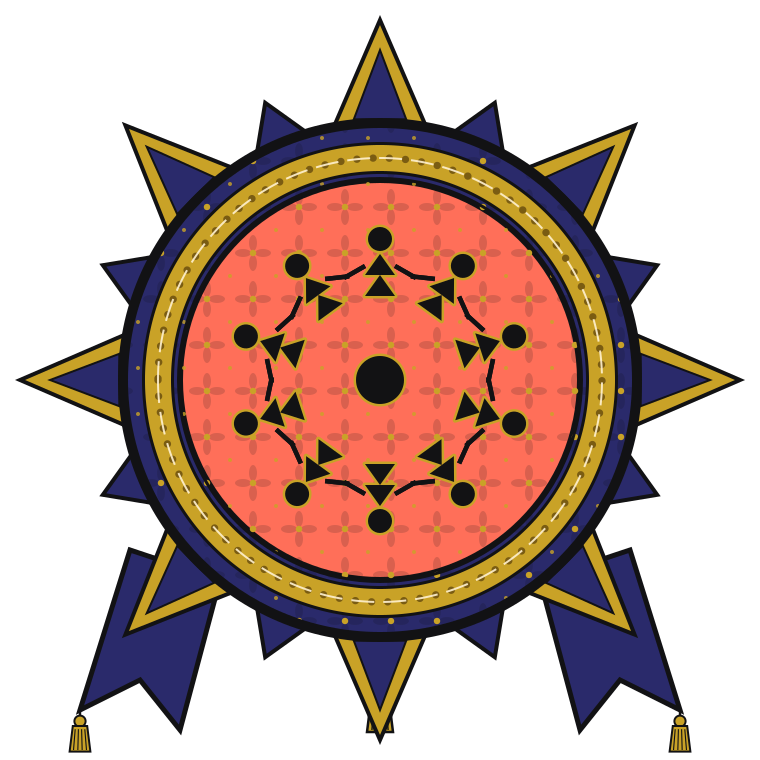
The sheet's emblem is the Warli painting itself, circles, triangles and squares, which Wikipedia describes as the art's visual vocabulary[1].
| Part of the kit | This clan |
|---|---|
| Field | Warm Red-Orange #FF6F59 |
| Accent | Deep Indigo #2A2A6B |
| Emblem colour | Charcoal Black #121214 |
| Zari metal | Gold |
| Main emblem | A Warli painting of stick figures in a circle |
| Second image | — |
| Night and day | Every visual accessory has two versions: by night the emblem on the dark field, by day the clan's field colour on cloth woven from its metal. |
6. Flags
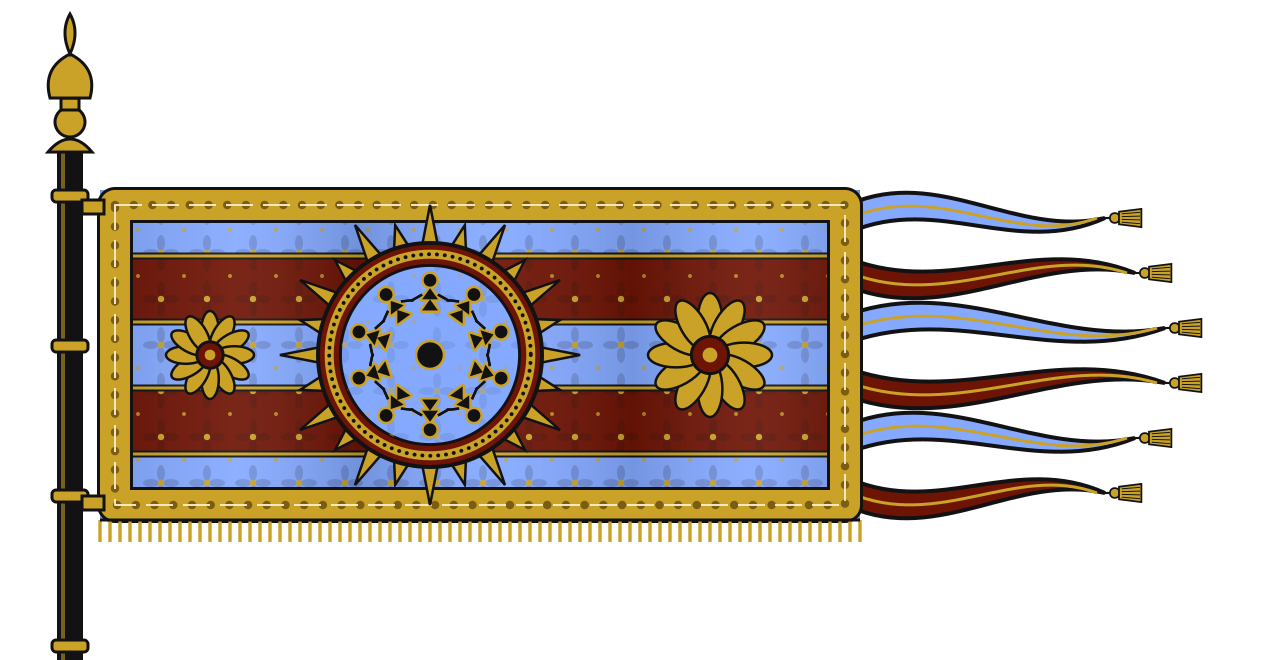
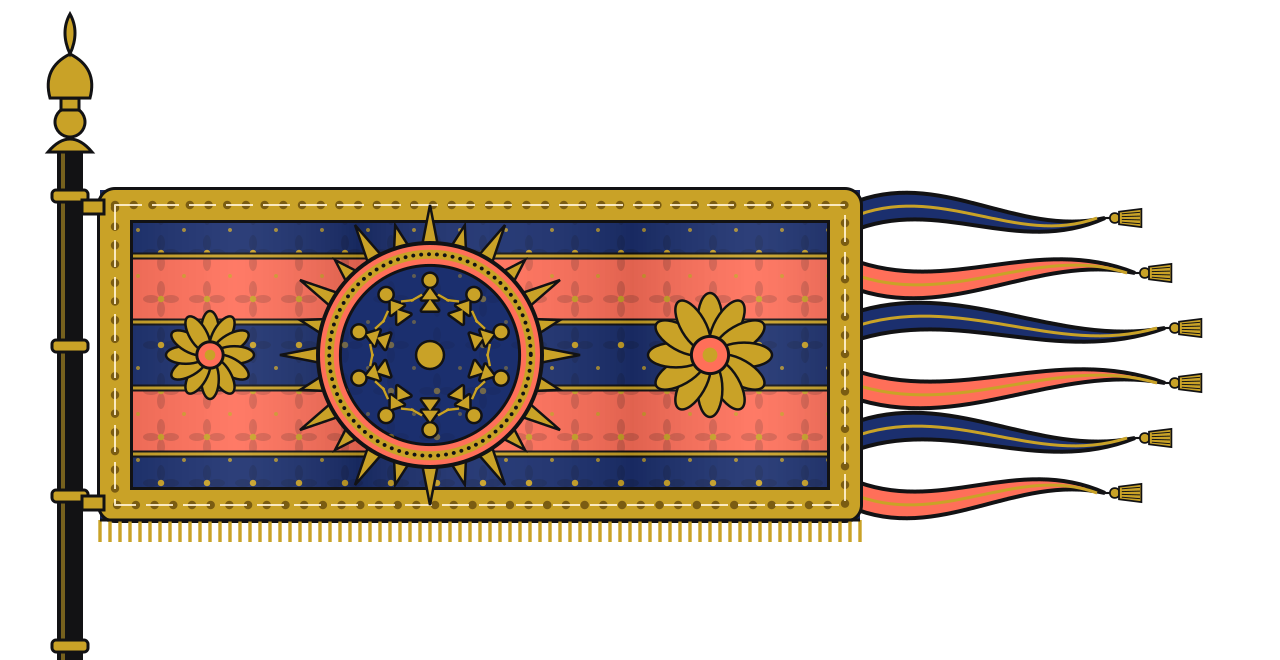
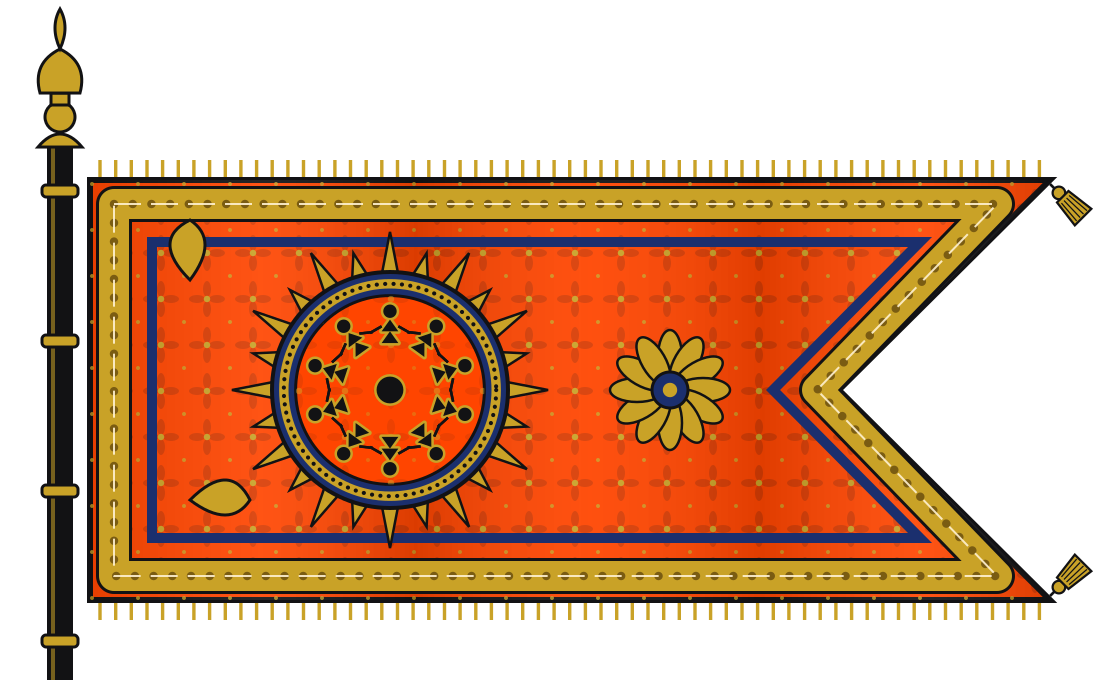
Every clan has every flag type; the type says the occasion and the colours say the clan. The outlined card is the flag the Atlas assigns.
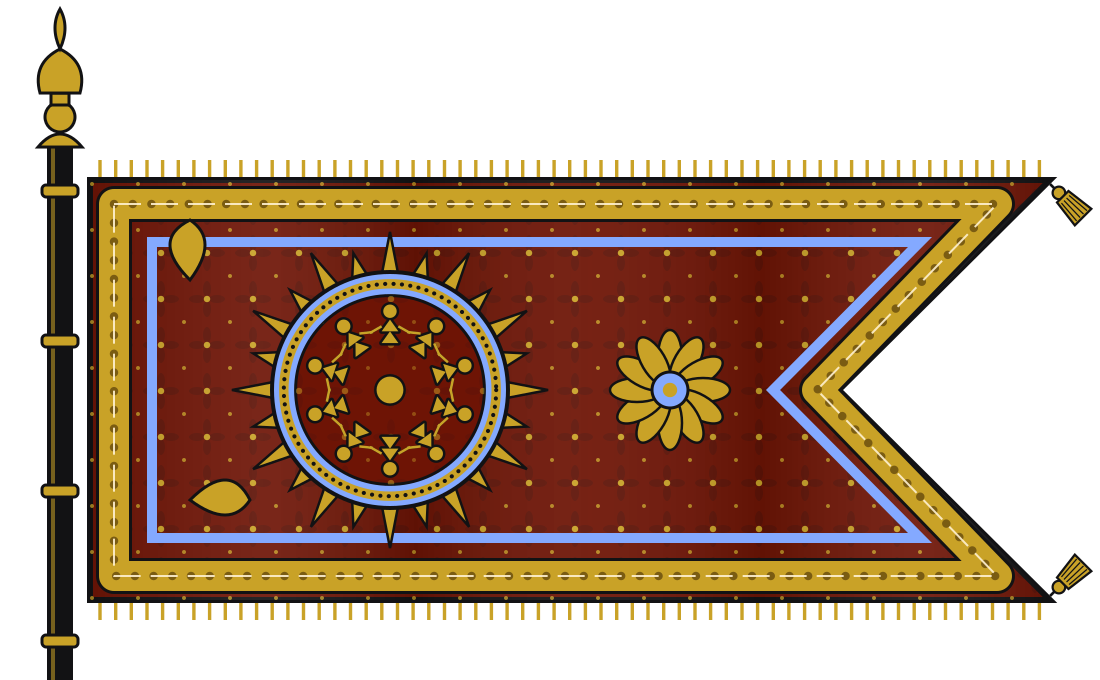
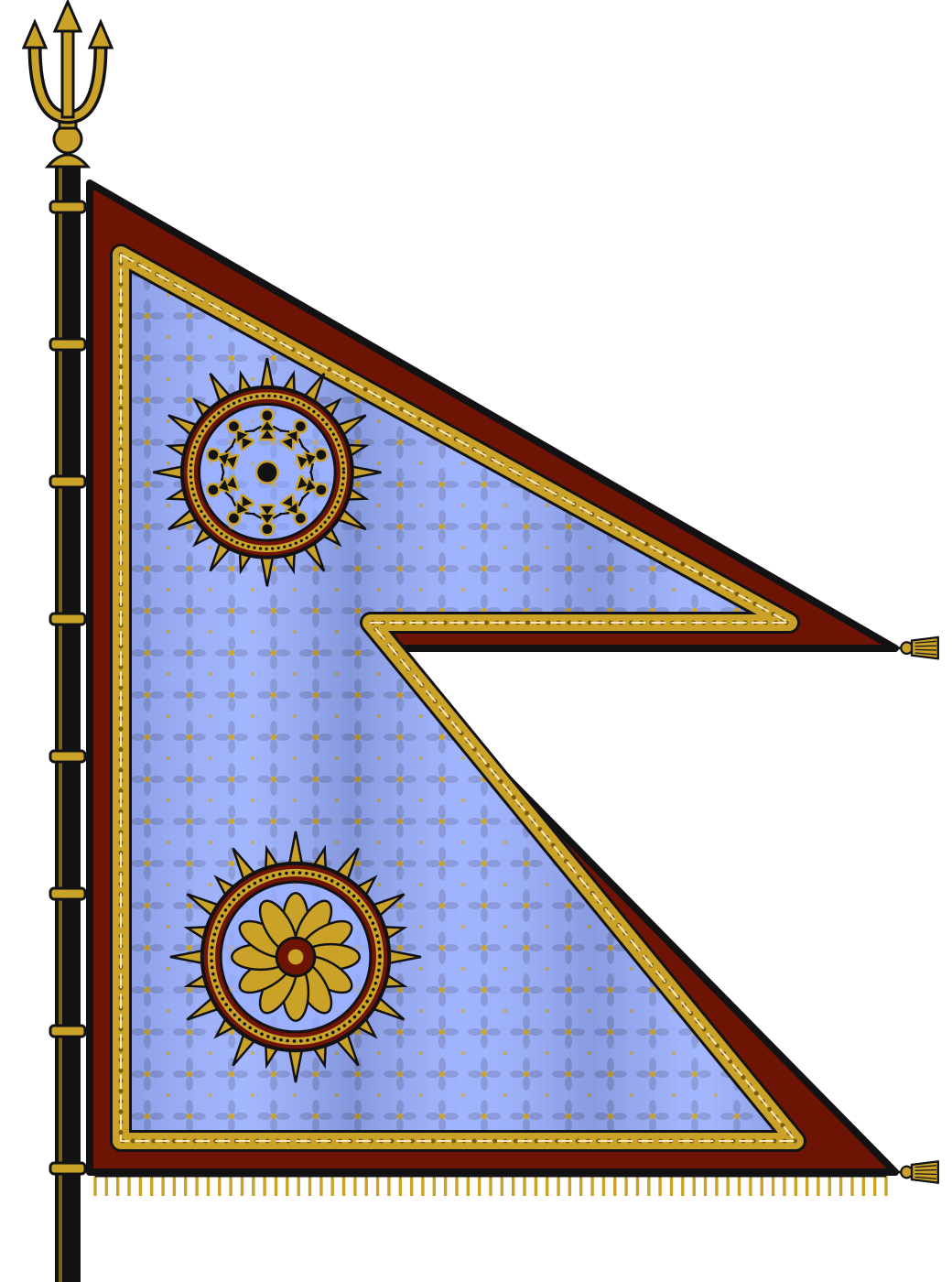
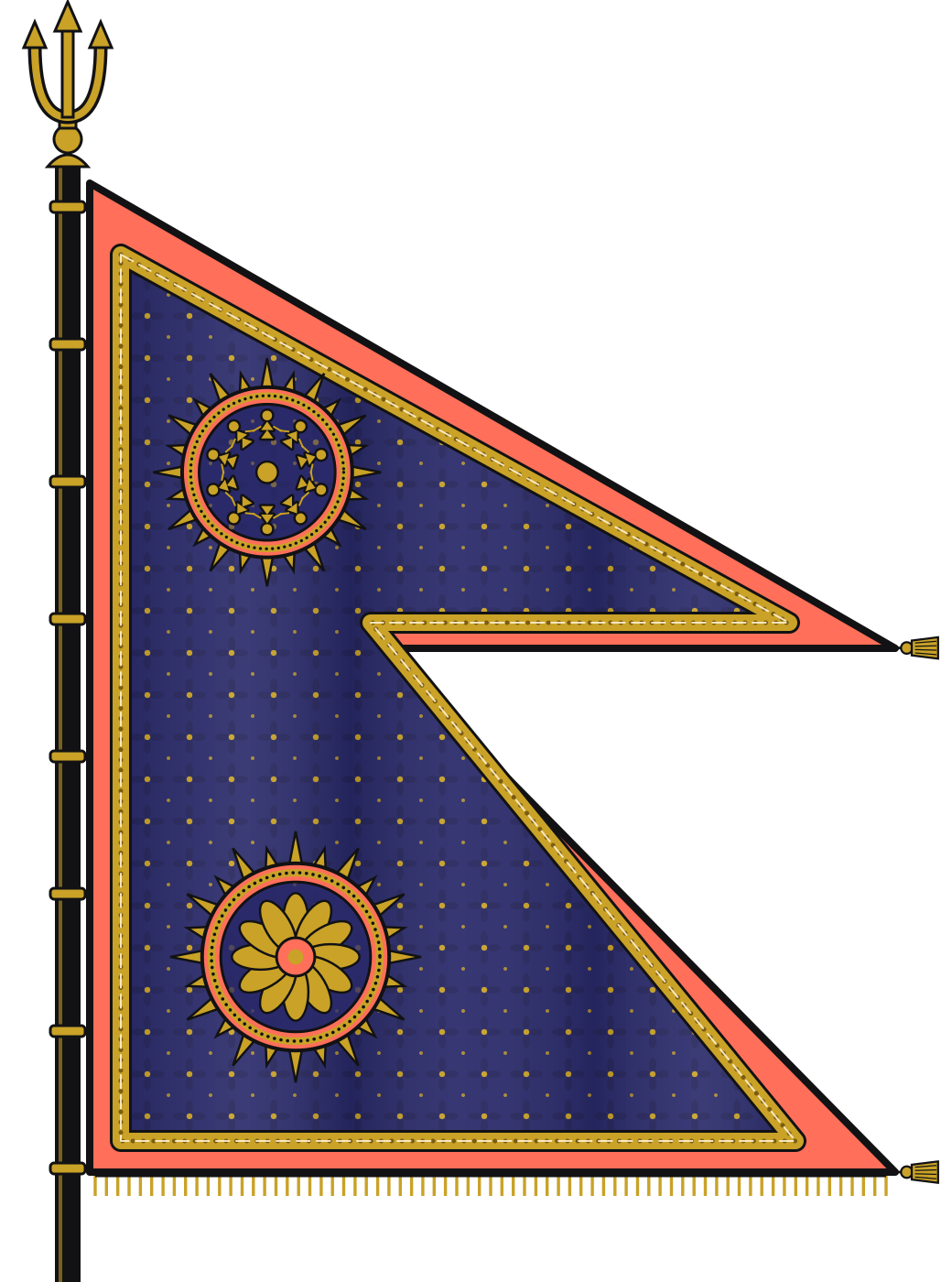
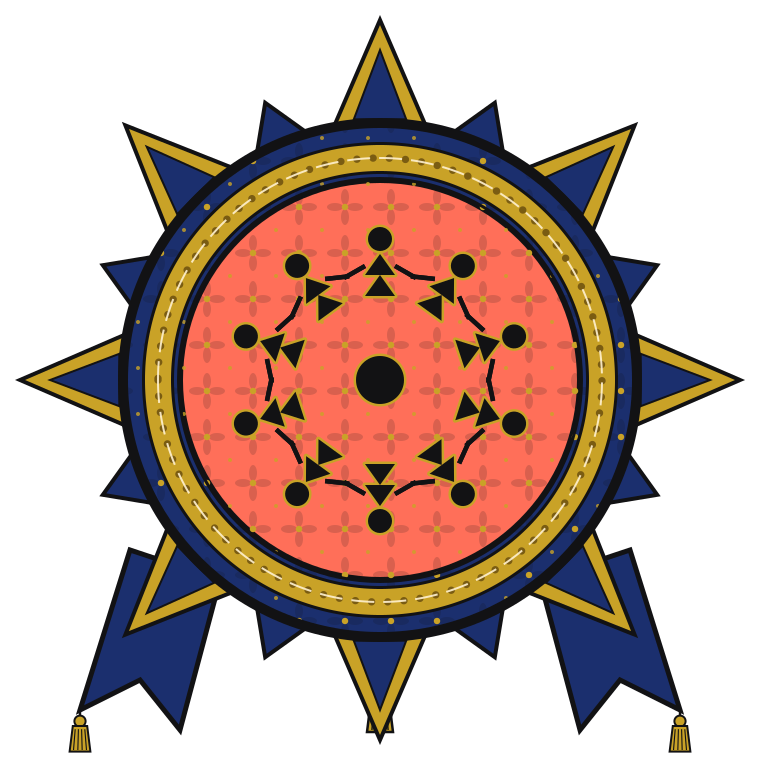
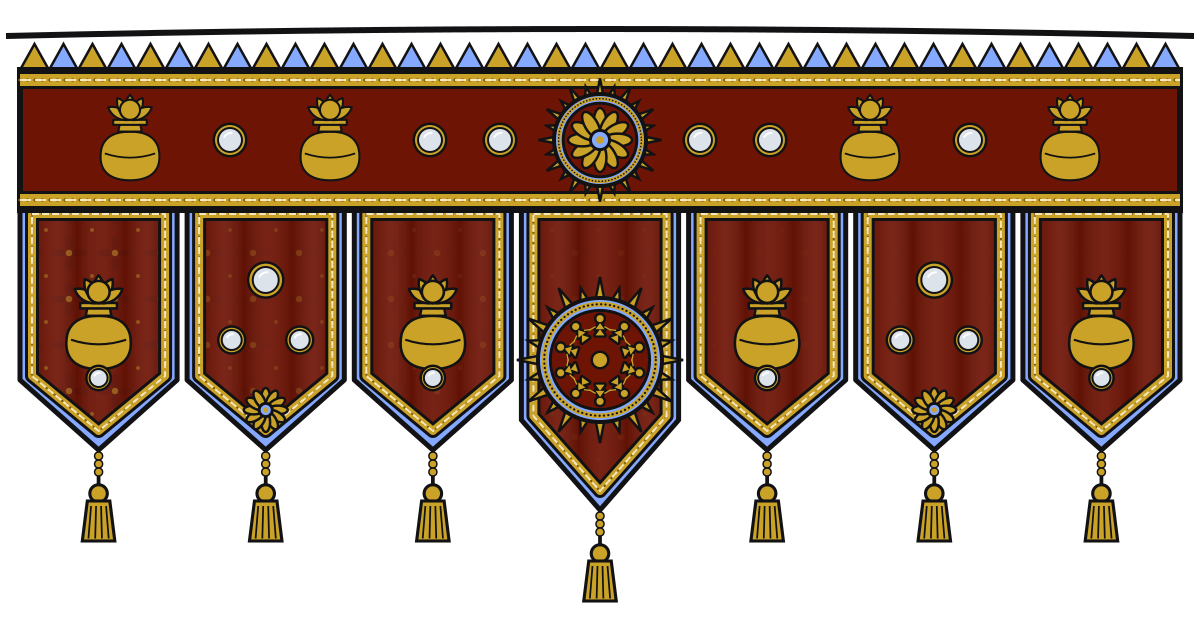
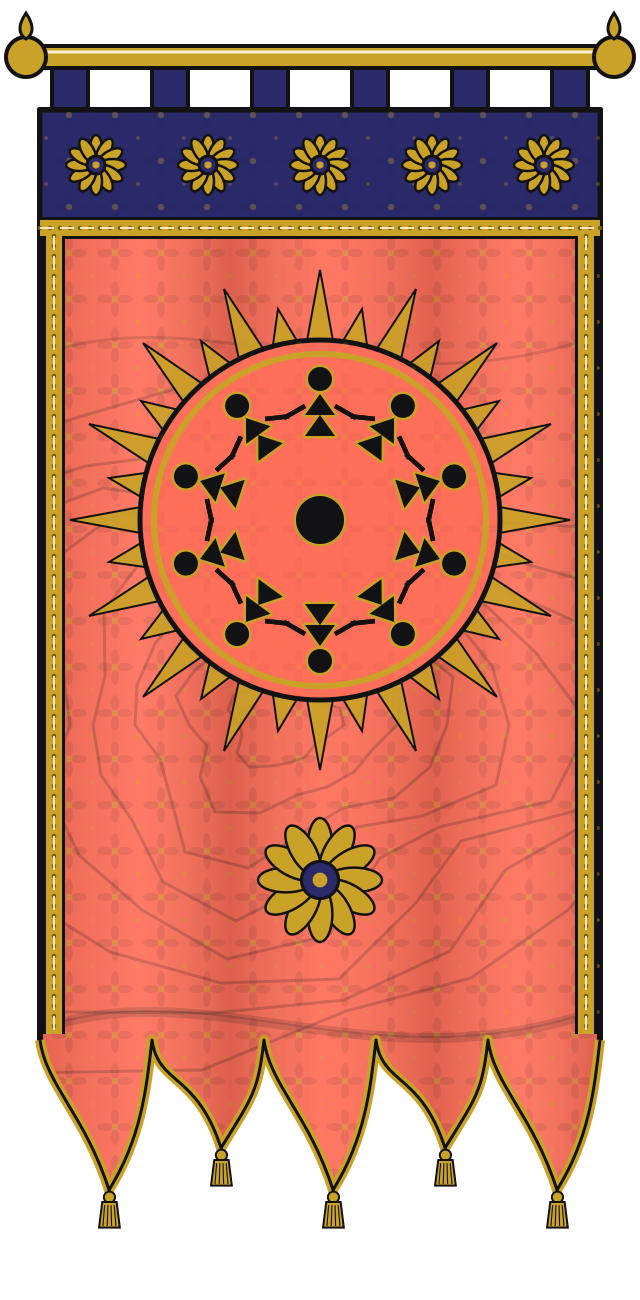
Historic banner
None known
New flag types
| Accessory | For this clan | Basis |
|---|---|---|
| A9 Pota-dhvaja · ship and trade flag For ships, caravans and markets | Not yet designed for this clan | Design |
| A10 Utsava-patāka · festival flag Light, bright flag for fairs and festivals | Not yet designed for this clan | Design |
| A11 Shoka-dhvaja · mourning flag White cloth with the emblem outline in the clan's metal | Not yet designed for this clan | Design |
7. Regalia
| Accessory | For this clan | Basis |
|---|---|---|
| E1 Chhatra · house parasol The ceremonial umbrella | Not yet designed for this clan | Design |
| E2 Chamara · fly-whisks The pair of whisks beside the head of the house | Not yet designed for this clan | Design |
| E3 Danda · staff of office Staff or scepter | Not yet designed for this clan | Design |
| E4 Simhasana · seat The seat of the house, covered in clan cloth | Not yet designed for this clan | Design |
| E5 Khetaka · shield A round shield; the Changi and Dhanush are its flag forms | Not yet designed for this clan | Regional tradition |
| E6 Kula-ayudha · clan weapon The weapon the clan honours | Not yet found for this clan | Under research |
8. Worn
| Accessory | For this clan | Basis |
|---|---|---|
| F1 Kula-vastra · clan cloth The clan's woven pattern in its kit colours | Not yet designed for this clan | Design |
| F2 Kirti-vastra · honour cloth A cloth earned for a deed, not inherited | Not yet designed for this clan | Design |
| F3 Kula-mala · garland flower The flower or leaf the clan wears as a garland | Not yet found for this clan | Under research |
| F4 Chinha · house pin A metal badge with the pin emblem | Not yet designed for this clan | Design |
9. Records
| Accessory | For this clan | Basis |
|---|---|---|
| H1 Clan words A traditional line in the native script | मानल त्याचा देव, नाही त्याचा नाही · “Belief makes the god (Marathi proverb quoted in a Warli tarpa player's account).” A Marathi proverb quoted by PARI; not a Warli motto[7] | Design |
| H2 Biruda · titles The house's title or titles | Not yet found for this clan | Under research |
| H3 Prashasti · praise genealogy The lineage as written at the head of a grant | Not yet found for this clan | Under research |
| H4 Vahi · clan register The book of the clan's births, marriages and deaths | Not yet found for this clan | Under research |
| H5 Rana-ghosha · war cry The clan's cry in battle or celebration | Not yet found for this clan | Under research |
10. VishwaVit · knower of the world
Game values are design choices for this project, not historical claims.
References
- Wikipedia, Warli people, read 2026-10-10, https://en.wikipedia.org/wiki/Warli_people
- dhammabharat.com, List of Scheduled Tribes in Maharashtra and Population of each Tribe (2011 Census), read 2026-10-10, https://dhammabharat.com/?p=13656
- Wikipedia, List of Scheduled Tribes in Gujarat (2011 Census table), read 2026-10-18, https://en.wikipedia.org/wiki/List_of_Scheduled_Tribes_in_Gujarat
- Tribal Research & Training Institute Gujarat, Brief Details of Warli, read 2026-10-10, https://trti.gujarat.gov.in/warli
- Wikipedia, Varli language, read 2026-10-10, https://en.wikipedia.org/wiki/Varli_language
- Wikipedia, Godavari Parulekar, read 2026-10-10, https://en.wikipedia.org/wiki/Godavari_Parulekar
- PARI (People's Archive of Rural India), My tarpa is my deity, read 2026-10-10, https://ruralindiaonline.org/article/my-tarpa-is-my-deity-bho
- Mamta Pared, वारली पाड्यावरची अलिकडची दिवाळी (Marathi), PARI, 17 Apr 2019, read 2026-10-10, https://ruralindiaonline.org/article/वारली-पाड्यावरची-अलिकडची-दिवाळी?locale=mr
- INTACH Archive, Documentation of the World of the Warli, Dahanu, Maharashtra, read 2026-10-10, https://icharchive.intach.org/Detail/collections/199
- HGCosmos, Warlis (bibliography entry, updated 2017), read 2026-10-19, https://www.hgcosmos.org/assets/culture/AZ/W/Warlis.pdf
- Gazetteer of the Bombay Presidency, Thana (1882), NVLI watermarked PDF, part I (population chapter, characters 200000-300000 read), read 2026-11-15, https://ocrdigitalfile.nvli.in/gazetteerrepository/262/Watermarked-Thana-I.pdf
- Vaaswat Sarkar, How the Warli Adivasi Revolt of 1945 shaped the legacy of indigenous movements in India, Homegrown, 17 May 2024, https://homegrown.co.in/homegrown-voices/how-the-warli-adivasi-revolt-of-1945-shaped-the-legacy-of-indigenous-movements-in-india
- Joshua Project, Varli in India (missions-database estimate, not census), read 2026-10-27, https://www.joshuaproject.net/index.php/people_groups/18299/IN
- Ministry of Tribal Affairs, State/UT-wise list of Scheduled Tribes, list dated 09-07-2024 (from sheet; not fetched)
- NHSRC, Demographic Status of Scheduled Tribe Population (Census 2001 table, p. 7), read 2026-10-19, https://www.nhsrcindia.org/sites/default/files/2021-05/Demographic%20Status%20of%20Scheduled%20Tribe%20Population%20-%20NHSRC.pdf
- census2011.co.in, Scheduled Tribe Population in India (all tribes, not Varli), read 2026-11-15, https://www.census2011.co.in/scheduled-tribes.php
- ORGI Census 2011, table PC11_A11 (Scheduled Tribes), Maharashtra, catalogue page, read 2026-10-27, https://new.census.gov.in/nada/index.php/catalog/6998
- ORGI Census 2011, table PC11_A11a (Scheduled Tribes, Primary Census Abstract), Dadra and Nagar Haveli, catalogue page, read 2026-10-27, https://new.census.gov.in/nada/index.php/catalog/7027
- ORGI, Census 2011 Table A-11 Appendix, Dadra & Nagar Haveli, read 3 Nov 2026, https://censusindia.gov.in/nada/index.php/catalog/43025
- ORGI, Census 2011 Table PC11_ST14, Dadra & Nagar Haveli, read 3 Nov 2026, https://new.census.gov.in/nada/index.php/catalog/12367
- ORGI, Census 2011 Table PC11_A11a, Daman & Diu, read 3 Nov 2026, https://new.census.gov.in/nada/index.php/catalog/7026