Banavasi, in Sirsi taluk of Uttara Kannada, is one of the oldest towns in Karnataka, and the Mahabharata calls it Vanavasaka[1][2]. The Kadamba kings made it their capital: Mayurasharma established the kingdom there in 345 CE, and it ruled northern Karnataka and the Konkan until about 540 CE[1][3]. The Atlas links the Vanavasis to this forest capital and to the Kadamba kingdom, and the early sources the Kadamba article cites are the Talagunda, Halmidi and Gudnapur inscriptions[3]. The Talagunda lion balustrade inscription, dated 370 CE and bilingual in Sanskrit and Kannada, is possibly the oldest Kannada inscription, and the dynasty was the first indigenous one to use Kannada administratively[3]. Scholars still differ on whether the Kadambas were Brahmin, tribal, or members of the Kadambu tribe, and no living community is named in the sources[3].
01Faith and deities
Early Kadamba inscriptions open with an invocation to Shiva[3], and the Madhukeshwara temple at Banavasi is a Shiva shrine[4]. These are the Kadamba rulers' own gods; the sources name no deity for the Vanavasis as a people. The Atlas's KulDevi is listed below.
Marikamba of Sirsi, beside Banavasi[5]
The presiding goddess of the clan's homeland or capital: a link of place, not a recorded clan tie.
| Deity or tradition | Place in the clan's life | Evidence |
|---|---|---|
| Shiva | Invoked at the head of early Kadamba inscriptions; Madhukeshwara at Banavasi | [3][4] |
| Mahadeva (Praneshvara) | Talagunda temple, linked to the earliest Kadamba architecture | [3] |
| Skanda legend | Six-faced god of war; anointed Mayurasharma (Talagunda inscription, per Mann 2011) | [3] |
| Jinendra (Jain) | Opening invocation of Kakusthavarma's copper-plate grant; Jain patronage was strong | [3] |
| Uma Devi, Shantalakshmi, Narasimha | Images at the Madhukeshwara temple | [2] |
| Marikamba (Durga) | KulDevi; the shrine is the Sirsi Marikamba temple, 24 km from Banavasi (sheet) | [5][1] |
02Temples
The Kadamba kings built and patronised these temples. The Atlas links the Vanavasis to their kingdom; that link is the sheet's, not the temples' own record. Dates are disputed where marked.
Built by the clan
| Temple | Deity | Built by | When | Where |
|---|---|---|---|---|
| Madhukeshwara temple | Shiva (Madhukeshwara) | Kadamba dynasty, per the temple page | Disputed: 2nd century (temple page) or 5th century (town page) | Banavasi[4][1] |
| Talagunda Mahadeva temple (Praneshvara) | Mahadeva (Praneshvara) | Linked to the earliest Kadamba architecture, per Adiga | Not dated | Talagunda[3] |
| Jain temple at Palasika | Jain (deity not named) | Mrigeshavarma | c. 475 CE | Palasika, Halasi[3] |
Given patronage or grants by the clan
| Temple | Deity | What the clan gave | When | Where |
|---|---|---|---|---|
| Jain institutions | Jinendra | A village for Jain observances (Mrigeshavarma); a Jain invocation in Kakusthavarma's grant | 5th century (Kakusthavarma c. 435; Mrigeshavarma c. 475) | Halasi (Palasika)[3] |
Later temples in the clan's lands
| Temple | Deity | Built | Where | |
|---|---|---|---|---|
| Sirsi Marikamba Temple (Marigudi) | Marikamba Devi (Durga) | Villagers, per the infobox (no source) | Built 1688, per the page | Sirsi[5] |
03Languages and scripts
| Language or script | Kind | Under the clan | Evidence |
|---|---|---|---|
| Kannada living | Language and script; the first indigenous dynasty to use it administratively (Rao and Minahan) | Under the Kadambas: the Talagunda and Halmidi inscriptions | [3] |
| Sanskrit | Language of the bilingual Talagunda lion inscription (370 CE) | Under the Kadambas | [3] |
04Books and literature
The Kadamba period's own texts are not in the sources. Chamarasa's Prabhulingaleele is set in Banavasi, and the town's survey is Kannada University, Dharwad, ಬನವಾಸಿ: ಸಮಗ್ರ ಪರಿಚಯ (1994)[2].
Written in the clan's lands during its era
| Work | Author | Kind | When | Link to the clan |
|---|---|---|---|---|
| Vikramarjuna Vijaya | Pampa | Kannada epic | 10th century | [2] |
Given patronage by the clan
Not recorded.
05Thinkers and scholars
| Name | Field | Era | Contribution |
|---|---|---|---|
| Mayurasharma | Vedic learning (a title in the inscriptions) | c. 345 CE | Called Vedangavaidya Sharada, master of the Vedas (Kamath)[3] |
The Banavasi page also says that Pampa, the first poet of Kannada, wrote his epics in Banavasi[1].
06Art and architecture
What survives is mostly stone: the temples, carved panels and the inscriptions on stone. Kamath credits the Kadambas with originating the Karnataka architectural style and the vimana[3].
Painting and wall art
| Art form | What it is | Era | Evidence |
|---|---|---|---|
| Kaavi murals later | Murals at the Sirsi Marikamba temple; the page calls the Kaavi art now extinct and says it was popular in coastal Konkan | Not dated | [5] |
Sculpture and temple art
| Art form | What it is | Era | Evidence |
|---|---|---|---|
| Talagunda lion balustrade | Lion balustrade with a bilingual Sanskrit and Kannada inscription | 370 CE | [3] |
| Madhukeshwara carvings | Carved sanctum doorway with a purushamriga; Nandi in the maha mandapa; an elephant at the maha dwara | Not dated | [2] |
Temple and building architecture
| Art form | What it is | Era | Evidence |
|---|---|---|---|
| Kadamba style | The Karnataka architectural style and the vimana, credited to the Kadambas (Kamath) | Kadamba period | [3] |
| Madhukeshwara temple | Kadamba style; a stone mandapa built by the Swadi rulers | Disputed (see temples) | [4][2] |
| Banavasi fort | Lowest courses of large flat bricks like those at Chandravalli (around CE 1000); a thick laterite wall on top | Wall believed Vijayanagara period | [2] |
Weaving and textiles
Not recorded.
Clothing and jewellery
Not recorded.
Coins, pottery and crafts
Not recorded.
07History
Before the Kadambas (not dated)
The Kannada Wikipedia page says that the Buddhist monk Rakkhita, sent by Emperor Ashoka, reached the Banavasi region, according to the Mahavamsa[2]. The Mahavamsa text itself has not been checked for this run. The Atlas dates the people from c. 300 BCE.
Under research: the Chutu and Satavahana period before the Kadambas. The sources say little about it beyond the Mahabharata's name for the town, Vanavasaka[2].
Founding, c. 345 CE
The Banavasi page says the Kadambas established themselves at Banavasi in A.D. 345 and ruled South India for at least two centuries[1]. The kingdom's founder was Mayurasharma, who studied at Kanchi with his guru and grandfather Veerasharma[3].
His conflict with the Pallavas began at Kanchi and led to an independent kingdom, according to the Talagunda inscription[3]. Kangavarma, who succeeded him c. 365, fought the Vakatakas, and Bhageerath, c. 390, is said to have won back his father's losses; the Talagunda record for the second point is not confirmed by Vakataka records[3].
Peak and division, c. 435 to 530 CE
Kakusthavarma's reign, c. 435, was the dynasty's peak, according to the Talagunda record, which calls him an ornament of the family[3]. His daughters married into the Ganga, Gupta and Vakataka houses (see Allies and rivals).
Santivarma, c. 455, divided the kingdom, and his brother Krishnavarma ruled the south[3]. Mrigeshavarma, c. 475, is recorded in the Halasi plates as a destructive fire to the Pallavas[3]. Ravivarma, c. 485 to 519, restored the kingdom's strength, and Harivarma, c. 519, was killed by Krishnavarma II, c. 530, who united the two branches (Bannahalli plates)[3].
Writing in Kannada, 370 to 450 CE
The Talagunda lion balustrade inscription, dated 370 CE, is bilingual in Sanskrit and Kannada and is possibly the oldest Kannada inscription (ASI publication, per the article)[3]. The Halmidi inscription, c. 450, shows early use of Kannada in administration[3].
The Gudnapur inscription, found by B. R. Gopal, describes Mayurasharma's Kshatriya character[3]. Kakusthavarma's copper-plate grant opens with the Jain invocation "Jayati Bhagavan Jinendra"[3]. A 5th-century copper coin with a Kannada-script inscription was found at Banavasi (Deccan Herald, 5 February 2006, per the Banavasi page)[1].
Later records and the end of the kingdom
The Chalukyas of Badami, Kadamba vassals, conquered the kingdom c. 540[3]. The Aihole inscription of Immadi Pulakeshi mentions the old fort of Banavasi, and the Aihole inscription describes Banavasi as prosperous[2][3].
A c. 1189 inscription says Kadamba Rudra was born in a Kadamba forest and called Mayuravarman[3]. Adikavi Pampa, the first poet of Kannada, wrote his epics in Banavasi[1]. The old fort's upper wall of laterite is believed to be of the Vijayanagara period[2].
Sirsi Marikamba in the 20th century
Gandhi visited Sirsi in 1934 and refused to enter the temple because of animal sacrifice. A he-buffalo had been bred for the offering at the biennial Rathayatra, and a movement led by the chief trustee Keshwain, with the Gandhian teacher Vitthal Rao Hodike, abolished it[5].
08Journey and migrations
The sources give the town's names over time, not migrations of the people.
| When | From | To | Why | Evidence |
|---|---|---|---|---|
| Mahabharata period (date not given) | — | Vanavasaka | The Mahabharata's name for the town | [2] |
| 1st century CE | Not stated | Banausi | Name recorded by the Greek traveller Ptolemy | [2] |
| 4th century CE | Banausi | Jayantipura or Vaijayanti (Vaijayantipura) | The name in the Kadamba period | [2] |
| c. 345 CE | Not stated | Banavasi | Mayurasharma establishes the Kadamba kingdom there | [1][3] |
09Seats and lands
| Place | Role | Where today |
|---|---|---|
| Banavasi | Capital of the Kadamba kingdom; on the left bank of the Varada river | Sirsi taluk, Uttara Kannada, Karnataka[1] |
| Halasi | Regional centre; Jain temple at Palasika | Not stated[3] |
| Triparvata | Regional centre | Not stated[3] |
| Uchangi | Regional centre | Not stated[3] |
| Northern Karnataka and the Konkan | Area ruled by the Kadambas | Karnataka and the Konkan coast[3] |
| Kanchi | Where Mayurasharma studied and where his conflict with the Pallavas began | Not stated[3] |
| Sirsi | Marikamba temple, the sheet's KulDevi shrine; 24 km from Banavasi | Uttara Kannada[5][4] |
10Notable figures
| Name | Role | Era | Known from |
|---|---|---|---|
| Veerasharma | Grandfather and guru of Mayurasharma | Before Mayurasharma | Talagunda inscription[3] |
| Mayurasharma | Founder of the kingdom; studied at Kanchi | c. 345 CE | Talagunda inscription[3] |
| Kangavarma | Succeeded Mayurasharma; fought the Vakatakas | c. 365 CE | [3] |
| Bhageerath | Said to have won back his father's losses (not confirmed by Vakataka records) | c. 390 CE | Talagunda record, per Kamath[3] |
| Kakusthavarma | Peak of the dynasty; an ornament of the family | c. 435 CE | Talagunda record[3] |
| Santivarma | Crown prince in the Talagunda pillar inscription; divided the kingdom | c. 450 to 455 CE | Talagunda pillar inscription[3] |
| Krishnavarma | Brother of Santivarma; ruled the south | c. 455 CE | Majumdar, per[3] |
| Mrigeshavarma | Struck the Pallavas; gave a village for Jain observances and built a Jain temple at Palasika | c. 475 CE | Halasi plates[3] |
| Ravivarma | Restored the kingdom's strength | c. 485 to 519 CE | Davanagere record, per Sircar[3] |
| Harivarma | Killed by Krishnavarma II, uniting the two branches | c. 519 CE | Bannahalli plates[3] |
| Trilochana Kadamba legend | Three-eyed, four-armed warrior said to have arisen from Shiva's sweat | Legendary | Moraes (1931), as cited[3] |
| Adikavi Pampa | First poet of Kannada; wrote his epics in Banavasi | 10th century | [2][1] |
| Chamarasa | Author of Prabhulingaleele, which is set in Banavasi | Not dated in the sources | [2] |
| Rakkhita | Buddhist monk sent by Ashoka, who reached the Banavasi region | Ashoka's time | Mahavamsa, per[2] |
11Allies, rivals and marriages
| People | Relationship | When |
|---|---|---|
| Pallavas | Rivals: the conflict began at Kanchi; Mrigeshavarma struck them | c. 345 CE and c. 475 CE |
| Chalukyas of Badami | Kadamba vassals who conquered the kingdom | c. 540 CE |
| Vakatakas | Fought by Kangavarma; Narendrasena married a Kadamba princess, Kakusthavarma's daughter | c. 365 CE; Kakusthavarma's time |
| Ganga dynasty | Madhava married a Kadamba princess, Kakusthavarma's daughter | Kakusthavarma's time |
| Gupta dynasty | Skanda Gupta married a Kadamba princess (per Desai); Chandragupta II sent Kalidasa to arrange a Kadamba marriage (per Sen) | c. 390 CE and 5th century |
| Emperor Ashoka | Sent the monk Rakkhita, who reached the Banavasi region (Mahavamsa) | Ashoka's time |
| Chutus of Banavasi | Linked to the Kadamba family in the Talagunda and Gudnapur inscriptions | Not dated |
| Satavahanas | The Kadamba rulers called themselves Dharmamaharajas, following them | Before the Kadambas |
| Cheras | Scholars consider whether the Kadambas were a Kadambu tribe opposed to them | Not dated |
| Sinhalese Buddhist monks | Came to Banavasi, per an inscription at Nagarjunakonda | Not dated |
| Swadi rulers | Built a distinctive stone mandapa at the Madhukeshwara temple | Not dated |
| Vijayanagara | The laterite wall on the old fort is believed to be of its period | Vijayanagara period |
12Society and livelihood
The Kadamba kingdom was ruled from Banavasi, with regional centres at Halasi, Triparvata and Uchangi[3]. The Talagunda and Gudnapur inscriptions say the family belonged to the Manavya gotra and were Haritiputras, linked to the Chutus of Banavasi[3]. Scholars differ on whether the Kadambas were Brahmin, tribal, or members of the Kadambu tribe opposed to the Cheras (Sastri, Kamath, Moraes; Chopra et al.), so both views are set out[3].
Government and social order
| Institution or group | What it was | Evidence |
|---|---|---|
| Kadamba kingdom | Northern Karnataka and the Konkan, ruled from Banavasi | [3] |
| Manavya gotra | Gotra named in the Talagunda and Gudnapur inscriptions | [3] |
| Banavasi custom houses | Eighteen custom houses (mandapika) at Banavasi, per Adiga (2006) | [3] |
Livelihood over time
| Era | Livelihood | Evidence |
|---|---|---|
| Kadamba era (c. 345 to 540 CE) | Land produce taxed at one-sixth; eighteen custom houses (mandapika) at Banavasi | [3] |
13Sub-clans and related clans
The Kadamba branches, gotra and related names the sources give. None is in the Atlas yet, so each is a candidate for its own entry.
| Clan | Relation | Where | Size | In the Atlas | Evidence |
|---|---|---|---|---|---|
| Kadambas of Goa | Sub-clan | Named in the sources as the Kadambas of Goa | new clan candidate | [3] | |
| Halasi Kadambas | Branch | Named in the sources as a branch; the place is not located in them | new clan candidate | [3] | |
| Hangal Kadambas | Branch | Named in the sources as a branch; a coin study, South Indian Coins: The Kadambas of Hangal, is cited | new clan candidate | [3][1] | |
| Vainad Kadambas | Branch | Not stated in the sources | new clan candidate | [3] | |
| Belur Kadambas | Branch | Not stated in the sources | same name as ANC-187: check | [3] | |
| Bankapura Kadambas | Branch | Not stated in the sources | same name as ANC-186: check | [3] | |
| Manavya gotra | Sub-clan | Not stated in the sources | new clan candidate | Talagunda and Gudnapur inscriptions, per[3] | |
| Chutus of Banavasi | Related people | Banavasi | same name as ANC-201: check | [3] | |
| Kadamba dynasty | Dynasty from this clan | Banavasi; northern Karnataka and the Konkan | same name as ANC-195: check | [3] |
Clans marked "new clan candidate" are not in the Atlas yet.
14Surnames
The Kadamba rulers took the surname Varman after Sharma (Sen 1999, per the Kadamba article)[3]. No count of bearers is in the sources.
| Surname | Clan or sub-clan | Where | People with this surname | Also used by other communities |
|---|---|---|---|---|
| Varman | Kadamba dynasty | Not stated in the sources | not yet counted | Not checked |
Counts are of everyone with the surname, from the cited source and year, not only members of this clan. A surname shared with other communities says nothing about any one person's origin.
15Songs and music
No song or ballad from the Kadamba or Banavasi tradition is in the sources.
None recorded yet.
16Poems, lullabies and children's rhymes
The one classical line in the sources is Pampa's, quoted under Clan words.
None recorded yet.
17Stories, legends and proverbs
Stories and legends
| Story | What happens | Told by | Evidence |
|---|---|---|---|
| Trilochana Kadamba legend | A three-eyed, four-armed warrior who arose from Shiva's sweat under a Kadamba tree | Moraes (1931), as cited | [3] |
| Mayurasharma born of Rudra legend | Born to Rudra and the earth goddess | Moraes (1931), as cited | [3] |
| Mayurasharma born of a monk's sister legend | Born to a Jain monk's sister under a Kadamba tree | Moraes (1931), as cited | [3] |
| The Kadamba tree | The family took its name from a Kadamba tree near its home | Talagunda inscription, per Kamath | [3] |
Proverbs and sayings
Not recorded.
18Festivals and fairs
| Festival or fair | When | Where | What happens |
|---|---|---|---|
| Kadambotsava | Spring, per a 2006 record; held every year by the Government of Karnataka | Banavasi | Literature, music and dance; the Pampa Award is presented there[2][3] |
| Banavasi fair | Maha Shivaratri | Banavasi, at the Madhukeshwara temple | Maha Shivaratri and the Banavasi Fair[4] |
| Sirsi Jatre ಸಿರ್ಸಿ ಜಾತ್ರೆ | 24 February to 4 March 2026 (infobox) | Sirsi, Uttara Kannada | Day 1, the marriage of Shiva and Marikambe; day 2, the slaying of Mahishasura, with Vijayotsava on days 2 to 9; day 9, a fierce walk to the outskirts (Kali); the Rathotsava chariot festival is part of the fair[5] |
| Other festivals at Sirsi | Listed on the page | Sirsi | Maha Shivaratri, Holi, Ugadi, Gowri Habba, Navaratri, Vijayadashami, Durga Puja, Kannada Rajyotsava, Karthikotsava and Sirsi Marikamba Jayanthi[5] |
19Food, dress and games
Food
Not recorded.
Dress
Not recorded.
Games and martial arts
| Item | What it is | Evidence |
|---|---|---|
| Wrestling | The Kadamba rulers are said to have had wrestling traditions (Kamat 1980) | [3] |
Tags: living still practised · revived brought back after a break · lost known only from records · research reported but not yet confirmed from a source. Songs and poems under copyright are listed by title only; restricted or sacred material is noted without its content.
20Status today
Banavasi is a town in Sirsi taluk, Uttara Kannada, and the Kadamba kingdom it held is a historical polity[1][3]. The Atlas records the Vanavasis as historical, not a modern category.
Recognised heritage
| What | Recognition | Evidence |
|---|---|---|
| Madhukeshwara temple, Banavasi | Old Hindu shrine to Shiva, 24 km from Sirsi | [4] |
| Kadambotsava | Held every year by the Government of Karnataka, with literature, music and dance, and the Pampa Award | [2][3] |
Not reviewed by any community. The sources describe a historical polity and name no living community that claims it.
21For children
The forest town
Long ago, in a forest town called Banavasi, a young man named Mayurasharma went to learn at Kanchi. When he came home, he made Banavasi the capital of a new kingdom, around the year 345. His family said their name came from a Kadamba tree near their home. Later kings built temples to Lord Shiva, such as Madhukeshwara. They wrote on stone in Sanskrit and in Kannada. Today Banavasi is a town with an old temple and a yearly festival called the Kadambotsava.
Riddle: I am a tree that gave a royal family its name. What am I? (The Kadamba tree)
22Across the project
| Project | What carries this clan | Status |
|---|---|---|
| Atlas of the Janas | Banavasi, 14°32′03″N 75°01′04″E (Wikipedia), a candidate pin | To check |
| KulDevi and GrahDevi | Marikamba (Saptamatrika, with Narasimhi); the homeland shrine is at Sirsi | From the Atlas |
| Planet naming | Not yet checked against the planet registers | To check |
| Renaming and waters | No place or water name drawn from the Vanavasis yet | — |
23Open questions
- The Atlas links the Vanavasis to the Kadamba kingdom ('Vanavasi → Kadamba kingdom'). No extract names the Vanavasis as the Kadambas' people; find a source for the link.
- Sirsi's distance from Banavasi: the deities row first placed the Sirsi Marikamba temple 'beside Banavasi', while the Madhukeshwara page gives 24 km from Sirsi (the lands row). Fixed to 24 km; the Marikamba page itself gives no distance.
- The people's own Kannada name: the pack gives ವನವಾಸಿ, which the extracts do not show. The extracts give ಬನವಾಸಿ (the town) and ವನವಾಸಕ (the Mahabharata's form).
- Madhukeshwara's date: 2nd century on the temple page, 5th century on the Banavasi page. Find a dated source.
- The Mahavamsa line on Rakkhita and Banavasi: the Geiger 1912 translation (library key ed_mahavamsa) is not checked for this run, so the Ashoka mission claim is only the Kannada Wikipedia page's.
- Pampa's line: a sourced edition and translation are needed. Until then the Clan words carry no translation.
- Pre-Kadamba Vanavasa (Chutu and Satavahana period): thin in the sources.
- Present-day people: no surname count, population or community claim in the sources. Check whether Varman is used as a surname.
- Kadamba branches: locations and dates for Halasi, Hangal, Vainad, Belur, Bankapura and the Goa Kadambas are not in the extracts.
- Unfetched leads: kamat.com (Kalranga, Banavasi), puratattva.in (Banavasi), the Kannada Wikipedia Madhukeshwara page, mintageworld.com (Kadamba), New World Encyclopedia (Kadamba), shastriyakannada.org (Kadamba), and the Uttara Kannada district history page.
24Astitva
अस्तित्व · being, existence: everything by which the clan is known
The Kadamba records are the clan's main accessory source: a copper coin with a Kannada-script inscription reported at Banavasi, the Talagunda inscriptions, and the dynasty's titles[3][1].
Every clan has every accessory, royal objects included. Each one says how it is known: Documented This clan's own object is recorded. · Regional tradition Recorded for the region or for peoples like this one, not for this clan. · Design Made for this project, with no historical claim. · Under research To be found for this clan from sources. Legends and titles are written in the clan's own script.
1. Seals and coins
| Accessory | For this clan | Basis |
|---|---|---|
| B1 Rajamudra · house seal Round seal with the clan emblem and a short legend in the clan's script | Not yet designed for this clan | Design |
| B2 Anguliya-mudra · signet ring Personal seal ring of the head of the house | Not yet designed for this clan | Design |
| B3 Chhapa · house stamp Ink or block stamp for letters, goods and cloth | Not yet designed for this clan | Design |
| B4 Tamrapatra · charter plate Copper-plate grant on a ring, closed with the house seal | Not yet designed for this clan | Design |
| B5 Shreni-mudra · guild or trade seal Seal for the clan's trade, craft or caravan | Not yet designed for this clan | Design |
| C1 Clan coin Emblem or deity on one side, a legend in the clan's script | Copper coin of the 5th century, found at Banavasi with a Kannada-script inscription; the legend is reported as "Srimanaragi" | Documented |
| C2 Coin die The die that strikes the coin | Not yet designed for this clan | Design |
2. Living symbols
| Accessory | For this clan | Basis |
|---|---|---|
| I1 Totem trio The tree, bird and animal the clan protects | Not yet found for this clan | Under research |
| I2 Kaval-maram · guardian tree The tree that stands at the clan's seat | Kadamba tree near the family's home, which gave the family its name The Talagunda inscription says the family took its name from a Kadamba tree near their home, per Kamath[3] | Documented |
3. Stone and gate
| Accessory | For this clan | Basis |
|---|---|---|
| G1 Torana · gateway The built gate of the seat; the cloth Toran hangs in it | Not yet designed for this clan | Regional tradition |
| G2 Viragallu · hero stone Carved panel stone for a member who died defending the clan | Not yet designed for this clan | Regional tradition |
| G3 Kula-shila · clan stones Standing and table stones that remember the ancestors | Not yet designed for this clan | Design |
| G4 Jayastambha · victory pillar A pillar raised for a victory | Not yet designed for this clan | Design |
| G5 Sima-shila · boundary stone Marks the clan's land, with a line in the native script | Not yet designed for this clan | Design |
4. Sounds
| Accessory | For this clan | Basis |
|---|---|---|
| D1 Pancha-mahashabda · five great sounds The right to five instruments | Not yet designed for this clan | Design |
| D2 Shankha · clan conch The clan's own named war conch | Not yet designed for this clan | Design |
| D3 Murasu · house drums Three drums: war, charity and justice | Not yet designed for this clan | Design |
5. Kit: colours, metals and emblems
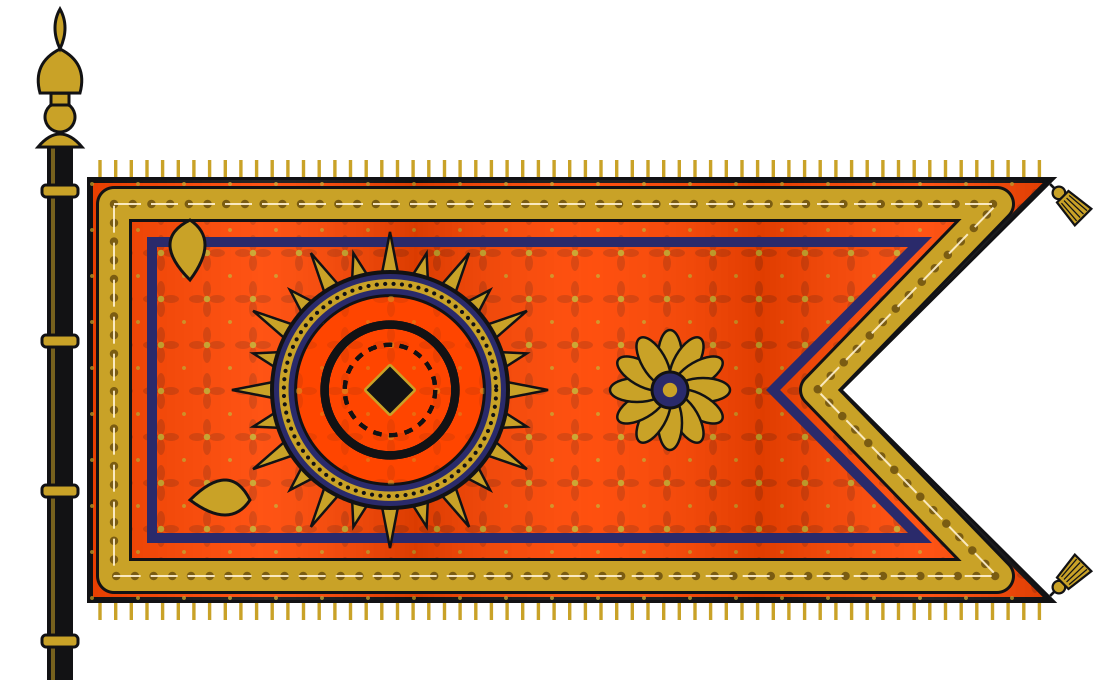
The extracts give no flag or crest for the Vanavasis. The Kadamba records name a tree as the family's source, and the emblem and flag on this page are designs[3].
| Part of the kit | This clan |
|---|---|
| Field | Fiery Vermilion #FF4500 |
| Accent | Deep Indigo #2A2A6B |
| Emblem colour | Charcoal Black #121214 |
| Zari metal | Gold |
| Main emblem | A great forest tree with a city gate in its trunk |
| Second image | — |
| Night and day | Every visual accessory has two versions: by night the emblem on the dark field, by day the clan's field colour on cloth woven from its metal. |
6. Flags
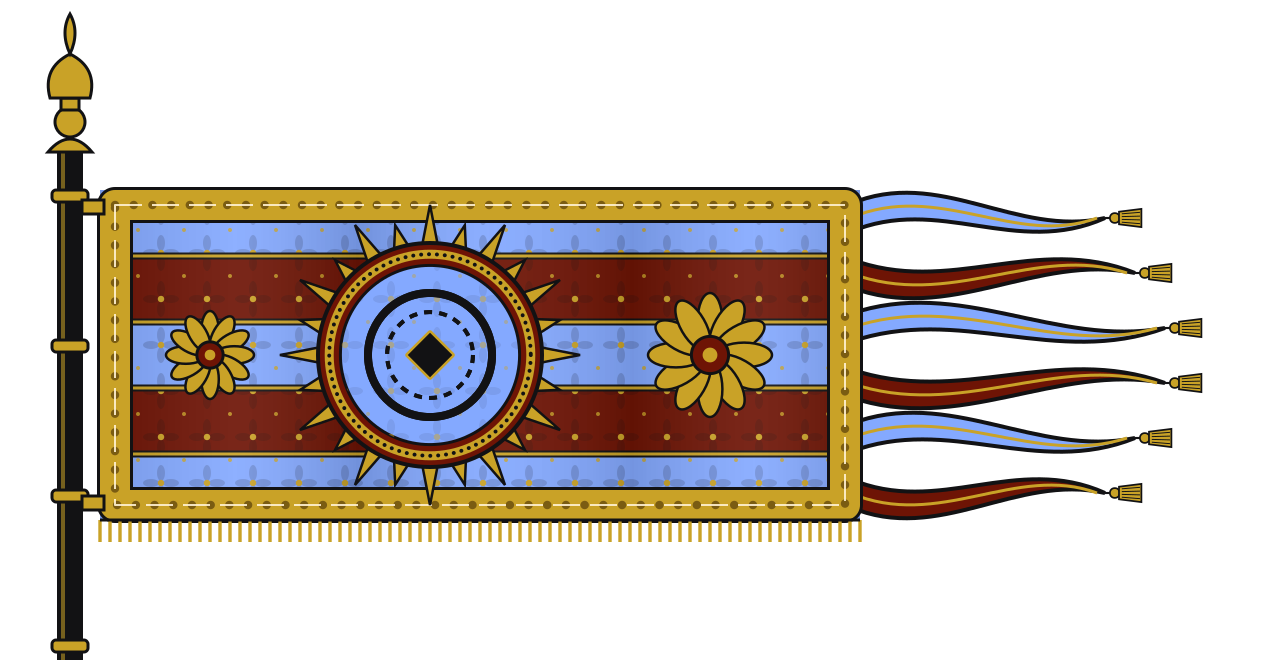
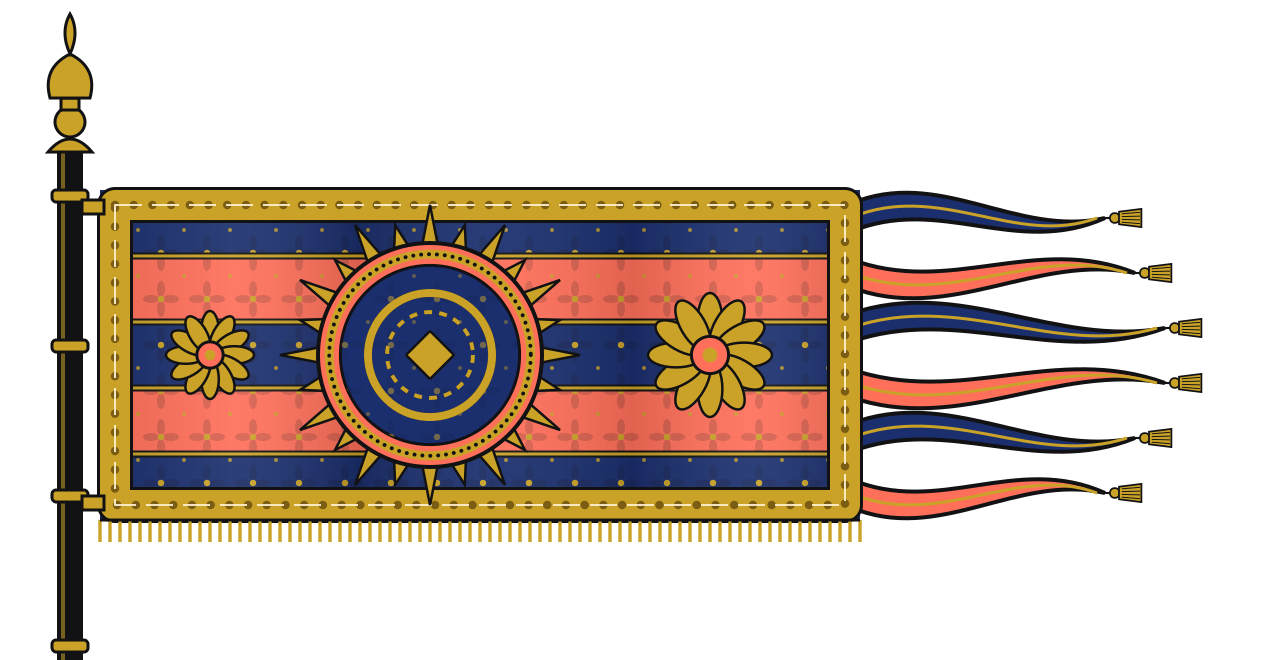
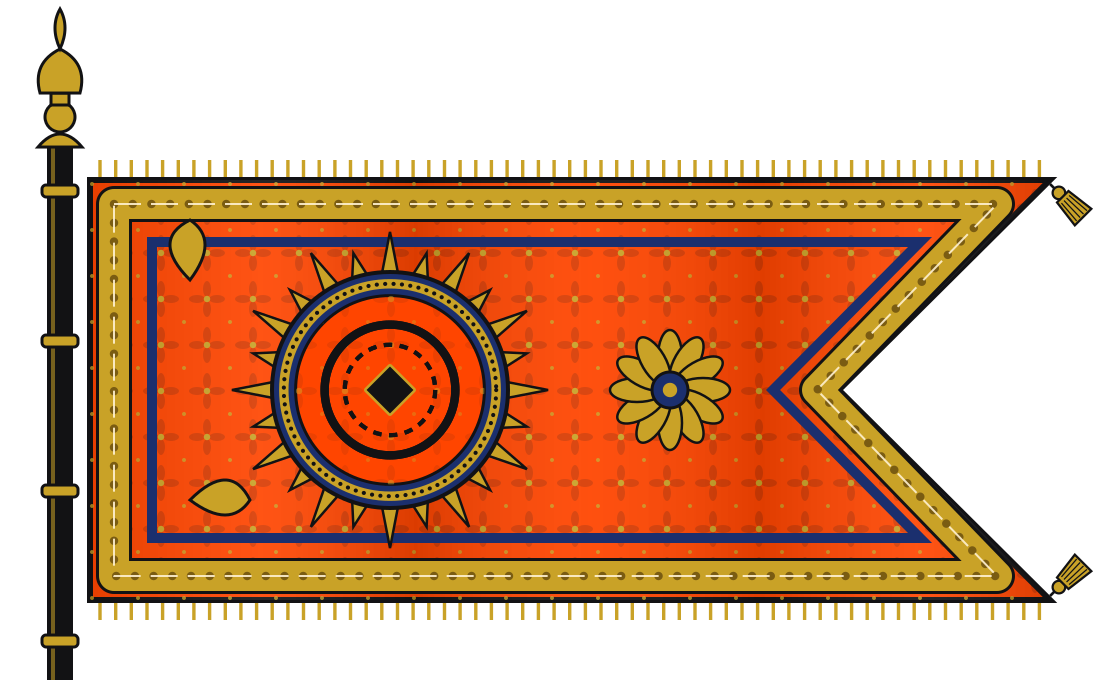
Every clan has every flag type; the type says the occasion and the colours say the clan. The outlined card is the flag the Atlas assigns.
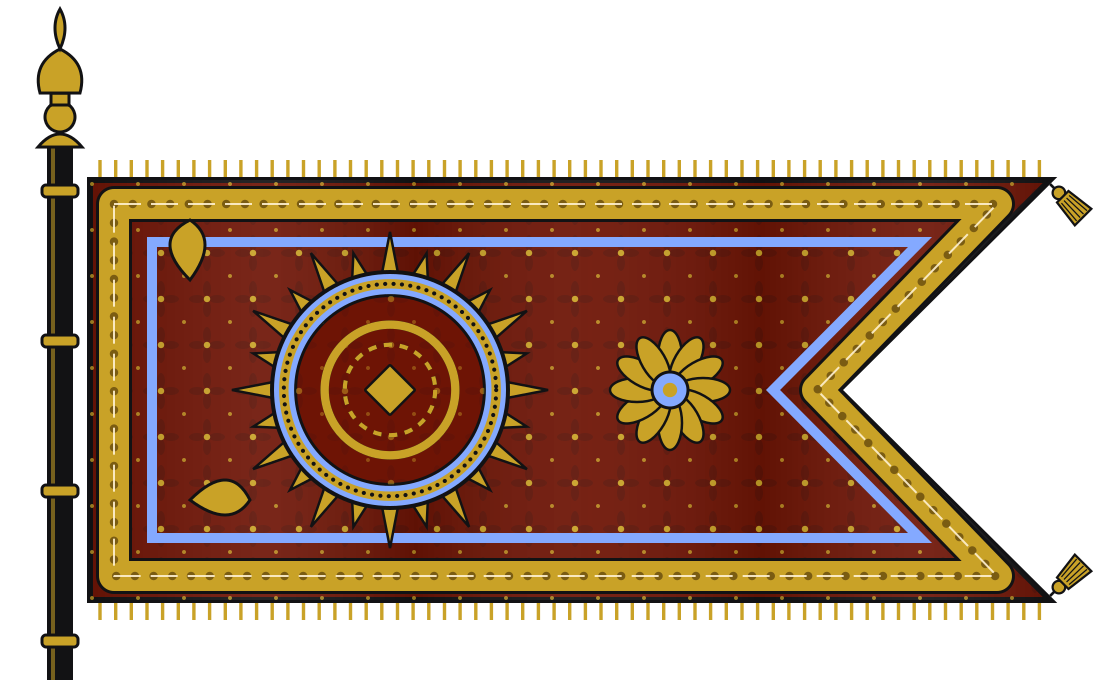
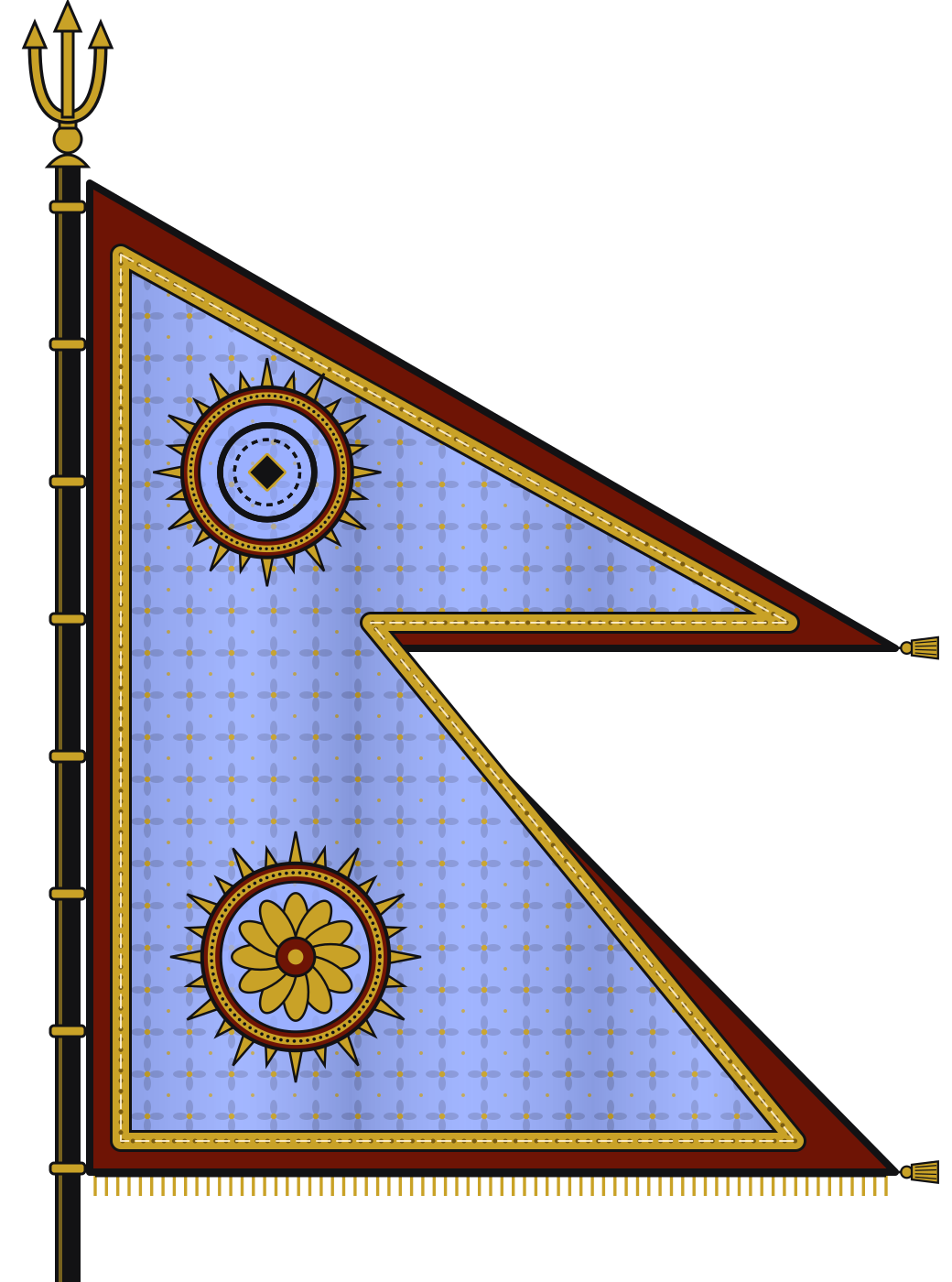
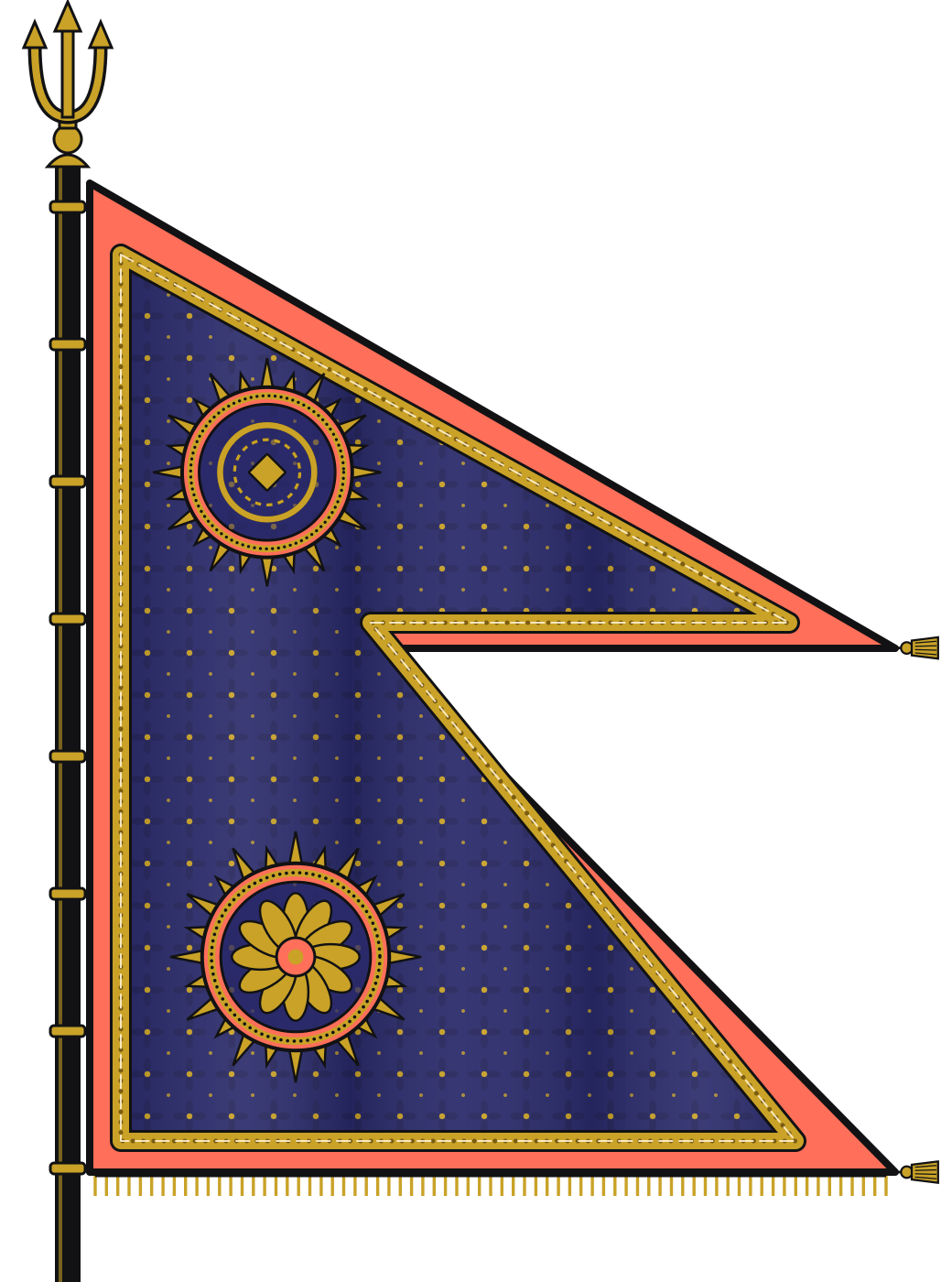

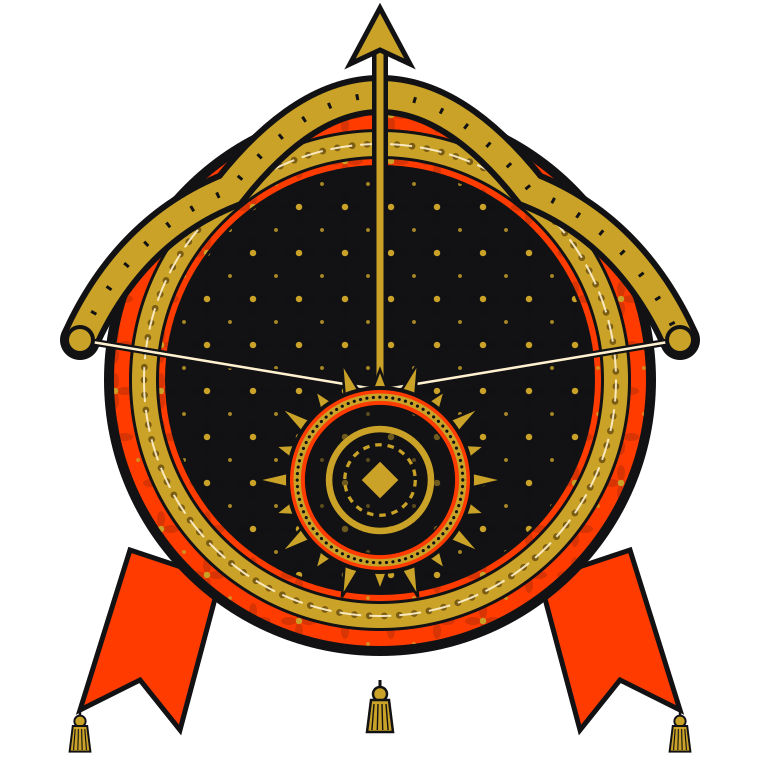
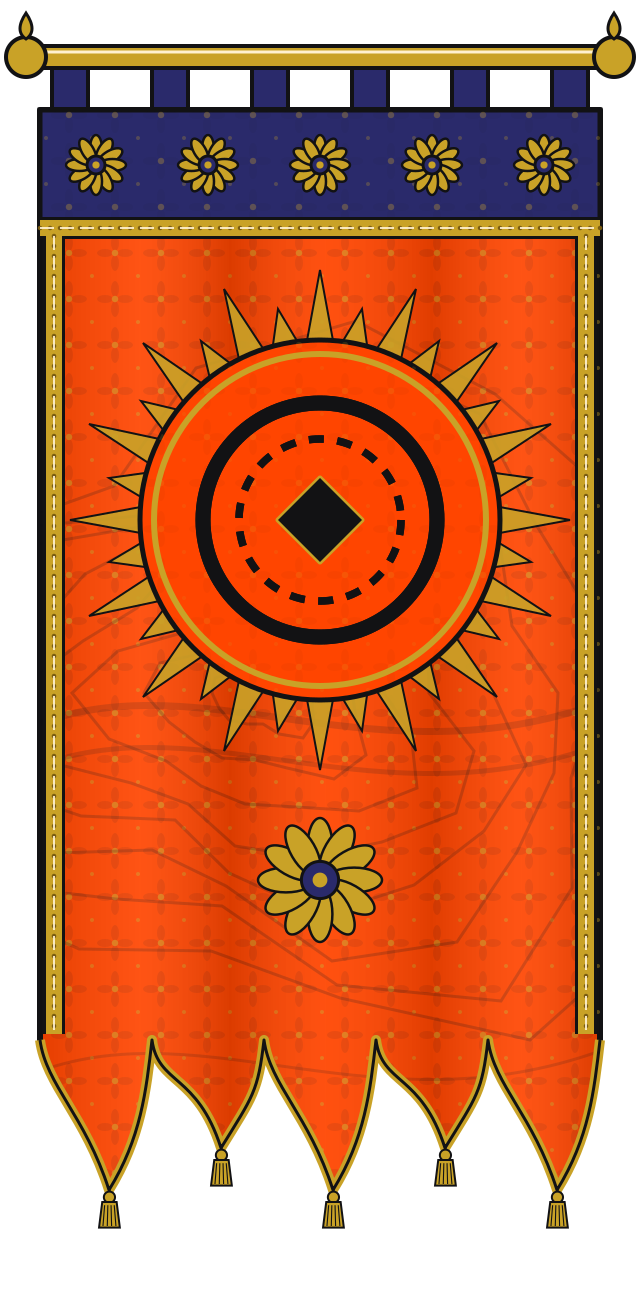
Historic banner
None known
New flag types
| Accessory | For this clan | Basis |
|---|---|---|
| A9 Pota-dhvaja · ship and trade flag For ships, caravans and markets | Not yet designed for this clan | Design |
| A10 Utsava-patāka · festival flag Light, bright flag for fairs and festivals | Not yet designed for this clan | Design |
| A11 Shoka-dhvaja · mourning flag White cloth with the emblem outline in the clan's metal | Not yet designed for this clan | Design |
7. Regalia
| Accessory | For this clan | Basis |
|---|---|---|
| E1 Chhatra · house parasol The ceremonial umbrella | Not yet designed for this clan | Design |
| E2 Chamara · fly-whisks The pair of whisks beside the head of the house | Not yet designed for this clan | Design |
| E3 Danda · staff of office Staff or scepter | Not yet designed for this clan | Design |
| E4 Simhasana · seat The seat of the house, covered in clan cloth | Not yet designed for this clan | Design |
| E5 Khetaka · shield A round shield; the Changi and Dhanush are its flag forms | Not yet designed for this clan | Regional tradition |
| E6 Kula-ayudha · clan weapon The weapon the clan honours | Not yet found for this clan | Under research |
8. Worn
| Accessory | For this clan | Basis |
|---|---|---|
| F1 Kula-vastra · clan cloth The clan's woven pattern in its kit colours | Not yet designed for this clan | Design |
| F2 Kirti-vastra · honour cloth A cloth earned for a deed, not inherited | Not yet designed for this clan | Design |
| F3 Kula-mala · garland flower The flower or leaf the clan wears as a garland | Not yet found for this clan | Under research |
| F4 Chinha · house pin A metal badge with the pin emblem | Not yet designed for this clan | Design |
9. Records
| Accessory | For this clan | Basis |
|---|---|---|
| H1 Clan words A traditional line in the native script | ಆರಂಕುಶವಿಟ್ಟೊಡಂ ನೆನೆವುದೆನ್ನ ಮನಂ ಬನವಾಸಿ ದೇಶಮಂ · “Translation not yet sourced. The line names Banavasi country (ಬನವಾಸಿ ದೇಶ).” Pampa, Vikramarjuna Vijaya (10th century), quoted on the Kannada Wikipedia page; edition not given[2] | Design |
| H2 Biruda · titles The house's title or titles | Dharmamaharaja, the title of the Kadamba rulers, following the Satavahanas | Documented |
| H3 Prashasti · praise genealogy The lineage as written at the head of a grant | Talagunda pillar inscription of crown prince Santivarma (c. 450): the family's origins, including Mayurasharma's studies at Kanchi The source on the family's origins[3] | Documented |
| H4 Vahi · clan register The book of the clan's births, marriages and deaths | Not yet found for this clan | Under research |
| H5 Rana-ghosha · war cry The clan's cry in battle or celebration | Not yet found for this clan | Under research |
10. VishwaVit · knower of the world
Game values are design choices for this project, not historical claims.
References
- Kadamba dynasty (Wikipedia, read 2026-10-10), citing the Talagunda, Halmidi and Gudnapur inscriptions, Kamath (2001), Moraes (1931) and Sen (1999).
- Banavasi Madhukeshwara Temple (Wikipedia, read 2026-10-10).
- Sirsi Marikamba Temple (Wikipedia, read 2026-10-10), citing Kamat's Potpourri and Rough Guides, South India (2003).