The Tripuri (also Tipra, Tiprasa, Twipra) are a Tibeto-Burman-speaking people of Tripura in India and of the hill districts of Bangladesh; their Wikipedia page describes them as descendants of the inhabitants of the Twipra kingdom[1]. The Manikya dynasty ruled that kingdom from about 1400 until it joined India on 15 October 1949, and the royal chronicle Rajmala begins its line with the Moon as first king[2][3]. The rulers struck silver coins for about 500 years, with a lion, a Garuda and fourteen garlanded lines among their designs[4]. Their family deities were the fourteen gods, the Chaturdasa Devata[5]. Today Kokborok is official in Tripura and has about 1,300,000 native speakers (2011), and the Koloma script is being revived[6][1].
01Faith and deities
The Tripuri page calls Goriya a Tripuri god, worshipped in the seven-day Buisu festival[1]. The Atlas's KulDevi, Tripura Sundari, is project data and is shown below.
Royal goddess of Tripura (Udaipur temple)[7]
A recorded tie between the clan and the goddess.
| Deity or tradition | Place in the clan's life | Evidence |
|---|---|---|
| Goriya (Lord Goriya) | Tripuri god; worshipped in the seven-day Buisu festival | [1] |
| Ama Mailuma and Ama Khuluma | Goddesses worshipped in the Buisu Goriya rites and the festival of lights; Mailuma is the goddess of corn (Lakshmi) and Khuluma of cotton | [1][8] |
| Ama Osa | Goddess named on the page; Osa Mwtai | [1] |
| Chaturdasa Devata (the fourteen gods) | The dynasty deity: worshipped at Kharchi mwtai by the royal priest Chontai; the family deities of the Manikya dynasty | [5][1] |
| Lampra Wathop and Tuisangramma | Worshipped at weddings | [1] |
| Lam-Para | Twin deities of the sky and the sea | [8] |
| Burha-sa | God of healing | [8] |
| Tripureshwari | Named as the patron goddess in the Culture of Tripura article; no clan link is given | [8] |
| Tripura Sundari | The Atlas's KulDevi (royal goddess of Tripura, Udaipur temple); the government page says she is popular among the tribal communities of Tripura | [7] |
02Temples
Tripura Sundari, the Udaipur temple, is a Bengali-style ek-ratna structure about 75 ft high (temple page)[9]. The government page says Samser Gazi captured Udaipur in the mid-18th century and offered puja to Devi Tripura Sundari there[7].
Built by the clan
| Temple | Deity | Built by | When | Where |
|---|---|---|---|---|
| Tripura Sundari Temple, Udaipur (Matabari) | Tripura Sundari | Maharaja Dhanya Manikya, per the government page, which also says it was constructed in the reign of Radhakishore Manikya | Founded 1501 (government page) | Udaipur, Gomati district[7][9] |
Given patronage or grants by the clan
| Temple | Deity | What the clan gave | When | Where |
|---|---|---|---|---|
| Chaturdasha Temple, Agartala | The fourteen gods (Chaturdasa Devata) | Maintained by the Tipra priests called Chantais | Not dated | Agartala[2] |
Later temples in the clan's lands
| Temple | Deity | Built | Where |
|---|---|---|---|
| Tripura Sundari Temple under the state | Tripura Sundari | Run by the State Government under the Tripura Merger Agreement; the Mata Tripura Sundari Temple Trust, chaired by the Chief Minister | Udaipur[7] |
03Languages and scripts
| Language or script | Kind | Under the clan | Evidence |
|---|---|---|---|
| Kokborok (Tripuri) living | Tibeto-Burman, Bodo-Garo branch; official in Tripura since 1979; taught primary to higher secondary since the 1980s | Tripuri people; Debbarma (Puratan Tripuri) is the prestige standard; Riang, Noatia, Jamatia, Koloi and Rupini are dialects | [6][1] |
| Koloma script lost | Native script of the Tripuri | Royal family; traditionally 1st century AD; out of use after the 14th century; revival in progress (Tripuri page) | [6][1] |
| Eastern Nagari alphabet | Alphabet that later replaced Koloma | Tripuri | [1] |
| Bengali script | Script used for Kokborok from the 19th century | Tripuri | [6] |
| Roman script living | Promoted after independence; TTAADC regulations 1992 and 2000 | Tripuri; Kokmari is unofficial, Ol Chiki proposed; a politicised issue | [6] |
04Books and literature
The royal chronicles are older (Rajmala, 15th century and later); the Kokborok books run from 1897 onwards.
Written during the clan's history
| Work | Author | Kind | When | Link to the clan |
|---|---|---|---|---|
| Rajmala | Court pandits; first part by Durlabhendra, Sukheshwar and Baneshwar | Chronicle in Bengali verse | 15th century | [3] |
| Rajratnakar | Credited to Durlabendra Chantai | Royal chronicle | Not dated | [6][1] |
| Kokborokma grammar | Radhamohan Thakur | Grammar | 1900 | [6] |
| Kokbokma | Daulot Ahmed with Mohammad Omar | Book, Comilla | 1897 | [6] |
| Tripur Kothamala | Radhamohan Thakur | Book | 1906 | [6] |
| Tripur Bhasabidhan | Radhamohan Thakur | Book | 1907 | [6] |
| Kwtal Kothoma | Sudhanwa Debbarma (Sudhanya Deb Barma) | First Kokborok magazine | 1954 | [10] |
| Twiprani Laihbuma (Rajmala) | R. K. Debbarma | Kokborok version of the Rajmala | 2002 | [6] |
| Tripura Somhita | Not named | Book in Kokborok | 1967 | [10] |
| Kokrobam | Not named | Dictionary | 1967 | [10] |
| Hachuk Khurio ('In the lap of Hills') | Not named in the literature article | Novel, the first modern Kokborok novel | 1987 | [10] |
| Tales and Tunes of Tripura Hills | Chandra Kanta Murasingh | Book (Sahitya Akademi) | 2007 | [10] |
Given patronage by the clan
| Work | Author | What the clan gave | When | Evidence |
|---|---|---|---|---|
| Rajmala | Court pandits | Commissioned by Dharma Manikya I for its first part (page gives 1458) | 1458 (Rajmala page) | [3] |
| Rajmala (later parts) | Court scholars | Parts added under Amar Manikya (16th century), Govinda Manikya (17th), Krishna Manikya (18th) and Kashi Chandra Manikya (19th); revised text by Durgamoni Uzir under Krishna Kishore Manikya, mid-19th century | 16th–19th century | [3] |
05Thinkers and scholars
| Name | Field | Era | Contribution |
|---|---|---|---|
| Radhamohan Thakur | Kokborok grammar and books | 1900–1907 | Kokborokma grammar (1900), Tripur Kothamala (1906), Tripur Bhasabidhan (1907)[6] |
| Daulot Ahmed | Kokborok book with Mohammad Omar | 1897 | Kokbokma, Comilla[6] |
| Sudhanwa Debbarma (Sudhanya Deb Barma) | Kokborok writing and organising | 1945 (Janasiksha Samiti), 1954 (magazine), 1987 (novel) | Tripura Janasiksha Samiti (27 Dec 1945); Kwtal Kothoma (1954)[10]; the Kokborok article also credits him with the novel Hachuk Khurio (1987)[6] |
| Bangshi Thakur (Amarendra Deb Barma) | Kokborok songs and book | 1948 | Koktang Kului (1948); Holi songs[10] |
| Bir Chandra Deb Barma | Kokborok organisation | 1967 | Tripura Kokborok Unnayan Parishad[10] |
| Chandra Kanta Murasingh | Tales and tunes | 2007 | Tales and Tunes of Tripura Hills, Sahitya Akademi[10] |
| Binoy Deb Barma | Dictionary | 1996, 2002 | Kokborok dictionary[6] |
| Durlabhendra (Durlabendra Chantai) | Royal priest | 15th century | Credited with the first part of the Rajmala[3][6] |
| Sukheshwar and Baneshwar (Sukreswar and Vaneswar) | Brahman pandits | Early 15th century | Compiled the Rajmala in Sanskrit and Bengali (Kokborok article spells Sukreswar and Vaneswar; Rajmala article Sukheshwar and Baneshwar)[3][6] |
Spellings differ between the articles; both are given.
06Art and architecture
The Tripuri page says the people have distinct dance, music, festivals, dress and food. Little of the art is described in the extracts beyond the items below.
Painting and wall art
Not recorded.
Sculpture and temple art
| Art form | What it is | Era | Evidence |
|---|---|---|---|
| Rock carvings at Unakoti, Pilak and Devtamura | Regional carvings in Tripura; the extract does not tie them to the Tripuri | [8] |
Temple and building architecture
| Art form | What it is | Era | Evidence |
|---|---|---|---|
| Ujjayanta Palace | Royal palace named in the Rajmala with Agartala; no builder or date in the extract | [3] | |
| Chaturdasha Temple, Agartala | Maintained by Tipra priests called Chantais | [2] |
Weaving and textiles
Not recorded.
Clothing and jewellery
Not recorded.
Coins, pottery and crafts
| Art form | What it is | Era | Evidence |
|---|---|---|---|
| Bamboo and cane handicrafts | Tripura-wide craft; not tied to the Tripuri in the extract | [8] |
07History
Origins in legend and in the chronicle
The Rajmala, a chronicle of the Tripura kings in Bengali verse, lists the first king as Chandra (the Moon) and the seventh as Druhyu, son of Yayati, of the lunar line; its historical kings begin with Ratna Fa (fl. 1280), the first to take the title Manikya[3]. The Tripuri page says that historical accounts it cites trace the Tripuris' migration from the upper Yangtze and Hwang Ho in western China, through the Himalayas, to Tripura[1].
The sources give different starts. The Rajmala dates Ratna Fa to c. 1280; the Twipra Kingdom article dates the kingdom's founding by Maha Manikya to c. 1400, and the Tripuri page says the Manikya dynasty ruled from 1400 for over 600 years, a claim of that page[3][2][1]. Both are kept here.
Writing, calendar and coinage
The Tripuri page says the earliest known Tripuri writing is dated to the 1st century AD, in Koloma script, and that the Tripurabda calendar began in 512 Saka Era under Hamtor pha alias Himti pha alias Jujharu pha[1]. The Kokborok article gives Koloma as traditionally 1st century AD, a royal-family script out of use after the 14th century and widely considered lost, and dates the language to at least the 1st century AD on oral tradition[6].
Ratna Manikya is credited with starting the coinage[4]. Dangar Pha (14th century): Ratna Pha took refuge in Gauda and regained his kingdom with Bengal sultan support[4]. The coins are mostly silver, struck for about 500 years, hand-struck to semi-machine by the late 18th century, machine-struck in the second half of the 19th, and produced to the mid-20th century[4]. Dated coins (Shaka years) include Ratna 1386, Mukut 1411, Dhanya 1412, Deva 1448, Vijay 1454, Udai 1489, Amar 1499, Yashodhar 1521-22, Kalyan 1548, Govinda 1582, Chhatra 1583, Ram 1598, Ratna II 1607-1634 and Dharma 1636[4].
Expansion, loss and the Mughal years
At its height the kingdom included the Barak Valley, Hailakandi and Karimganj (Assam), Comilla, Sylhet and the Chittagong Hill Tracts (Bangladesh), and modern Tripura; its boundaries were the Khasi Hills (north), the Manipur Hills (north-east), the Arakan Hills (east), the Bay of Bengal (south) and the Brahmaputra (west)[1]. Dhanya Manikya expanded into Eastern Bengal[2].
A renegade Tripuri prince, backed by the Mughal governors of Eastern Bengal, broke away with the plains, which became a Mughal client kingdom; the Mughals never entered the hills. The kingdom repelled Turks, Afghans, Mughals, Burmese and Arakanese[2]. In 1562 Chilarai (Koch) attacked; Khaspur was made dewani of the Koch kingdom. In the 18th century a Kachari king annexed Hailakandi. The kingdom then made a subsidiary alliance with British India[2].
Under British India and the merger
Bir Chandra Manikya (1862–1896) modelled the administration on British India[2]. Kirit Bikram Kishore was the last king (1947–1949) and the kingdom joined India on 15 October 1949[2][1]. Tripura became a Union Territory on 1 September 1956 and a state on 21 January 1972[1]. Kokborok has been official in Tripura since 1979[6].
08Journey and migrations
The sources give a legendary origin in the north, then a line of capitals moving down the valleys, from Trivega to Agartala.
| When | From | To | Why | Evidence |
|---|---|---|---|---|
| Before the chronicle (migration account) | Upper Yangtze and Hwang Ho, western China | Tripura, through the Himalayas | Migration as cited on the Tripuri page | [1] |
| Legendary (no date) | — | Trivega, on the Kapila | Druhyu built the first capital | [2] |
| Not dated | Trivega | Khalangma, on the Varavakra | Next capital named (Nath 2020, as cited in the Twipra article) | [2] |
| 8th century (citation needed in the source) | Khalangma | East along the Surma, near Kailasahar | Move east as the Twipra article gives it | [2] |
| Under Ratna Manikya I | — | Rangamati, on the Gomati | Capital; renamed Udaipur after Udai Manikya | [2] |
| Later | Udaipur | Agartala | Capital in the later kingdom | [3] |
09Seats and lands
| Place | Role | Where today |
|---|---|---|
| Trivega | Early capital on the Kapila, built by Druhyu[2] | Not located in the sources |
| Khalangma | Capital on the Varavakra[2] | Not located in the sources |
| Rangamati, renamed Udaipur | Capital under Ratna Manikya I, on the Gomati; named after Udai Manikya[2] | Udaipur, Gomati district, Tripura |
| Agartala | Capital named in the Rajmala, with Ujjayanta, Pushbanta and Neermahal palaces[3] | Tripura |
| Hill districts of Bangladesh | Khagrachhari, Bandarban and Rangamati, where Tripuri people live today[1] | Bangladesh |
| Barak Valley, Hailakandi and Karimganj | Part of the kingdom at its peak[1] | Assam |
| Sylhet, Comilla and Chittagong Hill Tracts | Part of the kingdom at its peak[1] | Bangladesh |
10Notable figures
| Name | Role | Era | Known from |
|---|---|---|---|
| Maha Manikya | Founder of the kingdom, per the Twipra article; reign c. 1400–1431 per the Rajmala | c. 1400 | [2][3] |
| Ratna Fa | First king to take the title Manikya (Rajmala) | fl. c. 1280 | [3] |
| Ratna Manikya I | Credited with starting the coinage; moved the capital to Rangamati | Shaka 1386 coins; 1462–1487 (Rajmala) | [4][3][2] |
| Dharma Manikya I | Commissioned the first part of the Rajmala (page's date 1458) | Reign 1431–1462 (Rajmala); r. 1431 (Twipra) | [3][2] |
| Dhanya Manikya | Expanded into Eastern Bengal; founder of the Tripura Sundari temple per the government history | 1463–1515 (Twipra); 1490–1515 (Rajmala) | [2][3][7] |
| Govinda Manikya | Resisted Muslim kingdoms | Shaka 1582 coin (Banglapedia) | [2][4] |
| Bir Chandra Manikya | Modelled the administration on British India | 1862–1896 | [2][3] |
| Bir Bikram Kishore | Named in the Twipra article as Bir Bikram Kishore Manikya (d. 1947); the Debbarma article names him Bir Bikram Kishore Debbarma | 1923–1947 (Rajmala); 1908–1947 (Debbarma article) | [2][11][3] |
| Kirit Bikram Kishore | Last king, 1947–1949 (Twipra article); the Tripuri page gives 1947–2006 | 1947–1949 (Twipra); titular to 1978 (Rajmala) | [2][3][1] |
| Pradyot Bikram Manikya Deb Barma | Titular king; leads TIPRA (The Indigenous Progressive Regional Alliance) | Titular from 1978 (Rajmala) | [11][3] |
| Sachin Dev Burman, Rahul Dev Burman, Nabadwipchandra Dev Burman | Named as music figures of the Tripuri people | Not dated | [1] |
| Dasarath Debbarma | First Tripuri Chief Minister | 1993–1998 | [11] |
| Benichandra Jamatia, Satyaram Reang | Named as Padma Shri holders | Not dated | [1] |
| Somdev Devvarman | Tennis player; Arjuna award 2011, Padma Shri 2018 | 2011, 2018 | [11] |
11Allies, rivals and marriages
| People | Relationship | When |
|---|---|---|
| Mughal governors of Eastern Bengal | Backed a renegade Tripuri prince who took the plains[2] | Not dated |
| Chilarai (Koch) | Attacked Tripura; Khaspur made dewani of the Koch kingdom[2] | 1562 |
| Bengal sultans | Helped Ratna Pha regain his kingdom[4] | 14th century; coinage |
| Arakanese | Took Chittagong from Tripura in the Shaka 1499 year, when Sylhet was won[4] | Shaka 1499 |
| Kachari king | Annexed Hailakandi[2] | 18th century |
| British India | Subsidiary alliance; administration modelled on British India; merger on 15 October 1949[2] | 19th century–1949 |
| Samser Gazi | Attacked and captured Udaipur; the government page says he offered puja to Devi Tripura Sundari[7] | Mid-18th century |
12Society and livelihood
Clans have social and administrative organisation from the village to community chieftainship[1]. The page lists the hierarchy as the Maharaja of Tripura (Missip), a liaison officer (Roy), the Sardar (village chief) and the individual[1].
Government and social order
| Institution or group | What it was | Evidence |
|---|---|---|
| Sardar | Village chief | [1] |
| Community chieftainship | Organisation above the village, in the clan's own administration | [1] |
| Tripur Kshatriya Samaj | Organisation named in the Debbarma article | [11] |
| Subrai Mission Trust | Organisation named in the Debbarma article | [11] |
| TIPRA (The Indigenous Progressive Regional Alliance) | Regional political alliance led by Pradyot Bikram Manikya Deb Barma | [11] |
| Tripura Royal House | The royal house, named in the Debbarma article | [11] |
Livelihood over time
| Era | Livelihood | Evidence |
|---|---|---|
| Not dated | Bamboo and cane handicrafts; bamboo for jhum work (Tripura-wide, not tied to the Tripuri in the extract) | [8] |
13Sub-clans and related clans
The Wikipedia page lists the main Tripuri clans as Debbarma (Tipra), Reang (Riang), Jamatia, Noatia and Uchoi[1]. Debbarma is the main clan of the Tripuri community, with the divisions Daspa, Beri and Dona[11]. The Tripuri Kshatriya group was at first only Debbarma or Tipra; the Raja later added Reang, Jamatia and Noatia[1]. Banglapedia counts 36 dofas (clan groups)[12].
| Clan | Relation | Where | Size | In the Atlas | Evidence |
|---|---|---|---|---|---|
| Debbarma | Parent people | Tripura, with the Tripuri community | new clan candidate | [11][1] | |
| Daspa | Sub-clan | new clan candidate | [11] (division of Debbarma) | ||
| Beri | Sub-clan | new clan candidate | [11] (division of Debbarma) | ||
| Dona | Sub-clan | new clan candidate | [11] (division of Debbarma) | ||
| Reang (Riang) | Related people | Tripura, Mizoram, Assam | 1,65,103, 2001 census[13] | ST-275 | [1][13] |
| Jamatia | Related people | Tripura | 74,949, year not stated[13] | ST-109 | [1][13] |
| Noatia | Related people | South Tripura and the Longtharai Valley[13] | 6,655, year not stated[13] | ST-236 | [1][13] (also listed as Murasing in the Atlas) |
| Uchoi | Related people | new clan candidate | [1] | ||
| Koloi | Related people | new clan candidate | [8][6] | ||
| Rupini | Related people | new clan candidate | [8][6] | ||
| Roaza | Related people | new clan candidate | [1] (used as a surname) | ||
| Murasing | Related people | Tripuri-speaking groups (Culture of Tripura) | ST-236 | [8][1] (Atlas lists Murasing as another name for Noatia) | |
| Uchai | Related people | Tripura | 2,103, year not stated[13] | ST-321 | [13] |
| Halam | Related people | Tripura | 47,261, year not stated[13] | ST-096 | [13] |
| Chakma | Related people | Tripura | 61,793, year not stated[13] | ST-049 | [13][8] |
| Mog | Related people | Sabroom and Belonia (settlement areas)[13] | 30,385, year not stated[13] | ST-208 | [13] (Atlas lists Mog among Marma names) |
| Garo | Related people | Tripura | 11,180, year not stated[13] | ST-084 | [13] |
| Kuki | Related people | Tripura | 11,674, year not stated; sub-groups Darlong and Lushai[13] | ST-162 | [13] |
| Mizo (Lushai) | Related people | Jampui Hills of North Tripura[13] | 4,777, year not stated[13] | ST-222 | [13] |
| Munda | Related people | Tripura | 12,416, year not stated[13] | ST-229 | [13][8] |
| Oraon (Orang) | Related people | Tripura | 6,223, year not stated[13] | ST-241 | [13][8] |
| Santal | Related people | Tripura | 2,151, year not stated[13] | ST-280 | [13] |
| Khasi | Related people | Kailashahar and Dharmanagar[13] | 630, year not stated[13] | ST-132 | [13] |
| Chaimal | Related people | Ambassa, Dhalai district[13] | 226, year not stated[13] | ST-047 | [13] |
| Lepcha | Related people | Mostly Dhalai district[13] | 105, year not stated[13] | ST-175 | [13] |
| Bhutia | Related people | Tripura | 29, year not stated[13] | ST-035 | [13] |
| Bhil | Related people | Tripura | 2,336, year not stated[13] | ST-027 | [13] |
| Hajong | Related people | Listed among the other tribes of Tripura | ST-094 | [8] |
Clans marked "new clan candidate" are not in the Atlas yet.
14Surnames
Surnames and spellings that the extracts give for Tripuri people. The counts for these families are not in the extracts.
| Surname | Clan or sub-clan | Where | People with this surname | Also used by other communities |
|---|---|---|---|---|
| Debbarma | Debbarma | Not stated for the surname | not yet counted | Not checked |
| Deb Barma, DebBarma, Dev Barma, Dev Varma, Deb Burman, Dev Burman, Debbarman, Dev Barman, Dev Varman, Devvarman | Debbarma (spellings) | not yet counted | Not checked | |
| Reang | Reang (Riang) | Not stated for the surname | not yet counted | Not checked |
| Riang | Reang (Riang) | Not stated for the surname | not yet counted | Not checked |
| Jamatia | Jamatia | Not stated for the surname | not yet counted | Not checked |
| Noatia | Noatia | Not stated for the surname | not yet counted | Not checked |
| Uchoi | Uchoi | not yet counted | Not checked | |
| Murasingh | Murasing | not yet counted | Not checked | |
| Roaza | Roaza | not yet counted | Not checked | |
| Burman, Dev Burman | Debbarma (spelling) | not yet counted | Not checked | |
| Chaudhury | Not stated | not yet counted | Not checked | |
| Tripura | Not stated | not yet counted | Not checked | |
| Manikya | The royal house (title of the kings) | not yet counted | Not checked | |
| Sen Dev Varma | Debbarma (spelling) | not yet counted | Not checked |
Counts are of everyone with the surname, from the cited source and year, not only members of this clan. A surname shared with other communities says nothing about any one person's origin.
15Songs and music
Traditional Tripuri songs tell of love, nature, daily life and ancestral legends[14]. Songs are sung at religious occasions, weddings and festivals[8]. Composers named in the Tripuri page are Sachin Dev Burman, Bikashrai Debbarma and Nanda Kumar Deb Barma; the page names no song titles[1]. Dances named: Goria (Tripuri and Jamatia), Lebang, mamita, mosak sulmani (Tripuri) and tangbiti, a harvest dance[8].
Traditional Tripuri songs of love, nature, daily life and ancestral legends living
Holi songs
Listed in the Kokborok literature article[10]; no text in the extract
Firogoi Faidi
Listed as a song title in the Kokborok literature article[10]
Tripura Kha-Khachangma Khumber Boi
Listed as 33 spiritual songs by Khushikrshna, 1942[10]
Bogla rwchapmung
Named as Baul-inspired in the Culture of Tripura article[8]
Kok-Borok Gono Sangit (1988), Rangbwtang (2011), Surang (2014), Suri (2015)
Listed by title and year in the Kokborok literature article[10]
Instruments and styles
| Instrument or style | What it is | Evidence |
|---|---|---|
| Sumui (bamboo flute) | Bamboo flute; the Tripuri name is given as murali/sumui; played at festivals, religious ceremonies and dances | [14][15][16] |
| Kham | Wood and animal skin; used by the Tripuri | [17] |
| Sarinda | Partly wooden; a bowed string instrument | [17][15] |
| Chongpreng | Named as popular among the Tripuri | [17] |
| Dangdu | Named as popular among the Tripuri | [17] |
| Cymbals | Percussion, popular among the Tripuri | [17] |
| Naumati Baja | Tripuri ensemble with sarinda, dubri and dhol | [15] |
| Dubri, dhol, tungdrum, mandira, banam | Instruments of Tripura named in the Asia Inch article; dubri and dhol are in the Tripuri Naumati Baja | [15] |
16Poems, lullabies and children's rhymes
Kokborok poetry in print, as the Kokborok literature article lists it. The poems themselves are not in the extracts.
Khani Ruchapmung
Listed in the Kokborok literature article[10]
Bubar
Listed by title and year[10]
Kok-Borok Koklob Bwchab
Listed by title and year[10]
Luku Sochama Rwchabmung
Listed by title and year[10]
Sonnet Koktangrog
Listed by title and year[10]
Chirik Morok
Listed by title and year[10]
17Stories, legends and proverbs
Stories and legends
| Story | What happens | Told by | Evidence |
|---|---|---|---|
| Adibasi Tripurar Loka-Katha (Krishna Das, TRCI 2000) | Book of folk tales; contents not in the extract | Not stated | [8] |
| Tripurar Upajati Lokakatha (TRCI 2000) | Book of folk tales listed under 'Arundhati Roy' in the Culture of Tripura article; the attribution needs checking; contents not in the extract | Not stated | [8] |
| ত্রিপুরার আদিবাসী লোককথা (Swapan Sharma, 2000) | Book in Bengali script, listed in the Culture of Tripura article; contents not in the extract | Not stated | [8] |
| Tales and Tunes of Tripura Hills | Stories and tunes, Chandra Kanta Murasingh, Sahitya Akademi 2007 | Not stated | [10] |
| Hachuk Khurio ('In the lap of Hills') | First modern Kokborok novel, 1987; plot not in the extract | Not stated | [10] |
| Modern novels | Chethuang, Dundurkma (1984), Nakhwrai (1989), Elemni Bibi (1989), Khong (1996), Busu (2000), Dolai Twima Naro (2008), Lokhopoti by Sefali Debbarma (2010); titles only | Not stated | [10] |
Proverbs and sayings
Not recorded.
18Festivals and fairs
| Festival or fair | When | Where | What happens |
|---|---|---|---|
| Buisu | New Year, 13 or 14 April; Hari Buisu is day one | Tripura | Seven-day festival of Lord Goriya; the Buisu Goriya rites honour Ama Mailuma and Ama Khuluma[1] |
| Kharchi (Kharchi mwtai) | July or August, eighth day of the new moon | Tripura | The fourteen gods are worshipped by the royal priest Chontai[1] |
| Ker (Ker mwtai) | 14 days after Kharchi | Tripura | The strictest puja[1] |
| Mamita | Harvest festival, held during Osa Mwtai | Tripura | Worship of Ama Mailuma[1] |
| Festival of lights | Said to date from King Subrairaja | Tripura | Ama Mailuma and Ama Khuluma are honoured[1] |
| Hangrai | Harvest festival | Tripura | Youth build bamboo-and-husk Nowshah huts; Awangs, Moi, Arak or chuwak[1] |
| Gomoti, Khachi, Baishu | Not dated | Not stated | Named with Ker as festivals and rites of the Tripuris; not described in the extract[12] |
| Wedding (Hamjwk Tubui Kaimani) | Not dated | Tripura | Broker Raibai; Koksungma engagement with rice beer; the wedding worships Lampra Wathop and Tuisangramma; procession with music and water pots; bride in a ceremonial palanquin; the bride's mother is barred from the feast[1] |
19Food, dress and games
Food
| Item | What it is | Evidence |
|---|---|---|
| Awang Bangwi (Awang Bwthai) | Cone-shaped sticky rice steamed in lairu or banana leaves | [1] |
| Awang Sokrang, Awang Phanswi, Phap ni Awang, Awang Belep | Named dishes; no description in the extract | [1] |
| Muya | Bamboo shoots | [1] |
| Chakhwi, Gudok, Bermabwtwi, Mosdeng, Awandru, Mwkhwikwtwi, Serma, Thokmui | Named dishes; no description in the extract | [1] |
| Bamboo chicken, pork or fish | Cooked over charcoal for 40–50 minutes in bamboo | [1] |
Dress
Not recorded.
Games and martial arts
| Item | What it is | Evidence |
|---|---|---|
| Thwngmung (Kokborok) | The Kokborok term for traditional sports; said to be gradually abandoned for modern games, though still played, especially in rural Tripura | [18][19] |
| Bumanikotor | Hide-and-seek between two groups | [18] |
| Tengdang | A stick game like gilli-danda; children and young men played it in the evenings, and the 2020 article says cricket and football have drawn them away | [20][18] |
| Sohlaimung | Free-hand wrestling | [18] |
| Kaldong | A game on footsteps tied to two bamboo pieces about two feet above the ground | [18] |
| Bamboo-pulling wrestling, tug of war, armpit-pole pushing | Named on the games page | [18] |
| Rope-swing songs | Children sing as they swing on two ropes or vines tied to a tree branch with a wooden seat, while others push | [18] |
Tags: living still practised · revived brought back after a break · lost known only from records · research reported but not yet confirmed from a source. Songs and poems under copyright are listed by title only; restricted or sacred material is noted without its content.
20Status today
The Tripuri are a Tibeto-Burman-speaking group in Tripura and the Bangladesh hill districts, with Kokborok as their language[1].
Who carries the name today
| Community | Link | Basis | Evidence |
|---|---|---|---|
| Tripuri in Bangladesh (ST-319) | Khagrachhari, Bandarban, Rangamati | Community tradition | [1] |
| Reang (ST-275) | Added to the Tripuri Kshatriya group by the Raja | Community tradition | [1] |
| Jamatia (ST-109) | Added to the Tripuri Kshatriya group by the Raja | Community tradition | [1] |
| Noatia (ST-236) | Added to the Tripuri Kshatriya group by the Raja | Community tradition | [1] |
Recognised heritage
| What | Recognition | Evidence |
|---|---|---|
| Kokborok language | Official language of Tripura since 1979 | [6] |
| Roman script for Kokborok | TTAADC regulations 1992 and 2000 | [6] |
| Koloma script | Revival in progress (Tripuri page) | [1] |
| Scheduled Tribe (India) | Atlas: state-wise list dated 09-07-2024 | Atlas |
| Recognised small ethnic group (Bangladesh) | Bangladesh Small Ethnic Groups Cultural Institutions Act, list of 50 (2019) | Atlas |
No review by the Tripuri community is recorded; this page has not been reviewed by the community.
21For children
The gate of the hills
The Tripuri people live in Tripura, a state of India, and in hill districts of Bangladesh. From about 1400 until 1949 their Manikya kings ruled the land. The kings struck silver coins, and some of them show a lion and a Garuda. Each April the people begin the New Year, Buisu, with seven days of worship for the god Goriya. At their festivals they play the sumui, a bamboo flute, and children sing as they swing on ropes.
Written for this project
Riddle: I am made of bamboo and I sing at festivals. The Tripuri play me in their dances. What am I? (The sumui, a bamboo flute)
22Across the project
| Project | What carries this clan | Status |
|---|---|---|
| Atlas of the Janas | Seat in the sources: Rangamati, renamed Udaipur, then Agartala | To check |
| KulDevi and GrahDevi | KulDevi Tripura Sundari, family Mahavidya; GrahDevi forms Kali, Tara, Shodashi, Bhuvaneshvari, Bhairavi, Chhinnamasta, Dhumavati, Bagalamukhi, Matangi, Kamala (both) | From the Atlas |
| Planet naming | Not yet checked against the Tier registers | To check |
| Renaming and waters | Rangamati renamed Udaipur after Udai Manikya; Kalyan Sagar lies east of the Tripura Sundari temple, where fishing is not permitted | [9] |
23Open questions
- The Tripuri people's page says Goriya is a Tripuri god, and the Atlas's KulDevi is Tripura Sundari. Which the community itself names as its clan deity needs a community source.
- Dates for the first kings and for the founding of the kingdom differ: Ratna Fa c. 1280 (Rajmala) against Maha Manikya c. 1400 (Twipra); Dhanya Manikya 1463–1515 (Twipra) against 1490–1515 (Rajmala); Dharma Manikya I 1431–1462 (Rajmala) against r. 1431 (Twipra), and the Rajmala part commissioned in 1458 (page). Each is kept as its source gives it.
- The Tripura Sundari temple was founded in 1501 by Dhanya Manikya and constructed in Radhakishore Manikya's reign, both according to the government page. Which is the building date?
- The 2001 Tripuri count is 543,848 in the Culture of Tripura article and 5,43,843 in the Vajiram article. Check the census table.
- Royal priests are spelled Chontai (Tripuri page) and Chantai (Twipra article); Chantai is the spelling of the temple priests in the Twipra article.
- The Rajmala's primary text (Bengali verse, Tripuri verse omitted) is not in the extracts. Find the Wikisource or a critical edition.
- The 36 dofas (Banglapedia): names and membership are needed to complete the clan list.
- Whether the Halam sub-clans Kaloi and Rupini are the same as the Koloi and Rupini named for the Tripuri.
- The 2020 Tengdang article is about the tribal communities of Tripura; check which of them play it and whether it is Tripuri.
- Locations of Trivega and Khalangma, and the 8th-century move along the Surma, which the source marks citation needed.
- The Koloma script, the native form of the coin legend (Bengali script, per Banglapedia), and the native name of the people are not in the extracts. A plate, catalogue or Kokborok source with the glyphs is needed.
- Proverbs and sayings with their text, lullabies, play rhymes and riddles: none in the extracts. Leads: Krishna Das's TRCI 2000 works ('Prabad-Prabachan O Dha-Dha') and the Kokborok literature list.
- Surname counts with year and source; whether Burman, Chaudhury, Tripura and Manikya are shared with other communities.
- Accessories still unsourced, with leads: copper-plate charter texts, a seal or signet, a totem or guardian tree, a war cry, a garland flower, the five great sounds, and the cloth (riha or risa, unconfirmed lead).
- Community review of this page.
- Koloma is tagged lost in the languages table, but the same row, the heritage table and the lead say revival is in progress: the tag and the text disagree. Sources:[6][1].
- Kirit Bikram Kishore's end date: the Tripuri page gives 1947–2006 (figures row) and the Rajmala gives titular status to 1978 (figures row). Which ends his title is not settled. Sources:[1][3].
- Murasing is a separate clan item (related, from the Culture of Tripura article) and is also given as another name for Noatia under the same ST-236 ID. The page does not settle whether they are one group. Sources:[8][13].
- Uchoi (Tripuri page, a main clan) and Uchai (Vajiram, ST-321) are listed as separate clans; the extracts do not say whether they are one group. Sources:[1][13].
24Astitva
अस्तित्व · being, existence: everything by which the clan is known
The coins of the Tripura rulers are the clan's documented accessory, with the lion, Garuda and fourteen garlanded lines; the title Manikya and the Rajmala chronicle are documented too[4][2][3]. The other accessories are not yet sourced for this people.
Every clan has every accessory, royal objects included. Each one says how it is known: Documented This clan's own object is recorded. · Regional tradition Recorded for the region or for peoples like this one, not for this clan. · Design Made for this project, with no historical claim. · Under research To be found for this clan from sources. Legends and titles are written in the clan's own script.
1. Seals and coins
| Accessory | For this clan | Basis |
|---|---|---|
| B1 Rajamudra · house seal Round seal with the clan emblem and a short legend in the clan's script | Not yet designed for this clan | Design |
| B2 Anguliya-mudra · signet ring Personal seal ring of the head of the house | Not yet designed for this clan | Design |
| B3 Chhapa · house stamp Ink or block stamp for letters, goods and cloth | Not yet designed for this clan | Design |
| B4 Tamrapatra · charter plate Copper-plate grant on a ring, closed with the house seal | Not yet designed for this clan | Design |
| B5 Shreni-mudra · guild or trade seal Seal for the clan's trade, craft or caravan | Not yet designed for this clan | Design |
| C1 Clan coin Emblem or deity on one side, a legend in the clan's script | Silver coins of the Tripura rulers, struck for about 500 years. Symbols recorded: lion; Garuda; fourteen vertical lines with garland (Chaturdashdevata coins); Ardhanarishvara; Krishna with flute between two Gopis; Krishna dancing over the Tripura lion; Shivalinga Banglapedia: Ratna Manikya credited with starting the coinage. The legend is recorded in Latin letters (coins in Bengali script; native legend not in the extract)[4] | Documented |
| C2 Coin die The die that strikes the coin | Not yet designed for this clan | Design |
2. Living symbols
| Accessory | For this clan | Basis |
|---|---|---|
| I1 Totem trio The tree, bird and animal the clan protects | Not yet found for this clan | Under research |
| I2 Kaval-maram · guardian tree The tree that stands at the clan's seat | Not yet found for this clan | Under research |
3. Stone and gate
| Accessory | For this clan | Basis |
|---|---|---|
| G1 Torana · gateway The built gate of the seat; the cloth Toran hangs in it | Not yet designed for this clan | Regional tradition |
| G2 Viragallu · hero stone Carved panel stone for a member who died defending the clan | Not yet designed for this clan | Regional tradition |
| G3 Kula-shila · clan stones Standing and table stones that remember the ancestors | Not yet designed for this clan | Design |
| G4 Jayastambha · victory pillar A pillar raised for a victory | Not yet designed for this clan | Design |
| G5 Sima-shila · boundary stone Marks the clan's land, with a line in the native script | Not yet designed for this clan | Design |
4. Sounds
| Accessory | For this clan | Basis |
|---|---|---|
| D1 Pancha-mahashabda · five great sounds The right to five instruments | Not yet designed for this clan | Design |
| D2 Shankha · clan conch The clan's own named war conch | Not yet designed for this clan | Design |
| D3 Murasu · house drums Three drums: war, charity and justice | Not yet designed for this clan | Design |
5. Kit: colours, metals and emblems
The Atlas gives the Tripuri a crown for royal lineage and a royal palace dome for the Ujjayanta Palace, on a Vaijayanti (imperial standard) for a kingdom that ruled a large territory. The coins of the Tripura rulers, with their lion, Garuda and fourteen garlanded lines, are the documented royal emblems[4].
| Part of the kit | This clan |
|---|---|
| Field | Royal Navy #1B2F6E |
| Accent | Fiery Vermilion #FF4500 |
| Emblem colour | Metallic Gold #C9A227 |
| Zari metal | Gold |
| Main emblem | A crown |
| Second image | A royal palace dome |
| Night and day | Every visual accessory has two versions: by night the emblem on the dark field, by day the clan's field colour on cloth woven from its metal. |
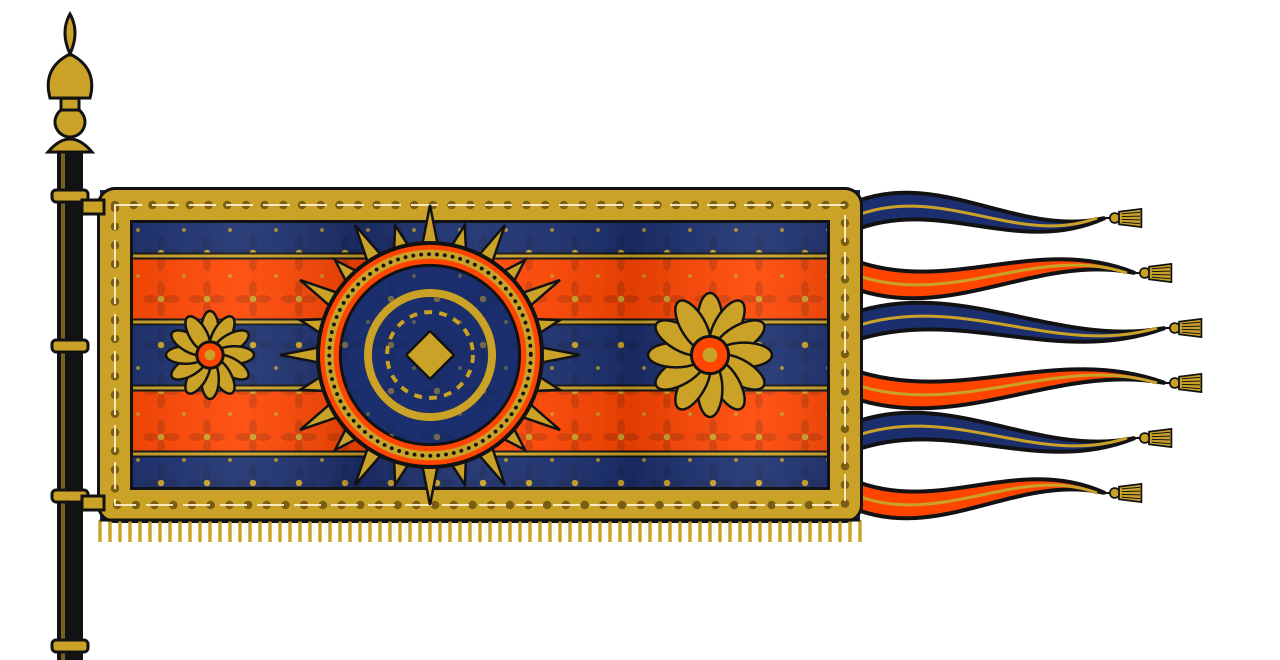
6. Flags
Every clan has every flag type; the type says the occasion and the colours say the clan. The outlined card is the flag the Atlas assigns.
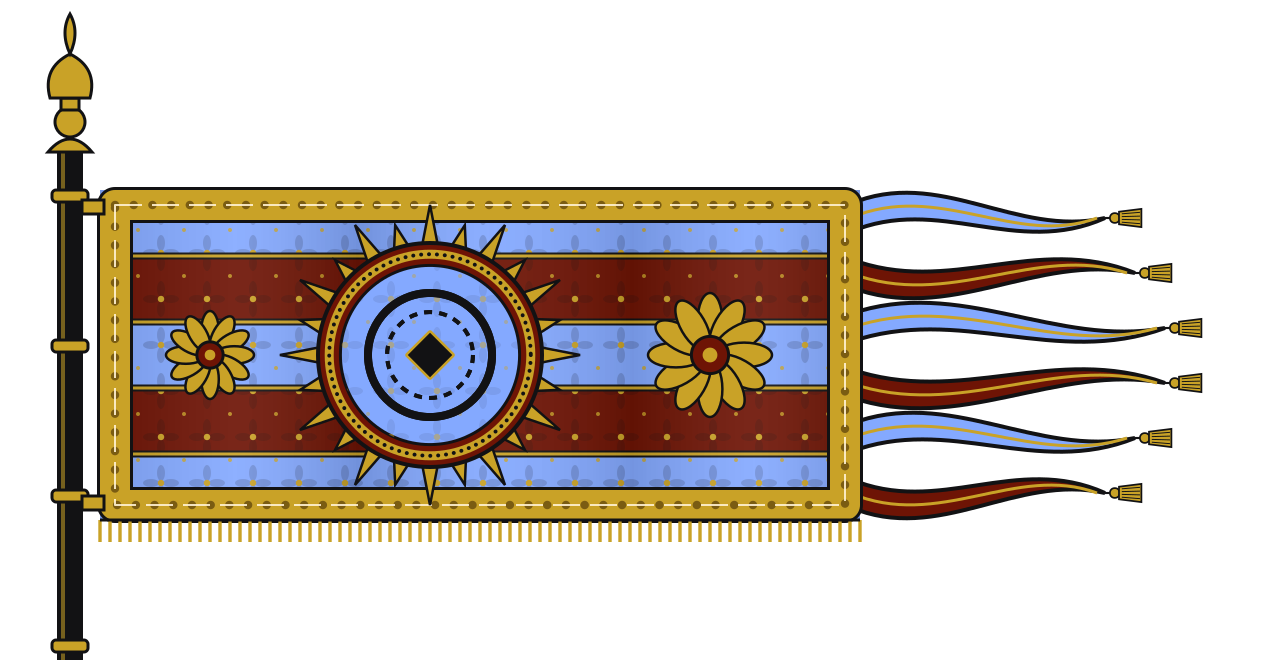
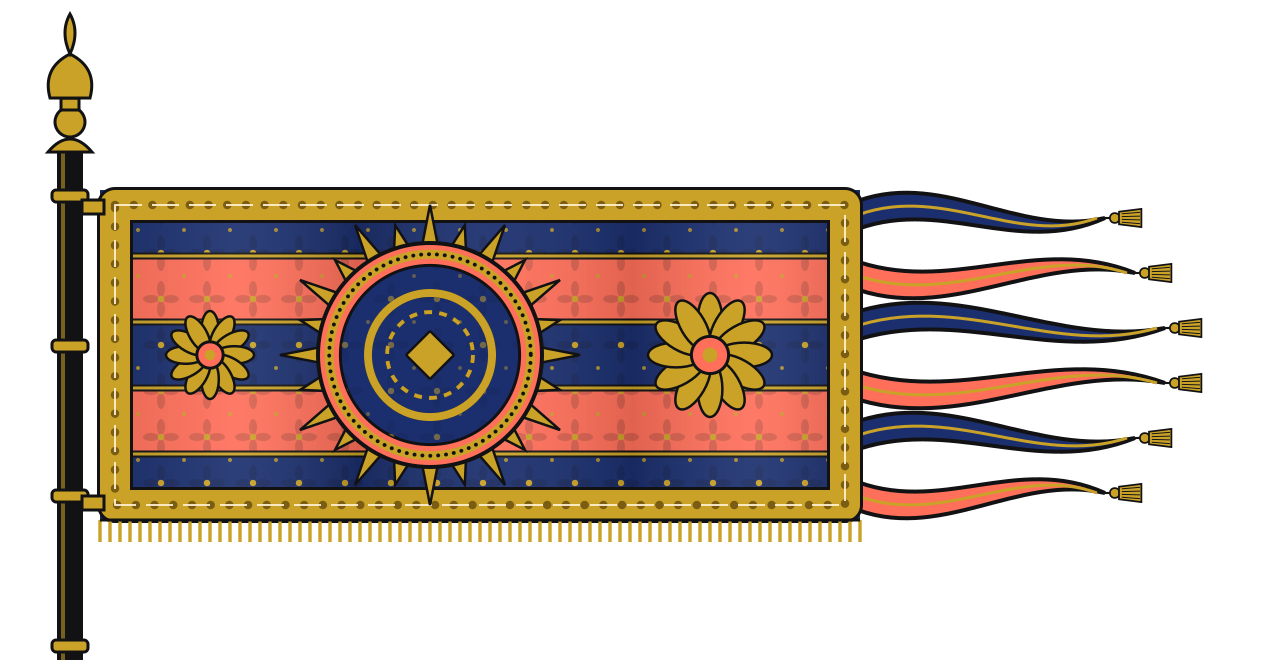
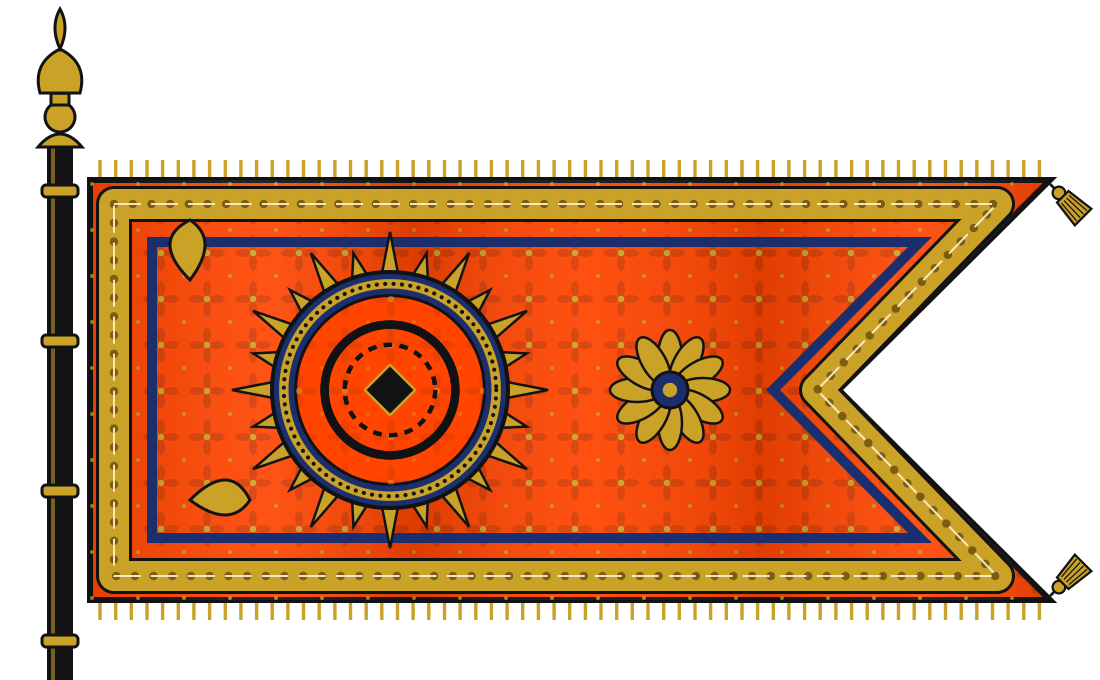
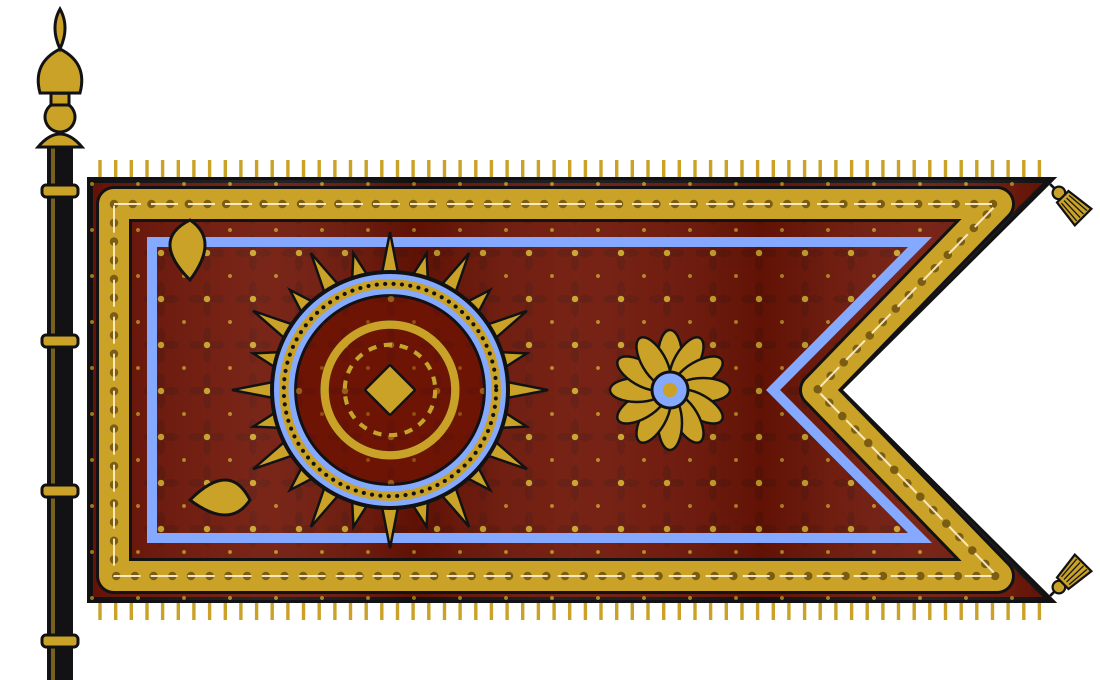
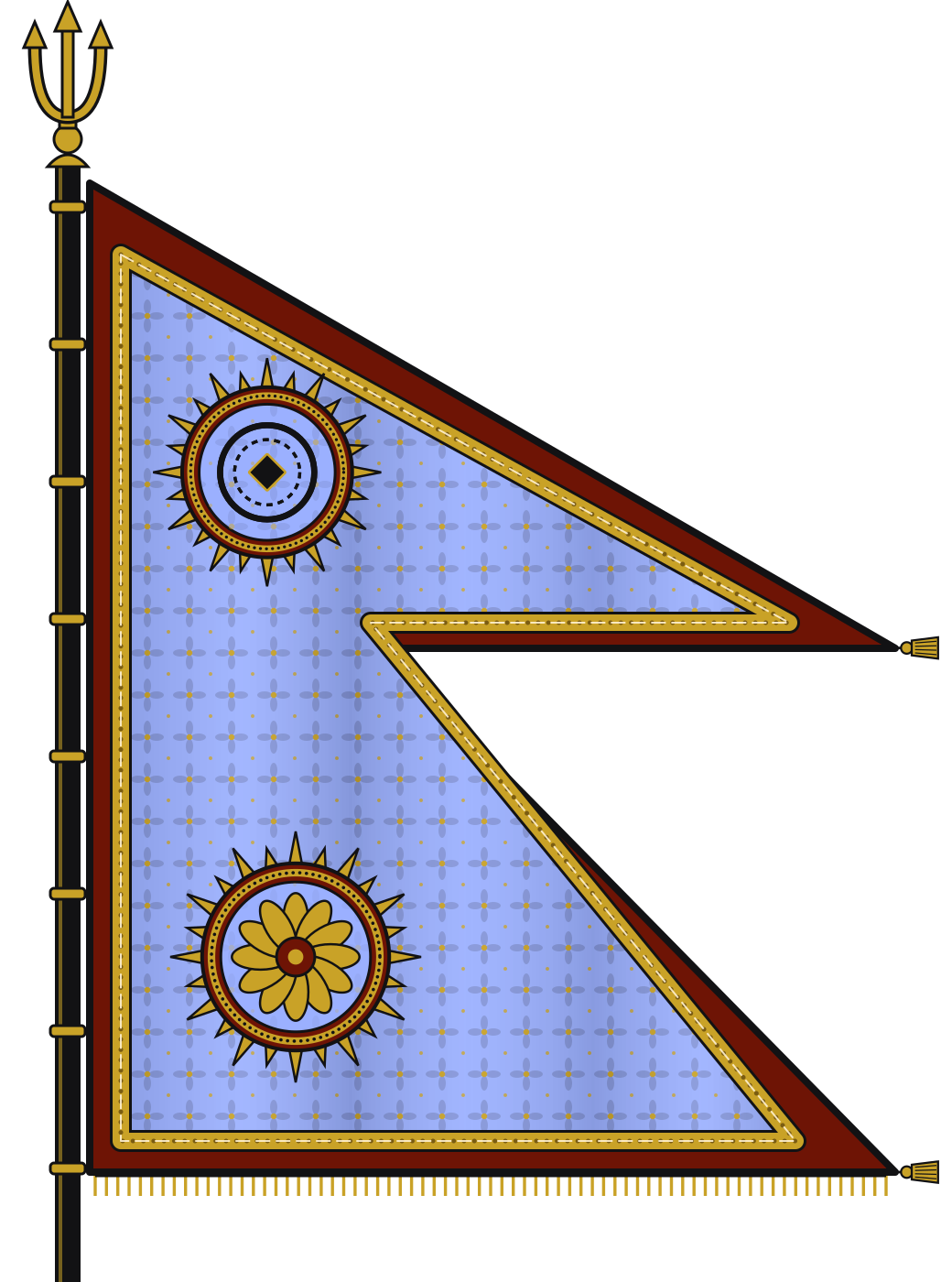
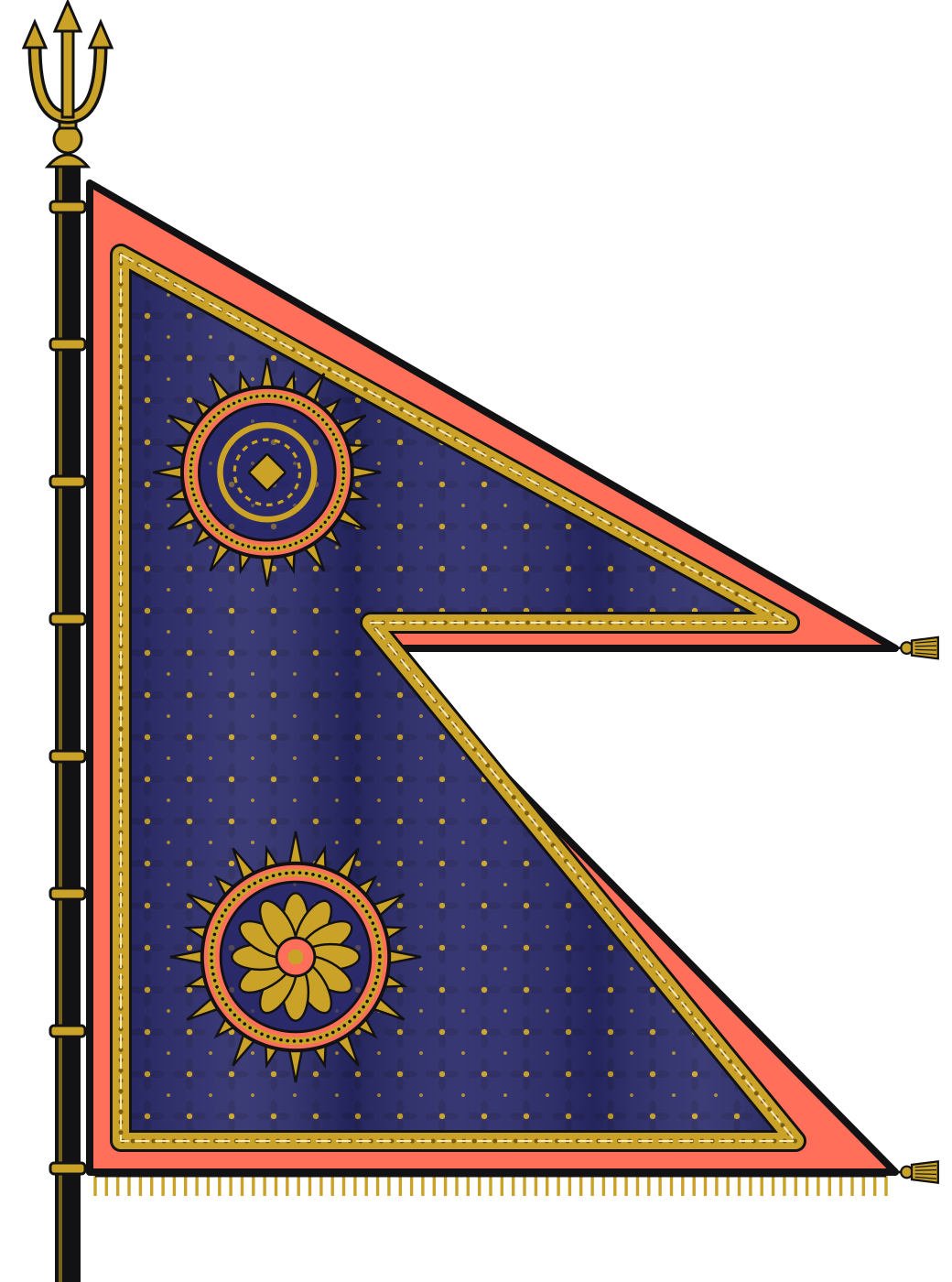

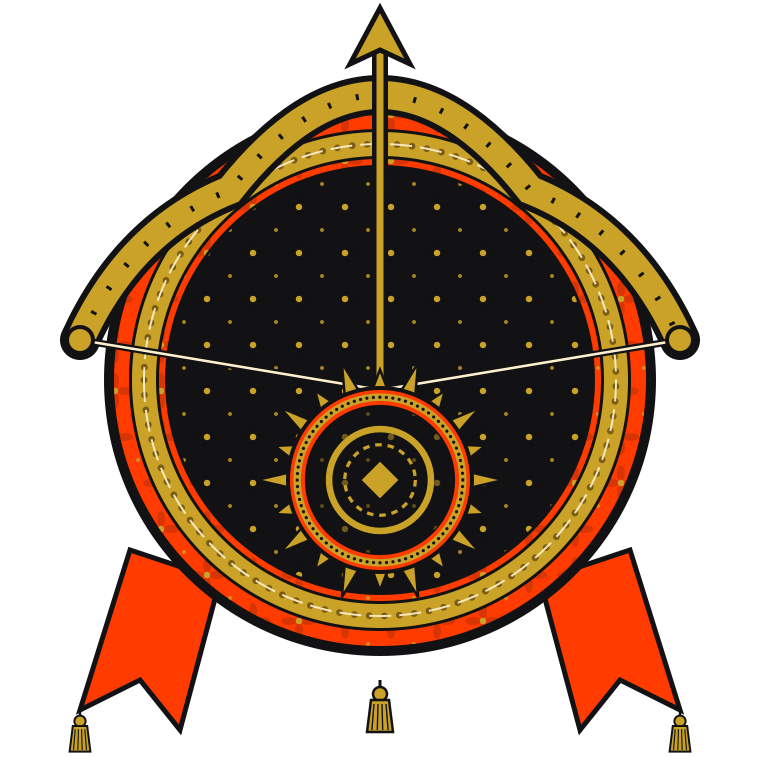
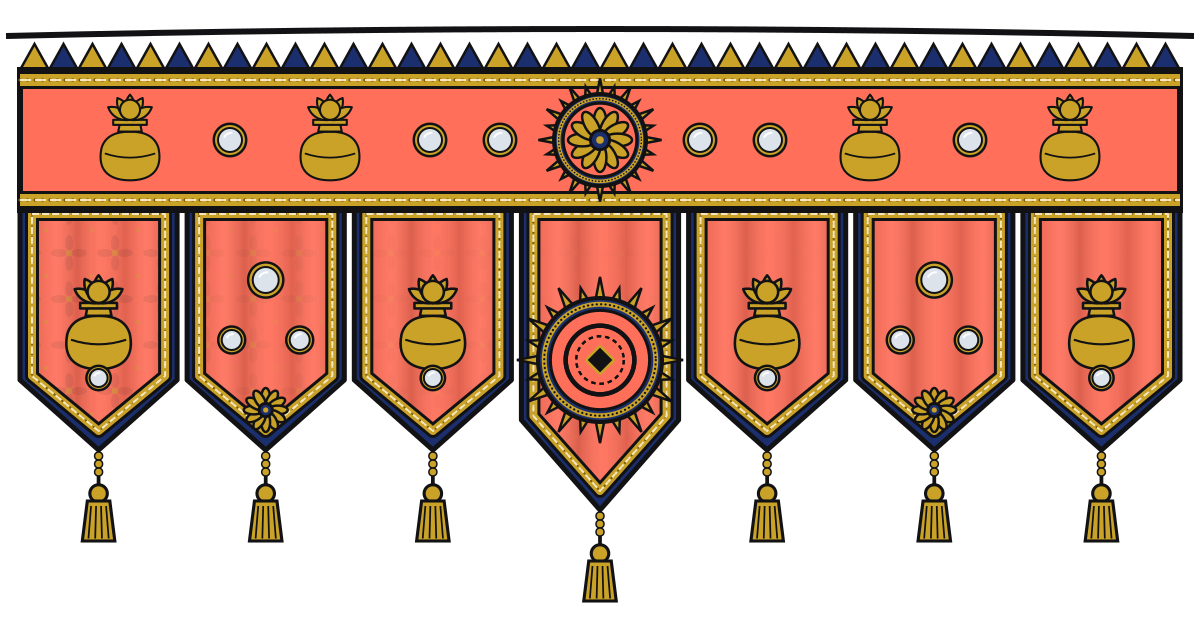
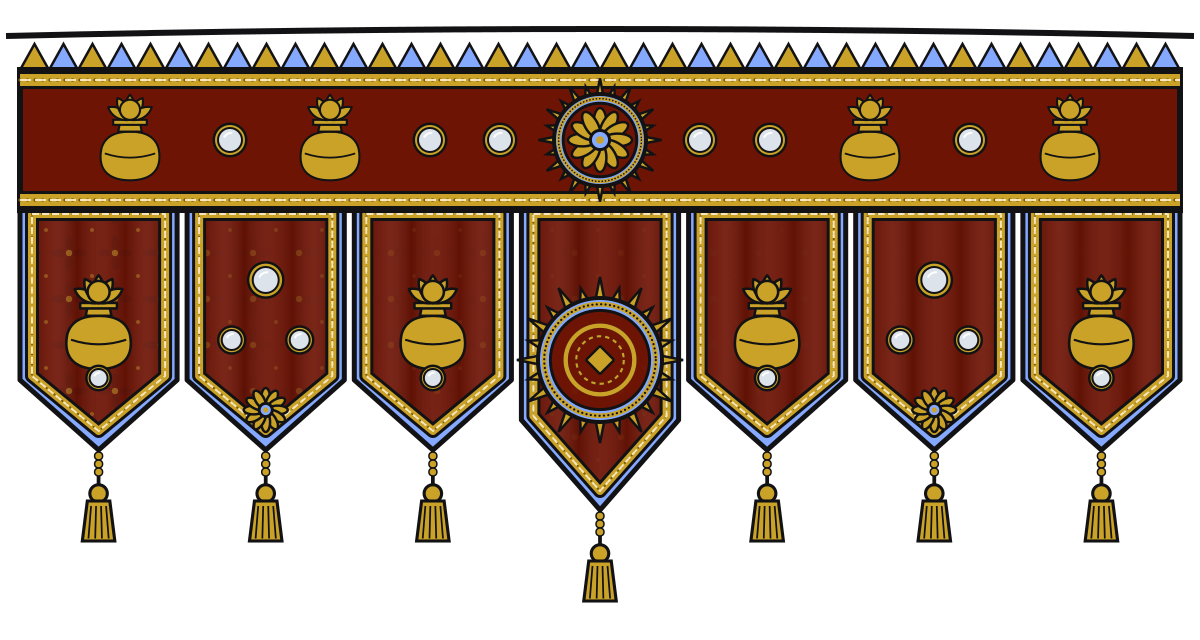

Historic banner
The princely state of Tripura (Manikya kings) had its own state flag (verify design)
New flag types
| Accessory | For this clan | Basis |
|---|---|---|
| A9 Pota-dhvaja · ship and trade flag For ships, caravans and markets | Not yet designed for this clan | Design |
| A10 Utsava-patāka · festival flag Light, bright flag for fairs and festivals | Not yet designed for this clan | Design |
| A11 Shoka-dhvaja · mourning flag White cloth with the emblem outline in the clan's metal | Not yet designed for this clan | Design |
7. Regalia
| Accessory | For this clan | Basis |
|---|---|---|
| E1 Chhatra · house parasol The ceremonial umbrella | Not yet designed for this clan | Design |
| E2 Chamara · fly-whisks The pair of whisks beside the head of the house | Not yet designed for this clan | Design |
| E3 Danda · staff of office Staff or scepter | Not yet designed for this clan | Design |
| E4 Simhasana · seat The seat of the house, covered in clan cloth | Not yet designed for this clan | Design |
| E5 Khetaka · shield A round shield; the Changi and Dhanush are its flag forms | Not yet designed for this clan | Regional tradition |
| E6 Kula-ayudha · clan weapon The weapon the clan honours | Not yet found for this clan | Under research |
8. Worn
| Accessory | For this clan | Basis |
|---|---|---|
| F1 Kula-vastra · clan cloth The clan's woven pattern in its kit colours | Not yet designed for this clan | Design |
| F2 Kirti-vastra · honour cloth A cloth earned for a deed, not inherited | Not yet designed for this clan | Design |
| F3 Kula-mala · garland flower The flower or leaf the clan wears as a garland | Not yet found for this clan | Under research |
| F4 Chinha · house pin A metal badge with the pin emblem | Not yet designed for this clan | Design |
9. Records
| Accessory | For this clan | Basis |
|---|---|---|
| H1 Clan words A traditional line in the native script | Shri Shri Durga Radha Napta Vijaya Ratnapure · “Coin legend in Latin letters, as Banglapedia gives it; the coins are in Bengali script and no translation is given in the source” Clan words · legend on the coins of the Tripura rulers[4] | Documented |
| H2 Biruda · titles The house's title or titles | Manikya: the cognomen of all Tripura kings until 1947 | Documented |
| H3 Prashasti · praise genealogy The lineage as written at the head of a grant | The Rajmala: the kings' chronicle in Bengali verse, which traces the line from the Moon and Druhyu, son of Yayati. | Documented |
| H4 Vahi · clan register The book of the clan's births, marriages and deaths | Not yet found for this clan | Under research |
| H5 Rana-ghosha · war cry The clan's cry in battle or celebration | Not yet found for this clan | Under research |
10. VishwaVit · knower of the world
Game values are design choices for this project, not historical claims.
References
- Wikipedia, Tripuri people, read 2026-11-08, link
- Wikipedia, Twipra Kingdom, read 2026-11-08, link
- Wikipedia, Rajmala, read 2026-11-08, link
- Vasant Chowdhury, Tripura Coinage, Banglapedia, read 2026-11-08, link
- "Chaturdasa Devata", Wikipedia (English), read 10 October 2026.
- Wikipedia, Kokborok, read 2026-11-08, link
- History, Mata Tripura Sundari Temple, Government of Tripura.
- Wikipedia, Culture of Tripura, read 2026-11-08, link
- Tripura Sundari Temple, Wikipedia.
- Wikipedia, Kokborok literature, read 2026-11-08, link
- Wikipedia, Debbarma, read 2026-11-08, link
- Banglapedia, Tripuris, The, read 2026-11-04, link
- Vajiram and Ravi, Tribes of Tripura, List of 19 Tribal Communities, read 2026-10-28, vajiramandravi.com
- Wikipedia, Sumui, read 2026-10-28, link
- Asia Inch, Musical instruments and sound creations of Tripura, read 2026-10-28, link
- National Virtual Library of India, Sumui, read 2026-10-28, link
- Wikipedia, Music of Tripura (read 25 Oct 2026, Veena discovery sweep).
- Wikipedia, Tripuri games and sports, read 2026-11-04, https://en.wikipedia.org/wiki/Tripuri_games_and_sports
- Dipankar Majumder, A Study on Traditional Sports and Games of Tripuris, Int. J. Physiology, Nutrition and Physical Education 11(4), 2026 (abstract page), read 2026-11-04, link
- Khumtia Debbarma (trans. Hamari Jamatia), How Tripura's tribal communities play Tengdang, Adivasi Lives Matter, 16 Oct 2020, read 2026-11-02, link