The Thakar are an Adivasi tribe of Maharashtra, originally of hilly areas and now spread across the state[1]. The Quint reports that the Thakar have lived at Pinguli for over 400 years, and that, by community tradition, their artists worked as spies for Maratha kings, Shivaji among them[2]. Their chitrakathi paintings on fallen peepal leaves and their string, leather and wooden puppets are the craft they are known for; Parshuram Gangavane received the Padma Shri in 2026 for preserving Thakar tribal art[3]. The Thakar are listed among Scheduled Tribes in Maharashtra (list dated 09-07-2024, Atlas), and the 2011 census row that names them with Thakur and Ka Thakur counts 5,67,968 across the state[4].
01Faith and deities
The KulDevi, from the Atlas (family Navadurga; homeland shrine at Karla). No fetched source ties the Thakar to Ekvira; Wikipedia's Ekvira page names the Koli, Aagri and Chandraseniya Kayastha Prabhu, not the Thakar[5]
Ekvira Aai of Karla, Sahyadri[5]
The presiding goddess of the clan's homeland or capital: a link of place, not a recorded clan tie.
| Deity or tradition | Place in the clan's life | Evidence |
|---|---|---|
| Forest deities and benevolent spirits | In the Thakar Ramayana; none named (The Quint) | [2] |
02Temples
No Thakar temple is named in the extracts. The Ekvira link comes from the Atlas only.
Built by the clan
Not recorded.
Given patronage or grants by the clan
| Temple | Deity | What the clan gave | When | Where |
|---|---|---|---|---|
| Temples assigned to the tribe (not named) | Navratri | Nine nights of singing and performance; villagers give 1 kg of rice as dhan | Navratri | Not named[3] |
03Languages and scripts
| Language or script | Kind | Under the clan | Evidence |
|---|---|---|---|
| Marathi living | Indo-Aryan language; spoken by Parshuram Gangavane (FPJ) | Parshuram Gangavane (FPJ) | [3] |
04Books and literature
The extracts name no Thakar-authored text. The works below are cited by others and were not read in full.
Written during the clan's history
| Work | Author | Kind | When | Link to the clan |
|---|---|---|---|---|
| Castes and Tribes of Southern India, vol. 7 | Edgar Thurston and K. Rangachari | Ethnographic survey entry on the Thakur | 1909 | [6] |
| Tribal Housing Issues | Robin D. Tribhuwan | Study cited on Wikipedia | 2005 | [1][7] |
| Thakurs of the Sahyadri | Chapekar | Study cited by Everyculture | 1960 | [8] |
| Milestone of Mannewar Tribe | Bone | Study cited for a caste-certificate excerpt | 2021 | [7] |
Given patronage by the clan
Not recorded.
05Thinkers and scholars
| Name | Field | Era | Contribution |
|---|---|---|---|
| Robin D. Tribhuwan | Writer on tribal housing | 2005 | Recorded Nagewadi, Raigad, as inhabited only by Thakar (cited on Wikipedia)[1][7] |
No Thakar scholar is named in the extracts beyond the studies cited above.
06Art and architecture
The Thakar's craft is the best-documented part of the record: the art forms are named by the FPJ and The Quint.
Painting and wall art
| Art form | What it is | Era | Evidence |
|---|---|---|---|
| Chitrakathi | Painting on fallen peepal leaves; red pigment from earth, black from ash, green from leaves (FPJ) | Museum paintings up to 450 years old (FPJ) | [3] |
Sculpture and temple art
Not recorded.
Temple and building architecture
Not recorded.
Weaving and textiles
| Art form | What it is | Era | Evidence |
|---|---|---|---|
| Woollen blankets | Some twist woollen threads for blankets (Bombay Gazetteer, quoted by Thurston; identity with the Thakar probable, not certain) | 1909 (as quoted) | [6] |
Clothing and jewellery
Not recorded.
Coins, pottery and crafts
| Art form | What it is | Era | Evidence |
|---|---|---|---|
| Sheesham-wood puppets | Puppets carved from sheesham wood (FPJ) | Not dated | [3] |
| Tamra leather puppets | Leather shadow puppetry (The Quint) | Not dated | [2] |
| Kalsutri bahulya | String puppetry (FPJ, The Quint) | Not dated | [3] |
07History
Hill origins (oral)
The Free Press Journal gives the community's ancestors as traced to the Sahyadri ranges, living isolated in the jungle[3].
Shivaji and the Maratha years (community tradition)
The FPJ says Shivaji Maharaj reportedly brought the tribe out of isolation and granted land "around Pilguri" (as printed); the tribe reportedly gathered local intelligence and signalled details in wars[3]. The Quint describes the artists moving through villages with stories while working as spies for Maratha kings[2]. These are community accounts, not inscriptions.
Pinguli and the Sawantwadi patronage
The Quint says the Thakar have lived in Pinguli over 400 years, and that the Raja of Sawantwadi was a patron who helped the chitrakathi artists move to handmade paper[2].
Decline and records
The FPJ says the community's fortunes declined after Shivaji's reign and that many artisans left the traditions after Independence[3]. A caste certificate of 15 December 2000 from the Baramati sub-divisional officer recognised the Thakar as a Scheduled Tribe; the text is a court-petition excerpt cited in Bone (2021), as given on Wikipedia[1].
08Journey and migrations
The sources give a hill origin and a settlement at Pinguli, with no dates for the move.
| When | From | To | Why | Evidence |
|---|---|---|---|---|
| Earlier (oral) | Sahyadri ranges, jungle | Land granted around Pilguri, as printed | Shivaji reportedly brought them out of isolation | [3] |
| Over 400 years to 2016 | Not stated | Pinguli | Settled at Pinguli (The Quint) | [2] |
09Seats and lands
| Place | Role | Where today |
|---|---|---|
| Pinguli | Home village for over 400 years; patron the Raja of Sawantwadi (The Quint) | Near NH 66 (FPJ) |
| Nagewadi | Hamlet exclusively inhabited by Thakar (Tribhuwan 2005, as cited on Wikipedia) | Pathraj village, Karjat tahsil, Raigad |
| Hill villages near Maratha forts | Historical polity | Raigad, Thane, Nashik, Pune |
10Notable figures
| Name | Role | Era | Known from |
|---|---|---|---|
| Shivaji | Maratha king; tradition says he reportedly brought the tribe out of isolation and used their spies | Maratha period | [3][2] |
| Raja of Sawantwadi | Patron who helped the chitrakathi artists move to handmade paper | Not dated | [2] |
| Parshuram Gangavane | Keeps the Thakar art; runs the Thakar Adivasi Kala Aangan Museum and Art Gallery near Pinguli | Living; Padma Shri 2026 (per article date) | [3] |
| Eknath and Chetan Gangavane | Sons of Parshuram; Chetan says the community has 11 rare art forms | Living | [3][2] |
11Allies, rivals and marriages
| People | Relationship | When |
|---|---|---|
| Maratha kings | Employers of the Thakar spies, by community tradition | Maratha period |
| Katkari (Kathodi) | The Thakar hold more land and wealth and power over the Katkari, who often work for Thakar and non-tribal households | Today |
| Asur | The Asur accept food from Thakurs (Wikipedia); the Thakurs named there are not identified with the Thakar | Under research |
| Thakur community of Palghar | A tarpi player is named as of the Thakur community (PARI); the ST list counts Thakur and Thakar in one row, so the link is probable, not confirmed | Today |
| Thakkar | Not the same people; Wikipedia warns against confusing the two | — |
12Society and livelihood
The Thakar are a hill people of Maharashtra with a settled base at Pinguli and a hamlet in Raigad. The Quint describes the community as well educated, with doctors, engineers and teachers (a claim about present-day members, attributed to the Quint).
Government and social order
| Institution or group | What it was | Evidence |
|---|---|---|
| Nagewadi hamlet | Hamlet in Pathraj village, Karjat tahsil, Raigad, exclusively inhabited by Thakar | [1] |
| Pinguli families | Parshuram Gangavane and his sons keep the Thakar art; their museum near Pinguli has about 1,000 inherited paintings | [3] |
| Land and power | The Thakar hold more land and wealth than the Katkari and hold power over them (Round Table India) | [9] |
| Insult tied to begging | Gangavane reports being insulted with a remark about begging (romanised quote in the FPJ); the Bombay Gazetteer, quoted by Thurston, says the Thakurs, a group not yet confirmed as this people, lived chiefly by begging and ballad singing | [3][6] |
Livelihood over time
| Era | Livelihood | Evidence |
|---|---|---|
| Historically | Wild berries and natural resources (FPJ); by tradition, spies and informants for the Maratha kings (The Quint) | [3][2] |
| 1909, quoted from the Bombay Gazetteer | Some twist woollen thread for blankets; the Thakurs live chiefly by begging and ballad singing, as quoted (identity with this people probable, not certain) | [6] |
| Modern | Painting, puppetry and performance as art forms; mentoring of youth by the Gangavane family | [3] |
13Sub-clans and related clans
The Thakar's branches come from the Atlas ('Ka and Ma Thakar branches') and the Maharashtra list, which names Thakur, Thakar and Ka Thakur together. The sources name no exogamous clans (gotras) beyond these.
| Clan | Relation | Where | Size | In the Atlas | Evidence |
|---|---|---|---|---|---|
| Ka Thakar | Branch | Maharashtra | new clan candidate | Atlas ('Ka and Ma Thakar branches'); 'Ka Thakur' in the ST list row[4] | |
| Ma Thakar | Branch | Maharashtra | new clan candidate | Atlas ('Ka and Ma Thakar branches') | |
| Katkari (Kathodi) | Related people | Raigad, Thane; Panvel hamlets | 235,022 in Maharashtra, 2001 figure as cited[9] | ST-124 | [9] |
Clans marked "new clan candidate" are not in the Atlas yet.
14Surnames
The extracts give one surname for the Thakar: Gangavane, the family of the Pinguli artists. No count of bearers is sourced.
| Surname | Clan or sub-clan | Where | People with this surname | Also used by other communities |
|---|---|---|---|---|
| Gangavane | Thakar (Pinguli family) | Pinguli, near NH 66 (FPJ) | not yet counted | Not checked |
Counts are of everyone with the surname, from the cited source and year, not only members of this clan. A surname shared with other communities says nothing about any one person's origin.
15Songs and music
No Thakar song text is in the extracts, and none is written here. Ballad singing and Navratri singing are named (FPJ, Thurston).
None recorded yet.
Instruments and styles
| Instrument or style | What it is | Evidence |
|---|---|---|
| Tarpi (तारपी) | A bamboo and dried-gourd instrument about five feet long; played by Raju Dumargoin of the Thakur community at home in Gunadajapada, Palghar, during Dussehra and Navratri (PARI); identity with the Thakar not confirmed | [10] |
16Poems, lullabies and children's rhymes
None recorded yet.
17Stories, legends and proverbs
Stories and legends
| Story | What happens | Told by | Evidence |
|---|---|---|---|
| Ramayana and Mahabharata | Retold through painting and puppetry (The Quint); ancestors recounted Mahabharata tales, and puppets depict mythological heroes (FPJ) | Thakar painters and puppeteers | [2][3] |
| Thakar Ramayana | Includes forest deities and benevolent spirits, and folk tales of spirits and battles with demons | Thakar tradition | [2] |
| Spy tradition | Artists moved through villages with stories and gathered local intelligence for the Marathas (community tradition) | Community tradition | [3][2] |
Proverbs and sayings
Not recorded.
18Festivals and fairs
| Festival or fair | When | Where | What happens |
|---|---|---|---|
| Navratri singing | Nine nights | Temples assigned to the tribe (not named) | The tribe sings and performs all nine nights; villagers give 1 kg of rice as dhan[3] |
| Ganeshotsav | Ganesh festival | Not stated | Women perform the Fughdya[2] |
| Thakar weddings | At weddings | Not stated | Radha Nrutya, with a man dressed as Radha[2] |
| Ram Navami | Ram Navami | Thakar and Katkari | Celebrated by the Thakar and Katkari[9] |
19Food, dress and games
Food
| Item | What it is | Evidence |
|---|---|---|
| Wild berries | The community historically survived on wild berries and natural resources (FPJ) | [3] |
Dress
Not recorded.
Games and martial arts
Not recorded.
Tags: living still practised · revived brought back after a break · lost known only from records · research reported but not yet confirmed from a source. Songs and poems under copyright are listed by title only; restricted or sacred material is noted without its content.
20Status today
The Thakar are listed as a Scheduled Tribe in Maharashtra (list dated 09-07-2024, Atlas)[7]. A living artist, Parshuram Gangavane, received the Padma Shri in 2026 for preserving Thakar tribal art[3].
Who carries the name today
| Community | Link | Basis | Evidence |
|---|---|---|---|
| Gangavane family (Pinguli) | Chitrakathi and puppet artists; museum near Pinguli | Documented | [3] |
Recognised heritage
| What | Recognition | Evidence |
|---|---|---|
| Padma Shri | Parshuram Gangavane, 2026 (per the article's date), for preserving Thakar tribal art | [3] |
| State felicitation | Parshuram Gangavane, 2009 | [2] |
| Museum | Thakar Adivasi Kala Aangan Museum and Art Gallery, founded May 2006 near Pinguli; about 1,000 inherited paintings | [2][3] |
| Guru-Shishya Parampara | Ministry of Culture programme: 8 programmes, 150+ students, 100+ workshops (FPJ) | [3] |
Not yet reviewed by the community.
21For children
Painting on a Peepal Leaf
Long ago, according to community accounts, the Thakar lived in the hills of the Sahyadri, in the jungle. They painted pictures on leaves that had fallen from a peepal tree. For red they used earth, for black they used ash, and for green they used leaves. Some Thakar carved puppets from sheesham wood, and the puppets showed heroes from old stories. Today Parshuram Gangavane keeps this art alive at a museum near Pinguli.
22Across the project
| Project | What carries this clan | Status |
|---|---|---|
| Atlas of the Janas | Places named in the extracts: Pinguli (near NH 66), Nagewadi in Karjat tahsil, Raigad, Gunadajapada in Palghar, and Panvel (Katkari hamlets) | |
| KulDevi and GrahDevi | KulDevi Ekvira, family Navadurga, homeland shrine at Karla. GrahDevi forms: Shailaputri, Brahmacharini, Chandraghanta, Kushmanda, Skandamata, Katyayani, Kalaratri, Mahagauri, Siddhidatri (both) | |
| Planet naming | Under research | |
| Renaming and waters | Under research |
23Open questions
- Thakar, Thakur and Ka Thakur share one ST row. Do the Palghar Thakur (PARI) and the Thakur of Thurston and the Encyclopedia.com article belong to this people? Keep the Rajput Thakur and the Thakkar apart until a source links them.
- Sinclair (1873) names the Thakurs of the Sahyadri hills as users of the halda spear, and Chapekar (1960) studied them. Confirm that these are the Thakar before any arms item is added.
- Ka Thakar and Ma Thakar: what the branches are, their size, their homeland and whether they marry within the group.
- Own deities: the Encyclopedia.com Thakur list is general and does not name the Thakar. Find a source for the Thakar's own deities, and for any link to Ekvira.
- Native script: the header is left blank. No extract gives the Thakar's own script form; PARI gives ठाकुर for the Thakur community only. Confirm the form with a source.
- Temples named for Navratri singing: the FPJ does not name them. Find the temples.
- Gangavane surname: whether other communities use it is not sourced, so the shared flag is left unchecked.
- Shivaji and the spy tradition are community accounts. Find an inscription or a Maratha record, or keep them as tradition.
- Bombay Gazetteer volumes for Kolaba (XI) and Thana (I, III) on nvli.in, and Modi's Thakurs of Matheran (Heidelberg), are not yet read.
- Powada and Gondhal: what the Thakar's versions are, and whether any song text may be quoted (rights).
- Thakar Ramayana: the forest deities and spirits are unnamed in the Quint. Find the text or a named list.
- Language vitality and dialect of Thakar speech under Marathi.
- Padma Shri date: the FPJ article is dated 7 Feb 2026; confirm the year of the award.
- Faith: the Kiwix Wikipedia extract (2023 snapshot) calls the tribe an 'Adivasi Hindu tribe'; the faith row says 'Not stated'. The present-day religious label is not carried on this page; settle it with a current source.
- Thakkar: the 'Also known as' row lists Thakkar as an FPJ spelling, while the clans text says Thakkar is not listed here and Wikipedia says the two are not the same. Decide which stands.
24Astitva
अस्तित्व · being, existence: everything by which the clan is known
The objects the extracts record are craft and performance items: chitrakathi paintings on peepal leaves, sheesham and leather puppets, and string puppets[3][2]. None is a seal, coin, totem or clan symbol.
Every clan has every accessory, royal objects included. Each one says how it is known: Documented This clan's own object is recorded. · Regional tradition Recorded for the region or for peoples like this one, not for this clan. · Design Made for this project, with no historical claim. · Under research To be found for this clan from sources. Legends and titles are written in the clan's own script.
1. Seals and coins
| Accessory | For this clan | Basis |
|---|---|---|
| B1 Rajamudra · house seal Round seal with the clan emblem and a short legend in the clan's script | Not yet designed for this clan | Design |
| B2 Anguliya-mudra · signet ring Personal seal ring of the head of the house | Not yet designed for this clan | Design |
| B3 Chhapa · house stamp Ink or block stamp for letters, goods and cloth | Not yet designed for this clan | Design |
| B4 Tamrapatra · charter plate Copper-plate grant on a ring, closed with the house seal | Not yet designed for this clan | Design |
| B5 Shreni-mudra · guild or trade seal Seal for the clan's trade, craft or caravan | Not yet designed for this clan | Design |
| C1 Clan coin Emblem or deity on one side, a legend in the clan's script | Not yet designed for this clan | Design |
| C2 Coin die The die that strikes the coin | Not yet designed for this clan | Design |
2. Living symbols
| Accessory | For this clan | Basis |
|---|---|---|
| I1 Totem trio The tree, bird and animal the clan protects | Not yet found for this clan | Under research |
| I2 Kaval-maram · guardian tree The tree that stands at the clan's seat | Not yet found for this clan | Under research |
3. Stone and gate
| Accessory | For this clan | Basis |
|---|---|---|
| G1 Torana · gateway The built gate of the seat; the cloth Toran hangs in it | Not yet designed for this clan | Regional tradition |
| G2 Viragallu · hero stone Carved panel stone for a member who died defending the clan | Not yet designed for this clan | Regional tradition |
| G3 Kula-shila · clan stones Standing and table stones that remember the ancestors | Not yet designed for this clan | Design |
| G4 Jayastambha · victory pillar A pillar raised for a victory | Not yet designed for this clan | Design |
| G5 Sima-shila · boundary stone Marks the clan's land, with a line in the native script | Not yet designed for this clan | Design |
4. Sounds
| Accessory | For this clan | Basis |
|---|---|---|
| D1 Pancha-mahashabda · five great sounds The right to five instruments | Not yet designed for this clan | Design |
| D2 Shankha · clan conch The clan's own named war conch | Not yet designed for this clan | Design |
| D3 Murasu · house drums Three drums: war, charity and justice | Not yet designed for this clan | Design |
5. Kit: colours, metals and emblems
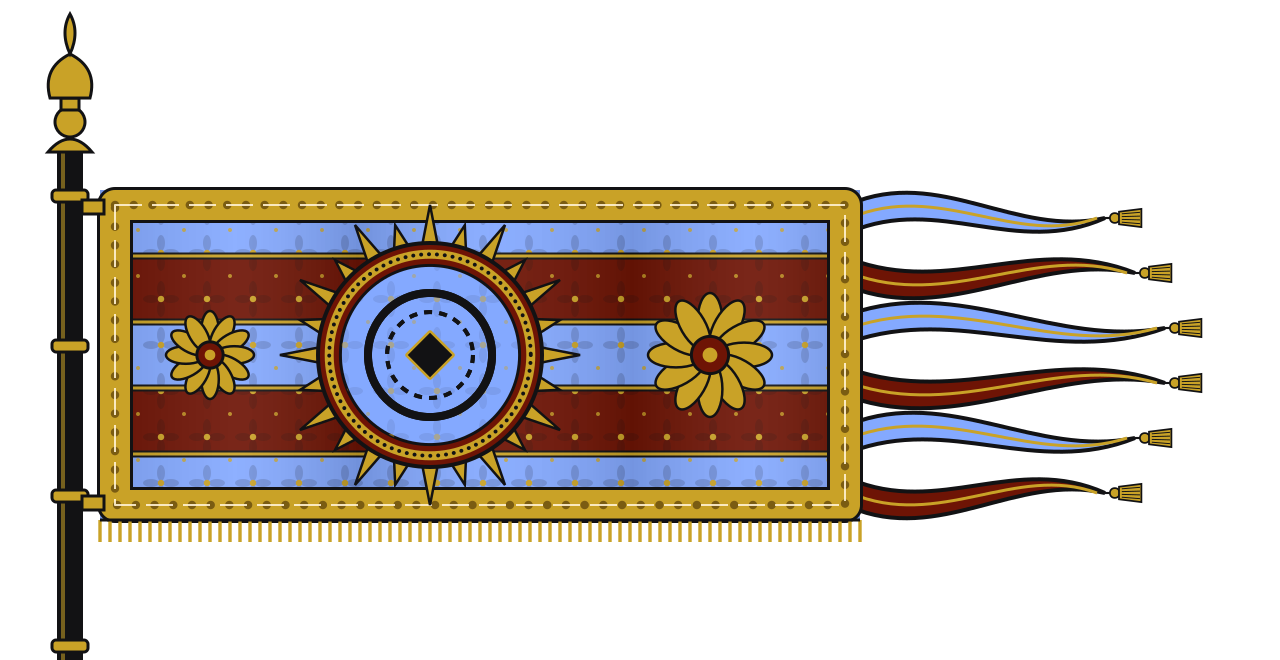
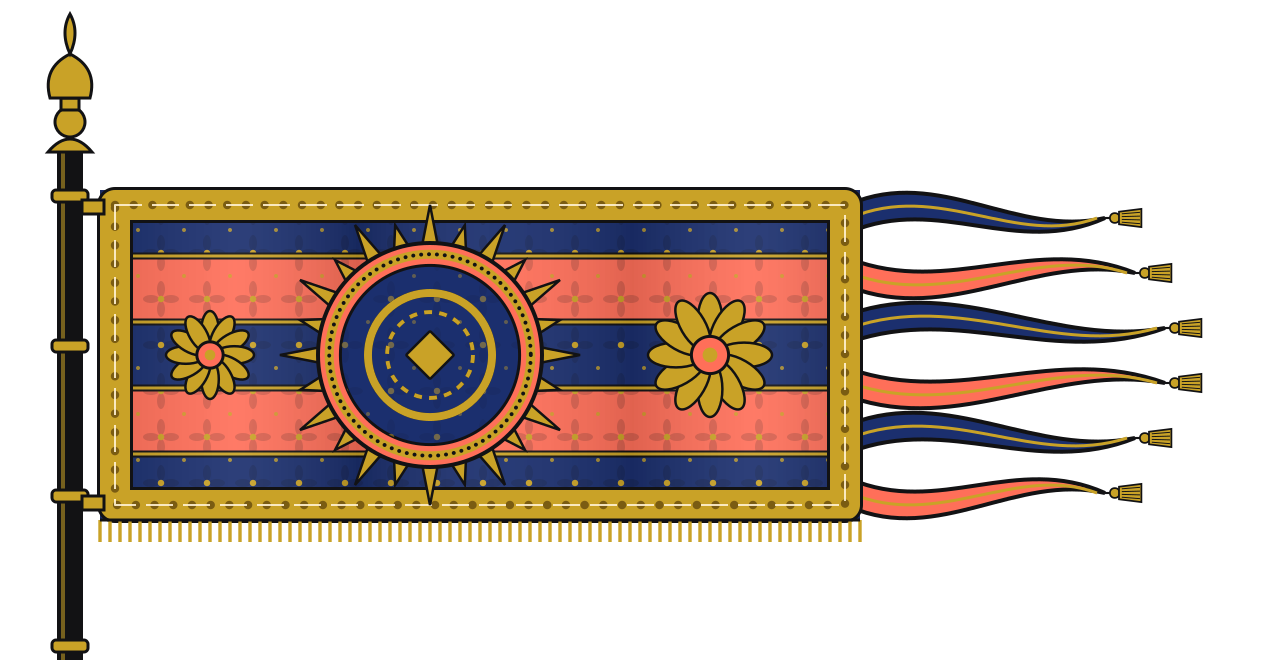
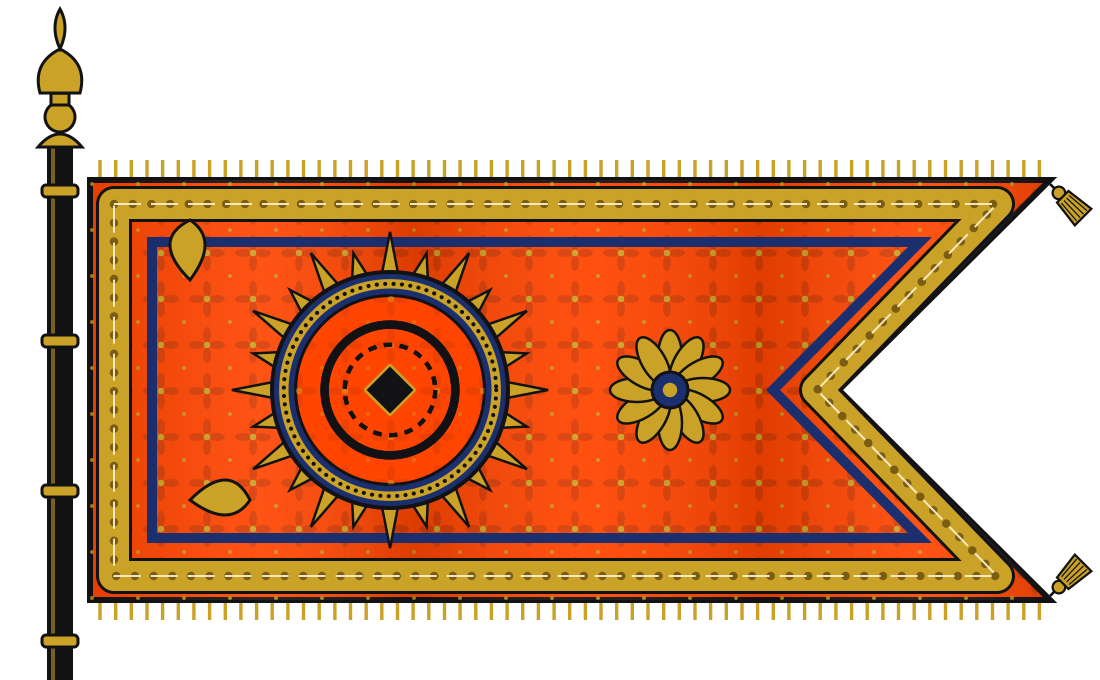
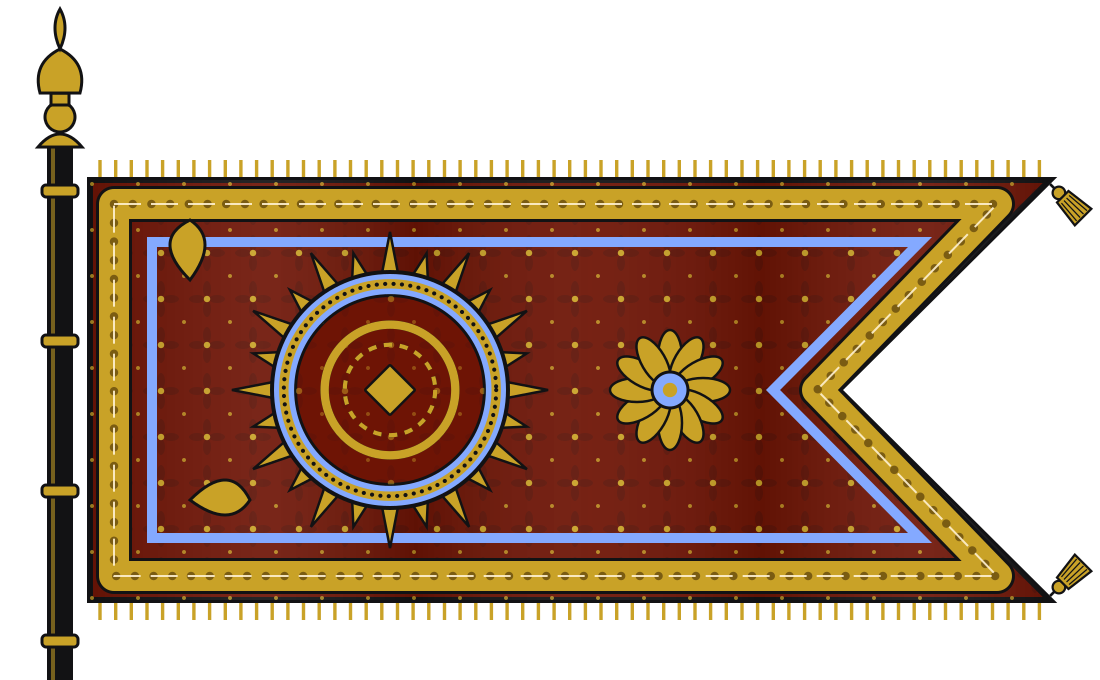
The main emblem (a hill) and second image (a karvi flower spray) come from the Atlas as design ideas, not documented symbols. No seal, coin, totem or clan cry of the Thakar is in the extracts.
| Part of the kit | This clan |
|---|---|
| Field | Deep Brick #7E2A1E |
| Accent | Deep Cosmic Blue #9BB0FF |
| Emblem colour | Metallic Gold #C9A227 |
| Zari metal | Gold |
| Main emblem | A hill |
| Second image | A karvi flower spray |
| Night and day | Every visual accessory has two versions: by night the emblem on the dark field, by day the clan's field colour on cloth woven from its metal. |
6. Flags
Every clan has every flag type; the type says the occasion and the colours say the clan. The outlined card is the flag the Atlas assigns.
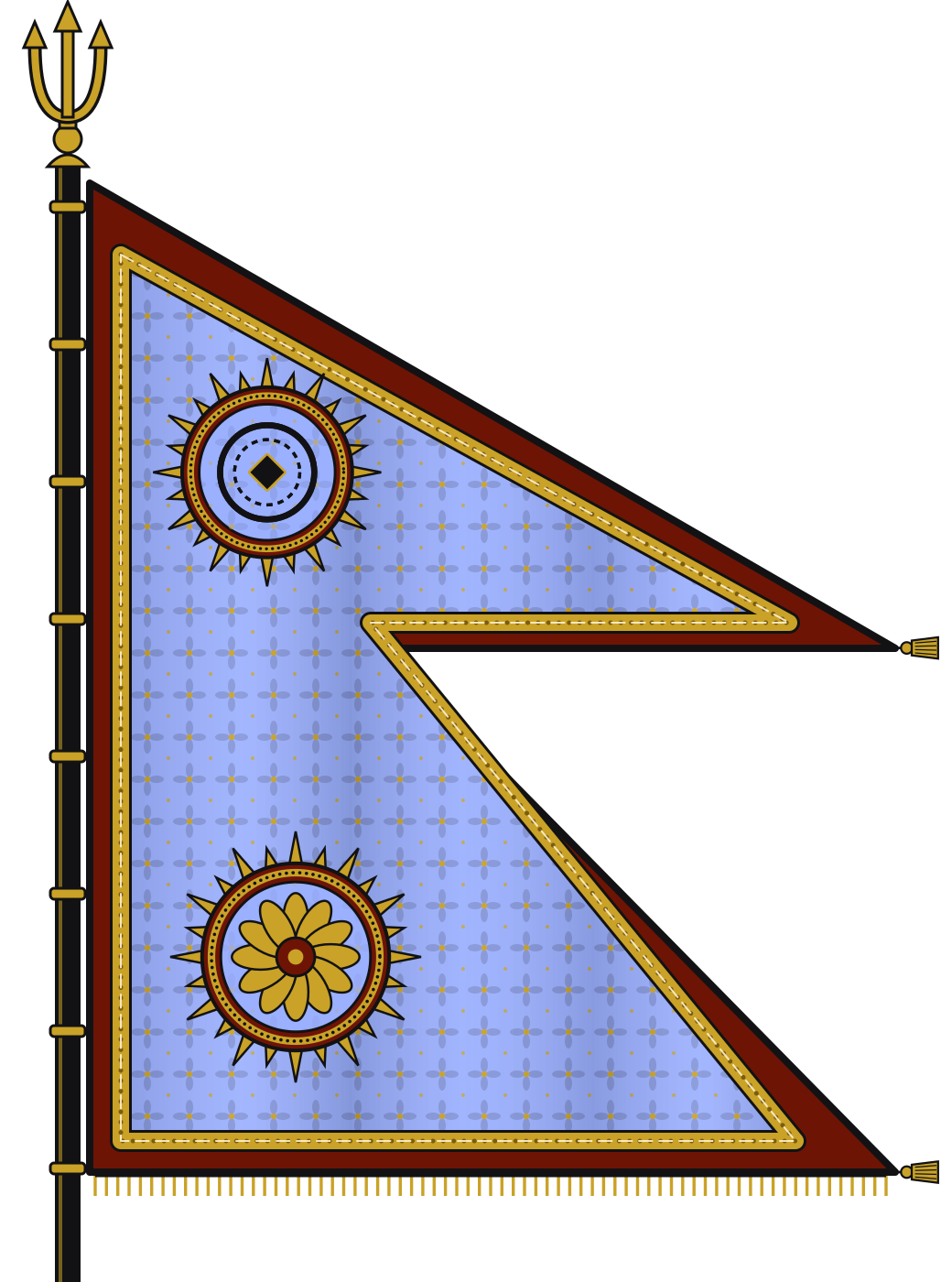
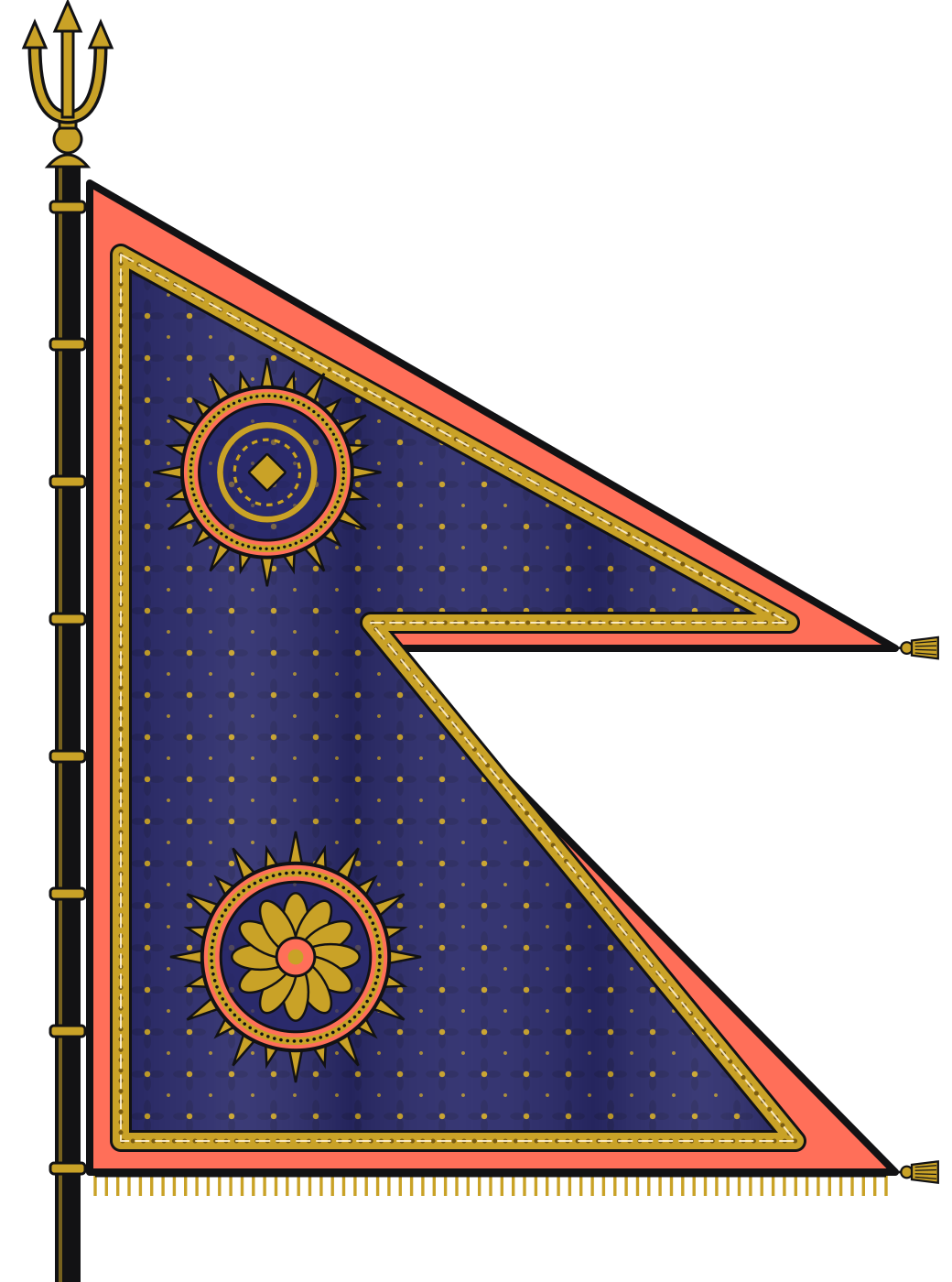

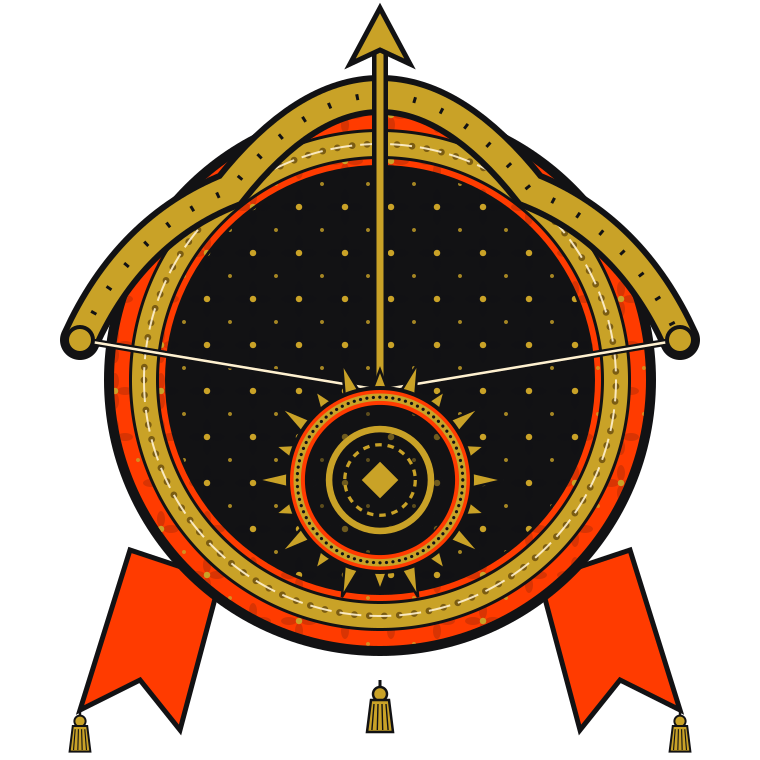
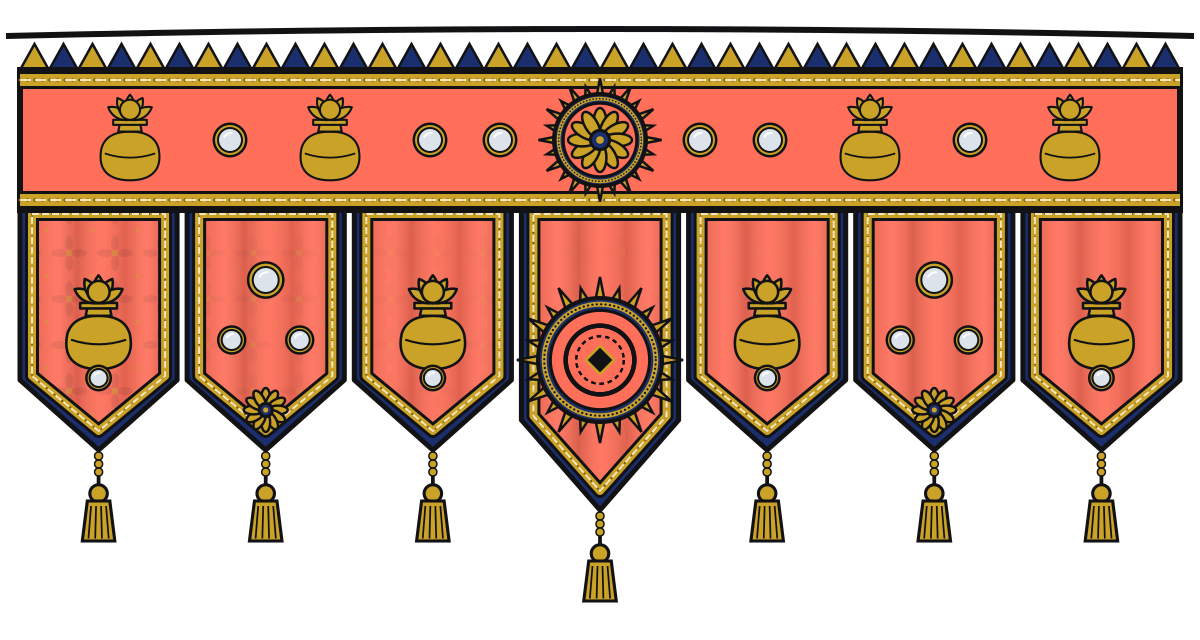
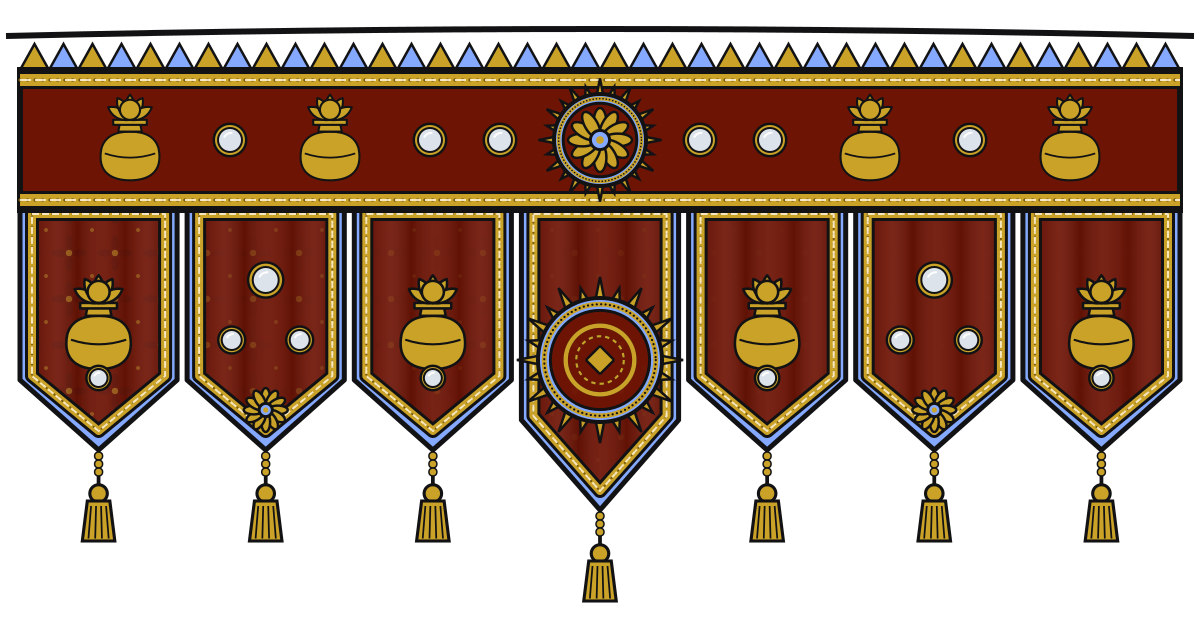

Historic banner
None known
New flag types
| Accessory | For this clan | Basis |
|---|---|---|
| A9 Pota-dhvaja · ship and trade flag For ships, caravans and markets | Not yet designed for this clan | Design |
| A10 Utsava-patāka · festival flag Light, bright flag for fairs and festivals | Not yet designed for this clan | Design |
| A11 Shoka-dhvaja · mourning flag White cloth with the emblem outline in the clan's metal | Not yet designed for this clan | Design |
7. Regalia
| Accessory | For this clan | Basis |
|---|---|---|
| E1 Chhatra · house parasol The ceremonial umbrella | Not yet designed for this clan | Design |
| E2 Chamara · fly-whisks The pair of whisks beside the head of the house | Not yet designed for this clan | Design |
| E3 Danda · staff of office Staff or scepter | Not yet designed for this clan | Design |
| E4 Simhasana · seat The seat of the house, covered in clan cloth | Not yet designed for this clan | Design |
| E5 Khetaka · shield A round shield; the Changi and Dhanush are its flag forms | Not yet designed for this clan | Regional tradition |
| E6 Kula-ayudha · clan weapon The weapon the clan honours | Not yet found for this clan | Under research |
8. Worn
| Accessory | For this clan | Basis |
|---|---|---|
| F1 Kula-vastra · clan cloth The clan's woven pattern in its kit colours | Not yet designed for this clan | Design |
| F2 Kirti-vastra · honour cloth A cloth earned for a deed, not inherited | Not yet designed for this clan | Design |
| F3 Kula-mala · garland flower The flower or leaf the clan wears as a garland | Not yet found for this clan | Under research |
| F4 Chinha · house pin A metal badge with the pin emblem | Not yet designed for this clan | Design |
9. Records
| Accessory | For this clan | Basis |
|---|---|---|
| H1 Clan words A traditional line in the native script | · “Under research” | Documented |
| H2 Biruda · titles The house's title or titles | Not yet found for this clan | Under research |
| H3 Prashasti · praise genealogy The lineage as written at the head of a grant | Not yet found for this clan | Under research |
| H4 Vahi · clan register The book of the clan's births, marriages and deaths | Not yet found for this clan | Under research |
| H5 Rana-ghosha · war cry The clan's cry in battle or celebration | Not yet found for this clan | Under research |
10. VishwaVit · knower of the world
Game values are design choices for this project, not historical claims.
References
- Wikipedia, Thakar (tribe), read 2026-10-25, link (citing Tribhuwan 2005 and Bone 2021)
- Avantika Bhuyan, The Quint, This 400-Year-Old Puppeteer Tribe Once Served as Spies for Shivaji, 27 Mar 2016 (updated 19 Feb 2020), read 14 Nov 2026, link
- Nicole Suares, Free Press Journal, Parshuram Gangavane Awarded Padma Shri For Preserving Thakar Tribal Art, updated 7 Feb 2026, read 14 Nov 2026, link
- dhammabharat.com, List of Scheduled Tribes in Maharashtra and Population of each Tribe (2011 Census), read 2026-10-10, https://dhammabharat.com/?p=13656
- Ekvira, Wikipedia (read 10 Oct 2026).
- Edgar Thurston and K. Rangachari, Castes and Tribes of Southern India, vol. 7 (Madras, 1909), Project Gutenberg eBook #42997, https://www.gutenberg.org/ebooks/42997
- Wikipedia, Thakar tribe (Kiwix mirror, snapshot Oct 2023), read 14 Nov 2026, link
- Everyculture.com, Thakur (general article, cites Chapekar 1960 Thakurs of the Sahyadri), read 14 Nov 2026, link
- Anil Sardar, Round Table India, The marginalisation of the Katkari tribals, read 12 Nov 2026, https://www.roundtableindia.co.in/the-marginalisation-of-the-katkari-tribals/
- Purusottam Thakur, PARI, हवाओं में बुनी तारपी की आवाज़ (Hindi), 22 Nov 2024, read 22 Oct 2026, link