The Tamang (native तामाङ) are a Tibeto-Burman people of Nepal, Sikkim, West Bengal and southern Bhutan, with a Tamangic language[1]. Their origin legend has ancestors born in Tibet who moved south to Lo Demozong, and TRI Sikkim says their ancestors followed Bon before the 7th–8th century AD and then mostly adopted Mahayana Buddhism[2]. Nepal's 2021 census counted 1,639,866 Tamang[1], and Sikkim's 2011 census counted 37,696[2]. Clans are exogamous within an endogamous people, and the Tamang Selo folk song genre and the damphu drum are named in the extracts[3][4].
01Faith and deities
Shakti Peetha of Kathmandu, honoured by Buddhists too[5]
The clan followed another faith. This goddess of its homeland is assigned for naming only.
| Deity or tradition | Place in the clan's life | Evidence |
|---|---|---|
| Bon | The ancestors' faith before the 7th–8th century AD | [2] |
| Mahayana Buddhism | Adopted by most of the ancestors, blending Bon traditions | [2] |
| Creation account: a father monkey and the mother goddess Dasin Dolma | Humans are said to descend from them | [2] |
| Guru Padmasambhava | Revered at Lo Demozong, where his footprint is said to be engraved | [2] |
| Territorial divinities | Clans are tied to them; not named in the source | [3] |
| Masked dances (Lhosar) | Performed to drive away evil spirits | [6] |
| Kalinchowk mountain pairing | A book listing says Kalingchok is paired as female with the male Thulo Sailung, in Tamang tradition; the book was not read | Book listing (Tautscher 2007), not read |
02Temples
No Tamang-specific temple is sourced in this run. The KulDevi Guhyeshwari (Atlas, assigned) is in the deities section. The TRI Sikkim page names Ahaley Tamang Gonpa as the source of one account of the name, and says nothing more about it.
Built by the clan
Not recorded.
Given patronage or grants by the clan
| Temple | Deity | What the clan gave | When | Where |
|---|---|---|---|---|
| Sameh Chuklakhang (monastery) | Not stated | Labour from Tamang youths of Lo Demozong | About the 7th–8th century | Tibet[2] |
03Languages and scripts
| Language or script | Kind | Under the clan | Evidence |
|---|---|---|---|
| Tamang (Taam or Gyot) living | Spoken language; Tamangic branch of Tibeto-Burman | Dialects Eastern, Western, Southwestern, Northwestern and Eastern Gorkha (Wikipedia); Khandoke, Paljoke, Nhupali and Syarphat (TRI Sikkim) | [1][2] |
| Taamyig script | Script from Sambota, with 25 consonants and 5 vowels (TRI Sikkim); Wikipedia names Tamyig, Tibetan-like, as a Tamang script | Tibetan form of the name printed as རྟ་དམག་ | [2][1] |
| Devanagari script | Also used for the Tamang name | Form printed as तामाङ | [1] |
| Taam in Sikkim | Recognised regional language in 1995, in schools from 2001, to class twelve; a Tamang Language Development Committee | Sikkim | [2] |
04Books and literature
No Tamang-specific book is read in this run. A lead is Gabriele Tautscher, Himalayan Mountain Cults (2007), a catalogue listing only, whose subtitle names Tamang histories. Under research.
Written during the clan's history
Not recorded.
Given patronage by the clan
Not recorded.
05Thinkers and scholars
Not recorded.
Under research. Leads: Gellner (2009) and Woebom (2014), cited on the Wikipedia page but not read; B. Sharma (2024), abstract only; N. J. Allen and Vansittart, as Himalayan Cultures cites them.
06Art and architecture
The extracts name printed Buddhist mantra cloths and the carved tungna lute as Tamang material culture.
Painting and wall art
Not recorded.
Sculpture and temple art
Not recorded.
Temple and building architecture
Not recorded.
Weaving and textiles
| Art form | What it is | Era | Evidence |
|---|---|---|---|
| Printed mantra cloths | Printed Buddhist mantra cloths are hung | Not dated | [1] |
Clothing and jewellery
Not recorded.
Coins, pottery and crafts
| Art form | What it is | Era | Evidence |
|---|---|---|---|
| Tungna lute | Carved wood, four strings, a dragon headstock in the Tamang form; luthiers are few and the craft is waning | Recent | [7][8] |
07History
Names and the first records
Tibetans called them Rongpa; historical names on the Wikipedia page are Bhote, Bodh, Lama, Murmi and Sain[1]. TRI Sikkim gives two accounts of the name: from Tibetan 'Tagmhaang' (godly vision, many), as Lt. Sangey Lama of the Ahaley Tamang Gonpa gives it, and from a phrase about many horses grazing, as Lt. Indraman Tamang gives it[2].
The 1891 Sikkim census recorded about 2,900 Tamang under the name 'Murmi', linked to the Tamang 'Mulmi', a village chieftain[2].
Origin accounts
legend TRI Sikkim credits the booklet of Zikten Tamchhoi for origins in Tibet, China and Russia, and a long presence in Sikkim[2]. Its first ancestor is a god's son born in Tibet, with three sons named Phuntsok, Nima Hoisher and Tenzeen; an astrologer advised the move south to Lo Demozong[2].
legend N. J. Allen gives four families at Wuijhang in Tibet as the origin: Bal, Yonjon, Moktan and Ghising[3].
Before the 8th century: Bon, then Buddhism
Before the 7th–8th century AD the ancestors followed Bon; most then adopted Mahayana Buddhism, blending Bon traditions[2].
legend Padmasambhava visited Tibet about the 7th–8th century at the invitation of King Thrisung Deochen to help build the Sameh Chuklakhang monastery, and Tamang youths from Lo Demozong gave labour[2].
1739 to 1762: Ghale-Botya, Temal and kipat
In 1739 the ruler Ghale-Botya attacked Nara Bhupal Shah near Nuwakot; Golma Ghale (Gyalpo) also fought him. The page gives no source for this[1].
In 1762 Prithvi Narayan Shah attacked the Tamang at Temal, and oral history says the local chief Rinjen Dorje was killed[1].
Kipat land was given to Gorkha generals and officials, and the Tamang lost it; earlier holdings were divided by clan, and the Tamang owed forced labour (Gellner 2009, as the Wikipedia page cites it)[1].
Sino-Nepalese War and the Daman
Tamangs fought in the Sino-Nepalese War of 1788–1792, and a few hundred settled in Tibet as the Daman, whom China classified as Tibetan in 2003 (Woebom 2014, as the page cites it)[1].
Later movements
A 2024 article in Voice, by B. Sharma, is on Tamang who moved from the hills around Kathmandu to the Nepalgunj Tarai; the abstract only was read[9].
08Journey and migrations
The extracts give a Tibetan origin legend, a move south to Lo Demozong, and later movements in Nepal and Sikkim. No dated route is sourced beyond these.
| When | From | To | Why | Evidence |
|---|---|---|---|---|
| Origin legend (no date) | Tibet | Lo Demozong | An astrologer advised a move south | [2] |
| Long ago (no dates) | Tibet | Nepal | Tamang, Sherpa, Hyolmo and Tibetan communities came to Nepal | [7] |
| After 1788–1792 (Sino-Nepalese War) | Nepal | Tibet | A few hundred settled as the Daman | [1] |
| Not dated | Hills around Kathmandu | Nepalgunj Tarai | Not stated in the abstract | [9] |
09Seats and lands
| Place | Role | Where today |
|---|---|---|
| Temal | Cultural heartland (Gellner 2009, as Wikipedia cites it); 1762 attack[1] | Not given in the extract |
| Lo Demozong | Settlement advised by the astrologer in the origin legend; Padmasambhava's footprint is said to be engraved there[2] | Not given in the extract |
| Wuijhang | Origin of the four families (N. J. Allen)[3] | Tibet |
| Bapsa | Ancestral land that clans share[3] | Not given in the extracts |
| Sikkim settlements | Gyalshing (Dokothang, Hee-Pechrek); Namchi (about 25 villages incl. Bumtar, Melli, Mamley); Gangtok (Syari, Burtuk, Sang); Mangan (Rangrang, Paksyak); Pakyong (Padamchey, Samsing, Pache); Soreng (Singling, Mangsari, Kolbung)[2] | All six Sikkim districts |
| Darjeeling, Kalimpong, Assam | Named as Tamang areas in northeast India[1] | West Bengal and Assam |
| Southern Bhutan | Tsirang, Dagana, Samtse, Chukha, Sarpang, Samdrup Jongkhar (Wikipedia)[1] | Bhutan |
| Nepalgunj Tarai | Where Tamang from the hills around Kathmandu moved (abstract)[9] | Nepal |
| Tamsaling | Homeland in the Atlas; no source in this run | Under research |
10Notable figures
| Name | Role | Era | Known from |
|---|---|---|---|
| Hira Devi Waiba | Called a pioneer of Nepali folk songs and Tamang Selo; about 300 songs over about 40 years (Telegraph, Calcutta, 2012) | Not dated | [4] |
| Aruna Lama | Singer | Not dated | [1] |
| Buddha Lama | Nepal Idol | Not dated | [1] |
| Prashant Tamang | Indian Idol | Not dated | [1] |
| Subhash Ghisingh | Founder of the GNLF | Not dated | [1] |
| Prem Singh Tamang | Chief Minister of Sikkim | Not dated | [1] |
| Kul Man Ghising | Named on the page; role not given | Not dated | [1] |
| Bidhan Lama | 1988 Olympic bronze | 1988 | [1] |
| Parijat (Bishnu Kumari Waiba) | Named on the page; role not given | Not dated | [1] |
| Jyoti Prakash Tamang | Named on the page; role not given | Not dated | [1] |
11Allies, rivals and marriages
| People | Relationship | When |
|---|---|---|
| Tibetans | Related group; called the Tamang Rongpa[1] | Not dated |
| Daman | Tamangs who settled in Tibet after the Sino-Nepalese War[1] | 1788–1792 war; classified Tibetan in 2003 |
| Gorkha forces and rulers | Attacked the Tamang at Temal; kipat land given to Gorkha generals[1] | 1762 |
| Gurung | Tamangic language close to Gurung[1] | Not dated |
| Sherpa, Qiang, Bhotiya, Thakali | Related groups listed on the Wikipedia page[1] | Not dated |
| Hyolmo | Share the Sonam Lhosar new year[6] | Not dated |
| Kiratas | Linked peoples in the Atlas | Ancient |
12Society and livelihood
The Tamang are endogamous; their clans are exogamous, and women keep their birth clan (Himalayan Cultures). Descent is patrilineal through the clan, called rui in Tamang.
Government and social order
| Institution or group | What it was | Evidence |
|---|---|---|
| Rui (patrilineal clan) | The clan, called rui in Tamang; clans are exogamous and the people endogamous | [3] |
| Swongi bhai (brother clans) | Brother clans extend the exogamy rule | [3] |
| Bapsa | Ancestral land shared by a clan, with territorial divinities (not named) | [3] |
| Tamba | Tamang genealogists who sing Hwai ritual songs; a ritual specialist who plays the lute at marriages | [1][7] |
| Out-marriage | Reportedly produced mixed Atharah Jaat groups with the same standing | [3] |
| Community association | Formed 1961 (TRI Sikkim; the page gives no place) | [2] |
Livelihood over time
| Era | Livelihood | Evidence |
|---|---|---|
| Not dated | Crops: millet, fox-tail millet (Tangre), dry paddy, wheat, buckwheat, barley, maize and pulses | [2] |
| Not dated | Kipat land and forced labour under the Gorkha state, as Gellner 2009 reports | [1] |
13Sub-clans and related clans
Clan names come from TRI Sikkim's twelve sub-castes with origin places (eighteen were named originally), N. J. Allen's four families, Vansittart's twelve as Himalayan Cultures cites it, and a 92-name table on Himalayan Cultures. The table is not attributed on the page. Spellings vary as the extracts show (for example Pakrin/Pakhrin, Goley/Golay, Mikchan/Mokchan, Yonjan/Yonzon).
| Clan | Relation | Where | Size | In the Atlas | Evidence |
|---|---|---|---|---|---|
| Yonjan | Sub-clan | Origin (TRI Sikkim): Nagpochyagi Gonpo. Spellings in the extracts: Yhonzan, Yonjon, Yonzon | new clan candidate | [2][3] | |
| Dumjan | Sub-clan | Origin (TRI Sikkim): Duma. Spellings in the extracts: Dumzan | new clan candidate | [2][3] | |
| Bomzan | Sub-clan | Origin (TRI Sikkim): Dhagar Ngili. Spellings in the extracts: Bomzon | new clan candidate | [2][3] | |
| Moktan | Sub-clan | Origin (TRI Sikkim): Mugu | new clan candidate | [2][3] | |
| Lopchan | Sub-clan | Origin (TRI Sikkim): Syargi Zong | new clan candidate | [2][3] | |
| Mikchan | Sub-clan | Origin (TRI Sikkim): Changpe. Spellings in the extracts: Mokchan | new clan candidate | [2][3] | |
| Ghising | Sub-clan | Origin (TRI Sikkim): Shergong. Spellings in the extracts: Ghishing | new clan candidate | [2][3] | |
| Theeng | Sub-clan | Origin (TRI Sikkim): Boi Yarling Sokar. Spellings in the extracts: Theengh | new clan candidate | [2][3] | |
| Ngyasur | Sub-clan | Origin (TRI Sikkim): Sachamgong | new clan candidate | [2] | |
| Gyabak | Sub-clan | Origin (TRI Sikkim): Gyanag or China | new clan candidate | [2][3] | |
| Marpa | Sub-clan | Origin (TRI Sikkim): Chita | new clan candidate | [2][3] | |
| Zimba | Sub-clan | Origin (TRI Sikkim): Shame, Tibet | new clan candidate | [2][3] | |
| Bal | Sub-clan | new clan candidate | [3] | ||
| Baju | Sub-clan | Spellings in the extracts: Bajyu | new clan candidate | [3] | |
| Giaba | Sub-clan | Vansittart's list (1906, as cited by Himalayan Cultures); the extracts do not say whether it is the Gyabak of TRI Sikkim | new clan candidate | [3] | |
| Golay | Sub-clan | Spellings in the extracts: Goley | new clan candidate | [3] | |
| Pakhrin | Sub-clan | Spellings in the extracts: Pakrin | new clan candidate | [3] | |
| Syangden | Sub-clan | Spellings in the extracts: Syangdhen | new clan candidate | [3] | |
| Blone | Sub-clan | new clan candidate | [3] | ||
| Bamten | Sub-clan | new clan candidate | [3] | ||
| Blendene | Sub-clan | new clan candidate | [3] | ||
| Chhyumi | Sub-clan | new clan candidate | [3] | ||
| Choten | Sub-clan | new clan candidate | [3] | ||
| Chhekpal | Sub-clan | new clan candidate | [3] | ||
| Chauthen | Sub-clan | new clan candidate | [3] | ||
| Singden | Sub-clan | new clan candidate | [3] | ||
| Titung | Sub-clan | new clan candidate | [3] | ||
| Thokar | Sub-clan | new clan candidate | [3] | ||
| Khyungba | Sub-clan | new clan candidate | [3] | ||
| Lungba | Sub-clan | new clan candidate | [3] | ||
| Glan | Sub-clan | new clan candidate | [3] | ||
| Waiba | Sub-clan | new clan candidate | [3] | ||
| Prabhuba | Sub-clan | new clan candidate | [3] | ||
| Lo | Sub-clan | new clan candidate | [3] | ||
| Manangthen | Sub-clan | new clan candidate | [3] | ||
| Ghale | Sub-clan | new clan candidate | [3] | ||
| Syangbo | Sub-clan | new clan candidate | [3] | ||
| Jyumi | Sub-clan | new clan candidate | [3] | ||
| Ghongba | Sub-clan | new clan candidate | [3] | ||
| Tongsang | Sub-clan | new clan candidate | [3] | ||
| Taisang | Sub-clan | new clan candidate | [3] | ||
| Jongan | Sub-clan | new clan candidate | [3] | ||
| Samten | Sub-clan | new clan candidate | [3] | ||
| Mulung | Sub-clan | new clan candidate | [3] | ||
| Negi | Sub-clan | new clan candidate | [3] | ||
| Mamba | Sub-clan | new clan candidate | [3] | ||
| Kamden | Sub-clan | new clan candidate | [3] | ||
| Moden | Sub-clan | new clan candidate | [3] | ||
| Sumba | Sub-clan | new clan candidate | [3] | ||
| Rimten | Sub-clan | new clan candidate | [3] | ||
| Jogna | Sub-clan | new clan candidate | [3] | ||
| Sarpakhor | Sub-clan | new clan candidate | [3] | ||
| Sugtal | Sub-clan | new clan candidate | [3] | ||
| Hen | Sub-clan | new clan candidate | [3] | ||
| Tupa | Sub-clan | new clan candidate | [3] | ||
| Kalden | Sub-clan | new clan candidate | [3] | ||
| Senten | Sub-clan | new clan candidate | [3] | ||
| Myapa | Sub-clan | new clan candidate | [3] | ||
| Thongten | Sub-clan | new clan candidate | [3] | ||
| Lockten | Sub-clan | new clan candidate | [3] | ||
| Lhaminkhor | Sub-clan | new clan candidate | [3] | ||
| Kagate | Sub-clan | new clan candidate | [3] | ||
| Damrang | Sub-clan | new clan candidate | [3] | ||
| Domten | Sub-clan | new clan candidate | [3] | ||
| Tunpa | Sub-clan | new clan candidate | [3] | ||
| Tungden | Sub-clan | new clan candidate | [3] | ||
| Gropchan | Sub-clan | new clan candidate | [3] | ||
| Gondan | Sub-clan | new clan candidate | [3] | ||
| Nasur | Sub-clan | new clan candidate | [3] | ||
| Malachoki | Sub-clan | new clan candidate | [3] | ||
| Mahindong | Sub-clan | new clan candidate | [3] | ||
| Manden | Sub-clan | new clan candidate | [3] | ||
| Fyuwa | Sub-clan | new clan candidate | [3] | ||
| Balam | Sub-clan | new clan candidate | [3] | ||
| Toiba | Sub-clan | new clan candidate | [3] | ||
| Jaba | Sub-clan | new clan candidate | [3] | ||
| Syamjan | Sub-clan | new clan candidate | [3] | ||
| Gemsing | Sub-clan | new clan candidate | [3] | ||
| Mitak | Sub-clan | new clan candidate | [3] | ||
| Gangtang | Sub-clan | new clan candidate | [3] | ||
| Ngarden | Sub-clan | new clan candidate | [3] | ||
| Brosinger | Sub-clan | new clan candidate | [3] | ||
| Lamaganju | Sub-clan | new clan candidate | [3] | ||
| Plengden | Sub-clan | new clan candidate | [3] | ||
| Gomchyo | Sub-clan | new clan candidate | [3] | ||
| Shahangri | Sub-clan | new clan candidate | [3] | ||
| Chimkan | Sub-clan | new clan candidate | [3] | ||
| Gotthar | Sub-clan | new clan candidate | [3] | ||
| Dong | Sub-clan | new clan candidate | [3] | ||
| Dartang | Sub-clan | new clan candidate | [3] | ||
| Gyamden | Sub-clan | new clan candidate | [3] | ||
| Rumba | Sub-clan | new clan candidate | [3] | ||
| Hangjo | Sub-clan | new clan candidate | [3] | ||
| Nikten | Sub-clan | new clan candidate | [3] | ||
| Baara Tamang (twelve) | Branch | Called 'Baara Tamangs' (twelve); the numbers are loose (Himalayan Cultures) | new clan candidate | [3] | |
| Atharah Jaat (eighteen) | Branch | Called 'Atharah Jaat' (eighteen); TRI Sikkim says eighteen main sub-castes originally | new clan candidate | [3][2] | |
| Rasuwali Tamang | Branch | Named with the Hyolmo for the Syabru dance (Wikipedia, Sonam Lhosar) | new clan candidate | [6] | |
| Hyolmo | Related people | Share the Sonam Lhosar new year (Wikipedia) | new clan candidate | [6] | |
| Murmi | Related people | Sikkim: 1891 census count of about 2,900 Tamang under this name | new clan candidate | [2] | |
| Daman | Related people | Tamangs who settled in Tibet after the Sino-Nepalese War; classified Tibetan by China in 2003 | new clan candidate | [1] | |
| Tibetan | Related people | Tibetans called the Tamang Rongpa (Wikipedia) | ST-314 | [1] | |
| Gurung | Related people | Tamangic language close to Gurung (Wikipedia) | SUB-033 | [1] | |
| Sherpa | Related people | Related group listed on the Wikipedia page | ST-289 | [1] | |
| Qiang | Related people | Related group listed on the Wikipedia page | new clan candidate | [1] | |
| Bhotiya | Related people | Related group listed on the Wikipedia page | new clan candidate | [1] | |
| Thakali | Related people | Related group listed on the Wikipedia page | SUB-090 | [1] | |
| Kiratas | Related people | Linked peoples in the Atlas | ANC-056 | Atlas |
Clans marked "new clan candidate" are not in the Atlas yet.
14Surnames
Clan names serve as identifying names (Himalayan Cultures). These names appear as surnames in the extracts, mainly on the Wikipedia list of notable people, which does not label them as clan names.
| Surname | Clan or sub-clan | Where | People with this surname | Also used by other communities |
|---|---|---|---|---|
| Waiba | not yet counted | Yes | ||
| Yonzon | Yonjan | not yet counted | Yes | |
| Ghising | Ghising | not yet counted | Yes | |
| Lama | not yet counted | Yes | ||
| Rumba | Rumba | not yet counted | Yes | |
| Shyangden | Syangden | not yet counted | Yes | |
| Ghale | Ghale | not yet counted | Yes | |
| Bal | Bal | not yet counted | Yes | |
| Negi Lama | Negi | not yet counted | Yes | |
| Moktan | Moktan | not yet counted | Yes | |
| Lopchan | Lopchan | not yet counted | Yes |
Counts are of everyone with the surname, from the cited source and year, not only members of this clan. A surname shared with other communities says nothing about any one person's origin.
15Songs and music
Tamang Selo is a folk song genre of the Tamang, popular among Nepali speakers in Nepal, India and abroad; its themes are love, sorrow and everyday life[4]. A 2024 article analyses its meaning and structure and says it expresses love of nature and national feeling (abstract only read)[9].
Hwai ritual songs living
Instruments and styles
| Instrument or style | What it is | Evidence |
|---|---|---|
| Damphu | Small goatskin drum; accompanies Tamang Selo and is played during Lhosar | [1][4][7][2] |
| Madal | Accompanies Tamang Selo (Wikipedia); described in general as a carved log with goatskin heads | [4][8] |
| Tungna living | Four-string lute, high-pitched in the Tamang form, with a short neck and short strings; dragon headstock; tuning and playing style differ from the Sherpa form; Tamang knowledge is oral; played by Tamba at marriages; recorded as originally Tamang | [7][8][4] |
| Daden | Named with the damphu among Tamang instruments; no description given | [2] |
| Konggaap | Played with fancy songs; no description given | [2] |
| Welcome dance | Slow, dignified welcome dance | [2] |
16Poems, lullabies and children's rhymes
Rhama is a poem-style rhyme recited at marriages (TRI Sikkim). No text is printed in the extracts, so none is quoted.
Rhama living
17Stories, legends and proverbs
Stories and legends
| Story | What happens | Told by | Evidence |
|---|---|---|---|
| Creation | Humans descend from a father monkey and the mother goddess Dasin Dolma | TRI Sikkim page | [2] |
| The god's son and the astrologer | A first ancestor, a god's son born in Tibet, has three sons (Phuntsok, Nima Hoisher, Tenzeen); an astrologer advises the move south to Lo Demozong | TRI Sikkim page | [2] |
| Weapons in the sand | Gorkha forces hid weapons in riverbank sand and washed them at Dapcha Kuwapani; the Tamang avoid drinking there | Oral history, as Gellner 2009 reports it | [1] |
Proverbs and sayings
Not recorded.
18Festivals and fairs
| Festival or fair | When | Where | What happens |
|---|---|---|---|
| Sonam Lhosar (Sonam Lhochhar) | Magh Shukla Pratipada (Magh, Feb–Mar) | Nepal, Sikkim, Darjeeling | New year of the Tamang and Hyolmo: visits to monasteries and stupas, house cleaning, traditional dress and jewellery, greetings; masked dances to drive away evil spirits; red is the liturgical colour; Tamang Selo and the damphu played for dance; the Syabru dance[6][1] |
| Sakha Dawa | Not dated | Not stated | Religious festival in the TRI Sikkim list[2] |
| Guru Thungkar | Not dated | Not stated | Religious festival in the TRI Sikkim list[2] |
| Lhabab Duichhen | Not dated | Not stated | Religious festival in the TRI Sikkim list[2] |
| Drukpa Chhesi | Not dated | Not stated | Religious festival in the TRI Sikkim list[2] |
| Chhechyu | Monthly | Not stated | Monthly observance in the TRI Sikkim list[2] |
| Saga Dawa | Not dated | Not stated | Named on Wikipedia as Buddha's birthday; the page marks the citation as needed[1] |
19Food, dress and games
Food
| Item | What it is | Evidence |
|---|---|---|
| Crops | Millet, fox-tail millet (Tangre), dry paddy, wheat, buckwheat, barley, maize and pulses | [2] |
| Drinks | Beer and Pachway | [2] |
Dress
| Item | What it is | Evidence |
|---|---|---|
| Male dress | Surlung, Khenza, Khenju, Tagi (names as printed) | [2] |
| Female dress | Hangre, Hanju, Syama/Dormo, Kerek, Tagi (names as printed) | [2] |
| Male ornaments | Along, Chyaap | [2] |
| Female ornaments | Gau, Mharkhari, Nachyo | [2] |
Games and martial arts
Not recorded.
Tags: living still practised · revived brought back after a break · lost known only from records · research reported but not yet confirmed from a source. Songs and poems under copyright are listed by title only; restricted or sacred material is noted without its content.
20Status today
The Tamang live in Nepal, Sikkim, West Bengal, Assam and southern Bhutan. Nepal's 2021 census counted 1,639,866[1], and Sikkim's 2011 census counted 37,696[2].
Recognised heritage
| What | Recognition | Evidence |
|---|---|---|
| Tamang Selo | Popular among Nepali speakers in Nepal, India and abroad (Wikipedia) | [4] |
| Community association | Formed 1961 (TRI Sikkim) | [2] |
No community review is recorded for this page.
21For children
The drum and the song
The Tamang are a people who live in Nepal, in Sikkim and West Bengal in India, and in southern Bhutan. Long ago, their ancestors are said to have come from Tibet, and an astrologer told them to move south. Tamang families belong to clans, and a Tamang person marries outside their own clan. They sing a folk song style called Tamang Selo. The damphu is a small goatskin drum, played for dance. At Sonam Lhosar, the new year, families visit monasteries, clean their homes and wear traditional dress and jewellery.
22Across the project
| Project | What carries this clan | Status |
|---|---|---|
| Atlas of the Janas | Lands named in the extracts: Nepal, Sikkim, West Bengal, southern Bhutan; Temal is named as the heartland. The Tamsaling homeland has no source yet. | Not yet pinned |
| KulDevi and GrahDevi | KulDevi Guhyeshwari, assigned; GrahDevi forms Kali, Tara, Shodashi, Bhuvaneshvari, Bhairavi, Chhinnamasta, Dhumavati, Bagalamukhi, Matangi, Kamala | From the Atlas |
| Planet naming | No planet or star name in the extracts | Under research |
| Renaming and waters | Dapcha Kuwapani, a riverside place in an oral history where the Tamang avoid drinking | From the Wikipedia page |
23Open questions
- The 92-name clan table on Himalayan Cultures is unattributed. Find its source (Vansittart 1906 or Allen) before treating its names as a list of sub-clans.
- West Bengal 2011 Scheduled Tribe count: the pack notes give 146,203 from a Wikipedia list of Scheduled Tribes in West Bengal. That list is not among the listed extracts, so the figure is not used here. Check it against the page.
- The ghyaling shawm is not in the pack's listed extracts. No claim about it is made here.
- TRI Sikkim literacy figures are inconsistent in the research, so none are used.
- Tamsaling homeland and Yambu sources are not found; no homeland claim is made.
- Hodgson and Risley period accounts (for example the Murmi entry in Risley's Tribes and Castes of Bengal) are not read.
- The Lama clan page on Wikipedia was not fetched (fetch blocked).
- The 'taj-Deva' language code in the pack is unverified; this page uses und-Deva for the native script.
- Kathmandu Post (2020) says the tungna was originally Tamang; check against a musicological source.
- Sonam Lhosar date (Magh Shukla Pratipada) and the year of the Hira Devi Waiba songs: check the sources.
- Clan words: no line from the Tamang's own words is printed in the extracts. A cited line is needed for the page.
- Contradiction (fixed): the astitva intro called both accessories documented, but the dress names are marked regional basis (TRI Sikkim,[2]) while the Tamba genealogists are marked documented ([1]). The intro now gives each its own basis.
24Astitva
अस्तित्व · being, existence: everything by which the clan is known
The extracts give no seal, coin, totem, guardian tree or war cry for the Tamang. Two items are on record: the Tamang dress names (regional basis) and the Tamba genealogists (documented basis). The damphu, a small goatskin drum, is recorded as accompanying Tamang Selo[4][1][2]
Every clan has every accessory, royal objects included. Each one says how it is known: Documented This clan's own object is recorded. · Regional tradition Recorded for the region or for peoples like this one, not for this clan. · Design Made for this project, with no historical claim. · Under research To be found for this clan from sources. Legends and titles are written in the clan's own script.
1. Seals and coins
| Accessory | For this clan | Basis |
|---|---|---|
| B1 Rajamudra · house seal Round seal with the clan emblem and a short legend in the clan's script | Not yet designed for this clan | Design |
| B2 Anguliya-mudra · signet ring Personal seal ring of the head of the house | Not yet designed for this clan | Design |
| B3 Chhapa · house stamp Ink or block stamp for letters, goods and cloth | Not yet designed for this clan | Design |
| B4 Tamrapatra · charter plate Copper-plate grant on a ring, closed with the house seal | Not yet designed for this clan | Design |
| B5 Shreni-mudra · guild or trade seal Seal for the clan's trade, craft or caravan | Not yet designed for this clan | Design |
| C1 Clan coin Emblem or deity on one side, a legend in the clan's script | Not yet designed for this clan | Design |
| C2 Coin die The die that strikes the coin | Not yet designed for this clan | Design |
2. Living symbols
| Accessory | For this clan | Basis |
|---|---|---|
| I1 Totem trio The tree, bird and animal the clan protects | Not yet found for this clan | Under research |
| I2 Kaval-maram · guardian tree The tree that stands at the clan's seat | Not yet found for this clan | Under research |
3. Stone and gate
| Accessory | For this clan | Basis |
|---|---|---|
| G1 Torana · gateway The built gate of the seat; the cloth Toran hangs in it | Not yet designed for this clan | Regional tradition |
| G2 Viragallu · hero stone Carved panel stone for a member who died defending the clan | Not yet designed for this clan | Regional tradition |
| G3 Kula-shila · clan stones Standing and table stones that remember the ancestors | Not yet designed for this clan | Design |
| G4 Jayastambha · victory pillar A pillar raised for a victory | Not yet designed for this clan | Design |
| G5 Sima-shila · boundary stone Marks the clan's land, with a line in the native script | Not yet designed for this clan | Design |
4. Sounds
| Accessory | For this clan | Basis |
|---|---|---|
| D1 Pancha-mahashabda · five great sounds The right to five instruments | Not yet designed for this clan | Design |
| D2 Shankha · clan conch The clan's own named war conch | Not yet designed for this clan | Design |
| D3 Murasu · house drums Three drums: war, charity and justice | Not yet designed for this clan | Design |
5. Kit: colours, metals and emblems
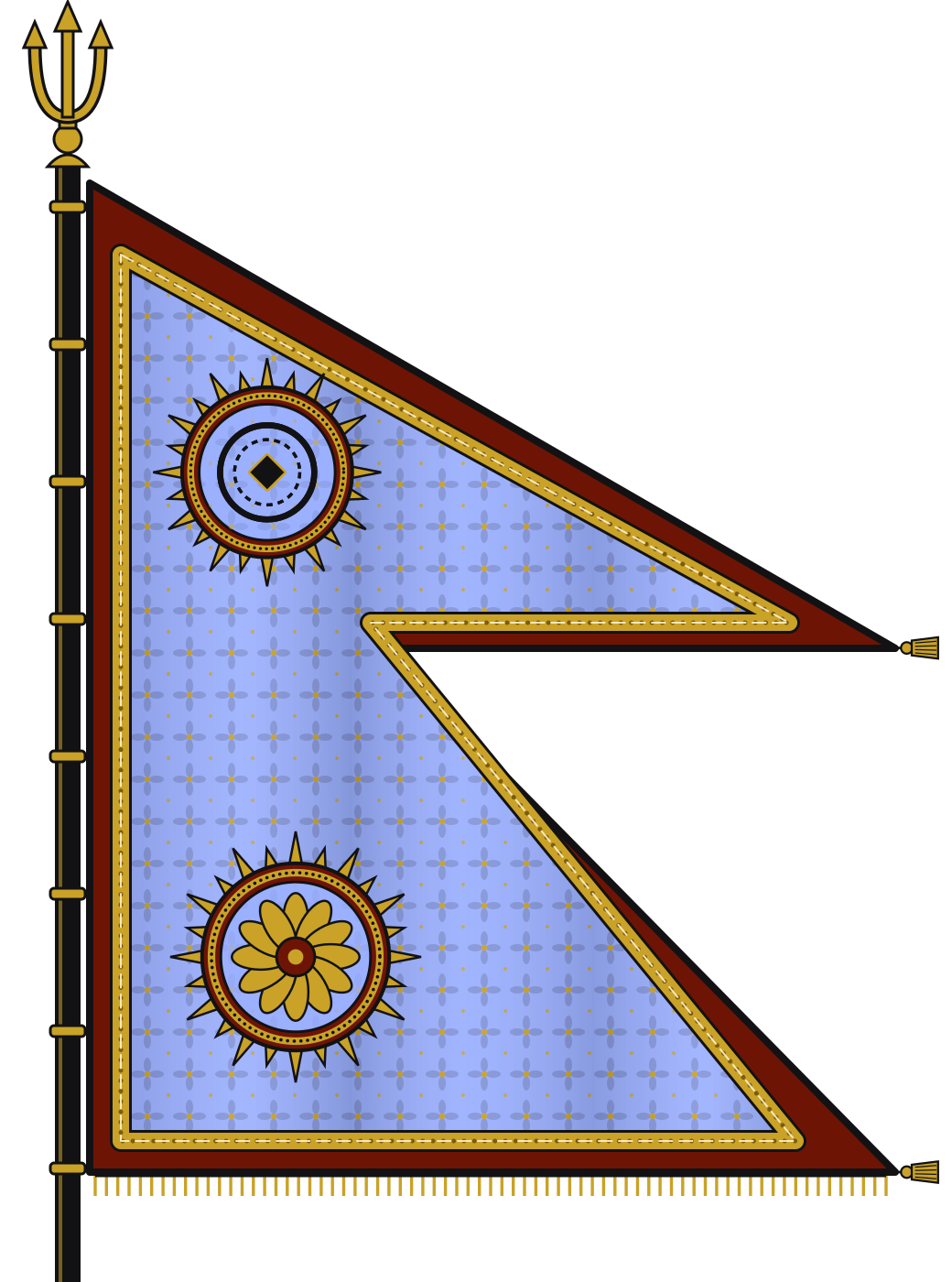
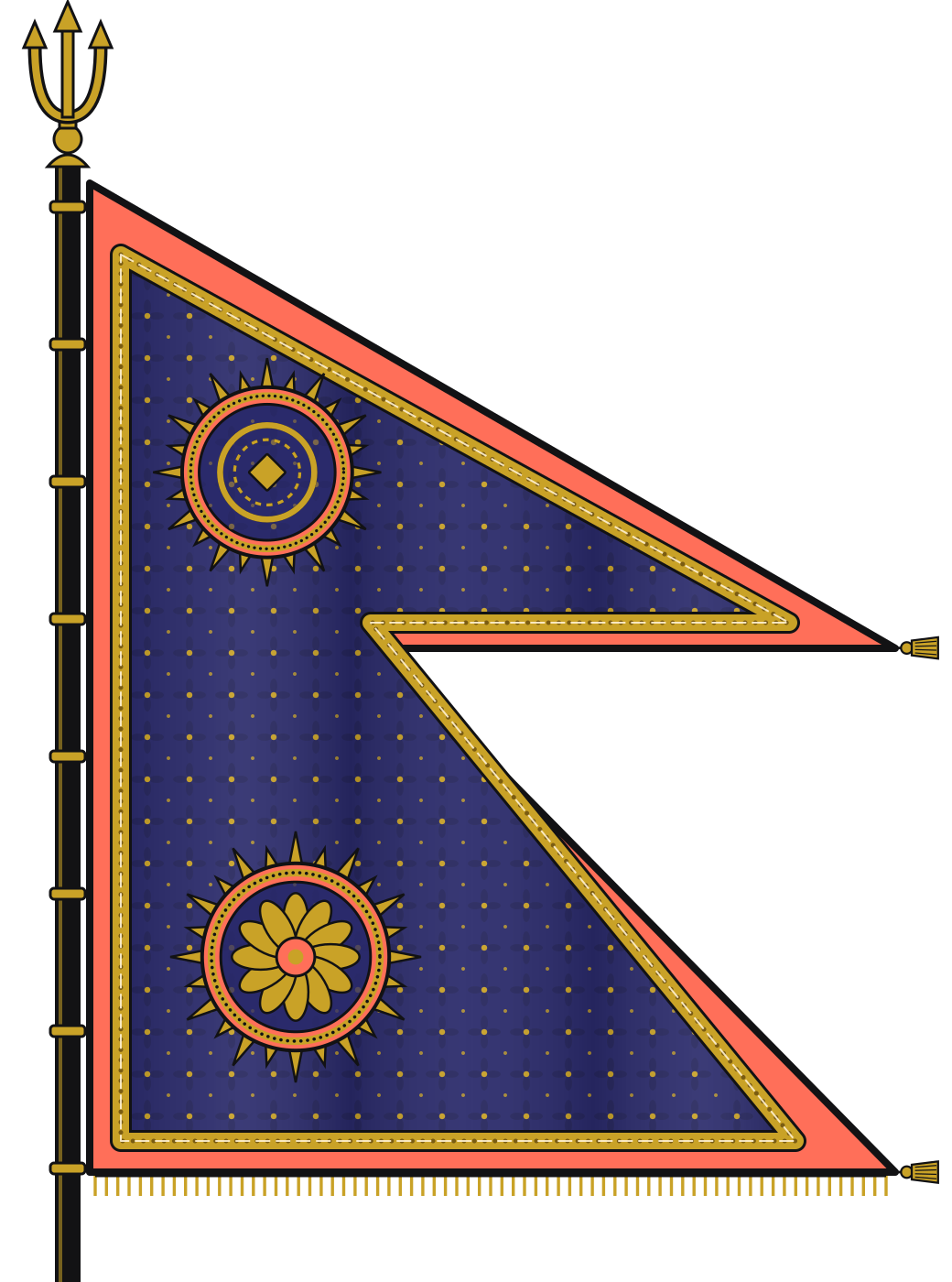
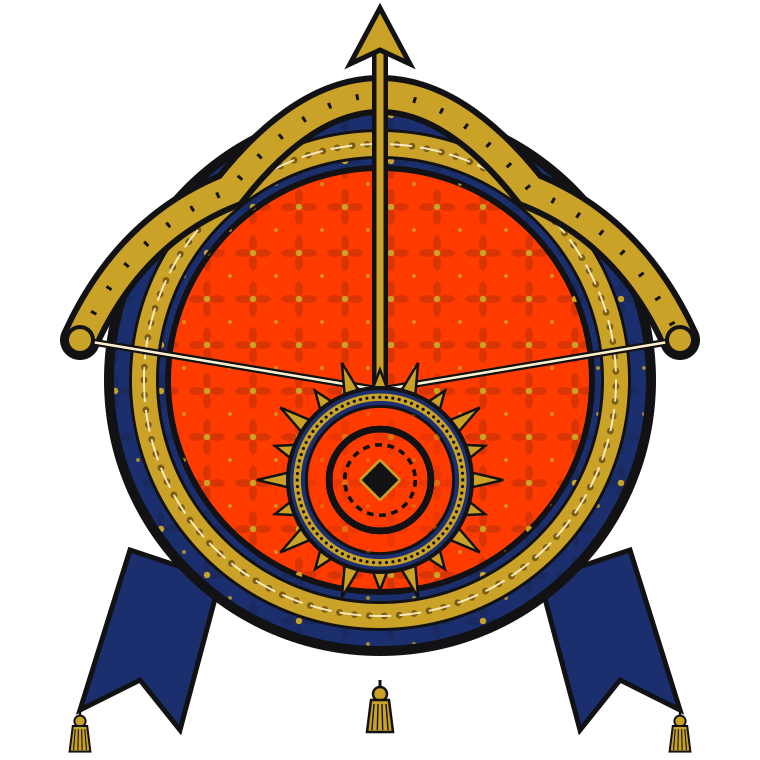
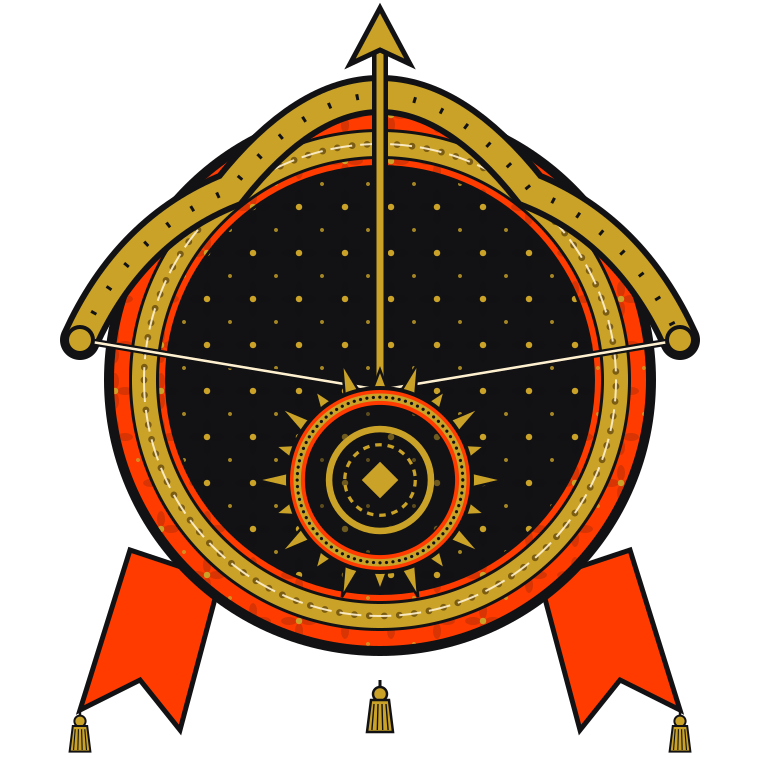
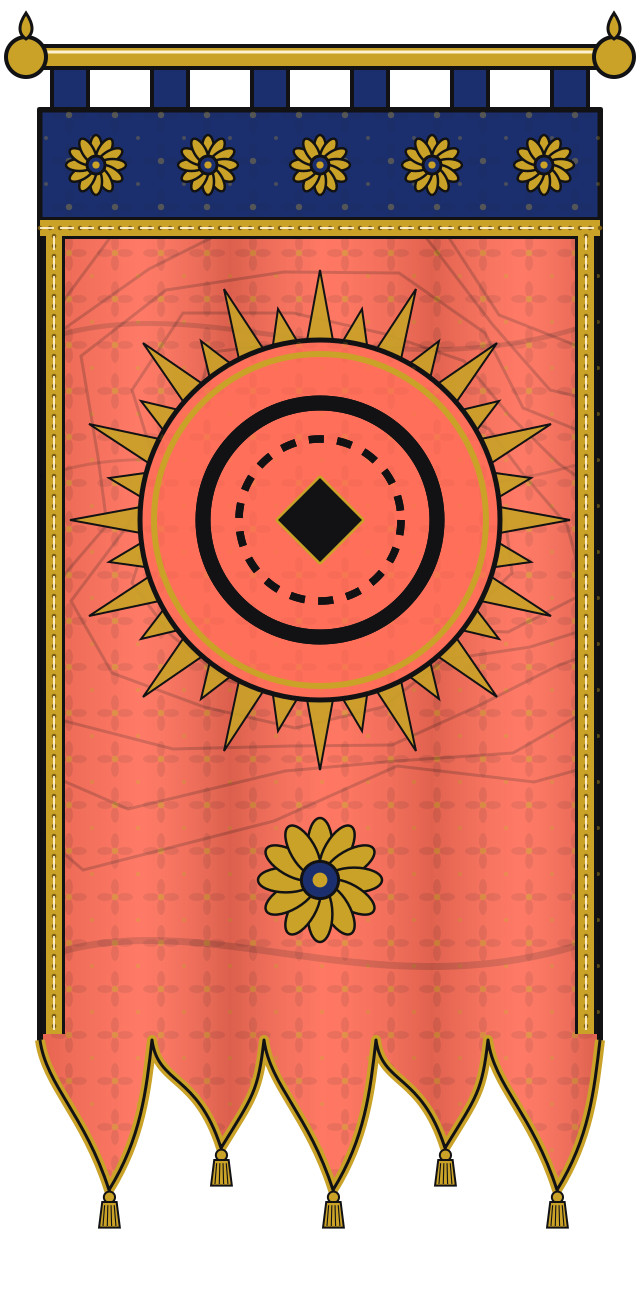
The flag's damphu emblem and the Changi form come, as a design idea and not a documented emblem. The damphu is recorded as a Tamang drum[4]
| Part of the kit | This clan |
|---|---|
| Field | Warm Red-Orange #FF6F59 |
| Accent | Royal Navy #1B2F6E |
| Emblem colour | Charcoal Black #121214 |
| Zari metal | Gold |
| Main emblem | A damphu drum |
| Second image | — |
| Night and day | Every visual accessory has two versions: by night the emblem on the dark field, by day the clan's field colour on cloth woven from its metal. |
6. Flags
Every clan has every flag type; the type says the occasion and the colours say the clan. The outlined card is the flag the Atlas assigns.
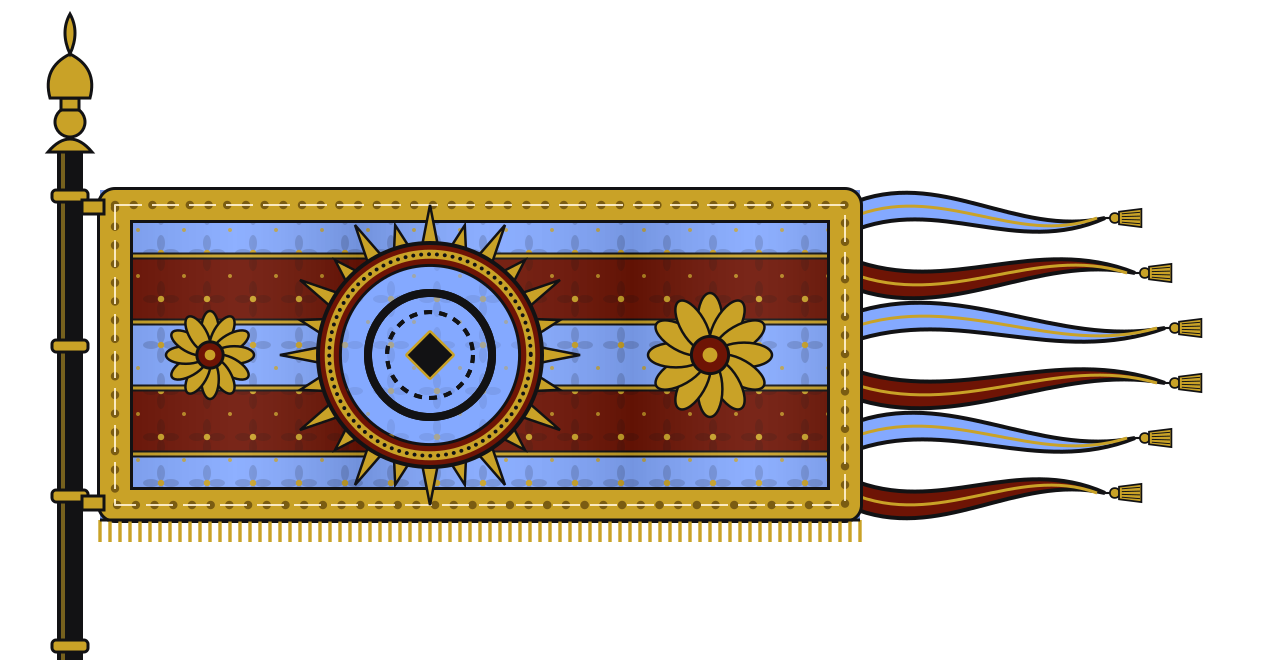
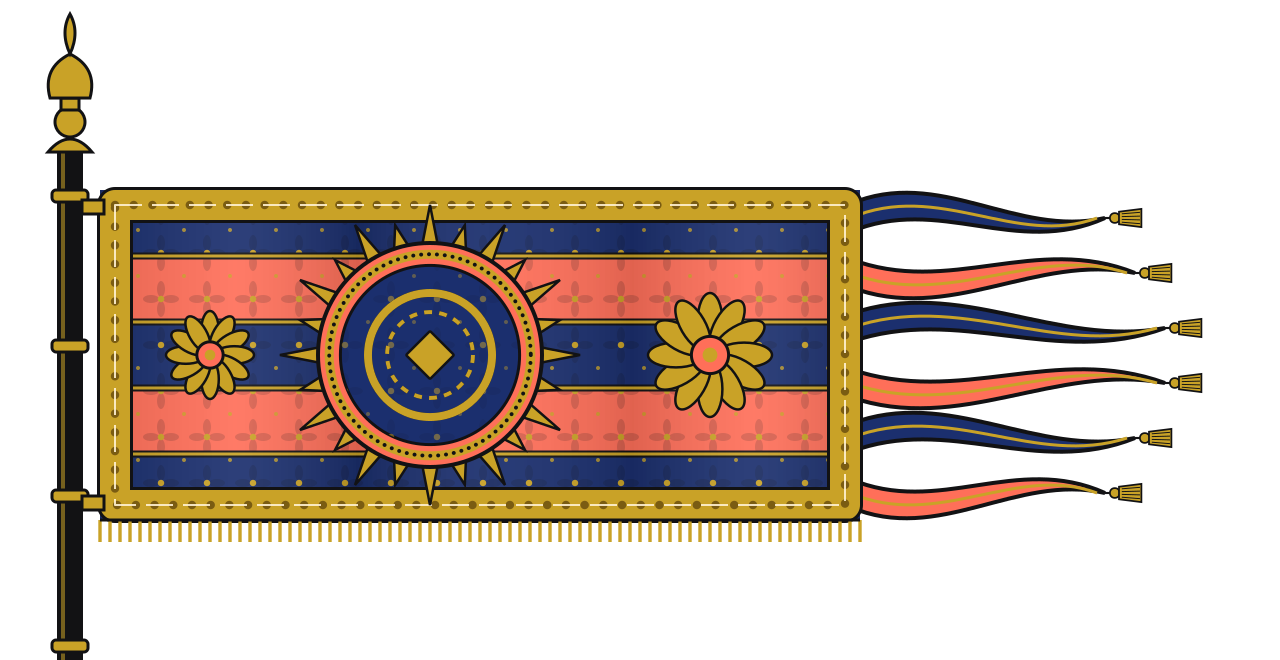
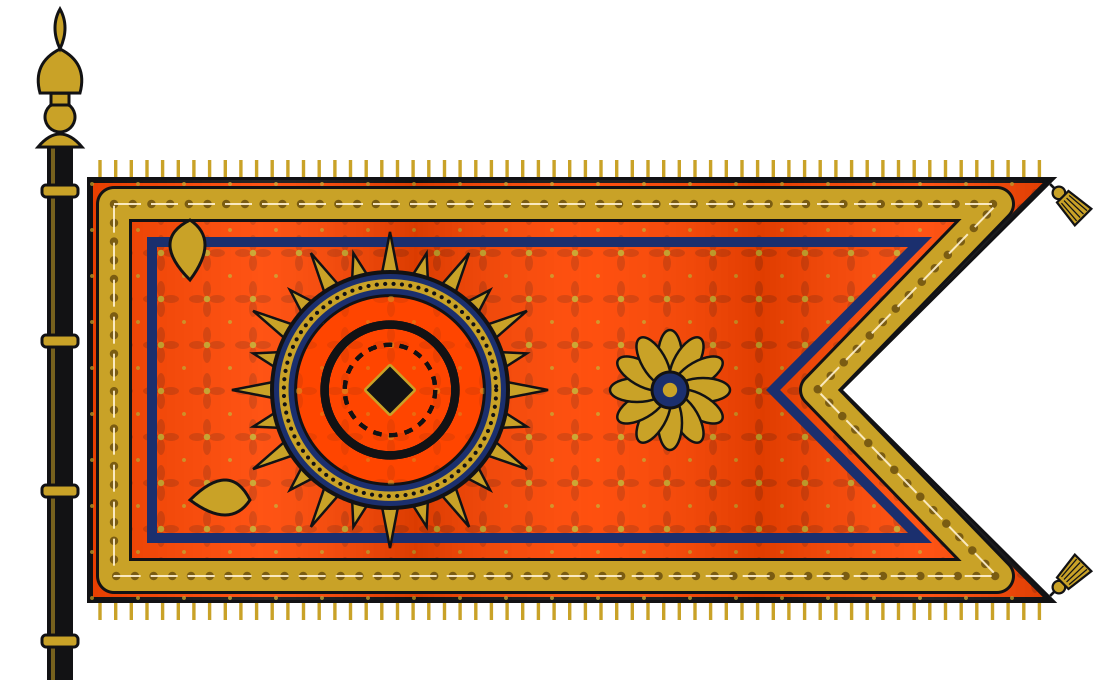
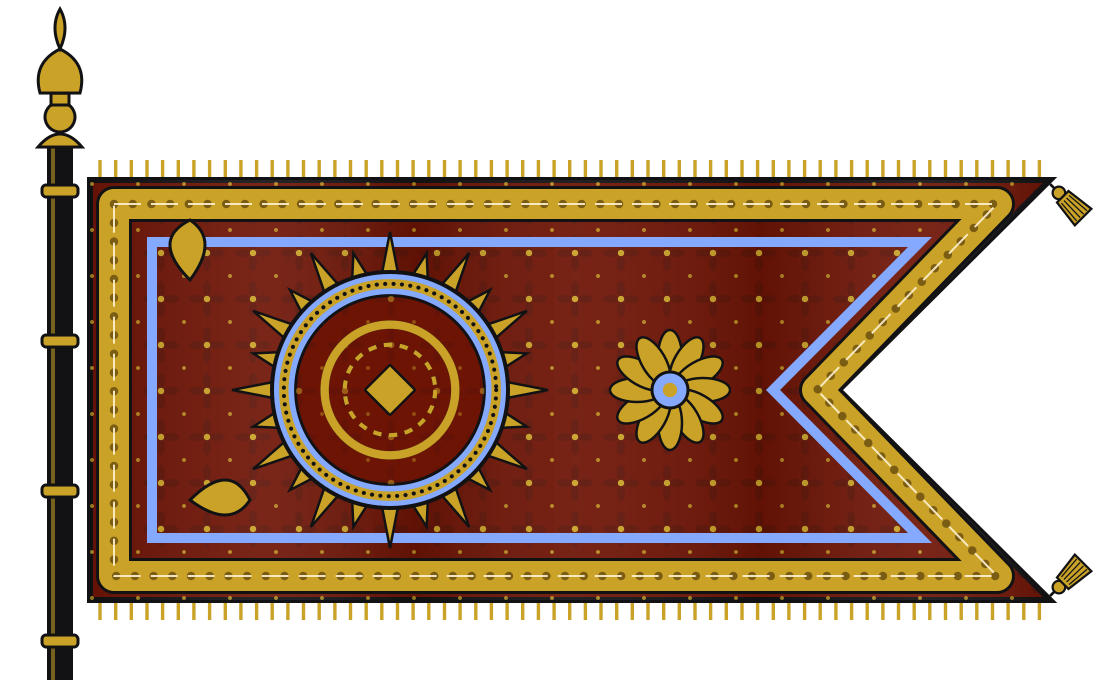
Historic banner
None known
New flag types
| Accessory | For this clan | Basis |
|---|---|---|
| A9 Pota-dhvaja · ship and trade flag For ships, caravans and markets | Not yet designed for this clan | Design |
| A10 Utsava-patāka · festival flag Light, bright flag for fairs and festivals | Not yet designed for this clan | Design |
| A11 Shoka-dhvaja · mourning flag White cloth with the emblem outline in the clan's metal | Not yet designed for this clan | Design |
7. Regalia
| Accessory | For this clan | Basis |
|---|---|---|
| E1 Chhatra · house parasol The ceremonial umbrella | Not yet designed for this clan | Design |
| E2 Chamara · fly-whisks The pair of whisks beside the head of the house | Not yet designed for this clan | Design |
| E3 Danda · staff of office Staff or scepter | Not yet designed for this clan | Design |
| E4 Simhasana · seat The seat of the house, covered in clan cloth | Not yet designed for this clan | Design |
| E5 Khetaka · shield A round shield; the Changi and Dhanush are its flag forms | Not yet designed for this clan | Regional tradition |
| E6 Kula-ayudha · clan weapon The weapon the clan honours | Not yet found for this clan | Under research |
8. Worn
| Accessory | For this clan | Basis |
|---|---|---|
| F1 Kula-vastra · clan cloth The clan's woven pattern in its kit colours | Tamang dress: male Surlung, Khenza, Khenju, Tagi; female Hangre, Hanju, Syama/Dormo, Kerek, Tagi | Regional tradition |
| F2 Kirti-vastra · honour cloth A cloth earned for a deed, not inherited | Not yet designed for this clan | Design |
| F3 Kula-mala · garland flower The flower or leaf the clan wears as a garland | Not yet found for this clan | Under research |
| F4 Chinha · house pin A metal badge with the pin emblem | Not yet designed for this clan | Design |
9. Records
| Accessory | For this clan | Basis |
|---|---|---|
| H1 Clan words A traditional line in the native script | · “” No clan words are printed in the extracts. Under research. | Documented |
| H2 Biruda · titles The house's title or titles | Not yet found for this clan | Under research |
| H3 Prashasti · praise genealogy The lineage as written at the head of a grant | Tamba genealogists, who sing Hwai ritual songs | Documented |
| H4 Vahi · clan register The book of the clan's births, marriages and deaths | Not yet found for this clan | Under research |
| H5 Rana-ghosha · war cry The clan's cry in battle or celebration | Not yet found for this clan | Under research |
10. VishwaVit · knower of the world
Game values are design choices for this project, not historical claims.
References
- Wikipedia, Tamang people, read 2026-11-09, https://en.wikipedia.org/wiki/Tamang_people
- Tribal Research Institute and Training Centre, Sikkim, Tamang tribe, read 2026-11-09, https://trisikkim.org/en/tribes/TAMANG TRIBE
- Himalayan Cultures, Tamang clans and lineage structure, read 2026-11-09, https://himalayancultures.com/cultures/tamang-culture/tamang-clans-and-lineage-structure/
- Wikipedia, Tamang Selo, read 2026-11-09, https://en.wikipedia.org/wiki/Tamang_Selo
- Nepal Traveller, Guhyeshwari Temple: a sacred Shakti Peetha in Kathmandu, read 2026-10-09, https://www.nepaltraveller.com/sidetrack/guhyeshwari-temple-a-sacred-shakti-peetha-in-kathmandu
- Wikipedia, Sonam Lhosar, read 2026-11-09, https://en.wikipedia.org/wiki/Sonam_Lhosar
- Rebika Kunwar, Sound of Himalayas: Tungna's ethnomusicology and its waning craft, The Farsight Nepal, 26 Jul 2023, read 2026-10-30, https://farsightnepal.com/news/192
- Kathmandu Post, The unchanging tunes of six Nepali musical instruments, 6 Mar 2020, read 2026-10-29, https://kathmandupost.com/weekender/2020/03/06/the-unchanging-tunes-of-six-nepali-musical-instruments
- Sharma, B., तामाङ लोक संस्कृति र सेलो गीतको सूक्ष्म विश्लेषण, Voice 16(2), 2024, 159-168 (abstract), read 2026-11-09, https://nepjol.info/index.php/voice/article/view/72788