The Sounti are a Scheduled Tribe of Odisha (list dated 09-07-2024), counted at 112,803 in the 2011 census, most of them in Keonjhar[1][2]. Their origin is given three ways that do not agree: a 1931 census account credits Joygobinda Das of Puri with founding the group in the 17th century[2]; oral accounts recorded in 1998 say that a Keonjhar king named them Saunti and that they were gathered from many communities[3]; and the Odisha State Tribal Museum derives the name from 'gathered in'[4]. All three are unverified tradition. Most Sounti speak a dialect of Odia, and their main living is farming and labouring[2][4]. The Atlas gives Tarini of Ghatagaon as their kuldevi; the oral account has her stay at Ghatagan but does not call her the Sounti's own deity[5][3].
01Faith and deities
Maa Tarini of Ghatagaon, Keonjhar[5]
The presiding goddess of the clan's homeland or capital: a link of place, not a recorded clan tie.
| Deity or tradition | Place in the clan's life | Evidence |
|---|---|---|
| Thakurani | A village deity worshipped by the Sounti | [2] |
| Mangala | A village deity worshipped by the Sounti | [2] |
| Siva | A Hindu deity worshipped by the Sounti | [2] |
| Raghunath | A Hindu deity worshipped by the Sounti | [2] |
| Some animist beliefs | Noted on the Wikipedia page, which credits the SCSTRTI | [2] |
| Dharam Devata | The Sun god, in the blog's account | [6] |
| Basuki Mata | The goddess Earth, in the blog's account | [6] |
| Tarini (KulDevi) ମା ତାରିଣୀ | Guardian deity of Kanchi who was brought to Keonjhar and stayed at Ghatagan (oral account) | [3][5] |
| Madanamohana | A statue taken from Kanchi and installed at Trilochanapur Dandapat (oral account) | [3] |
| Jagannath and Balabhadra | Named in the oral account | [3] |
| Bata Ganesha | Ganesha is called Bata Ganesha at Puri, and is known at a banyan tree (oral account) | [3] |
02Temples
No temple is recorded as built or patronised by the Sounti. The oral account names Ghatagan, where Tarini stayed, and Trilochanapur Dandapat, where the Madanamohana statue was installed (Tripathy, oral, unverified)[3]. The sheet's KulDevi shrine, Maa Tarini Temple at Ghatgaon in Kendujhar district (ମା ତାରିଣୀ ମନ୍ଦିର, Kalinga architecture, Patua Yatra), is not shown as built or patronised by the Sounti, because no fetched source ties it to them[5][7].
Built by the clan
Not recorded.
Given patronage or grants by the clan
Not recorded.
03Languages and scripts
| Language or script | Kind | Under the clan | Evidence |
|---|---|---|---|
| Odia dialect (Sounti) living | Spoken by most Sounti (Wikipedia, 2011 census and SCSTRTI) | Odisha | [2] |
| Odia living | Language given by the OSTM for the Sounti | Odisha | [4] |
| Sounti research | Blog: the Sounti speak Sounti, said to be Indo-Aryan; no grammar or word list is in the extracts | Keonjhar, Odisha | [6] |
04Books and literature
No script, manuscript or written literature of the Sounti is recorded in the extracts. The works below are the sources the Wikipedia page cites on the Sounti; they were not read for this page.
Written during the clan's history
| Work | Author | Kind | When | Link to the clan |
|---|---|---|---|---|
| Orissa district gazetteers | Senapati and Sahu | Gazetteer | 1966 | [2] |
| Census of Mayurbhanj State | Laeequddin | Census | 1931 (pub. 1937) | [2] |
| Communities, Segments, Synonyms, Surnames and Titles | K. S. Singh | Book | 1996 | [2] |
| Tribal and Indigenous People of India | Pati and Dash | Book | 2002 | [2] |
| State of the Adivasis in Odisha | SAGE India | Book | 2014 | [2] |
Given patronage by the clan
Not recorded.
05Thinkers and scholars
Not recorded.
No Sounti thinker or scholar is named in the extracts. The authors above are listed under Books, as the Wikipedia page cites them.
06Art and architecture
No painting, sculpture, architecture, textile or craft of the Sounti is recorded in the extracts.
Painting and wall art
Not recorded.
Sculpture and temple art
Not recorded.
Temple and building architecture
Not recorded.
Weaving and textiles
Not recorded.
Clothing and jewellery
Not recorded.
Coins, pottery and crafts
Not recorded.
07History
Origin accounts (unverified tradition)
The Wikipedia page gives the 1931 Mayurbhanj census as saying that the caste is said to have emerged in the 17th century under Joygobinda Das[2]. This is unverified tradition.
The Tribal Tribune's oral accounts (interviews of 1998, by Biyotkesh Tripathy) say that Purushottama Bhanja of Keonjhar named the group Saunti, and that they were gathered from many communities, with helpers brought from Uttar Pradesh[3]. The article presents these as folk tradition, not verified.
The Odisha State Tribal Museum derives the name Sounti from Saunta, 'gathered in', and says the community was believed to have been formed from people outcast from other castes, later allowed to settle at Mamamata village in Keonjhar (spelling as printed; Wikipedia gives Mananta)[4][2]. This is unverified tradition.
The name
The 1931 census prints 'Saunti' and the 1956 SC/ST Order uses 'Sounti'; members may say 'Samuli' or 'Samti' (Wikipedia)[2]. The Orissa Annual Reference 2004 also prints 'Saunti'[8].
Keonjhar in the oral accounts (15th century)
The oral accounts date events by Keonjhar's rulers: Trilochana Bhanja ruled 1461-1480; a Kanchi War of Purusottama Deba of Puri is dated 1474-1475, and Gobinda Bhanja, son of Trilochana, won the second Kanchi War as Commander and returned to Keonjhar in 1480[3]. Purushottama Bhanja then held a yagnya and sent for Brahmins from Uttar Pradesh[3]. These dates come from the oral accounts and are not checked against a chronicle.
Keonjhar State
The Sounti are said to have been created in Keonjhar (oral account)[3]. Keonjhar State, by Wikipedia's account, was founded under Eastern Ganga rule in the 12th century by tradition, and merged into India on 1 January 1948[9].
08Journey and migrations
Two movements are recorded, and the sources do not connect them: a settlement at Mananta village after 1603 CE (census account), and helpers who came from Uttar Pradesh in the reign of Purushottama Bhanja (oral account). The dates of the second are not given.
| When | From | To | Why | Evidence |
|---|---|---|---|---|
| 1603 CE | Puri | Kendujhar, settled at Mananta village | Joygobinda Das came from Puri and was allowed to settle (1931 census, per Laeequddin; unverified) | [2] |
| In Purushottama Bhanja's reign (not dated) | Uttar Pradesh | Keonjhar | Brahmins and helpers came at Purushottama Bhanja's request; the helpers were called Dalapanthi in Uttar Pradesh (oral account) | [3] |
09Seats and lands
| Place | Role | Where today |
|---|---|---|
| Keonjhar (Kendujhar) | Main district: 72,752 in 2011; the blog says mainly Keonjhar, with quite a few in Anandapur subdivision; the oral accounts place the creation of the group here | Keonjhar, Odisha[2][6][3] |
| Mayurbhanj | Second district: 28,677 in 2011; listed in the KISS handbook and the Orissa Annual Reference 2004 | Mayurbhanj, Odisha[2][10][8] |
| Khordha (Khurda) | 3,269 in 2011; the KISS handbook prints Khurda | Khordha, Odisha[2][10] |
| Nabarangapur, Baleswar, Ganjam | 2011: Nabarangapur 3,898; Baleswar 2,042; Ganjam 1,069 | Odisha[2] |
| Puri | Listed among the tribal communities of Puri district, as printed; no population | Puri, Odisha[8] |
| Uttar Pradesh | Named as the origin of the helpers in the oral account; not a Sounti homeland | Uttar Pradesh[3] |
| Mushakhori, Kapundi, Patana, Karanjiapada, Rai Tihar | Villages and place named in the oral accounts; where they lie is not stated | Named in[3] |
10Notable figures
| Name | Role | Era | Known from |
|---|---|---|---|
| Joygobinda Das | Credited with founding the group; came from Puri (census account, unverified) | 1603 CE | [2] |
| Trilochana Bhanja | Ruler of Keonjhar, father of Gobinda Bhanja | 1461-1480 | [3] |
| Purushottama Bhanja | Keonjhar ruler who named the group Saunti and sent for Brahmins from Uttar Pradesh | Not dated | [3] |
| Gobinda Bhanja | Commander in the second Kanchi War; brought Tarini to Keonjhar (oral account) | 1480 | [3] |
| Janardan Bhanja | Ruler whose reign had the war for Singhabhum and the Tentaposhi War (oral account) | Not dated | [3] |
| Jaigopal Guman Singh Bedhajala Mahapatra | The Kanchi Commander; made a landlord, with Mushakhori and Kapundi (about 120 bati, 2,400 acres) (oral account) | Not dated (oral) | [3] |
| Radhamohan Mahapatra | Leader of the Saunti in the oral account; father of Bhakta Bisoi | d. 1964 | [3] |
| Bhakta Bisoi | Warrior honoured with an iron sword; received land at Rai Tihar (oral account) | Not dated | [3] |
| Manika Gauduni legend | Cowgirl in folklore (oral account) | Folklore | [3] |
11Allies, rivals and marriages
| People | Relationship | When |
|---|---|---|
| Bhuiya | Related group (Wikipedia) | Today |
| Bathudi | Related group (Wikipedia); said to have good rapport with the Sounti (blog) | Today |
| Bhuyan, Bhumij, Gond, Ho, Juang, Kharwar, Kisan, Kolha | Said to have good rapport with the Sounti (blog) | Today |
| Keonjhar royal house (Bhanja) | Purushottama Bhanja named them Saunti (oral account); their service to Brahmins was tied to the king's sasana villages, and cultivation and homestead land were granted by the king (oral accounts) | Oral accounts, not dated |
| Brahmins from Uttar Pradesh | Brought by Purushottama Bhanja; the Sounti served them as helpers (oral account) | Not dated |
| Ho, Bhumij, Bhuiya, Khond, Chutia | Deori priest role also among these peoples (Munda people page)[11] | Today |
12Society and livelihood
Patrilineal and mostly monogamous, with rare polygamy; a traditional council under a village chief and elders handles disputes (Pati and Dash 2002, on the Wikipedia page)[2]. The blog calls the community endogamous and divided into exogamous groups called khilis[6]; the Wikipedia page calls the bansa exogamous[2].
Government and social order
| Institution or group | What it was | Evidence |
|---|---|---|
| Village chief and elders | A traditional council that handles disputes | [2] |
| Bansa | Exogamous patri-lineages, as printed (see Sub-clans) | [2] |
| Khili | Exogamous groups in the blog's account (see Sub-clans) | [6] |
| Nageswar gotra | The totemic gotra (killi), the cobra (see Astitva) | [2] |
| Marriage | By negotiation, with bride price; widows, widowers and divorcees may remarry; junior levirate and sororate are permitted | [2] |
| Pollution | Birth pollution 21 days; death pollution 10 days | [2] |
| Funerals | Both cremation and burial are practised | [2] |
| Houses and household | Two-room houses with a verandah, a cattle shed and a rice de-husking shed; charpoys, date-palm mats, bell-metal and aluminium utensils | [2] |
| Priesthood | Service to Brahmins, tied to the king's sasana villages (oral account); the Deori priest role is also among the Sounti (Munda people page) | [3][11] |
Livelihood over time
| Era | Livelihood | Evidence |
|---|---|---|
| Forest life as children (oral account) | Forest children raised by the king of Keonjhar, who gave cultivation and homestead land | [3] |
| Today (Census 2011; SAGE 2014) | Farming, livestock and forestry; many are farm labourers | [2] |
| Today (OSTM) | Agriculture and wage labour are the main income; occasional hunting and gathering in forests; cattle rearing | [4] |
| Today (blog) | Basically agricultural; women work as daily labourers and in household work | [6] |
13Sub-clans and related clans
Sub-clans, lineages and related peoples the sources name. The totemic gotra (killi) is the cobra. Exogamous patri-lineages (bansa) are listed as printed on the Wikipedia page, from the Mayurbhanj census and Singh (1996), 95 names; the blog gives a separate set of exogamous groups called khilis, some of which are the same names (marked in 'where'). Spelling is as printed; no sub-clan has a size or a homeland in the sources. Related peoples: Bhuiya and Bathudi (Wikipedia, with 2011 Scheduled Tribe sizes). The Bhanja name is the royal name of the Keonjhar house in the oral account, and Dalapanthi is the name the helpers had in Uttar Pradesh. Items without a sheet ID become new clan candidates.
| Clan | Relation | Where | Size | In the Atlas | Evidence |
|---|---|---|---|---|---|
| Nageswar (cobra) | Sub-clan | Totemic gotra (killi), the cobra | new clan candidate | [2] | |
| Aguan Sinha | Sub-clan | Exogamous patri-lineage (bansa), spelling as printed | new clan candidate | [2] | |
| Anukulia | Sub-clan | Exogamous patri-lineage (bansa), spelling as printed | new clan candidate | [2] | |
| Apat | Sub-clan | Exogamous patri-lineage (bansa), spelling as printed | new clan candidate | [2] | |
| Atala | Sub-clan | Exogamous patri-lineage (bansa), spelling as printed | new clan candidate | [2] | |
| Badam | Sub-clan | Exogamous patri-lineage (bansa), spelling as printed | new clan candidate | [2] | |
| Baghasinha | Sub-clan | Exogamous patri-lineage (bansa), spelling as printed | new clan candidate | [2] | |
| Bahabalindra | Sub-clan | Exogamous patri-lineage (bansa), spelling as printed | new clan candidate | [2] | |
| Baliposia | Sub-clan | Exogamous patri-lineage (bansa), spelling as printed | new clan candidate | [2] | |
| Banapadia | Sub-clan | Exogamous patri-lineage (bansa), spelling as printed | new clan candidate | [2] | |
| Bansmulia | Sub-clan | Exogamous patri-lineage (bansa), spelling as printed | new clan candidate | [2] | |
| Baradia | Sub-clan | Exogamous patri-lineage (bansa), spelling as printed | new clan candidate | [2] | |
| Bebarta | Sub-clan | Exogamous patri-lineage (bansa), spelling as printed | new clan candidate | [2] | |
| Behera | Sub-clan | Exogamous patri-lineage (bansa), spelling as printed | new clan candidate | [2] | |
| Betjharia | Sub-clan | Exogamous patri-lineage (bansa), spelling as printed | new clan candidate | [2] | |
| Chipindia | Sub-clan | Exogamous patri-lineage (bansa), spelling as printed; also a khili in the blog list | new clan candidate | [2] | |
| Chowdhury | Sub-clan | Exogamous patri-lineage (bansa), spelling as printed | new clan candidate | [2] | |
| Dakua | Sub-clan | Exogamous patri-lineage (bansa), spelling as printed | new clan candidate | [2] | |
| Dala Behera | Sub-clan | Exogamous patri-lineage (bansa), spelling as printed | new clan candidate | [2] | |
| Dalai | Sub-clan | Exogamous patri-lineage (bansa), spelling as printed | new clan candidate | [2] | |
| Dalai Mahapatra | Sub-clan | Exogamous patri-lineage (bansa), spelling as printed | new clan candidate | [2] | |
| Bhala Bhai | Sub-clan | Exogamous patri-lineage (bansa), spelling as printed | new clan candidate | [2] | |
| Bhuinya Mahapatra | Sub-clan | Exogamous patri-lineage (bansa), spelling as printed | new clan candidate | [2] | |
| Bhujabala | Sub-clan | Exogamous patri-lineage (bansa), spelling as printed | new clan candidate | [2] | |
| Bhuri Bisai | Sub-clan | Exogamous patri-lineage (bansa), spelling as printed | new clan candidate | [2] | |
| Biswal | Sub-clan | Exogamous patri-lineage (bansa), spelling as printed | new clan candidate | [2] | |
| Budhipat | Sub-clan | Exogamous patri-lineage (bansa), spelling as printed | new clan candidate | [2] | |
| Chatarpania | Sub-clan | Exogamous patri-lineage (bansa), spelling as printed | new clan candidate | [2] | |
| Daldashia | Sub-clan | Exogamous patri-lineage (bansa), spelling as printed | new clan candidate | [2] | |
| Danakulia | Sub-clan | Exogamous patri-lineage (bansa), spelling as printed | new clan candidate | [2] | |
| Dandapat | Sub-clan | Exogamous patri-lineage (bansa), spelling as printed | new clan candidate | [2] | |
| Dandasena | Sub-clan | Exogamous patri-lineage (bansa), spelling as printed | new clan candidate | [2] | |
| Das | Sub-clan | Exogamous patri-lineage (bansa), spelling as printed; also a khili in the blog list | new clan candidate | [2] | |
| Dehuri | Sub-clan | Sub-clan as printed on the Wikipedia page; the Atlas has a Dehuri (ST-380) in the Chota Nagpur list, and the link is not made here | same name as ST-380: check | [2] | |
| Desa Dakua | Sub-clan | Exogamous patri-lineage (bansa), spelling as printed | new clan candidate | [2] | |
| Ghulakundia | Sub-clan | Exogamous patri-lineage (bansa), spelling as printed | new clan candidate | [2] | |
| Dhangad | Sub-clan | Exogamous patri-lineage (bansa), spelling as printed | new clan candidate | [2] | |
| Foudakar | Sub-clan | Exogamous patri-lineage (bansa), spelling as printed | new clan candidate | [2] | |
| Ganabarai | Sub-clan | Exogamous patri-lineage (bansa), spelling as printed | new clan candidate | [2] | |
| Gharapua Mahapatra | Sub-clan | Exogamous patri-lineage (bansa), spelling as printed | new clan candidate | [2] | |
| Giri | Sub-clan | Exogamous patri-lineage (bansa), spelling as printed; also a khili in the blog list | new clan candidate | [2] | |
| Gobargadia | Sub-clan | Exogamous patri-lineage (bansa), spelling as printed | new clan candidate | [2] | |
| Gumanaganjan Singh Berdhajal Mahapatra | Sub-clan | Exogamous patri-lineage (bansa), spelling as printed | new clan candidate | [2] | |
| Hati | Sub-clan | Exogamous patri-lineage (bansa), spelling as printed | new clan candidate | [2] | |
| Hatiram | Sub-clan | Exogamous patri-lineage (bansa), spelling as printed | new clan candidate | [2] | |
| Jadipadia | Sub-clan | Exogamous patri-lineage (bansa), spelling as printed | new clan candidate | [2] | |
| Jalpadia | Sub-clan | Exogamous patri-lineage (bansa), spelling as printed | new clan candidate | [2] | |
| Jhapat Sinha | Sub-clan | Exogamous patri-lineage (bansa), spelling as printed | new clan candidate | [2] | |
| Kalapadia | Sub-clan | Exogamous patri-lineage (bansa), spelling as printed | new clan candidate | [2] | |
| Kalapal | Sub-clan | Exogamous patri-lineage (bansa), spelling as printed | new clan candidate | [2] | |
| Kapandia | Sub-clan | Exogamous patri-lineage (bansa), spelling as printed | new clan candidate | [2] | |
| Kargi | Sub-clan | Exogamous patri-lineage (bansa), spelling as printed | new clan candidate | [2] | |
| Khamadiha | Sub-clan | Exogamous patri-lineage (bansa), spelling as printed | new clan candidate | [2] | |
| Khamalia | Sub-clan | Exogamous patri-lineage (bansa), spelling as printed | new clan candidate | [2] | |
| Khamrai | Sub-clan | Exogamous patri-lineage (bansa), spelling as printed | new clan candidate | [2] | |
| Khanda | Sub-clan | Exogamous patri-lineage (bansa), spelling as printed | new clan candidate | [2] | |
| Khandapatra | Sub-clan | Exogamous patri-lineage (bansa), spelling as printed | new clan candidate | [2] | |
| Kialia | Sub-clan | Exogamous patri-lineage (bansa), spelling as printed | new clan candidate | [2] | |
| Kuabasia | Sub-clan | Exogamous patri-lineage (bansa), spelling as printed | new clan candidate | [2] | |
| Kulapadia | Sub-clan | Exogamous patri-lineage (bansa), spelling as printed | new clan candidate | [2] | |
| Kundalia | Sub-clan | Exogamous patri-lineage (bansa), spelling as printed | new clan candidate | [2] | |
| Kusmalia | Sub-clan | Exogamous patri-lineage (bansa), spelling as printed; also a khili in the blog list | new clan candidate | [2] | |
| Mahapatra | Sub-clan | Exogamous patri-lineage (bansa), spelling as printed | new clan candidate | [2] | |
| Malik | Sub-clan | Exogamous patri-lineage (bansa), spelling as printed | new clan candidate | [2] | |
| Mangal Puria Mardaraj Mahapatra | Sub-clan | Exogamous patri-lineage (bansa), spelling as printed | new clan candidate | [2] | |
| Miriga Khojia | Sub-clan | Exogamous patri-lineage (bansa), spelling as printed | new clan candidate | [2] | |
| Mudi | Sub-clan | Exogamous patri-lineage (bansa), spelling as printed | new clan candidate | [2] | |
| Narendra | Sub-clan | Exogamous patri-lineage (bansa), spelling as printed | new clan candidate | [2] | |
| Nayak | Sub-clan | Exogamous patri-lineage (bansa), spelling as printed | new clan candidate | [2] | |
| Nuagadia | Sub-clan | Exogamous patri-lineage (bansa), spelling as printed | new clan candidate | [2] | |
| Nuakulia | Sub-clan | Exogamous patri-lineage (bansa), spelling as printed | new clan candidate | [2] | |
| Nungalia | Sub-clan | Exogamous patri-lineage (bansa), spelling as printed | new clan candidate | [2] | |
| Padhan | Sub-clan | Exogamous patri-lineage (bansa), spelling as printed | new clan candidate | [2] | |
| Palta Sinha | Sub-clan | Exogamous patri-lineage (bansa), spelling as printed | new clan candidate | [2] | |
| Pangia | Sub-clan | Exogamous patri-lineage (bansa), spelling as printed | new clan candidate | [2] | |
| Paramanik | Sub-clan | Exogamous patri-lineage (bansa), spelling as printed | new clan candidate | [2] | |
| Parida | Sub-clan | Exogamous patri-lineage (bansa), spelling as printed | new clan candidate | [2] | |
| Putulia | Sub-clan | Exogamous patri-lineage (bansa), spelling as printed | new clan candidate | [2] | |
| Sarubalia | Sub-clan | Exogamous patri-lineage (bansa), spelling as printed | new clan candidate | [2] | |
| Satrusala | Sub-clan | Exogamous patri-lineage (bansa), spelling as printed | new clan candidate | [2] | |
| Raipadia | Sub-clan | Exogamous patri-lineage (bansa), spelling as printed | new clan candidate | [2] | |
| Sankhalua | Sub-clan | Exogamous patri-lineage (bansa), spelling as printed | new clan candidate | [2] | |
| Saradia | Sub-clan | Exogamous patri-lineage (bansa), spelling as printed | new clan candidate | [2] | |
| Sarpat | Sub-clan | Exogamous patri-lineage (bansa), spelling as printed | new clan candidate | [2] | |
| Sarpuria | Sub-clan | Exogamous patri-lineage (bansa), spelling as printed; also a khili in the blog list | new clan candidate | [2] | |
| Saru | Sub-clan | Exogamous patri-lineage (bansa), spelling as printed | new clan candidate | [2] | |
| Sindura Roy | Sub-clan | Exogamous patri-lineage (bansa), spelling as printed | new clan candidate | [2] | |
| Sindurgaria | Sub-clan | Exogamous patri-lineage (bansa), spelling as printed | new clan candidate | [2] | |
| Sinha | Sub-clan | Exogamous patri-lineage (bansa), spelling as printed | new clan candidate | [2] | |
| Tainsiria | Sub-clan | Exogamous patri-lineage (bansa), spelling as printed | new clan candidate | [2] | |
| Talsarua | Sub-clan | Exogamous patri-lineage (bansa), spelling as printed | new clan candidate | [2] | |
| Tandakar | Sub-clan | Exogamous patri-lineage (bansa), spelling as printed | new clan candidate | [2] | |
| Tangania | Sub-clan | Exogamous patri-lineage (bansa), spelling as printed | new clan candidate | [2] | |
| Tangiria | Sub-clan | Exogamous patri-lineage (bansa), spelling as printed | new clan candidate | [2] | |
| Tarania | Sub-clan | Exogamous patri-lineage (bansa), spelling as printed | new clan candidate | [2] | |
| Tinti | Sub-clan | Exogamous patri-lineage (bansa), spelling as printed | new clan candidate | [2] | |
| Baghsingh | Sub-clan | Khili (blog list, marked 'etc.'), spelling as printed | new clan candidate | [6] | |
| Balaria | Sub-clan | Khili (blog list, marked 'etc.'), spelling as printed | new clan candidate | [6] | |
| Naik | Sub-clan | Khili (blog list, marked 'etc.'), spelling as printed | new clan candidate | [6] | |
| Paida | Sub-clan | Khili (blog list, marked 'etc.'), spelling as printed | new clan candidate | [6] | |
| Palia | Sub-clan | Khili (blog list, marked 'etc.'), spelling as printed | new clan candidate | [6] | |
| Ankulia | Sub-clan | Khili (blog list, marked 'etc.'), spelling as printed | new clan candidate | [6] | |
| Poida | Sub-clan | Surname as printed on the Wikipedia page | new clan candidate | [2] | |
| Pradhan | Sub-clan | Surname as printed on the Wikipedia page | new clan candidate | [2] | |
| Bisoi | Related people | Surname, as in the oral account (Gautam Bisoi; Bhakta Bisoi) | new clan candidate | [3] | |
| Bhuiya | Related people | Related group (Wikipedia) | 306,129, 2011[1] | ST-031 | [2][1] |
| Bathudi | Related people | Related group (Wikipedia) | 217,395, 2011[1] | ST-019 | [2][1] |
| Bhanja | Dynasty from this clan | Royal name of the Keonjhar house, as the oral account gives it | same name as ANC-297: check | [3] | |
| Dalapanthi | Related people | Name for the helpers from Uttar Pradesh, in the oral account | new clan candidate | [3] |
Clans marked "new clan candidate" are not in the Atlas yet.
14Surnames
Surnames the sources name for the Sounti. 'Bhanja' is the royal name in the oral account, not a surname, and is not listed here. No count of bearers is sourced.
| Surname | Clan or sub-clan | Where | People with this surname | Also used by other communities |
|---|---|---|---|---|
| Biswal | Biswal (bansa)[2] | not yet counted | Yes | |
| Dalai | Dalai (bansa)[2] | not yet counted | Yes | |
| Dehuri | Dehuri (bansa)[2]; priestly role in the oral account[3] | not yet counted | Yes | |
| Naik | Naik (khili)[6] | not yet counted | Yes | |
| Poida | Poida (surname as printed)[2] | not yet counted | Yes | |
| Pradhan | Pradhan (surname as printed)[2] | not yet counted | Yes | |
| Bisoi | Bisoi (oral account)[3] | not yet counted | Yes | |
| Mahapatra | Mahapatra (bansa)[2]; named in the oral account[3] | not yet counted | Yes | |
| Das | Das (bansa and khili)[2][6]; 'Das (Misra)' in the oral account[3] | not yet counted | Yes |
Counts are of everyone with the surname, from the cited source and year, not only members of this clan. A surname shared with other communities says nothing about any one person's origin.
15Songs and music
No song, title or instrument of the Sounti is recorded in the extracts, and none is quoted here. The blog says festivals, dance and music are integral to their life, without naming any.
None recorded yet.
16Poems, lullabies and children's rhymes
No poem, lullaby or rhyme is recorded for the Sounti in the extracts.
None recorded yet.
17Stories, legends and proverbs
Stories and legends
| Story | What happens | Told by | Evidence |
|---|---|---|---|
| Forest children raised by the king | Forest children were taken and raised by the king of Keonjhar; cultivation and homestead land were granted by the king | Oral account, teller RD[3] | |
| Gobinda Bhanja's Kanchi victory | Gobinda Bhanja wins the second Kanchi War; a Madanamohana statue is taken from Kanchi and installed at Trilochanapur Dandapat | Oral account, teller JD[3] | |
| Tarini stays at Ghatagan | Tarini, guardian deity of Kanchi, is brought to Keonjhar by Gobinda Bhanja and stays at Ghatagan | Oral accounts, tellers GB and JD[3] | |
| Bhakta Bisoi and the Tentaposhi War | Bhakta Bisoi, honoured with an iron sword, takes part in the Tentaposhi War | Oral account, teller GB[3] | |
| Manika Gauduni and the kudua pawn | A cowgirl of folklore, in a story that includes the kudua pawn | Oral account, teller JD[3] | |
| Bata Ganesha | Ganesha is known as Bata Ganesha at Puri, and at a banyan tree | Oral account, tellers JD and RD[3] |
Proverbs and sayings
Not recorded.
18Festivals and fairs
| Festival or fair | When | Where | What happens |
|---|---|---|---|
| Yagnya after Purushottama Bhanja's victory | After the victory (oral account; not dated) | Keonjhar (oral account) | A yagnya, with Brahmins sent for from Uttar Pradesh[3] |
| Village ritual worship | Not dated | Not stated | Ordered by the king (oral account)[3] |
| Tarini's ghee-pot offering | Not dated | Ghatagan | A ghee-pot offering to Tarini (oral account)[3] |
19Food, dress and games
Food
Not recorded.
Dress
| Item | What it is | Evidence | |||||||||||||||||||||||||||||||||||||||||||||||||||||||||||||||||||||||||||||||||||||||||||||||||
|---|---|---|---|---|---|---|---|---|---|---|---|---|---|---|---|---|---|---|---|---|---|---|---|---|---|---|---|---|---|---|---|---|---|---|---|---|---|---|---|---|---|---|---|---|---|---|---|---|---|---|---|---|---|---|---|---|---|---|---|---|---|---|---|---|---|---|---|---|---|---|---|---|---|---|---|---|---|---|---|---|---|---|---|---|---|---|---|---|---|---|---|---|---|---|---|---|---|---|---|
| M | e | n | w | e | a | r | t | h | e | d | h | o | t | i | , | w | o | m | e | n | t | h | e | s | a | r | e | e | ; | t | a | t | t | o | o | i | n | g | i | s | n | o | t | p | o | p | u | l | a | r | ( | S | C | S | T | R | T | I | , | v | i | a | W | i | k | i | p | e | d | i | a | ) | [ | [ | s | o | u | n | t | i | _ | w | p | ] | ] |
Games and martial arts
Not recorded.
Tags: living still practised · revived brought back after a break · lost known only from records · research reported but not yet confirmed from a source. Songs and poems under copyright are listed by title only; restricted or sacred material is noted without its content.
20Status today
The Sounti are a living Scheduled Tribe of Odisha (list dated 09-07-2024), not a PVTG, counted at 112,803 in 2011[1][4][10]. The three origin accounts are set out in the history.
Recognised heritage
| What | Recognition | Evidence |
|---|---|---|
| Scheduled Tribe status | 1956 SC/ST Order uses 'Sounti' (Wikipedia); ST list dated 09-07-2024 | [2] |
Not yet reviewed by the Sounti community.
21For children
The People of Keonjhar
The Sounti are a people of Odisha. Most of them live in Keonjhar, and some live in Mayurbhanj and Khordha. In the 2011 census, 112,803 people were counted as Sounti. The government lists them as a Scheduled Tribe (list dated 09-07-2024). Many of them farm the land, keep cattle or work as labourers. Their stories say that a king named them and that they were gathered from many places, but these are old stories and are not proven. Most Sounti speak a dialect of Odia.
22Across the project
| Project | What carries this clan | Status |
|---|---|---|
| Atlas of the Janas | Keonjhar, Mayurbhanj, Khordha and the other 2011 districts (Wikipedia); footprint file not yet written | To do |
| KulDevi and GrahDevi | KulDevi Tarini of Ghatagaon. GrahDevi forms: Brahmani, Maheshvari, Kaumari, Vaishnavi, Varahi, Indrani, Chamunda, Narasimhi | From the Atlas |
| Planet naming | Not in the extracts | — |
| Renaming and waters | Gonasika, source of the Baitarani in Keonjhar, is the sheet's second emblem image; the Baitarani is Keonjhar State's main river[9] | From the Atlas |
23Open questions
- Native name: no Odia or other native form of 'Sounti' is printed in any fetched source, so none is given. Add it when a source prints it.
- Origin: three accounts, all unverified (1931 census via Wikipedia; Tribune oral accounts; OSTM). The Mayurbhanj census of 1931 and the Senapati and Sahu gazetteers (1966) were not found online.
- Dates of the oral accounts (Trilochana Bhanja 1461-1480; Purusottama Deba's Kanchi War 1474-1475; the return in 1480) come from the Tribune alone and are not checked.
- Village: OSTM prints Mamamata and Wikipedia gives Mananta. Both are kept as printed; not reconciled.
- Clan list: the bansa names come from the Wikipedia page (Mayurbhanj census and Singh 1996); the khilis from the blog. The blog's khili list and the bansa list share some names and differ in others; the sources do not reconcile them. Spelling variants such as Paida and Poida, Baghsingh and Baghasinha, Ankulia and Anukulia are not reconciled.
- Blog's note on physical resemblance to other peoples is not carried here; no source basis for it is given in the extracts.
- Blog's ranking of Sounti among the principal tribes is not carried: the page gives no ranking of communities.
- Language: a dialect of Odia (Wikipedia) against a separate Sounti speech (blog). Not settled.
- Tarini: the KulDevi is. The oral account has Tarini stay at Ghatagan; it does not call her the Sounti's deity. The link is under research.
- Accessories: no coin, seal, plate, title, war cry, guardian tree or garland flower is tied to the Sounti in the extracts. Leads: the full Tribal Tribune text; kbk.nic.in tribal profile; joshuaproject.net/people_groups/18155; wikimili.com/en/Sounti (none fetched).
- Community review: none yet.
- The sheet's Changi emblem (a hill and a spring) is a design for this project; no documented Sounti emblem is in the extracts.
24Astitva
अस्तित्व · being, existence: everything by which the clan is known
Recorded for the Sounti: the cobra as the totemic gotra (killi), and an iron sword given in honour of Bhakta Bisoi in the oral account. No coin, seal with a legend, plate, war cry or title is found in the extracts[2][3].
Every clan has every accessory, royal objects included. Each one says how it is known: Documented This clan's own object is recorded. · Regional tradition Recorded for the region or for peoples like this one, not for this clan. · Design Made for this project, with no historical claim. · Under research To be found for this clan from sources. Legends and titles are written in the clan's own script.
1. Seals and coins
| Accessory | For this clan | Basis |
|---|---|---|
| B1 Rajamudra · house seal Round seal with the clan emblem and a short legend in the clan's script | Not yet designed for this clan | Design |
| B2 Anguliya-mudra · signet ring Personal seal ring of the head of the house | Not yet designed for this clan | Design |
| B3 Chhapa · house stamp Ink or block stamp for letters, goods and cloth | Not yet designed for this clan | Design |
| B4 Tamrapatra · charter plate Copper-plate grant on a ring, closed with the house seal | Not yet designed for this clan | Design |
| B5 Shreni-mudra · guild or trade seal Seal for the clan's trade, craft or caravan | Not yet designed for this clan | Design |
| C1 Clan coin Emblem or deity on one side, a legend in the clan's script | Not yet designed for this clan | Design |
| C2 Coin die The die that strikes the coin | Not yet designed for this clan | Design |
2. Living symbols
| Accessory | For this clan | Basis |
|---|---|---|
| I1 Totem trio The tree, bird and animal the clan protects | Animal: the cobra (Nageswar), the totemic gotra (killi) | Documented |
| I2 Kaval-maram · guardian tree The tree that stands at the clan's seat | Not yet found for this clan | Under research |
3. Stone and gate
| Accessory | For this clan | Basis |
|---|---|---|
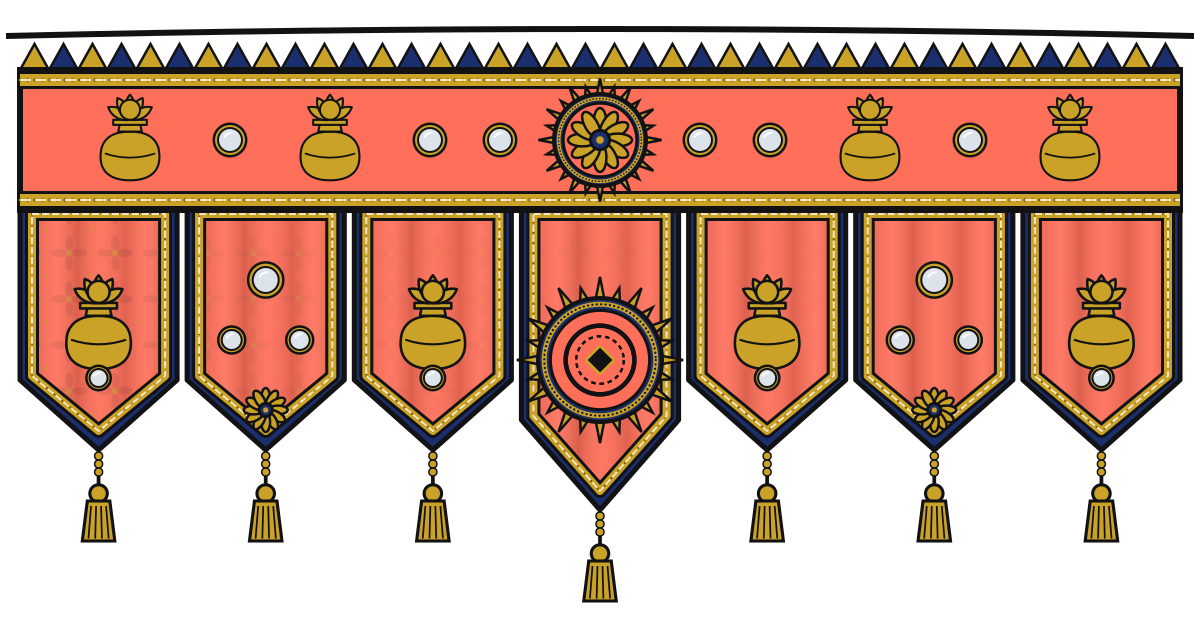
| G1 Torana · gateway The built gate of the seat; the cloth Toran hangs in it | Not yet designed for this clan | Regional tradition |
| G2 Viragallu · hero stone Carved panel stone for a member who died defending the clan | Not yet designed for this clan | Regional tradition |
| G3 Kula-shila · clan stones Standing and table stones that remember the ancestors | Not yet designed for this clan | Design |
| G4 Jayastambha · victory pillar A pillar raised for a victory | Not yet designed for this clan | Design |
| G5 Sima-shila · boundary stone Marks the clan's land, with a line in the native script | Not yet designed for this clan | Design |
4. Sounds
| Accessory | For this clan | Basis |
|---|---|---|
| D1 Pancha-mahashabda · five great sounds The right to five instruments | Not yet designed for this clan | Design |
| D2 Shankha · clan conch The clan's own named war conch | Not yet designed for this clan | Design |
| D3 Murasu · house drums Three drums: war, charity and justice | Not yet designed for this clan | Design |
5. Kit: colours, metals and emblems
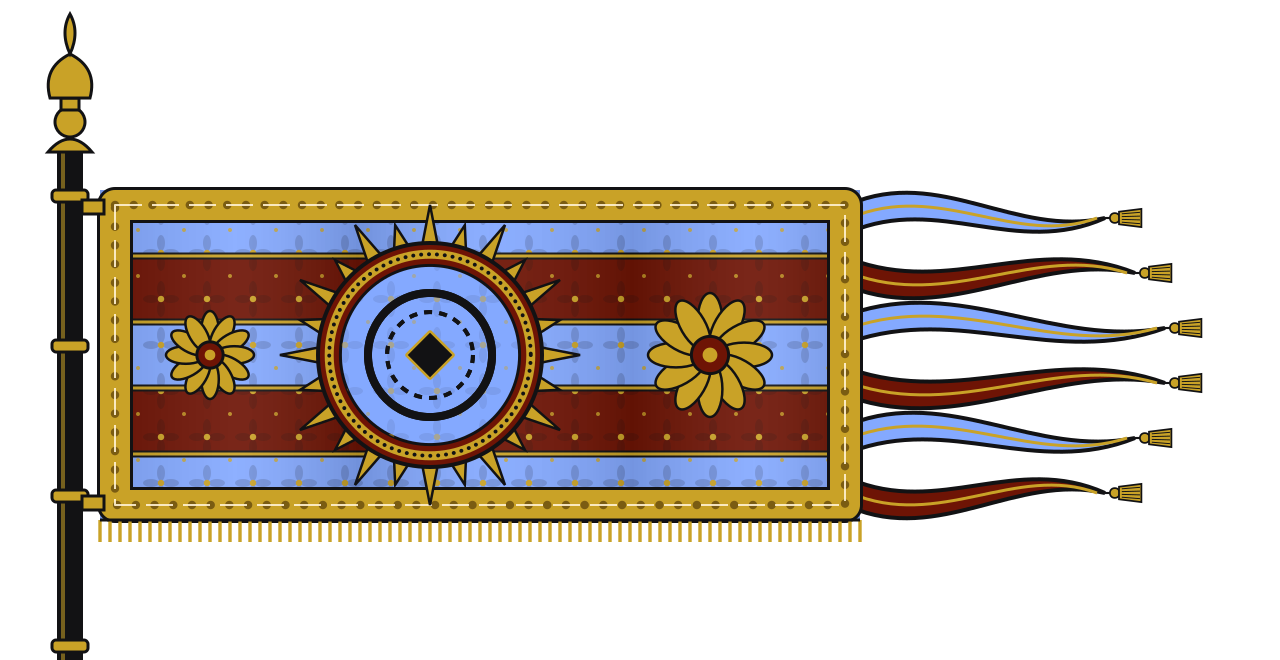
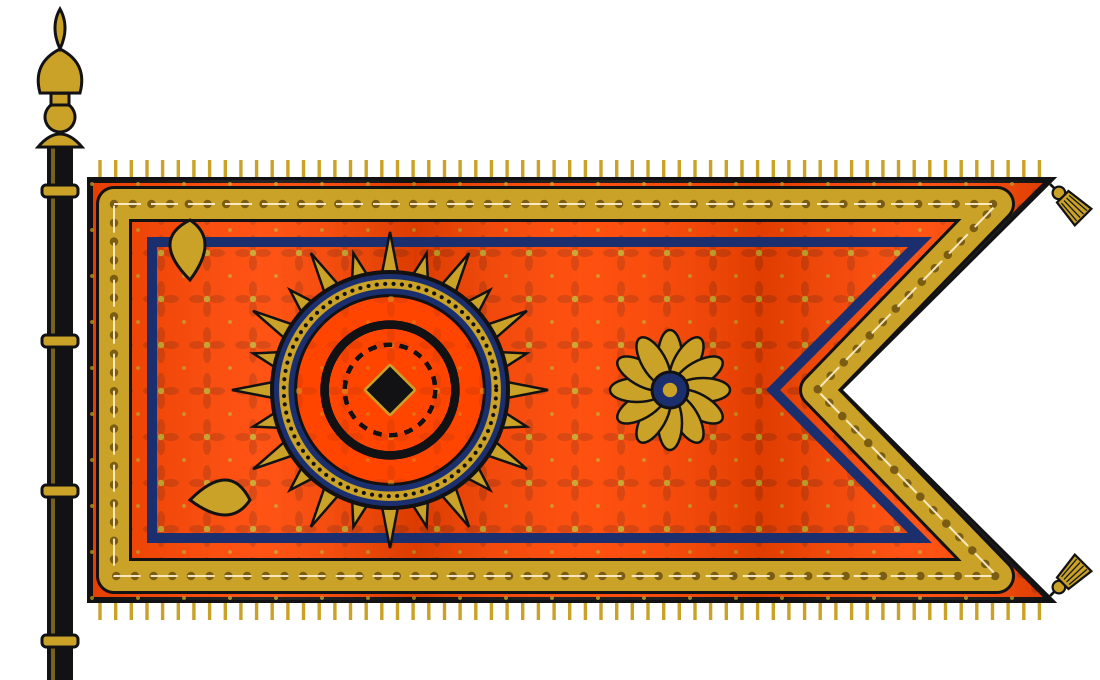
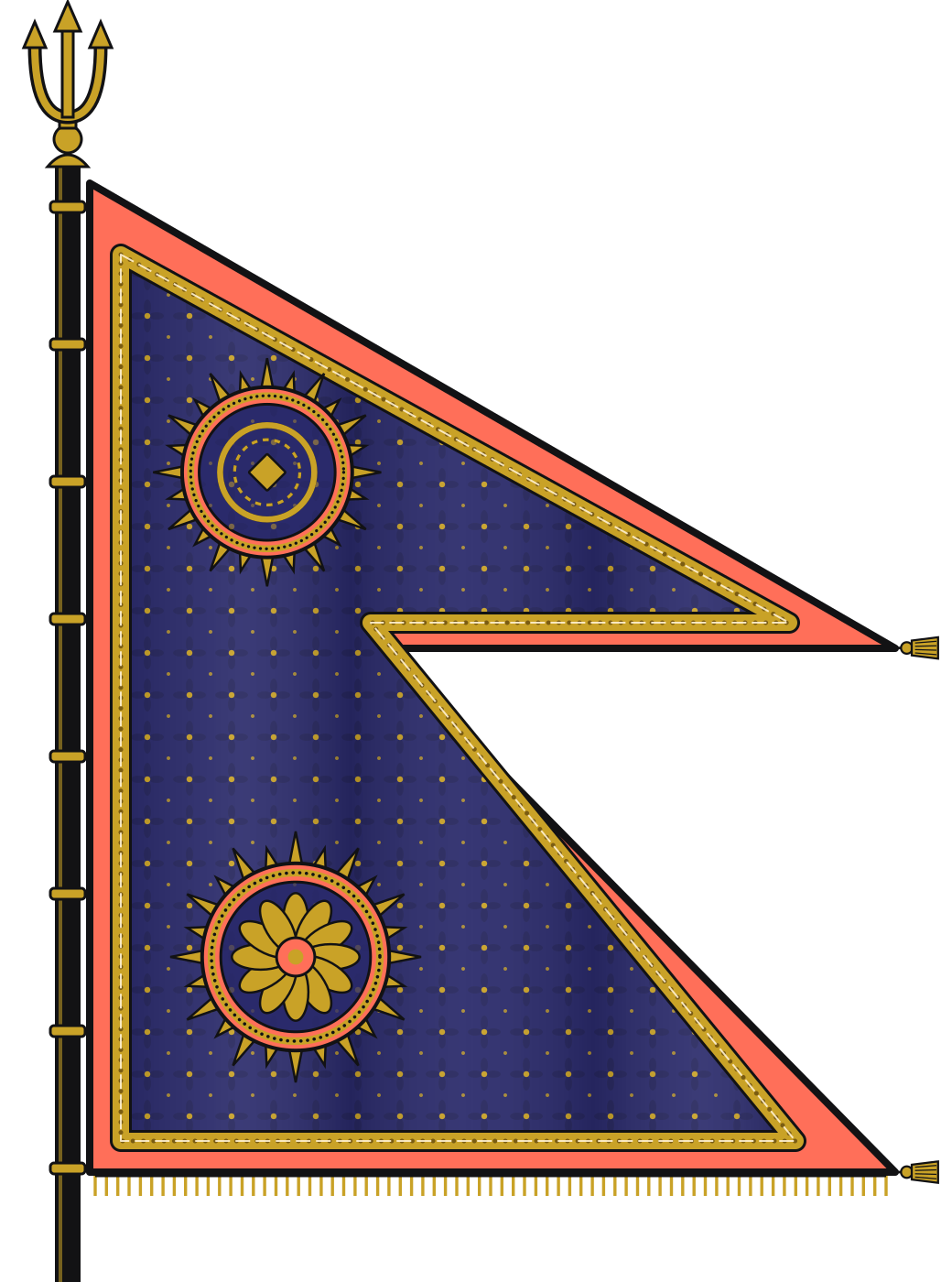
The sheet's flag is a design for the project: a Changi (sun crest) with a hill and a spring flowing from a rock, in Deep Brick and Deep Cosmic Blue with gold emblem. No documented emblem of the Sounti is in the extracts[2].
| Part of the kit | This clan |
|---|---|
| Field | Deep Brick #7E2A1E |
| Accent | Deep Cosmic Blue #9BB0FF |
| Emblem colour | Metallic Gold #C9A227 |
| Zari metal | Gold |
| Main emblem | A hill |
| Second image | A spring flowing from a rock |
| Night and day | Every visual accessory has two versions: by night the emblem on the dark field, by day the clan's field colour on cloth woven from its metal. |
6. Flags
Every clan has every flag type; the type says the occasion and the colours say the clan. The outlined card is the flag the Atlas assigns.





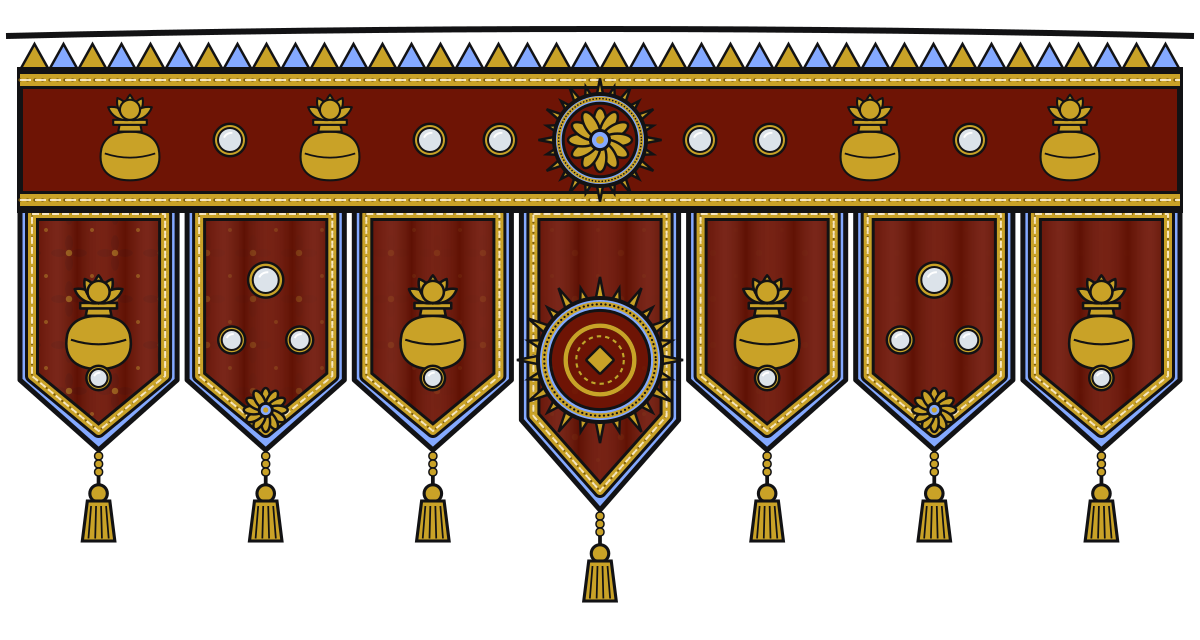

Historic banner
None known
New flag types
| Accessory | For this clan | Basis |
|---|---|---|
| A9 Pota-dhvaja · ship and trade flag For ships, caravans and markets | Not yet designed for this clan | Design |
| A10 Utsava-patāka · festival flag Light, bright flag for fairs and festivals | Not yet designed for this clan | Design |
| A11 Shoka-dhvaja · mourning flag White cloth with the emblem outline in the clan's metal | Not yet designed for this clan | Design |
7. Regalia
| Accessory | For this clan | Basis |
|---|---|---|
| E1 Chhatra · house parasol The ceremonial umbrella | Not yet designed for this clan | Design |
| E2 Chamara · fly-whisks The pair of whisks beside the head of the house | Not yet designed for this clan | Design |
| E3 Danda · staff of office Staff or scepter | Not yet designed for this clan | Design |
| E4 Simhasana · seat The seat of the house, covered in clan cloth | Not yet designed for this clan | Design |
| E5 Khetaka · shield A round shield; the Changi and Dhanush are its flag forms | Not yet designed for this clan | Regional tradition |
| E6 Kula-ayudha · clan weapon The weapon the clan honours | Iron sword honouring Bhakta Bisoi, a warrior (oral account, unverified). The clan's own weapon is not recorded | Documented |
8. Worn
| Accessory | For this clan | Basis |
|---|---|---|
| F1 Kula-vastra · clan cloth The clan's woven pattern in its kit colours | Not yet designed for this clan | Design |
| F2 Kirti-vastra · honour cloth A cloth earned for a deed, not inherited | Not yet designed for this clan | Design |
| F3 Kula-mala · garland flower The flower or leaf the clan wears as a garland | Not yet found for this clan | Under research |
| F4 Chinha · house pin A metal badge with the pin emblem | Not yet designed for this clan | Design |
9. Records
| Accessory | For this clan | Basis |
|---|---|---|
| H1 Clan words A traditional line in the native script | · “No line linked to the Sounti is in the extracts” | Documented |
| H2 Biruda · titles The house's title or titles | Not yet found for this clan | Under research |
| H3 Prashasti · praise genealogy The lineage as written at the head of a grant | Not yet found for this clan | Under research |
| H4 Vahi · clan register The book of the clan's births, marriages and deaths | Not yet found for this clan | Under research |
| H5 Rana-ghosha · war cry The clan's cry in battle or celebration | Not yet found for this clan | Under research |
10. VishwaVit · knower of the world
Game values are design choices for this project, not historical claims.
References
- Wikipedia, List of Scheduled Tribes in Odisha, read 2026-10-20, https://en.wikipedia.org/wiki/List_of_Scheduled_Tribes_in_Odisha
- Wikipedia, Sounti, read 2026-11-02, https://en.wikipedia.org/wiki/Sounti
- Biyotkesh Tripathy, "The Making of the Saunti Tribe" (oral accounts), The Tribal Tribune vol. 1 issue 4, read 2026-11-02, https://www.etribaltribune.com/index.php/volume-1/mv1i4/the-making-of-the-saunti-tribe
- Odisha State Tribal Museum, Tribes of Odisha (Sounti entry), read 2026-11-02, https://ostm.in/?p=5486
- Maa Tarini Temple, Ghatgaon, Wikipedia (read 10 Oct 2026, KulDevi run 40).
- Prasanta Kumar Mohanta, "Sounti Tribe", Tribal Culture of Odisha (blog), 19 May 2012, read 2026-11-02, https://tribalcultureofodisha.blogspot.com/2012/05/sounti-tribe.html
- Maa Tarini Pitha, Ghatagaon, Kendujhar district, Government of Odisha (read 10 Oct 2026, KulDevi run 40).
- Orissa Annual Reference 2004, Tribal communities of Orissa (districtwise), read 2026-11-02, link
- Wikipedia, Keonjhar State, read 2026-10-24, https://en.wikipedia.org/wiki/Keonjhar_State
- Sushree Mohanty, Indigenous Colours of Odisha: Handbook on 62 Tribes (KISS), read 2026-10-20, https://kissnew.kiss.ac.in/wp-content/uploads/2026/05/Indigenous-Colours-of-Odisha-Handbook-on-62-Tribes-Sushree-Mohanty.pdf
- Wikipedia, Munda people, read 2026-10-21, https://en.wikipedia.org/wiki/Munda_people