The Sinhalese are the Indo-Aryan people of Sri Lanka, about 75% of the island's population and over 15 million strong[1]. The Mahavamsa, a Pali chronicle compiled by Anuradhapura monks, says they descend from settlers who came under Prince Vijaya from Sinhapura about 543 BCE; modern scholars call that account part legend[1][2]. Their kingdoms at Anuradhapura, Polonnaruwa and Kandy are named in the sources, and the Tooth Relic was brought to Kandy in 1595[2][3]. Their language, Sinhala, is written in a script derived from Brahmi[4].
01Faith and deities
Goddess of chastity and healing, worshipped across Sri Lanka[7]
A recorded tie between the clan and the goddess.
| Deity or tradition | Place in the clan's life | Evidence |
|---|---|---|
| Kataragama Deviyo | Named for a hometown in Moneragala District; powerful in the 20th century; Hindus worship him as Murugan | [8] |
| Upulvan | From Vishnu; Dondra is listed as Upulvan's site | [1][8] |
| Ayyanayake | From Aiyanar | [1] |
| Natha | Named among the deities; the Pattini article names a Natha Devale | [8][7] |
| Vishnu | Named among the deities; no detail in the source | [8] |
| Vibhisana | Worshipped; declined in the 20th century | [8] |
| Saman | Adam's Peak; one of Pattini's seven avatars | [8][6] |
| Gale Bandara Deviyo | Leading oracle, said to be a Muslim prince killed by Sinhalese; revered at Kurunegala | [8] |
| Sanni Yakuma | Invoked in healing rituals | [1] |
| Devas and yakkas | Sinhalese Buddhism gives a warrant (varan) to entities that regulate reality within the sima; devas and yakkas control material events | [8] |
| Kiri Amma (the Milk Mother) | An earlier deity absorbed into Pattini | [7] |
02Temples
The extracts name the Anuradhapura stupas (Ruwanwelisaya, Jetavanaramaya, Abayagiriya), Dambulla and the Temple of the Tooth, but do not say who built them, so none is listed as built by the clan. The Pattini devalayas are listed with what each source gives.
Built by the clan
| Temple | Deity | Built by | When | Where |
|---|---|---|---|---|
| Nawagamuwa Pattini devalaya | Pattini (the sacred anklet, salamba) | Not named in the source; built to enshrine the anklet | Not dated in the source | Navagamuwa, about 37 km east of Colombo[6][7] |
| Kabulumulla Pattini devalaya | Pattini Salamba | Named with Rajasinghe I | 1582 | Kabulumulla[7] |
Given patronage or grants by the clan
| Temple | Deity | What the clan gave | When | Where |
|---|---|---|---|---|
| Sri Dalada Maligawa (Temple of the Tooth) | The Tooth Relic | Custody of the Tooth Relic by the Kandyan dynasties; the Perahara | Brought to Kandy in 1595 | Kandy[1][3] |
03Languages and scripts
| Language or script | Kind | Under the clan | Evidence |
|---|---|---|---|
| Sinhala (Helabasa) living | Indo-Aryan language, shaped by Pali, Sanskrit and Telugu; borrowed from Tamil, Portuguese, Dutch and English | The clan's own language | [1] |
| Sinhala script (සිංහල) living | Abugida, a Brahmi derivative, written left to right; also used for Pali and Sanskrit; earliest surviving literature from the 9th century CE | The clan's script | [4] |
| Brahmi inscriptions at Anuradhapura | 6th-century BCE pottery bears Brahmi inscriptions in Helu Prakrit | Local Brahmi use at Anuradhapura | [4] |
| Illakkam numerals | Used until the fall of the Kandyan Kingdom in 1815; lith illakkam with zero used for horoscopes into the 20th century | Clan's numerals | [4] |
04Books and literature
The oldest Pali manuscripts are in the Sinhala script, and the first written Pali Tripitaka was produced in Sri Lanka between 29 and 17 BCE[4].
Written during the clan's history
| Work | Author | Kind | When | Link to the clan |
|---|---|---|---|---|
| Dipavamsa | Not named in the source | Pali chronicle | Not dated in the source | [2] |
| Mahavamsa | Anuradhapura monks (not named) | Pali chronicle | c. 4th century CE | [1][9] |
| Thupavamsa | Not named in the source | Pali chronicle | Not dated in the source | [2] |
| Culavamsa | Dhammakitti (probably) | Pali chronicle | Probably 13th century | [1] |
| Hela Atuwa lost | Not named in the source | Early text, lost | Not dated in the source | [1] |
| Amavatura, Kavu Silumina, Jathaka Potha, Sala Liheeniya | Not named in the source | Early texts | Not dated in the source | [1] |
| Sidat Sangara | Not named in the source | Grammar of Sinhala | 1300 CE | [4] |
| Sandesha Kavya | Buddhist priests | Sandesha Kavya poems | Not dated in the source | [1] |
| Madol Duwa | Martin Wickremasinghe | Modern work | Modern (not dated in the source) | [1] |
| Hath Pana | Munadasa Cumaratunga | Modern work | Modern (not dated in the source) | [1] |
| අපේ සංස්කෘතික උරුමය | Guruge | Modern book | 1995 | [2] |
Given patronage by the clan
Not recorded.
05Thinkers and scholars
| Name | Field | Era | Contribution |
|---|---|---|---|
| Gananath Obeyesekere and Kitsiri Malalgoda | Scholars of religion | Not dated in the source | Coined the term "Protestant Buddhism"[1] |
| Dhammasena Thero | Monk and writer | 13th century | Saddharma-Ratnavaliya, which lists four classes: Raja, Bamunu, Velanda, Govi[3] |
| Dhammakitti | Chronicler | Probably 13th century | Culavamsa (probably)[1] |
| Martin Wickremasinghe | Writer | Not dated in the source | Madol Duwa[1] |
| G. B. Senanayake | Writer | Not dated in the source | Named as a writer[1] |
| Mahagama Sekera | Writer | Not dated in the source | Named as a writer[1] |
| Madewela S. Ratnayake | Writer | Not dated in the source | Named as a writer[1] |
| Munadasa Cumaratunga | Writer | Not dated in the source | Hath Pana[1] |
| Ananda Samarakoon | Music | Late 1930s to early 1940s | Developed the Sarala gee song style[1] |
| Sarachchandra | Dramatist | 1956 | Maname[1] |
| Lester James Peries | Film-maker | 1956 | Rekava[1] |
| E. W. Perera | Historian of flags | 1916 | Published the blazon of the Kandyan royal standard[10] |
| Gooneratne | Folklorist | 1976 | Described folk work-songs of harvest and sowing[1] |
The names are those the sources give, with what each is credited with. The extracts give no further detail on the writers.
06Art and architecture
Art named in the sources: the Sigiriya frescoes, Dambulla paintings, Anuradhapura stupas and reservoirs.
Painting and wall art
| Art form | What it is | Era | Evidence |
|---|---|---|---|
| Sigiriya frescoes | Frescoes at Sigiriya | Not dated in the source | [1] |
| Ajanta Cave 17 mural | Mural of the coming of the Sinhala | Not dated in the source | [2] |
| Dambulla paintings | Paintings at Dambulla | Not dated in the source | [1] |
Sculpture and temple art
Not recorded.
Temple and building architecture
| Art form | What it is | Era | Evidence |
|---|---|---|---|
| Ruwanwelisaya, Jetavanaramaya, Abayagiriya | Stupas at Anuradhapura | Not dated in the source | [1] |
| Parakrama Samudra, Kaudulla, Kandalama | Reservoirs | Not dated in the source | [1] |
| Mihintale Hospital | Hospital site at Mihintale | Not dated in the source | [1] |
Weaving and textiles
Not recorded.
Clothing and jewellery
Not recorded.
Coins, pottery and crafts
Not recorded.
07History
A lion legend and the Vijaya landing (c. 543 BCE)
The Mahavamsa says the monarch Sinhabahu slew a lion, and that his mother, Princess Suppadevi of Vanga, had been abducted by a lion[1]. The name Sinhala is tied to this legend: the Atlas's Simhalas row gives simha, "lion", as the origin of the name.
The Mahavamsa says Prince Vijaya, possibly Sinhabahu's son or grandson, and 700 followers were expelled from Sinhapura, India, and landed on the day of the Buddha's Parinirvana. They founded Tambapanni, which had earlier been ruled by Yakkhas, with capital Sirisavatthu and queen Kuveni[1][2].
Scholars doubt the account. One calls the Vijaya legend "at best questionably-biased" (Gavin Thomas, 2009); another says Vijaya was "probably a composite character" (Codrington, 1926)[2]. Firmer records start in the 3rd century BCE, with Buddhism under Devanampiya Tissa[2].
Anuradhapura and the first kingdoms
The Mahavamsa credits Pandukabhaya (437–367 BC) with moving the capital to Anuradhapura in 377 BC, and with building lying-in homes and Ayurvedic hospitals[1]. The medieval period is dated from the fall of Anuradhapura in AD 1017[2].
Kings credited with defeating South Indian invaders include Dutthagamani, Valagamba and Dhatusena; the article also names Gajabahu I, Sena II and Parakramabahu I[1]. Polonnaruwa under Parakramabahu was called the rice mill of the east[1].
Chronicle links with Kalinga and the Pandyas
Sri Lankan chronicles tie the island to Kalinga: Vijaya is said by some scholars to come from Simhapura, and the chronicles name a Kalinga princess who married Vijayabahu I, Nissanka Malla (1187–1196) and Magha of Kalinga (1214–1235)[11].
The Mahavamsa says Vijaya married a princess of the Pandu (Pandya) kingdom, who had no children, and that his followers married maidens sent by the Pandu king[2][12].
Kingdoms of the 13th to 15th centuries
In the 13th century there were kingdoms at Sitawaka, Kotte, Jaffna and Kandy[1]. An invasion by Magha in the 13th century drove Buddhists, mostly Sinhalese, to migrate[1]. The Kandyan kingdom separated from Kotte about 1469 and kept Kotte's emblems[10].
Parakramabahu VI of Kotte conquered the Jaffna kingdom and held the island for 17 years[1].
Kandy, the Tooth Relic and the end of the kingdom (1595–1815)
The Tooth Relic was held by ruling dynasties for about 1,700 years and was brought to Kandy in 1595[3]. The last Kandyan dynasty was of Nayake origin (Balija caste), from Madurai[3].
The royal standard, a lion holding a sword in its right paw, was lost after the Battle of Hanwella in 1803 and relinquished in 1815, when Sri Vikrama Rajasinha (1798–1815) was the last king[10]. E. W. Perera rediscovered three Sinhalese banners at the Royal Hospital Chelsea in 1908[10]. The feudal hierarchy continued after the monarchy ended in 1815[13].
Origins in the present
Genetic studies show affinity with South Indian populations (Singh et al. 2023), while older studies pointed to Bengali contributions; Ranaweera (2013) and Kivisild (2003) note links to Southeast Asian and north-east Indian populations[1].
08Journey and migrations
The first move in the sources is Vijaya's landing. Later moves were the Magha migration and the emigration of recent decades.
| When | From | To | Why | Evidence |
|---|---|---|---|---|
| c. 543 BCE (Mahavamsa) | Sinhapura, India | Tambapanni, Sri Lanka | Vijaya and 700 followers expelled and landed near Puttalam[1] | [1] |
| 13th century | Kingdoms of the island | Not named in the source | Magha's invasion drove Buddhists, mostly Sinhalese, to migrate[1] | [1] |
| Since the 1970s (Italy) | Sri Lanka | Italy and other countries | Emigration; the article gives Italy (30,000–33,000 estimated) and the major communities in the UK, Australia, US and Canada[1] | [1] |
09Seats and lands
| Place | Role | Where today |
|---|---|---|
| Sinhapura | Vijaya's home city, per the Mahavamsa | Not located in the sources |
| Tambapanni | Kingdom Vijaya founded; earlier ruled by Yakkhas, with capital Sirisavatthu | Landing near Puttalam[1] |
| Upatissa Nuwara | Founded by Upatissa, regent 505–504 BC[1][2] | Not located in the sources |
| Anuradhapura | Capital from 377 BC (Mahavamsa); fell in AD 1017[1][2] | Anuradhapura district, where Sinhalese were over 90% in 2001[1] |
| Polonnaruwa | Kingdom under Parakramabahu, called the rice mill of the east[1] | Polonnaruwa district, over 90% Sinhalese in 2001[1] |
| Kandy | Kandyan kingdom, formed in the 15th century[1]; 21 provinces, 12 Disavanis and 9 Ratas[10] | Kandy, with the Temple of the Tooth[1] |
10Notable figures
| Name | Role | Era | Known from |
|---|---|---|---|
| Sinhabahu legend | Said to have slain a lion; the lion ancestor of the line | Legendary (Mahavamsa) | [1] |
| Suppadevi legend | Princess of Vanga, abducted by a lion; mother of Sinhasivali and Sinhabahu | Legendary | [1] |
| Vijaya legend | First king; landed with 700 followers and founded Tambapanni | 543–505 BC (Mahavamsa) | [2] |
| Kuveni legend | Yakkhini queen of the earlier rulers of Tambapanni; her children are said to have given rise to the Pulinda race, identified with Veddas | Legendary | [2] |
| Upatissa | Regent; founded Upatissa Nuwara | 505–504 BC | [2][1] |
| Pandukabhaya | Moved the capital to Anuradhapura; built lying-in homes and Ayurvedic hospitals | 437–367 BC (as dated in the article) | [1] |
| Dutthagamani | King credited with defeating South Indians | Not dated in the source | [1] |
| Parakramabahu I | King of Polonnaruwa; the kingdom was called the rice mill of the east | Not dated in the source | [1] |
| Gajabahu I legend | Reigned 113–135 CE; the Nawagamuwa legend says he brought a Pattini anklet from India | 113–135 CE | [7] |
| Parakramabahu VI | Of Kotte; conquered the Jaffna kingdom and held the island for 17 years | Not dated in the source | [1] |
| Vikrama Rajasinha | Last king of Kandy | 1798–1815 | [10] |
| E. W. Perera | Rediscovered three Sinhalese banners at the Royal Hospital Chelsea | 1908 (published 1916) | [10] |
11Allies, rivals and marriages
| People | Relationship | When |
|---|---|---|
| Pandya kingdom | A Pandya princess married Prince Vijaya, per the Mahavamsa; the Pandu king sent maidens to the followers[12][2] | Legendary (Mahavamsa) |
| Kalingas | Chronicles tie the island to Kalinga through Vijaya's origin and later Kalinga kings[11] | Vijaya; 1187–1235 (chronicle dates) |
| Veddas (Pulinda race) | Kuveni's children are said to have given rise to the Pulinda race, identified with Veddas[2] | Legendary |
| Vanavasis | Sinhalese Buddhist monks came to Banavasi, per an inscription at Nagarjunakonda[14] | Date of the inscription not given in the extract |
| Sri Lankan Tamils, Burghers and Sri Lankan Moors | Related groups on the island[1] | Living |
| Nagas | Integrated into Sinhala culture in Sri Lanka; Nagadeepa is the Jaffna Peninsula[2] | Pre-Anuradhapura period |
12Society and livelihood
Under the Kandyan rajakariya ("the king's work") system each caste was tied to an occupation and a service. Caste is said to have diminished in urban areas, but to remain relevant to marriage and temple patronage in parts of Kandy District and the southern lowlands[13].
Government and social order
| Institution or group | What it was | Evidence |
|---|---|---|
| Rajakariya | Kandyan system tying each caste to an occupation and service | [13] |
| Radalas | Kandyan aristocracy within the Govigama | [3] |
| Duraya (British grouping) | Lower Kandyan castes: Vahumpura, Puda, Panna, Velli, Berava, possibly Henaya | [13] |
| Siam Nikaya | Established 19 July 1753; by 1764 higher ordination was given only to Govigama; the Mahavihara Wanshika Siyam Order holds custody of the Sri Dalada Maligawa today | [3] |
| Weda Mahaththaya | Village medical practitioner; healing with Ayurveda and Buddhist chanting (Pirith) | [1] |
Livelihood over time
| Era | Livelihood | Evidence |
|---|---|---|
| Kandyan period | Govi and Bathgama cultivated land under Rajakariya tenure | [3] |
| Caste table (colonial era) | Karava fishermen; Salagama weavers and cinnamon peelers; Durava coconut cultivators; Navadanna artisans; Hannali tailors; Hunu lime burners; Hena washers; Vahumpura jaggery makers; Badahala potters; Panikki barbers | [13] |
| Caste table (colonial era) | Velli-durayi guard the sacred Bo tree (Kandyan); Berava beat tom-toms; Batgam bear palanquins; Oli dance; Kinnara weave mats; Kavikara dance and chant at shrines; Ambattaya barbers; Hinnava dhobies | [13] |
| Parker's Ceylon tales | Gamarala (headman, cultivating caste), Hettiyas (merchants), Vaedda (hunter), washerman, tom-tom beater, carpenter | [15] |
13Sub-clans and related clans
Sinhalese society is divided into castes; the sources give no single official list. The items below are the caste table and the Govigama divisions the extracts name, plus related peoples. Each sub-clan without a sheet ID is a new clan candidate.
| Clan | Relation | Where | Size | In the Atlas | Evidence |
|---|---|---|---|---|---|
| Govigama | Sub-clan | Sinhalese caste; traditionally agricultural | about half the Sinhalese, undated[3] | new clan candidate | [3] |
| Radalas | Branch | Kandyan aristocracy within Govigama | new clan candidate | [3] | |
| Rate atto | Branch | Husbandmen within Govigama | new clan candidate | [3] | |
| Patti | Branch | Shepherds within Govigama | new clan candidate | [3] | |
| Katupulle | Branch | Govigama subdivision | new clan candidate | [3] | |
| Nilamakkara | Branch | Govigama subdivision | new clan candidate | [3] | |
| Porovakara | Branch | Govigama subdivision | new clan candidate | [3] | |
| Vahal | Branch | Govigama subdivision | new clan candidate | [3] | |
| Gattara | Branch | Govigama subdivision | new clan candidate | [3] | |
| Guruvo | Branch | Govigama subdivision | new clan candidate | [13] | |
| Mudaliyars | Branch | Govigama subdivision; present-day Mudaliperuwa | new clan candidate | [13][3] | |
| Bathgama | Sub-clan | Peasants under Govigama | new clan candidate | [13] | |
| Karava | Sub-clan | Low Country; fishermen; South India origin 13th–18th c. | new clan candidate | [13] | |
| Salagama | Sub-clan | Weavers and cinnamon peelers; South India origin | same name as SUB-129: check | [13][1] | |
| Durava | Sub-clan | Coconut cultivators | new clan candidate | [13] | |
| Navadanna | Sub-clan | Artisans | new clan candidate | [13] | |
| Hannali | Sub-clan | Tailors, Kandyan | new clan candidate | [13] | |
| Hunu | Sub-clan | Lime burners | new clan candidate | [13] | |
| Hena | Sub-clan | Washers | new clan candidate | [13] | |
| Vahumpura | Sub-clan | Jaggery makers; in the Duraya grouping | new clan candidate | [13][3] | |
| Hinna | Sub-clan | Washers to the Salagama | new clan candidate | [13] | |
| Badahala | Sub-clan | Potters | same name as SUB-135: check | [13] | |
| Panikki | Sub-clan | Barbers, Low Country | new clan candidate | [13] | |
| Ambattaya | Sub-clan | Barbers | new clan candidate | [13] | |
| Hinnava | Sub-clan | Dhobies (washers) | new clan candidate | [13] | |
| Velli-durayi | Sub-clan | Kandyan; guardians of the sacred Bo tree; in the Duraya grouping | same name as SUB-130: check | [13] | |
| Panna-durayi | Sub-clan | Kandyan; in the Duraya grouping | new clan candidate | [13] | |
| Puda | Sub-clan | Kandyan; in the Duraya grouping | new clan candidate | [13] | |
| Berava | Sub-clan | Tom-tom beaters; in the Duraya grouping | same name as SUB-137: check | [13] | |
| Batgam Berava | Sub-clan | Berava group | new clan candidate | [13] | |
| Galaha-beravaa | Sub-clan | Funeral drummers | new clan candidate | [13] | |
| Kontadurayi | Sub-clan | Kandyan caste (no role in the source) | new clan candidate | [13] | |
| Batgam | Sub-clan | Palanquin bearers | new clan candidate | [13] | |
| Oli | Sub-clan | Dancers | new clan candidate | [13] | |
| Kavikara | Sub-clan | Shrine dancers and chanters | new clan candidate | [13] | |
| Pali | Sub-clan | Washers to low castes | new clan candidate | [13] | |
| Kinnara | Sub-clan | Mat weavers | new clan candidate | [13] | |
| Rodi | Related people | Named in the colonial caste table; not confirmed as the Rodiya community | new clan candidate | [13] | |
| Demala-Gattara | Related people | Tamil outcastes, Low Country | new clan candidate | [13] | |
| Nayake (Balija) dynasty | Dynasty from this clan | Last Kandyan dynasty, from Madurai | new clan candidate | [3] | |
| Simhalas | Parent people | Ancient people of the island (Atlas link) | ANC-125 | Atlas;[1] | |
| Kalingas | Related people | Kalinga; chronicle ties | ANC-045 | [11] | |
| Pandyas | Related people | Madurai | ANC-095 | [12] | |
| Vanavasis | Related people | Banavasi | ANC-142 | [14] | |
| Pulindas | Related people | Race identified with Veddas in the Kuveni legend | ANC-105 | [2] | |
| Vedda | Related people | Named in the Kuveni legend, as the Pulinda race | SUB-098 | [2] | |
| Sri Lankan Tamils | Related people | Related group on the island | SUB-083 | [13] | |
| Sri Lankan Moors | Related people | Tamil-speaking Sunni Muslims (McGilvray 1988) | SUB-082 | [1][5] | |
| Malaiyaha Tamils | Related people | Named with the Indian Tamil communities in the caste source | SUB-057 | [13] | |
| Yakkhas | Related people | Earlier rulers of Tambapanni, with capital Sirisavatthu | new clan candidate | [1] | |
| Nagas | Related people | Nagadeepa (Jaffna Peninsula) | same name as ANC-088: check | [2] | |
| Burghers | Related people | Named as a related group | same name as SUB-239: check | [1] |
Clans marked "new clan candidate" are not in the Atlas yet.
14Surnames
The Govigama article names families whose surnames record ancestry; no counts are sourced, so no bearer numbers are given.
| Surname | Clan or sub-clan | Where | People with this surname | Also used by other communities |
|---|---|---|---|---|
| Rajapaksa | Govigama | Sri Lanka | not yet counted | Not checked |
| Senanayake | Govigama | Sri Lanka | not yet counted | Not checked |
| Bandaranaike | Govigama | Sri Lanka | not yet counted | Not checked |
| Wijewardane | Govigama | Sri Lanka | not yet counted | Not checked |
| Corea | Govigama | Sri Lanka | not yet counted | Not checked |
| Ilangakoon | Govigama | Sri Lanka | not yet counted | Not checked |
| Obeyesekere | Govigama | Sri Lanka | not yet counted | Not checked |
| de Saram | Govigama | Sri Lanka | not yet counted | Not checked |
| Kumarage | Govigama | Sri Lanka | not yet counted | Not checked |
| de Alwis | Govigama | Sri Lanka | not yet counted | Not checked |
Counts are of everyone with the surname, from the cited source and year, not only members of this clan. A surname shared with other communities says nothing about any one person's origin.
15Songs and music
The extracts name a song style, folk work-songs and a game-opening song, but give no lyrics for them. No excerpt is printed.
Sarala gee
Folk work-songs of harvest and sowing
Song that opens an Olinda Keliya game living
Instruments and styles
| Instrument or style | What it is | Evidence |
|---|---|---|
| Kandyan dance (18 wannam) | Kandyan dance, named with its 18 wannam, without detail in the source | [1] |
| Tom-tom and drums | Beaten by the Berava (tom-tom beaters) and Galaha-beravaa (funeral drummers) castes | [13] |
16Poems, lullabies and children's rhymes
No poem texts are in the extracts, so none is printed. The folk work-songs are listed under songs, and the Sandesha Kavyas under books.
None recorded yet.
17Stories, legends and proverbs
Stories and legends
| Story | What happens | Told by | Evidence |
|---|---|---|---|
| Sinhabahu slays the lion legend | Suppadevi of Vanga is carried off by a lion and bears Sinhasivali and Sinhabahu; Sinhabahu slays a lion | Mahavamsa, per Wikipedia | [1] |
| Vijaya's landing legend | Vijaya and 700 followers land near Puttalam on the day of the Buddha's Parinirvana and found Tambapanni, earlier ruled by Yakkhas | Mahavamsa, per Wikipedia | [1] |
| Mahadana Muttha saha Golayo | A foolish pundit with his followers | Sinhalese folk tales (named in the article) | [1] |
| Kawate Andare | A witty court jester | Sinhalese folk tales (named in the article) | [1] |
| A Legend of Kandy (No. 76) | A jackal chasing a hare leads a basket-mender to the place where a king founds Kandy (Senkadagala), Uva Province | Village tales of Ceylon, collected by Henry Parker; teller not named | [15] |
| The Gamarala's Girl (No. 78) | A riddling letter (the summary read gives only this) | Village tales of Ceylon; teller not named | [15] |
| The Royal Prince and the Carpenter's Son (No. 80) | A Naga-gem princess and a wooden peacock | Village tales of Ceylon; teller not named | [15] |
Proverbs and sayings
Not recorded.
18Festivals and fairs
| Festival or fair | When | Where | What happens |
|---|---|---|---|
| Sinhala and Tamil New Year | April (New Year season, per the press articles) | Island-wide; a national festival of togetherness | Games for all ages; Avurudu Kumaraya and Kumari chosen each year; said to originate from the old ritual Suriya Wandanawa[17][18] |
| Kataragama festival | Annual | Kataragama | Tens of thousands attend; Pada Yatra foot pilgrimage[8] |
| Esala festival | Esala | Not given in the source | Named in the source; no detail given[8] |
| Maduwa Pattini Devalaya festival | July–August | Maduwa Pattini Devalaya | Pattini festival; rites include Gammaduwa, Ankeliya (horn games) and Porakeliya (coconut fight)[7] |
| Gammaduwa | Village ritual, not dated | Pattini villages, central shrine at Navagamuwa | Led by a kapurala for the village's well-being and harvest; includes fire-trampling and water-cutting[6] |
| Harvest festivals | End of the Yala and Maha seasons | Not given in the source | Kings joined the harvest festivals[3] |
| Tovil | Not dated in the source | Not given in the source | Exorcism rituals[1] |
19Food, dress and games
Food
| Item | What it is | Evidence |
|---|---|---|
| Pattini offerings | Kiriya, kavum, milk aluwa, milk rice and plantains, given to seven or more virtuous women | [7] |
Dress
| Item | What it is | Evidence |
|---|---|---|
| Kandyan osariya | Dress of the Kandyan Sinhalese, with the sarong | [1] |
Games and martial arts
| Item | What it is | Evidence |
|---|---|---|
| Olinda Keliya living | Two-player seed game on a carved board of nine holes with four beads each; the seeds are red with a black spot and poisonous (abrin). Played at the New Year, mainly by the women of the house and village women and girls[19][16][20] | [21] |
| Pancha Dameema living | Played with five small seashells, a coconut shell and a chart, in two groups; named among the Sinhala and Hindu New Year games, with no ritual role given | [18] |
| Outdoor New Year games | Pillow fight, tug-of-war, greasy pole, bun-eating, Onchili pedeema, Kana mutti bindeema, Raban geseema | [17] |
| Ankeliya (horn games) | Part of the Pattini rites | [7] |
| Angampora | Martial art that nearly died out under British rule (1815) | [1] |
Tags: living still practised · revived brought back after a break · lost known only from records · research reported but not yet confirmed from a source. Songs and poems under copyright are listed by title only; restricted or sacred material is noted without its content.
20Status today
The Sinhalese are about three-quarters of Sri Lanka's people, a majority group that the Atlas marks as living[1].
Who carries the name today
| Community | Link | Basis | Evidence |
|---|---|---|---|
| Overseas Sinhalese communities | Documented | [1] |
Recognised heritage
| What | Recognition | Evidence |
|---|---|---|
| Sinhala script | Added to Unicode in September 1999 (v3.0), standard SLS1134 | [4] |
| Folk New Year games | Argued that folk games should be protected (Moraspirit, 2019) | [17] |
| Temple of the Tooth and the Perahara | Named in the article; no recognition status given in the extracts | [1] |
No community review of this page is recorded yet.
21For children
The lion-slayer's people
The old chronicle tells that long ago a princess named Suppadevi of Vanga was carried off by a lion. She had two sons, Sinhasivali and Sinhabahu. Sinhabahu grew strong and slew a lion. The name of his people is said to come from the word for lion, simha. His son or grandson was Prince Vijaya, who sailed from Sinhapura with 700 followers. They landed near Puttalam on the day the Buddha passed away, and founded a kingdom called Tambapanni. Today most of the island's people are Sinhalese, and they speak Sinhala.
22Across the project
| Project | What carries this clan | Status |
|---|---|---|
| Atlas of the Janas | Not yet pinned: the sources give districts, not a seat with coordinates | To check |
| KulDevi and GrahDevi | Pattini; GrahDevi forms: Brahmani, Maheshvari, Kaumari, Vaishnavi, Varahi, Indrani, Chamunda, Narasimhi | From the Atlas |
| Planet naming | Not yet checked against the Tier registers | To check |
| Renaming and waters | No place or water name drawn from the Sinhalese yet | — |
23Open questions
- Clan words: no native-script line of the Sinhalese is in the extracts. The people's own name is used until a saying with a source is found.
- Sinhala-script folk verse and sayings: none in the extracts. Parker vol. 2 (after No. 82) and vol. 3 are not read.
- Coins (kahavanu), seals, copper plates, titles, totems and sacred trees for this people are not yet found; the Sri Maha Bodhi is not fetched.
- Kandyan provincial flags (Sat Korales lion, Uva swan, Valapane peacock, Udapalata lotus, Vellassa tiger and others) and the official flags (Ethkandalihiniya roc, Gajanayaka elephant, Aspantiye horse, Atapattuwa drum banner, Sudaliya-Maruwalliya fencer) are recorded by Wikipedia; they belong to the Kandyan polity and are not yet placed as accessories.
- Rodi (caste) and Rodiya (SUB-075): the same community is not confirmed.
- Kinnara (mat weavers) and the Kinnaras of the Atlas (ANC-055): not assumed to be the same.
- The Kalinga and Pandya ties are chronicle claims; Vijaya's home Simhapura is placed only by some scholars.
- Surname counts for the Govigama families and the ranking names: none sourced.
- Community review of this page: none recorded.
- Gajabahu I: the history section lists him with the Polonnaruwa kings, as the article does[1]; the figures row gives his reign as 113–135 CE, and the Pattini article calls him Gajabahu I of Anuradhapura[7]. His place is left as the sources give it.
- Olinda Keliya board: the games row gives nine holes of four beads each[19][16], while its Parker 1910 source gives a board of 14 cup-shaped hollows in two rows of seven[21]. Both are kept until the board is checked.
24Astitva
अस्तित्व · being, existence: everything by which the clan is known
The Sinhalese lion is the legend's own animal, and the Kandyan royal standard is the people's historic banner. No coin, seal or copper plate of this people is in the extracts, and the Kandyan provincial flags are not yet placed as accessories.
Every clan has every accessory, royal objects included. Each one says how it is known: Documented This clan's own object is recorded. · Regional tradition Recorded for the region or for peoples like this one, not for this clan. · Design Made for this project, with no historical claim. · Under research To be found for this clan from sources. Legends and titles are written in the clan's own script.
1. Seals and coins
| Accessory | For this clan | Basis |
|---|---|---|
| B1 Rajamudra · house seal Round seal with the clan emblem and a short legend in the clan's script | Not yet designed for this clan | Design |
| B2 Anguliya-mudra · signet ring Personal seal ring of the head of the house | Not yet designed for this clan | Design |
| B3 Chhapa · house stamp Ink or block stamp for letters, goods and cloth | Not yet designed for this clan | Design |
| B4 Tamrapatra · charter plate Copper-plate grant on a ring, closed with the house seal | Not yet designed for this clan | Design |
| B5 Shreni-mudra · guild or trade seal Seal for the clan's trade, craft or caravan | Not yet designed for this clan | Design |
| C1 Clan coin Emblem or deity on one side, a legend in the clan's script | Not yet designed for this clan | Design |
| C2 Coin die The die that strikes the coin | Not yet designed for this clan | Design |
2. Living symbols
| Accessory | For this clan | Basis |
|---|---|---|
| I1 Totem trio The tree, bird and animal the clan protects | Animal: the lion (Sinhabahu's lion); the tree and bird are not named The Mahavamsa's Sinhabahu slays a lion[1]; the Atlas's Simhalas row gives the lion-ancestor legend as the name's origin | Documented |
| I2 Kaval-maram · guardian tree The tree that stands at the clan's seat | The sacred Bo tree, guarded by the Velli-durayi caste (Kandyan) Velli-durayi are guardians of the sacred Bo tree[13] | Regional tradition |
3. Stone and gate
| Accessory | For this clan | Basis |
|---|---|---|
| G1 Torana · gateway The built gate of the seat; the cloth Toran hangs in it | Not yet designed for this clan | Regional tradition |
| G2 Viragallu · hero stone Carved panel stone for a member who died defending the clan | Not yet designed for this clan | Regional tradition |
| G3 Kula-shila · clan stones Standing and table stones that remember the ancestors | Not yet designed for this clan | Design |
| G4 Jayastambha · victory pillar A pillar raised for a victory | Not yet designed for this clan | Design |
| G5 Sima-shila · boundary stone Marks the clan's land, with a line in the native script | Not yet designed for this clan | Design |
4. Sounds
| Accessory | For this clan | Basis |
|---|---|---|
| D1 Pancha-mahashabda · five great sounds The right to five instruments | Not yet designed for this clan | Design |
| D2 Shankha · clan conch The clan's own named war conch | Not yet designed for this clan | Design |
| D3 Murasu · house drums Three drums: war, charity and justice | Not yet designed for this clan | Design |
5. Kit: colours, metals and emblems
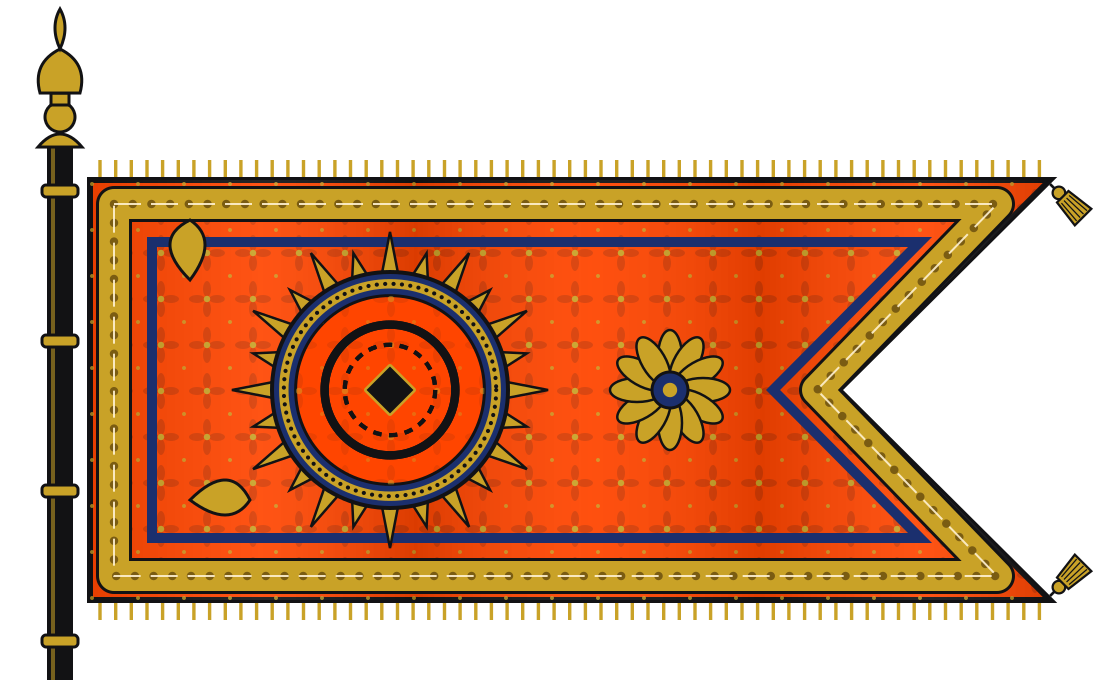
The lion holding a sword is the Sinhalese royal standard in the Malwathu manuscript; Perera's 1916 blazon gives a gold lion with a chowry on red. The standard was lost in 1803 and relinquished in 1815[10].
| Part of the kit | This clan |
|---|---|
| Field | Royal Navy #1B2F6E |
| Accent | Fiery Vermilion #FF4500 |
| Emblem colour | Metallic Gold #C9A227 |
| Zari metal | Gold |
| Main emblem | A lion with a sword |
| Second image | A rock fortress |
| Night and day | Every visual accessory has two versions: by night the emblem on the dark field, by day the clan's field colour on cloth woven from its metal. |
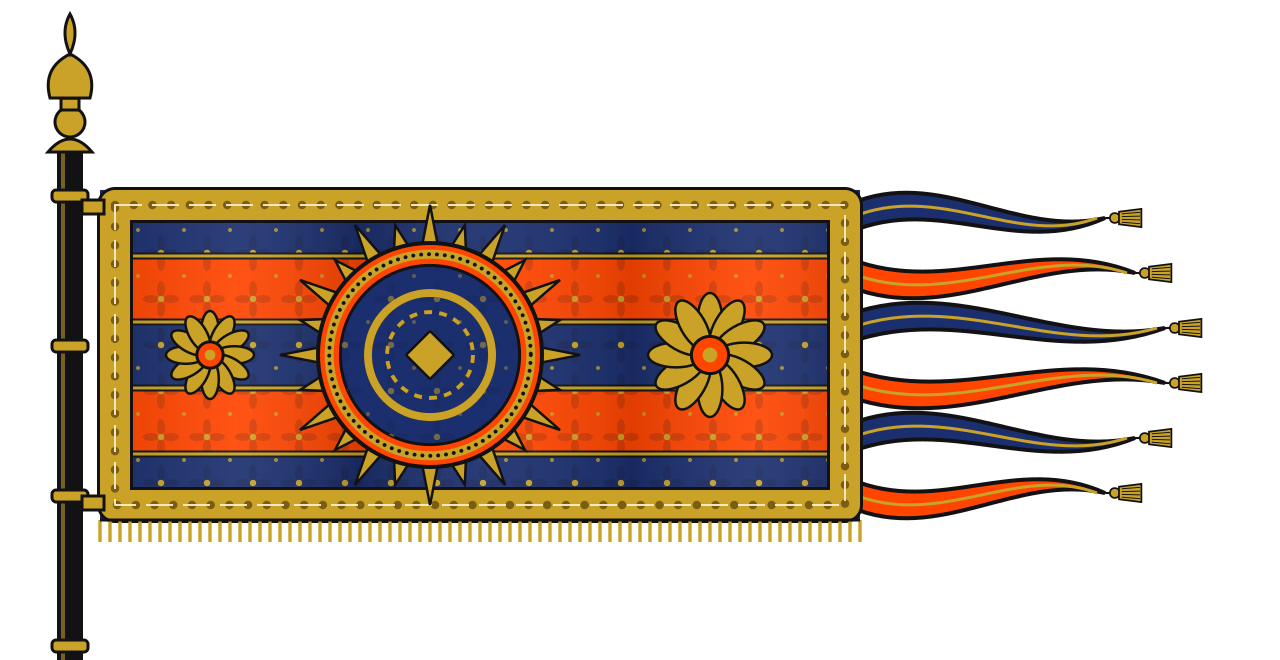
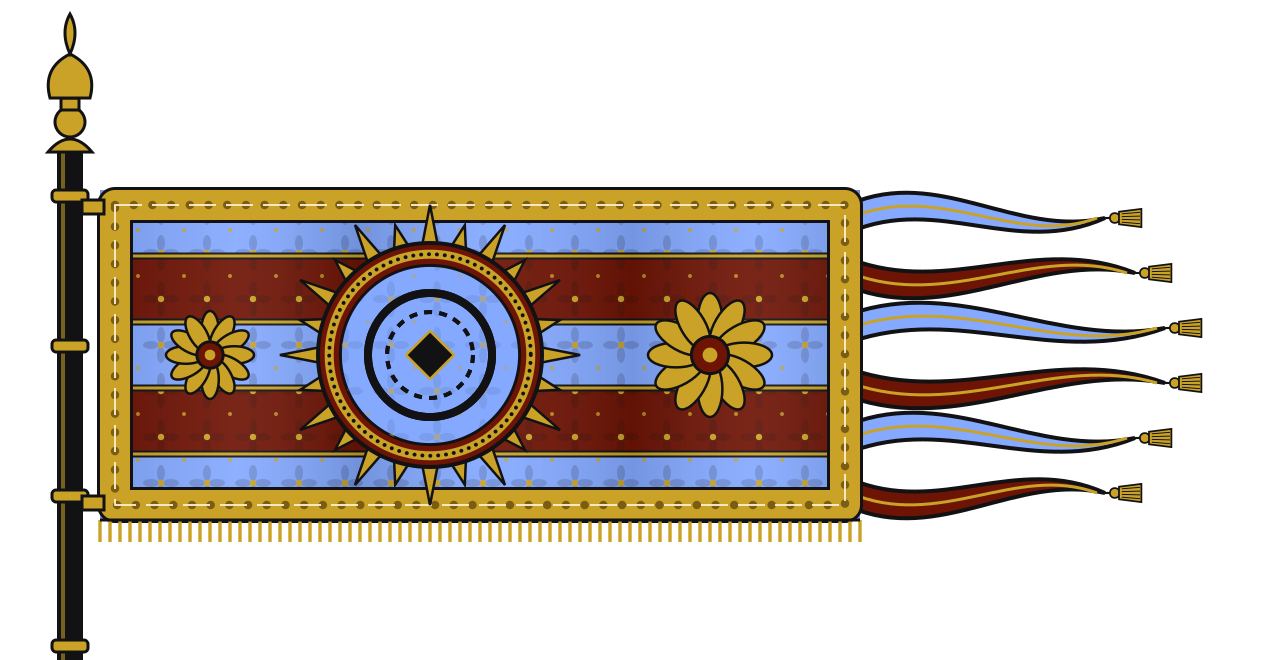
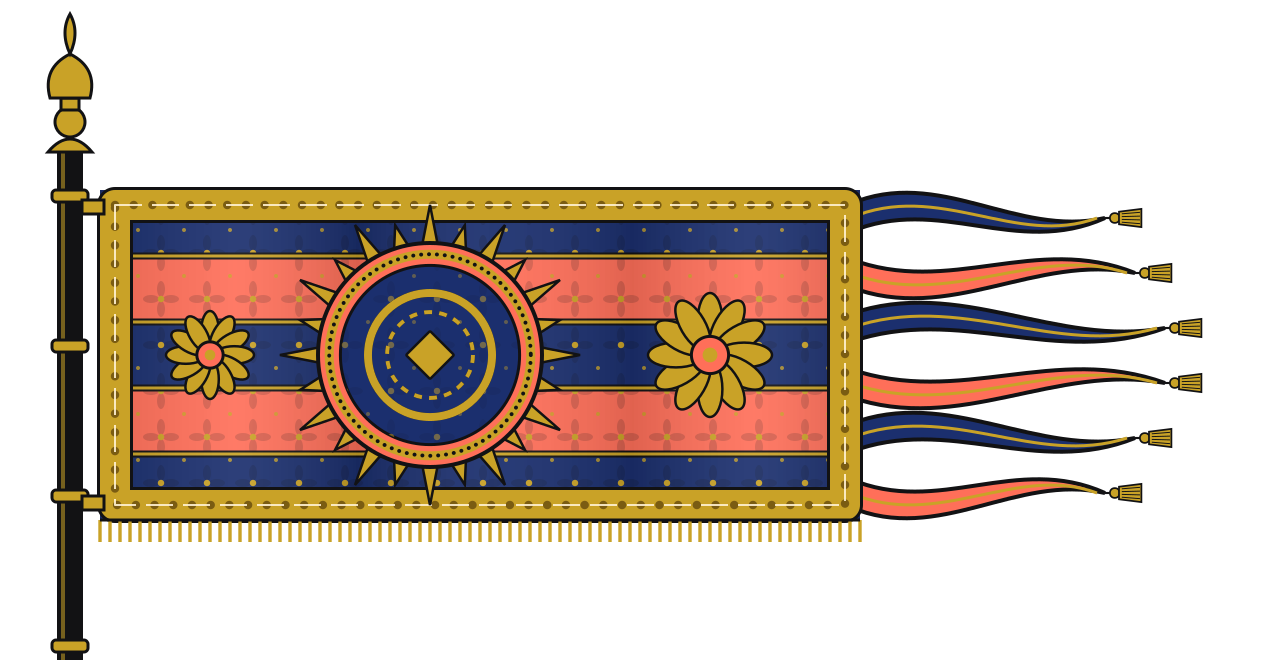
6. Flags
Every clan has every flag type; the type says the occasion and the colours say the clan. The outlined card is the flag the Atlas assigns.
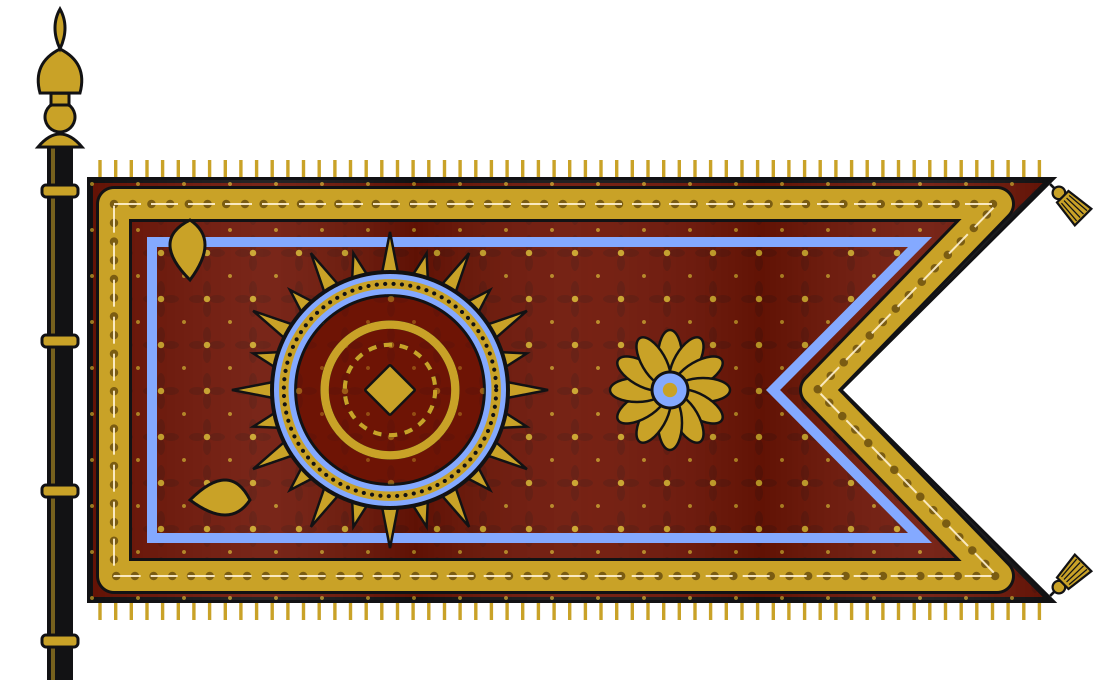
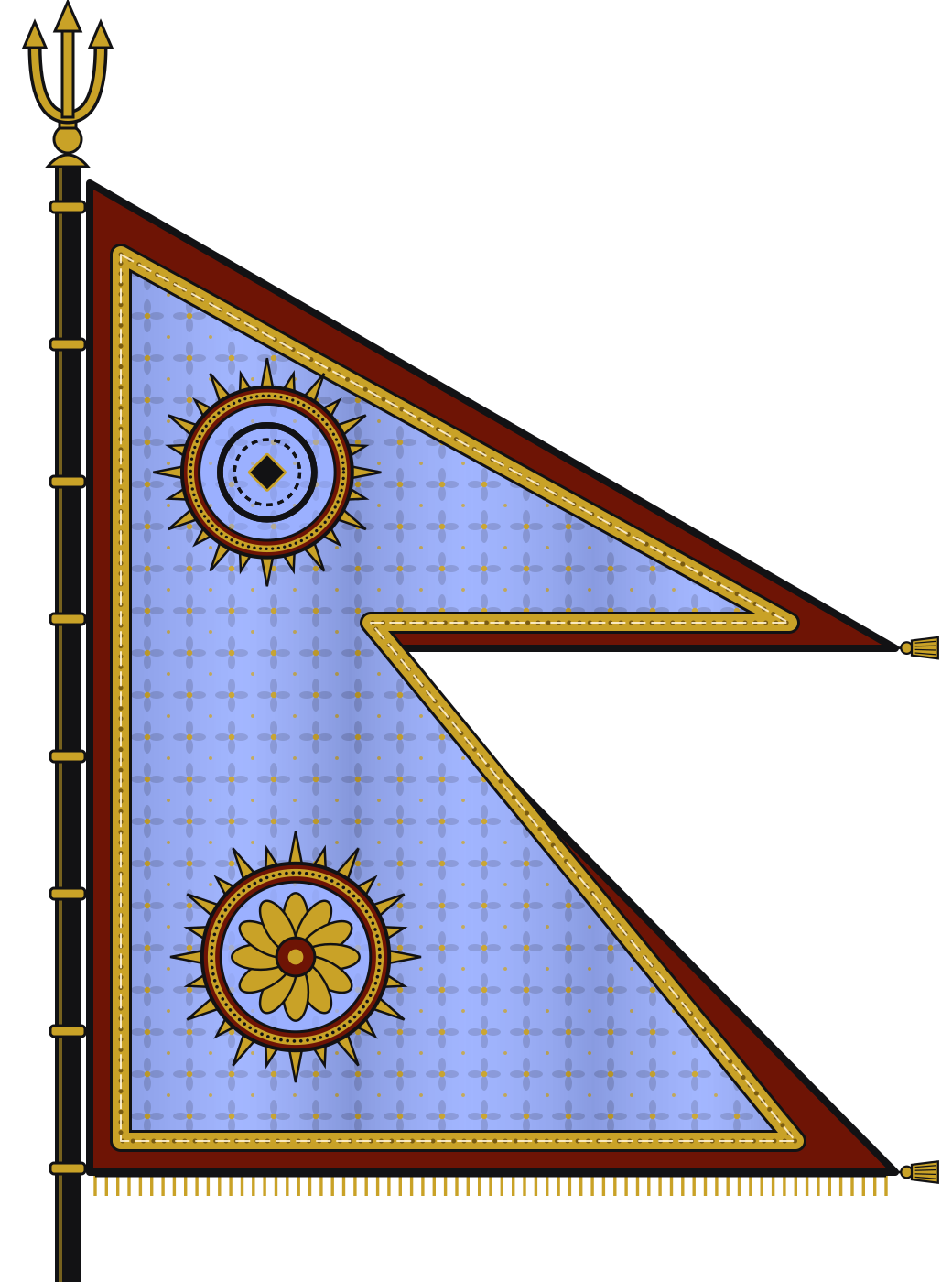
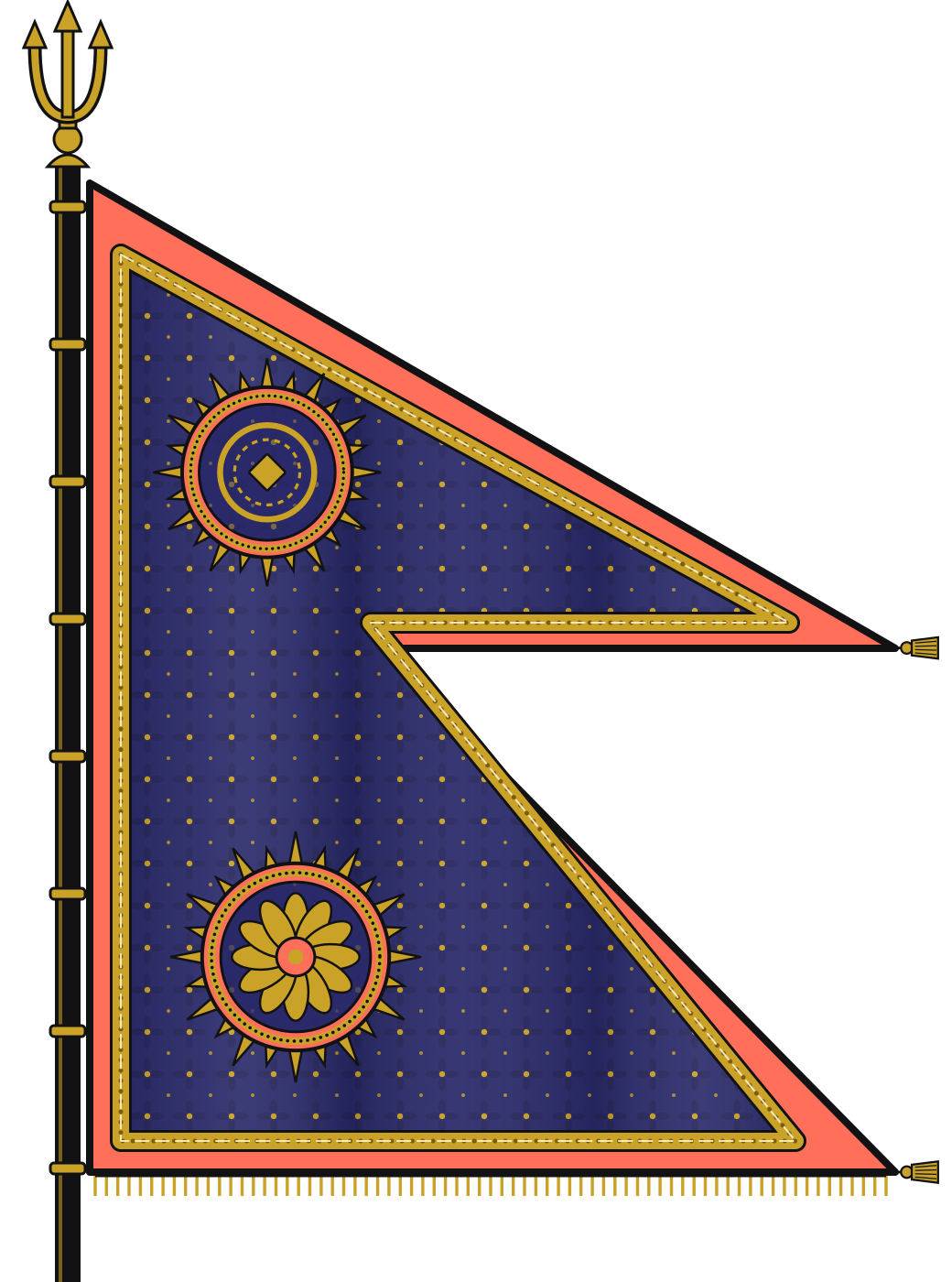
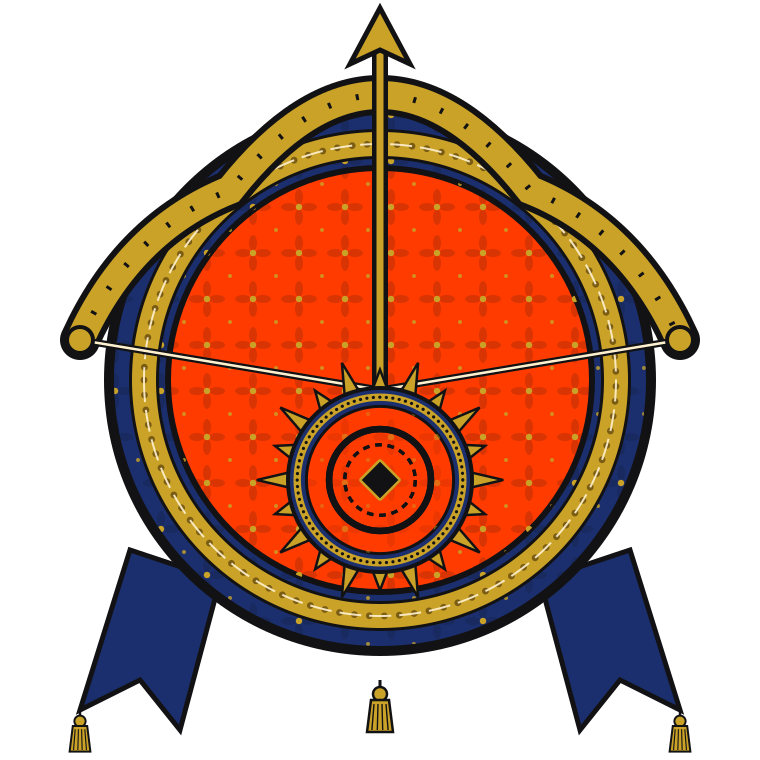
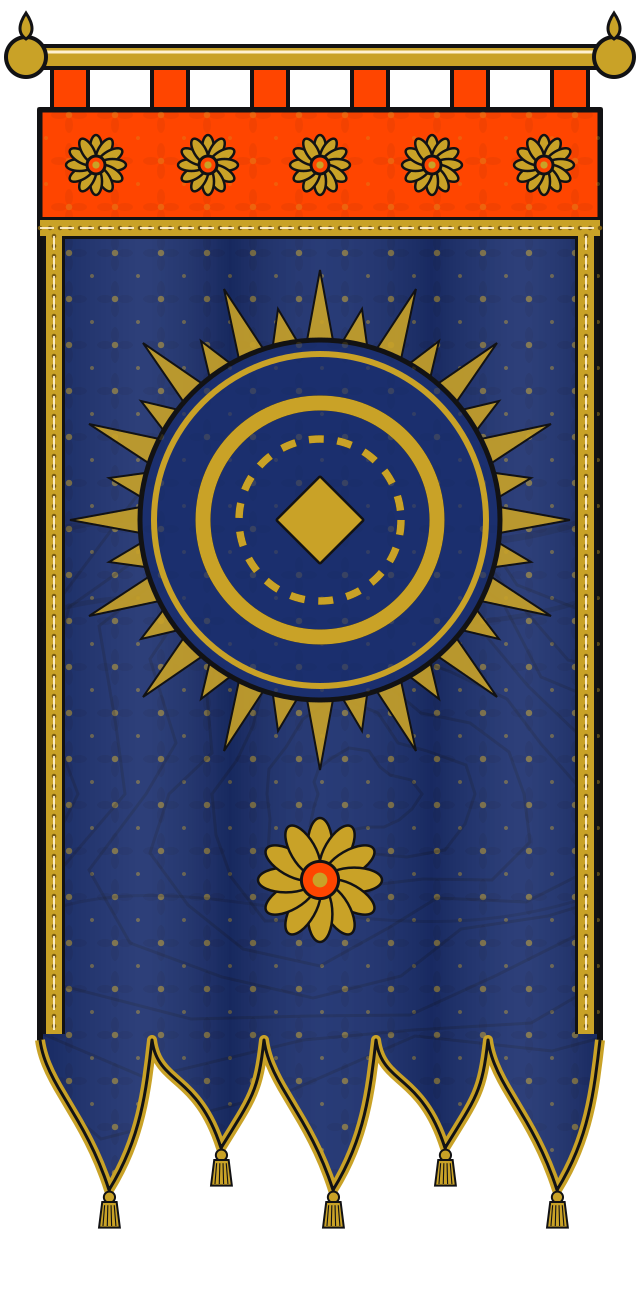
Historic banner
The Kandyan kings' lion flag is the basis of Sri Lanka's national flag
New flag types
| Accessory | For this clan | Basis |
|---|---|---|
| A9 Pota-dhvaja · ship and trade flag For ships, caravans and markets | Not yet designed for this clan | Design |
| A10 Utsava-patāka · festival flag Light, bright flag for fairs and festivals | Not yet designed for this clan | Design |
| A11 Shoka-dhvaja · mourning flag White cloth with the emblem outline in the clan's metal | Not yet designed for this clan | Design |
7. Regalia
| Accessory | For this clan | Basis |
|---|---|---|
| E1 Chhatra · house parasol The ceremonial umbrella | Not yet designed for this clan | Design |
| E2 Chamara · fly-whisks The pair of whisks beside the head of the house | A chowry (fly-whisk) held by the lion on the Kandyan royal standard Perera's 1916 blazon: a gold lion passant holding a chowry[10] | Documented |
| E3 Danda · staff of office Staff or scepter | Not yet designed for this clan | Design |
| E4 Simhasana · seat The seat of the house, covered in clan cloth | Not yet designed for this clan | Design |
| E5 Khetaka · shield A round shield; the Changi and Dhanush are its flag forms | Not yet designed for this clan | Regional tradition |
| E6 Kula-ayudha · clan weapon The weapon the clan honours | Not yet found for this clan | Under research |
8. Worn
| Accessory | For this clan | Basis |
|---|---|---|
| F1 Kula-vastra · clan cloth The clan's woven pattern in its kit colours | Not yet designed for this clan | Design |
| F2 Kirti-vastra · honour cloth A cloth earned for a deed, not inherited | Not yet designed for this clan | Design |
| F3 Kula-mala · garland flower The flower or leaf the clan wears as a garland | Not yet found for this clan | Under research |
| F4 Chinha · house pin A metal badge with the pin emblem | Not yet designed for this clan | Design |
9. Records
| Accessory | For this clan | Basis |
|---|---|---|
| H1 Clan words A traditional line in the native script | සිංහල ජනතාව · “Sinhala people (the people's own name)” The people's name in Sinhala script, as the Wikipedia article gives it[1] | Documented |
| H2 Biruda · titles The house's title or titles | Kandyan office titles: Dissava, Rate Mahatmaya, Nilame, Lekam, Rala Titles of the Kandy kingdom, romanised in the source; not the clan's own biruda[10] | Regional tradition |
| H3 Prashasti · praise genealogy The lineage as written at the head of a grant | Not yet found for this clan | Under research |
| H4 Vahi · clan register The book of the clan's births, marriages and deaths | Not yet found for this clan | Under research |
| H5 Rana-ghosha · war cry The clan's cry in battle or celebration | Not yet found for this clan | Under research |
10. VishwaVit · knower of the world
Game values are design choices for this project, not historical claims.
References
- Wikipedia, Sinhalese people, read 10 Oct 2026, https://en.wikipedia.org/wiki/Sinhalese_people
- Wikipedia, Pre-Anuradhapura period, read 10 Oct 2026, https://en.wikipedia.org/wiki/Pre-Anuradhapura_period
- Wikipedia, Govigama, read 10 Oct 2026, https://en.wikipedia.org/wiki/Govigama
- Wikipedia, Sinhala script, read 10 Oct 2026, https://en.wikipedia.org/wiki/Sinhala_script
- Dennis B. McGilvray, "Sex, Repression, and Sanskritization in Sri Lanka?", Ethos 16 (1988) (PDF, read 10 Oct 2026, KulDevi run 36).
- Pattini, Asia Research Institute, National University of Singapore (read 10 Oct 2026, KulDevi run 36).
- Pattini, Wikipedia (read 10 Oct 2026, KulDevi run 36).
- Peter R. Blood, Countries of the World, Sri Lanka: Religion, as hosted at kataragama.org (Popular Sinhalese Religion), read 10 Oct 2026, link
- The Mahāvaṃsa or the Great Chronicle of Ceylon, tr. W. Geiger (Pali Text Society, 1912).
- Wikipedia, Flags of the Kingdom of Kandy, read 10 Oct 2026, https://en.wikipedia.org/wiki/Flags_of_the_Kingdom_of_Kandy
- Maritime history of Odisha (Wikipedia, read 2026-10-08), citing S. Tripati, B. Patra, H. P. Ray and the Dathavamsa, Chulavamsa and Samantapasadika.
- Wikipedia, Pandya dynasty, read 2026-10-10, https://en.wikipedia.org/wiki/Pandya_dynasty
- Wikipedia, Caste system in Sri Lanka, read 10 Oct 2026, https://en.wikipedia.org/wiki/Caste_system_in_Sri_Lanka
- Henry Parker, Village Folk-Tales of Ceylon vol. II, London: Luzac, 1914 (Project Gutenberg #57399, read 10 Oct 2026), link
- Time Out Sri Lanka, Olinda Keliya, 6 Apr 2016, read 2026-10-10, URL
- Moraspirit, Sports heritage of the New Year season, 14 Apr 2019, read 2026-10-10, URL
- Sunday Observer, New Year Games - Avurudu Kreeda, 9 Apr 2017, read 2026-10-10, URL
- The Morning, Not just sports: take a look at Olinda Keliya, 19 Sep 2021, read 2026-10-10, URL
- Sunday Observer, Olinda Keliya, 10 Apr 2022, read 2026-10-10, URL
- H. Parker, Village Folk-Tales of Ceylon, vol. 1 (Luzac, 1910), Introduction p. 22, Project Gutenberg 56614