The Shakas were horse-riding nomads of Iranic Scythian origin, called Indo-Scythians or Indo-Sakas, who moved from Central Asia into Afghanistan, Iran and north-west India between the mid-2nd century BCE and the 4th century CE[1]. Maues took Gandhara and Taxila c. 80 BCE, and Northern Satraps then ruled Mathura, though the sources date these first kings differently[1][2]. The Western Satraps, of the Kshaharata and Kardamaka houses, held Ujjain, Gujarat and Malwa from c. 35 CE to 415 CE[3]. Indian tradition credits the Vikrama era to the defeat of the Shakas, and the Saka calendar is official in India today[4]; no living Shaka community is named in the extracts.
01Faith and deities
The Atlas gives no KulDevi (basis: Research), and no deity is sourced as the Shakas' own. Their coins and inscriptions name Buddhist, Greek and Brahmanical figures, listed below.
No KulDevi has been found for this clan yet; it is on the research list.
| Deity or tradition | Place in the clan's life | Evidence |
|---|---|---|
| Buddhism | Patrons: the Indo-Scythians supported Buddhism; Mathura's stupa held a Buddha relic donated under Rajuvula | [1][5] |
| Triratna and Buddhist lion | On the coins of Vijayamitra and Azes II; the Mathura capital carries a central triratna | [1][5] |
| Vasudeva and Vaishnavism | The Northern Satraps' deities include Vasudeva, Vishnu and Lakshmi; Vasudeva is named on the Vasu doorjamb (c. 15 CE) | [2] |
| Jinas | Rishabhanatha, Suparshvanath and Parsvanatha, patronised at Mathura; Kankali Tila Jain stupa | [2] |
| Brahmanical gifts | Ushavadata followed Vedic religion (Brahmanism) and gave 300,000 cows and gold at the Barnasa river, 16 villages to deities and Brahmanas, and fed Brahmanas yearly | [6] |
| Karana mudra | Used on the Buner friezes to ward off evil spirits | [1] |
02Temples
No temple built by the Shakas as a clan is documented in the extracts. The Buddhist caves and stupas below are the Western and Northern Satraps' gifts, as the sources record them.
Built by the clan
| Temple | Deity | Built by | When | Where |
|---|---|---|---|---|
| Mora Vrishni shrine | Five Vrishnis, called bhagavatam, with images | Satrap Sodasa (per his Mora well inscription) | c. 15 CE | Mora, c. 7 km west of Mathura[2] |
Given patronage or grants by the clan
| Temple | Deity | What the clan gave | When | Where |
|---|---|---|---|---|
| Karla Great Chaitya | Buddhist chaitya | Nahapana's donative record: gifts to Brahmanas, Devas and ascetics | Dedicated 120 CE | Karla[3] |
| Nasik Cave 10 (Nahapana Vihara) | Buddhist cave | Ushavadata's gift of a field to the Buddhists; inscription No. 12 (year 42, month Vesakha) | Year 42 | Nasik Pandavleni[6][3] |
| Devnimori stupa and viharas | Stupa with Gandharan-influenced Buddha images | Rudrasimha coins are found inside | Not dated | Devnimori[3] |
| Kankali Tila tablet | Jain stupa, Amohini relief | Jinas named among deities patronised | Not dated | Mathura[2] |
03Languages and scripts
| Language or script | Kind | Under the clan | Evidence |
|---|---|---|---|
| Saka (Khotanese) lost | Iranian language of the Sakas | Known from records; the Indo-Scythian page equates it with Khotanese, first documented in the Tarim Basin | [1] |
| Prakrit lost | Language of the Mathura inscriptions | Mathura inscriptions in Prakrit, in Kharoshthi; Western Satraps used Maharashtri Prakrit | [5][3] |
| Sanskrit | Court language under Rudradaman; adopted by the Northern Satraps | The Junagadh inscription is the first long, mostly standard Sanskrit record; Salomon 1998 | [7][2] |
| Pali | Listed among the common languages | Infobox of the Indo-Scythian page | [1] |
| Greek lost | Legend on coin obverses | Greek legends: Nahapana's coin reads ' PANNIΩ IAHAPATAC NAHAΠANAC ' | [3][1] |
| Kharoshthi and Brahmi lost | Scripts of Saka coins and stones | Kharoshthi on Indo-Scythian reverses and on Nahapana's reverse; Brahmi on Western Satrap reverses | [1][3][8] |
| Chinese 塞 (Sai) | Chinese name for the Sakas | Han Shu: 西擊塞王。塞王南走遠徙,月氏居其地。, quoted on the Indo-Scythian page | [1] |
| Ancient Iranian language family | Family of the Saka language | Bharat Discovery (Hindi page) | [9] |
04Books and literature
The Shakas left inscriptions and coins. The books below are by others who named or wrote about them. No Saka-language book is named in the extracts.
Written in the clan's lands during its era
| Work | Author | Kind | When | Link to the clan |
|---|---|---|---|---|
| Periplus of the Erythraean Sea | Not named | Text naming a Scythian district with Minnagara | c. 70–80 CE | [1] |
| Parthian Stations | Isidore of Charax | Text naming the Sacastana | Not dated | [1] |
| Work not named | Ptolemy | Text naming the Sakas | Not dated | [1] |
| Writings naming the Sakas | Arrian | Text naming the Sakas (title not given) | Not dated | [1] |
| Shiji and Han Shu | Not named | Chinese histories naming the Sai | Not dated | [1] |
| Puranas, Manusmriti, Ramayana, Mahabharata | Not named | Texts naming the Shakas | Not dated | [1] |
| Mahabhasya, Brihat Samhita, Kavyamimamsa, Brihatkathamanjari, Kathasaritsagara | Not named | Sanskrit texts naming the Shakas | Not dated | [1] |
| Junagadh rock inscription | Court of Rudradaman I | Inscription in Sanskrit prose | Shortly after 150 CE | [7] |
| Nasik and Karla inscriptions | Nahapana; Ushavadata | Donative inscriptions | Nahapana years 41–46; Ushavadata year 42 | [3][6] |
| Kalakacharya Kathanaka | Mahesarasuri; ed. W. Norman Brown | Story | Edition 1933 | [4] |
Given patronage by the clan
Not recorded.
05Thinkers and scholars
| Name | Field | Era | Contribution |
|---|---|---|---|
| Father of Vasubandhu (not named) | Brahmin; court priest | Not dated in the extracts | A brahmin of the Kauśika gotra and court priest of Shaka princes, per the IEP page; probably under the Shilada clan[10][11] |
| Yavanesvara | Translator | c. 150 CE | Translated the Yavanajataka c. 150 CE; the page does not name his patron[3] |
The extracts name no Saka scholar. The Vasubandhu link is through his father.
06Art and architecture
The surviving art is in coins, stone and reliefs: a king on horseback, the Mathura lion capital, caskets, and soldiers on the Buner friezes.
Painting and wall art
Not recorded.
Sculpture and temple art
| Art form | What it is | Era | Evidence |
|---|---|---|---|
| Mathura lion capital | Red sandstone capital, h. 34 cm, w. 52.5 cm, central Buddhist triratna; Prakrit in Kharoshthi | Dated 1–10 CE | British Museum 1889,0314.1[5] |
| Chastana statue | Statue found at Mathura, inscribed 'Sha-sta-na' in Middle Brahmi | Not dated | Mathura[3] |
| Mora Vrishni torsos | Torsos of the Vrishni figures | c. 15 CE | Mora[2] |
| Isapur Buddha | Buddha image | c. 15 CE | Isapur[2] |
| Katra Bodhisattva | Bodhisattva image from Katra | Not dated | Katra[2] |
| Sirkap stone palette | Winged horseman on a winged deer attacked by a lion | Not dated | Sirkap, Taxila[1] |
| Bimaran casket | Casket with an early Buddha | Not dated | British Museum[1] |
| Bajaur casket | Casket of prince Indravarman | 5–6 CE | Metropolitan Museum[1] |
| शक राज पुरुष (Saka king) | Image titled Saka King, Mastan | Not dated | Government Museum, Mathura[9] |
Temple and building architecture
| Art form | What it is | Era | Evidence |
|---|---|---|---|
| Karla Great Chaitya | Buddhist chaitya | Dedicated 120 CE | Karla[3] |
| Nasik Pandavleni Cave 10 | Cave with 16 rooms | Nahapana's and Ushavadata's time | Nasik[3] |
| Butkara Stupa capital | Indo-Corinthian capital | c. 20 BCE | Swat, Butkara Stupa[1] |
| Rest houses | Four-roomed rest houses, with gardens, tanks, wells and free river crossings | Ushavadata's time | Bharukachchha, Dashapura, Govardhana, Shurparaka[6] |
Weaving and textiles
Not recorded.
Clothing and jewellery
| Art form | What it is | Era | Evidence |
|---|---|---|---|
| Tunics, trousers and pointed hoods | Soft tunics and trousers with pointed hats or hoods, and the Scythian cap | Not dated | [1] |
| Buner soldiers | Soldiers in tunics, trousers, pointed hoods or Scythian caps, with straight swords | Not dated | Buner reliefs[1] |
Coins, pottery and crafts
| Art form | What it is | Era | Evidence |
|---|---|---|---|
| Coins | King on horseback (sometimes camel) or seated cross-legged, no portrait; quality declined under Rajuvula | Not dated | [1] |
| Western Satrap coins | Bust with a Greek-derived legend; thunderbolt and arrow, then a three-arched hill with river, crescent and sun; Brahmi dates | Dates from Jivadaman and Rudrasimha I | [3] |
| Taxila copper plate | Copper plate donation of a Buddha relic by Patika Kusulaka | 6 CE (Western Satraps page) | Taxila[3][1] |
07History
Origins and the move south (c. 175 BCE – c. 80 BCE)
The Indo-Scythians (Indo-Sakas) were nomads of Iranic Scythian origin who moved from Central Asia into Afghanistan, eastern Iran and north-west India, in migrations from the mid-2nd century BCE to the 4th century CE[1].
The Yuezhi were defeated by Modu Shanyu c. 175 BCE, and the Sakas were pushed toward Ferghana and Sogdiana, then Bactria and Afghanistan, settled Drangiana (later Sakastan, Sistan), and entered India by the Indus under Maues[1]. Greco-Bactria ended c. 130 BCE with the Scythian and Yuezhi migrations[12].
Maues and Azes I in the north-west (c. 85–35 BCE)
Maues was the first Saka king in the subcontinent, dated c. 85–60 BCE on the Indo-Scythian page, and took Gandhara and Taxila c. 80 BCE[1]. The Taxila article dates Maues to c. 90 BCE and says Azilises had a Taxila mint, with Greek and Kharoshthi legends on its coins[13].
Azes I took the north-west in 55 BCE after defeating Hippostratos (table 55–35 BCE on the Indo-Scythian page); the Indo-Greek page gives Azes I as 48/47 BCE[1][12]. Gondophares ended Indo-Scythian rule in the north-west in the late 1st century BCE, and the Kushans regained the north-west c. 75 CE and Mathura c. 100 CE[1].
Mathura and the Northern Satraps (c. 60 BCE – 2nd century CE)
The Northern Satraps at Mathura are dated by the infobox to 60 BCE and by the text to c. 70 BCE, ending in the 2nd century CE. Mathura was taken from a presumed Datta dynasty; Hagamasha (55–35 BCE) and Hagana (25 BCE–10 CE) came first[2].
Rajuvula, a Mahakshatrapa under Azilises, took Sagala from Strato II c. 10 CE[2]. The Mathura lion capital, red sandstone with a central Buddhist triratna, is dated 1–10 CE and was consecrated under the satrap Rajuvula; it was found at the Saptarishi mound in 1869 by Bhagwan Lal Indraji[5]. Its text names Muki, whose funeral occasioned the capital and who is conjectured to be Maues[5].
Sodasa, Rajuvula's son, made Mathura his capital (c. 15 CE), and the Mora well inscription records his shrine and images[5][2]. Kanishka's third-year inscription, c. 130 CE, names Kharapallana and Vanaspara, Northern Satraps who had become Kushan feudatories[2].
The Western Satraps and the Kshaharatas (c. 35 – c. 120 CE)
The Western Satraps, of the Kshaharata (Chaharada) and Kardamaka houses, are dated c. 35 CE to 415 CE. Their cities were Ujjain, Bharuch (Barygaza), Minnagara, Dashapura (Mandasor), Govardhana (Nasik) and Shorparaga (Sopara)[3]. Abhiraka (c. 35 CE, coins) and Bhumaka came before Nahapana[3][8].
Nahapana's dates vary: 24–70 CE (Sagar), 66–71 CE (Fynes), or, if the years 41–46 of his inscriptions are read in the Saka era, 119–124 CE; the Western Satraps page reckons years 41 to 46 as 58 to 63 CE[8][3]. His Karla record (Karla Great Chaitya, dedicated 120 CE) gives gifts to Brahmanas, Devas and ascetics "without any distinction of sect or origin"[3]. The Avasyaka Niryukti, Curnisutra and Sridhara's Srutavatara say that he abdicated and became a Jain monk, Bhutabali[8].
Ushavadata, Nahapana's son-in-law and viceroy, held the southern Saka territories of Nasik, Karle and Junnar[6]. Gautamiputra Satakarni apparently defeated him, and his Nasik record of the 18th year grants land once held by Ushavadata[6]. Gautamiputra's Pandavleni Cave 3 inscription claims that he destroyed the Sakas, Yavanas and Pahlavas and uprooted the Khakharata family[3].
The Saka era, Chastana and Rudradaman I (c. 78 – 150 CE)
The Saka era begins at 78 CE. Chastana, Ujjain satrap, may have founded it; the page also gives a competing Azes-era view (Senior)[3]. Dated use: Jivadaman's Saka 100 (178 CE) on the first dated coins, and Rudrasimha I's Setkhedi inscription of Saka 107 (185 CE)[3]. Chastana's grandson Rudradaman I was Mahakshatrapa c. 130 CE and gave his daughter to Vashishtiputra Satakarni[3].
The Junagadh rock inscription, Sanskrit prose on a rock near Girnar and shortly after 150 CE, tells of the Sudarshana lake, built under Chandragupta Maurya by his governor Pushyagupta, a Vaishya, and repaired under Rudradaman[7]. Saka year 72 is c. 150–51 CE[14]. The repair was done without forced labour or extra taxes, and the minister Suvisakha, a Pahlava, carried it out[14]. Rudradaman claims to have defeated the Yaudheyas and to have defeated Satakarni twice, sparing him through marriage[7][3].
Rudradaman's vow to abstain from slaying men except in battle is given in Kielhorn's translation[15]. Bharat Discovery quotes a historian: "सभी शक स्किथी थे, लेकिन सभी स्किथी शक नहीं थे" (all Shakas were Scythians, but not all Scythians were Shakas)[9].
Decline and end (3rd – 5th century CE)
Rudrasimha I ruled 178–197 CE, Rudrasena II 256–278 CE, Visvasena 293–304 CE and Rudrasimha II 304–348 CE. Sridharavarman (339–368 CE) is recorded at Kanakerha (319 CE) and as a Saka chief at Vidisha, Sanchi and Eran[3].
Chandragupta II's Sanchi inscription (412–413 CE) is recorded, and the Allahabad pillar names a Saka ruler, probably Sridharavarman, who submits to Samudragupta[3]. Sistan was held until Bahram II (276–293 CE)[1].
The last Western Satrap, Rudrasimha III, is dated 388–415 CE on the Western Satraps page, which ends the line in 415 CE. The Indo-Scythian page instead says that Chandragupta II defeated him in 395 CE. The Natya-darpana fragment tells that Rudrasimha III demanded Dhruvadevi and that Chandragupta II killed him[3][1].
Indian tradition: Vikrama and the era (later accounts)
Tradition has Vikramaditya of Ujjain defeat the Shakas and found the Vikrama era, dated 58 BCE on the Indo-Scythian page and to epoch 57 BCE on the Vikram Samvat page[1][4]. Colonial scholars read the era as the expulsion of the Shakas from Ujjain; the Vikram Samvat page says that later evidence shows no historical basis for this[4].
08Journey and migrations
The moves below are the ones the extracts date or name. They run from Central Asia to the Indus and then south and west into the Western Satraps' lands.
| When | From | To | Why | Evidence |
|---|---|---|---|---|
| c. 175 BCE | Ili valley and Ferghana | Sogdiana, then Bactria and Afghanistan | Pressed by the Yuezhi after Modu Shanyu defeated them | [1][16] |
| c. 130 BCE | Greco-Bactria | Bactria | Greco-Bactrian kingdom ends with the Scythian and Yuezhi migrations | [12] |
| Not dated | Drangiana | Sakastan (Sistan) | Settled; the region took the name Sakastan | [1] |
| c. 80 BCE | Afghanistan, by the Indus and Karakoram route | Gandhara and Taxila | Entered India under Maues | [1] |
| c. 10 CE | Mathura | Sagala | Rajuvula took Sagala from Strato II | [2] |
| c. 35 CE | Not stated | Ujjain, Gujarat and Malwa | Western Satraps' rule begins; Ujjain is their western capital | [3][1] |
09Seats and lands
| Place | Role | Where today |
|---|---|---|
| Syr Darya delta, Ferghana, Sogdiana, Bactria, Ili valley, Tarim Basin | Early homes in Central Asia | Central Asia (Indo-Scythian page) |
| Sakastan (Sistan) (सीस्तान) | Settled in Drangiana; the name survives | Sistan[1][9] |
| Gandhara, Taxila, Sirkap, Indus valley | Taken by Maues c. 80 BCE | Taxila, Pakistan (sheet)[13] |
| Minnagara | Metropolis of Syrastrene (Periplus) and a Western Satrap city | Not located in the extracts[3] |
| Mathura (मथुरा) | Northern Satrapy; capital of Sodasa | Mathura[2][9] |
| Sagala | Taken from Strato II c. 10 CE | Sialkot, Pakistan (Indo-Greek page)[12] |
| Ujjain (Ozene) | Western capital | Ujjain, Madhya Pradesh[17] |
| Bharuch (Barygaza) | Port of the Western Satraps; trade with Rome | Bharuch[3] |
| Dashapura | Western Satrap city | Mandasor[3] |
| Govardhana | Western Satrap city; Nasik caves | Nasik[3] |
| Shorparaga | Western Satrap city | Sopara[3] |
| Karla, Nasik, Junnar | Caves with Nahapana and Ushavadata's gifts | Maharashtra (sheet)[6] |
| Junagadh (Girinagara) | Rudradaman's rock inscription and the Sudarshana lake | Near Girnar[7] |
| Mora | Vrishni shrine of Sodasa's inscription | c. 7 km west of Mathura[2] |
| Kamboj (कबोह) and Yona island (यूनान) | Places listed among the Saka lands on Bharat Discovery | Not located in the extracts[9] |
| Xinjiang (झींगझियांग) | Possibly the Saka homeland region | Xinjiang (Bharat Discovery: possibly)[9] |
10Notable figures
| Name | Role | Era | Known from |
|---|---|---|---|
| Maues | First Saka king in the subcontinent; took Gandhara and Taxila | c. 85–60 BCE; takeover c. 80 BCE | [1] |
| Azes I | Took the north-west after defeating Hippostratos | 55–35 BCE (table); 48/47 BCE (Indo-Greek page) | [1][12] |
| Arta (Kamuia) | Brother of Maues; father of Kharahostes | Not dated | [1] |
| Kharahostes | Yuvaraja (crown prince) | 10 BCE – 10 CE | [1][5] |
| Hagamasha | Satrap at Mathura | 55–35 BCE | [2] |
| Hagana | Satrap at Mathura, with Hagamasha in a joint coin legend | 25 BCE – 10 CE | [2] |
| Rajuvula (राजुबुल) | Mahakshatrapa; took Sagala; consecrated the Mathura lion capital | c. 10–25 CE | [2][5][9] |
| Sodasa (शोडाष) | Son of Rajuvula; made Mathura his capital | c. 15 CE | [5][2][9] |
| Patika Kusulaka | Great Satrap; donated a Buddha relic on the Taxila copper plate | Not dated | [1] |
| Ayasia and Nadasi Kasa | Chief queen (Ayasia) and queen (Nadasi Kasa) | Not dated | [5] |
| Vijayamitra | Ruler; triratna on his coins | 12 BCE – 15 CE | [1] |
| Indravarman | Prince named on the Bajaur casket | 5–6 CE | [1] |
| Kharapallana and Vanaspara | Northern Satraps who became Kushan feudatories | c. 130 CE (Kanishka's third year) | [2][1] |
| Bhumaka (भूमक) | Kshaharata ruler; Nahapana's father | Not dated | [8][9] |
| Nahapana (नहपान) | Kshaharata ruler; satrap, then Mahakshatrapa | 24–70, 66–71 or 119–124 CE (variants) | [8][3][9] |
| Ayama | Minister at Junnar, of the Vatsa gotra | Manmodi, Junnar, year 46 (124 CE) | [8] |
| Dinika and Dakshamitra | Father of Ushavadata; Ushavadata's wife, Nahapana's daughter | Not dated | [6] |
| Ushavadata (उषवदात) | Viceroy of the southern Saka territories; son-in-law of Nahapana | Nasik record of year 42 | [6][9] |
| Chastana (चष्टन) | Ujjain satrap; may have founded the Saka era | 78 CE (era) | [3][9] |
| Rudradaman I (रुद्रदामन) | Mahakshatrapa; Junagadh inscription; defeated the Yaudheyas | c. 130–150 CE | [7][9] |
| Jivadaman | Ruler; first dated coins (Saka 100) | 178 CE | [3] |
| Rudrasimha I | Ruler; Setkhedi inscription (Saka 107) | 178–197 CE | [3] |
| Rudrasena II | Ruler; Andhra Ikshvaku link via Rudradhara-bhattarika | 256–278 CE | [3] |
| Sridharavarman | Saka chief at Vidisha, Sanchi and Eran; Kanakerha inscription | 339–368 CE; inscription 319 CE | [3] |
| Rudrasimha III | Last Western Satrap | 388–415 CE (Western Satraps); defeated 395 CE (Indo-Scythian page) | [3][1] |
| Rupiamma | Donor of the Pauni pillar, Vidarbha | 2nd century CE | [3] |
| Vikramaditya legend | Ujjain king of tradition who defeated the Shakas | Tradition: 58 BCE (Indo-Scythian) or epoch 57 BCE (Vikram Samvat) | [4] |
| Sahi legend | Shaka king of Sistan who defeats Gandharvasena in the Kalakacharya story | Not dated | [4] |
| अम्लाट, कम्बोजिका, गर्दभिल्ल, यशोभोतिक | Rulers named in the Bharat Discovery list; not identified in the extracts | Not dated | [9] |
11Allies, rivals and marriages
| People | Relationship | When |
|---|---|---|
| Satavahanas (Gautamiputra Satakarni) | Rivals; Satavahana defeat of the Satraps c. 105–106 CE (Cave 10 record); Rudradaman defeated Satakarni twice and spared him[3] | c. 105–106 CE; c. 150 CE |
| Kushanas (Yuezhi) | Displaced the Sakas in the Ili valley; regained the north-west c. 75 CE and Mathura c. 100 CE; Kushan feudatories under Kanishka[16][1] | c. 175 BCE – c. 130 CE |
| Yavanas | Named with the Shakas in the Mudrarakshasa alliance and the Mahabharata prophecy[1] | Not dated |
| Pahlavas | Minister Suvisakha, a Pahlava, carried out the Junagadh repair; Gautamiputra claims to have destroyed Pahlavas[14] | c. 150 CE |
| Mauryas | Pushyagupta, governor under Chandragupta Maurya, built the Sudarshana lake[7] | 321–297 BCE (Chandragupta) |
| Kamboja | Named with the Shakas; Konow links Kambojas with Sakas and Yavanas[5] | Not dated |
| Yaudheyas | Defeated by Rudradaman I[7] | c. 150 CE |
| Chandragupta II | Defeated Rudrasimha III (395 CE; 388–415 CE for the satrap's reign); Sanchi inscription 412–413 CE[1][3] | 395 CE; 412–413 CE |
| Samudragupta | The Allahabad pillar: a Saka ruler submits to him[3] | Not dated |
| Shakyas | The Buddha's clan, possibly of Scythian origin (Witzel and Beckwith); Bronkhorst disputes it[1] | c. 600–450 BCE (sheet) |
12Society and livelihood
The Shakas ruled through satraps: Northern Satraps at Mathura and Western Satraps in Gujarat and Malwa. Their trade, the rest houses of Ushavadata's gifts and the claims made about their origin are set out below.
Government and social order
| Institution or group | What it was | Evidence |
|---|---|---|
| Northern Satraps (शक क्षत्रप) | Satraps at Mathura, the Northern Satrapy | [1][2][9] |
| Western Satraps | Satraps in Gujarat and Malwa, with Ujjain as their western capital | [3][1] |
| Viceroy Ushavadata | Viceroy of the southern Saka territories (Nasik, Karle, Junnar) | [6] |
| Minister Ayama | Minister at Junnar, of the Vatsa gotra | [8] |
| Charaka associations | Ushavadata gave 32,000 coconut stems at Nanamgola to charaka associations | [6] |
| Kushan feudatories | Kharapallana and Vanaspara, Northern Satraps who became Kushan vassals under Kanishka | [2] |
| Ksatriya origin | The Agneya-purana describes the Sakas as originally Ksatriyas (Hazra); Bharat Discovery says these peoples were आर्य with religious customs not very different from Indian ones | [18][9] |
Livelihood over time
| Era | Livelihood | Evidence |
|---|---|---|
| Before India | Horse nomads who used chariots and sacrificed horses (citing Herodotus) | [1] |
| Under the Northern Satraps | Coins at Mathura: silver declining, bronze and billon rising | [2] |
| 1st century CE | Barigaza, a major port for trade with Rome (wine, copper, silk, ivory, per the Periplus); a Pompeii Lakshmi statuette may have been exported through it | [3] |
| Ushavadata's time | Four-roomed rest houses at Bharukachchha, Dashapura, Govardhana and Shurparaka, with gardens, tanks, wells and free river crossings | [6] |
13Sub-clans and related clans
The sources name these houses, dynasties and peoples. Those with a sheet ID are linked; the rest become new clan candidates. Descent claims on the uncited oocities page are marked as claims, not facts.
| Clan | Relation | Where | Size | In the Atlas | Evidence |
|---|---|---|---|---|---|
| Kshaharatas | Dynasty from this clan | Nasik, Karle, Junnar; the Barygaza (Bharuch) coast | ANC-172 | [3][8] | |
| Western Satraps | Dynasty from this clan | Ujjain, Gujarat, Malwa, Maharashtra (sheet) | ANC-185 | [3] | |
| Kardamaka (Bhadramukha) line | Sub-clan | Ujjain (Chastana); Junagadh (Rudradaman I) | new clan candidate | [3] | |
| Northern Satraps शक क्षत्रप | Branch | Mathura; Sagala from c. 10 CE | same name as ANC-217: check | [2][9] | |
| Shilada clan | Sub-clan | Not stated | same name as ANC-278: check | [11] | |
| Kushanas (Yuezhi) 月氏 | Related people | Central Asia; Bactria; north-west India | ANC-070 | [16][1] | |
| Yavanas | Related people | Punjab; Afghanistan and Pakistan (sheet) | ANC-154 | [1] | |
| Kambojas | Related people | Jammu & Kashmir (Rajouri theory), Afghanistan, Tajikistan, Pakistan (sheet) | ANC-046 | [1][5] | |
| Pahlavas | Related people | Punjab; Taxila (sheet) | ANC-092 | [14][1] | |
| Paradas | Related people | Western frontier (sheet) | ANC-097 | [1] | |
| Vahlikas (Bahlikas) | Related people | Punjab (sheet) | ANC-138 | [1] | |
| Abhiras | Related people | Gujarat, Rajasthan, Maharashtra (sheet) | ANC-001 | [1] | |
| Rishikas | Related people | Central Asia (sheet) | ANC-111 | [1] | |
| Shakyas | Related people | Kapilavastu (sheet) | ANC-120 | [1] | |
| Parasikas | Related people | Not stated | same name as ANC-221: check | [1] | |
| Massagetae | Related people | Not stated | same name as ANC-206: check | [1] | |
| Sacaraucae | Related people | Not stated | same name as ANC-243: check | [1] | |
| Medii | Related people | Not stated | new clan candidate | [1] | |
| Xanthii | Related people | Not stated | same name as ANC-235: check | [1] | |
| Sarmatians | Related people | Not stated | same name as ANC-240: check | [9][19] | |
| Kamuia | Related people | Mathura (lion capital) | same name as ANC-196: check | [5] | |
| Datta dynasty (Mathura) | Related people | Mathura, before the satraps (presumed) | same name as ANC-252: check | [2] | |
| Wusun | Related people | Ili valley (Yuezhi page) | same name as ANC-234: check | [16] | |
| Xiongnu | Related people | Gansu and the steppe (Yuezhi page) | same name as ANC-237: check | [16] | |
| Gujjar | Related people | Himachal Pradesh, Jammu and Kashmir, Ladakh (sheet) | ST-093 | [19] (claim) | |
| Jat | Related people | Not stated | same name as SUB-177: check | [19] (claim) | |
| Ahir | Related people | Not stated | same name as ST-363: check | [19] (claim) | |
| Rajput | Related people | Not stated | new clan candidate | [19] (claim) | |
| Lohar | Related people | Not stated | new clan candidate | [19] (claim) | |
| Tarkhan | Related people | Not stated | new clan candidate | [19] (claim) | |
| Madra | Related people | Madra kingdom (sheet) | ANC-074 | [19] (claim) | |
| Gill | Related people | Not stated | new clan candidate | [19] (claim) | |
| Bajwa | Related people | Not stated | new clan candidate | [19] (claim) | |
| Sandhu | Related people | Not stated | new clan candidate | [19] (claim) | |
| Mann | Related people | Not stated | new clan candidate | [19] (claim) | |
| Her | Related people | Not stated | new clan candidate | [19] (claim) | |
| Bhullar | Related people | Not stated | new clan candidate | [19] (claim) | |
| Chauhan | Related people | Rajasthan-descent (claim) | SUB-109 | [19] (claim) | |
| Powar | Related people | Rajasthan-descent (claim) | new clan candidate | [19] (claim) | |
| Rathi | Related people | Rajasthan-descent (claim) | new clan candidate | [19] (claim) | |
| Sial | Related people | Rajasthan-descent (claim) | new clan candidate | [19] (claim) | |
| Thakur | Related people | Thakur surname (claim) | ST-310 | [19] (claim) | |
| Sessodia | Related people | Not stated | new clan candidate | [19] (claim) |
Clans marked "new clan candidate" are not in the Atlas yet.
14Surnames
The oocities page names these surnames as of Scythian descent. The page cites no count or source, and no count is given here. The list rests on one uncited amateur page and is a claim, not a fact.
| Surname | Clan or sub-clan | Where | People with this surname | Also used by other communities |
|---|---|---|---|---|
| Gill | Claimed on the oocities page | Afghan-descent (page's claim) | not yet counted | Not checked |
| Bajwa | Claimed on the oocities page | Afghan-descent (page's claim) | not yet counted | Not checked |
| Sandhu | Claimed on the oocities page | Afghan-descent (page's claim) | not yet counted | Not checked |
| Mann | Claimed on the oocities page | Afghan-descent (page's claim) | not yet counted | Not checked |
| Her | Claimed on the oocities page | Afghan-descent (page's claim) | not yet counted | Not checked |
| Bhullar | Claimed on the oocities page | Afghan-descent (page's claim) | not yet counted | Not checked |
| Chauhan | Claimed on the oocities page | Rajasthan-descent (page's claim) | not yet counted | Not checked |
| Powar | Claimed on the oocities page | Rajasthan-descent (page's claim) | not yet counted | Not checked |
| Rathi | Claimed on the oocities page | Rajasthan-descent (page's claim) | not yet counted | Not checked |
| Sial | Claimed on the oocities page | Rajasthan-descent (page's claim) | not yet counted | Not checked |
| Thakur | Claimed on the oocities page | Thakur surname; the sheet lists Thakur as an alias of Thakar (ST-310) | not yet counted | Yes |
| Sessodia | Claimed on the oocities page | Not stated | not yet counted | Not checked |
Counts are of everyone with the surname, from the cited source and year, not only members of this clan. A surname shared with other communities says nothing about any one person's origin.
15Songs and music
No song, instrument or music of the Shakas is named in the extracts.
None recorded yet.
16Poems, lullabies and children's rhymes
No lullaby, rhyme or poem of the Shakas is named in the extracts.
None recorded yet.
17Stories, legends and proverbs
Stories and legends
| Story | What happens | Told by | Evidence |
|---|---|---|---|
| Vikramaditya and the Shakas | Vikramaditya of Ujjain defeats the Shakas and founds the era; the page says later evidence shows no historical basis | Indian tradition, as the Vikram Samvat page gives it | [4] |
| Kalakacharya Kathanaka | Gandharvasena of Ujjain abducts the nun Sarasvati; the monk Kalaka enlists the Shaka king Sahi of Sistan, who defeats Gandharvasena; Vikramaditya later drives the Shakas out of Ujjain | Mahesarasuri; ed. W. Norman Brown (1933) | [4] |
| Herodotus origin myth | A plough, yoke, sword and cup fall from the sky; the progenitor of the Sakas picks them up | Herodotus, as retold on an uncited amateur page | [19] |
| Mahabharata prophecy | In the Kali Yuga the Shakas, Yavanas and Kambojas rule unrighteously (the Indo-Scythian page adds Bahlikas) | Vanaparva of the Mahabharata, as the Yona entry gives it | [20][1] |
| Yuga Purana invasion | A Scythian invasion of Pataliputra in the 1st century BCE; the Saka king is slain by a Kalinga king (Shata) and Sabalas | Yuga Purana, as the Indo-Scythian page gives it | [1] |
| Ramagupta legend | Rudrasimha III demands Dhruvadevi; Chandragupta II kills him | Natya-darpana fragment | [3] |
| Aji Saka legend | The extracts give only the link: the page ties the legend to the Indian colonisation of Java | Sagar (1992), as cited on the Western Satraps page | [3] |
Proverbs and sayings
Not recorded.
18Festivals and fairs
Not recorded.
19Food, dress and games
Food
Not recorded.
Dress
| Item | What it is | Evidence |
|---|---|---|
| Tunics, trousers and hoods | Soft tunics, trousers and pointed hats or hoods; the Scythian cap and the Phrygian hat | [1] |
| Horse and chariot | Horse nomads who used chariots, sacrificed horses and buried in kurgans (citing Herodotus) | [1] |
Games and martial arts
Not recorded.
Tags: living still practised · revived brought back after a break · lost known only from records · research reported but not yet confirmed from a source. Songs and poems under copyright are listed by title only; restricted or sacred material is noted without its content.
20Status today
No Shaka people is named as living in the extracts. The Saka era (78 CE) still dates India's calendar, and the name Sakastan survives in Sistan[4][1].
Who carries the name today
| Community | Link | Basis | Evidence |
|---|---|---|---|
| Jat (no sheet ID) | Disputed | [19] (claimed from Gatae; the cache note says mainstream historians do not accept many of the page's derivations) | |
| Gujjar (ST-093) | Disputed | [19] (claimed from Khazar) | |
| Ahir (no sheet ID) | Disputed | [19] (claimed from Avar) | |
| Rajput clans (no sheet ID) | Disputed | [19] (the page says virtually all Rajputs are of Scythic descent) | |
| Lohar and Tarkhan (no sheet ID) | Disputed | [19] | |
| Surnames Gill, Bajwa, Sandhu, Mann, Her, Bhullar | Disputed | [19] | |
| Surnames Chauhan, Powar, Rathi, Sial | Disputed | [19] |
Recognised heritage
| What | Recognition | Evidence |
|---|---|---|
| Shaka era (78 CE) | Saka calendar is official in India (Vikram Samvat page); the Atlas calls it India's national calendar | [4] |
| Sakastan, Sistan | The name of the region is the Saka name | [1] |
| Mathura lion capital | In the British Museum (1889,0314.1) | [5] |
No living community is named in the extracts, so no community has reviewed this page.
21For children
The Horse Riders from the North
Long ago, horse riders called Shakas came from the north. Some books call them Scythians. Their kings ruled cities such as Mathura and Ujjain. Their coins show a king on a horse. A Saka king named Rudradaman had a long Sanskrit writing cut into a rock near Junagadh. One Saka king, Chastana, may have started a new count of years in 78 CE. Today India still uses that Shaka era as its national calendar.
22Across the project
| Project | What carries this clan | Status |
|---|---|---|
| Atlas of the Janas | Pins at Ujjain, Mathura and Minnagara | From the Atlas |
| KulDevi and GrahDevi | No KulDevi in the Atlas (basis: Research) | Research |
| Planet naming | Not checked against the Tier registers | To check |
| Renaming and waters | The Sudarshana lake at Junagadh, repaired under Rudradaman I; Sakastan's name survives in Sistan and Shakadvipa in the Puranas | From the extracts |
23Open questions
- Shaka own kuldevi or deity: none is sourced; the sheet gives KulDevi basis Research.
- Maues's dates: c. 85–60 BCE and c. 80 BCE (Indo-Scythian page), c. 90 BCE for Taxila (Taxila article). Check against a primary numismatic source.
- Azes I: 55–35 BCE and 60–20 BCE both appear on the Indo-Scythian page; the Indo-Greek page gives 48/47 BCE.
- Nahapana's dates: 24–70, 66–71 or 119–124 CE; the Western Satraps page reckons years 41–46 as 58–63 CE.
- Rudrasimha III's end: 388–415 CE (Western Satraps) against his defeat by Chandragupta II in 395 CE (Indo-Scythian page).
- The Vikrama era: 58 BCE (Indo-Scythian page) or epoch 57 BCE (Vikram Samvat page). Chastana's founding of the Saka era in 78 CE is 'may have'.
- Descent claims (Jat, Gujjar, Ahir, Rajput, the surnames list): one uncited amateur page; find a source before any count or claim is stated.
- Kalakacharya story: the primary text is not in the extracts.
- Sakas in the Puranas: no detail in the extracts beyond the mentions listed.
- Rajuvula's date: the Mathura lion capital is dated 1–10 CE and was consecrated under Rajuvula[5]; Rajuvula himself is dated c. 10–25 CE[1][2] (the capital's date starts before his).
24Astitva
अस्तित्व · being, existence: everything by which the clan is known
The Shakas' documented marks are coins, titles and inscriptions: Western Satrap coins with Greek and Brahmi legends, the Northern Satraps' Brahmi titles, the Taxila copper plate, and the Junagadh and Nasik prashastis[3][2].
Every clan has every accessory, royal objects included. Each one says how it is known: Documented This clan's own object is recorded. · Regional tradition Recorded for the region or for peoples like this one, not for this clan. · Design Made for this project, with no historical claim. · Under research To be found for this clan from sources. Legends and titles are written in the clan's own script.
1. Seals and coins
| Accessory | For this clan | Basis |
|---|---|---|
| B1 Rajamudra · house seal Round seal with the clan emblem and a short legend in the clan's script | Not yet designed for this clan | Design |
| B2 Anguliya-mudra · signet ring Personal seal ring of the head of the house | Not yet designed for this clan | Design |
| B3 Chhapa · house stamp Ink or block stamp for letters, goods and cloth | Not yet designed for this clan | Design |
| B4 Tamrapatra · charter plate Copper-plate grant on a ring, closed with the house seal | Taxila copper plate: Patika Kusulaka, Great Satrap, donated a Buddha relic; the Kshaharata term is dated 6 CE | Documented |
| B5 Shreni-mudra · guild or trade seal Seal for the clan's trade, craft or caravan | Not yet designed for this clan | Design |
| C1 Clan coin Emblem or deity on one side, a legend in the clan's script | Western Satrap coin: bust with a Greek legend on the obverse; thunderbolt and arrow on the reverse; the Kharoshthi form of Nahapana's name is 𐨣𐨱𐨤𐨣 on his reverses PANNIΩ IAHAPATAC NAHAΠANAC Raño Kshaharatasa Nahapanasa · “Of King Nahapana of the Kshaharata line” | Documented |
| C2 Coin die The die that strikes the coin | Not yet designed for this clan | Design |
2. Living symbols
| Accessory | For this clan | Basis |
|---|---|---|
| I1 Totem trio The tree, bird and animal the clan protects | Not yet found for this clan | Under research |
| I2 Kaval-maram · guardian tree The tree that stands at the clan's seat | Not yet found for this clan | Under research |
3. Stone and gate
| Accessory | For this clan | Basis |
|---|---|---|
| G1 Torana · gateway The built gate of the seat; the cloth Toran hangs in it | Not yet designed for this clan | Regional tradition |
| G2 Viragallu · hero stone Carved panel stone for a member who died defending the clan | Not yet designed for this clan | Regional tradition |
| G3 Kula-shila · clan stones Standing and table stones that remember the ancestors | Not yet designed for this clan | Design |
| G4 Jayastambha · victory pillar A pillar raised for a victory | Not yet designed for this clan | Design |
| G5 Sima-shila · boundary stone Marks the clan's land, with a line in the native script | Not yet designed for this clan | Design |
4. Sounds
| Accessory | For this clan | Basis |
|---|---|---|
| D1 Pancha-mahashabda · five great sounds The right to five instruments | Not yet designed for this clan | Design |
| D2 Shankha · clan conch The clan's own named war conch | Not yet designed for this clan | Design |
| D3 Murasu · house drums Three drums: war, charity and justice | Not yet designed for this clan | Design |
5. Kit: colours, metals and emblems
The documented emblem is the king on horseback on Indo-Scythian coins, and on Western Satrap coins the thunderbolt and arrow, later the three-arched hill with river, crescent and sun[1][3]. The Atlas's galloping horse and calendar wheel are design ideas for the project.
| Part of the kit | This clan |
|---|---|
| Field | Royal Navy #1B2F6E |
| Accent | Deep Crimson Red #FF3B00 |
| Emblem colour | Metallic Gold #C9A227 |
| Zari metal | Gold |
| Main emblem | A galloping horse |
| Second image | A calendar wheel |
| Night and day | Every visual accessory has two versions: by night the emblem on the dark field, by day the clan's field colour on cloth woven from its metal. |
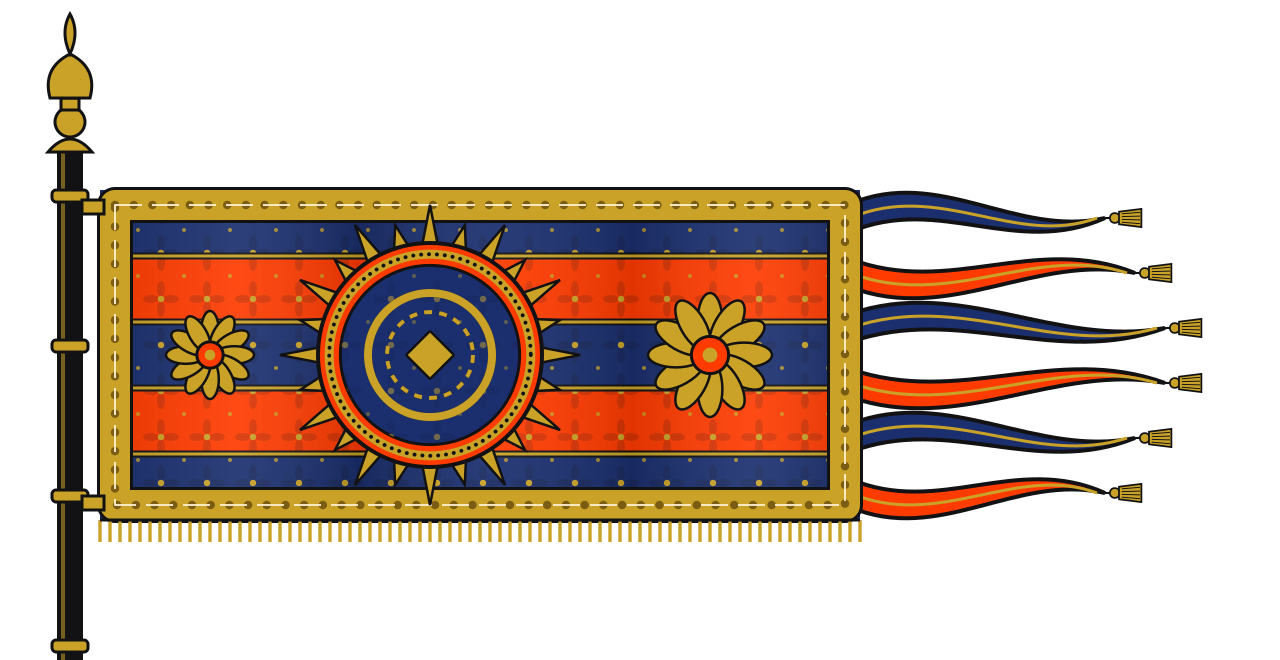
6. Flags
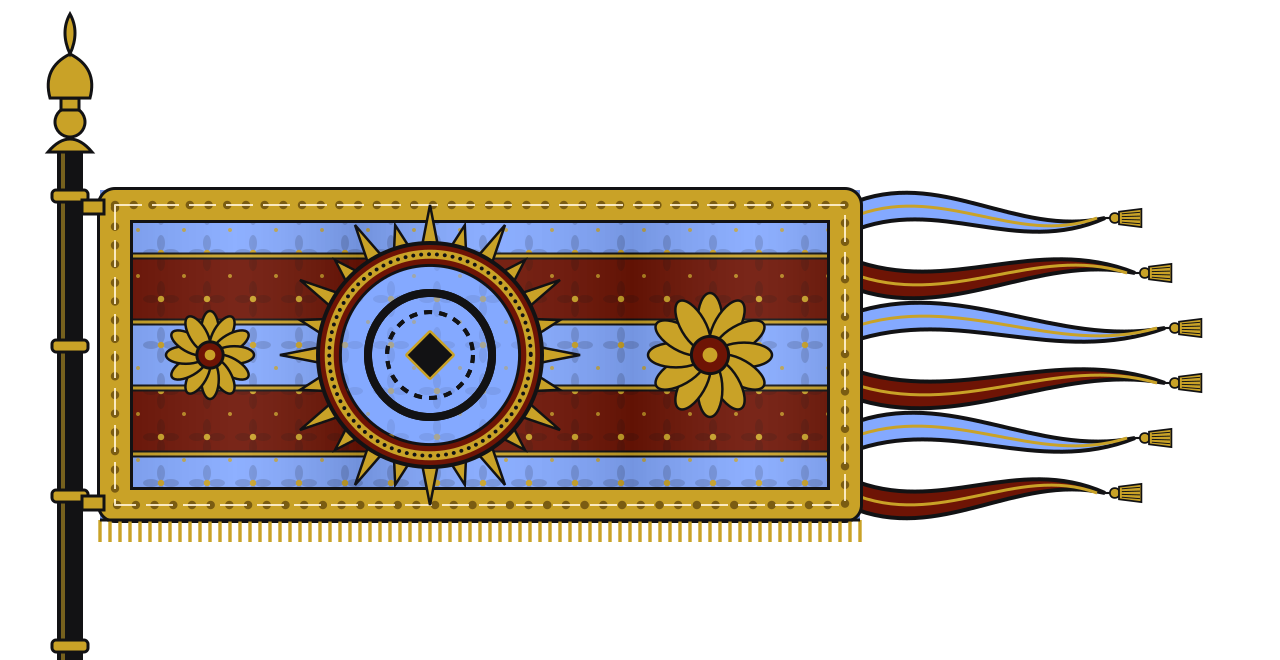
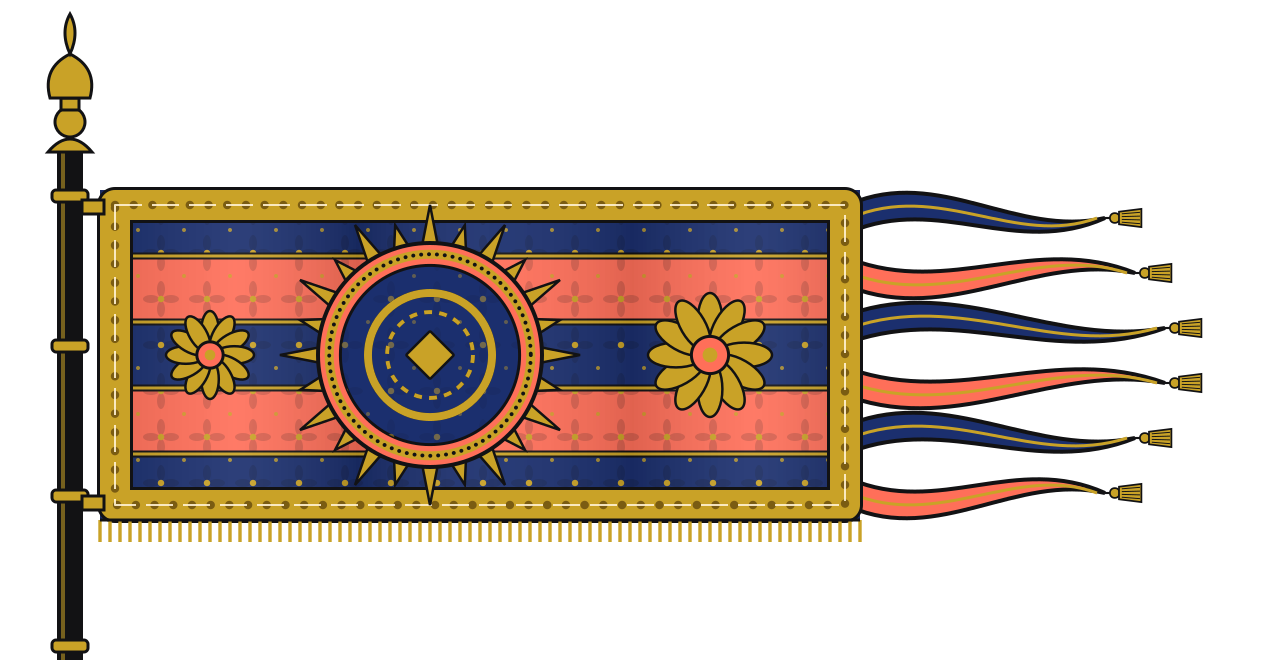
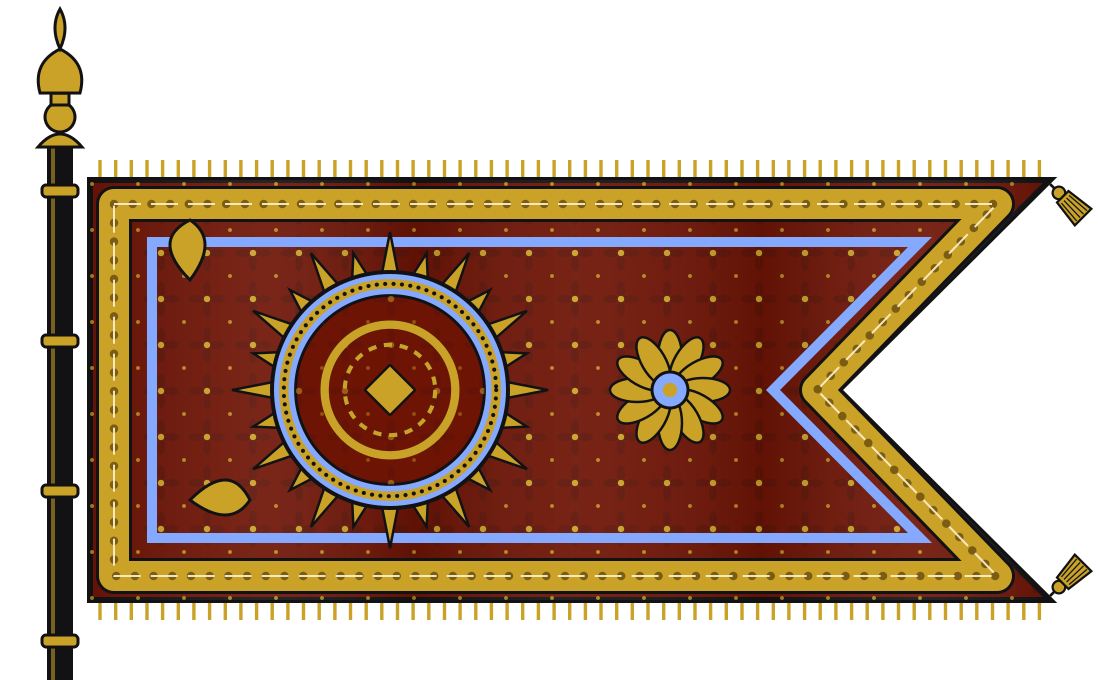
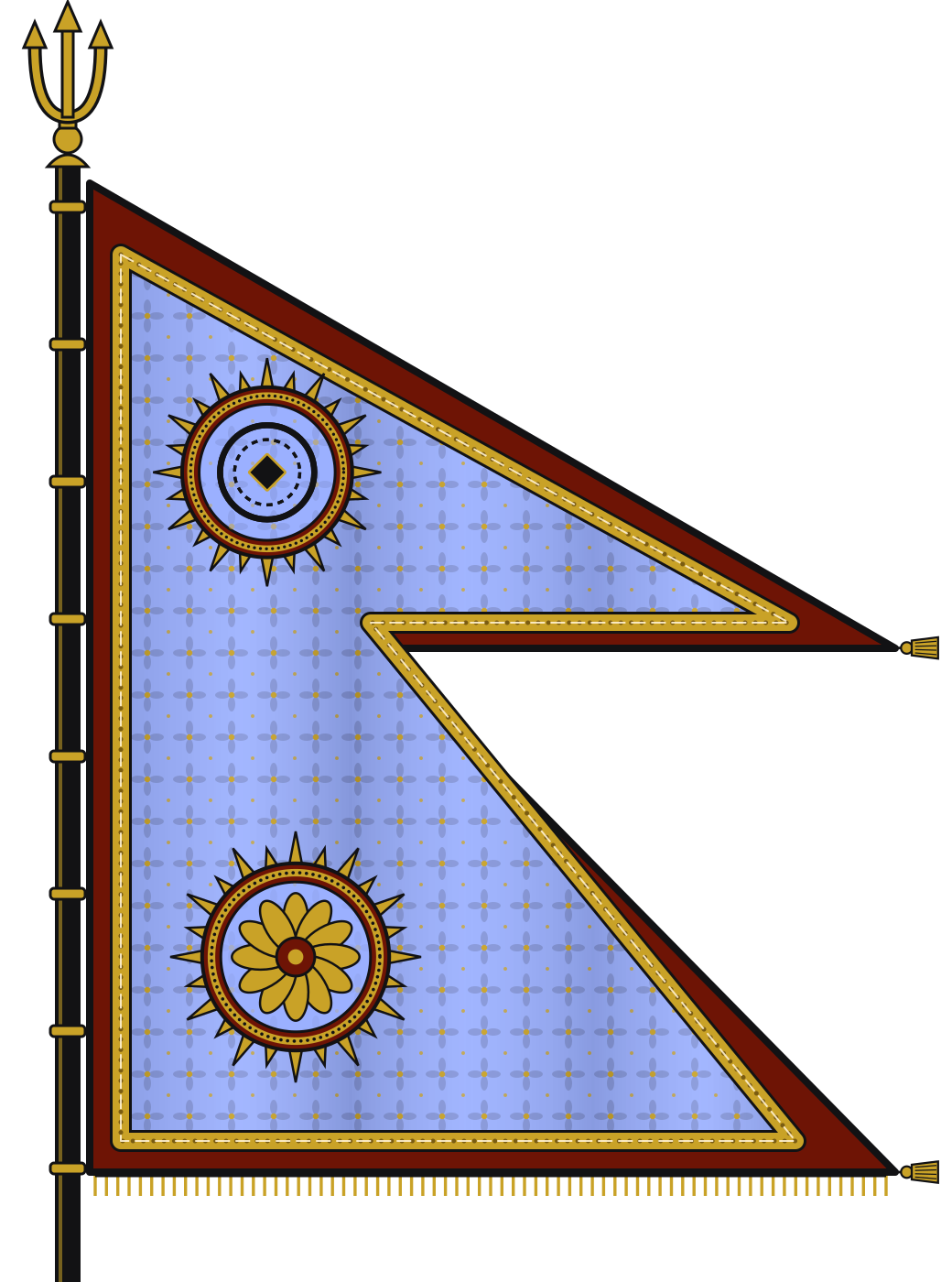
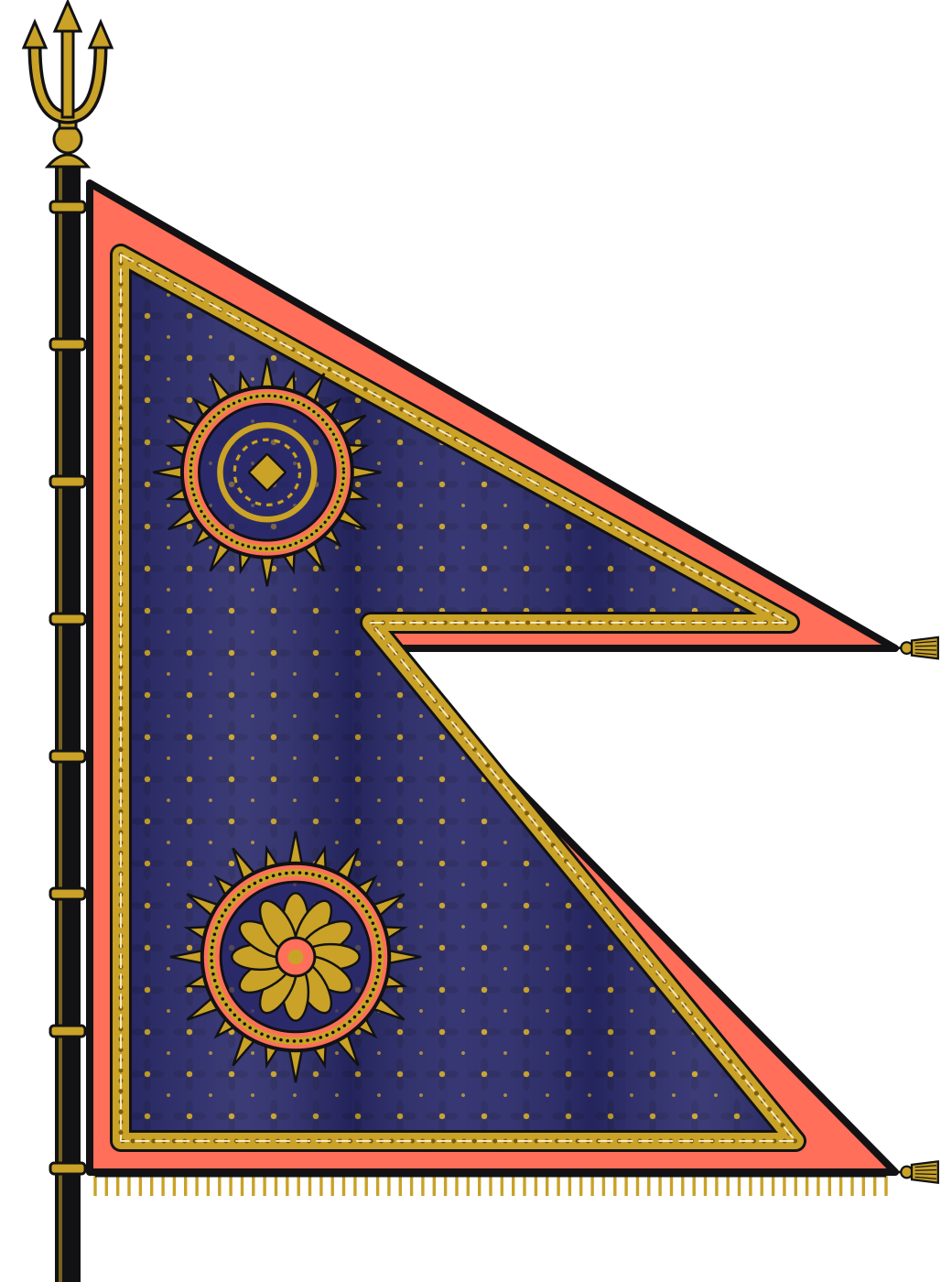
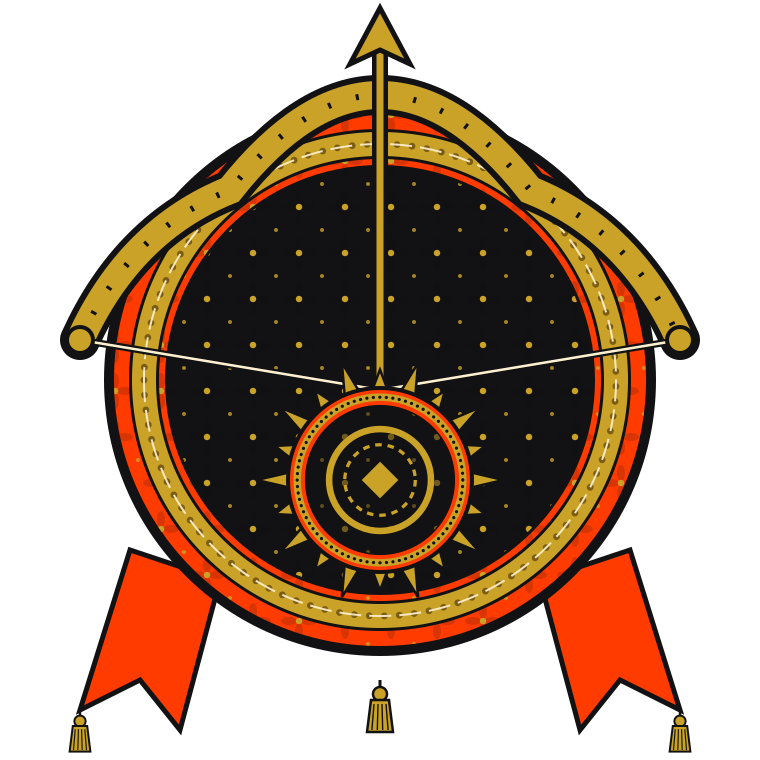
Every clan has every flag type; the type says the occasion and the colours say the clan. The outlined card is the flag the Atlas assigns.
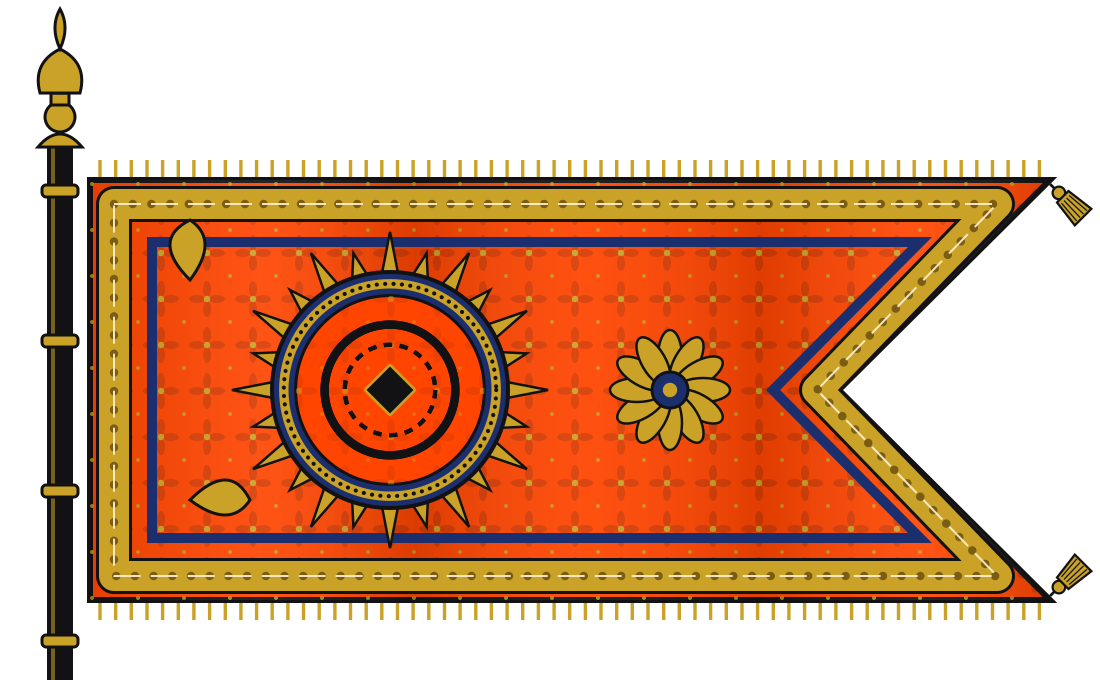

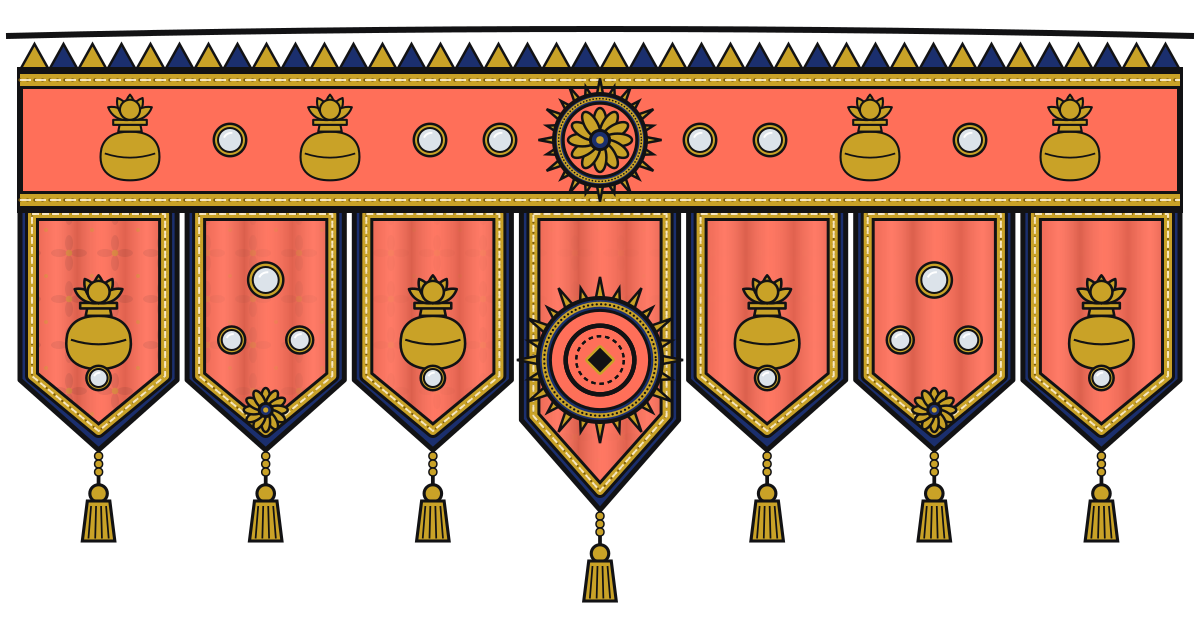
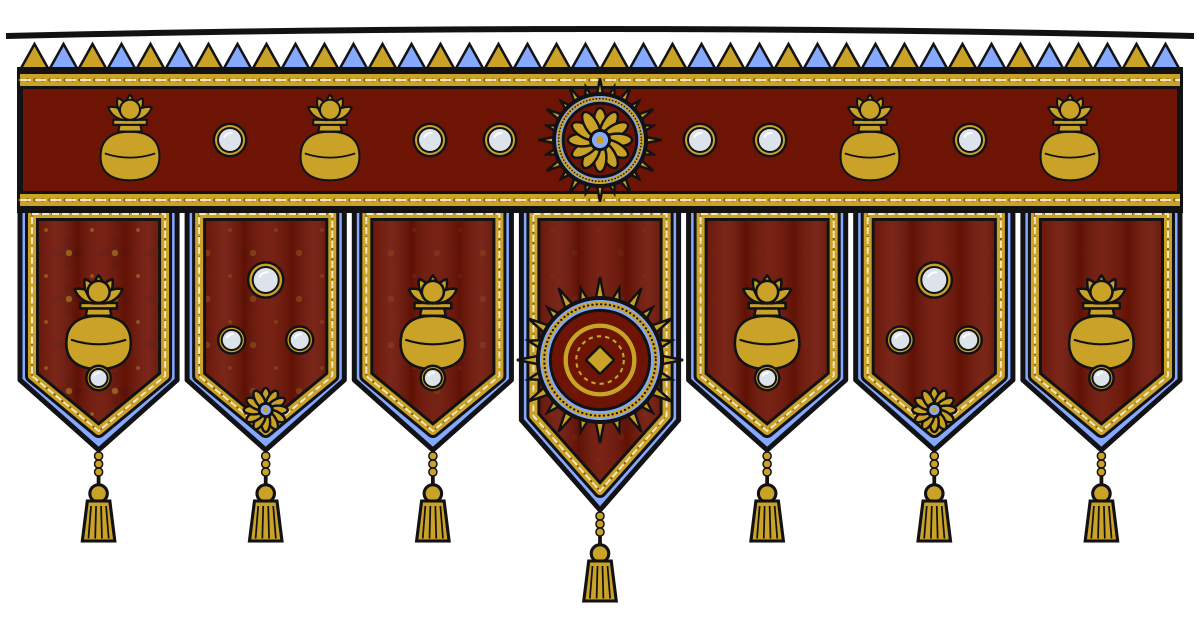

Historic banner
None known
New flag types
| Accessory | For this clan | Basis |
|---|---|---|
| A9 Pota-dhvaja · ship and trade flag For ships, caravans and markets | Not yet designed for this clan | Design |
| A10 Utsava-patāka · festival flag Light, bright flag for fairs and festivals | Not yet designed for this clan | Design |
| A11 Shoka-dhvaja · mourning flag White cloth with the emblem outline in the clan's metal | Not yet designed for this clan | Design |
7. Regalia
| Accessory | For this clan | Basis |
|---|---|---|
| E1 Chhatra · house parasol The ceremonial umbrella | Not yet designed for this clan | Design |
| E2 Chamara · fly-whisks The pair of whisks beside the head of the house | Not yet designed for this clan | Design |
| E3 Danda · staff of office Staff or scepter | Not yet designed for this clan | Design |
| E4 Simhasana · seat The seat of the house, covered in clan cloth | Not yet designed for this clan | Design |
| E5 Khetaka · shield A round shield; the Changi and Dhanush are its flag forms | Not yet designed for this clan | Regional tradition |
| E6 Kula-ayudha · clan weapon The weapon the clan honours | Not yet found for this clan | Under research |
8. Worn
| Accessory | For this clan | Basis |
|---|---|---|
| F1 Kula-vastra · clan cloth The clan's woven pattern in its kit colours | Not yet designed for this clan | Design |
| F2 Kirti-vastra · honour cloth A cloth earned for a deed, not inherited | Not yet designed for this clan | Design |
| F3 Kula-mala · garland flower The flower or leaf the clan wears as a garland | Not yet found for this clan | Under research |
| F4 Chinha · house pin A metal badge with the pin emblem | Not yet designed for this clan | Design |
9. Records
| Accessory | For this clan | Basis |
|---|---|---|
| H1 Clan words A traditional line in the native script | 𑀲𑁆𑀯𑀸𑀫𑀺𑀲𑁆𑀬 𑀫𑀳𑀓𑁆𑀰𑀢𑁆𑀭𑀧𑀲𑁆𑀬 𑀰𑀼𑀤𑀸𑀲𑀲𑁆𑀬 · “Svamisya mahakshatrapasya Shudasasya: of Shudasa (Sodasa), Svami and Mahakshatrapa” Brahmi coin legend of Sodasa, Northern Satrap at Mathura, as printed on the Northern Satraps page[2] | Documented |
| H2 Biruda · titles The house's title or titles | Titles: Mahakṣatrapa, Kṣatrapa (heir), Rañō (king) and Svami (lord); a Brahmi coin legend of Sodasa reads Svamisya mahakshatrapasya Shudasasya 𑀲𑁆𑀯𑀸𑀫𑀺𑀲𑁆𑀬 𑀫𑀳𑀓𑁆𑀰𑀢𑁆𑀭𑀧𑀲𑁆𑀬 𑀰𑀼𑀤𑀸𑀲𑀲𑁆𑀬 Svamisya mahakshatrapasya Shudasasya · “Of Shudasa (Sodasa), Svami and Mahakshatrapa” | Documented |
| H3 Prashasti · praise genealogy The lineage as written at the head of a grant | Prashasti: the Junagadh inscription praises Rudradaman and tells of the Sudarshana lake; Ushavadata's Nasik inscription opens with a Sanskrit eulogy before its donation record | Documented |
| H4 Vahi · clan register The book of the clan's births, marriages and deaths | Not yet found for this clan | Under research |
| H5 Rana-ghosha · war cry The clan's cry in battle or celebration | Not yet found for this clan | Under research |
10. VishwaVit · knower of the world
Game values are design choices for this project, not historical claims.
References
- Wikipedia, Indo-Scythian Kingdom, read 2026-10-19, https://en.wikipedia.org/wiki/Indo-Scythian_Kingdom
- Wikipedia, Northern Satraps, read 2026-10-19, https://en.wikipedia.org/wiki/Northern_Satraps
- Western Satraps (Wikipedia, read 2026-10-09), citing E. J. Rapson, R. Salomon (1998), U. Singh (2008), D. C. Sircar and J. Cribb (2013).
- Vikram Samvat (Wikipedia, read 2026-10-11), citing Salomon (1998), W. N. Brown (1933), Falk and Bennett (2009)
- Wikipedia, Mathura lion capital, read 2026-10-19, https://en.wikipedia.org/wiki/Mathura_lion_capital
- Wikipedia, Ushavadata, read 2026-10-19, https://en.wikipedia.org/wiki/Ushavadata
- Junagadh rock inscription of Rudradaman (Wikipedia, read 2026-10-09), citing F. Kielhorn (Epigraphia Indica VIII), R. Salomon, Indian Epigraphy (1998) and D. K. Chakrabarti (1999).
- Wikipedia, Nahapana, read 2026-10-19, https://en.wikipedia.org/wiki/Nahapana
- Bharat Discovery (भारत डिस्कवरी), शक, read 2026-10-19, https://bharatdiscovery.org/india/शक
- K. T. S. Sarao, Vasubandhu, Internet Encyclopedia of Philosophy, read 2026-10-19, link
- K. T. S. Sarao, Vasubandhu, Internet Encyclopedia of Philosophy (Twenty Verses source), read 2026-10-19, https://iep.utm.edu/page/vasubandhu/
- Wikipedia, Indo-Greek Kingdom, read 2026-10-18, https://en.wikipedia.org/wiki/Indo-Greek_Kingdom
- Taxila (Wikipedia, read 2026-10-09), citing J. Marshall, Taxila (1951) and A Guide to Taxila (1960), A. Cunningham (1871), R. K. Mookerji (1951), H. Scharfe (2002), R. Thapar (1997) and U. Singh (2008).
- P. Bhaskar Reddy, K. Muniratnam, Suchandra Ghosh, "Junagadh Inscription of Rudradaman", e-PG Pathshala (INFLIBNET) module, read 2026-10-10, PDF
- F. Kielhorn, "Junagadh Rock Inscription of Rudradaman", Epigraphia Indica VIII, no. 6 (1905–06), pp. 36–49 — translation as quoted in the Wikipedia article (read 2026-10-09).
- Wikipedia, Yuezhi, read 2026-10-19, https://en.wikipedia.org/wiki/Yuezhi
- Ujjain (Wikipedia, read 2026-10-09), citing K. C. Jain (1972), H. Kulke and D. Rothermund (2004), F. R. Allchin and G. Erdosy (1995), A. Eraly (2002) and the Census of India 2011.
- R. C. Hazra, article on the Agneya-purana (Part II), wilbourhall.org, read 2026-10-11, https://wilbourhall.org/sansknet/general/ourheritage/Agneya.htm
- oocities.org (pak_history), Scythian Origins (uncited amateur page; claims attributed to it), read 2026-10-19, https://www.oocities.org/pak_history/scythians.html
- New World Encyclopedia, Yona (adapted from Wikipedia, CC BY-SA 3.0), read 2026-10-18, https://www.newworldencyclopedia.org/entry/Yona