The Saora (also Savara, Sora, Soura) are a Munda-speaking Scheduled Tribe (list dated 09-07-2024, Atlas) of southern Odisha, north coastal Andhra Pradesh and the Eastern Ghats[1][2]. Pliny and Ptolemy are said to place the Sora in Kalinga, and Pliny's name for them is Suari[3][1]. The hill Lanjia Saora paint ritual wall pictures called Idital, and the older style survives most fully at Puttasingha[4]. Their language has its own script, Sorang Sompeng, dated 1936 by its own article[5]. Their lineage groups, called Birinda, are exogamous, and the sources say they have no exogamous totemic clans[6].
01Faith and deities
Modakondamma of Paderu, goddess of the Visakhapatnam Agency
The presiding goddess of the clan's homeland or capital: a link of place, not a recorded clan tie.
| Deity or tradition | Place in the clan's life | Evidence |
|---|---|---|
| Sonuman / Sonnum / Sunnum | Supreme God | [7][8][6] |
| Labosum (Labaosum) | The Earth; with Rudesum and Krunisum (Mohanty) | [7][6] |
| Uyungsam (Ayungang, Dharma Boja) | The Sun | [7][8] |
| Angajan, Ajorasum, Babusum, Bomersum, Ilinbongasum, Ringesum, Saptungtongsum, Tobardasum | Moon; snake of streams; village guardian; market; rainbow; wind; dancing; banyan (a sidebar of Hinduism Today lists 126 gods) | [7] |
| Jodisum | Village deity; two wooden human-form poles at the village crossroads; new redgram eating ceremony | [4] |
| Jananglasum (Jananglo Sum) | First eating of sweet potato; cures and blessings (Patel); the KISS handbook calls it the wind deity | [4][9] |
| Mandua | Village deity of the Lanjia Saora | [9] |
| Gangsum, Isarsum, Sarpalasum, Ildas | Against smallpox; the departed soul entering the underworld; god of the path; ancestral and benevolent spirits | [4] |
| Kittung | Supernatural beings in forests, mountains, villages and rivers, served by female priests (kuran). Thurston names ten Kittung brothers | [1][8] |
| Kanni | Spirit that lives in big trees (Thurston) | [8] |
| Ancestors | Worshipped through ikons (Hill Saora kinship article); the Guar festival joins the ancestral dead | [10][7] |
| Jalia | Described as malevolent; goats are sacrificed so that the mangoes ripen | [8] |
| Earth Goddess | Her pets are the garden lizard, crab, scorpion, snail and porcupine; the tiger is her vehicle | [4] |
02Temples
No temples: the home is the sacred space[7]. Patel records the village Jodisum poles at the crossroads[4].
Built by the clan
Not recorded.
Given patronage or grants by the clan
Not recorded.
03Languages and scripts
| Language or script | Kind | Under the clan | Evidence |
|---|---|---|---|
| Sora (Saora, Savara, Soura) living | Austroasiatic; South Munda, Sora-Gorum branch | Mother tongue of the people; 409,549 speakers in 2011, about 61% of the ethnic population[3] | |
| Sorang Sompeng living | Script (constructed 1936; left to right) | Native-script form 𑃐𑃦𑃝𑃗 𑃐𑃦𑃖𑃛𑃣𑃗; mainly used in religious rites, with some secular use in Odisha and Andhra[5] | |
| Sora in Latin, Odia and Telugu scripts | Scripts also used | Many speak Odia or Telugu as well[3] | |
| Lanjia Saora dialect living | Dialect of Mundari with Oriya | Hill Saora keep a Munda dialect; most speak Oriya[6][11] | |
| Savara among the Munda languages | G. A. Grierson includes the Savara language among the Munda languages, as Thurston records it | Recorded 1909[8] | |
| Before the script | Everyculture (Gale Group 2008) calls the Sora a nonliterate culture that links literacy with state power, and ties shamans' familiar spirits to ideas about writing | [12] | |
| Savara speakers in Gunupur taluk | 38 per cent of the taluk's people speak Savara, per the gazetteer (edition and year not stated) | Gunupur taluk (gazetteer); Gunupur is an Odisha block today[13][1] | |
| Sorang Sompeng: 2025 study | Behera and Dash, The Invention and Development of Saora Script, Odisha Journal of Social Science 12(2), 2025; abstract only, full text not read | The abstract gives 1936 for the invention by Guru Mangei Gamango (the record's spelling). The record names no books in the script, oral literature, songs or sayings[14] |
04Books and literature
The works below are those the sources name; none is a Saora-authored book from the clan's own early period.
Written during the clan's history
| Work | Author | Kind | When | Link to the clan |
|---|---|---|---|---|
| A Manual of the Sora (Savara) Language | R. S. (G. V.) Ramamurti | Language manual | 1931 | [3] |
| Sora-English dictionary | G. Venkataramamurti | Dictionary | 1986 | [3] |
| 'Sora', in The Munda Languages (pp. 299–380) | Anderson and Harrison | Scholarly chapter | 2008 | [3] |
| The Munda Verb | Anderson | Scholarly book | 2007 | [3] |
| Sora Bible (KJV-derived, Latin-based alphabet) | Not named in the source | Translation | 1960s | [1] |
| Tribal Art of Middle India | Verrier Elwin | Art book (cited by Patel) | 1951 | [4] |
| The Religion of an Indian Tribe | Verrier Elwin | Ethnography (cited by Patel; not read) | 1955 | [4] |
| Tribal Wall Paintings of Orissa | Mahapatra | Art book (cited by Patel) | 1991 | [4] |
| Saura Paintings of Orissa | Kar and Agarwal | Art book (cited by Patel) | 2004 | [4] |
| Matthew's Gospel in Soura | Matthew Limma | Translation | 1951 | [15] |
| John's Gospel in Soura | Alice Munro (Bible Society of India) | Translation | Not dated in the article | [15] |
| First complete New Testament in Soura | Limma, Perry and Edith Allaby, with Soura believers | Translation | 1965 | [15] |
| Complete Soura Bible | Bible Society of India; Old Testament led by Dave and Ruby Hayward | Translation | 1992 (dedication attended by about 35,000) | [15] |
Given patronage by the clan
Not recorded.
05Thinkers and scholars
| Name | Field | Era | Contribution |
|---|---|---|---|
| Malia Gomango | Script maker (as Hinduism Today and the Sora article credit him) | 1930s | [7][1] |
| Mangei Gomango | Script maker and Sora activist (as the Sorang Sompeng and Mangei Gomango articles credit him; Behera and Dash 2025 name him "Guru Mangei Gamango") | 1936 (script date) | [5][16][14] |
| Piers Vitebsky | Anthropologist of Sora shamanism | 1993–2017 | [1][4] |
| Verrier Elwin | Anthropologist of the Saora; the first scholar of Saura pictograms (as Patel says); calls Saura speech "surprisingly picturesque and metaphorical" | 1951–1955 | [4] |
| C. B. Patel | Writer on Saura painting | 2005 | [4] |
| Mangala Prasad Mohanty | Writer on the Saora in transition | 1995 | [7] |
| S. K. Mohanty | Writer on the Lanjia Saora of Orissa | Undated | [6] |
| L. Behera and J. Dash | Authors of a 2025 article on how the Saora script was invented and developed (only the Zenodo record was read; the article text was not) | 2025 | [14] |
| Fawcett | Describes the Savaras as industrious, with terraced paddy fields and huts in two rows, as Thurston quotes him | Not dated (cited 1909) | [8] |
| Mallebrein | Cited by Patel among the scholars of Saura pictograms | 2001 | [4] |
Vitebsky's Dialogues with the Dead (1993) and Living Without the Dead (2017) are cited in the Sora article and in Patel.
06Art and architecture
The Idital (also Ikon or Italons) are ritual wall paintings. Patel records that commercial demand is moving painters towards interior decoration[4].
Painting and wall art
| Art form | What it is | Era | Evidence |
|---|---|---|---|
| Idital (ritual wall painting) | Painted icons: Jananglasum Idital, Kittung Sum Idital, Sargaisan Abdsur Idital; motifs include humans, horses, elephants, gunmen, aeroplanes, cycles, the sun and the moon | Present[4] | |
| Jananglasum icons | In five sections, with a triangular shrine on top (Patel) | Present[4] | |
| Sidangpur and Andumjappur icons | Icons for a good crop (Sidangpur) and for seed sowing (Andumjappur), as Patel prints them | Present[4] |
Sculpture and temple art
| Art form | What it is | Era | Evidence |
|---|---|---|---|
| Jodisum poles | Two wooden human-form poles at the village crossroads | Present[4] | |
| Earthen-pot fetishes | Earthen pots slung from the roof | Recorded 1909[8] |
Temple and building architecture
| Art form | What it is | Era | Evidence |
|---|---|---|---|
| Houses | High plinths, verandahs and red-earth or red soil-slip walls; mud-walled, sedge-roofed houses in the foothills | Present[4][6][1] | |
| Villages | About 200 households a village (Patel 2005) | Present[4] | |
| Huts in two rows | Fawcett's description, as Thurston records it | Recorded 1909[8] |
Weaving and textiles
| Art form | What it is | Era | Evidence |
|---|---|---|---|
| Cloth | Cloth for the Saora is woven by Dombs | Present[4] |
Clothing and jewellery
| Art form | What it is | Era | Evidence |
|---|---|---|---|
| Men's loincloth | A loincloth whose tail gave the name Lanjia | Present[6] | |
| Women's waist cloth | Waist cloth with a grey border | Present[6][4] | |
| Facial and ear adornment | Forehead tattoo and enlarged earlobes among women | Present[7] |
Coins, pottery and crafts
| Art form | What it is | Era | Evidence |
|---|---|---|---|
| Bauhinia leaf platters | Sold by the Savaras, as Thurston records them | Recorded 1909[8] |
07History
Ancient records
Pliny and Ptolemy place the Sora in Kalinga[3]. The Sora article gives their names as Suari (Pliny) and Sabarae (Ptolemy)[1].
The Brahmanas are said to mention Savaras with the Vaidarbhas and Pulindas[1].
Hinduism Today (1995) reports that the Aitareya Brahmana is cited for the Saora's descent from Viswamitra. This is the article's own claim and has not been checked here[7].
Everyculture says contact with the outside world is "likely very old" and links some Sora cultural features to ancient Southeast Asian ties. The page gives the second as its own claim, not checked here[12].
Kalinga and the Atavika kingdom
Patel (2005) states that the Hathigumpha inscription of Kharavela (1st century BC) calls the Savaras of Orissa the Vidyadhardhivasas, who served in his army. The inscription's text has not been read here[4].
Patel also states that Asoka had no control over Savara territory, the Atavika kingdom of the 3rd century BC[4].
Jagannath legends (heritage claims)
Hinduism Today reports the Saora tradition that Jagannath was first worshipped by a Saora named Basu, from palm-leaf chronicles[7].
Patel gives a legend in which a Savara arrow kills Krishna, and his body becomes the log said to yield the Jagannath triad near Puri[4]. These are legends, not dated records.
The Oriya say that the Sora originally stole their god Jagannath. This is the Oriya view as Everyculture reports it, not a Saora record[12].
Medieval and later references
Hinduism Today names a Saora chief, Chola Ganga Dev, of the 11th century as printed, who is said to have begun the assimilation of the Saora[7].
A Bihari tradition, reported in the Sora article, dates the Savara overthrow of the Cheros to around 500 CE[3].
Maliya Savarulu, undated account
An account in the Catalogue Raisonné of Oriental Manuscripts, as Thurston quotes it, describes the Maliya Savarulu. They built houses over mountain torrents in the forest so that they could escape underneath in an attack. They cultivated independently and paid no tribute. If a zemindar troubled them for tribute, they burnt his house by night and retreated. If a compact was made, they abstained from wrong and rebuilt and assisted him. The account is not dated in the cache[8].
Colonial rising at Pottasingi, 1863–1866
In 1863 the Agent to the Governor of Madras received complaints at Gunapur (Thurston's spelling) about the "thievish habits of the Soura tribes" on the hills between Gunapur and Pedda Kimedy. The report says they were expert at breaking through mud walls and used arrows when hard pressed. The Agent arranged an armed reserve party at the ghat. This is the official's view, as Thurston records it[8].
In July 1864 a headman was wrongly arrested by the Pottasingi police. The Savaras rescued him, killed the Inspector and four constables, and burnt the station-house. Twenty-four were captured, nine were transported for life and five were hanged at Jalteru. The Raja of Jeypore helped and was given a rifle[13][8].
In 1865 a police party sent to the hills was attacked and forced back. A large force firmly occupied the post in January 1866, and three ringleaders were transported for life[13][8]. Everyculture sums up the period as a British expedition in 1864–1866 that brought the hill area under government control, executed and deported the resistance leaders, and set up a permanent police presence[12].
The gazetteer records that as late as 1874 the hill Savaras were only beginning to frequent the plains markets[13].
The gazetteer's Gunupur taluk chapter belongs to the Vizagapatam District Gazetteer, and in British times the Sora area was the northern tip of Madras Presidency[13][12]. The Sora article lists Gunupur among the blocks with Sora[1]. The extracts do not place Pottasingi in a district. The sources read name no Savara rising in present-day Andhra Pradesh.
Schooling proposals, 1905
Government proposals of 1905 for Savara education, as Thurston records them: instruction orally in the mother tongue; where a Savara knows Uriya and Telugu, he is to be educated in Uriya; evening classes; and an itinerating agency to inspect the agency schools[8].
Census figures
Patel gives Saora population figures of 311,614 (1961), 342,797 (1971) and 370,061 (1981), with 19,401 for 1951 as printed[4]. Patel also gives 6.26% of the state's tribal population in 1981 and the third place among 62 tribes, with a sex ratio of 1030.
Mohanty gives 403,518 Lanjia Saora at the 1991 census, 6.72% of Orissa's tribal people[6].
Script and literature, from 1930s
The Sorang Sompeng script was created in 1936 (18 June)[5]. The sources name two different inventors. The Sora article and Hinduism Today credit Malia Gomango (Hinduism Today dates it to 1935–36, from his grandson's account), while the Sorang Sompeng article credits Mangei Gomango[1][7][5]. The sources differ; both names are given.
R. S. Ramamurti published a Manual of the Sora (Savara) Language in 1931[3].
Baptist mission from 1905 (church account)
The Canadian Baptist Ministries article says that in the early 1900s the Soura of the Odisha hills were regarded as lower than "untouchables". This is the mission's account of the period[15].
In 1905 Rev. and Mrs. J. A. Glendinning were the first Canadian Baptist missionaries assigned to the Soura. The article says that in the first two decades "The Souras had not a shadow of interest in our message"[15].
In 1924 the Serango Christian Hospital opened under Dr. Hinson West. The article says it still runs, with cataract surgery and maternal and infant care[15].
In the 1950s Matthew Limma, an Oriya businessman who had cheated Soura families, converted and repaid them. The article says that whole villages became Christian in the 1950s through his witness[15].
Soura-language books, as the article gives them: Matthew's Gospel by Limma (1951); John's Gospel by Alice Munro for the Bible Society of India; the first complete New Testament (1965); and the complete Soura Bible (1992), whose dedication about 35,000 people attended[15].
The article says Soura Baptists began sending missionaries to a neighbouring state in the late 1960s, and that there are later churches in cities such as Mumbai. It reports attacks on tribal Christians in Odisha in the early 2000s[15].
The article describes 2018 village health, farming, girls' literacy and hostel, water and widows' skills programmes. It does not cover Indian independence or political history[15].
08Journey and migrations
The sources read give no dated migration for the Saora. The Sora article places their villages with Sora-origin names along the coast from the Mahanadi to northern Andhra Pradesh, following Vitebsky (1993) as cited there.
Not recorded.
09Seats and lands
| Place | Role | Where today |
|---|---|---|
| Gajapati, Ganjam and Puri | Saora districts in the Odisha Scheduled Tribe list | Odisha[2] |
| Gajapati, Rayagada, Baragarh and Bolangir | Districts as the KISS handbook prints them (its spellings) | Odisha[9] |
| Lanjia hills: Paralakhemundi and Gunupur areas; Puttasingha | Home of the Lanjia Saora | Odisha[6][4] |
| Plains near the Vansadhara (Sudha) | Plains group of the Sudha, against the hill Lanjia | Vansadhara area[7] |
| Srikakulam, Vizianagaram and Visakhapatnam | Districts where Sora are found in Andhra Pradesh | Andhra Pradesh[1] |
| Ganjam and Vizagapatam | Thurston's Saoras of these districts | Odisha and Andhra Pradesh[8] |
| Kalinga | Where Pliny and Ptolemy place the Sora | Odisha[3] |
| Gunupur, Padmapur and Gudari blocks | Blocks with Sora, per the Sora article | Odisha[1] |
| Mainly Orissa, Madhya Pradesh, Andhra Pradesh and Bihar | Britannica's list of the Savara's main states | Central and eastern India[11] |
| Bihar, Andhra Pradesh, Madhya Pradesh, Maharashtra, West Bengal, Assam and Tripura | Other states Patel lists as the article states | Various[4] |
| Pottasingi and Gunupur | The 1863–1866 Savara rising at Pottasingi; Gunupur taluk of the Vizagapatam District Gazetteer. Gunupur is a block in Odisha today; the extracts do not place Pottasingi in a district | Odisha today (Gunupur block); Madras Presidency then[13][12][1] |
10Notable figures
| Name | Role | Era | Known from |
|---|---|---|---|
| Basu legend | Saora said to have first worshipped Jagannath (palm-leaf chronicles, as Hinduism Today reports) | Legendary | [7] |
| Viswavasu legend | Savara chief said to have worshipped Nilamadhava at Nilachal | Legendary | [4] |
| Chola Ganga Dev | Saora chief who began the assimilation, as printed | 11th century, as printed | [7] |
| Dinakrishna Das | Poet cited for the Saora account of Jagannath | 16th century, as printed | [7] |
| Malia Gomango | Credited with the Sora script; sources differ on the inventor | 1935–36 (Hinduism Today); 1936 (Sora article) | [1][7] |
| Mangei Gomango | Credited with Sorang Sompeng; a self-taught scholar and Sora activist; had Sora books printed on a letterpress. Born at Marichaguda, Jeypore Estate; poet, Ayurvedic scholar and reformer, titled "Pandita Sabara". In 1936 he set up a press at Puthasahi, Gunupur subdivision, to spread the script; the Odisha Sahitya Academy honoured him. Native-script name ବୁରୁ ମଙ୍ଗେଇ ଗମାଙ୍ଗ (Buru Mangei Gamang), via the CiNii catalogue | Born 16 June 1916; died 1980; script 1936 | [16][5][1] |
| J. A. Glendinning | Rev. and Mrs. J. A. Glendinning, first Canadian Baptist missionaries assigned to the Soura (church account) | 1905 | [15] |
| Dr. Hinson West | Opened the Serango Christian Hospital, which the article says still runs | 1924 | [15] |
| Matthew Limma | Oriya businessman who had cheated Soura families, converted and repaid them; author of Matthew's Gospel in Soura; with Perry and Edith Allaby on the first complete New Testament | 1950s; Gospel 1951; New Testament 1965 | [15] |
| Alice Munro | Credited with John's Gospel in Soura (Bible Society of India) | Not dated in the article | [15] |
| Dave and Ruby Hayward | Led the Old Testament in Soura | Not dated in the article | [15] |
11Allies, rivals and marriages
| People | Relationship | When |
|---|---|---|
| Sabara / Shabara (Shabaras, ANC-118) | Also known as the Savara: the Sora article gives Sabara as another name; the Atlas links the Shabaras | Ancient to present[1] |
| Munda, Ho and Santhal | Related Mundari-speaking groups, per the Sora article's infobox | Present[1] |
| Sabar (ST-564), West Bengal | Claim descent from the ancient Savaras; called Shabar and Saora by others | Present[3][17] |
| Lodha (ST-177) | Mallik's 2019 thesis calls the Lodha of Paschim Medinipur 'Savara' | Present[18] |
| Savar (ST-285) | Russell's Central Provinces Savar, with an eastern branch in Chhattisgarh and Sambalpur. The Odisha list gives Savar as another name for the Saora, so the sources differ (see open) | Colonial record, 1916[19] |
| Dombs | Weave the cloth worn by the Lanjia Saora | Present[4] |
12Society and livelihood
The Sora are endogamous, mostly in nuclear families; marriage is by capture, elopement or negotiation[1]. The Lanjia Saora marry simply, and spend heavily on festivals rather than marriages[7][6].
Government and social order
| Institution or group | What it was | Evidence |
|---|---|---|
| Birinda | Lineage group of descendants of a common ancestor over four or five generations; marriage within it is prohibited; a woman keeps her father's Birinda after marriage and death. Not a clan or gotra. | [6] |
| Gomango | Village head (Hinduism Today) and secular head (Sora article) | [7][1] |
| Buyya / Buiya | Religious head (Sora article); Mohanty says the Buiya conducts the agricultural festivals | [1][6] |
| Kudan / Kuran | Shaman who mediates with the dead in trance, usually a woman (Sora article); Hinduism Today says about half of shamans are women | [1][7] |
| Barik | Named in the Sora article as a messenger post; the page gives no source for it | [1] |
| Gomong and Boya | Each group of Savaras has two chiefs: the Gomong (the great man, who led men in battle with a neighbouring village) and the Boya (also the high priest). The offices are hereditary, with a council of elders who fined liquor and cattle. G. V. Ramamurti Pantulu says this, as Thurston quotes him | [8] |
| Gomang (British revenue headman) | In Koraput District the British created the gomang village headman system to collect revenue for the Raja of Jeypore | [12] |
| Bissoyis and Sankaranthi | The Bissoyis exempted the Savaras from personal service. On his annual tour the Governor's Agent invited the elders to bheti. At Sankaranthi the Savaras brought firewood, yams and pumpkins as presents and received gifts | [8] |
| Kudang and Beju | Priest titles that Thurston lists with the Boya. The cache does not say what each office does | [8] |
| Idaibois and Idaimar | Priests of the Idital paintings: Idaibois (women) and Idaimar (men). A buya offers a pig, and the "picture men" interpret the paintings | [4] |
| The dead | Dead are cremated | [4] |
Livelihood over time
| Era | Livelihood | Evidence |
|---|---|---|
| Present (Mohanty) | Terraces: Sarroba (wet, paddy) and Jyanum (dry, millet and pulses); shifting plots allotted by the Birinda | [6] |
| Present (Patel 2005) | Shifting cultivation is the main livelihood; hunting and fishing are secondary; also terraces. Calendar: forest clearing Nov–Dec, firing March, sowing April, weeding July, harvest Aug and Jan | [4] |
| Present (Sora article) | Terraced rice and podu (shifting cultivation); men hunt | [1] |
| Present (Thurston 1909; Hinduism Today 1995) | Mahua liquor distilling; salap palm wine | [8][7] |
| Sub-groups by occupation (Britannica) | Jati: cultivators; Arsi: weavers; Muli: iron workers; Kindal: basket makers; Kumbi: potters | [11] |
| Tools (Patel 2005) | The hoe is called gubla | [4] |
| Terraces, Gunupur (gazetteer) | The gazetteer praises the terraced farming: stone revetments up to about 15 feet, cholam 12–14 feet tall, fodder platforms and irrigation from every rill. Only remnants of the true hill Savaras survive in the district (edition and year not stated) | [13] |
13Sub-clans and related clans
The Saora have no exogamous totemic clans[6]. Their named divisions are sub-groups, several named by occupation[11]; the Birinda is the local lineage group[10]. The lists differ by source. The Atlas names Kapu, Maliya, Konda and Khutto Savara and about 30 sub-groups. Patel (2005) also states that the Saura have no clan or sub-organisation[4]; the sub-groups below come from other sources.
| Clan | Relation | Where | Size | In the Atlas | Evidence |
|---|---|---|---|---|---|
| Jati (Jati Sabara) | Sub-clan | Hill Saora; cultivators (Britannica) | new clan candidate | [6][11] | |
| Arsi (Arisi, Lambo Lanjia) | Sub-clan | Hill Saora; weavers (Britannica) | new clan candidate | [6][11] | |
| Laura (Muli) | Sub-clan | Hill Saora; iron workers (Britannica, Muli) | new clan candidate | [6][11] | |
| Kindal | Sub-clan | Hill Saora; basket makers (Britannica) | new clan candidate | [6][11] | |
| Jabu (Jadu) | Sub-clan | Hill Saora (Mohanty) | new clan candidate | [6][1] | |
| Kumbi | Sub-clan | Hill Saora; potters (Britannica) | new clan candidate | [6][11][8] | |
| Kapu (Pallapu) | Sub-clan | Low country (Mohanty); Thurston writes Kampu (Kapu) | new clan candidate | [6][8] | |
| Sudho (Sudha) | Sub-clan | Plains near the Vansadhara; Suddho Savaras adopted Oriya language and customs (Thurston) | new clan candidate | [7][6][8] | |
| Lanjia Saora | Sub-clan | Hills of Paralakhemundi and Gunupur; PVTG | 403,518, 1991 census[6] | new clan candidate | [6] |
| Konda Savara | Sub-clan | PVTG | new clan candidate | Atlas | |
| Maliya | Sub-clan | Named in the Atlas; Thurston writes Maliah (Jati Savara or Maliah) | new clan candidate | Atlas[8] | |
| Khutto Savara | Sub-clan | Named among the Savara sub-groups in the Atlas | new clan candidate | Atlas | |
| Kudumba | Sub-clan | Named by Thurston (1909) among the Savara sub-divisions; the cache gives no place | new clan candidate | [8] | |
| Bobbili | Sub-clan | Named by Thurston (1909) among the Savara sub-divisions; the cache gives no place | new clan candidate | [8] | |
| Bhima | Sub-clan | Named by Thurston (1909) among the Savara sub-divisions; the cache gives no place | new clan candidate | [8] | |
| Birinda | Branch | Patrilineal descent group; marriage within it prohibited; not a clan or gotra | new clan candidate | [6][10] | |
| Shabaras | Related people | The Atlas's linked people (ANC-118) | ANC-118 | [1] | |
| Savar | Related people | Central Provinces (Russell); the Odisha list gives Savar as another name for the Saora (see open) | About 600,000 in India, 1911[19] | ST-285 | [19] |
| Sabar | Related people | West Bengal and Jharkhand (infobox) | 40,374 in West Bengal (infobox)[17] | ST-564 | [17][3] |
| Lodha | Related people | Paschim Medinipur; Mallik's thesis uses the name Savara | ST-177 | [18] | |
| Munda | Related people | Related group, per the Sora article's infobox | ST-229 | [1] | |
| Ho | Related people | Related group, per the Sora article's infobox | ST-102 | [1] | |
| Santal | Related people | Related group, per the Sora article's infobox | ST-280 | [1] | |
| Dombs | Related people | Weave the cloth of the Lanjia Saora (Patel) | new clan candidate | [4] |
Clans marked "new clan candidate" are not in the Atlas yet.
14Surnames
The sources read name one surname. Gomango is a hereditary post and the surname of Malia and Mangei Gomango[1]. No count of bearers is sourced.
| Surname | Clan or sub-clan | Where | People with this surname | Also used by other communities |
|---|---|---|---|---|
| Gomango | Sora (a hereditary post) | Among the Sora | not yet counted | Not checked |
Counts are of everyone with the surname, from the cited source and year, not only members of this clan. A surname shared with other communities says nothing about any one person's origin.
15Songs and music
No Saora song is given in the sources read, and no native-script song or saying is recorded. The Sora article says there are only a few songs and folk tales, oral, with no lyrics recorded (Chatterji 1971, as cited)[3]. Patel gives none[4].
None recorded yet.
Instruments and styles
| Instrument or style | What it is | Evidence |
|---|---|---|
| Drums, metal gongs, wind pipes and a split-bamboo instrument | Instruments in use (Mohanty) | [6] |
| Flute, drums and gongs | Music at the Saora festivals (Patel) | [4] |
| Percussion and bamboo music | Music in the Saora's ritual life (Hinduism Today) | [7] |
16Poems, lullabies and children's rhymes
Patel quotes Elwin, who found Saura speech "surprisingly picturesque and metaphorical"[4]. No rhyme, lullaby or riddle text is in the sources read.
None recorded yet.
17Stories, legends and proverbs
Stories and legends
| Story | What happens | Told by | Evidence |
|---|---|---|---|
| Basu and Jagannath legend | A Saora named Basu is said to have first worshipped Jagannath (palm-leaf chronicles) | Saora tradition, as Hinduism Today reports | [7] |
| Jara Savara's arrow legend | The arrow kills Krishna; the body becomes the log that yields the Jagannath triad near Puri | Listed by Patel (2005) | [4] |
| Viswavasu and Nilamadhava legend | The Savara chief Viswavasu worships Nilamadhava at Nilachal | Listed by Patel (2005) | [4] |
| Savari and Rama legend | Savari's devotion to Rama, listed among the Saora stories | Listed by Patel (2005) | [4] |
| The name Lanjia | The name is said to come from the loincloth tail that a stranger might take for a tail | Reported in the Sora article | [1] |
| Ekalavya legend | Listed among the Saora stories with Savari and the Jara Savara | Listed by Patel (2005) | [4] |
Proverbs and sayings
Not recorded.
18Festivals and fairs
| Festival or fair | When | Where | What happens |
|---|---|---|---|
| Guar | Not dated in the sources | Not named | Buffalo sacrifice to join the ancestral dead (Hinduism Today); ancestral sacrifices (Thurston)[7][8] |
| Meria puja | Not dated | Not named | New rice, kandula and a goat (Hinduism Today)[7] |
| Mayur Kedar | Not dated | Not named | Peacock hunt (Hinduism Today)[7] |
| Rudri Keda | Not dated | Not named | Animals taken to the river (Hinduism Today)[7] |
| Car Festival at Gunpur | Not dated | Gunpur | Linked to Jagannath (Hinduism Today)[7] |
| Mahua, hill grain and red gram festivals | Seasonal | Not named | Listed by Thurston[8] |
| New redgram, sweet potato and seed-sowing ceremonies | Seasonal (forest clearing Nov–Dec; sowing April; harvest Aug and Jan) | Not named | No new crop eaten before it is offered to God and the forefathers; hen, goat and pig sacrificed with wine and water[4] |
| Dalkhai dance | During Dusshera | Sambalpuri culture | Young girls of the Soura (Saora) perform it with the Binjhal and Mirdha; songs are sung with it[20] |
19Food, dress and games
Food
| Item | What it is | Evidence |
|---|---|---|
| Rice and millet | Terraced paddy and dry millet and pulses; boiled food (Mohanty; Hinduism Today) | [6][7] |
| Palm wine and mahua liquor | Salap palm wine; mahua liquor distilling | [7][8] |
Dress
| Item | What it is | Evidence |
|---|---|---|
| Men's loincloth | A loincloth with a tail | [6] |
| Women's waist cloth | Waist cloth with a grey border | [6][4] |
Games and martial arts
Not recorded.
Tags: living still practised · revived brought back after a break · lost known only from records · research reported but not yet confirmed from a source. Songs and poems under copyright are listed by title only; restricted or sacred material is noted without its content.
20Status today
The Saora are a Scheduled Tribe in Odisha (Odisha list); the Atlas adds Andhra Pradesh and Telangana. The 2011 Odisha Scheduled Tribe list counts 534,751[2], while the Sora article counts 709,349 in Odisha and 139,424 in Andhra Pradesh; both figures are given[1].
Who carries the name today
| Community | Link | Basis | Evidence |
|---|---|---|---|
| Lanjia Saora (PVTG, Atlas) | Documented | [6] | |
| Sabar of West Bengal (ST-564) | Community tradition | [3][17] |
Recognised heritage
| What | Recognition | Evidence |
|---|---|---|
| Scheduled Tribe | Constitution (ST) Order list dated 09-07-2024; Odisha list; Andhra Pradesh and Telangana per the Atlas | [2] |
| PVTG | Lanjia Saora and Konda Savara (no web source names the PVTG list) | Atlas |
Community review: not yet reviewed by the community; no review is recorded in the sources read.
21For children
The painted walls of the hills
The Saora live in the hills and plains of southern Odisha and north Andhra Pradesh. Their wall paintings are called Idital. The paintings show people, horses, elephants, the sun and the moon. The Saora grow rice on terraces and also grow millet and pulses. They have their own writing, called Sorang Sompeng, made in 1936.
22Across the project
| Project | What carries this clan | Status |
|---|---|---|
| Atlas of the Janas | Villages with Sora-origin names run along the coast from the Mahanadi to northern Andhra (Vitebsky 1993, as cited in the Sora article). | [3] |
| KulDevi and GrahDevi | The Atlas gives Modakondamma of Paderu as KulDevi, on a homeland-shrine basis. No source read names her; the clan's own chief deity is Sonnum or Sunnum (see faith). | Atlas |
| Planet naming | Under research: no source read names a planet for the Saora. | |
| Renaming and waters | Under research: no source read on renaming. Waters: the plains Sudha settle near the Vansadhara (Hinduism Today). | [7] |
23Open questions
- Which 'Sora' population figure is right for Odisha: 534,751 (Odisha list, 2011) or 709,349 (Sora article, 2011)? Both are shown; the difference needs a census table.
- Inventor of Sorang Sompeng: Malia Gomango (Hinduism Today, Sora article) or Mangei Gomango (Sorang Sompeng article, Mangei Gomango article, and Behera and Dash 2025, who name him "Guru Mangei Gamango")? The sources differ; both names are given.
- Clan words: no line tied to the Saora is in the sources read. Find a classical or community line, cited, before the page leaves illustrative mode.
- Native-script songs, sayings and rhymes: none found. Elwin 1955 and the Sora dictionary are the leads.
- The Hathigumpha text of Kharavela is not in the cache.
- Thurston's full Savara entry is not in the cache in full. The history, society, school, relations and some festival and deity passages are cached; the rest is not.
- Sub-group list: about 30 sub-groups in the Atlas. The cached Thurston passages add Kudumba, Bobbili and Bhima; the others are not named in the sources read.
- Contradiction, wind deity: Ringesum is the wind (Hinduism Today, deities row 4) and Jananglasum is called the wind deity (KISS handbook, deities row 6). Both are printed; the sources differ.
- Contradiction, shamans: the Sora article says the kuran shaman is usually a woman (society order row 4); Hinduism Today says about half of shamans are women (same row). Both are printed.
- Village deity: Jodisum is given as a village deity (Patel 2005, deities row 5) and Mandua as the Lanjia Saora village deity (KISS handbook, deities row 7). The sources do not say how the two relate.
- Odisha districts: the Odisha list gives Gajapati, Ganjam and Puri (lands row 1); the KISS handbook gives Gajapati, Rayagada, Baragarh and Bolangir (lands row 2). Both are printed with their sources.
- Sorang Sompeng dates: the Mangei Gomango article gives 1936 for the vision and the press, and 1966 as the year the script was developed for spreading the language, unresolved on the page. The Zenodo record gives 1936.
- Pottasingi rising: the sources say "Savaras" but do not say which sub-group, if any, took part, or whether it was the Lanjia Saora of the Paralakhemundi and Gunupur hills.
- Maliya Savarulu: the account quoted by Thurston from the Catalogue Raisonné of Oriental Manuscripts is undated in the cache. Its date and author need the original.
- Contradiction, Savar (ST-285): the Odisha list gives Saora (Savar, Saura, Sahara) as the Saora's names; Russell (1916) treats the Savar as a Central Provinces people with an eastern branch in Chhattisgarh and Sambalpur. Both are printed; the sources differ.
24Astitva
अस्तित्व · being, existence: everything by which the clan is known
The sources read record no coin, seal, copper plate, title, war cry or clan stone for the Saora. The instruments and the cloth are documented[6][4].
Every clan has every accessory, royal objects included. Each one says how it is known: Documented This clan's own object is recorded. · Regional tradition Recorded for the region or for peoples like this one, not for this clan. · Design Made for this project, with no historical claim. · Under research To be found for this clan from sources. Legends and titles are written in the clan's own script.
1. Seals and coins
| Accessory | For this clan | Basis |
|---|---|---|
| B1 Rajamudra · house seal Round seal with the clan emblem and a short legend in the clan's script | Not yet designed for this clan | Design |
| B2 Anguliya-mudra · signet ring Personal seal ring of the head of the house | Not yet designed for this clan | Design |
| B3 Chhapa · house stamp Ink or block stamp for letters, goods and cloth | Not yet designed for this clan | Design |
| B4 Tamrapatra · charter plate Copper-plate grant on a ring, closed with the house seal | Not yet designed for this clan | Design |
| B5 Shreni-mudra · guild or trade seal Seal for the clan's trade, craft or caravan | Not yet designed for this clan | Design |
| C1 Clan coin Emblem or deity on one side, a legend in the clan's script | Not yet designed for this clan | Design |
| C2 Coin die The die that strikes the coin | Not yet designed for this clan | Design |
2. Living symbols
| Accessory | For this clan | Basis |
|---|---|---|
| I1 Totem trio The tree, bird and animal the clan protects | Not yet found for this clan | Under research |
| I2 Kaval-maram · guardian tree The tree that stands at the clan's seat | Not yet found for this clan | Under research |
3. Stone and gate
| Accessory | For this clan | Basis |
|---|---|---|
| G1 Torana · gateway The built gate of the seat; the cloth Toran hangs in it | Not yet designed for this clan | Regional tradition |
| G2 Viragallu · hero stone Carved panel stone for a member who died defending the clan | Not yet designed for this clan | Regional tradition |
| G3 Kula-shila · clan stones Standing and table stones that remember the ancestors | Not yet designed for this clan | Design |
| G4 Jayastambha · victory pillar A pillar raised for a victory | Not yet designed for this clan | Design |
| G5 Sima-shila · boundary stone Marks the clan's land, with a line in the native script | Not yet designed for this clan | Design |
4. Sounds
| Accessory | For this clan | Basis |
|---|---|---|
| D1 Pancha-mahashabda · five great sounds The right to five instruments | Instruments in use: drums, metal gongs, wind pipes and a split-bamboo instrument (the five-sound right itself is not recorded) | Documented |
| D2 Shankha · clan conch The clan's own named war conch | Not yet designed for this clan | Design |
| D3 Murasu · house drums Three drums: war, charity and justice | Not yet designed for this clan | Design |
5. Kit: colours, metals and emblems
The sources read record no seal, coin, plate, title or royal emblem for the Saora. Patel says the Idital wall paintings serve as the tribe's literature and philosophy[4].
| Part of the kit | This clan |
|---|---|
| Field | Deep Brick #7E2A1E |
| Accent | Intense Electric Blue #84A9FF |
| Emblem colour | Metallic Gold #C9A227 |
| Zari metal | Gold |
| Main emblem | Stone terraces on a hill |
| Second image | An Idital painting of stick figures |
| Night and day | Every visual accessory has two versions: by night the emblem on the dark field, by day the clan's field colour on cloth woven from its metal. |
6. Flags
Every clan has every flag type; the type says the occasion and the colours say the clan. The outlined card is the flag the Atlas assigns.
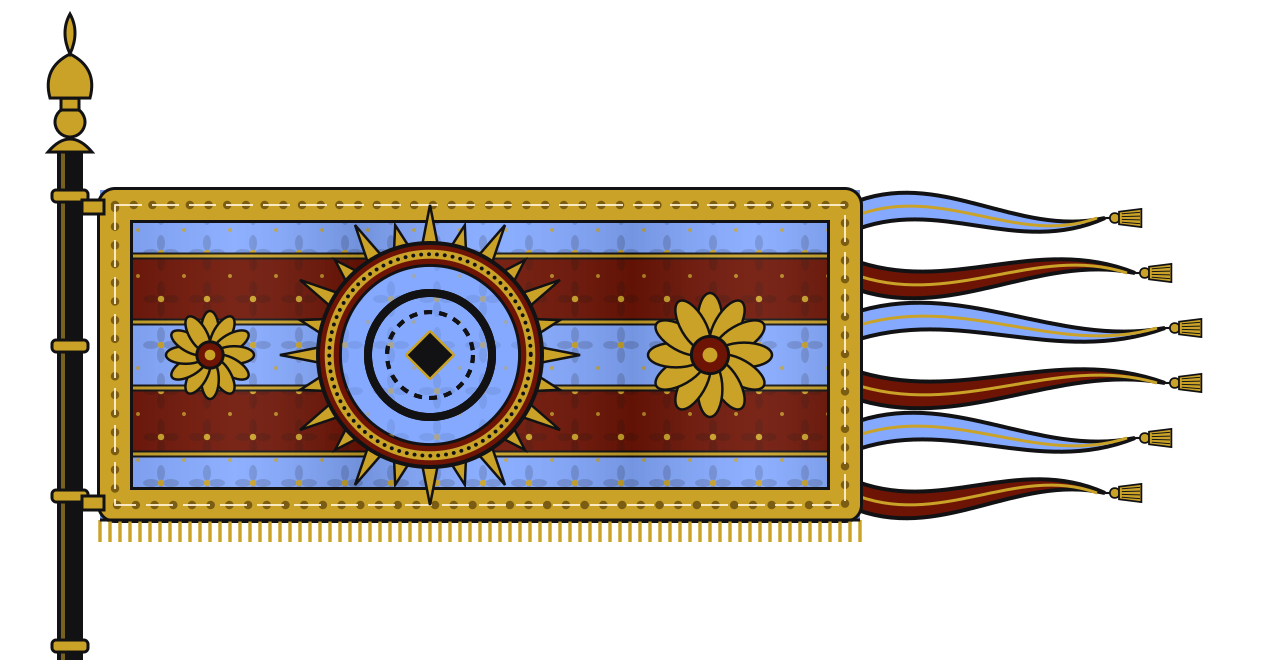
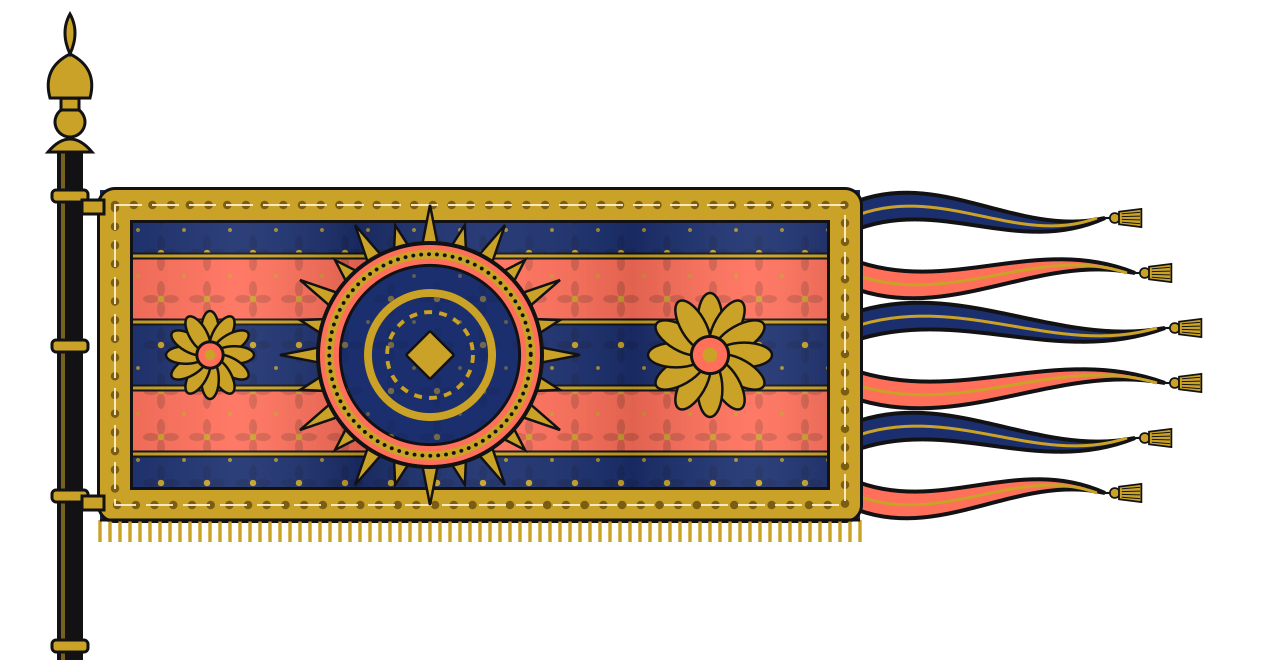
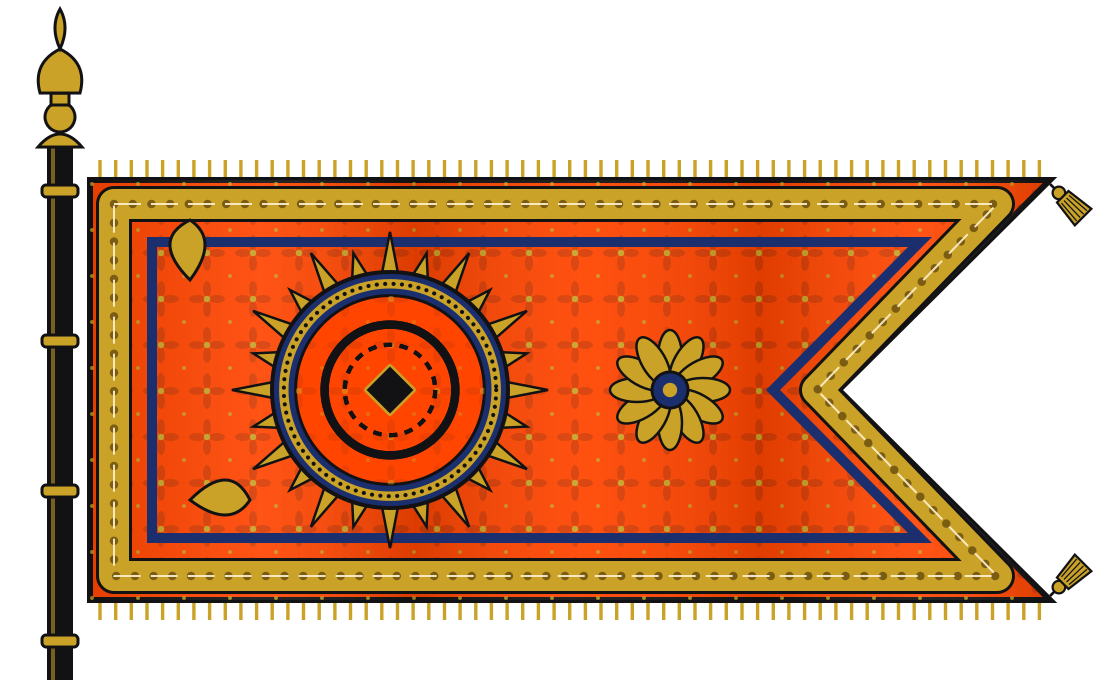
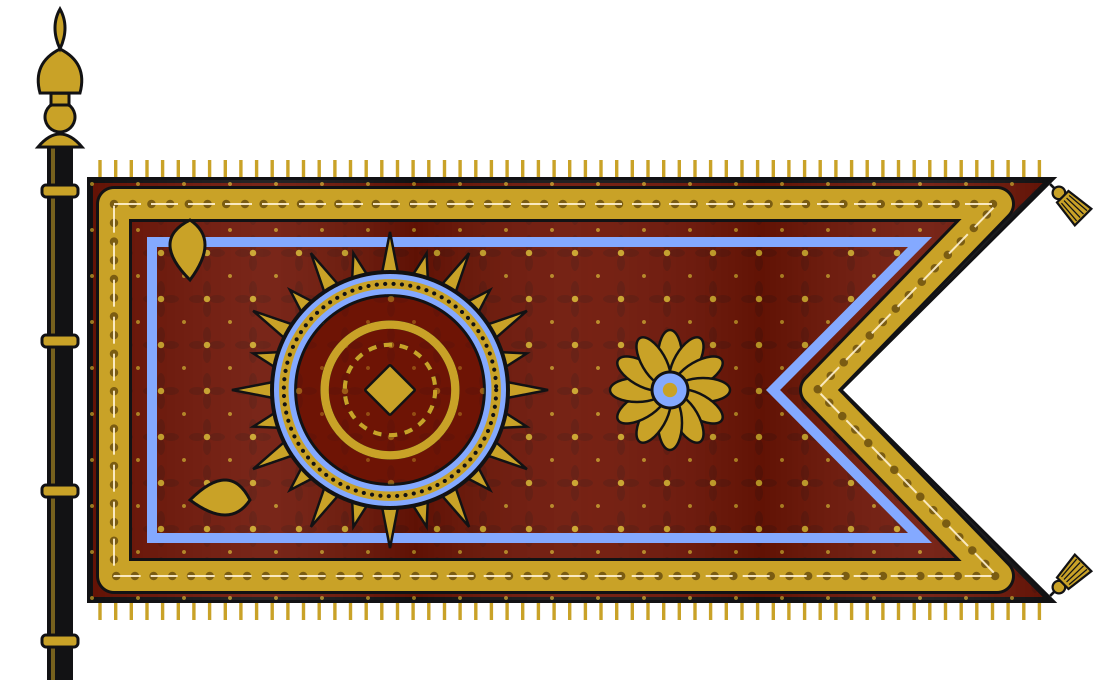

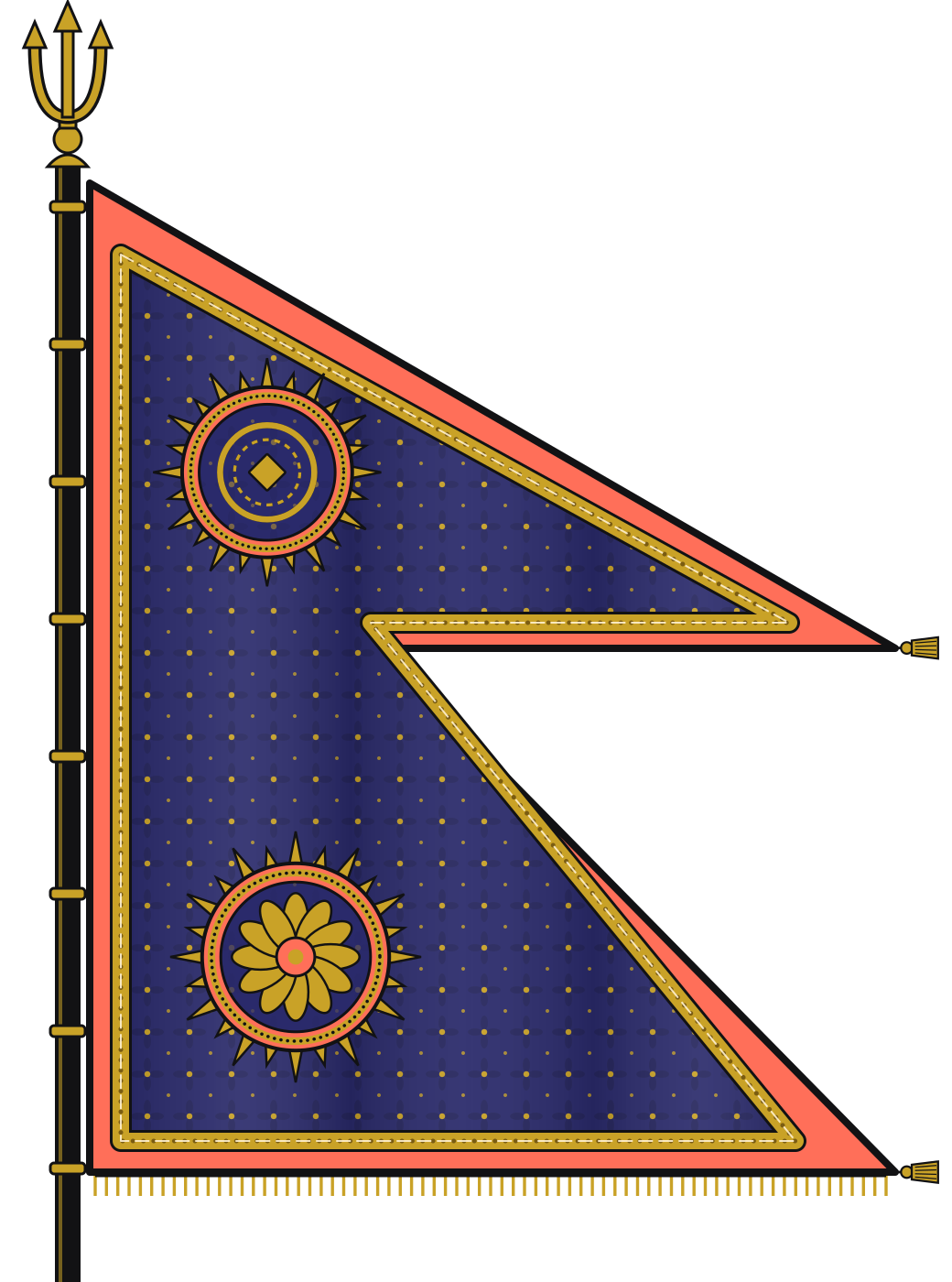


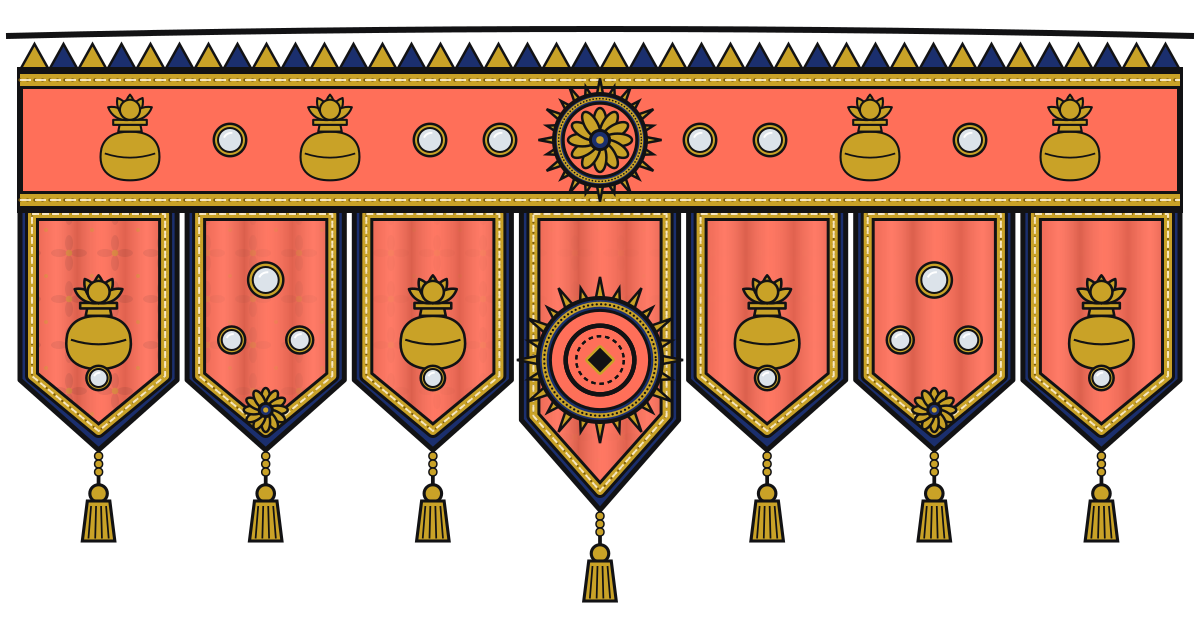
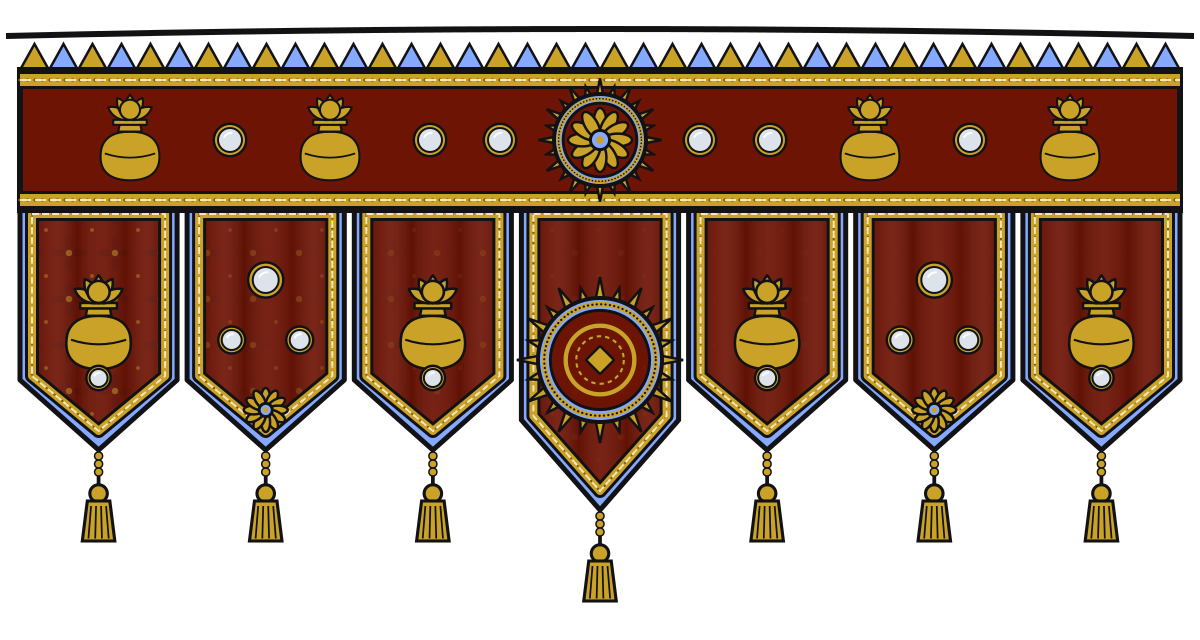

Historic banner
None known
New flag types
| Accessory | For this clan | Basis |
|---|---|---|
| A9 Pota-dhvaja · ship and trade flag For ships, caravans and markets | Not yet designed for this clan | Design |
| A10 Utsava-patāka · festival flag Light, bright flag for fairs and festivals | Not yet designed for this clan | Design |
| A11 Shoka-dhvaja · mourning flag White cloth with the emblem outline in the clan's metal | Not yet designed for this clan | Design |
7. Regalia
| Accessory | For this clan | Basis |
|---|---|---|
| E1 Chhatra · house parasol The ceremonial umbrella | Not yet designed for this clan | Design |
| E2 Chamara · fly-whisks The pair of whisks beside the head of the house | Not yet designed for this clan | Design |
| E3 Danda · staff of office Staff or scepter | Not yet designed for this clan | Design |
| E4 Simhasana · seat The seat of the house, covered in clan cloth | Not yet designed for this clan | Design |
| E5 Khetaka · shield A round shield; the Changi and Dhanush are its flag forms | Not yet designed for this clan | Regional tradition |
| E6 Kula-ayudha · clan weapon The weapon the clan honours | Not yet found for this clan | Under research |
8. Worn
| Accessory | For this clan | Basis |
|---|---|---|
| F1 Kula-vastra · clan cloth The clan's woven pattern in its kit colours | Dress, not a clan pattern: men's loincloth with a tail; women's grey-bordered waist cloth; cloth woven by Dombs | Documented |
| F2 Kirti-vastra · honour cloth A cloth earned for a deed, not inherited | Not yet designed for this clan | Design |
| F3 Kula-mala · garland flower The flower or leaf the clan wears as a garland | Not yet found for this clan | Under research |
| F4 Chinha · house pin A metal badge with the pin emblem | Not yet designed for this clan | Design |
9. Records
| Accessory | For this clan | Basis |
|---|---|---|
| H1 Clan words A traditional line in the native script | · “” Under research: no clan line tied to the Saora is in the sources read. Leads are in open. | Documented |
| H2 Biruda · titles The house's title or titles | Not yet found for this clan | Under research |
| H3 Prashasti · praise genealogy The lineage as written at the head of a grant | Not yet found for this clan | Under research |
| H4 Vahi · clan register The book of the clan's births, marriages and deaths | Not yet found for this clan | Under research |
| H5 Rana-ghosha · war cry The clan's cry in battle or celebration | Not yet found for this clan | Under research |
10. VishwaVit · knower of the world
Game values are design choices for this project, not historical claims.
References
- Wikipedia, Sora people, read 2026-10-27, https://en.wikipedia.org/wiki/Sora_people
- Wikipedia, List of Scheduled Tribes in Odisha, read 2026-10-20, https://en.wikipedia.org/wiki/List_of_Scheduled_Tribes_in_Odisha
- Wikipedia, Sora language, read 2026-10-27, https://en.wikipedia.org/wiki/Sora_language
- C. B. Patel, The Sauras and Their Panoramic Paintings, Orissa Review, January 2005, read 2026-10-27, https://magazines.odisha.gov.in/orissareview/jan2005/englishPdf/Souras_Paintings.pdf
- Wikipedia, Sorang Sompeng script, read 2026-10-27, https://en.wikipedia.org/wiki/Sorang_Sompeng_script
- S. K. Mohanty, Lanjia Saora of Orissa, The Tribal Tribune vol. 1 issue 1, read 2026-10-27, https://www.etribaltribune.com/index.php/volume-1/mvii1/lanjia-saora-of-orissa
- Mangala Prasad Mohanty, Tales of Tribals in Transition, Hinduism Today, March 1995, read 2026-10-27, https://www.hinduismtoday.com/magazine/march-1995/1995-03-tales-of-tribals-in-transition/
- Edgar Thurston and K. Rangachari, Castes and Tribes of Southern India, vol. 6 (Madras, 1909), Project Gutenberg eBook #42996, https://www.gutenberg.org/ebooks/42996
- Sushree Mohanty, Indigenous Colours of Odisha: Handbook on 62 Tribes (KISS), read 2026-10-20, https://kissnew.kiss.ac.in/wp-content/uploads/2026/05/Indigenous-Colours-of-Odisha-Handbook-on-62-Tribes-Sushree-Mohanty.pdf
- Origin, Culture and Kinship Structure of Hill Saora, eTribal Tribune vol. 5 (read 20 Oct 2026, cached 2026-10-20).
- Encyclopaedia Britannica, Savara, read 2026-10-27, https://www.britannica.com/topic/Savara
- Gale Group, Sora: History and Cultural Relations, Encyclopedia of World Cultures (2008), everyculture.com, read 2026-11-03, link
- Vizagapatam District Gazetteer, Gunupur Taluk chapter (Wikisource transcription via mirror; edition and year not stated in the excerpt), read 2026-11-03, link
- L. Behera and J. Dash, The Invention and Development of Saora Script, Odisha Journal of Social Science 12(2), 2025 (record page read 2026-11-03), https://zenodo.org/records/18787224
- Blair Clark and Suraj Komaravalli, The Soura Story, Mosaic (Canadian Baptist Ministries), Winter 2018, reposted 13 Nov 2024, read 2026-11-14, https://www.cbmin.org/the-soura-story/
- Wikipedia, Mangei Gomango, read 2026-11-03, https://en.wikipedia.org/wiki/Mangei_Gomango
- Wikipedia, Sabar people, read 2026-10-22, https://en.wikipedia.org/wiki/Sabar_people
- Supriya Mallik, Ph.D. thesis preface on the Lodha (Savara) of Paschim Medinipur, Vidyasagar University, Nov 2019, read 2026-10-26, https://ir.vidyasagar.ac.in/jspui/bitstream/123456789/5449/5/05_Preface.pdf
- R. V. Russell and Hira Lal, The Tribes and Castes of the Central Provinces of India, vol. 4 (London, 1916), Project Gutenberg eBook #20668, https://www.gutenberg.org/ebooks/20668
- Wikipedia, Sambalpuri culture, read 2026-10-25, https://en.wikipedia.org/wiki/Sambalpuri_culture