The Savars, also written Sabar or Shabar, are a Scheduled Tribe in India (list dated 09-07-2024)[1], found mainly in Purulia, Bankura, Jhargram and Paschim Medinipur in West Bengal, and also in Odisha, Jharkhand and Bangladesh[2][3][4]. The Atlas links them to the ancient Shabaras, a name that Russell records in Sanskrit works from about 800 BC to AD 1200[5]. Under the Criminal Tribes Act of 1871 and later Acts they were branded a criminal tribe, and that framework was replaced in 1952[6][7]. Russell recorded them in 1916 as a large group in the Central Provinces, with exogamous septs called bargas, some named after totems[5]. The Panchakot paper reports the loss of forest livelihood and, in the 1971 census, mostly agricultural labour; PARI reports sal-leaf plate work in Purulia today[6][8].
01Faith and deities
Chhinnamasta of Rajrappa, Jharkhand
The presiding goddess of the clan's homeland or capital: a link of place, not a recorded clan tie.
| Deity or tradition | Place in the clan's life | Evidence |
|---|---|---|
| Bhawani | Worshipped under various names by the Savars (Russell) | [5] |
| Dulha Deo | The young bridegroom killed by a tiger; worshipped, and placed in the kitchen (Russell) | [5] |
| Baghiapat and Masan | Uriya Savars worship Baghiapat (the tiger-eaten) and Masan (the serpent-bitten) and consult a gunia (Russell) | [5] |
| Karna Shabari | A primitive Shabar goddess in Sahajiya Buddhist literature, linked to youth, thunder and curing disease (Panchakot, citing Nihar Ranjan Roy) | [6] |
| Manasa | Linked to forest people and snakebite (Panchakot, citing Roy) | [6] |
| Nilmadhav | Said by local belief to be the god of the Shabar dynasty | [6] |
| Baghut | Protector against animal attack; the Baghut Puja and Baghut Than | [6] |
| Dalma, Dharburu, Porapaku | Nature gods (Panchakot) | [6] |
| Parna Shabari | Named in the paper; no detail given | [6] |
| Samalai | A scholar's view, not a documented clan goddess: K. C. Das, citing Siba Prasad Das, ties her to tribal groups including the Savarai and Mundas north of the Mahanadi | [9] |
| Sabari mantras | Charms used by the Savars (Russell) | [5] |
02Temples
No temple built by the clan is recorded in the extracts. Sacred places are trees and household shrines: Garam Than (sacred trees outside villages where new house tiles are offered), Baghut Than and a household ritual pedestal (Panchakot). In East Singhbhum, Keystone records the sacred sites Jayra Sarna and an unnamed hilltop site.
Built by the clan
Not recorded.
Given patronage or grants by the clan
Not recorded.
03Languages and scripts
| Language or script | Kind | Under the clan | Evidence |
|---|---|---|---|
| Bengali living | Regional language | Spoken first by most Sabars in West Bengal (Wikipedia) | [10] |
| Savar speech research | Munda-family speech | Russell found it lost in the Central Provinces, where they speak Hindi or Uriya; Mundari speech kept in Madras; the paper calls the Shabar language Astro-Asiatic and notes Kharia words | [5][6] |
| Kudmali research | Language | Listed with Savar as the languages of the Odisha Shabar | [11] |
| Magdhi script | Script | A Shabar song cited by Suhrid Kumar Bhowmick is written in it (Panchakot, as spelled there) | [6] |
04Books and literature
No book patronised by the Savars is recorded in the extracts. The works below are about the Savars or name them.
Written during the clan's history
| Work | Author | Kind | When | Link to the clan |
|---|---|---|---|---|
| The Book of the Hunter | Mahasweta Devi (trans. Sagaree and Mandira Sengupta) | Book | 2002 | [10] |
| Hated, Humiliated, Butchered | Not stated | Article (Tehelka) | 12 Oct 2007 | [10] |
| The Why-Why Girl | Not stated (illustrated by Kanyika Kini) | Book (Tulika) | 2005 | [10] |
| Savara, The snake charmer | H. M. Roy | Book (Calcutta) | 1986 | [10] |
| The Savar, a Scheduled Tribe in West Bengal | B. K. Roy | Monograph (Census 1961) | 1970 | [10] |
| Shabar | Subhash Jengcham | Encyclopaedia entry (Banglapedia) | 2012 | [10] |
| The Tribes and Castes of the Central Provinces of India | R. V. Russell and Hira Lal | Ethnography | 1916 | [5] |
| Tribes and Castes of Bengal | H. H. Risley | Ethnography | 1891 | [12] |
Given patronage by the clan
Not recorded.
05Thinkers and scholars
| Name | Field | Era | Contribution |
|---|---|---|---|
| Mahasweta Devi | Writer and activist | Not dated | Worked with these forest tribals; wrote The Book of the Hunter[10] |
| Dilip D'Souza | Writer (cited by Wikipedia) | 1999 | Rediff account of the stigma and ostracism of the Sabars[10] |
| R. V. Russell and Hira Lal | Writers on the tribes of the Central Provinces | 1916 | Savar entry in the Central Provinces survey[5] |
| H. H. Risley | Writer on the tribes and castes of Bengal | 1891 | Tribes and Castes of Bengal, cited by the Panchakot paper[6] |
| E. T. Dalton | Writer on the Kols of Chotanagpur | 1866 | First referred to the 'Kheriah' in 1866[6] |
| Alexander Cunningham | Writer (cited) | Not dated | Savaras as a dominant Kolarian branch; the axe etymology (Russell)[5] |
| Sarat Chandra Roy | Writer | Not dated | Thought Lodha and Asura might be the same people[6] |
| Nihar Ranjan Roy | Writer | Not dated | On Karna Shabari and Manasa, and on Shabar body decoration[6] |
| Atul Krishna Sur | Writer | Not dated | Credited Alpana, Nabapatrika and shankha blowing to Shabar culture[6] |
| B. K. Roy | Writer | 1970 | Census 1961 monograph on the Savar of West Bengal[10] |
The writers are those the extracts cite. Their views are not checked here.
06Art and architecture
The extracts record floor art, terracotta, body decoration and basketry. No painting or sculpture of the Savars is sourced.
Painting and wall art
| Art form | What it is | Era | Evidence |
|---|---|---|---|
| Alpana floor designs | Floor decoration credited to Shabar culture by Atul Krishna Sur; houses are repainted with natural colours before Kali Puja (Panchakot) | Not dated | [6] |
Sculpture and temple art
Not recorded.
Temple and building architecture
| Art form | What it is | Era | Evidence |
|---|---|---|---|
| Paharpur terracotta | Terracotta designs on the Pala-period stupas, said to reflect Shabar society (Panchakot) | Pala dynasty | [6] |
Weaving and textiles
Not recorded.
Clothing and jewellery
Not recorded.
Coins, pottery and crafts
| Art form | What it is | Era | Evidence |
|---|---|---|---|
| Baskets, bamboo brooms, fish traps | Made from grass, bamboo and palm leaves in East Singhbhum (Keystone) | Not dated | [13] |
| Sal-leaf plates | Eight to ten sal leaves joined with bamboo sticks, made in Sabarpada, Purulia (PARI) | 2024 | [8] |
07History
Ancient Shabaras
The Atlas calls the Savars heirs of the ancient Shabaras. Russell records the name in Sanskrit works from about 800 BC to AD 1200, and cites Grierson's identification of the Savars and Gadabas with the Suari of Pliny and the Sabarae of Ptolemy[5]. The Panchakot paper says the Shabars appear in the Mandaran government of Bengal at Tamralipta, in the Ain-i-Akbari[6].
Cunningham's account
Alexander Cunningham held that the Savaras were once the dominant branch of the Kolarian family, pushed aside by other Kolarian tribes and by the Gonds. Russell gives a Saugor tradition that the Gonds beat them by making them drunk[5]. Cunningham also derived the name from an axe; Crooke disputed this derivation (same source).
Under the criminal-tribe Acts
The Criminal Tribes Act of 1871 (Chotanagpur) placed the Shabars under the criminal-tribe label. A Forest Act of 1892 and the Criminal Tribes Act of 1924 followed, and a de-notified framework replaced the 1924 Act in 1952[6][7]. Dalton first referred to the 'Kheriah' in 1866[6]. The Odisha museum says the Shabar were previously listed as a criminal tribe[11], and PARI says the Act branded the Savar 'criminal' until it was repealed in 1952[8].
Counts in the census
Russell gives about 70,000 Savars in the Central Provinces and 600,000 in India in the 1911 census[5]. The Panchakot paper gives 197 Shabars in 1881 and 6,900 in Purulia in 1941[6].
2004, Midnapore
In 2004 five people died in the Sabar village of Amlasole, Midnapore district, after months of starvation, according to a report cited by Wikipedia[10].
08Journey and migrations
The sources give a few moves: an origin story at Kharia Ghat, a colonial move to Bangladesh, and the forest-to-village shift of the recent past.
| When | From | To | Why | Evidence |
|---|---|---|---|---|
| About 110–120 years before the Panchakot paper | Between Rohtas and Patna, by the paper's account | Kharia Ghat, then the outskirts of villages | The ancestors stopped at Kharia Ghat, which the paper says gave the name of the Kharia group | [6] |
| Colonial period | Not stated | Bangladesh, Moulvibazar district | Hundreds went as tea-garden labourers (Wikipedia) | [10] |
| Not dated | Forest areas of Jharkhand and Odisha | Purulia and nearby districts | Migration from the forests, as the paper describes it; semi-nomadic | [6] |
| Not dated | Midnapore | Gplot, Sundarbans, Patharpratima block, South 24 Parganas | Wikipedia says Midnapore Sabars now live here; citation needed on that page | [10] |
09Seats and lands
| Place | Role | Where today |
|---|---|---|
| Purulia | Sabarpada and Kunchia villages, Banduan taluka (PARI) | Purulia, West Bengal |
| Bankura, Jhargram, Paschim Medinipur | Places where Sabar are found mainly (Vajiram and Ravi) | West Bengal |
| Midnapore, Gplot and Patharpratima | Sabar settlements in the Sundarbans area (Wikipedia) | South 24 Parganas, West Bengal |
| East Singhbhum (Musabani, Potka) | Sabar tolas at village fringes; known as Kariya at Musabani (Keystone, Wikipedia) | Jharkhand |
| Gajapati, Kalahandi, Rayagada, Cuttack, Dhenkanal | Places the Odisha museum lists for the Shabar | Odisha |
| Singhbhum, Mayurbhanj, Manbhum, Dhalbhum, Vindhya district | Places named in the Panchakot paper | Not stated |
| Raipur, Bilaspur, Chhattisgarh and Sambalpur | Suarmar zamindari in Raipur; Seorinarayan in Bilaspur; the eastern Laria and Uriya branches (Russell) | Chhattisgarh and Sambalpur, as Russell places them |
| Bundelkhand | Where the Saonr branch lives (Russell) | Not stated |
| Moulvibazar district | Nandarani, Harinchhara and Rajghat (Wikipedia, citing Banglapedia) | Bangladesh |
10Notable figures
| Name | Role | Era | Known from |
|---|---|---|---|
| Jara (Jarasura) legend | The hunter who shot Krishna as a deer (Russell); the Panchakot paper names Jarasura, who sought to kill Krishna | Mahabharata legend | [5][6] |
| Shabar Pad | Writer of a verse in the Charyapada | Charyapada, date not given | [6] |
| Nepali Sabar | Leaf-plate maker of Sabarpada, Purulia; subject of a PARI article | 2024 | [8] |
11Allies, rivals and marriages
| People | Relationship | When |
|---|---|---|
| Shabaras (ANC-118) | Parent: the Atlas calls the Savars heirs of the ancient Shabaras | Ancient |
| Savara (ST-286), of Ganjam and Vizagapatam | The related southern Savara in Thurston 1909, a Munda-speaking people of Ganjam and Vizagapatam; not the Bengal Sabar | 1909 |
| Kols (ST-141) | Savars in the Central Provinces call themselves Kols (Russell, vol. 3) | 1916 |
| Munda (ST-229) | Russell, vol. 3, lists Savar Mundas among the Risley Munda sub-castes; Wikipedia lists the Munda as related | 1916 |
| Ho (ST-102) | Related Mundari-speaking people (Wikipedia) | Not dated |
| Santhal (ST-280) | Related Mundari-speaking people (Wikipedia); hunting-festival partners (Mongabay); neighbours in East Singhbhum (Keystone) | 2025 |
| Oraon (ST-241) | Hunting-festival partners (Mongabay) | 2025 |
| Lodha (ST-177) | Lodha-Shabar is a separate endogamous group with its own customs; Shabar and Lodha are both Scheduled Tribes and are often confused | Not dated |
| Kharia (ST-130) | Hill Kharias use Shabar as a surname (Panchakot) | Not dated |
| Gond (ST-088) | Some Bundelkhand Savars were held to be a Gond sub-tribe; the better informed deny it (Russell) | 1916 |
| Bhumij (ST-033) | Neighbours who share villages in East Singhbhum (Keystone) | Not dated |
12Society and livelihood
The sources describe a forest-based, socially isolated people, many of them labourers. The Panchakot paper reports ostracism and birth and marriage rites; Wikipedia calls the Sabar traditionally forest-dwelling.
Government and social order
| Institution or group | What it was | Evidence |
|---|---|---|
| Barga (exogamous sept) | 52 in the north and 80 among the Uriya Savars; the Uriya bargas divide into Joria and Khuntia | [5] |
| Marriage | Marriage within the same gotra avoided; love marriages common (Panchakot); widow marriage allowed (Russell) | [6][5] |
| Marriage rites | Bride and groom carried on relatives' shoulders; girls marry an arrow tied to the hand, in seven rounds of a mahua branch; seven lines drawn at the groom's door (Russell) | [5] |
| Birth and death rites | Birth purification and hair-cutting rites (Panchakot); the dead are burnt or buried with the head to the north (Russell) | [6][5] |
| Status | Socially ostracised; 19th-century writers treated them as untouchable (Panchakot) | [6] |
| Hamlets | Tolas at the fringes of villages; nomadic or semi-nomadic in the past (Keystone) | [13] |
Livelihood over time
| Era | Livelihood | Evidence |
|---|---|---|
| Historic (Russell, 1916) | Collect jungle produce and cultivate; skilled honey-gatherers; women wear pith ear ornaments | [5] |
| 1971 census (as the paper gives it) | 10.61 per cent farmers and 79.61 per cent agricultural labourers | [6] |
| Not dated (paper) | Food gathering, hunting, fishing for reptiles, frogs, crabs, honey and fruit; hired farm labour; bow-and-arrow hunting | [6] |
| Not dated (OSTM) | Main income: wage labour, forest collection, agriculture and winemaking | [11] |
| 2024 (PARI) | Families in Sabarpada, Purulia, make sal-leaf plates; Nepali Sabar makes 200 to 300 a day, at about 60 to 80 paisa a plate | [8] |
13Sub-clans and related clans
The sources name these sub-clans, septs and related peoples. Russell's bargas and eastern branches come from the Central Provinces; the Panchakot groups from Purulia. Other names for the people: Saonr (Bundelkhand, Russell), Sahra (Russell), Kariya (Musabani, Wikipedia).
| Clan | Relation | Where | Size | In the Atlas | Evidence |
|---|---|---|---|---|---|
| Laria | Sub-clan | Chhattisgarh and Sambalpur (eastern branch) | same name as ST-413: check | [5] | |
| Uriya | Sub-clan | Chhattisgarh and Sambalpur (eastern branch); its 80 bargas | same name as ST-511: check | [5] | |
| Kalapithia | Sub-clan | Orissa; called 'Black Backs' | same name as ST-421: check | [5] | |
| Joria | Sub-clan | Uriya bargas; burial near a jor (brook) | same name as ST-399: check | [5] | |
| Khuntia | Sub-clan | Uriya bargas; burial near a khunt (old tree) | same name as ST-423: check | [5] | |
| Bagh | Sub-clan | Totemic barga (tiger) | new clan candidate | [5] | |
| Bagula | Sub-clan | Totemic barga (heron) | new clan candidate | [5] | |
| Bisi | Sub-clan | Totemic barga (scorpion) | new clan candidate | [5] | |
| Hathia | Sub-clan | Totemic barga (elephant) | new clan candidate | [5] | |
| Karsa | Sub-clan | Totemic barga (deer) | new clan candidate | [5] | |
| Khairaiya | Sub-clan | Totemic barga (catechu tree) | new clan candidate | [5] | |
| Rajhans | Sub-clan | Totemic barga (swan) | new clan candidate | [5] | |
| Suriya Bansia | Sub-clan | Totemic barga (sun) | new clan candidate | [5] | |
| Sona | Sub-clan | Totemic barga (gold) | new clan candidate | [5] | |
| Badaiya | Sub-clan | Totemic barga (carpenter bird) | new clan candidate | [5] | |
| Khedia Shabar | Branch | A separate group in the Panchakot paper | same name as ST-425: check | [6] | |
| Lodha-Shabar | Related people | Separate endogamous group with different customs (Panchakot) | ST-177 | [6] | |
| Hill Kharia | Related people | Use Shabar as a surname; believe they are related to the Shabars of the Vindhya region | ST-130 | [6] | |
| Kharia | Related people | Also called Kheria, Kheda, Kharyas, Sabars, Bandigars (Panchakot) | ST-130 | [6] | |
| Shabaras | Parent people | Ancient; Eastern Ghats | ANC-118 | [5] | |
| Savara | Related people | The related southern Savara of Ganjam and Vizagapatam (Thurston 1909), not the Bengal Sabar | ST-286 | [14] | |
| Kol | Related people | Savars in the Central Provinces call themselves Kols (Russell) | ST-141 | [15] | |
| Munda | Related people | Russell lists Savar Mundas among the Risley Munda sub-castes | ST-229 | [15] | |
| Gond | Related people | Some Bundelkhand Savars held to be a Gond sub-tribe (Russell) | ST-088 | [5] | |
| Santhal | Related people | Related Mundari-speaking people (Wikipedia) | ST-280 | [10] | |
| Ho | Related people | Related Mundari-speaking people (Wikipedia) | ST-102 | [10] | |
| Oraon | Related people | Hunting-festival partners (Mongabay) | ST-241 | [16] | |
| Bhumij | Related people | Neighbours in East Singhbhum (Keystone) | ST-033 | [13] |
Clans marked "new clan candidate" are not in the Atlas yet.
14Surnames
Surnames named in the extracts. No count is sourced, so none is given.
| Surname | Clan or sub-clan | Where | People with this surname | Also used by other communities |
|---|---|---|---|---|
| Sabar | Savar (the community) | After personal names (Nepali Sabar, Ghaltu Sabar) (PARI); after names in East Singhbhum (Keystone) | not yet counted | No |
| Shabar | Hill Kharia (Panchakot) | Title surname used by most Hill Kharias, who believe they are related to the Shabars of the Vindhya region | not yet counted | Yes |
| Sardar | Not stated | After personal names in East Singhbhum (Keystone) | not yet counted | Not checked |
| Biswas | Not stated | After personal names in East Singhbhum (Keystone) | not yet counted | Not checked |
| Bhumij | Bhumij (neighbours) | Listed after personal names in East Singhbhum (Keystone) | not yet counted | Not checked |
Counts are of everyone with the surname, from the cited source and year, not only members of this clan. A surname shared with other communities says nothing about any one person's origin.
15Songs and music
The extracts name Savar songs and their forms. No song text is quoted, and the rights in each song are not known.
Shabari Rag
Bhendia living
Jamudal living
Songs of protest against segregation
Song cited by Suhrid Kumar Bhowmick
Instruments and styles
| Instrument or style | What it is | Evidence |
|---|---|---|
| Ghumura (pot drum) | The main musical instrument of the Shabar, with a dance of the same name (OSTM) | [11] |
| Shankha (conch) | Conch blowing credited to Shabar culture (Atul Krishna Sur, cited in the Panchakot paper) | [6] |
16Poems, lullabies and children's rhymes
The Charyapada includes a verse on the Shabars. Its text is not in the extracts.
ShabarPadanam
17Stories, legends and proverbs
Stories and legends
| Story | What happens | Told by | Evidence |
|---|---|---|---|
| Ramachandra and the Shabar woman | Ramachandra visits a Shabar woman's hut | Valmiki, as cited by the Panchakot paper | [6] |
| Shiva's curse | Shiva curses the Shabars after a Shabar betrayal | Panchakot paper | [6] |
| Jara Savar | The hunter who shot Krishna as a deer | Russell, 1916 | [5] |
| Savar and Mahadeo | Mahadeo made a Savar with an axe to clear the forest, and cursed him to poverty in the jungle while giving him knowledge of roots and fruits (Bundelkhand Saonrs) | Russell, 1916 | [5] |
| Seori of Seorinarayan | The local tradition says Seori gave Ramchandra plums | Russell, 1916 | [5] |
| Savars and Puri | The Savars were created to carry stones for the Puri temple and to drag Jagannath's car | Russell, 1916 | [5] |
| Origin from Vishwamitra | The Aitareya Brahmana makes them descendants of Vishwamitra; the Mahabharata says Kamdhenu created them against him | Russell, 1916 | [5] |
Proverbs and sayings
| Saying | Meaning | Evidence |
|---|---|---|
| Jai chulha, tai Dulha (There is a Dulha Deo to every hearth) | Each hearth has its Dulha Deo (Russell's translation) | [5] |
| Sawara ke pange, Rawat ke bandhe | The man bewitched by a Savar and the bullock tied up by a Rawat cannot escape | [5] |
| The ornaments of the Sawara are gumchi seeds | Not glossed in the source | [5] |
| It is the Savar who can drive the black bees from their hive | Not glossed in the source | [5] |
18Festivals and fairs
| Festival or fair | When | Where | What happens |
|---|---|---|---|
| Poila Baishakh | Doubtful: the paper gives 1 January, which is not used here | Not stated | The Shabar New Year, per the paper[6] |
| Kali Puja and Badhna or Gorya Puja | Not dated | Not stated | Houses are renovated with natural colours and designs before Kali Puja[6] |
| Baghut Puja | Not dated | Not stated | Worship of Baghut, the protector against animal attack[6] |
| Garam Than worship | Not dated | Villages | New house tiles are offered at the sacred trees outside villages[6] |
| Shabar Utsav | During Durga Puja, per the Kalika Puran | Not stated | A festival named in the Kalika Puran[6] |
| Nabapatrika | Not dated | Not stated | Worship credited to Shabar culture by Atul Krishna Sur[6] |
| Shikar Utsav | Not dated | The region | Hunting festivals, with the Santhal, Lodha and Oraon[16] |
| Village puja | Not dated | Otejhari, East Singhbhum | A puja held at the village meeting; no festival is named[13] |
19Food, dress and games
Food
| Item | What it is | Evidence |
|---|---|---|
| Wild foods | Honey, fruit, reptiles, frogs and crabs (Panchakot); kukti, red ants and their larvae, gathered in Kartik, Aghan and Pus and sold at about Rs 140 a kilo in the village (Keystone) | [6][13] |
| Shared dishes and crops | Khichdi and hadia are shared; homestead crops include gangi (sorghum), rahar, tubers, papaya and banana (Keystone) | [13] |
Dress
| Item | What it is | Evidence |
|---|---|---|
| Pith ear ornaments | Women wear khilwan (pith) ear ornaments and are tattooed (Russell) | [5] |
| Body decoration | Peacock feathers, floral necklaces and fruit-seed earrings (Roy, cited by the Panchakot paper) | [6] |
Games and martial arts
Not recorded.
Tags: living still practised · revived brought back after a break · lost known only from records · research reported but not yet confirmed from a source. Songs and poems under copyright are listed by title only; restricted or sacred material is noted without its content.
20Status today
A living community, a Scheduled Tribe in India (list dated 09-07-2024), found mainly in southern West Bengal and Jharkhand, and also in Odisha[4] and, in a small community, Bangladesh[1][10].
Who carries the name today
| Community | Link | Basis | Evidence |
|---|---|---|---|
| Hill Kharia (ST-130) | Community tradition | [6] | |
| Shabaras (ANC-118) | Under research | [6] | |
| Savara (ST-286) | Community tradition | [11] |
Recognised heritage
| What | Recognition | Evidence |
|---|---|---|
| Scheduled Tribe in India | State and UT list dated 09-07-2024 | [1] |
| De-notified and Scheduled tribe in West Bengal | Listed as both (PARI, no list date given) | [8] |
| Primitive tribal group in Jharkhand | PVTG (Atlas, no list date given); the Keystone project works with 13 Sabar hamlets in East Singhbhum | [13] |
No community review is recorded yet.
21For children
Leaves into plates
In a village called Sabarpada, in Purulia, seven of the eleven families make plates from leaves. They pick sal leaves from the forest. Eight to ten leaves are joined together with bamboo sticks. One man can make two hundred to three hundred plates in a day. The family earns money from the plates.
Written for this project
22Across the project
| Project | What carries this clan | Status |
|---|---|---|
| Atlas of the Janas | Districts and places are in the lands section; the footprint file is left to the host | |
| KulDevi and GrahDevi | KulDevi Chhinnamasta is assigned by the project and is not documented as the Savar's own deity; the GrahDevi forms are | From the Atlas |
| Planet naming | Under research | |
| Renaming and waters | Under research |
23Open questions
- Which deity is the Savars' chief? Russell names Bhawani and Dulha Deo; neither is shown to be a clan goddess.
- Odisha population: the Wikipedia Odisha list gives 516,402 for 'Shabar (Lodha)' and 534,751 for 'Saora (Savar, Saura, Sahara)'[4]; OSTM gives 5,16,402 for Shabar-Lodha[11]. Which count, if any, is the Savar's is open.
- The date of Poila Baishakh: the paper's 1 January needs checking.
- Russell's Savars are of the Central Provinces and Bundelkhand; their link to the Bengal Sabar is not documented in the extracts.
- Risley's Tribes and Castes of Bengal was not read for the Savars.
- What are the songs and their texts? The Bengali PARI articles and the Charyapada verse are still to be read.
- Is the Bangladesh move as Wikipedia gives it documented? Its source is marked as needed.
- Seals, coins, a war cry, titles and stones of the Savars are not in the extracts.
- Contradiction, density and population: the summary places the people mainly in southern West Bengal and Jharkhand[10], yet the Odisha figures (516,402 or 534,751) are far above West Bengal's 40,374[3].
- Contradiction, Shabar and Lodha: OSTM titles one group Shabar-Lodha and the Odisha list gives 'Shabar (Lodha)'[11][4]; the Lodha row treats Lodha-Shabar as a separate endogamous group, per Panchakot[6]. Whether the Savar and Lodha entries are one count is open.
24Astitva
अस्तित्व · being, existence: everything by which the clan is known
The extracts record a totem line, a sacred tree shrine, a conch, a hunting weapon and a flower garland for the Savars[5][6].
Every clan has every accessory, royal objects included. Each one says how it is known: Documented This clan's own object is recorded. · Regional tradition Recorded for the region or for peoples like this one, not for this clan. · Design Made for this project, with no historical claim. · Under research To be found for this clan from sources. Legends and titles are written in the clan's own script.
1. Seals and coins
| Accessory | For this clan | Basis |
|---|---|---|
| B1 Rajamudra · house seal Round seal with the clan emblem and a short legend in the clan's script | Not yet designed for this clan | Design |
| B2 Anguliya-mudra · signet ring Personal seal ring of the head of the house | Not yet designed for this clan | Design |
| B3 Chhapa · house stamp Ink or block stamp for letters, goods and cloth | Not yet designed for this clan | Design |
| B4 Tamrapatra · charter plate Copper-plate grant on a ring, closed with the house seal | Not yet designed for this clan | Design |
| B5 Shreni-mudra · guild or trade seal Seal for the clan's trade, craft or caravan | Not yet designed for this clan | Design |
| C1 Clan coin Emblem or deity on one side, a legend in the clan's script | Not yet designed for this clan | Design |
| C2 Coin die The die that strikes the coin | Not yet designed for this clan | Design |
2. Living symbols
| Accessory | For this clan | Basis |
|---|---|---|
| I1 Totem trio The tree, bird and animal the clan protects | Khairaiya (catechu tree) · Badaiya (carpenter bird) · Bagh (tiger) and the other barga totems | Documented |
| I2 Kaval-maram · guardian tree The tree that stands at the clan's seat | Garam Than: the sacred trees outside villages where new house tiles are offered | Documented |
3. Stone and gate
| Accessory | For this clan | Basis |
|---|---|---|
| G1 Torana · gateway The built gate of the seat; the cloth Toran hangs in it | Not yet designed for this clan | Regional tradition |
| G2 Viragallu · hero stone Carved panel stone for a member who died defending the clan | Not yet designed for this clan | Regional tradition |
| G3 Kula-shila · clan stones Standing and table stones that remember the ancestors | Not yet designed for this clan | Design |
| G4 Jayastambha · victory pillar A pillar raised for a victory | Not yet designed for this clan | Design |
| G5 Sima-shila · boundary stone Marks the clan's land, with a line in the native script | Not yet designed for this clan | Design |
4. Sounds
| Accessory | For this clan | Basis |
|---|---|---|
| D1 Pancha-mahashabda · five great sounds The right to five instruments | Not yet designed for this clan | Design |
| D2 Shankha · clan conch The clan's own named war conch | Shankha blowing in Shabar culture (not a named clan conch) Credited to Shabar culture by Atul Krishna Sur[6] | Documented |
| D3 Murasu · house drums Three drums: war, charity and justice | Not yet designed for this clan | Design |
5. Kit: colours, metals and emblems
No seal, coin or flag of the Savars is recorded in the extracts[5]; the emblem on this page is a project design.
| Part of the kit | This clan |
|---|---|
| Field | Warm Red-Orange #FF6F59 |
| Accent | Deep Indigo #2A2A6B |
| Emblem colour | Charcoal Black #121214 |
| Zari metal | Gold |
| Main emblem | A forest |
| Second image | A broken chain |
| Night and day | Every visual accessory has two versions: by night the emblem on the dark field, by day the clan's field colour on cloth woven from its metal. |
6. Flags
Every clan has every flag type; the type says the occasion and the colours say the clan. The outlined card is the flag the Atlas assigns.

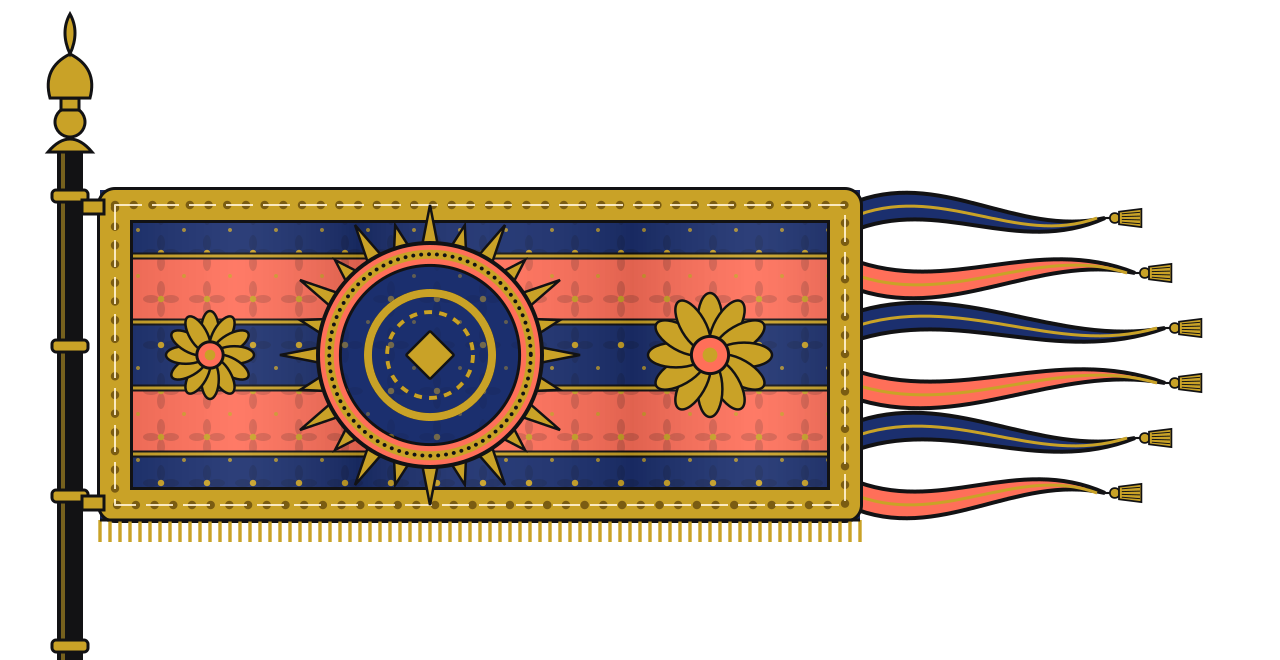
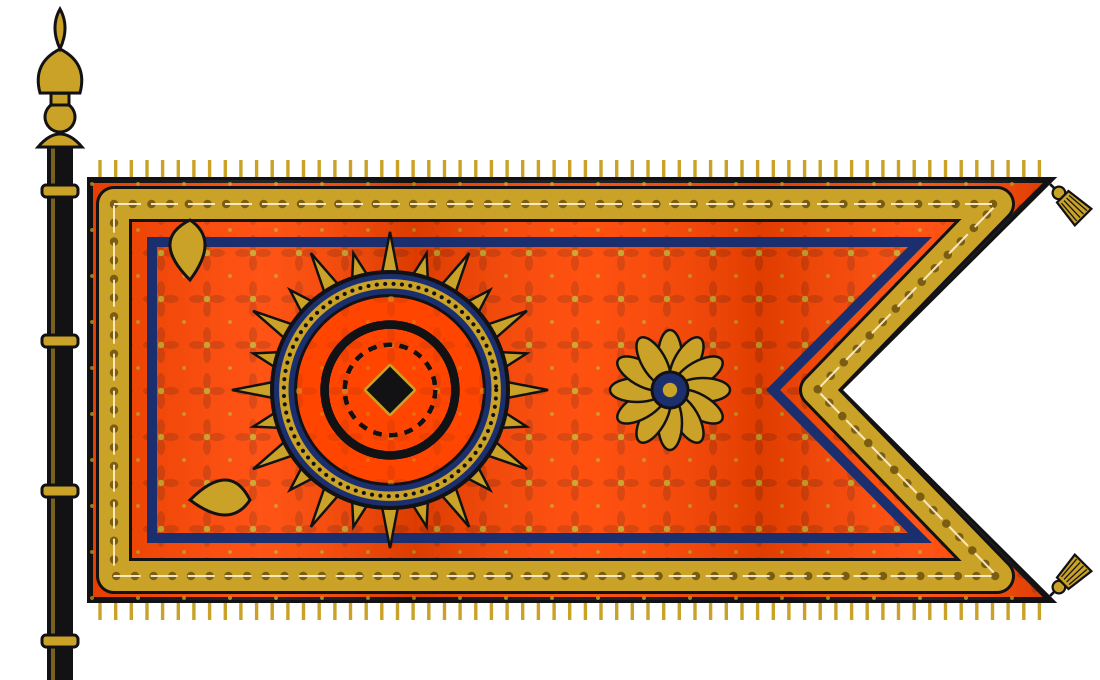
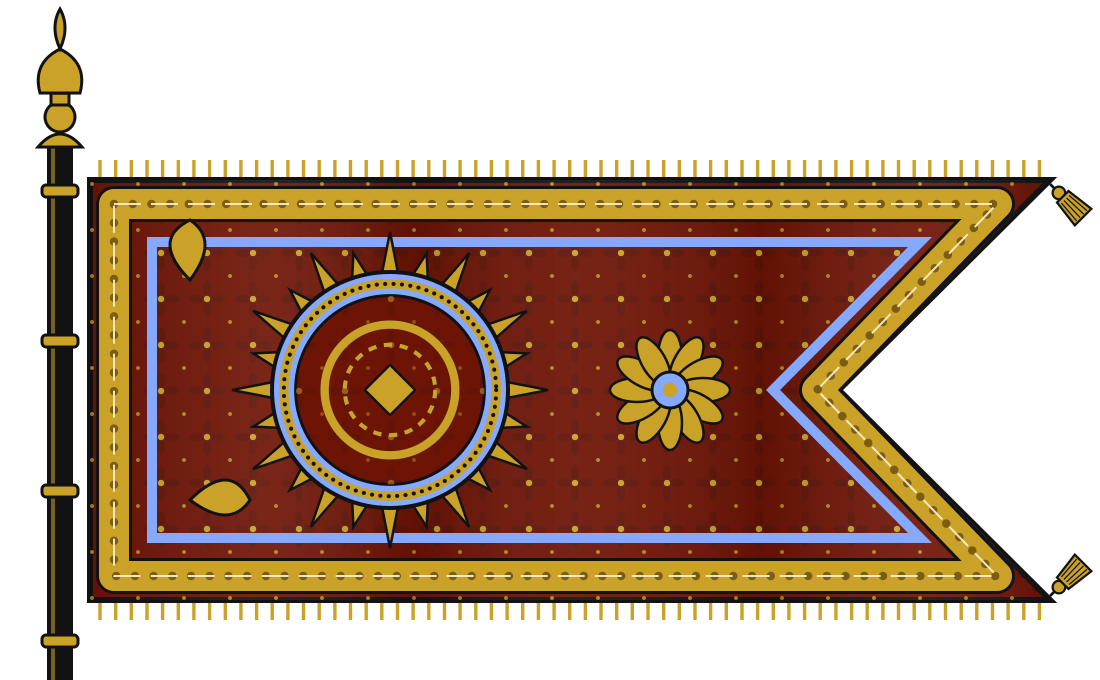

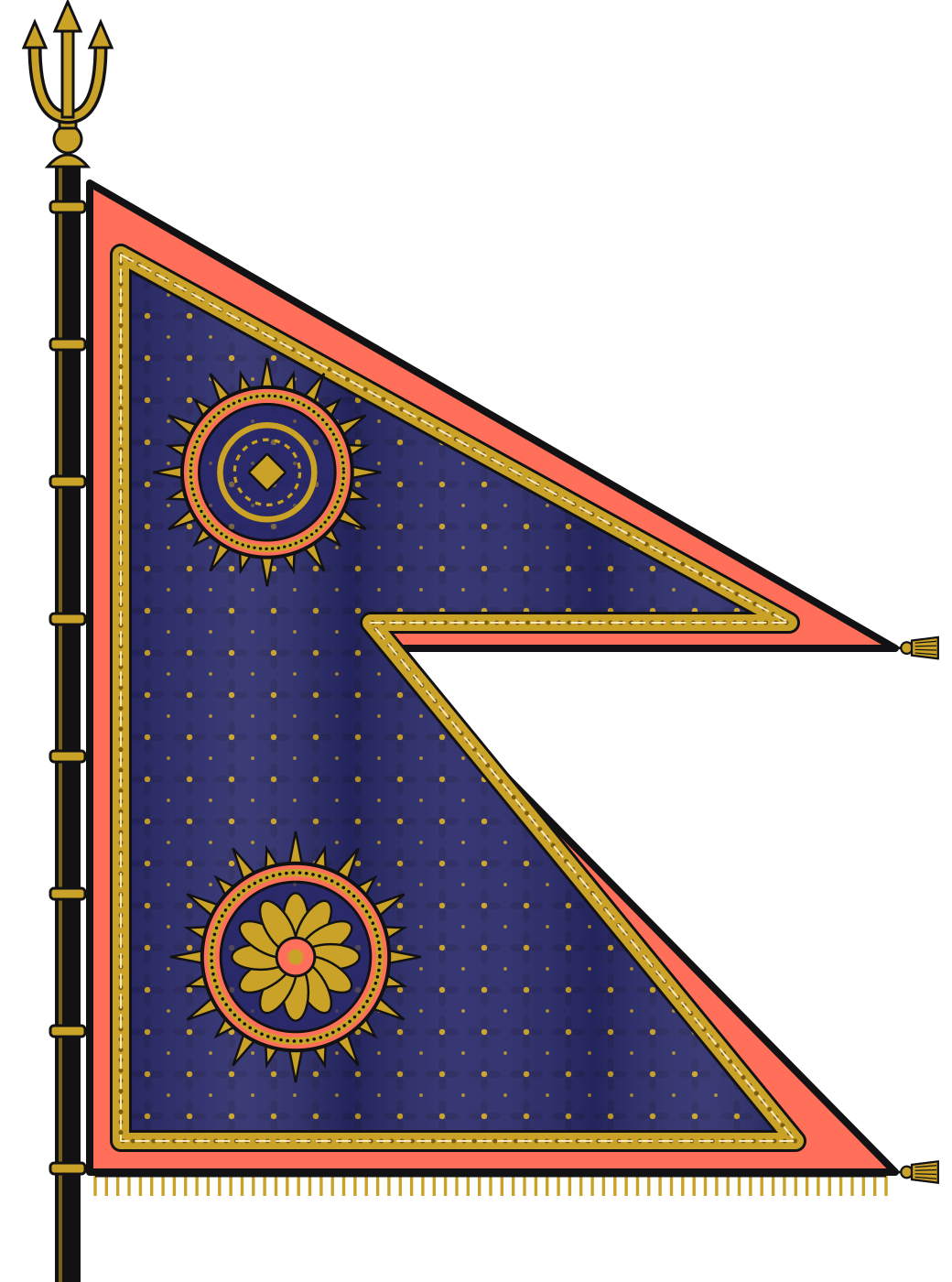


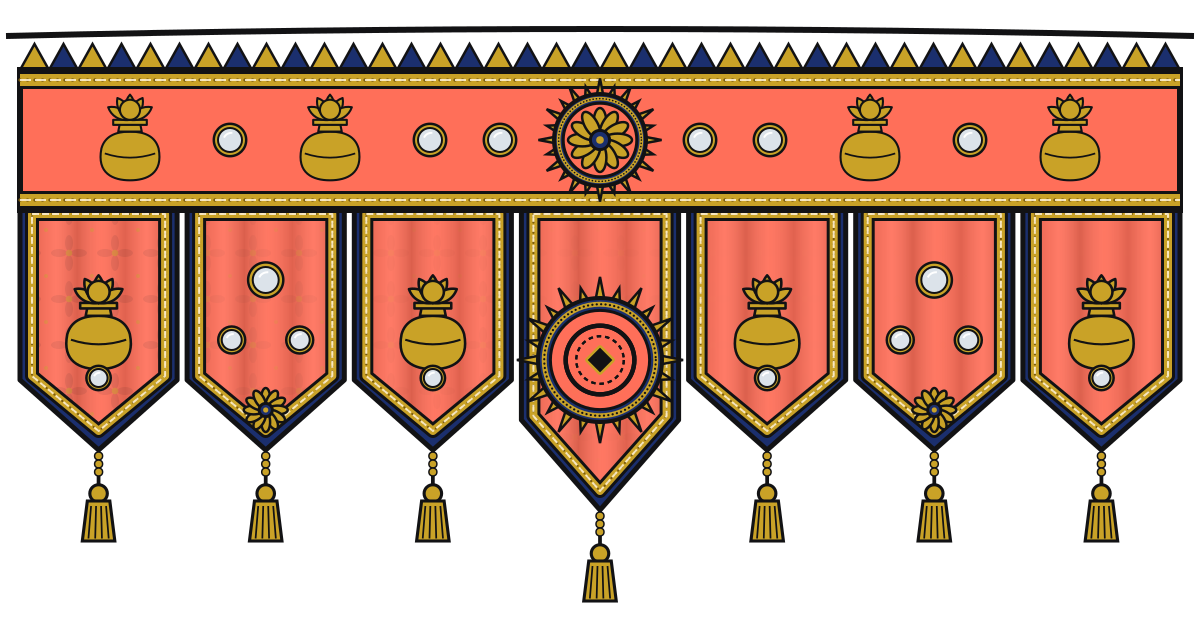
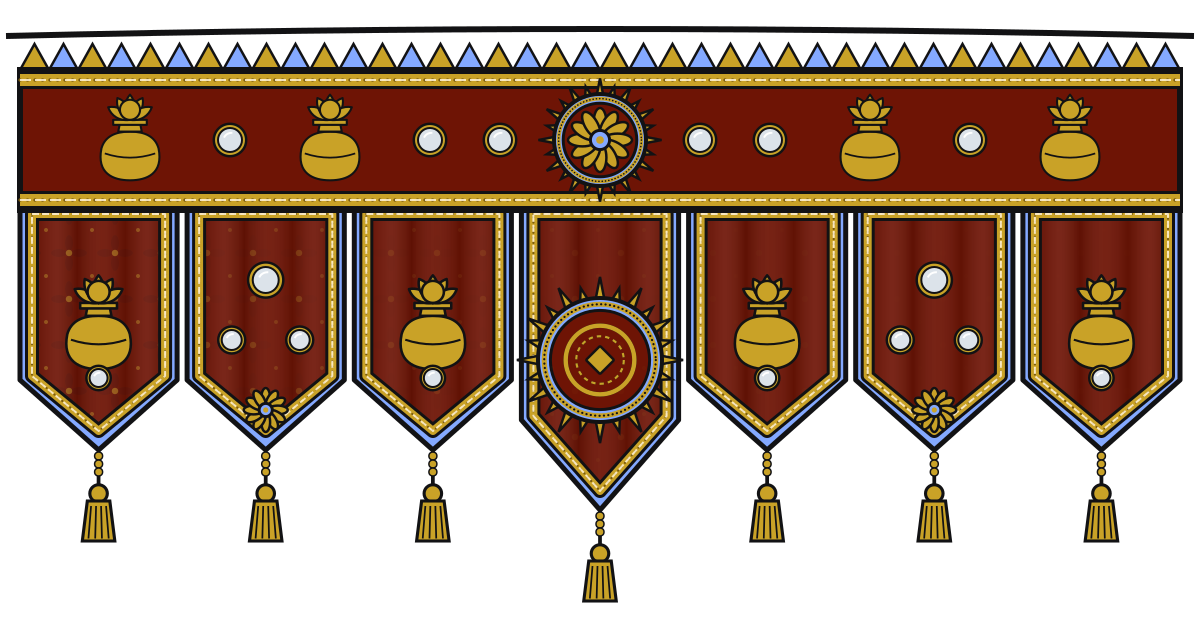

Historic banner
None known
New flag types
| Accessory | For this clan | Basis |
|---|---|---|
| A9 Pota-dhvaja · ship and trade flag For ships, caravans and markets | Not yet designed for this clan | Design |
| A10 Utsava-patāka · festival flag Light, bright flag for fairs and festivals | Not yet designed for this clan | Design |
| A11 Shoka-dhvaja · mourning flag White cloth with the emblem outline in the clan's metal | Not yet designed for this clan | Design |
7. Regalia
| Accessory | For this clan | Basis |
|---|---|---|
| E1 Chhatra · house parasol The ceremonial umbrella | Not yet designed for this clan | Design |
| E2 Chamara · fly-whisks The pair of whisks beside the head of the house | Not yet designed for this clan | Design |
| E3 Danda · staff of office Staff or scepter | Not yet designed for this clan | Design |
| E4 Simhasana · seat The seat of the house, covered in clan cloth | Not yet designed for this clan | Design |
| E5 Khetaka · shield A round shield; the Changi and Dhanush are its flag forms | Not yet designed for this clan | Regional tradition |
| E6 Kula-ayudha · clan weapon The weapon the clan honours | Bow and arrow: the hunting weapon (Panchakot) and the girl's arrow in marriage (Russell) | Documented |
8. Worn
| Accessory | For this clan | Basis |
|---|---|---|
| F1 Kula-vastra · clan cloth The clan's woven pattern in its kit colours | Not yet designed for this clan | Design |
| F2 Kirti-vastra · honour cloth A cloth earned for a deed, not inherited | Not yet designed for this clan | Design |
| F3 Kula-mala · garland flower The flower or leaf the clan wears as a garland | Floral necklaces worn as body decoration Roy, cited by the Panchakot paper[6] | Documented |
| F4 Chinha · house pin A metal badge with the pin emblem | Not yet designed for this clan | Design |
9. Records
| Accessory | For this clan | Basis |
|---|---|---|
| H1 Clan words A traditional line in the native script | Jai chulha, tai Dulha · “There is a Dulha Deo to every hearth” A saying recorded among the Savars[5] | Documented |
| H2 Biruda · titles The house's title or titles | Not yet found for this clan | Under research |
| H3 Prashasti · praise genealogy The lineage as written at the head of a grant | Not yet found for this clan | Under research |
| H4 Vahi · clan register The book of the clan's births, marriages and deaths | Not yet found for this clan | Under research |
| H5 Rana-ghosha · war cry The clan's cry in battle or celebration | Not yet found for this clan | Under research |
10. VishwaVit · knower of the world
Game values are design choices for this project, not historical claims.
References
- Ministry of Tribal Affairs, State/UT-wise list of Scheduled Tribes (Constitution (ST) Order 1950 as amended; list dated 09-07-2024), via the Atlas entries ST-015 and ST-093.
- Vajiram and Ravi, Tribes of West Bengal, read 2026-10-21, https://vajiramandravi.com/current-affairs/tribes-of-west-bengal/
- Wikipedia, List of Scheduled Tribes in West Bengal, read 2026-10-21, https://en.wikipedia.org/wiki/List_of_Scheduled_Tribes_in_West_Bengal
- Wikipedia, List of Scheduled Tribes in Odisha, read 2026-10-20, https://en.wikipedia.org/wiki/List_of_Scheduled_Tribes_in_Odisha
- R. V. Russell and Hira Lal, The Tribes and Castes of the Central Provinces of India, vol. 4 (London, 1916), Project Gutenberg eBook #20668, https://www.gutenberg.org/ebooks/20668
- Panchakot Mahavidyalaya journal, paper on the Shabar of Purulia (full text PDF), read 2026-10-22, https://journal.panchakotmv.ac.in/published/paper_full_text/969401668329252.pdf
- Wikipedia, Criminal Tribes Act, read 2026-10-10, https://en.wikipedia.org/wiki/Criminal_Tribes_Act
- Umesh Solanki, The life and labour of Nepali Sabar, People's Archive of Rural India, 4 October 2024, read 2026-10-22, https://ruralindiaonline.org/article/the-life-and-labour-of-nepali-sabar
- Kailash Chandra Das, "Samalai and Sitalasasti", The Tribal Tribune vol. 4 no. 4 (ISSN 2249 3433), undated (read 9 Oct 2026).
- Wikipedia, Sabar people, read 2026-10-22, https://en.wikipedia.org/wiki/Sabar_people
- Odisha State Tribal Museum, Shabar-Lodha, read 2026-10-22, https://ostm.in/tribes_of_odisha/shabar-lodha/
- NVLI rare books catalogue record, H. H. Risley, The Tribes and Castes of Bengal Vol-I (1891), read 2026-10-20, https://icvtesting.nvli.in/rarebooks/tribes-and-castes-bengal-vol-i
- Keystone Foundation (Using Diversity), Field visit to Sabar villages of East Singhbhum District, Jharkhand, read 2026-10-22, https://usingdiversity.keystone-foundation.org/field-visit-to-sabar-villages-of-east-singhbhum-district-jharkhand/
- Edgar Thurston and K. Rangachari, Castes and Tribes of Southern India, vol. 6 (Madras, 1909), Project Gutenberg eBook #42996, https://www.gutenberg.org/ebooks/42996
- R. V. Russell, The Tribes and Castes of the Central Provinces of India, vol. 3 (1916), Project Gutenberg #41424, read 2026-10-10, https://gutenberg.org/cache/epub/41424/pg41424-images.html
- Nabarun Guha, Efforts to end ritualistic hunting results in reduced kills, Mongabay India, 7 May 2025, read 2026-10-10, link
- Wikipedia, Tribals in Madhya Pradesh, read 2026-10-19, https://en.wikipedia.org/wiki/Tribals_in_Madhya_Pradesh
- dhammabharat.com, List of Scheduled Tribes in Maharashtra and Population of each Tribe (2011 Census), read 2026-10-10, https://dhammabharat.com/?p=13656
- Wikipedia, Tribes of Jharkhand, read 2026-10-20, https://en.wikipedia.org/wiki/Tribes_of_Jharkhand