Sauvira (सौवीर) was a kingdom of the lower Indus valley, named in Late Vedic and early Buddhist literature and in the Mahabharata, and often named together with the Sindhus as Sindhu-Sauvira[1][2]. Its capital Roruka is identified with present-day Aror or Rohri in Sindh, Pakistan[2]. In the Mahabharata, Jayadratha, king of the Sindhus, conquered Sauvira and Sivi, and Sauvira warriors fought on the Kaurava side[2]. Sindhu-Sauvira is among the lands of Rudradaman I in the Junagadh rock inscription, shortly after 150 CE[3]. The fetched sources record no deity, seal, coin or banner of the Sauviras themselves, so the main deity and emblem on this page come from the Atlas and are labelled so.
01Faith and deities
The fetched sources name no chief deity of the Sauviras. The main deity is the KulDevi, Hinglaj Mata, basis homeland shrine (the sheet calls it a Shakti Peetha of Balochistan). It is shown as the sheet's KulDevi, not as a deity from the sources.
Shakti Peetha of Balochistan
The presiding goddess of the clan's homeland or capital: a link of place, not a recorded clan tie.
| Deity or tradition | Place in the clan's life | Evidence |
|---|---|---|
| Vishnu | The Vishnu temple on the Devika bank that the priest Maitreya built for a Sauvira king (Agni Purana 200) | [4][5] |
| The Sun | Sun temple near the Devika at Mulasthana (Multan), regional (Skanda Purana) | [5] |
| Mahavira (Jainism) | Udayana heard Mahavira at Vitabhaya and became a Jain monk (Jain sources) | [1] |
| The Buddha (Buddhism) | Buddhist sources say Udayana embraced Buddhism and was ordained by the Buddha | [1] |
| Devika river bathing | Bathing in the Devika is said to make the body beautiful after death (Anushasana Parva 25) | [5] |
02Temples
The sources name one temple built for the Sauviras: a Vishnu temple on the Devika bank, built by the priest of a Sauvira king. A Sun temple near the Devika at Mulasthana is regional, and a Jain image from Vitabhaya is in the later record.
Built by the clan
| Temple | Deity | Built by | When | Where |
|---|---|---|---|---|
| Vishnu temple on the Devika bank | Vishnu | Maitreya, priest of a Sauvira king | Not dated in the sources (Agni Purana 200) | Devika bank[4][5] |
Given patronage or grants by the clan
Not recorded.
Later temples in the clan's lands
| Temple | Deity | Built | Where | |
|---|---|---|---|---|
| Jivantasvami Mahavira image | Mahavira (Jain) | Kumarapala excavated it from the ruins of Vitabhaya-pattana and installed it in a Jain temple at Patan | 12th century | Patan[1] |
03Languages and scripts
| Language or script | Kind | Under the clan | Evidence |
|---|---|---|---|
| Sanskrit | Literary language of the texts | The name Sauvira (सौवीर) and Sindhu-Sauvīra; the Mahabharata names the kingdom | [1][6] |
| Pali | Buddhist literary language | Sindhu-Sovīra; Rauruka for Roruka (Jatland) | [1][5] |
| Prakrits | Vernacular languages of the period | Listed for the kingdom; no Prakrit text of the Sauviras is named in the sources | [1] |
| Saraiki (claim) | Community claim (Dani and Dharmachandra, cited in Jatland) | The Saraiki name may derive from Sauvira; Dharmachandra links Jat, Multani and Saraiki to Sauvira. Both are claims | [5] |
04Books and literature
The kingdom is historical. The works below name it or its people; none is a Sauvira work.
Written in the clan's lands during its era
| Work | Author | Kind | When | Link to the clan |
|---|---|---|---|---|
| Mahabharata | Vyasa, by tradition | Epic | Ancient | [6] |
| Ashtadhyayi | Panini | Grammar | Ancient | Family-group suffix -ayani (Mimata to Maimatayani)[5] |
| Charaka Samhita (चरकसंहिता) | Charaka | Medical text | Ancient | Salt in milk among the Sauviras (Vimanasthana 1:18)[2] |
| Agni Purana | Traditional | Purana | Ancient | Chapter 200: the Vishnu temple on the Devika bank[4][5] |
| Skanda Purana | Traditional | Purana | Ancient | Prabhasa Khanda 278: a Sun temple near the Devika at Mulasthana[5] |
| Divyavadana | Buddhist text | Buddhist text | Ancient | Names a Sauvira king Rudrayana (रुद्रायण)[5] |
| Jain texts (Pravachan-Saroddhar; Vyakhya-prajnapti) | Jain tradition | Jain texts | Ancient | Name the capital Vitabhaya (वीतभय)[5] |
Given patronage by the clan
Not recorded.
05Thinkers and scholars
| Name | Field | Era | Contribution |
|---|---|---|---|
| Raychaudhuri | Ancient Indian history | 1953 | Political History of Ancient India; dates the kingdom to c. 1000 BCE[1] |
| Witzel | Vedic studies | 1987 | Attests Sindhu-Sauvira in Late Vedic, early Buddhist and early Jain literature[1] |
| Jain | Jain studies | 1974 | Lord Mahāvīra and His Times: the Sindhu and Sauvira bounds, and Udayana's story[1] |
| Sikdar | Jain studies | 1964 | Studies in the Bhagawatīsūtra: Udayana and his sister's son Keshi[1] |
| Shah | Jain art history | 1987 | Jaina-rūpa-maṇḍana: the Jivantasvami image from Vitabhaya[1] |
| Agrawala | Panini studies | — | India as Known to Panini: the Sauvira gotras (as cited in Jatland)[5] |
| Mathur | Encyclopaedic entries (AS, as cited in Jatland) | — | Sophir and Ophir; the Sindhi -ani surnames; the extent of Sauvira[5] |
Names as cited on the Wikipedia and Jatland pages. The works themselves were not read.
06Art and architecture
The sources name one Sauvira-linked image, a Jain Mahavira image recovered from Vitabhaya. No painting, textile or architecture of the Sauviras is named.
Painting and wall art
Not recorded.
Sculpture and temple art
| Art form | What it is | Era | Evidence |
|---|---|---|---|
| Jivantasvami Mahāvīra image later | Recovered from the ruins of Vitabhaya-pattana by Kumarapala (12th c.) and installed in a Jain temple at Patan | 12th century | [1] |
Temple and building architecture
Not recorded.
Weaving and textiles
Not recorded.
Clothing and jewellery
Not recorded.
Coins, pottery and crafts
Not recorded.
07History
An Iron Age kingdom in the early texts
Sindhu-Sauvira is described as an Iron Age Indo-Aryan kingdom of the lower Indus valley, estimated at c. 1000 BCE. It is attested in Late Vedic, early Buddhist and early Jain literature, and its Pali form is Sindhu-Sovīra[1]. Jatland calls it the kingdom of the lower Indus valley that sided with the Kauravas[5].
Jayadratha and the Mahabharata war
In the Mahabharata, Jayadratha, king of the Sindhus, conquered neighbouring Sauvira and Sivi, and Sauvira sided with the Kauravas (MBh 6:71, 7:10, 7:136)[2]. Arjuna defeated several Sauvira kings, including Vipula and Sumitra or Dattamitra (MBh 1:141), and Sauvira warriors were in Bhishma's division (MBh 6:18, 6:20, 6:52, 6:59, 6:118)[2]. Jatland adds that Arjuna killed a Sauvira king (Adi Parva 133)[5].
Udayana in the Jain and Buddhist accounts (6th–5th century BCE)
Udayana, also given as Udrāyaṇa or Rudrāyaṇa, ruled a powerful Sindhu-Sauvīra in the 6th–5th century BCE[1]. Jain sources say he heard Mahavira at Vitabhaya, gave up his kingdom and became a Jain monk. Buddhist sources say he embraced Buddhism and was ordained by the Buddha[1]. Jatland gives the Jain capital as Vitabhaya (वीतभय), and another Jain text as Vitahavya (वीतहव्य), which was deserted in King Kesi's time[5].
Succession after Udayana
Keshikumara, Udayana's sister's son, was installed as king instead of Abhijitkumara, Udayana's son, who found asylum with Kunika at Campa[1].
Achaemenid conquest and Alexander's time
The Achaemenid conquest under Darius I, c. 518 BCE, placed the region in the satrapy of Hindush[1]. Roruka was probably the capital of Mousikanos, whom Alexander met sailing down the Indus in 326 BCE[1].
Rudradaman I's list of lands (after 150 CE)
The Junagadh rock inscription of the Western Satrap Rudradaman I lists Sindhu-Sauvira among his lands[3][1].
Later geographers and Greek forms
Al-Beruni placed Sauvira in south-west Punjab, including Multan and Mithankot. The Greek forms were Sophir (सोफीर) and Ophir (ओफीर)[5]. Bharat Discovery reports that the Siddhanta Kaumudi (सिद्धांतकौमुदी) names a city Dattamitri (दात्तामित्री) in Sauvira, which the page says may have been founded by Demetrius, and that in Xuanzang's time Sindhu and Multan were neighbouring countries[4].
08Journey and migrations
The sources record no migration of the Sauviras. They name routes that the stories cross and places the people are said to reach.
| When | From | To | Why | Evidence |
|---|---|---|---|---|
| Mahabharata age | Dwaraka | Sauvira | Route implied by Shishupala's abduction of Akrura's wife on the way from Dwaraka to Sauvira (MBh 2:44) | [2] |
| Mahabharata age | — | Sauvira | Vidura visits Sauvira (Purana index, as cited in Jatland) | [5] |
| Mahabharata age | Sauvira | Devika tirtha route | The Devika is on a pilgrimage route in the Vana Parva (Jatland) | [5] |
09Seats and lands
| Place | Role | Where today |
|---|---|---|
| Sauvira (सौवीर) | Kingdom: the coast and the land east of the Indus, up to Multan (Jain 1974) | Lower Indus, Sindh and southern Punjab, Pakistan[1] |
| Roruka (रोरुकनगर), Pali Rauruka | Capital; Vitabhaya (वीतभय) is named as its Jain name; medieval Arohṛ | Aror / Rohri, Sindh, Pakistan (modern Rohṛī)[2][5] |
| Dattamitri (दात्तामित्री) | City in Sauvira named in the Siddhanta Kaumudi | Not located in the sources[4] |
| Devika (देविका) river | Within Sauvira (Agni Purana); bathing place (Anushasana Parva 25) | Near Mulasthana (Multan), per Jatland[4][5] |
| Mulasthana (Multan) | Sun temple near the Devika (Skanda Purana, Prabhasa Khanda 278) | Multan, Pakistan[5] |
| Mithankot | Part of Sauvira in Al-Beruni's account, with Multan | Punjab, Pakistan[5] |
| Dwaraka and Anarta | Sauvira is said to lie near them (Mahabharata) | Gujarat, for the Anartas[2] |
| Parts of Gujarat | Listed among the lands of Sauvira (Mathur, AS p. 998, as cited in Jatland) | Gujarat, India[5] |
10Notable figures
| Name | Role | Era | Known from |
|---|---|---|---|
| Suvira (सुवीर) legend | Said to be a son of Sivi who founded Sauvira; the Wikipedia page marks it citation needed | Mythic | [5][2] |
| Udayana (Udrāyaṇa, Rudrāyaṇa; रुद्रायण in the Divyavadana) | King of Sindhu-Sauvira; heard Mahavira and became a Jain monk (Jain sources), or was ordained by the Buddha (Buddhist sources) | 6th–5th c. BCE | [1][5] |
| Prabhavati | Udayana's wife, daughter of Cetaka, consul of the Vajjika League (Jain sources) | 6th–5th c. BCE | [1] |
| Keshikumara | Udayana's sister's son; installed as king in place of Abhijitkumara | After Udayana | [1] |
| Abhijitkumara | Udayana's son, passed over; found asylum with Kunika at Campa | After Udayana | [1] |
| Mousikanos | Probably ruler from Roruka; met by Alexander on the Indus | 326 BCE | [1] |
| Vipula; Sumitra or Dattamitra legend | Sauvira kings defeated by Arjuna (MBh 1:141) | Mahabharata age | [2] |
| Satrunjaya legend | King of the Sauviras (MBh 12:139) | Mahabharata age | [2] |
| Ajavindu (Ajabindu) legend | Among the Suviras; described as annihilator of his race (MBh 5:74) | Mahabharata age | [2][5] |
| Sauviri legend | Wife of Manasyu; mother of Subhru, Sahana and Vagmi (MBh 1:89) | Mahabharata age | [5] |
| Dasaswa, Madiraswa, Dyutimat, Suvira, Sudurjaya legend | Descendants of Manu who ruled Sauvira (MBh 13:2) | Mythic | [2] |
| Kotika legend, son of Suratha | Ally of Jayadratha (MBh 3:263) | Mahabharata age | [2] |
11Allies, rivals and marriages
| People | Relationship | When |
|---|---|---|
| Jayadratha legend, king of the Sindhus | Conquered Sauvira; married Dussala, Duryodhana's sister, with wives from Gandhara and Kamboja (MBh 11:22) | Mahabharata age |
| Sindhus (ANC-126) | Named together with Sauvira as Sindhu-Sauvira in Sanskrit and Pali texts | Late Vedic to early Buddhist period |
| Sivis (ANC-121) | Sauvira's founder is said to be a son of Sivi; Jayadratha conquered Sivi with Sauvira (MBh 6:71, 7:10) | Mahabharata age |
| Madras (ANC-074) | Named with the Sauviras; Karna compares them (MBh 8:44) | Mahabharata age |
| Kekayas (ANC-051) | Named with the Sauviras (MBh 6:18, 6:59, 6:118) | Mahabharata age |
| Gandharas (ANC-035) | Named with the Sauviras (MBh 8:44, 12:100) | Mahabharata age |
| Khasas (ANC-053) | Named with the Sauviras (MBh 8:44, 12:100) | Mahabharata age |
| Kambojas (ANC-046) | Source of Jayadratha's wives (MBh 11:22) | Mahabharata age |
| Malavas (ANC-078) | Named with the Sauviras, Sivis, Vasatis, Kekayas and Trigartas (MBh 6:18, 6:59, 6:118) | Mahabharata age |
| Trigartas (ANC-131) | Named with the Sauviras (MBh 6:18, 6:59, 6:118) | Mahabharata age |
| Kauravas (Kurus, ANC-069) | Sauvira sided with the Kauravas (MBh 6:71, 7:10, 7:136) | Mahabharata war |
| Yadus (ANC-150) | Jarasandha enlisted the Sauviras against the Yadus (Jatland, Purana index) | Mahabharata age |
| Abhiras (ANC-001) | Once connected with the Sauviras (Bhagavata Purana; Eggermont 1975) | Undated |
| Hunas (ANC-040) | Vishnu and Kurma Puranas list the Sauviras with the Sindhus and Hunas (Dahiya, a Jat-community claim, cited in Jatland) | Puranic |
12Society and livelihood
The sources say little of Sauvira society: it was a monarchy with kings, its warriors fought in the great war, and its trade is noted in Buddhist literature.
Government and social order
| Institution or group | What it was | Evidence |
|---|---|---|
| Monarchy | Kingdom under kings (Sindhu-Sauvira) | [1] |
| Warriors in the Mahabharata war | Sauvira warriors served in Bhishma's division; twelve Sauvira princes carried Jayadratha's standards (MBh 3:263) | [2] |
Livelihood over time
| Era | Livelihood | Evidence |
|---|---|---|
| Not dated in the sources (Buddhist literature) | Trade: a major trading centre (MacLean 1989, as cited on the Wikipedia page) | [2] |
13Sub-clans and related clans
Gotras, sub-clans and kin groups named in the sources. The Jat-community groups are claims, not documented descent. Peoples already in the Atlas carry their IDs.
| Clan | Relation | Where | Size | In the Atlas | Evidence |
|---|---|---|---|---|---|
| Phantahriti | Sub-clan | Sauvira gotra (Agrawala, as cited in Jatland) | new clan candidate | [5] | |
| Mimata | Sub-clan | Sauvira gotra; Panini's family form Maimatayani (Jatland) | same name as ANC-174: check | [5] | |
| Bhagavitti | Sub-clan | Sauvira gotra; a link to the Bugti tribe is only suggested (Jatland) | same name as ANC-166: check | [5] | |
| Tarnabindava | Sub-clan | Sauvira gotra (Agrawala, as cited in Jatland) | new clan candidate | [5] | |
| Akasapeya | Sub-clan | Sauvira gotra (Agrawala, as cited in Jatland) | same name as ANC-162: check | [5] | |
| Yamunda | Sub-clan | Sauvira gotra (Agrawala, as cited in Jatland) | new clan candidate | [5] | |
| Suyama | Sub-clan | Sauvira gotra (Agrawala, as cited in Jatland) | new clan candidate | [5] | |
| Sohu | Related people | Shivi-descended Jat clan (Jat-community claim, Jatland) | new clan candidate | [5] | |
| Tevatia | Related people | Shivi-descended Jat clan (Jat-community claim, Jatland) | new clan candidate | [5] | |
| Jatrana जटराणा | Related people | Jat-community claim (Dharmachandra, cited in Jatland) | new clan candidate | [5] | |
| Sinwar | Related people | Associated with Sindhu-Sauvira (Dahiya, Jat-community claim) | new clan candidate | [5] | |
| Ahlawat | Related people | Jat-community claim that Sauvira is a Jat clan (Jatland) | new clan candidate | [5] | |
| Jartagana | Related people | Jat-community claim (Dharmachandra, cited in Jatland) | new clan candidate | [5] | |
| Panchajanya | Related people | Jat-community claim (Dharmachandra, cited in Jatland) | new clan candidate | [5] | |
| Vasatis | Related people | Listed with the Sauviras (MBh 6:18, 6:59, 6:118) | new clan candidate | [2] | |
| Sindhus | Related people | Lower Indus | ANC-126 | [1] | |
| Shibis | Related people | Sivis of the Mahabharata | ANC-121 | [2] | |
| Madras | Related people | Madrakas | ANC-074 | [2] | |
| Kekayas | Related people | Kaikeyas | ANC-051 | [2] | |
| Gandharas | Related people | Gandhara | ANC-035 | [2] | |
| Khasas | Related people | Listed with the Sauviras (MBh 8:44, 12:100) | ANC-053 | [2] | |
| Kambojas | Related people | Kamboja | ANC-046 | [2] | |
| Malavas | Related people | Malavas | ANC-078 | [2] | |
| Trigartas | Related people | Listed with the Sauviras (MBh 6:18, 6:59, 6:118) | ANC-131 | [2] | |
| Kurus | Related people | Kauravas: the side Sauvira fought on | ANC-069 | [2] | |
| Abhiras | Related people | Once connected with the Sauviras | ANC-001 | [2] | |
| Hunas | Related people | Listed with the Sauviras in the Vishnu and Kurma Puranas (a Jat-community claim) | ANC-040 | [5] | |
| Yadus | Related people | Sauviras enlisted by Jarasandha against them (Jatland) | ANC-150 | [5] | |
| Bugti | Related people | Only a suggested link for the Bhagavitti gotra (Jatland) | SUB-015 | [5] |
Clans marked "new clan candidate" are not in the Atlas yet.
14Surnames
Surnames the sources name as used for Sauvira-linked groups. A surname is not evidence of origin, and no count is given: none in the sources comes with a year.
| Surname | Clan or sub-clan | Where | People with this surname | Also used by other communities |
|---|---|---|---|---|
| Sohu | Shivi-descended Jat clan (Jat-community claim) | Jat communities (claimed, Jatland) | not yet counted | Not checked |
| Tevatia | Shivi-descended Jat clan (Jat-community claim) | Jat communities (claimed, Jatland) | not yet counted | Not checked |
| Jatrana जटराणा | Jat-community claim (Dharmachandra) | Jat communities (claimed, Jatland) | not yet counted | Not checked |
Counts are of everyone with the surname, from the cited source and year, not only members of this clan. A surname shared with other communities says nothing about any one person's origin.
15Songs and music
No song of the Sauviras is named in the fetched sources.
None recorded yet.
16Poems, lullabies and children's rhymes
None recorded yet.
17Stories, legends and proverbs
Stories and legends
| Story | What happens | Told by | Evidence |
|---|---|---|---|
| Vidula urges her son to win back his kingdom legend | Vidula urges her son to win back his kingdom from the Sindhus | Kunti, in the Mahabharata (MBh 5:133–136) | [2] |
| Shishupala and Akrura's wife legend | Shishupala abducts Akrura's wife on the road from Dwaraka to Sauvira (MBh 2:44) | Mahabharata | [2] |
| Udayana's renunciation legend | Udayana hears Mahavira at Vitabhaya, gives up his kingdom and becomes a Jain monk; Buddhist sources say he was ordained by the Buddha | Jain and Buddhist sources | [1] |
Proverbs and sayings
Not recorded.
18Festivals and fairs
Not recorded.
19Food, dress and games
Food
| Item | What it is | Evidence |
|---|---|---|
| Salt in food and milk | Charaka Samhita (Vimanasthana 1:18) says the Sauvira people were over-fond of salt and even added it to milk; excess salt was linked to lethargy and weakness | [2] |
Dress
Not recorded.
Games and martial arts
Not recorded.
Tags: living still practised · revived brought back after a break · lost known only from records · research reported but not yet confirmed from a source. Songs and poems under copyright are listed by title only; restricted or sacred material is noted without its content.
20Status today
No living community is named in the fetched sources as Sauviras. The kingdom's land is now in Pakistan (Rohri, Sukkur, Multan). Jat-community claims in Jatland, Dahiya and Dharmachandra link present-day groups to Sauvira; they are claims, not documented descent[2][5].
Who carries the name today
| Community | Link | Basis | Evidence |
|---|---|---|---|
| Sohu and Tevatia (Jat clans claimed to descend from Shivi; no ID) | https://www.jatland.com/home/Sauvira | Community tradition | [5] |
| Ahlawat (Jat clan; no ID) | https://www.jatland.com/home/Sauvira | Community tradition | [5] |
| Sinwar (claimed association with Sindhu-Sauvira; no ID) | https://www.jatland.com/home/Sauvira | Community tradition | [5] |
| Jatrana, Jartagana, Panchajanya (claimed links; no ID) | https://www.jatland.com/home/Sauvira | Community tradition | [5] |
The Jat-community claims come from Jatland, a Jat-community wiki, and are labelled as claims.
21For children
The Land of Sauvira
Long ago, a kingdom called Sauvira grew up beside the great river Sindhu, the Indus, in the land that is now Pakistan. Its city was Roruka, which is identified with Rohri in Sindh today. People often named Sauvira together with the Sindhus. In the great story of the Mahabharata, Sauvira's warriors fought in a great war. A king named Udayana ruled there long ago, and both Jain and Buddhist storytellers tell about him. Shortly after the year 150, Sindhu-Sauvira was on a king's list of lands carved on a rock near Junagadh.
Written for this project
Riddle: I was a kingdom by a great river, and my name is in an old epic. What am I? (Sauvira)
22Across the project
| Project | What carries this clan | Status |
|---|---|---|
| Atlas of the Janas | Pinned in the project atlas for the homeland (Far north-west); check the placement against Roruka | To check |
| KulDevi and GrahDevi | Hinglaj Mata, from the Atlas (homeland shrine) | From the Atlas |
| Planet naming | Not checked against the Tier registers | To check |
| Renaming and waters | The Devika river and Roruka are named in the sources; no name is drawn from them yet | — |
23Open questions
- Does any source name a deity, shrine, seal, coin or banner of the Sauviras themselves? None is in the fetched extracts; the main deity and flag emblem are.
- Was the Vishnu temple on the Devika bank (Agni Purana 200) a temple of the Sauvira royal house, or only of the king's priest?
- The Atlas ties a silver boar to Jayadratha's banner (Mahabharata) and a camel to desert trade. Neither tie is in the fetched extracts; the Mahabharata passages need reading.
- The founder Suvira, son of Sivi: the Wikipedia page marks it citation needed, and Jatland names no source.
- The link by descent between Sauvira and Sivi's sons Madraka, Kekaya and Vrsadarbha is marked citation needed.
- The dynasty after Udayana and the kingdom's end after 326 BCE are not in the fetched sources.
- Kincaid, Folk Tales of Sind and Guzarat (1925): the full text has not been read, so its tales, sayings and songs are unchecked.
- Sabha Parva 51: what the elephant-drawn chariots, horses and gems were, and in what context they are given.
- Is the link between the Bhagavitti gotra and the Bugti tribe real? Jatland only suggests it.
- The Jat-community claims (Jatland, Dahiya, Dharmachandra) need primary sources before they are set out as descent.
- Not yet fetched: the Helsinki article on Sindhu, Sauvira and Jayadratha; the Sindhu Kingdom and Sivi kingdom pages; Sasanian coinage of Sindh; the Ancient Buddhist texts chapter on western India.
- Contradiction on Sivi's sons: Jatland says Sivi's other sons ruled Madra, Kekaya and Sindhu, with no source credited[5]; the Wikipedia page links Sauvira by descent to Sivi's sons Madraka, Kekaya and Vrsadarbha, citation needed[2].
- Contradiction on the Atlas pin: the Atlas of the Janas entry says 'Far north-west', but the page places Sauvira in the lower Indus, Sindh, with its capital Roruka at Aror or Rohri[2]. Check the pin against the lands.
24Astitva
अस्तित्व · being, existence: everything by which the clan is known
The fetched sources name no seal, coin, totem, war cry or banner of the Sauviras themselves. The one banner-like detail is Jayadratha's standard, carried by twelve Sauvira princes (MBh 3:263)[2].
Every clan has every accessory, royal objects included. Each one says how it is known: Documented This clan's own object is recorded. · Regional tradition Recorded for the region or for peoples like this one, not for this clan. · Design Made for this project, with no historical claim. · Under research To be found for this clan from sources. Legends and titles are written in the clan's own script.
1. Seals and coins
| Accessory | For this clan | Basis |
|---|---|---|
| B1 Rajamudra · house seal Round seal with the clan emblem and a short legend in the clan's script | Not yet designed for this clan | Design |
| B2 Anguliya-mudra · signet ring Personal seal ring of the head of the house | Not yet designed for this clan | Design |
| B3 Chhapa · house stamp Ink or block stamp for letters, goods and cloth | Not yet designed for this clan | Design |
| B4 Tamrapatra · charter plate Copper-plate grant on a ring, closed with the house seal | Not yet designed for this clan | Design |
| B5 Shreni-mudra · guild or trade seal Seal for the clan's trade, craft or caravan | Not yet designed for this clan | Design |
| C1 Clan coin Emblem or deity on one side, a legend in the clan's script | Not yet designed for this clan | Design |
| C2 Coin die The die that strikes the coin | Not yet designed for this clan | Design |
2. Living symbols
| Accessory | For this clan | Basis |
|---|---|---|
| I1 Totem trio The tree, bird and animal the clan protects | Not yet found for this clan | Under research |
| I2 Kaval-maram · guardian tree The tree that stands at the clan's seat | Not yet found for this clan | Under research |
3. Stone and gate
| Accessory | For this clan | Basis |
|---|---|---|
| G1 Torana · gateway The built gate of the seat; the cloth Toran hangs in it | Not yet designed for this clan | Regional tradition |
| G2 Viragallu · hero stone Carved panel stone for a member who died defending the clan | Not yet designed for this clan | Regional tradition |
| G3 Kula-shila · clan stones Standing and table stones that remember the ancestors | Not yet designed for this clan | Design |
| G4 Jayastambha · victory pillar A pillar raised for a victory | Not yet designed for this clan | Design |
| G5 Sima-shila · boundary stone Marks the clan's land, with a line in the native script | Not yet designed for this clan | Design |
4. Sounds
| Accessory | For this clan | Basis |
|---|---|---|
| D1 Pancha-mahashabda · five great sounds The right to five instruments | Not yet designed for this clan | Design |
| D2 Shankha · clan conch The clan's own named war conch | Not yet designed for this clan | Design |
| D3 Murasu · house drums Three drums: war, charity and justice | Not yet designed for this clan | Design |
5. Kit: colours, metals and emblems
The Atlas gives the flag emblem as a camel for desert trade and a silver boar, which it ties to Jayadratha's banner in the Mahabharata. The fetched sources do not tie either emblem to the Sauviras, so both are shown as the Atlas's design, not as recorded arms[2].
| Part of the kit | This clan |
|---|---|
| Field | Deep Indigo #2A2A6B |
| Accent | Deep Crimson Red #FF3B00 |
| Emblem colour | Metallic Gold #C9A227 |
| Zari metal | Gold |
| Main emblem | A camel |
| Second image | A silver boar |
| Night and day | Every visual accessory has two versions: by night the emblem on the dark field, by day the clan's field colour on cloth woven from its metal. |
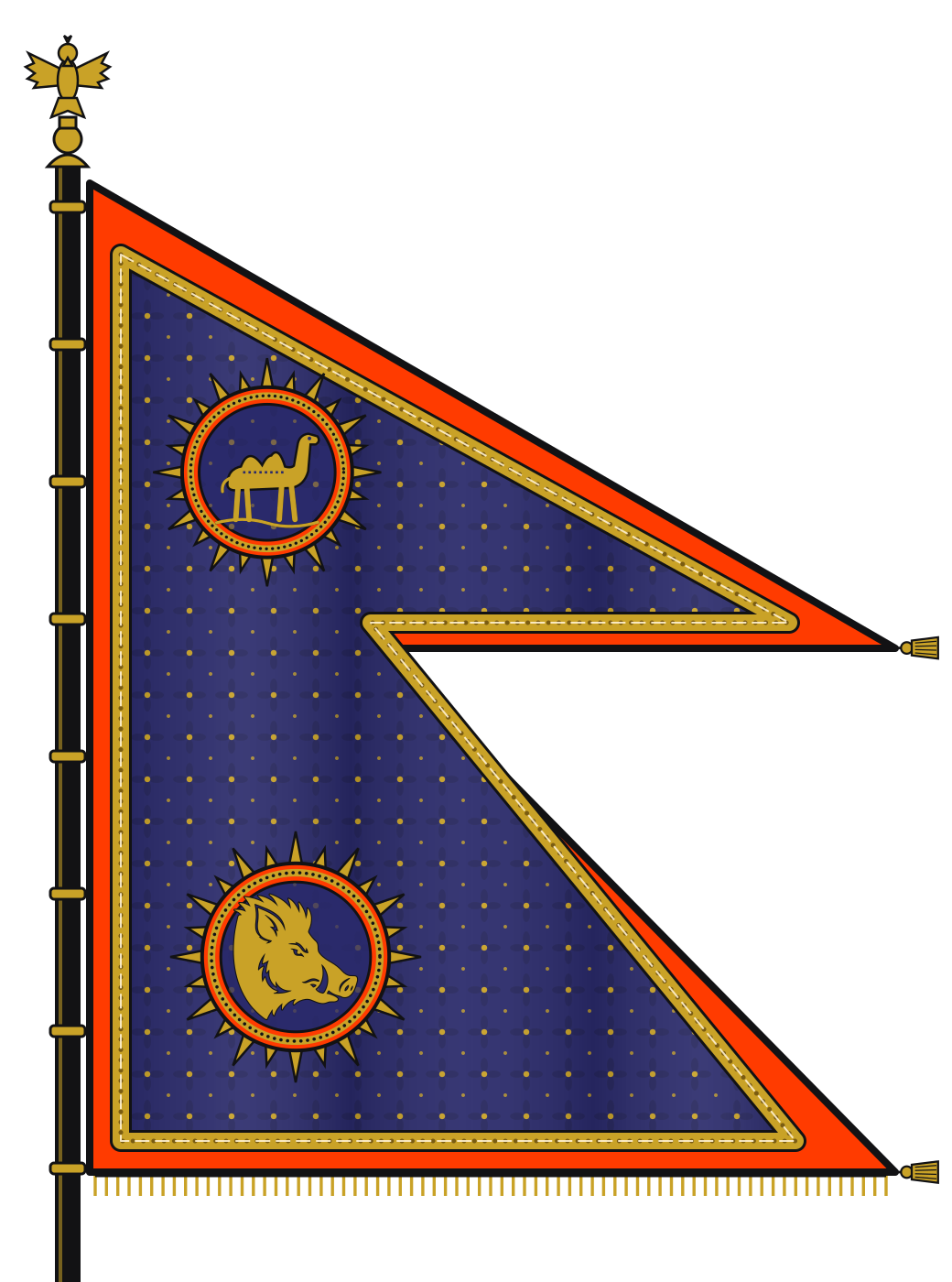
6. Flags
Every clan has every flag type; the type says the occasion and the colours say the clan. The outlined card is the flag the Atlas assigns.
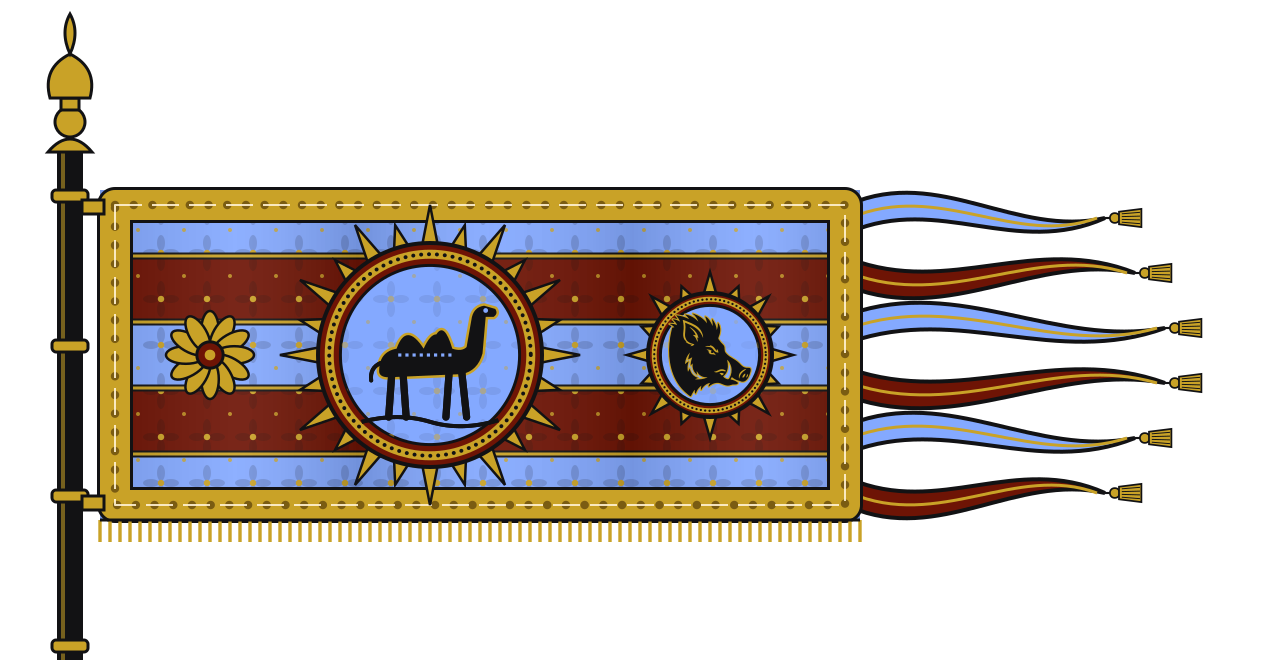
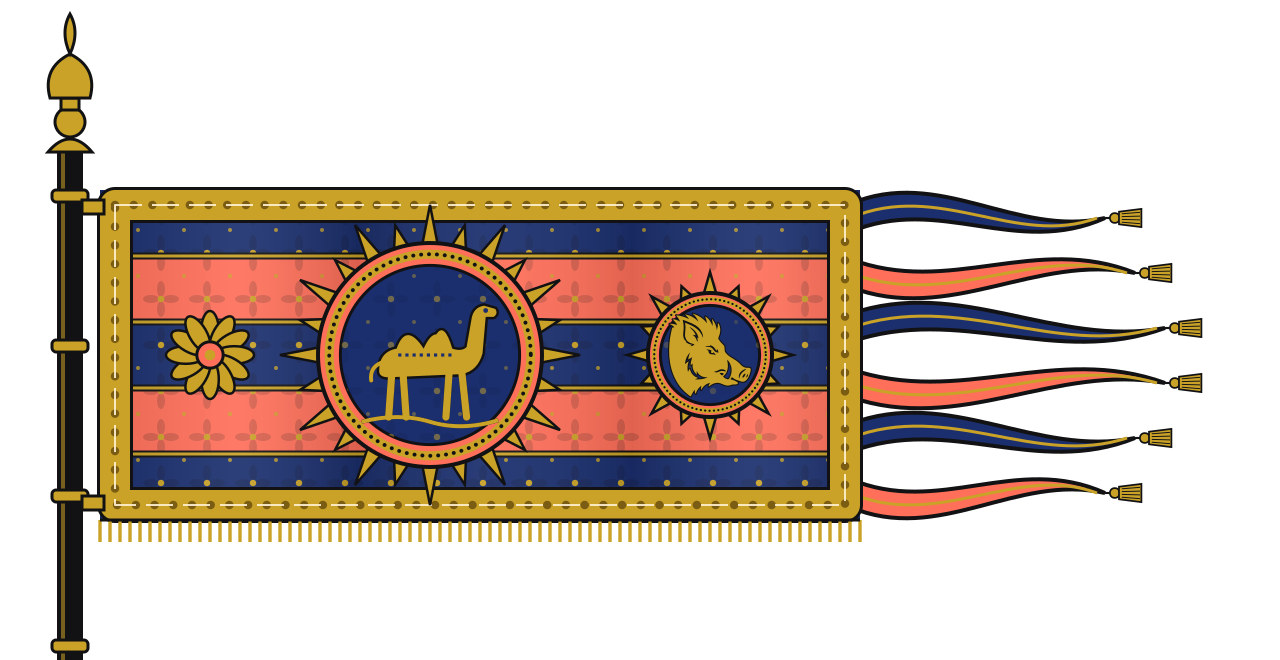
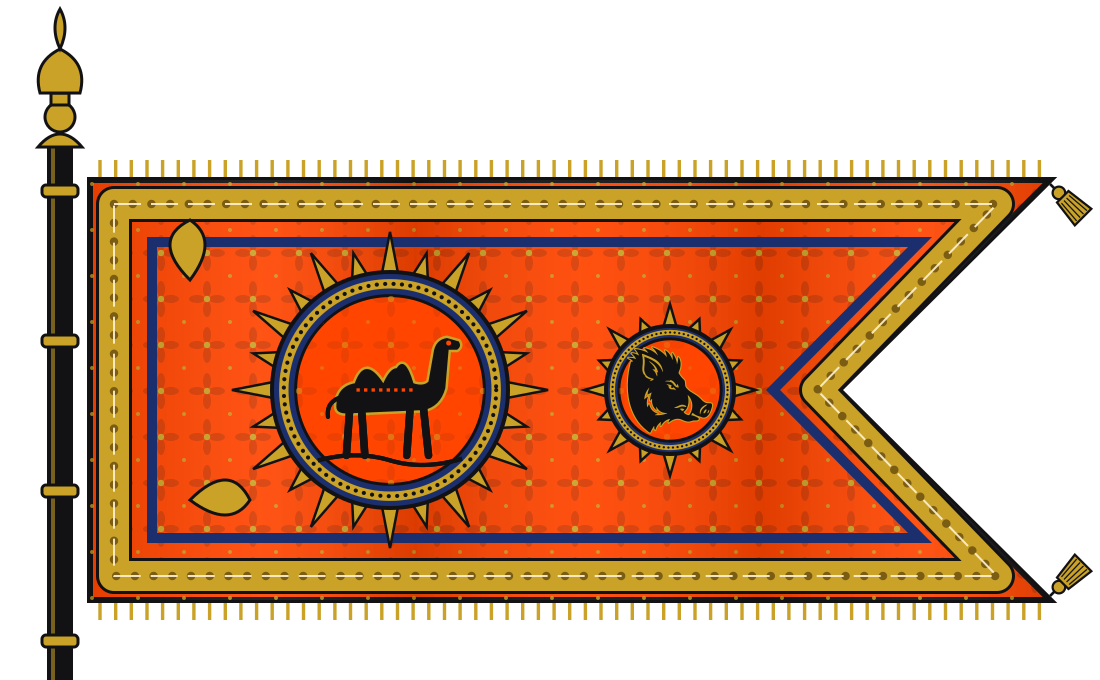
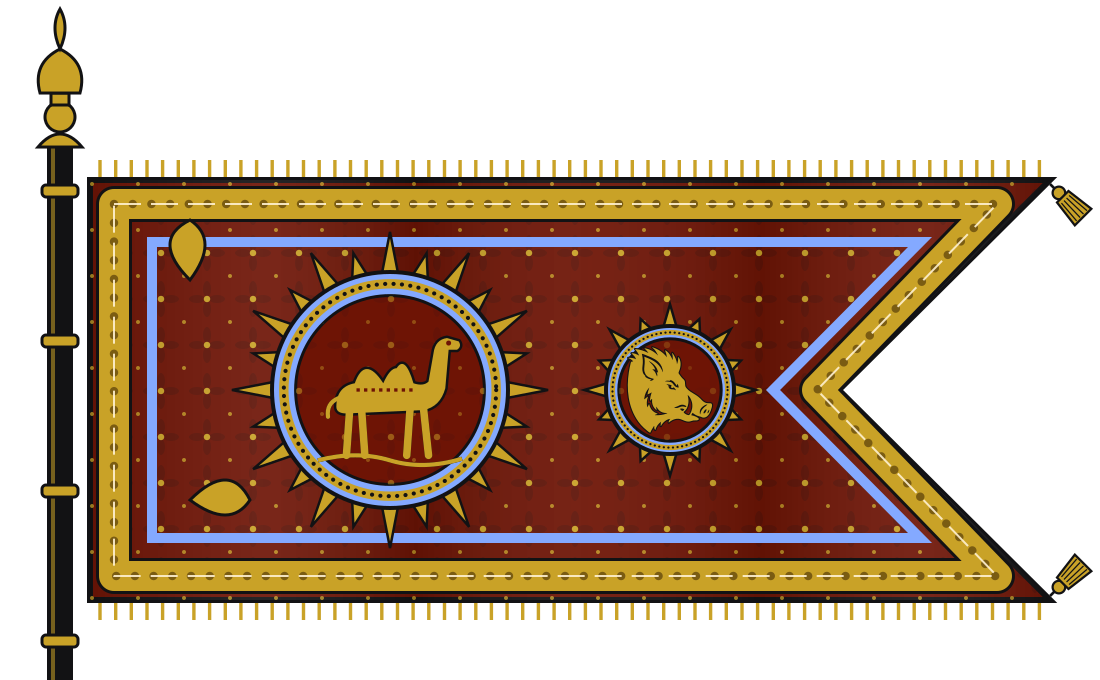
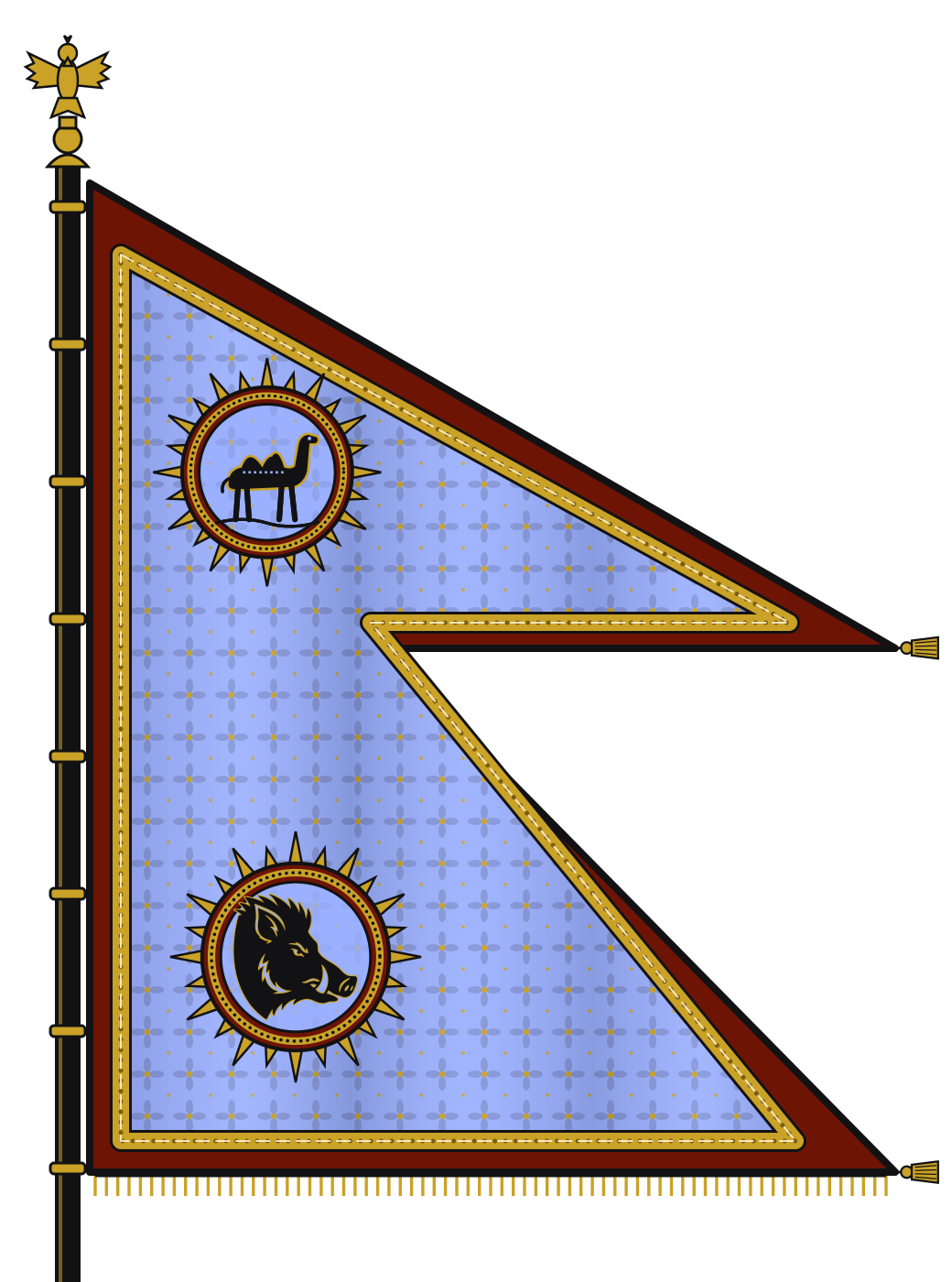
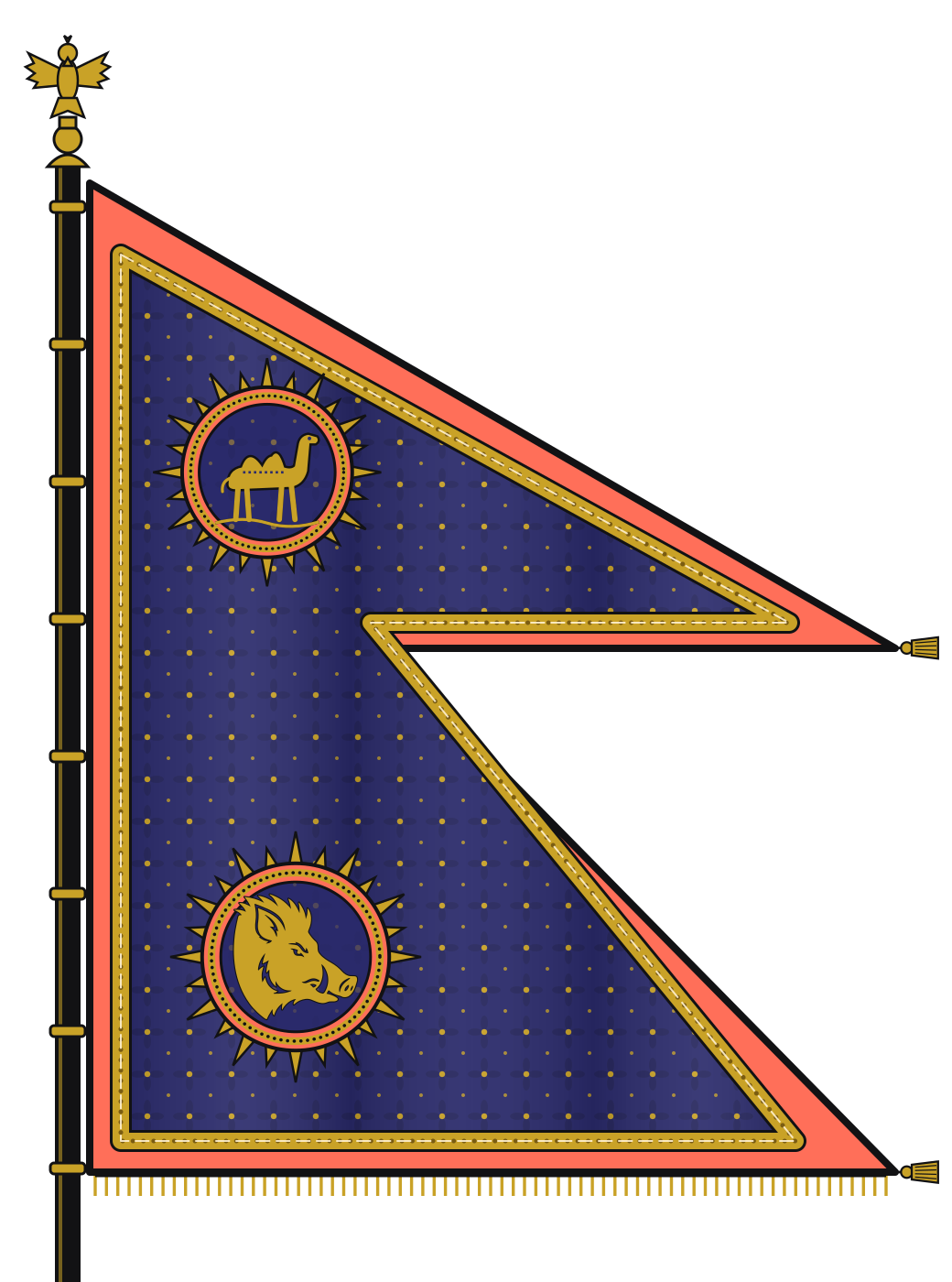
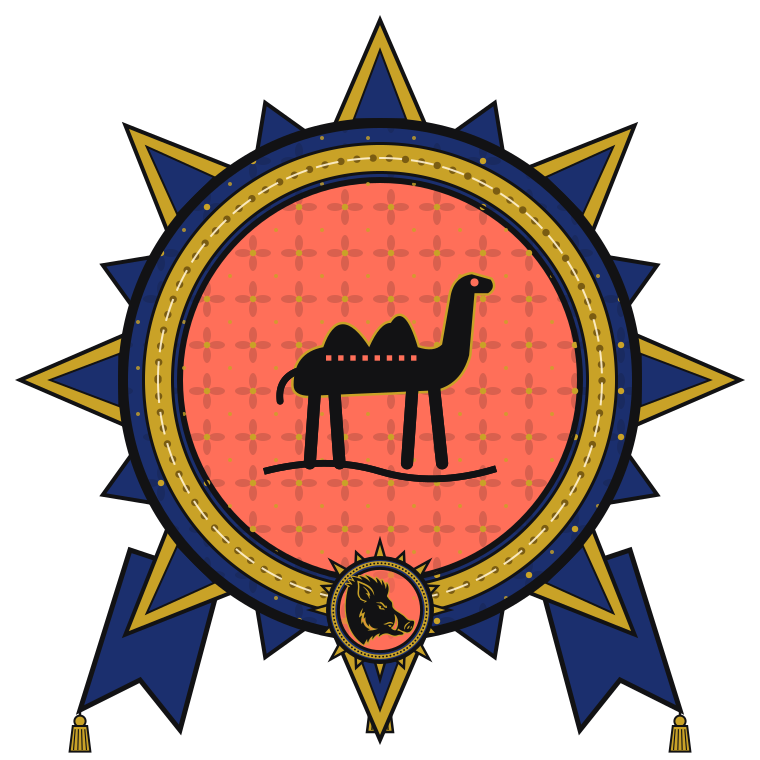
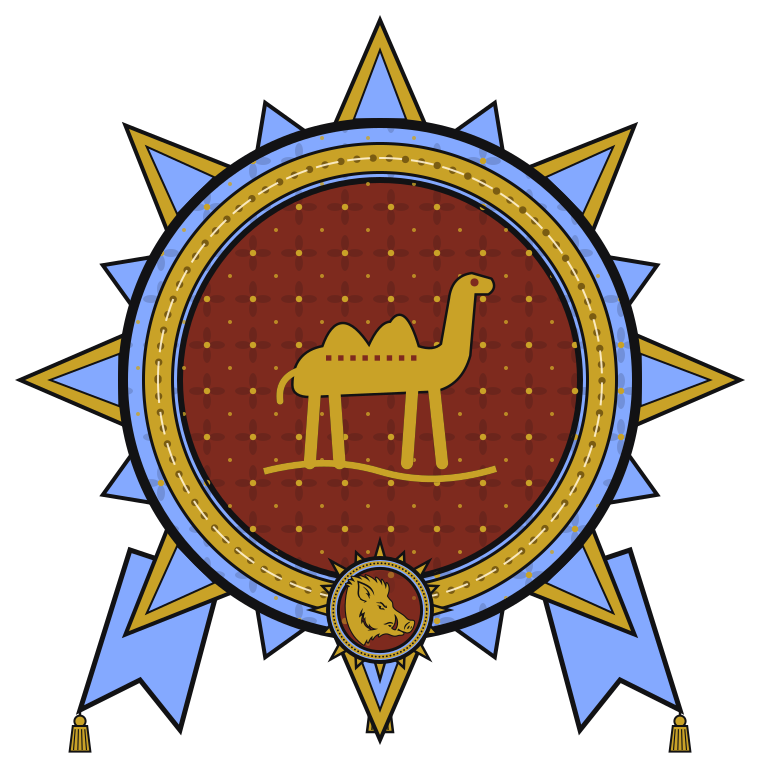
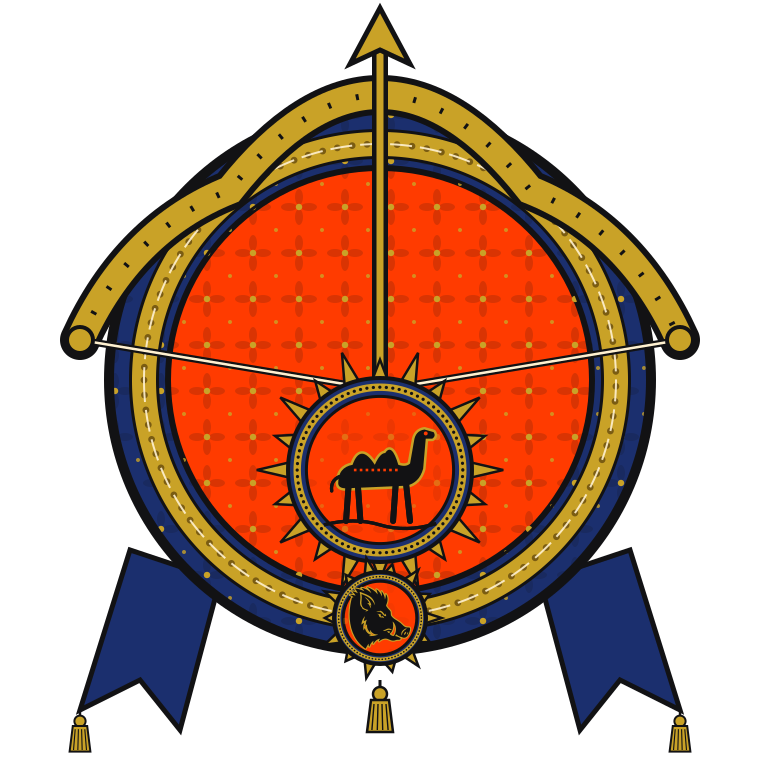
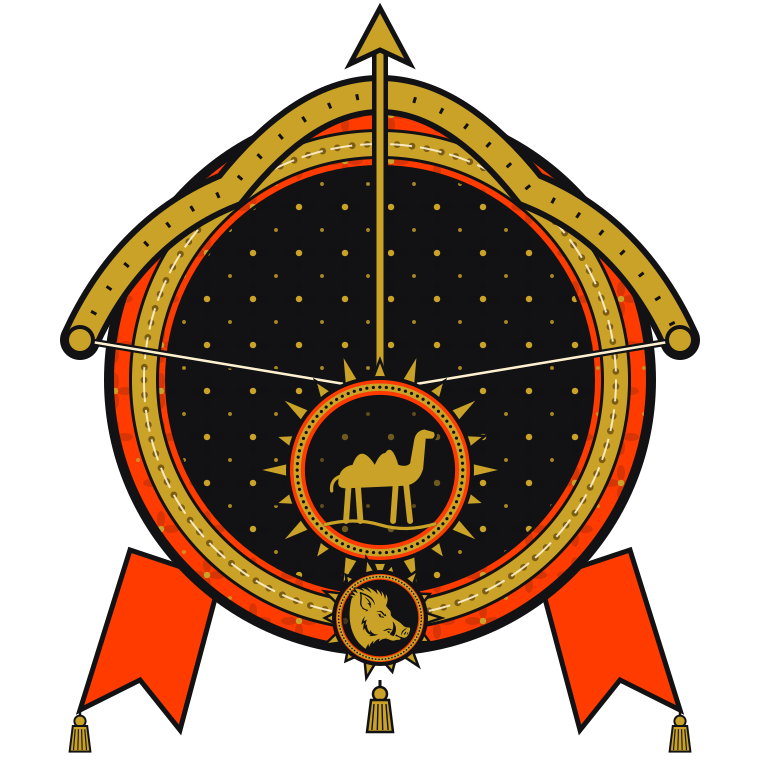
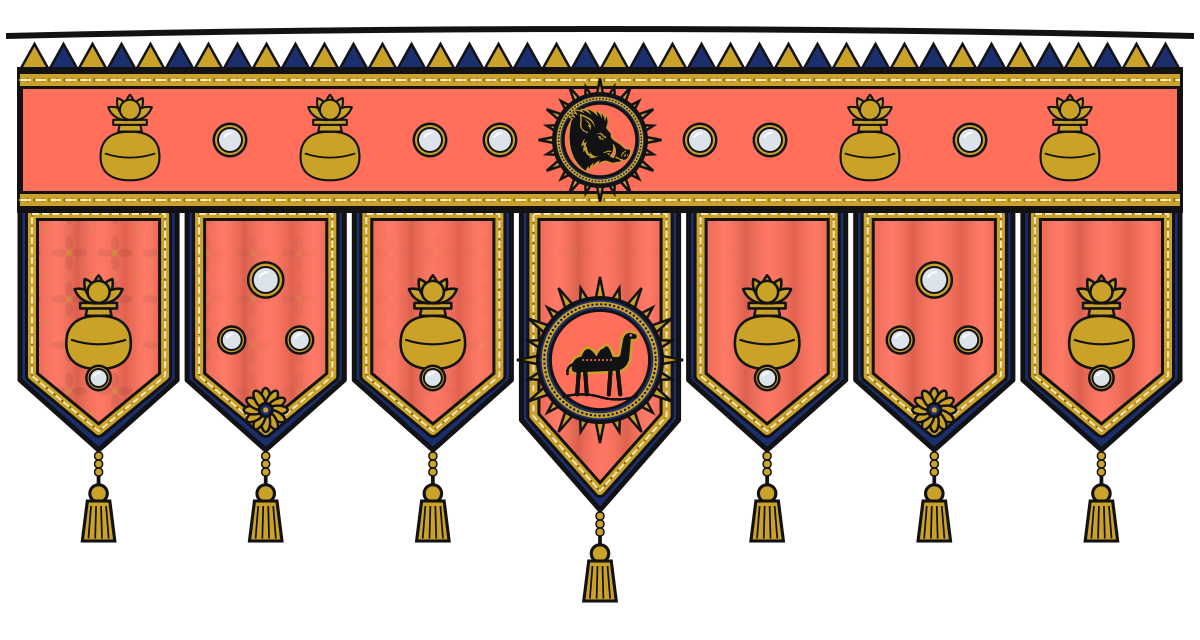
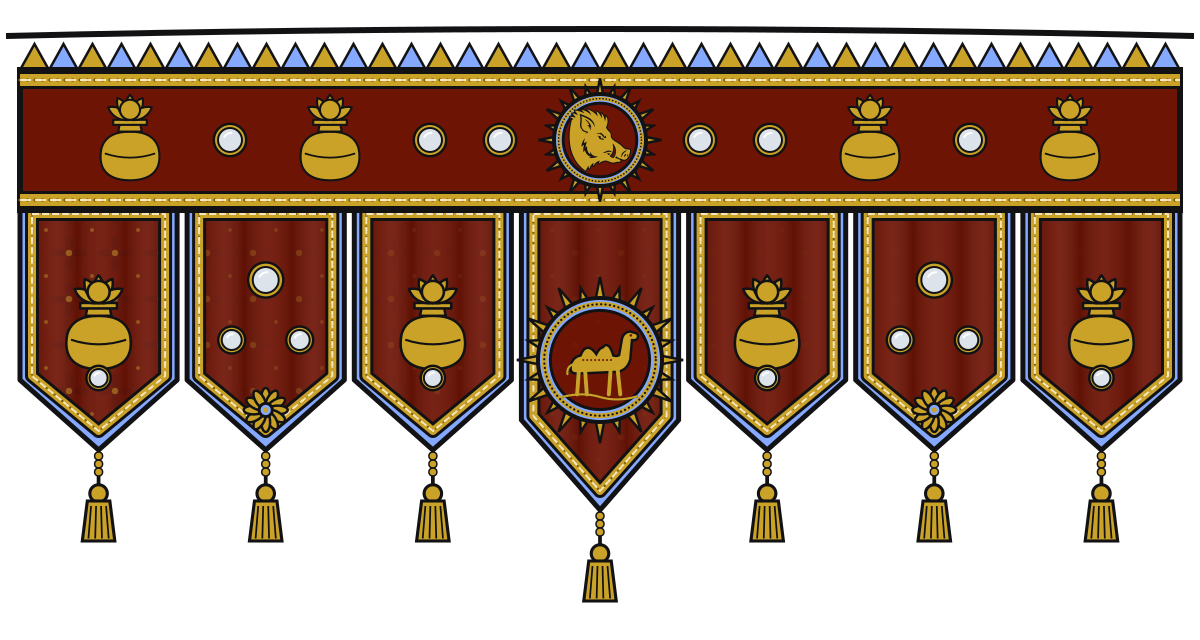
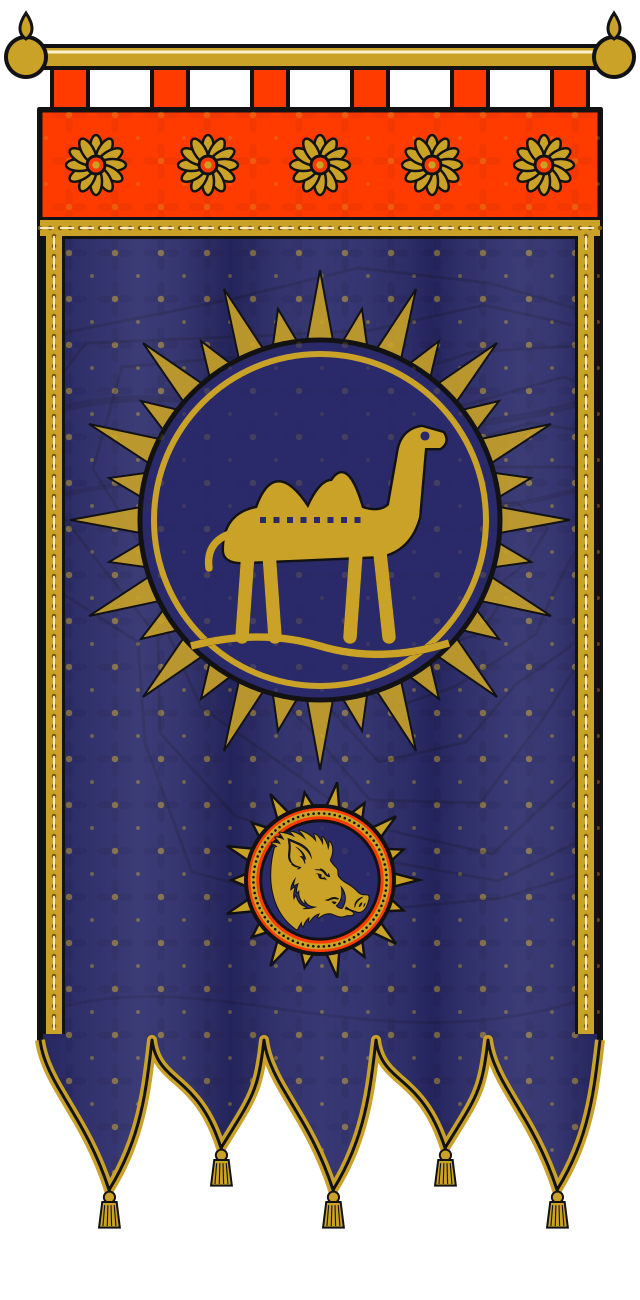
Historic banner
Mahabharata: Jayadratha, king of Sindhu-Sauvira, bore a silver boar on his banner
New flag types
| Accessory | For this clan | Basis |
|---|---|---|
| A9 Pota-dhvaja · ship and trade flag For ships, caravans and markets | Not yet designed for this clan | Design |
| A10 Utsava-patāka · festival flag Light, bright flag for fairs and festivals | Not yet designed for this clan | Design |
| A11 Shoka-dhvaja · mourning flag White cloth with the emblem outline in the clan's metal | Not yet designed for this clan | Design |
7. Regalia
| Accessory | For this clan | Basis |
|---|---|---|
| E1 Chhatra · house parasol The ceremonial umbrella | Not yet designed for this clan | Design |
| E2 Chamara · fly-whisks The pair of whisks beside the head of the house | Not yet designed for this clan | Design |
| E3 Danda · staff of office Staff or scepter | Not yet designed for this clan | Design |
| E4 Simhasana · seat The seat of the house, covered in clan cloth | Not yet designed for this clan | Design |
| E5 Khetaka · shield A round shield; the Changi and Dhanush are its flag forms | Not yet designed for this clan | Regional tradition |
| E6 Kula-ayudha · clan weapon The weapon the clan honours | Not yet found for this clan | Under research |
8. Worn
| Accessory | For this clan | Basis |
|---|---|---|
| F1 Kula-vastra · clan cloth The clan's woven pattern in its kit colours | Not yet designed for this clan | Design |
| F2 Kirti-vastra · honour cloth A cloth earned for a deed, not inherited | Not yet designed for this clan | Design |
| F3 Kula-mala · garland flower The flower or leaf the clan wears as a garland | Not yet found for this clan | Under research |
| F4 Chinha · house pin A metal badge with the pin emblem | Not yet designed for this clan | Design |
9. Records
| Accessory | For this clan | Basis |
|---|---|---|
| H1 Clan words A traditional line in the native script | सौवीरराजस्य पुरा मैत्रेया भूत पुरोहित: तेन चायतनं विष्णो: कारितं देविका तटे। · “Maitreya, the priest of the Sauvira king, built a temple to Vishnu on the bank of the Devika.” Agni Purana 200, Devanagari line as quoted in Bharat Discovery, with its Hindi gloss[4] | Design |
| H2 Biruda · titles The house's title or titles | Not yet found for this clan | Under research |
| H3 Prashasti · praise genealogy The lineage as written at the head of a grant | Not yet found for this clan | Under research |
| H4 Vahi · clan register The book of the clan's births, marriages and deaths | Not yet found for this clan | Under research |
| H5 Rana-ghosha · war cry The clan's cry in battle or celebration | Not yet found for this clan | Under research |
10. VishwaVit · knower of the world
Game values are design choices for this project, not historical claims.
References
- Wikipedia, Sindhu-Sauvīra, read 2026-10-10, https://en.wikipedia.org/wiki/Sindhu-Sauv%C4%ABra
- Wikipedia, Sauvira kingdom, read 2026-10-10, https://en.wikipedia.org/wiki/Sauvira_kingdom
- Junagadh rock inscription of Rudradaman (Wikipedia, read 2026-10-09), citing F. Kielhorn (Epigraphia Indica VIII), R. Salomon, Indian Epigraphy (1998) and D. K. Chakrabarti (1999).
- Bharat Discovery (भारतकोश), सौवीर, read 2026-10-10, https://bharatdiscovery.org/india/सौवीर
- Jatland Wiki (Jat-community wiki; Jat-origin claims are community claims), Sauvira, read 2026-10-10, https://www.jatland.com/home/Sauvira
- Mahabharata (Vyasa, by tradition; composed mostly c. 400 BCE–400 CE) — the Kuru dynasty, the war at Kurukshetra, the banners of the Kuru princes and the line “yato dharmas tato jayah”.
- C. A. Kincaid, Folk tales of Sind and Guzarat (Karachi: Daily Gazette Press, 1925), Internet Archive record read 2026-10-10, https://archive.org/details/folktalesofsindg00caki