The Santal (ᱥᱟᱱᱛᱟᱲ) are a Munda-ethnic people, mainly in Jharkhand, West Bengal, Odisha, Bihar, Assam and Tripura, with smaller communities in Bangladesh and Nepal[1][2]. They speak Santali, the most widely spoken Munda-subfamily language, whose official script, Ol Chiki, was created in 1925 by Pandit Raghunath Murmu[1][3]. Their society is divided into twelve totemic clans, the paris, seven senior and five junior, and senior clans cannot marry junior ones[1]. In 1855 Sidhu and Kanhu Murmu led the Santal Hul against the East India Company and the zamindari system; it was crushed, and the Sonthal Parganas Act of 1855 followed[4].
01Faith and deities
The Santal's own supreme deity, called 'the Great Mountain' and the cause of all causes[5]. The Atlas's KulDevi is Chhinnamasta of Rajrappa, shown in the Temples section; Marang Buru is the clan's own sourced deity.
Goddess of the sacred grove (Jaher than)
A recorded tie between the clan and the goddess.
| Deity or tradition | Place in the clan's life | Evidence |
|---|---|---|
| Jaher Era (Jaher Ayo) | Bonga of the sacred grove, the Jaherthan; Marang Buru's consort | [6][5] |
| Gosae Era | One of the most important bongas, with Marang Buru and Jaher Era | [1] |
| Singbonga and Buru Bonga | Named as the spirits of the Jaherthan grove | [6] |
| Thakur Jiu | Another name for Marang Buru: 'life giver' | [1] |
| Karam Gosain | Worshipped at the Karam feast; petitioned in the Karmu and Dharmu tale | [7] |
| Malan Budhi and the tortoise | In the creation story: the world began as water, with Marang Buru, Malan Budhi and a tortoise | [1] |
| Malignant bongas | Propitiated by the ojha | [1] |
| Noa puri and hana puri | The visible and the invisible spirits | [1] |
| Marang Buru's abodes | Parasnath (identified with Marang Buru, Sammed Shikharji to Jains), Ajodhya Hills and Dalma Hills | [5] |
| Naike, Laya, Deuri | Priests: Naike (Santal), Laya or Deuri (Bhumij and Santal grove), Pahan (Munda), Dehuri (Ho) | [5][6] |
02Temples
The extracts place Santal worship at groves, uncut stones and village mounds; they name no Santal-built temple.
Built by the clan
| Temple | Deity | Built by | When | Where |
|---|---|---|---|---|
| Jaherthan (sacred grove) | Jaher Ayo | The grove is set aside when the village is founded | When the village is founded | Villages at the edge of Santal and Bhumij settlements[6] |
| Majhi Than (earth mound) | Ancestral spirits | The village: a raised earth mound outside the headman's house | Not dated | Santal villages; decisions are made there[1] |
Given patronage or grants by the clan
| Temple | Deity | What the clan gave | When | Where |
|---|---|---|---|---|
| Chhinnamasta, Rajrappa | Chhinnamasta (the sheet's KulDevi) | Pilgrimage and ash immersion; no gift is recorded | Ash immersion mostly in December | Ramgarh district, Jharkhand[8] |
03Languages and scripts
| Language or script | Kind | Under the clan | Evidence |
|---|---|---|---|
| Santali living | Munda subfamily of Austroasiatic; the most widely spoken Munda-subfamily language | The clan's own language; printed forms ᱥᱟᱱᱛᱟᱲ ᱦᱚᱲ and ᱥᱟᱱᱛᱟᱲ (a first form printed in Tai Le letters is not used; see open) | [1] |
| Ol Chiki (ᱚᱞ ᱪᱤᱠᱤ), also Ol Chemet' (ᱚᱞ ᱪᱮᱢᱮᱫ) living | Alphabet of 30 letters, left to right, not an abugida; created 1925 by Pandit Raghunath Murmu, first publicised in 1939 at a Mayurbhanj State exhibition | The official script of Santali | [3] |
| Earlier scripts | Santali was written in Bangla, Devanagari, Kalinga and Latin before Ol Chiki; Paul Olaf Bodding romanised it | Replaced by Ol Chiki for writing | [3] |
| Lowercase Ol Chiki forms research | Worked on by Sudip Iglesias Murmu since 2017 | Not officially accepted | [3] |
04Books and literature
Santali was written in several scripts before Ol Chiki. Bodding's Santal Dictionary is in Latin letters. The extracts give titles only for the works below.
Written during the clan's history
| Work | Author | Kind | When | Link to the clan |
|---|---|---|---|---|
| Folklore of the Santal Parganas | Cecil Henry Bompas (translator); collected by Rev. O. Bodding | Folktales | 1909 | [7] |
| A Santal Dictionary | Paul Olaf Bodding | Dictionary (Latin letters) | Not dated in the extract | [3] |
| Ol Chemed | Raghunath Murmu | Book (script not stated in the extract) | Not dated in the extract | [3] |
| Kherwal Bonso Dhorom Puthi | Majhi Ramdas Tudu | Puthi (kind not stated) | Not dated in the extract | [5] |
| Jomsim Binti | Somai Kisku; Kanhailal Tudu | Binti (kind not stated) | Not dated in the extract | [5] |
| Karam Binti | Dhirendranath Baskey; Kanhailal Tudu | Binti (kind not stated) | Not dated in the extract | [5] |
Given patronage by the clan
Not recorded.
05Thinkers and scholars
| Name | Field | Era | Contribution |
|---|---|---|---|
| Raghunath Murmu (Olguru, Guru Gonke) | Script | Created 1925; first publicised 1939 | Ol Chiki script[3] |
| Paul Olaf Bodding | Missionary; romanised Santali | Not dated in the extract | A Santal Dictionary; collected the tales in Bompas[3][7] |
| Cecil Henry Bompas (ICS) | Translator of folklore | 1909 | Folklore of the Santal Parganas[7] |
| W. G. Archer | Song collector | Mid-twentieth century | Hundreds of Santal songs[9] |
| P. C. Hembram (Phatik Chandra Hembram) | Writer on drums | 1976 | 'The drum beat in Santhal culture'[10] |
| Sadhu Ramchand Murmu (Kabiguru) | Poet | Not dated in the extract | Named in the people article[1] |
| Shibu Soren (Disomguru) | Named with the title Disomguru | Not dated in the extract | Named in the people article[1] |
| Peter B. Andersen | Writer on the rebellion | Not dated in the extract | The Santal Rebellion 1855-1856, named as a source[4] |
| Kalikinkar Datta | Writer on the rebellion | 1940 | Named as a source[4] |
| Ranajit Guha | Writer on the rebellion | 1983 | Named as a source[4] |
| Abha Xalxo | Writer on the rebellion | 2008 | Named as a source[4] |
| Ranabir Samaddar | Writer on the rebellion | Not dated in the extract | Named as a source; on the Kamar, Bagdi and Bagal part[4] |
Titles for Somers (1979), Sen (1997), Hembrom (1996), Schulte-Droesch (2018) and Orans (1965), named in the people article, are not in the extracts.
06Art and architecture
The extracts name carved walls, carved bridal palanquins and the Chadar Badar wooden-puppet show. None is dated in the extract.
Painting and wall art
Not recorded.
Sculpture and temple art
Not recorded.
Temple and building architecture
| Art form | What it is | Era | Evidence |
|---|---|---|---|
| Carved walls | Animals, hunts, dances and geometric patterns carved on walls | Not dated | [1] |
Weaving and textiles
Not recorded.
Clothing and jewellery
Not recorded.
Coins, pottery and crafts
| Art form | What it is | Era | Evidence |
|---|---|---|---|
| Carved bridal palanquins | Palanquins carved for brides | Not dated | [1] |
| Chadar Badar | Wooden-puppet folk show | Not dated | [1] |
07History
Origins and first records
Folklore has the Santal come from Hihiri, which scholars identify with Ahuri in Hazaribagh, and then through Chota Nagpur, Jhalda, Patkum and Saont[1]. The name may come from Samanta Pal, Samanta Al or Sawantal (Midnapore), possibly meaning 'plain land' or 'border protector'[1]. The first recorded mention is 'Soontars' in 1795[1].
Damin-i-koh, 1832
In 1832 the East India Company demarcated the Damin-i-koh in the Raj Mahal hills and invited the Santals to settle there after the Paharias declined[4]. The Santal population rose from 3,000 in 1838 to 82,790 in 1851, and revenue rose twenty-two-fold[4][1].
Santal Hul, 1855
The rising began on 30 June 1855. Sidhu and Kanhu Murmu gathered about 10,000 people and claimed that Thakur Bonga had ordered them to drive out outsiders[4]. The rebels won at Narayanpur. On 24 July about 100 Santals were killed at Maheshpur[4]. The people article gives about 30,000 Santals taking part against about 10,000 British troops[1]. Martial law ran from November 1855 to 3 January 1856, and the deaths are put at 10,000 to 15,000[4].
The rebels called their leaders suba thakur and nazir[4]. Ram Manjhi became leader after the Toulmain ambush of 22 July[4].
After the rising
The Sonthal Parganas Act (Act 37 of 1855) set up a district of 5,470 square miles with its Deputy Commissioner at Dumka, and the Santhal Parganas Tenancy Act followed in 1876[4]. Land transfer to non-Santals was made illegal[1]. Marx called the rising India's first organised 'mass revolution'[4]. 30 June is observed as Hul Diwas in Jharkhand[4].
Hunting rites and the courts
In 1911 Swetamber Jains sought to prohibit Santal hunting rites, and the British courts rejected the petition[5]. A wildlife sanctuary was set up in 1978[5]. In 2023 the environment ministry (MoEFCC) imposed a ban on meat and alcohol within 25 km, covering 99 villages, and the Jharkhand High Court upheld it on 3 May 2025[5]. The community's case is that hunting was once safety and food and that Santals no longer need to hunt, since the animals have dwindled[11].
Migration and the twentieth century
Santals migrated to the Assam tea gardens and to North Bengal, where about 200,000 were living in the 1930s[1]. Jitu Sardar led agitations from 1924, and protests followed in 1928, 1929 and 1932, the last an attempt at a Santal state[1]. The movement then took part in the Tebhaga movement, and Jangal Santhal took part in the Naxalbari uprising[1].
In 2000 the Santal Parganas became a division of Jharkhand[1].
08Journey and migrations
The extracts give a folklore route from Hihiri through Chota Nagpur, and later settlement and migration. The Austroasiatic date is for the language family, not for the Santal alone.
| When | From | To | Why | Evidence |
|---|---|---|---|---|
| c. 2000–1500 BCE (for Austroasiatic speakers) | Indochina | Odisha coast | Paul Sidwell's date for the arrival of Austroasiatic speakers; not a Santal date | [1] |
| Folklore, no date | Hihiri (identified by scholars as Ahuri, Hazaribagh) | Chota Nagpur, Jhalda, Patkum, Saont | The origin route in Santal folklore | [1] |
| 1832 | Chota Nagpur and the hills | Damin-i-koh, Raj Mahal hills | The East India Company invited Santals to settle after the Paharias declined | [4] |
| Later, no date given | Santal Parganas and the hills | Assam tea gardens and North Bengal | Migration to work the tea gardens and land in North Bengal | [1] |
09Seats and lands
| Place | Role | Where today |
|---|---|---|
| Hihiri (Ahuri) | Origin place in folklore | Hazaribagh |
| Chota Nagpur, Jhalda, Patkum, Saont | Places in the folklore route | Not stated in the extracts |
| Damin-i-koh | Settled from 1832 in the Raj Mahal hills | Not stated in the extracts |
| Santal Parganas | Cultural heartland; the 1855 Act's district | Jharkhand (a division from 2000) |
| Parasnath, Ajodhya Hills, Dalma Hills | Abodes of Marang Buru | Parasnath (Jharkhand, not stated); Ajodhya Pahar at Purulia; Dalma (Jharkhand) |
| Rajrappa | Final resting place in Santal mythology; ash immersion in the Damodar | Ramgarh district, Jharkhand |
| Jaherthan groves | Sacred groves on the outskirts of Santal and Bhumij villages | Villages (state not stated) |
10Notable figures
| Name | Role | Era | Known from |
|---|---|---|---|
| Sidhu and Kanhu Murmu | Leaders of the 1855 Santal Hul | 1855 | [4] |
| Chand and Bhairav | Brothers in the rising; Chand and Bhairab captured in early December 1855 with Kanhu | 1855 | [4] |
| Phoolo and Jhano | Sisters of Sidhu and Kanhu, killed in the rising | 1855 | [4] |
| Bir Singh Manjhi, Margo Raja | Named among the leaders (no role given) | 1855 | [4] |
| Ram Manjhi | New leader after the Toulmain ambush of 22 July | 1855 | [4] |
| Jitu Sardar | Led agitations | From 1924 | [1] |
| Jangal Santhal | Named in the Naxalbari uprising | Not dated in the extract | [1] |
| Raghunath Murmu (Guru Gonke) | Created the Ol Chiki script | 1925 | [3] |
| Sadhu Ramchand Murmu (Kabiguru) | Poet | Not dated in the extract | [1] |
| Shibu Soren (Disomguru) | Named with the title Disomguru | Not dated in the extract | [1] |
| Droupadi Murmu later | 15th President of India; Santal | Present | [1] |
| Rathin Kisku | Baul singer | Not dated in the extract | [1] |
| Hemant Soren, Babulal Marandi, Mohan Charan Majhi | Named in the people article's list (no role given) | Not dated | [1] |
| Birbaha Hansda, Uma Saren, Khagen Murmu, Salkhan Murmu, G. C. Murmu, Purnima Hembram, Rafayel Tudu, Shanti Mardi | Named in the people article's list (no role given) | Not dated | [1] |
11Allies, rivals and marriages
| People | Relationship | When |
|---|---|---|
| Paharias | Declined the 1832 invitation to settle Damin-i-koh | 1832 |
| Gowalas and Lohars | Aided the rebels | 1855 |
| Kamars, Bagdis, Bagals | Also took part in the rising (per Samaddar) | 1855 |
| Nawab of Murshidabad | Sent elephants and soldiers to the East India Company against the rebels | 1855 |
| Bhumij, Ho, Munda | Share Marang Buru as supreme deity | Not dated |
| Bhumij, Bedia, Paharia | Sarna and Sari Dharam followers who worship at Jaherthan groves | Not dated |
| Lodha, Sabar, Oraon | Take part in the hunting festivals with the Santal | Current (2025 report) |
12Society and livelihood
Kinship is patrilineal and described as strictly endogamous; the kin groups are mainly ceremonial, and local chiefs and priests have more political weight than kinship[12].
Government and social order
| Institution or group | What it was | Evidence |
|---|---|---|
| Boeha and pera | Boeha, 'sibling', and pera, 'guest', are the great division; nije boeha are children of the same father or grandfather | [1] |
| Mit orak hor | 'People of one house': they cannot marry or worship the same deity | [1] |
| Phul, bala, sangat | Phul is ritual friendship; bala are the parents of a couple; sangat are cross-siblings | [1] |
| Marang and hudin | Seniority terms: marang is senior, hudin is junior | [1] |
| Manjhi and pradhan | The village council is led by the manjhi (also called pradhan) | [1] |
| Jog majhi | The envoy in marriage negotiations | [1] |
| Manjhi, paranik, jogmanghi, naeke, godet | Village offices: headman, assistant, the supervisor of young people's conduct, the priest and the constable; a pargana or tribal chief covers groups of villages | [7] |
| Khunti | Groups of recent common ancestry (gusti in south Chota Nagpur) | [1] |
| Poeta | Thread-wearers; the extract gives no further meaning | [1] |
| Marriage | Seven kinds of marriage, from hapramko bapla, the most elaborate, to kesimek', the most common, where the groom's house takes the bride and a light bride price is set through headmen. The bride visits her natal village with a pot of white clay. | [1] |
Livelihood over time
| Era | Livelihood | Evidence |
|---|---|---|
| Past | Hunting was once safety and food (Rajen Tudu) | [11] |
| Past | Labour in the Assam tea gardens and North Bengal (migration; no date given) | [1] |
13Sub-clans and related clans
Twelve totemic clans, the paris: seven senior (Hansda, Murmu, Marandi, Kisku, Soren, Hembram, Tudu) and five junior (Baskey, Besra, Chorey, Pauria, Bediya)[1]. Senior clans cannot marry junior ones, and certain pairs such as Marandi and Kisku are forbidden to marry[1]. Totems: Hansda, goose; Murmu, nilgai; Marandi, Ischaemum rugosum; Kisku, kingfisher; Soren, the Pleiades; Hembram, betel palm; Tudu, owl; Baskey, stale rice; Besra, falcon; Chorey, lizard; Pauria, pigeon[1]. Clans avoid harming their totem[1]. Gale's encyclopedia counts 164 subclans, ranked senior and junior and pure and impure[12], and associates Kisku with kingship and Murmu with priesthood[12].
| Clan | Relation | Where | Size | In the Atlas | Evidence |
|---|---|---|---|---|---|
| Hansda | Sub-clan | new clan candidate | [1] | ||
| Murmu | Sub-clan | new clan candidate | [1] | ||
| Marandi | Sub-clan | new clan candidate | [1] | ||
| Kisku | Sub-clan | new clan candidate | [1] | ||
| Soren | Sub-clan | new clan candidate | [1] | ||
| Hembram | Sub-clan | new clan candidate | [1] | ||
| Tudu | Sub-clan | new clan candidate | [1] | ||
| Baskey | Sub-clan | same name as ST-362: check | [1] | ||
| Besra | Sub-clan | same name as ST-354: check | [1] | ||
| Chorey | Sub-clan | same name as ST-357: check | [1] | ||
| Pauria | Sub-clan | same name as ST-483: check | [1] | ||
| Bediya | Sub-clan | new clan candidate | [1] | ||
| Bhumij | Related people | ST-033 | [6][5] | ||
| Munda | Related people | ST-229 | [5] | ||
| Ho | Related people | ST-102 | [5] | ||
| Bedia | Related people | ST-022 | [6] | ||
| Paharia | Related people | new clan candidate | [4][6] | ||
| Oraon | Related people | ST-241 | [11] | ||
| Lodha | Related people | ST-177 | [11] | ||
| Sabar | Related people | same name as ST-564: check | [11] | ||
| Kamar | Related people | ST-117 | [4] | ||
| Bagdi | Related people | ST-343 | [4] | ||
| Bagal | Related people | same name as NE-032: check | [4] | ||
| Gowala | Related people | new clan candidate | [4] | ||
| Lohar | Related people | new clan candidate | [4] |
Clans marked "new clan candidate" are not in the Atlas yet.
14Surnames
Murmu, Soren, Hembram, Hansda, Kisku, Tudu, Marandi, Besra, Baskey, Chorey, Pauria and Bediya function as family names[1]. Manjhi and Sonthal are noted as other surnames of Santali people[2].
| Surname | Clan or sub-clan | Where | People with this surname | Also used by other communities |
|---|---|---|---|---|
| Murmu | Sub-clan Murmu (nilgai) | not yet counted | Not checked | |
| Soren | Soren (Pleiades) | not yet counted | Not checked | |
| Hembram | Hembram (betel palm) | not yet counted | Not checked | |
| Hansda | Hansda (goose) | not yet counted | Not checked | |
| Kisku | Kisku (kingfisher) | not yet counted | Not checked | |
| Tudu | Tudu (owl) | not yet counted | Not checked | |
| Marandi | Marandi | not yet counted | Not checked | |
| Besra | Besra (falcon) | not yet counted | Not checked | |
| Baskey | Baskey (stale rice) | not yet counted | Not checked | |
| Chorey | Chorey (lizard) | not yet counted | Not checked | |
| Pauria | Pauria (pigeon) | not yet counted | Not checked | |
| Bediya | Bediya | not yet counted | Not checked | |
| Manjhi | Not a pari; other surname noted in the surnames article | not yet counted | Not checked | |
| Sonthal | Not a pari; other surname noted in the surnames article | not yet counted | Not checked |
Counts are of everyone with the surname, from the cited source and year, not only members of this clan. A surname shared with other communities says nothing about any one person's origin.
15Songs and music
Drums are the metric foundation of Santal music. Tunes are named after festivals such as Sohrae, the harvest, and the hemiola is common. Men play most instruments and women sing in groups[9]. Hembram (1976) writes: 'The beat of the drum is the very pulse of the Santhals'[10]. W. G. Archer collected hundreds of Santal songs in the mid-twentieth century[9].
Songs collected by W. G. Archer
Sung refrains in Karmu and Dharmu and The Girl Who Found Helpers
[7]. Lyrics not extracted; a plea to Karam Gosain is sung.
Instruments and styles
| Instrument or style | What it is | Evidence |
|---|---|---|
| Tumdak' | Two-headed hand-struck drum with a clay body and leather straps zigzagging between the heads; hung from the neck; the left head is larger | [9] |
| Tamak' | Single-headed kettle drum, played with two sticks; head 14–16 in.; thought to have spiritual power | [9] |
| Madal and nagara | Used in the Santal harvest and festival dance | [13] |
| Junko, jhal | Ankle bells and cymbals | [9] |
| Tiriwaw (Tirio) | Seven-hole bamboo flute | [9] |
| Dhodro banam, Phet banam | Bowed lutes | [9] |
| Kabkubi | One-stringed plucked instrument; missionaries and Christian converts used it in place of the tamak' | [9] |
| Sarpa, Buan, Sarenga, Banam, Lerda | Named as Santal instruments (no description in the extract) | [9] |
16Poems, lullabies and children's rhymes
No Santal poem or children's rhyme is quoted in the extracts. Sadhu Ramchand Murmu, called Kabiguru, is named as a poet[1].
None recorded yet.
17Stories, legends and proverbs
Stories and legends
| Story | What happens | Told by | Evidence |
|---|---|---|---|
| Creation | The world began as water; Marang Buru, Malan Budhi and a tortoise are in the story | Santal tradition[1] | |
| Pilchu Haram and Pilchu Budhi | They had seven sons and seven daughters, and the children became clans. A variant has Pilchu Budhi weeping until Marang Buru reunites the family. | Santal tradition[1] | |
| Karmu and Dharmu | A feast with rice beer, worship of Karam Gosain, and dancing all night | Collected by Rev. O. Bodding; written out in Santali by Sagram Murmu[7] | |
| Singh Chando | Petitions for a son | Collected by Rev. O. Bodding; written out in Santali by Sagram Murmu[7] | |
| The Girl Who Found Helpers | Contains sung refrains, including the plea to Karam Gosain | Collected by Rev. O. Bodding; written out in Santali by Sagram Murmu[7] | |
| The Miser's Servant | A story that carries the sayings below | Collected by Rev. O. Bodding; written out in Santali by Sagram Murmu[7] | |
| Dealings with the bongas, witchcraft | Part IV covers dealings with bongas; Part VI covers witchcraft, dains and ojhas | Collected by Rev. O. Bodding; written out in Santali by Sagram Murmu[7] |
Proverbs and sayings
| Saying | Meaning | Evidence |
|---|---|---|
| A man can stand scolding, but not starvation (English only; no Santali form in the extract) | Hunger is worse than scolding | [7] |
| Hunger is the worst disease of all (English only; no Santali form in the extract) | As printed in the same story | [7] |
18Festivals and fairs
| Festival or fair | When | Where | What happens |
|---|---|---|---|
| Sohrai (Sohrae) | Harvest; the principal festival | Not stated | Festival tunes are named after it; dances with tamak' and tumdak' drums[1][9] |
| Karam | Not dated in the extract | Not stated | Feast with rice beer, worship of Karam Gosain, dancing all night[7] |
| Baha | Not dated in the extract | Not stated | Named in the people article's festival list[1] |
| Sarhul, Baha parab, Sohrai, Mage | Named in the Marang Buru and Jaherthan articles | Jaherthan groves | Named in the Jaherthan festivals list[6][5] |
| Dashain, Sakrat, Mahmore, Rundo, Magsim | Named in the people article | Not stated | Named only[1] |
| Sendra Parab | On Buddha Purnima | Ajodhya Pahar, Purulia | One of the largest Santhal festivals; a hunting festival[11] |
| Shikar Utsav / Parab | January to June, about 50 a year | Hunting festivals in Jharkhand and West Bengal | Up to 10,000–15,000 hunters; Santhal, Lodha, Sabar and Oraon take part[11] |
| Bariat, Lagre, Danta, Send'ra hunt | Named in the NVLI abstract | Not stated | Drums sound at these rites[10] |
| Ash immersion at Rajrappa | Mostly in December | Damodar at Rajrappa | Groups called yatri immerse the dead's ashes; the folk songs call the site Thel Kopi Ghat[8] |
| Hul Diwas | 30 June | Jharkhand | Observed as Hul Diwas[4] |
19Food, dress and games
Food
| Item | What it is | Evidence |
|---|---|---|
| Rice beer | Ends the ceremonies that propitiate the spirits, and is drunk at the Karam feast | [7] |
Dress
Not recorded.
Games and martial arts
Not recorded.
Tags: living still practised · revived brought back after a break · lost known only from records · research reported but not yet confirmed from a source. Songs and poems under copyright are listed by title only; restricted or sacred material is noted without its content.
20Status today
The Santal are a living people, a Scheduled Tribe in five Indian states, with communities in Bangladesh and Nepal, and they keep the Ol Chiki script, the paris and their festivals[1][3].
Who carries the name today
| Community | Link | Basis | Evidence |
|---|---|---|---|
| Santal communities in Bangladesh (Rajshahi and Rangpur Divisions) | Documented | [1] | |
| Santal in Nepal (Adivasi Janajati) | Documented | Atlas;[1] | |
| Santal in the Assam tea gardens (Tea Tribes, NE-009) | Documented | [1]; the sheet lists the Santal in NE-009 |
Recognised heritage
| What | Recognition | Evidence |
|---|---|---|
| Hul Diwas, 30 June | Observed in Jharkhand | [4] |
| Ol Chiki in Unicode | Unicode 5.1 (April 2008), U+1C50–1C7F | [3] |
| Ol Chiki in UDHR | Article 1 of the UDHR is published in Santali | [3] |
| Sarna Dharam | Jharkhand assembly resolution of 2020 for census recognition | [1] |
| Mrigayaa | Mrinal Sen's film (1976), named in the rebellion article | [4] |
| Marang Buru hunting rites | A wildlife sanctuary was set up in 1978 (site not named in the extract); in 2023 the MoEFCC banned meat and alcohol within 25 km (99 villages), and the Jharkhand High Court upheld it on 3 May 2025 | [5] |
No community review of this page is recorded in the extracts.
21For children
Pilchu and the seven sons
Long ago, the Santal say, the world began as water. Marang Buru, the supreme deity, was there, and so were Malan Budhi and a tortoise. Pilchu Haram and Pilchu Budhi had seven sons and seven daughters. Their children grew up and became clans, called paris. Each clan has a totem, and its people do not harm it. The Santal call Marang Buru the cause of all causes. Today Santal families live mainly in Jharkhand, West Bengal, Odisha, Bihar, Assam and Tripura.
22Across the project
| Project | What carries this clan | Status |
|---|---|---|
| Atlas of the Janas | Places named in the extracts: Damin-i-koh, Santal Parganas, Rajrappa (Ramgarh district), Parasnath, Ajodhya Hills, Dalma Hills. No footprints file yet. | To check |
| KulDevi and GrahDevi | KulDevi in the Atlas: Chhinnamasta (Mahavidya), family Saptamatrika (+Narasimhi); the sheet's KulDevi note reads 'Goddess of the sacred grove (Jaher than)' | From the Atlas |
| Planet naming | Not in the extracts | — |
| Renaming and waters | The Damodar at Rajrappa, where the dead's ashes are immersed; Thel Kopi Ghat in the folk songs | Sourced |
23Open questions
- The first letter of ᥥᱟᱱᱛᱟᱲ and ᥥᱟᱨᱱᱟ in the cached extracts is Tai Le (U+1965), not Ol Chiki. Check the printed forms in the sources before they are used again.
- Santali script: no clan line or saying in Santali is in the extracts. The clan words are the printed name form ᱥᱟᱱᱛᱟᱲ ᱦᱚᱲ, and the mapping of the three printed forms (Santal, Santali language, Santal person) needs checking.
- Population: the overall figure of about 7.5 million has no year in the extract. Check the 2011 Census catalogue (not read).
- Surnames: counts of bearers, and whether Murmu, Hembram and the other surnames are shared with other communities, are not checked. The Murmu and Hembram pages are not read.
- Bediya (junior pari) and Bedia (ST-022) may or may not be the same people; not confirmed.
- Uma Saren appears in the people article. Check whether Saren is a spelling of Soren.
- Gowala, Lohar and Bagal: no master-sheet entries; names as the rebellion article gives them.
- Clan weapon: Ak' Sar is the weapon of Marang Buru (the supreme deity). It is not confirmed as a clan weapon of the Santal.
- Flag: the Sarna flag (red and white) is recorded in the Atlas. The flagspot Santal flag page is not read.
- Unread sources: Bodding's Traditions and Institutions (Quai Branly), Campbell's Santal Folk Tales (Project Gutenberg 35060), the rest of Bompas from character 100,000, Risley 1915 (pp. 442–443), the Jaher Ayo and Sarnaism pages, and the Bhognadih and Raghunath Murmu pages.
- The Sarna Dharam census resolution (Jharkhand assembly, 2020) is cited only from the people article.
- Homeland pin: no coordinates for the Santal homeland are in the extracts. Rajrappa (23.63222 N, 85.69389 E) is a shrine, not the homeland.
- Community review: none recorded. The only community voice in the extracts is Rajen Tudu on the hunting ban.
24Astitva
अस्तित्व · being, existence: everything by which the clan is known
What the extracts document for the Santal: the totems of the twelve paris, the Jaherthan grove and its stones, the festival drums, the weapon of the supreme deity, and the titles of the 1855 rising[1][4].
Every clan has every accessory, royal objects included. Each one says how it is known: Documented This clan's own object is recorded. · Regional tradition Recorded for the region or for peoples like this one, not for this clan. · Design Made for this project, with no historical claim. · Under research To be found for this clan from sources. Legends and titles are written in the clan's own script.
1. Seals and coins
| Accessory | For this clan | Basis |
|---|---|---|
| B1 Rajamudra · house seal Round seal with the clan emblem and a short legend in the clan's script | Not yet designed for this clan | Design |
| B2 Anguliya-mudra · signet ring Personal seal ring of the head of the house | Not yet designed for this clan | Design |
| B3 Chhapa · house stamp Ink or block stamp for letters, goods and cloth | Not yet designed for this clan | Design |
| B4 Tamrapatra · charter plate Copper-plate grant on a ring, closed with the house seal | Not yet designed for this clan | Design |
| B5 Shreni-mudra · guild or trade seal Seal for the clan's trade, craft or caravan | Not yet designed for this clan | Design |
| C1 Clan coin Emblem or deity on one side, a legend in the clan's script | Not yet designed for this clan | Design |
| C2 Coin die The die that strikes the coin | Not yet designed for this clan | Design |
2. Living symbols
| Accessory | For this clan | Basis |
|---|---|---|
| I1 Totem trio The tree, bird and animal the clan protects | Twelve totems, one per pari: the goose, nilgai, Ischaemum rugosum, kingfisher, the Pleiades, betel palm, owl, stale rice, falcon, lizard, pigeon; Bediya's is not given | Documented |
| I2 Kaval-maram · guardian tree The tree that stands at the clan's seat | Jaherthan: a sacred grove on the outskirts of Santal and Bhumij villages | Documented |
3. Stone and gate
| Accessory | For this clan | Basis |
|---|---|---|
| G1 Torana · gateway The built gate of the seat; the cloth Toran hangs in it | Not yet designed for this clan | Regional tradition |
| G2 Viragallu · hero stone Carved panel stone for a member who died defending the clan | Not yet designed for this clan | Regional tradition |
| G3 Kula-shila · clan stones Standing and table stones that remember the ancestors | Uncut stones in the Jaherthan grove represent the bongas (spirits) | Documented |
| G4 Jayastambha · victory pillar A pillar raised for a victory | Not yet designed for this clan | Design |
| G5 Sima-shila · boundary stone Marks the clan's land, with a line in the native script | Not yet designed for this clan | Design |
4. Sounds
| Accessory | For this clan | Basis |
|---|---|---|
| D1 Pancha-mahashabda · five great sounds The right to five instruments | Not yet designed for this clan | Design |
| D2 Shankha · clan conch The clan's own named war conch | Not yet designed for this clan | Design |
| D3 Murasu · house drums Three drums: war, charity and justice | Tumdak' and tamak' are the festival drums | Documented |
5. Kit: colours, metals and emblems
The emblem and flag on this page come from the Atlas and are design work. The extracts document no Santal seal, coin or flag. The sheet records a Sarna flag, red and white, used by some Santal and other Sarna/Sari Dharam followers, and the tamak' drum as the second image.
| Part of the kit | This clan |
|---|---|
| Field | Deep Cosmic Blue #9BB0FF |
| Accent | Fiery Vermilion #FF4500 |
| Emblem colour | Charcoal Black #121214 |
| Zari metal | Gold |
| Main emblem | Two crossed bows with a rising sun |
| Second image | A Santal kettle drum (tamak) |
| Night and day | Every visual accessory has two versions: by night the emblem on the dark field, by day the clan's field colour on cloth woven from its metal. |

6. Flags
Every clan has every flag type; the type says the occasion and the colours say the clan. The outlined card is the flag the Atlas assigns.


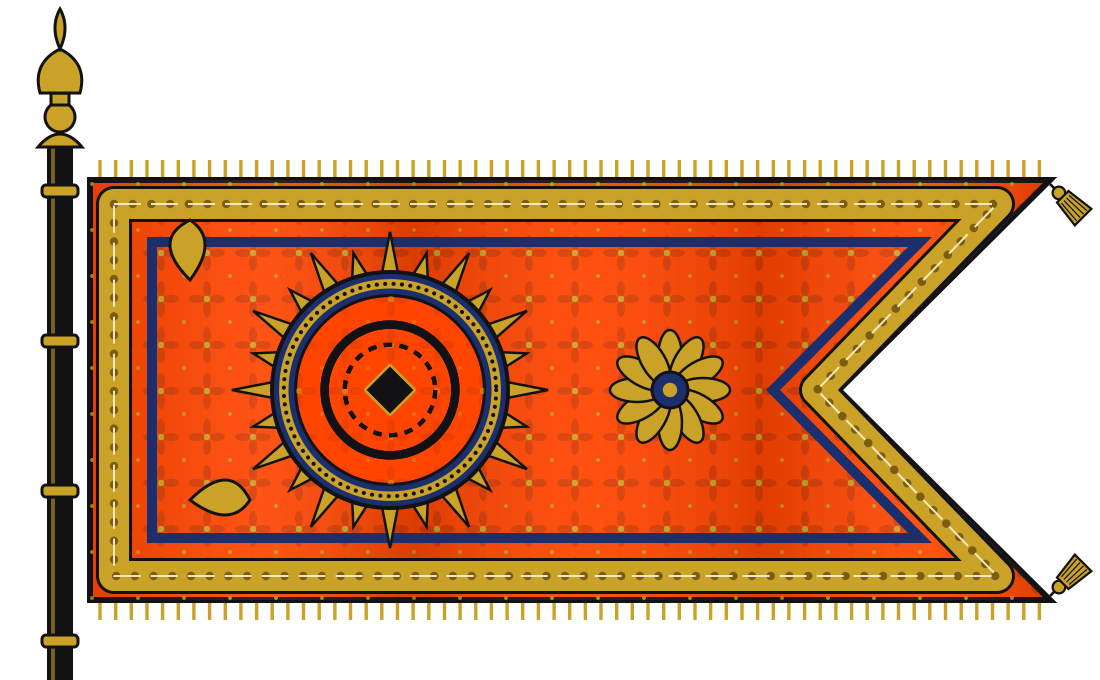





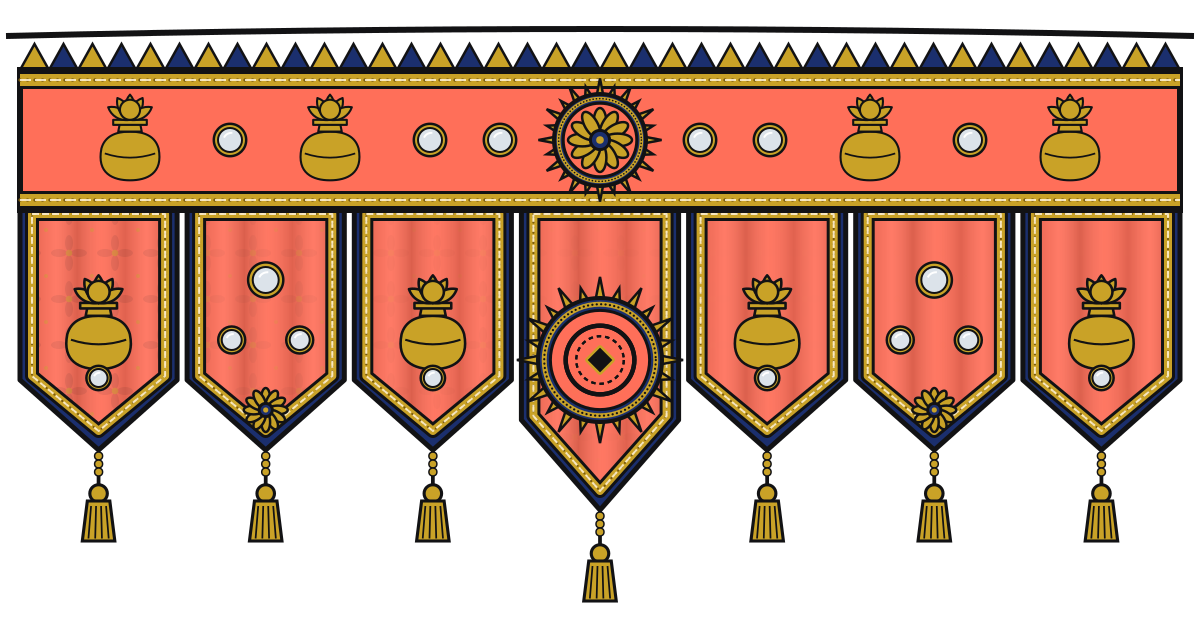
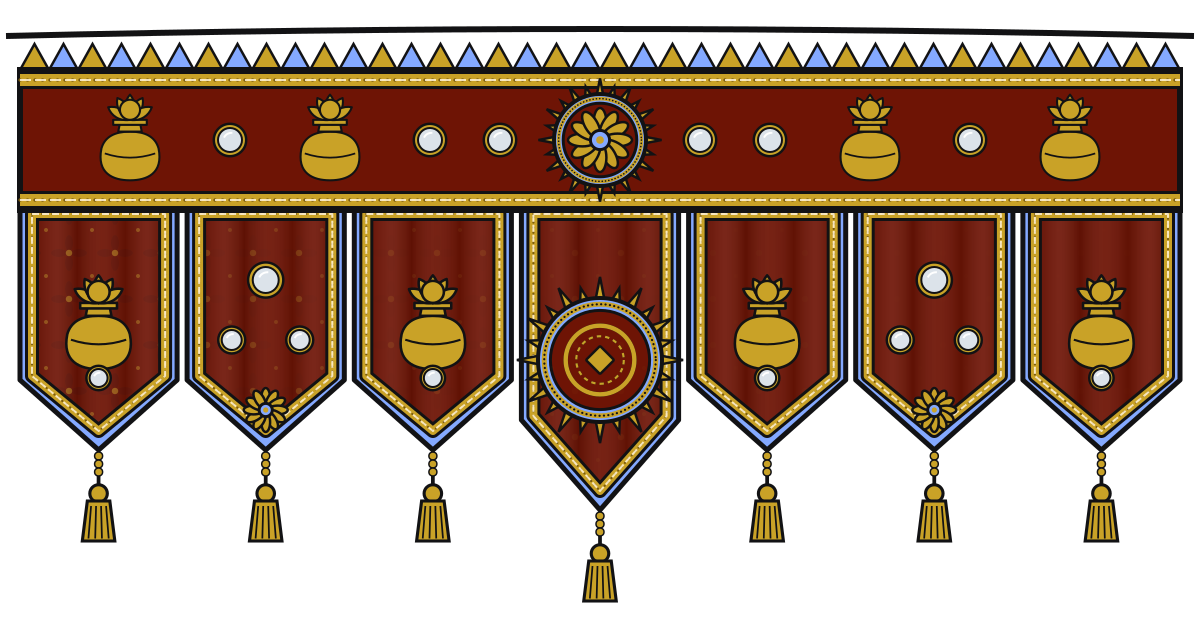

Historic banner
Some Santal and other Sarna/Sari Dharam followers use a Sarna flag (red and white)
New flag types
| Accessory | For this clan | Basis |
|---|---|---|
| A9 Pota-dhvaja · ship and trade flag For ships, caravans and markets | Not yet designed for this clan | Design |
| A10 Utsava-patāka · festival flag Light, bright flag for fairs and festivals | Not yet designed for this clan | Design |
| A11 Shoka-dhvaja · mourning flag White cloth with the emblem outline in the clan's metal | Not yet designed for this clan | Design |
7. Regalia
| Accessory | For this clan | Basis |
|---|---|---|
| E1 Chhatra · house parasol The ceremonial umbrella | Not yet designed for this clan | Design |
| E2 Chamara · fly-whisks The pair of whisks beside the head of the house | Not yet designed for this clan | Design |
| E3 Danda · staff of office Staff or scepter | Not yet designed for this clan | Design |
| E4 Simhasana · seat The seat of the house, covered in clan cloth | Not yet designed for this clan | Design |
| E5 Khetaka · shield A round shield; the Changi and Dhanush are its flag forms | Not yet designed for this clan | Regional tradition |
| E6 Kula-ayudha · clan weapon The weapon the clan honours | Ak' Sar, the weapon of Marang Buru, the Santal supreme deity | Documented |
8. Worn
| Accessory | For this clan | Basis |
|---|---|---|
| F1 Kula-vastra · clan cloth The clan's woven pattern in its kit colours | Not yet designed for this clan | Design |
| F2 Kirti-vastra · honour cloth A cloth earned for a deed, not inherited | Not yet designed for this clan | Design |
| F3 Kula-mala · garland flower The flower or leaf the clan wears as a garland | Not yet found for this clan | Under research |
| F4 Chinha · house pin A metal badge with the pin emblem | Not yet designed for this clan | Design |
9. Records
| Accessory | For this clan | Basis |
|---|---|---|
| H1 Clan words A traditional line in the native script | ᱥᱟᱱᱛᱟᱲ ᱦᱚᱲ · “The people's own name, from the self-name Hor Hopon, which means 'child of human'” Wikipedia, Santal people (printed name form)[1] | Documented |
| H2 Biruda · titles The house's title or titles | Titles in the 1855 rising: suba thakur and nazir | Documented |
| H3 Prashasti · praise genealogy The lineage as written at the head of a grant | Not yet found for this clan | Under research |
| H4 Vahi · clan register The book of the clan's births, marriages and deaths | Not yet found for this clan | Under research |
| H5 Rana-ghosha · war cry The clan's cry in battle or celebration | Not yet found for this clan | Under research |
10. VishwaVit · knower of the world
Game values are design choices for this project, not historical claims.
References
- Wikipedia, Santal people, read 2026-10-10, https://en.wikipedia.org/wiki/Santal_people
- Wikipedia, Santal surnames, read 2026-10-10, https://en.wikipedia.org/wiki/Santal_surnames
- Wikipedia, Ol Chiki script, read 2026-10-10, https://en.wikipedia.org/wiki/Ol_Chiki_script
- Wikipedia, Santhal rebellion, read 2026-10-10, https://en.wikipedia.org/wiki/Santhal_rebellion
- Wikipedia, Marang Buru, read 2026-10-10, https://en.wikipedia.org/wiki/Marang_Buru
- Wikipedia, Jaherthan, read 2026-10-10, https://en.wikipedia.org/wiki/Jaherthan
- Cecil Henry Bompas (trans.), Folklore of the Santal Parganas (1909; Project Gutenberg #11938), read 2026-10-10, https://gutenberg.org/cache/epub/11938/pg11938-images.html
- Chhinnamasta Temple, Rajrappa, Wikipedia (cites E. A. Benard 2000 and R. Mahalakshmi 2014).
- Wikipedia, Santal music, read 2026-10-10, https://en.wikipedia.org/wiki/Santal_music
- National Virtual Library of India, The drum beat in Santhal culture (P. C. Hembram, Sangeet Natak 39, 1976), read 2026-10-10, https://icvtesting.nvli.in/drum-beat-santhal-culture
- Nabarun Guha, Efforts to end ritualistic hunting results in reduced kills, Mongabay India, 7 May 2025, read 2026-10-10, link
- Encyclopedia of World Cultures (Gale, 2008) via everyculture.com, Santal: Kinship, read 2026-10-10, https://www.everyculture.com/South-Asia/Santal-Kinship.html
- Wikipedia, Folk dances of Jharkhand, read 2026-10-10, https://en.wikipedia.org/wiki/Folk_dances_of_Jharkhand