The Sahariya are a Scheduled Tribe of Madhya Pradesh, Rajasthan and Uttar Pradesh, and the Wikipedia article takes their name from the Hindi word for jungle[1]. PARI reports that their forests were cut under the Indian Forests Act (1927)[2]. The 2011 census counts are 6,14,958 in Madhya Pradesh, 1,11,377 in Rajasthan and 70,634 in Uttar Pradesh[3][4][5]. Their Holi performance, the Saharia Swang, is recorded in the NVLI and Vajiram sources[6][7].
01Faith and deities
No KulDevi has been found for this clan yet; it is on the research list.
| Deity or tradition | Place in the clan's life | Evidence |
|---|---|---|
| Bhavani | Local deity worshipped as a Hindu | [1] |
| Gond Devta | Local deity worshipped as a Hindu | [1] |
| Bundela Devta | Local deity worshipped as a Hindu | [1] |
| Soorin | Local deity worshipped as a Hindu | [1] |
| Bijasur | Local deity (also named by Vajiram) | [1][7] |
| Shiva | Worshipped by Baiju Bheel, named in an origin claim (no source given) | [1] |
| Vishnu, Krishna and Hanuman | Honoured in the Holi festival, in the Holika legend | [2] |
| Siddh Baba | Local saint honoured at a temple near Mamoni | [2] |
| Animistic elements | Vajiram says the faith mixes Hinduism with animistic elements | [7] |
02Temples
No temple built by the people is recorded in the extracts.
Built by the clan
Not recorded.
Given patronage or grants by the clan
| Temple | Deity | What the clan gave | When | Where |
|---|---|---|---|---|
| Hanuman and Siddh Baba temple | Hanuman; Siddh Baba | Pilgrimage by elders at the end of Holi; visits declining | At the end of Holi | Near Mamoni village, Baran district[2] |
03Languages and scripts
| Language or script | Kind | Under the clan | Evidence |
|---|---|---|---|
| Hindi and local dialects living | Indo-Aryan family | The people speak local dialects (Vajiram); Hindi (Wikipedia infobox) | [1][7] |
| Original language lost | Not named in the extracts | Lost, per Vajiram | [7] |
04Books and literature
Written sources on the people are few; the two works below are cited in the extracts.
Written during the clan's history
| Work | Author | Kind | When | Link to the clan |
|---|---|---|---|---|
| A Primitive Tribe of Madhya Pradesh: Social Organization and Religion of the Sahariya | Vibha Joshi | M.Phil thesis, Delhi University | 1987 | [1] |
| People of India: Uttar Pradesh, vol. XLII | A. Hasan and J. C. Das (eds) | Cited for pp. 1231–1236 | Date not in the extract | [1] |
Given patronage by the clan
Not recorded.
05Thinkers and scholars
| Name | Field | Era | Contribution |
|---|---|---|---|
| Vibha Joshi (also V. J. Patel) | Social organisation and religion (her thesis) | 1987; film 1992–93 | M.Phil thesis; 35-minute film "The Sahariya of Madhya Pradesh" (Anthropological Survey of India)[1] |
| Vinay Kumar Srivastava | Journal: Sociological Bulletin | 2016 | "Speaking of Caste: Merit of the Principle of Segmentation"[1] |
| Meenal Tatpati (Kalpavriksh) | Forest rights | 2015 | Discusses the Forest Rights Act (2006) in the PARI article[2] |
06Art and architecture
The PARI article mentions a miniature cow-dung buffalo by Sita Mehta; the extract does not say she is Sahariya, so it is not placed here.
Painting and wall art
Not recorded.
Sculpture and temple art
Not recorded.
Temple and building architecture
| Art form | What it is | Era | Evidence |
|---|---|---|---|
| Patore houses | Houses of stone boulders with stone-slab roofs called patore; some mud houses | Undated | [7] |
Weaving and textiles
Not recorded.
Clothing and jewellery
Not recorded.
Coins, pottery and crafts
| Art form | What it is | Era | Evidence |
|---|---|---|---|
| Basketry | An important craft (People of India); the Kindal sub-group are basket makers | Undated | [1][7] |
07History
Forest origins (undated)
The Wikipedia article gives two origin claims, neither with a source on the page: descent from Shabri of the Ramayana, or from Baiju Bheel, a Shiva worshipper[1]. The name is given as Hindi "sahra", jungle, with "jungle dwellers" as the sense[1]; the NVLI record gives "sahar" for the same word[6].
Forests and the Forest Act (1927)
PARI says the Sahariyas first settled in the forests of eastern Rajasthan, and that the forests were cut under the Indian Forests Act (1927). It reports acute hunger and child deaths in the district around 2002[2].
Settlement at Shahabad (undated)
The NVLI record says the people were originally forest dwellers, settled at Shahabad, Rajasthan, and 12 adjoining villages with the aim of modernising them[6].
Uttar Pradesh status (by 2007)
Uttar Pradesh first classified them Scheduled Caste, then redesignated them Scheduled Tribe by 2007 (the article cites Pratiyogita Darpan, July 2007)[1]. As of 2017 the ST designation applied only in Lalitpur district, citing the Ministry of Tribal Affairs[1].
08Journey and migrations
The extracts give no dated migration. The only settlement movement recorded is the forest settlement at Shahabad.
| When | From | To | Why | Evidence |
|---|---|---|---|---|
| Undated | Forests of eastern Rajasthan | Shahabad and 12 adjoining villages | Settled with the aim of modernising them (NVLI record) | [2][6] |
09Seats and lands
| Place | Role | Where today |
|---|---|---|
| Bundelkhand region | Forest-covered region of Madhya Pradesh and Uttar Pradesh where the people are found[1] | Madhya Pradesh, Uttar Pradesh |
| Shivpuri district | District named for the people in the Madhya Pradesh article[3] | Madhya Pradesh |
| Guna district | Homeland listed in the Atlas (no extract names it) | Madhya Pradesh |
| Baran district | Mamoni village (Kishanganj taluka)[2]; the Rajasthan list gives Baran a figure for this people, 108,520 (2011)[4] | Rajasthan |
| Shahabad | Settlement with 12 adjoining villages[6] | Rajasthan, bordering Madhya Pradesh |
| Lalitpur district | Only district of Uttar Pradesh where ST status applied (as of 2017)[1] | Uttar Pradesh |
| Kuno National Park | Sahariya members took part in an event with the President (news item, undated)[7] | Sheopur district, Madhya Pradesh |
10Notable figures
| Name | Role | Era | Known from |
|---|---|---|---|
| Shabri legend | Figure of the Ramayana, named as one origin claim | Ramayana | [1] |
| Baiju Bheel legend | Shiva worshipper, named as another origin claim (no source given) | Undated | [1] |
| Ramesh Singh Sikarwar | Named in the article as a surrendered dacoit interviewed in the 1993 film; the extract does not say he belongs to the people | 1993 | [1] |
| Devilal Sahariya | Folk musician and drummer; PARI describes his access to 12 of 20 bighas allotted to him | 2015 | [2] |
11Allies, rivals and marriages
| People | Relationship | When |
|---|---|---|
| Panika | Related ethnic group (Wikipedia) | Undated |
| Parahiya | Related ethnic group (Wikipedia) | Undated |
| Bind | Related ethnic group (Wikipedia) | Undated |
| Chero | Other Bundelkhand tribe (People of India) | Undated |
| Kol | Other Bundelkhand tribe (People of India) | Undated |
| Sardar, Jat and upper-caste landholders | Hold much of the land around Mamoni village (PARI) | 2015 |
12Society and livelihood
The article describes a caste council headed by a patel, which imposes fines and boycotts; the page marks this statement "citation needed"[1]. Land and forest use matter for the economy; see the livelihood table.
Government and social order
| Institution or group | What it was | Evidence |
|---|---|---|
| Caste council (patel) | Imposes fines and boycotts, per the article (marked citation needed) | [1] |
| Exogamous gotras | The people are divided into exogamous gotras; see section 13 | [1] |
| Forest economy | Forests a major economic resource (People of India) | [1] |
Livelihood over time
| Era | Livelihood | Evidence |
|---|---|---|
| Traditional | Cutting wood, collecting honey, basket making, mining and quarrying, breaking stones[1] | |
| Undated | Forest produce, small plots and landless labour; catechu made from khair trees[7] | |
| 2015 | Farming and cattle care; PARI describes the people as among Rajasthan's most deprived communities, often bonded labourers[2] |
13Sub-clans and related clans
The Wikipedia article says the people are divided into exogamous gotras, and gives twelve, citing People of India (pp. 1232–1236). Vajiram names five sub-tribes by occupation: Jati (farmers), Arsi (weavers), Muli (iron workers), Kindal (basket makers) and Kumbi (potters). Related peoples named are Panika, Parahiya and Bind (Wikipedia), and Chero and Kol as other Bundelkhand tribes. Rawat, Banrawat, Banrakha and Soarain are given as alternative names for the people. The gotra "Solanki" is written here as Solanki (gotra) to keep it apart from the Solanki dynasty in the sheet.
| Clan | Relation | Where | Size | In the Atlas | Evidence |
|---|---|---|---|---|---|
| Sanauna | Sub-clan | new clan candidate | [1] | ||
| Rajauria | Sub-clan | new clan candidate | [1] | ||
| Chandele | Sub-clan | new clan candidate | [1] | ||
| Rohtele | Sub-clan | new clan candidate | [1] | ||
| Solanki (gotra) | Sub-clan | new clan candidate | [1] | ||
| Khareyia | Sub-clan | new clan candidate | [1] | ||
| Bagolia | Sub-clan | new clan candidate | [1] | ||
| Jecheria | Sub-clan | new clan candidate | [1] | ||
| Kusmorna | Sub-clan | new clan candidate | [1] | ||
| Chakardiya | Sub-clan | new clan candidate | [1] | ||
| Kurwana | Sub-clan | new clan candidate | [1] | ||
| Theogana | Sub-clan | new clan candidate | [1] | ||
| Jati | Sub-clan | new clan candidate | [7] | ||
| Arsi | Sub-clan | new clan candidate | [7] | ||
| Muli | Sub-clan | new clan candidate | [7] | ||
| Kindal | Sub-clan | new clan candidate | [7] | ||
| Kumbi | Sub-clan | new clan candidate | [7] | ||
| Panika | Related people | ST-248 | [1] | ||
| Chero | Related people | ST-055 | [1] | ||
| Kol | Related people | ST-141 | [1] | ||
| Parahiya | Related people | new clan candidate | [1] | ||
| Bind | Related people | new clan candidate | [1] |
Clans marked "new clan candidate" are not in the Atlas yet.
14Surnames
The extracts name no family or clan surname used by this people.
Not recorded.
15Songs and music
The extracts describe performance and music but give no song text, title or excerpt. Nothing here is quoted.
Instruments and styles
| Instrument or style | What it is | Evidence |
|---|---|---|
| Dhol | Played to the Saharia Swang (as named in the extract) | [6] |
| Nagari | Played to the Saharia Swang (as named in the extract) | [6] |
| Matki | Played to the Saharia Swang (as named in the extract) | [6] |
16Poems, lullabies and children's rhymes
None recorded yet.
17Stories, legends and proverbs
Stories and legends
| Story | What happens | Told by | Evidence |
|---|---|---|---|
| Holika and Prahlada | Holika's shawl flies onto Prahlada in the fire; Holika dies, and Vishnu kills Hiranyakashipu; ash is put on foreheads | As told to PARI in Mamoni | [2] |
Proverbs and sayings
Not recorded.
18Festivals and fairs
| Festival or fair | When | Where | What happens |
|---|---|---|---|
| Holi in Mamoni | Up to a week around the March full moon | Mamoni village, Kishanganj taluka, Baran district, Rajasthan | A bonfire the night before, where wheat stalks are roasted; colour play the next day; the community sings together each evening[2] |
| Saharia Swang | In the month of Holi | Dancers form troupes and travel village to village | Swang to dhol, nagari and matki; a male dancer in female attire dances around male performers[6][7] |
| Pilgrimage to the Hanuman temple | At the end of Holi | Temple near Mamoni village | Elders visit on pilgrimage; visits are declining[2] |
19Food, dress and games
Food
Not recorded.
Dress
| Item | What it is | Evidence |
|---|---|---|
| Swang costume | A male dancer in female attire; leaves on the head and hips; colourful body paint[6] | [6] |
Games and martial arts
Tags: living still practised · revived brought back after a break · lost known only from records · research reported but not yet confirmed from a source. Songs and poems under copyright are listed by title only; restricted or sacred material is noted without its content.
20Status today
Listed as a Scheduled Tribe in Madhya Pradesh, Rajasthan and Uttar Pradesh[4][5][3]. The Atlas gives PVTG status, and names it Rajasthan's only PVTG.
Not reviewed by the community; no community review is recorded.
21For children
Holi in the forest village
The Sahariya people have lived in forests and villages in Madhya Pradesh, Rajasthan and Uttar Pradesh. Their name comes from a word for jungle. They gather honey, and they make catechu from khair trees. At Holi, the people light a bonfire, roast wheat stalks in it, and play with colours the next day. In the evenings they sing together. Dancers perform the Swang to drums, and one male dancer wears women's clothes.
22Across the project
| Project | What carries this clan | Status |
|---|---|---|
| Atlas of the Janas | Places named in the extracts: Shivpuri, Baran, Lalitpur, Shahabad (no pin placed yet) | To place |
| KulDevi and GrahDevi | No KulDevi in the Atlas (basis: Research) | Research |
| Planet naming | Not yet checked for this clan | To check |
| Renaming and waters | No water or place name from the people's name yet | — |
23Open questions
- The native-script name सहरिया is the researcher's rendering and is unverified: no fetched page printed native script. Check before use.
- Clan words (H1) are not in the extracts. The clan's own line is needed, or a cited classical line linked to this people (illustrative).
- The KulDevi is empty in the Atlas (basis: Research). Find a KulDevi or a chief deity from a source, then set main deity.
- Surnames: none sourced. Check Joshi 1987 and the Russell gazetteer for surnames and gotra names.
- Totem trio, guardian tree, seal, coin, war cry, weapon and garland flower: none in the extracts. Leads: Joshi 1987 and the People of India Madhya Pradesh volume (not read).
- Native-script forms of Saharia Swang, its songs and the names of the gotras: none in the extracts. Read the NVLI Swang video page and the Hindi Granthaalayah article (not read).
- Songs, proverbs and children's rhymes: no text in the extracts; search for public-domain or traditional collections.
- Origin claims (Shabri, Baiju Bheel) have no source on the Wikipedia page. Find a primary source or leave them as claims.
- Chhattisgarh and Guna appear in the Atlas only; no extract gives a figure or place for them.
- Check the NVLI intangible-heritage entry for Saharia Swang (apitesting.nvli.in); the record read here is a portal page.
- Dated history: Forest Act 1927 clearances, the 2002 hunger reports and the Kuno relocation need more detail from primary or official sources.
- Community review: none recorded.
- Contradiction: the lead and the Uttar Pradesh ST row give Sahariya as an ST group in Uttar Pradesh, with 70,634 in 2011[5]; but the note that ST status applied only in Lalitpur district as of 2017[1] is not reconciled with that figure in any extract. Check the census and official gazette.
- PVTG status: the Atlas gives PVTG and the 09-07-2024 list date for the state-wise Scheduled Tribe list; no extract gives a list date for PVTG status itself[7].
24Astitva
अस्तित्व · being, existence: everything by which the clan is known
No seal, coin, title or war cry for the Sahariya is in the extracts. The documented material culture is the Swang's instruments and costume, patore stone-slab houses and basketry (sections 06 and 15–19). The emblem and flag come.
Every clan has every accessory, royal objects included. Each one says how it is known: Documented This clan's own object is recorded. · Regional tradition Recorded for the region or for peoples like this one, not for this clan. · Design Made for this project, with no historical claim. · Under research To be found for this clan from sources. Legends and titles are written in the clan's own script.
1. Seals and coins
| Accessory | For this clan | Basis |
|---|---|---|
| B1 Rajamudra · house seal Round seal with the clan emblem and a short legend in the clan's script | Not yet designed for this clan | Design |
| B2 Anguliya-mudra · signet ring Personal seal ring of the head of the house | Not yet designed for this clan | Design |
| B3 Chhapa · house stamp Ink or block stamp for letters, goods and cloth | Not yet designed for this clan | Design |
| B4 Tamrapatra · charter plate Copper-plate grant on a ring, closed with the house seal | Not yet designed for this clan | Design |
| B5 Shreni-mudra · guild or trade seal Seal for the clan's trade, craft or caravan | Not yet designed for this clan | Design |
| C1 Clan coin Emblem or deity on one side, a legend in the clan's script | Not yet designed for this clan | Design |
| C2 Coin die The die that strikes the coin | Not yet designed for this clan | Design |
2. Living symbols
| Accessory | For this clan | Basis |
|---|---|---|
| I1 Totem trio The tree, bird and animal the clan protects | Not yet found for this clan | Under research |
| I2 Kaval-maram · guardian tree The tree that stands at the clan's seat | Not yet found for this clan | Under research |
3. Stone and gate
| Accessory | For this clan | Basis |
|---|---|---|
| G1 Torana · gateway The built gate of the seat; the cloth Toran hangs in it | Not yet designed for this clan | Regional tradition |
| G2 Viragallu · hero stone Carved panel stone for a member who died defending the clan | Not yet designed for this clan | Regional tradition |
| G3 Kula-shila · clan stones Standing and table stones that remember the ancestors | Not yet designed for this clan | Design |
| G4 Jayastambha · victory pillar A pillar raised for a victory | Not yet designed for this clan | Design |
| G5 Sima-shila · boundary stone Marks the clan's land, with a line in the native script | Not yet designed for this clan | Design |
4. Sounds
| Accessory | For this clan | Basis |
|---|---|---|
| D1 Pancha-mahashabda · five great sounds The right to five instruments | Not yet designed for this clan | Design |
| D2 Shankha · clan conch The clan's own named war conch | Not yet designed for this clan | Design |
| D3 Murasu · house drums Three drums: war, charity and justice | Not yet designed for this clan | Design |
5. Kit: colours, metals and emblems
The Atlas gives the emblem as a honeycomb (foraging for honey) with a gum-resin tree (collecting forest gum in Shivpuri), and a Changi flag type. These are project designs from the sheet; no historic arms are in the extracts.
| Part of the kit | This clan |
|---|---|
| Field | Deep Brick #7E2A1E |
| Accent | Deep Cosmic Blue #9BB0FF |
| Emblem colour | Metallic Gold #C9A227 |
| Zari metal | Gold |
| Main emblem | A honeycomb |
| Second image | A gum-resin tree |
| Night and day | Every visual accessory has two versions: by night the emblem on the dark field, by day the clan's field colour on cloth woven from its metal. |
6. Flags
Every clan has every flag type; the type says the occasion and the colours say the clan. The outlined card is the flag the Atlas assigns.


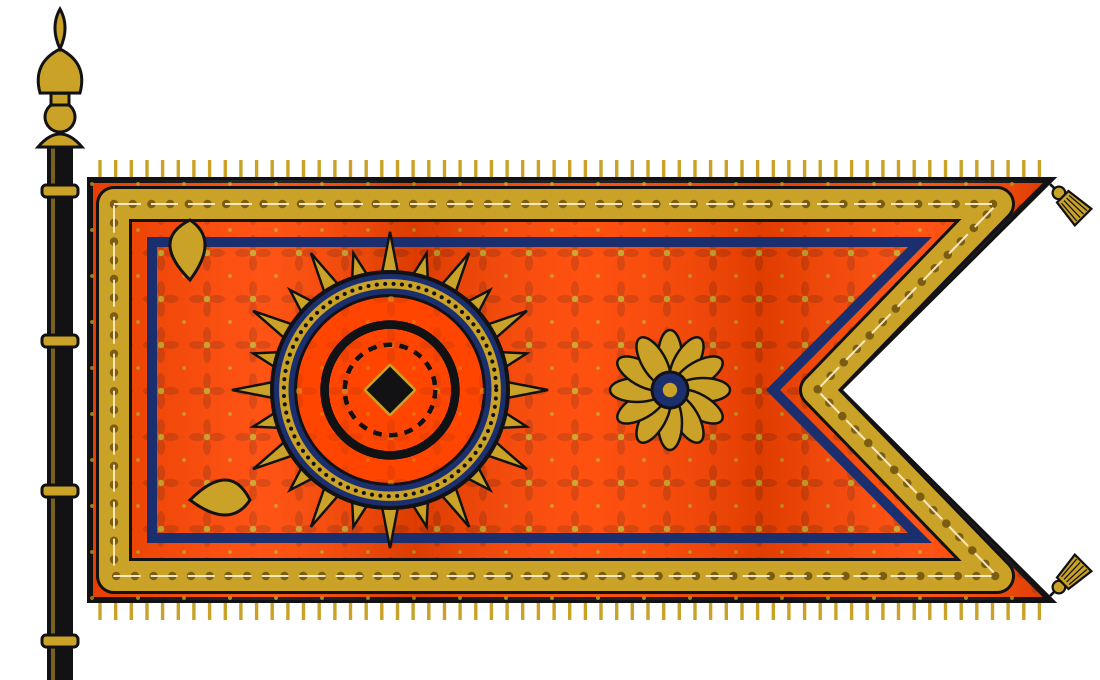
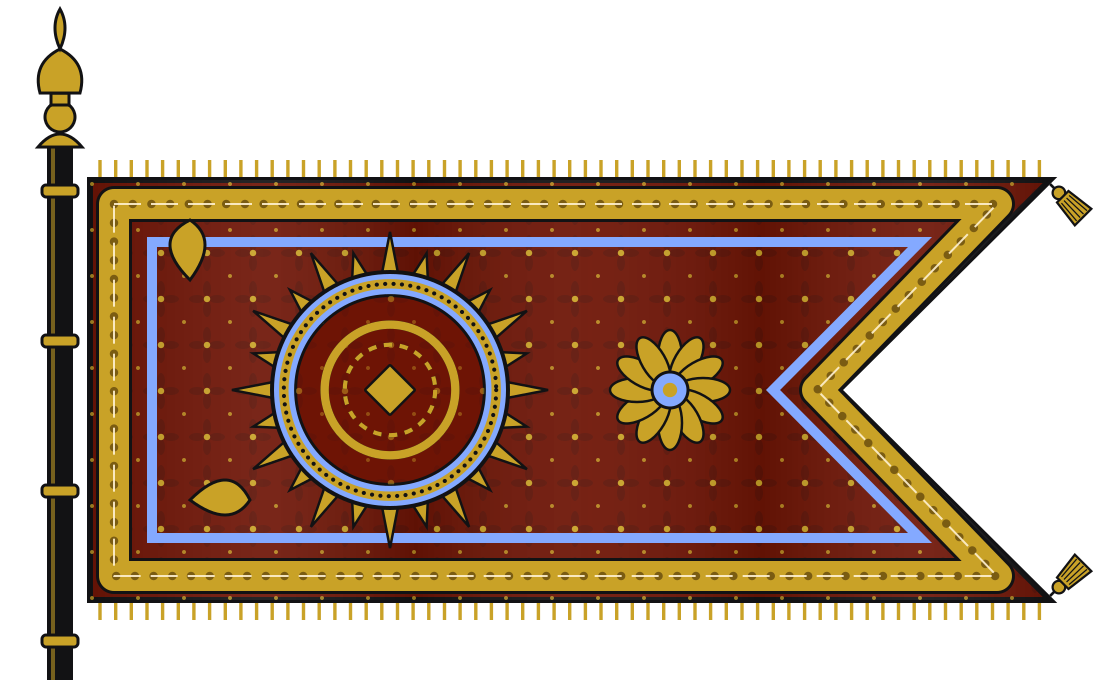

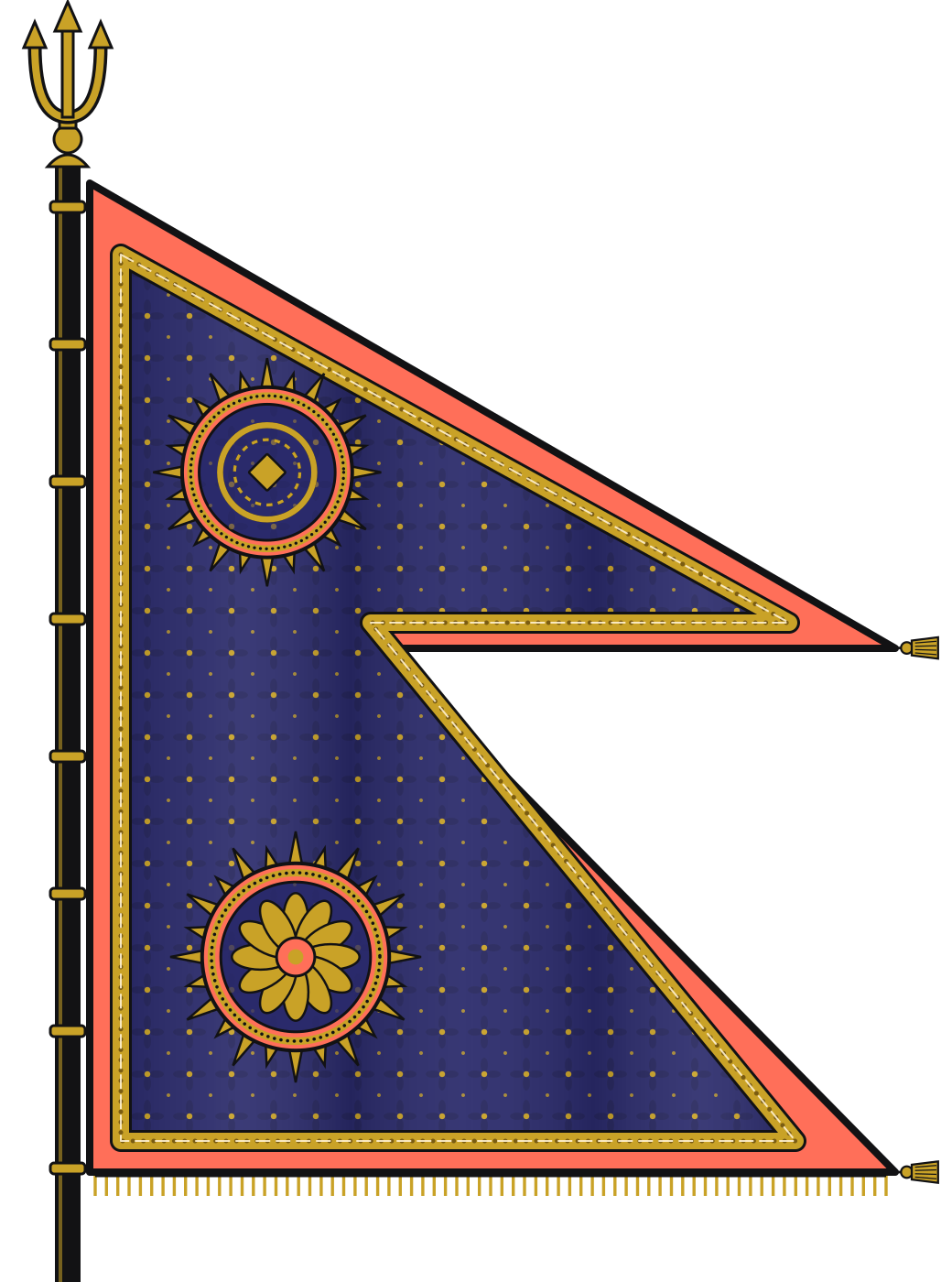

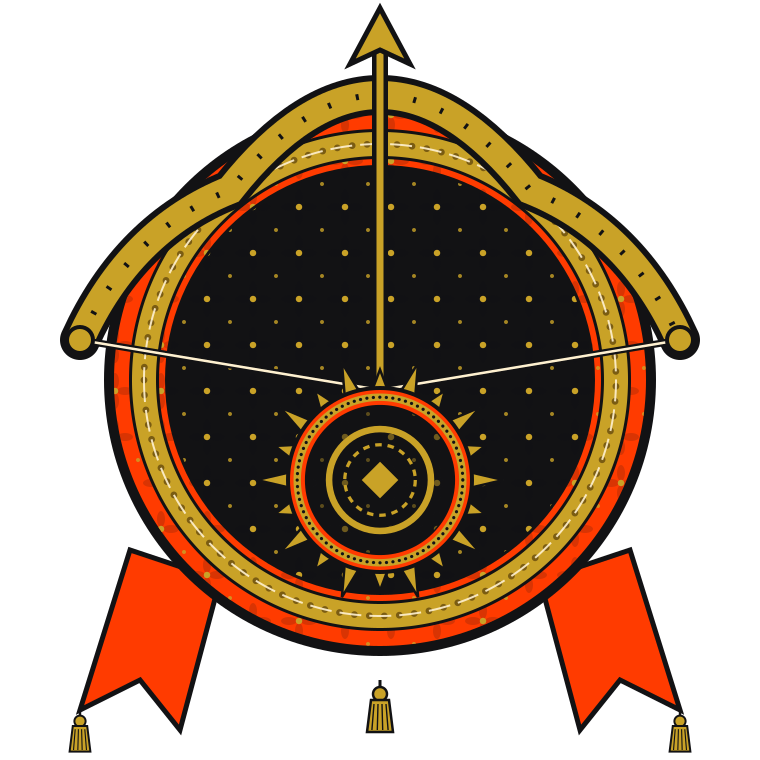
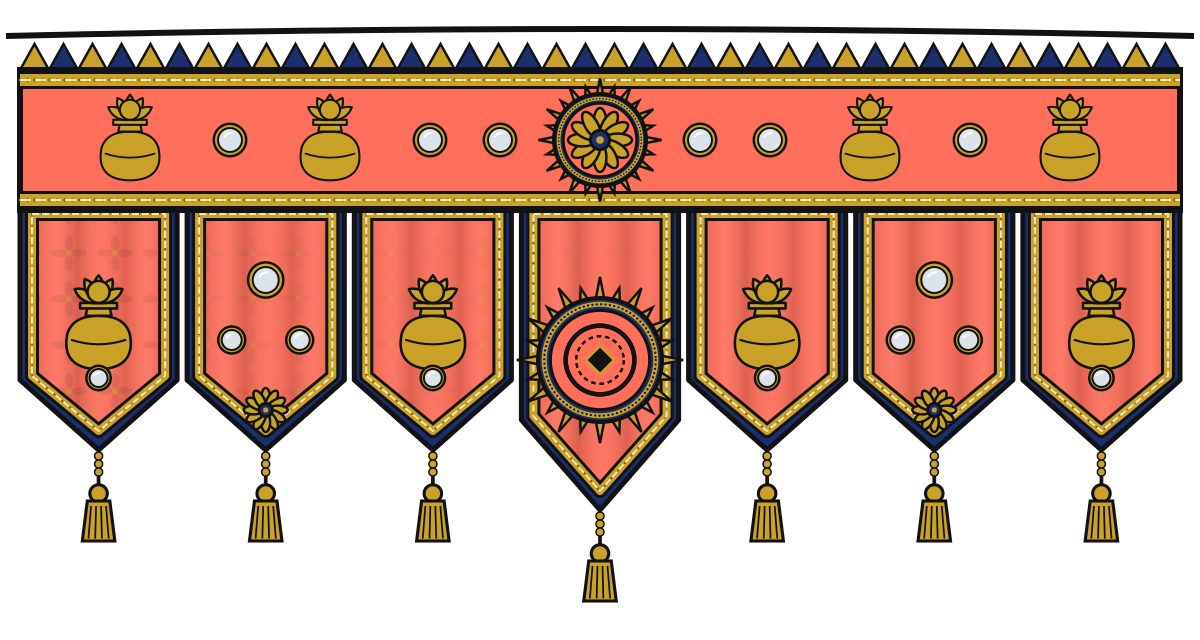
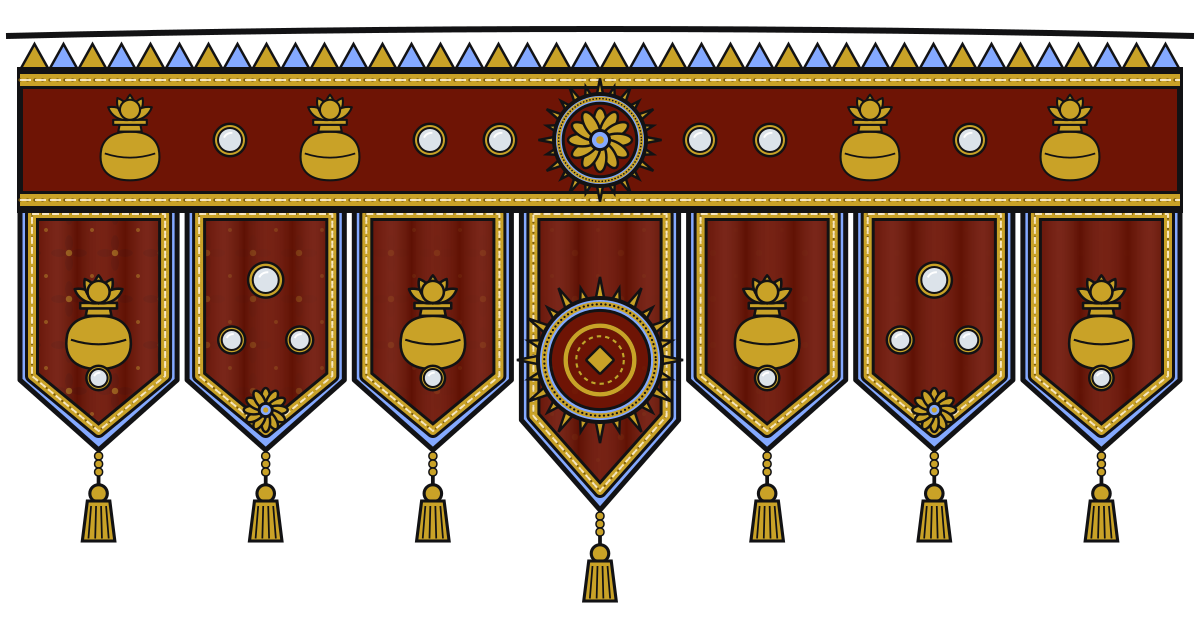

Historic banner
None known
New flag types
| Accessory | For this clan | Basis |
|---|---|---|
| A9 Pota-dhvaja · ship and trade flag For ships, caravans and markets | Not yet designed for this clan | Design |
| A10 Utsava-patāka · festival flag Light, bright flag for fairs and festivals | Not yet designed for this clan | Design |
| A11 Shoka-dhvaja · mourning flag White cloth with the emblem outline in the clan's metal | Not yet designed for this clan | Design |
7. Regalia
| Accessory | For this clan | Basis |
|---|---|---|
| E1 Chhatra · house parasol The ceremonial umbrella | Not yet designed for this clan | Design |
| E2 Chamara · fly-whisks The pair of whisks beside the head of the house | Not yet designed for this clan | Design |
| E3 Danda · staff of office Staff or scepter | Not yet designed for this clan | Design |
| E4 Simhasana · seat The seat of the house, covered in clan cloth | Not yet designed for this clan | Design |
| E5 Khetaka · shield A round shield; the Changi and Dhanush are its flag forms | Not yet designed for this clan | Regional tradition |
| E6 Kula-ayudha · clan weapon The weapon the clan honours | Not yet found for this clan | Under research |
8. Worn
| Accessory | For this clan | Basis |
|---|---|---|
| F1 Kula-vastra · clan cloth The clan's woven pattern in its kit colours | Not yet designed for this clan | Design |
| F2 Kirti-vastra · honour cloth A cloth earned for a deed, not inherited | Not yet designed for this clan | Design |
| F3 Kula-mala · garland flower The flower or leaf the clan wears as a garland | Not yet found for this clan | Under research |
| F4 Chinha · house pin A metal badge with the pin emblem | Not yet designed for this clan | Design |
9. Records
| Accessory | For this clan | Basis |
|---|---|---|
| H1 Clan words A traditional line in the native script | · “Under research: no clan line in the extracts” The name is given as Hindi sahra, jungle[1]. The clan's own line is still to find. | Documented |
| H2 Biruda · titles The house's title or titles | Not yet found for this clan | Under research |
| H3 Prashasti · praise genealogy The lineage as written at the head of a grant | Not yet found for this clan | Under research |
| H4 Vahi · clan register The book of the clan's births, marriages and deaths | Not yet found for this clan | Under research |
| H5 Rana-ghosha · war cry The clan's cry in battle or celebration | Not yet found for this clan | Under research |
10. VishwaVit · knower of the world
Game values are design choices for this project, not historical claims.
References
- Wikipedia, Sahariya (caste), read 2026-11-05, https://en.wikipedia.org/wiki/Sahariya_(caste)
- Sweta Daga, A Sahariya Holi, People's Archive of Rural India, 2015 (modified 2025), read 2026-11-05, https://ruralindiaonline.org/articles/a-sahariya-holi
- Wikipedia, Tribals in Madhya Pradesh, read 2026-10-19, https://en.wikipedia.org/wiki/Tribals_in_Madhya_Pradesh
- Wikipedia, List of Scheduled Tribes in Rajasthan, read 18 Oct 2026, https://en.wikipedia.org/wiki/List_of_Scheduled_Tribes_in_Rajasthan
- Wikipedia, List of Scheduled Tribes in Uttar Pradesh, read 2026-10-22, https://en.wikipedia.org/wiki/List_of_Scheduled_Tribes_in_Uttar_Pradesh
- National Virtual Library of India (wzcc.nvli.in), Saharia Swang record node 2613153, read 2026-11-05, https://wzcc.nvli.in/node/2613153
- Vajiram & Ravi, Key Facts about Sahariya Tribe, read 2026-11-05, https://vajiramandravi.com/current-affairs/key-facts-about-sahariya-tribe/
- Wikipedia, List of Scheduled Castes in Uttar Pradesh, read 2026-10-22, https://en.wikipedia.org/wiki/List_of_Scheduled_Castes_in_Uttar_Pradesh