The Rathwa, also written Rathawa, Rathva or Rathava, are a Scheduled Tribe of east-central Gujarat (list dated 09-07-2024), highest in Chhota Udaipur and Vadodara, and also listed in Karnataka and Maharashtra[1][2]. The community recalls a migration from present-day Madhya Pradesh in the Middle Ages, and was counted with the Kolis until the 1971 census[1][2]. Its chief god is Baba Pithora, also called Baba Deb, and the Pithora wall painting is made to thank him after a vow is fulfilled[2][3]. Sahapedia and the district site both say there are 56 clans, and that marriage within the same clan is forbidden[3][4]. The 2011 census counted 643,381 in India, of whom 642,348 were in Gujarat[1].
01Faith and deities
Kalika of Pavagadh, Panchmahal[5]
The presiding goddess of the clan's homeland or capital: a link of place, not a recorded clan tie.
| Deity or tradition | Place in the clan's life | Evidence |
|---|---|---|
| Baba Ind (Indra, also Meghraj) | A king in the Pithora story; Pithora claims a share of his kingdom | [3] |
| Kandu Raja (Savariya Maulan) | Father of Pithora in the Pithora story | [3] |
| Rani Kali Koyal | Mother of Pithora in the Pithora story | [3] |
| Rani Kajal | Rescued Pithora after he was abandoned | [3] |
| Horse of Baba Ganesh | Listed among the deities in Sahapedia; no further detail | [3] |
| Other gods and goddesses | Also worshipped; not named in the district account | [4] |
| Mahakali of Pavagadh (KulDevi) | Clan goddess in the Atlas, basis 'homeland shrine'. No extract ties the Rathwa to Pavagadh; the Kalika page says local Bhil and Koli first worshipped her[5] | [6][5] |
| Pujara (also Gor), priests | Priests from the community, who lead marriages | [2] |
| Badva, shaman | Takes a share of the harvest, grain, money, chicken, coconut and a goat's head | [3] |
| Ghardhani, householder | Ritual role: the home owner (Sahapedia) | [3] |
02Temples
The extracts name no temple built or patronised by the clan. The community's own shrines are the devasthal at the village edge[3]. A travel listing says the Devmogra Mata Mandir at Bhad Bhunja is revered especially by the Rathwa, with a fair in Chaitra[7]. It is a weak source and is left out of the table.
Built by the clan
| Temple | Deity | Built by | When | Where |
|---|---|---|---|---|
| Devasthal, village-edge shrines | Not named in the extract | The community (Sahapedia calls them community shrines) | Not dated | Village edges[3] |
Given patronage or grants by the clan
Not recorded.
03Languages and scripts
| Language or script | Kind | Under the clan | Evidence |
|---|---|---|---|
| Rathvi (Rathwi) living | Dialect of Gujarati (Sahapedia); Indo-Aryan | Spoken within the family and the community[2][1] | [3][6] |
| Gujarati living | Regional language | Used with others and for writing[2] | [2] |
| Hindi | Used outside the community | Used with outsiders[2] | [2] |
04Books and literature
No book written or patronised by the clan is named in the extracts. The works below are scholarship about the Rathwa, as cited in Wikipedia; none was fetched directly.
Written during the clan's history
| Work | Author | Kind | When | Link to the clan |
|---|---|---|---|---|
| The Rathawas of Chota-Udaipur: A Short Ethnographic Note | R. B. Lal | Journal article | 1970 | [8] |
| Being Tribal | Ratnagar | Cited work | 2010 | [9] |
| Tribal Chic | Alles | Cited work | 2012 | [10] |
| The Structure of Indian Society | Arvind Shah | Cited work | 2012 | [11] |
| Tribal Land Systems | Harshad Trivedi | Cited work | 1993 | [12] |
| Hints of Ontology in Eastern Gujarat | Alles | Cited work | 2017 | [13] |
| Pithora: Survey of a Living Socio-Cultural Tradition in Gujarat | Parikh | Survey | 2002 | [14] |
Given patronage by the clan
Not recorded.
05Thinkers and scholars
| Name | Field | Era | Contribution |
|---|---|---|---|
| R. B. Lal | Ethnographic study | 1970 | A short ethnographic note on the Rathawas of Chota-Udaipur; records about 32 septs[8][1] |
| Parikh | Study of Pithora | 2002 | A survey of Pithora as a living tradition in Gujarat[14] |
| Alles | Writings on the Rathwa | 2012 and 2017 | Says Pithora paintings resemble cosmographs[13][1] |
| Ratnagar | Writings on tribal identity | 2010 | Reports that Rathwa informants rejected a Bhil descent[9] |
| Arvind Shah | Writings on Indian society | 2012 | Notes the Koli and Bhil confusion, from few systematic studies of the Kolis[11] |
The scholarship is thin in the extracts: most of it is the reading list of the Wikipedia article, cited here as listed.
06Art and architecture
The extracts describe Pithora painting in most detail, and Sahapedia calls it a form of writing that expresses the community's faith, culture and history[3]. Body tattoos are recorded[2][4]. Pithora is painted by Rathwa, Bhil and Bhilala painters[15].
Painting and wall art
| Art form | What it is | Era | Evidence |
|---|---|---|---|
| Pithora wall painting | Painted on three inner walls, chiefly at the threshold (osari), to please Baba Pithora. Horses are the main motif, with tiger, camel and elephant figures; about 165 motif types in one painting; bamboo brushes; pigments from mahuda liquor and cow's milk. Ardho Pithora shows 5–9 horses; Akho Pithora shows 18 horses with celestial riders. The painting also shows gods, people, plants, birds and animals[1][3] | Painted after a vow is fulfilled; also painted in Dhanak and Naikda houses | [3][2][4] |
Sculpture and temple art
| Art form | What it is | Era | Evidence |
|---|---|---|---|
| Clay horses and terracotta | Horse, tiger, elephant and camel figures made by Kumbhar potters; clay horses offered in thanks at temples; terracotta horses and lamps offered at devasthal shrines | Not dated | [1][3][2] |
| Wood-carved totems | Offered at the devasthal shrines. These are shrine offerings, not a clan totem | Not dated | [3] |
Temple and building architecture
Not recorded.
Weaving and textiles
Not recorded.
Clothing and jewellery
Not recorded.
Coins, pottery and crafts
| Art form | What it is | Era | Evidence |
|---|---|---|---|
| Bamboo brushes and bamboo articles | Brushes for painting Pithora; bamboo articles sold at the weekly haats | Not dated | [3][4] |
07History
Name and place
The name is said to come from "rath", a jungle and hill region (Rathvistar) near the Madhya Pradesh–Gujarat border[3]. The Chhota Udaipur district site also derives the name Rathava from an older region called "rath"[4]. TRTI records the inhabitants as Rathwas, also Rathawa Koli[2].
Migration as recalled
The community recalls a migration to Gujarat from present-day Madhya Pradesh in the Middle Ages[1][2]. The extracts give no date or route for it.
Counted with the Kolis (until 1971)
Medieval sources used "koli" for the people generally, and the Rathwa were not separately recorded until the 1971 census; before that they were counted with the Kolis[1].
Descent: two disputed claims
One claim: some sources say the Rathwa descend from migrant Bhil, but Rathwa informants rejected this, according to Ratnagar[1]. The other: Kolis treat the Rathwa as inferior, and some sources call them Rathwa Koli[1]. Neither claim is settled in the extracts.
Census figures
The 1981 census recorded 3,08,640 and the 2001 census 5,35,284 (2,73,296 men and 2,61,988 women)[2]. The 2011 census counted 643,381 in India[1].
08Journey and migrations
The extracts record one recalled movement, from present-day Madhya Pradesh into east-central Gujarat, with no dates or routes.
| When | From | To | Why | Evidence |
|---|---|---|---|---|
| Middle Ages (as recalled, undated) | Present-day Madhya Pradesh | East-central Gujarat, Chhota Udaipur | Community tradition of migration | [2] |
09Seats and lands
| Place | Role | Where today |
|---|---|---|
| Rath (Rathvistar), a jungle and hill region | Source of the name | Near the Madhya Pradesh–Gujarat border[3] |
| Chhota Udaipur, Jabugam and Nasvadi talukas | Highest numbers of the community (Wikipedia) | Gujarat; Nasvadi and Jabugam in Vadodara district[1] |
| Baria, Halol and Kalol talukas | Homeland talukas (Wikipedia) | Panchmahal district, Gujarat[1][2] |
| Hill villages of Chhota Udaipur state | Historical polity | Gujarat[6] |
| Madhya Pradesh | Place of origin as recalled | 500 counted there in 2011[1] |
| Karnataka and Maharashtra | Also listed as Scheduled Tribes (list dated 09-07-2024) | 45 in Karnataka and 488 in Maharashtra (2011)[1][16] |
10Notable figures
| Name | Role | Era | Known from |
|---|---|---|---|
| Amarsinh Rathawa | Member of Parliament (Lok Sabha) | 1977–1989 | [1] |
| Mohansinh Chhotubhai Rathava | Politician | Not dated in the extract | [1] |
| Ninad Rathva | Cricketer | Born 1999 | [1] |
11Allies, rivals and marriages
| People | Relationship | When |
|---|---|---|
| Koli | Treat the Rathwa as inferior; some call them Rathwa Koli; counted with them until 1971 | Until the 1971 census |
| Bhil | Some sources say the Rathwa descend from migrant Bhil; Rathwa informants rejected this | Not dated |
| Dhanak and Naikda | Culturally indistinguishable from the Rathwa; Pithora painted in their houses | Not dated |
| Patels, Rajputs and Brahmans | Traditionally did not accept water or food from Rathwas; restrictions eased | Traditional; eased |
12Society and livelihood
The Rathwa are endogamous and patrilineal in inheritance (Lal, cited in Wikipedia)[1]. They are patrilocal, and the eldest son heads the family[2]. Literacy was about 35% in 2001[1].
Government and social order
| Institution or group | What it was | Evidence |
|---|---|---|
| Traditional council | Police Patel settles disputes with the elders[2] | [2] |
| Marriage rules and kin | No marriage with a maternal uncle's daughter or a father's brother's daughter; avoidance between daughter-in-law and father-in-law; joking relation between an elder sister's husband and wife's younger sister; dharambhai and dharambahin as ritual kin[2] | [2] |
| Bhagat and Jagat | Divisions: Bhagat, influenced by Swaminarayan and vegetarian; Jagat, non-vegetarian[2] | [2] |
| Birth, marriage and death | Birth: 40–45 days of pollution; naming after one year; mundan for boys. Marriage: arranged, with elopement and fair-based choice also, and bride-price; the Pujara leads. Death: cremation, with egarma, barma or terma on the 11th–13th days[2] | [2] |
Livelihood over time
| Era | Livelihood | Evidence |
|---|---|---|
| Traditional | Agriculture with gathering, fishing and hunting (Wikipedia) | [1] |
| Today | Mainly small and medium farmers; barter at a weekly haat[3] | [3] |
| Today | Some in the police, the Border Security Force and clerical posts; boys to secondary school and girls to primary[2] | [2] |
13Sub-clans and related clans
Exogamous clans (petha) named by TRTI: Hamania, Thebaria, Mahania, Kothari Baka and Fadia. The community is also divided into the Bhagat and Jagat divisions. Sahapedia and the district site say there are 56 clans and name none[3][4].
| Clan | Relation | Where | Size | In the Atlas | Evidence |
|---|---|---|---|---|---|
| Hamania | Sub-clan | Exogamous clan (petha) | new clan candidate | trti_rathwa | |
| Thebaria | Sub-clan | Exogamous clan (petha) | new clan candidate | trti_rathwa | |
| Mahania | Sub-clan | Exogamous clan (petha) | new clan candidate | trti_rathwa | |
| Kothari Baka | Sub-clan | Exogamous clan (petha) | new clan candidate | trti_rathwa | |
| Fadia | Sub-clan | Exogamous clan (petha) | new clan candidate | trti_rathwa | |
| Bhagat | Branch | Division; Swaminarayan-influenced and vegetarian | new clan candidate | trti_rathwa | |
| Jagat | Branch | Division; non-vegetarian | new clan candidate | trti_rathwa | |
| Bhil | Related people | Some sources give the Rathwa a Bhil descent; Rathwa informants rejected it | ST-027 | kd_w_rathwa | |
| Bhilala | Related people | Named with the Bhil as Pithora painters | ST-342 | pithora_painting_wiki | |
| Naikda | Related people | Culturally indistinguishable from the Rathwa; Pithora painted in their houses | ST-232 | kd_w_rathwa | |
| Dhanak | Related people | Culturally indistinguishable from the Rathwa; Pithora painted in their houses | new clan candidate | kd_w_rathwa | |
| Koli | Related people | Rathwa counted with Kolis until 1971; some call them Rathwa Koli; Kolis treat the Rathwa as inferior | new clan candidate | kd_w_rathwa |
Clans marked "new clan candidate" are not in the Atlas yet.
14Surnames
Names are formed from the father's name and the community name[2]. Spellings in the sources are Rathva, Rathwa, Rathawa and Rathava[1]. No surname list is in the extracts, and no count is given.
| Surname | Clan or sub-clan | Where | People with this surname | Also used by other communities |
|---|---|---|---|---|
| Rathva | Community name, used after the father's name | Spelling of the community name in the sources (also Rathwa, Rathawa, Rathava) | not yet counted | Not checked |
Counts are of everyone with the surname, from the cited source and year, not only members of this clan. A surname shared with other communities says nothing about any one person's origin.
15Songs and music
The extracts name folk songs sung at marriages, and dance and music at festivals and weddings. None prints a lyric or a title.
16Poems, lullabies and children's rhymes
None recorded yet.
17Stories, legends and proverbs
Stories and legends
| Story | What happens | Told by | Evidence |
|---|---|---|---|
| The birth of Pithora | Pithora is born to Rani Kali Koyal and Kandu Raja, abandoned, and rescued by Rani Kajal. He claims a share of Baba Ind's kingdom. Lakhari and Jokhari, scribes of the future, predict it, and the gods persuade Baba Ind to give half his kingdom. A drought-time vow explains the origin of the rituals. | Rathwa tradition, as summarised by Sahapedia | [3] |
Proverbs and sayings
Not recorded.
18Festivals and fairs
| Festival or fair | When | Where | What happens |
|---|---|---|---|
| Pithora | Before Holi, January–February | Rathwa villages | A goat is sacrificed; Pithora is painted after a vow is fulfilled[2][1] |
| Holi | Not dated | Not stated | Listed among the community's festivals; melas follow Holi[3][2] |
| Dev-divaso | Not dated | Not stated | Named in the list of festivals; no description[3][4] |
| Dussehra | Not dated | Not stated | Named in the list of festivals; no description[3][2] |
| Dev-diwali | Not dated | Not stated | Named in the list of festivals; no description[3][4] |
| Akhatrij | Not dated | Not stated | Named in the list of festivals; no description[3][4] |
| Diwali and Ujani | Not dated | Not stated | Named in the list of festivals; fowls are sacrificed at festivals[2] |
| Telav Mata Mela | After Holi | Pavijetpur | One of the melas after Holi[3][4] |
| Gher Mela | After Holi | Kawant | One of the melas after Holi[3][4] |
| Dungarvat, Jhojh, Raisingpur, Chhota Udepur and Amrol melas | After Holi | Those places | Listed among the melas after Holi[3][4] |
| Ger Mela and Turkheda | Not dated | Not stated | Named in Wikipedia without description[1] |
| Bhagoria | Not dated | Not stated | The Rathwa take part (saved note on the Bhagoria festival)[17] |
19Food, dress and games
Food
| Item | What it is | Evidence |
|---|---|---|
| Staple diet | Rotla, rice, dal and sabji; sometimes meat or fish; home-brewed alcohol[2] | [2] |
Dress
Not recorded.
Games and martial arts
Not recorded.
Tags: living still practised · revived brought back after a break · lost known only from records · research reported but not yet confirmed from a source. Songs and poems under copyright are listed by title only; restricted or sacred material is noted without its content.
20Status today
The Rathwa are a Scheduled Tribe (list dated 09-07-2024), living mainly in Gujarat, with smaller numbers listed in Karnataka and Maharashtra[1][16][6].
Recognised heritage
| What | Recognition | Evidence |
|---|---|---|
| Pithora painting | Recorded on the Chhota Udaipur district culture and heritage page[4] | [4] |
| Scheduled Tribe list | Recorded in the Atlas from the list dated 09-07-2024[6] | [6] |
Not reviewed by the community. No community review is recorded in the extracts.
21For children
The painted horse
In Chhota Udaipur in Gujarat live the Rathwa people. Their chief god is Baba Pithora, who is thought to ride a horse. When a family makes a vow and the vow comes true, they paint a Pithora picture on the walls of their house. The painting is made on three inner walls, and it is painted most of all at the threshold. It shows horses, gods, plants, birds and animals. The painter uses a bamboo brush and natural colours. The painting is a way to say thank you, and it tells the family's faith and history on the wall.
Written for this project
22Across the project
| Project | What carries this clan | Status |
|---|---|---|
| Atlas of the Janas | Homeland: east-central Gujarat, with the Chhota Udaipur and Panchmahal talukas. The extracts give no pin coordinates. | To check |
| KulDevi and GrahDevi | Mahakali of Pavagadh (Atlas, basis 'homeland shrine'); the GrahDevi forms in the Atlas are Kali, Tara, Shodashi, Bhuvaneshvari, Bhairavi, Chhinnamasta, Dhumavati, Bagalamukhi, Matangi and Kamala | From the Atlas |
| Planet naming | Not yet checked against the Tier registers | To check |
| Renaming and waters | The name comes from "rath", a hill region; no water name is in the extracts | — |
23Open questions
- Which names make up the 32 septs recorded by Lal (1970), and the 56 clans given by Sahapedia and the district site?
- Descent: the Bhil descent claim and the Koli claim are both in the extracts, and neither is settled. Set out both with sources and the community's own view.
- When and by what route did the migration from Madhya Pradesh happen? The extracts give neither date nor route.
- No extract ties the Rathwa to Pavagadh. The Atlas's KulDevi, Mahakali of Pavagadh, needs a source from the community or a study of the Rathwa.
- Devmogra Mata Mandir at Bhad Bhunja is named in a travel listing (weak source). Check it against a Gujarati source before it is placed in the temples.
- The Bhagoria festival: which Rathwa groups take part, and when. Source: saved note from the Bhil research, not yet read directly.
- Descendants: the extracts name no community that claims descent from the Rathwa.
- Community review of this page is still to come.
- Contradiction (Astitva): the intro called Pithora painting a visual record, but the research note says Pithora as a form of writing is not a register (sahapedia_pithora_rathvas). The intro now says only that it is a painted tradition; whether it counts as a record is open.
- Contradiction (KulDevi): the Atlas names Mahakali of Pavagadh as the clan goddess (master_sheet), and the page earlier said she was not the clan's deity. The page now says only that no extract ties the clan to her (kd_w_kalika_pavagadh).
- Contradiction (counts): Sahapedia and the district site give 56 clans (sahapedia_pithora_rathvas, chhotaudepur_nic_culture), while Lal (1970), as cited in kd_w_rathwa, records about 32 septs. The two counts are not reconciled.
24Astitva
अस्तित्व · being, existence: everything by which the clan is known
Pithora painting is the clan's painted tradition, and its horse, tiger, elephant and camel motifs are documented[3][2]. The extracts name no coin, seal, title, war cry, garland flower or clan totem.
Every clan has every accessory, royal objects included. Each one says how it is known: Documented This clan's own object is recorded. · Regional tradition Recorded for the region or for peoples like this one, not for this clan. · Design Made for this project, with no historical claim. · Under research To be found for this clan from sources. Legends and titles are written in the clan's own script.
1. Seals and coins
| Accessory | For this clan | Basis |
|---|---|---|
| B1 Rajamudra · house seal Round seal with the clan emblem and a short legend in the clan's script | Not yet designed for this clan | Design |
| B2 Anguliya-mudra · signet ring Personal seal ring of the head of the house | Not yet designed for this clan | Design |
| B3 Chhapa · house stamp Ink or block stamp for letters, goods and cloth | Not yet designed for this clan | Design |
| B4 Tamrapatra · charter plate Copper-plate grant on a ring, closed with the house seal | Not yet designed for this clan | Design |
| B5 Shreni-mudra · guild or trade seal Seal for the clan's trade, craft or caravan | Not yet designed for this clan | Design |
| C1 Clan coin Emblem or deity on one side, a legend in the clan's script | Not yet designed for this clan | Design |
| C2 Coin die The die that strikes the coin | Not yet designed for this clan | Design |
2. Living symbols
| Accessory | For this clan | Basis |
|---|---|---|
| I1 Totem trio The tree, bird and animal the clan protects | Not yet found for this clan | Under research |
| I2 Kaval-maram · guardian tree The tree that stands at the clan's seat | Not yet found for this clan | Under research |
3. Stone and gate
| Accessory | For this clan | Basis |
|---|---|---|
| G1 Torana · gateway The built gate of the seat; the cloth Toran hangs in it | Not yet designed for this clan | Regional tradition |
| G2 Viragallu · hero stone Carved panel stone for a member who died defending the clan | Not yet designed for this clan | Regional tradition |
| G3 Kula-shila · clan stones Standing and table stones that remember the ancestors | Not yet designed for this clan | Design |
| G4 Jayastambha · victory pillar A pillar raised for a victory | Not yet designed for this clan | Design |
| G5 Sima-shila · boundary stone Marks the clan's land, with a line in the native script | Not yet designed for this clan | Design |
4. Sounds
| Accessory | For this clan | Basis |
|---|---|---|
| D1 Pancha-mahashabda · five great sounds The right to five instruments | Not yet designed for this clan | Design |
| D2 Shankha · clan conch The clan's own named war conch | Not yet designed for this clan | Design |
| D3 Murasu · house drums Three drums: war, charity and justice | Not yet designed for this clan | Design |
5. Kit: colours, metals and emblems
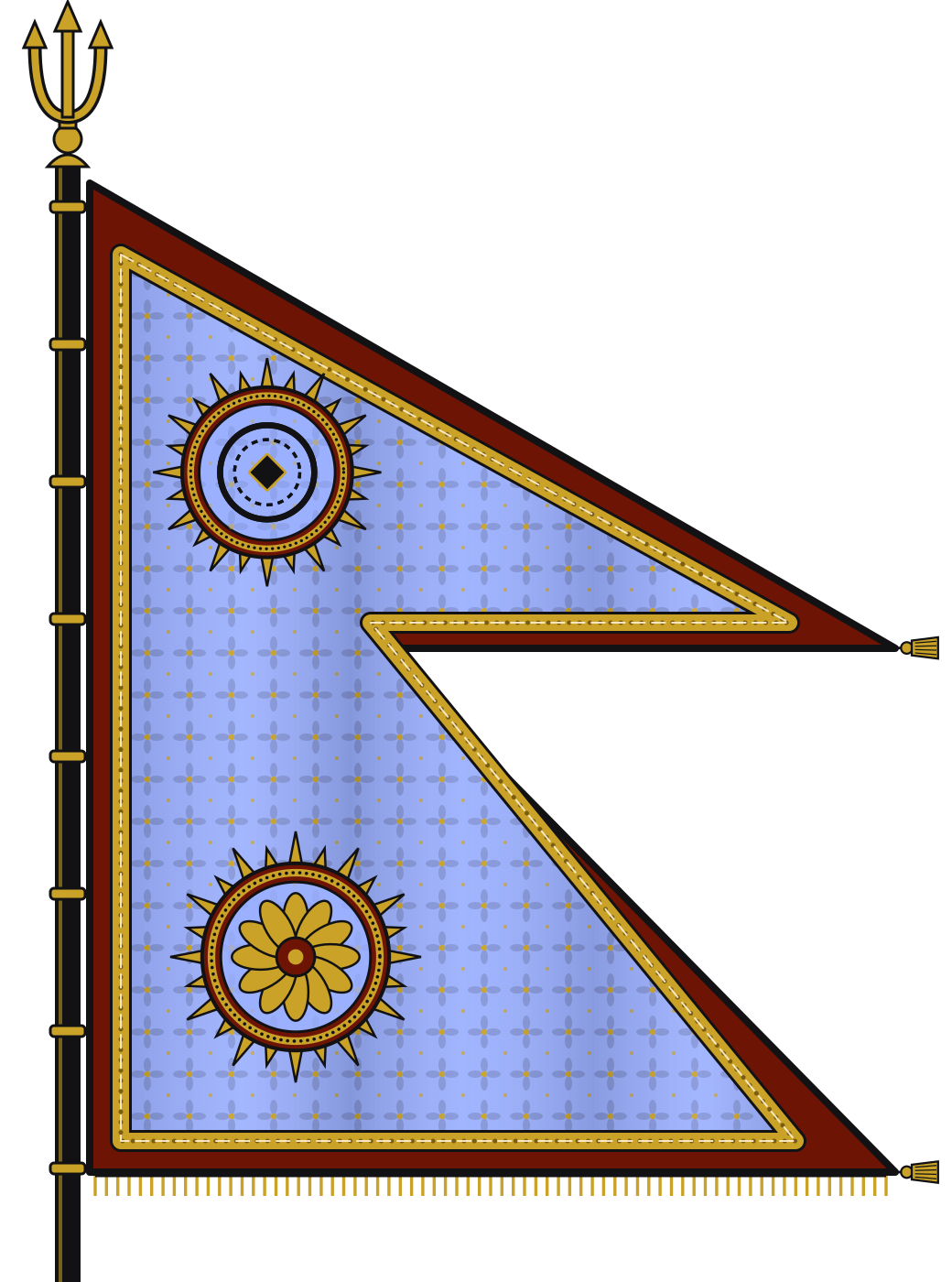
The Atlas gives a painted horse from a Pithora mural as the Rathawa's emblem, and the flag is a Changi (Dynasty Crest, Sun)[6]. The horse ties the emblem to Pithora painting, which the extracts describe in detail[3].
| Part of the kit | This clan |
|---|---|
| Field | Deep Brick #7E2A1E |
| Accent | Deep Cosmic Blue #9BB0FF |
| Emblem colour | Metallic Gold #C9A227 |
| Zari metal | Gold |
| Main emblem | A painted horse from a Pithora mural |
| Second image | — |
| Night and day | Every visual accessory has two versions: by night the emblem on the dark field, by day the clan's field colour on cloth woven from its metal. |
6. Flags
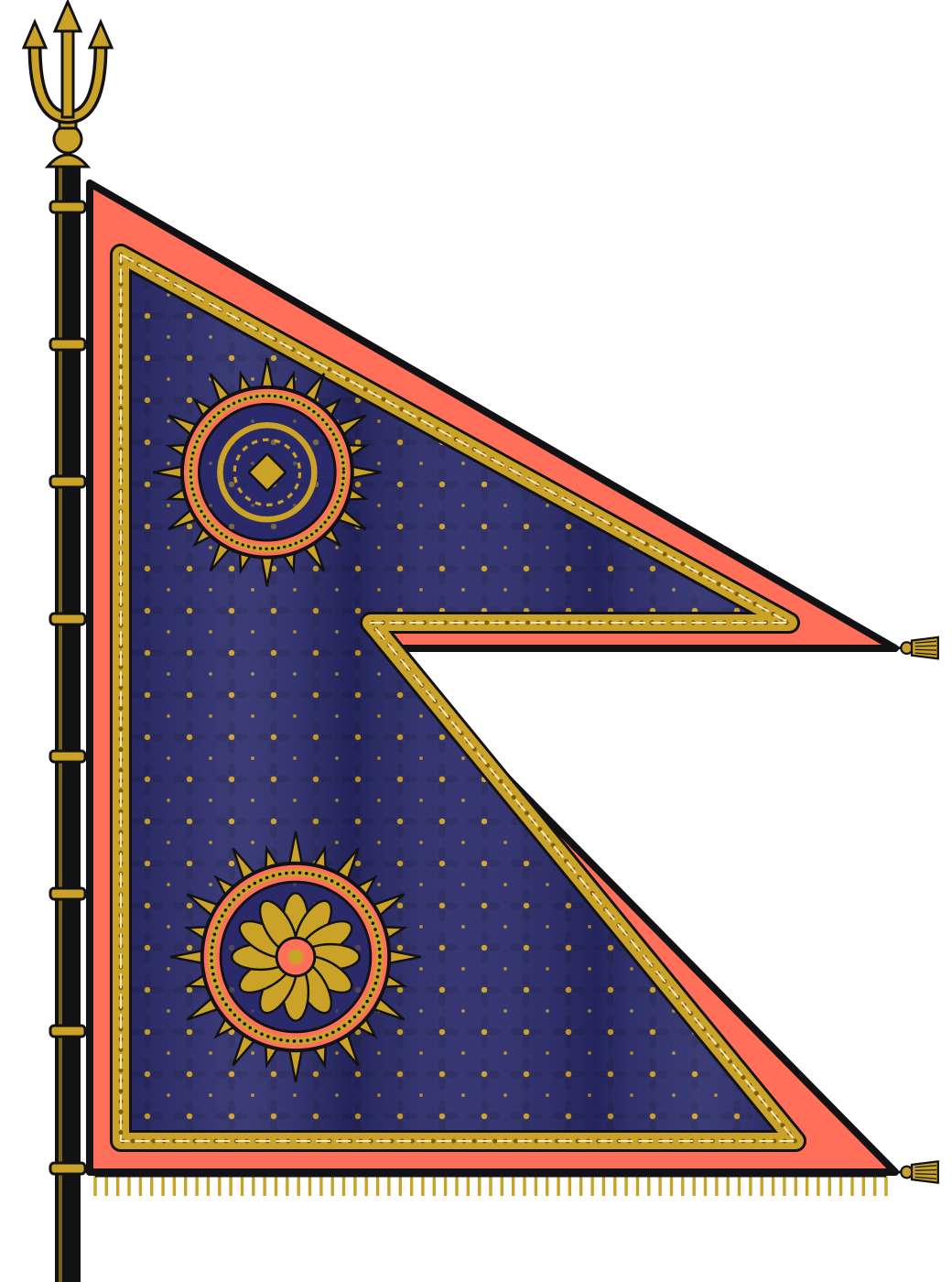
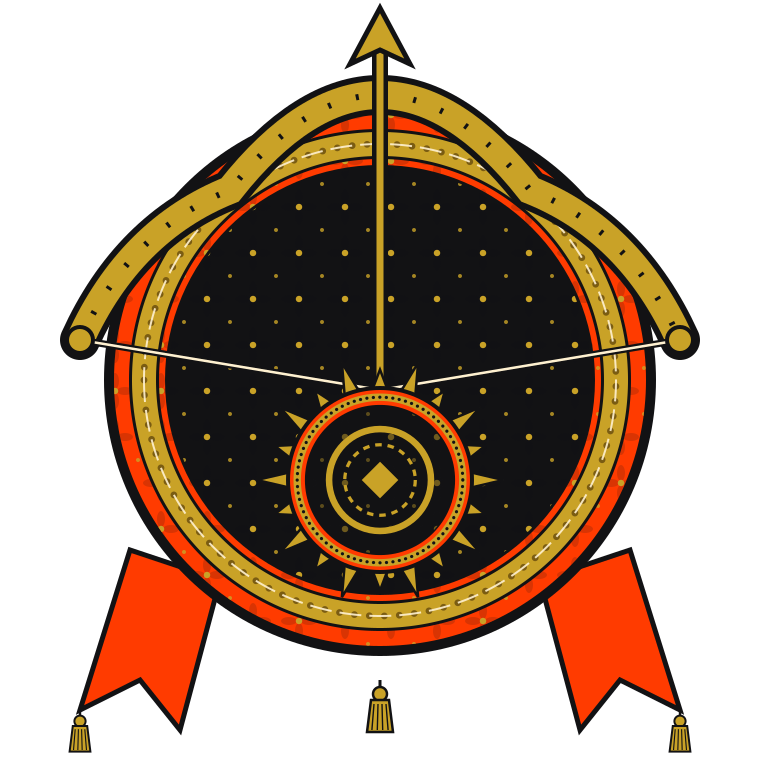
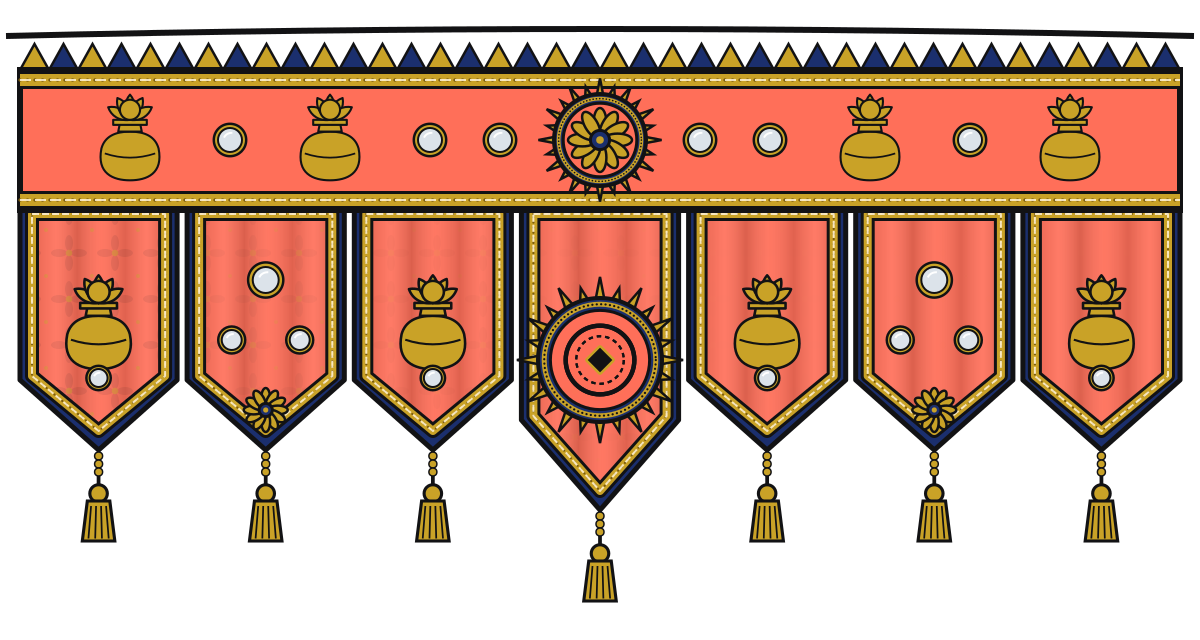
Every clan has every flag type; the type says the occasion and the colours say the clan. The outlined card is the flag the Atlas assigns.
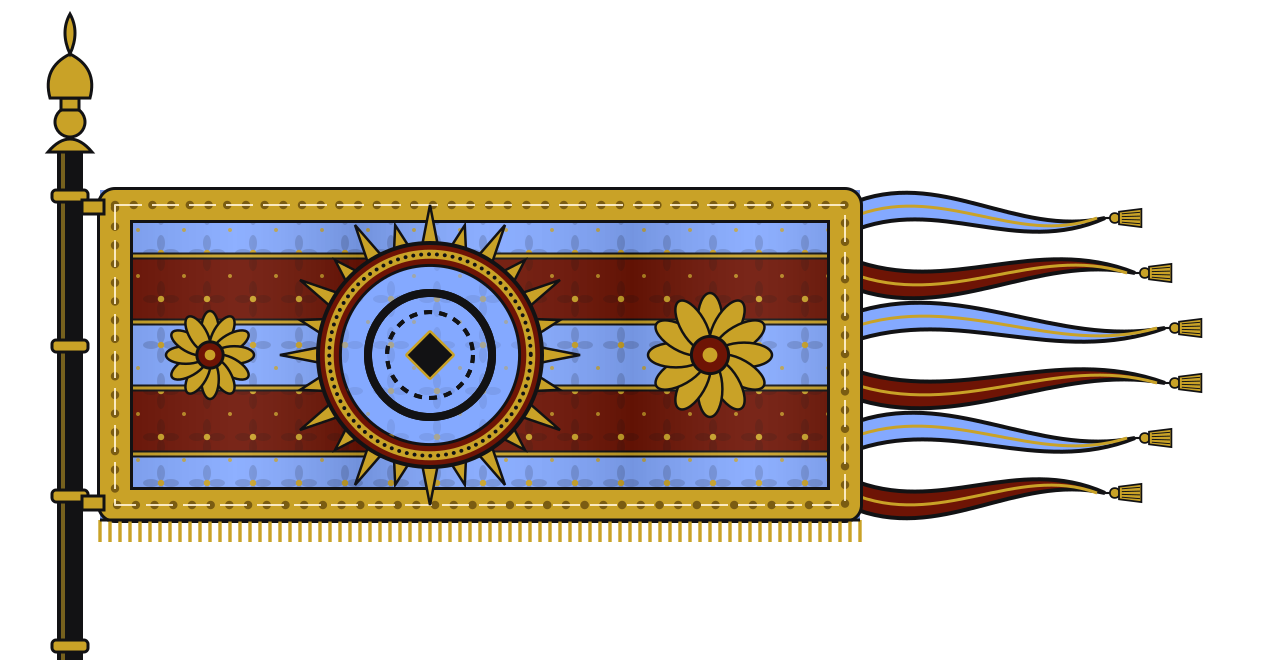
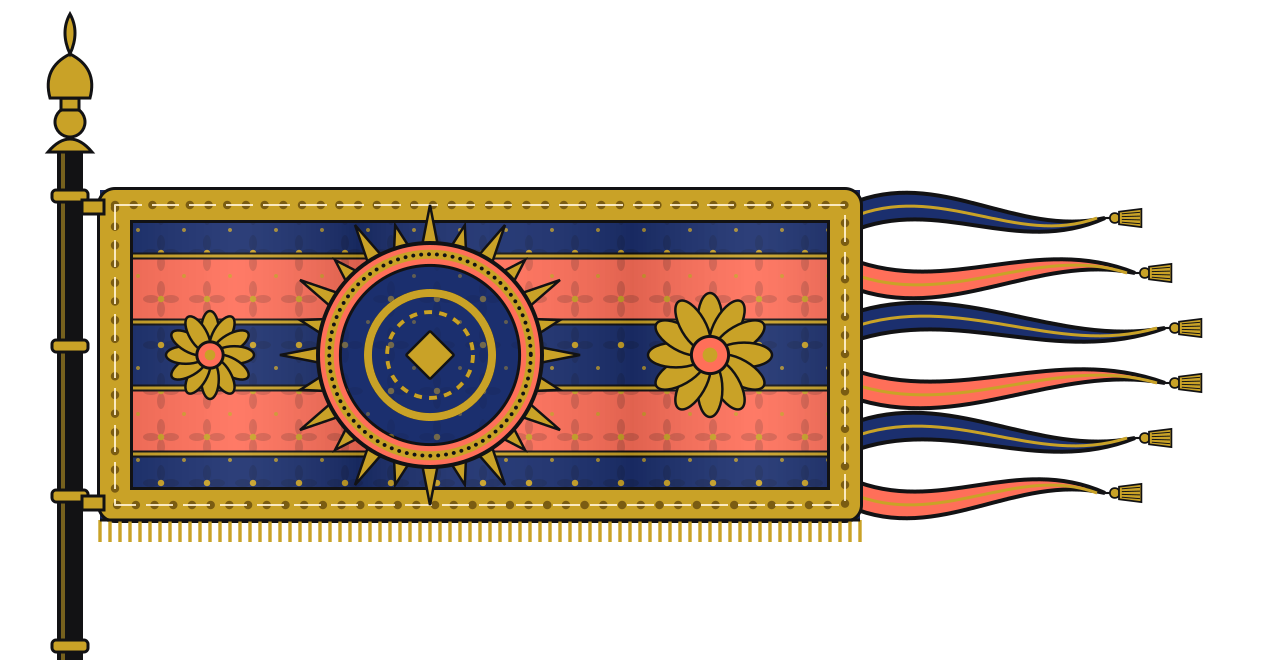
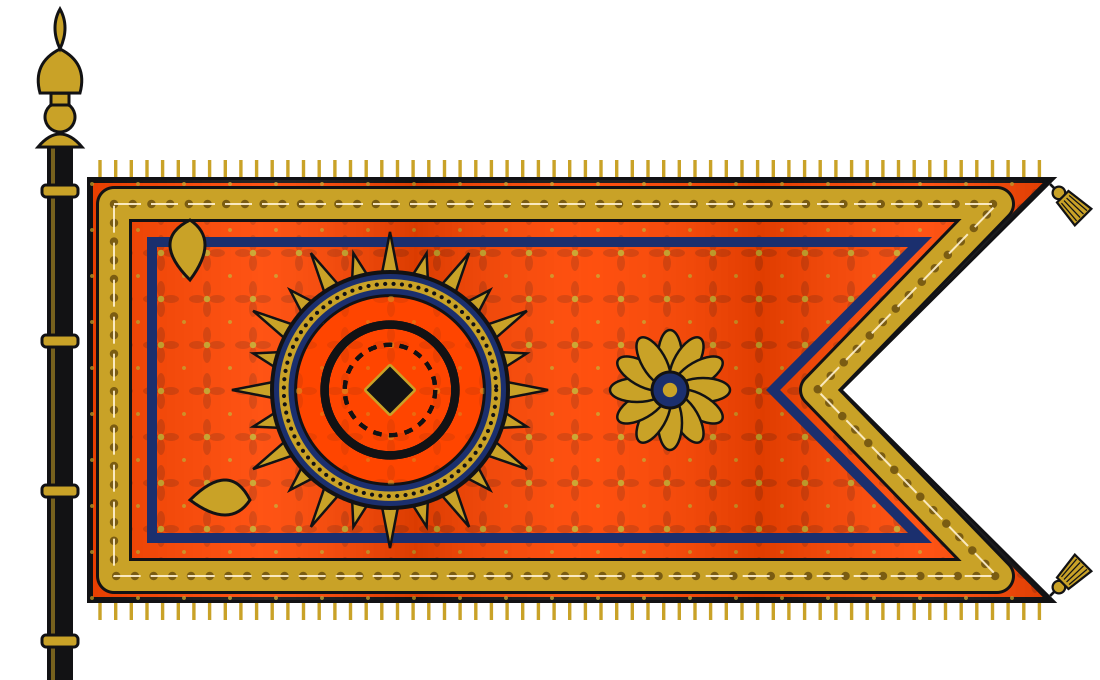
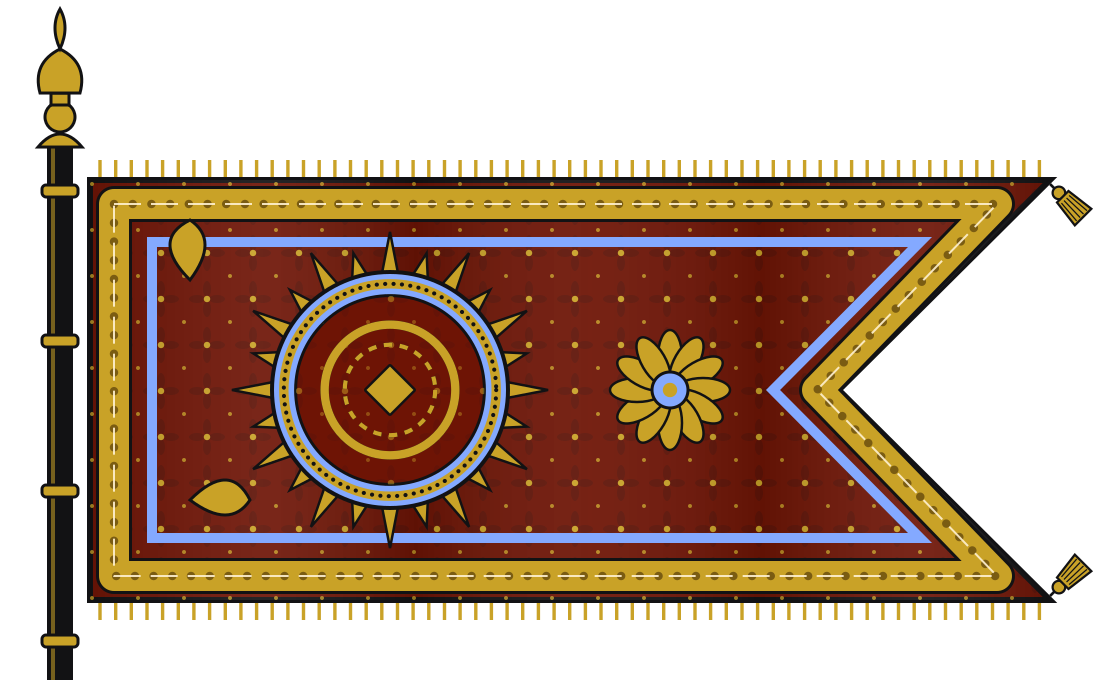

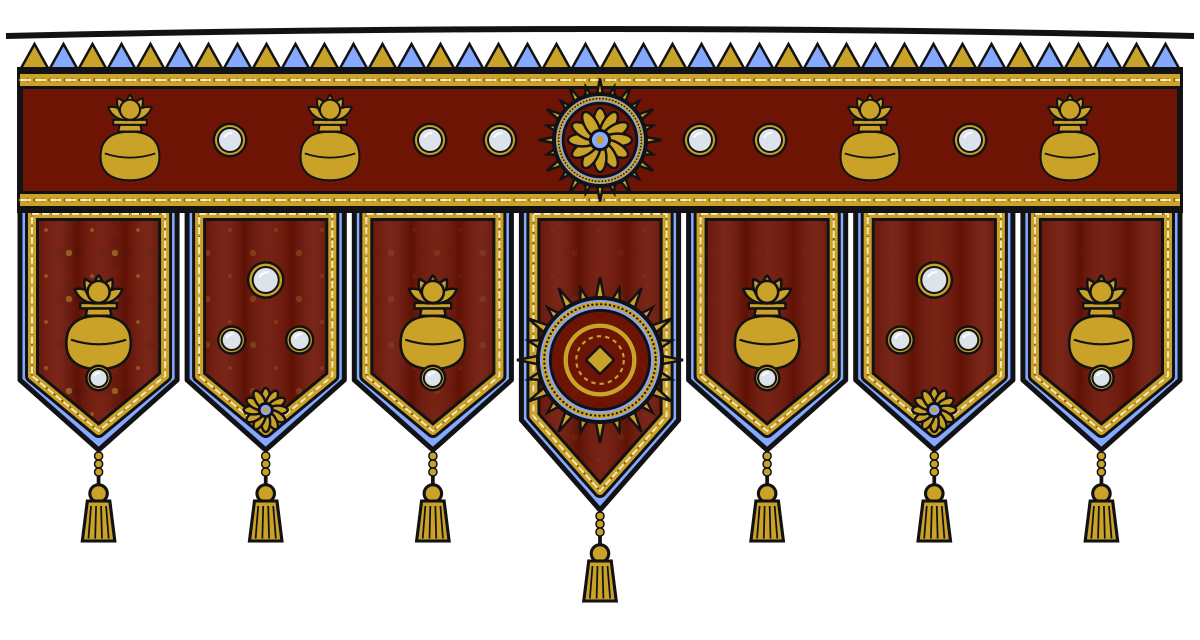
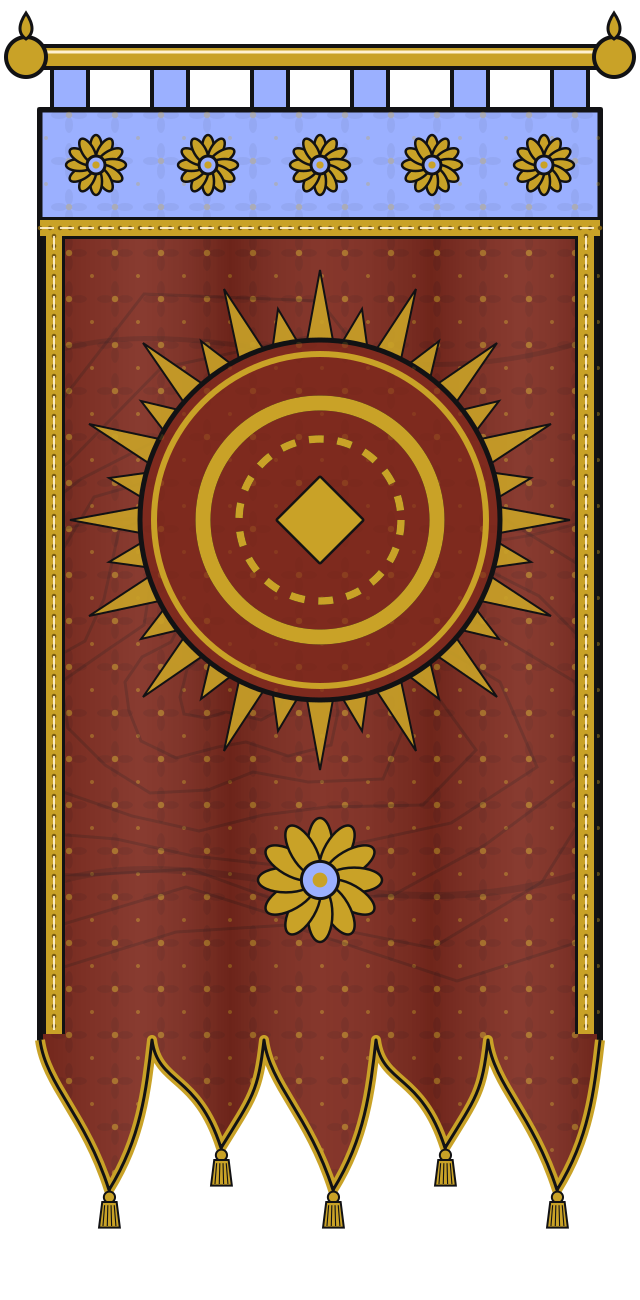
Historic banner
None known
New flag types
| Accessory | For this clan | Basis |
|---|---|---|
| A9 Pota-dhvaja · ship and trade flag For ships, caravans and markets | Not yet designed for this clan | Design |
| A10 Utsava-patāka · festival flag Light, bright flag for fairs and festivals | Not yet designed for this clan | Design |
| A11 Shoka-dhvaja · mourning flag White cloth with the emblem outline in the clan's metal | Not yet designed for this clan | Design |
7. Regalia
| Accessory | For this clan | Basis |
|---|---|---|
| E1 Chhatra · house parasol The ceremonial umbrella | Not yet designed for this clan | Design |
| E2 Chamara · fly-whisks The pair of whisks beside the head of the house | Not yet designed for this clan | Design |
| E3 Danda · staff of office Staff or scepter | Not yet designed for this clan | Design |
| E4 Simhasana · seat The seat of the house, covered in clan cloth | Not yet designed for this clan | Design |
| E5 Khetaka · shield A round shield; the Changi and Dhanush are its flag forms | Not yet designed for this clan | Regional tradition |
| E6 Kula-ayudha · clan weapon The weapon the clan honours | Not yet found for this clan | Under research |
8. Worn
| Accessory | For this clan | Basis |
|---|---|---|
| F1 Kula-vastra · clan cloth The clan's woven pattern in its kit colours | Not yet designed for this clan | Design |
| F2 Kirti-vastra · honour cloth A cloth earned for a deed, not inherited | Not yet designed for this clan | Design |
| F3 Kula-mala · garland flower The flower or leaf the clan wears as a garland | Not yet found for this clan | Under research |
| F4 Chinha · house pin A metal badge with the pin emblem | Not yet designed for this clan | Design |
9. Records
| Accessory | For this clan | Basis |
|---|---|---|
| H1 Clan words A traditional line in the native script | Under research · “Under research: no sourced Rathawa line or Gujarati name has been read yet” No Gujarati name or clan line is in the extracts read, so this entry is left open. | Documented |
| H2 Biruda · titles The house's title or titles | Not yet found for this clan | Under research |
| H3 Prashasti · praise genealogy The lineage as written at the head of a grant | Not yet found for this clan | Under research |
| H4 Vahi · clan register The book of the clan's births, marriages and deaths | Not yet found for this clan | Under research |
| H5 Rana-ghosha · war cry The clan's cry in battle or celebration | Not yet found for this clan | Under research |
10. VishwaVit · knower of the world
Game values are design choices for this project, not historical claims.
References
- Rathwa people, Wikipedia, read 9 Nov 2026 (cites R. B. Lal 1970, Parikh 2002, Ratnagar 2010 and others, as listed there).
- Tribal Research and Training Institute, Gujarat, Rathwa, read 9 Nov 2026, https://trti.gujarat.gov.in/showpage.aspx?contentid=88
- Hanoz H.R. Patel, Pithora of the Rathvas, Sahapedia, read 9 Nov 2026 (credits Rathva and Rathva 2016, TRTI Gujarat and the Ministry of Tribal Affairs, Census 2011), https://www.sahapedia.org/pithora-of-the-rathvas
- Chhota Udaipur District, Culture and Heritage, read 9 Nov 2026, https://chhotaudepur.nic.in/culture-heritage/
- Kalika Mata Temple, Pavagadh, Wikipedia, read 10 Oct 2026 (cites R. K. Trivedi 1961 and the 1977 Kheda Gazetteer, as listed there).
- Project Atlas, row ST-272 (Rathawa): official status, homeland, polity, flag and emblem fields, KulDevi and GrahDevi fields. Official list: Ministry of Tribal Affairs, State/UT-wise list of Scheduled Tribes (Constitution (ST) Order 1950 as amended; list dated 09-07-2024).
- Explurger, 'Devmogra Mata Mandir', read 9 Oct 2026, https://www.explurger.com/pd/4d4yzcicxrw8rxr1h (a travel listing; weak source).
- R. B. Lal (1970), "The Rathawas of Chota-Udaipur: A Short Ethnographic Note", Journal of Social Research; as listed in the Wikipedia article on the Rathwa people (read 9 Nov 2026). Not fetched directly.
- Ratnagar (2010), Being Tribal; as cited in the Wikipedia article on the Rathwa people (read 9 Nov 2026). Not fetched directly.
- Alles (2012), "Tribal Chic"; as cited in the Wikipedia article on the Rathwa people (read 9 Nov 2026). Not fetched directly.
- Arvind Shah (2012), The Structure of Indian Society; as cited in the Wikipedia article on the Rathwa people (read 9 Nov 2026). Not fetched directly.
- Harshad Trivedi (1993), Tribal Land Systems; as cited in the Wikipedia article on the Rathwa people (read 9 Nov 2026). Not fetched directly.
- Alles (2017), "Hints of Ontology in Eastern Gujarat"; as cited in the Wikipedia article on the Rathwa people (read 9 Nov 2026). Not fetched directly.
- Parikh (2002), "Pithora: Survey of a Living Socio-Cultural Tradition in Gujarat"; as cited in the Wikipedia article on the Rathwa people (read 9 Nov 2026). Not fetched directly.
- Pithora (painting), Wikipedia, read 2026-10-10 (saved note from the Bhil codex research).
- dhammabharat.com, List of Scheduled Tribes in Maharashtra and Population of each Tribe (2011 Census), read 2026-10-10, https://dhammabharat.com/?p=13656
- Bhagoria Festival, Wikipedia, read 2026-10-09 (page carries a maintenance notice), citing the Indian Express, 23 January 2015 (saved note from the Bhil codex research).