The Rajuar are a small community of Odisha, listed as a Scheduled Tribe (list of 9 July 2024)[1], also spelt Rajwar, Rajuala and Rajuad[2][3]. They are said to have lived earlier in Chotanagpur, and the Odisha branch is traced to Dhalbhum, Shikharbhum and Tungabhum and then to the Bengal-border village of Handibhanga, though their origin is described as doubtful[2]. A 1937 account records a Rajput claim made in Chotanagpur, and a link with the Bhuiya (Bhuyan) is proposed beside it[2]. The Odisha population was 3,518 in the 2011 Census on the Odisha ST list and in the KISS handbook[3][4], and the religion is recorded as Hinduism[2]. No clan deity, song, story or seal is sourced yet, so those parts are marked under research[5].
01Faith and deities
The project KulDevi, from the Atlas: Samaleswari of Sambalpur, goddess of western Odisha, as a homeland shrine[5]. No source names a clan deity for the Rajuar: the Wikipedia page names none[2] and the KISS handbook gives no deity for them[4]. The KulDevi is project data, not a clan tradition.
Samaleswari of Sambalpur, goddess of western Odisha
The presiding goddess of the clan's homeland or capital: a link of place, not a recorded clan tie.
| Deity or tradition | Place in the clan's life | Evidence |
|---|---|---|
| Hinduism | Religion recorded for the clan; the main festivals are said to be based on it | [2] |
| Village or clan deities | None named in the sources for this people | [4] |
02Temples
No temple built or patronised by the Rajuar is named in the extracts. The KulDevi Samaleswari is project data from the Atlas and is not tied to the clan by any source.
Built by the clan
Not recorded.
Given patronage or grants by the clan
Not recorded.
03Languages and scripts
| Language or script | Kind | Under the clan | Evidence |
|---|---|---|---|
| Magahi living | Primary language (infobox) | Recorded for the people as a whole | [2] |
| Hindi, Khortha, Kurmali, Bengali, Odia living | Regional languages (infobox) | Listed as regional languages of the people | [2] |
| Odia living | Language of Odisha | Used for talk between communities in Odisha (Mandal 2006, as cited) | [2] |
| Bengali or Kudmali living | Home language in Odisha | Spoken at home in Odisha (Mandal 2006, as cited) | [2] |
| Tamlia Bangla research | Mixed dialect | Kamli village, Khunta (Mandal 2006, p. 71, as cited) | [2] |
04Books and literature
The works below are known from Wikipedia's citations; none was read for this page.
Written during the clan's history
| Work | Author | Kind | When | Link to the clan |
|---|---|---|---|---|
| Rajuara pariciti | Sahoo and Sahoo | Odia book (title only) | 2007 | [2] |
| Rajuar | Ota | Book | 2016 | [2] |
| Census of Mayurbhanj State 1931 | Laeequddin | Census report (vol. II, 1935; 1937 account) | 1931 | [2] |
Given patronage by the clan
Not recorded.
05Thinkers and scholars
Not recorded.
06Art and architecture
No art, architecture, painting or craft of the Rajuar is recorded in the extracts.
Painting and wall art
Not recorded.
Sculpture and temple art
Not recorded.
Temple and building architecture
Not recorded.
Weaving and textiles
Not recorded.
Clothing and jewellery
Not recorded.
Coins, pottery and crafts
Not recorded.
07History
Said to be from Chotanagpur
The Rajuar are said to have lived earlier in Chotanagpur, and to have settled with other groups on finding suitable land (Kumar 2000, as cited on Wikipedia)[2].
The Odisha branch
The Odisha branch is traced to Dhalbhum, Shikharbhum and Tungabhum, and then to the Bengal-border village of Handibhanga (Ota 2016; 1961 Census report on Orissa Scheduled Tribes, both as cited on Wikipedia). Wikipedia describes the origin as doubtful[2].
Theories of origin
Laeequddin (1937) links the people to the Bhuyan or Bhuiya. The 1931 census of Mayurbhanj State calls them "probably an offshoot of Bhuinyas". West Bengal accounts say the people have mixed Kurmi and Kol descent (Anthropology of Small Populations, 1998; Singh, 1994, as cited on Wikipedia). None of these theories is confirmed in the extracts[2].
A Rajput claim
In Chotanagpur the people are recorded as claiming "to be an inferior class of the Rajputs" (Laeequddin, 1937, quoted on Wikipedia). The Atlas records the claim as the people's identifier[5].
Counts, 1901 and 1931
The 1901 census (Gait, 1909, as cited on Wikipedia) counted 159,698 Rajuar: 63,189 in Gaya, 32,166 in Manbhum, 21,686 in the Chota Nagpur tributary states and 495 in the Orissa tributary states[2]. In 1931 Mayurbhanj State counted 1,014, with literacy at 0.39%, given as four people (Laeequddin, 1935, as cited on Wikipedia)[2].
08Journey and migrations
The route is given in outline only, and the extracts give no dates for the moves.
| When | From | To | Why | Evidence |
|---|---|---|---|---|
| Earlier, undated | Chotanagpur (said) | Dhalbhum, Shikharbhum, Tungabhum | Not stated | [2] |
| Undated | Dhalbhum, Shikharbhum, Tungabhum | Handibhanga, Bengal border | Not stated | [2] |
| Before 1931 | Not stated | Mayurbhanj, Odisha (counted there in 1931) | Not stated | [2] |
09Seats and lands
| Place | Role | Where today |
|---|---|---|
| Chotanagpur | Earlier home, said to be | — |
| Dhalbhum, Shikharbhum, Tungabhum | Stops on the route to Odisha (Ota 2016, as cited) | — |
| Handibhanga | Bengal-border village on the route | — |
| Gaya | 1901 count: 63,189 | — |
| Manbhum | 1901 count: 32,166 | — |
| Chota Nagpur tributary states | 1901 count: 21,686 | — |
| Orissa tributary states | 1901 count: 495 | — |
| Asankhali | 1931 count: 459 (Baripada sub-division) | Mayurbhanj |
| Deuli | 1931 count: 34 (Baripada sub-division) | Mayurbhanj |
| Khanua | 1931 count: 44 (Baripada sub-division) | Mayurbhanj |
| Nij Majhalbagh | 1931 count: 4 (Baripada sub-division) | Mayurbhanj |
| Saranda | 1931 count: 92 (Bamanghati) | Mayurbhanj |
| Khauta | 1931 count: 69 (Bamanghati) | Mayurbhanj |
| Gartal | 1931 count: 6 (Bamanghati) | Mayurbhanj |
| Dukura | 1931 count: 142 (Kaptipada) | Mayurbhanj |
| Khunta Karkachia | 1931 count: 127 (Kaptipada) | Mayurbhanj |
| Mayurbhanj and Balasore | Odisha districts, as the KISS handbook prints them[4] | Odisha |
10Notable figures
Not recorded.
11Allies, rivals and marriages
| People | Relationship | When |
|---|---|---|
| Bhuiya (Bhuyan) | Proposed origin: 1931 census calls them "probably an offshoot of Bhuinyas"; Laeequddin (1937) links them too. Related group in the infobox | 1931 and 1937 accounts |
| Bathudi (Bathuri) | Related group in the Wikipedia infobox | Not stated |
| Kurmi and Kol | Mixed descent proposed in West Bengal accounts (1998; Singh, 1994, as cited) | Not stated |
| Nagabansi group | Odisha settlers mostly described as this group; described as socially lagging | Not stated |
| Rajputs | Claimed lineage; recorded in Chotanagpur as an inferior class of the Rajputs (Laeequddin, 1937, quoted) | 1937 record |
12Society and livelihood
Government and social order
Not recorded.
Livelihood over time
Not recorded.
13Sub-clans and related clans
The Wikipedia extract names seven exogamous clans (alternative names as printed in brackets), three endogamous groups, and related peoples. Relations are as the extract states them.
| Clan | Relation | Where | Size | In the Atlas | Evidence |
|---|---|---|---|---|---|
| Nageswar (Nag) | Sub-clan | new clan candidate | [2] | ||
| Kachap (Kachim) | Sub-clan | new clan candidate | [2] | ||
| Sankhua (Sankh) | Sub-clan | new clan candidate | [2] | ||
| Champa | Sub-clan | new clan candidate | [2] | ||
| Mukut (Mod) | Sub-clan | new clan candidate | [2] | ||
| Sinha | Sub-clan | new clan candidate | [2] | ||
| Kashyapa | Sub-clan | new clan candidate | [2] | ||
| Bhogta | Branch | new clan candidate | [2] | ||
| Lathaur | Branch | new clan candidate | [2] | ||
| Nakchedia | Branch | new clan candidate | [2] | ||
| Nagabansi | Related people | Odisha settlers mostly described as this group | new clan candidate | [2] | |
| Bhuiya | Related people | ST-031 | [2] | ||
| Bathudi | Related people | Also written Bathuri | ST-019 | [2] | |
| Kurmi | Related people | SUB-301 | [2] | ||
| Kol | Related people | ST-141 | [2] | ||
| Rajput | Related people | Claimed lineage | new clan candidate | [2] |
Clans marked "new clan candidate" are not in the Atlas yet.
14Surnames
Four surnames are given for the Odisha people (Mandal 2006, Ota 2016, Kumar 2000 and Singh 1998, as cited on[2]). The extracts give no counts of bearers and do not say whether other communities share them.
| Surname | Clan or sub-clan | Where | People with this surname | Also used by other communities |
|---|---|---|---|---|
| Behera | Not stated | Odisha | not yet counted | Not checked |
| Ram | Not stated | Odisha | not yet counted | Not checked |
| Ray | Not stated | Odisha | not yet counted | Not checked |
| Parmanik | Not stated | Odisha | not yet counted | Not checked |
Counts are of everyone with the surname, from the cited source and year, not only members of this clan. A surname shared with other communities says nothing about any one person's origin.
15Songs and music
No songs are recorded in the extracts.
None recorded yet.
16Poems, lullabies and children's rhymes
None recorded yet.
17Stories, legends and proverbs
Stories and legends
Not recorded.
Proverbs and sayings
Not recorded.
18Festivals and fairs
| Festival or fair | When | Where | What happens |
|---|---|---|---|
| Dhulia living | Not stated | Not stated | Named among the main festivals; Hindu-based, like the surrounding region[2] |
| Jantal living | Not stated | Not stated | Named among the main festivals; Hindu-based, like the surrounding region[2] |
| Magha Puja living | Not stated | Not stated | Named among the main festivals; Hindu-based, like the surrounding region[2] |
| Bandhna living | Not stated | Not stated | Named among the main festivals; Hindu-based, like the surrounding region[2] |
| Karam living | Not stated | Not stated | Named among the main festivals; Hindu-based, like the surrounding region[2] |
19Food, dress and games
Food
Not recorded.
Dress
Not recorded.
Games and martial arts
Not recorded.
Tags: living still practised · revived brought back after a break · lost known only from records · research reported but not yet confirmed from a source. Songs and poems under copyright are listed by title only; restricted or sacred material is noted without its content.
20Status today
A Scheduled Tribe in Odisha (list of 9 July 2024)[1]; the people are now mostly settled agriculturists, and some sell flattened rice (Kumar 2000, as cited)[2].
Who carries the name today
| Community | Link | Basis | Evidence |
|---|---|---|---|
| Rajuar in Odisha (ST-270) | Documented | wikipedia_st_odisha | |
| Rajuar in Bihar, Jharkhand and West Bengal | Documented | kd_wiki_rajuar |
Recognised heritage
| What | Recognition | Evidence |
|---|---|---|
| Scheduled Tribe in Odisha | Official list, quoted from the Atlas (list dated 9 July 2024) | [1] |
No community review of this page is recorded yet.
21For children
Rajuar in the field
Long ago, the Rajuar people lived in Chotanagpur, or so the old accounts say. They found land to settle on and made their homes with other groups. Some of them came to Odisha, to the districts of Mayurbhanj and Balasore. In the past, many grew crops by clearing new land and moving on. Today most of them farm the land in one place, and some sell flattened rice. The Rajuar are a Scheduled Tribe of Odisha (list of 9 July 2024), and their name is spelt in more than one way.
Written for this project
22Across the project
| Project | What carries this clan | Status |
|---|---|---|
| Atlas of the Janas | Odisha districts Mayurbhanj and Balasore (KISS handbook); no pin set yet | To check |
| KulDevi and GrahDevi | Samaleswari (Atlas, homeland shrine); GrahDevi forms Shailaputri to Siddhidatri | From the Atlas |
| Planet naming | Not in the extracts | — |
| Renaming and waters | Also spelt Rajwar, Rajuala and Rajuad (Wikipedia); no water name in the extracts | — |
23Open questions
- Is there a clan deity or tutelary deity? The Zenodo record on south Odisha tutelary deities does not name the Rajuar[6]; Mandal (2006) and Ota (2016) are the leads.
- The Odisha 2011 figure is 3,518 on the ST list and in the KISS handbook, but 3,517 in the Wikipedia infobox. Which does the Census table print?
- Descent is disputed: the Bhuyan or Bhuiya link (1931 census; Laeequddin 1937) and the mixed Kurmi and Kol account (1998; Singh 1994) are both set out and neither is confirmed.
- Read Risley's Tribes and Castes of Bengal for a Rajwar entry[7], and Ota (2016) and Laeequddin (1935, 1937) for the claims above.
- Is there a clan line or motto? None is in the extracts.
- Songs, rhymes, stories, proverbs and accessories (seals, totems, war cry) are not found. Odia-language search and the Odia book Rajuara pariciti (Sahoo and Sahoo, 2007) are the leads.
- Do the sub-clans Nageswar, Kachap, Sankhua, Champa, Mukut, Sinha and Kashyapa have sizes or areas? Are any of their names the surnames of the people?
- Contradiction, now narrowed: the info box gave Samaleswari as the main deity, while the faith section says no source names a clan deity[2][4]. The info box row now says none is named in the sources; Samaleswari stays as project KulDevi data[5].
- Contradiction, now fixed: the clans intro promised alternative names in brackets, which the items did not show. The names are now given as printed in the Wikipedia extract[2]. The intro calls the seven names exogamous clans, while the schema label for them is sub-clan; the page keeps that label[2].
24Astitva
अस्तित्व · being, existence: everything by which the clan is known
No seal, coin, title or other accessory of the Rajuar is documented in the extracts. The kit and flag are project design[5].
Every clan has every accessory, royal objects included. Each one says how it is known: Documented This clan's own object is recorded. · Regional tradition Recorded for the region or for peoples like this one, not for this clan. · Design Made for this project, with no historical claim. · Under research To be found for this clan from sources. Legends and titles are written in the clan's own script.
1. Seals and coins
| Accessory | For this clan | Basis |
|---|---|---|
| B1 Rajamudra · house seal Round seal with the clan emblem and a short legend in the clan's script | Not yet designed for this clan | Design |
| B2 Anguliya-mudra · signet ring Personal seal ring of the head of the house | Not yet designed for this clan | Design |
| B3 Chhapa · house stamp Ink or block stamp for letters, goods and cloth | Not yet designed for this clan | Design |
| B4 Tamrapatra · charter plate Copper-plate grant on a ring, closed with the house seal | Not yet designed for this clan | Design |
| B5 Shreni-mudra · guild or trade seal Seal for the clan's trade, craft or caravan | Not yet designed for this clan | Design |
| C1 Clan coin Emblem or deity on one side, a legend in the clan's script | Not yet designed for this clan | Design |
| C2 Coin die The die that strikes the coin | Not yet designed for this clan | Design |
2. Living symbols
| Accessory | For this clan | Basis |
|---|---|---|
| I1 Totem trio The tree, bird and animal the clan protects | Not yet found for this clan | Under research |
| I2 Kaval-maram · guardian tree The tree that stands at the clan's seat | Not yet found for this clan | Under research |
3. Stone and gate
| Accessory | For this clan | Basis |
|---|---|---|
| G1 Torana · gateway The built gate of the seat; the cloth Toran hangs in it | Not yet designed for this clan | Regional tradition |
| G2 Viragallu · hero stone Carved panel stone for a member who died defending the clan | Not yet designed for this clan | Regional tradition |
| G3 Kula-shila · clan stones Standing and table stones that remember the ancestors | Not yet designed for this clan | Design |
| G4 Jayastambha · victory pillar A pillar raised for a victory | Not yet designed for this clan | Design |
| G5 Sima-shila · boundary stone Marks the clan's land, with a line in the native script | Not yet designed for this clan | Design |
4. Sounds
| Accessory | For this clan | Basis |
|---|---|---|
| D1 Pancha-mahashabda · five great sounds The right to five instruments | Not yet designed for this clan | Design |
| D2 Shankha · clan conch The clan's own named war conch | Not yet designed for this clan | Design |
| D3 Murasu · house drums Three drums: war, charity and justice | Not yet designed for this clan | Design |
5. Kit: colours, metals and emblems
The kit and flag for the Rajuar come from the Atlas as project design. No seal, coin or banner of the Rajuar is recorded in the extracts[5].
| Part of the kit | This clan |
|---|---|
| Field | Deep Brick #7E2A1E |
| Accent | Intense Electric Blue #84A9FF |
| Emblem colour | Metallic Gold #C9A227 |
| Zari metal | Gold |
| Main emblem | A sword with a tree |
| Second image | — |
| Night and day | Every visual accessory has two versions: by night the emblem on the dark field, by day the clan's field colour on cloth woven from its metal. |
6. Flags
Every clan has every flag type; the type says the occasion and the colours say the clan. The outlined card is the flag the Atlas assigns.
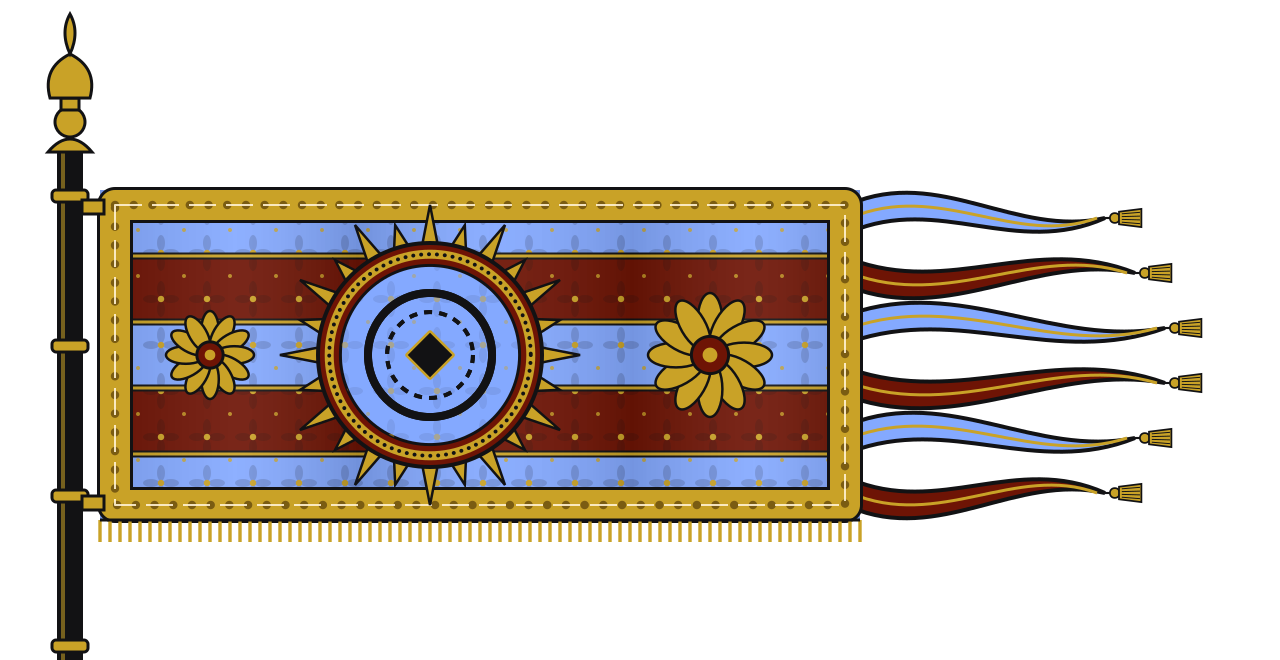
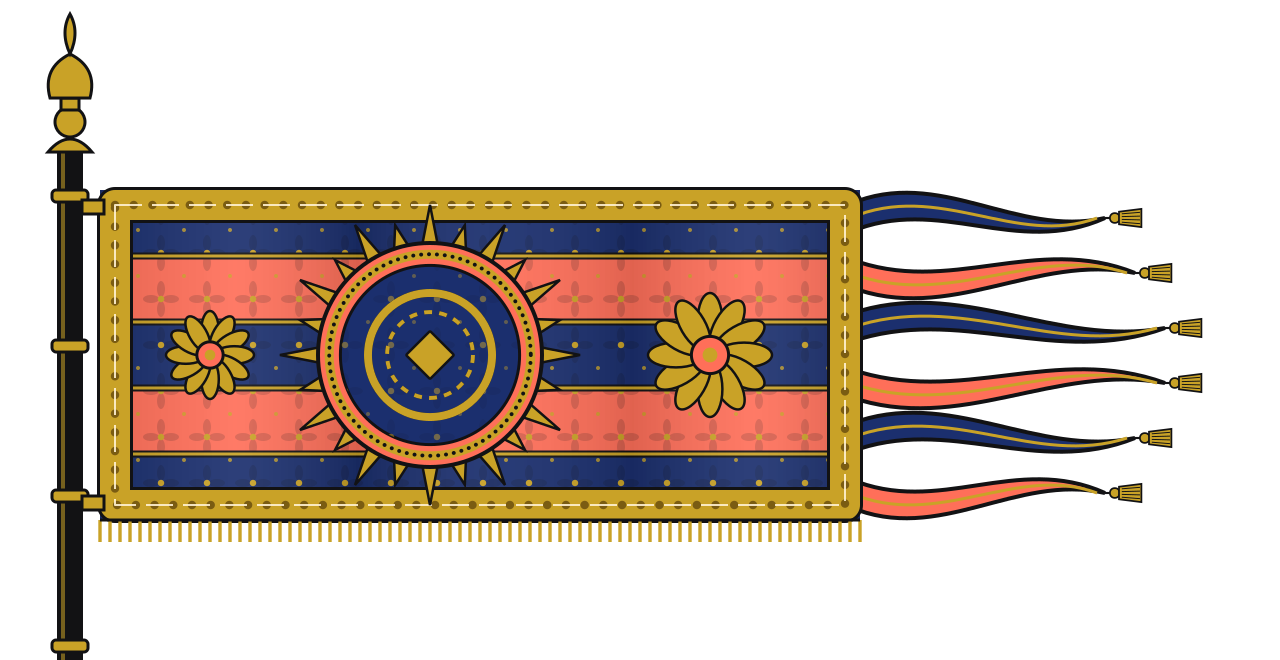
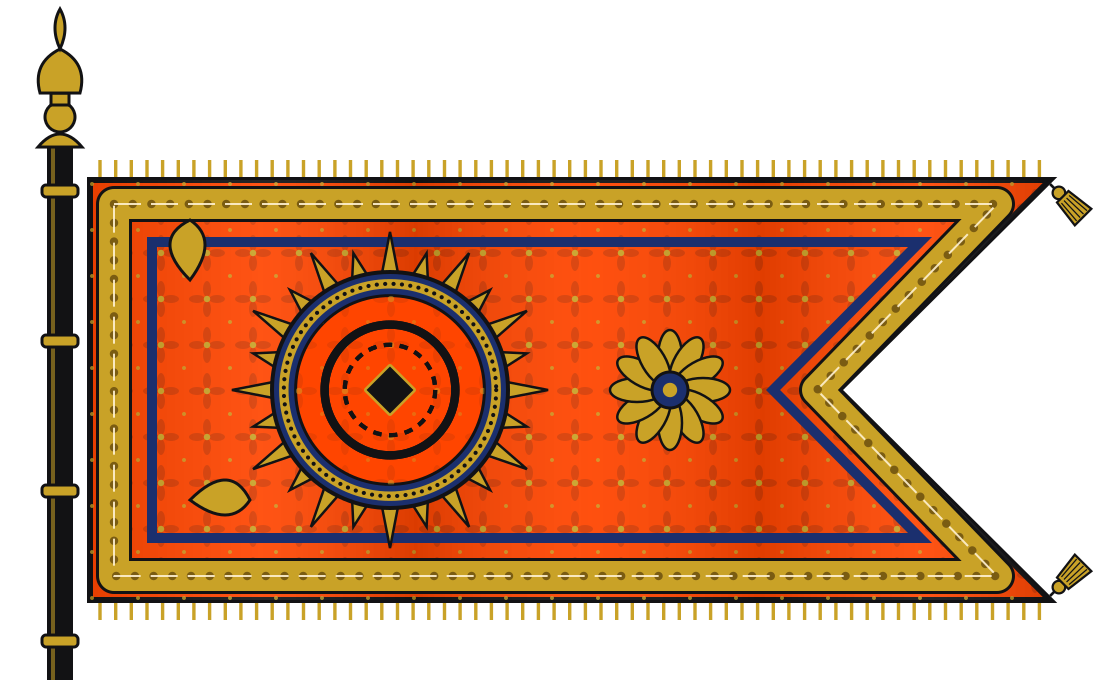
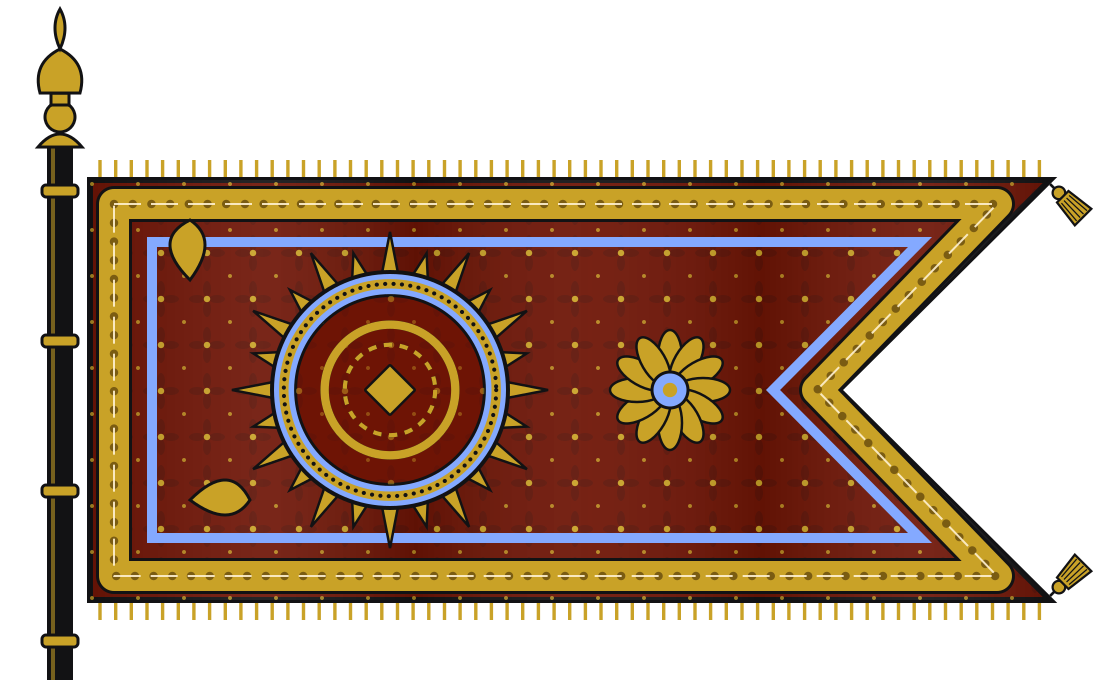

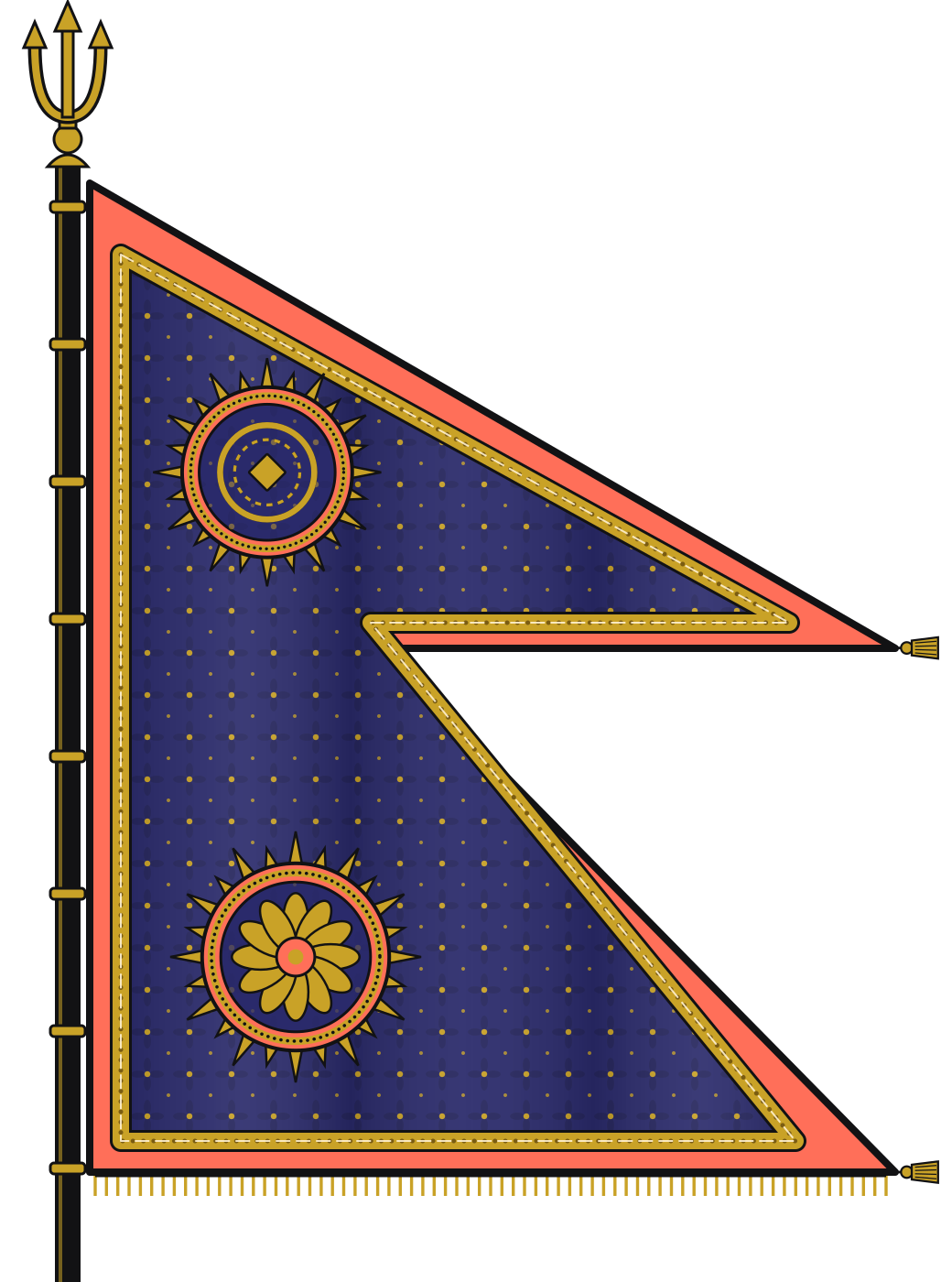


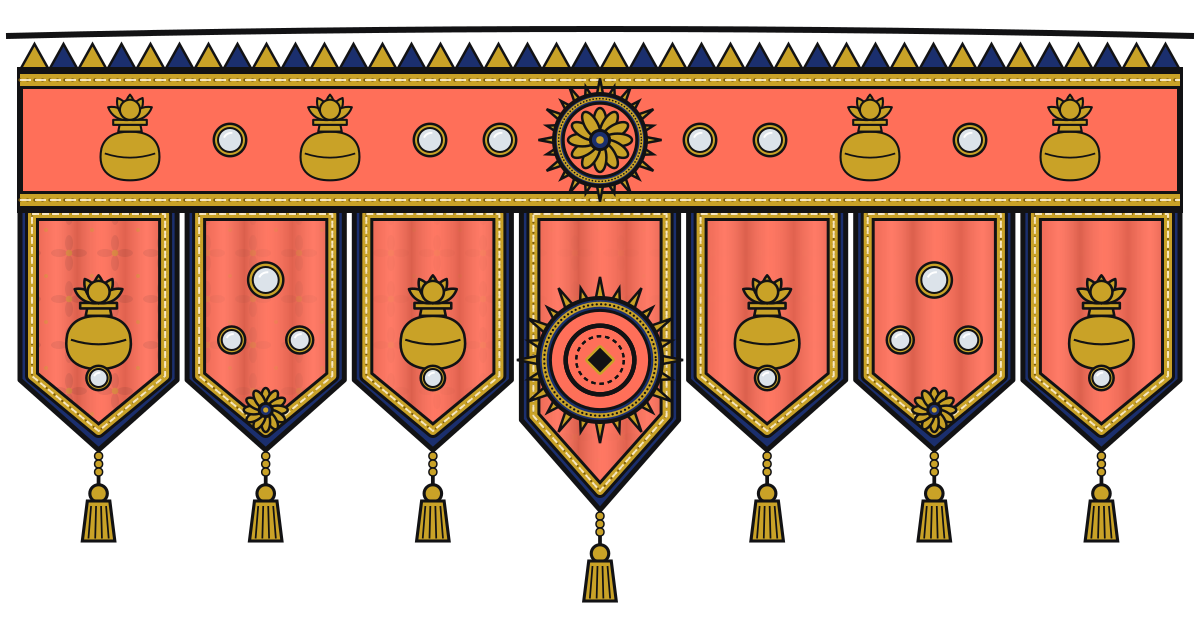
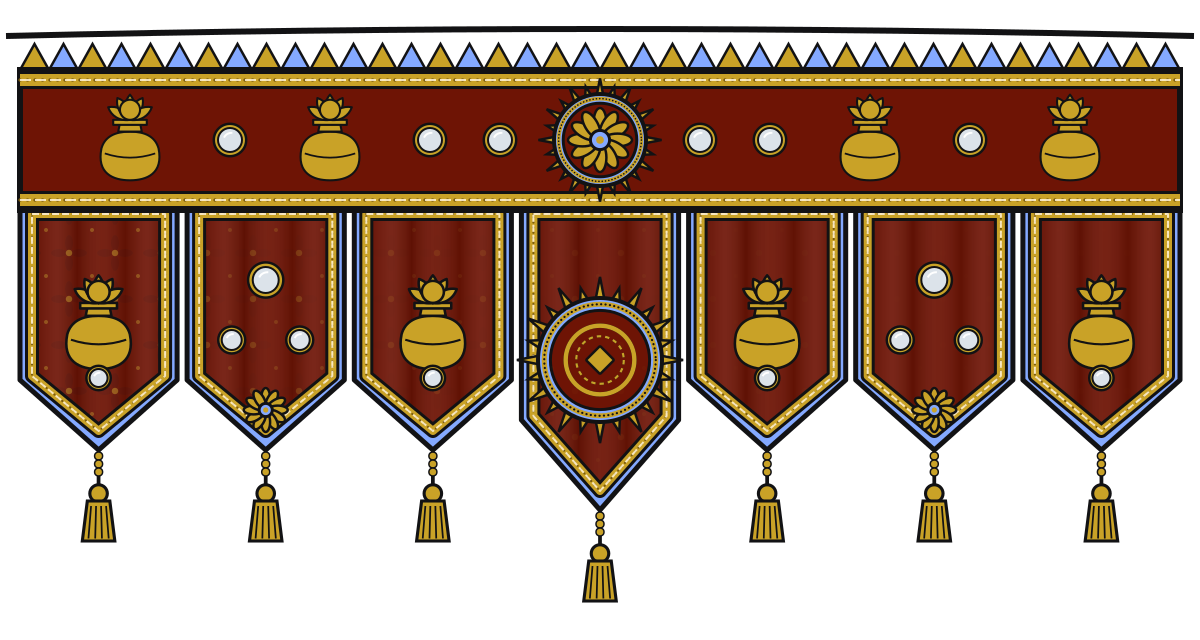

Historic banner
None known
New flag types
| Accessory | For this clan | Basis |
|---|---|---|
| A9 Pota-dhvaja · ship and trade flag For ships, caravans and markets | Not yet designed for this clan | Design |
| A10 Utsava-patāka · festival flag Light, bright flag for fairs and festivals | Not yet designed for this clan | Design |
| A11 Shoka-dhvaja · mourning flag White cloth with the emblem outline in the clan's metal | Not yet designed for this clan | Design |
7. Regalia
| Accessory | For this clan | Basis |
|---|---|---|
| E1 Chhatra · house parasol The ceremonial umbrella | Not yet designed for this clan | Design |
| E2 Chamara · fly-whisks The pair of whisks beside the head of the house | Not yet designed for this clan | Design |
| E3 Danda · staff of office Staff or scepter | Not yet designed for this clan | Design |
| E4 Simhasana · seat The seat of the house, covered in clan cloth | Not yet designed for this clan | Design |
| E5 Khetaka · shield A round shield; the Changi and Dhanush are its flag forms | Not yet designed for this clan | Regional tradition |
| E6 Kula-ayudha · clan weapon The weapon the clan honours | Not yet found for this clan | Under research |
8. Worn
| Accessory | For this clan | Basis |
|---|---|---|
| F1 Kula-vastra · clan cloth The clan's woven pattern in its kit colours | Not yet designed for this clan | Design |
| F2 Kirti-vastra · honour cloth A cloth earned for a deed, not inherited | Not yet designed for this clan | Design |
| F3 Kula-mala · garland flower The flower or leaf the clan wears as a garland | Not yet found for this clan | Under research |
| F4 Chinha · house pin A metal badge with the pin emblem | Not yet designed for this clan | Design |
9. Records
| Accessory | For this clan | Basis |
|---|---|---|
| H1 Clan words A traditional line in the native script | · “Under research” The extracts give no clan words or motto for the Rajuar.[5] | Documented |
| H2 Biruda · titles The house's title or titles | Not yet found for this clan | Under research |
| H3 Prashasti · praise genealogy The lineage as written at the head of a grant | Not yet found for this clan | Under research |
| H4 Vahi · clan register The book of the clan's births, marriages and deaths | Not yet found for this clan | Under research |
| H5 Rana-ghosha · war cry The clan's cry in battle or celebration | Not yet found for this clan | Under research |
10. VishwaVit · knower of the world
Game values are design choices for this project, not historical claims.
References
- Ministry of Tribal Affairs, State/UT-wise list of Scheduled Tribes (Constitution (ST) Order 1950 as amended; list dated 9 July 2024), as recorded on the project Atlas, ST-160
- Rajuar, Wikipedia (read 30 Oct 2026, KulDevi clan check).
- Wikipedia, List of Scheduled Tribes in Odisha, read 2026-10-20, https://en.wikipedia.org/wiki/List_of_Scheduled_Tribes_in_Odisha
- Sushree Mohanty, Indigenous Colours of Odisha: Handbook on 62 Tribes (KISS), read 2026-10-20, https://kissnew.kiss.ac.in/wp-content/uploads/2026/05/Indigenous-Colours-of-Odisha-Handbook-on-62-Tribes-Sushree-Mohanty.pdf
- Project Atlas, row ST-270, Rajuar. The Scheduled Tribe status, KulDevi, flag and emblem fields are project data, not web sources.
- Tutelary deities of south Odisha (Zenodo record 20544836), Zenodo (read 30 Oct 2026, KulDevi clan check).
- NVLI rare books catalogue record, H. H. Risley, The Tribes and Castes of Bengal Vol-I (1891), read 2026-10-20, https://icvtesting.nvli.in/rarebooks/tribes-and-castes-bengal-vol-i