The Rabha (ৰাভা, also called Raba[1]) are a Scheduled Tribe (list dated 09-07-2024) of north-east India, living in Assam, Meghalaya and West Bengal[2][3]. Their language, Rabha, is a Tibeto-Burman language with dialects Rongdani, Maitori and Kocha[4]. The 2011 Census counted 296,189 in Assam, 32,662 in Meghalaya and 27,820 in West Bengal[2][3]. Their harvest festival, Baikho or Khoksi Puja, honours Khoksi, a goddess of crops and wealth[5]. The early sources are thin: Endle's 1911 survey calls the Rabha a cognate tribe of the Kacharis[6].
01Faith and deities
The clan's own supreme deity: the Wikipedia mirror says Rabha worship 'originated from the worship of their supreme deity, Khoksi or Baikho'[7]; assaminfo.com calls Baikho or Khoksi the goddess of crops and wealth[5]. The KulDevi in the Atlas is Kamakhya (from the Atlas, basis: homeland shrine).
Kamakhya of Assam
The presiding goddess of the clan's homeland or capital: a link of place, not a recorded clan tie.
| Deity or tradition | Place in the clan's life | Evidence |
|---|---|---|
| Khoksi or Baikho | Supreme deity; goddess of crops and wealth; the harvest festival takes her name. The Wikipedia mirror says Kocha Rabhas are said not to worship Khoksi | [7][5] |
| Rishi-Bai (Shiva) | Named on the Wikipedia mirror as the creator of the universe | [7] |
| Susari, Nakkati, Tamai, Daduri, Dahari, Rongbad, Champai | Other named deities of the Baikho rites; may be shown by silver ornaments or objects on the altar (assaminfo.com, not verified) | [5] |
| Oja and Pali | Priests who lead the Baikho rites in forests or hills; the Oja is assisted by the Pali | [5] |
| Kamakhya | the Kamakhya article names a Koch and Rabha sacrificial site; NVLI names Kamakhya Puja as important in Rabha life | [8][9] |
| Kechai Khati (Tamreswari) | The Rabha hold a yearly Kechai-khati festival at the Tamreswari temple near Sadiya (Wikipedia) | [10] |
02Temples
No temple built by the Rabha is sourced. Baikho is held in forests or hills (assaminfo.com).
Built by the clan
Not recorded.
Given patronage or grants by the clan
| Temple | Deity | What the clan gave | When | Where |
|---|---|---|---|---|
| Tamreswari temple | Dikkaravasini, Kechai Khati | A yearly Rabha festival (Kechai-khati), not a gift | Yearly | Near Sadiya, Tinsukia, Assam[10] |
03Languages and scripts
| Language or script | Kind | Under the clan | Evidence |
|---|---|---|---|
| Rabha living | Tibeto-Burman; Konyak-Rabha branch (Wikipedia, after Joseph 2006); Sal branch (Omniglot) | Dialects Rongdani, Maitori and Kocha | [4][1] |
| Assamese and Bengali script; Latin | Writing systems | Assamese/Bengali script first adopted by the Rabha Literary Association in 1975 (Omniglot) | [1] |
| Rabhamese | Everyday speech | Everyday speech is called Rabhamese (Wikipedia) | [2] |
| Rongdani, Maitori, Kocha living | Dialects still spoken | Rongdani, Maitori and Kocha Rabha still actively spoken; others endangered or extinct; Kocha is 'highly divergent' (Joseph) | [2][4] |
| Hello and sun (romanised) | Sample words | Hello: Srirasong (Rongdani), Seolawu (Kocha), Urgirasong (Maitori). Sun: Rangsang (Rongdani), Rasan (Kocha), Rangsang (Maitori). Unattributed table | [4] |
04Books and literature
Rabha is written in Assamese or Bengali script, or in Latin (Omniglot). A Bible translation exists (Omniglot). The Rabha Baptist Convention site announces a Koch-Rabha Holy Bible release programme on 24 March 2023 (interested party).
Written during the clan's history
| Work | Author | Kind | When | Link to the clan |
|---|---|---|---|---|
| The Kacharis | Sidney Endle | Ethnography; the Rabha are a cognate tribe | 1911 | [6] |
| Languages of the Greater Himalayan Region, Vol. 1: Rabha | Umbavu V. Joseph | Language study (Brill) | 2006 on the people page; 2007 on the language page | [2][4] |
| Rabha Grammar | U. V. Joseph | Grammar (CIIL) | 2006 | [2] |
| Sociolinguistic Survey among the Koch | Alexander Kondakov | Survey (SIL) | 2010 | [2] |
| A Sociolinguistic Survey of the Rabha Dialects of Meghalaya and Assam | Alexander Kondakov | Survey (SIL) | 2023 | [2] |
| The Rabha Tribe of North-East India, Bengal and Bangladesh | Phukana Candra Basumatari | Book (Mittal) | 2010 | [2] |
| West Bengal District Handbooks: Jalpaiguri | A. Mitra | District handbook | 1953 | [2] |
| The Rabhas of Western Duars: Structural Analysis of a Changing Matrilineal Society | M. K. Raha | Study | 1974 | [2] |
| Writing on social mobility among the Rabhas of North Bengal (title not given) | B. Roy Choudhury | Article | 1970 | [2] |
| Oral Songs of Tribal Communities of Assam | Nabin Ch. Sarma | Songs of several tribes | 2006 | [2] |
| PhD thesis on Kocha Rabha identity | Romeo Rwtin Lokobok | Thesis, Gauhati University | 2022 | [2] |
| Rabhas of West Bengal | Author not shown | Text (NVLI digital) | Not dated | [9] |
Given patronage by the clan
Not recorded.
05Thinkers and scholars
| Name | Field | Era | Contribution |
|---|---|---|---|
| Umbavu V. Joseph | Linguistics | 2006–2007 | Rabha language, grammar and dialects[4] |
| Alexander Kondakov | Sociolinguistics | 2010, 2023 | Surveys of the Koch and of the Rabha dialects[2] |
| Phukana Candra Basumatari | Ethnography | 2010 | A book on the Rabha tribe[2] |
| M. K. Raha | Social structure | 1974 | The Rabhas of the Western Duars as a changing matrilineal society[2] |
| B. Roy Choudhury | Sociology | 1970 | Social mobility among the Rabhas of North Bengal[2] |
| Pabitra Kumar Gupta | Cited on the Wikipedia page | 1977 | Cited; the work is not named in the extract[2] |
| Saumitra Ghosh | Cited on the Wikipedia page | 1990 | Cited; the work is not named in the extract[2] |
| Romeo Rwtin Lokobok | Thesis | 2022 | PhD thesis, Gauhati University, on Kocha Rabha identity[2] |
Scholars named on the Wikipedia Rabha page. The extracts give no Rabha-authored work.
06Art and architecture
The sources name weaving, beads and silver ornaments. No painting, sculpture or architecture is recorded in the extracts.
Painting and wall art
Not recorded.
Sculpture and temple art
Not recorded.
Temple and building architecture
Not recorded.
Weaving and textiles
| Art form | What it is | Era | Evidence |
|---|---|---|---|
| Weaving | Traditional weaving is named as part of the Rabha economy; women weave | [2][11] |
Clothing and jewellery
| Art form | What it is | Era | Evidence |
|---|---|---|---|
| Beads and silver ornaments | Worn by women; silver ornaments may be shown on the Baikho altar (assaminfo.com, not verified) | [11][5] |
Coins, pottery and crafts
Not recorded.
07History
1911: a cognate tribe of the Kacharis
Endle's 1911 survey counts 'Rabha (Totala)' at about 31,370 persons, chiefly in Goalpara, and calls the Rabha a cognate tribe of the Kacharis[6]. Kacharis 'occasionally take wives from the cognate tribes known as Rabhas (Totlas)'; such marriages are 'not looked upon with favour'[6].
A migration tradition
A West Bengal text in the National Virtual Library says the Rabha were said to have migrated from Tibetan regions to Assam and later settled in the Garo Hills; the text gives no author or date[9].
Matriarchy, a claim tagged [citation needed]
The Wikipedia Rabha article says the Rabha were historically matriarchal, a claim its page marks [citation needed][2]. Raha's 1974 study is titled as a study of 'a changing matrilineal society' in the Western Duars[2]. The Rabha Baptist Convention site calls the society matrilineal[11].
From shifting cultivation to the plough
The Rabha Baptist Convention site says the Rabha once practised shifting cultivation with a gogo (bill-hook) and later settled plough cultivation[11]. The site gives no dates.
The language in print
Omniglot says the Rabha language was first documented at the end of the nineteenth century, and that Assamese or Bengali script was first adopted by the Rabha Literary Association in 1975[1]. The Rabha Baptist Convention site says restoration of the language 'began in 1959 AD'[11].
Under research: Koch-era sources
The Atlas gives the historical polity as 'Rabha chiefdoms within the Koch kingdom'. No extract supports this, and no inscription or Koch-era source is in the pack. Under research: inscriptions, Koch-era records and the Rabha Hasong Autonomous Council, which no extract describes.
08Journey and migrations
The only migration account in the extracts is the West Bengal text in the National Virtual Library.
| When | From | To | Why | Evidence |
|---|---|---|---|---|
| Not dated | Tibetan regions | Assam | Said to have migrated (tradition in the NVLI text) | [9] |
| Not dated | Assam | Garo Hills | Later settled, as the same text says | [9] |
09Seats and lands
| Place | Role | Where today |
|---|---|---|
| Goalpara | Chiefly here, about 31,370 in 1911 (Endle) | Assam |
| Goalpara, Kamrup and Darrang | Mainly concentrated (Vajiram and Ravi) | Assam[12] |
| Garo Hills | Later settled (NVLI text); East and West Garo Hills (Omniglot) | Meghalaya[9][1] |
| Dooars: Jalpaiguri, Cooch Behar and Alipurduar | Concentrated, particularly Jalpaiguri and Cooch Behar[13]; Alipurduar (Omniglot) | West Bengal |
| Nine districts of Bhutan | Communities; about 1,600 in 2011, as printed[2] | Bhutan |
| Nagaland | Named among the places where the language is spoken[4] | Nagaland |
10Notable figures
| Name | Role | Era | Known from |
|---|---|---|---|
| Akan Chandra Rabha | Politician | Not dated | [2] |
| Birubala Rabha | Activist | 1954–2024 | [2] |
| Dipak Rabha | Politician | Not dated | [2] |
| Drishti Rajkhowa (born Manoj Rabha) | Listed as separatist | Not dated | [2] |
| Nabin Rabha | Footballer | born 1996 | [2] |
| Pabitra Rabha | Actor | born 1976 | [2] |
| Pabitra Rabha | Politician | born 1996 | [2] |
| Subam Rabha | Football coach | Not dated | [2] |
| Tankeswar Rabha | Politician | born 1973 | [2] |
11Allies, rivals and marriages
| People | Relationship | When |
|---|---|---|
| Kacharis | Cognate tribe; Kacharis sometimes take Rabha wives (Endle) | 1911 account[6] |
| Garo | Listed as related; Atong is traditionally a Garo dialect | Not dated[14][2] |
| Atong | Rabha resembles Atong, traditionally a Garo dialect (Kondakov 2023; Joseph 2006) | Not dated[2] |
| Koch | Kocha Rabha is closer to Koch (Kondakov 2010) | Not dated[2] |
| Mech, Hajong | Bodo-Kachari family, with Garo, Kachari and Mech; cultural similarities with the Hajongs (NVLI) | Not dated[2][9] |
| Pani-Koch | Cultural similarities (NVLI text) | Not dated[9] |
12Society and livelihood
Men and women both work the fields, and rice is the staple[11]. The Rabha Baptist Convention site, an interested party, calls the society matrilineal; Wikipedia calls the Rabha historically matriarchal, tagged [citation needed][2]. Endle (1911) says children of marriages between Kacharis and Rabhas 'become in all cases members of the father's subdivision of the Bodo race'[6]. The sources disagree on descent; see open.
Government and social order
| Institution or group | What it was | Evidence |
|---|---|---|
| Rabha Baptist Convention | Church body, formerly the Rabha Baptist Church Union, begun with the Australian Baptist Missionary Society and the Baptist Church of Mizoram; 63rd Annual Council in 2022 | [11] |
| Rabha Literary Association | Adopted Assamese or Bengali script in 1975 (Omniglot) | [1] |
| Mission schools | Mount Olive School, Dipsing Academy, Mount Zion School and Glasby Memorial School, listed on the Rabha Baptist site | [11] |
| Agricultural villages and forest settlements | In West Bengal, people live in agricultural villages and in forest settlements, where many work as labourers (NVLI text) | [9] |
Livelihood over time
| Era | Livelihood | Evidence |
|---|---|---|
| Once | Shifting cultivation with a gogo (bill-hook); hunting was an old practice | [11] |
| Later | Settled plough cultivation | [11] |
| As the sources describe it | Agriculture, forest activities, shifting cultivation and weaving (Wikipedia); both men and women work the fields (rabha.org) | [2][11] |
13Sub-clans and related clans
The Wikipedia Rabha article and rabha.org list eleven dialect groups (Joseph 2006b). The article says 'nine' in one place and 'eleven' in another. The related peoples below are those the extracts name.
| Clan | Relation | Where | Size | In the Atlas | Evidence |
|---|---|---|---|---|---|
| Rongdani | Sub-clan | Dialect group; Baikho linked to the Rongdani and Maitori groups[5] | new clan candidate | [2][11] | |
| Maitori | Sub-clan | Dialect group (also spelt Maituri or Maithori); Baikho linked to this group[5] | new clan candidate | [2][4] | |
| Pati | Sub-clan | Dialect group | new clan candidate | [2][11] | |
| Dahori | Sub-clan | Dialect group | new clan candidate | [2][11] | |
| Dotla | Sub-clan | Dialect group | new clan candidate | [2][11] | |
| Halua | Sub-clan | Dialect group | new clan candidate | [2][11] | |
| Betolia | Sub-clan | Dialect group | new clan candidate | [2][11] | |
| Hanna | Sub-clan | Dialect group | new clan candidate | [2][11] | |
| Sunga | Sub-clan | Dialect group | new clan candidate | [2][11] | |
| Modahi | Sub-clan | Dialect group | new clan candidate | [2][11] | |
| Kocha | Sub-clan | Dialect group, also called Kocha Rabha; closer to Koch and 'highly divergent' (Joseph)[4][2] | new clan candidate | [4][11] | |
| Garo | Related people | Garo Hills; listed as related in the Bodo-Kachari family[2] | ST-084 | [2][14] | |
| Koch | Related people | Kocha Rabha is closer to Koch[4] | ST-136 | [4] | |
| Mech | Related people | Bodo-Kachari family[2] | ST-213 | [2] | |
| Hajong | Related people | Cultural similarities (NVLI text)[9] | ST-094 | [9] | |
| Atong | Related people | South Garo Hills, West Khasi Hills, southern Kamrup; a Garo subgroup in India[15] | new clan candidate | [15][2] | |
| Pani-Koch | Related people | Cultural similarities (NVLI text)[9] | new clan candidate | [9] |
Clans marked "new clan candidate" are not in the Atlas yet.
14Surnames
The extracts name no surname as a Rabha family name. The Wikipedia figures list gives full names but does not say which part is a surname. No count is given.
Not recorded.
15Songs and music
The extracts name one traditional song and no text.
Hoymaru research
Instruments and styles
| Instrument or style | What it is | Evidence |
|---|---|---|
| Drumming | Drumming, singing and dancing are named at the Baikho festival; no instrument is named | [5] |
16Poems, lullabies and children's rhymes
No poem, lullaby or children's rhyme is named in the extracts.
None recorded yet.
17Stories, legends and proverbs
Stories and legends
Not recorded.
Proverbs and sayings
Not recorded.
18Festivals and fairs
| Festival or fair | When | Where | What happens |
|---|---|---|---|
| Baikho (Khoksi Puja) living | Bohag and Jeth, mid-April to June; main day Purnima | Lower Assam: Goalpara, Kamrup, Baksa, Udalguri, Kokrajhar and Bongaigaon | The harvest festival of the Rabha, linked to the Rongdani and Maitori groups. It ran 3–7 days traditionally and now runs 1–2 days. Priests called Oja, assisted by Pali, lead it in forests or hills. Offerings are pigs, chickens and goats; there is fire-walking (Barnakkay) and evening bonfires of tall bamboo structures; prayers are in Rabha and Assamese; feasts include faksak and rice beer. It was once a setting for choosing partners; now it has stage programmes, folk dance, fairs and beauty contests, and student unions promote it[5] |
| Kechai-khati | Yearly | Tamreswari temple, near Sadiya, Tinsukia | The Rabha hold a yearly festival here. The name means 'raw' (kechai) and 'eat' (khati)[10] |
| Kamakhya Puja | Not dated | Not stated | Named as an important festival in Rabha community life (NVLI text)[9] |
19Food, dress and games
Food
| Item | What it is | Evidence |
|---|---|---|
| Rice and rice beer | Rice is the staple; the people are non-vegetarian (rabha.org). Rice beer and faksak are served at Baikho feasts (assaminfo.com) | [11][5] |
Dress
| Item | What it is | Evidence |
|---|---|---|
| Beads and silver ornaments | Worn by women (rabha.org) | [11] |
Games and martial arts
| Item | What it is | Evidence |
|---|---|---|
| Lewa Tenna | Tug-of-war, named on the Baikho page | [5] |
Tags: living still practised · revived brought back after a break · lost known only from records · research reported but not yet confirmed from a source. Songs and poems under copyright are listed by title only; restricted or sacred material is noted without its content.
20Status today
The Rabha are a Scheduled Tribe in Assam, Meghalaya and West Bengal. The 2011 Census population is about 359,000 as the Wikipedia article prints it[2].
Recognised heritage
| What | Recognition | Evidence |
|---|---|---|
| Baikho (Khoksi Puja) | Stage programmes, folk dance and fairs now; student unions promote it | [5] |
| Rabha language | Restoration 'began in 1959 AD' as the Rabha Baptist site prints it; a Bible translation exists | [11][1] |
Not reviewed by the community. The Rabha Baptist Convention site is a church body's own page, an interested-party source.
21For children
The Harvest Goddess Khoksi
The Rabha people hold a harvest festival called Baikho. It is also called Khoksi Puja. The goddess of crops and wealth is named Khoksi. The festival is held in the months of Bohag and Jeth, from mid-April to June, and its main day is the full moon. Priests called Oja, with helpers called Pali, lead the prayers in the forests or on the hills. At night the people light tall bamboo bonfires. Some people walk across the fire, and there are drums, songs and dances. Today there are also stage shows and fairs.
22Across the project
| Project | What carries this clan | Status |
|---|---|---|
| Atlas of the Janas | Rabha land on the atlas: Goalpara, Kamrup and Darrang in Assam; Garo Hills in Meghalaya; the Dooars in West Bengal (see Lands) | [12] |
| KulDevi and GrahDevi | The Atlas gives Kamakhya as the KulDevi (family Mahavidya, basis homeland shrine). The GrahDevi forms on the sheet are Kali, Tara, Shodashi, Bhuvaneshvari, Bhairavi, Chhinnamasta, Dhumavati, Bagalamukhi, Matangi and Kamala | Atlas |
| Planet naming | No extract on planet names for the Rabha | |
| Renaming and waters | Not researched in this run |
23Open questions
- Rabha Hasong Autonomous Council: not covered. The council page on Wikipedia, the Goalpara district history, the granthaalayahpublication article 7056, saspublishers article 17906 and Hunter's Statistical Account were not read (the fetch timed out).
- Dialect groups: the Wikipedia article says 'nine' and 'eleven' in different places. The list gives eleven names (Joseph 2006b). The spelling is Maituri on the article and Maitori or Maithori elsewhere.
- Descent: the Rabha Baptist site calls the society matrilineal and Wikipedia calls the Rabha historically matriarchal [citation needed]. Endle (1911) says children of Kachari-Rabha marriages follow the father's subdivision. Which rule holds, and when, is open.
- Joseph's Rabha book is dated 2006 on the people page and 2007 on the language page.
- Bhutan or Bangladesh: Wikipedia puts communities in nine districts of Bhutan (1,600). The Atlas names Bangladesh as another country. No extract gives a Bangladesh figure.
- Surnames and exogamous clans: none is named in the extracts. The Wikipedia figures list uses 'Rabha' in personal names; the Census surname tables are not read.
- Which Koch is meant: the Rabha extracts say 'Koch' without a sub-type; the Atlas has Koch (ST-136) and Koch-Rajbongshi (NE-004).
- Religion beyond the Baikho rites: no Rabha account of belief (Hodgson's or Endle's Rabha section) is in the extracts. Endle's first 100,000 characters hold none.
- Music and proverbs: no song text, saying or tale is in the extracts.
- Sources of weak standing: assaminfo.com is unverified and the Rabha Baptist site is a church body's own page. The Baikho detail rests mainly on assaminfo.com.
- The Farkanti festival and the Rabha Hasong council in the Atlas have no source in the extracts.
24Astitva
अस्तित्व · being, existence: everything by which the clan is known
No seal, coin, plate, title, totem, guardian tree, garland flower, war cry or cloth is recorded for the Rabha in the extracts. The Baikho page says the goddess may be shown by silver ornaments or objects on the altar (assaminfo.com, not verified).
Every clan has every accessory, royal objects included. Each one says how it is known: Documented This clan's own object is recorded. · Regional tradition Recorded for the region or for peoples like this one, not for this clan. · Design Made for this project, with no historical claim. · Under research To be found for this clan from sources. Legends and titles are written in the clan's own script.
1. Seals and coins
| Accessory | For this clan | Basis |
|---|---|---|
| B1 Rajamudra · house seal Round seal with the clan emblem and a short legend in the clan's script | Not yet designed for this clan | Design |
| B2 Anguliya-mudra · signet ring Personal seal ring of the head of the house | Not yet designed for this clan | Design |
| B3 Chhapa · house stamp Ink or block stamp for letters, goods and cloth | Not yet designed for this clan | Design |
| B4 Tamrapatra · charter plate Copper-plate grant on a ring, closed with the house seal | Not yet designed for this clan | Design |
| B5 Shreni-mudra · guild or trade seal Seal for the clan's trade, craft or caravan | Not yet designed for this clan | Design |
| C1 Clan coin Emblem or deity on one side, a legend in the clan's script | Not yet designed for this clan | Design |
| C2 Coin die The die that strikes the coin | Not yet designed for this clan | Design |
2. Living symbols
| Accessory | For this clan | Basis |
|---|---|---|
| I1 Totem trio The tree, bird and animal the clan protects | Not yet found for this clan | Under research |
| I2 Kaval-maram · guardian tree The tree that stands at the clan's seat | Not yet found for this clan | Under research |
3. Stone and gate
| Accessory | For this clan | Basis |
|---|---|---|
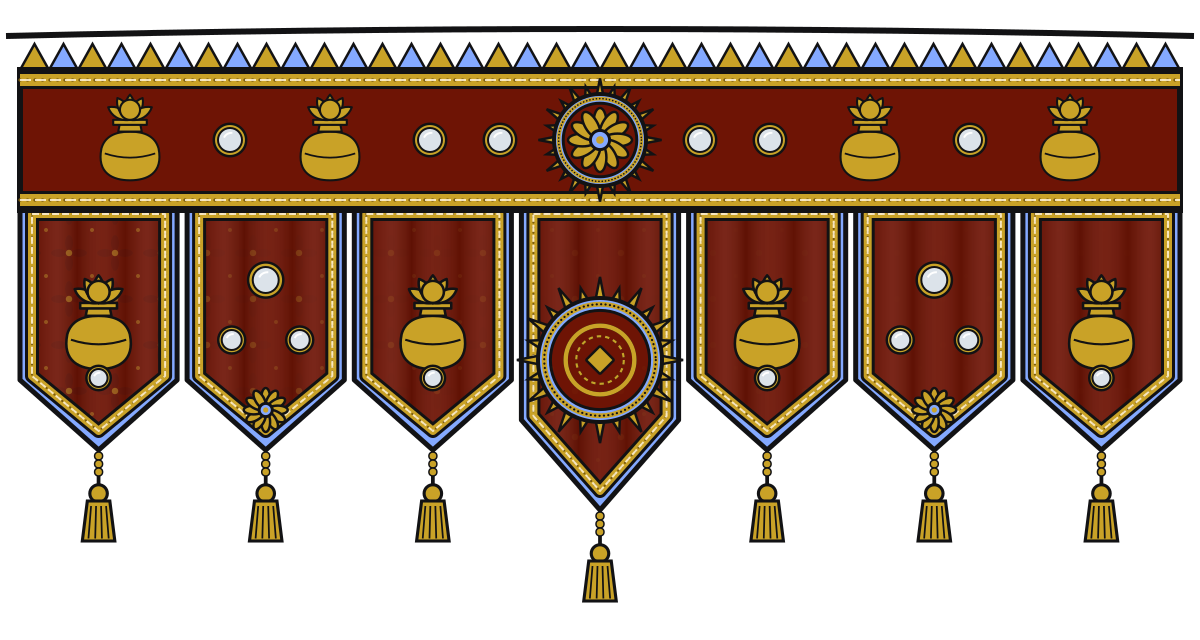
| G1 Torana · gateway The built gate of the seat; the cloth Toran hangs in it | Not yet designed for this clan | Regional tradition |
| G2 Viragallu · hero stone Carved panel stone for a member who died defending the clan | Not yet designed for this clan | Regional tradition |
| G3 Kula-shila · clan stones Standing and table stones that remember the ancestors | Not yet designed for this clan | Design |
| G4 Jayastambha · victory pillar A pillar raised for a victory | Not yet designed for this clan | Design |
| G5 Sima-shila · boundary stone Marks the clan's land, with a line in the native script | Not yet designed for this clan | Design |
4. Sounds
| Accessory | For this clan | Basis |
|---|---|---|
| D1 Pancha-mahashabda · five great sounds The right to five instruments | Not yet designed for this clan | Design |
| D2 Shankha · clan conch The clan's own named war conch | Not yet designed for this clan | Design |
| D3 Murasu · house drums Three drums: war, charity and justice | Not yet designed for this clan | Design |
5. Kit: colours, metals and emblems
The main emblem in the Atlas is a design, 'A forest with a field', for forest farming. No documented Rabha seal, coin, banner or totem is in the extracts.
| Part of the kit | This clan |
|---|---|
| Field | Deep Brick #7E2A1E |
| Accent | Deep Cosmic Blue #9BB0FF |
| Emblem colour | Metallic Gold #C9A227 |
| Zari metal | Gold |
| Main emblem | A forest with a field |
| Second image | — |
| Night and day | Every visual accessory has two versions: by night the emblem on the dark field, by day the clan's field colour on cloth woven from its metal. |
6. Flags
Every clan has every flag type; the type says the occasion and the colours say the clan. The outlined card is the flag the Atlas assigns.
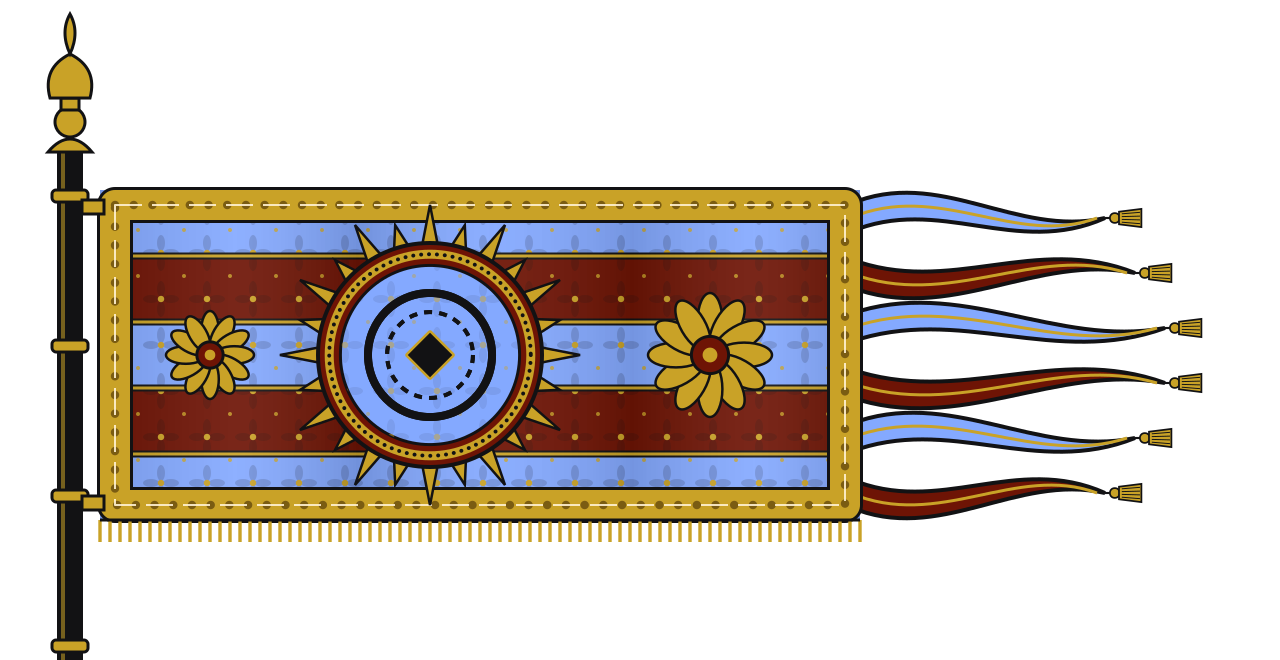
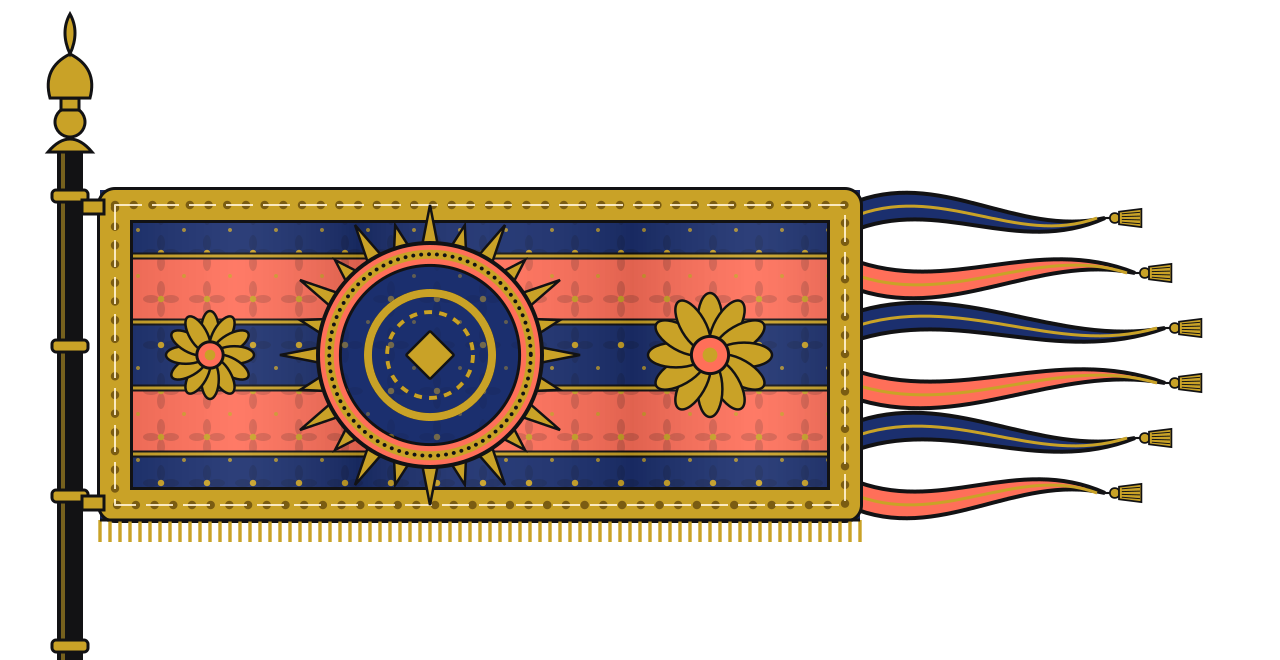
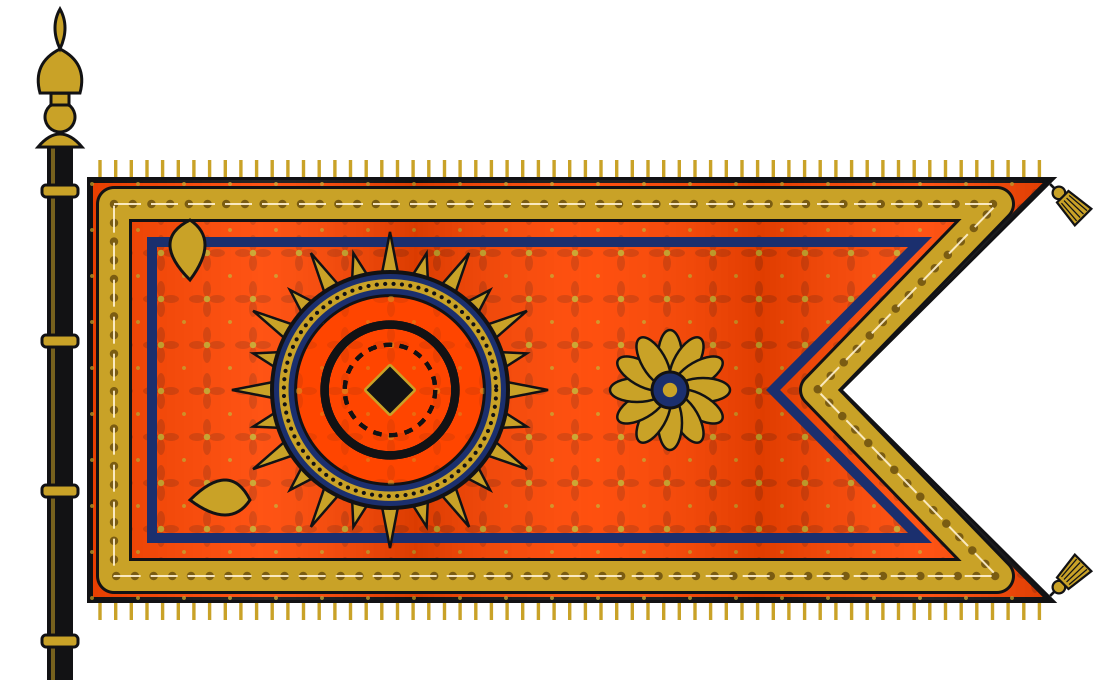
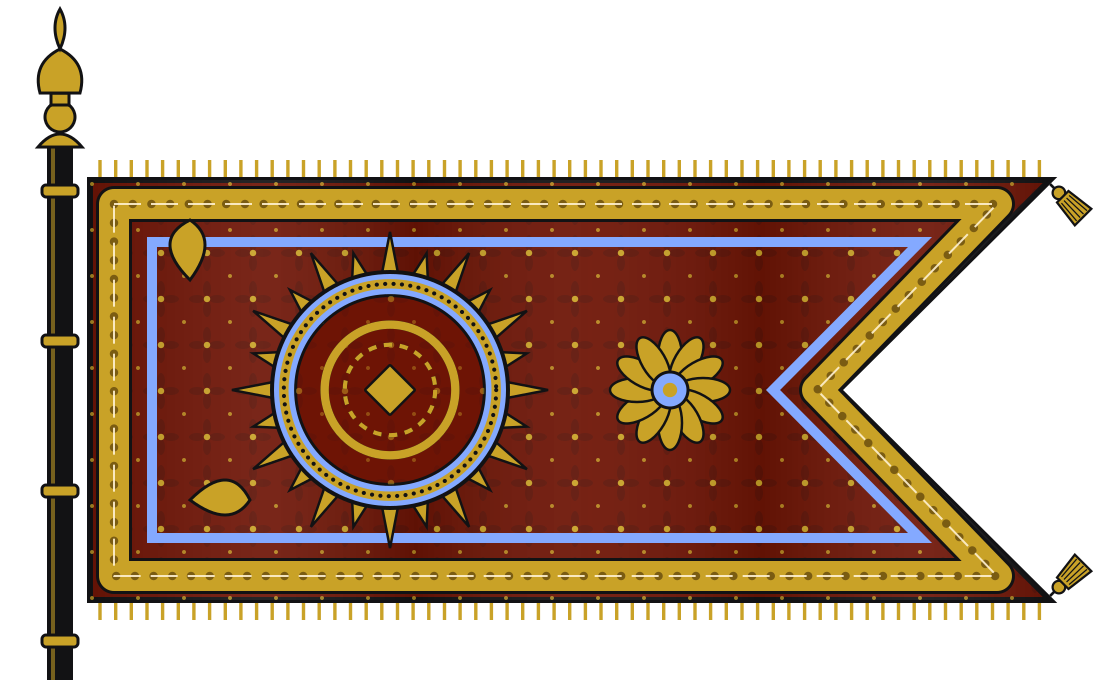
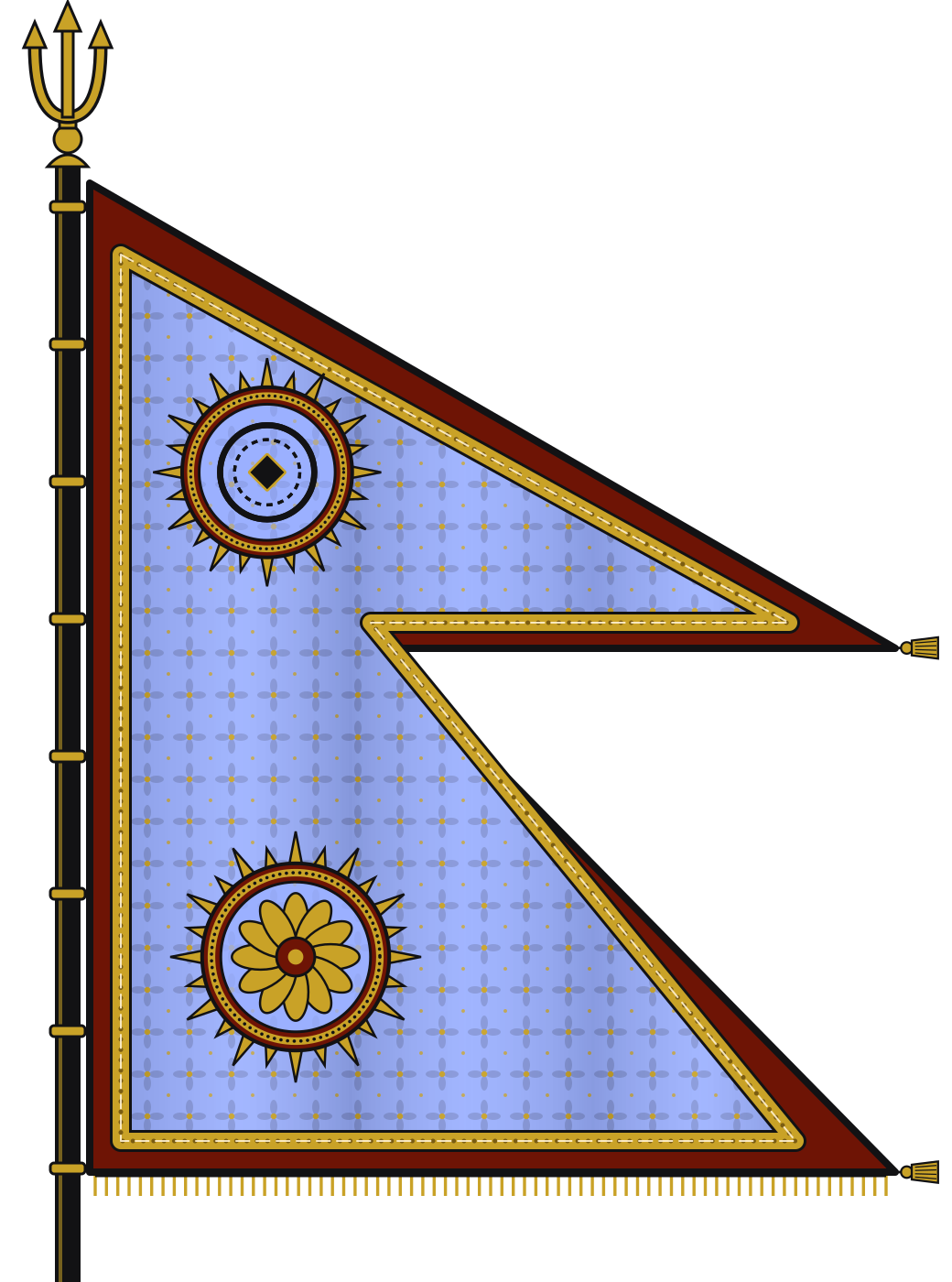
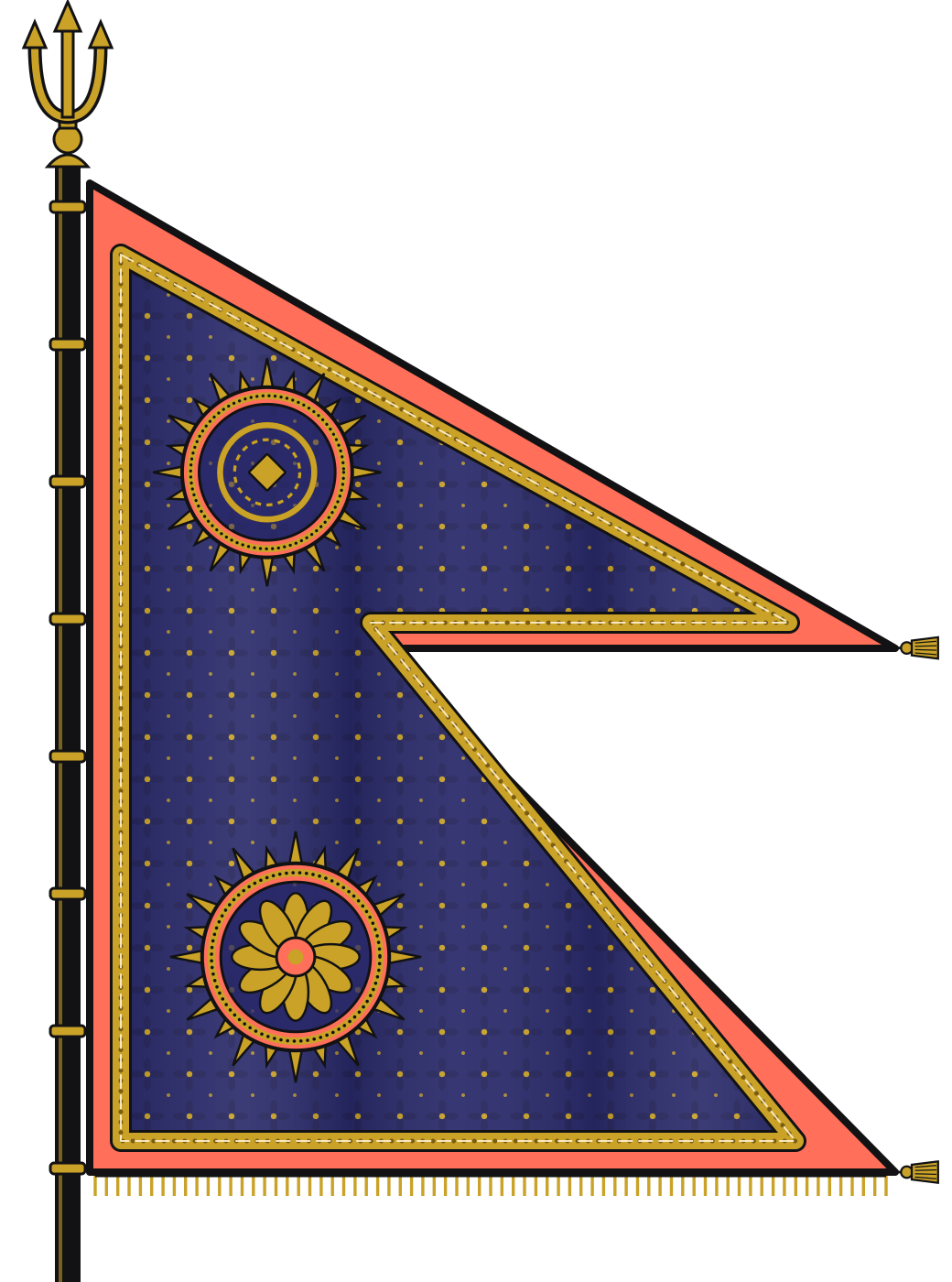

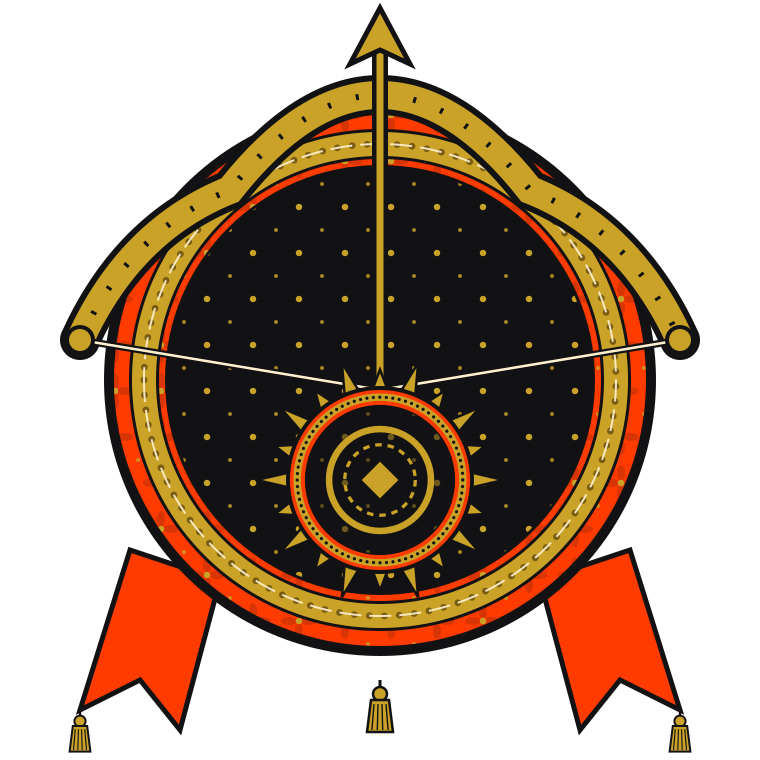
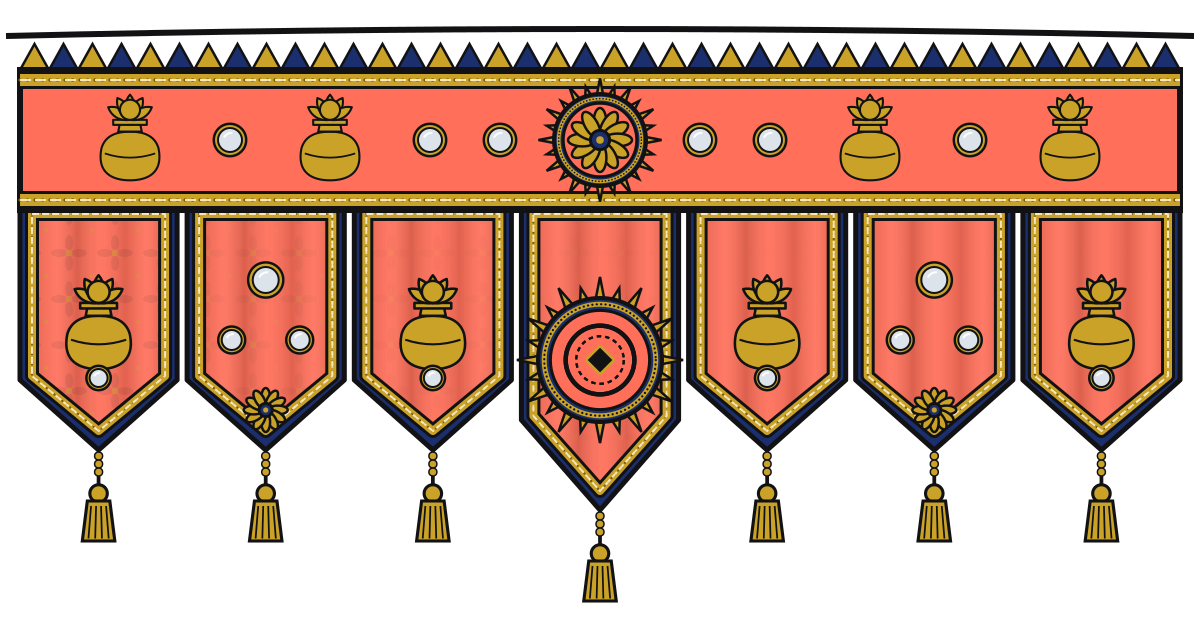
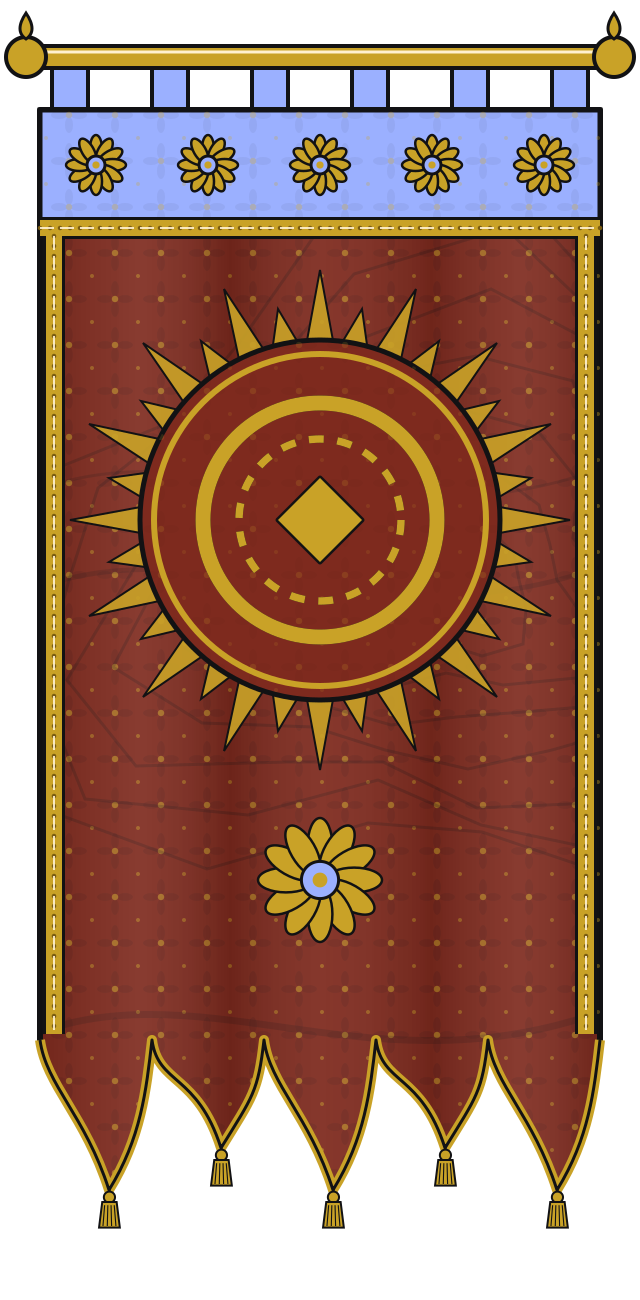
Historic banner
None known
New flag types
| Accessory | For this clan | Basis |
|---|---|---|
| A9 Pota-dhvaja · ship and trade flag For ships, caravans and markets | Not yet designed for this clan | Design |
| A10 Utsava-patāka · festival flag Light, bright flag for fairs and festivals | Not yet designed for this clan | Design |
| A11 Shoka-dhvaja · mourning flag White cloth with the emblem outline in the clan's metal | Not yet designed for this clan | Design |
7. Regalia
| Accessory | For this clan | Basis |
|---|---|---|
| E1 Chhatra · house parasol The ceremonial umbrella | Not yet designed for this clan | Design |
| E2 Chamara · fly-whisks The pair of whisks beside the head of the house | Not yet designed for this clan | Design |
| E3 Danda · staff of office Staff or scepter | Not yet designed for this clan | Design |
| E4 Simhasana · seat The seat of the house, covered in clan cloth | Not yet designed for this clan | Design |
| E5 Khetaka · shield A round shield; the Changi and Dhanush are its flag forms | Not yet designed for this clan | Regional tradition |
| E6 Kula-ayudha · clan weapon The weapon the clan honours | Not yet found for this clan | Under research |
8. Worn
| Accessory | For this clan | Basis |
|---|---|---|
| F1 Kula-vastra · clan cloth The clan's woven pattern in its kit colours | Not yet designed for this clan | Design |
| F2 Kirti-vastra · honour cloth A cloth earned for a deed, not inherited | Not yet designed for this clan | Design |
| F3 Kula-mala · garland flower The flower or leaf the clan wears as a garland | Not yet found for this clan | Under research |
| F4 Chinha · house pin A metal badge with the pin emblem | Not yet designed for this clan | Design |
9. Records
| Accessory | For this clan | Basis |
|---|---|---|
| H1 Clan words A traditional line in the native script | ৰাভা · “Rabha (the people's name, as Omniglot prints it)” Omniglot, Rabha (ৰাভা)[1] | Documented |
| H2 Biruda · titles The house's title or titles | Not yet found for this clan | Under research |
| H3 Prashasti · praise genealogy The lineage as written at the head of a grant | Not yet found for this clan | Under research |
| H4 Vahi · clan register The book of the clan's births, marriages and deaths | Not yet found for this clan | Under research |
| H5 Rana-ghosha · war cry The clan's cry in battle or celebration | Not yet found for this clan | Under research |
10. VishwaVit · knower of the world
Game values are design choices for this project, not historical claims.
References
- Omniglot (Simon Ager), Rabha, read 2026-11-19, https://www.omniglot.com/writing/rabha.htm
- Wikipedia, Rabha people, read 2026-11-19, https://en.wikipedia.org/wiki/Rabha_people
- Wikipedia, List of Scheduled Tribes in West Bengal, read 2026-10-21, https://en.wikipedia.org/wiki/List_of_Scheduled_Tribes_in_West_Bengal
- Wikipedia, Rabha language, read 2026-11-19, https://en.wikipedia.org/wiki/Rabha_language
- Assam Info, Baikho Festival (site not verified), read 2026-11-19, https://assaminfo.com/festivals/baikho-festival-assam
- Sidney Endle, The Kacharis (Macmillan, London, 1911), Project Gutenberg #50008, read 2026-11-19, https://dev4.gutenberg.org/ebooks/50008.txt.utf-8
- Wikipedia mirror (wiki.riteme.site), Rabha people, read 2026-11-02, https://wiki.riteme.site/wiki/Rabha_people
- Kamakhya Temple, Wikipedia (citing Shin 2010, Urban 2009–2019, Banerji 1925, Sarma 1981/1988, Nath 1989, Kakati 1989, Neog 1980).
- Rabhas of West Bengal (NVLI digital text, author not shown), read 2026-11-19, https://ocrdigitalfile.nvli.in/dlirepository/275/Rabhas-Of-West-Bengal.txt
- Tamreswari Temple, Wikipedia, read 10 Oct 2026.
- Rabha Baptist Convention, rabha.org (a church body; interested party), read 2026-11-19, https://rabha.org/node/33
- Vajiram and Ravi, Tribes of Assam (exam-prep site, secondary), read 2026-10-26, https://vajiramandravi.com/current-affairs/tribes-of-assam/
- Vajiram and Ravi, Tribes of West Bengal, read 2026-10-21, https://vajiramandravi.com/current-affairs/tribes-of-west-bengal/
- Wikipedia, Garo people, read 2026-11-15, https://en.wikipedia.org/wiki/Garo_people (cites Playfair 1909, Sinha 1955, Marak 2005 and Marak 2014 as printed in the article)
- Wikipedia, Atong language (Sino-Tibetan), read 2026-11-16, https://en.wikipedia.org/wiki/Atong_language_(Sino-Tibetan)
- Wikipedia, List of Scheduled Tribes in Assam, read 2026-10-26, https://en.wikipedia.org/wiki/List_of_Scheduled_Tribes_in_Assam