The Porja are a Scheduled Tribe in the Koraput hills of southern Odisha (the Wikipedia list gives no list date), counted at 374,628 in the 2011 census of Odisha[1]. Thurston found them in 1909 not to be a compact caste but a conglomerate of endogamous sections, and Russell in 1916 gave the name as a class name from Sanskrit praja, a subject[2][3]. Both writers record the tradition that the Rajas and the Parjas were brothers, the Rajas taking to horses and the Parjas carrying burdens[2]. The sheet also lists them in Andhra Pradesh, Chhattisgarh, Madhya Pradesh, Maharashtra and Telangana.
01Faith and deities
The clan's own deity as recorded: the Jhodia, Pengu and Kondhi divisions worship her once in three years, also called Jakar Devata[2]. The Atlas's KulDevi is Majhighariani, a homeland shrine (see below).
Majhighariani of Rayagada, goddess of the Koraput hills[4]
The presiding goddess of the clan's homeland or capital: a link of place, not a recorded clan tie.
| Deity or tradition | Place in the clan's life | Evidence |
|---|---|---|
| Bhumi Devata, also Jakar Devata | Earth goddess, a stone under a tree outside the village; once in three years a cow, goat, pig and pigeon are offered, with a casteman as pujari (1909) | [2] |
| Duarmundi Thakurani | The village deity of the Paroja, with a shrine (the KISS handbook) | [5] |
| Takurani (Bonda) | Worshipped by the Bonda Porojas in Chaitra and Magho with animal sacrifice; an annual gathering follows (Thurston 1909) | [2] |
| Matera Hundi (Bonda) | Goddess of harvest, shown by a branch of kusi or jamo (guava) planted in the village; an egg sacrificed at sowing, and a sacrifice again at Nua Khau, the first-fruits festival (Henderson, via Thurston) | [2] |
| Spirits of the dead (Bonda) | Belief in the spirits of the departed, sayire (Henderson, via Thurston) | [2] |
| Nandi, also Dharani Debata and Mati Debata | Goddess of the soil, worshipped at Jadaput in the Nandapur area; clay idols made from anthill soil | [6] |
| Thakurani | Described at Jadaput as an incarnation of Ganga Debata (Tribal Tribune) | [6] |
| Danteshwari | Tutelary goddess of the Rajas of Bastar, worshipped by the Parjas; in the Bastar story she leads the brothers | [3] |
| Bhimsen Deo | A wood post set in the ground for rain, 'King of the Clouds': water is poured on it and prayer offered (Russell 1916) | [3] |
| Hill and forest divinities | Worshipped by the Parjas of Bastar; fowl offered to the field at sowing (Russell 1916) | [3] |
| Majhighariani (KulDevi) | The Atlas's KulDevi: a homeland shrine at Rayagada. The extracts do not tie this shrine to the Porja's own practice. | [4] |
| Kanak Durga, the Rajas' goddess | Titular goddess of the Jeypore rulers, who remained so (Odisha Review). The source does not tie her to the Porja | [7] |
02Temples
No temple is recorded in the extracts as built, patronised or later rebuilt by the Porja. The village shrines are listed under faith. The Atlas's KulDevi, the Majhighariani shrine at Rayagada, is a homeland shrine; a devotional page gives its history from the 4th century AD (its own account, linked to Samudragupta's invasion of Mahakantara) with no link to the Porja.
Built by the clan
Not recorded.
Given patronage or grants by the clan
Not recorded.
03Languages and scripts
| Language or script | Kind | Under the clan | Evidence |
|---|---|---|---|
| Parji living | Kind: language. A dialect of Gondi by Grierson's classification (Russell, Thurston); a variety of Odia by the Endangered Alphabets page | Porja | [3][8] |
| Bodo Parja living | Kind: language, Indo-Aryan (Eastern, Oriya group), written in Odia script; 156,354 native speakers in the 2011 census | Porja (Bodo Paroja) | [9] |
| Desia living | Kind: market language, used by Porja speakers at markets | Porja | [10][9] |
| Parji (Duruwa) script research | Kind: script made by Dr Prasanna Sree, one of nearly twenty she made, mostly in Andhra Pradesh; the page shows the script as an image only, with no printed text | Porja | [8] |
| Odia script | Kind: the script in which Bodo Parja is written | Porja | [9] |
04Books and literature
The early sources on the Porja are colonial and early-twentieth-century ethnographies. No book written by the Porja appears in the extracts.
Written during the clan's history
| Work | Author | Kind | When | Link to the clan |
|---|---|---|---|---|
| Paraja (novel, Oriya) | Gopinath Mohanty | Novel, title only (modern work) | 1945 | [6] |
| Mudulipadara Loke | D. Patra | Book listed as a reference | 2010 | [11] |
Given patronage by the clan
Not recorded.
05Thinkers and scholars
| Name | Field | Era | Contribution |
|---|---|---|---|
| Dr Prasanna Sree | Script-maker | Date not given | Made the Parji (Duruwa) script for the Porja (Endangered Alphabets)[8] |
Edgar Thurston, R. V. Russell, Grierson, C. Hayavadana Rao, Henderson, May and W. Francis are quoted in the sources on the Porja; they are sources for this page, not thinkers of the clan.
06Art and architecture
No painting, sculpture or architecture is recorded for the Porja in the extracts. The Endangered Alphabets page describes a design element in the Parji script: a young shoot growing from a seed the Porja sow before leaving a site (its account).
Painting and wall art
Not recorded.
Sculpture and temple art
Not recorded.
Temple and building architecture
Not recorded.
Weaving and textiles
| Art form | What it is | Era | Evidence |
|---|---|---|---|
| Bonda cloth | Women's only clothing a strip of fibre cloth (setukudi, ankudi or kareng fibre), as recorded by Thurston (1909) | 1909 record | [2] |
Clothing and jewellery
| Art form | What it is | Era | Evidence |
|---|---|---|---|
| Jhodia girls' dance dress | White cloths with cerise borders, brass bells on the toes, tattooed arms and brass bangles and anklets (W. Francis, via Thurston 1909) | 1909 record | [2] |
| Surcha dress | Men in a long coat, turban and scarves, with strings of bells on the feet and bead garlands (Russell 1916) | 1916 record | [3] |
Coins, pottery and crafts
Not recorded.
07History
A name and a class
The Madras Census of 1871 recorded seven classes of Parjas, differing in language and custom; the name is a Sanskrit word for a subject, used of a class rather than a tribe[2][3].
The Odia form Paroja is a local term from Sanskrit praja, the common people or subjects of kings and zamindars[10]. Thurston records the derivation from Oriya po, son, and raja: sons of Rajas[2].
The brothers and the Rajas
The tradition running through the whole tribe, recorded by Thurston and Russell, is that the Rajas and the Parjas were brothers. The Rajas took to riding horses (the Barenja Parjas, 'sitting still') and the Parjas became carriers of burdens[2][3].
When the Rajas of Jeypore rose to prominence at Nandapur, the tribes surrendered their rights to the soil for protection, according to the tradition Thurston records[2].
The Bastar migration {LEG}
Russell gives the Parja story: their ancestor was the elder brother of the first Raja of Bastar, living south of Warangal. They fled a Muhammadan invasion with the goddess Danteshwari; the younger became Raja and rode, while the elder carried the baggage. They met the Bhatras at Bhadrachallam and the Halbas further on, and the goddess left them when the Raja looked back at the sands of the rivers Sankani and Dankani. The brothers settled in Bastar, and the elder's descendants became the Parjas[3].
Nandapur and the claim to antiquity
The Tribal Tribune claims the Porja as ancient inhabitants of the Nandapur area (the page's claim), and links the Thakurani festival of Nandapur to Nandapur as the kingdom's centre in the 15th century AD (the page's claim)[6].
Land taken by others
Thurston records that Ronas, Oriya-speaking hill cultivators, hold estates taken from the Parjas, and that a Parja village head can point out the fields taken[2]. Russell notes that a Parja is called in to point out ancient landmarks in field-boundary disputes[3].
The Malkangiri taluk and the Banda Porojas
Francis (1907), describing the Malkangiri and Korukonda taluk, says the taluk passed to Jeypore after a confederacy in which the Jeypore Raja took part; the confederacy killed Orjon Malik at a fort near Korukonda. The taluk was granted on service tenure to a Uriya paik and was held by the Tat Rajas until Paramanando died, about 1835[12].
Francis lists the tribes of the taluk as the Mattiyas to the north, the 'Banda (naked) Porojas' in the eastern hills near the Macheru, the Ronas (paiks, around Malkanagiri and Korukonda) and the Koyas to the south of Malkanagiri[12]. The page does not link the Porojas to the Rajas, and Thurston places the Bonda Porojas in the western part of the taluk (see Seats and lands)[2].
Koraput under British rule (context)
Undivided Koraput district came under direct British administration in 1863, and the Government of India Act of 1919 declared the whole district a Scheduled Area. The Odisha Review gives this for the district, not for the Porja alone[11].
Nalas, Nagas and the Silavamsis before Jeypore
The district history page says the Nalas ruled in ancient times with Pushkari (modern Umerkote) as their capital, and that Nandapur developed as the capital under the Silavamsi kings in the medieval period[13]. The blog gives Silavamsi rule at Nandapur in the 14th and 15th centuries, from inscriptions at Simhachalam and Kurmam as the blog gives them, and suggests that western Jeypore may have been part of a Naga kingdom ruling Bastar in the 11th and 12th centuries[14].
The blog says Kapilendra Deva, the first Gajapati, conferred the Nandapur kingdom, and that the last Gajapati, Mukund Deo, was overthrown in 1568[14]. The district page says Nandapur lost its independence in 1571, when it became a feudatory of the Qutub Shahis of Golkonda[13].
The Nandapur line and the Silavamsa
The Jeypore Estate page gives a Silavamsa line from Ganga Raja of Nandapur, through Viswanadha or Bhairava Raja and Pratap Ganga Raja; the page cites no source for this line, and dates the Estate's founding to 1443[15]. The Odisha Review (Mohanty, 2013) says the Silavamsis arrived in 1353 under Ganga-Raja and ruled until the estate was abolished, which the text gives as 1953[7].
Pratap Ganga Raja gave Bobbili lands to his generals in 1427 and reached the Bay of Bengal about 1434. A record at Srikurmam of 1435 says he 'washed his sword in the ocean', as the Estate page quotes it from Devi (1933)[15].
In 1443 Vinayak Dev of Gudari married Lilavati, Pratap Ganga Raja's daughter, and ruled Nandapur; the Odisha Review says he was installed on the 32-step throne Vikramarka at Nandapur, which survives as a memorial[7]. The chronicles say he claimed descent from Kanakasena of the Suryavansha, and a copper-plate study says the dynasty began as a vassal of the Gajapati of Cuttack; a crescent seal suggests Somavanshi claims (Ramdas 1931, as cited by the Estate page). The Estate page reports these as the chronicles' claim and as a study's and a seal's suggestions[15].
The Sanskrit chronicle Gangavamsanu Charitam, by Vasudev Ratha (1760-61), is named on the Estate page[15].
Vinayaka Deo at Nandapuram
Francis (1907) traces the family to Vinayaka Deo, who 'succeeded in 1443 A.D. to the famous throne of 32 steps' at Nandapuram, the old capital in Pottangi taluk, and says he was said to have married the king's daughter[16]. The blog gives 1443 for Binayak Deo as a tradition[14]. The district page says Vinayak Deo inherited the Silavamsi kingdom by the middle of the 15th century and founded the Jeypore Raj family[13].
Vishwanath Dev and Rayagada
Bhairava Dev, a feudatory of Prataprudra Deva, defended Kondapalli Fort against Krishna Deva Raya in 1516, and ruled until 1527[15][7].
Vishwanath Dev Gajapati (1527-1571) moved the capital to Rayagada, built a mud fort and the Nagavali temples including Majhighariani, and took the title Nauna Gajapati, 'no less than a Gajapati'[15][17]. The Wikipedia page says that by 1550 he had lost the Krishna-Godavari regions to the Qutb Shahis, and that Ibrahim Qutb Shah invaded after 1571[17].
The Estate, Vishwanath Dev and Odisha Review pages do not name the Porja, so these entries are about the Rajas and not the Porja[15][17][7].
Tribute to Golkonda
The Jeypore Estate page says that in 1571 the Qutb Shahi of Golkonda forced tributary status (citing Mohanty, 2013), and that the Estate was tributary to the Qutb Shahis until 1671[15]. The Odisha Review gives 1565 for the same tribute, when the Shah of Golkonda also gave Balaram Deo the title Maharaja[7]. The two dates are not reconciled (see open).
Veer Vikram Dev and the move to Jeypore
The Estate page calls Veer Vikram Dev the eighth king. He founded Jeypore in the mid-17th century and died in 1669, and Krishna Dev succeeded him[15]. The Jeypore page gives the founding by Veer Vikram Dev in its infobox as 1648[18].
The Estate page dates Jeypore as the capital from 1649, and cites Schnepel (1995) that Muslim incursions may explain the move beyond the astrologers' 'curse'[15]. The Odisha Review gives 1758 for Vir Vikram Deo making Jeypore the capital, with the legend of Kali's curse[7]. The dates conflict (see open).
Vira Vikrama's dates and the feudal estates
Francis (1907) says Vira Vikrama (1637-69) moved the capital to Jeypore, 'named after the famous Jeypore of the north', and that a 1665 Golconda copper grant gave him the title Maharaja[16]. The blog gives his reign as 1637-1699 and says he moved the capital to Jeypore[14]. The district page says Virvikram Deo of the Solar dynasty shifted his headquarters to Jeypore about the middle of the 17th century[13].
Francis says Visvambara Deo I (1672-76) set up the feudal estate system, and gives the reign of Visvanadha as 1527-71[16].
Balaram Deo III and the seceding zamindars
The district page says Balaram Deo III reigned 1711-1713, when many zamindars and feudatories seceded with Maratha help. Vikram Deo I later retained the seceded territories for an annual rent of Rs 40,000, which was never more than three-fourths paid[13].
The blog says Biswambara Deo (1713-1752) made Narayanapatna the capital[14], and Francis places Visvambara Deo II (1713-52) at Narayanapatnam[16]. Wikipedia says Jeypore had been deserted since Balaram Dev's time in 1711, and that Vikram Dev I moved the capital back from Narayanapatna to Jeypore; the page does not date the move[19].
Narayanapatna, Jeypore and the British
The Estate page gives Narayanapatna as the capital from 1711 to 1758, between two periods at Jeypore[15]. Vishwambhara Dev II (1713-52) was a Vaishnava, according to a later panegyrist[15].
Vikram Dev I (1758-81) joined the regional kings against the British, and the Estate page dates the destruction of the fort to 1775. The Odisha Review gives Puranagada as destroyed by Capt. Mathews in 1781[15][7]. The Jeypore page says the East India Company defeated the kingdom in 1777, after which it became a zamindari or feudatory of the British Crown[18]. Under the 1803 settlement the tribute was 16,000 rupees, and the area was about 10,000 square miles[15]; the Odisha Review calls it the largest zamindari in the Madras Presidency[7].
Rama Chandra Dev II (1781-1825) cooperated with the British, according to the Estate page. He also dug the Jagannath Sagar, according to the Odisha Review[15][7].
The 1752 grant and Vizianagram
The blog says that in 1752 Salabat Jang granted Jeypore as a jagir to the Raja of Vizianagram[14]. Wikipedia calls it an alleged 1752 grant from Salabatjung, and says that in 1768 Vijayarama Raju II of Vizianagram claimed Jeypore under it[19]. Francis says Vikrama Deo I (1758-81) regained the estate with Vizianagram help[16].
Vikram Dev I, 1758 to 1781
Wikipedia gives Vikram Dev I's reign as 1758-1781, with birth at Purunagarh (Fort Purnagadh) in 1701 and death at Jeypore in 1781; these infobox dates are uncited. He succeeded his brother Lal Krishna Dev, and his son Ram Chandra Dev II succeeded him[19]. The page says he kept an army of 4,000 guarding Jeypore-Narayanpatna, and lists among his actions the driving out of a French expedition by way of Malkangiri and a Maratha advance to Umarkot (Datt, Senapati and Sahu 2016, p.49, as cited by the page)[19].
Wikipedia says that the British took Rayagada by 15 January 1775 and besieged the Jeypore fort, and that the kingdom was reduced to a zamindari (Datt et al. 2016, pp.48-50, as cited)[19]. Francis says Vikrama Deo surrendered the fort to Captain Mathews in 1775 and that it was demolished[16]. The Estate page also gives 1775 for the fort's destruction[15]; the Odisha Review gives 1781 (see open).
Wikipedia says that in 1777 Vikram Dev restored Raja Daryao Deo of Bastar against his brother, and that the Kotpad tract was granted to him for this (Joshi 1990, p.28, as cited)[19].
Sanads, peshkash and the Maharaja title, 1794 to 1896
Francis says that in 1794 Lord Hobart granted the estate in perpetuity to Ramachandra Deo II, with a peshkash of Rs 16,000 from 1803[16]. The blog dates the Jeypore sanad to Ramachandra Deo as 1794 or 1802[14].
Francis says Ramachandra Deo III died in 1889, that the estate was under Government management until 1895, and that the title Maharaja was conferred in 1896[16]. He also says that the misrule of Vikrama Deo II in 1848 led to unrest, and that Vikrama Deo III was born in 1875[16].
The blog gives a Vikram Deo who died in 1860 (unnumbered), the start of direct British administration in January 1863, and the abolition of the Jeypore Estate on 29 December 1952[14]. The end date is in conflict with the other sources (see open).
Titular rule and the end of the estate
Vikram Dev III (1889-1920) was KCIE and 'Maharajah' from 1896. Ramchandra Dev IV (1920-31) died in 1931 without issue. Vikram Dev IV (1931-51) was a scholar and vice-chancellor of Andhra and Utkal universities[15].
The Estate joined Orissa Province in 1936 and the Union of India in 1947[15]. The Jeypore page gives its dissolution in the Dominion of India as 1947[18]. The Odisha Review gives the abolition of the estate as 1953 per its text[7]. These dates conflict (see open).
Titular rule continued: Ram Krishna Dev is titular from 1951 to 2006, and Vishweshvar Dev was crowned on 14 January 2013 with the succession disputed[15]. The Jeypore page calls the 2013 pretender the twenty-seventh king[18].
08Journey and migrations
The Porja's own accounts place them in Orissa, then in the hills of Koraput and Bastar. Each step below is a claim or a legend, as marked.
| When | From | To | Why | Evidence |
|---|---|---|---|---|
| About 300 years ago (page's claim) | Orissa | Agency area, Visakhapatnam district | Seeking cultivable land, per the Endangered Alphabets page | [8] |
| Undated (legend legend) | South of Warangal | Bastar | Fleeing a Muhammadan invasion with the goddess Danteshwari | [3] |
| Undated (legend legend) | Bhadrachallam | On the way to Bastar | Meeting the Bhatras on the way, in the Parja story | [3] |
09Seats and lands
| Place | Role | Where today |
|---|---|---|
| Koraput | Homeland: the Jhodia Porojas of the Koraput and Nandapuram country | Koraput district, Odisha (sheet; Thurston 1909) |
| Nandapur | Where the Rajas of Jeypore rose to prominence, in the tradition; the Nandi and Thakurani festivals | Nandapur area, Koraput, Odisha (Tribal Tribune) |
| Jadaput | Village of the Nandi festival | Nandapur area, Koraput, Odisha (Tribal Tribune) |
| Malkangiri (western taluk) | Bonda Porojas live here | Malkangiri, Odisha (Thurston 1909) |
| Bastar | Parjas, known there as Dhurwa; Danteshwari's country | Bastar, Chhattisgarh (Russell 1916) |
| Agency area, Visakhapatnam | Porja of the Munchangiputtu, Ananthagiri and Pedda Bayalu mandals | Visakhapatnam district, Andhra Pradesh (Endangered Alphabets) |
| Other Odisha districts | Nowrangapur, Malkangiri, Kalahandi and Rayagada, with small numbers in Sundergarh, Keonjhar, Puri and Cuttack | Odisha (KISS handbook spellings; OSTM) |
| Rayagada | Capital 1550-1581 on the Estate's list; Vishwanath Dev Gajapati moved the capital here, with a mud fort and the Nagavali temples | Rayagada, Odisha (Jeypore Estate; Wikipedia Vishwanath Dev) |
| Jeypore | Capital 1649-1711 and 1758-1947 on the Estate's list; the Jeypore page gives the founding in 1648 and the Odisha Review gives the move in 1758 (see open) | Jeypore, Koraput district, Odisha (Jeypore Estate; Odisha Review) |
| Narayanapatna | Capital 1711-1758 on the Estate's list | Jeypore Estate infobox (location not given in the extract) |
| Nandapuram | Old capital in Pottangi taluk; the throne of 32 steps, where Vinayaka Deo succeeded in 1443 (Francis) | Pottangi taluk, Koraput (Francis 1907) |
| Pushkari (modern Umerkote) | Capital of the Nalas in ancient times (district page) | Umerkote (district page; area not given) |
| Purunagarh (Fort Purnagadh) | Birthplace of Vikram Dev I in 1701 (Wikipedia) | Not given in the extract |
| Kotpad | Tract granted to Vikram Dev I in 1777 (Wikipedia, citing Joshi 1990) | Not given in the extract |
| Malkangiri and Korukonda taluk | Taluk passed to Jeypore after a confederacy (Francis); the 'Banda Porojas' live in its eastern hills near the Macheru | Malkangiri taluk (Vizagapatam gazetteer, 1907) |
10Notable figures
| Name | Role | Era | Known from |
|---|---|---|---|
| Benck Raja and Benck Rani legend | An aged, childless Paraja couple who raised a Domb boy who became King of Nandapur (the page also names them Malidhangra and Malidhangri as foster parents) | Undated | [6] |
| The elder brother legend | Ancestor of the Parjas in the Bastar story; elder brother of the first Raja of Bastar | Undated | [3] |
| Gopinath Mohanty | Oriya novelist; his novel Paraja (1945) gave the tribe regional fame | 1945 | [6] |
| Pratap Ganga Raja | Gave Bobbili lands to generals in 1427; reached the Bay of Bengal about 1434; a Srikurmam record of 1435 says he washed his sword in the ocean (Devi 1933, as cited by the Estate page) | 1427-1435 | [15] |
| Vinayak Dev | Ruler of Nandapur after marrying Lilavati in 1443; on the Estate's genealogy (1443-76); his claimed descent from Kanakasena is the dynasty's own claim | 1443-1476 | [15][7] |
| Vijaya Chandra | Succeeded 1476; the Odisha Review gives a Kanak Durga origin legend with Gajapati Purusottama Dev | 1476-1510 | [15][7] |
| Bhairava Dev | Feudatory of Prataprudra Deva; defended Kondapalli Fort against Krishna Deva Raya in 1516 | to 1527 | [15][17] |
| Vishwanath Dev Gajapati | Nauna Gajapati, 'no less than a Gajapati'; moved the capital to Rayagada; built the mud fort and the Nagavali temples including Majhighariani | 1527-1571 | [17][15][7] |
| Balaram Dev I | Named by the Odisha Review as the ruler who paid tribute to the Qutb Shahi of Golkonda in 1565, when he was given the title Maharaja; the Estate gives 1571 for the tribute without naming him; see open | 1571-1597 (Estate genealogy) | [15][7] |
| Yashasvan Dev | On the Estate's genealogy | 1597-1637 | [15] |
| Veer Vikram Dev | The eighth king; founded Jeypore in the mid-17th century; died in 1669 (Estate) Francis and the blog give a Vira Vikrama with reigns of 1637-69 and 1637-1699; whether that is this ruler is not settled (see open). | d. 1669; reign 1637-69 (Francis), 1637-1699 (blog) | [15][18][16][14] |
| Vishwambhara Dev II | Vaishnava, according to a later panegyrist The blog says he made Narayanapatna the capital; Francis places him at Narayanapatnam. | 1713-1752 | [15][14][16] |
| Vikram Dev I | Joined the regional kings against the British; the fort was destroyed in 1775 (Estate) or 1781 (Odisha Review, Capt. Mathews) Born 1701 at Purunagarh and died 1781 at Jeypore (Wikipedia infobox, uncited); succeeded his brother Lal Krishna Dev; succeeded by his son Ram Chandra Dev II (Wikipedia). | 1758-1781 | [15][7][19] |
| Rama Chandra Dev II | Cooperated with the British; built the new capital at Jeypore (Estate); dug the Jagannath Sagar (Odisha Review) Granted the estate in perpetuity in 1794 by Lord Hobart (Francis); the blog dates the Jeypore sanad 1794 or 1802. | 1781-1825 | [15][7][16][14] |
| Vikram Dev III | KCIE; 'Maharajah' from 1896 Born 1875 (Francis). | 1889-1920 | [15][16] |
| Ramchandra Dev IV | Died in 1931 without issue | 1920-1931 | [15] |
| Vikram Dev IV | Scholar; vice-chancellor of Andhra and Utkal universities | 1931-1951 | [15] |
| Ram Krishna Dev | Titular ruler | 1951-2006 | [15] |
| Vishweshvar Chandrachud Dev | Crowned as the pretender Maharaja on 14 January 2013; the succession is disputed (Estate); the twenty-seventh king (Jeypore page) | crowned 2013 | [15][18] |
| Lal Krishna Dev | Brother and predecessor of Vikram Dev I (Wikipedia) | Undated | [19] |
| Kapilendra Deva | The first Gajapati; conferred the Nandapur kingdom (blog) | Undated | [14] |
| Mukund Deo | The last Gajapati; overthrown (blog) | 1568 (overthrown) | [14] |
| Visvambara Deo I | Set up the feudal estate system (Francis) | 1672-1676 | [16] |
| Balaram Deo III | Reigned 1711-1713; many zamindars and feudatories seceded with Maratha help (district page) | 1711-1713 | [13] |
| Ramachandra Deo III | Died in 1889; the estate was under Government management until 1895 (Francis) | d. 1889 | [16] |
| Vikrama Deo II | His misrule in 1848 led to unrest (Francis) | 1848 | [16] |
11Allies, rivals and marriages
| People | Relationship | When |
|---|---|---|
| Jeypore Rajas | Protectors in the tradition; the tribes gave up their rights to the soil for protection | When the Rajas rose at Nandapur (tradition) |
| Rajas of Bastar | Brothers in the tradition; the Parjas call the Rani of Bastar their Bohu, 'younger brother's wife' (Russell) | Tradition, undated |
| Gonds | Russell describes the Parjas as originally an offshoot of the Gonds and infers that the Raj-Gonds supplanted them | 1916 account |
| Khonds | Most Parjas akin to the Khonds of the Ganjam Maliahs (1871 report, via Russell) | 1871 report |
| Bhatras | Older residents of Bastar than most Gonds, by Russell's inference; met at Bhadrachallam in the legend | 1916 account; legend |
| Ronas | Hold estates taken from the Parjas (Thurston) | Undated |
| Matiyas | Said to be superior to the Kois and the Parjas (Thurston, another entry) | Undated |
| Konda Doras | A separate caste, not a Poroja division; contrasted with the Parja (Thurston) | 1909 |
| Gadabas | Parengi Poroja and Bonda Porojas are sections of the Gadabas (Thurston) | 1909 |
| Koyas | Tagara Poroja are a section of the Koyas (Thurston) | 1909 |
| Didayi | Dur Poroja, also said to be Didayi Poroja (Thurston) | 1909 |
| Gajapatis of Cuttack | Overlords: a copper-plate study says the Jeypore dynasty began as their vassal (Estate page) | Undated |
| Krishna Deva Raya | Bhairava Dev defended Kondapalli Fort against him in 1516 (Estate page) | 1516 |
| Qutb Shahis of Golkonda | Forced the Rajas into tributary status (1571 per the Estate; 1565 per the Odisha Review); tributary until 1671 (Estate) | 1565 or 1571 to 1671 |
| East India Company | Defeated the Jeypore Rajas in 1777 (Jeypore page); Rama Chandra Dev II cooperated with the British (Estate); tribute of 16,000 rupees under the 1803 settlement | 1777; 1803 |
| Kalahandi | Vikram Dev I married Lalitamani Devi, granddaughter of Raja Udaya Singh of Kalahandi; the friendship with Kalahandi was strengthened (Wikipedia) | Undated |
| Vizianagram | Alleged 1752 grant of Jeypore (Wikipedia; the blog states the grant); Vijayarama Raju II claimed Jeypore in 1768; Vizianagram helped Vikrama Deo I regain the estate (Francis) | 1752; 1768 |
| Marathas | Help the zamindars and feudatories who seceded in 1711-1713 (district page); a Maratha advance to Umarkot is among Vikram Dev I's recorded actions (Wikipedia) | 1711-1713; 1758-1781 |
| Daryao Deo of Bastar | Restored by Vikram Dev I in 1777 against his brother (Wikipedia) | 1777 |
12Society and livelihood
The Porja are a set of endogamous sections, not one compact caste (Thurston 1909). Village life had elders, ritual specialists and youth dormitories, and Russell (1916) records the village offices.
Government and social order
| Institution or group | What it was | Evidence |
|---|---|---|
| Janni and Mudili | The elders of the Barang Jhodia, Pengu and Kondhi divisions (Thurston 1909) | [2] |
| Muduli | The village head in the Odisha Review's account of the Paraja (spelt MUDULI) | [11] |
| Disari | The ritual specialist of the Porja divisions (Thurston 1909) | [2] |
| Dhangada and Dhangdi basa | The bachelors' and girls' dormitories, in force among the Barang Jhodia, Pengu and Kondhi (Thurston 1909); the Odisha Review describes them as general to Koraput tribes | [2][11] |
| Sirha and Medha Gantia | Most villages have a Sirha, a man possessed by the deity who detects witches, and a Medha Gantia, who fixes the days for weddings, house-building and sowing (Russell 1916) | [3] |
| Dhurwa | The village headman in Bastar; many Parjas are village headmen (Russell 1916) | [3] |
| Goti service | Bonded service for a loan, among Porojas and others of Vizagapatam; paid about two rupees at Dussera, with cloth and sandals (Thurston 1909) | [2] |
| Marriage: Barang Jhodia | Liquor and rice are presented; a year later rice, new cloth and liquor follow; a gourd hung between two poles is cut with an axe; the bride returns to her father's house for a year (Thurston 1909) | [2] |
| Marriage: Parja of Bastar | Proposal by the boy's father with a cup of liquor; same-sept marriage allowed if not in the same village; the bride comes only with female relatives; the couple sit on a mat and three to seven pots of cold water are poured over them (Russell 1916) | [3] |
| Marriage: Bonda | Youths visit the girls' sleeping house; a marriage pit in the cold season; a fire-brand test in the jungle (Thurston 1909) | [2] |
| Widows | Widow remarriage is allowed; a younger brother usually marries his elder brother's widow (Thurston 1909; Russell 1916) | [2][3] |
| Burial and mourning | Parja dead are buried, head to the east; Thurston records that the dead are usually burnt (1909); mourners offer liquor and sweets at the next weekly market (Russell 1916) | [3][2] |
Livelihood over time
| Era | Livelihood | Evidence |
|---|---|---|
| 1909 (Thurston) | Hill cultivators; by tradition the carriers of burdens | [2] |
| 1916 (Russell) | Cultivators; many village headmen; eat fowl, pig, monkey, large lizard, field-rats, bison and wild buffalo; some eat beef; not considered impure | [3] |
| Traditionally (page's account) | Farm an area for eight months to two years, then scatter seeds as a final ritual of thanks to Nature | [8] |
| Today (OSTM) | Cultivate wet and dry land, largely given up shifting cultivation, tend vegetable kitchen gardens; hunt, fish and gather mahua in the lean season; rear cows, goats, pigs and fowl | [10] |
13Sub-clans and related clans
The sections the extracts name as parts of the Porja, and the related peoples. Thurston (1909) lists seven endogamous sections; Russell (1916) lists three divisions and exogamous totem septs; the Odisha State Tribal Museum names four sections. Sheet IDs are given where the people is listed in the Atlas.
| Clan | Relation | Where | Size | In the Atlas | Evidence |
|---|---|---|---|---|---|
| Barang Jhodia | Sub-clan | Koraput and Nandapuram country; eat beef and speak Oriya (Thurston 1909). The OSTM spells it Baeng Jodia. | new clan candidate | [2][10] | |
| Pengu Poroja | Sub-clan | Buffalo-eating and non-buffalo-eating subdivisions; language like Kondh (Thurston 1909). The OSTM names them Penga. | new clan candidate | [2][10] | |
| Khondi Poroja | Sub-clan | Also Kondi Poroja: a section of the Kondhs, speaking Kodu or Kondh (Thurston 1909) | new clan candidate | [2] | |
| Parengi Poroja | Sub-clan | A section of the Gadabas, buffalo-eating and not, with a Gadaba dialect (Thurston 1909) | new clan candidate | [2] | |
| Bondo | Sub-clan | Bonda, Bunda or Nanga Poroja: western Malkangiri taluk; a section of the Gadabas who call themselves Bonda Gadaba (Thurston 1909) | ST-042 | [2][5] | |
| Didayi | Sub-clan | Dur Poroja, also said to be the Didayi Poroja; speak Oriya (Thurston 1909) | ST-070 | [2] | |
| Tagara Poroja | Sub-clan | A section of the Koyas, speaking Koya or Telugu (Thurston 1909). Russell (1916) names a division Thakara or Tagara, found in Bastar. | new clan candidate | [2][3] | |
| Mudara Parja | Sub-clan | One of Russell's three divisions, with Thakara or Tagara and Peng (Russell 1916); no further detail given | new clan candidate | [3] | |
| Parenga | Sub-clan | A Paraja sub-group with Sodia and Jadia (Tribal Tribune) | ST-253 | [6] | |
| Jadia Paroja | Sub-clan | A Paraja sub-group named with Sodia Paroja (a sheet alias of the Porja) and Parenga (Tribal Tribune) | new clan candidate | [6] | |
| Bada Paroja | Sub-clan | A section named by the OSTM with Penga, Baeng Jodia and Selia | new clan candidate | [10] | |
| Selia Paroja | Sub-clan | A section said to have been goat-herders (OSTM) | new clan candidate | [10] | |
| Bagh sept | Sub-clan | Exogamous totemistic sept; the totem is the tiger (Russell 1916) | new clan candidate | [3] | |
| Kachhim sept | Sub-clan | Exogamous totemistic sept; the totem is the tortoise (Russell 1916) | new clan candidate | [3] | |
| Bokda sept | Sub-clan | Exogamous totemistic sept; the totem is the goat (Russell 1916) | new clan candidate | [3] | |
| Netam sept | Sub-clan | Exogamous totemistic sept; the totem is the dog (Russell 1916) | new clan candidate | [3] | |
| Gohi sept | Sub-clan | Exogamous totemistic sept; the totem is the big lizard (Russell 1916) | new clan candidate | [3] | |
| Pandki sept | Sub-clan | Exogamous totemistic sept; the totem is the dove (Russell 1916) | new clan candidate | [3] | |
| Snake sept | Sub-clan | Russell (1916) names a snake sept (the name is not in the extract); Thurston lists nag (cobra) among the Barang Jhodia totems | new clan candidate | [3][2] | |
| Konda Dora | Related people | A separate hill-cultivator caste of Vizagapatam, not a Poroja division (Thurston) | ST-149 | [20] | |
| Bhattra | Related people | Older residents of Bastar, by Russell's inference; met at Bhadrachallam in the Parja story | ST-026 | [3] | |
| Gond | Parent people | The Parjas are described as originally an offshoot of the Gonds (Russell 1916) | ST-088 | [3] | |
| Khond | Related people | Most Parjas akin to the Khonds of the Ganjam Maliahs (1871 report, via Russell) | ST-408 | [3] | |
| Gadaba | Related people | Parengi Poroja and Bonda Porojas are sections of the Gadabas (Thurston) | ST-076 | [2] | |
| Koya | Related people | Tagara Poroja are a section of the Koyas (Thurston) | ST-160 | [2] | |
| Matya | Related people | Said to be superior to the Kois and the Parjas (Thurston, another entry) | ST-210 | [21] | |
| Rona | Related people | Oriya-speaking hill cultivators who hold estates taken from the Parjas (Thurston) | ST-276 | [2] | |
| Dhurwa | Related people | The Bastar name for the Parjas (Russell 1916); Dhurwa there means a village headman | ST-069 | [3] | |
| Jeypore Rajas | Dynasty from this clan | The Rajas of Jeypore; in tradition the tribes gave up their rights to the soil when the Rajas rose at Nandapur | new clan candidate | [2][6] | |
| Bastar Rajas | Dynasty from this clan | The Rajas of Bastar, in whose story the Parjas are the elder brother's line | same name as SUB-255: check | [3] |
Clans marked "new clan candidate" are not in the Atlas yet.
14Surnames
No surname is given for the Porja in the extracts. The sections and septs above are clan names, not surnames.
Not recorded.
15Songs and music
No song text is printed in the extracts except one paraphrased exchange from Russell (1916), which is not verbatim. The forms below are the ones recorded.
Surcha (wedding dance songs)
Jhodia girls' chain dance
Bonda dance
Songs of the Nandi festival living
Instruments and styles
| Instrument or style | What it is | Evidence |
|---|---|---|
| Drums of assorted sizes | The orchestra of the Jhodia girls' dance; drums also play for the Surcha | [2][3] |
| Peacock-feather baton | The long baton the leader carries, marking time at the Jhodia girls' dance | [2] |
| Bamboo flutes and an iron flute | Played in the Surcha wedding dance; the iron instrument is described as flute-like | [3] |
| Bells | Strings of bells worn on the feet by Surcha dancers and on the legs by Bonda dancers | [3][2] |
16Poems, lullabies and children's rhymes
No poem, lullaby or children's rhyme is in the extracts.
None recorded yet.
17Stories, legends and proverbs
Stories and legends
| Story | What happens | Told by | Evidence |
|---|---|---|---|
| The brothers, the Raja and the Parja | The Rajas and the Parjas were brothers: the Rajas took to horses, the Parjas to carrying burdens | Porja tradition, as recorded in 1909 and 1916 | [2][3] |
| The Bastar migration legend | The brothers flee an invasion with Danteshwari; she leaves them when the Raja looks back at the sands of the Sankani and Dankani rivers | Parja story (Russell) | [3] |
| Benck Raja and Benck Rani legend | A childless Paraja couple raise a Domb boy, who becomes King of Nandapur | Nandi festival tradition (Tribal Tribune) | [6] |
| The iron knife legend | A Paraja hunter finds an iron knife in a castor-tree nest and dreams that it is Goddess Ganga Debata | Tribal Tribune | [6] |
| The Kachhim tortoise legend | A tortoise is reborn in a man's belly, which is the origin of an enlarged spleen (Kachhim sept) | Kachhim sept (Russell) | [3] |
Proverbs and sayings
Not recorded.
18Festivals and fairs
| Festival or fair | When | Where | What happens | |
|---|---|---|---|---|
| Hareli | July | Bastar Parjas | Festival of new vegetation (Russell 1916) | [3] |
| Nawakhani | August or September | Bastar Parjas | Festival of the new rice (Russell 1916) | [3] |
| Am Nawakhani | April or May | Bastar Parjas | Festival of the new mango crop; ancestors are worshipped inside the house with offerings of new crops (Russell 1916) | [3] |
| Nandi festival (Nandi Parab) | Seven days; date not given | Jadaput, Nandapur area | For soil fertility: no one digs the earth; on the last day Mali Dhangda and Mali Dhangdi dance, two boys from different clans; bow-wielding boys shoot castor fruits; village girls dance at the Sadar (Tribal Tribune) | [6] |
| Pus Parab | Pausha (December to January) | Koraput region (general to tribes; Paraja among the observers) | A wood fire, singing and dancing (Odisha Review) | [11] |
| Chaiti Parab | Chaitra | Koraput region (general to tribes) | Feasting, dancing and forest hunts (Odisha Review) | [11] |
| Bhumi Devata worship | Once in three years | Jhodia, Pengu and Kondhi villages | A cow, goat, pig and pigeon are offered; a feast and drink follow (Thurston 1909) | [2] |
| Dhemsa later | Date not given | Nearly every Koraput village (Odisha Review) | A group dance with men and women of all ages linking fingers; no Porja-specific style is described. The sheet gives it as the popular identifier. | [11] |
19Food, dress and games
Food
| Item | What it is | Evidence |
|---|---|---|
| Fowl, pig, monkey, large lizard, field-rats, bison and wild buffalo; some eat beef (Russell 1916). The Barang Jhodia eat beef (Thurston 1909). | Food | [3][2] |
Dress
| Item | What it is | Evidence |
|---|---|---|
| Women tattooed with dots on the chest and arms; young men tie their long hair in a bunch behind (Russell 1916) | Dress and body | [3] |
Games and martial arts
Not recorded.
Tags: living still practised · revived brought back after a break · lost known only from records · research reported but not yet confirmed from a source. Songs and poems under copyright are listed by title only; restricted or sacred material is noted without its content.
20Status today
The Porja are a Scheduled Tribe in the Koraput hills (no list date in the extract), counted in Odisha at 374,628 in the 2011 census[1], and listed in other states. The Bonda, one of their sections, is a separate Scheduled Tribe in the Atlas (no list date given).
Recognised heritage
| What | Recognition | Evidence |
|---|---|---|
| Paraja (novel, Gopinath Mohanty, 1945) | Gave the tribe regional fame (Tribal Tribune) | [6] |
| Parji script (Dr Prasanna Sree) | A script made for the Parji language; listed by the Endangered Alphabets Project | [8] |
Not yet reviewed by the Porja community. No community review is recorded in this run.
21For children
The Raja and the Parja
Long ago, a Raja and a Parja were brothers. The Raja learned to ride a horse. The Parja sat still and carried the loads. When people argue about a field, the Parja is called to point out the old boundary stones. This is a short retelling of a story the Porja tell about themselves.
22Across the project
| Project | What carries this clan | Status |
|---|---|---|
| Atlas of the Janas | The Koraput hills and the Nandapur country are the Porja's homeland; the Bastar story and the Visakhapatnam Agency are other places in the record. | [2] |
| KulDevi and GrahDevi | KulDevi: Majhighariani, a homeland shrine of Rayagada; KulDevi family Saptamatrika (+Narasimhi). | [4] |
| Planet naming | The GrahDevi forms for the planets, inner to outer, are Brahmani, Maheshvari, Kaumari, Vaishnavi, Varahi, Indrani, Chamunda and Narasimhi. No Porja planet naming is recorded in the extracts. | |
| Renaming and waters | After the harvest the Parjas worship the rivers or streams of the village; the Bhimsen Deo wood post is watered for rain (Russell 1916). No renaming of places is recorded. | [3] |
23Open questions
- Is there a native-script form of the name, or a native-script song, saying or legend, in Odia, Parji or the Parji script? None is in the extracts.
- The Parji classification conflicts: Grierson (through Russell and Thurston) treats it as a dialect of Gondi, while the Endangered Alphabets page calls it a variety of Odia.
- Are the Barang Jhodia, Pengu, Khondi and Parengi divisions still in use? Only the 1909 record names them.
- How are the Sodia, Jadia and Parenga sub-groups of the Tribal Tribune related to the 1909 divisions?
- Are the Bastar Parjas (Dhurwa) and the Odisha Porja the same people in the sources, or separate communities?
- Which exogamous septs exist today, beyond the six totem septs and the snake sept recorded in 1916?
- The Porja surnames are not sourced; no census list of surnames has been checked.
- The 2001 census figure of 12,600 (Endangered Alphabets) names no area; the Odisha list gives 374,628 for 2011.
- The Atlas's KulDevi, Majhighariani, is a homeland shrine. Is there any Porja practice tied to it in the sources?
- The Porja community has not reviewed this page.
- Janni and Mudili are elders of three divisions in Thurston (1909, L6065), but the Odisha Review calls MUDULI the village head of the Paraja. The page gives both roles (society, astitva H2); the extracts do not settle which the Porja use.
- Thurston (1909, L6033) lists the Bonda and the Parengi among the Porja sections and also calls them sections of the Gadabas. The clans list makes them Porja sub-clans, and the today summary calls the Bonda one of the Porja's sections; which description the sources support is unresolved.
- Date conflict, capital at Jeypore: 1649 (Jeypore Estate page, capitals line; the Jeypore page gives 1648 as the founding in its infobox) against 1758 (Odisha Review, Mohanty 2013: Vir Vikram Deo made Jeypore the capital in 1758). Francis (1907) says Vira Vikrama (1637-69) moved it, the blog gives 1637-1699, and the district page says mid-17th century but also that the capital was finally transferred under Vikram Deo II; Wikipedia says Vikram Dev I moved it back from Narayanapatna with no date. Did the move happen in 1649, 1758 or later, and do the sources name the same Vikram Dev?
- Date conflict, Golkonda: 1571 (Jeypore Estate page, citing Mohanty 2013, and the district page, which gives 1571 for Nandapur becoming a feudatory of the Qutub Shahis; the Vishwanath Dev page places an invasion by Ibrahim Qutb Shah after 1571) against 1565 (Odisha Review, Mohanty 2013, which also gives the title Maharaja to Balaram Deo). Francis (1907) gives a 1665 Golconda copper grant with the title Maharaja to Vira Vikrama. The Odisha Review names Balaram Deo as given the title in 1565, and Francis names Vira Vikrama for a 1665 grant; the 1565 date is not confirmed by a second source.
- Date conflict, end of the estate: dissolution in the Dominion of India in 1947 (Jeypore page) and union with India in 1947 (Jeypore Estate page) against abolition on 29 December 1952 (blog, tribalkoraput 2009) and abolition in 1953 per the text (Odisha Review, Mohanty 2013).
- Date conflict, fort: the siege or surrender in 1775 (Jeypore Estate page; Francis 1907, who says Vikrama Deo surrendered the fort to Captain Mathews and it was demolished; Wikipedia, which says the British besieged the fort after taking Rayagada by 15 January 1775) against Puranagada destroyed by Capt. Mathews in 1781 (Odisha Review). Three sources give 1775; the 1781 date rests on the Odisha Review alone and is not reconciled.
- The Jeypore Rajas' records in the extracts (Estate page, Vishwanath Dev page, Odisha Review, Jeypore page, Wikipedia on Vikram Dev, the district page, the blog and Francis 1907) do not name the Porja in any dated entry. Francis names the 'Banda (naked) Porojas' among the tribes of the Malkangiri taluk, which passed to Jeypore, but does not link them to the Rajas. The tie to the Porja is still Thurston's 1909 tradition only. Do any dated records mention the Porja?
- Regnal numbering and dates: Vira Vikrama 1637-69 (Francis) or 1637-1699 (blog) against death in 1669 (Estate page) for 'Veer Vikram Dev'; Vikram Dev I 1758-81 (Wikipedia, Estate page); Balaram Deo III 1711-1713 (district page) against Balaram Dev's time in 1711 (Wikipedia) and Balaram Dev I 1571-97 (Estate genealogy); Vikrama Deo II's misrule in 1848 (Francis) and an unnumbered Vikram Deo who died in 1860 (blog). Francis's list and text also conflict on Vikrama numbering. Wikipedia's birth and death years for Vikram Dev I are in an uncited infobox. Are these the same rulers under the same numbers?
- Date conflict, sanad to Ramachandra Deo II: 1794 (Francis: Lord Hobart granted the estate in perpetuity) against 1794 or 1802 (blog). The peshkash of Rs 16,000 is dated 1803 (Francis; Jeypore Estate page).
- Banda or Bonda: Francis (1907) writes 'Banda (naked) Porojas' in the eastern hills near the Macheru, Malkangiri taluk; Thurston (1909) places the Bonda Porojas in the western part of the taluk. Are these one people in one place, and are Banda and Bonda the same name?
24Astitva
अस्तित्व · being, existence: everything by which the clan is known
The extracts record totems, village titles and a cry for the Porja sections, but no seal or coin for the Porja as a whole[2].
Every clan has every accessory, royal objects included. Each one says how it is known: Documented This clan's own object is recorded. · Regional tradition Recorded for the region or for peoples like this one, not for this clan. · Design Made for this project, with no historical claim. · Under research To be found for this clan from sources. Legends and titles are written in the clan's own script.
1. Seals and coins
| Accessory | For this clan | Basis |
|---|---|---|
| B1 Rajamudra · house seal Round seal with the clan emblem and a short legend in the clan's script | Not yet designed for this clan | Design |
| B2 Anguliya-mudra · signet ring Personal seal ring of the head of the house | Not yet designed for this clan | Design |
| B3 Chhapa · house stamp Ink or block stamp for letters, goods and cloth | Not yet designed for this clan | Design |
| B4 Tamrapatra · charter plate Copper-plate grant on a ring, closed with the house seal | Not yet designed for this clan | Design |
| B5 Shreni-mudra · guild or trade seal Seal for the clan's trade, craft or caravan | Not yet designed for this clan | Design |
| C1 Clan coin Emblem or deity on one side, a legend in the clan's script | Not yet designed for this clan | Design |
| C2 Coin die The die that strikes the coin | Not yet designed for this clan | Design |
2. Living symbols
| Accessory | For this clan | Basis |
|---|---|---|
| I1 Totem trio The tree, bird and animal the clan protects | Bird and animal totems only: vulture, tiger and cobra for the Barang Jhodia; tiger, tortoise, goat, dog, lizard and dove for the Russell septs. No tree is recorded. | Documented |
| I2 Kaval-maram · guardian tree The tree that stands at the clan's seat | A branch of kusi or jamo (guava) tree planted in the village for Matera Hundi, goddess of harvest (Bonda Porojas) | Documented |
3. Stone and gate
| Accessory | For this clan | Basis |
|---|---|---|
| G1 Torana · gateway The built gate of the seat; the cloth Toran hangs in it | Not yet designed for this clan | Regional tradition |
| G2 Viragallu · hero stone Carved panel stone for a member who died defending the clan | Not yet designed for this clan | Regional tradition |
| G3 Kula-shila · clan stones Standing and table stones that remember the ancestors | Not yet designed for this clan | Design |
| G4 Jayastambha · victory pillar A pillar raised for a victory | Not yet designed for this clan | Design |
| G5 Sima-shila · boundary stone Marks the clan's land, with a line in the native script | Not yet designed for this clan | Design |
4. Sounds
| Accessory | For this clan | Basis |
|---|---|---|
| D1 Pancha-mahashabda · five great sounds The right to five instruments | Not yet designed for this clan | Design |
| D2 Shankha · clan conch The clan's own named war conch | Not yet designed for this clan | Design |
| D3 Murasu · house drums Three drums: war, charity and justice | Not yet designed for this clan | Design |
5. Kit: colours, metals and emblems
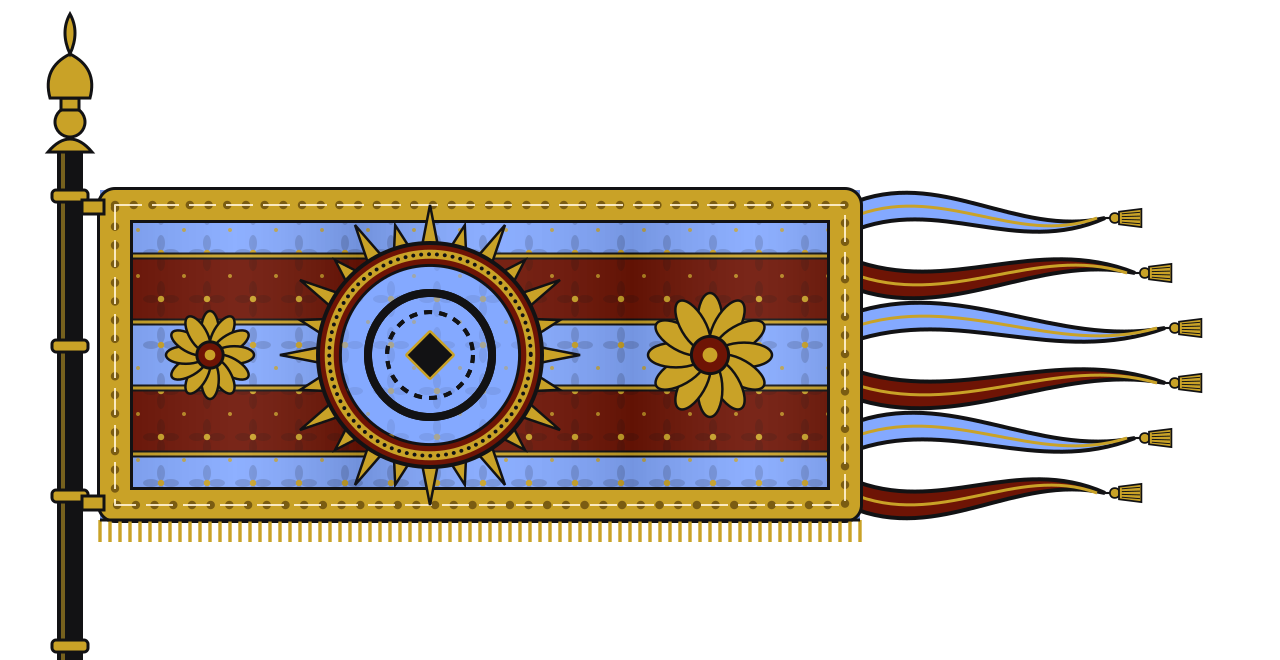
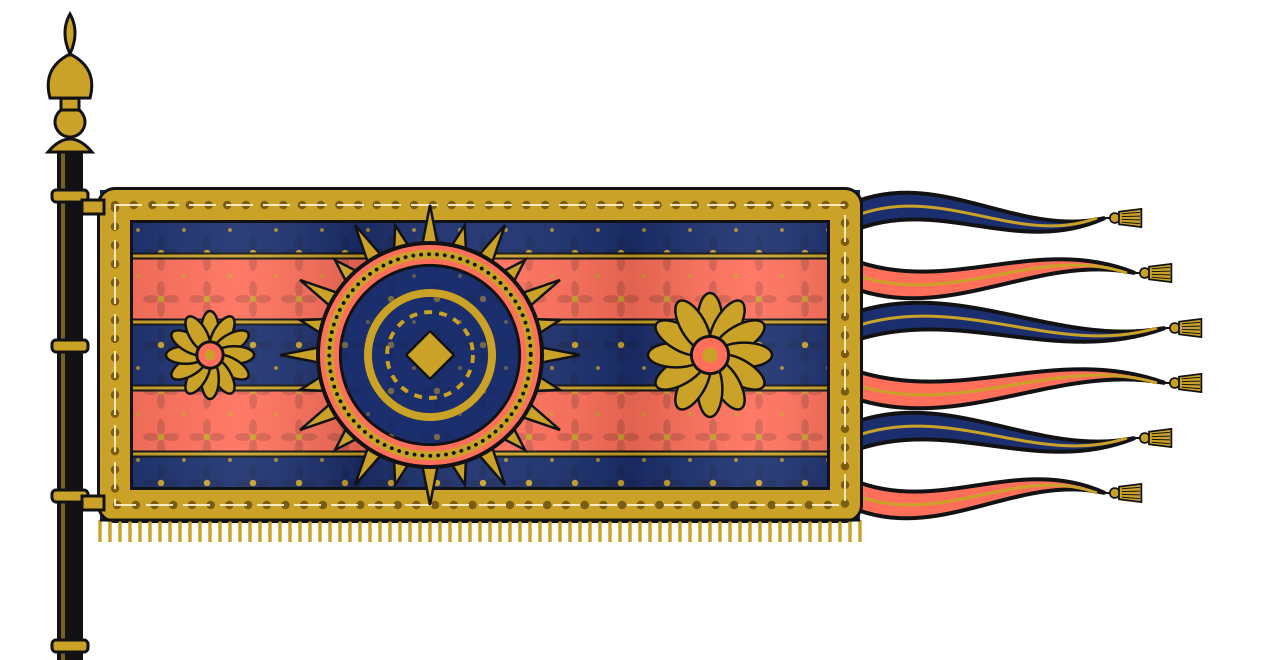
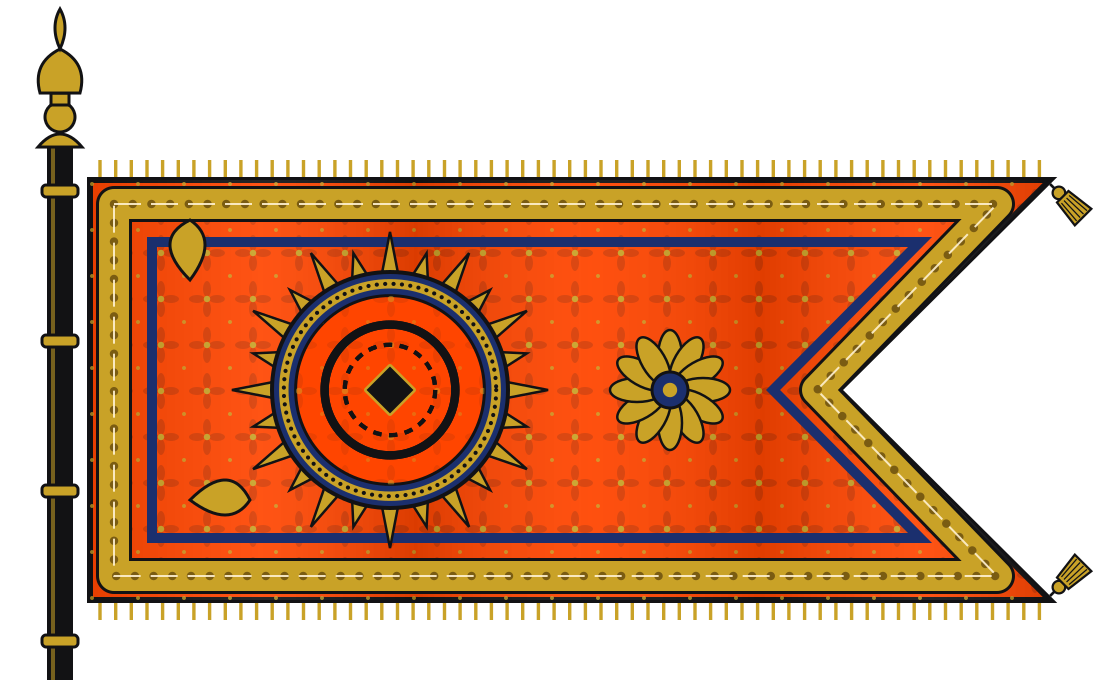
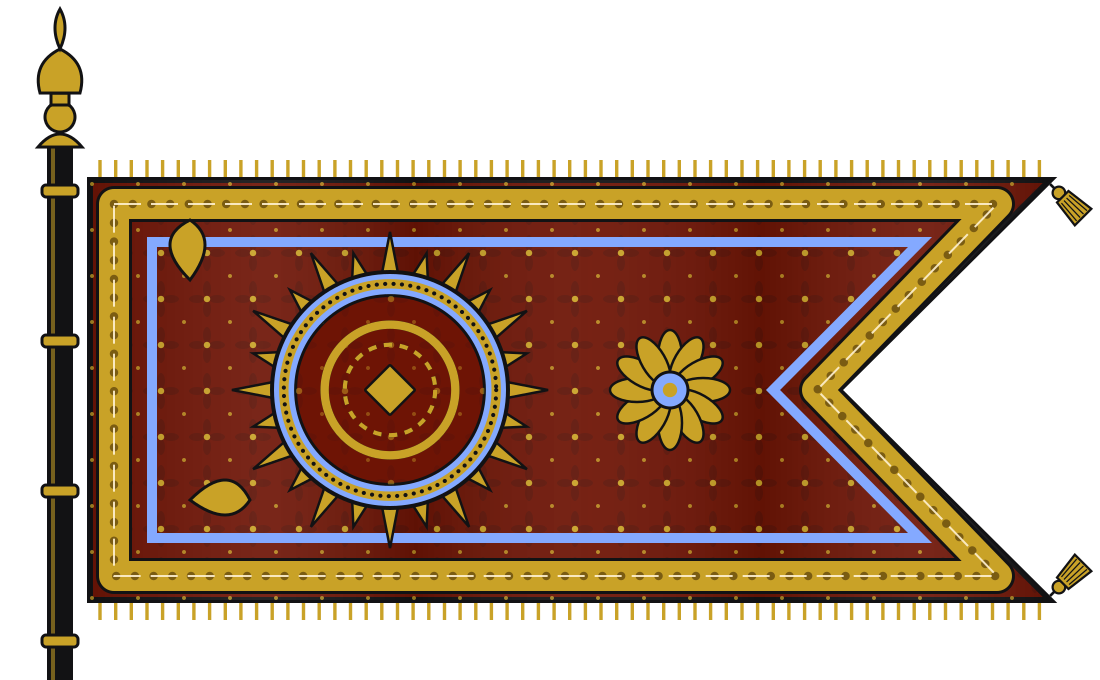
No seal, coin or banner of the Porja as a whole is recorded in the extracts. The arms below are the Atlas's design choices.
| Part of the kit | This clan |
|---|---|
| Field | Deep Brick #7E2A1E |
| Accent | Intense Electric Blue #84A9FF |
| Emblem colour | Metallic Gold #C9A227 |
| Zari metal | Gold |
| Main emblem | Dancers linked in a line |
| Second image | A crown held above bowed heads |
| Night and day | Every visual accessory has two versions: by night the emblem on the dark field, by day the clan's field colour on cloth woven from its metal. |
6. Flags
Every clan has every flag type; the type says the occasion and the colours say the clan. The outlined card is the flag the Atlas assigns.



Historic banner
None known
New flag types
| Accessory | For this clan | Basis |
|---|---|---|
| A9 Pota-dhvaja · ship and trade flag For ships, caravans and markets | Not yet designed for this clan | Design |
| A10 Utsava-patāka · festival flag Light, bright flag for fairs and festivals | Not yet designed for this clan | Design |
| A11 Shoka-dhvaja · mourning flag White cloth with the emblem outline in the clan's metal | Not yet designed for this clan | Design |
7. Regalia
| Accessory | For this clan | Basis |
|---|---|---|
| E1 Chhatra · house parasol The ceremonial umbrella | Not yet designed for this clan | Design |
| E2 Chamara · fly-whisks The pair of whisks beside the head of the house | Not yet designed for this clan | Design |
| E3 Danda · staff of office Staff or scepter | Not yet designed for this clan | Design |
| E4 Simhasana · seat The seat of the house, covered in clan cloth | Not yet designed for this clan | Design |
| E5 Khetaka · shield A round shield; the Changi and Dhanush are its flag forms | Not yet designed for this clan | Regional tradition |
| E6 Kula-ayudha · clan weapon The weapon the clan honours | Not yet found for this clan | Under research |
8. Worn
| Accessory | For this clan | Basis |
|---|---|---|
| F1 Kula-vastra · clan cloth The clan's woven pattern in its kit colours | Not yet designed for this clan | Design |
| F2 Kirti-vastra · honour cloth A cloth earned for a deed, not inherited | Not yet designed for this clan | Design |
| F3 Kula-mala · garland flower The flower or leaf the clan wears as a garland | Not yet found for this clan | Under research |
| F4 Chinha · house pin A metal badge with the pin emblem | Not yet designed for this clan | Design |
9. Records
| Accessory | For this clan | Basis |
|---|---|---|
| H1 Clan words A traditional line in the native script | ryot · “Ryot, a peasant. The Porojas call themselves 'ryot' people (Thurston 1909).” | Documented |
| H2 Biruda · titles The house's title or titles | Village head: Muduli. Elders: Janni and Mudili (Thurston; Odisha Review) | Documented |
| H3 Prashasti · praise genealogy The lineage as written at the head of a grant | Not yet found for this clan | Under research |
| H4 Vahi · clan register The book of the clan's births, marriages and deaths | Not yet found for this clan | Under research |
| H5 Rana-ghosha · war cry The clan's cry in battle or celebration | 'Am! Am! Am!', called out in the Bonda marriage fire-brand test in the jungle | Documented |
10. VishwaVit · knower of the world
Game values are design choices for this project, not historical claims.
References
- Wikipedia, List of Scheduled Tribes in Odisha, read 2026-10-20, https://en.wikipedia.org/wiki/List_of_Scheduled_Tribes_in_Odisha
- Edgar Thurston and K. Rangachari, Castes and Tribes of Southern India, vol. 6 (Madras, 1909), Project Gutenberg eBook #42996, https://www.gutenberg.org/ebooks/42996
- R. V. Russell and Hira Lal, The Tribes and Castes of the Central Provinces of India, vol. 4 (London, 1916), Project Gutenberg eBook #20668, https://www.gutenberg.org/ebooks/20668
- Majhighariani Temple (tag page: "History of Majhi Ghariani, Rayagada (Majhigouri Temple)"), HinduPad (excerpts only; read 9 Oct 2026).
- Sushree Mohanty, Indigenous Colours of Odisha: Handbook on 62 Tribes (KISS), read 2026-10-20, https://kissnew.kiss.ac.in/wp-content/uploads/2026/05/Indigenous-Colours-of-Odisha-Handbook-on-62-Tribes-Sushree-Mohanty.pdf
- The Tribal Tribune, Festival of the Parjas, read 2026-10-25, https://www.etribaltribune.com/index.php/volume-1/issue-7/festival-of-the-parjas
- Indrajeet Mohanty, Jeypore - A Historical Perspective, Odisha Review, June 2013, read 2026-10-31, https://magazines.odisha.gov.in/Orissareview/2013/jun/engpdf/70-72.pdf
- Endangered Alphabets Project, Parji, read 2026-10-25, https://www.endangeredalphabets.net/alphabets/parji-duruwa/
- Wikipedia, Bodo Parja language, read 2026-10-25, https://en.wikipedia.org/wiki/Bodo_Parja_language
- Odisha State Tribal Museum, Tribes of Odisha: Paroja, read 2026-10-25, https://ostm.in/tribes_of_odisha/paroja/
- Odisha Review, Cultural Life of the Tribals of the Koraput Region, April 2016, read 2026-10-25, https://magazines.odisha.gov.in/Orissareview/2016/April/engpdf/78-82.pdf
- W. Francis, Vizagapatam District Gazetteer (1907), printed p.279 (Malkangiri/Korukonda taluk), Wikisource text via kiwix mirror, read 2026-11-09, https://kwx.liehendr.com/content/wikisource_en_all_maxi_2022-09/A/Page%3AVizagapatam.djvu/299
- Koraput district (Government of Odisha), History, read 2026-11-09, https://koraput.odisha.gov.in/en/about-district/history
- tribalkoraput (blog), Brief history of the Koraput region, 23 May 2009, read 2026-11-09, https://tribalkoraput.blogspot.com/2009/05/brief-history-of-koraput-region-and-its.html
- Wikipedia, Jeypore Estate, read 2026-10-31, https://en.wikipedia.org/wiki/Jeypore_Estate
- W. Francis, Vizagapatam District Gazetteer (1907), Jeypore Taluk section, Wikisource text via kiwix mirror (2022-09 dump), read 2026-11-09, https://kwx.liehendr.com/content/wikisource_en_all_maxi_2022-09/A/Vizagapatam/Gazetteer/Jeypore_Taluk
- Wikipedia, Vishwanath Dev Gajapati, read 2026-10-31, https://en.wikipedia.org/wiki/Vishwanath_Dev_Gajapati
- Wikipedia, Jeypore, read 2026-10-25, https://en.wikipedia.org/wiki/Jeypore
- Wikipedia, Vikram Dev, read 2026-11-09, https://en.wikipedia.org/wiki/Vikram_Dev
- Edgar Thurston and K. Rangachari, Castes and Tribes of Southern India, vol. 3 (Madras, 1909), Project Gutenberg eBook #42993, https://www.gutenberg.org/ebooks/42993
- Edgar Thurston and K. Rangachari, Castes and Tribes of Southern India, vol. 5 (Madras, 1909), Project Gutenberg eBook #42995, https://www.gutenberg.org/ebooks/42995
- Wikipedia, Tribals in Madhya Pradesh, read 2026-10-19, https://en.wikipedia.org/wiki/Tribals_in_Madhya_Pradesh
- dhammabharat.com, List of Scheduled Tribes in Maharashtra and Population of each Tribe (2011 Census), read 2026-10-10, https://dhammabharat.com/?p=13656