The Parhaiya are a forest people of Palamu and Latehar in Jharkhand, with smaller entries in southern Sonbhadra (Uttar Pradesh) and the West Bengal Scheduled Tribe table[1][2][3]. The Atlas records them as a Scheduled Tribe (state list dated 09-07-2024) and a PVTG[4]. Their exogamous clans are called kuris, and eight main kuris are named in People of India as Wikipedia reports them[2]. Scroll reports that many families leave each year after Diwali for brick-kiln work elsewhere[5]. The name is said to mean 'burners of the forest' in Gondi, with 'Paharia' as a possible origin[2].
01Faith and deities
The master-sheet KulDevi (basis: homeland shrine, Rajrappa, Jharkhand). No source read names a single chief deity for the Parhaiya, so the sheet's KulDevi is used, and it is not a source-backed link to this people. The people's own deities are listed below[2].
Chhinnamasta of Rajrappa, Jharkhand
The presiding goddess of the clan's homeland or capital: a link of place, not a recorded clan tie.
| Deity or tradition | Place in the clan's life | Evidence |
|---|---|---|
| Jawalamukhi Devi | One of the tribal deities the people have of their own (the Uttar Pradesh group, as the Wikipedia article reports) | [2] |
| Dharti Mata | One of the tribal deities the people have of their own (the Uttar Pradesh group, as the Wikipedia article reports) | [2] |
02Temples
No temple is recorded for the Parhaiya in the extracts read.
Built by the clan
Not recorded.
Given patronage or grants by the clan
Not recorded.
03Languages and scripts
| Language or script | Kind | Under the clan | Evidence |
|---|---|---|---|
| Dialect of Hindi living | Indo-Aryan (Atlas: language family); the people speak a dialect of Hindi | Spoken by the people as the Wikipedia article describes | [2] |
04Books and literature
No book by or for the Parhaiya is recorded. The bibliography below lists the two ethnographic studies the hgcosmos sheet cites.
Written during the clan's history
| Work | Author | Kind | When | Link to the clan |
|---|---|---|---|---|
| The Parahiyas: a study in cultural ecology and tribal dynamics | Prasad | Study (bibliography entry) | 1978 | [6] |
| The Parhaiyas of Palamau: an ethnographic study | Sharma | Study (bibliography entry) | 1996 | [6] |
Given patronage by the clan
Not recorded.
05Thinkers and scholars
| Name | Field | Era | Contribution |
|---|---|---|---|
| Prasad | Cultural ecology and tribal dynamics (from the title) | 1978 | Author of the study listed in the bibliography[6] |
| Sharma | Ethnography (from the title) | 1996 | Author of the study listed in the bibliography[6] |
The two names come from the bibliography only; no biography is in the extracts. Leads: the IHD chapter 6 profile (not reached) and Dalton's Descriptive Ethnology of Bengal (not reached).
06Art and architecture
No painting, sculpture, architecture or textile is recorded for the Parhaiya in the extracts.
Painting and wall art
Not recorded.
Sculpture and temple art
Not recorded.
Temple and building architecture
Not recorded.
Weaving and textiles
Not recorded.
Clothing and jewellery
Not recorded.
Coins, pottery and crafts
| Art form | What it is | Era | Evidence |
|---|---|---|---|
| Bamboo winnowing basket (soop) | Woven from bamboo and sold; one maker in Chandwa block, Latehar, sold them at Rs 150, as Scroll reports | Not dated | [5] |
07History
Name and early claims
The name is said to mean 'burners of the forest' in Gondi, and 'Paharia' (Hindi, hill dweller) is given as a possible origin[2].
The Journals of India page says the Parhaiya claim to be among the earliest inhabitants of the region and cites Megasthenes and Hiuen Tsang. That is the page's own claim, printed without a source and not checked[1].
Classification in Uttar Pradesh
The Wikipedia article says the Parahiya were classified a Scheduled Caste in Uttar Pradesh and later redesignated a Scheduled Tribe, citing Pratiyogita Darpan (July 2007). As of 2017 they were a Scheduled Tribe only in Sonbhadra district, according to the Ministry of Tribal Affairs as the article cites it[2].
The PVTG category
The Journals of India page says the Dhebar Commission (1960–61) found inequality among the Scheduled Tribes, that the fourth Five Year Plan created the 'Primitive tribal group', and that it was renamed 'Particularly vulnerable tribal group' in 2006[1]. Scroll dates the Dhebar Commission's PVTG finding to 1973[5].
08Journey and migrations
Seasonal work takes families out of the Latehar blocks each year. Scroll reports that about 73 per cent of households in two Latehar blocks migrate for work (Anmol Somanchi, cited by Scroll).
| When | From | To | Why | Evidence |
|---|---|---|---|---|
| After Diwali (late November), each year | Latehar blocks | Brick kilns in Bokaro, Varanasi, Hyderabad, Bengaluru, Kerala and Delhi | Work, with dadan loans arranged through a sardar | [5] |
| June, each year | Brick kilns | Home for the Kharif season | Farming | [5] |
09Seats and lands
| Place | Role | Where today |
|---|---|---|
| Palamu and Latehar | Forest homeland; the Journals of India page says mainly Latehar and Palamau districts. Scroll: Palamu and Latehar lie in a rain-shadow area and the 2011 count was mainly here[1][5] | Jharkhand |
| Southern Sonbhadra | Hilly, forested country at the foot of the Vindhya mountains, where the Wikipedia article places the Parahiya Scheduled Tribe entry[2][7] | Uttar Pradesh |
| West Bengal | Listed as 'Pahariya' in the West Bengal Scheduled Tribes table; no district is given[3] | West Bengal |
10Notable figures
Not recorded.
11Allies, rivals and marriages
| People | Relationship | When |
|---|---|---|
| Sahariya | Named as a related ethnic group of the Sahariya[8] | Not dated |
| Panika | Live in the same hilly, forested southern Sonbhadra area[2] | Not dated |
12Society and livelihood
The Parhaiya are endogamous, and their exogamous clans are called kuris[2]. Work outside the village is organised through a sardar and dadan loans[5].
Government and social order
| Institution or group | What it was | Evidence |
|---|---|---|
| Endogamous group | Marriage is within the people; the kuris are exogamous | [2] |
| Kuri | Exogamous clans; the eight main kuris are listed in the clan section | [2] |
| Sardar and dadan loans | The labour system through which families are sent to brick kilns, as Scroll describes it | [5] |
Livelihood over time
| Era | Livelihood | Evidence |
|---|---|---|
| Traditionally (as the Uttar Pradesh article describes) | Forest dependent; hunting and gathering roots, tubers, fruits, lac and leaves for local markets; slash-and-burn traditionally associated; hunting has ceased and settled cultivation is now the main work | [2] |
| Today (Jharkhand, as the Journals of India page describes) | Hunting expeditions, share-cropping and shifting cultivation; mud houses; firewood from the forest; herbal medicine | [1] |
| Today (Scroll, 2024) | Seasonal migration to brick kilns; bamboo winnowing baskets (soop) made by one maker in Chandwa block; goats; firewood | [5] |
13Sub-clans and related clans
The Parhaiya are endogamous, with exogamous clans called kuris. The eight main kuris below are named in People of India (the Uttar Pradesh group, as Wikipedia reports it)[2]. They are not yet in the Atlas, so each is a new clan candidate.
| Clan | Relation | Where | Size | In the Atlas | Evidence |
|---|---|---|---|---|---|
| Bengeha | Sub-clan | Not stated | new clan candidate | [2] | |
| Bhaloa | Sub-clan | Not stated | new clan candidate | [2] | |
| Bhania | Sub-clan | Not stated | new clan candidate | [2] | |
| Bhusan | Sub-clan | Not stated | new clan candidate | [2] | |
| Gohawa | Sub-clan | Not stated | new clan candidate | [2] | |
| Gurgur | Sub-clan | Not stated | new clan candidate | [2] | |
| Monnoor | Sub-clan | Not stated | new clan candidate | [2] | |
| Sira | Sub-clan | Not stated | new clan candidate | [2] | |
| Sahariya | Related people | Uttar Pradesh (as the related people) | ST-278 | [8] |
Clans marked "new clan candidate" are not in the Atlas yet.
14Surnames
Not recorded.
15Songs and music
Magahī Parab is celebrated with song and dance (Journals of India). No song title or lyric is recorded in the extracts.
None recorded yet.
16Poems, lullabies and children's rhymes
None recorded yet.
17Stories, legends and proverbs
Stories and legends
Not recorded.
Proverbs and sayings
Not recorded.
18Festivals and fairs
| Festival or fair | When | Where | What happens |
|---|---|---|---|
| Magahī Parab living | Not dated in the extracts | Not stated | Celebrated with song and dance[1] |
| Karma research | September 2023, as Scroll mentions it | Not stated | Mentioned in the Scroll article; the extract does not say how the Parhaiya keep it[5] |
19Food, dress and games
Food
| Item | What it is | Evidence |
|---|---|---|
| Roots, tubers and fruits | Gathered from the forest (Uttar Pradesh group, as the Wikipedia article reports) | [2] |
Dress
Not recorded.
Games and martial arts
Not recorded.
Tags: living still practised · revived brought back after a break · lost known only from records · research reported but not yet confirmed from a source. Songs and poems under copyright are listed by title only; restricted or sacred material is noted without its content.
20Status today
The Atlas gives the Parhaiya a Scheduled Tribe status (state list dated 09-07-2024) and PVTG status in Jharkhand. Scroll reports that 25,585 Parhaiyas were counted in India in the 2011 census, mainly in Palamu and Latehar[5].
Recognised heritage
| What | Recognition | Evidence |
|---|---|---|
| PVTG category | Created as 'Primitive tribal group' in the fourth Five Year Plan; renamed 'Particularly vulnerable tribal group' in 2006 (Journals of India) | [1] |
| Government schemes for PVTG households | Dakiya Yojana, launched April 2017 in Godda, Palamu and Sahebganj; PVTG pension of Rs 1,000 per household; PM-JANMAN housing of Rs 2 lakh (Scroll) | [5] |
Not yet reviewed by the community. No community review appears in the sources read.
21For children
Forest, water and land
Far away in the forests of Palamu and Latehar, in Jharkhand, live the Parhaiya families. They gather firewood and herbs from the forest. One maker in Chandwa block weaves bamboo winnowing baskets, which are sold. Every year after Diwali, many families travel to work in brick kilns elsewhere. They come home in June for the Kharif farming season. At the Magahī Parab festival they sing and dance together. The Parhaiya say that water, forest and land are what they value most.
22Across the project
| Project | What carries this clan | Status |
|---|---|---|
| Atlas of the Janas | Districts are in the lands section; the footprint file is not written in this run | To check |
| KulDevi and GrahDevi | KulDevi Chhinnamasta (Rajrappa, Jharkhand) is the Atlas's; no source ties it to the Parhaiya. The GrahDevi forms are | From the Atlas |
| Planet naming | Not yet checked against the Tier registers | To check |
| Renaming and waters | 'Jal, Jangal, Zameen' is the phrase Scroll gives; no place or water name is drawn from the Parhaiya in the extracts | — |
23Open questions
- Which Parhaiya the entries mean: the Uttar Pradesh 'Parahiya' entry (Sonbhadra) and the West Bengal 'Pahariya' row (matched by the table's own note) may not be the Jharkhand people. The Jharkhand facts come from the Journals of India and Scroll; the Wikipedia article describes the Uttar Pradesh group.
- How many PVTGs Jharkhand has: nine (Journals of India; the Vikaspedia list) or eight of 32 tribes (the IHD foreword).
- The Dhebar Commission's date: 1960–61 (Journals of India) or 1973 (Scroll).
- The Megasthenes and Hiuen Tsang claim is printed on the Journals of India page as its own, unverified.
- Whether the eight kuris are the Jharkhand Parhaiya's kuris, and whether any kuri is used as a surname.
- The Uttar Pradesh (901) and West Bengal (921) figures come from saved notes and the library pages, not from a fresh read this run. The Scheduled Caste figure for the Parahiya outside Sonbhadra (2,446, 2011) is a different list entry and is not used here.
- The sheet gives Bihar among the states; no extract confirms it.
- The KulDevi Chhinnamasta has only the Atlas as its basis.
- Native-script forms of the people's songs, sayings and tales: none in the extracts. Leads not reached: IHD Adivasis of Jharkhand chapter 6 (p. 182, from offset 100,000); serialsjournals 97314_7 and 52166_8; indiantribalheritage.org/?p=16582; Beggiora PDF (iris.unive.it); peoplegroups.org and Joshua Project entries; eparlib AS24.pdf; Dalton and the Palamu District Gazetteer.
- Scheduled Tribe scope: the Atlas gives Scheduled Tribe status with no state named (state list dated 09-07-2024); Wikipedia, as of 2017 and citing the Ministry of Tribal Affairs, gives ST in Uttar Pradesh only for Sonbhadra district[4][2].
24Astitva
अस्तित्व · being, existence: everything by which the clan is known
No seal, coin, title, prashasti, war cry, totem, guardian tree, garland flower, instrument or cloth is recorded for the Parhaiya in the extracts read. The people's tribal deities and their bamboo winnowing baskets are recorded, but none is an accessory of the kind listed here[2][5].
Every clan has every accessory, royal objects included. Each one says how it is known: Documented This clan's own object is recorded. · Regional tradition Recorded for the region or for peoples like this one, not for this clan. · Design Made for this project, with no historical claim. · Under research To be found for this clan from sources. Legends and titles are written in the clan's own script.
1. Seals and coins
| Accessory | For this clan | Basis |
|---|---|---|
| B1 Rajamudra · house seal Round seal with the clan emblem and a short legend in the clan's script | Not yet designed for this clan | Design |
| B2 Anguliya-mudra · signet ring Personal seal ring of the head of the house | Not yet designed for this clan | Design |
| B3 Chhapa · house stamp Ink or block stamp for letters, goods and cloth | Not yet designed for this clan | Design |
| B4 Tamrapatra · charter plate Copper-plate grant on a ring, closed with the house seal | Not yet designed for this clan | Design |
| B5 Shreni-mudra · guild or trade seal Seal for the clan's trade, craft or caravan | Not yet designed for this clan | Design |
| C1 Clan coin Emblem or deity on one side, a legend in the clan's script | Not yet designed for this clan | Design |
| C2 Coin die The die that strikes the coin | Not yet designed for this clan | Design |
2. Living symbols
| Accessory | For this clan | Basis |
|---|---|---|
| I1 Totem trio The tree, bird and animal the clan protects | Not yet found for this clan | Under research |
| I2 Kaval-maram · guardian tree The tree that stands at the clan's seat | Not yet found for this clan | Under research |
3. Stone and gate
| Accessory | For this clan | Basis |
|---|---|---|
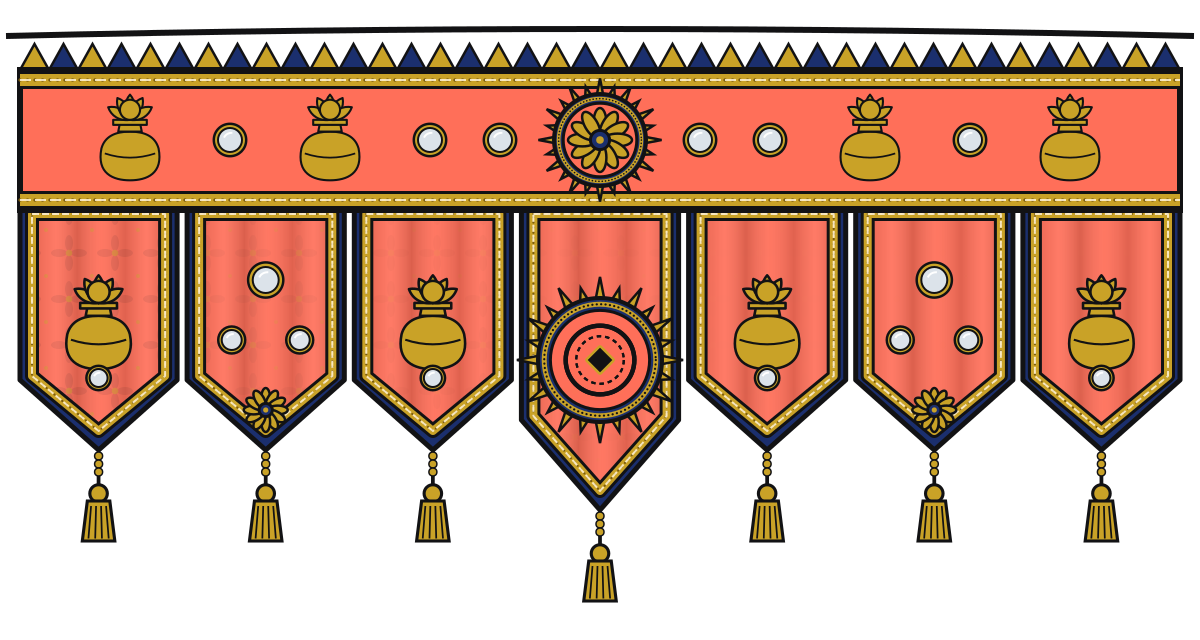
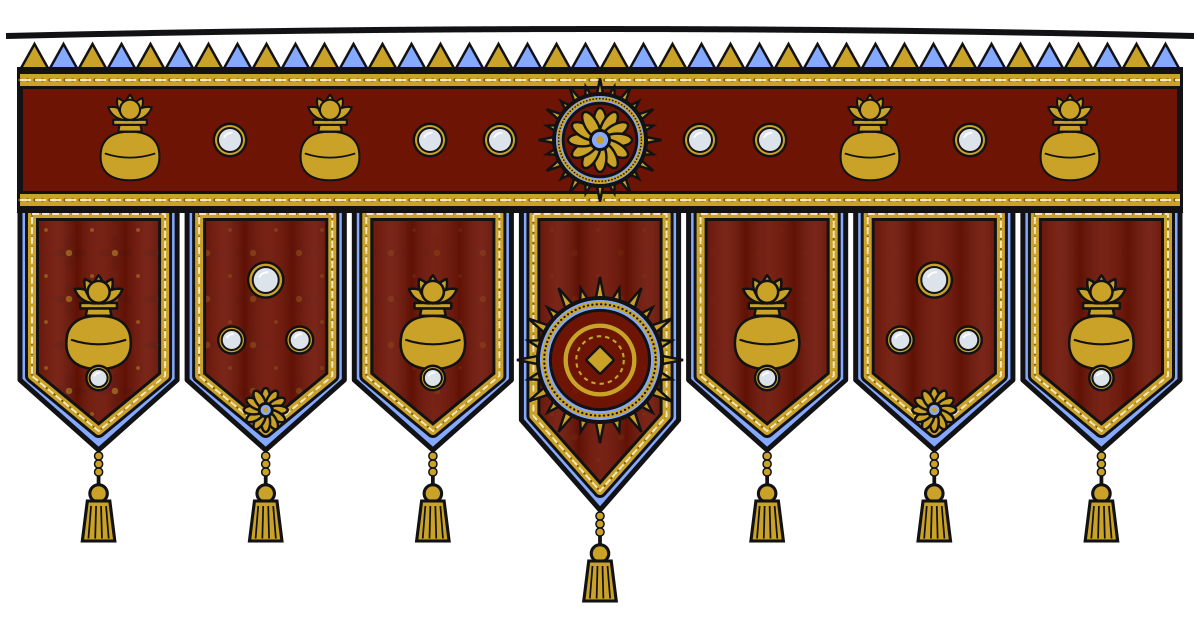
| G1 Torana · gateway The built gate of the seat; the cloth Toran hangs in it | Not yet designed for this clan | Regional tradition |
| G2 Viragallu · hero stone Carved panel stone for a member who died defending the clan | Not yet designed for this clan | Regional tradition |
| G3 Kula-shila · clan stones Standing and table stones that remember the ancestors | Not yet designed for this clan | Design |
| G4 Jayastambha · victory pillar A pillar raised for a victory | Not yet designed for this clan | Design |
| G5 Sima-shila · boundary stone Marks the clan's land, with a line in the native script | Not yet designed for this clan | Design |
4. Sounds
| Accessory | For this clan | Basis |
|---|---|---|
| D1 Pancha-mahashabda · five great sounds The right to five instruments | Not yet designed for this clan | Design |
| D2 Shankha · clan conch The clan's own named war conch | Not yet designed for this clan | Design |
| D3 Murasu · house drums Three drums: war, charity and justice | Not yet designed for this clan | Design |
5. Kit: colours, metals and emblems
No seal, coin, banner, totem or instrument of the Parhaiya is recorded in the sources read. The main emblem in the Atlas, a forest clearing with a hut for forest craft, is a project design and is not a documented symbol.
| Part of the kit | This clan |
|---|---|
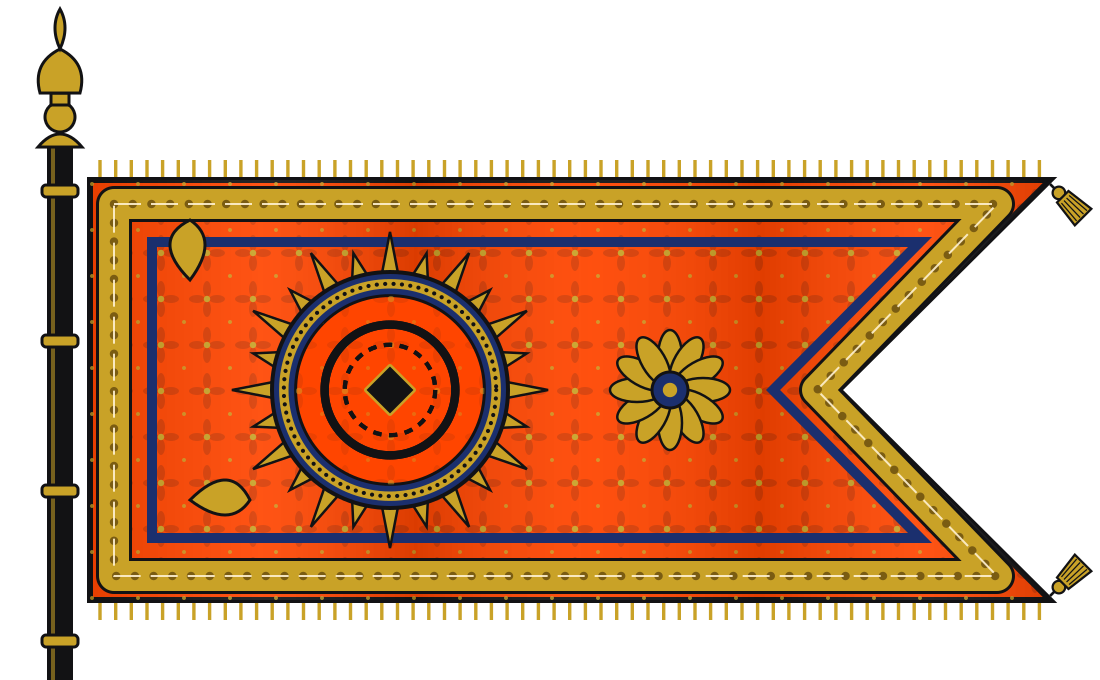
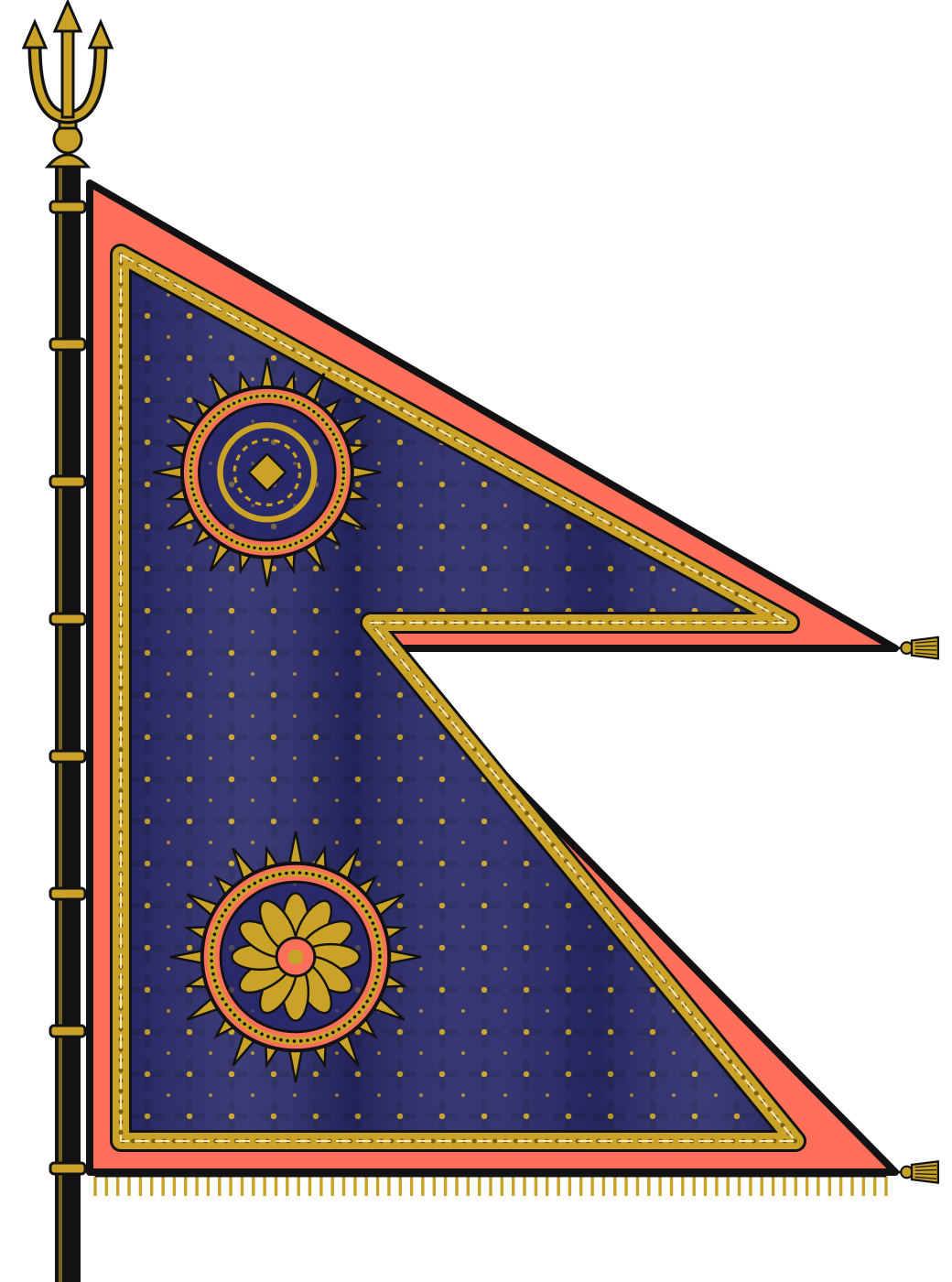
| Field | Warm Red-Orange #FF6F59 |
| Accent | Deep Indigo #2A2A6B |
| Emblem colour | Charcoal Black #121214 |
| Zari metal | Gold |
| Main emblem | A forest clearing with a hut |
| Second image | — |
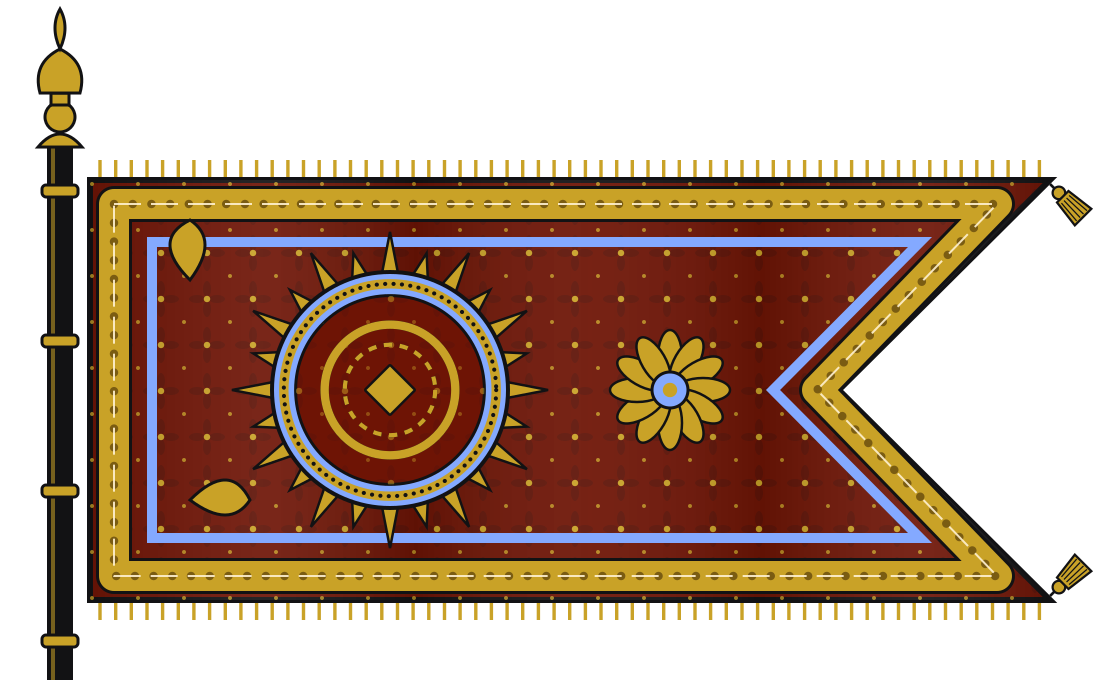
| Night and day | Every visual accessory has two versions: by night the emblem on the dark field, by day the clan's field colour on cloth woven from its metal. |
6. Flags
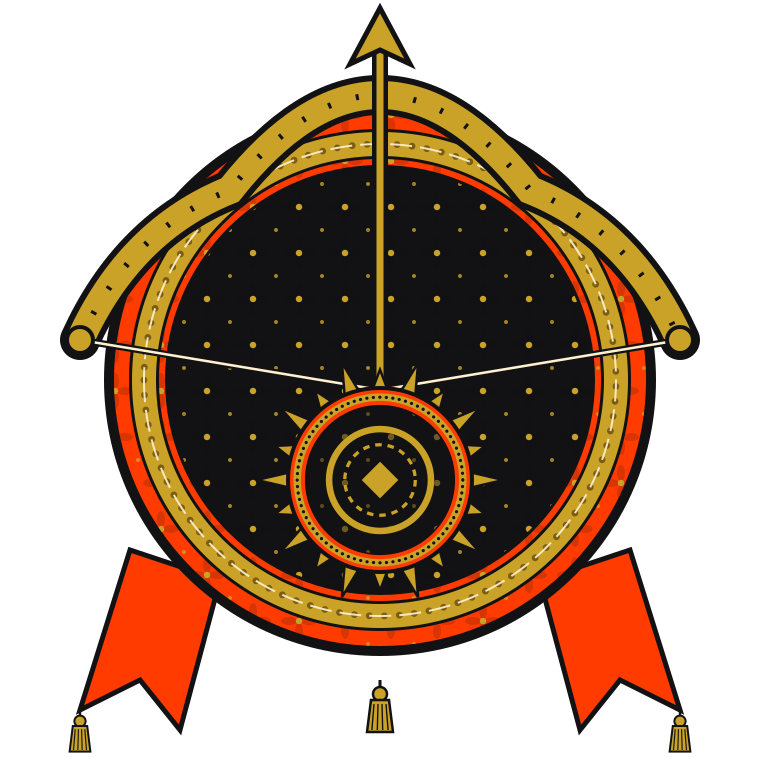
Every clan has every flag type; the type says the occasion and the colours say the clan. The outlined card is the flag the Atlas assigns.





Historic banner
None known
New flag types
| Accessory | For this clan | Basis |
|---|---|---|
| A9 Pota-dhvaja · ship and trade flag For ships, caravans and markets | Not yet designed for this clan | Design |
| A10 Utsava-patāka · festival flag Light, bright flag for fairs and festivals | Not yet designed for this clan | Design |
| A11 Shoka-dhvaja · mourning flag White cloth with the emblem outline in the clan's metal | Not yet designed for this clan | Design |
7. Regalia
| Accessory | For this clan | Basis |
|---|---|---|
| E1 Chhatra · house parasol The ceremonial umbrella | Not yet designed for this clan | Design |
| E2 Chamara · fly-whisks The pair of whisks beside the head of the house | Not yet designed for this clan | Design |
| E3 Danda · staff of office Staff or scepter | Not yet designed for this clan | Design |
| E4 Simhasana · seat The seat of the house, covered in clan cloth | Not yet designed for this clan | Design |
| E5 Khetaka · shield A round shield; the Changi and Dhanush are its flag forms | Not yet designed for this clan | Regional tradition |
| E6 Kula-ayudha · clan weapon The weapon the clan honours | Not yet found for this clan | Under research |
8. Worn
| Accessory | For this clan | Basis |
|---|---|---|
| F1 Kula-vastra · clan cloth The clan's woven pattern in its kit colours | Not yet designed for this clan | Design |
| F2 Kirti-vastra · honour cloth A cloth earned for a deed, not inherited | Not yet designed for this clan | Design |
| F3 Kula-mala · garland flower The flower or leaf the clan wears as a garland | Not yet found for this clan | Under research |
| F4 Chinha · house pin A metal badge with the pin emblem | Not yet designed for this clan | Design |
9. Records
| Accessory | For this clan | Basis |
|---|---|---|
| H1 Clan words A traditional line in the native script | Jal, Jangal, Zameen · “Water, forest, land: the prized possessions, as Scroll reports them. The extract gives no native-script form.” Scroll (IndiaSpend), 15 Feb 2024[5] | Design |
| H2 Biruda · titles The house's title or titles | Not yet found for this clan | Under research |
| H3 Prashasti · praise genealogy The lineage as written at the head of a grant | Not yet found for this clan | Under research |
| H4 Vahi · clan register The book of the clan's births, marriages and deaths | Not yet found for this clan | Under research |
| H5 Rana-ghosha · war cry The clan's cry in battle or celebration | Not yet found for this clan | Under research |
10. VishwaVit · knower of the world
Game values are design choices for this project, not historical claims.
References
- Journals of India, The Parhaiyas of Jharkhand (print version, 17 Feb 2023), read 2026-11-17, https://journalsofindia.com/the-parhaiyas-of-jharkhand/?print=pdf
- Wikipedia, Parahiya, read 2026-11-17 (full article; it describes the Uttar Pradesh group, citing People of India vol. XLII pt 3), https://en.wikipedia.org/wiki/Parahiya
- Wikipedia, List of Scheduled Tribes in West Bengal, read 2026-10-21, https://en.wikipedia.org/wiki/List_of_Scheduled_Tribes_in_West_Bengal
- Ministry of Tribal Affairs, State/UT-wise list of Scheduled Tribes (Constitution (ST) Order 1950 as amended; list dated 09-07-2024), as recorded in the Atlas
- Padmini Ramesh and Sangeeth Sugathan (IndiaSpend), As climate change erodes livelihoods, Jharkhand's Parhaiya Adivasis migrate to toil in brick kilns, Scroll.in, 15 Feb 2024, read 2026-11-17, https://scroll.in/article/1063294/as-climate-change-erodes-livelihoods-jharkhands-parhaiya-adivasis-migrate-to-toil-in-brick-kilns
- hgcosmos.org, Parahiya (bibliography sheet), read 2026-10-27, https://www.hgcosmos.org/assets/culture/AZ/P/Parahiya.pdf
- Wikipedia, List of Scheduled Tribes in Uttar Pradesh, read 2026-10-22, https://en.wikipedia.org/wiki/List_of_Scheduled_Tribes_in_Uttar_Pradesh
- Wikipedia, Sahariya (caste), read 2026-11-05, https://en.wikipedia.org/wiki/Sahariya_(caste)