Parenga are a Scheduled Tribe of Odisha (list dated 09-07-2024), with 9,445 people counted in the 2011 Census, mainly in the Nandapur and Lamtaput areas of Koraput district[1]. The Odisha government classes them as a sub-tribe of the Gadaba within the Munda group, and Parenga call the Gadaba their brothers[1]. Their oral annals derive the name from kerang, a plant fibre used for clothing[1]. They speak Gorum, a South Munda language, and are typically bilingual in Desia and Telugu[1].
01Faith and deities
KulDevi from the Atlas (basis: homeland shrine; Majhighariani of Rayagada, goddess of the Koraput hills). No clan deity of the Parenga is named in the extracts: the Odisha State Tribal Museum Parenga page names none[2].
Majhighariani of Rayagada, goddess of the Koraput hills
The presiding goddess of the clan's homeland or capital: a link of place, not a recorded clan tie.
Not recorded.
02Temples
No temple of the Parenga is named in the extracts. Gadaba temples and sacred groves are recorded in the notes for the Gadaba.
Built by the clan
Not recorded.
Given patronage or grants by the clan
Not recorded.
03Languages and scripts
| Language or script | Kind | Under the clan | Evidence |
|---|---|---|---|
| Gorum living | South Munda language (Austroasiatic) | Spoken by the Parenga | [1] |
| Desia and Telugu | Second languages: Parenga are typically bilingual in them | Spoken by the Parenga | [1] |
| Script | No native-script form of Gorum or Parenga is printed in the extracts | — | [1] |
04Books and literature
Two works on the Parenga are named by Wikipedia, neither read. Titles are given as Wikipedia cites them.
Written during the clan's history
| Work | Author | Kind | When | Link to the clan |
|---|---|---|---|---|
| Pareṅgā jībanadhārā | Sahu, Pradhan and Mohanty | Cited via Wikipedia | 2010 | [1] |
| Parenga | Ota, Patel and Paikray (SCSTRTI) | Cited via Wikipedia, on clan structure | 2018 | [1] |
Given patronage by the clan
Not recorded.
05Thinkers and scholars
Not recorded.
Under research. The authors of the works above are named there; no Parenga scholar is in the extracts.
06Art and architecture
Under research: no Parenga painting, craft, architecture or dress is in the extracts.
Painting and wall art
Not recorded.
Sculpture and temple art
Not recorded.
Temple and building architecture
Not recorded.
Weaving and textiles
Not recorded.
Clothing and jewellery
Not recorded.
Coins, pottery and crafts
Not recorded.
07History
The name (oral annals)
The Parenga oral annals derive the name 'Parenga', or 'Peranga', from kerang, a plant fibre used for clothing (credited by Wikipedia to SCSTRTI and the Odisha State Tribal Museum)[1].
A Gadaba sub-tribe
The Odisha government classes Parenga as a sub-tribe of the Gadaba within the Munda group[1].
Thurston and Rangachari's 1909 entry on the Gadaba names five Gadaba sections, of which Parenga is one[3].
Later record
No dated Parenga history is in the extracts. The 1909 Gadaba entry and the Koraput page describe the Gadaba, not the Parenga, and their material is kept in the notes for other clans.
08Journey and migrations
No migration of the Parenga is recorded in the extracts.
Not recorded.
09Seats and lands
| Place | Role | Where today |
|---|---|---|
| Nandapur and Lamtaput areas | Main area of settlement | Koraput district, Odisha[1] |
| Malkangiri, Kalahandi, Sundargarh, Balangir | Settlements outside the main area | Odisha[1] |
| Koraput and Malkangiri | Districts as the KISS handbook prints them | Odisha[4] |
| Jeypore | Historical kingdom | Odisha |
10Notable figures
Not recorded.
11Allies, rivals and marriages
| People | Relationship | When |
|---|---|---|
| Gadaba | Parent people: Parenga are a sub-tribe of the Gadaba; they call the Gadaba their brothers | Today[1] |
| Gutob | Fellow Gadaba section (Bodo or Gutob), per Thurston 1909 | 1909[3] |
| Paraja (Porja) | The Tribal Tribune lists Parenga as one of the Paraja sub-groups, with Sodia and Jadia (the page's wording) | Today[5] |
12Society and livelihood
Parenga households are nuclear, patrilocal, patrilineal and patripotestal, and mostly monogamous. Wider kin matter for economic cooperation and ritual, and the groups of the two lineages regulate marriage[1].
Government and social order
| Institution or group | What it was | Evidence |
|---|---|---|
| Household | Nuclear, patrilocal, patrilineal, patripotestal; mostly monogamous | [1] |
| Wider kin | Important for economic cooperation and ritual | [1] |
| Lineage groups | Two lineages (Vaishya and Putuli), each with groups; the groups regulate marriage | [1] |
| Marriage by fight or elopement | Parenga Gadabas, as Thurston and Rangachari (1909) give Paddison's record: biba, where the groom must carry off the bride after a fist fight; lethulia, an elopement followed by a fine of 20 rupees or what the man can afford | [3] |
Livelihood over time
Not recorded.
13Sub-clans and related clans
Parenga are a sub-tribe of the Gadaba. Wikipedia names two main lineages, Vaishya and Putuli, each subdivided into groups: Ontal (cobra), Khara (sun), Khilla (tiger), Pangi (vulture), Khinbudi (bear), Machha (fish) and Golari (snake). The groups regulate marriage[1]. Thurston's 1909 Gadaba entry names five Gadaba sections, Parenga among them[3].
| Clan | Relation | Where | Size | In the Atlas | Evidence |
|---|---|---|---|---|---|
| Gadaba | Parent people | Koraput, Malkangiri and Nowrangapur (KISS handbook) | 84,689, 2011[6] | ST-076 | [1][3] |
| Vaishya | Sub-clan | new clan candidate | [1] | ||
| Putuli | Sub-clan | new clan candidate | [1] | ||
| Ontal (cobra) | Sub-clan | new clan candidate | [1] | ||
| Khara (sun) | Sub-clan | new clan candidate | [1] | ||
| Khilla (tiger) | Sub-clan | new clan candidate | [1] | ||
| Pangi (vulture) | Sub-clan | new clan candidate | [1] | ||
| Khinbudi (bear) | Sub-clan | new clan candidate | [1] | ||
| Machha (fish) | Sub-clan | new clan candidate | [1] | ||
| Golari (snake) | Sub-clan | new clan candidate | [1] | ||
| Gutob (Bodo Gadaba) | Branch | Lamptaput block, Koraput; also Khoirput block and Visakhapatnam district[7] | new clan candidate | [3][7] | |
| Olaro | Branch | Gadaba section (Thurston 1909) | new clan candidate | [3] | |
| Kaththiri | Branch | Gadaba section, also Kaththara (Thurston 1909) | new clan candidate | [3] | |
| Kapu Gadaba | Branch | Gadaba section (Thurston 1909) | new clan candidate | [3][6] | |
| Ollara Gadaba | Branch | Gadaba sub-group, Odisha | new clan candidate | [8][6] | |
| Sano Gadaba | Branch | Gadaba sub-group, Odisha | new clan candidate | [8][6] | |
| Bonda Gadaba | Related people | new clan candidate | [3] | ||
| Kerang Kapus | Related people | new clan candidate | [3] | ||
| Paraja (Porja) | Related people | Koraput; Nandapur area | ST-261 | [5] | |
| Munda | Related people | Munda group of tribes; the Gadaba sit within it (Wikipedia) | ST-229 | [1] |
Clans marked "new clan candidate" are not in the Atlas yet.
14Surnames
Not recorded.
15Songs and music
No Parenga song is named in the extracts.
None recorded yet.
16Poems, lullabies and children's rhymes
None recorded yet.
17Stories, legends and proverbs
Stories and legends
| Story | What happens | Told by | Evidence |
|---|---|---|---|
| The name from kerang | The Parenga name ('Parenga' or 'Peranga') comes from kerang, a plant fibre used for clothing | Parenga oral annals, as credited on Wikipedia | [1] |
Proverbs and sayings
Not recorded.
18Festivals and fairs
Not recorded.
19Food, dress and games
Food
Not recorded.
Dress
Not recorded.
Games and martial arts
Not recorded.
Tags: living still practised · revived brought back after a break · lost known only from records · research reported but not yet confirmed from a source. Songs and poems under copyright are listed by title only; restricted or sacred material is noted without its content.
20Status today
A Scheduled Tribe in Odisha (list dated 09-07-2024); 9,445 Parenga were counted in the 2011 Census[1].
Not yet reviewed by the Parenga community; no community review is recorded.
21For children
The Fibre Name
The Parenga live in Koraput district, in Odisha. Their oral stories say that their name comes from kerang, a plant whose fibre is used for clothing. They are counted as one of the Gadaba groups, and the Gadaba are a people of the Munda group. The Parenga speak a language called Gorum. In the 2011 Census, 9,445 Parenga were counted in Odisha. Their people belong to two main lineages, called Vaishya and Putuli.
Riddle: Which plant fibre gives the Parenga their name in their oral stories? (Kerang, a plant fibre used for clothing.)
22Across the project
| Project | What carries this clan | Status |
|---|---|---|
| Atlas of the Janas | Not pinned: the extracts give no place beyond the Koraput district | To check |
| KulDevi and GrahDevi | Majhighariani, from the Atlas (goddess of the Koraput hills) | From the Atlas |
| Planet naming | Not checked against the Tier registers | To check |
| Renaming and waters | The name is tied to kerang, a plant fibre; no place or water name drawn yet | — |
23Open questions
- The Parenga's own deity, shrine or temple is not in the extracts. Read the full Odisha State Tribal Museum Parenga page (only its deity line was extracted) and SCSTRTI 2018.
- No native-script name or script for Gorum or the Parenga is in the extracts. Wikipedia prints none.
- Clan words: no line of the Parenga's own is in the extracts. Choose and cite a line only after a source is read.
- Which groups (Ontal, Khara, Khilla, Pangi, Khinbudi, Machha, Golari) sit under the Vaishya lineage and which under Putuli, and their sizes: SCSTRTI 2018 (Ota, Patel and Paikray), cited on Wikipedia, not read.
- Contradiction: the lead and history say the Odisha government classes Parenga as a Gadaba sub-tribe[1]; the Odisha list gives Parenga 9,445 as its own row and also as 'Parenga Gadaba' within the Gadaba figure of 84,689[6]. Check the census table.
- Thurston 1909 vol. 6 (lead from the pack: L4464, 'A sub-division of Gadaba') is not in the cache. Read it and cache the extract before relying on it.
- Vizagapatam gazetteer pages on the Wikisource mirror (public domain, Gadaba customs) and SOAS notes on the Gadabas (1941, bibliographic only): not read.
- Whether the marriage forms recorded by Paddison (biba, lethulia, 1909) are still practised by the Parenga.
- Gorum: confirm the language and its speaker figures against a linguistic source; the Parenga speak Gorum per Wikipedia (ATLC).
- Community review: none recorded.
24Astitva
अस्तित्व · being, existence: everything by which the clan is known
The extracts record no seal, coin, title, banner or plate for the Parenga. The one documented living symbol is the set of group names, which take the sun, cobra, tiger, vulture, bear, fish and snake[1].
Every clan has every accessory, royal objects included. Each one says how it is known: Documented This clan's own object is recorded. · Regional tradition Recorded for the region or for peoples like this one, not for this clan. · Design Made for this project, with no historical claim. · Under research To be found for this clan from sources. Legends and titles are written in the clan's own script.
1. Seals and coins
| Accessory | For this clan | Basis |
|---|---|---|
| B1 Rajamudra · house seal Round seal with the clan emblem and a short legend in the clan's script | Not yet designed for this clan | Design |
| B2 Anguliya-mudra · signet ring Personal seal ring of the head of the house | Not yet designed for this clan | Design |
| B3 Chhapa · house stamp Ink or block stamp for letters, goods and cloth | Not yet designed for this clan | Design |
| B4 Tamrapatra · charter plate Copper-plate grant on a ring, closed with the house seal | Not yet designed for this clan | Design |
| B5 Shreni-mudra · guild or trade seal Seal for the clan's trade, craft or caravan | Not yet designed for this clan | Design |
| C1 Clan coin Emblem or deity on one side, a legend in the clan's script | Not yet designed for this clan | Design |
| C2 Coin die The die that strikes the coin | Not yet designed for this clan | Design |
2. Living symbols
| Accessory | For this clan | Basis |
|---|---|---|
| I1 Totem trio The tree, bird and animal the clan protects | Groups named for the sun, cobra, tiger, vulture, bear, fish and snake The names of the groups under the two lineages (Wikipedia). The extracts do not describe a protection rite for them.[1] | Documented |
| I2 Kaval-maram · guardian tree The tree that stands at the clan's seat | Not yet found for this clan | Under research |
3. Stone and gate
| Accessory | For this clan | Basis |
|---|---|---|
| G1 Torana · gateway The built gate of the seat; the cloth Toran hangs in it | Not yet designed for this clan | Regional tradition |
| G2 Viragallu · hero stone Carved panel stone for a member who died defending the clan | Not yet designed for this clan | Regional tradition |
| G3 Kula-shila · clan stones Standing and table stones that remember the ancestors | Not yet designed for this clan | Design |
| G4 Jayastambha · victory pillar A pillar raised for a victory | Not yet designed for this clan | Design |
| G5 Sima-shila · boundary stone Marks the clan's land, with a line in the native script | Not yet designed for this clan | Design |
4. Sounds
| Accessory | For this clan | Basis |
|---|---|---|
| D1 Pancha-mahashabda · five great sounds The right to five instruments | Not yet designed for this clan | Design |
| D2 Shankha · clan conch The clan's own named war conch | Not yet designed for this clan | Design |
| D3 Murasu · house drums Three drums: war, charity and justice | Not yet designed for this clan | Design |
5. Kit: colours, metals and emblems
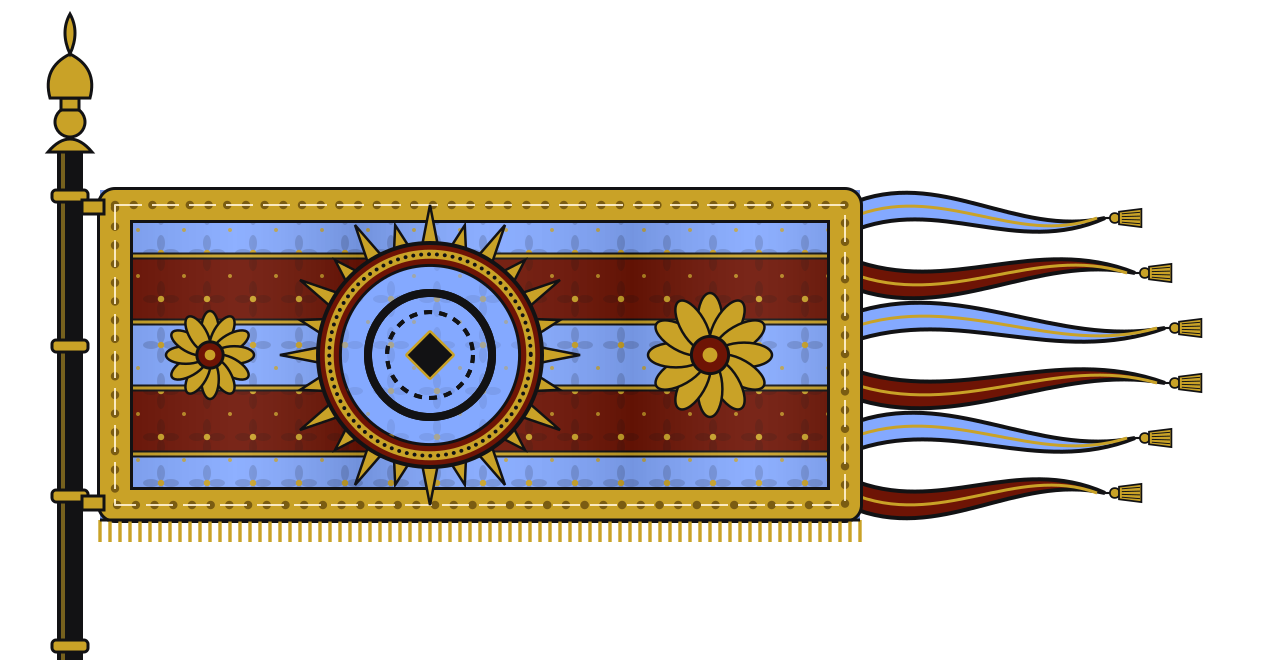
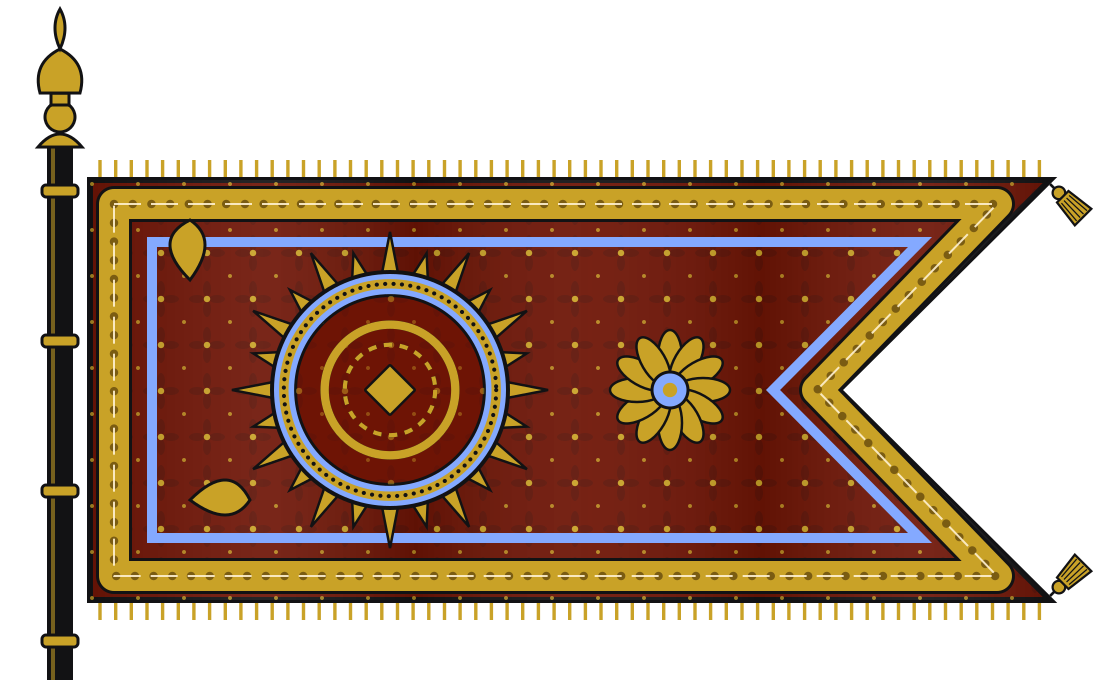
The Atlas gives the Parenga flag as a Changi (sun crest) with a misty hill for the Koraput hills. The extracts give no seal, banner or emblem of the Parenga; the documented symbols are the names of its groups[1].
| Part of the kit | This clan |
|---|---|
| Field | Deep Brick #7E2A1E |
| Accent | Deep Cosmic Blue #9BB0FF |
| Emblem colour | Metallic Gold #C9A227 |
| Zari metal | Gold |
| Main emblem | A misty hill |
| Second image | — |
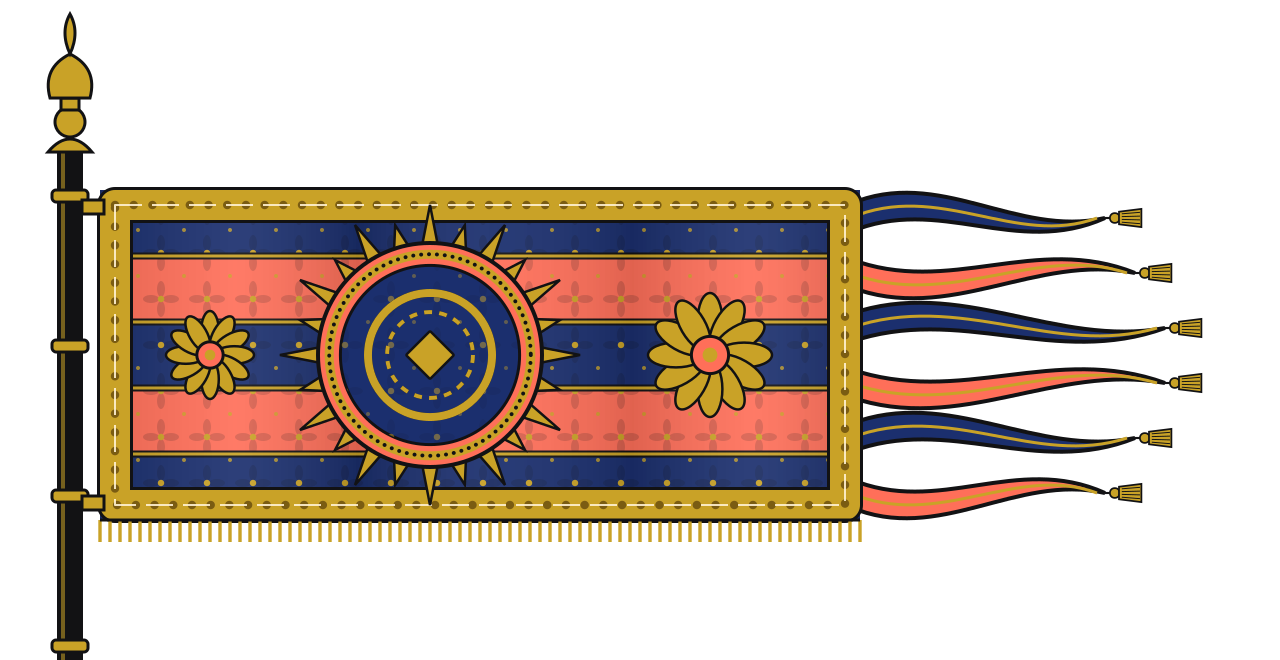
| Night and day | Every visual accessory has two versions: by night the emblem on the dark field, by day the clan's field colour on cloth woven from its metal. |
6. Flags
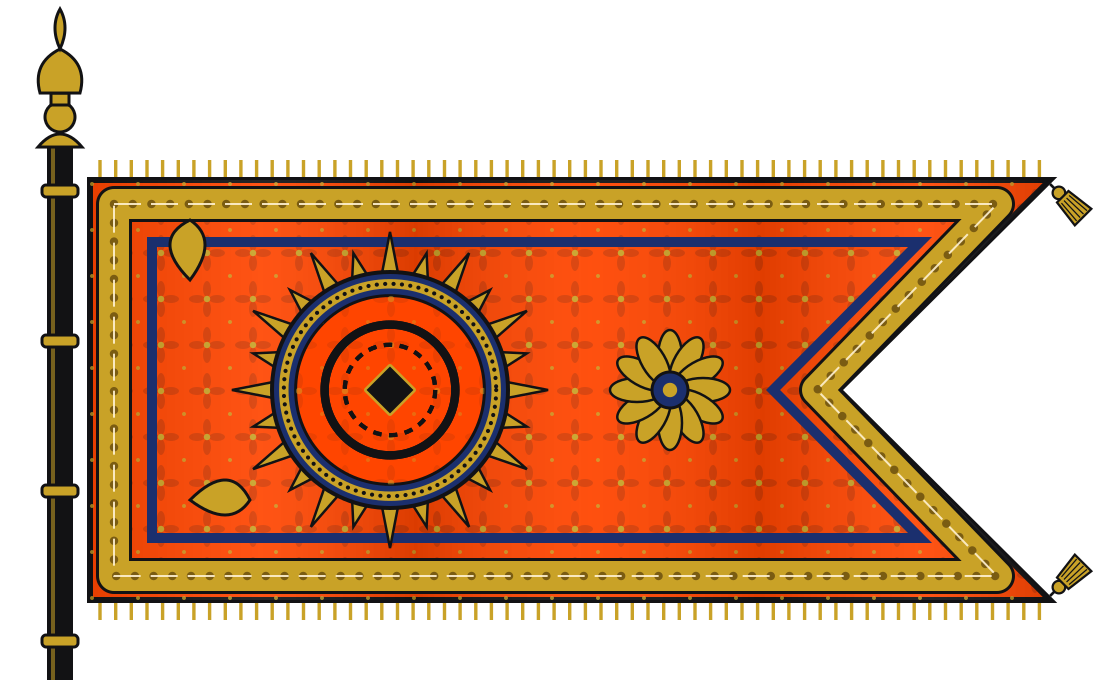
Every clan has every flag type; the type says the occasion and the colours say the clan. The outlined card is the flag the Atlas assigns.

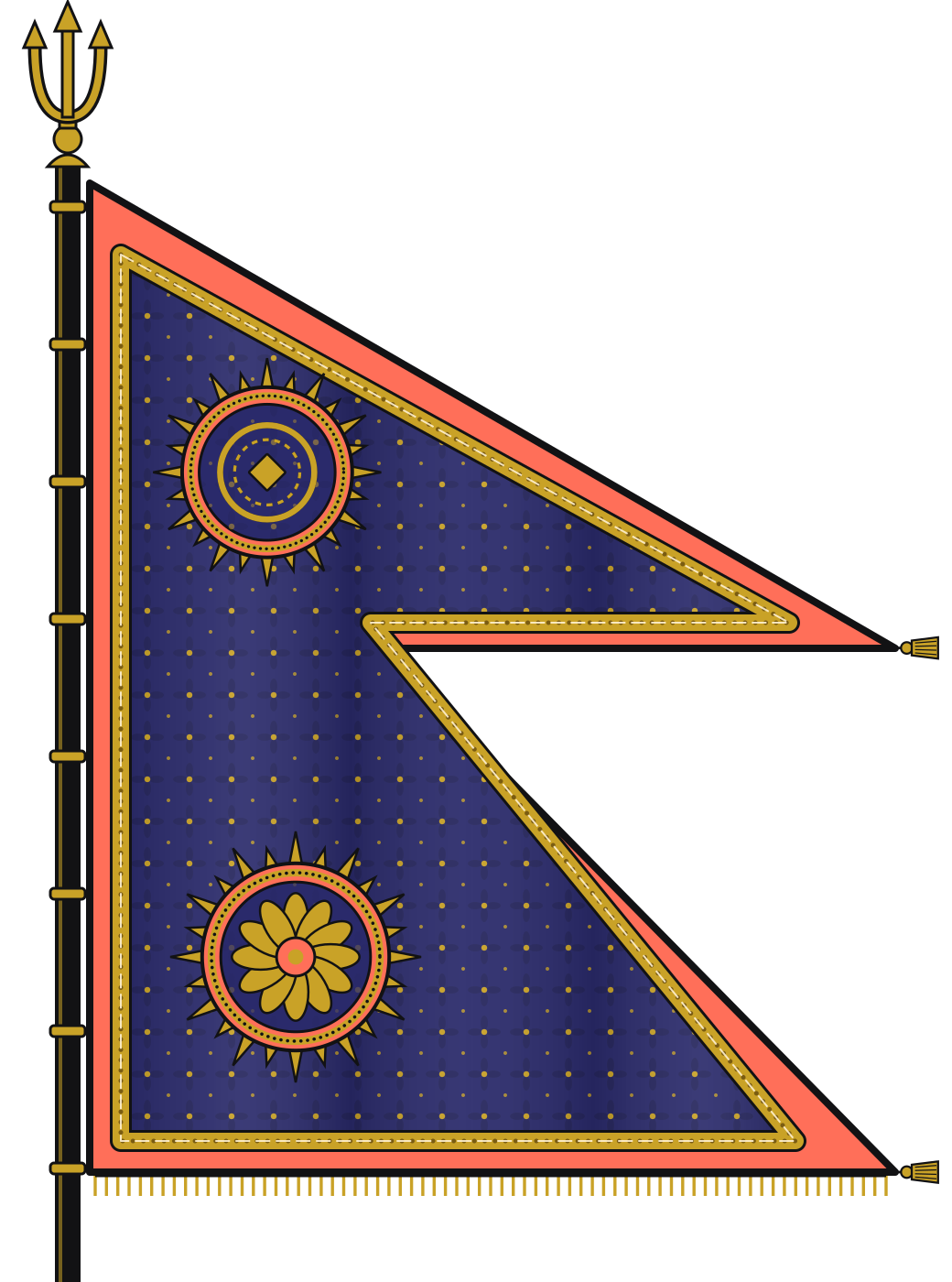


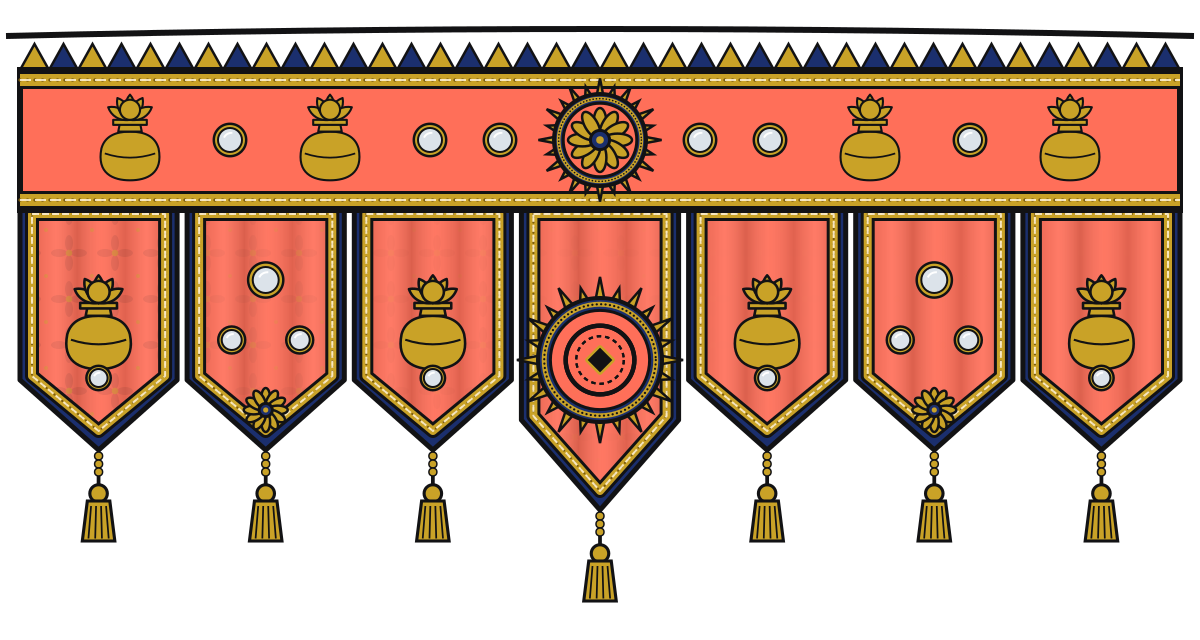
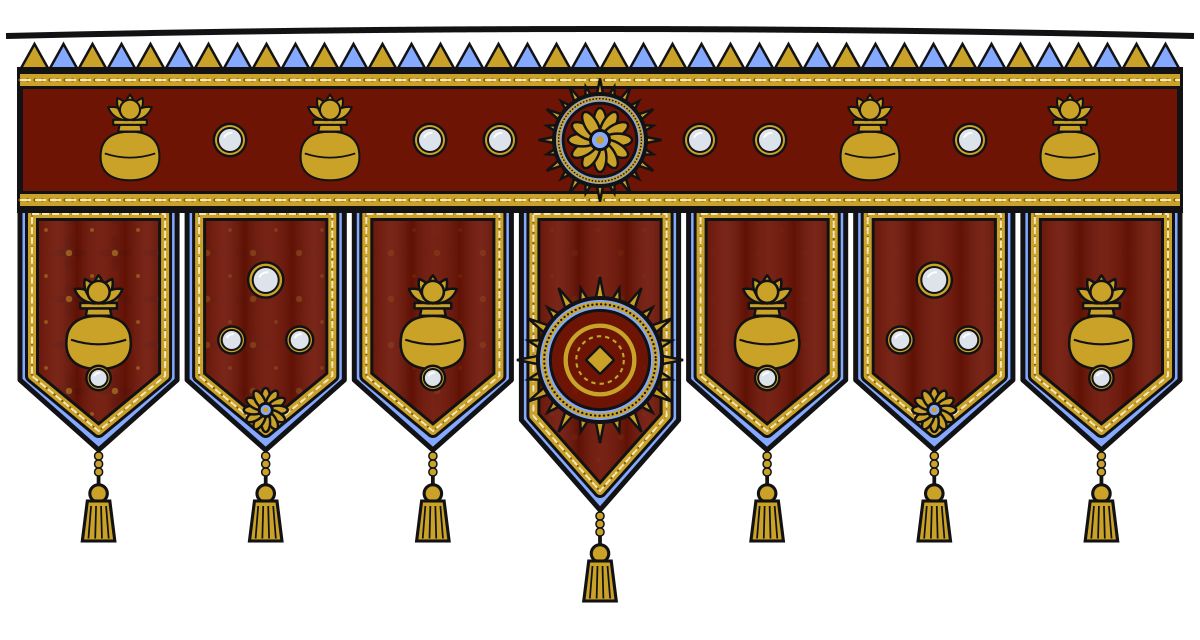

Historic banner
None known
New flag types
| Accessory | For this clan | Basis |
|---|---|---|
| A9 Pota-dhvaja · ship and trade flag For ships, caravans and markets | Not yet designed for this clan | Design |
| A10 Utsava-patāka · festival flag Light, bright flag for fairs and festivals | Not yet designed for this clan | Design |
| A11 Shoka-dhvaja · mourning flag White cloth with the emblem outline in the clan's metal | Not yet designed for this clan | Design |
7. Regalia
| Accessory | For this clan | Basis |
|---|---|---|
| E1 Chhatra · house parasol The ceremonial umbrella | Not yet designed for this clan | Design |
| E2 Chamara · fly-whisks The pair of whisks beside the head of the house | Not yet designed for this clan | Design |
| E3 Danda · staff of office Staff or scepter | Not yet designed for this clan | Design |
| E4 Simhasana · seat The seat of the house, covered in clan cloth | Not yet designed for this clan | Design |
| E5 Khetaka · shield A round shield; the Changi and Dhanush are its flag forms | Not yet designed for this clan | Regional tradition |
| E6 Kula-ayudha · clan weapon The weapon the clan honours | Not yet found for this clan | Under research |
8. Worn
| Accessory | For this clan | Basis |
|---|---|---|
| F1 Kula-vastra · clan cloth The clan's woven pattern in its kit colours | Not yet designed for this clan | Design |
| F2 Kirti-vastra · honour cloth A cloth earned for a deed, not inherited | Not yet designed for this clan | Design |
| F3 Kula-mala · garland flower The flower or leaf the clan wears as a garland | Not yet found for this clan | Under research |
| F4 Chinha · house pin A metal badge with the pin emblem | Not yet designed for this clan | Design |
9. Records
| Accessory | For this clan | Basis |
|---|---|---|
| H1 Clan words A traditional line in the native script | · “” Under research: the extracts give no line of the Parenga's own, and no classical line has been chosen. See open. | Documented |
| H2 Biruda · titles The house's title or titles | Not yet found for this clan | Under research |
| H3 Prashasti · praise genealogy The lineage as written at the head of a grant | Not yet found for this clan | Under research |
| H4 Vahi · clan register The book of the clan's births, marriages and deaths | Not yet found for this clan | Under research |
| H5 Rana-ghosha · war cry The clan's cry in battle or celebration | Not yet found for this clan | Under research |
10. VishwaVit · knower of the world
Game values are design choices for this project, not historical claims.
References
- Wikipedia, Parenga, read 2026-10-31, https://en.wikipedia.org/wiki/Parenga
- Odisha State Tribal Museum, Tribes of Odisha: Parenga, read 2026-10-29, https://ostm.in/tribes_of_odisha/parenga/
- Edgar Thurston and K. Rangachari, Castes and Tribes of Southern India, vol. 2 (Madras, 1909), Project Gutenberg eBook #42992, https://www.gutenberg.org/ebooks/42992
- Sushree Mohanty, Indigenous Colours of Odisha: Handbook on 62 Tribes (KISS), read 2026-10-20, https://kissnew.kiss.ac.in/wp-content/uploads/2026/05/Indigenous-Colours-of-Odisha-Handbook-on-62-Tribes-Sushree-Mohanty.pdf
- The Tribal Tribune, Festival of the Parjas, read 2026-10-25, https://www.etribaltribune.com/index.php/volume-1/issue-7/festival-of-the-parjas
- Wikipedia, List of Scheduled Tribes in Odisha, read 2026-10-20, https://en.wikipedia.org/wiki/List_of_Scheduled_Tribes_in_Odisha
- Wikipedia, Gutob language, read 2026-10-31, https://en.wikipedia.org/wiki/Gutob_language
- Odisha State Tribal Museum, Tribes of Odisha: Gadaba, read 2026-10-26, https://ostm.in/?p=5444