In 1916 the Pardhis were recorded as wandering fowlers and hunters, about 15,000 in the Central Provinces and Berar in 1911[1]. Their own legend makes the first ancestor a Gond, whom Mahadeo taught the art of snaring so that he would not have to shoot game, and for this reason ordinary Pardhis never use a gun[1]. Wikipedia dates the criminal branding of the group to the Criminal Tribes Act of 1871[2]; the Act was repealed and the tribes denotified in 1952[3][4]. Pardhi is a Bhil-group language with 69,100 native speakers in the 2011 census[5], and the Ministry of Tribal Affairs list dated 09-07-2024 gives them Scheduled Tribe status, area-restricted[6].
01Faith and deities
Russell 1916 gives the goddess Devi as the principal deity in Berar[1]; the Atlas gives Devi as the KulDevi (family Navadurga, basis Documented).
Devi: "In Berar their principal deity is the goddess Devi" (Russell and Hira Lal 1916; accepted by the owner 10 Oct 2026; family assigned by the sweep)[1]
A recorded tie between the clan and the goddess.
| Deity or tradition | Place in the clan's life | Evidence |
|---|---|---|
| Devi, Berar | Every Langoti Pardhi family keeps her silver image on red cloth; women wear no silver below the waist and do not hang a sari on a peg | [1] |
| Guraiya Deo, Hoshangabad | Embossed silver human figure kept in a leather bag on the west side of the tents; goats offered and horns placed in the bag | [1] |
| Tent-rope rites | Fowl sacrificed to the tent ropes at Dasahra and Diwali; hunting implements cleaned and offered turmeric and rice at Dasahra | [1] |
| Mauli, Kalika, Saptashrungi, Vadekhan and Khodiyar Mata | Named as Kuldevis by Wikipedia, which marks them as needing a citation | [2] |
| Sun and moon | Believed to die and be reborn each day | [1] |
| Shaktism | Wikipedia says the Pardhis follow Shaktism, citation needed | [2] |
02Temples
No temple built, patronised or later kept by the Pardhis is documented in the extracts. Their shrines are the tent-rope and oath-bag rites above. Leads: the Berar Devi image and the Guraiya Deo bag have no located shrine.
Built by the clan
Not recorded.
Given patronage or grants by the clan
Not recorded.
03Languages and scripts
| Language or script | Kind | Under the clan | Evidence |
|---|---|---|---|
| Pardhi living | Bhil-group language, Bareli branch (Wikipedia); ISO 639-3 pcl | 69,100 native speakers, 2011 census[5] | |
| Dialect names | Neelishikari, Pittala Bhasha, Takari, Haran Shikari (Wikipedia) | Takari and Haran Shikari match sub-group names in the Atlas[5] | |
| Wagdi and Pardhi dialects | Mixed Rajasthani and Gujarati dialects, mainly Wagdi and Pardhi (Wikipedia) | Varies by place[2] | |
| Gujarati, Marwari and Hindi | Russell: many speak a dialect of Gujarati; in the north a mixture of Marwari and Hindi, often Marathi or Urdu too | Dialects of the places they live[1] | |
| Bhil group | Pardhi is classed in the Bareli branch of Bhil languages, with Palya, Pauri, Rathwi Bareli and Kalto (Nahali) (Wikipedia) | Bhil languages[7] |
04Books and literature
No book written by or for the Pardhis is in the extracts. The outside accounts used here are Russell and Hira Lal (1916), Thurston (1909, for a different use of the word Shikari), D'Souza (Manushi 123) and Menon (Sanctuary Asia). Under research: Ganga and Shodh (ethnography of Pardhi Adivasis, as cited by Wikipedia; not read).
Written during the clan's history
Not recorded.
Given patronage by the clan
Not recorded.
05Thinkers and scholars
| Name | Field | Era | Contribution |
|---|---|---|---|
| R. V. Russell and Hira Lal | Colonial ethnography | 1916 | Pardhi entry, vol. 4 of The Tribes and Castes of the Central Provinces[1] |
| Rajnarayan Chandavarkar | History | Cited by D'Souza | Argues colonial policing created the category of criminal tribes and castes[3] |
| Bhavna Menon | Field reporting, Last Wilderness Foundation | Undated in the extract | Pardhis of Panna, Madhya Pradesh[8] |
| Dr. Mahendra Kumar Mishra | Folklore | 2018 | Documented a Pardhi Ramkatha from singer Smt Kumari Devi of Belsonda village, Mahasamund, Chhattisgarh (Wikipedia)[2] |
Pardhi-written sources are not in the extracts. Members appear as quoted speakers in Menon and in PARI 2018.
06Art and architecture
No Pardhi art is documented in the extracts. Lead: a Gaon Connection article on Pardhi children as writers, theatre artists and Gond painters (title seen in search results; not read).
Painting and wall art
Not recorded.
Sculpture and temple art
Not recorded.
Temple and building architecture
Not recorded.
Weaving and textiles
Not recorded.
Clothing and jewellery
Not recorded.
Coins, pottery and crafts
| Art form | What it is | Era | Evidence |
|---|---|---|---|
| Carved whistles and rudraksh pendants | Teetar whistles carved from tendu or khair bark, and a knife made by Pardhis for carving them and rudraksh; ek mukhi rudraksh pendants sold at Nag Panchami | [8] |
07History
Name and origin claims
The name is said to come from Marathi paradh, hunting[1]; Wikipedia adds a Sanskrit form, papardhi, without a citation[2].
Russell records Moghia as a Hindustani word for fowler, and Takankar as an occupational offshoot whose name comes from takna, to tap or chisel, the work of roughening household grinding-mills[1].
Some accounts say the Pardhis came from Rajasthan and moved through Gujarat to Maharashtra and other states; Wikipedia cites Ganga and Shodh for this, and Vajiram and Ravi trace their origins to Rajasthan and the Gujarat region. This is a claim, not an established history[2][9].
Hunting for courts and sportsmen
Vajiram and Ravi say the Pardhis were hired for hunting from the Mughal period onward, for British sport and for the kitchens of zamindars[9].
Menon gives the same work: aides to British sport and in the rasoi ghars of zamindars. Later, demand for big-cat skins led to tiger and leopard hunting[8].
Chimalgi's History of Hunting names Pardhis among the groups it calls poaching groups, in its own wording[10].
Colonial criminal-tribe law, 1871 to 1952
D'Souza says Britain passed the Criminal Tribes Act in 1871, listing about 150 tribes as criminal, and that India repealed it in 1952[3]. PARI puts the number at more than 120 communities, citing a TISS study[4].
Chandavarkar, as cited by D'Souza, argues that colonial policing selected groups and so created the category of criminal tribes and castes; by the late 19th century, he says, they posed little real threat[3].
Russell quotes a police-era officer's view that the caste had criminal tendencies. The 1916 book records that view as the officer's account and does not adopt it as a finding[1].
Wikipedia dates the denotification to 1952[2]; Vajiram and Ravi give the 1871 listing and the 1952 denotification the same dates[9].
The Wire's 2018 photo essay on Pardhis in Maharashtra, who seek to shed the criminal label decades after denotification, is cited here from its metadata only[11].
Colonial gazetteer record
Wikipedia cites the Bombay Presidency Gazetteer, vol. XII (1880), which describes Pardhi groups as still given to hunting and poaching[2]. D'Souza notes the same Gazetteer describes Pardhi groups including the Phase Pardhi sub-tribe[3]. The Gazetteer itself is not yet read.
Counts through the censuses
1901: 12,214 Pardhis (6,320 men and 5,894 women)[2]. 1981: 8,066 Bahelias and Chitas grouped with Pardhis in Madhya Pradesh; 814 Pardhis in Gujarat; 95,115 in Maharashtra. 2001: 159,875 in Maharashtra[2].
2011: 2,23,527 in Maharashtra, in the row Pardhi, Advichincher[12]; 5,896 in Madhya Pradesh, in the row Pardhi, Bahelia, etc.[13]; 3,450 in Gujarat, in the row Pardhi, Advichincher, Phase Pardhi[14].
Recent years
Hunting and poaching bans led most settled Pardhis to agriculture. Nomads sell cheap goods, handicrafts or food door to door, and still wait for land rights (Wikipedia; its citations for these points are marked as needed)[2].
In February 2025 a Madhya Pradesh government order called for search and surveillance of nomadic tribes, including Pardhis. Forest-rights activists and lawyers voiced concern (Vajiram and Ravi, citing the New Indian Express of 25 Feb 2025)[9].
08Journey and migrations
The routes are claims. The dated points are colonial-era records and recent policy; the migration story is not confirmed.
| When | From | To | Why | Evidence |
|---|---|---|---|---|
| Unknown | Rajasthan (claimed) | Gujarat, then Maharashtra and other states | Migration account; Wikipedia cites Ganga and Shodh | [2] |
| 1916 | Central Provinces (Bahelias) | Merged with Pardhis | Russell: Bahelias and Pardhis merge in the Central Provinces | [1] |
| After the hunting bans | Hunting | Agriculture, door-to-door sales | Hunting and poaching bans (Wikipedia, citation needed) | [2] |
| Recent | Hunting and trapping at Panna | Farming by one family; some resell bangles and necklaces | Panna Tiger Reserve, WWF India and the Education Department promoted alternative livelihoods (Menon); only one Pardhi family farms at Panna | [8] |
09Seats and lands
| Place | Role | Where today |
|---|---|---|
| Berar | Devi image kept by every Langoti Pardhi family; Takankars serve villages and are paid in grain | Historical region (Russell 1916) |
| Hoshangabad | Guraiya Deo silver figure in a leather bag; the most solemn oath is taken in his name | District named in Russell 1916 |
| Khandesh | Numerous (Russell 1916); Jalgaon listed among settled districts (Wikipedia) | Historical region; Maharashtra |
| Satara district | Pardhi groups and tolis (family-centred groups), listed for Satara by a retired police constable | Maharashtra[3] |
| Pune and Ahmednagar villages | Kranti works in 229 villages across Daund and Shirur talukas (Pune) and Shrigonda taluka (Ahmednagar) | Maharashtra[4] |
| Panna | One Pardhi family farms; some resell bangles and necklaces | Madhya Pradesh[8] |
| Gujarat | Pardhi, Advichincher and Phase Pardhi listed (3,450, 2011) | Gujarat[14] |
10Notable figures
| Name | Role | Era | Known from |
|---|---|---|---|
| Mahadeo legend | God who taught the first ancestor, a Gond, the art of snaring | Legend | [1] |
| T. V. Stephens | British officer named by Wikipedia as linking hereditary caste work with hereditary criminality (uncited there) | Colonial | Wikipedia, Pardhi[2] |
| Pinya Hari Kale | Landless labourer of Baramati, Satara district; died 9 June 1998 after being beaten at Baramati police station. The NHRC directed compensation of Rs 2,00,000 on 22 Dec 1998 | 1998 | [3] |
| Sunita Bhosale | Founder of the non-profit Kranti in 2010; estimates it has served about 25,000 Pardhis, with about 50 volunteers | 2010 onward | [4] |
11Allies, rivals and marriages
| People | Relationship | When |
|---|---|---|
| Bahelia (Bahelias) | Merged with the Pardhis in the Central Provinces (Russell 1916). Wikipedia's Bahelia page is the Baheliya caste of Uttar Pradesh: related, not identical | 1916 |
| Bawaria | Russell records the Pardhis as a mixed group of Bawarias or other Rajput outcastes, Gonds and others | 1916 |
| Gonds | The first ancestor of the Pardhis is a Gond in their own legend (Russell 1916) | Legend |
| Bhil | Pardhi language is classed as a Bhil language; one sub-group, the Bhil or Shikari Pardhis, uses firearms | Language and sub-group |
| Rajput descent | Pardhis claim Rajput descent (Menon; Wikipedia). Wikipedia says it lacks verifiable historical evidence. Russell's entry does not discuss the claim | Claimed; disputed |
| Panwar sections | Russell lists Pardhi among the section names of the Nagpur and Wainganga Panwars | 1916 |
| Maratha surnames | Pawar, Shinde and Dabhade are reported as adopted by Pardhis to assert status (Wikipedia, uncited) | Reported |
12Society and livelihood
Endogamous groups of hunters, fowlers and trappers. Russell 1916 gives the caste's own structure, meetings and rites; later sources describe the same groups in Maharashtra and Madhya Pradesh.
Government and social order
| Institution or group | What it was | Evidence |
|---|---|---|
| Deokaria | Caste meeting; Russell glosses the word as an act performed in honour of God. Fines are paid in liquor | [1] |
| Village Joshi | Names the dates for weddings; Brahmans do not officiate | [1] |
| Jaat panchayat | Caste council whose decisions families fear (PARI 2018) | [4] |
| Marriage | Couple walk seven times round a tanda (a cluster of mat tents); in Berar, a cloth canopy on four poles and a married woman with five pitchers of water. Divorce and widow marriage are free. Marriages take place all year. Bride-price recorded in 1916: Rs 9 at Chanda, Rs 35 at Bilaspur, Rs 60 or more at Hoshangabad and Saugor | [1] |
| Death | The dead are buried with the head to the north; no head-shaving in mourning | [1] |
| Discipline (as recorded in 1916) | Adultery was punished by cutting a piece of the left ear; trial by ordeal included lifting a pice from boiling oil and dough cakes with silver or coal | [1] |
Livelihood over time
| Era | Livelihood | Evidence |
|---|---|---|
| Mughal period onward | Hired hunters for courts, British sport and zamindars' kitchens | [9] |
| 1916 | Decoy stags, trained hawks for ducks, crocodile fishing with a large double hook (oil sold, flesh not eaten), hunting cheetahs for black-buck; villagers hire them to guard spring crops from black-buck for grain | [1] |
| Recent years | Settled Pardhis farm; nomads sell cheap goods, handicrafts or food door to door (Wikipedia, citation needed) | [2] |
| 2018 | Hunting of monitor lizards, pheasants and rabbits; begging; odd jobs (PARI) | [4] |
| Panna, today | Trap wild boar raiding crops, with farmers letting them keep the meat; carve whistles and rudraksh pendants (Menon) | [8] |
13Sub-clans and related clans
Not the Pardhan (ST-251), a separate people with their own codex. Groups below are the sub-groups, dialect names and related families the sources name for the Pardhis.
| Clan | Relation | Where | Size | In the Atlas | Evidence |
|---|---|---|---|---|---|
| Shikari or Bhil Pardhi | Sub-clan | Firearm users; most Pardhis refuse firearms (Russell 1916) | new clan candidate | [1][4] | |
| Phanse Pardhi | Sub-clan | Noose hunters, traps and snares; PARI says Phanse Pardhis are listed as Scheduled Tribe | new clan candidate | [1][4] | |
| Langoti Pardhi | Sub-clan | Narrow loin-strip; Berar families keep the Devi silver image (Russell 1916) | new clan candidate | [1] | |
| Langoli Pardhi | Related people | Name on the Madhya Pradesh ST list (Langoli Pardhi) | new clan candidate | [13] | |
| Phans Pardhi | Related people | Name on the Madhya Pradesh ST list (Phans Pardhi) | new clan candidate | [13] | |
| Takankar | Sub-clan | Berar; roughen grinding-mills; village servants paid in grain (Russell 1916) | new clan candidate | [1][13] | |
| Takari | Sub-clan | Sub-group name, and a dialect name (Wikipedia) | new clan candidate | [2][5] | |
| Takia | Related people | Name on the Madhya Pradesh ST list | new clan candidate | [13] | |
| Chitewale (Chita Pardhi) | Sub-clan | Keep tame hunting leopards (cheetahs) for black-buck (Russell 1916) | new clan candidate | [1][13] | |
| Gayake | Sub-clan | Stalk game from behind a bullock (Russell 1916) | new clan candidate | [1] | |
| Gosain Pardhi | Sub-clan | Wear ochre clothes; kill only hares, jackals and foxes (Russell 1916) | new clan candidate | [1] | |
| Shishi ke Telwale | Sub-clan | Sell crocodile oil (Russell 1916) | new clan candidate | [1] | |
| Bandarwale | Sub-clan | Performing monkeys (Russell 1916) | new clan candidate | [1] | |
| Haranshikari | Sub-clan | Name in the Atlas; Haran Shikari is a dialect name (Wikipedia) | new clan candidate | [5] | |
| Vaghri Pardhi | Sub-clan | Main group named by Wikipedia | new clan candidate | [2] | |
| Phase Pardhi | Sub-clan | Main group named by Wikipedia; Phase Pardhi sub-tribe in the 1880 Bombay Presidency Gazetteer (via D'Souza) | 3,450, Gujarat, 2011, in the row Pardhi, Advichincher, Phase Pardhi | new clan candidate | [2][14][3] |
| Pal Pardhi | Sub-clan | Tent-dwellers (PARI 2018); sub-group named by Wikipedia | new clan candidate | [4][2] | |
| Gav Pardhi | Sub-clan | Mostly agriculturalists, mainly in Amravati district (Wikipedia, citation needed) | new clan candidate | [2] | |
| Advichincher | Related people | Name in the Maharashtra and Gujarat ST rows | 2,23,527, Maharashtra, 2011 (state figure; the row lists Pardhi, Advichincher) | new clan candidate | [12] |
| Bahelia | Related people | Uttar Pradesh Baheliya caste (Wikipedia, related not identical); Bahelias in the Central Provinces merge with Pardhis (Russell 1916) | About 2,000 Bahelias in the Central Provinces and Berar, 1911 (Russell 1916) | same name as ST-567: check | [1][15] |
| Karijat | Related people | Bahelia sub-caste that kills only black birds (Russell 1916) | new clan candidate | [1] | |
| Meywarees | Related people | Listed among other names of the Pardhis (Wikipedia) | new clan candidate | [2] | |
| Bawaria | Related people | Russell names Bawarias among the groups the Pardhis are mixed with | new clan candidate | [1] | |
| Sesodia | Sub-clan | Exogamous group with a Rajput name; the Sesodia group does not sleep on a cot (Russell 1916) | same name as ST-554: check | [1] | |
| Panwar | Sub-clan | Exogamous group with a Rajput name (Russell 1916) | same name as ST-517: check | [1] | |
| Solanki | Sub-clan | Exogamous group with a Rajput name (Russell 1916); widely found (Wikipedia) | same name as ANC-229: check | [1][2] | |
| Chauhan | Sub-clan | Exogamous group with a Rajput name; written Chauhan or Chavan (Russell 1916; Wikipedia; PARI) | same name as SUB-109: check | [1][2][4] | |
| Rathor | Sub-clan | Exogamous group with a Rajput name (Russell 1916); Rathod on Wikipedia | same name as ST-487: check | [1][2] | |
| Salunkhe | Related people | Surname reported as adopted (Wikipedia, uncited) | new clan candidate | [2] | |
| Sindiya | Related people | Surname reported as adopted (Wikipedia, uncited) | new clan candidate | [2] | |
| Pawar | Related people | Surname reported as adopted (Wikipedia, uncited) | new clan candidate | [2] | |
| Shinde | Related people | Surname reported as adopted (Wikipedia, uncited) | new clan candidate | [2] | |
| Dabhade | Related people | Surname reported as adopted (Wikipedia, uncited) | new clan candidate | [2] | |
| Bhosale | Related people | Surname listed for Pardhi families (PARI 2018) | same name as SUB-257: check | [4] | |
| Kale | Related people | Surname listed for Pardhi families (PARI 2018; Manushi) | new clan candidate | [4][3] |
Clans marked "new clan candidate" are not in the Atlas yet.
14Surnames
Surnames the extracts name for Pardhi families. None of these counts is sourced with a year, so no bearer counts are given.
| Surname | Clan or sub-clan | Where | People with this surname | Also used by other communities |
|---|---|---|---|---|
| Sesodia | Sesodia (exogamous group) | Not given (Russell 1916) | not yet counted | Not checked |
| Panwar | Panwar (exogamous group) | Russell 1916 | not yet counted | Yes |
| Solanki | Solanki (exogamous group) | Wikipedia: widely found | not yet counted | Yes |
| Chauhan / Chavan | Chauhan (exogamous group) | Russell 1916; Wikipedia: widely found; PARI: Chavan | not yet counted | Yes |
| Rathor / Rathod | Rathor (exogamous group) | Russell 1916; Wikipedia: Rathod | not yet counted | Yes |
| Salunkhe | Reported as adopted (Wikipedia, uncited) | not yet counted | Not checked | |
| Sindiya | Reported as adopted (Wikipedia, uncited) | not yet counted | Not checked | |
| Pawar | Reported as adopted (Wikipedia, uncited) | not yet counted | Yes | |
| Shinde | Reported as adopted (Wikipedia, uncited) | not yet counted | Yes | |
| Dabhade | Reported as adopted (Wikipedia, uncited) | not yet counted | Not checked | |
| Bhosale / Bhosle | Listed for Pardhi families (PARI 2018) | Pune and Ahmednagar villages (PARI 2018) | not yet counted | Yes |
| Kale | Listed for Pardhi families (PARI 2018; Manushi) | Pinya Hari Kale, Satara district (Manushi); the surname is listed in PARI 2018 | not yet counted | Not checked |
Counts are of everyone with the surname, from the cited source and year, not only members of this clan. A surname shared with other communities says nothing about any one person's origin.
15Songs and music
No Pardhi song text or title is in the extracts.
None recorded yet.
16Poems, lullabies and children's rhymes
No lullaby, rhyme, riddle or verse is in the extracts.
None recorded yet.
17Stories, legends and proverbs
Stories and legends
| Story | What happens | Told by | Evidence |
|---|---|---|---|
| Mahadeo teaches snaring legend | A Gond, the first ancestor, is taught snaring by Mahadeo so that he need not shoot game; ordinary Pardhis never use a gun | Pardhi tradition as recorded in 1916 | [1] |
| Pardhi Ramkatha | Ramkatha, a Rama story, documented in 2018 (contents not in the extract) | Smt Kumari Devi, Belsonda village, Mahasamund, Chhattisgarh | [2] |
Proverbs and sayings
Not recorded.
18Festivals and fairs
| Festival or fair | When | Where | What happens |
|---|---|---|---|
| Dasahra | At Dasahra | Recorded by Russell 1916 (region not stated) | Fowl sacrificed to the tent ropes; hunting implements cleaned and offered turmeric and rice[1] |
| Diwali | At Diwali | Recorded by Russell 1916 (region not stated) | Fowl sacrificed to the tent ropes[1] |
| Hailstorm puja | Around Dusshera | Panna, Madhya Pradesh | Puja to protect farms from hailstorms; farmers reward them with produce such as wheat[8] |
| Nag Panchami | Nag Panchami | Panna, Madhya Pradesh | Ek mukhi rudraksh pendants are sold at the festival[8] |
19Food, dress and games
Food
| Item | What it is | Evidence |
|---|---|---|
| Meat | Wild boar trapped where it raids crops; farmers let them keep the meat (Menon) | [8] |
| Crocodile | Flesh not eaten; the oil is sold (Russell 1916) | [1] |
Dress
| Item | What it is | Evidence |
|---|---|---|
| Shoes | Never worn, because Devi is said to have promised their first ancestor that no insect or reptile in the forest would harm them (Russell 1916) | [1] |
| Ochre cloth | Gosain Pardhis wear ochre clothes (Russell 1916) | [1] |
Games and martial arts
Not recorded.
Tags: living still practised · revived brought back after a break · lost known only from records · research reported but not yet confirmed from a source. Songs and poems under copyright are listed by title only; restricted or sacred material is noted without its content.
20Status today
A Scheduled Tribe (list dated 09-07-2024, area-restricted) in central and western India; the 2011 census figures below cover Maharashtra, Madhya Pradesh and Gujarat[12].
Recognised heritage
| What | Recognition | Evidence |
|---|---|---|
| Denotified tribes | Criminal Tribes Act repealed and tribes denotified in 1952[3] | [3] |
| Scheduled Tribe list | Ministry of Tribal Affairs list dated 09-07-2024, area-restricted | [6] |
| Madhya Pradesh surveillance order | February 2025 government order on search and surveillance of nomadic tribes, including Pardhis, as reported by Vajiram and Ravi | [9] |
No community review of this page is recorded. The community's own words appear only in quoted interviews (Menon; PARI 2018).
21For children
Mahadeo and the first snare
Long ago, a man of the Gond people lived in the forest. He wanted to catch animals for food. But he did not want to shoot them, because shooting game was a sin. Mahadeo came to him and taught him the art of snaring. In the Pardhi legend, this man was the first ancestor of the Pardhis, and ordinary Pardhis never use a gun.
22Across the project
| Project | What carries this clan | Status |
|---|---|---|
| Atlas of the Janas | Settled districts named by Wikipedia (2001 census data) include Amravati, Akola, Buldhana, Jalgaon, Yavatmal, Osmanabad and Pune; no footprint file is written in this run | [2] |
| KulDevi and GrahDevi | KulDevi Devi, basis Documented, family Navadurga. GrahDevi forms are not in the extracts | [1] |
| Planet naming | Nothing in the extracts | |
| Renaming and waters | Nothing in the extracts |
23Open questions
- No native-script form of the name, the clan or any deity is in the extracts. The page carries none; the pack's Devanagari form was not sourced and is left out.
- No clan line or motto of the Pardhis is in the extracts, so the words block is empty. Lead: Crooke vol. 4 (Bahelia and Pardhi).
- Dev Dev festival: only a keyword in The Wire's 2018 metadata; the article is not read.
- Gaon Connection article on Pardhi writers and Gond painters, Outlook (Phasi Pardhi), Deccan Herald (Hunted, haunted), Joshua Project, and Kranti's own pages: found in search results, not read.
- Bombay Presidency Gazetteer vol. XII (1880) and Crooke vol. 4: not read.
- Whether the Sesodia, Panwar, Solanki, Chauhan and Rathor groups here are the same as the sheet entries with those names.
- Whether the Madhya Pradesh Bahelia (row Pardhi, Bahelia, etc.) is the same group as the Uttar Pradesh Baheliya caste.
- A People of India volume and an all-India total for the Pardhis (none in the extracts).
- Coordinates for the sub-groups: the Atlas has none for the Pardhis, and the extracts give none.
- Kuldevi: the Atlas gives Devi (family Navadurga, basis Documented); Wikipedia names Mauli, Kalika, Saptashrungi, Vadekhan and Khodiyar as Kuldevis, citation needed. The extracts do not settle which is the family's Kuldevi.
- Panna: Menon says only one Pardhi family farms at Panna. Earlier lines in lands and journey had several families farming and guiding; they now follow Menon, and forest guiding is in no extract.
24Astitva
अस्तित्व · being, existence: everything by which the clan is known
No seal, coin, totem or title of the Pardhis is documented. Practice tools are recorded (Russell 1916; Menon) but none is shown to be a clan accessory[1][8].
Every clan has every accessory, royal objects included. Each one says how it is known: Documented This clan's own object is recorded. · Regional tradition Recorded for the region or for peoples like this one, not for this clan. · Design Made for this project, with no historical claim. · Under research To be found for this clan from sources. Legends and titles are written in the clan's own script.
1. Seals and coins
| Accessory | For this clan | Basis |
|---|---|---|
| B1 Rajamudra · house seal Round seal with the clan emblem and a short legend in the clan's script | Not yet designed for this clan | Design |
| B2 Anguliya-mudra · signet ring Personal seal ring of the head of the house | Not yet designed for this clan | Design |
| B3 Chhapa · house stamp Ink or block stamp for letters, goods and cloth | Not yet designed for this clan | Design |
| B4 Tamrapatra · charter plate Copper-plate grant on a ring, closed with the house seal | Not yet designed for this clan | Design |
| B5 Shreni-mudra · guild or trade seal Seal for the clan's trade, craft or caravan | Not yet designed for this clan | Design |
| C1 Clan coin Emblem or deity on one side, a legend in the clan's script | Not yet designed for this clan | Design |
| C2 Coin die The die that strikes the coin | Not yet designed for this clan | Design |
2. Living symbols
| Accessory | For this clan | Basis |
|---|---|---|
| I1 Totem trio The tree, bird and animal the clan protects | Not yet found | Under research |
| I2 Kaval-maram · guardian tree The tree that stands at the clan's seat | Not yet found for this clan | Under research |
3. Stone and gate
| Accessory | For this clan | Basis |
|---|---|---|
| G1 Torana · gateway The built gate of the seat; the cloth Toran hangs in it | Not yet designed for this clan | Regional tradition |
| G2 Viragallu · hero stone Carved panel stone for a member who died defending the clan | Not yet designed for this clan | Regional tradition |
| G3 Kula-shila · clan stones Standing and table stones that remember the ancestors | Not yet designed for this clan | Design |
| G4 Jayastambha · victory pillar A pillar raised for a victory | Not yet designed for this clan | Design |
| G5 Sima-shila · boundary stone Marks the clan's land, with a line in the native script | Not yet designed for this clan | Design |
4. Sounds
| Accessory | For this clan | Basis |
|---|---|---|
| D1 Pancha-mahashabda · five great sounds The right to five instruments | Not yet designed for this clan | Design |
| D2 Shankha · clan conch The clan's own named war conch | Not yet designed for this clan | Design |
| D3 Murasu · house drums Three drums: war, charity and justice | Not yet designed for this clan | Design |
5. Kit: colours, metals and emblems
No seal, coin, clan totem or banner of the Pardhis is documented in the extracts. What is recorded are working objects (the phanda snare with its antelope-horn core, the deer-horn whistle) and two silver images of deities, the Devi image of the Langoti families and the Guraiya Deo figure (Russell 1916)[1].
| Part of the kit | This clan |
|---|---|
| Field | Warm Red-Orange #FF6F59 |
| Accent | Royal Navy #1B2F6E |
| Emblem colour | Charcoal Black #121214 |
| Zari metal | Gold |
| Main emblem | A snare trap |
| Second image | A broken chain |
| Night and day | Every visual accessory has two versions: by night the emblem on the dark field, by day the clan's field colour on cloth woven from its metal. |
6. Flags
Every clan has every flag type; the type says the occasion and the colours say the clan. The outlined card is the flag the Atlas assigns.
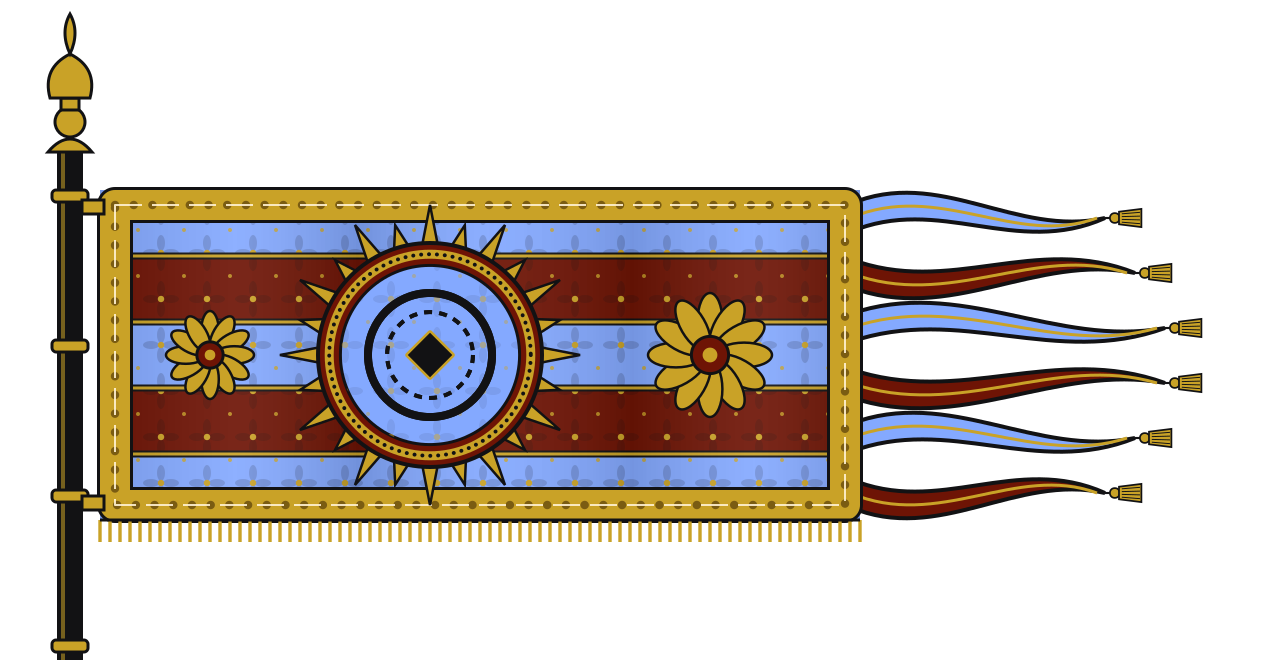
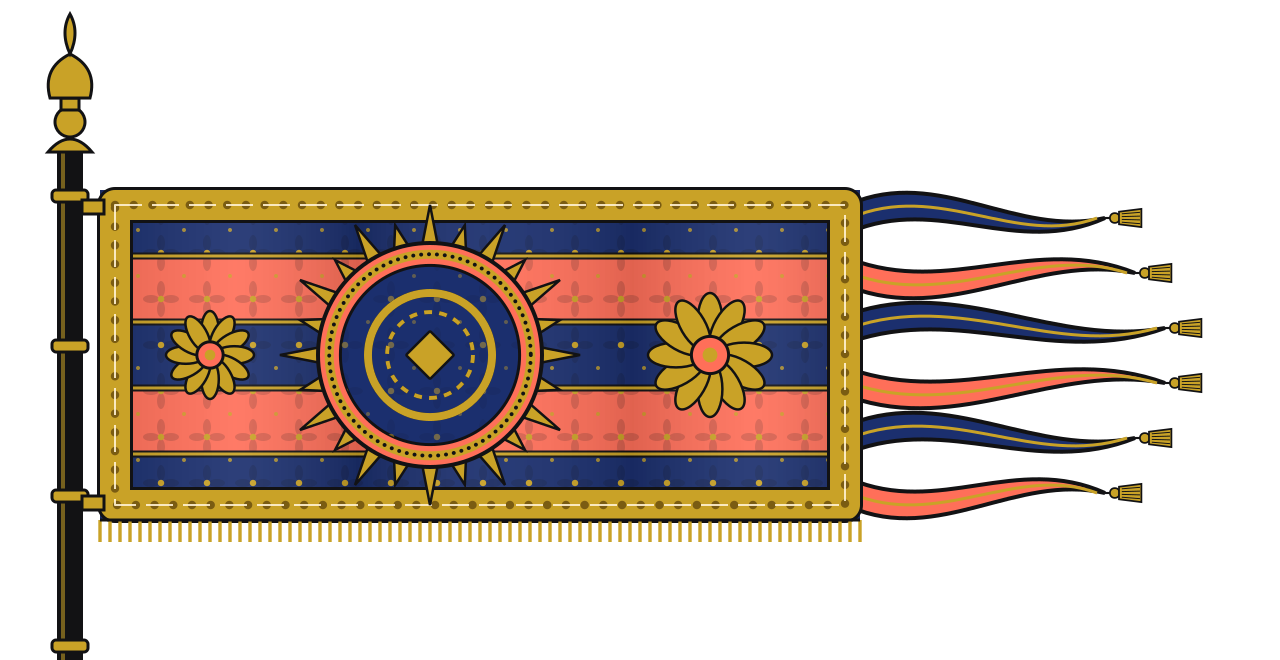
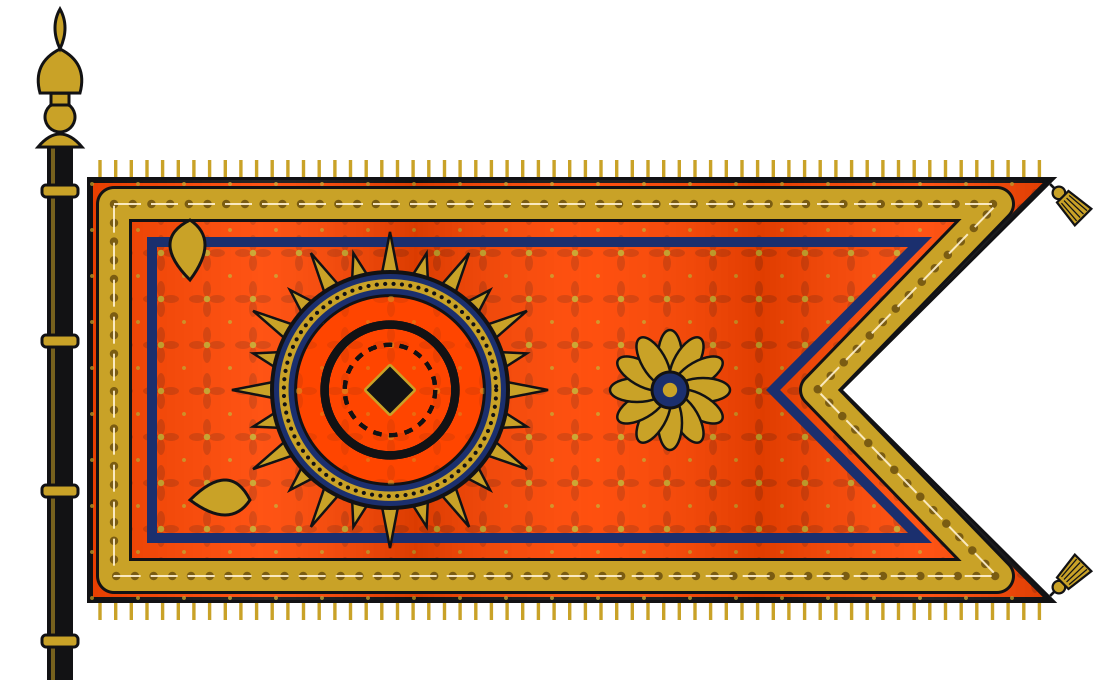
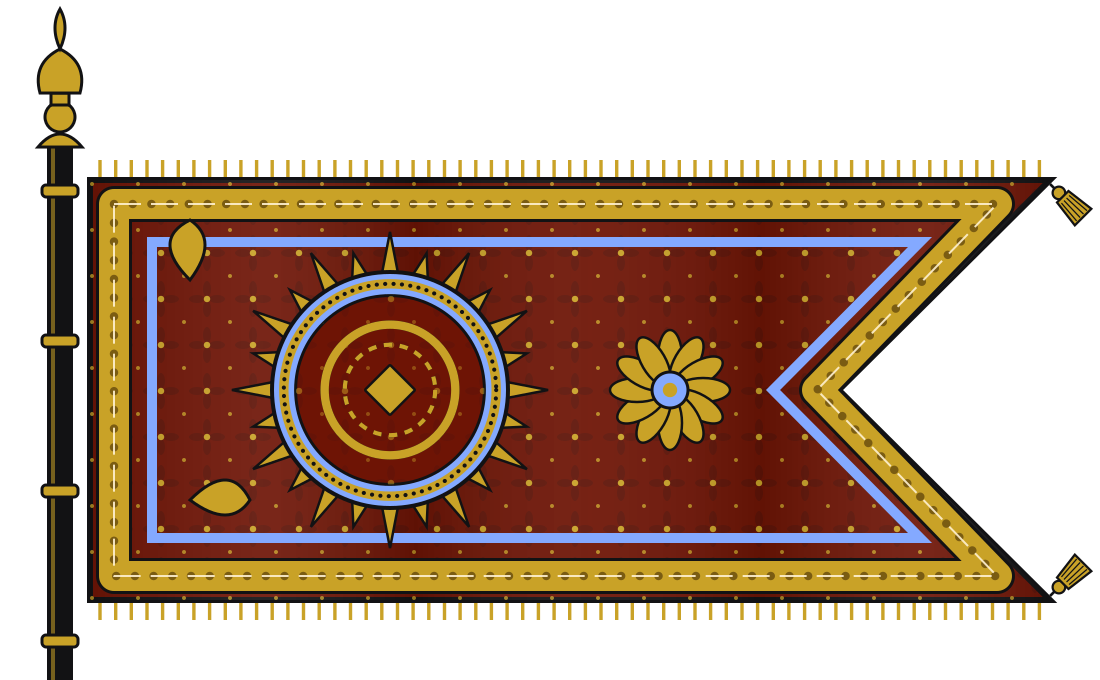

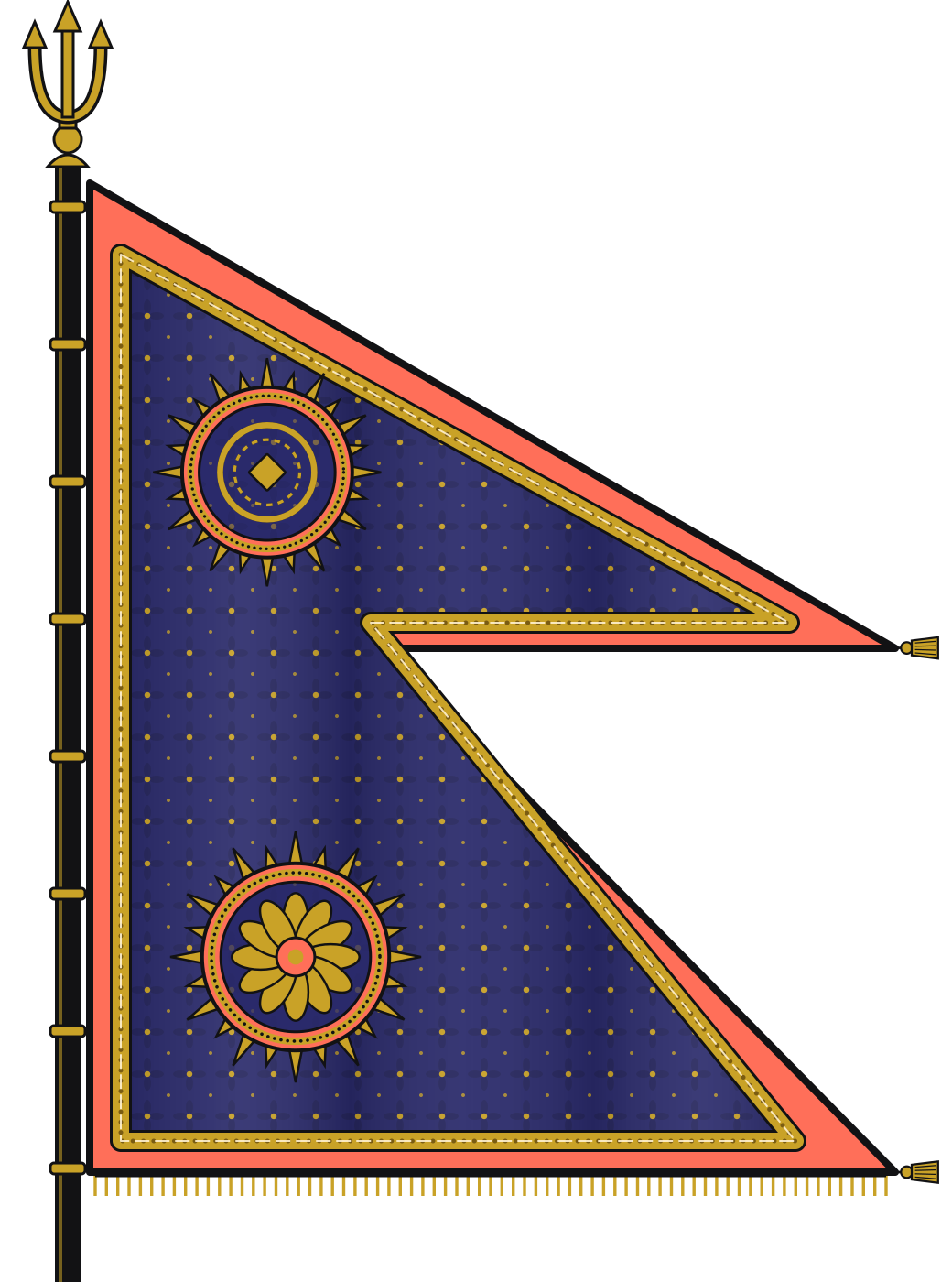

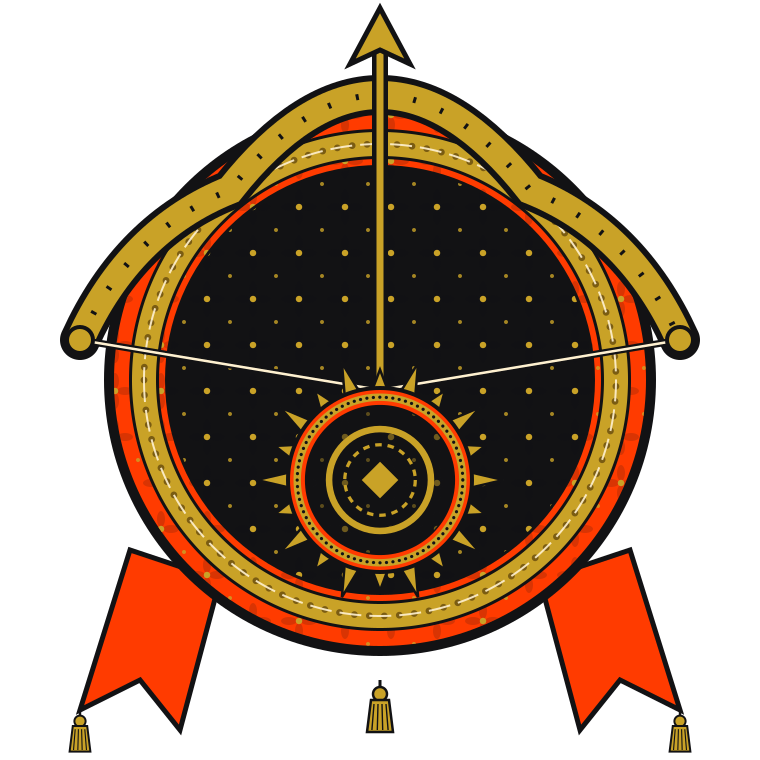
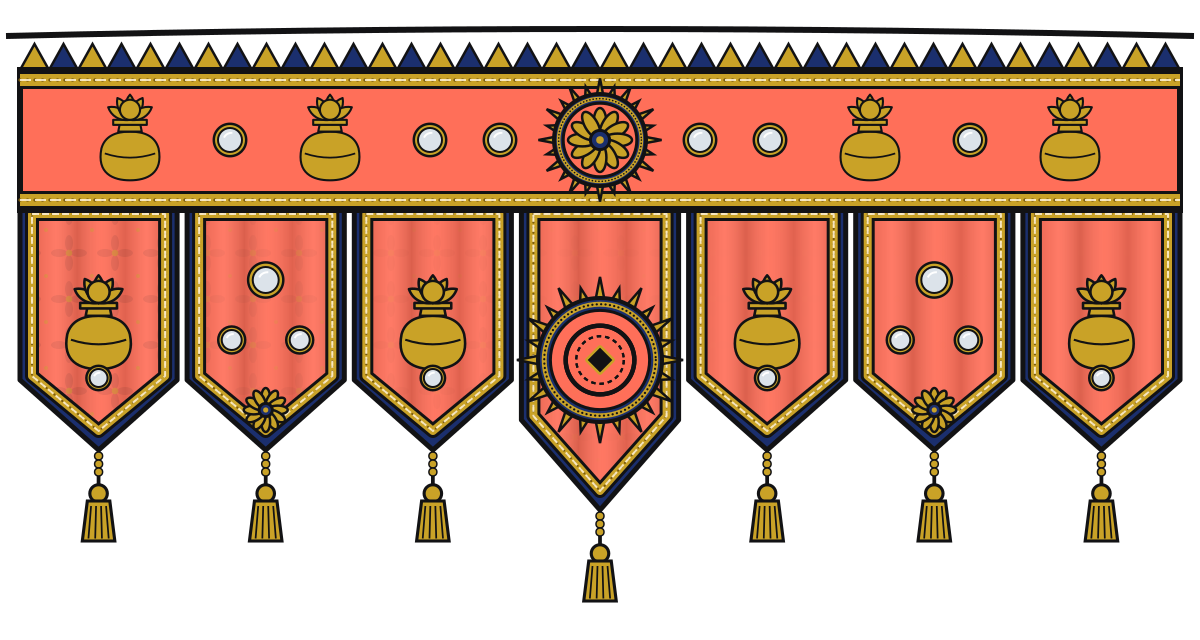
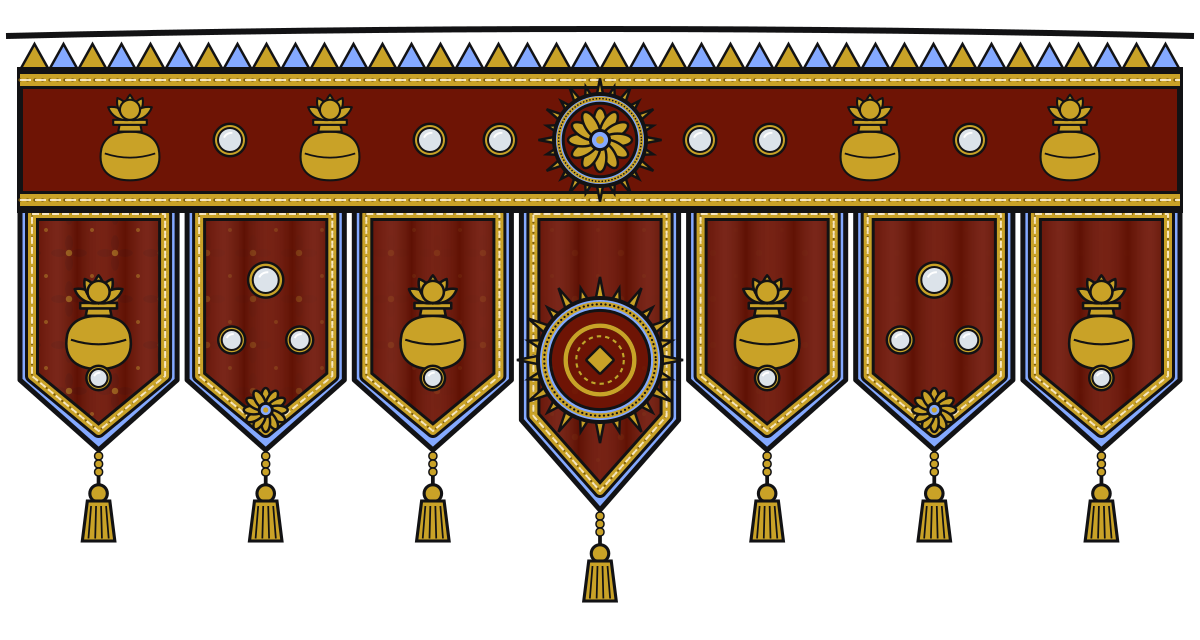

Historic banner
None known
New flag types
| Accessory | For this clan | Basis |
|---|---|---|
| A9 Pota-dhvaja · ship and trade flag For ships, caravans and markets | Not yet designed for this clan | Design |
| A10 Utsava-patāka · festival flag Light, bright flag for fairs and festivals | Not yet designed for this clan | Design |
| A11 Shoka-dhvaja · mourning flag White cloth with the emblem outline in the clan's metal | Not yet designed for this clan | Design |
7. Regalia
| Accessory | For this clan | Basis |
|---|---|---|
| E1 Chhatra · house parasol The ceremonial umbrella | Not yet designed for this clan | Design |
| E2 Chamara · fly-whisks The pair of whisks beside the head of the house | Not yet designed for this clan | Design |
| E3 Danda · staff of office Staff or scepter | Not yet designed for this clan | Design |
| E4 Simhasana · seat The seat of the house, covered in clan cloth | Not yet designed for this clan | Design |
| E5 Khetaka · shield A round shield; the Changi and Dhanush are its flag forms | Not yet designed for this clan | Regional tradition |
| E6 Kula-ayudha · clan weapon The weapon the clan honours | Not yet found as a clan weapon. Practice tools in the extracts: the phanda snare, the deer-horn whistle, the bamboo nal with bird-lime (Bahelia)[1] | Under research |
8. Worn
| Accessory | For this clan | Basis |
|---|---|---|
| F1 Kula-vastra · clan cloth The clan's woven pattern in its kit colours | Not yet designed for this clan | Design |
| F2 Kirti-vastra · honour cloth A cloth earned for a deed, not inherited | Not yet designed for this clan | Design |
| F3 Kula-mala · garland flower The flower or leaf the clan wears as a garland | Not yet found | Under research |
| F4 Chinha · house pin A metal badge with the pin emblem | Not yet designed for this clan | Design |
9. Records
| Accessory | For this clan | Basis |
|---|---|---|
| H1 Clan words A traditional line in the native script | · “” Under research: no clan line for the Pardhis is in the extracts. Leads: Crooke, Tribes and Castes of the North-Western Provinces, vol. 4 (Bahelia and Pardhi entries, not yet read); Bombay Presidency Gazetteer vol. XII (1880), via Wikipedia. | Documented |
| H2 Biruda · titles The house's title or titles | Not yet found for this clan | Under research |
| H3 Prashasti · praise genealogy The lineage as written at the head of a grant | Not yet found for this clan | Under research |
| H4 Vahi · clan register The book of the clan's births, marriages and deaths | Not yet found for this clan | Under research |
| H5 Rana-ghosha · war cry The clan's cry in battle or celebration | Not yet found; Dev Dev festival appears only as a keyword | Under research |
10. VishwaVit · knower of the world
Game values are design choices for this project, not historical claims.
References
- R. V. Russell and Hira Lal, The Tribes and Castes of the Central Provinces of India, vol. 4 (London, 1916), Project Gutenberg eBook #20668, https://www.gutenberg.org/ebooks/20668
- Wikipedia, Pardhi, read 2026-11-06, https://en.wikipedia.org/wiki/Pardhi
- Dilip D'Souza, 'Declared Criminal at Birth', Manushi issue 123, read 2026-11-06, https://indiatogether.org/manushi/issue123/tribe.htm
- Jyoti Shinoli, 'No crime, unending punishment', People's Archive of Rural India, 10 Aug 2018, read 2026-11-06, https://ruralindiaonline.org/article/no-crime-unending-punishment
- Wikipedia, Pardhi language, read 2026-11-06, https://en.wikipedia.org/wiki/Pardhi_language
- Ministry of Tribal Affairs, State/UT-wise list of Scheduled Tribes (Constitution (ST) Order 1950 as amended; list dated 9 July 2024), as recorded on the project Atlas, ST-160
- Bhil languages, Wikipedia (read 2026-10-09), citing Census of India 2011 and the 52nd report of the Commissioner for Linguistic Minorities (2014–15).
- Bhavna Menon, 'An Alternative Lifestyle: The Pardhis of Panna', Sanctuary Asia (Last Wilderness Foundation), read 2026-11-06, PDF
- Vajiram & Ravi, 'Pardhi Community', 1 Mar 2025, read 2026-11-06, https://vajiramandravi.com/current-affairs/pardhi-community/
- Kavya Chimalgi, History of Hunting in the Indian Subcontinent, read 2026-10-10, PDF
- The Wire, 'Decades after denotification, Pardhis in Maharashtra struggle to stave off criminal tag', 31 Aug 2018 (photo essay by Sudharak Olwe; metadata and summary only), read 2026-11-06, link
- dhammabharat.com, List of Scheduled Tribes in Maharashtra and Population of each Tribe (2011 Census), read 2026-10-10, https://dhammabharat.com/?p=13656
- Wikipedia, Tribals in Madhya Pradesh, read 2026-10-19, https://en.wikipedia.org/wiki/Tribals_in_Madhya_Pradesh
- Wikipedia, List of Scheduled Tribes in Gujarat (2011 census figures), read 2026-10-18, https://en.wikipedia.org/wiki/List_of_Scheduled_Tribes_in_Gujarat
- Wikipedia, Bahelia (the Baheliya caste of Uttar Pradesh, a related group and not the same people), read 2026-11-06, https://en.wikipedia.org/wiki/Bahelia