The Pardhan are the bards and priest-musicians of the Gonds; Russell, writing in 1916, says their occupation is to act as the priests and minstrels of the Gonds[1]. Sahapedia's account, based on conversations with two named informants, says the Pardhan play the bana at annual rituals and life events, and that the bana is the dwelling of Buda Dev[2]. Pardhan is a dialect of Gondi, with about 140,000 speakers in 2007[3]. Gond painting, now called Jangarh Kalam, was brought to paper and canvas by Pardhan artists from the 1980s, and the artist Jangarh Singh Shyam brought the tradition into the art world[4][5]. The Atlas lists them as a Scheduled Tribe in Andhra Pradesh, Chhattisgarh, Madhya Pradesh, Maharashtra and Telangana (from the Atlas; the list is dated 09-07-2024).
01Faith and deities
Russell records the Pardhans' ceremonial worship of Bura Deo[1], and the Gondi page lists Badadeo among the names of the high god Baradeo[6]. Sahapedia gives Bada Dev as the primary creator deity in the bana tradition[2]. The master-sheet KulDevi is Kali Kankali; no page read names her as the Pardhan's own clan goddess.
Bards of the Gonds who sing the Lingo epic of Kali Kankali
A recorded tie between the clan and the goddess.
| Deity or tradition | Place in the clan's life | Evidence |
|---|---|---|
| Bura Deo | Worshipped on the third day of bright Baisakh (April) with goats, pigs, liquor, coconuts, betel, flowers, lemons and rice; enshrined under a mahua or saj tree outside the village[1] | [1] |
| Buda Dev (बूढ़ा देव) | Resides in the bana and is awakened by its sound; household shrines are called मूढ़रघर[2] | [2] |
| Bana | The bana is the deity's dwelling and is regarded as a form of the god[2] | [2] |
| Persa Pen | Pardhan bards play the kingri fiddle to calm Persa Pen in Gond worship[6] | [6] |
| Kali Kankali | The master-sheet KulDevi; the sheet's note says the Pardhan sing the Lingo epic of her story. No page read ties her to the Pardhan as clan goddess | From the Atlas |
02Temples
No temple built by the Pardhan is recorded in the extracts. Their worship of Bura Deo is at a tree outside the village[1].
Built by the clan
Not recorded.
Given patronage or grants by the clan
| Temple | Deity | What the clan gave | When | Where |
|---|---|---|---|---|
| Jangubai cave temple and Kaplai caves | Not stated | Pilgrimage visits: Pradhan pilgrims are named among the visiting tribes; no gift is recorded | Not stated | [7] |
03Languages and scripts
| Language or script | Kind | Under the clan | Evidence |
|---|---|---|---|
| Pardhan (Pradhan) living | Dialect of Gondi (Dravidian, South-Central, Gondi-Kui) | The Pardhan community; about 140,000 speakers (2007) | [3] |
| Devanagari living | Script | The script given for Pardhan in Wikipedia; no other native-script forms of the language are printed | [3] |
04Books and literature
The extracts name one study of the Pardhan language and Russell's 1916 entry; no Pardhan-authored text is recorded.
Written during the clan's history
| Work | Author | Kind | When | Link to the clan |
|---|---|---|---|---|
| The Tribes and Castes of the Central Provinces of India | R. V. Russell and Hira Lal | Ethnography; Pardhan entry in vol. 4 | 1916 | [1] |
| A Sociolinguistic Survey Among the Pardhan Community of Central India | Valte, Mathai and George | Sociolinguistic survey | 2008 | [8] |
Given patronage by the clan
Not recorded.
05Thinkers and scholars
| Name | Field | Era | Contribution |
|---|---|---|---|
| Russell and Hira Lal | Ethnography | 1916 | The Pardhan entry in the Tribes and Castes of the Central Provinces[1] |
| Valte, Mathai and George | Sociolinguistics | 2008 | A sociolinguistic survey of the Pardhan community[8] |
| Roderic Knight | Music recording | 1982 | Harp playing recorded in 1982: Rahangi village (Oberlin page) or Kokomata village (Stephens, photo credit)[9][10] |
| Stephens | Harp study | 1982 player recorded | Records the Gogia Pardhan five-string bin-baja and its possible link to the harp-vina[10] |
The Pardhan language and music have few written sources in the extracts; the Oberlin and Stephens notes are about bin-baja players.
06Art and architecture
Pardhan-Gond painting, Jangarh Kalam, is practised by Pardhan artists and was long confused with Gond art[4].
Painting and wall art
| Art form | What it is | Era | Evidence |
|---|---|---|---|
| Jangarh Singh Shyam | Twentieth-century Pardhan painter, Jangarh Kalam; subjects include Phulvari Devi and Marahi Devi | Twentieth century | [4] |
| Dots and lines | Dots and lines like women's tattoos; tigers, deer, snakes, cattle, birds and trees | Undated | [5] |
Sculpture and temple art
Not recorded.
Temple and building architecture
| Art form | What it is | Era | Evidence |
|---|---|---|---|
| Murals on mud walls and floors | Temporary murals made for festive occasions, painted with chhui (white clay) and koochi brushes of bark fibre | Festive occasions | [4] |
Weaving and textiles
Not recorded.
Clothing and jewellery
Not recorded.
Coins, pottery and crafts
| Art form | What it is | Era | Evidence |
|---|---|---|---|
| Pigments | Geru (red or orange), coal (black), cow dung (green) and ramraj or pili mitti (yellow) | Undated | [4] |
07History
Names and a legend of origin (undated)
Russell gives the name Pardhan from the Sanskrit word for minister, and records a tradition that the Gond kings employed Pardhans as ministers and genealogists[1].
legend Russell records a legend that Bura Deo had seven sons; the youngest and his descendants became the ones who pay homage, and the greeting is 'Babu Johar', answered with 'Pathari Johar'[1].
Patronage at Patangarh (undated)
At Patangarh village in Dindori district, Pardhans and Gonds were interdependent. As Gond patronage declined, Pardhans took labouring jobs[5].
The 1916 count
Russell and Hira Lal give nearly 120,000 Pardhans in the Central Provinces and Berar in 1911, and 8,000 in Hyderabad[1].
Painting from the 1980s
Pardhan artists brought Gond art to paper and canvas since the 1980s; Jangarh Kalam was long confused with Gond art[4].
08Journey and migrations
The extracts give no dated move for the Pardhan.
Not recorded.
09Seats and lands
| Place | Role | Where today |
|---|---|---|
| Gondwana | Homeland, from the Atlas (Telangana to Chhattisgarh) | Telangana, Chhattisgarh |
| Dindori district | Gond and Pardhan at Patangarh ([5]); bin-baja players ([9]) | Madhya Pradesh |
| Chanda and Bastar | Mades division (Russell's names for the places[1]) | Not stated |
| Chhattisgarh plain | Khalotia division ([1]) | Not stated |
| Chhindwara | Deogarhia division ([1]) | Not stated |
| Balaghat | Mokasi name ([1]) | Not stated |
10Notable figures
| Name | Role | Era | Known from |
|---|---|---|---|
| Jangarh Singh Shyam | Pardhan painter, Jangarh Kalam; his first painting was Hanuman in yellow mud, and Jagdish Swaminathan recognised his work in Bhopal[5] | Twentieth century[4] | Known from[4][5] |
| Hirasuka (Heera Sukha) research | Bard who plays the kingri in the Kachargarh origin story; the naavalam page calls him a creation of the modern movement and says he appears in none of the old ethnographers | Disputed | [11] |
| Ram Prasad Pandro | Bin-baja player pictured on the Oberlin page; Stephens records him at Kokomata village in 1982 | 1982 | [9][10] |
11Allies, rivals and marriages
| People | Relationship | When |
|---|---|---|
| Gonds | Patrons: the Pardhan are the Gonds' bards and priest-musicians, sharing their clans and gods[11][1] | Traditional |
| Halba | A Halba exogamous section is named Pardhan, after another caste[12] | Recorded 1916 |
12Society and livelihood
The Pardhan are bards, minstrels and priest-musicians of the Gonds. Sahapedia gives the caste names as परधान, परघनिया and पठारी (Pathari)[2].
Government and social order
| Institution or group | What it was | Evidence |
|---|---|---|
| Raj Pardhans | Bards who may officiate as priests; the Bhumka generally officiates (Tawney, quoted by Russell) | [1] |
| Public worship | A Pardhan should attend every public worship in the Deo-khalla (Tawney, quoted by Russell) | [1] |
| Marriage | Wedding in a public place: five circuits, an iron ring on the little finger, five chickens killed, bride-price Rs. 12 (Russell, 1916) | [1] |
| Greeting | 'Babu Johar', answered by 'Pathari Johar' (romanised in Russell) | [1] |
Livelihood over time
| Era | Livelihood | Evidence |
|---|---|---|
| Traditional | Bards who tour villages and play for patron households, paid in grain, cloth and money[2] | [2] |
| Traditional | Recording patrons' genealogies in song; paid in grain, clothes, cattle or gold[5] | [5] |
| Undated | Labouring work after Gond patronage declined at Patangarh[5] | [5] |
| 1916 | Kandres: bamboo workers ([1]) | [1] |
| Since the 1980s | Pardhan-Gond painting, sold in galleries and online[4][5] | [4] |
13Sub-clans and related clans
Russell lists endogamous divisions and occupational groups; the state lists print the names Pathari and Saroti. Names as Russell gives them.
| Clan | Relation | Where | Size | In the Atlas | Evidence |
|---|---|---|---|---|---|
| Raj Pardhan | Sub-clan | Not stated | new clan candidate | [1] (endogamous division; bards who may officiate as priests) | |
| Ganda Pardhan | Sub-clan | Not stated | new clan candidate | [1] (endogamous division) | |
| Thothia Pardhan | Sub-clan | Not stated | new clan candidate | [1] (endogamous division) | |
| Mades | Sub-clan | Chanda and Bastar | new clan candidate | [1] | |
| Khalotias | Sub-clan | Chhattisgarh plain | new clan candidate | [1] | |
| Deogarhias | Sub-clan | Chhindwara | new clan candidate | [1] | |
| Kandres | Sub-clan | Not stated | new clan candidate | [1] (occupational: bamboo workers) | |
| Gaitas | Sub-clan | Chhattisgarh | new clan candidate | [1] (priests) | |
| Arakhs | Sub-clan | Not stated | new clan candidate | [1] | |
| Gogia Pardhan | Related people | Not stated | new clan candidate | [10] (play the five-string bin-baja) | |
| Gond Patharis | Related people | Chanda | new clan candidate | [1] | |
| Panal | Related people | Not stated | new clan candidate | [1] (own name recorded by Russell) | |
| Diwan | Related people | Not stated | new clan candidate | [1] (another name recorded by Russell) | |
| Desai | Related people | Not stated | new clan candidate | [1] (another name recorded by Russell) | |
| Parganiha | Related people | Not stated | new clan candidate | [1] (another name recorded by Russell) | |
| Pardhan Patharia | Related people | Not stated | new clan candidate | [1] (another name recorded by Russell) | |
| Mokasi | Related people | Balaghat | new clan candidate | [1] (name recorded in Balaghat) | |
| Gond | Parent people | Central India | ST-088 | [1][6] | |
| Halba | Related people | Not stated | ST-097 | [12] (a Halba exogamous section is named Pardhan) | |
| Chhidaiya छिदैया | Related people | Gond clan | new clan candidate | [2] (Gond clan with its own bana); Pardhans share the Gonds' clans[11] | |
| Netam नेताम | Related people | Gond clan | same name as ST-480: check | [2] (Gond clan with its own bana); Pardhans share the Gonds' clans[11] | |
| Markam मरकाम | Related people | Gond clan | same name as ST-453: check | [2] (Gond clan with its own bana); Pardhans share the Gonds' clans[11] | |
| Marai मरई | Related people | Gond clan | new clan candidate | [2] (Gond clan with its own bana); Pardhans share the Gonds' clans[11] | |
| Porte पोर्ते | Related people | Gond clan | new clan candidate | [2] (Gond clan with its own bana); Pardhans share the Gonds' clans[11] |
Clans marked "new clan candidate" are not in the Atlas yet.
14Surnames
The extracts give no surname list for the Pardhan.
Not recorded.
15Songs and music
Pardhan bards sing Gond heritage and mythology, recount Gond genealogies, and play the bana and the kingri. The Sahapedia article quotes no text.
Instruments and styles
| Instrument or style | What it is | Evidence |
|---|---|---|
| Bana | Bowed string instrument (गज/हथवा): body of साजा, सागौन or खमार wood, goat-skin membrane, horsehair strings[2] | [2] |
| Kingri (kingadi) | A stick through a gourd with a string or wire; another kind has three horsehair strings played with a bow[1] | [1] |
| Bin-baja | A harp played by a few Pardhan musicians in Dindori district, in place of the bana; plucked with a plectrum[9] | [9] |
16Poems, lullabies and children's rhymes
None recorded yet.
17Stories, legends and proverbs
Stories and legends
| Story | What happens | Told by | Evidence |
|---|---|---|---|
| Bura Deo's seven sons legend | Bura Deo had seven sons; the youngest and his descendants became the ones who pay homage | Pardhan tradition, recorded by Russell | [1] |
| The kingri from heaven legend | A kingri fell from heaven into the lap of a priest, the ancestor of the Raj Pardhans; priests were then allowed to marry | Recorded by Russell | [1] |
| Seven Gond brothers and the stringed instrument legend | Seven Gond brothers worshipped and the god did not appear; the youngest made an instrument of wood and string, and the god came; hence the Pardhans play the kingri | Recorded by Russell | [1] |
| Bada Dev and the saja tree legend | Bada Dev left a Gond home after a menstruating woman prepared his offering; he settled in a saja tree outside the village and is awakened by the bana | Sahapedia's account | [2] |
| Kali Kankali's children legend | The goddess bears thirty-three children, imprisoned twelve years in the Kachargarh cave; the Lingo story has Raitad Jungo (Jangu Bai) urge the release | Lingo story as recorded on the naavalam page | [11] |
Proverbs and sayings
Not recorded.
18Festivals and fairs
| Festival or fair | When | Where | What happens |
|---|---|---|---|
| Bura Deo worship | Third day of bright Baisakh (April) | Outside the village, under a mahua or saj tree | Goats, pigs, liquor, coconuts, betel, flowers, lemons and rice[1] |
| Hadiya badlav (हड़िया बदलाव) | After the birth of the first son | Not stated | Parghaniyas play at the ritual[2] |
| Pida pujai (पीढ़ा पुजाई) | After a father's death | Not stated | Parghaniyas play at the ritual[2] |
| Griha pravesh (गृह प्रवेश) | House entry | Not stated | Parghaniyas play at the ritual[2] |
| Dev uthani (देव उठानी) | Not stated | Not stated | Parghaniyas play at the ritual[2] |
| Touring season | About four months after the harvest, from Dussehra | Patron villages and households | Bards tour and play for patron households[2] |
19Food, dress and games
Food
Not recorded.
Dress
Not recorded.
Games and martial arts
Not recorded.
Tags: living still practised · revived brought back after a break · lost known only from records · research reported but not yet confirmed from a source. Songs and poems under copyright are listed by title only; restricted or sacred material is noted without its content.
20Status today
The Pardhan are a Scheduled Tribe in five states (list dated 09-07-2024). The 2011 census shows 1,23,742 in the Madhya Pradesh ST row 'Pardhan, Paroti, Satauri' and 1,45,131 in the Maharashtra row 'Pardhan, Pathari, Saroti' (state figure, not all-India)[13][14]. Their language had about 140,000 speakers in 2007[3].
Recognised heritage
| What | Recognition | Evidence |
|---|---|---|
| Pardhan-Gond painting (Jangarh Kalam) | Paintings are in metropolitan galleries and sold online[5] | [5] |
| Bana makers and players | Sahapedia says few makers and players remain, with one named at Katghari (Janjgir-Champa) and two at Karra (Bilaspur)[2] | [2] |
Not yet reviewed by the Pardhan community. The Sahapedia article draws on conversations with two named informants (Yuvraj Singh Pathari and K. P. Pardhan), which is not a review of this page[2].
21For children
The bard and the kingri
Long ago, seven Gond brothers worshipped their great god. The god did not come. The youngest brother made an instrument from wood and string. Then the god came. From that day, the Pardhan play the kingri. This is a retelling of a legend that Russell wrote down in 1916.
22Across the project
| Project | What carries this clan | Status |
|---|---|---|
| Atlas of the Janas | Homeland in Gondwana | From the Atlas |
| KulDevi and GrahDevi | KulDevi Kali Kankali, family Mahavidya; GrahDevi forms Kali, Tara, Shodashi, Bhuvaneshvari, Bhairavi, Chhinnamasta, Dhumavati, Bagalamukhi, Matangi, Kamala | From the Atlas |
| Planet naming | Not in the extracts | — |
| Renaming and waters | Not in the extracts | — |
23Open questions
- Does any Pardhan group worship Kali Kankali as clan goddess? The Atlas gives her as KulDevi; no page read ties the Pardhan to her.
- What are the Pardhan surnames? No surname list is in the extracts; leads: People of India, census surname tables.
- Are Diwan, Desai, Parganiha and Pathari used as surnames, or only as names of the caste?
- What are the native-script forms of the sub-clan names (Raj, Ganda, Thothia Pardhan; Mades; Khalotias; Deogarhias; Kandres; Gaitas; Arakhs)?
- The sources do not print the greeting in native script; the community could supply it. Russell gives only the romanised 'Pathari Johar'.
- Hirasuka (Heera Sukha): the Wikipedia Gondi page calls him a bard in the Kachargarh story, and the naavalam page calls him a creation of the modern movement. Which is right?
- Gogia Pardhan bin-baja: Stephens gives five strings; the Oberlin page does not state the number of strings.
- Pardhan lullabies, rhymes, riddles and proverbs are not in the extracts. Hislop 1866 (rarebooksociety PDF) is the next source to read for Lingo notes on the Pardhan.
- The 2011 census figures for the Chhattisgarh, Andhra Pradesh and Telangana rows are not yet read.
- Chor Patharis are named by Russell; the entry's criminal claims about the Patharis are not repeated and have not been checked.
- The Pardhan's own totems (Russell's tattoo) are not named.
- Contradiction, bin-baja: Stephens calls it a five-string bow harp[10]; Oberlin says it is plucked with a plectrum[9]. The instrument row follows Oberlin.
- Contradiction, 1982 harp recording: Oberlin gives Rahangi village[9]; Stephens gives Kokomata village[10].
- Contradiction, Kali Kankali: the Atlas's note says the Pardhan sing the Lingo epic of her story; naavalam says the Pardhan share the Gonds' clans and gods and does not tie them to Kali Kankali[11].
- Identity, Jangubai: the Drishti extract names 'Pradhan' pilgrims[7]; it does not say they are the Pardhan. The page takes the spelling as the same people, which is not confirmed.
24Astitva
अस्तित्व · being, existence: everything by which the clan is known
The extracts document one accessory for the Pardhan: the tree outside the village under which Bura Deo is enshrined[1]. No seal, coin, plate, title or inscription is recorded.
Every clan has every accessory, royal objects included. Each one says how it is known: Documented This clan's own object is recorded. · Regional tradition Recorded for the region or for peoples like this one, not for this clan. · Design Made for this project, with no historical claim. · Under research To be found for this clan from sources. Legends and titles are written in the clan's own script.
1. Seals and coins
| Accessory | For this clan | Basis |
|---|---|---|
| B1 Rajamudra · house seal Round seal with the clan emblem and a short legend in the clan's script | Not yet designed for this clan | Design |
| B2 Anguliya-mudra · signet ring Personal seal ring of the head of the house | Not yet designed for this clan | Design |
| B3 Chhapa · house stamp Ink or block stamp for letters, goods and cloth | Not yet designed for this clan | Design |
| B4 Tamrapatra · charter plate Copper-plate grant on a ring, closed with the house seal | Not yet designed for this clan | Design |
| B5 Shreni-mudra · guild or trade seal Seal for the clan's trade, craft or caravan | Not yet designed for this clan | Design |
| C1 Clan coin Emblem or deity on one side, a legend in the clan's script | Not yet designed for this clan | Design |
| C2 Coin die The die that strikes the coin | Not yet designed for this clan | Design |
2. Living symbols
| Accessory | For this clan | Basis |
|---|---|---|
| I1 Totem trio The tree, bird and animal the clan protects | Not yet found for this clan | Under research |
| I2 Kaval-maram · guardian tree The tree that stands at the clan's seat | Mahua or saj tree outside the village, under which Bura Deo is enshrined | Documented |
3. Stone and gate
| Accessory | For this clan | Basis |
|---|---|---|
| G1 Torana · gateway The built gate of the seat; the cloth Toran hangs in it | Not yet designed for this clan | Regional tradition |
| G2 Viragallu · hero stone Carved panel stone for a member who died defending the clan | Not yet designed for this clan | Regional tradition |
| G3 Kula-shila · clan stones Standing and table stones that remember the ancestors | Not yet designed for this clan | Design |
| G4 Jayastambha · victory pillar A pillar raised for a victory | Not yet designed for this clan | Design |
| G5 Sima-shila · boundary stone Marks the clan's land, with a line in the native script | Not yet designed for this clan | Design |
4. Sounds
| Accessory | For this clan | Basis |
|---|---|---|
| D1 Pancha-mahashabda · five great sounds The right to five instruments | Not yet designed for this clan | Design |
| D2 Shankha · clan conch The clan's own named war conch | Not yet designed for this clan | Design |
| D3 Murasu · house drums Three drums: war, charity and justice | Not yet designed for this clan | Design |
5. Kit: colours, metals and emblems
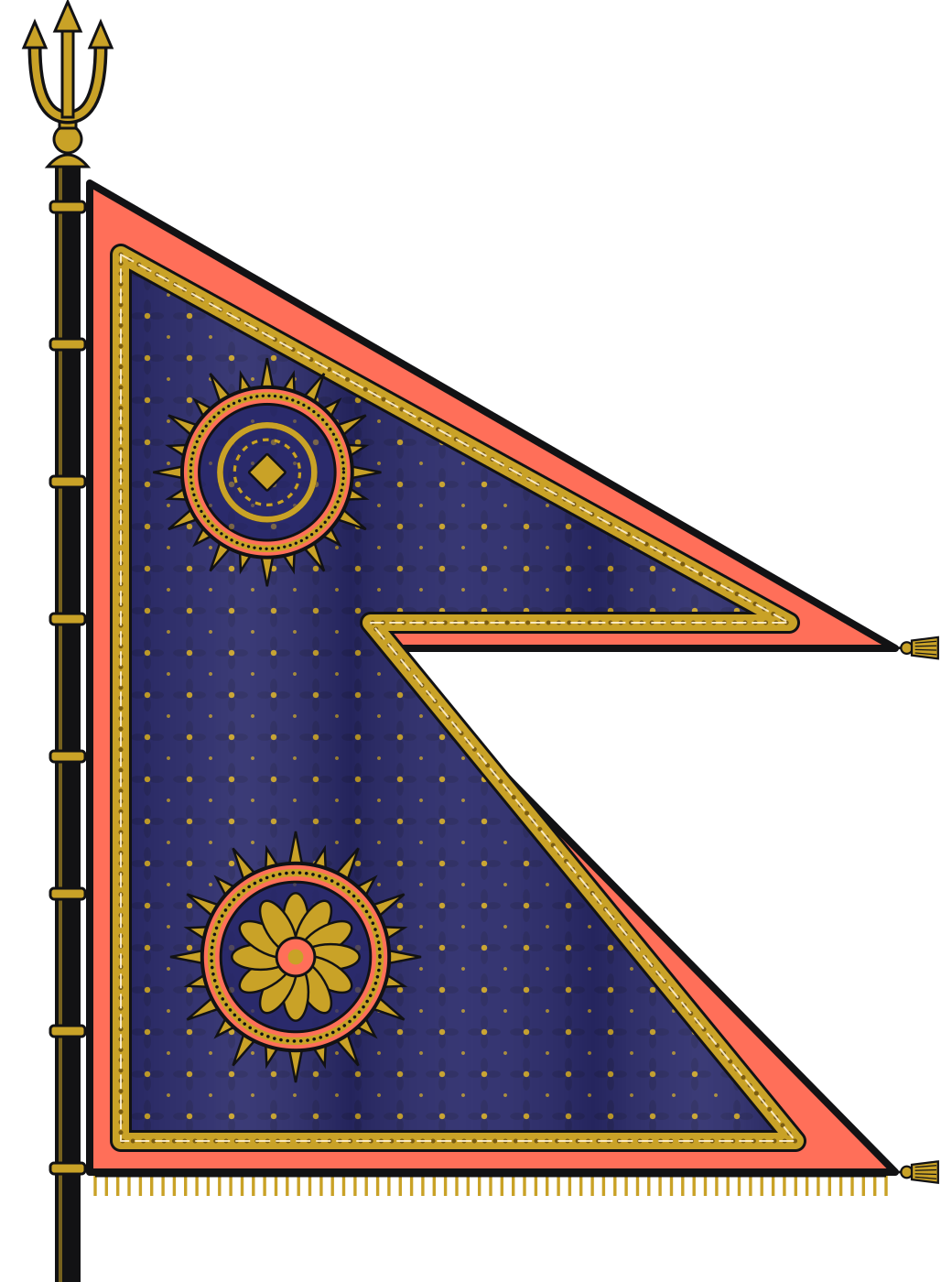
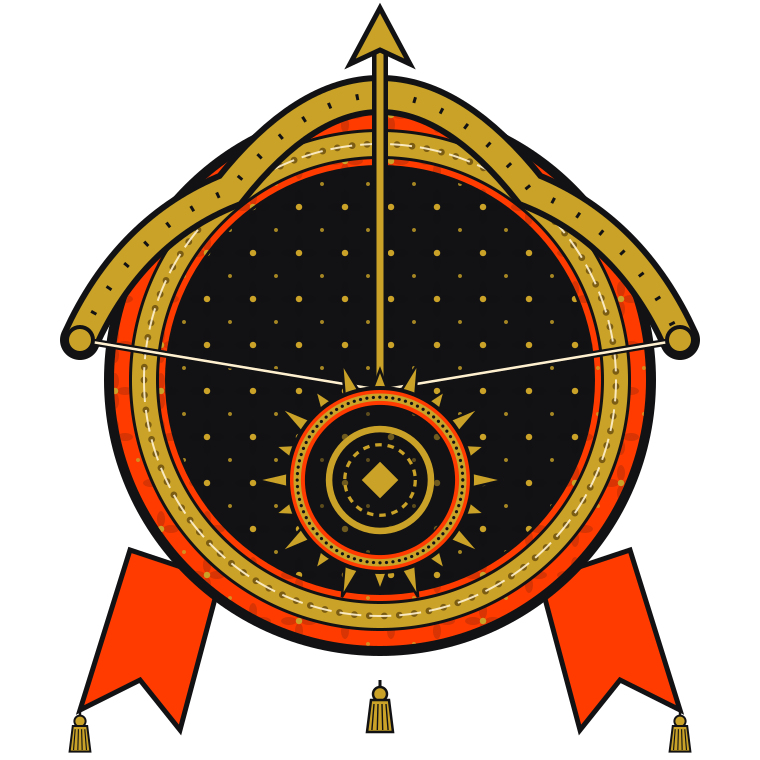
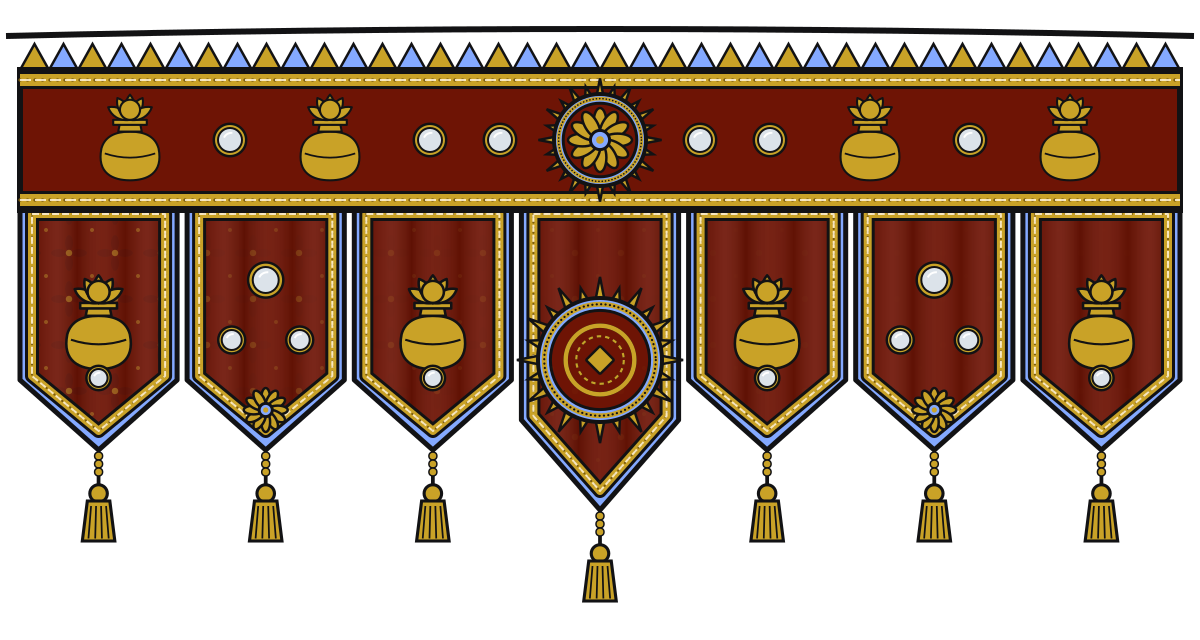
The flag and banner are project designs from the Atlas: a bana fiddle and a painted bird in dots and lines.
| Part of the kit | This clan |
|---|---|
| Field | Deep Brick #7E2A1E |
| Accent | Intense Electric Blue #84A9FF |
| Emblem colour | Metallic Gold #C9A227 |
| Zari metal | Gold |
| Main emblem | A bana fiddle |
| Second image | A painted bird in dots and lines |
| Night and day | Every visual accessory has two versions: by night the emblem on the dark field, by day the clan's field colour on cloth woven from its metal. |
6. Flags
Every clan has every flag type; the type says the occasion and the colours say the clan. The outlined card is the flag the Atlas assigns.
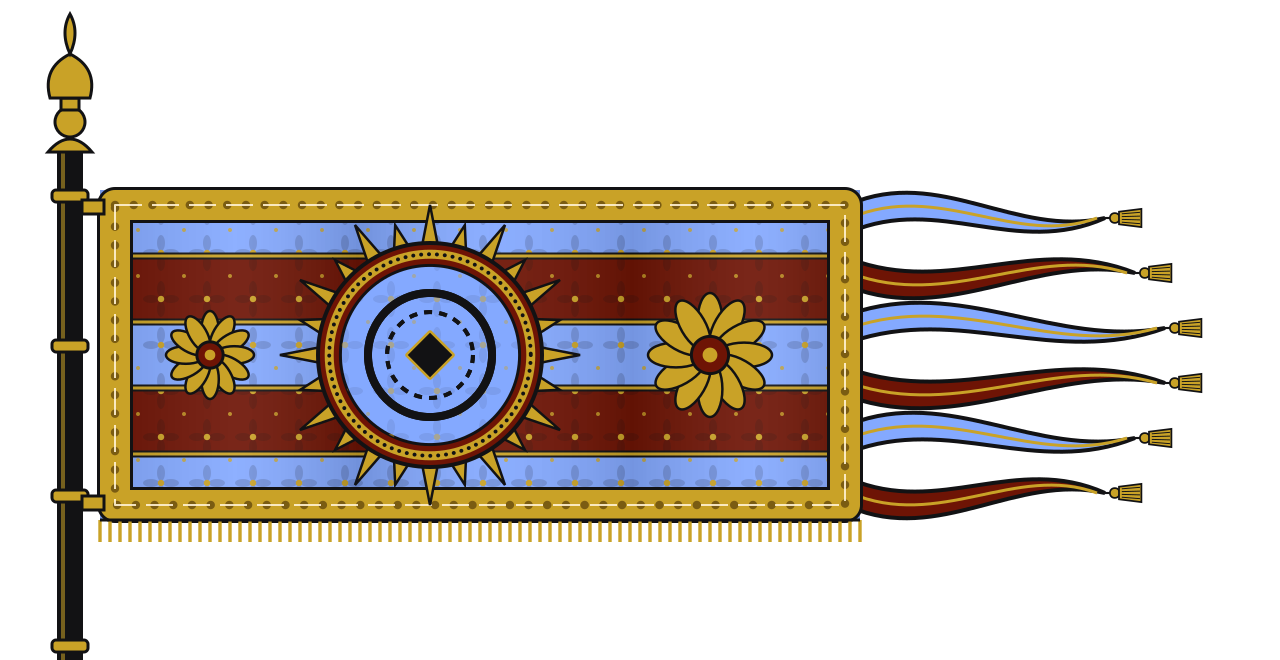
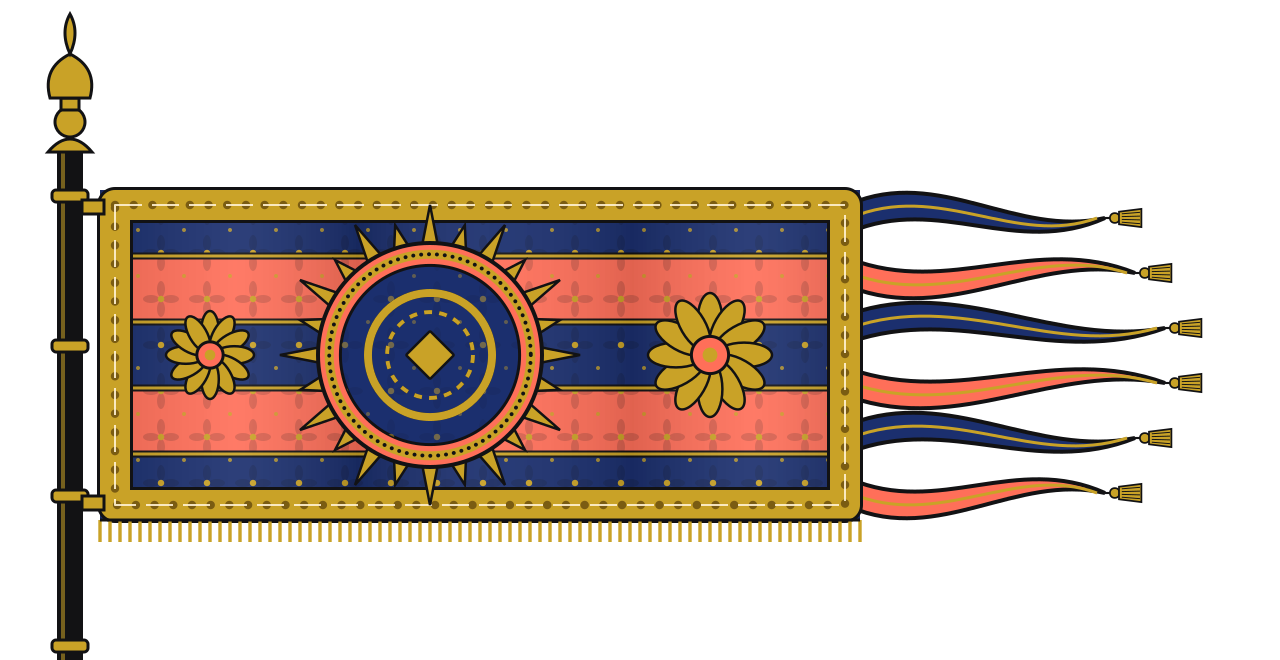
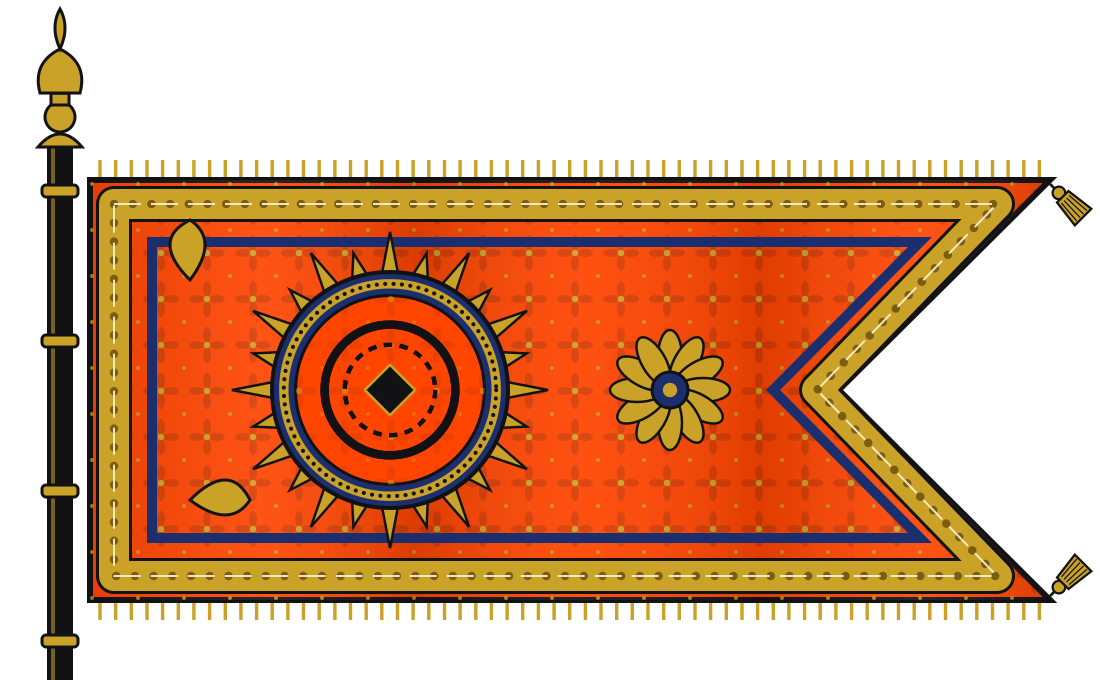
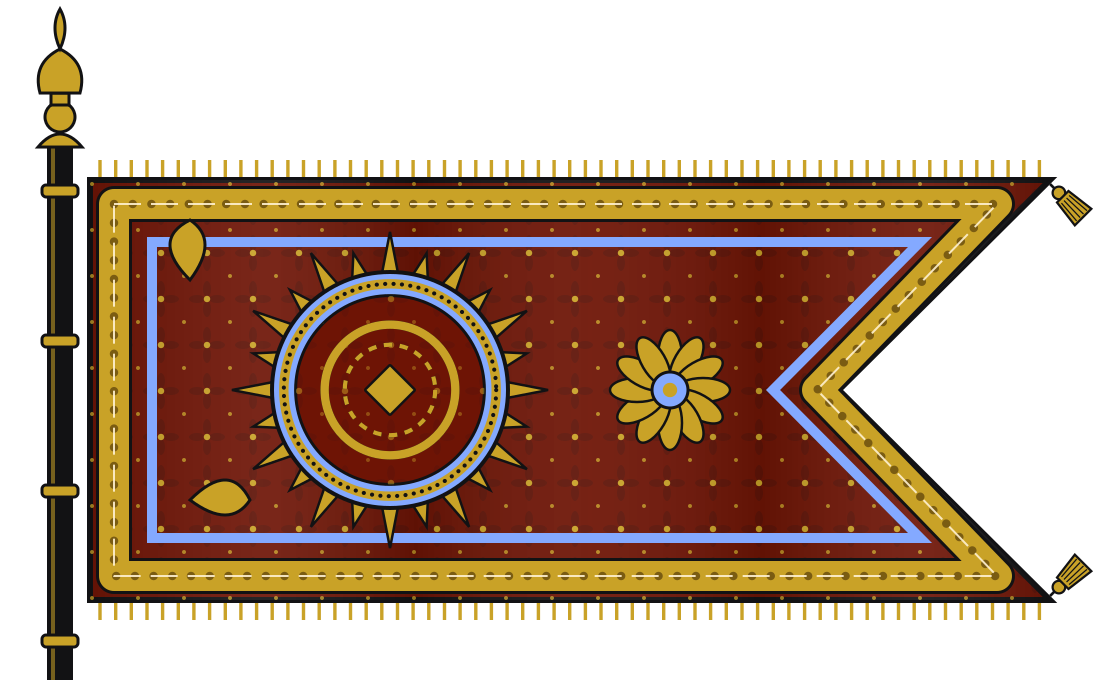



Historic banner
None known
New flag types
| Accessory | For this clan | Basis |
|---|---|---|
| A9 Pota-dhvaja · ship and trade flag For ships, caravans and markets | Not yet designed for this clan | Design |
| A10 Utsava-patāka · festival flag Light, bright flag for fairs and festivals | Not yet designed for this clan | Design |
| A11 Shoka-dhvaja · mourning flag White cloth with the emblem outline in the clan's metal | Not yet designed for this clan | Design |
7. Regalia
| Accessory | For this clan | Basis |
|---|---|---|
| E1 Chhatra · house parasol The ceremonial umbrella | Not yet designed for this clan | Design |
| E2 Chamara · fly-whisks The pair of whisks beside the head of the house | Not yet designed for this clan | Design |
| E3 Danda · staff of office Staff or scepter | Not yet designed for this clan | Design |
| E4 Simhasana · seat The seat of the house, covered in clan cloth | Not yet designed for this clan | Design |
| E5 Khetaka · shield A round shield; the Changi and Dhanush are its flag forms | Not yet designed for this clan | Regional tradition |
| E6 Kula-ayudha · clan weapon The weapon the clan honours | Not yet found for this clan | Under research |
8. Worn
| Accessory | For this clan | Basis |
|---|---|---|
| F1 Kula-vastra · clan cloth The clan's woven pattern in its kit colours | Not yet designed for this clan | Design |
| F2 Kirti-vastra · honour cloth A cloth earned for a deed, not inherited | Not yet designed for this clan | Design |
| F3 Kula-mala · garland flower The flower or leaf the clan wears as a garland | Not yet found for this clan | Under research |
| F4 Chinha · house pin A metal badge with the pin emblem | Not yet designed for this clan | Design |
9. Records
| Accessory | For this clan | Basis |
|---|---|---|
| H1 Clan words A traditional line in the native script | Pathari Johar · “Reply to the greeting 'Babu Johar', romanised as Russell gives it; no native-script form of the greeting is in the sources” Russell, 1916[1] | Documented |
| H2 Biruda · titles The house's title or titles | Not yet found for this clan | Under research |
| H3 Prashasti · praise genealogy The lineage as written at the head of a grant | Not yet found for this clan | Under research |
| H4 Vahi · clan register The book of the clan's births, marriages and deaths | Not yet found for this clan | Under research |
| H5 Rana-ghosha · war cry The clan's cry in battle or celebration | Not yet found for this clan | Under research |
10. VishwaVit · knower of the world
Game values are design choices for this project, not historical claims.
References
- R. V. Russell and Hira Lal, The Tribes and Castes of the Central Provinces of India, vol. 4 (London, 1916), Project Gutenberg eBook #20668, https://www.gutenberg.org/ebooks/20668
- Mushtaq Khan, Gond Vadya Bana (Bana, the musical god), Sahapedia, read 2026-11-05, https://www.sahapedia.org/gaonda-vaadaya-baanaa-vaadaya-bhai-daeva-bhai-bana-musical-god
- Wikipedia, Pardhan language, read 2026-11-05, https://en.wikipedia.org/wiki/Pardhan_language
- Map Academy (EIA editors), Gond painting / Jangarh Kalam, read 2026-11-05, https://mapacademy.io/?p=3655
- Gaatha, Painted Songs, read 2026-11-05, https://gaatha.com/?p=454
- Wikipedia, Gondi people, read 2026-10-10, https://en.wikipedia.org/wiki/Gondi_people
- "Jangubai Cave Temple and Kaplai Caves", Drishti IAS daily news analysis (citing The Hindu), 14 December 2019.
- Wikipedia mirror, Pardhan, read 2026-11-05, https://wiki.riteme.site/wiki/Pardhan
- www2.oberlin.edu page, read 2026-10-21 (Codex drafting run), www2.oberlin.edu
- Stephens, Ancient Indian harp-vina and sruti tuning, Chrysalis Foundation, AAWM vol. 6 no. 1, read 19 Oct 2026, link
- naavalam (Substack), "Pardhan Bards of the Gond" (read 30 Oct 2026, KulDevi run 357).
- R. V. Russell, The Tribes and Castes of the Central Provinces of India, vol. 3 (1916), Project Gutenberg #41424, read 2026-10-10, https://gutenberg.org/cache/epub/41424/pg41424-images.html
- Wikipedia, Tribals in Madhya Pradesh, read 2026-10-19, https://en.wikipedia.org/wiki/Tribals_in_Madhya_Pradesh
- dhammabharat.com, List of Scheduled Tribes in Maharashtra and Population of each Tribe (2011 Census), read 2026-10-10, https://dhammabharat.com/?p=13656
- Ministry of Tribal Affairs, State/UT-wise list of Scheduled Tribes, list dated 09-07-2024 (from sheet; not fetched)
- State-wise ST list (annual report 2023-24), Andhra Pradesh Part I, read 2026-10-10, https://iiitl.ac.in/wp-content/uploads/2024/08/07014a84-st-list-as-per-annual-report_-2023-24.pdf
- Verdictum, Tellam Venkata Rao v Union of India (report, 26 July 2025), read 2026-10-10, https://www.verdictum.in/court-updates/supreme-court/tellam-venkata-rao-v-union-of-india-lambadas-sugalis-banjaras-scheduled-tribe-telangana-1586192