The Panika, also written Panka or Pankha, are a community traditionally of weavers[1], listed as Scheduled Tribe in the Madhya Pradesh and Uttar Pradesh lists[2][3] (Ministry of Tribal Affairs list dated 09-07-2024[4]). Russell's 1916 entry says the Central Provinces Panka worship only Kabir, with a chauka of flour lines and songs in his praise[5]. The sources on weaving and Kabir describe Bastar and Central Provinces Panka, so the link to the Baghelkhand Panika of the Atlas is probable, not proven[6][5]. The Panika were listed in 1907, and the whole community was classed Scheduled Tribe in 1949[1].
01Faith and deities
Sharda of Maihar, Baghelkhand
The presiding goddess of the clan's homeland or capital: a link of place, not a recorded clan tie.
| Deity or tradition | Place in the clan's life | Evidence |
|---|---|---|
| Kabir (Kabirpanthi) | The one deity worshipped: a chauka of flour lines, songs in his praise, a coconut broken. No idols (Joshua Project) | [5][7] |
| Dulha Deo (bridegroom god) | Saktaha offer fire to him; his shrine is in the cook-room (Russell 1916) | [5] |
| Mahadeo and Parvati | The betrothed worship them under a Brahman (Russell 1916) | [5] |
| Village deities | The Sakta worship many village deities (Joshua Project) | [7] |
| Sharda Maa (KulDevi) | Homeland shrine: Sharda of Maihar, Baghelkhand, per the Atlas. No source in the extracts ties her to the Panika | From the Atlas |
02Temples
No temple built, patronised or named for the Panika is in the extracts. Kabirpanthi worship is done with the chauka and songs (Russell 1916)[5].
Built by the clan
Not recorded.
Given patronage or grants by the clan
Not recorded.
03Languages and scripts
| Language or script | Kind | Under the clan | Evidence |
|---|---|---|---|
| Chhattisgarhi living | Language; main language of the Panika (Joshua Project: 510,000 speakers, estimate) | Under the clan | [7][1] |
| Hindi living | Language (Joshua Project: 444,000 speakers, estimate) | Under the clan | [7][1] |
| Odia living | Language (Joshua Project: 40,000 speakers, estimate) | Under the clan | [7][1] |
| Sadri, Bengali, Bhojpuri, Northern Gondi | Languages (Joshua Project: 29,000, 18,000, 3,000 and 2,200 speakers, estimates) | Under the clan | [7] |
| Indo-Aryan | Language family | Under the clan | From the Atlas |
04Books and literature
The Panika are a living community. The works below are the ones found so far that describe them.
Written during the clan's history
| Work | Author | Kind | When | Link to the clan |
|---|---|---|---|---|
| Natives of Northern India | Not stated in the extracts | Ethnographic list | 1907 | [1] |
| The Tribes and Castes of the Central Provinces of India, vol. 4 | R. V. Russell and Hira Lal | Ethnography; 'Panka' entry | 1916 | [5] |
| Awareness in Weaker Section: Perspective Development and Prospects | Mahendra Lal Patel | Book (p. 34 cited) | 1997 | [1] |
| 'Panika weaving traditions of Bastar' | Sudha Dhingra | Sahapedia article | 2024 | [6] |
| 'Adivasi Pata of Kotpad' | Pankaja Sethi | Global InCH article (preview only) | 2019 | [8] |
Given patronage by the clan
Not recorded.
05Thinkers and scholars
| Name | Field | Era | Contribution |
|---|---|---|---|
| R. V. Russell and Hira Lal | Colonial ethnography | 1916 | The Panka entry in vol. 4, with septs, divisions and worship[5] |
| Mahendra Lal Patel | Development and weaker sections | 1997 | Book cited by Wikipedia for the Panika, p. 34[1] |
| Sudha Dhingra | Weaving and craft study | 2024 | Panika weaving of Bastar[6] |
| Pankaja Sethi | Craft and heritage writing | 2019 | The Adivasi pata of Kotpad, Koraput[8] |
The extracts give no Baghelkhand scholar of the Panika.
06Art and architecture
The weaving is the art. Bastar Panika pata and phenta are woven with aal-dyed yarn on a pit loom[6].
Painting and wall art
Not recorded.
Sculpture and temple art
Not recorded.
Temple and building architecture
Not recorded.
Weaving and textiles
| Art form | What it is | Era | Evidence |
|---|---|---|---|
| Pata and phenta | Pata is a sari; phenta is a turban or shoulder cloth. Both are woven with aal-dyed yarn | Bastar | [6] |
| Mangtha pit loom | Pit loom used for extra-weft designs | Bastar | [6] |
| Phera border | Three-shuttle bordering | Bastar | [6] |
| Motifs | Animals, birds, insects, plants and geometric forms; the Doli dandi motif (a decorated pole carried in goddess worship); the Mai luga design made to order for weddings | Bastar | [6] |
| Adivasi pata | Textile of the Kotpad weavers | Kotpad, Koraput, Odisha | [8] |
Clothing and jewellery
| Art form | What it is | Era | Evidence |
|---|---|---|---|
| White clothes | Worn by the Panka (Russell 1916) | Central Provinces | [5] |
Coins, pottery and crafts
Not recorded.
07History
1907: listing
The 1907 list Natives of Northern India records 'A Panka, Dravidian weaver, Southern Hills (P. 136)'[1].
1916: the Central Provinces Panka
Russell and Hira Lal describe the Panka of Mandla, Raipur and Bilaspur as a Dravidian caste of weavers and labourers, 215,000 in 1911[5]. They form a separate division of the Gandas who became Kabirpanthi, and touch was not held to convey impurity[5].
This is the Central Provinces caste. The Baghelkhand Panika is probably the same people; that is not proven.
The name
The caste explains the name as pani ka, 'from water', and tells a legend that Kabir was found by a weaver woman on a lotus leaf[5].
Wikipedia says 'Panika' is a mispronunciation of 'Pankha', citing a Hindi article of 1 November 2021[1].
Weaving in Bastar
Pankas of Bastar say aal-dyeing and weaving have been practised for at least 200 years, by oral accounts; there are no written records[6].
Status changes, 1949 to 2018
In 1949 the whole community was classed Scheduled Tribe. In 1971 Madhya Pradesh redesignated the then-Chhattisgarh Panika as OBC, and in 2001 that status was kept when Chhattisgarh was created[1].
As of 2018, on the NCBC list as Wikipedia gives it, the Panika were OBC in Chhattisgarh, ST in some Madhya Pradesh districts and OBC in others[1].
08Journey and migrations
One movement is recorded in the extracts: the ancestors of the Manikpuria division, said to come from Manikpur in Darbhanga. Baghelkhand movements are not in the extracts.
| When | From | To | Why | Evidence |
|---|---|---|---|---|
| About 300 years before 1916 (Manikpuria tradition) | Manikpur, Darbhanga | Central Provinces, as Russell records them | Not stated | [5] |
09Seats and lands
| Place | Role | Where today |
|---|---|---|
| Shahdol district | Primary district of the Panika (Joshua Project) | Madhya Pradesh[7] |
| Chhattisgarh | Largest estimated population, 799,000 (Joshua Project estimate) | Chhattisgarh[7] |
| Madhya Pradesh districts | Named for the people: Chhatarpur, Datia, Panna, Rewa, Satna, Shahdol, Sidhi, Tikamgarh | Madhya Pradesh[2] |
| Uttar Pradesh districts | ST list row 'Pankha, Panika': Sonbhadra and Mirzapur | Uttar Pradesh[3] |
| Bastar | Weaving centre; Panka are one of three main weaver castes there | Chhattisgarh[6] |
| Kotpad village | Weavers of the 'Adivasi pata' (the Koraput Panika, not Baghelkhand) | Koraput district, Odisha[8] |
| Maikal hills | Plateaus at 2,000–3,000 ft, named in the Joshua Project lands note | Joshua Project lands note, with Shahdol[7] |
| Jharkhand, West Bengal, Odisha | Estimated 60,000, 15,000 and 5,500 people (Joshua Project estimates) | Jharkhand, West Bengal, Odisha[7] |
10Notable figures
| Name | Role | Era | Known from |
|---|---|---|---|
| Kabir | Saint and poet. The Panka follow him; Global InCH calls him a julaha (weaver) and poet | Not stated in the extracts | [5][8] |
11Allies, rivals and marriages
| People | Relationship | When |
|---|---|---|
| Gandas | The Panka are a separate division of the Gandas | Recorded 1916[5] |
| Sahariya | Named in the Sahariya article as a related ethnic group | Recorded in the Sahariya article[9] |
| Parahiya and Bind | Named with the Panika as related groups of the Sahariya | Recorded in the Sahariya article[9] |
| Gond, Baiga and Pardhi | Live in multi-ethnic villages with the Panika | Present[7] |
| Mahar and Chandar | The other weaver castes of Bastar, with the Panka | Present[6] |
12Society and livelihood
The Central Provinces Panka were recorded in 1916 as weavers, village watchmen and cultivators[5]. Marriage within the same group is prohibited[7]. In 1916 the dead were buried with the head to the north and a coconut broken over the grave[5].
Government and social order
| Institution or group | What it was | Evidence |
|---|---|---|
| Mahant | Presides over Kabir worship; a hereditary office covering ten or fifteen villages (Russell 1916) | [5] |
| Diwan | Prepares the chauka; a hereditary office (Russell 1916) | [5] |
| Bhat genealogist | Each sept has its own Bhat genealogist (Russell 1916) | [5] |
| Exogamous septs | Twelve septs, each exogamous; see Sub-clans and related clans (Russell 1916) | [5] |
| Kabirha and Saktaha | The main division: Kabirha (Kabirpanthi) and Saktaha (Sakta sect) (Russell 1916) | [5] |
Livelihood over time
| Era | Livelihood | Evidence |
|---|---|---|
| 1916, Central Provinces | Weavers of coarse cloth, village watchmen and cultivators; they will not grow san-hemp or breed tasar cocoons | [5] |
| Bastar, at least 200 years by oral account | Aal-dyed pata and phenta cloth, woven on a pit loom | [6] |
| Bastar, today | Demand has declined; synthetic saris cost about one-eighth as much; weavers try wild silk and urban markets | [6] |
13Sub-clans and related clans
Divisions and septs of the Panka, from Russell 1916 (Central Provinces). Baghelkhand names may differ; see Open questions.
| Clan | Relation | Where | Size | In the Atlas | Evidence |
|---|---|---|---|---|---|
| Kabirha | Branch | Kabirpanthi division of the Panka | 84 per cent, 1916[5] | new clan candidate | [5] |
| Saktaha | Branch | Sakta sect; offer fire to Dulha Deo | new clan candidate | [5] | |
| Manikpuria | Branch | Ancestors said to come from Manikpur, Darbhanga, about 300 years before 1916 | new clan candidate | [5] | |
| Bajania | Branch | Musicians (Russell 1916) | new clan candidate | [5] | |
| Dom Panka | Branch | Subdivision named by Russell 1916 | new clan candidate | [5] | |
| Tandia | Sub-clan | Central Provinces; named for an earthen pot | new clan candidate | [5] | |
| Chhura | Sub-clan | Central Provinces; named for a razor | new clan candidate | [5] | |
| Neora | Sub-clan | Central Provinces; named for a mongoose | new clan candidate | [5] | |
| Parewa | Sub-clan | Central Provinces; named for a wild pigeon | new clan candidate | [5] | |
| Panaria | Sub-clan | Central Provinces; named for the bringer of betel-leaf | new clan candidate | [5] | |
| Kuldip | Sub-clan | Central Provinces; named for the lamp-lighter | new clan candidate | [5] | |
| Pandwar | Sub-clan | Central Provinces; named for the washer of feet | new clan candidate | [5] | |
| Ghughua | Sub-clan | Central Provinces (Russell 1916) | new clan candidate | [5] | |
| Khetgarhia | Sub-clan | Central Provinces; named for the field watcher | new clan candidate | [5] | |
| Sonwania | Sub-clan | Central Provinces; named 'gold-water', readmits outcastes | new clan candidate | [5] | |
| Naurang | Sub-clan | Central Provinces; named 'nine-coloured' | new clan candidate | [5] | |
| Sati | Sub-clan | Central Provinces (Russell 1916) | new clan candidate | [5] | |
| Gandas | Parent people | The Panka are a separate division of the Gandas | new clan candidate | [5] | |
| Sahariya | Related people | Bundelkhand; ST only in Lalitpur, UP (as of 2017) | 70,634, 2011[3] | ST-278 | [9] |
| Parahiya | Related people | Named with the Panika as related groups of the Sahariya; Sonbhadra | 901, 2011[3] | ST-254 | [9][3] |
| Bind | Related people | Named with the Panika as related groups of the Sahariya | new clan candidate | [9] | |
| Mahar | Related people | Bastar weaver caste, with the Panka and the Chandar | same name as SUB-159: check | [6] | |
| Chandar | Related people | Bastar weaver caste, with the Panka and the Mahar | new clan candidate | [6] |
Clans marked "new clan candidate" are not in the Atlas yet.
14Surnames
No surname is sourced as used by the Panika in the extracts. The sept names above are not confirmed as surnames.
Not recorded.
15Songs and music
The extracts name no Panika song by title. Russell records songs in praise of Kabir, and Joshua Project records praise singing to cymbals. The 1916 rhyme is under poems.
None recorded yet.
Instruments and styles
| Instrument or style | What it is | Evidence |
|---|---|---|
| Cymbals | Praise singing to cymbals (Joshua Project) | [7] |
16Poems, lullabies and children's rhymes
One doggerel rhyme on the origin of the Panka is recorded, from 1916.
Doggerel on the origin of the Panka
Russell 1916 gives the rhyme: the Panka were born of water, and there were Pankas before Kabir[5].
Pani se Panka bhae, bundan rache sharir, / Age age Panka bhae, pachhe Das Kabir.“Panka is born of water, body made of drops; there were Pankas before Kabir.”
17Stories, legends and proverbs
Stories and legends
| Story | What happens | Told by | Evidence |
|---|---|---|---|
| The name from water | The Panka name means 'from water'. Kabir was found by a weaver woman on a lotus leaf | The caste (Russell 1916) | [5] |
Proverbs and sayings
| Saying | Meaning | Evidence |
|---|---|---|
| Where a Panka can get a little boiled rice and a pumpkin, he will stay for ever. (English only in the extract) | A neighbours' saying as recorded in 1916; no further gloss given | [5] |
18Festivals and fairs
| Festival or fair | When | Where | What happens |
|---|---|---|---|
| Kabir full-moon fasts | Full-moon days of Magh, Phagun and Kartik | Central Provinces (Russell 1916) | Fasts in honour of Kabir[5] |
| Dussehra and nayikhani | Dussehra; nayikhani, the first-harvest festival | Bastar | Aal-dyed saris are worn at Dussehra, pujas, weddings and nayikhani[6] |
| Weddings | At weddings | Bastar | The Mai luga design is made to order for weddings[6] |
19Food, dress and games
Food
| Item | What it is | Evidence |
|---|---|---|
| No liquor; vegetarian | Strict vegetarians who take no liquor, the Kabirha (Russell 1916); the Kabirpanthi avoid liquor and meat (Joshua Project) | [5][7] |
Dress
| Item | What it is | Evidence |
|---|---|---|
| White clothes; tulsi bead garland | White clothes; men wear a tulsi bead garland (Russell 1916). Kabirpanthi wear small bead necklaces (Joshua Project) | [5][7] |
Games and martial arts
Not recorded.
Tags: living still practised · revived brought back after a break · lost known only from records · research reported but not yet confirmed from a source. Songs and poems under copyright are listed by title only; restricted or sacred material is noted without its content.
20Status today
The Panika are a Scheduled Tribe in listed districts of Madhya Pradesh and Uttar Pradesh[2][3] (Ministry of Tribal Affairs list dated 09-07-2024[4]), and were OBC in Chhattisgarh as of 2018[1]. Bastar weaving has lost demand[6].
Recognised heritage
| What | Recognition | Evidence |
|---|---|---|
| Bastar weaving: pata and phenta with aal dye | A Sahapedia article written for the Directorate of Culture and Archaeology, Government of Chhattisgarh (2024) | [6] |
No community review is recorded for this page.
21For children
The water-born weaver
In 1916 the Central Provinces Panka were recorded as weavers and village watchmen. Their elders say their name means 'from water'. They tell how a weaver woman found Kabir on a lotus leaf. Kabir is remembered as a poet and a weaver. The Panka sing songs in his praise, and they draw lines of flour when they worship him. In Bastar, weavers dye their thread with aal and weave saris on a pit loom. Children start to learn this weaving when they are ten or twelve.
Riddle: I sit in a pit and turn thread into cloth. What am I? (A pit loom, the mangtha of the Bastar weavers)
22Across the project
| Project | What carries this clan | Status |
|---|---|---|
| Atlas of the Janas | Districts named for the people in the Madhya Pradesh and Uttar Pradesh lists (see Seats and lands). No footprint file was written in this run | |
| KulDevi and GrahDevi | Sharda Maa is the KulDevi in the Atlas, on a homeland-shrine basis. No clan goddess is named in the extracts | |
| Planet naming | Not in the extracts | |
| Renaming and waters | Wikipedia says 'Panika' is a mispronunciation of 'Pankha'; the caste explains the name as 'from water' (Russell 1916) | [1][5] |
23Open questions
- Identity: Russell 1916 and Sahapedia describe the Central Provinces and Bastar Panka, and Global InCH the Koraput Panika of Kotpad. The link to the Baghelkhand Panika and Pankha of Madhya Pradesh and Uttar Pradesh is probable, not proven.
- Baghelkhand history, temples and clan deity: no Baghelkhand source is in the extracts. Sharda Maa is a master-sheet choice, not a sourced Panika deity.
- Odisha and Uttar Pradesh SC entries ('Panka' in Odisha; 'Pankha, excluding Mirzapur and Sonbhadra' in UP) are not sourced as the same people as this clan.
- Surnames: none is sourced as a Panika surname. The sept names are not confirmed as surnames.
- Totems: Russell 1916 names septs for an earthen pot, a razor, a mongoose and a wild pigeon, which may be totems. This is not confirmed.
- Pan: the cache note on Russell says the Pan tribe of Orissa and Chota Nagpur is also known as Panika. Check the book before use.
- Kabir texts: the sakhi texts, the Kabir panth article and the ir.nbu.ac.in study are not yet read.
- Crooke 1896 (vol. 1, Gutenberg 74620): only the first 100,000 characters were read; no Panika entry in that part.
- The pin position is not sourced in the extracts, so no coordinates are given for the clan or its sub-clans.
- Community review: none is recorded.
- Contradiction, deities: Russell 1916 says the Pankas worship only Kabir[5], yet the same entry has Saktaha offering fire to Dulha Deo and the betrothed worshipping Mahadeo and Parvati[5], and Joshua Project says the Sakta worship many village deities[7]. Not resolved: the one-deity line is not confirmed for every division.
24Astitva
अस्तित्व · being, existence: everything by which the clan is known
No coin, seal, plate, title, prashasti or war cry is documented for the Panika in the extracts. Weaving cloth and garland are recorded for the Bastar and Central Provinces Panka, which is the nearest documented match[6][5].
Every clan has every accessory, royal objects included. Each one says how it is known: Documented This clan's own object is recorded. · Regional tradition Recorded for the region or for peoples like this one, not for this clan. · Design Made for this project, with no historical claim. · Under research To be found for this clan from sources. Legends and titles are written in the clan's own script.
1. Seals and coins
| Accessory | For this clan | Basis |
|---|---|---|
| B1 Rajamudra · house seal Round seal with the clan emblem and a short legend in the clan's script | Not yet designed for this clan | Design |
| B2 Anguliya-mudra · signet ring Personal seal ring of the head of the house | Not yet designed for this clan | Design |
| B3 Chhapa · house stamp Ink or block stamp for letters, goods and cloth | Not yet designed for this clan | Design |
| B4 Tamrapatra · charter plate Copper-plate grant on a ring, closed with the house seal | Not yet designed for this clan | Design |
| B5 Shreni-mudra · guild or trade seal Seal for the clan's trade, craft or caravan | Not yet designed for this clan | Design |
| C1 Clan coin Emblem or deity on one side, a legend in the clan's script | Not yet designed for this clan | Design |
| C2 Coin die The die that strikes the coin | Not yet designed for this clan | Design |
2. Living symbols
| Accessory | For this clan | Basis |
|---|---|---|
| I1 Totem trio The tree, bird and animal the clan protects | Not yet found for this clan | Under research |
| I2 Kaval-maram · guardian tree The tree that stands at the clan's seat | Not yet found for this clan | Under research |
3. Stone and gate
| Accessory | For this clan | Basis |
|---|---|---|
| G1 Torana · gateway The built gate of the seat; the cloth Toran hangs in it | Not yet designed for this clan | Regional tradition |
| G2 Viragallu · hero stone Carved panel stone for a member who died defending the clan | Not yet designed for this clan | Regional tradition |
| G3 Kula-shila · clan stones Standing and table stones that remember the ancestors | Not yet designed for this clan | Design |
| G4 Jayastambha · victory pillar A pillar raised for a victory | Not yet designed for this clan | Design |
| G5 Sima-shila · boundary stone Marks the clan's land, with a line in the native script | Not yet designed for this clan | Design |
4. Sounds
| Accessory | For this clan | Basis |
|---|---|---|
| D1 Pancha-mahashabda · five great sounds The right to five instruments | Not yet designed for this clan | Design |
| D2 Shankha · clan conch The clan's own named war conch | Not yet designed for this clan | Design |
| D3 Murasu · house drums Three drums: war, charity and justice | Not yet designed for this clan | Design |
5. Kit: colours, metals and emblems
The Atlas gives a handloom shuttle (weaving) as the clan's emblem and a single-string instrument, the ektara, as its second image. Neither is documented in the extracts as a Panika symbol. The page shows the placeholder medallion until the emblem is drawn.
| Part of the kit | This clan |
|---|---|
| Field | Warm Red-Orange #FF6F59 |
| Accent | Intense Electric Blue #84A9FF |
| Emblem colour | Charcoal Black #121214 |
| Zari metal | Gold |
| Main emblem | A handloom shuttle |
| Second image | A single-string instrument (ektara) |
| Night and day | Every visual accessory has two versions: by night the emblem on the dark field, by day the clan's field colour on cloth woven from its metal. |
6. Flags
Every clan has every flag type; the type says the occasion and the colours say the clan. The outlined card is the flag the Atlas assigns.
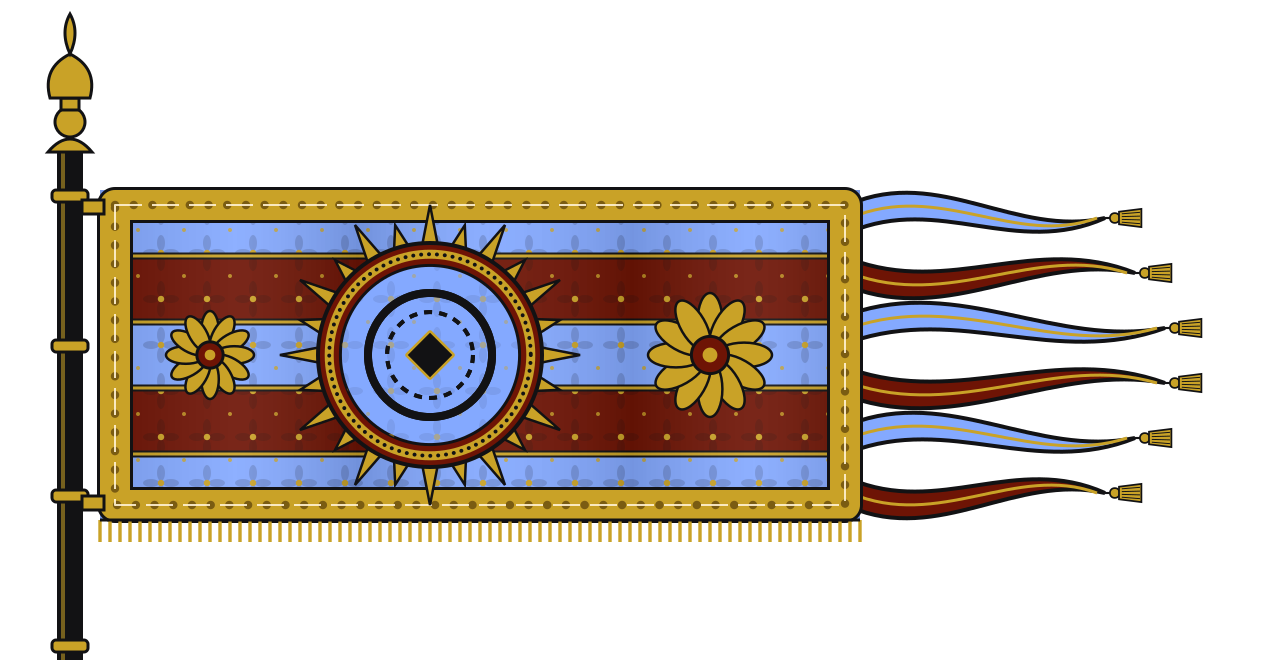
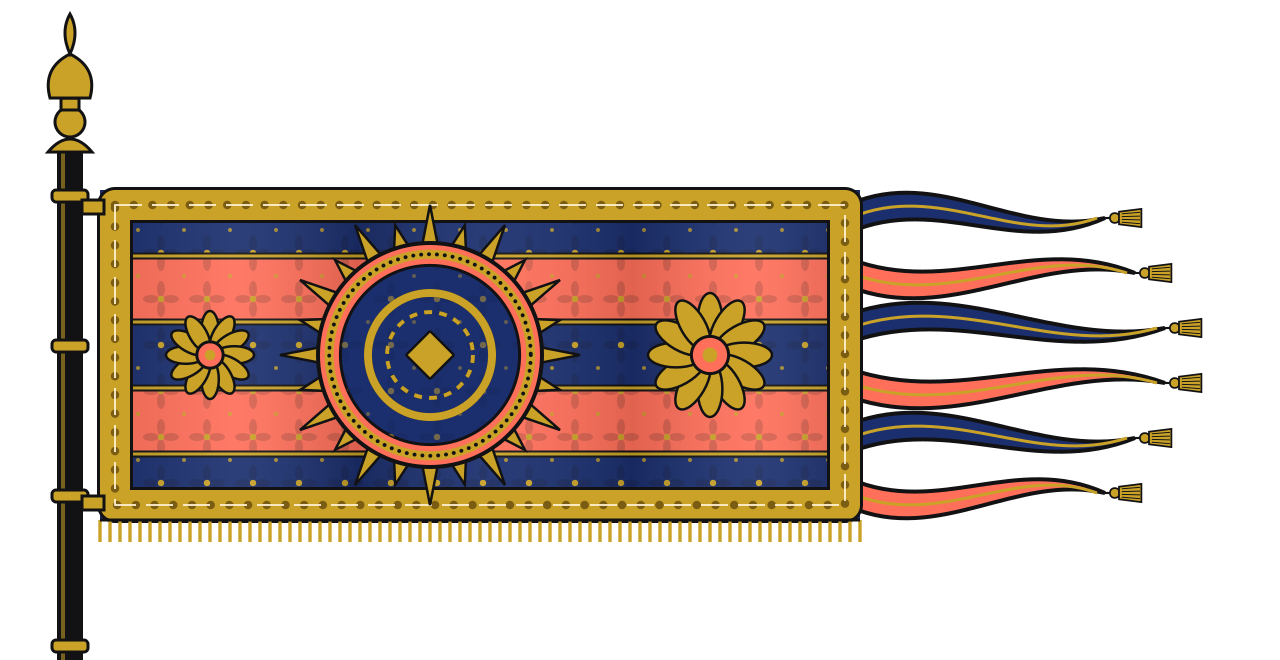
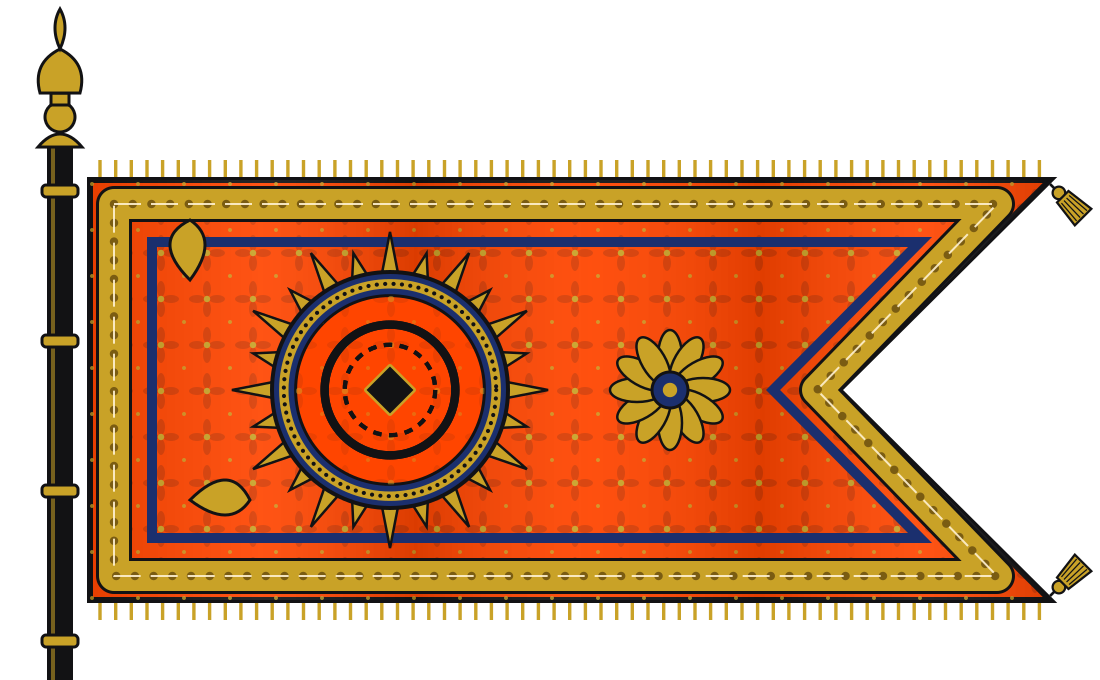
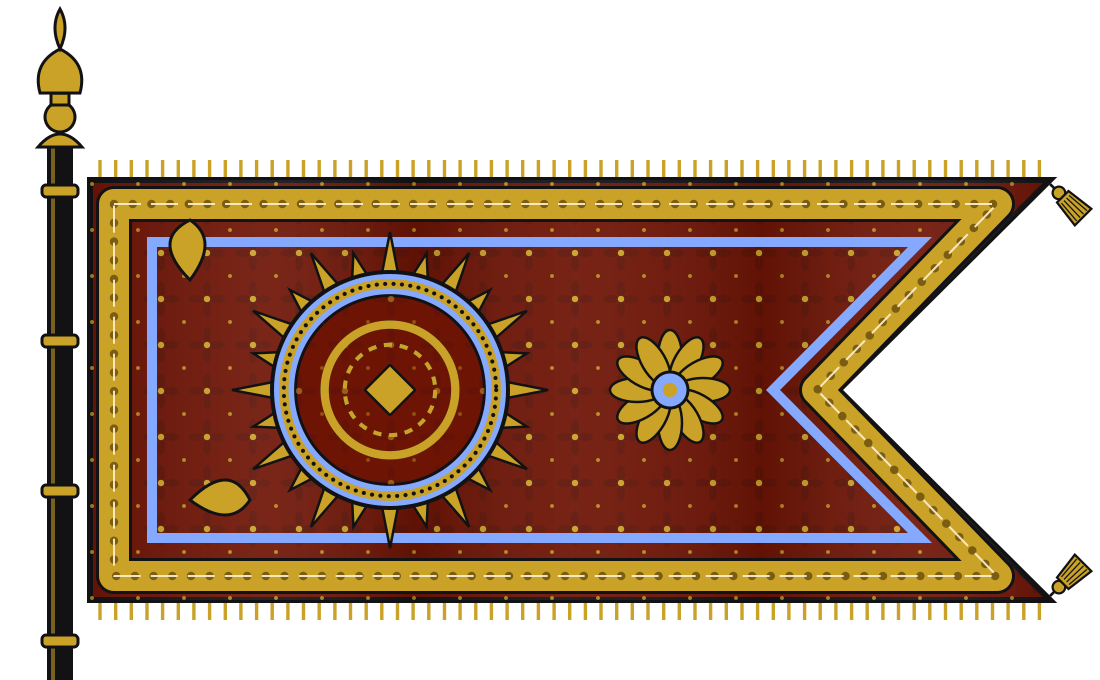

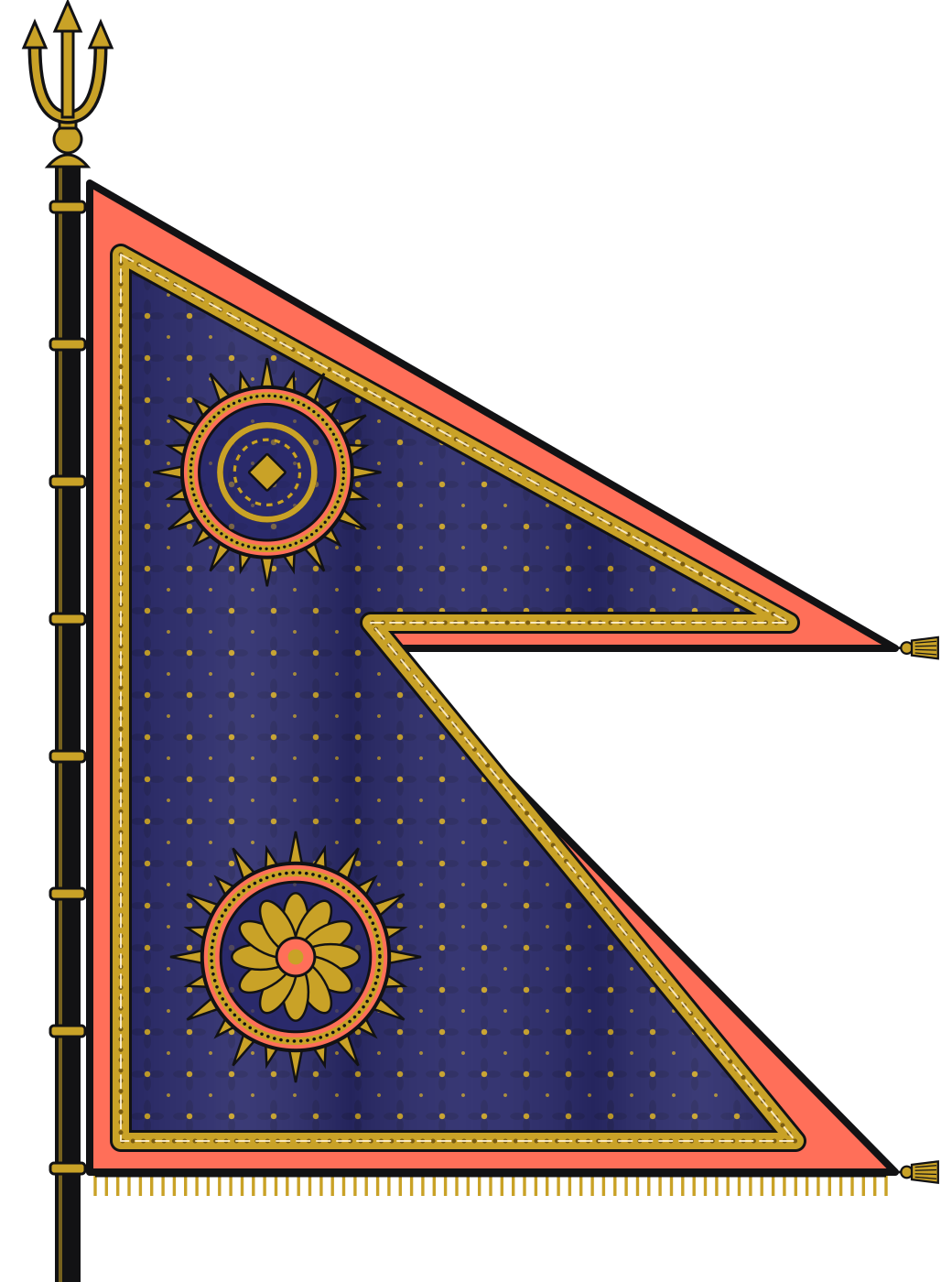


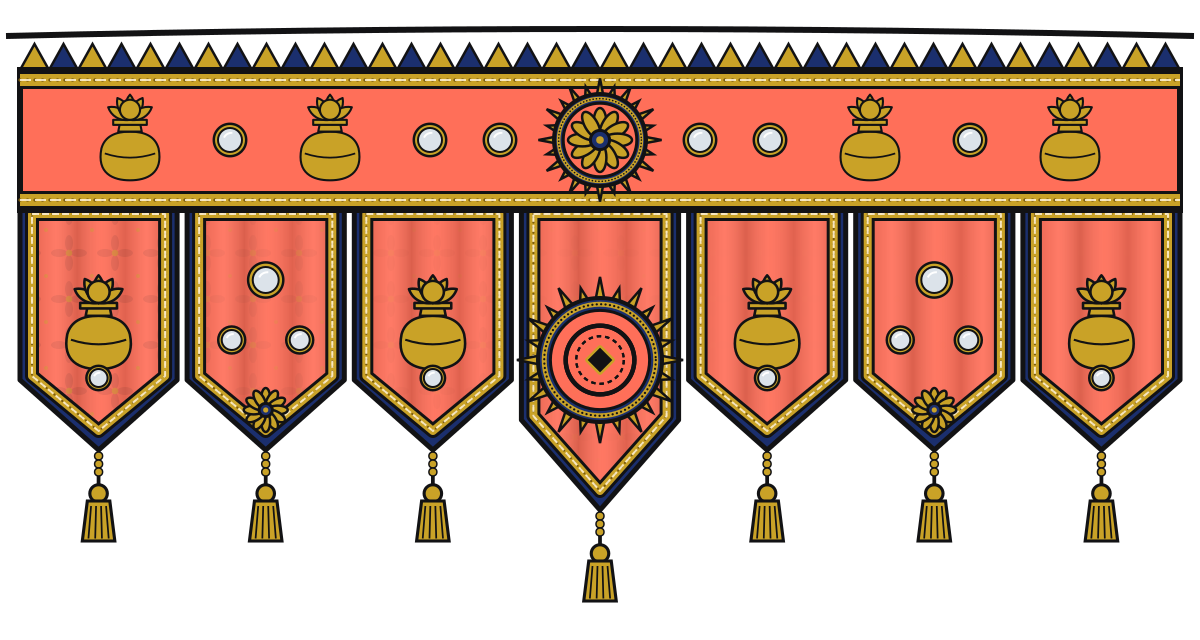
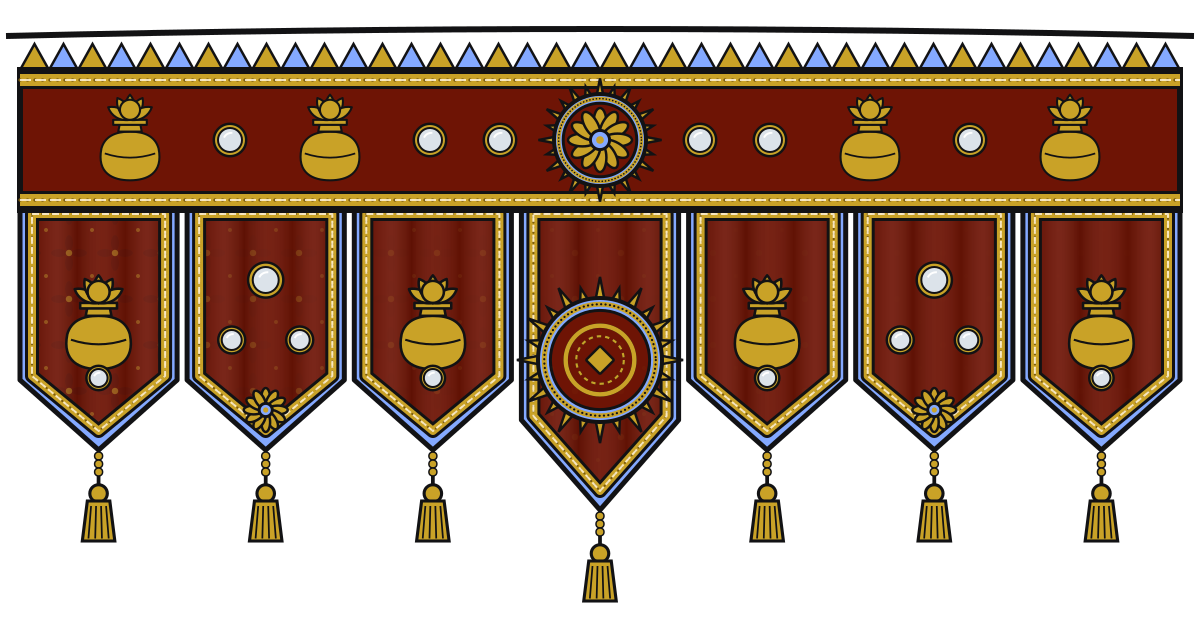
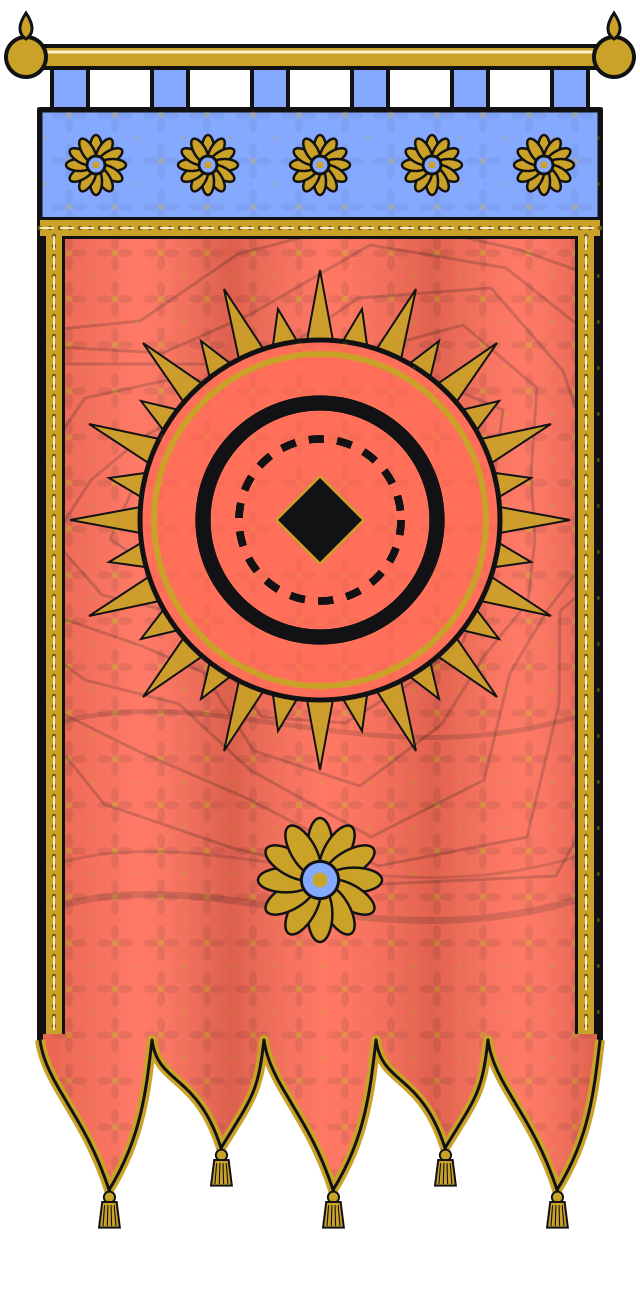
Historic banner
None known
New flag types
| Accessory | For this clan | Basis |
|---|---|---|
| A9 Pota-dhvaja · ship and trade flag For ships, caravans and markets | Not yet designed for this clan | Design |
| A10 Utsava-patāka · festival flag Light, bright flag for fairs and festivals | Not yet designed for this clan | Design |
| A11 Shoka-dhvaja · mourning flag White cloth with the emblem outline in the clan's metal | Not yet designed for this clan | Design |
7. Regalia
| Accessory | For this clan | Basis |
|---|---|---|
| E1 Chhatra · house parasol The ceremonial umbrella | Not yet designed for this clan | Design |
| E2 Chamara · fly-whisks The pair of whisks beside the head of the house | Not yet designed for this clan | Design |
| E3 Danda · staff of office Staff or scepter | Not yet designed for this clan | Design |
| E4 Simhasana · seat The seat of the house, covered in clan cloth | Not yet designed for this clan | Design |
| E5 Khetaka · shield A round shield; the Changi and Dhanush are its flag forms | Not yet designed for this clan | Regional tradition |
| E6 Kula-ayudha · clan weapon The weapon the clan honours | Not yet found for this clan | Under research |
8. Worn
| Accessory | For this clan | Basis |
|---|---|---|
| F1 Kula-vastra · clan cloth The clan's woven pattern in its kit colours | Pata and phenta woven with aal-dyed yarn, with a phera border, Bastar | Regional tradition |
| F2 Kirti-vastra · honour cloth A cloth earned for a deed, not inherited | Not yet designed for this clan | Design |
| F3 Kula-mala · garland flower The flower or leaf the clan wears as a garland | Tulsi bead garland worn by men (Central Provinces Panka, 1916) | Regional tradition |
| F4 Chinha · house pin A metal badge with the pin emblem | Not yet designed for this clan | Design |
9. Records
| Accessory | For this clan | Basis |
|---|---|---|
| H1 Clan words A traditional line in the native script | Pani se Panka bhae, bundan rache sharir, / Age age Panka bhae, pachhe Das Kabir. · “Panka is born of water, body made of drops; there were Pankas before Kabir.” Doggerel rhyme of the Panka, Central Provinces, recorded by Russell and Hira Lal in 1916[5]. Roman text only in the extract; no native-script form given. | Documented |
| H2 Biruda · titles The house's title or titles | Not yet found for this clan | Under research |
| H3 Prashasti · praise genealogy The lineage as written at the head of a grant | Not yet found for this clan | Under research |
| H4 Vahi · clan register The book of the clan's births, marriages and deaths | Not yet found for this clan | Under research |
| H5 Rana-ghosha · war cry The clan's cry in battle or celebration | Not yet found for this clan | Under research |
10. VishwaVit · knower of the world
Game values are design choices for this project, not historical claims.
References
- Wikipedia, Panika, read 2026-11-06, https://en.wikipedia.org/wiki/Panika
- Wikipedia, Tribals in Madhya Pradesh (Census 2011 ST rows), read 2026-10-19, https://en.wikipedia.org/wiki/Tribals_in_Madhya_Pradesh
- Wikipedia, List of Scheduled Tribes in Uttar Pradesh (Census 2011 populations), read 2026-10-22, https://en.wikipedia.org/wiki/List_of_Scheduled_Tribes_in_Uttar_Pradesh
- Ministry of Tribal Affairs, State/UT-wise list of Scheduled Tribes (Constitution (ST) Order 1950 as amended; list dated 09-07-2024), as recorded in the project Atlas (ST-248)
- R. V. Russell and Hira Lal, The Tribes and Castes of the Central Provinces of India, vol. 4 (London, 1916), Project Gutenberg eBook #20668, https://www.gutenberg.org/ebooks/20668 (entry Panka)
- Sudha Dhingra, Panika weaving traditions of Bastar, Sahapedia (2024, CC-BY-NC-SA 4.0; for the Directorate of Culture and Archaeology, Government of Chhattisgarh), read 2026-11-06, https://www.sahapedia.org/panika-weaving-traditions-of-bastar
- Joshua Project, Panika in India (people 17824; missions-data estimates, not census), read 2026-11-06, https://joshuaproject.net/people_groups/17824/IN
- Pankaja Sethi, Adivasi Pata of Kotpad, Global InCH, Summer 2019 (preview only), read 2026-11-06, https://globalinch.org/?p=161556
- Wikipedia, Sahariya (caste) (citing People of India, Uttar Pradesh vol. XLII), read 2026-11-05, https://en.wikipedia.org/wiki/Sahariya_(caste)
- Wikipedia, List of Scheduled Castes in Uttar Pradesh (Census 2011 populations), read 2026-10-22, https://en.wikipedia.org/wiki/List_of_Scheduled_Castes_in_Uttar_Pradesh
- Wikipedia, List of Scheduled Castes in Odisha, read 2026-10-20, https://en.wikipedia.org/wiki/List_of_Scheduled_Castes_in_Odisha