The Pandyas were one of the three crowned dynasties of the Tamil country, with the Cholas and the Cheras, ruling the far south of India from Madurai. Their emblem was the fish. Greek writers knew their land for its pearls[1][2], Ashoka's rock edicts name them among the peoples outside his empire[3][4], and Tamil tradition places the academies of the Sangam poets at their court. Their power rose and fell over nearly two thousand years[5].
01Faith and deities
Pandya princess-goddess of Madurai[8]
A recorded tie between the clan and the goddess.
| Deity or tradition | Place in the clan's life | Evidence |
|---|---|---|
| Meenakshi and Sundareswarar | Presiding goddess and god of Madurai, the royal capital | Madurai temple tradition; the best-known Pandya-country temple[7][5] |
| Murugan | God of the Tamil hills; Thiruparankundram near Madurai is the first of his six abodes | Tirumurukarruppatai by the Madurai poet Nakkirar[9] |
| Vishnu | Worshipped at Koodal Azhagar in Madurai and Srivilliputhur, home of the Alvar saints Periyalvar and Andal | Alvar hymns (Nalayira Divya Prabandham)[10] |
| Jain teachers | Tradition makes the early Pandya rulers Jain patrons before they turned to Shaivism | [11][5] |
| Alli Rani legend | The 'amazonian' queen of the Pandya tradition, sometimes seen as an incarnation of Meenakshi and Kannagi | [5] |
| Alagar (Kallalagar) | Vishnu; Meenakshi's brother, who takes the form of a Kallar man at the Ethir sevai | [7] |
| Shaiva and Vaishnava worship | Supported by the elite; Shiva later gained more support | [5] |
02Temples
The Meenakshi Temple in Madurai is the best-known Pandya-country temple. Pandya kings were crowned in the Adheenam Mutt of the Kasi Viswanathar temple at Tenkasi[5].
Built by the clan
| Temple | Deity | Built by | When | Where |
|---|---|---|---|---|
| Mangulam cave monastery | Jain monks | King Nedunjeliyan | c. 3rd–2nd century BCE | Near Madurai[11] |
| Thiruparankundram rock-cut cave | Shiva | Early Pandyas; enlarged by Maravarman Sundara Pandyan (1216–1239) | 8th century | Madurai[12] |
| Vettuvan Koil | Shiva | Varagunavarman I (Parantaka Nedunjadaiyan) | 8th century | Kalugumalai[13] |
| East gopuram, Meenakshi temple | Meenakshi and Sundareswarar | Jatavarman Sundara Pandyan I | 13th century | Madurai[14] |
| Kasi Viswanathar temple | Shiva | Parakrama Pandyan | 15th century (dates disputed) | Tenkasi[15] |
Given patronage or grants by the clan
| Temple | Deity | What the clan gave | When | Where |
|---|---|---|---|---|
| Ranganathaswamy temple | Vishnu | Roofs gilded by Jatavarman Sundara Pandyan I, who took the title 'the lord who roofed with gold' | 13th century | Srirangam[14] |
| Nataraja temple | Shiva | Restored and roofs gilded by Jatavarman Sundara Pandyan I | 13th century | Chidambaram[14] |
| Venkateswara temple | Vishnu | Gopuram gilded and a gold finial placed on the sanctum | 13th century | Tirumala[14] |
| Koneswaram temple | Shiva | Gopuram renovated | 1263 | Trincomalee, Sri Lanka[14] |
Later temples in the clan's lands
| Temple | Deity | Built | Where | |
|---|---|---|---|---|
| Meenakshi Temple, Madurai later | Meenakshi and Sundareswarar | The best-known temple of the Pandya country | Not dated in the extract | Madurai[5][8] |
03Languages and scripts
| Language or script | Kind | Under the clan | Evidence |
|---|---|---|---|
| Tamil living | Language of court and poetry; the official language today | Tamil tradition places the Sangam poets' academies at Madurai | [16][17][5] |
| Tamil-Brahmi lost | Script | The earliest Tamil-Brahmi inscription, at Mangulam, records a Pandya king's gift; the Pandya article also says early coins used it | [11][5] |
| Vatteluttu lost | Script | The rounded Tamil script of Pandya inscriptions, used for the Tamil portion of the Velvikudi plates | [18] |
| Grantha and Sanskrit | Script and court language | Sanskrit praise of the kings on copper plates, written in the Grantha script | [18] |
| Coin legends | Scripts on coins | Sanskrit on silver and gold coins; Tamil legends on most copper coins (no native-script forms printed) | [19] |
04Books and literature
The Pandya article dates the dynasty's continuity from about 400 BCE to 1618 CE[5]. The works below are tied to the Pandya country by the sources cited on each row.
Written in the clan's lands during its era
| Work | Author | Kind | When | Link to the clan |
|---|---|---|---|---|
| Maduraikkanci | Mangudi Marudanar | Sangam poem (Pattuppattu) | Sangam age (c. 2nd century CE) | The fullest portrait of Pandya Madurai, its markets and festivals[20] |
| Nedunalvadai | Nakkirar | Sangam poem (Pattuppattu) | Sangam age | A Pandya king's winter war camp[21] |
| Tirumurukarruppatai | Nakkirar | Devotional poem | Sangam age | Guide to Murugan's six abodes, beginning at Thiruparankundram[9] |
| Tirukkural | Tiruvalluvar | Ethics in couplets | c. 1st century BCE – 5th century CE (debated) | Tradition says the Madurai Sangam accepted it[22] |
| Iraiyanar Akapporul, with commentary | Commentary attributed to Nakkirar | Grammar of love poetry | c. 7th–8th century | Source of the legend of three Sangams at Madurai[23][6] |
| Tiruvasagam | Manikkavacakar | Shaiva hymns | 3rd or 6th century (disputed) | Written by a Pandya minister[24] |
| Tiruppavai and Tiruvaymoli | Andal; Nammalvar | Vaishnava hymns | 8th–9th century | Composed in Srivilliputhur and Alvarthirunagari, in the Pandya country[10] |
| Purananuru | Various poets: 157 poets, 14 anonymous, at least 10 women | Sangam anthology | c. 1st century BCE – 5th century CE (most 2nd–5th century CE) | 138 poems praise 43 kings, 12 of them early Pandyas. Some poems are claimed to be by Pandya rulers[25][5] |
| Silappatikaram | Ilango Adigal | Epic | Not dated in the extract (under research) | Madurai and Kannagi[17] |
| Arthashastra | Kautilya | Treatise on statecraft | Not dated in the extract (under research) | Calls Madurai 'Mathura of the south'[5] |
Given patronage by the clan
| Work | Author | What the clan gave | When | Evidence |
|---|---|---|---|---|
| Maduraikkanci | Mangudi Marudanar | Addressed to King Nedunjeliyan of Talaiyalanganam, in praise and counsel | Sangam age | [20] |
| Nedunalvadai | Nakkirar | Composed for King Nedunjeliyan | Sangam age | [21] |
| Pandikkovai | Unknown poet | Verses celebrating a Pandya king's victories, preserved in the Iraiyanar Akapporul commentary | c. 7th–8th century | [23] |
| The Sangam academies legend | Many poets | Tradition says the Pandya kings maintained three academies of poets at Madurai | Legendary chronology | [23] |
| Periyalvar's hymns legend | Periyalvar | Tradition says he was honoured at the court of the Pandya king Srimara Srivallabha | 9th century | [10] |
05Thinkers and scholars
| Name | Field | Era | Contribution |
|---|---|---|---|
| Nakkirar | Poet | Sangam age | Madurai poet; author of the Tirumurukarruppatai to Murugan[9] |
| Kaniyan Pungundranar (கணியன் பூங்குன்றன்) | Poet | Sangam age | Author of Purananuru 192[25] |
| Manikkavacakar | Philosopher and Shaiva saint | 3rd or 6th century (disputed) | Minister of a Pandya king; author of the Tiruvasagam[24] |
| Periyalvar and Andal | Vaishnava saints | 8th–9th century | Poet-saints of Srivilliputhur in the Pandya country[10] |
| Nammalvar | Philosopher and Vaishnava saint | 9th century | Of Alvarthirunagari in the Pandya country; his hymns shaped later Vedanta[10] |
No mathematicians or astronomers of the Pandya clan are firmly recorded.
06Art and architecture
Pandya art survives from three stages: Sangam-era coins and literature (c. 300 BCE – 300 CE[6]); the early Pandya rock-cut caves and cave paintings; and the later Pandya gopurams. Pandya contributions to Dravidian architecture include very large, elaborately decorated gopurams, following Pallava and Chola developments[5].
Painting and wall art
| Art form | What it is | Era | Evidence |
|---|---|---|---|
| Sittanavasal cave paintings | Jain murals of a lotus pond with people gathering lotuses, fish, geese, elephants and buffaloes, and two dancers. Painted in fresco-secco on lime plaster with ochres, lamp-black, green earth and blue. | 7th century; 9th-century layers | Renovation by a Pandya king recorded in an inscription[26] |
| Meenakshi temple murals later | The 64 sacred games of Shiva painted around the walls, and the marriage of Meenakshi and Sundareswarar on the walls of the golden lotus tank. | 17th–18th century | Nayak period[8] |
Sculpture and temple art
| Art form | What it is | Era | Evidence |
|---|---|---|---|
| Vettuvan Koil reliefs | An unfinished temple cut down into a rock face at Kalugumalai, built under Parantakan Nedunjadaiyan. Its tower carries Shiva and Uma in conversation, Dakshinamurthy playing a drum (mridanga), Nandi, ganas, monkeys and lions. | 8th century | Rock-cut monument[13] |
| Kunnakudi door guardians | Rock-cut shrines with some of the earliest carved dvarapalas (door guardians) in South India. | 8th century | Rock-cut shrines[27] |
| Thiruparankundram cave panels | Rock-cut shrine panels in the cave temple at Murugan's hill outside Madurai. | 8th century | Cave and inscription[12] |
Temple and building architecture
| Art form | What it is | Era | Evidence |
|---|---|---|---|
| Rock-cut cave temples | Early Pandya shrines cut into granite hills around Madurai, Kalugumalai and Kunnakudi, before large stone temples were built. | 7th–9th century | [27] |
| Gopuram (gateway tower) | Tall, tiered entrance towers that the later Pandyas made the main feature of the Tamil temple. At Madurai, Kulasekaran I built the gopuram of the Sundareswarar shrine, and the east tower, the oldest of the great towers, dates from the early 13th century. | 1190–1250 | [8] |
| Musical pillars | Stone pillars at the Nellaiappar temple, Tirunelveli, each giving a different note when struck. | Pandya temple; pillar date uncertain | [27] |
| Thousand-pillared hall later | 985 carved pillars in the Meenakshi temple. | 16th century | Nayak period[8] |
Weaving and textiles
| Art form | What it is | Era | Evidence |
|---|---|---|---|
| Madurai muslins and silks | Cotton and silk cloth of Madurai, famous for its quality; the finest muslins carried coloured floral work and were likened to a cobra's slough or a cloud of steam. | Sangam era | Sangam poems[28][20] |
| Cloth trade | Ilavettanar, one of the Sangam poets, was a Madurai cloth merchant (aruvai vanigan). | Sangam era | [29] |
| Madurai Sungudi later | Tie-dyed cotton with thousands of tiny knots, made by Saurashtrian weavers who settled at Madurai. | Nayak period onward | GI tag 2005[30] |
Clothing and jewellery
| Art form | What it is | Era | Evidence |
|---|---|---|---|
| Pearls of Korkai | The Pandya coast's pearls were worn across Tamilakam and north India and exported to Rome at high prices. | 3rd century BCE – 1st century CE | [1][2][28] |
| Royal dress of Maabar | The Pandya king wore only a fine loincloth, with a necklace of rubies, sapphires and emeralds and a silk cord strung with 104 pearls. | c. 1292 | Eyewitness account[31] |
| Blue-dyed loincloths | Dyeing flourished; blue was the favourite colour for loincloths. | Sangam era | [28] |
Coins, pottery and crafts
| Art form | What it is | Era | Evidence |
|---|---|---|---|
| Fish-and-elephant coins | Rectangular, die-struck copper coins with an elephant on one side and a stylised fish on the other; later coins show one or two fish with the bull. | Sangam era; 7th–10th century | Coins found around Korkai and in Sri Lanka[32][19] |
| Kammalar craft guilds | The artisan community of goldsmiths, brass-smiths, blacksmiths, carpenters and masons who built and decorated the temples. | Medieval | [27] |
07History
The pearl kingdom
Megasthenes, writing around 300 BCE, describes a southern land called Pandaia ruled by a queen[1]. Ashoka's second and thirteenth rock edicts name the Pandyas, with the Cholas, Cheras and Satiyaputras, outside his empire[3][4]. The Periplus of the Erythraean Sea, a 1st-century Greek trade guide, knows the Pandya coast for its pearl fisheries, centred on the port of Korkai[2].
The Sangam age
The earliest Tamil-Brahmi inscription, at Mangulam near Madurai, records the Pandya king Nedunjeliyan giving a monastery to a Jain monk[11]. Tamil tradition places the Sangam academies of poets at Madurai under Pandya patronage. The Purananuru poems praise 43 kings, 12 of them early Pandyas[25]. Nedunjeliyan II was the victor of Talaiyalanganam[5]. The epic Silappatikaram sets its tragedy of Kannagi in Pandya Madurai[17].
Eclipse and return
After the Sangam age the Kalabhras overran the Tamil kingdoms[33]. Around 560–590 CE King Kadungon restored Pandya rule, as recorded in the Velvikudi copper plates[18][5], and his successors clashed repeatedly with the Pallavas and the Cholas[5].
The Velvikudi grant
The bilingual Velvikudi copper plates, dated c. 769–770 CE (the date is disputed), were issued by Nedunjadaiyan Varaguna-varman I, alias Jatila Parantaka (r. c. 765/768–815 CE), in his third regnal year. They renew an earlier grant after the Kalabhra interregnum, when the Kalabhras had conquered the Pandya country and Kadungon recovered it[34]. The victories listed include Arikesari Maravarman at Pali, Nelveli, Sennilam and Puliyur; Sadaiyan at Marudur, Sengodi, Pudankodu and Mangalapuram; and Ter-Maran at Neduvayal, Kulumbur and Periyalur[34].
The second empire
In the 13th century the Pandyas rose again and broke Chola power. Under Jatavarman Sundara Pandyan I (1251–1268) their rule stretched from Kerala to Nellore and Sri Lanka paid tribute[14]. Marco Polo visited the Pandya coast in 1288 and 1293 and wrote of its pearl divers and its port of Kayal[35][5].
Over the Cholas
In 1215–16 Maravarman Sundara Pandiyan II defeated the Chola king Kulothunga III, and the Pandyas absorbed the Cholas; Chola power ceased in 1279[33]. The Chola article also records a rivalry between the two houses from 1150 to 1280, with intermarriage between them[33].
The fall
A war of succession between the sons of Maravarman Kulasekara Pandyan I opened the way for Malik Kafur's raid from Delhi in 1311. The Madurai Sultanate followed in c. 1334[5], and Pandya chiefs held out at Tenkasi into the 16th century[15].
08Journey and migrations
The extracts give embassies and visits, not migrations. No migration of the clan is recorded.
| When | From | To | Why | Evidence |
|---|---|---|---|---|
| c. 13 CE | Pandya country | Augustus (Rome) | A Pandya embassy reached Augustus | [5] |
| 1288 and 1293 | Marco Polo's travels | The Pandya kingdom | Marco Polo visited the Pandya coast in both years | [35][5] |
| c. 361 CE | Pandya country | Julian (Rome) | A Pandya embassy reached Julian | [5] |
| c. 1370 | Madurai | Vijayanagara | Vijayanagara took Madurai | [5] |
09Seats and lands
| Place | Role | Where today |
|---|---|---|
| Madurai (Koodal, கூடல்) | Royal capital; tradition makes it the seat of the Sangam academies legend | Madurai, Tamil Nadu |
| Korkai | Early port and pearl-fishing centre | Thoothukudi district, Tamil Nadu |
| Kayal | Port described by Marco Polo | Kayalpattinam, Tamil Nadu |
| Vaigai river | River of Madurai | Tamil Nadu |
| Tenkasi | A later Pandya capital[5] | Tenkasi, Tamil Nadu |
| Pandya Nadu | The Pandya country itself, south of Chola Nadu | Tamil Nadu[36][5] |
| Kanchi | Secondary capital | Under research |
| Tirunelveli | Later capital | Tamil Nadu |
| Northern Sri Lanka | Held at times | Sri Lanka[5] |
| South Kerala | Held at times | Kerala[5] |
| Nellore | Northern reach of Jatavarman Sundara Pandyan I's rule | Under research |
10Notable figures
| Name | Role | Era | Known from |
|---|---|---|---|
| The queen of Pandaia legend | Ruler named by Megasthenes | c. 300 BCE | Megasthenes, via Arrian[1] |
| Nedunjeliyan | Sangam king; victor of Talaiyalanganam | Sangam age | Sangam poems; Mangulam inscription; Pandya article[16][11][5] |
| Kannagi legend | Heroine of the Silappatikaram, set in Madurai | Sangam age | Silappatikaram[17] |
| Kadungon | Restored Pandya rule after the Kalabhras | c. 560–590 CE | Velvikudi plates[18][5] |
| Jatavarman Sundara Pandyan I | Ruler of the second empire; his rule stretched from Kerala to Nellore and Sri Lanka | 1251–1268 | Inscriptions[14] |
| Maravarman Kulasekara Pandyan I | King in Marco Polo's time; his sons' war ended the empire | 1268–1310 | Pandya article; Marco Polo[5][35] |
| Varaguna-varman I (Jatila Parantaka) | Issued the Velvikudi grant in his third regnal year | r. c. 765/768–815 CE | [34] |
| Arikesari Maravarman | Victories at Pali, Nelveli, Sennilam and Puliyur, listed in the Velvikudi plates | Recorded in the Velvikudi plates (c. 769–770 CE) | [34] |
| Sadaiyan (Ko Chadaiyan) | Victories at Marudur, Sengodi, Pudankodu and Mangalapuram; title Madura-Karunatakan | Recorded in the Velvikudi plates (c. 769–770 CE) | [34] |
| Ter-Maran (Maravarman Rajasimha I) | Victories at Neduvayal, Kulumbur and Periyalur; allied by marriage with the Gangaraja | Recorded in the Velvikudi plates (c. 769–770 CE) | [34] |
| Maravarman Sundara Pandiyan II | Defeated the Chola king Kulothunga III | 1215–16 | [33] |
| Vikrama Pandya | Named in the Pandya article; role not given | 1401–1422 | [5] |
| Mudukudimi Peruvaludi | Named in the Pandya article; role not given | Not dated in the extract | [5] |
| Varagunavarman II | Named in the Pandya article; role not given | Not dated in the extract | [5] |
| Mankudi Maruthanar | Named in the Pandya article; role not given | Not dated in the extract | [5] |
11Allies, rivals and marriages
| People | Relationship | When |
|---|---|---|
| Cholas | Rivals; clashed repeatedly; the Pandyas absorbed the Cholas in the 13th century[33] | 1150–1280 (rivalry) |
| Cheras | Fellow crowned kings; allied with the Pandyas against the Cholas[5] | Not dated in the extract |
| Pallavas | Clashed repeatedly with the Pandyas | From the 6th century[33] |
| Sri Lanka | Allied with the Pandyas against the Cholas[5] | Not dated in the extract |
| Rome | Pandya embassies reached Augustus and Julian[5] | c. 13 CE and c. 361 CE |
| Delhi Sultanate | Malik Kafur's raid of 1311 | 1311 |
| Hoysalas and Chalukyas | Clashed repeatedly with the Pandyas | Not dated in the extract[5] |
| Sinhalese and Cheras | Allied with the Pandyas against the Cholas | Not dated in the extract[5] |
| Kalabhras | Overran the Tamil kingdoms; Kadungon restored Pandya rule | c. 300 – 6th century CE[33][18] |
| Malavas | Rajasimha married the daughter of the Malava king | Velvikudi plates, c. 769–770 CE[34] |
| Gangas | Ter-Maran allied by marriage with the Gangaraja | Velvikudi plates, c. 769–770 CE[34] |
| Kalinga | After Kharavela broke the 113-year Tramira (Tamil) league, the Pandya king sent pearls and jewels to Kalinganagara | 2nd or 1st century BCE (Kharavela article); c. 150 BCE (Sources article)[37][3] |
| Sinhalese prince Vijaya legend | Married a Pandya princess, per the Mahavamsa | Mahavamsa (5th century CE text)[5] |
| Ashoka | Named the Pandyas among the peoples outside his empire | 3rd century BCE[3][4] |
| Vijayanagara; Madurai Nayak dynasty; Jaffna kingdom | Successors and rivals of the later Pandyas | Later period, not dated in the extract[5] |
12Society and livelihood
The sources describe a kingdom whose wealth came from pearl fisheries and silk, with temples doing public work and a king-centred society.
Government and social order
| Institution or group | What it was | Evidence |
|---|---|---|
| Temples | Served as banks, schools, dispensaries and poorhouses | [5] |
| Pearl divers | The Periplus says convicts were used as pearl divers | [2][5] |
| Sangam-era society | Described in the poems Maduraikkanci and Nedunalvadai | [20][21][5] |
Livelihood over time
| Era | Livelihood | Evidence |
|---|---|---|
| Sangam age | Pearl fishing; Korkai the pearl-trade centre | [5][2] |
| Sangam age | Silk; Madurai's cloth trade | [28][29] |
| c. 769–770 CE | Gift of a village to Brahmins (brahmadeya), the headman keeping a third of it | [34] |
13Sub-clans and related clans
Sub-branches and related peoples named in the sources. The Maravar and Kallar are listed because the extracts name them; no source links them to the Pandyas by descent, and no descent claim is made here.
| Clan | Relation | Where | Size | In the Atlas | Evidence |
|---|---|---|---|---|---|
| Tenkasi Pandyas | Sub-clan | Tenkasi, Tamil Nadu | new clan candidate | [5][15] | |
| Pandyas of Ucchangi | Sub-clan | Under research | new clan candidate | [5] | |
| Cholas | Dynasty from this clan | Kaveri valley and delta | ANC-029 | [5][33] | |
| Cheras | Dynasty from this clan | ANC-027 | [5] | ||
| Velir | Related people | Hill chieftains | ANC-145 | [5] | |
| Kalabhras | Related people | ANC-043 | [33][18] | ||
| Mutharaiyar | Related people | Chieftains; place not given | same name as ANC-212: check | [5] | |
| Maravar | Related people | Ramnad, Madurai and Tirunelveli | same name as SUB-113: check | [38] | |
| Kallar | Related people | Nadus north and west of Madurai | same name as SUB-112: check | [39][7] |
Clans marked "new clan candidate" are not in the Atlas yet.
14Surnames
Names the sources mention alongside the clan. Neither is a Pandya surname; both are Maravar terms in the Maravar article. No counts are sourced.
| Surname | Clan or sub-clan | Where | People with this surname | Also used by other communities |
|---|---|---|---|---|
| Thevar | Maravar (related) | Tamil Nadu | not yet counted | Not checked |
| Sethupathi | Maravar (related) | Ramnad | not yet counted | Not checked |
Counts are of everyone with the surname, from the cited source and year, not only members of this clan. A surname shared with other communities says nothing about any one person's origin.
15Songs and music
No Pandya song text is sourced in the extracts. The Sangam poems are listed under Books and Poems.
None recorded yet.
16Poems, lullabies and children's rhymes
No Pandya poem, lullaby or rhyme text is sourced in the extracts beyond the clan words.
None recorded yet.
17Stories, legends and proverbs
Stories and legends
| Story | What happens | Told by | Evidence |
|---|---|---|---|
| The three brothers of Korkai legend | Cheran, Cholan and Pandyan, three brothers who ruled from Korkai (likened to Romulus and Remus) | Origin myth in the Pandya article | [5] |
| Malayadhvaja and Meenakshi legend | The childless king and queen Kanchana Malai receive a three-year-old girl with three breasts from the sacrificial fire, an incarnation of Parvati. She conquers the world, meets Shiva, and her third breast falls away. Sundareswarar weds her, and they rule the Pandya kingdom | Madurai temple tradition | [7] |
| The three Sangams legend | Three academies of poets held at Madurai under Pandya patronage. The third had 49 members, led by Kapilar, Paranar and Nakkirar, and met at the Pond of Golden Lotuses. Scholars disagree whether they existed | Nakkirar's commentary on the Iraiyanar Akapporul (c. 7th–8th century); Nambi's Thiruvilaiyadal Puranam | [6][23] |
| Alli Rani legend | An 'amazonian' queen of the Pandya tradition | Pandya article | [5] |
Proverbs and sayings
Not recorded.
18Festivals and fairs
| Festival or fair | When | Where | What happens |
|---|---|---|---|
| Meenakshi Tirukalyanam (Chithirai Tiruvizha) | Annual; one month in the Tamil month of Chithirai (April) | Madurai | First 15 days: Meenakshi's coronation and marriage; next 15 days: Kallalagar's (Alagar's) journey. Kodi yetram (flag hoisting), pattabhishekam, Ter Tiruvizha (chariot) the day after the wedding, Ethir sevai, Alagar Vaigai Yeluntarulutal, Devendra puja on the fourteenth day, with devotees bathing in the golden lotus pond[7] |
| Shaiva Meenakshi festival | Formerly in the Tamil month of Masi; merged with the Alagar festival under Tirumala Nayaka | Madurai | The two festivals were merged, per Branfoot 2000 and The Hindu 2011[7] |
19Food, dress and games
Food
Not recorded.
Dress
Not recorded.
Games and martial arts
Not recorded.
Tags: living still practised · revived brought back after a break · lost known only from records · research reported but not yet confirmed from a source. Songs and poems under copyright are listed by title only; restricted or sacred material is noted without its content.
20Status today
The former Pandya country is in present-day Tamil Nadu, and Korkai lies in Thoothukudi district[5]. The dynasty is historical; its name survives in the Madurai temple tradition and in the sheet's aliases.
No community review is recorded for this codex.
21For children
The fish on the coin
Long ago, in the south of India, the Pandyas ruled from Madurai, a city on the river Vaigai. Their badge was a fish, and some of their coins had a fish on them. The poets of their court were said to meet in three great gatherings. In the stories, a little girl with three breasts became queen of Madurai, and her name was Meenakshi. Today, in the month of Chithirai, people still celebrate her wedding to Shiva in the great temple at Madurai.
Written for this project
Riddle: I was a badge on a king's copper coin, a fish of the southern sea. What am I? (The fish, the Pandya badge)
22Across the project
| Project | What carries this clan | Status |
|---|---|---|
| Atlas of the Janas | Madurai and Korkai are the seat and port in the lands section; no footprint file yet | To check |
| KulDevi and GrahDevi | Meenakshi, KulDevi, family Navadurga; GrahDevi forms: Shailaputri, Brahmacharini, Chandraghanta, Kushmanda, Skandamata, Katyayani, Kalaratri, Mahagauri, Siddhidatri | From the Atlas |
| Planet naming | Not yet checked against the Tier registers | To check |
| Renaming and waters | Pearl fisheries of Korkai and the Vaigai river of Madurai; no place or water name checked yet | To check |
23Open questions
- Era end: the eyebrow and the info table give c. 400 BCE – 1400 CE (page); the Pandya article gives roughly 400 BCE to 1618 CE[5]. The Tenkasi sentence in the fall section gives the 16th century. Reconcile.
- Hathigumpha date: the Kalinga row gives 2nd or 1st century BCE from the Kharavela article[37]; the Sources article gives c. 150 BCE[3]. Reconcile.
- Nedunjeliyan's date: the Mangulam entry gives the 3rd–2nd century BCE, the Pandya article gives Nedunjeliyan I as c. 270 BCE. Reconcile.
- Early coin script: the Pandya article says Tamil-Brahmi on early coins; the coinage article says Sanskrit on silver and gold coins and Tamil on most copper. Check against the coins.
- Coin shape: the earlier text said square; the coinage article says rectangular (used here). Check against a coin photograph.
- Clan words: the Tamil line and its translation were removed by the checker because no cached extract gives them. Check a published edition of Purananuru 192 before any line is shown again.
- The Chandravamsha (Lunar Race) descent claim: find the inscription that makes it. The Velvikudi genealogy begins with Budha and Pururavas.
- Tenkasi Pandyas and Pandyas of Ucchangi: dates and places beyond the Pandya article (the Tenkasi temple page is cited but not cached).
- Mutharaiyar: place, period and type.
- Maravar and Kallar: no descent link to the Pandyas is sourced. Any community claim needs a source and both sides set out.
- Surnames: whether Pandiyan, Pandian or Pandyan is used as a surname, and any count with year.
- Jatavarman Sundara Pandyan I's title and inscriptions, and the Chandravamsha claim: read the Epigraphia Indica vol. 3 page (lead, not fetched).
- Accessories with no source: seal (B1), war cry (H5), guardian tree (I2), totem tree and bird (I1), garland flower (F3), charter seal. See the astitva research note.
- Kanchi and Nellore: where they are today.
- Community review: none recorded.
- The ClearIAS study guide: its Mattavilasa Prahasana attribution is doubtful and is not used. Its officials list is not used until verified.
- Not in any cached extract (the keys are not cached): the Malik Kafur raid of 1311 and the war of succession before it, Kayal and Nellore, Jatavarman Sundara Pandyan I's dates, the Madurai Nayak building work, and the Mangulam, Sittanavasal and gopuram dates. Source them before the next run.
24Astitva
अस्तित्व · being, existence: everything by which the clan is known
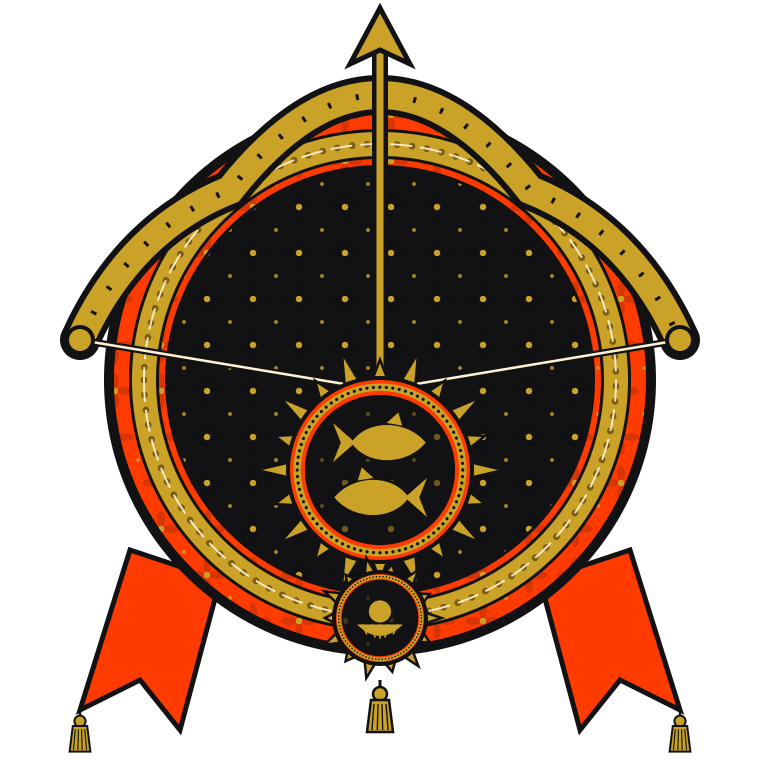
The Pandya signs in the sources are the fish: on the earliest coins it is 'the well-known Pandyans badge'[19], and the Velvikudi plates give a pair of fish as the emblem[34].
Every clan has every accessory, royal objects included. Each one says how it is known: Documented This clan's own object is recorded. · Regional tradition Recorded for the region or for peoples like this one, not for this clan. · Design Made for this project, with no historical claim. · Under research To be found for this clan from sources. Legends and titles are written in the clan's own script.
1. Seals and coins
| Accessory | For this clan | Basis |
|---|---|---|
| B1 Rajamudra · house seal Round seal with the clan emblem and a short legend in the clan's script | Not yet designed for this clan | Design |
| B2 Anguliya-mudra · signet ring Personal seal ring of the head of the house | Not yet designed for this clan | Design |
| B3 Chhapa · house stamp Ink or block stamp for letters, goods and cloth | Not yet designed for this clan | Design |
| B4 Tamrapatra · charter plate Copper-plate grant on a ring, closed with the house seal | Velvikudi copper plates: ten plates (c. 27.5 × 8 cm) on a copper ring. The article says there is no seal | Documented |
| B5 Shreni-mudra · guild or trade seal Seal for the clan's trade, craft or caravan | Not yet designed for this clan | Design |
| C1 Clan coin Emblem or deity on one side, a legend in the clan's script | Earliest rectangular copper coins: an elephant on one side, a stylised fish on the other. Later: one or two fish with the Pandya bull. Early coins also show the Nandi bull and a chakram symbol; other motifs include a boar, a Garuda and a pair of feet | Documented |
| C2 Coin die The die that strikes the coin | Die-struck rectangular copper coins | Documented |
2. Living symbols
| Accessory | For this clan | Basis |
|---|---|---|
| I1 Totem trio The tree, bird and animal the clan protects | Not yet found as a totem trio. The fish is the clan's emblem (see Kit). Tree and bird: under research | Under research |
| I2 Kaval-maram · guardian tree The tree that stands at the clan's seat | Not yet found for this clan | Under research |
3. Stone and gate
| Accessory | For this clan | Basis |
|---|---|---|
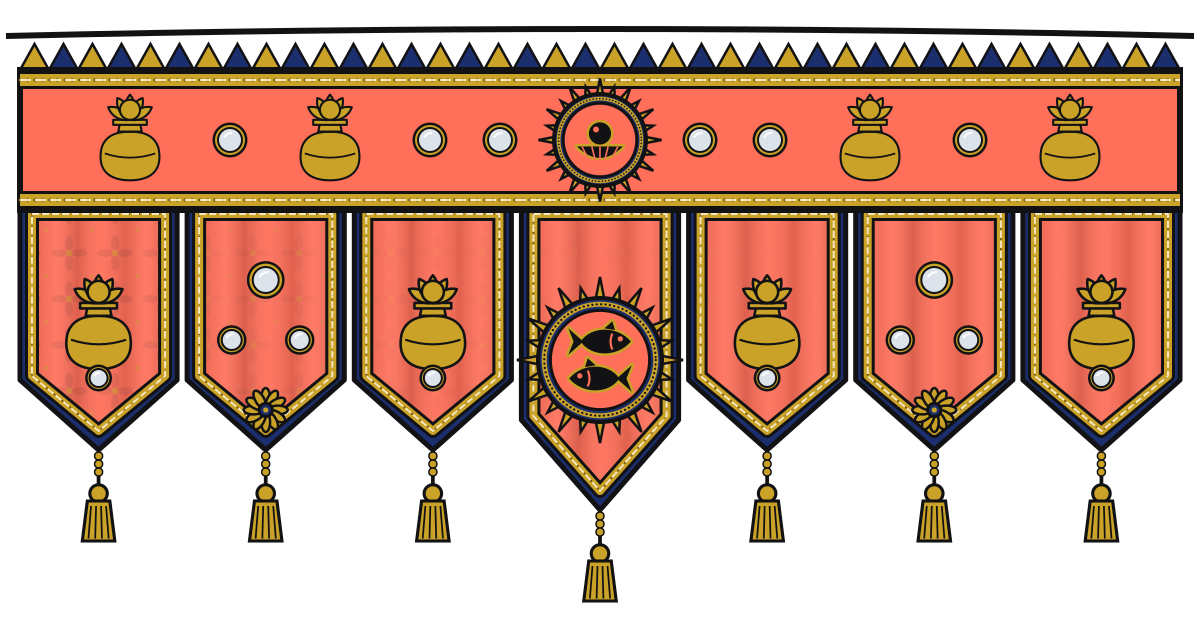
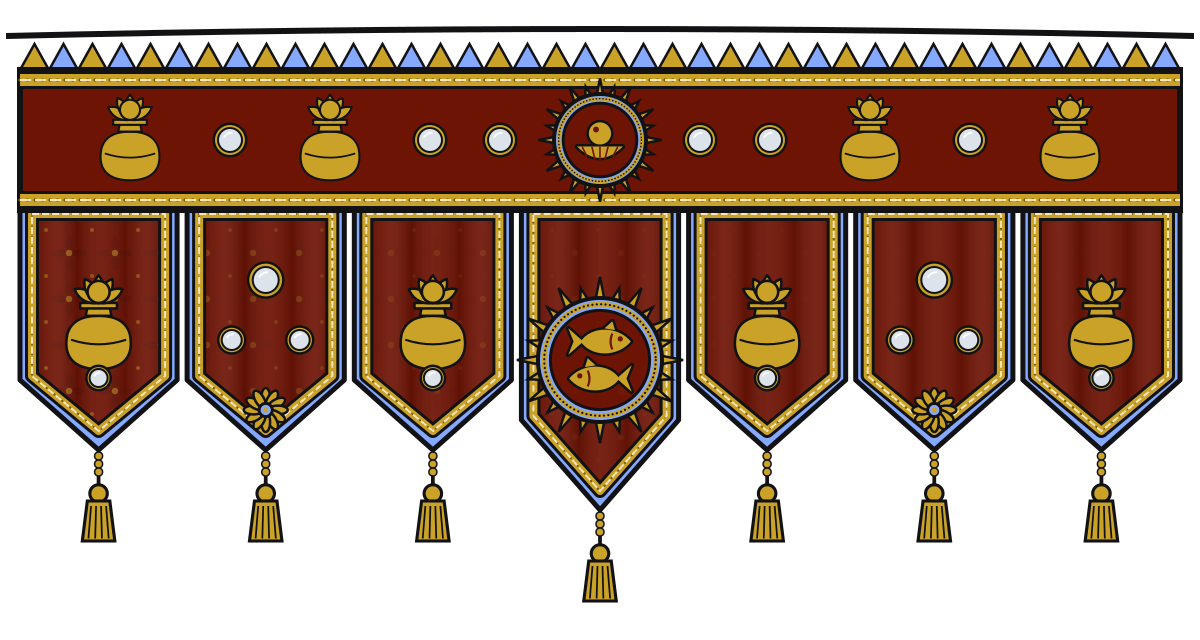
| G1 Torana · gateway The built gate of the seat; the cloth Toran hangs in it | Gopuram: the tiered gateway towers that the later Pandyas made the main feature of the Tamil temple, very large and elaborately decorated | Regional tradition |
| G2 Viragallu · hero stone Carved panel stone for a member who died defending the clan | Hero stones (natukal), raised after cremation in the Sangam-age poems | Regional tradition |
| G3 Kula-shila · clan stones Standing and table stones that remember the ancestors | Not yet designed for this clan | Design |
| G4 Jayastambha · victory pillar A pillar raised for a victory | Not yet designed for this clan | Design |
| G5 Sima-shila · boundary stone Marks the clan's land, with a line in the native script | Not yet designed for this clan | Design |
4. Sounds
| Accessory | For this clan | Basis |
|---|---|---|
| D1 Pancha-mahashabda · five great sounds The right to five instruments | Not yet designed for this clan | Design |
| D2 Shankha · clan conch The clan's own named war conch | Not yet designed for this clan | Design |
| D3 Murasu · house drums Three drums: war, charity and justice | Not yet designed for this clan | Design |
5. Kit: colours, metals and emblems
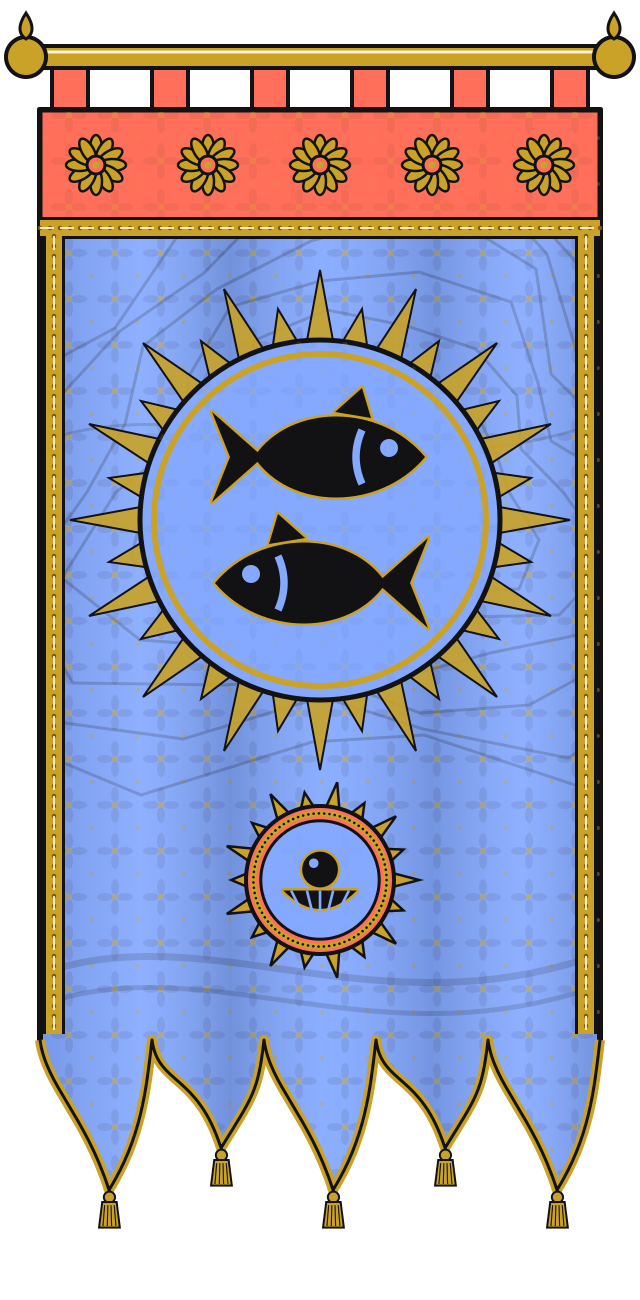
The Atlas records a fish (kayal) as the Pandya banner in Sangam literature. The Velvikudi plates give a pair of fish as the emblem, introduced by Pururavas[34]. The flag is a Vaijayanti, the imperial standard.
| Part of the kit | This clan |
|---|---|
| Field | Intense Electric Blue #84A9FF |
| Accent | Warm Red-Orange #FF6F59 |
| Emblem colour | Charcoal Black #121214 |
| Zari metal | Gold |
| Main emblem | A pair of fish |
| Second image | A pearl in an open oyster |
| Night and day | Every visual accessory has two versions: by night the emblem on the dark field, by day the clan's field colour on cloth woven from its metal. |
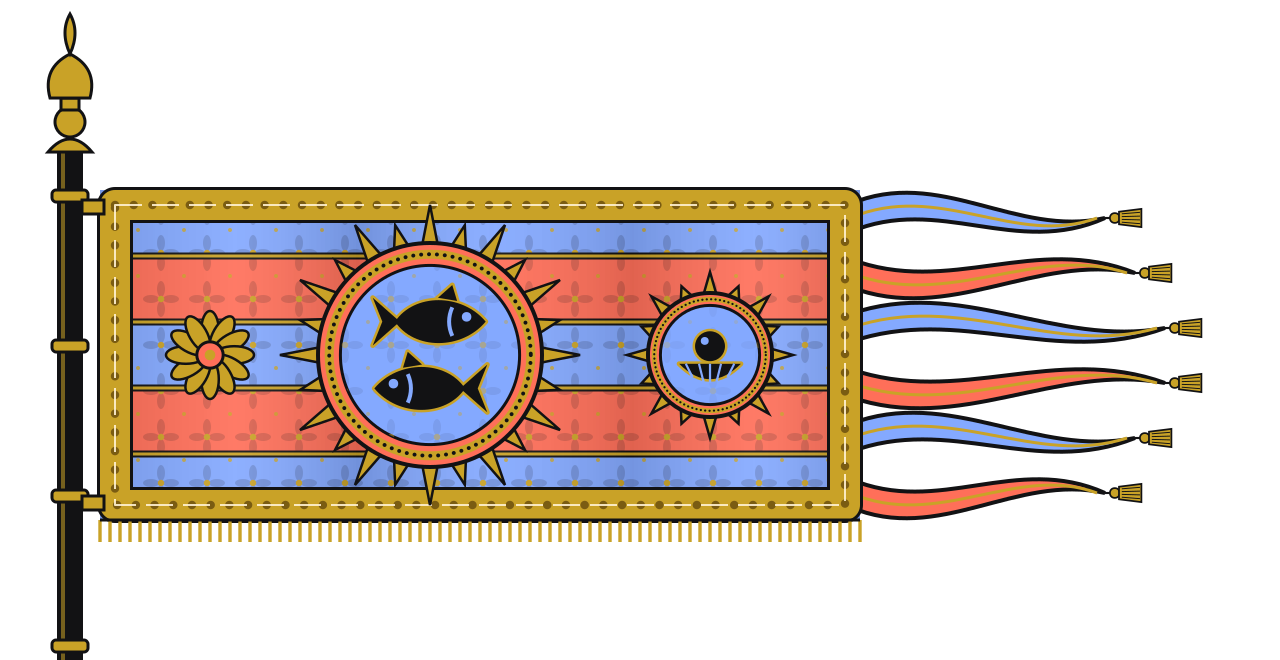
6. Flags
Every clan has every flag type; the type says the occasion and the colours say the clan. The outlined card is the flag the Atlas assigns.
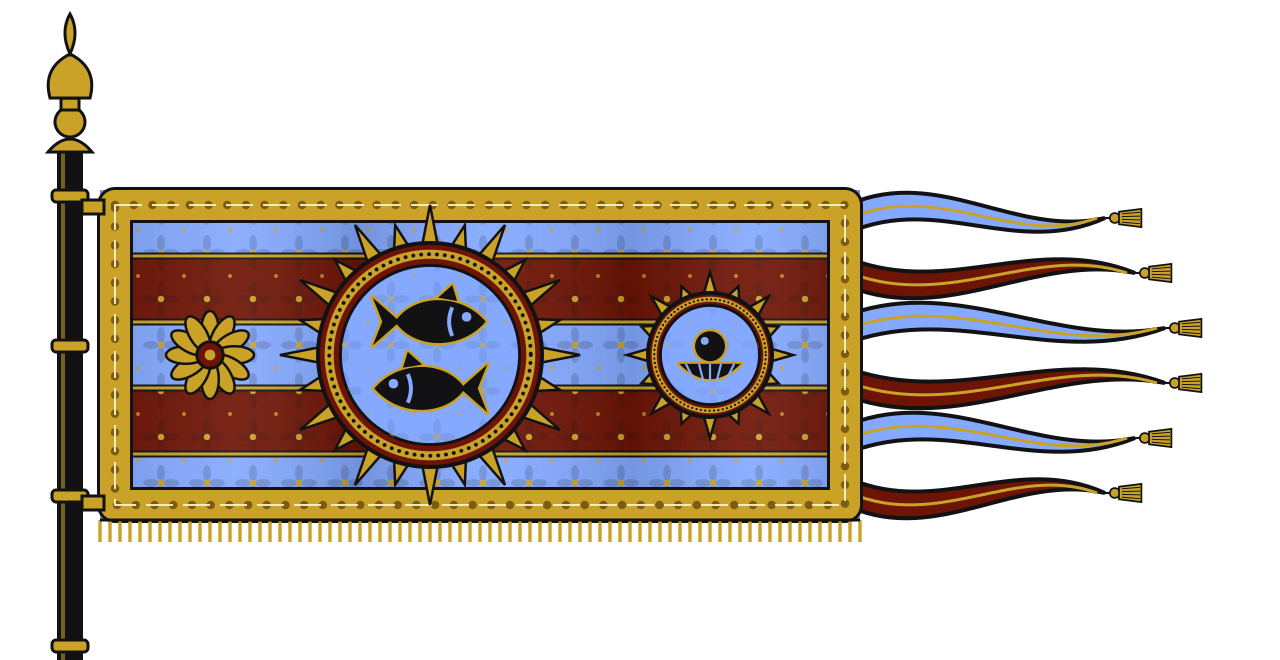
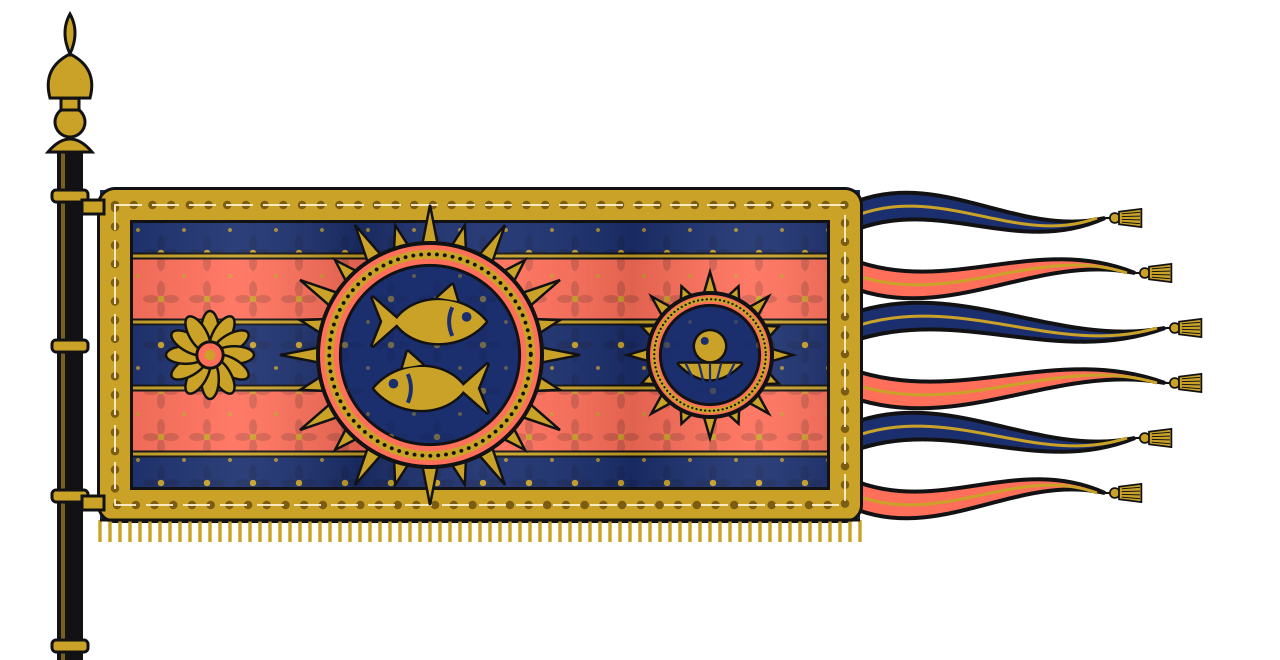
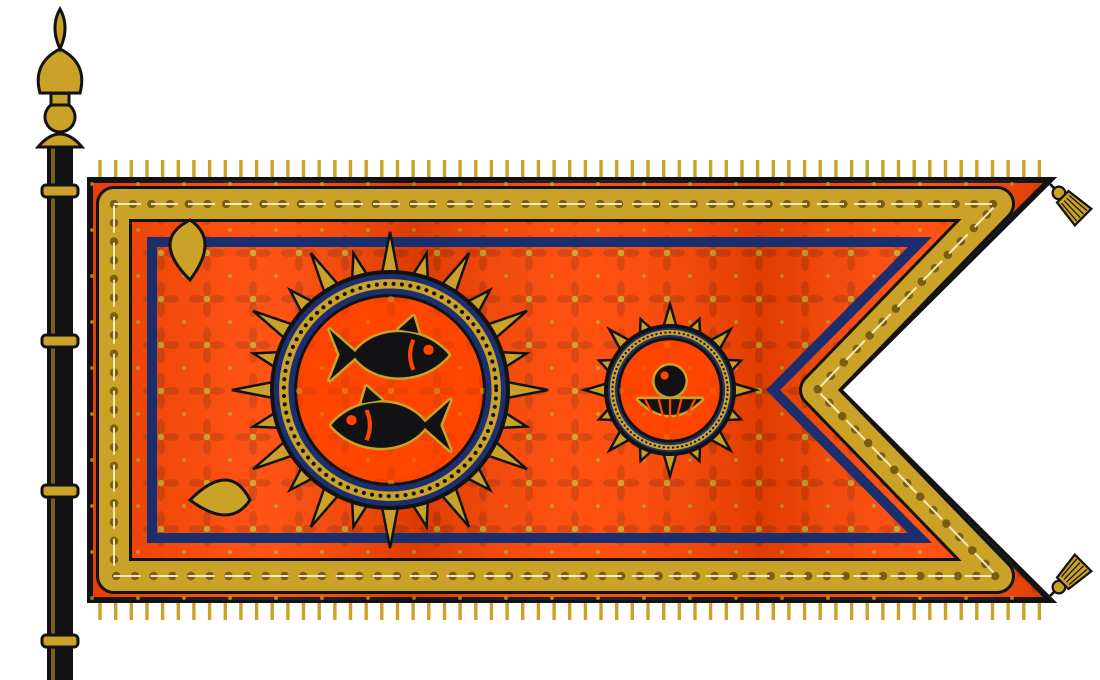
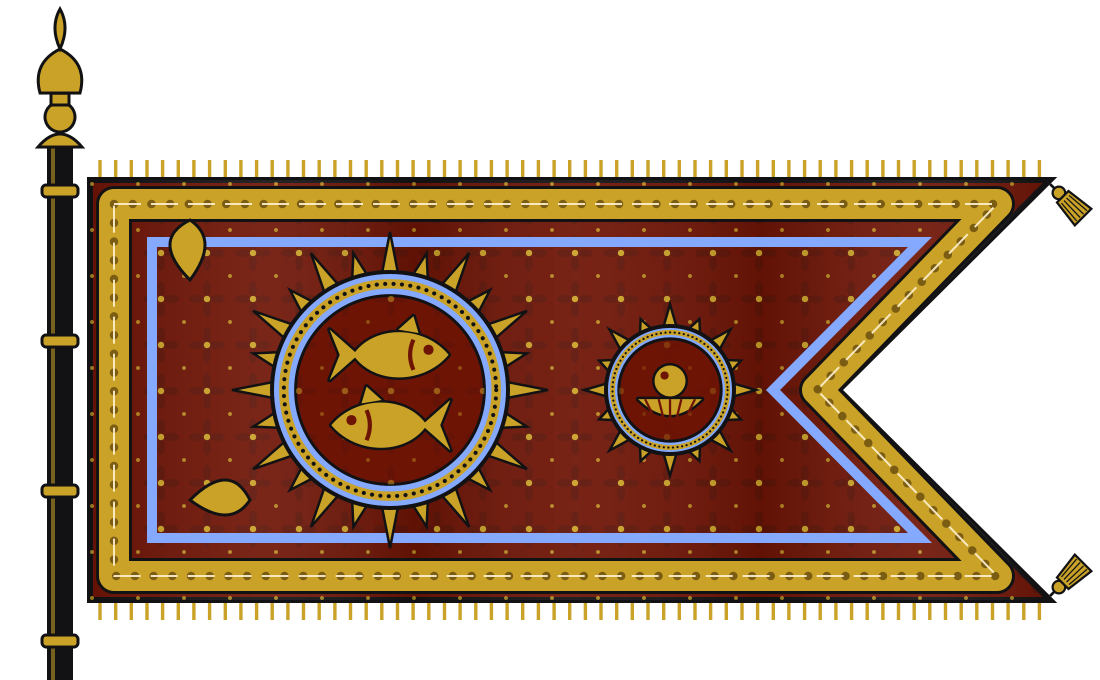
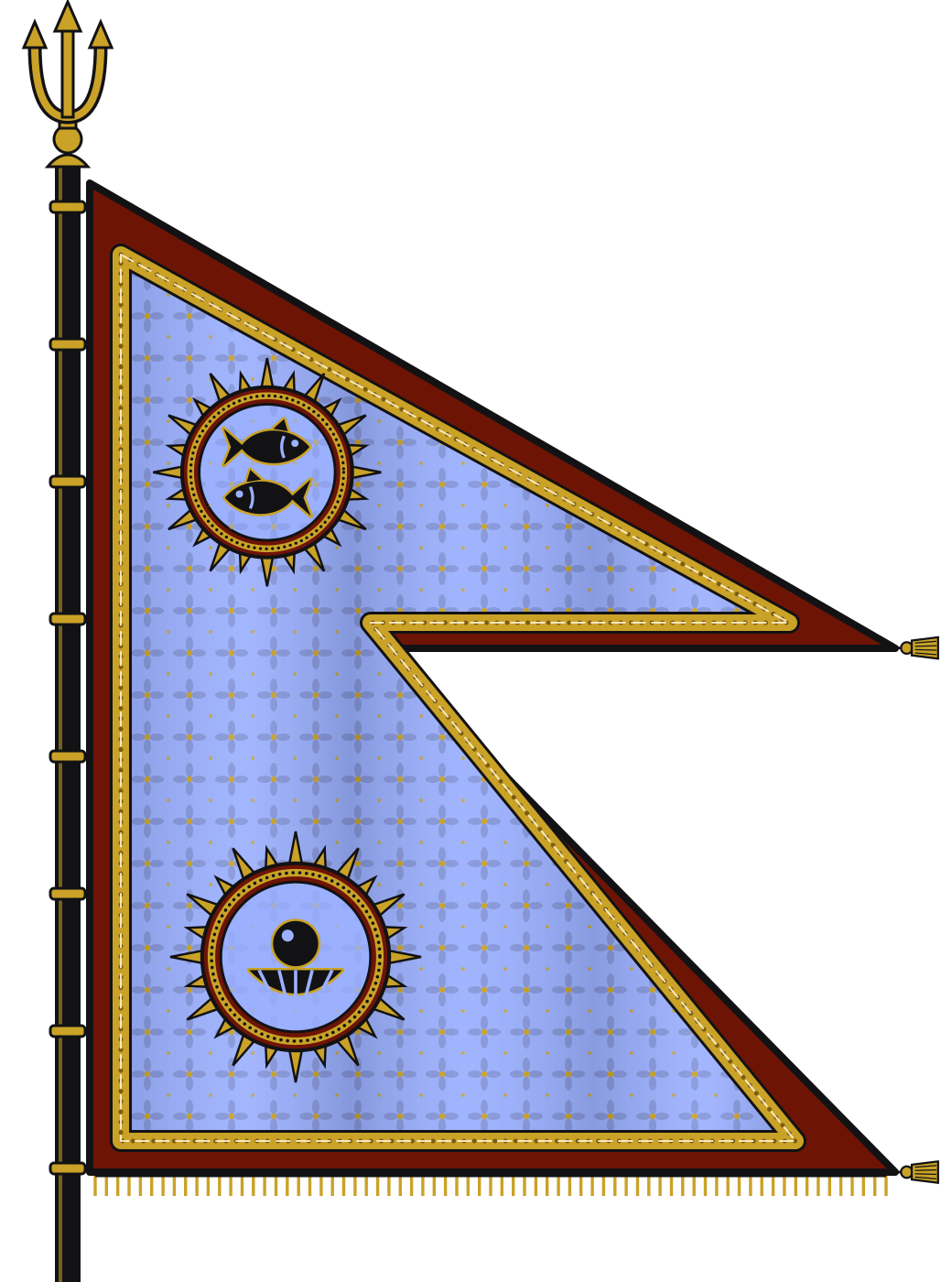
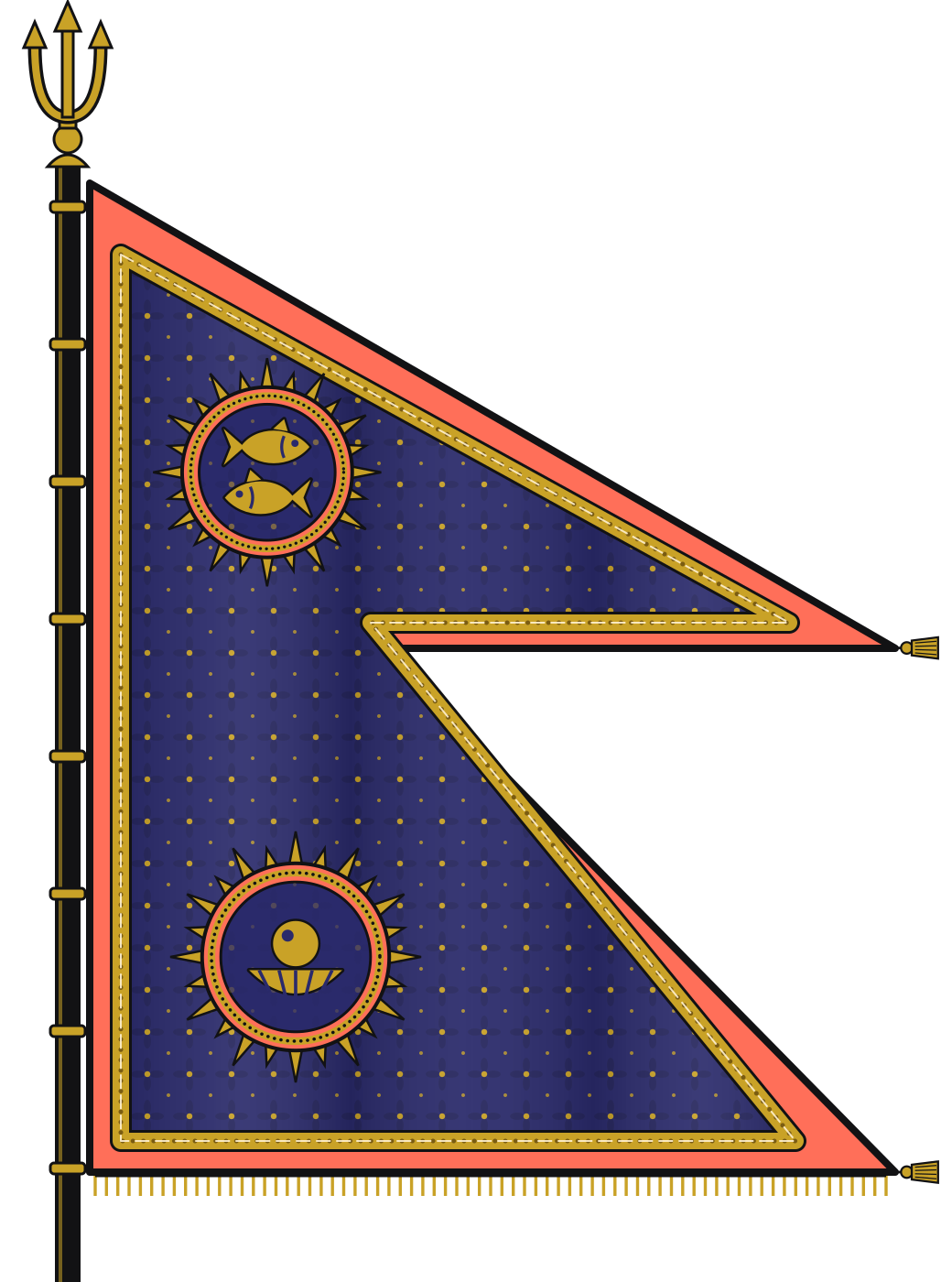


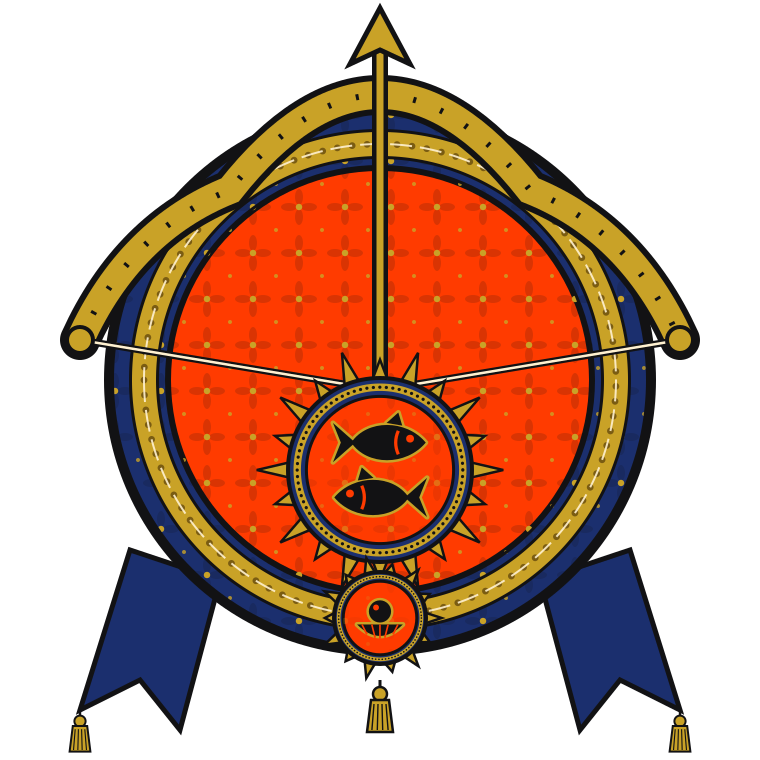
Historic banner
The Pandya flag bore a fish (kayal) according to Sangam literature
New flag types
| Accessory | For this clan | Basis |
|---|---|---|
| A9 Pota-dhvaja · ship and trade flag For ships, caravans and markets | Not yet designed for this clan | Design |
| A10 Utsava-patāka · festival flag Light, bright flag for fairs and festivals | Not yet designed for this clan | Design |
| A11 Shoka-dhvaja · mourning flag White cloth with the emblem outline in the clan's metal | Not yet designed for this clan | Design |
7. Regalia
| Accessory | For this clan | Basis |
|---|---|---|
| E1 Chhatra · house parasol The ceremonial umbrella | Not yet designed for this clan | Design |
| E2 Chamara · fly-whisks The pair of whisks beside the head of the house | Not yet designed for this clan | Design |
| E3 Danda · staff of office Staff or scepter | Not yet designed for this clan | Design |
| E4 Simhasana · seat The seat of the house, covered in clan cloth | Not yet designed for this clan | Design |
| E5 Khetaka · shield A round shield; the Changi and Dhanush are its flag forms | Not yet designed for this clan | Regional tradition |
| E6 Kula-ayudha · clan weapon The weapon the clan honours | A bow, stamped with a tiger and a fish on Mount Meru by Sadaiyan | Documented |
8. Worn
| Accessory | For this clan | Basis |
|---|---|---|
| F1 Kula-vastra · clan cloth The clan's woven pattern in its kit colours | Not yet designed for this clan | Design |
| F2 Kirti-vastra · honour cloth A cloth earned for a deed, not inherited | Not yet designed for this clan | Design |
| F3 Kula-mala · garland flower The flower or leaf the clan wears as a garland | Not yet found for this clan | Under research |
| F4 Chinha · house pin A metal badge with the pin emblem | Not yet designed for this clan | Design |
9. Records
| Accessory | For this clan | Basis |
|---|---|---|
| H1 Clan words A traditional line in the native script | கூடல் · “Koodal, 'gathering': the Tamil name of Madurai, the Pandya capital, which the Wikipedia article on the legendary Tamil Sangams gives as the older word for the Sangam assembly” Not a Pandya motto; the capital's old name, from the Wikipedia article on the legendary Tamil Sangams[6] | Design |
| H2 Biruda · titles The house's title or titles | Titles listed for Sadaiyan (Ko Chadaiyan): Tenna-Vanavan, Sembiyan, Solan, Madura-Karunatakan; for Parantaka Nedunjadaiyan: Pandita-vatsala. Native-script forms are not in the extract | Documented |
| H3 Prashasti · praise genealogy The lineage as written at the head of a grant | The praise genealogy of the Velvikudi grant: in Sanskrit from Budha and Pururavas, and in Tamil from Kadungon onward. The Pandya article says the dynasty claimed descent from the Chandravamsha (Lunar Race), with Pururavas and Nahusha as ancestors | Documented |
| H4 Vahi · clan register The book of the clan's births, marriages and deaths | Not yet found for this clan | Under research |
| H5 Rana-ghosha · war cry The clan's cry in battle or celebration | Not yet found for this clan | Under research |
10. VishwaVit · knower of the world
Game values are design choices for this project, not historical claims.
References
- Megasthenes, Indica (preserved in Arrian, Indica 8) — Pandaia and its queen.
- Periplus of the Erythraean Sea — the pearl fisheries of the Pandya coast.
- Wikipedia, Sources of ancient Tamil history, read 2026-10-10 (codex team pilot), https://en.wikipedia.org/wiki/Sources_of_ancient_Tamil_history
- Ashoka, Rock Edict II — the Pandyas beyond the empire.
- Wikipedia, Pandya dynasty, read 2026-10-10, https://en.wikipedia.org/wiki/Pandya_dynasty
- Wikipedia, Legendary Tamil Sangams, read 2026-10-10, https://en.wikipedia.org/wiki/Legendary_Tamil_Sangams
- Wikipedia, Meenakshi Tirukalyanam, read 2026-10-10, https://en.wikipedia.org/wiki/Meenakshi_Tirukalyanam
- Meenakshi Temple, Madurai — the Meenakshi legend and the temple's history.
- Nakkirar, Tirumurukarruppatai — Thiruparankundram as the first abode of Murugan.
- Nalayira Divya Prabandham — hymns of Periyalvar, Andal and Nammalvar.
- Mangulam Tamil-Brahmi inscriptions — Mangulam.
- Thirupparankundram Rock-cut Cave and Inscription.
- Vettuvan Koil, Kalugumalai.
- Jatavarman Sundara Pandyan I — conquests, temple gilding and grants.
- Kasi Viswanathar Temple, Tenkasi — the later Pandyas.
- Purananuru and other Sangam anthologies — Pandya kings, Talaiyalanganam; poem 192 by Kaniyan Pungundranar.
- Ilango Adigal, Silappatikaram — Madurai and Kannagi.
- Velvikudi copper plates — Kadungon's restoration; Sanskrit in Grantha and Tamil in Vatteluttu.
- Wikipedia, Pandya coinage, read 2026-10-10, https://en.wikipedia.org/wiki/Pandya_coinage
- Maduraikkanci, Pattuppattu — Maturaikkanci.
- Nakkirar, Nedunalvadai, Pattuppattu — Netunalvatai.
- Tiruvalluvar, Tirukkural — Kural.
- Iraiyanar Akapporul and its commentary — the three Sangams and the Pandikkovai verses; Iraiyanar Akapporul.
- Manikkavacakar — minister of a Pandya king; the Tiruvasagam.
- Wikipedia, Purananuru, read 2026-10-10, https://en.wikipedia.org/wiki/Purananuru
- Pandyan art and architecture — rock-cut shrines, Kunnakudi dvarapalas, Nellaiappar musical pillars, Kammalar artisans.
- Industry in ancient Tamil country — Madurai cottons and silks, muslins likened to a cobra's slough, Korkai pearls.
- Madurai Aruvai Vanigan Ilavettanar — Sangam poet and cloth merchant of Madurai.
- Madurai Sungudi — tie-dyed cotton of the Saurashtrian weavers under Nayak patronage; GI tag 2005.
- Marco Polo, The Travels, Book 3, ch. 17 (Yule's translation) — the king of Maabar's dress: a fine loincloth, a jewelled necklace and a silk cord of 104 pearls.
- Pandya coinage — square copper coins with elephant and fish; later fish and bull.
- Wikipedia, Chola dynasty, read 2026-10-10, https://en.wikipedia.org/wiki/Chola_dynasty
- Wikipedia, Velvikudi inscription, read 2026-10-10, https://en.wikipedia.org/wiki/Velvikudi_inscription
- Marco Polo, The Travels — the Pandya coast and Kayal.
- Wikipedia, Chola Nadu, read 2026-10-10, https://en.wikipedia.org/wiki/Chola_Nadu
- Kharavela (Wikipedia, read 2026-10-08) — the Hathigumpha inscription year by year, citing K. P. Jayaswal, R. D. Banerji, D. C. Sircar, N. K. Sahu and S. Chattopadhyaya.
- Wikipedia, Maravar, read 2026-10-10, https://en.wikipedia.org/wiki/Maravar
- Wikipedia, Kallar (caste), read 2026-10-10, https://en.wikipedia.org/wiki/Kallar_(caste)