The Pahlavas are the people the Sanskrit texts call Pahlava, and modern historians call their kingdom the Indo-Parthian kingdom; its founder, Gondophares I, had declared independence from the Parthian Empire while governor of Drangiana[1][2][3]. He took Taxila, the probable capital, c. 20 BCE, and by the Wikipedia account the Kabul valley, the Punjab and Sindh from the Indo-Scythian king Azes; he ruled c. 19–46 CE[4][3][2]. The kingdom is known mainly from its coins, and after his death it broke up, and from the mid-1st century CE the Kushans took the north of India from it[5][2][6]. A Christian text of the third century, the Acts of Thomas, names a king Gundaphorus who has the Apostle Thomas build him a palace, a legend that the sources do not confirm as history[7][3].
01Faith and deities
The Atlas gives no KulDevi for this clan (KulDevi basis: Research), and no deity of the Pahlavas is recorded. Shiva appears on coins of Gondophares I, which is a coin type, not a clan deity[2].
No KulDevi has been found for this clan yet; it is on the research list.
| Deity or tradition | Place in the clan's life | Evidence |
|---|---|---|
| Shiva | Shown on the coins of Gondophares I | [2] |
| Nike | Victory goddess crowning the king on the coin reverses | [5] |
| Zeus and Athena | Zeus Nikephorus on some coins; Zeus or Athena on Gandhara bronzes; Athena Alkidemos on Jammu coins | [5] |
| Zoroastrianism (assumed) | The faith of the rulers is listed in the Wikipedia infobox. It is an assumption, not documented | [3][2] |
| Buddhism (one claim) | Gondophares is credited with patronising Buddhist establishments in one Wikipedia note; no royal support is recorded in the sources | [3][2] |
| St Thomas (legend) | The Acts of Thomas links the king with the Apostle | [7] |
02Temples
No temple is recorded as built by the Pahlavas. The sources give one interpretation and one weak claim, both hedged below.
Built by the clan
| Temple | Deity | Built by | When | Where |
|---|---|---|---|---|
| Jandial temple, Taxila | Not named | Not documented; read as a Zoroastrian fire temple (an interpretation) | Not dated in the sources | Taxila[2] |
Given patronage or grants by the clan
| Temple | Deity | What the clan gave | When | Where |
|---|---|---|---|---|
| Takht-i-Bahi monastery | Buddhist | One Wikipedia note credits Gondophares with building it. The codex does not rely on this; it is the page's own claim | Not dated in the sources | Mardan[3][2] |
03Languages and scripts
| Language or script | Kind | Under the clan | Evidence |
|---|---|---|---|
| Parthian lost | Language of the Arsacid and Indo-Parthian kingdoms | Pahlavi legends on the gold coins of Abdagases II; the infobox lists Parthian | [9][5][2] |
| Greek | Coin legends and titles | Gondophares' coin legends and the title autokrator | [5][3] |
| Kharoshthi (Gandhari Prakrit) lost | Script of the coin legends on the Indian side | Gudaphara on the coins of Gondophares; the words gada and gadana are undeciphered | [3][5] |
| Sanskrit | Puranic language | The people's name in the Puranas; listed for the kingdom in the infobox | [8][2] |
| Prakrit (Brahmi) | Written in Brahmi | Listed for the kingdom in the infobox | [2] |
| Aramaic lost | The source of the Pahlavi writing | Listed for the kingdom in the infobox; Pahlavi writing derives from Aramaic | [2][9] |
04Books and literature
The sources record no book written by the Pahlavas themselves. The works below name the Pahlavas or their kings.
Written in the clan's lands during its era
| Work | Author | Kind | When | Link to the clan |
|---|---|---|---|---|
| Manusmriti (X.43–44) | Traditional | Law text | Not dated here | Pahlavas named as former Kshatriyas[1] |
| Mahabharata | Traditional | Epic | Not dated here | Nakula's victory; Pahlava kings at the Rajasuya[1] |
| Ramayana | Traditional | Epic | Not dated here | Vasishtha's Pahlava allies (Balakanda)[1] |
| Brihat Samhita | Varahamihira | Astronomy and omens | 6th century | Pahlava as a south-western kingdom[1][8] |
| Mudrarakshasa | Visakhadutta | Sanskrit drama | Not dated here | Pahlavas in Chandragupta's allied army[1] |
| Kavyamimamsa | Rajashekhara | Poetics | 10th century | Pahlava named[1] |
| Acts of Thomas | Anonymous | Apocryphal acts | Third century | King Gundaphorus[7][3] |
| Takht-i-Bahi inscriptions | Not named | Kharoshthi royal inscriptions | Regnal years 26 and 103 | Dates from the kingdom article; the year-103 text is a catalogue title only[2][10] |
Given patronage by the clan
Not recorded.
05Thinkers and scholars
| Name | Field | Era | Contribution |
|---|---|---|---|
| Suvisakha (सुविसाख) | Minister; repaired the dam | c. 150 CE (Saka year 72) | Son of Kulaipa; restored the Sudarshana dam under Rudradaman[11][12][13] |
No Pahlava scholar or thinker is named in the sources. Modern scholars of the Indo-Parthians are cited in the references.
06Art and architecture
What survives of the Indo-Parthian kingdom is mostly coins and some stone. Painting and textiles are not sourced for the Pahlavas.
Painting and wall art
| Art form | What it is | Era | Evidence |
|---|---|---|---|
| Body colour in the Natyashastra | Pahlava shown with reddish-yellow (gaura) colour in theatre body painting (ch. 23) | Sanskrit treatise, not dated here | [8] |
Sculpture and temple art
| Art form | What it is | Era | Evidence |
|---|---|---|---|
| Stone palette, Naprstek Museum, Prague | A seated king with attendants serving wine; Greek and Persian influence, with Parthian frontality | Indo-Parthian | [2] |
| Foreign heads at Mathura, Sarnath and Patna | Cited as West Asian influence (S. P. Gupta, 1980); not identified as Pahlava portraits in the sources | 2nd century BCE (Mathura head) | [1] |
Temple and building architecture
| Art form | What it is | Era | Evidence |
|---|---|---|---|
| Sirkap, Taxila | City with Indo-Parthian layers, excavated by Marshall | Indo-Parthian layers | [2] |
Weaving and textiles
Not recorded.
Clothing and jewellery
| Art form | What it is | Era | Evidence |
|---|---|---|---|
| Crossover jackets, baggy trousers, headbands | Dress of the Indo-Parthian figures; men wore bushy hair with headbands from the 1st century CE (Willcox) | 1st century CE on | [2] |
Coins, pottery and crafts
Not recorded.
07History
Before the kingdom: Sanskrit and Puranic sources
The Manusmriti (X.43–44) says the Pahlavas were once Kshatriyas who fell to Mlechcha status through neglect of the Kshatriya codes[1][8].
Puranic accounts have king Sagara defeat the Pahlavas, who were allied with the Haihaya Kshatriyas of the Yadava line[1][8]. The Mahabharata has Nakula defeat the Pahlavas on his western expedition, and Pahlava kings attend Yudhishtra's Rajasuya[1].
Per Patrick Carnegy (1868), the 4th-century BCE Vartika of Katyayana mentions the Sakah-Parthavah, which suggests early awareness of Saka-Parthians, probably through trade[1].
Gondophares and the first kingdom (c. 20 BCE to 46 CE)
Gondophares I declared independence from the Parthian Empire while governor of Drangiana (Sakastan) and founded the kingdom. Sources date the start to 19 or 20 CE, and give his reign as c. 19–46 CE[2][3].
Under Robert Senior's chronology his conquests of former Indo-Scythian and Indo-Greek lands came c. 20–10 BCE, and the Wikipedia article dates his taking of Taxila to c. 20 BCE[2][4]. The Gandhara article puts the end of Greek rule in the north-west by the Indo-Parthians at c. 50 BCE, a date that does not match Gondophares' conquests and is left open[14].
Coins of Gondophares show a diadem and portrait, with Nike crowning the king on the reverse. The Greek title autokrator is on his coins, and the name Gondophares served as a dynastic title rather than a personal name[5][3].
Successors and the Kushan takeover (mid-1st century CE)
After Gondophares I died the realm fragmented under Sarpedones, Abdagases, Orthagnes, Ubouzanes and Sases[2]. Sases was the fourth king to use the Gondophares title[3].
The Bharatkosh article says that Kujula Kadphises, who unified five Tukhar principalities, took Kabul and Kandahar from the Indo-Greeks and defeated the Pahlavas[6]. The Wikipedia article dates the Kushan takeover of northern India to the mid-1st century CE, and Iranica puts the end of Indo-Parthian rule in northern Arachosia at about 50 CE[2][5].
Philostratus has Apollonius of Tyana visit Taxila in the 40s or c. 50 CE (sources differ), when the king Phraotes reigned. One account identifies Phraotes with Gondophares[3][4][2].
The Christian legend (Acts of Thomas)
The Acts of Thomas, a third-century apocryphal text in M. R. James's 1924 edition, has the Indian king Gundaphorus send the merchant Abbanes to buy a carpenter, and Thomas builds him a palace[7][3].
James calls Gundaphorus a historical personage who reigned over part of India in the first century after Christ. The Acts' ruler is linked to the coin king by name, a link that Reinaud and others have drawn[7][3].
Indian records of the 2nd century CE
The Junagadh rock inscription of Rudradaman I, dated Saka year 72 (c. 150–151 CE), names a minister, Suvisakha (सुविसाख), a Pahlava and son of Kulaipa, who restored the Sudarshana dam[11][12][13]. The inscription says he was appointed over Anarta and Surashtra[11].
The Nashik prashasti of Gautamiputra Satakarni claims that he defeated the Shakas, Yavanas and Pahlavas (in Brahmi, Saka-Yavana-Palhava) and uprooted the Kshaharata family[15]. This is the claim of the prashasti itself, not an independent record of a war.
The end of the kingdom
The Wikipedia infobox dates the end of the kingdom to 226 CE, with Farn-Sasan as its last ruler (c. 210–226). The article's text says Turan and Sakastan submitted to the Sasanian Ardeshir I c. 230 CE[2]. The Paratarajas fell into the Sasanian orbit c. 262 CE[2].
08Journey and migrations
Gondophares was governor of Drangiana before he founded a kingdom from the Kabul valley to Sindh, on lands that the Sakas and Indo-Greeks had held[2][3][16].
| When | From | To | Why | Evidence |
|---|---|---|---|---|
| c. 20 BCE | Drangiana (Sakastan) | Taxila | Gondophares takes the north-west from the Indo-Scythians | [4][3] |
| c. 19–46 CE | Parthian governorship | Independent kingdom | Gondophares declares independence and rules from Taxila (the probable capital) | [2][3] |
| Mid-1st century CE | Kabul valley and western Punjab | Kushan rule | Kujula Kadphises defeats the Pahlavas; the Kushans take the north of India | [6][2] |
| c. 50 CE | Northern Arachosia | Kushan rule | Kushan power ends Indo-Parthian rule there | [5] |
| c. 230 CE | Turan and Sakastan | Sasanian Empire | Submit to Ardeshir I | [2] |
09Seats and lands
| Place | Role | Where today |
|---|---|---|
| Taxila | Probable capital; the Gondophares kings' seat | Rawalpindi District, Punjab, Pakistan[4] |
| Drangiana (Sakastan) | Gondophares' base as governor; later part of the Sasanian submission | Seistan[3][2] |
| Kabul valley, Punjab and Sindh | Taken from the Indo-Scythian king Azes by Gondophares | Afghanistan and Pakistan[3] |
| Arachosia | Coins of Orthagnes and Abdagases; Kushan rule from c. 50 CE | Afghanistan[5] |
| Takht-i-Bahi | Buddhist monastery and inscriptions; the link to Gondophares is hedged (see Temples) | Mardan, Pakistan[2] |
| Bajaur | Seat of the Apracaraja family of local princes | Bajaur, Pakistan[5] |
10Notable figures
| Name | Role | Era | Known from |
|---|---|---|---|
| Gondophares I | Founder of the kingdom; 'King of Kings' and autokrator on coins | c. 19–46 CE | [2][3] |
| Phraotes | King of Taxila, Greek-educated; one account identifies him with Gondophares | c. 46 CE | Philostratus, via[2][3] |
| Orthagnes (Gondophares III Gudana) | Ruled Drangiana and Arachosia; in Arachosia put Gondophares' name before his own | c. 20–30 CE | [2][5] |
| Abdagases I | Nephew of Gondophares; minted in Gandhara, northern Arachosia and Jammu | 1st century CE | [5][3] |
| Sases (Gondophares IV) | Later king; coins with the Greek legend SASH and a tiara; linked to the Takht-i-Bahi inscription by Senior | Mid-1st century CE | [2][5] |
| Sarpedones | Early successor; ruled Kandahar, Jammu and Sindh | After Gondophares I | [5][2] |
| Gundaphorus legend | The king of the Acts of Thomas, who commissions Thomas to build him a palace | 1st century (legend) | [7] |
| An Shih Kao | Parthian prince who translated Buddhist texts in China; listed among the Parthians in China | 148–170 CE | [2] |
11Allies, rivals and marriages
| People | Relationship | When | |
|---|---|---|---|
| Shakas (Indo-Scythians) | Earlier rulers of the north-west; Gondophares took their lands, which Azes I had held | c. 80 BCE to late 1st century BCE | [16][3] |
| Yavanas (Indo-Greeks) | Earlier Greek rulers; the Indo-Parthians ended their rule (c. 50 BCE per the Gandhara article) | c. 185 BCE to 50 BCE | [14] |
| Kushanas | Kujula Kadphises defeated the Pahlavas; the Kushans took their northern Indian portion | Mid-1st century CE | [6] |
| Satavahanas (Gautamiputra Satakarni) | The Nashik prashasti claims victory over the Pahlavas; the claim is the prashasti's own | 1st–2nd century CE (dates disputed) | [15] |
| Western Satraps (Kshaharatas) | Nahapana is called Saka-Pahlava by some sources; his family was uprooted by Gautamiputra | c. 35–415 CE | [17][18] |
| Parthian Empire (Arsacids) | Parent kingdom from which Gondophares declared independence; Mithridates II had set satraps in Sakastan | 124–88 BCE onward | [2][3] |
| Apracaraja family | Local princes of Bajaur under Indo-Parthian power; Aspavarma, probably a 1st-century ruler, was a probable uncle of Sases | 1st century CE | [5][2] |
| Mauryas (Chandragupta) | A Pahlava contingent in the army Chandragupta gained with the Himalayan king Parvatka (Mudrarakshasa, Parishishtaparvan) | Chandragupta's time | [1] |
| Haihayas (Taljunga Kshatriyas) | Allies of the Pahlavas in Puranic accounts; Sagara defeated them with the Pahlavas | Puranic time | [1] |
| Panca-ganah (five hordes) | The Pahlavas grouped with Kambojas, Sakas, Yavanas and Paradas | Puranic time | [1] |
12Society and livelihood
The Indo-Parthian kingdom ruled through local princes; its framework was loose, and smaller dynasts recognised Gondophares to keep their positions[2].
Government and social order
| Institution or group | What it was | Evidence |
|---|---|---|
| Gondophares' dynastic title | The name was used as a title by the kings of the dynasty | [5][3] |
| Tamga mintmark | The dynasty's mark on its coins | [5] |
| Local princes (Apracarajas, Paratarajas) | Smaller dynasts; the Apracarajas ruled in Bajaur under Gondophares | [2] |
| Parthian satraps | Governed Sakastan after Mithridates II defeated the Sakas | [2] |
| Panca-ganah (five hordes) | A Puranic grouping of the Pahlavas, Kambojas, Sakas, Yavanas and Paradas | [1] |
| Uttarapatha | The northern division into which the Puranic lists place the Pahlavas | [1] |
Livelihood over time
Not recorded.
13Sub-clans and related clans
The Puranic and epic lists name the Pahlavas with the peoples below. The sources give no living sub-clan, gotra or division of the Pahlavas; the entries are the peoples named with them.
| Clan | Relation | Where | Size | In the Atlas | Evidence |
|---|---|---|---|---|---|
| House of Suren | Related people | Arsacid Iran | new clan candidate | [3] | |
| Apracarajas | Dynasty from this clan | Bajaur | same name as ANC-188: check | [5] | |
| Paratarajas | Dynasty from this clan | Baluchistan | same name as ANC-222: check | [2] | |
| Kshaharatas | Related people | Gujarat | ANC-172 | [2] | |
| Western Satraps | Related people | Western India (Ujjain, Bharuch) | ANC-185 | [18] | |
| Kushanas | Related people | Peshawar, Mathura | ANC-070 | [6] | |
| Shakas | Related people | Sakastan, Taxila, Mathura, Ujjain | ANC-119 | [16] | |
| Yavanas | Related people | Taxila, Sagala | ANC-154 | [14] | |
| Kambojas | Related people | ANC-046 | [1] | ||
| Paradas | Related people | ANC-097 | [1] | ||
| Bahlikas | Related people | ANC-138 | [1][16] | ||
| Gandharas | Related people | Taxila, Pushkalavati | ANC-035 | [1][14] | |
| Hunas | Related people | ANC-040 | [1][14] | ||
| Lampakas | Related people | ANC-071 | [1] | ||
| Tanganas | Related people | ANC-130 | [1] | ||
| Rishikas | Related people | ANC-111 | [1][16] | ||
| Khasas | Related people | ANC-053 | [1] | ||
| Kiratas | Related people | ANC-056 | [1] | ||
| Daradas | Related people | ANC-031 | [1] | ||
| Parasikas | Related people | same name as ANC-221: check | [1][16] | ||
| Parthians (Arsacid) | Related people | Iran, and China (translators) | same name as ANC-223: check | [2][9] | |
| Haihayas | Related people | same name as ANC-039: check | [1] | ||
| Turukshas | Related people | new clan candidate | [1] | ||
| Vokanas | Related people | new clan candidate | [1] | ||
| Chinas | Related people | same name as ANC-028: check | [1] | ||
| Angalaukikas | Related people | new clan candidate | [1] | ||
| Barbaras | Related people | same name as ANC-019: check | [1] | ||
| Sabaras | Related people | same name as ANC-283: check | [1] | ||
| Uttarakurus | Related people | same name as ANC-284: check | [1] | ||
| Dravidas | Related people | new clan candidate | [1] | ||
| Pulindas | Related people | same name as ANC-105: check | [1] | ||
| Simhalas | Related people | same name as ANC-125: check | [1] | ||
| Madhyadesis | Related people | new clan candidate | [1] |
Clans marked "new clan candidate" are not in the Atlas yet.
14Surnames
The sources name no present-day surname for this clan. The one name in the extracts that is used as a surname is An, the Chinese rendering of a Parthian name, carried by Parthian translators in China.
| Surname | Clan or sub-clan | Where | People with this surname | Also used by other communities |
|---|---|---|---|---|
| An | Parthian (Arsacid) translators in China | China | not yet counted | Not checked |
Counts are of everyone with the surname, from the cited source and year, not only members of this clan. A surname shared with other communities says nothing about any one person's origin.
15Songs and music
No song or music of the Pahlavas is sourced.
None recorded yet.
16Poems, lullabies and children's rhymes
No poem of the Pahlavas is sourced.
None recorded yet.
17Stories, legends and proverbs
Stories and legends
| Story | What happens | Told by | Evidence |
|---|---|---|---|
| The palace of Gundaphorus legend | The king's merchant buys Thomas as a carpenter; Thomas builds a palace, which the king's brother Gad is shown after his death; the king releases Thomas and asks to serve his God | Acts of Thomas (third century) | [7][3] |
| Sagara and the Pahlavas legend | King Sagara defeats the Pahlavas and sentences them to wear beards (Vishnu Purana) or moustaches (Brahmanda Purana) | Puranas | [8] |
| Nakula's western victory legend | Nakula defeats the Pahlavas on his western expedition | Mahabharata | [1] |
| Vasishtha's allies legend | Vasishtha's Pahlava allies fight Vishwamitra | Ramayana, Balakanda | [1] |
Proverbs and sayings
Not recorded.
18Festivals and fairs
Not recorded.
19Food, dress and games
Food
Not recorded.
Dress
Not recorded.
Games and martial arts
Not recorded.
Tags: living still practised · revived brought back after a break · lost known only from records · research reported but not yet confirmed from a source. Songs and poems under copyright are listed by title only; restricted or sacred material is noted without its content.
20Status today
The Indo-Parthian kingdom ended in the 3rd century CE[2]. No living Pahlava community, descent or surname is sourced for this clan, so no descendants are listed.
Recognised heritage
| What | Recognition | Evidence |
|---|---|---|
| Taxila, UNESCO World Heritage Site | UNESCO, 1980 (criteria iii and vi) | [4] |
| Takht-i-Bahi, UNESCO World Heritage Site | UNESCO; its link to Gondophares and Sases is hedged in the sources | [2] |
Not reviewed by any community: no living community is recorded for this clan.
21For children
The king at Taxila
Long ago, a king named Gondophares ruled from the city of Taxila, probably his capital, in the north-west of India. He came from the Parthian lands in the west, and he made himself an independent king. He took land from the Indo-Scythian kings, and his coins show his face. Old stories say he hired a builder named Thomas, who came to his court to build a palace. Today Taxila is a World Heritage Site, with old cities and stupas to see.
22Across the project
| Project | What carries this clan | Status |
|---|---|---|
| Atlas of the Janas | Pin at Taxila, the homeland in the Atlas (c. 20–100 CE) | To check |
| KulDevi and GrahDevi | No KulDevi in the Atlas (basis: Research); none sourced | Research |
| Planet naming | Not checked against the Tier registers | To check |
| Renaming and waters | The Sudarshana lake, repaired under a Pahlava minister, belongs to the Saraswati codex; no place name for this clan is sourced | — |
23Open questions
- The Takht-i-Bahi inscriptions: the text of the year-103 inscription (CKI 53 page is empty) and the year-26 record. Fetch the CARC Takht-i-Bahi essay and Epigraphia Indica vol. 18 p. 338.
- Gondophares' Takht-i-Bahi link and the monastery claim are hedged; find an independent source.
- The date gap: the Gandhara article's c. 50 BCE end of Greek rule against Gondophares' conquests of c. 20–10 BCE; and the kingdom's end (226 CE infobox against c. 230 CE in the text).
- The Zoroastrian faith of the rulers is an assumption. Find a source for it or drop it.
- A living community or surname claiming descent is not sourced. Check the Medlycott 'India and the Apostle Thomas' PDF and the rarebooksocietyofindia PDF for surnames.
- The 'horse archers' signature from the Atlas is a game idea, not a sourced clan weapon.
- Whether the Parthians in China (An Shih Kao and others) belong to this people or to the Parthian Empire.
24Astitva
अस्तित्व · being, existence: everything by which the clan is known
The coins of the Indo-Parthian kings are the clearest documented symbols of the kingdom: the diadem, Nike, a tamga mintmark and the dynastic title[5][3].
Every clan has every accessory, royal objects included. Each one says how it is known: Documented This clan's own object is recorded. · Regional tradition Recorded for the region or for peoples like this one, not for this clan. · Design Made for this project, with no historical claim. · Under research To be found for this clan from sources. Legends and titles are written in the clan's own script.
1. Seals and coins
| Accessory | For this clan | Basis |
|---|---|---|
| B1 Rajamudra · house seal Round seal with the clan emblem and a short legend in the clan's script | Not yet designed for this clan | Design |
| B2 Anguliya-mudra · signet ring Personal seal ring of the head of the house | Not yet designed for this clan | Design |
| B3 Chhapa · house stamp Ink or block stamp for letters, goods and cloth | Not yet designed for this clan | Design |
| B4 Tamrapatra · charter plate Copper-plate grant on a ring, closed with the house seal | Not yet designed for this clan | Design |
| B5 Shreni-mudra · guild or trade seal Seal for the clan's trade, craft or caravan | Not yet designed for this clan | Design |
| C1 Clan coin Emblem or deity on one side, a legend in the clan's script | Silver and copper coins of Gondophares I: the king's diadem and portrait, with Nike crowning him on the reverse, and the dynasty's tamga mintmark 𐨒𐨂𐨡𐨥𐨪 Gudaphara · “Gondophares in Kharoshthi (a dynastic title)” | Documented |
| C2 Coin die The die that strikes the coin | Not yet designed for this clan | Design |
2. Living symbols
| Accessory | For this clan | Basis |
|---|---|---|
| I1 Totem trio The tree, bird and animal the clan protects | Not yet found for this clan | Under research |
| I2 Kaval-maram · guardian tree The tree that stands at the clan's seat | Not yet found for this clan | Under research |
3. Stone and gate
| Accessory | For this clan | Basis |
|---|---|---|
| G1 Torana · gateway The built gate of the seat; the cloth Toran hangs in it | Not yet designed for this clan | Regional tradition |
| G2 Viragallu · hero stone Carved panel stone for a member who died defending the clan | Not yet designed for this clan | Regional tradition |
| G3 Kula-shila · clan stones Standing and table stones that remember the ancestors | Not yet designed for this clan | Design |
| G4 Jayastambha · victory pillar A pillar raised for a victory | Not yet designed for this clan | Design |
| G5 Sima-shila · boundary stone Marks the clan's land, with a line in the native script | Not yet designed for this clan | Design |
4. Sounds
| Accessory | For this clan | Basis |
|---|---|---|
| D1 Pancha-mahashabda · five great sounds The right to five instruments | Not yet designed for this clan | Design |
| D2 Shankha · clan conch The clan's own named war conch | Not yet designed for this clan | Design |
| D3 Murasu · house drums Three drums: war, charity and justice | Not yet designed for this clan | Design |
5. Kit: colours, metals and emblems
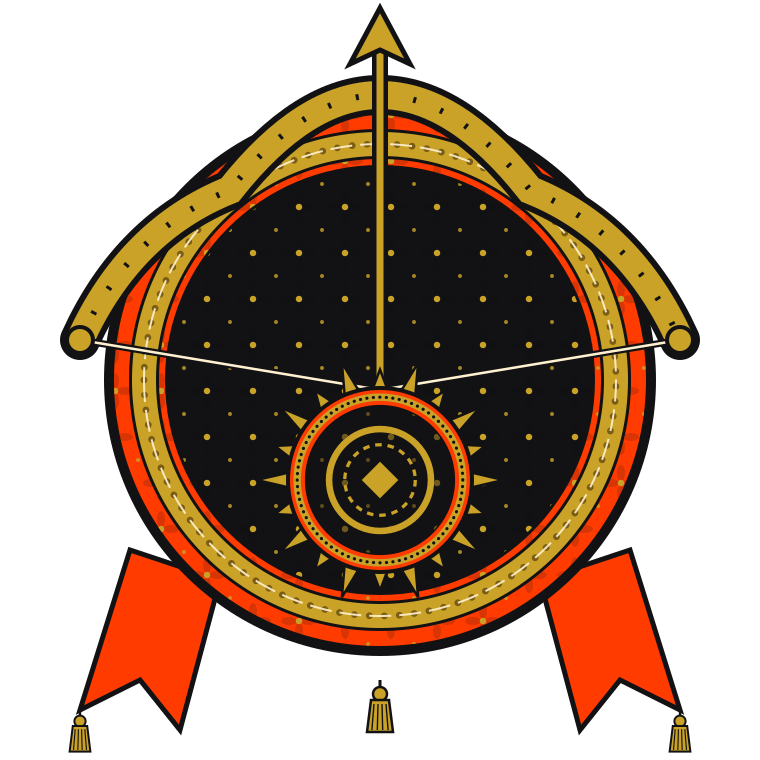
The coins give the clan's most documented symbols: a diadem, Nike crowning the king and a tamga mintmark of the dynasty[5]. No clan emblem is recorded, so the Atlas's mounted archer is a placeholder.
| Part of the kit | This clan |
|---|---|
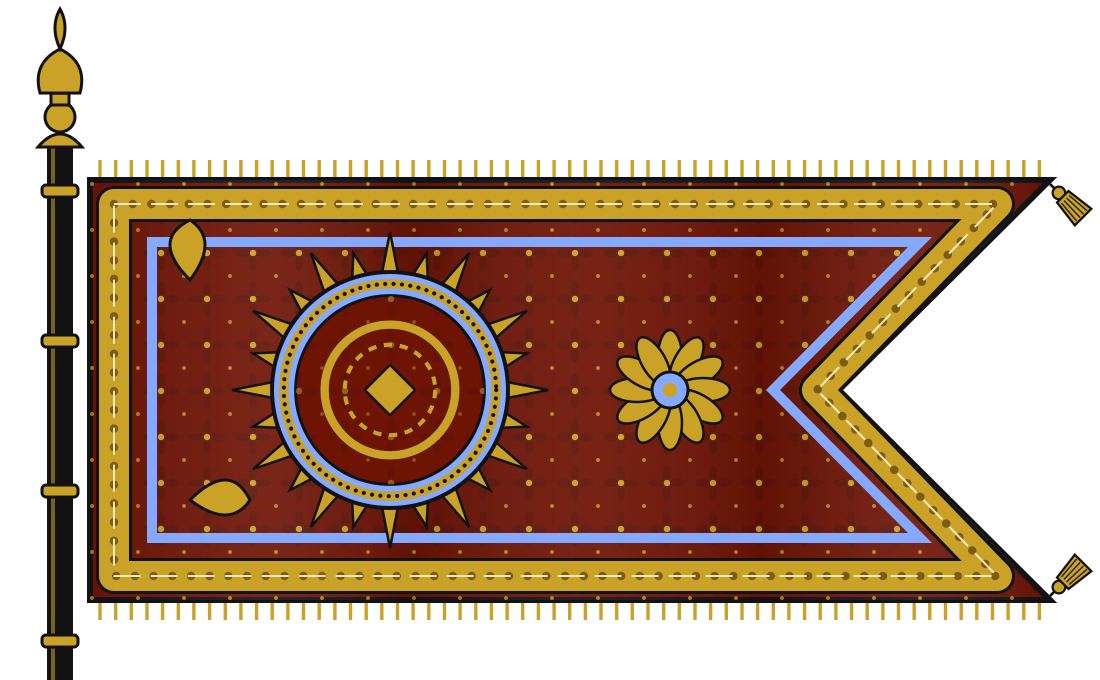
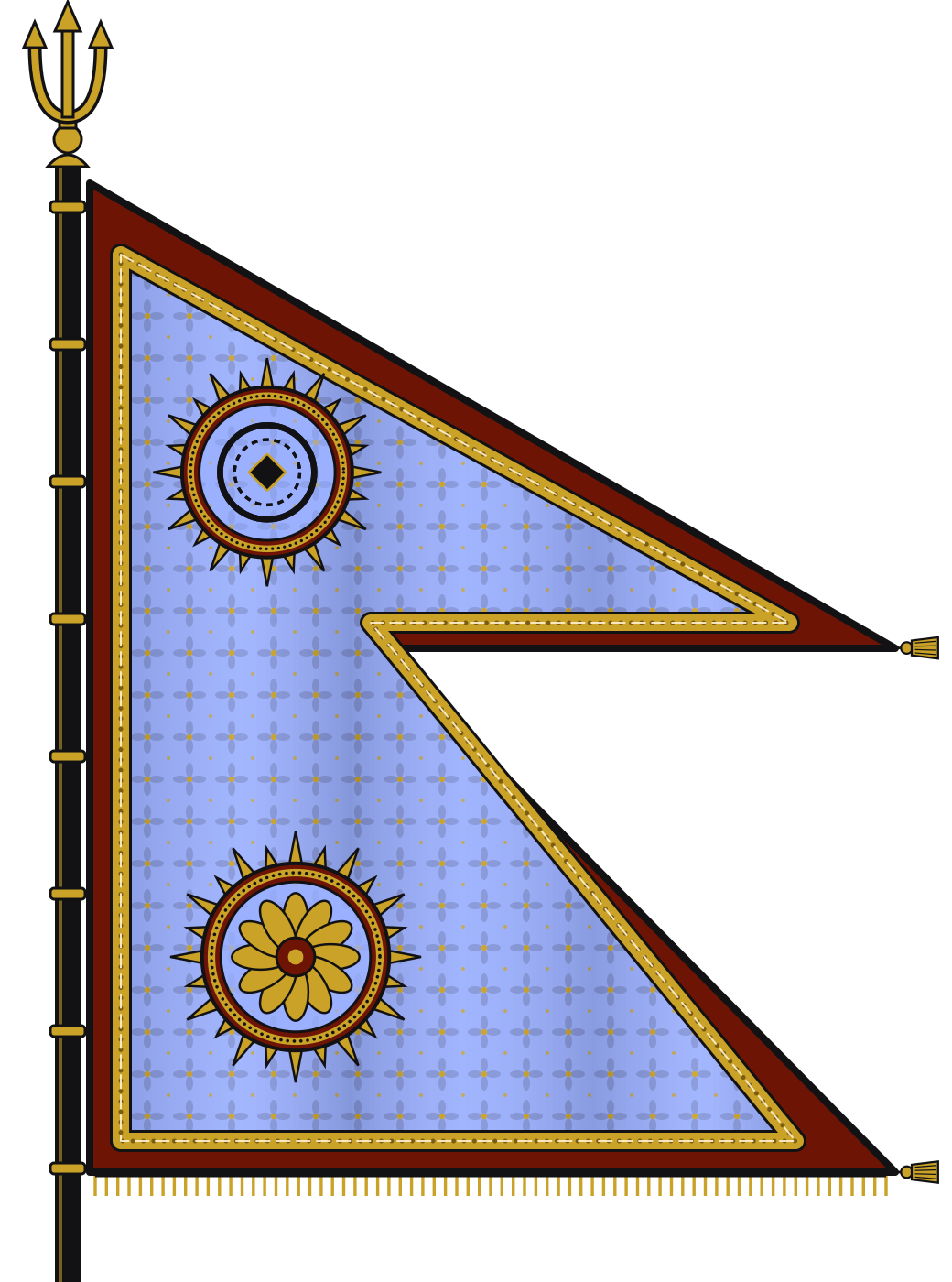
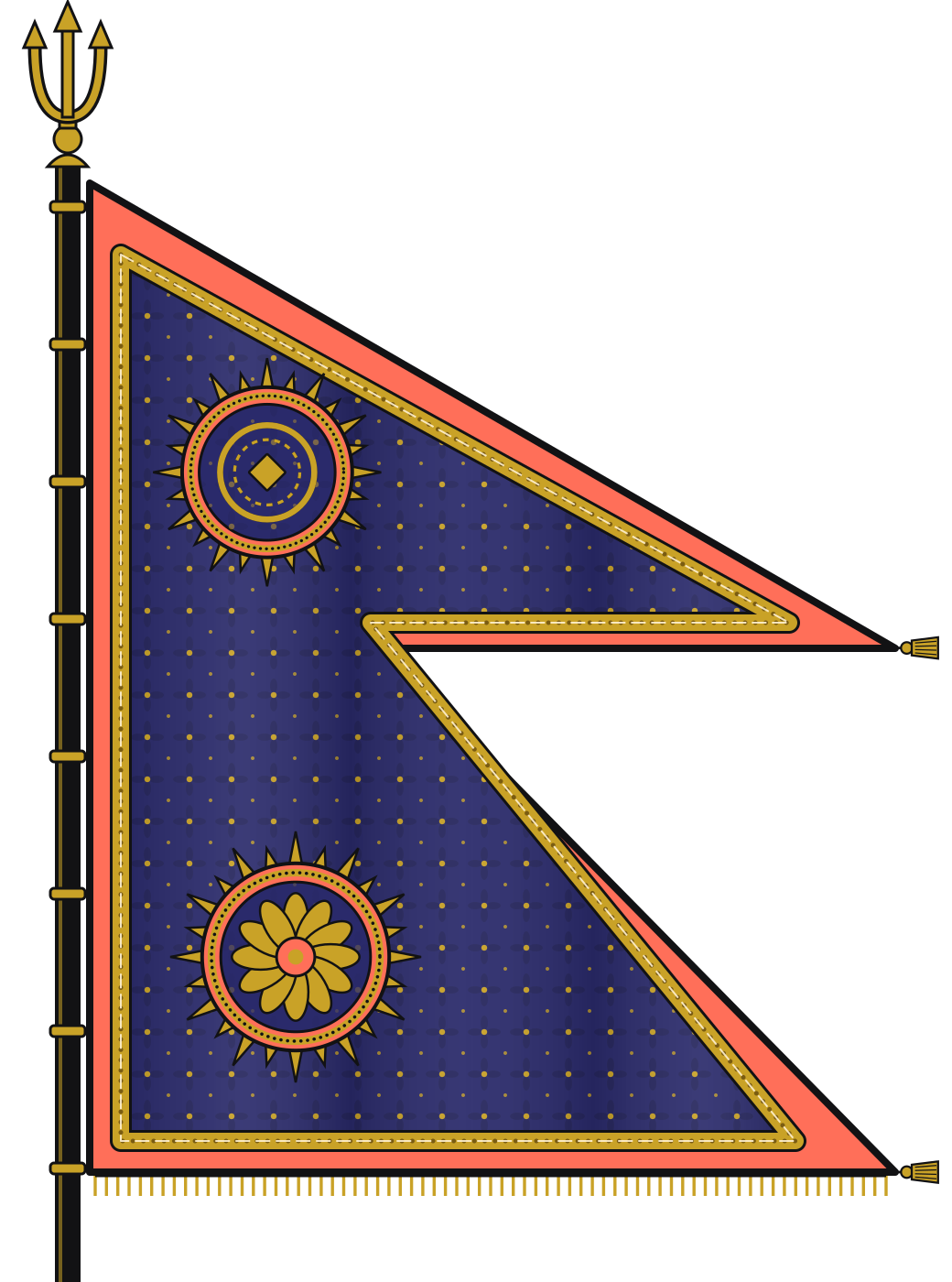
| Field | Royal Navy #1B2F6E |
| Accent | Fiery Vermilion #FF4500 |
| Emblem colour | Metallic Gold #C9A227 |
| Zari metal | Gold |
| Main emblem | A mounted archer turning to shoot backward |
| Second image | — |
| Night and day | Every visual accessory has two versions: by night the emblem on the dark field, by day the clan's field colour on cloth woven from its metal. |
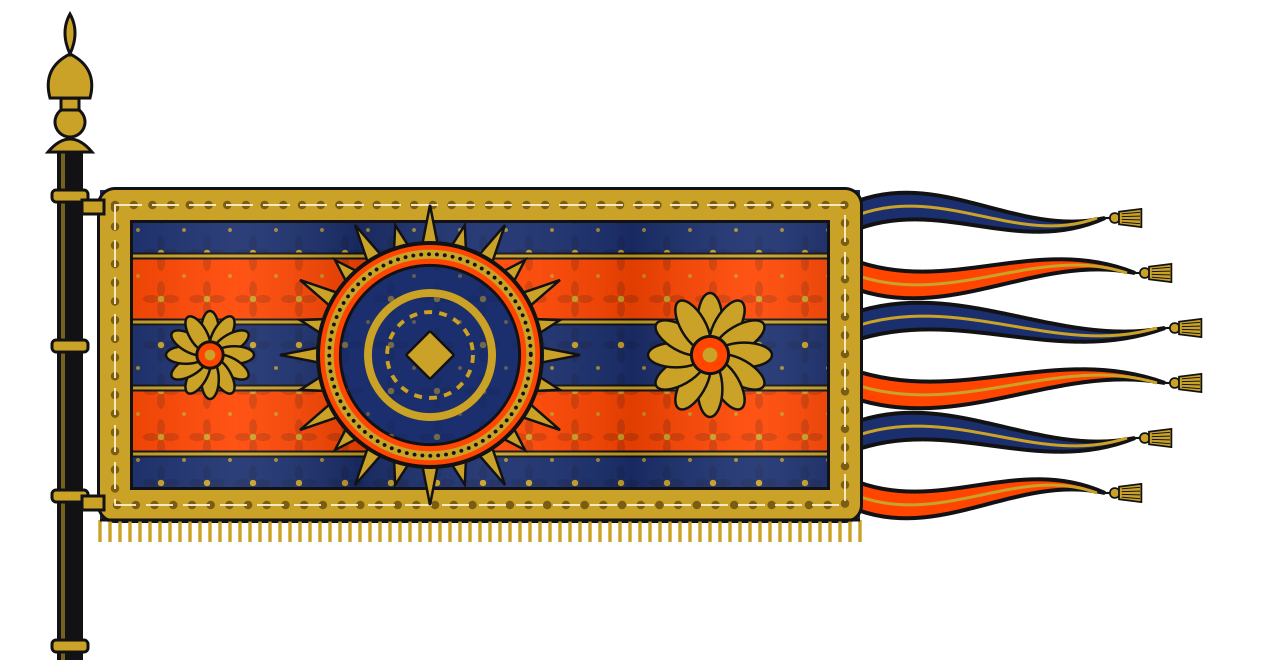
6. Flags
Every clan has every flag type; the type says the occasion and the colours say the clan. The outlined card is the flag the Atlas assigns.
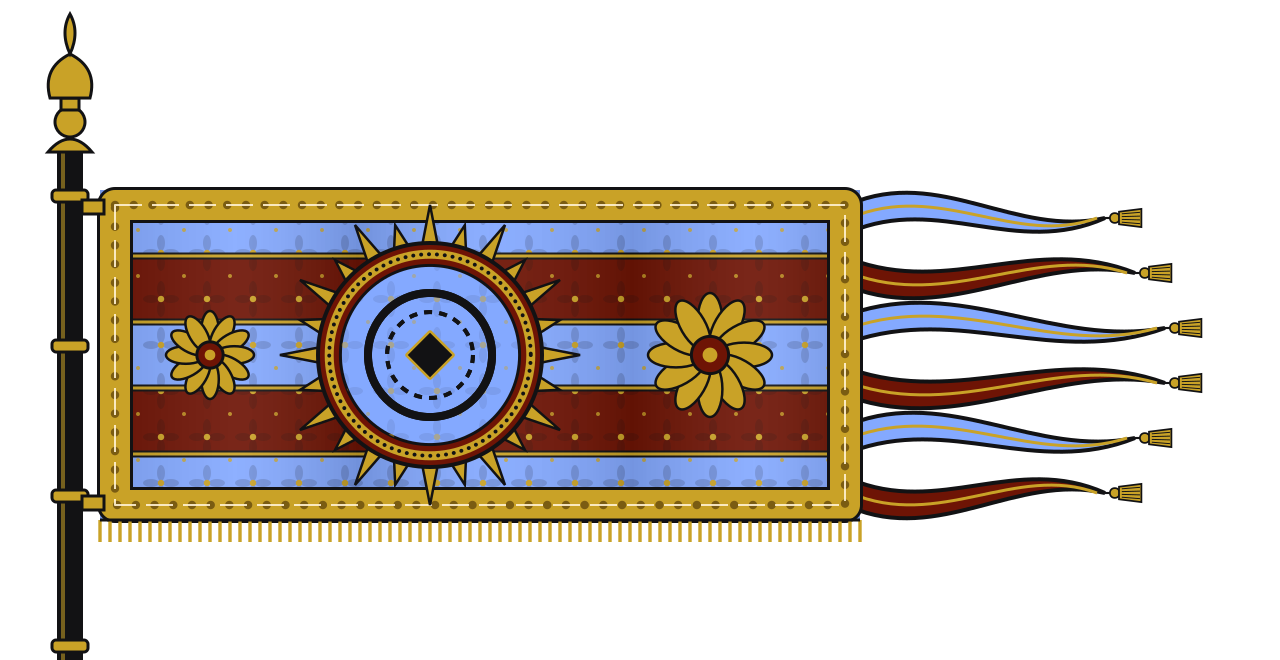
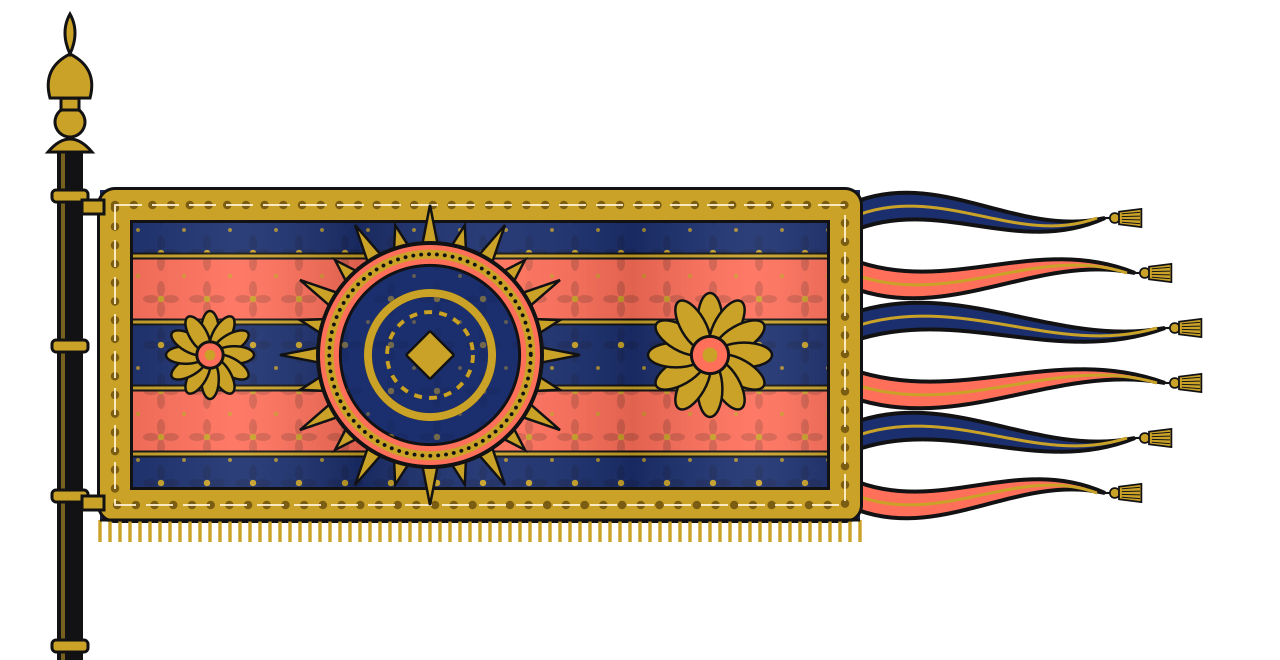
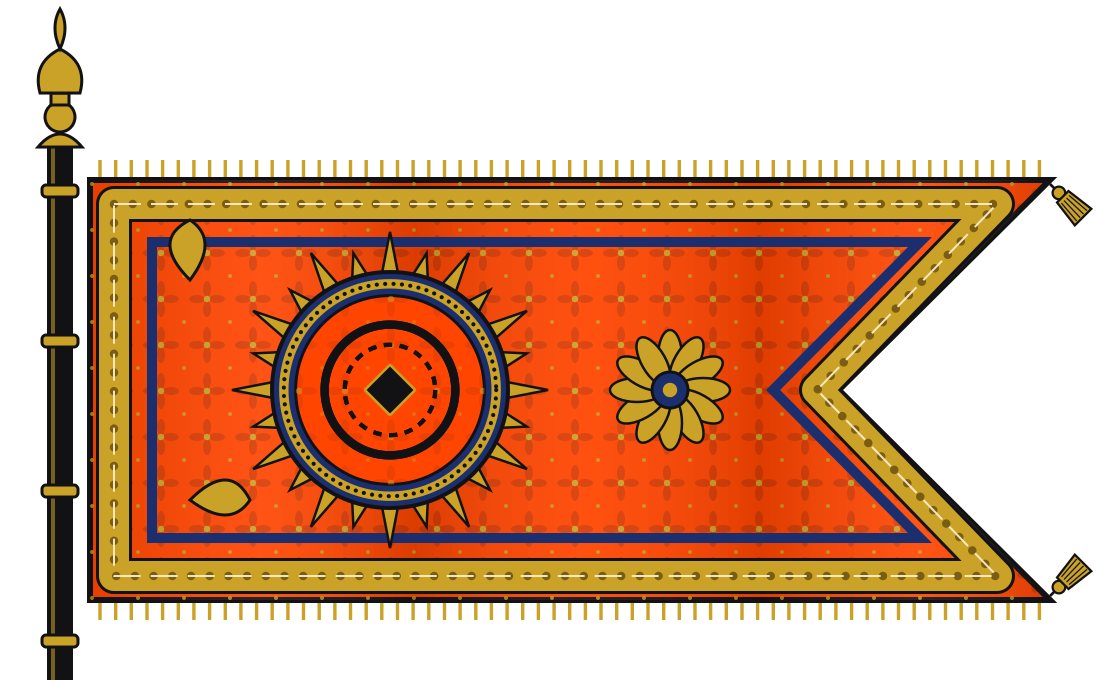

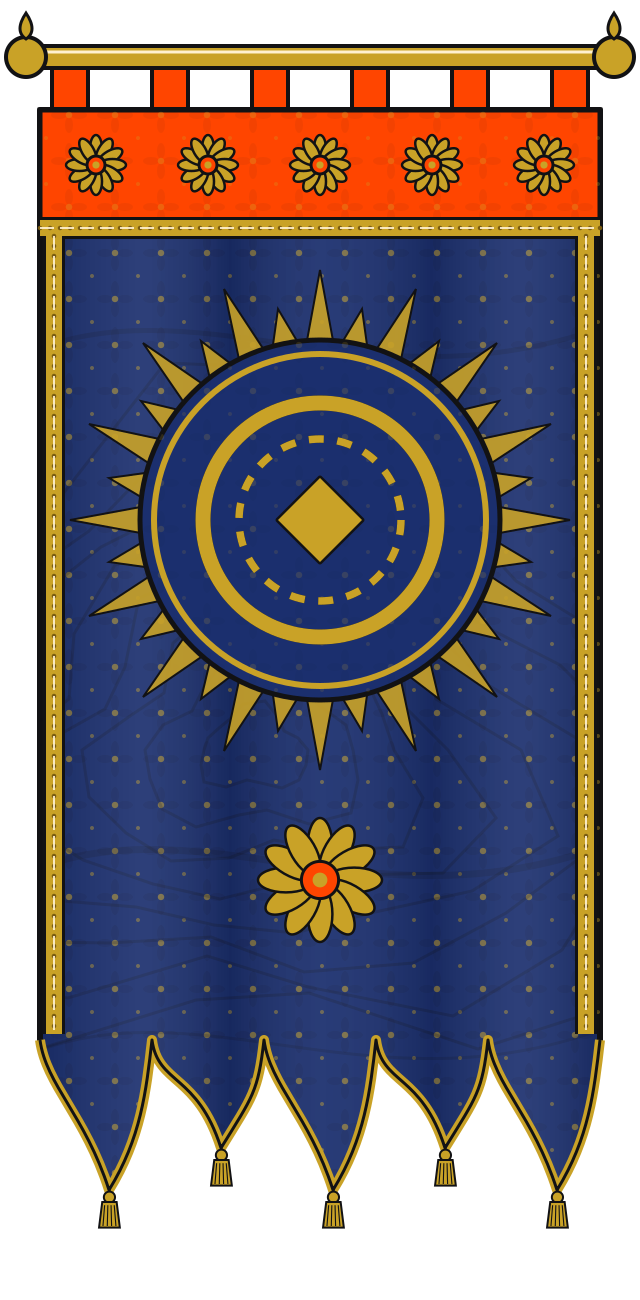
Historic banner
None known
New flag types
| Accessory | For this clan | Basis |
|---|---|---|
| A9 Pota-dhvaja · ship and trade flag For ships, caravans and markets | Not yet designed for this clan | Design |
| A10 Utsava-patāka · festival flag Light, bright flag for fairs and festivals | Not yet designed for this clan | Design |
| A11 Shoka-dhvaja · mourning flag White cloth with the emblem outline in the clan's metal | Not yet designed for this clan | Design |
7. Regalia
| Accessory | For this clan | Basis |
|---|---|---|
| E1 Chhatra · house parasol The ceremonial umbrella | Not yet designed for this clan | Design |
| E2 Chamara · fly-whisks The pair of whisks beside the head of the house | Not yet designed for this clan | Design |
| E3 Danda · staff of office Staff or scepter | Not yet designed for this clan | Design |
| E4 Simhasana · seat The seat of the house, covered in clan cloth | Not yet designed for this clan | Design |
| E5 Khetaka · shield A round shield; the Changi and Dhanush are its flag forms | Not yet designed for this clan | Regional tradition |
| E6 Kula-ayudha · clan weapon The weapon the clan honours | Not yet found for this clan | Under research |
8. Worn
| Accessory | For this clan | Basis |
|---|---|---|
| F1 Kula-vastra · clan cloth The clan's woven pattern in its kit colours | Not yet designed for this clan | Design |
| F2 Kirti-vastra · honour cloth A cloth earned for a deed, not inherited | Not yet designed for this clan | Design |
| F3 Kula-mala · garland flower The flower or leaf the clan wears as a garland | Not yet found for this clan | Under research |
| F4 Chinha · house pin A metal badge with the pin emblem | Not yet designed for this clan | Design |
9. Records
| Accessory | For this clan | Basis |
|---|---|---|
| H1 Clan words A traditional line in the native script | पह्लवा · “Pahlava” The people's name in Sanskrit, from the Puranic and dictionary usage (Parthians or Persians). No line of the Pahlavas' own is recorded[8] | Design |
| H2 Biruda · titles The house's title or titles | King of Kings, and autokrator on the coins: the titles of Gondophares I | Documented |
| H3 Prashasti · praise genealogy The lineage as written at the head of a grant | Not yet found for this clan | Under research |
| H4 Vahi · clan register The book of the clan's births, marriages and deaths | Not yet found for this clan | Under research |
| H5 Rana-ghosha · war cry The clan's cry in battle or celebration | Not yet found for this clan | Under research |
10. VishwaVit · knower of the world
Game values are design choices for this project, not historical claims.
References
- Wikipedia, Pahlavas, read 2026-10-20, https://en.wikipedia.org/wiki/Pahlavas
- Wikipedia, Indo-Parthian Kingdom, read 2026-10-20, https://en.wikipedia.org/wiki/Indo-Parthian_kingdom
- Wikipedia, Gondophares, read 2026-10-20, https://en.wikipedia.org/wiki/Gondophares
- Taxila (Wikipedia, read 2026-10-09), citing J. Marshall, Taxila (1951) and A Guide to Taxila (1960), A. Cunningham (1871), R. K. Mookerji (1951), H. Scharfe (2002), R. Thapar (1997) and U. Singh (2008).
- Christine Frohlich, "Indo-Parthian dynasty", Encyclopaedia Iranica XIII/1 (2004, updated 2015), read 2026-10-20, https://iranicaonline.org/articles/indo-parthian-dynasty-1
- Bharatkosh (bharatdiscovery.org), कुषाण वंश, read 2026-10-19, https://bharatdiscovery.org/india/कुषाण_वंश
- Acts of Thomas, tr. M. R. James, The Apocryphal New Testament (1924), earlychristianwritings.com, read 2026-10-20, https://earlychristianwritings.com/text/actsthomas.html
- Wisdom Library, Pahlava definitions, read 2026-10-20, https://www.wisdomlib.org/definition/pahlava
- Wikipedia, Parthian language, read 2026-10-20, https://en.wikipedia.org/wiki/Parthian_language
- Gandhari.org, CKI 53, so-called Takht-i-Bahi inscription of the year 103 (catalog title only), read 2026-10-20, https://gandhari.org/catalog?textID=53
- Epigraphia Indica VIII, p. 52, Junagadh Inscription of Rudradaman (No. 6), jainqq.org page read 2026-10-10, https://jainqq.org/pagetext/Epigraphia_Indica_Vol_08/032562/52
- P. Bhaskar Reddy, K. Muniratnam, Suchandra Ghosh, "Junagadh Inscription of Rudradaman", e-PG Pathshala (INFLIBNET) module, read 2026-10-10, PDF
- Bharat Discovery, "सुदर्शन झील", read 2026-10-10, link
- Gandhara (Wikipedia, snapshot of 24 May 2022, read 2026-10-09), citing Macdonell and Keith (1912), Al-Biruni (tr. Sachau 1910), Watters (1904), Salomon (1998), Neelis (2010), Behrendt (2007), Srinivasan (2008), Blurton (1993), Upinder Singh (2017) and Narasimhan et al. (2019).
- Wikipedia, "Gautamiputra Satakarni", read 10 Oct 2026, https://en.wikipedia.org/wiki/Gautamiputra_Satakarni
- Wikipedia, Indo-Scythian Kingdom, read 2026-10-19, https://en.wikipedia.org/wiki/Indo-Scythian_Kingdom
- Wikipedia, Nahapana, read 2026-10-19, https://en.wikipedia.org/wiki/Nahapana
- Western Satraps (Wikipedia, read 2026-10-09), citing E. J. Rapson, R. Salomon (1998), U. Singh (2008), D. C. Sircar and J. Cribb (2013).