The Oraon call themselves Kurukh; the name Oraon was applied by outsiders[1][2]. Their language, Kurukh, is North Dravidian, and the people are a Scheduled Tribe in several Indian states (list dated 09-07-2024, Atlas), with communities in Bangladesh and Nepal[3][4]. Their society rests on exogamous totem clans named for plants and animals, a bachelors' dormitory called the Dhumkuria, and the Parha council of villages[4][1]. The Tana Bhagat uprising of 1914 to 1919 began as religious reform and became a no-rent and anti-British campaign[5]. The Sarhul festival of the sal flower and the Karma festival are named among the Oraon festivals[6][4][1].
01Faith and deities
Sarna mother of the sacred grove[1]
A recorded tie between the clan and the goddess.
| Deity or tradition | Place in the clan's life | Evidence |
|---|---|---|
| Chala Pachcho, the KulDevi | Sarna mother of the sacred grove, per the sheet; Russell's 'Chola Pacho', the lady of the grove in the sarna, gives rain and crops[1] | [1] |
| Sarna Burhi ('Woman of the Grove') | Goddess of the sal groves, worshipped in the Bengal region by the Munda, Kurukh and Oraon; harming the sal trees is said to bring misfortune[7] | [7] |
| Gram Devi, as quoted in a course blog (secondary) | Village goddess who protects and nurtures the Oraon, 'a caring old age lady with beautifully flowing white hair'[8] | [8] |
| Biri (sun), Chando (moon), Dharti Aayo (earth) | The sun is worshipped as Biri, a name for Dharmesh; Chando Biri are words used in Sarna pujas; the earth is 'earth as mother'[4] | [4] |
| Bhuts, Churel, Bhula, Murkuri, Chordewa | Spirits of the household, sept and village; of women dead in pregnancy; of unnatural deaths; and a witch as a black cat[1] | [1] |
| Pitras (ancestors) | Worshipped at every festival; a hen is offered at new rice[1] | [1] |
| Mahadeo | Worshipped by the Tana Bhagats; a Mahadeo stone at Kanihari gets milk from the Baiga[4][1] | [4][1] |
| Marang Buru | A 2025 report quotes Jagdeep Oraon, a professor in Purulia, saying life and religion are tied to the forest and to Marang Buru, god of forests[9]; see open questions | [9] |
| Tana Bhagat tricolour with chakra | The tricolour with a chakra fixed in the courtyard of Tana Bhagat houses[4][10] | [4] |
02Temples
No temple built by the Oraon is recorded in the extracts. The rites are performed under the shade of the sacred grove, the sarna[4].
Built by the clan
Not recorded.
Given patronage or grants by the clan
Not recorded.
Later temples in the clan's lands
| Temple | Deity | Built | Where | |
|---|---|---|---|---|
| Kamakhya | Durga, honoured by the Kamru Bhagats | Pilgrimage by Oraons; the Kamru Bhagat sect arose after it | Undated | Assam[4] |
03Languages and scripts
| Language or script | Kind | Under the clan | Evidence |
|---|---|---|---|
| Kurukh (Kurux) living | North Dravidian language | Oraon, and Kisan (a related variety) | [3] |
| Dialects: Oraon, Kisan, Dhangar | Dialects; Oraon and Kisan are about 73% mutually intelligible | Only Oraon is being standardised | [3] |
| Devanagari living (कुँड़ुख़) | Script used for Kurukh; Kurukh has no written character of its own (Grierson, 1916) | Oraon; the gospels were printed by Rev. F. Halm | [1][3] |
| Kurukh Banna | Script released in 1991 by Basudev Ram Khalkho of Odisha; the Kurukh Parha promotes it in Sundargarh | Kurukh | [3] |
| Tolong Siki living (vowels - i, e, u, o, a, ā) | Script invented in 1999 by Dr Narayan Oraon; recognised by Jharkhand in 2007 | Kurukh; promoted by the Kurukh Literary Society of India | [11] |
| Keraʔ Mundari living | A creolised Mundari dialect spoken by about 200,000 Kurukhs near Ranchi (Kobayashi and Murmu, 2008, as cited) | Kurukh speakers near Ranchi | [4] |
| Sadri and Odia | Regional languages, often a first language | Kurukh speakers in West Bengal, Bangladesh, Assam and Tripura | [4] |
| Ha'an and Malla | Yes and no in Kurukh (romanised as given) | Kurukh | [3] |
04Books and literature
The record is Hahn's, Dalton's, Raynbird's and Roy's. The extracts give titles and dates only; none of these works was read in full for this page.
Written during the clan's history
| Work | Author | Kind | When | Link to the clan |
|---|---|---|---|---|
| Kuruḵh grammar | Ferdinand Hahn | Grammar | 1900, 1911 | [3] |
| Kuruḵh-English dictionary | Ferdinand Hahn | Dictionary | 1903 | [3] |
| Kuruḵh folk-lore | Ferdinand Hahn | Tales | 1905 | [3] |
| Blicke in die Geisteswelt der heidnischen Kols | Ferdinand Hahn | Sagas, tales and songs of the Oraon | 1906 | [4] |
| Oraon Folk-lore | Ferdinand Hahn, ed. A. Grignard | Folk-lore | 1931 | [3] |
| Uranw or Kunr'kh Folk Tale | Hugh Raynbird | Folk tale | 1889 | [3] |
| The Oraons: Descriptive Ethnology of Bengal | Col. Dalton | Ethnology | 1872 | [4] |
| History and Culture of the Oraon Tribe | Abhik Ghosh | History | 2003 | [4] |
| The Kurux Language | Kobayashi and Bablu Tirkey | Linguistic study (Brill) | 2017 | [3] |
| Linguistic Survey of India volume (title not printed in the extract) | Gopalakrishnan | Linguistic survey | 2021 | [3] |
| S. C. Roy's 1915 work on the Oraons (title not in the extract; not read) | S. C. Roy | Ethnography | 1915 | [5] |
| Barcha Onta Ranph; Jharkhand Ond Najir; Udhiya Ra Pinjara Ta Maina (titles only) | Francisca Kujur (b. 1959) | Kurukh short stories | Modern | [2] |
| I Am Not Your Data; Being Adivasi (titles only) | Abhay Xaxa | Genre not given | 1983 to 2020 | [2] |
Given patronage by the clan
Not recorded.
05Thinkers and scholars
| Name | Field | Era | Contribution |
|---|---|---|---|
| Col. Dalton | Ethnologist | 1872 | 'Oraon' is an outside name from the Munda neighbours, meaning 'to roam'[4] |
| Ferdinand Hahn (Russell: Rev. F. Halm) | Missionary linguist | 1900 to 1931 | Kurukh grammar, dictionary and folk-lore; linked Kurukh to 'speaker'[3][1] |
| Sten Konow | Linguist | Undated | Linked Uraon to the Dravidian word for 'man', and Kurukh to 'a speaker'[4] |
| S. C. Roy | Anthropologist | 1915, 1928 | Proposed a South Indian origin (Coorg)[4][5][6] |
| Elefenbein | Linguist | 1987 | Proposed a Balochi and Brahui link[4] |
| Zvelebil | Dravidianist | Undated | Distinguished the Dhangar from the Kurux proper[4] |
| Kobayashi and Bablu Tirkey | Linguists | 2017 | The Kurux Language (Brill)[3] |
| Dr Narayan Oraon | Creator of the Tolong Siki script | 1999 | Invented the Tolong Siki script[11] |
| Basudev Ram Khalkho | Script maker | 1991 | Released Kurukh Banna[3] |
| Julius Tigga | Educator, writer-editor, politician | 1903 to 1971 | Opened a Dhumkuriya school; edited the Hindi journal Adivasi[2] |
| Shanti Khalkho | Scholar | PhD, Ranchi, 1993 | On cultural change among Oraons[2] |
The thinkers above are named in the sources. No Oraon artist or school of art is recorded.
06Art and architecture
The extracts record dress, tattoos, dance and the Tana Bhagat flag. No painting or sculpture of the Oraon is recorded. Ritwik Ghatak shot a 1957 test film, Oraon, near Ranchi[4].
Painting and wall art
Not recorded.
Sculpture and temple art
Not recorded.
Temple and building architecture
| Art form | What it is | Era | Evidence |
|---|---|---|---|
| Dhumkuria | The bachelors' dormitory of the village (Dalton, seen in Sarguja) | Recorded 1916 | [1] |
| Akhra | The village meeting place and dance ground | Recorded 1916 | [4][1] |
Weaving and textiles
| Art form | What it is | Era | Evidence |
|---|---|---|---|
| Cotton sari | Thick cotton sari with purple or red thread borders; men wear a dhoti or lungi with a similar border | Undated (Wikipedia) | [4] |
Clothing and jewellery
Not recorded.
Coins, pottery and crafts
| Art form | What it is | Era | Evidence |
|---|---|---|---|
| Weaving, utensils, jewellery | Made by women (Oraons of Bangladesh) | Today | [12] |
07History
Origins claimed (undated)
Gait, as printed by Russell in 1916, says the tribe first lived in the Carnatic, went up the Nerbudda (Narmada) and settled on the Son in Bihar; Muslim pressure then split it, one part going by the Ganges to the Rajmahal hills (the ancestors of the Male or Saonria) and the other up the Son to north-west Chota Nagpur[1].
Dalton records Oraon claims of earlier settlement in Gujarat, Kalinjar and Rohtasgarh, from where Muslims drove them in Akbar's reign[4].
Other opinions in the sources: S. C. Roy proposed a South Indian origin (Coorg); the Indian Anthropological Society placed the Konkan as the original home; Wikipedia, citing Singh (2018), says the people settled the plateau by 100 CE, and one opinion puts the Kurukh in the Indus Valley with a migration c. 2500 BCE[4][10]. These are opinions, not settled history.
After the Mundas (undated)
Russell records Oraon settlement in Chota Nagpur as later than that of the Mundas[13]. In an Oraon village the headman is called Munda, and the priest, Pahan, is a Munda where one is available, which Russell reads as a sign that the Mundas settled first[1].
Each village was divided into three khunts named for Munda, Pahan and Mahto; the Bhuinhari Khunt, with the Pahan Khunt and the Mahato Khunt, is the major lineage[1][4].
1832: the Lakra rebellion
Budhu Bhagat led the Lakra rebellion, also called the Kol uprising, in 1832[4].
1914 to 1919: the Tana Bhagat movement
Jatra Oraon, of Gumla, said in April 1914 that he had a divine message; he was arrested on 23 April 1914 and released on 2 June 1915. At its peak the movement had about 26,000 followers, some of them Munda and Kharia[5]. Wikipedia dates the movement 1914 to 1920, citing Kumar (2008)[4].
The movement opposed ghost hunts, exorcism, animal sacrifice and liquor, and kept to vegetarianism and austerity. It became a no-rent campaign against landlords, then turned against the British and the missions; from the 1920s it joined Gandhian nationalism, with khadi and the Congress flag[5].
Litho Oraon declared herself a goddess and was imprisoned; Mangor Oraon led from November 1915; Sibu Oraon and Maya Oraon revived the movement in 1919[5].
1916 onward: tea gardens
In 1916 the movement spread to Oraon labourers on the Jalpaiguri tea gardens, and to Palamau and Hazaribagh[5]. The 1921 census counted 115,350 Oraons on the Duars tea estates[14].
1939 to 1948: the Adivasi Mahasabha
Julius Tigga (1903 to 1971), educator, writer-editor and politician, was General Secretary of the Adivasi Mahasabha from 1939 to 1948 and edited the Hindi journal Adivasi[2].
1971: Bangladesh
The Daily Star names Oraons among those in the 1971 Liberation War, without unit details[12].
08Journey and migrations
The Oraon's own accounts are of a southern origin and a march north. The moves below are the claims and records the extracts give, not settled history.
| When | From | To | Why | Evidence |
|---|---|---|---|---|
| Undated (Gait's account) | The Carnatic | The Narmada, then the Son in Bihar | Settling; then split by Muslim pressure | [1] |
| Akbar's reign (Oraon claim) | Rohtasgarh | Chota Nagpur | Driven out by Muslims, in the Oraon claim recorded by Dalton | [4] |
| Mughal period | Kankan region (origin believed) | Bengal: the Barind region (Rajshahi, Dinajpur, Rangpur) | Livelihood | [12] |
| Not dated | Chota Nagpur | Assam, the Andaman and Nicobar Islands, and Maharashtra | The mandar drum carried by Oraons, per the journal paper | [15] |
| 1916 | Chota Nagpur | Jalpaiguri tea gardens; Palamau and Hazaribagh | Labour; the Tana Bhagat movement spread | [5] |
| 1921 | Chota Nagpur | Duars tea estates, Jalpaiguri | Tea-garden labour (census: 115,350 Oraons) | [14] |
| Under British rule | Chota Nagpur | Assam, West Bengal, Bangladesh, Fiji, Guyana, Trinidad and Tobago, Mauritius | Tea-garden workers ('Hill Coolies') | [4] |
09Seats and lands
| Place | Role | Where today |
|---|---|---|
| Chota Nagpur plateau | Main area of settlement | Jharkhand, Odisha, Chhattisgarh, West Bengal[4] |
| Gumla, Ranchi, Lohardaga, Latehar, Simdega | Kurukh districts | Jharkhand[3] |
| Anjan | Munda and Oraon are the larger populations here, per a local page | Gumla district, Jharkhand[16] |
| Raigarh, Surguja, Jashpur | Kurukh districts; about 47,000 Oraons in Jashpur State in 1916[3][1] | Chhattisgarh |
| Jharsuguda, Sundargarh, Sambalpur, Deogarh, Keonjhar | Odisha districts where Kurukh is spoken (spelling as printed) | Odisha[3][17] |
| Jalpaiguri and Alipurduar | Mainly Oraon districts in West Bengal | West Bengal[18][3] |
| Duars tea estates | Tea-garden labour; 115,350 Oraons in the 1921 census | Jalpaiguri, West Bengal[14] |
| Rajshahi, Dinajpur, Rangpur, Chittagong Hill Tracts | Places where Oraons live in Bangladesh | Bangladesh[12] |
10Notable figures
| Name | Role | Era | Known from |
|---|---|---|---|
| Budhu Bhagat | Led the Lakra rebellion (Kol uprising) | 1832 | [4] |
| Jatra Oraon | Of Gumla; began the Tana Bhagat movement with a claimed divine message | April 1914 | [5] |
| Mangor Oraon | Led the Tana Bhagat movement | From November 1915 | [5] |
| Litho Oraon | Declared herself a goddess and was imprisoned | Undated | [5] |
| Sibu Oraon and Maya Oraon | Revived the movement | 1919 | [5] |
| Turia Bhagat | Named with the Tana Bhagat sect | Undated | [4] |
| Julius Tigga | Educator, writer-editor and politician; General Secretary of the Adivasi Mahasabha | 1903 to 1971; 1939 to 1948 | [2] |
| Abhay Xaxa | Activist, poet and anthropologist; author of I Am Not Your Data | 1983 to 2020 | [2][4] |
| Albert Ekka | Named as a Param Vir Chakra recipient | Undated | [4] |
| Mukut Minz | Padma Shri (2017) | 2017 | [4] |
| Telesphore Toppo | Cardinal | Undated | [4] |
| Sudhir Chandra Oraon | Named with the Dighri Raja Parishad in Bangladesh | Undated | [12] |
11Allies, rivals and marriages
| People | Relationship | When |
|---|---|---|
| Mundas (Kols) | Found Chota Nagpur first; the Oraon came after them. Mundas and Oraons are known by the general name Kol | Before the Oraon settled[13][14] |
| Kisan and Kuda | Kisan speak Kurukh. Russell says the Kuda and Kisan returned in the 1901 census were really Oraons | 1901 census returns[1][3] |
| Malto and Brahui | Closest linguistic relatives of Kurukh[3]. Elefenbein proposed a Balochi and Brahui link[4] | Linguistic |
| Asur | The Bir Asur legend has the Asur trading iron tools to the Oraon for rice[19]. Asuri has many Dravidian loanwords from Kurukh[20] | Legend and language contact |
| Santal, Lodha and Sabar | Take part in the same hunting festivals in the region[9] | Recent (2025 report) |
| Kharia | In the Uriya country, Oraons who carry litters are also called Kharias, per Hira Lal in Russell[1] | Russell's account |
| Gonds and Khonds | Came to Chota Nagpur after the Mundas, with the Oraon[1] | After the Mundas |
12Society and livelihood
Patrilineal, patrilocal and exogamous clans. Marriage is usually arranged with a bride-price; the rite includes vermilion on the forehead and water poured over the bower, and widows remarry regularly[4][1]. Russell records betrothal with pan, a bride-price of Rs 5 and four maunds of grain, and the handia rite. After death, the bones go into a pot, which is thrown into a river the next day[1].
Government and social order
| Institution or group | What it was | Evidence |
|---|---|---|
| Dhumkuria | Bachelors' dormitory of the village; girls lodge with widows (Dalton, seen in Sarguja) | [1][4] |
| Akhra | Meeting place and dance ground of the village | [4][1] |
| Parha | Council of 12 to 30 villages, with the Raja village the highest; its offices are dewan, panrey, kotwar and praja villages | [4][10] |
| Pahan | Village priest; assisted by the Panibharwa (water-bearer), Pujar, Bhandari and Chowkidar (watchmen) | [4] |
| Panua | Head of the caste panchayat; fee Rs 5; in some States appointed by the Raja | [1] |
| Munda | The village headman, in an Oraon village | [1] |
| Khunts | Lineages: the Bhuinhari, Pahan and Mahato Khunts | [1][4] |
| Sindoordaan | Marriage rite of vermilion and water over the couple | [4][10] |
Livelihood over time
| Era | Livelihood | Evidence |
|---|---|---|
| Historically | Forest and plough agriculture, not jhum; under British rule many were labourers for zamindars on former lands | [4][10] |
| 1916 | Tea-garden labour on the Jalpaiguri estates | [5] |
| Today | Women weave, make utensils and jewellery (Oraons of Bangladesh) | [12] |
| Bangladesh, 2025 study | The Daily Star cites an unnamed study: 70% of Adivasi people are day labourers. These figures are for Adivasi people in general, not for the Oraon alone | [12] |
13Sub-clans and related clans
The Oraon's exogamous totem clans, named for plants and animals (Wikipedia, citing Singh 1996 and Frazer 2000; the Tribal Research Institute lists 27), with the village khunts and the related peoples the extracts name. Totem clans are sub-clans; the names with a master-sheet ID are linked to it.
| Clan | Relation | Where | Size | In the Atlas | Evidence |
|---|---|---|---|---|---|
| Addo (ox) | Sub-clan | new clan candidate | [4] | ||
| Aind (fish) | Sub-clan | new clan candidate | [4][10] | ||
| Alla (dog) | Sub-clan | new clan candidate | [4] | ||
| Bakula (heron) | Sub-clan | new clan candidate | [4][10] | ||
| Bando (wild cat) | Sub-clan | same name as ST-434: check | [4] | ||
| Bara (banyan) | Sub-clan | same name as ST-369: check | [4][10] | ||
| Barwa (wild dog) | Sub-clan | new clan candidate | [4][10] | ||
| Beck (salt) | Sub-clan | new clan candidate | [4][10] | ||
| Chidra (squirrel) | Sub-clan | same name as ST-437: check | [4][10] | ||
| Edgo (mouse) | Sub-clan | new clan candidate | [4][10] | ||
| Ekka (Kachhap, turtle) | Sub-clan | new clan candidate | [4][10] | ||
| Gari (monkey) | Sub-clan | new clan candidate | [4] | ||
| Gede (duck) | Sub-clan | same name as ST-440: check | [4][10] | ||
| Gidhi (vulture) | Sub-clan | same name as ST-443: check | [4] | ||
| Halman (langur) | Sub-clan | same name as ST-393: check | [4][10] | ||
| Keond (fruit) | Sub-clan | new clan candidate | [4] | ||
| Khoya (wild dog) | Sub-clan | new clan candidate | [4][10] | ||
| Kinduar (fish) | Sub-clan | new clan candidate | [4] | ||
| Kindo (fish) | Sub-clan | new clan candidate | [4] | ||
| Kosuar (fish) | Sub-clan | new clan candidate | [4] | ||
| Kiro (fruit) | Sub-clan | new clan candidate | [4][10] | ||
| Kissi (pig) | Sub-clan | new clan candidate | [4] | ||
| Kerketta (hedge-sparrow) | Sub-clan | same name as ST-420: check | [4][10] | ||
| Kokro (cock) | Sub-clan | same name as ST-409: check | [4] | ||
| Kujur (medicinal plant) | Sub-clan | new clan candidate | [4][10] | ||
| Lakra (tiger) | Sub-clan | new clan candidate | [4][10] | ||
| Minz (fish) | Sub-clan | new clan candidate | [4][10] | ||
| Nag (Khetta, cobra) | Sub-clan | new clan candidate | [4][10] | ||
| Panna (iron) | Sub-clan | new clan candidate | [4][10] | ||
| Tido (fish) | Sub-clan | new clan candidate | [4][10] | ||
| Tirkuar (tithio bird) | Sub-clan | new clan candidate | [4] | ||
| Tirkey (eagle) | Sub-clan | new clan candidate | [4][10] | ||
| Toppo (woodpecker) | Sub-clan | same name as ST-508: check | [4][10] | ||
| Tigga (monkey) | Sub-clan | new clan candidate | [4][10] | ||
| Xalxo (pigeon) | Sub-clan | same name as ST-522: check | [4][10] | ||
| Xaxa (crow) | Sub-clan | new clan candidate | [4][10] | ||
| Xess (Dhan, paddy) | Sub-clan | new clan candidate | [4][10] | ||
| Khalkho (Halko, fish) | Sub-clan | new clan candidate | [4] | ||
| Barga | Sub-clan | new clan candidate | [1] (Risley's five divisions) | ||
| Dhanka (Oraon division) | Sub-clan | new clan candidate | [1] (Risley's five divisions; Russell suggests a variant of Dhangar) | ||
| Khendro | Sub-clan | new clan candidate | [1] (Risley's five divisions) | ||
| Bhuinhari Khunt | Sub-clan | new clan candidate | [1][4] (major lineage) | ||
| Pahan Khunt | Sub-clan | new clan candidate | [1][4] | ||
| Mahato Khunt | Sub-clan | new clan candidate | [1][4] | ||
| Munda | Related people | ST-229 | [1][14] (Risley's Munda division) | ||
| Kharia | Related people | ST-130 | [1] (Risley's Kharia division) | ||
| Kisan | Related people | ST-135 | [3][1] | ||
| Mirdha (Kuda) | Related people | ST-219 | [1] (Kuda census returns)[21] (Mirdhas, Kuda) | ||
| Kol | Related people | ST-141 | [14] (general name for Mundas and Oraons) | ||
| Mahto | Related people | SUB-121 | [14][1] | ||
| Asur | Related people | ST-012 | [19][20] | ||
| Santal | Related people | ST-280 | [9] | ||
| Lodha | Related people | ST-177 | [9] | ||
| Savar | Related people | ST-285 | [9] | ||
| Malto | Related people | same name as ST-452: check | [3][4] | ||
| Brahui | Related people | SUB-013 | [3] | ||
| Male (Saonria) | Related people | Rajmahal hills | same name as SUB-213: check | [1] (Gait's account) | |
| Nagvanshi Rajas | Dynasty from this clan | Chota Nagpur | new clan candidate | [13] (the Nagvansi Rajas, of Munda origin in the record) |
Clans marked "new clan candidate" are not in the Atlas yet.
14Surnames
Clan names used as last names (Wikipedia, citing the figures it lists; Lehigh)[4][2], with the bearers named in the sources. No counts: none of the sources gives a number of bearers with a year.
| Surname | Clan or sub-clan | Where | People with this surname | Also used by other communities |
|---|---|---|---|---|
| Toppo | Toppo (woodpecker) | not yet counted | Not checked | |
| Lakra | Lakra (tiger) | not yet counted | Not checked | |
| Tirkey | Tirkey (eagle) | not yet counted | Not checked | |
| Xaxa | Xaxa (crow) | not yet counted | Not checked | |
| Kujur | Kujur (medicinal plant) | not yet counted | Not checked | |
| Ekka | Ekka (Kachhap, turtle) | not yet counted | Not checked | |
| Kerketta | Kerketta (hedge-sparrow) | not yet counted | Not checked | |
| Minz | Minz (fish) | not yet counted | Not checked | |
| Khalkho | Khalkho (Halko, fish) | not yet counted | Not checked | |
| Tigga | Tigga (monkey) | not yet counted | Not checked | |
| Oraon | — | not yet counted | Not checked |
Counts are of everyone with the surname, from the cited source and year, not only members of this clan. A surname shared with other communities says nothing about any one person's origin.
15Songs and music
The Oraon sing and dance together. Dandi is the Kurukh word for a song and for a dance; the dances are named below. The extracts give no song texts, so no excerpt is printed. Jatra dance meetings were held in mango groves, with village flags set on the road, swords, shields, drums, large horns and yak-tail whisks in procession[1].
Jagra Matha living
Dudhiya living
Benja Nalna living
Chali living
Instruments and styles
| Instrument or style | What it is | Evidence |
|---|---|---|
| Mandar (माँदर) | A drum with an earthen body; the large side is coated with a paste of clay and boiled rice, the small side with iron ore and rice; Ghasis are traditional makers in Gumla. Drums are often sold for Oraon weddings | [15][23] |
| Nagara | Named with the mandar and the kartal as Oraon instruments | [4] |
| Kartal | Named with the mandar and the nagara; the Oraons of Bangladesh play it at births, weddings and harvests | [4][12] |
| Tasi, Ektara, Mukhbanshi | Played at births, weddings and harvests by the Oraons of Bangladesh | [12] |
| Bhenr and Narsingha | Named as played by the Uraon, the Munda and the Sadani; few makers are left | [24] |
| Tritiyo, Thechka and Phechka; Rata | Played by the Uraon, Kharia and Munda; the Rata is listed with the Jatra dance, by the Uraon and Munda | [24] |
16Poems, lullabies and children's rhymes
Oraon writers; titles only, as the extracts give them.
I am a poet of the forest living
[2] (Mahadev Toppo)
Earth's Unnamed Warriors living
[2] (Ujjwala Jyoti Tigga; in Kavi Man Jani Man, ed. Vandana Tete)
Care; Can You Return?; Jamuni, Stop Yourself from Being Sold living
[2] (Jacinta Kerketta)
Just Think, Hira; Only Questions living
[2] (Francisca Kujur)
The Sal Tree has Fallen living
[2] (Jyoti Lakra)
Green Jharkhand living
[2] (Shanti Khalkho)
17Stories, legends and proverbs
Stories and legends
| Story | What happens | Told by | Evidence |
|---|---|---|---|
| Subjects of Rawan (Ravana) legend | Some say the Oraon descend from the subjects of Rawan; Russell also records a story of Hanuman and loin-cloths tied to his tail, which the extract does not give in full | Some Oraon, as Russell records; not a tribal text | [1] |
Proverbs and sayings
Not recorded.
18Festivals and fairs
| Festival or fair | When | Where | What happens |
|---|---|---|---|
| Sarhul (Khaddi) | Chaitra, from the third day of the bright half to the full moon (Wikipedia); about early April (Russell) | The sarna (sacred grove) and the Akhara | The marriage of the sun and the earth: a white cock (sun) and a black hen (earth) are sacrificed; the Pahan goes to the sarna to Sarna Burhi; sal flowers are placed over houses and in women's hair; holy water is put on the seed; a night dance at the Akhara[6][1] |
| Karma (Karam) | May (Russell, planting out of rice); the full moon of Bhadra (The Daily Star) | The Akhara | Young people cut a branch of the karma tree (Nauclea parvifolia), plant it in the Akhara, and dance round it garlanded (Dalton)[1]; in Bangladesh three days of processions, dance and music[12] |
| Kanihari | Before threshing, on a Tuesday (Russell) | The village | Fowl blood on the new rice; the Baiga pours milk on the stone of Mahadeo[1][4] |
| Asarh fast | From Asarh (June), after sowing | The village | No shaving, no turmeric, no leaf-plates[1] |
| Jatra | Not dated | Dance meetings in mango groves | Village flags set on the road; swords, shields, drums, large horns, yak-tail whisks, garlanded poles as umbrellas; a man on a wooden horse as the Raja; a shout, hururu[1] |
| Shikar (hunting festivals) | January to June (Shikar Utsav, per Mongabay) | Purulia, Jhargram, Bankura and the region | Oraons take part with Santhal, Lodha and Sabar; a Calcutta High Court interim order of 2018 concerned the hunts, and a 2019 embargo followed a tiger killing[9] |
| Dhanbuni, Harihari, Khariyani | Not dated in the extracts | Chota Nagpur plateau | Named as festivals the Kurukh celebrate; no detail in the extracts[4] |
19Food, dress and games
Food
| Item | What it is | Evidence |
|---|---|---|
| Handia | Rice beer; drunk at visits (pahis) and at weddings, where 40 handias were given for a marriage feast | [1] |
| Pork, fowl and field-mice | Oraons eat pork and fowl and abstain from beef; young men give grilled field-mice as a delicacy | [1] |
| New rice | A hen is offered at the new rice and killed by crushing its head with the fist | [1] |
Dress
| Item | What it is | Evidence |
|---|---|---|
| Women's dress | One six-yard cloth, red beads, a heavy brass torque-like neck ornament, copper finger rings, toe rings of brass or bell-metal, and metal rather than glass bangles | [1] |
| Men's dress | Hair in a knot with wooden combs, brass ornaments, a small mirror, a red or white turban, a girdle of tasar silk or cane cords | [1] |
| Dancing dress | Heron-feather plumes | [1] |
| Tattoos | Symmetrical tattoos on forearms, ankles and chest; women have three vertical lines on the forehead and knee marks, 'steps to heaven'; a boy who enters the Dhumkuria has five burn marks on the left arm, so that he is known as an Oraon after death | [4][1] |
Games and martial arts
| Item | What it is | Evidence |
|---|---|---|
| Ball (Russell's name) | Girls stand in lines by height, holding hands | [1] |
Tags: living still practised · revived brought back after a break · lost known only from records · research reported but not yet confirmed from a source. Songs and poems under copyright are listed by title only; restricted or sacred material is noted without its content.
20Status today
A living Scheduled Tribe in India (list dated 09-07-2024), in several states, with communities in Bangladesh and Nepal; about 3.6 million in India in the 2011 census[4][25].
Who carries the name today
| Community | Link | Basis | Evidence |
|---|---|---|---|
| Kisan (ST-135) | Disputed | [1][3] | |
| Mirdha (ST-219) | Disputed | [1] | |
| Male (Saonria) | Community tradition | [1] (Gait's account) |
Recognised heritage
| What | Recognition | Evidence |
|---|---|---|
| Tolong Siki script | Recognised by Jharkhand (2007); an additional official script in Jharkhand and West Bengal, as Wikipedia credits (2018 instruments); added to Unicode in September 2025 | [11] |
| Kurukh language | Additional official language in Jharkhand and West Bengal | [3] |
| Sarhul | Processions in Ranchi and Gumla since 1961 | [6] |
Not yet reviewed by the Oraon community; the extracts record no community review.
21For children
Sal flowers at Sarhul
The Oraon, who call themselves Kurukh, live on the Chota Nagpur plateau and in some neighbouring states. Each village has a sarna, a sacred grove of sal trees, which is kept when the forest is cleared. In spring, at the Sarhul festival, people gather sal flowers. The flowers are placed over the houses and worn in the women's hair. The priest, called the Pahan, goes with the people to the sarna. Every family belongs to a clan named after a plant or an animal, and its members do not kill or eat that totem. So the sal tree, the grove and the clan are all part of one village's life.[1][6][4]
22Across the project
| Project | What carries this clan | Status |
|---|---|---|
| Atlas of the Janas | Oraon villages: the Chota Nagpur plateau, the Jalpaiguri and Duars tea estates, Bangladesh and Nepal (see Seats and lands) | [4][14] |
| KulDevi and GrahDevi | KulDevi Chala Pachcho, family Saptamatrika (+Narasimhi), basis documented; GrahDevi forms Brahmani to Narasimhi | |
| Planet naming | Under research: no source in the extracts | |
| Renaming and waters | Under research: no source in the extracts |
23Open questions
- Kanihari and Nawakhani: Wikipedia names Nawakhani among the Kurukh festivals[4]; Russell describes Kanihari as a rite held before threshing[1]. The extracts do not say they are one rite, so they are listed apart.
- Homeland: Chota Nagpur is the main area of settlement, but the history and journey give the Carnatic, the Konkan and the Indus Valley as origins[1][4], so the lands table does not call it the homeland.
- Dhangar: the Atlas lists Dhangar, Dhangad and Jhangad as names of this people. Wikipedia says Dhangad is the name in Maharashtra and Jhangar is used in the eastern Nepal Terai, while Zvelebil and Ethnologue treat the Nepali Dhangar as distinct. The Dhangar shepherd caste of Maharashtra and the Dhangar wrestler notes are a different people and are not used here.[3][4]
- Words: no traditional line of the Oraon in native script was found in the extracts; the people's own name is used. Lead: Hahn's Kuruḵh folk-lore (1905) and Oraon Folk-lore (1931) for a cited line.
- Chala Pachcho: the KulDevi is. Russell gives 'Chola Pacho' in the sarna; Wikipedia's Sarna Burhi page does not name her. The course-blog account is secondary.
- Marang Buru: a 2025 report quotes an Oraon professor naming him god of forests; the Tribes of Jharkhand entry ties him to Santal sacred groves. Whether the Oraon hold him as a deity is open.
- Anna Kuari or Mahadhani: Russell (after Dehon, 1906) records a goddess feared for human sacrifice. The claim is a 1916 colonial-era record that the extract itself says to handle with care, and it is not verified here, so it is left out. Lead: Dehon 1906, not read.
- State count: the Atlas lists eight states; Wikipedia says the Kurukh are a Scheduled Tribe in seven, and its state figures give none for Madhya Pradesh or Maharashtra.
- Bangladesh count: 85,846 (Wikipedia, no year printed) and about 120,000 (The Daily Star, undated). Both are kept with their sources.
- Baiga: named in the Sarhul and Kanihari rites (Russell). Whether this is a role or the Baiga people is not settled.
- Kula-ayudha (E6): the Atlas links a weapon to the Oraon through a waiting note on pit and net traps. The Mongabay extract says Oraons take part in hunting festivals but does not mention traps as Oraon's weapon, so no E6 entry is made.
- Surnames: no bearer counts; the sources give none with a year. Lead: K. S. Singh, People of India, and the NBU PDF (not read).
- Sources not read in full: S. C. Roy (1915, 1928), Dehon (1906), Hahn's folk-lore texts, Britannica print article, the NBU repository PDF, the Drishti Hindi PDF and the Sanglap journal (Aug 2024), the Scroll.in Tolong Siki article, and the Sarhul and Oraon accounts on Outlook Traveller and Forward Press.
- Community review: none recorded. The Oraon community has not reviewed this page.
- Official status is, not from a web page; the list date is 09-07-2024.
24Astitva
अस्तित्व · being, existence: everything by which the clan is known
The Oraon's documented accessories are the totem clans, the sarna grove with its sal trees, the sal flower of Sarhul, the Tolong cloth whose name the script takes, and the swords, shields, whisks and garlanded umbrella poles of the Jatra procession[1][4]. The Tana Bhagat tricolour with its chakra is recorded[4]. The Jatra village flags are recorded[1]; the mandar and other drums are in the songs section.
Every clan has every accessory, royal objects included. Each one says how it is known: Documented This clan's own object is recorded. · Regional tradition Recorded for the region or for peoples like this one, not for this clan. · Design Made for this project, with no historical claim. · Under research To be found for this clan from sources. Legends and titles are written in the clan's own script.
1. Seals and coins
| Accessory | For this clan | Basis |
|---|---|---|
| B1 Rajamudra · house seal Round seal with the clan emblem and a short legend in the clan's script | Not yet designed for this clan | Design |
| B2 Anguliya-mudra · signet ring Personal seal ring of the head of the house | Not yet designed for this clan | Design |
| B3 Chhapa · house stamp Ink or block stamp for letters, goods and cloth | Not yet designed for this clan | Design |
| B4 Tamrapatra · charter plate Copper-plate grant on a ring, closed with the house seal | Not yet designed for this clan | Design |
| B5 Shreni-mudra · guild or trade seal Seal for the clan's trade, craft or caravan | Not yet designed for this clan | Design |
| C1 Clan coin Emblem or deity on one side, a legend in the clan's script | Not yet designed for this clan | Design |
| C2 Coin die The die that strikes the coin | Not yet designed for this clan | Design |
2. Living symbols
| Accessory | For this clan | Basis |
|---|---|---|
| I1 Totem trio The tree, bird and animal the clan protects | Totem clans named for plants and animals (e.g. Bara, banyan; Tirkey, eagle; Lakra, tiger); members do not kill or eat their totem | Documented |
| I2 Kaval-maram · guardian tree The tree that stands at the clan's seat | Sal trees of the sarna, the sacred grove left when the forest is cleared; Chola Pacho, 'lady of the grove', is recorded there | Documented |
3. Stone and gate
| Accessory | For this clan | Basis |
|---|---|---|
| G1 Torana · gateway The built gate of the seat; the cloth Toran hangs in it | Not yet designed for this clan | Regional tradition |
| G2 Viragallu · hero stone Carved panel stone for a member who died defending the clan | Not yet designed for this clan | Regional tradition |
| G3 Kula-shila · clan stones Standing and table stones that remember the ancestors | Not yet designed for this clan | Design |
| G4 Jayastambha · victory pillar A pillar raised for a victory | Not yet designed for this clan | Design |
| G5 Sima-shila · boundary stone Marks the clan's land, with a line in the native script | Not yet designed for this clan | Design |
4. Sounds
| Accessory | For this clan | Basis |
|---|---|---|
| D1 Pancha-mahashabda · five great sounds The right to five instruments | Not yet designed for this clan | Design |
| D2 Shankha · clan conch The clan's own named war conch | Not yet designed for this clan | Design |
| D3 Murasu · house drums Three drums: war, charity and justice | Not yet designed for this clan | Design |
5. Kit: colours, metals and emblems
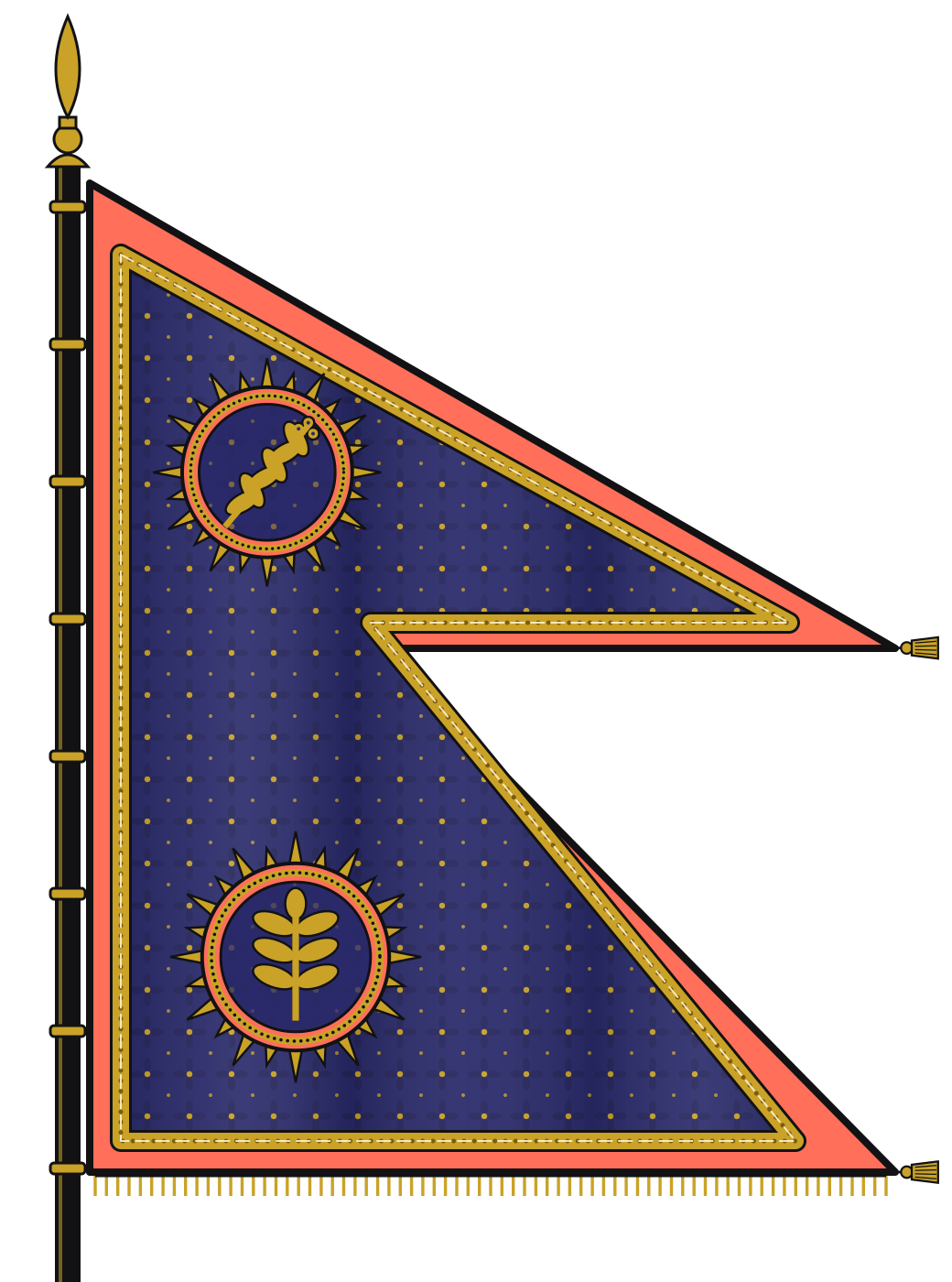
The main emblem is a sal branch with flowers, for the Sarhul festival, where sal flowers are placed over houses and in women's hair[1][6]. The second image is a Karam tree branch, for the Karma festival, where a branch of the karma tree is planted in the Akhara[1]. Both emblems and the flag form are set in the Atlas.
| Part of the kit | This clan |
|---|---|
| Field | Deep Indigo #2A2A6B |
| Accent | Warm Red-Orange #FF6F59 |
| Emblem colour | Metallic Gold #C9A227 |
| Zari metal | Gold |
| Main emblem | A sal branch with flowers |
| Second image | A Karam tree branch |
| Night and day | Every visual accessory has two versions: by night the emblem on the dark field, by day the clan's field colour on cloth woven from its metal. |
6. Flags
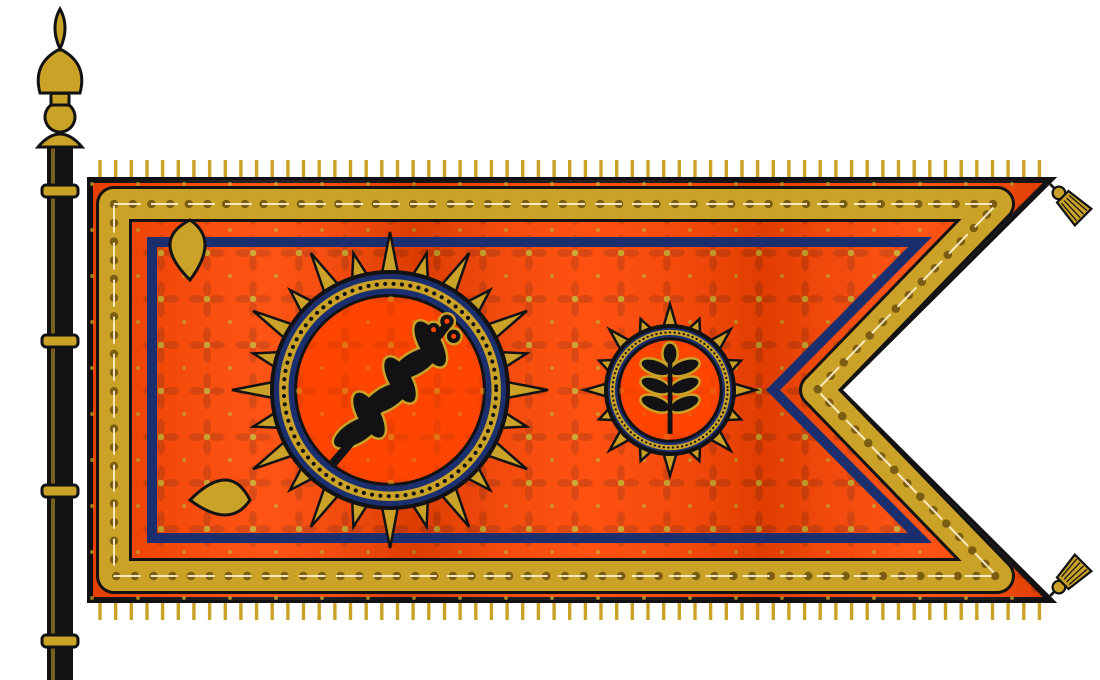
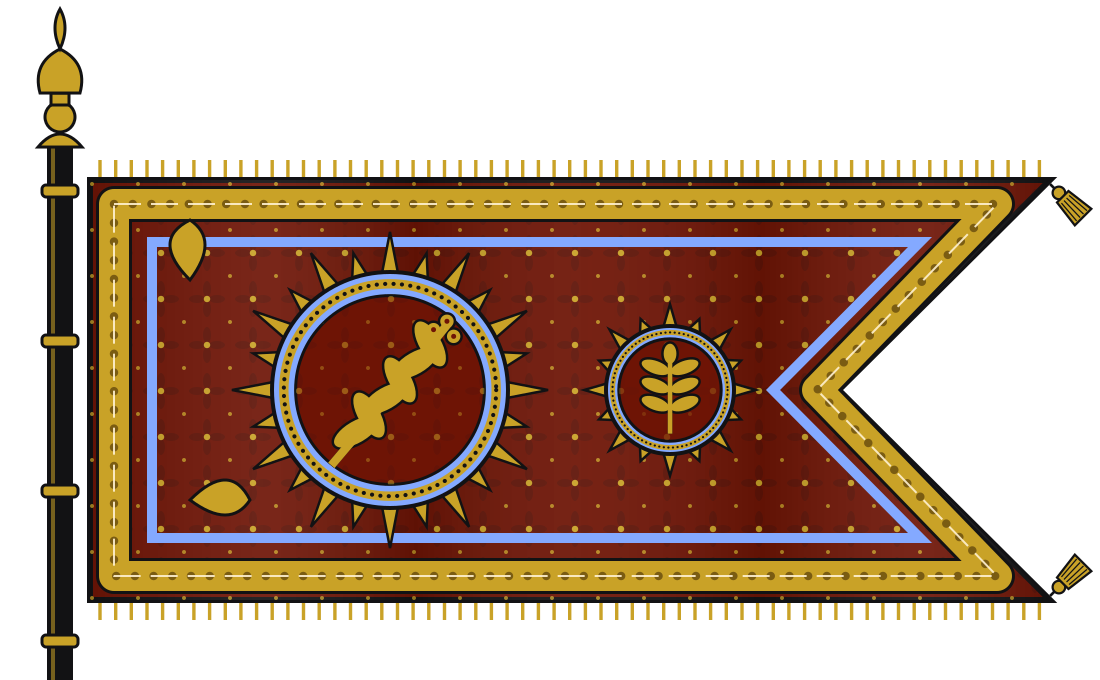
Every clan has every flag type; the type says the occasion and the colours say the clan. The outlined card is the flag the Atlas assigns.







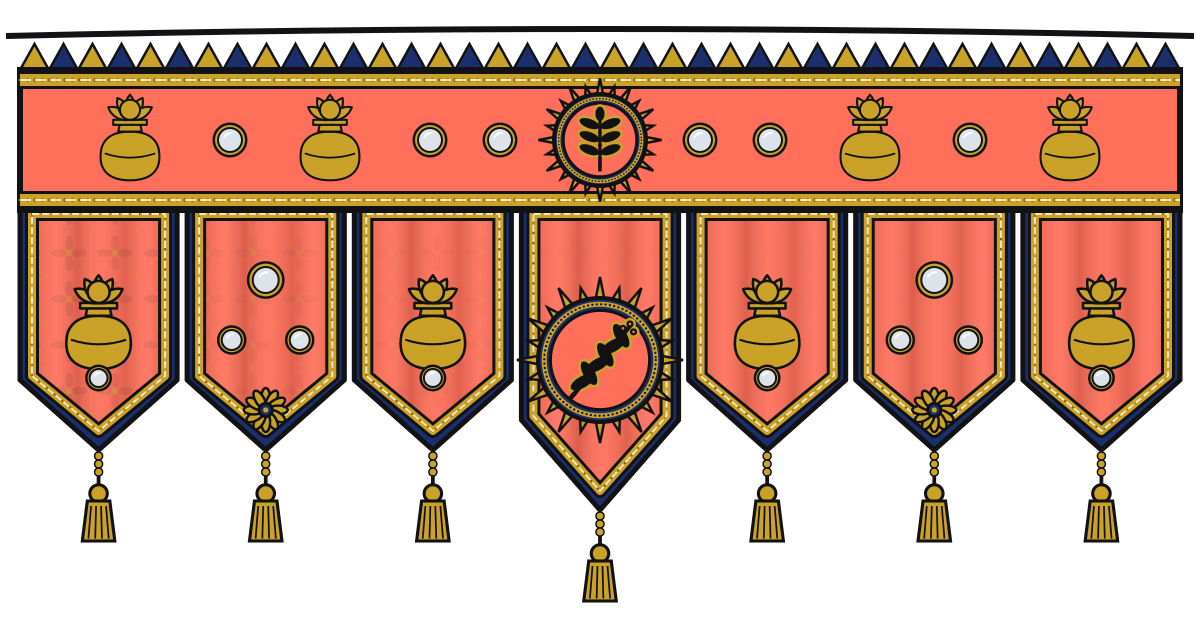
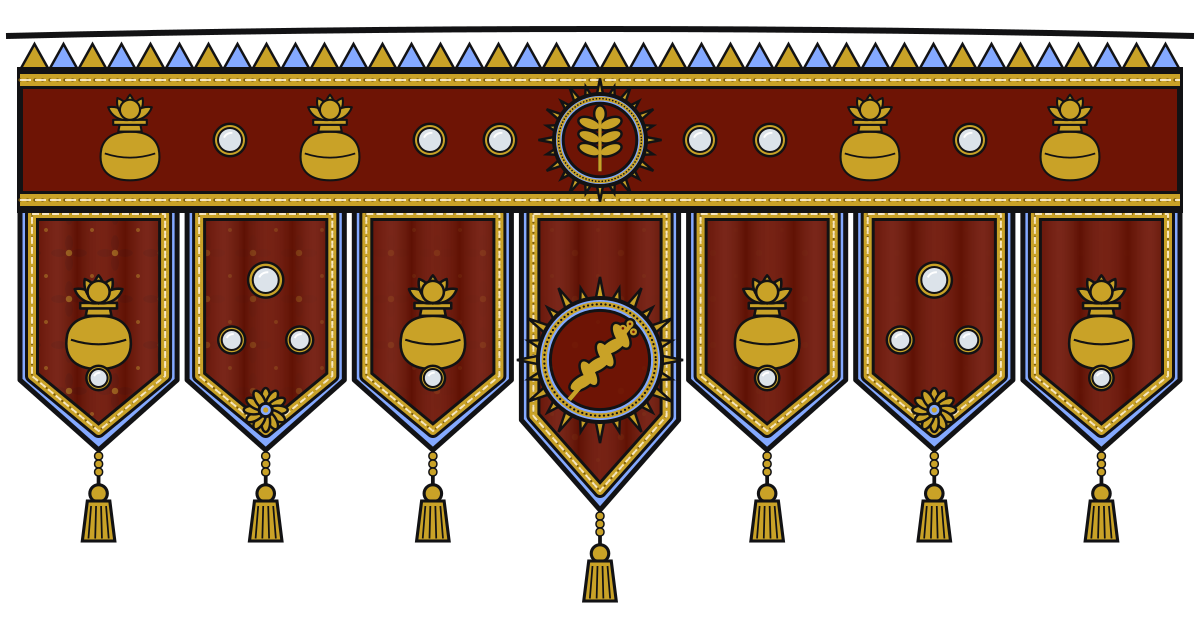

Historic banner
The Sarna flag (red and white) is used by many Adivasi Sarna followers, especially Oraon, in Jharkhand
New flag types
| Accessory | For this clan | Basis |
|---|---|---|
| A9 Pota-dhvaja · ship and trade flag For ships, caravans and markets | Not yet designed for this clan | Design |
| A10 Utsava-patāka · festival flag Light, bright flag for fairs and festivals | Not yet designed for this clan | Design |
| A11 Shoka-dhvaja · mourning flag White cloth with the emblem outline in the clan's metal | Not yet designed for this clan | Design |
7. Regalia
| Accessory | For this clan | Basis |
|---|---|---|
| E1 Chhatra · house parasol The ceremonial umbrella | Garlanded poles carried as umbrellas in the Jatra procession | Documented |
| E2 Chamara · fly-whisks The pair of whisks beside the head of the house | Yak-tail whisks carried in the Jatra procession | Documented |
| E3 Danda · staff of office Staff or scepter | Not yet designed for this clan | Design |
| E4 Simhasana · seat The seat of the house, covered in clan cloth | Not yet designed for this clan | Design |
| E5 Khetaka · shield A round shield; the Changi and Dhanush are its flag forms | Swords and shields carried in the Jatra procession | Documented |
| E6 Kula-ayudha · clan weapon The weapon the clan honours | Not yet found for this clan | Under research |
8. Worn
| Accessory | For this clan | Basis |
|---|---|---|
| F1 Kula-vastra · clan cloth The clan's woven pattern in its kit colours | Tolong, the loincloth worn by Kurukh men; the Tolong Siki script takes its name from it | Documented |
| F2 Kirti-vastra · honour cloth A cloth earned for a deed, not inherited | Not yet designed for this clan | Design |
| F3 Kula-mala · garland flower The flower or leaf the clan wears as a garland | Sal flower: women wear sal flowers in the hair, and sal flowers are placed over houses at Sarhul | Documented |
| F4 Chinha · house pin A metal badge with the pin emblem | Not yet designed for this clan | Design |
9. Records
| Accessory | For this clan | Basis |
|---|---|---|
| H1 Clan words A traditional line in the native script | कुँड़ुख़ · “Kurukh, the people's own name (Hahn linked it to 'speaker')” | Documented |
| H2 Biruda · titles The house's title or titles | Not yet found for this clan | Under research |
| H3 Prashasti · praise genealogy The lineage as written at the head of a grant | Not yet found for this clan | Under research |
| H4 Vahi · clan register The book of the clan's births, marriages and deaths | Not yet found for this clan | Under research |
| H5 Rana-ghosha · war cry The clan's cry in battle or celebration | Not yet found for this clan | Under research |
10. VishwaVit · knower of the world
Game values are design choices for this project, not historical claims.
References
- R. V. Russell and Hira Lal, The Tribes and Castes of the Central Provinces of India, vol. 4 (London, 1916), Project Gutenberg eBook #20668, https://www.gutenberg.org/ebooks/20668
- Lehigh University (Srishti Raj, Amardeep Singh), Adivasi Writers: Oraon (Kurukh) community, read 2026-10-21, https://scalar.lehigh.edu/adivasi-writers-indias-indigenous-literary-tradition/oraon-kurukh-community
- Wikipedia, Kurukh language, read 2026-10-21, https://en.wikipedia.org/wiki/Kurukh_language
- Wikipedia, Kurukh people, read 2026-10-21, https://en.wikipedia.org/wiki/Kurukh_people
- Sanjukta Das Gupta, Oraon Tana Vagat Movement, Banglapedia (revision 18 June 2021), read 2026-10-21, https://en.banglapedia.org/index.php/Oraon_Tana_Vagat_Movement
- Wikipedia, Sarhul, read 2026-10-21, https://en.wikipedia.org/wiki/Sarhul
- Sarna Burhi, Wikipedia (read 18 Oct 2026).
- Old Woman of the Forest: Chala Paccho, Jahira Buru, and more, Suppressed Histories (anonymous course blog, secondary; quotes Tribes of Jharkhand and Krishnamurthy and Bahadur, Ethnobotany of India, 2017), read 18 Oct 2026, link
- Nabarun Guha, Efforts to end ritualistic hunting results in reduced kills, Mongabay India, 7 May 2025, read 2026-10-10, link
- Tribal Research Institute Jharkhand (डॉ. रामदयाल मुंडा जनजातीय कल्याण शोध संस्थान), Oraon people, read 2026-10-21, https://trijharkhand.in/en/oraon
- Wikipedia, Tolong Siki, read 2026-10-21, https://en.wikipedia.org/wiki/Tolong_Siki
- Babul Chandra Sutradhar, Kurukh Voices: The Oraons of Bangladesh, The Daily Star, 4 July 2025, read 2026-10-21, https://www.thedailystar.net/slow-reads/unheard-voices/news/kurukh-voices-the-oraons-bangladesh-3932626
- R. V. Russell, The Tribes and Castes of the Central Provinces of India, vol. 3 (1916), Project Gutenberg #41424, read 2026-10-10, https://gutenberg.org/cache/epub/41424/pg41424-images.html
- Enamul Haq, Munda, Banglapedia (revision 18 June 2021), read 2026-10-21, https://en.banglapedia.org/index.php/Munda
- Serials Publications journal abstract, Mandar makers of Chhotanagpur (journal paper; title not printed in extract), read 2026-10-10, https://serialsjournals.com/abstract/74102_1-ahok.pdf
- Gumla, Jharkhand: Lord Hanuman's birthplace and the tribal lore and belief (Hindi), The Indian Tribal, 10 May 2023, read 10 Oct 2026, link
- Sushree Mohanty, Indigenous Colours of Odisha: Handbook on 62 Tribes (KISS), read 2026-10-20, link
- Vajiram and Ravi, Tribes of West Bengal, read 2026-10-21, https://vajiramandravi.com/current-affairs/tribes-of-west-bengal/
- Vandna Tete, असुरों की 'चमत्कारी' धातु लोहा, Sahapedia (Sahapedia-UNESCO Fellowship, interviews 2019), read 2026-10-20, https://www.sahapedia.org/asauraon-kai-camatakaarai-dhaatau-laohaa
- Wikipedia, Asur language, read 2026-10-20, https://en.wikipedia.org/wiki/Asur_language
- Wikipedia, List of Scheduled Tribes in Odisha, read 2026-10-20, https://en.wikipedia.org/wiki/List_of_Scheduled_Tribes_in_Odisha
- Wikipedia, Folk dances of Jharkhand, read 2026-10-10, https://en.wikipedia.org/wiki/Folk_dances_of_Jharkhand
- Native Picture, The Dying Sounds Of Rhythm (1 Jun 2021, updated 14 May 2025), read 2026-10-10, https://www.nativepicture.com/post/the-dying-sounds-of-rhythm
- Sangeet Galaxy, Jharkhand traditional instruments (Ashok Gope, Shakir Tasnim), read 2026-10-10, https://sangeetgalaxy.co.in/wp-content/uploads/2025/06/15.-Ashok-Gope-Shakir-Tasnim.pdf
- Project Atlas, row ST-241, Reference / source column: Ministry of Tribal Affairs, State/UT-wise list of Scheduled Tribes (Constitution (ST) Order 1950 as amended; list dated 09-07-2024); NFDIN (Nepal) list of 59 Adivasi Janajati; Bangladesh Small Ethnic Groups Cultural Institutions Act (list of 50, 2019)
- Wikipedia, Tribes of Jharkhand, read 2026-10-20, https://en.wikipedia.org/wiki/Tribes_of_Jharkhand
- Wikipedia, List of Scheduled Tribes in West Bengal, read 2026-10-21, https://en.wikipedia.org/wiki/List_of_Scheduled_Tribes_in_West_Bengal