The Omanatya are a people of Koraput and Nabarangpur districts in Odisha, listed as a Scheduled Tribe (Ministry of Tribal Affairs state-wise list dated 09-07-2024, per the Atlas) with 28,736 people in the 2011 Census[1][2]. Their name, also written Omanatyo or Amanatya[3], is linked to amatya, a minister or counsellor[4][5]. A tradition recorded by the Odisha State Tribal Museum and the Joshua Project says they are believed to descend from a minister of Sri Ram who later took to agriculture[3][4]. They are Odia-speaking cultivators of wetland paddy, sugarcane and ragi, who honour the deities Thakurani and Bhairab[3][4]. Dated history, temples, songs and proverbs are under research.
01Faith and deities
Majhighariani of Rayagada, goddess of the Koraput hills
The presiding goddess of the clan's homeland or capital: a link of place, not a recorded clan tie.
| Deity or tradition | Place in the clan's life | Evidence |
|---|---|---|
| Thakurani | Honoured by the people[4] | [4] |
| Bhairab | Honoured by the people[4] | [4] |
| Gram Devti | Honoured by the people[4] | [4] |
| Duma Devta | Honoured by the people[4] | [4] |
| Pujari and disari | Spiritual leaders[4] | [4] |
02Temples
No temple, shrine or built place of the people is named in the extracts.
Built by the clan
Not recorded.
Given patronage or grants by the clan
Not recorded.
03Languages and scripts
| Language or script | Kind | Under the clan | Evidence |
|---|---|---|---|
| Odia living | Main language: 16,000 speakers, no year[4] | Spoken by the people | [4] |
| Pengo | Secondary language[4] | Spoken by some of the people | [4] |
| Bhatri | Secondary language[4] | Spoken by some of the people | [4] |
| Telugu | Secondary language[4] | Spoken by some of the people | [4] |
| Hindi | Secondary language[4] | Spoken by some of the people | [4] |
| Desiya | Secondary language[4] | Spoken by some of the people | [4] |
| Bengali | Secondary language[4] | Spoken by some of the people | [4] |
| Native name | Printed in Devanagari only: ओमनतया; the Odia form is not in the extracts[4] | Written form | [4] |
04Books and literature
No book or written work of, or about, the people is named in the extracts.
Written during the clan's history
Not recorded.
Given patronage by the clan
Not recorded.
05Thinkers and scholars
Not recorded.
No thinker or scholar of the people is named in the extracts.
06Art and architecture
The extracts name no painting, sculpture or temple. The people's houses and crafts are the only art recorded.
Painting and wall art
Not recorded.
Sculpture and temple art
Not recorded.
Temple and building architecture
Weaving and textiles
Not recorded.
Clothing and jewellery
Not recorded.
Coins, pottery and crafts
07History
The name (undated)
The Joshua Project links the name to Amatya, a minister or counsellor[4]. The Koraput district website says the people "possibly derive their name from the word 'Amatya'", glossed as "Minister of State Affairs in the ancient Indian princely provinces"[5].
A legend of descent (undated)
The Odisha State Tribal Museum says the people are "believed to have descended from a minister of Sri Ram who later took to agriculture"[3]. The Joshua Project gives the same legend of a minister in Sri Ram's court who took up agriculture[4]. The sources give no date for it and name no ancestor.
Koraput records (2004)
The Orissa Reference Annual 2004 lists the Omanatya among the tribes of Koraput district, which then included Malkangiri[6]. The Odisha State Tribal Museum calls them an "Odia-speaking cultivating class of tribals"[3].
Earlier history
Under research. No inscription, dated record or earlier history of the people is in the pack. The Atlas names the Jeypore kingdom as the historical polity, but no extract links the people to it.
08Journey and migrations
Under research. The extracts record no migration for the Omanatya. The Koraput page's account of migration belongs to the Bhottada (Bhottara), not to this people.
Not recorded.
09Seats and lands
| Place | Role | Where today |
|---|---|---|
| Koraput district | Main area: Borigumma, Jeypore, Kotpad and Kundra blocks[5] | Odisha |
| Nabarangpur district | Named with Koraput as the main districts[4]; the Odisha State Tribal Museum spells it Nabrangpur | Odisha |
| Hill slopes and foothills near streams | Where the people settle[4] | Koraput and Nabarangpur |
| Andhra Pradesh | 2,500 people, no year given[4] | Andhra Pradesh |
10Notable figures
| Name | Role | Era | Known from |
|---|---|---|---|
| Minister of Sri Ram legend | Ancestor of the people in the legend, who took to agriculture | Legendary, no date | [3][4] |
| Sri Ram legend | The master of the minister in the legend | Legendary, no date | [3] |
11Allies, rivals and marriages
Not recorded.
12Society and livelihood
Mostly nuclear families, living in separate hamlets, with village councils under hereditary leaders (Joshua Project). The extracts do not state endogamy or exogamy for this people.
Government and social order
| Institution or group | What it was | Evidence |
|---|---|---|
| Nuclear family | Mostly nuclear families[4] | [4] |
| Hamlets | Separate hamlets[4] | [4] |
| Village council | Under hereditary leaders[4] | [4] |
Livelihood over time
| Era | Livelihood | Evidence |
|---|---|---|
| Not dated | Wetland cultivation of paddy, sugarcane, tobacco, ragi, with pulses and oilseeds; cattle, goats, sheep and poultry | [3][4] |
| Not dated | Fishing, occasional hunting, manual labour in the lean season, and rearing bullocks | [3] |
13Sub-clans and related clans
The Joshua Project gives two subgroups and six totemic clans for the Omanatya. The extracts name no further sub-clans, gotras or divisions for this people.
| Clan | Relation | Where | Size | In the Atlas | Evidence |
|---|---|---|---|---|---|
| Bodo | Sub-clan | Not stated | 6,100, no year given[4] | new clan candidate | [4] |
| Sanno | Sub-clan | Not stated | 6,100, no year given[4] | new clan candidate | [4] |
| Tiger | Sub-clan | new clan candidate | [4] (totemic clan, English name as given) | ||
| Cobra | Sub-clan | new clan candidate | [4] (totemic clan, English name as given) | ||
| Tortoise | Sub-clan | new clan candidate | [4] (totemic clan, English name as given) | ||
| Parrot | Sub-clan | new clan candidate | [4] (totemic clan, English name as given) | ||
| Pumpkin | Sub-clan | new clan candidate | [4] (totemic clan, English name as given) | ||
| Stone | Sub-clan | new clan candidate | [4] (totemic clan, English name as given) |
Clans marked "new clan candidate" are not in the Atlas yet.
14Surnames
The extracts name no surname used by this people.
Not recorded.
15Songs and music
Songs and dances are central to the people's life (Joshua Project). No song is named, quoted or dated in the extracts.
None recorded yet.
Instruments and styles
| Instrument or style | What it is | Evidence |
|---|---|---|
| Junia Nach | Dance named on the Koraput page | [5] |
| Chera Chera Nach | Dance named on the Koraput page | [5] |
16Poems, lullabies and children's rhymes
None recorded yet.
17Stories, legends and proverbs
Stories and legends
| Story | What happens | Told by | Evidence |
|---|---|---|---|
| Descent from a minister of Sri Ram legend | A minister in Sri Ram's court takes up agriculture, and the people are believed to descend from him | Not named in the sources | [4][3] |
Proverbs and sayings
Not recorded.
18Festivals and fairs
Not recorded.
19Food, dress and games
Food
Not recorded.
Dress
| Item | What it is | Evidence |
|---|---|---|
| Men | Simple clothing[5] | [5] |
| Women | Traditional jewellery, including a distinctive black bead necklace[5] | [5] |
Games and martial arts
Not recorded.
Tags: living still practised · revived brought back after a break · lost known only from records · research reported but not yet confirmed from a source. Songs and poems under copyright are listed by title only; restricted or sacred material is noted without its content.
20Status today
The Omanatya are a Scheduled Tribe of Odisha (state-wise list dated 09-07-2024, per the Atlas), one of the 62 listed in the state, and not a PVTG[3][1]. The 2011 Census counts 28,736 of them[2].
No community review is recorded for this page.
21For children
The minister who took to the land
Long ago, a people in the Koraput hills were called the Omanatya. Their name may come from amatya, the word for a minister. In a legend, people say their forefather was a minister in the court of Sri Ram, who later chose to farm the land. Today the Omanatya live on the hill slopes and foothills of Koraput and Nabarangpur, near the streams. They grow paddy, ragi and sugarcane in wet fields, and they keep cattle, goats and sheep. Each clan is marked by a totem, such as the tiger, the cobra, the tortoise, the parrot, the pumpkin or the stone. Songs and dances are very important to them, and their village councils are led by hereditary leaders.
22Across the project
| Project | What carries this clan | Status |
|---|---|---|
| Atlas of the Janas | Koraput and Nabarangpur districts (Atlas homeland); no coordinates in the extracts | No pin yet |
| KulDevi and GrahDevi | Majhighariani, the project KulDevi (KD-013); no clan deity in the extracts. Saptamatrika (+Narasimhi) family | From the Atlas |
| Planet naming | Not yet checked against the GrahDevi forms | To check |
| Renaming and waters | Hill slopes and foothills near streams[4]; no place or water name drawn from the people yet | — |
23Open questions
- Only the Devanagari form ओमनतया is printed; the Odia native script and any Odia names for the subgroups and totems are still to find.
- The totemic clan names (tiger, cobra, tortoise, parrot, pumpkin, stone) are English glosses from the Joshua Project; the people's own names are not in the pack.
- Bodo and Sanno: confirm the subgroup names from a second source. The Koraput page's Bodo and Bada names belong to the Bhottada (Bhottara).
- Which text, if any, the Sri Ram minister legend comes from is not stated in the sources.
- Thurston, Castes and Tribes of Southern India, vol. 4, and the Vizagapatam Wikisource page are leads, not yet fetched.
- Population: 28,736 (2011 Census) and Joshua Project's 33,000 with no year do not match; Joshua Project's Odisha and Andhra Pradesh figures (30,000 and 2,500) are also undated.
- Andhra Pradesh is outside the Atlas's state (Odisha); whether to add a footprint is for the host to decide.
- Language tag: set to 'und' (undetermined) because the only native form printed is Devanagari (Joshua Project); an Odia tag can follow once an Odia form is found.
- No pin coordinates, years or Official status list text are in the extracts for the Atlas.
- Community review of the page has not happened.
- The Sri Ram minister legend has no native-script name or transliteration in the extracts; it is given in English only.
- Contradiction: the info row 'Main deity' names Majhighariani, but the deities note says she is not a clan deity, since no clan deity is named in[4],[3] or[5].
- Contradiction: the page says one of the 62 Scheduled Tribes of Odisha[3]; the Wikipedia list text says 64 recognised and 13 PVTGs, with a table of 62 numbered rows[1]. The count is not settled.
24Astitva
अस्तित्व · being, existence: everything by which the clan is known
The extracts document one accessory for this people: the totemic clans[4]. No coin, seal, plate, title, war cry, guardian tree or garland flower is named.
Every clan has every accessory, royal objects included. Each one says how it is known: Documented This clan's own object is recorded. · Regional tradition Recorded for the region or for peoples like this one, not for this clan. · Design Made for this project, with no historical claim. · Under research To be found for this clan from sources. Legends and titles are written in the clan's own script.
1. Seals and coins
| Accessory | For this clan | Basis |
|---|---|---|
| B1 Rajamudra · house seal Round seal with the clan emblem and a short legend in the clan's script | Not yet designed for this clan | Design |
| B2 Anguliya-mudra · signet ring Personal seal ring of the head of the house | Not yet designed for this clan | Design |
| B3 Chhapa · house stamp Ink or block stamp for letters, goods and cloth | Not yet designed for this clan | Design |
| B4 Tamrapatra · charter plate Copper-plate grant on a ring, closed with the house seal | Not yet designed for this clan | Design |
| B5 Shreni-mudra · guild or trade seal Seal for the clan's trade, craft or caravan | Not yet designed for this clan | Design |
| C1 Clan coin Emblem or deity on one side, a legend in the clan's script | Not yet designed for this clan | Design |
| C2 Coin die The die that strikes the coin | Not yet designed for this clan | Design |
2. Living symbols
| Accessory | For this clan | Basis |
|---|---|---|
| I1 Totem trio The tree, bird and animal the clan protects | Totemic clans: tiger, cobra, tortoise, parrot, pumpkin and stone (English names as the Joshua Project gives them) | Documented |
| I2 Kaval-maram · guardian tree The tree that stands at the clan's seat | Not yet found for this clan | Under research |
3. Stone and gate
| Accessory | For this clan | Basis |
|---|---|---|
| G1 Torana · gateway The built gate of the seat; the cloth Toran hangs in it | Not yet designed for this clan | Regional tradition |
| G2 Viragallu · hero stone Carved panel stone for a member who died defending the clan | Not yet designed for this clan | Regional tradition |
| G3 Kula-shila · clan stones Standing and table stones that remember the ancestors | Not yet designed for this clan | Design |
| G4 Jayastambha · victory pillar A pillar raised for a victory | Not yet designed for this clan | Design |
| G5 Sima-shila · boundary stone Marks the clan's land, with a line in the native script | Not yet designed for this clan | Design |
4. Sounds
| Accessory | For this clan | Basis |
|---|---|---|
| D1 Pancha-mahashabda · five great sounds The right to five instruments | Not yet designed for this clan | Design |
| D2 Shankha · clan conch The clan's own named war conch | Not yet designed for this clan | Design |
| D3 Murasu · house drums Three drums: war, charity and justice | Not yet designed for this clan | Design |
5. Kit: colours, metals and emblems
No coin, seal or title is recorded for the Omanatya in the extracts. Their totemic clans are the only documented symbols[4]. The Atlas's main emblem is a plateau for Koraput, a design idea and not a documented symbol.
| Part of the kit | This clan |
|---|---|
| Field | Warm Red-Orange #FF6F59 |
| Accent | Intense Electric Blue #84A9FF |
| Emblem colour | Charcoal Black #121214 |
| Zari metal | Gold |
| Main emblem | A plateau |
| Second image | — |
| Night and day | Every visual accessory has two versions: by night the emblem on the dark field, by day the clan's field colour on cloth woven from its metal. |
6. Flags
Every clan has every flag type; the type says the occasion and the colours say the clan. The outlined card is the flag the Atlas assigns.
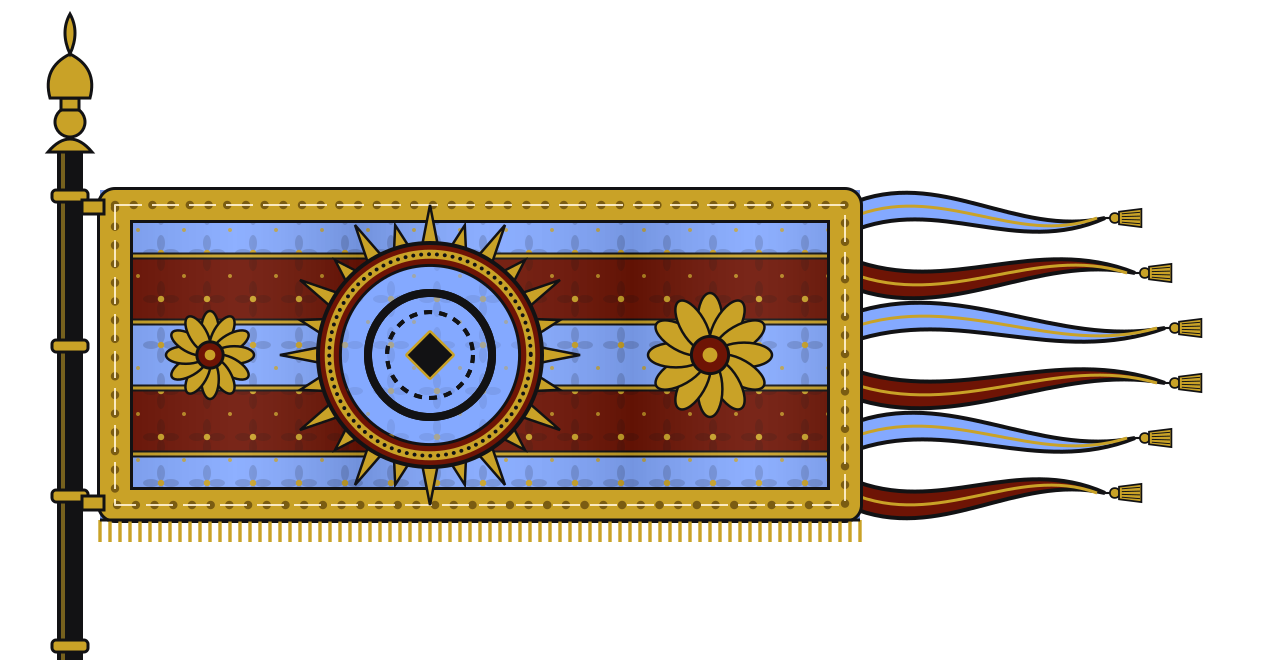
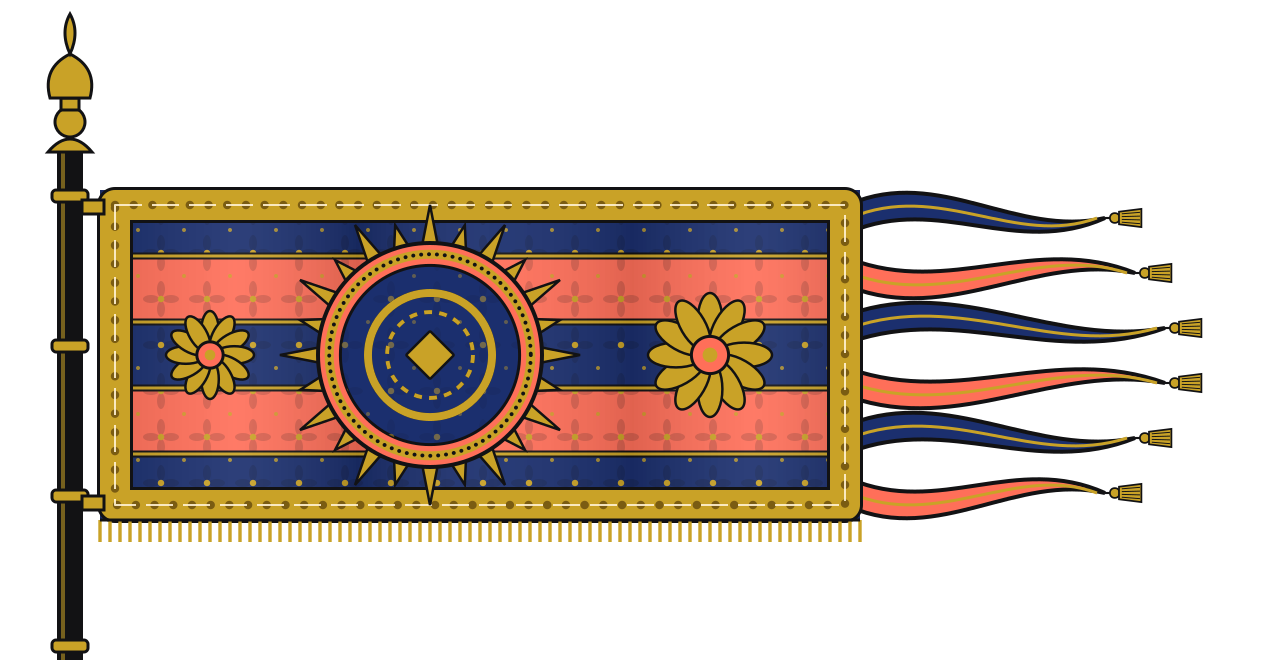
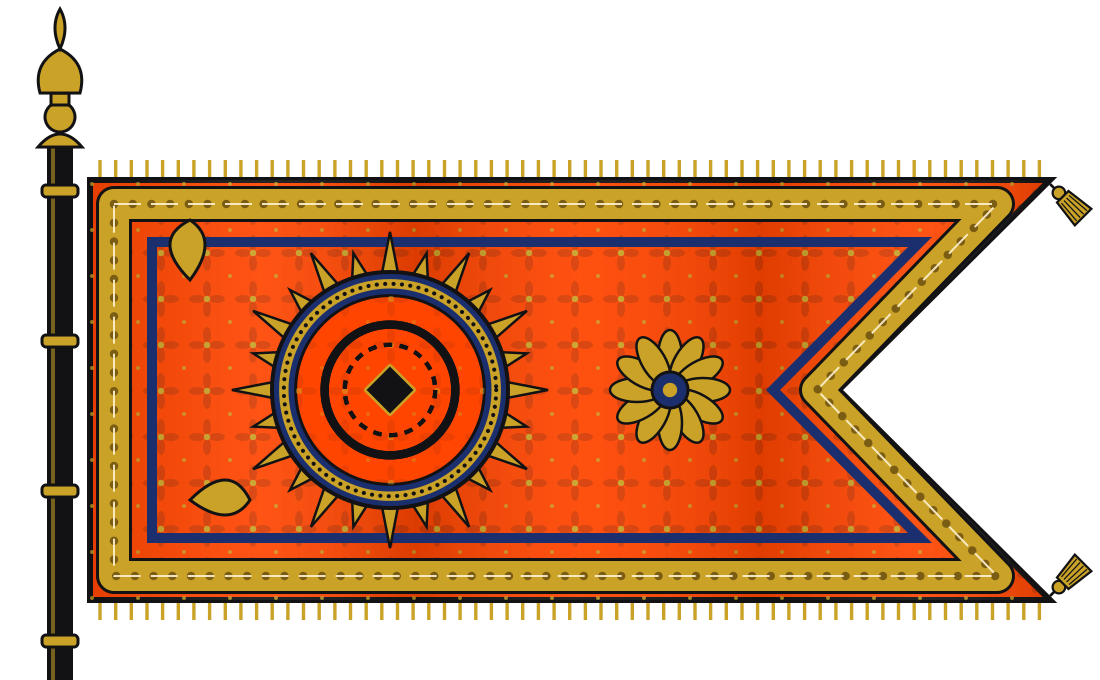
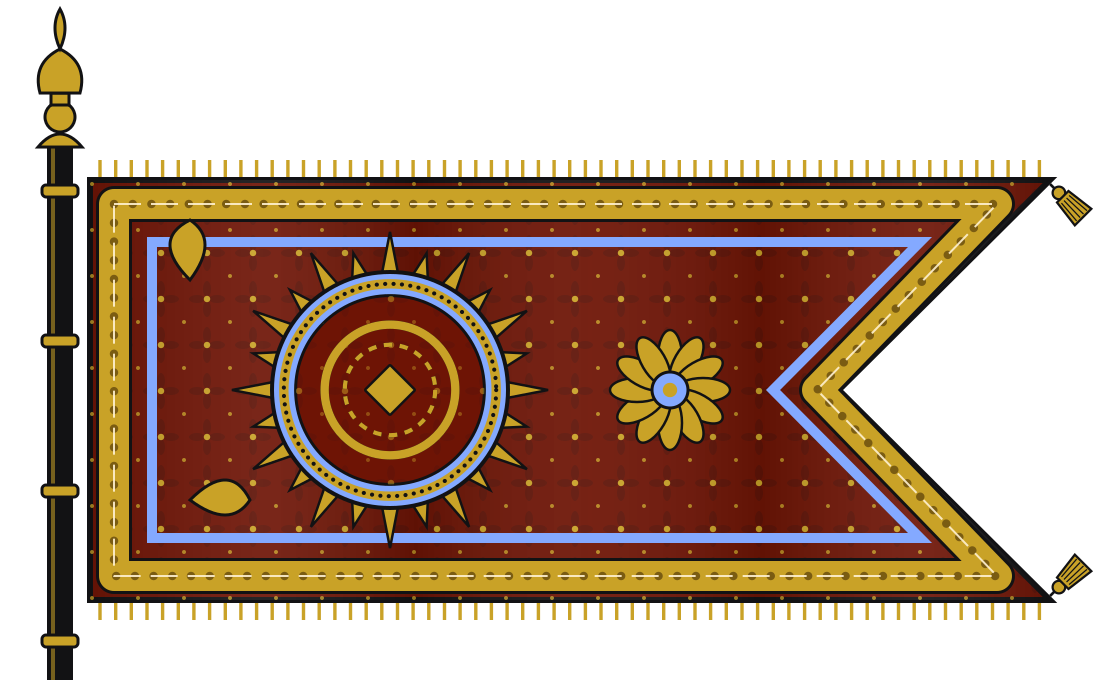

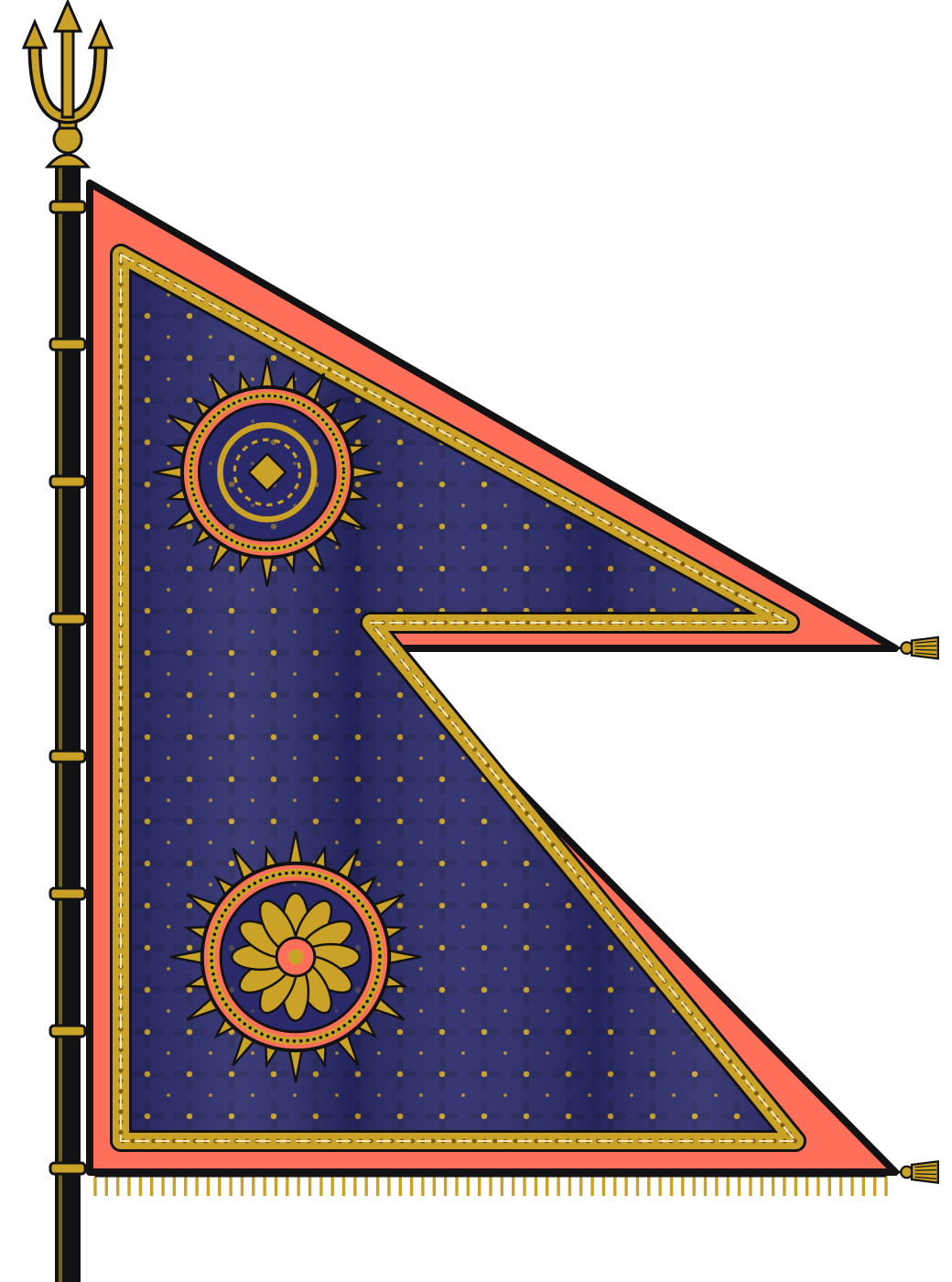

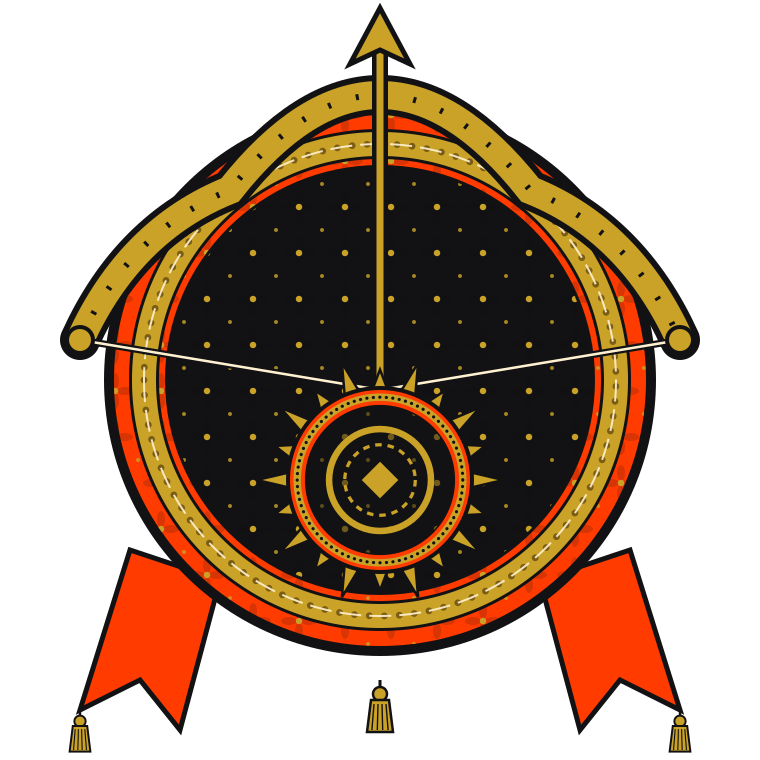
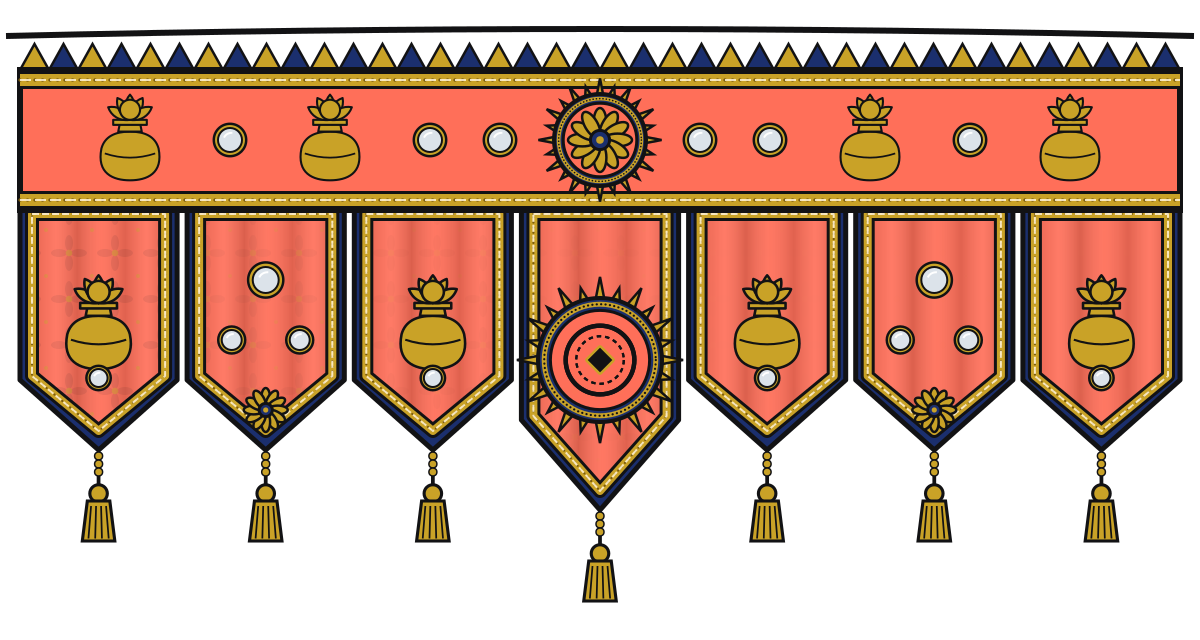
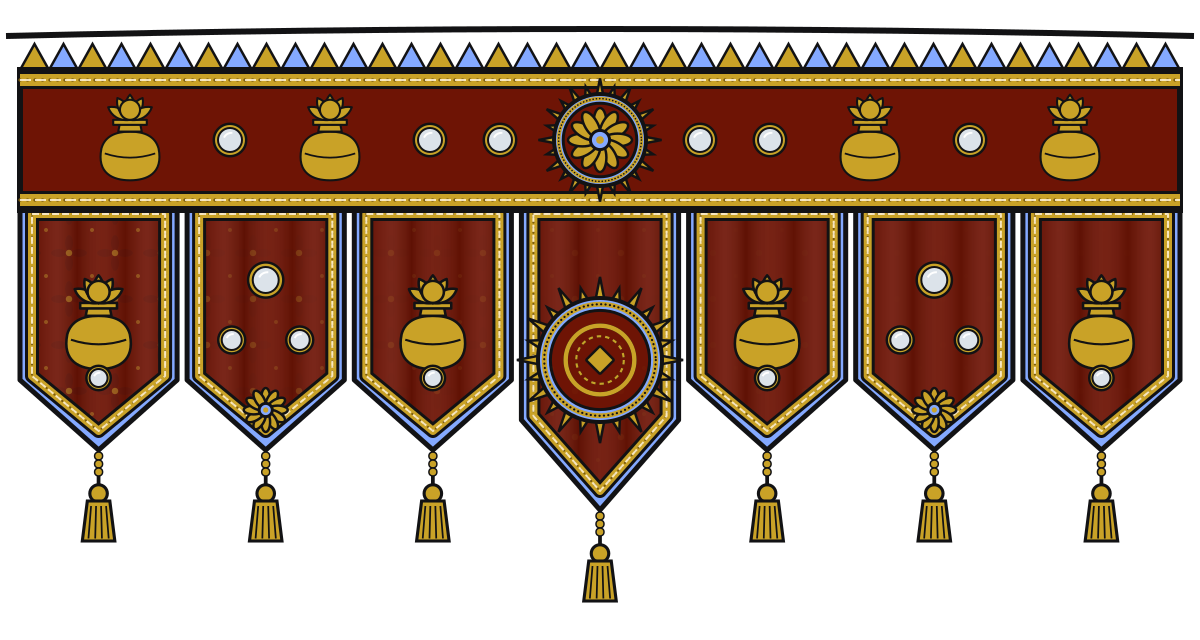
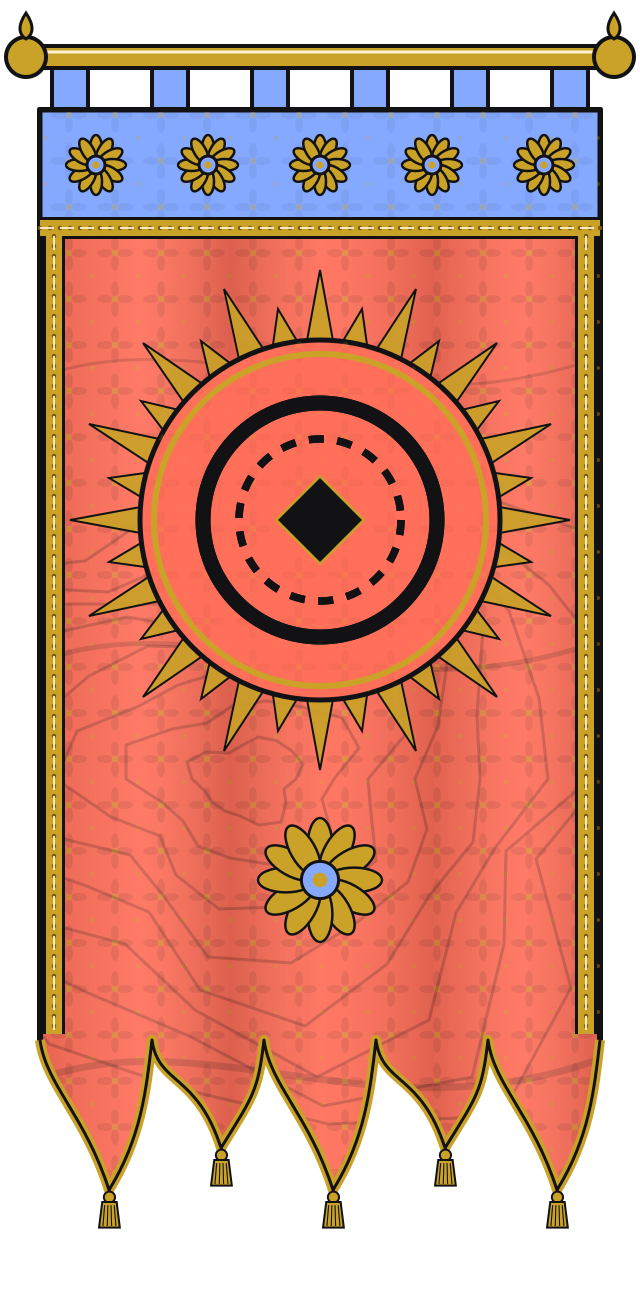
Historic banner
None known
New flag types
| Accessory | For this clan | Basis |
|---|---|---|
| A9 Pota-dhvaja · ship and trade flag For ships, caravans and markets | Not yet designed for this clan | Design |
| A10 Utsava-patāka · festival flag Light, bright flag for fairs and festivals | Not yet designed for this clan | Design |
| A11 Shoka-dhvaja · mourning flag White cloth with the emblem outline in the clan's metal | Not yet designed for this clan | Design |
7. Regalia
| Accessory | For this clan | Basis |
|---|---|---|
| E1 Chhatra · house parasol The ceremonial umbrella | Not yet designed for this clan | Design |
| E2 Chamara · fly-whisks The pair of whisks beside the head of the house | Not yet designed for this clan | Design |
| E3 Danda · staff of office Staff or scepter | Not yet designed for this clan | Design |
| E4 Simhasana · seat The seat of the house, covered in clan cloth | Not yet designed for this clan | Design |
| E5 Khetaka · shield A round shield; the Changi and Dhanush are its flag forms | Not yet designed for this clan | Regional tradition |
| E6 Kula-ayudha · clan weapon The weapon the clan honours | Not yet found for this clan | Under research |
8. Worn
| Accessory | For this clan | Basis |
|---|---|---|
| F1 Kula-vastra · clan cloth The clan's woven pattern in its kit colours | Not yet designed for this clan | Design |
| F2 Kirti-vastra · honour cloth A cloth earned for a deed, not inherited | Not yet designed for this clan | Design |
| F3 Kula-mala · garland flower The flower or leaf the clan wears as a garland | Not yet found for this clan | Under research |
| F4 Chinha · house pin A metal badge with the pin emblem | Not yet designed for this clan | Design |
9. Records
| Accessory | For this clan | Basis |
|---|---|---|
| H1 Clan words A traditional line in the native script | — · “Under research” No line of the people's own is in the pack, and no classical line has been linked to them. | Documented |
| H2 Biruda · titles The house's title or titles | Not yet found for this clan | Under research |
| H3 Prashasti · praise genealogy The lineage as written at the head of a grant | Not yet found for this clan | Under research |
| H4 Vahi · clan register The book of the clan's births, marriages and deaths | Not yet found for this clan | Under research |
| H5 Rana-ghosha · war cry The clan's cry in battle or celebration | Not yet found for this clan | Under research |
10. VishwaVit · knower of the world
Game values are design choices for this project, not historical claims.
References
- Wikipedia, List of Scheduled Tribes in Odisha, read 2026-10-20, https://en.wikipedia.org/wiki/List_of_Scheduled_Tribes_in_Odisha
- Sushree Mohanty, Indigenous Colours of Odisha: Handbook on 62 Tribes (KISS), read 2026-10-20, https://kissnew.kiss.ac.in/wp-content/uploads/2026/05/Indigenous-Colours-of-Odisha-Handbook-on-62-Tribes-Sushree-Mohanty.pdf
- Odisha State Tribal Museum (SCSTRTI), "Omanatyo, Amanatya", read 30 October 2026, https://ostm.in/?p=5477
- Joshua Project, "Omanatya", read 30 October 2026, https://joshuaproject.net/people_groups/17799
- Koraput district website, "Major Tribes of Koraput", read 30 October 2026, https://koraput.odisha.gov.in/en/more/tribal-communities
- Orissa Reference Annual 2004, p. 448, "Tribal Communities of Orissa (District Wise)", read 2026-10-30, link (no Matya row)