The Newars are the people of the Kathmandu valley in Nepal, who speak Nepal Bhasa and write it in the Newa script[1][2]. The Licchavi kingdom and then the Malla kings ruled the valley from about the 5th century until the Gorkha conquest of 1767–69[3][1]. The Malla kings built the Taleju temple in Kathmandu in 1564, and the goddess Taleju Bhawani was the royal tutelary deity of the Malla rulers; she is the Newar KulDevi in the Atlas[4][5]. The 2021 census of Nepal counted 1,341,363 Newars, 4.6% of the population[6][1].
01Faith and deities
The KulDevi in the Atlas (Documented; the royal goddess of the Malla kings). Wikipedia calls her the royal tutelary deity of the Malla rulers, and Live History India says Newars regard her as their patron goddess[5][7]. The lineage deity of the digu dya is not named in the sources, so the sheet's KulDevi stands as the main deity.
Royal goddess of the Malla kings[5]
A recorded tie between the clan and the goddess.
| Deity or tradition | Place in the clan's life | Evidence |
|---|---|---|
| Ganesh | Worshipped first, before the other deities | [1] |
| Mother goddesses and Bhairavas | The mother goddesses and the Bhairavas of the Newar pantheon | [1] |
| Kumari | The living goddess, a form of Taleju, chosen from the Shakya caste (and the Bajracharya may audition) | [1][5] |
| Digu dya | The lineage's tutelary deity, shown by crude or carved stones | [8] |
| Aakash Bhairab | Mask used in the opening of Indra Jatra (Yenya) | [9] |
| Karunamaya | Buddhist deity honoured in Jana Baha Dyah Jatra | [9] |
| Surya and Shiva | Sun rite (Bahra) and Shiva marriage to the bael tree | [1] |
| Manjusri | Drained the valley lake in the Swayambhu Purana legend | [1] |
02Temples
The Malla kings built the Taleju temples; Newar priests serve the Guhyeshwari and Taleju shrines.
Built by the clan
| Temple | Deity | Built by | When | Where |
|---|---|---|---|---|
| Taleju Temple, Hanuman Dhoka | Taleju Bhawani | Mahendra Malla | 1564 | Kathmandu, Durbar Square[4] |
| Taleju Temple, Bhaktapur | Taleju Bhawani | Mahendra Malla (per Live History India) | About the 1550s | Bhaktapur[7][10] |
| Mul Chok | Not stated | Yakshamalla | 1455 | Kathmandu valley[3] |
Given patronage or grants by the clan
| Temple | Deity | What the clan gave | When | Where |
|---|---|---|---|---|
| Guhyeshwari Temple | Guhyeshwari (Shakti Peetha) | Priestly service: Karmacharya priests do the tantric rites; Rajopadhyaya Brahmins the Vedic rites (a service tie) | Daily | Kathmandu[11][12] |
| Taleju temples of Kathmandu, Patan and Bhaktapur | Taleju Bhawani | Rajopadhyaya and Karmacharya priests serve her | — | The valley[5] |
| Pashupatinath | Shiva | Patrons: Chatharīya Shresthas | — | Kathmandu[13] |
| Bhagavan Bahal | Buddhist vihara | Patronised by the Pradhans | — | Thamel, Kathmandu[13] |
| Swatha | Buddhist vihara | Patronised by the Amatyas | — | Lalitpur[13] |
03Languages and scripts
| Language or script | Kind | Under the clan | Evidence |
|---|---|---|---|
| Nepal Bhasa (Newari) living | Tibeto-Burman language; five dialects (Kathmandu-Lalitpur, Bhaktapur, Dolakha, Chitlang, Pahari) | About 846,000 native speakers (2011); official in Bagmati Province and Sikkim | [1] |
| Newa script | Writing system: Nepalakshara, Nepala lipi, Nevah akhah, Pracalit lipi | Used from the 10th century; in Unicode 9.0 (2016) as the 'Newa' block | [2] |
| Sanskrit | Court and inscription language | Used with Nepal Bhasa in the 1654 Pratap Malla polyglot inscription | [1][2] |
| Maithili | Court language | Given equal status with Sanskrit at the Malla court | [1] |
04Books and literature
Nepal Bhasa works of the Malla period survive in manuscripts and records; the works below are listed as the sources give them.
Written during the clan's history
| Work | Author | Kind | When | Link to the clan |
|---|---|---|---|---|
| Manava Nyayashastra | Not stated | Law book | 1380 | [1] |
| Gopalaraja Vamsavali | Not stated | Chronicle of the valley's kings | 1389 | [1] |
| Brihat Jataka (manuscript) | Not stated | Manuscript | 1399 | [2] |
| Ramayana (manuscript) | Not stated | Manuscript; the oldest of its kind listed | 1019 | [2] |
| Abhijnana Shakuntala (manuscript) | Not stated | Manuscript; the oldest of its kind listed | 12th century | [2] |
| Devikavacha stotra | Not stated | Stotra (manuscript) | 11th century | [2] |
| Glory of Ekadashi | Not stated | Manuscript | 1837 | [2] |
| Dhon Cholecha and Swasthani Bakhan | Not stated | Works in Nepal Bhasa (kind not given) | — | [1] |
| Madhava Nidana | Madhava | Medical text; a Nepal manuscript in Nepalakshara (the Newar script) | No manuscript date; the record estimates the text around the 7th century | [14] |
Given patronage by the clan
| Work | Author | What the clan gave | When | Evidence |
|---|---|---|---|---|
| Bhagavata Purana (translation) | Not stated | Commissioned by Devakidevi, daughter of King Bhuwana Malla | 1505 | [1] |
05Thinkers and scholars
| Name | Field | Era | Contribution |
|---|---|---|---|
| Mahendra Malla (r. 1560–1574) | Poet | 1560–1574 | Called Adikavi (first poet); the earliest known Nepal Bhasa poems[1] |
| Jagat Prakasha Malla | Playwright | — | Bhaktapur's first playwright[1] |
| Nisthananda Bajracharya, Siddhidas Amatya, Jagat Sundar Malla, Yogbir Singh Kansakar | Writers of the Nepal Bhasa renaissance | 1909–1941 | The Four Pillars[1] |
| Chittadhar Hridaya | Writer | — | Named as a Nepal Bhasa writer[1] |
| Moti Laxmi Upasika | Writer | — | Named in the Newar article[1] |
The Nepal Bhasa renaissance of 1909–1941 is the period the Newar article names for the Four Pillars.
06Art and architecture
What survives is mostly painting, metalwork, carving and architecture in the valley.
Painting and wall art
| Art form | What it is | Era | Evidence |
|---|---|---|---|
| Paubha | Painted scroll and icon; the earliest dated paubha is the Vasudhara Mandala | 1365 CE (NS 485) | [1] |
| Raj Man Singh Chitrakar | Watercolour | 1797–1865 | [1] |
| Bhaju Man Chitrakar | Painter | 1817–1874 | [1] |
| Tej Bahadur Chitrakar | Painter | 1898–1971 | [1] |
| Chandra Man Singh Maskey | Painter | — | [1] |
Sculpture and temple art
| Art form | What it is | Era | Evidence |
|---|---|---|---|
| Repoussé | Relief work in metal | — | [1] |
| Wood carving | Carved wood | — | [1] |
| Lost-wax casting | Metal casting | — | [1] |
Temple and building architecture
| Art form | What it is | Era | Evidence |
|---|---|---|---|
| Pagoda, shikhara, stupa and chaitya | Forms of valley architecture | — | [1] |
| Carved windows and bahal courtyards | Carved windows and monastic courtyards | — | [1] |
| Golden Gate, Bhaktapur | Carved gate | — | [1] |
Weaving and textiles
Not recorded.
Clothing and jewellery
Not recorded.
Coins, pottery and crafts
Not recorded.
07History
The name in early records (4th–8th century)
Nepala appears in Indian inscriptions from the 4th century AD, and Samudragupta (353–373) claimed tribute from a 'lord of Nepal'[3]. A Sanskrit inscription of 512 at Tistung has 'greetings to the Nepals', and Newari words appear in Licchavi inscriptions dated 400–879 CE[1]. The term 'Newar' first appears in a Kathmandu inscription of 1654[1].
Licchavi kings (464–733)
The Licchavi dynasty ruled the valley from about the 5th to the 9th century. The earliest known record is the inscription of Manadeva I, dated 464, and the last Licchavi inscription is dated 733[3]. The Gopalaraja Vamsavali lists the Gopal kings, the Mahispals and the Kirats before the Licchavis[1].
Malla kings (1200–1769)
Arimalla (r. 1200–1216) was the first to adopt the title Malla. Harisinha-deva of Simraun conquered Nepal c. 1324, and Jayasthitimalla united the valley and codified its law[3]. Sthitimalla (1382–1395) codified caste[3]. Yakshamalla's kingdom later split into Kathmandu, Patan and Bhadgaon, and Ratnamalla seized Kathmandu in 1484[3]. Maithili had equal status with Sanskrit at the Malla court[1].
Taleju and the Malla court
The Malla royal family adopted Manesvari, the goddess Taleju, as their personal deity[3]. Mahendra Malla (r. 1560–1574) built the Taleju temple in Kathmandu in 1564; it is the principal shrine of Taleju Bhawani and her living embodiment, the Kumari[4][1]. Live History India says the Malla kings claimed her as patron and that the Bhaktapur shrine was built about the 1550s under Mahendra Malla[7].
Script and first texts (908–1173 CE)
The Newar script is first seen in a Lankavatara Sutra manuscript of 908 CE, and the first inscription is Shankaradeva's at Jaishideval, Kathmandu, of 920 CE[2]. The Uku Bahah palm-leaf of 1114 CE is the earliest full document in Nepal Bhasa, and the Bajrayogini inscription of King Rudradeva (1173 CE) is the first full inscription[1]. The Newar article names a coin of Shivadeva (1098–1126 CE) as the first coin of the Newar script[2].
Gorkha conquest and the Ranas (1767–2006)
The Battle of Kirtipur in 1767 began the Gorkha conquest, which ended the Malla kingdoms in 1768–69[1]. Prithvi Narayan Shah established modern Nepal in 1768[3]. Nepal Bhasa was the state language from the 14th century to 1769, was suppressed under the Ranas from the 1840s until 2006, and the Newar script was banned from late 1906, when Devanagari replaced it[1][2].
08Journey and migrations
Newar merchants and settlers took the trade routes into the hills, Tibet and India. The dates of most settlements are not given in the sources.
| When | From | To | Why | Evidence |
|---|---|---|---|---|
| Not dated | Kathmandu valley | Nuwakot, Nala, Banepa, Dhulikhel, Panauti, Dolakha, Chitlang, Bhimphedi, Bandipur, Baglung, Silgadhi, Tansen, Chainpur, Bhojpur | Settlements outside the valley; no reason given | [1] |
| 1752 | Kathmandu valley | Pokhara | Settlement | [1] |
| Not dated | Kathmandu valley | Darjeeling, Kalimpong, Assam, Manipur, Sikkim (the Taksaris and Thikadars of Sikkim) | Settlement; no reason given | [1] |
| Until the mid-1960s | Newar merchants in the Tibet–India trade | Lhasa, Shigatse and Gyantse, Tibet | Trade colonies, which ended in the mid-1960s | [1] |
| 13th century | Not stated | Kublai Khan's court, China | Arniko, an artisan at the court | [1] |
09Seats and lands
| Place | Role | Where today |
|---|---|---|
| Kathmandu (Hanuman Dhoka) | Taleju temple, built 1564 by Mahendra Malla; open to the public once a year, on Mahanavami | Kathmandu Durbar Square, UNESCO site |
| Bhaktapur | Taleju temple, the oldest of the three and open year-round; the Golden Gate | Bhaktapur, Nepal |
| Patan (Lalitpur) | Taleju temple, open only to priests; Patan is the most Buddhist of the three cities | Lalitpur, Nepal |
| Yambu (Koligrama), Bhadgaon (Khoprn), Yala (Patan) | Older names of valley places (Licchavi settlement and Malla kingdoms) | Kathmandu valley |
| Nepal Mandala | Former kingdom; Tibet to the north, Kirata to the east, Makwanpur to the south, Trishuli (Gorkha) to the west | Kathmandu valley and its hills |
| Banepa and Tisting | Limits of Licchavi settlement, east to Banepa and west to Tisting | Nepal |
10Notable figures
| Name | Role | Era | Known from |
|---|---|---|---|
| Manadeva I | Licchavi king; earliest known record, 464 | 464 CE | [3] |
| Arimalla | First Malla king to adopt the title | r. 1200–1216 | [3] |
| Jayasthiti Malla | United the valley and codified its law | r. 1382–1395 | [7][3] |
| Yakshamalla | Malla king; copperplate in Newar (1446); built Mul Chok (1455) | c. 1428–1482 | [3][2] |
| Mahendra Malla | Adikavi, the first poet; built the Kathmandu Taleju temple (1564) | r. 1560–1574 | [1][4] |
| Ratnamalla | Seized Kathmandu in 1484 and ruled to 1520 | 1484–1520 | [3][13] |
| Pratap Malla | Kantipur king; polyglot inscription at Kathmandu (1654) with Newar script | r. 1641–1674 | [13][2] |
| Bhupatindra Malla | Bhaktapur king; Newar-language inscription (1713) | r. 1696–1722 | [13][2] |
| Ranajit Malla | Malla Lawat of Bhaktapur descend from him; Newar inscription (1754) | 1722–1769 | [13][2] |
| Hari Simha Dev | Karnat king whom most Chatharīya Shresthas name as their ancestor (a claim) | 14th century | [13] |
| Arniko | Artisan at Kublai Khan's court | 13th century | [1] |
| Shukra Raj Shastri, Dharma Bhakta Mathema, Ganga Lal Shrestha | Named in the Newar article as martyrs (no date given) | — | [1] |
| Marich Man Singh Shrestha | Prime Minister of Nepal, 1986–90 | 1986–90 | [13] |
| Hari Prasad Pradhan | First Chief Justice of Nepal | — | [1] |
11Allies, rivals and marriages
| People | Relationship | When |
|---|---|---|
| Rajopadhyaya Brahmins | Vedic priests; the Chatharīya and Panchthariya Shresthas are their patrons[13] | — |
| Karmacharya Acharyas | Tantric priests at Taleju and Guhyeshwari | — |
| Maithil Brahmins | Priests invited to the Malla court; Maithili given equal status there | Malla period |
| Gorkha (Shah) kings | Conquerors; early Shah rulers used the Newar script, including in the 1775 Nepal–Tibet treaty[2] | 1768 onwards |
| Ranas | Banned the Newar script (1906); suppressed Nepal Bhasa | 1840s–2006 |
| Tibet | Trade partner; Newar trade colonies at Lhasa, Shigatse and Gyantse | To the mid-1960s |
12Society and livelihood
Newar society is organised by hereditary occupational groups, which take their caste shape from the Vedic varna model. Lineages, guthis and life-cycle rites run alongside the castes.
Government and social order
| Institution or group | What it was | Evidence |
|---|---|---|
| Caste groups | Hereditary occupational endogamous groups on a late-Vedic varna model; introduced in the Licchavi period, in their present form under the Mallas | [15] |
| Guthi | Associations, often though not always based on common descent | [16] |
| Phuki | An exogamous lineage | [16] |
| Digu dya pūjā guthi | Patrilineal lineage members worship a common tutelary deity, the digu dya, shown by crude or carved stones | [8] |
| Gunla Bajan societies | Locality- or caste-based hereditary societies perform Gunla Bajan and teach music | [17] |
| Patrons of the Shresthas | Chatharīya and Panchthariya patrons of the Rajopadhyaya Brahmins, Karmacharya Acharyas, Jyapu, Nau barbers, Chitrakar, Tamrakar and Halwai | [13] |
| Life-cycle rites | The 10 karma sanskar; Kaeta Puja and Bratabandha for boys aged 5–13; Ihi, the marriage of girls to the bael (wood-apple) tree at odd ages; Bahra, the sun rite after menarche; Janku at 77, 83, 88 and 99, after which the elder is regarded as a god | [1][9] |
| Marriage | Through a go-between (lamee); the bride adopts the husband's family name; cross- and parallel-cousin marriage is forbidden. Chatharīya marry only within the Chatharīya group | [1][13] |
Livelihood over time
| Era | Livelihood | Evidence |
|---|---|---|
| Recorded (no date given) | Farmers (Jyapu, the majority of valley Newars); woodcarvers (Shilpakar); coppersmiths (Tamrakar); bronzesmiths (Kansakar) and sweetmakers (Rajkarnikar) of the Uray; fishermen and sweepers (Chyame); tailors and musicians (Jogi); temple cleaners (Dyahla); leather workers (Kulu); butchers (Naye, Khadgi) | [15] |
| Until the mid-1960s | Trade between Nepal, India and Tibet, with Newar trade colonies in Tibet | [1] |
13Sub-clans and related clans
Newar society is divided into the Chatharīya and Panchthariya Shrestha and many artisan, priestly and merchant groups. Each is a candidate for its own entry where the Atlas has no ID.
| Clan | Relation | Where | Size | In the Atlas | Evidence |
|---|---|---|---|---|---|
| Shrestha श्रेष्ठ | Parent people | Kathmandu valley | about 21% of Newars, 2001 census (Nepal's 1.1%) | new clan candidate | [13] |
| Chatharīya Shrestha | Sub-clan | Kathmandu valley; descended from Malla-era nobles | new clan candidate | [13][1] | |
| Panchthariya Shrestha | Sub-clan | Kathmandu valley | new clan candidate | [13][1] | |
| Malla मल्ल | Dynasty from this clan | Kathmandu valley | SUB-302 | [13][1] | |
| Rathore राठौर | Sub-clan | Ministers at the Malla court | new clan candidate | [13][1] | |
| Pradhan प्रधान | Sub-clan | new clan candidate | [13][1] | ||
| Pradhananga प्रधानाङ्ग | Sub-clan | new clan candidate | [13][1] | ||
| Rajbhandari राजभण्डारी | Sub-clan | Treasurers | new clan candidate | [13][1] | |
| Kayastha कायस्थ | Sub-clan | Scribes | new clan candidate | [13][1] | |
| Chandela चंदेल | Sub-clan | new clan candidate | [13][1] | ||
| Hada हाडा | Sub-clan | new clan candidate | [13][1] | ||
| Patravamsh पात्रबंश | Sub-clan | new clan candidate | [13][1] | ||
| Rajvamshi / Raghuvamshi राजबंशी / रघुबंशी | Sub-clan | new clan candidate | [13][1] | ||
| Maskey मास्के | Sub-clan | new clan candidate | [13][1] | ||
| Raj Vaidya राजवैद्य | Sub-clan | new clan candidate | [13][1] | ||
| Joshi जोशी | Sub-clan | Astrologers | new clan candidate | [13][1] | |
| Karmacharya कर्माचार्य | Sub-clan | Tantric priests | SUB-153 | [13][1] | |
| Amatya अमात्य | Sub-clan | Amatyas of Swatha, Lalitpur, patrons of viharas | new clan candidate | [13][1] | |
| Mathema माथेमा | Sub-clan | new clan candidate | [13][1] | ||
| Vaidya वैद्य | Sub-clan | new clan candidate | [13][1] | ||
| Madhikarmi माधि:कर्मी | Sub-clan | new clan candidate | [13] | ||
| Kacchipati काछिपती | Sub-clan | new clan candidate | [13] | ||
| Shahukhala शाहुखल | Sub-clan | new clan candidate | [13] | ||
| Bhaju भाजु | Sub-clan | new clan candidate | [13] | ||
| Deoju देउजु | Sub-clan | new clan candidate | [13] | ||
| Naeju नायजु | Sub-clan | new clan candidate | [13] | ||
| Chhipi छिपी | Sub-clan | new clan candidate | [13] | ||
| Bhocchibhoya भोचिभोया | Sub-clan | new clan candidate | [13] | ||
| Duwal दुवल | Sub-clan | new clan candidate | [13] | ||
| Singh सिंह | Sub-clan | new clan candidate | [13] | ||
| Sakhakarmi साख:कर्मी | Sub-clan | new clan candidate | [13] | ||
| Syayabaji स्याबजी | Sub-clan | new clan candidate | [13] | ||
| Acharju आचजु | Sub-clan | Bhaktapur (highest Panchthariya there) | new clan candidate | [13] | |
| Thakoo थकू | Sub-clan | Kathmandu (descendants of a pre-Malla Vaishya-Thakuri dynasty) | new clan candidate | [13] | |
| Malla Lawat मल्ल लवट | Sub-clan | Bhaktapur | new clan candidate | [13] | |
| Rajopadhyaya | Related people | Newar Brahmin priests (Dyabhaju) | SUB-201 | [1] | |
| Maithil Brahmin (Jha Baje) | Related people | Malla court priests | same name as SUB-333: check | [1] | |
| Gubhaju / Bajracharya | Related people | Buddhist purohits | new clan candidate | [1][15] | |
| Bare / Shakya | Related people | Buddhist temple priests, goldsmiths | new clan candidate | [15] | |
| Uray / Udas | Related people | Merchant and craft groups: Tuladhar, Bania, Kansakar, Sthapit, Kasthakar | new clan candidate | [1][15] | |
| Jyapu / Maharjan | Related people | Farmers; the majority of valley Newars (Suwal, Basukala) | new clan candidate | [15] | |
| Kumha / Prajapati | Related people | new clan candidate | [15] | ||
| Tamrakar | Related people | Coppersmiths | new clan candidate | [15] | |
| Shilpakar | Related people | Woodcarvers | new clan candidate | [15] | |
| Chitrakar (Pun) | Related people | new clan candidate | [1][13] | ||
| Pahari (Nepal) | Related people | SUB-068 | [1] | ||
| Balami | Related people | Kathmandu valley | new clan candidate | [1] | |
| Bha / Karanjit | Related people | Kathmandu valley | new clan candidate | [1] | |
| Chipa / Ranjitkar | Related people | Kathmandu valley | new clan candidate | [1] | |
| Duhim / Putwar / Dali | Related people | Kathmandu valley | new clan candidate | [1] | |
| Gathu / Malakar / Mali | Related people | Kathmandu valley | new clan candidate | [1] | |
| Khusa / Tandukar | Related people | Kathmandu valley | new clan candidate | [1] | |
| Kau / Nakarmi | Related people | Kathmandu valley | new clan candidate | [1] | |
| Nau / Napit | Related people | Kathmandu valley | new clan candidate | [1] | |
| Sayami / Manandhar | Related people | Kathmandu valley | new clan candidate | [1] | |
| Kansakar bronzesmiths; Rajkarnikar / Halwai sweetmakers | Related people | Sweetmakers and bronzesmiths | new clan candidate | [15] | |
| Chyame / Chamaha | Related people | Fishermen, sweepers | new clan candidate | [15] | |
| Dhobi | Related people | new clan candidate | [1] | ||
| Dyahla / Pode | Related people | Temple cleaners | new clan candidate | [15] | |
| Jogi / Kapali | Related people | Kanphata Yogi sect, tailors, musicians | new clan candidate | [15] | |
| Kulu / Dom | Related people | Leather workers | new clan candidate | [15] | |
| Naye / Khadgi / Shahi | Related people | Butchers; the Khadgi play the naykhin | new clan candidate | [15][18] | |
| Awale | Related people | new clan candidate | [15] | ||
| Sapu | Related people | new clan candidate | [15] |
Clans marked "new clan candidate" are not in the Atlas yet.
14Surnames
Surnames in use among the Newars, from the printed lists in the Shresthas and Newar articles. The sources give no year for any count, so none is given. The Shresthas article says that the listed surnames are also adopted by the Sakya, Vajracharya, Prajapati, Jyapu and Jogi.
| Surname | Clan or sub-clan | Where | People with this surname | Also used by other communities |
|---|---|---|---|---|
| Amatya अमात्य | Chatharīya Shrestha | not yet counted | No | |
| Banepali बनेपाली | — | not yet counted | No | |
| Bharo भारो | — | not yet counted | No | |
| Bhariju भारिजु | — | not yet counted | No | |
| Chandela चंदेल | — | not yet counted | No | |
| Chauhan चौहान | — | not yet counted | No | |
| Dhaubhadel धौभडेल | — | not yet counted | No | |
| Daiwagya दैवग्य | — | not yet counted | No | |
| Gurubacharya गुरुवाचार्य | — | not yet counted | No | |
| Hada हाडा | Chatharīya Shrestha | not yet counted | No | |
| Joshi जोशी | Chatharīya Shrestha | not yet counted | No | |
| Jonchhe जोँछे | — | not yet counted | No | |
| Kasaju कसजु | — | not yet counted | No | |
| Kayastha कायस्थ | Chatharīya Shrestha | not yet counted | No | |
| Karmacharya कर्माचार्य | Chatharīya Shrestha | not yet counted | No | |
| Khyargoli ख्यर्गोली | — | not yet counted | No | |
| Khwakhali ख्वखली | — | not yet counted | No | |
| Lakhey लाखे | — | not yet counted | No | |
| Lacoul लकौल | — | not yet counted | No | |
| Layeku लएकु | — | not yet counted | No | |
| Malla मल्ल | Chatharīya Shrestha | not yet counted | No | |
| Munankarmi मुनंकर्मी | — | not yet counted | No | |
| Mulepati मुलेपती | — | not yet counted | No | |
| Maskey मास्के | Chatharīya Shrestha | not yet counted | No | |
| Malekoo मलेकू | — | not yet counted | No | |
| Mathema माथेमा | Chatharīya Shrestha | not yet counted | No | |
| Mool मूल | — | not yet counted | No | |
| Mahapatra महापात्र | — | not yet counted | No | |
| Mulmi मुल्मी | — | not yet counted | No | |
| Onta ओन्त | — | not yet counted | No | |
| Pradhananga प्रधानाङ्ग | Chatharīya Shrestha | not yet counted | No | |
| Pradhan प्रधान | Chatharīya Shrestha | not yet counted | No | |
| Patrabansh पात्रबंश | — | not yet counted | No | |
| Piya पिया | — | not yet counted | No | |
| Palikhe पालिखे | — | not yet counted | No | |
| Rajbhandari राजभण्डारी | Chatharīya Shrestha | not yet counted | No | |
| Raya राय | — | not yet counted | No | |
| Rajbanshi राजबंशी | — | not yet counted | No | |
| Raghuvanshi रघुबंशी | — | not yet counted | No | |
| Rawal रावल | — | not yet counted | No | |
| Rathor राठौर | — | not yet counted | No | |
| Rajbaidya राजवैद्य | — | not yet counted | No | |
| Rajlawat राजलवट | — | not yet counted | No | |
| Sainju सैंजु | — | not yet counted | No | |
| Sinya सिन्या | — | not yet counted | No | |
| Shrestha श्रेष्ठ | Chatharīya and Panchthariya Shrestha | not yet counted | No | |
| Talchabhadel ताल्चाभडेल | — | not yet counted | No | |
| Timila तिमीला | — | not yet counted | No | |
| Thaiba थैव | — | not yet counted | No | |
| Thakoo थकू | Panchthariya Shrestha | not yet counted | No | |
| Vaidya वैद्य | Chatharīya Shrestha | not yet counted | No | |
| Varman बर्मन | — | not yet counted | No | |
| Tuladhar | Uray / Udas | not yet counted | No | |
| Bajracharya | Gubhaju / Bajracharya | not yet counted | No | |
| Shakya | Bare / Shakya | not yet counted | No | |
| Kansakar | Uray / Udas | not yet counted | No | |
| Sthapit | Uray / Udas | not yet counted | No | |
| Chitrakar | Pun / Chitrakar | not yet counted | No | |
| Manandhar | Sayami / Manandhar | not yet counted | No | |
| Tamrakar | Tamrakar | not yet counted | No | |
| Maharjan | Jyapu / Maharjan | not yet counted | No | |
| Suwal | — | not yet counted | No | |
| Basukala | — | not yet counted | No | |
| Nakarmi | Kau / Nakarmi | not yet counted | No | |
| Ranjitkar | Chipa / Ranjitkar | not yet counted | No | |
| Sakhwa | — | not yet counted | No | |
| Yami | — | not yet counted | No | |
| Bijukchhe | — | not yet counted | No | |
| Sagar | — | not yet counted | No | |
| Upasika | — | not yet counted | No |
Counts are of everyone with the surname, from the cited source and year, not only members of this clan. A surname shared with other communities says nothing about any one person's origin.
15Songs and music
The Newars sing seasonal songs, tragedy songs and ballads, and play drums and cymbals at every function from birth to death. The songs are listed by title; no excerpts are given because their rights are not yet checked.
Sitala Maju
Silu
Ji Waya La Lachhi Maduni
Rajamati
Seturam Shrestha's recording was the first gramophone recording of the ballad[1]
Gunla Bajan living
Newar Buddhist devotional music played in the Gunla month, with the dhaa as its main drum[17]
Dapha hymns
Named in the Newar article[1]
Instruments and styles
| Instrument or style | What it is | Evidence |
|---|---|---|
| Dhimay | A drum of one hollowed wooden cylinder with leather at both ends; the most popular ethnic drum of the Newars, played with the cymbals bhushyah and chushyah and a gong-like tai-nai | [19][20] |
| Naykhin (nayakhin) | Drum of the Khadgi, played at funerals and in Gunla; used for proclamations in the Malla period | [18][19] |
| Dhaa | The main drum of Gunla Bajan | [17] |
| Bhusyah and chhusyah | Cymbals of the Newar drum and cymbal sets | [18] |
| Tah | Cymbal of the Charya dances and songs of Newar Buddhists | [21][22] |
| न्याकुँ बाजा (buffalo horn) | The distinctive main instrument of the Gunla tradition | [23] |
| Muhali (shawm) and bansuri | The shawm plays the Naubaja; the bansuri is a flute | [19][18] |
| Dhunya (Munya) | Bamboo poles with coloured cloth and yak tail, played with the dhimay; only 17 of the 32 toles of Kathmandu keep the dhunya tradition | [19] |
16Poems, lullabies and children's rhymes
The Newar poetic tradition in Nepal Bhasa begins with Mahendra Malla and runs through the 20th-century renaissance.
None recorded yet.
17Stories, legends and proverbs
Stories and legends
| Story | What happens | Told by | Evidence |
|---|---|---|---|
| Lakhey legend | A demon falls in love with a Majipa girl and is granted a place in the city if he protects children | Newar tradition | [9] |
| Sawan Bhaku legend | Banished, and returns on Yanyaa Punhi | Newar tradition | [9] |
| Pulukisi legend | A hollow elephant from Kilagal, worshipped as Ganesh | Newar tradition | [9] |
| Taleju and the dice game legend | Taleju visited King Jayaprakash Malla to play dice and counsel him; after his impure intentions she vanished, to return only as a young girl, the Kumari | Malla court legend | [5] |
| The Kumari's omens | Her expressions are read as omens: tears for death, laughter for a national crisis, trembling for war | Kumari tradition | [5] |
| Mahadeva and the dhimay legend | Lord Mahadeva first played the dhimay on a tree trunk, after regretting the evil spirits Khyak and Kankal | Dhimay account | [19] |
| Manjusri drains the lake legend | Manjusri drained the valley lake and founded Manjupattan; Dharmakara was made king | Swayambhu Purana | [1] |
Proverbs and sayings
Not recorded.
18Festivals and fairs
| Festival or fair | When | Where | What happens |
|---|---|---|---|
| Swanti (Tihar), with Mha Puja | Nepal Sambat New Year | Newar communities | New Year festival with Mha Puja and Kija Puja[24][9] |
| Mohani | Named with Dashain and Navaratri | Mataya, Lalitpur | Festival named in the Taleju list[24][5] |
| Sa Paru (Gai Jatra) | — | Newar communities | Festival named in the Newar lists[9] |
| Yenya (Indra Jatra) | — | — | Three cars carry the Kumari and two child deities; the festival opens with the Yosin pole and Aakash Bhairab mask[9] |
| Jana Baha Dyah Jatra | Three days | — | Festival of Karunamaya[9] |
| Bunga Dyah Jatra (Bhoto Jatra) | About a month | Lalitpur | Festival with the Bhoto Jatra[9] |
| Bisket (Biska Jatra) | Nine days | Bhaktapur | Festival of Bhaktapur[24][9] |
| Gunla (Gunhu Punhi) | The tenth month of Nepal Sambat, about August | Newar Buddhist communities | Nine days of sprouted cereals ending Krishnastami; Gunla Bajan devotional music[9][17] |
| Bagh Jatra | — | Bandipur and Chitwan | A Newar tiger festival, per Kantipur 2023; the article does not mention the board game[25] |
| Dashain | Not stated | Newar communities | Offerings to the goddess Taleju; animal sacrifices[16] |
| Mahanavami | The ninth day of Dashain | Kathmandu Taleju temple | The Kathmandu temple opens to the public once a year[4] |
| Sithi Nakha, Pahan Charhe, Yomari Punhi, Sakimila Punhi, Holi Punhi | — | — | Named in the Newar festival lists; what happens is not given[24] |
19Food, dress and games
Food
Not recorded.
Dress
Not recorded.
Games and martial arts
| Item | What it is | Evidence |
|---|---|---|
| Bagh-chal (धुँ कासा) | Tiger game; Wikipedia gives धुँ कासा as the Newar name; the rjuuc page gives बाघ चाल as the Newar name and धुँ कासा as a Hindi name (see open) | [26][27] |
Tags: living still practised · revived brought back after a break · lost known only from records · research reported but not yet confirmed from a source. Songs and poems under copyright are listed by title only; restricted or sacred material is noted without its content.
20Status today
The Newars are the people of the Kathmandu valley and its diaspora. Nepal Bhasa is spoken, and it is official in Bagmati Province[1].
Who carries the name today
| Community | Link | Basis | Evidence |
|---|---|---|---|
| Chatharīya Shrestha | Malla-era nobles; most claim descent from the Karnat king Hari Simha Dev (14th century) | Community tradition | [13] |
| Malla Lawat (Bhaktapur) | Descended from Ranajit Malla (1722–1769) | Community tradition | [13] |
| Thakoo (Panchthariya) | Descendants of a pre-Malla Vaishya-Thakuri dynasty in Kathmandu | Under research | [13] |
Recognised heritage
| What | Recognition | Evidence |
|---|---|---|
| Newa script | Unicode block U+11400–U+1147F, 'Newa' (Unicode 9.0, June 2016) | [2] |
| Kathmandu Durbar Square | UNESCO World Heritage Site | [4] |
| Valley monuments | Seven UNESCO sites and about 2,500 temples in the valley | [1] |
| Newa Autonomous State | Proposed; not established | [1] |
| Nepal's list of Adivasi Janajati | 59 indigenous peoples recognised by the Government of Nepal (list date not in the extracts), per the Atlas and the Newar article | [1] |
No community review of this page is recorded yet.
21For children
The living goddess
In the Kathmandu valley, the Newar people honour a living goddess called Kumari. Kumari is a form of the goddess Taleju, who was the royal goddess of the Malla kings. She is a young girl from the Shakya caste, chosen before she reaches puberty. People read her face as a sign: if she cries, someone may die, and if she trembles, there may be war. In Kathmandu, the Taleju temple opens to the public only once a year, on the ninth day of Dashain.
22Across the project
| Project | What carries this clan | Status |
|---|---|---|
| Atlas of the Janas | Homeland: Kathmandu valley; pin not yet placed | To check |
| KulDevi and GrahDevi | KulDevi Taleju Bhawani (Documented, Atlas); GrahDevi forms: Kali, Tara, Shodashi, Bhuvaneshvari, Bhairavi, Chhinnamasta, Dhumavati, Bagalamukhi, Matangi, Kamala | From the Atlas |
| Planet naming | Not yet checked against the Tier registers | To check |
| Renaming and waters | The name Nepala (Indian inscriptions from the 4th century AD) and the name 'Newar' (1654); the valley's older Licchavi names | [3] |
23Open questions
- Find a sourced line in the clan's own words (the clan words here are the people's name only, labelled illustrative).
- Find the totem, guardian tree, seal, signet and war cry of the Newar groups, or the lineage of a sub-clan that keeps them.
- Check the rights of the songs (Sitala Maju, Silu, Ji Waya La Lachhi Maduni, Rajamati, Dapha hymns) before any excerpt is written.
- Find Newari proverbs in native script with their meaning (leads: the Nepjol Sa Paru paper; the Hamro Patro Newah day page).
- Check the word bachha (spear) in the History of Nepal glossary against a Newar weapon.
- The India figure of 166,000 (2006) is in the cached Newar article extract (wp_newar_people) but is not used on the page; add it only with that citation.
- Confirm the date of the Newars' official status in India, as the Atlas gives none.
- Confirm the identity of the Pahari (SUB-068) and the Bania groups, which may differ from the master-sheet entries of the same name.
- Food, dress and the Newar way of playing Bagh-chal are not yet sourced.
- The digu dya deity is not named by the sources; find the name of a lineage deity if the sources give one.
- Contradiction: the Bhaktapur Taleju temple is dated about the 1550s under Mahendra Malla (Temples, Live History India[7]), but The Longest Way Home says the Bhaktapur temple was built in the 14th century and not completed until 1754[10]. Check both before publishing.
- Contradiction: Figures give Jayasthiti Malla r. 1382–1395 (Live History India[7]), while History says Sthitimalla (1382–1395) codified caste ([3]). Check whether these are one king.
- Contradiction: Bagh-chal's Newar name. Wikipedia gives धुँ कासा as the Newar name[26]; the rjuuc page gives बाघ चाल as the Newar name and धुँ कासा as a Hindi name, and flags its own claim as unverified[27].
- Contradiction: Guhyeshwari Vedic rites. Wikipedia says Rajopadhyaya Brahmins do them on special occasions ([11]); Nepal Traveller gives them without an occasion ([12]). The Temples row follows Nepal Traveller.
24Astitva
अस्तित्व · being, existence: everything by which the clan is known
The Newar-script inscriptions and coins of the valley are documented for the Malla kings. The clan's own seals, totems, guardian tree and war cry are not yet found in the sources.
Every clan has every accessory, royal objects included. Each one says how it is known: Documented This clan's own object is recorded. · Regional tradition Recorded for the region or for peoples like this one, not for this clan. · Design Made for this project, with no historical claim. · Under research To be found for this clan from sources. Legends and titles are written in the clan's own script.
1. Seals and coins
| Accessory | For this clan | Basis |
|---|---|---|
| B1 Rajamudra · house seal Round seal with the clan emblem and a short legend in the clan's script | Not yet designed for this clan | Design |
| B2 Anguliya-mudra · signet ring Personal seal ring of the head of the house | Not yet designed for this clan | Design |
| B3 Chhapa · house stamp Ink or block stamp for letters, goods and cloth | Not yet designed for this clan | Design |
| B4 Tamrapatra · charter plate Copper-plate grant on a ring, closed with the house seal | Copperplate grant of Yaksha Malla, in Newar (1446) Newar-language copper plate of the valley's Malla king[2] | Regional tradition |
| B5 Shreni-mudra · guild or trade seal Seal for the clan's trade, craft or caravan | Not yet designed for this clan | Design |
| C1 Clan coin Emblem or deity on one side, a legend in the clan's script | Chakravartendra Malla's silver mohar of Kathmandu (Nepal Sambat 789, AD 1669); the coin of Rajya Prakash Malla (1745) with Newar-script legends | Regional tradition |
| C2 Coin die The die that strikes the coin | Not yet designed for this clan | Design |
2. Living symbols
| Accessory | For this clan | Basis |
|---|---|---|
| I1 Totem trio The tree, bird and animal the clan protects | Not yet found for this clan | Under research |
| I2 Kaval-maram · guardian tree The tree that stands at the clan's seat | Not yet found for this clan | Under research |
3. Stone and gate
| Accessory | For this clan | Basis |
|---|---|---|
| G1 Torana · gateway The built gate of the seat; the cloth Toran hangs in it | Golden Gate of Bhaktapur Carved gate in the valley's architecture; the Golden Gate is listed in the Newar article[1] | Regional tradition |
| G2 Viragallu · hero stone Carved panel stone for a member who died defending the clan | Not yet designed for this clan | Regional tradition |
| G3 Kula-shila · clan stones Standing and table stones that remember the ancestors | Digu dya: lineage tutelary deity shown by crude or carved stones Patrilineal lineage members worship a common tutelary deity, the digu dya, represented by crude or carved stones[8] | Documented |
| G4 Jayastambha · victory pillar A pillar raised for a victory | Not yet designed for this clan | Design |
| G5 Sima-shila · boundary stone Marks the clan's land, with a line in the native script | Not yet designed for this clan | Design |
4. Sounds
| Accessory | For this clan | Basis |
|---|---|---|
| D1 Pancha-mahashabda · five great sounds The right to five instruments | Not yet designed for this clan | Design |
| D2 Shankha · clan conch The clan's own named war conch | Not yet designed for this clan | Design |
| D3 Murasu · house drums Three drums: war, charity and justice | Dhimay and nayakhin drums: proclamation drums of the Lichhavi and Malla periods Lichhavi-period dhimay fanfares proclaimed news; in the Malla period proclamation was by beating the nayakhin[19] | Regional tradition |
5. Kit: colours, metals and emblems
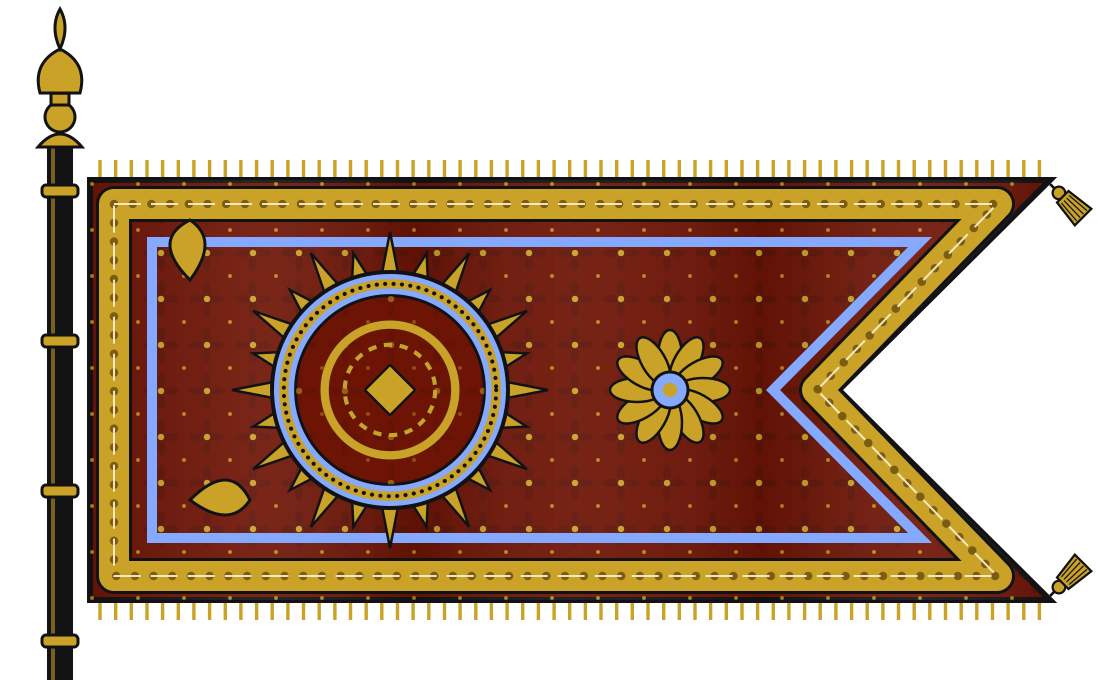
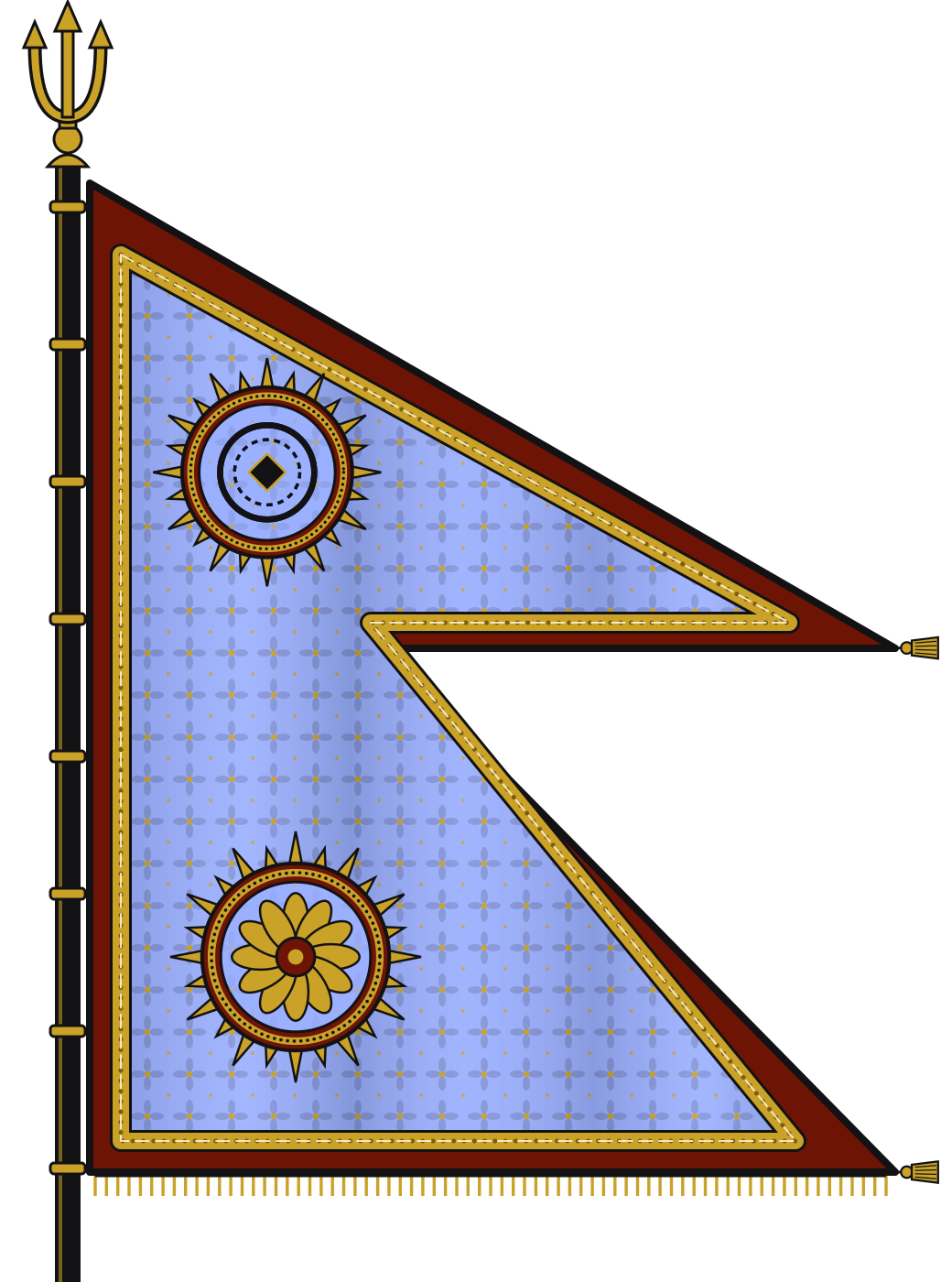
The Atlas gives the Newar emblem as a pagoda temple with a living goddess's eye, for master builders and the Kumari, and the flag as a Jaripataka. The pagoda and the Kumari are both named in the Newar article[1].
| Part of the kit | This clan |
|---|---|
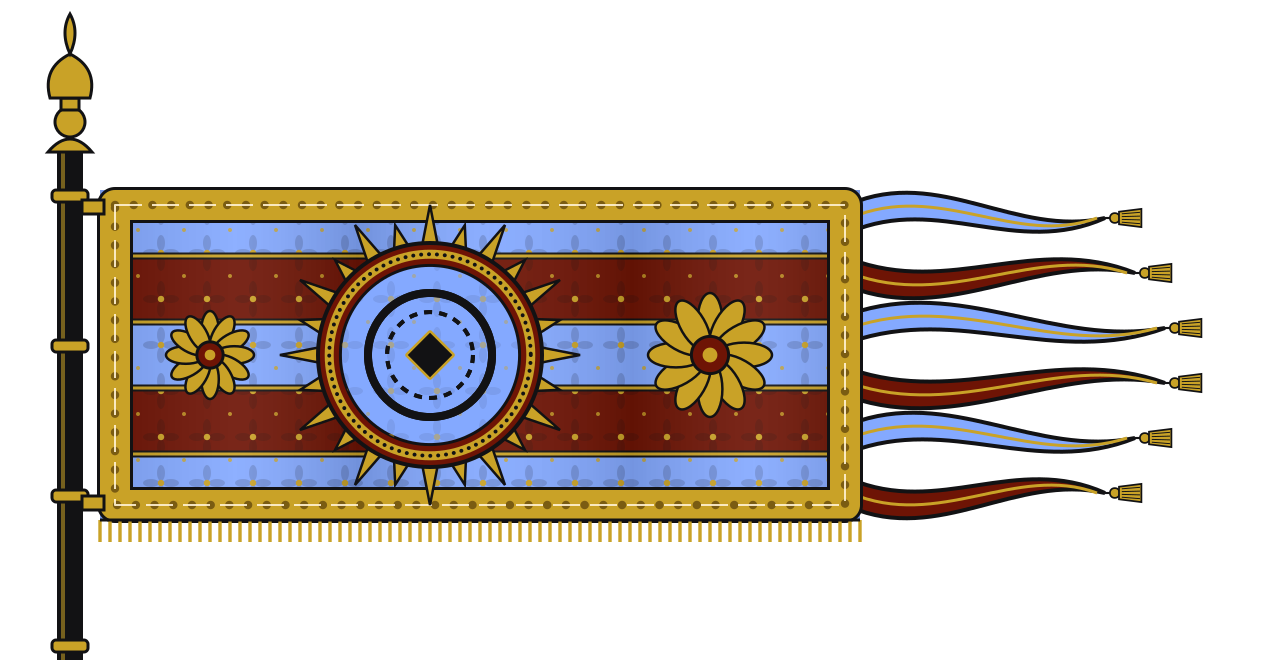
| Field | Maroon #6E1405 |
| Accent | Intense Electric Blue #84A9FF |
| Emblem colour | Metallic Gold #C9A227 |
| Zari metal | Gold |
| Main emblem | A pagoda temple |
| Second image | A living goddess's eye |
| Night and day | Every visual accessory has two versions: by night the emblem on the dark field, by day the clan's field colour on cloth woven from its metal. |
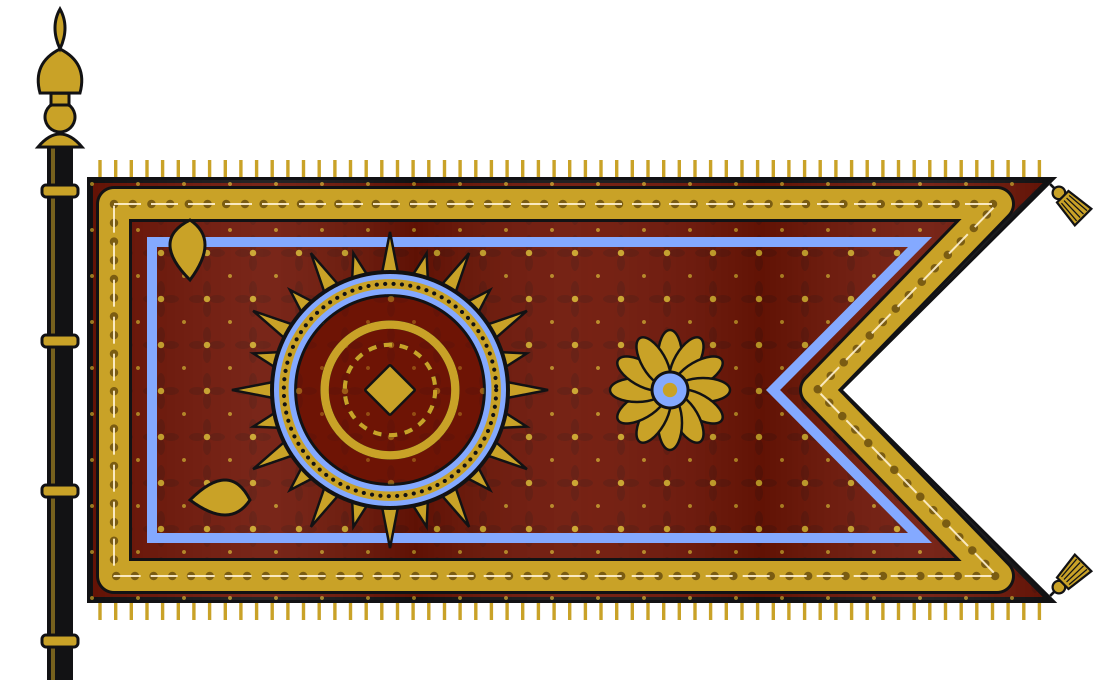
6. Flags
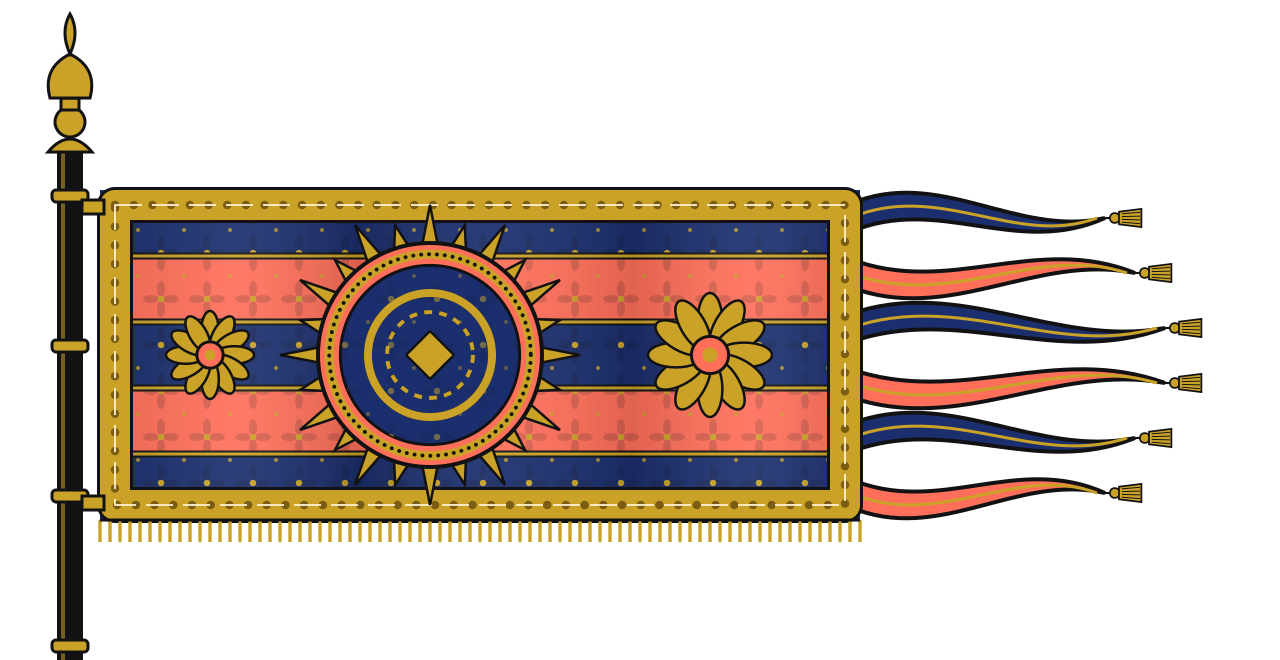
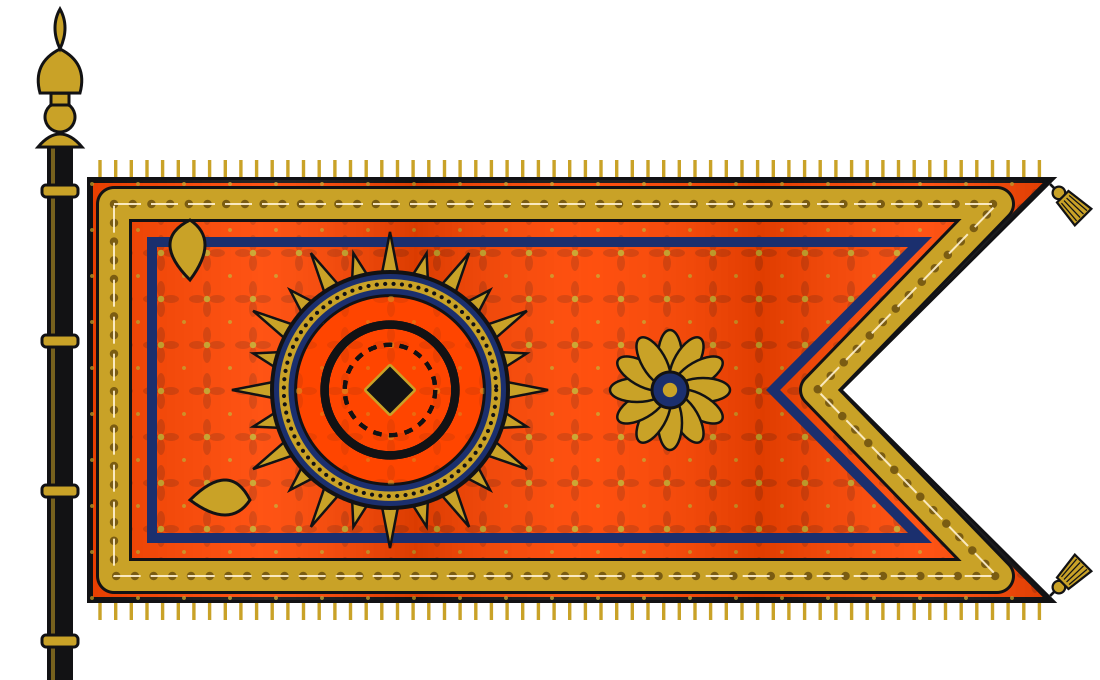
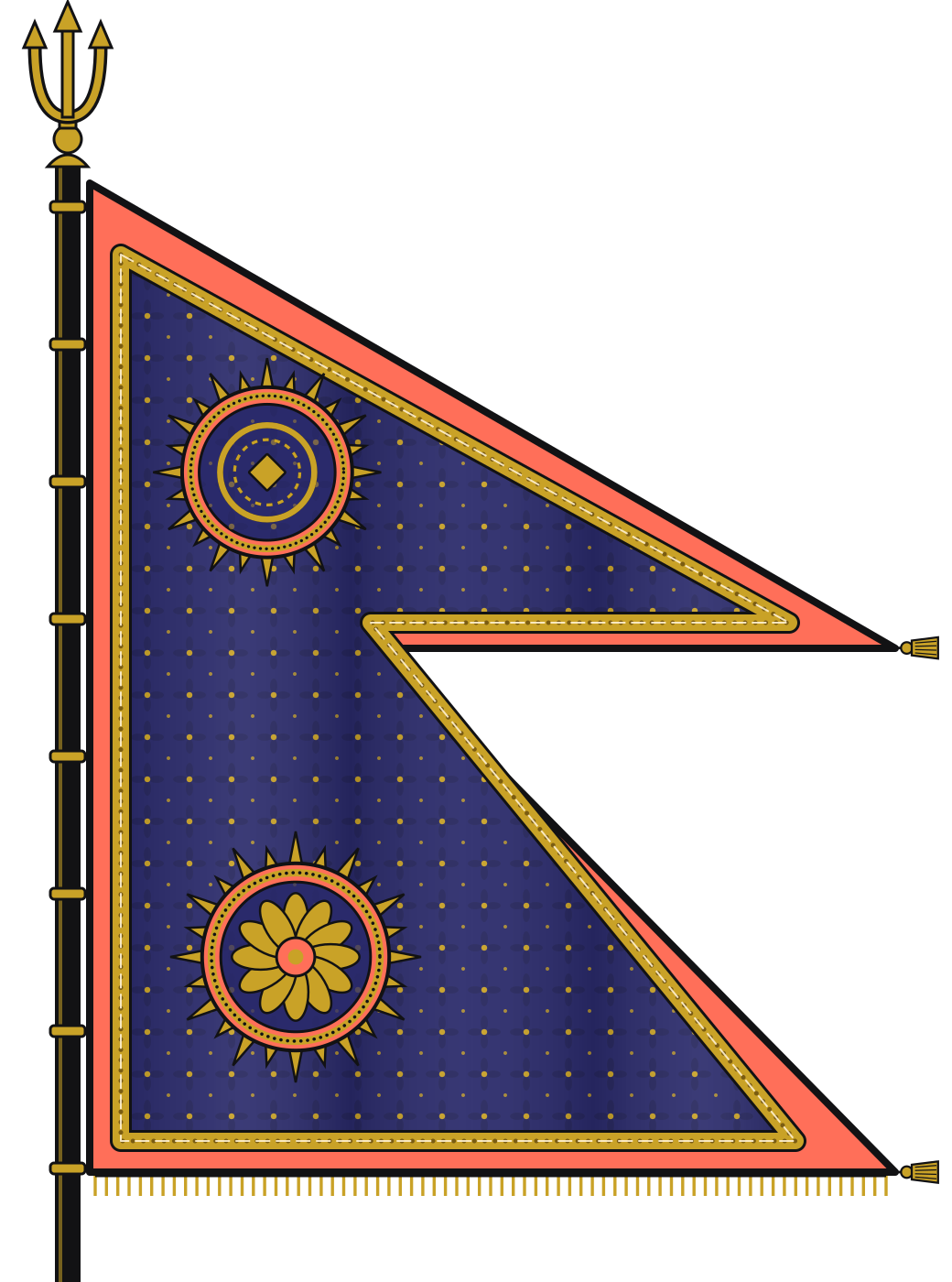
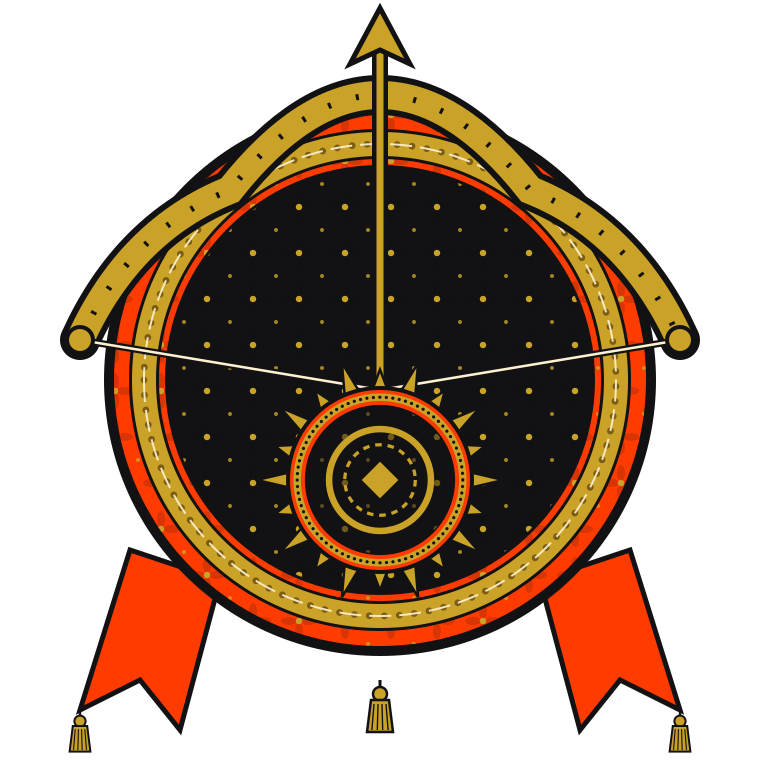
Every clan has every flag type; the type says the occasion and the colours say the clan. The outlined card is the flag the Atlas assigns.

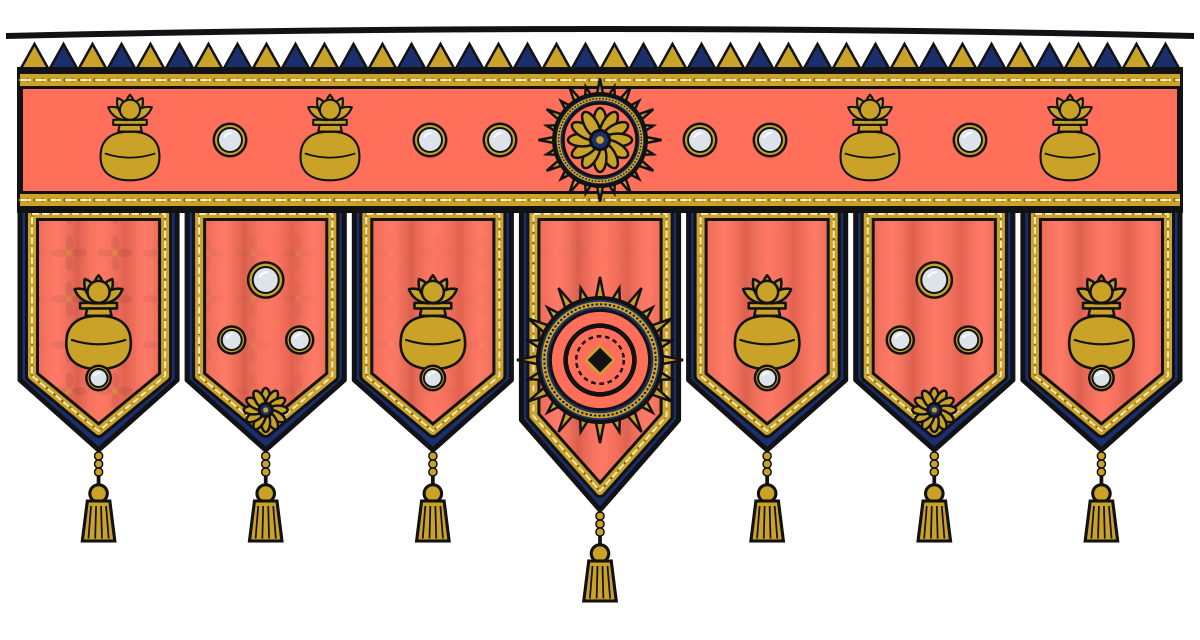
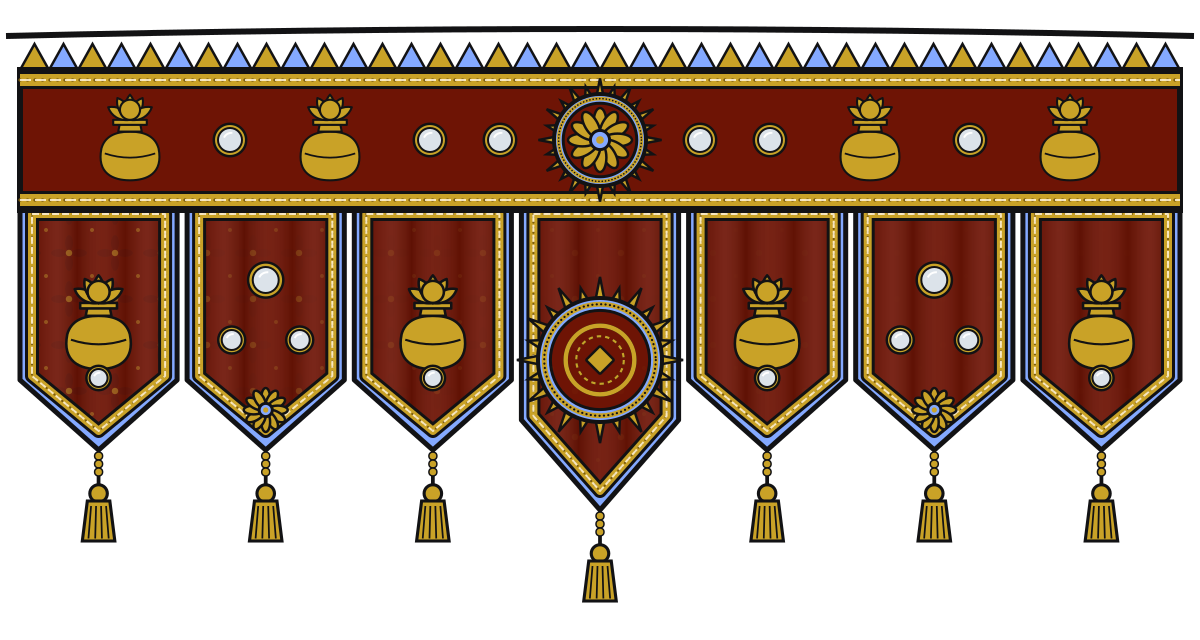

Historic banner
None known
New flag types
| Accessory | For this clan | Basis |
|---|---|---|
| A9 Pota-dhvaja · ship and trade flag For ships, caravans and markets | Not yet designed for this clan | Design |
| A10 Utsava-patāka · festival flag Light, bright flag for fairs and festivals | Not yet designed for this clan | Design |
| A11 Shoka-dhvaja · mourning flag White cloth with the emblem outline in the clan's metal | Not yet designed for this clan | Design |
7. Regalia
| Accessory | For this clan | Basis |
|---|---|---|
| E1 Chhatra · house parasol The ceremonial umbrella | Not yet designed for this clan | Design |
| E2 Chamara · fly-whisks The pair of whisks beside the head of the house | Not yet designed for this clan | Design |
| E3 Danda · staff of office Staff or scepter | Not yet designed for this clan | Design |
| E4 Simhasana · seat The seat of the house, covered in clan cloth | Not yet designed for this clan | Design |
| E5 Khetaka · shield A round shield; the Changi and Dhanush are its flag forms | Not yet designed for this clan | Regional tradition |
| E6 Kula-ayudha · clan weapon The weapon the clan honours | Not yet found for this clan | Under research |
8. Worn
| Accessory | For this clan | Basis |
|---|---|---|
| F1 Kula-vastra · clan cloth The clan's woven pattern in its kit colours | Not yet designed for this clan | Design |
| F2 Kirti-vastra · honour cloth A cloth earned for a deed, not inherited | Not yet designed for this clan | Design |
| F3 Kula-mala · garland flower The flower or leaf the clan wears as a garland | Not yet found for this clan | Under research |
| F4 Chinha · house pin A metal badge with the pin emblem | Not yet designed for this clan | Design |
9. Records
| Accessory | For this clan | Basis |
|---|---|---|
| H1 Clan words A traditional line in the native script | नेवाः · “Newāḥ, the people's own name in Devanagari” The name as the Newar script article gives it in Devanagari[2]. It is not a motto; a sourced line is still to find. | Design |
| H2 Biruda · titles The house's title or titles | Shrestha, a collective title for Hindu clans at the Malla courts श्रेष्ठ Before unification 'Shrestha' was a collective title for Hindu Bharo clans of the Malla courts[13] | Documented |
| H3 Prashasti · praise genealogy The lineage as written at the head of a grant | Not yet found for this clan | Under research |
| H4 Vahi · clan register The book of the clan's births, marriages and deaths | Not yet found for this clan | Under research |
| H5 Rana-ghosha · war cry The clan's cry in battle or celebration | Not yet found for this clan | Under research |
10. VishwaVit · knower of the world
Game values are design choices for this project, not historical claims.
References
- Wikipedia, Newar people, read 2026-11-07, https://en.wikipedia.org/wiki/Newar_people
- Wikipedia, Newar script, read 2026-11-07, https://en.wikipedia.org/wiki/Newar_script
- Facts and Details, Early Nepal Dynasties: Licchavis and the Malla Kings (quoting Library of Congress, Savada 1991), read 2026-11-07, https://factsanddetails.com/south-asia/Nepal/History_Nepal/entry-7806.html
- Taleju Temple, Kathmandu, Wikipedia (read 10 Oct 2026, KulDevi run 61).
- Taleju Bhawani, Wikipedia (read 10 Oct 2026, KulDevi run 61).
- Wikipedia, Ethnic groups in Nepal (2021 census figures), read 2026-11-01, https://en.wikipedia.org/wiki/Ethnic_groups_in_Nepal
- The goddess who went to Nepal, Live History India (read 10 Oct 2026, KulDevi run 61).
- Newar Kinship, Countries and Their Cultures (everyculture.com), read 1 Nov 2026, KulDevi clan check.
- Newar Society blog, जात्रा (Festival), 2013, read 2026-11-07, https://newarsociety.blogspot.com/p/blog-page_7.html
- Taleju Temple (Mul Chowk), Bhaktapur, The Longest Way Home (read 1 Nov 2026).
- Guhyeshwari Temple, Wikipedia (read 9 Oct 2026).
- Guhyeshwari Temple – a sacred Shakti Peetha in Kathmandu, Nepal Traveller.
- Wikipedia, Shresthas, read 2026-11-07, https://en.wikipedia.org/wiki/Shresthas
- SAMHiTA (IIC Delhi), manuscript record Madhava Nidana EAP 790/05/041, read 2026-10-22, link
- National Museum of Nepal, Newar Caste (text mirrors Wikipedia), read 2026-11-07, https://nationalmuseum.gov.np/?p=123
- Newars, Encyclopedia.com (read 1 Nov 2026, KulDevi run 388).
- Wikipedia, Gunla Bajan (citing Todd T. Lewis 1993, 1996; Locke 1985, 2008; Himalayan Times 5 Aug 2011), read 2 Nov 2026, link
- Prakriti, Newars in Musics, Sept 2010, read 29 Oct 2026, link
- Subhash Ram Prajapati, Outreach Ethnomusicology, Dhimay, the most popular ethnic drum of the Newars, read 2026-10-30, link
- Kathmandu Post, The unchanging tunes of six Nepali musical instruments, read 2026-10-29, kathmandupost.com
- Wikipedia, List of Nepali musical instruments, read 2026-11-03, link
- Música para Ver, Tah (Nepal), 6 Nov 2026, link
- Kantipur, सुरु भयो एक महिने गुँला पर्व, 25 Jul 2025, read 2 Nov 2026, link
- Wikipedia, Newar festivals, read 2026-11-07, https://en.wikipedia.org/wiki/Newar_festivals
- Kantipur feature on Bagh Jatra (Bandipur and Chitwan), 5 Sep 2023, read 11 Oct 2026, link
- Wikipedia, Bagh-chal, read 2026-10-11, link
- Nepali Game, games.rjuuc.edu.np (names claim only; read 11 Oct 2026), games.rjuuc.edu.np
- Wikipedia, Coinage of Nepal, read 2026-11-07, https://en.wikipedia.org/wiki/Nepalese_coins
- Wisdom Library, Bhala: definitions (Molesworth, Hindi and Nepali dictionaries; History of Nepal glossary), read 2026-10-11, link