The Nambudiri are a Brahmin community of Kerala's Malabar region. They speak Malayalam, keep Sanskrit and Vedic learning, and were the landholders and temple priests of the region[1][2][3]. Their own tradition says that Parashurama brought them to the land he made, while Kerala historian K. Veluthat says their settlements may date from the 3rd to 9th centuries CE, by a chain of migration along the west coast[4][1]. Their head, the Azhvanchery Thamprakkal, held the rights at Guruvayur and carried a title meaning emperor[5]. From Nambudiri families came the astronomers and mathematicians of the Kerala school, among them Parameshvara, Nilakantha Somayaji and Jyesthadeva[6][7][8]. Land reforms weakened their holdings (Mencher dates the cuts to the 1920s–30s and early 1970s), and in the 1901 Census they were a super-minority of Kerala's population[1][2].
01Faith and deities
No KulDevi has been found for this clan yet; it is on the research list.
| Deity or tradition | Place in the clan's life | Evidence |
|---|---|---|
| Parashurama | Sixth avatar of Vishnu; tradition says he made the land between Gokarnam and Kanyakumari and gave it to the Namboothiris | [4][3] |
| Vishnu, Shiva, Brahma | Deities named in the devotional article's account of the community's worship | [3] |
| Achyuta (Krishna) | Named in the same article | [3] |
| Durga | Named in the same article; 108 Durga temples are said to be founded by Parashurama (legend) | [3] |
| Grama Paradevata | Village deities, named in the same article | [3] |
| Tantra worship (puja) | Puja follows Tantra Vidhi (2012 article); Vedic sacrifice traditions are kept in some gramams (2012 article) | [3][9] |
02Temples
The sources name the gramam temples and the Vedic community's shrines. The 2012 article says Parashurama founded 108 Shiva and 108 Durga temples; that is a legend it reports, not a record. Taliparamba (Perinchellur) and Panniyur temples are named as important to all Namboothiris.
Built by the clan
| Temple | Deity | Built by | When | Where |
|---|---|---|---|---|
| Gramakshetrams (gramam temples) | A temple for each gramam (Mencher) | The gramams (Mencher: each gramam had its own temple) | Not dated | Kerala; the surviving structural temples[4][2] |
| Melttali, Keezhtali, Netiya Tali, Chingapuram Tali | Not stated | Not stated; the Nalu Tali council's four temples | Not dated | [4] |
Given patronage or grants by the clan
| Temple | Deity | What the clan gave | When | Where |
|---|---|---|---|---|
| Guruvayur Temple | Not stated | Rights held by the Azhvanchery Thamprakkal | Credited to K. V. Krishna Iyer (1938) | Guruvayur[5] |
| Badrinath Temple | Not stated | Chief priests only Nambudiris, a rule set by Adi Shankara | Not dated | Named in Wikipedia[1] |
| Perumanam Temple | Not stated | Hereditary administration by Chittoor Mana | Not dated | Kerala[3] |
| Vadakunnathan and Perumanam temple boards | Not stated | Boards ruled by heads who held power in parts of Trichur Taluk | Not dated | Trichur Taluk, Cochin State[2] |
03Languages and scripts
| Language or script | Kind | Under the clan | Evidence |
|---|---|---|---|
| Malayalam living | Dravidian language; the Namboothiri mother tongue | Under the clan | [1][9] |
| Sanskrit living | Classical language, used for reciting slokas and the Vedas | Under the clan | [2] |
| Tulu | Language of the 32 gramams of the Tulu region | Under the clan | [4] |
| Canarese | Language of the Karnataka coast, named with Tulu | Under the clan | [4] |
| Manipravalam | Literature in Manipravalam, named by Veluthat | Under the clan | [4] |
| Grantha script | The script that evolved into the Malayalam script | Under the clan | [1] |
| Early Middle Tamil | West-coast dialect; disputed | Under the clan | [1] |
04Books and literature
The 2012 article says that the Vedic sacrifice traditions are still kept at Perumanam, Perinchellur, Sukapuram and Irinjalakuda, and that the Rig, Yajur and Sama schools are followed in different gramams. Logan (1887) says most follow Rik or Yajur, a few Sama.
Written during the clan's history
| Work | Author | Kind | When | Link to the clan |
|---|---|---|---|---|
| Narayaneeyam | Melpathur Narayana Bhattathiri | Devotional treatise | Not dated | [1] |
| Tantrasamuccaya | Chennas Narayanan Namboodiripad | Manual on temple architecture and ritual | Work not dated (author born 1428) | [10] |
| Tantrasangraha | Nilakantha Somayaji | Astronomy; series results given in verse without proof | c. 1500 | [7][11] |
| Yuktibhasa | Jyesthadeva | Malayalam text with proofs of the sine, cosine and inverse tangent series | c. 1530 | [7][8] |
| Drgganita | Parameshvara | Astronomical treatise | 1431 | [6] |
| Grahanamandana | Parameshvara | Eclipse computation, with epoch 15 July 1411 | 1411 | [6] |
| Goladipika | Parameshvara | Work listed by Wikipedia; kind not stated | 1443 | [6] |
| Kriyakramakari (on the Lilavati) | Narayana, co-author | Commentary on the Lilavati | c. 1560 (commentary); Narayana c. 1540–1610 | [12] |
| Keralolpatty | Anonymous | Traditional account of Kerala history | Written down in the 18th century | [2] |
| Kerala Mahatmyam | Not named | Sanskrit text, part of the Brahmanda Purana | Not dated | [3] |
| Vedic recensions | Vedic seers | Rig Sakala, Yajur Taittiriya, Sama Jaiminiya (Bāṣkala extinct among Nambudiris) | Not dated | [1] |
| Early recension of the Mahabharata | Not named | Basis of the Malayalam version (T. P. Mahadevan) | Not dated | [1] |
| Namboori Phalithangal (modern book) | Kunhunny | Modern book on Namboori wit; title only | June 1997 | [13] |
Given patronage by the clan
| Work | Author | What the clan gave | When | Evidence |
|---|---|---|---|---|
| Tantrasangraha and the Nilakantha family | Nilakantha Somayaji | Patron named as Netranarayana, religious head of Kerala's Nambudiris | Not dated | [14][11] |
| Mathematics and astronomy | Kerala school | Thamprakkals said to have been patrons (page credits no source) | 14th–16th centuries | [5] |
05Thinkers and scholars
| Name | Field | Era | Contribution |
|---|---|---|---|
| Adi Shankara | Vedanta | Not dated | Described as a Nambudiri ascetic and Vedic scholar; Logan says the whole caste adopted his teaching[1][15] |
| Madhava of Sangamagrama | Mathematics and astronomy | 14th century (Kerala school 14th–16th c.) | Founder of the Kerala school; his house Kutallur Mana had a gurukulam[7][16] |
| Parameshvara | Astronomy and eclipse computation | c. 1380–1460 | Bhrgu gotra, Vatasseri illam at Alattur on the north bank of the Nila; Grahanamandana (1411) and Drgganita (1431)[6][17] |
| Nilakantha Somayaji | Astronomy and mathematics | 1444–1544 | Garga (also Gargya) gotra, from Trikkantiyur near Tirur; Tantrasangraha[11][14][18][6] |
| Jyesthadeva | Mathematics | c. 1530 (Yuktibhasa) | Of the Paranottu (Parakrodu) family near Alattur and Trikkantiyur; Yuktibhasa with the proofs of the series[8][19] |
| Narayana | Mathematics | c. 1540–1610 | Co-author of the Kriyakramakari on the Lilavati; Mahishamangalam family at Peruvanam[12] |
| Narayana Bhattathiri | Mathematics | 1559–1632 | Original discoveries of the Kerala school appear to end with him[7] |
| Melpathur Narayana Bhattathiri | Devotional verse | Not dated | Author of the Narayaneeyam[1] |
| Chennas Narayanan Namboodiripad | Tantra ritual and Vaasthusaastram | Born 1428 | Tantrasamuccaya, still regarded as an authoritative reference manual[10] |
| Vaidyamadham Cheriya Narayanan Namboodiri | Elephant medicine | Living as of 2001 | Translated the Paalakaapyam (Hasthyaayurvedam) from Sanskrit into Malayalam[20] |
| Avanapparambu Maheswaran Nambudiripad | Elephant medicine | Living as of 2001 | Living expert as of 2001, of the Avanapparambu Mana[20] |
| Frits Staal | Vedic ritual studies | Not dated | Editor of Agni, cited with the Agnicayana[4] |
| Elamkulam P. N. Kunjan Pillai | History | Not dated | Earlier historian of the Nambudiris[4] |
| E. K. Pillai | History | Not dated | Believed the Nambudiris arrived later than most historians hold[2] |
| Rahul Easwar | Policy commentary | Not dated | Named in Wikipedia's list of thinkers[1] |
The Ananta Journal (2022) article is OCR-garbled and rated low in reliability. It gives Nilakantha's father as Jatavedas and his brother as Shankara, who commented on the Tantrasamgraha, and places the family in the Ashvalayana shakha and the Bhatta family; these are not used as facts above[21]. The Kerala school's transmission ran through Govinda Bhattathiri to Parameshvara, Damodara, Nilakantha Somayaji, Jyesthadeva and Acyuta Pisarati[7].
06Art and architecture
Koodiyattam and Sanskrit theatre were traditionally patronised by Nambudiris (Wikipedia, which notes that the claim needs a citation). Expressive culture is otherwise described in the sources as the pujas, sacrifices and the Agnicayana[1][2].
Painting and wall art
| Art form | What it is | Era | Evidence |
|---|---|---|---|
| Namboothiri and Akkitham Narayanan | Named by Wikipedia as painters; the page gives no works | Not dated | [1] |
Sculpture and temple art
Not recorded.
Temple and building architecture
| Art form | What it is | Era | Evidence |
|---|---|---|---|
| Gramakshetrams | The surviving structural temples of the gramams | Not dated | [4] |
Weaving and textiles
Not recorded.
Clothing and jewellery
| Art form | What it is | Era | Evidence |
|---|---|---|---|
| Thorthu (thortumundu) | The cloth worn at home; two extra cloths when travelling | Not dated | [1] |
Coins, pottery and crafts
| Art form | What it is | Era | Evidence |
|---|---|---|---|
| Aranmula kannadi | Mirrors are part of the ashtamangalyam of Nambuthiri Brahmin brides | Not dated | [22] |
07History
Origins: tradition and the historians
Keralolpatty, the traditional account of Kerala's history written down in the eighteenth century, says that Parashurama brought Brahmans to the south-west coast, and the customs and physical traits of the Nambudiris are said to show that they came from outside[2]. Veluthat says settlements may date from the 3rd to the 9th centuries CE, with epigraphic mentions from the 9th century, and describes chain migration along the west coast beginning in Sourashtra, not a single event[4]. The commonly accepted view is that they came from North India by Tulu Nadu or Karnataka; a theory due to Mahadevan has them come from Tamil Nadu through the Palakkad Gap[1].
A devotional article from 2012 dates the settlement to the 2nd century BC, arguing from Sangam literature, Dandi's story and Sanskrit-speaking Brahmins in Sri Lanka by 275 BCE; its claims are its own and contested[3]. William Logan notes that a conjectured Aryan descent from the phrase "Aryya Brahmanar" "requires proof", and gives Dr Gundert's derivation of the name Nambutiri from Dravidian nambuka (to confide, desire) and Sanskrit tiri (office, dignity), which he calls correct[15].
Caste organised and the Chera kings (8th–12th centuries)
Logan records that caste was finally organised about the 8th century A.D., and that the Syrians' deed of A.D. 774 names only Panniyur and Chovur (Chovaram, i.e. Sivapuram) as organised Brahman villages[15]. Each Namboothiri house belongs to one of the 32 gramams of Kerala[4].
Veluthat says the Chera kingdom was ruled from Mahodayapuram and disintegrated in the 12th century, and that the Brahmanans put the Chera king on the throne, per Keralolpathi and other sources[4]. Wikipedia notes land grants that predate the 9th century, and grants tied to Vedic rites, and records that in the Chola–Chera wars Vedic schools were turned into military academies[1]. Veluthat describes armed Brahmanans, the Chatter or Chattirar, trained in the Salais[4].
Heyday and the British (12th–19th centuries)
Mencher places the heyday of the Nambudiri system between the twelfth and seventeenth centuries, and says that the British took direct control of Malabar around the end of the eighteenth century[2]. Wikipedia records the reign of Marthanda Varma of Travancore (1729–1748), which Susan Bayly sees as marking the decline of the Nambudiris[1]. Logan calls the Nambudiri a "confidential adviser and trusty friend" of the rajas[15].
Reform and land reform (20th century)
The Yogakshema movement of 1908 sought reform within the community[1]. Veluthat says it demanded the end of polygyny, and names Kurur Unni Nambudiripad and V.T. Bhattathiripad as reformers[4]. Mencher says that land reforms in the 1920s–30s and the early 1970s weakened Nambudiri holdings, and that E. M. S. Namboodiripad, who led the CPI(M) for about twenty-five years, came out of the Nambudiri reform movement[2]. Kerala's land reforms from 1957 are noted in Wikipedia[1].
08Journey and migrations
The sources give several accounts of how the Nambudiris came to Kerala. None is fixed by a dated record, and the settlement dates are debated.
| When | From | To | Why | Evidence |
|---|---|---|---|---|
| Mythic age | The Narmada, Krishna and Kaveri rivers | The west coast | Tradition of origin | [1] |
| Not dated | North India, by Tulu Nadu or Karnataka | Kerala | The commonly accepted route | [1][5] |
| Not dated | Tamil Nadu, through the Palakkad Gap | The Bharathappuzha basin | Mahadevan's theory | [1] |
| Possibly 3rd–9th centuries CE (Veluthat) | North India along the West Coast, from Sourashtra | Settlements around temples in Kerala | Chain migration, not one event | [4] |
| Later | Palakkad Taluk | West along the Bharathappuzha, to the Athavanad–Tirunavaya region | The Thamprakkals' move (Shreedhara Menon, 2007) | [5] |
09Seats and lands
| Place | Role | Where today |
|---|---|---|
| Kerala | Homeland of the community | Kerala[1] |
| Malabar | Core of the Nambudiri system (Atlas homeland) | Palakkad, Kozhikode and Kannur districts |
| Perumanam | Largest Namboothiri village, about 300 families, mostly Yajur Vedi | Kerala, as the 2012 article describes it[3] |
| Perinchellur | About 200 Illams, mostly Yajur Vedi (2012) | Kerala[3] |
| Panniyur | Vaishnavite gramam with a boar emblem (Logan); about 30 families, none Vedic (2012) | Kerala[15][3] |
| Chovur (Sivapuram) | Saiva gramam, named in the 774 deed (Logan) | Kerala[15] |
| Athavanad–Tirunavaya region | Bought by the Thamprakkals (Shreedhara Menon, 2007) | Malabar, Kerala[5] |
| Guruvayur | Temple over which the Azhvanchery Thamprakkals held rights | Guruvayur[5] |
| Tirunavaya and Trichchur | Sanskrit colleges, each headed by a Vadhyan (Logan) | Ponnani taluk; Cochin[15] |
10Notable figures
| Name | Role | Era | Known from |
|---|---|---|---|
| Parashurama legend | Sixth avatar of Vishnu, who made the land and gave it to the Brahmans in the tradition | Legend | [1][4] |
| Azhvanchery Thamprakkal | Head of the community, with the title Thamprakkal (emperor); spiritual head | Not dated | [5] |
| Adi Shankara | Ascetic and Vedic scholar, described as a Nambudiri; Logan says he is believed to have been one | Not dated | [1][15] |
| Kurur Unni Nambudiripad | Yogakshema reformer | Early 20th century | [4] |
| V. T. Bhattathiripad | Yogakshema reformer | Early 20th century | [4] |
| E. M. S. Namboodiripad | Led the CPI(M) about twenty-five years; came from the Nambudiri reform movement | 20th century | [2] |
| Nibha Namboodiri (Kodeeri) | First Namboothiri female mahout | Not dated | [20] |
| Avanapparambu Narayanan Nambudiripad | Foremost elephant physician; died ME 1119 (1943–44), aged 79 | 20th century | [20] |
11Allies, rivals and marriages
| People | Relationship | When |
|---|---|---|
| Nair (Nayar) women | Sambandham unions; younger sons formed liaisons; children of sambandham were not Nambudiri | Not dated[1][2] |
| Kshatriya women | Sambandham unions; children not Nambudiri | Not dated[1] |
| Pandyan queens | Cited as evidence of matrilineal practice (Wikipedia) | Not dated[1] |
| Chera kings | Brahmanans put the Chera king on the throne, per Keralolpathi | Chera period[4] |
| Zamorin of Kozhikode | Coronation requires the Thamprakkal's presence | Coronation rite[1] |
| Chakkiar community | Performs Koothu, the Sanskrit drama that trained Nambudiris in wit | Not dated[13] |
| Tamil, South Kanara, Embrandiri and Pattar Brahmans | Served as temple priests alongside Nambudiris | Not dated[2] |
| Sakala, Taittiriya and Jaiminiya schools | Vedic schools of the Rig, Yajur and Sama, with the Bāṣkala recension extinct among the Nambudiris | Not dated[1] |
12Society and livelihood
The Nambudiris lived in large manorial houses called illams, ran the temples and held the land. Only the eldest son married within the caste[1][2].
Government and social order
| Institution or group | What it was | Evidence |
|---|---|---|
| Adhyans | The wealthiest Nambudiri families, with the suffix -pad; the eight most powerful tended to marry within their group[2] | [2] |
| Asyans | Vedic reciters[2] | [2] |
| Illams and Tharavad | Ancestral homes; the illams were large manorial houses, usually 16–40 km from the temple (Mencher) | [1][2] |
| Ur, urar and uralar committees | Managed temples and land | [4] |
| Nalu Tali council | Council of four temples: Melttali, Keezhtali, Netiya Tali and Chingapuram Tali | [4] |
| Tambrakkal, Vydikan, Oykkan | Village head, ritual authority and Vedic teachers, respectively (2012 article) | [3] |
| Smartha families | Excommunication, per the 2012 article | [3] |
| Azhvanchery Thamprakkal | Four privileges: Bhadrasthanam (chief seat), Sarvamanyam (universal respectability), Brahma Samrajyam (sovereignty over Brahmins), Brahmavarchas (highest authority in Vedic learning); the page credits no source | [5] |
Livelihood over time
| Era | Livelihood | Evidence |
|---|---|---|
| Medieval | Landholding and temple service; the Nambudiri system's heyday, twelfth to seventeenth centuries | [2] |
| Medieval | Vedic schools turned into military academies in the Chola–Chera wars | [1] |
| Not dated | Advisers to the rajas | [15] |
| 20th century | Holdings weakened by the land reforms of the 1920s–30s and early 1970s | [2][4] |
| Today | Many households impoverished after the land reforms; many have taken modern education | [2][4] |
13Sub-clans and related clans
Every sub-clan, gramam, house, gotra and related people that the sources name. Each listed item has its evidence, and the rest of the 32 gramams are not yet named in the sources.
| Clan | Relation | Where | Size | In the Atlas | Evidence |
|---|---|---|---|---|---|
| Azhvanchery Mana | Sub-clan | Palakkad Taluk, then Athavanad–Tirunavaya region | new clan candidate | [5] | |
| Kalpakanchery Thamprakkals | Sub-clan | Kalpakanchery | new clan candidate | [5] | |
| Kutallur Mana | Sub-clan | Not stated | new clan candidate | [16] | |
| Kelallur house | Sub-clan | Trikkantiyur, near Tirur (MacTutor) | new clan candidate | [14] | |
| Veluthat Mana | Sub-clan | Near Tirur | new clan candidate | [4] | |
| Chittoor Mana | Sub-clan | Perumanam | new clan candidate | [3] | |
| Kirangatt Mana | Sub-clan | Perumanam (Tambrakkals) | new clan candidate | [3] | |
| Vadakkumkara Mana | Sub-clan | Not stated | new clan candidate | [13] | |
| Avanapparambu Mana | Sub-clan | Kumbalangatt, Wadakkancherry, Thrissur | new clan candidate | [20] | |
| Mahishamangalam family | Sub-clan | Peruvanam (Puruvanagrama) | new clan candidate | [12] | |
| Adhyan Namboodiris | Sub-clan | Not stated | new clan candidate | [2] | |
| Asyan Namboodiris | Branch | Not stated | new clan candidate | [2] | |
| Perumanam | Sub-clan | Not stated | about 300 families, 2012[3] | new clan candidate | [3] |
| Perinchellur | Sub-clan | Not stated | about 200 Illams, 2012[3] | new clan candidate | [3] |
| Panniyur | Sub-clan | Not stated | about 30 families, 2012[3] | new clan candidate | [15][3] |
| Sukapuram (Chovur) | Sub-clan | Chovur, i.e. Sivapuram | new clan candidate | [15] | |
| Peruvanam | Sub-clan | Peruvanam | new clan candidate | [15] | |
| Irinjalakuda | Related people | Irinjalakuda (Vedic sacrifice kept, 2012) | new clan candidate | [3] | |
| Karikkad | Sub-clan | Not stated | new clan candidate | [15] | |
| Trissivaperur | Sub-clan | Not stated | new clan candidate | [15] | |
| Venganad | Sub-clan | Not stated | new clan candidate | [15] | |
| Alattur | Sub-clan | Alattur, north bank of the Nila | new clan candidate | [15][17] | |
| Edakkad | Sub-clan | Not stated | new clan candidate | [15] | |
| Irinyalalaula (as printed by Logan) | Sub-clan | Not stated; the name is as Logan prints it | new clan candidate | [15] | |
| Paranottu (Parakrodu) family | Sub-clan | Near Alattur and Trikkantiyur; the house still stands | new clan candidate | [8] | |
| Vatasseri illam | Sub-clan | Alattur, north bank of the Nila | new clan candidate | [6][17] | |
| Gargya gotra | Branch | Nilakantha's gotra; Kelallur house | new clan candidate | [14][1] | |
| Bhrgu gotra | Branch | Parameshvara's gotra | new clan candidate | [17] | |
| Ashvalayana sutra | Branch | Parameshvara's and Nilakantha's sutra (Wikipedia; MacTutor) | new clan candidate | [6][14] | |
| Bhatta family | Related people | Not stated (low-reliability source) | new clan candidate | [21] | |
| Pūrvaśikhā Brahmins | Related people | Not stated | new clan candidate | [1] | |
| Aparaśikhā Brahmins | Related people | Not stated | new clan candidate | [1] | |
| Iyers | Related people | Migrants among the Aparaśikhā | new clan candidate | [1] | |
| Śōḻiya Brahmins | Related people | Not stated | new clan candidate | [1] | |
| Embranthiris | Related people | Kerala temples | new clan candidate | [1][2] | |
| Dikshitars | Related people | Tamil Nadu | new clan candidate | [1] | |
| Tamil Brahmans | Related people | Kerala temples as priests; Tamil country | new clan candidate | [2] | |
| South Kanara Brahmans | Related people | South Kanara District and Karnataka | new clan candidate | [2] | |
| Pattar Brahmans | Related people | Kerala temples as priests | new clan candidate | [2] | |
| Nayar | Related people | Kerala | SUB-313 | [2] | |
| Chakkiar | Related people | Not stated | new clan candidate | [13] | |
| Ambalavasi castes | Related people | Kerala temples | new clan candidate | [3] | |
| Samantans | Related people | Kerala | new clan candidate | [1] | |
| Saurashtras | Related people | Sourashtra, origin of the migration | ANC-116 | [4] | |
| Saraswat Brahmins | Related people | Claim descent from Parashurama's followers (contested) | SUB-308 | [3] | |
| Bhumihar Brahmins | Related people | Claim descent from Parashurama's followers (contested) | new clan candidate | [3] | |
| Chitpawan Brahmins | Related people | Claim descent from Parashurama's followers (contested) | new clan candidate | [3] | |
| Sharada Brahmins | Related people | Own temples, mutts and guru lineages | new clan candidate | [3] | |
| Chowwara (Sukapuram) Nambudiris | Related people | Chowwara (Sukapuram) | new clan candidate | [5] | |
| Pulamanthol family | Related people | Not stated | new clan candidate | [20] | |
| Zamorin of Kozhikode | Dynasty from this clan | Kozhikode | new clan candidate | [1][5] | |
| Tarur Swaroopam (Palakkad Rajas) | Dynasty from this clan | Palakkad | new clan candidate | [5] | |
| Perumpadappu Swaroopam | Dynasty from this clan | Cochin | new clan candidate | [1] | |
| Parur Raja family | Dynasty from this clan | Not stated | new clan candidate | [1] |
Clans marked "new clan candidate" are not in the Atlas yet.
14Surnames
The sources name these forms of the community's name and house-style. No count of bearers is sourced.
| Surname | Clan or sub-clan | Where | People with this surname | Also used by other communities |
|---|---|---|---|---|
| Namboothiri | Nambudiri | Kerala | not yet counted | Not checked |
| Namboodiripad | Adhyan families (Mencher: -pad suffix); junior members (Azhvanchery page) | Kerala | not yet counted | Not checked |
| Bhattathiripad | Nambudiri (reformers) | Kerala | not yet counted | Not checked |
Counts are of everyone with the surname, from the cited source and year, not only members of this clan. A surname shared with other communities says nothing about any one person's origin.
15Songs and music
No song of the Nambudiris with a source is in the fetched pages.
None recorded yet.
Instruments and styles
| Instrument or style | What it is | Evidence |
|---|---|---|
| Vedic recitation | Chanting of the Rig, Yajur and Sama recensions; Logan says most follow Rik or Yajur, a few Sama | [15][1] |
| Koodiyattam and Sanskrit theatre | Traditionally patronised by Nambudiris (the page asks for a citation) | [1] |
16Poems, lullabies and children's rhymes
The fetched sources name one devotional text and the Venmani and Manipravalam literary styles.
Narayaneeyam
17Stories, legends and proverbs
Stories and legends
| Story | What happens | Told by | Evidence |
|---|---|---|---|
| Parashurama's axe legend | Parashurama throws his axe into the sea from Gokarnam; the land that rises out is given to the Namboothiris | Tradition | [3][4] |
| The Keralolpatty origin legend | Parashurama brings Brahmans to the south-west coast; their customs and traits are said to show that they came from outside | Keralolpatty | [2] |
| The sixty-four men | A Nambudiri woman named sixty-four men as her partners in adultery, which ended the special courts for women | Told in Mencher's entry | [2] |
| Zamorin's coronation | The coronation rite requires the Thamprakkal's presence; the Azhvanchery and Kalpakanchery lords attend | Krishna Iyer (1938) | [5] |
| Pakkanar and the golden cow legend | Pakkanar, a low-caste man, claimed the right to take dead cows; the Thamprakkal, back from Kulashekhara Perumal's coronation with a golden cow, revived one with water, and Pakkanar called him Thamprakkal (the page credits no source) | Wikipedia (uncredited) | [5] |
| The festoons | Vaazhakunnam Atithiri saw the roads decorated and was told a Collector was coming; he said the Collector was coming through the festoons | namboothiri.com | [13] |
| The bus | A Namboothiri stopped a bus by waving his hand, and said that Ittyasu of his Illam had called such buses a wonder | namboothiri.com | [13] |
| Iratta gopi | V. S. Nambudiripad of Vadakkumkara Mana joked with the poet Vallathole Narayana Menon, back from a Russian tour for funds, using a Malayalam word meaning nothing | namboothiri.com | [13] |
Proverbs and sayings
Not recorded.
18Festivals and fairs
| Festival or fair | When | Where | What happens |
|---|---|---|---|
| Agnicayana | Season Vasantham (spring); begins on or after the new moon | Panjal (1975); Andhra Pradesh, per David Knipe | A twelve-day optional (kamya) rite; performed seventeen times in the last hundred years, and celebrated in 1975 and 1990 after a gap of almost twenty years[9][1] |
| Agnistoma | Six days | Never near cremation grounds, in temples or on temple grounds | The Soma rite; the yajamana must have performed the Agnistoma and Aadhaanam, and be married with a living wife[9] |
| Zamorin's coronation (Ariyittu Vazhcha) | At each new Zamorin's coronation | Kozhikode | Usually attended by the Azhvanchery and Kalpakanchery lords[5] |
| Vishu, Onam and Thiruvathira | Yearly | Kerala | Named by Mencher as the most important Hindu ceremonies in Kerala[2] |
19Food, dress and games
Food
| Item | What it is | Evidence |
|---|---|---|
| Hospitality | The Travancore Census (1871) says the Nambutiri's hospitality and charity are proverbial | [15] |
Dress
| Item | What it is | Evidence |
|---|---|---|
| Thorthu (thortumundu) | Worn at home; two extra cloths when travelling | [1] |
| Kudumi | Hair tuft worn at the front | [1] |
Games and martial arts
| Item | What it is | Evidence |
|---|---|---|
| Chathurangam | A game in the medieval period, along with feasts and leisure | [4] |
Tags: living still practised · revived brought back after a break · lost known only from records · research reported but not yet confirmed from a source. Songs and poems under copyright are listed by title only; restricted or sacred material is noted without its content.
20Status today
The Nambudiris are a living community in Kerala, with their holdings weakened by the land reforms. Mencher gives them under 1% of Kerala's Hindu population, with the year not given on the page. Vedic sacrifice is still performed in a few gramams[2][3].
Who carries the name today
| Community | Link | Basis | Evidence |
|---|---|---|---|
| Syrian Catholics (as the 2012 article puts it) | Community tradition | [3] |
Recognised heritage
| What | Recognition | Evidence |
|---|---|---|
| Vedic recitation and Agnicayana | Agnicayana performed in 1975 and 1990; described as authentic and alive, neither reconstruction nor recent revival[9] | [9] |
| Kerala school of astronomy and mathematics | Flourished 14th–16th centuries in the Tirur–Tirunavaya–Triprangode region (the Azhvanchery page, uncredited); Madhava is named as its founder[7] | [7][5] |
No community review is recorded. The sources are an encyclopedia, scholarly pages and devotional and community websites.
21For children
The clever Namboothiri
The Namboothiris of Kerala are known for their wit. They enjoy a joke, even when it is at their own expense. Once a wit named Atithiri saw the roads decorated with festoons. He was told that an important officer was coming. He said that the officer was coming through the festoons. Some people say that this wit grew from listening to Koothu, a Sanskrit play that the Chakkiar community performed.
22Across the project
| Project | What carries this clan | Status |
|---|---|---|
| Atlas of the Janas | Homeland: Malabar. The Kerala school's region is Tirur–Tirunavaya–Triprangode (the Azhvanchery page, uncredited). | [5] |
| KulDevi and GrahDevi | Under research: the sheet's KulDevi is blank (basis Research); see Main deity. | |
| Planet naming | Under research: not in the fetched sources. | |
| Renaming and waters | Under research: not in the fetched sources. |
23Open questions
- The clan's own deity: the sheet's KulDevi is blank, and no clan deity is named in the fetched sources.
- The Malayalam-script name (നമ്പൂതിരി) is not printed in any fetched source; it is left out of the title until a source gives it.
- No line in the clan's own words or in native script is in the fetched sources, so the clan words are under research.
- Are the Narayana of the Kriyakramakari (c. 1540–1610) and Narayana Bhattathiri (1559–1632) the same man? The sources give different dates.
- The date and route of first settlement: Veluthat (3rd–9th centuries CE) against a 2012 article (2nd century BC, contested).
- The Ananta Journal's claims (Bhatta family; Jatavedas as father) are low-reliability and unverified.
- The 32 gramams: ten are named in Logan's list[15]; the rest are not named in the fetched sources, and Logan's chapter remainder (offset 100000) is unread.
- No count of Nambudiri bearers of any surname, and no post-1881 population figure for Brahmans of Malabar, is sourced.
- Native-script songs and proverbs, and the Nambudiri lullabies and rhymes, are not in the fetched sources.
- Namboodiripad: Mencher ties the -pad suffix to the wealthiest Adhyan families[2], but the Azhvanchery page gives it as the style of junior members[5]; both are kept, unresolved.
24Astitva
अस्तित्व · being, existence: everything by which the clan is known
The fetched sources record one documented accessory for the community: the title Thamprakkal, held by the anointed head of Azhvanchery Mana[5]. Seals, coins and symbols are not in the fetched sources.
Every clan has every accessory, royal objects included. Each one says how it is known: Documented This clan's own object is recorded. · Regional tradition Recorded for the region or for peoples like this one, not for this clan. · Design Made for this project, with no historical claim. · Under research To be found for this clan from sources. Legends and titles are written in the clan's own script.
1. Seals and coins
| Accessory | For this clan | Basis |
|---|---|---|
| B1 Rajamudra · house seal Round seal with the clan emblem and a short legend in the clan's script | Not yet designed for this clan | Design |
| B2 Anguliya-mudra · signet ring Personal seal ring of the head of the house | Not yet designed for this clan | Design |
| B3 Chhapa · house stamp Ink or block stamp for letters, goods and cloth | Not yet designed for this clan | Design |
| B4 Tamrapatra · charter plate Copper-plate grant on a ring, closed with the house seal | Not yet designed for this clan | Design |
| B5 Shreni-mudra · guild or trade seal Seal for the clan's trade, craft or caravan | Not yet designed for this clan | Design |
| C1 Clan coin Emblem or deity on one side, a legend in the clan's script | Not yet designed for this clan | Design |
| C2 Coin die The die that strikes the coin | Not yet designed for this clan | Design |
2. Living symbols
| Accessory | For this clan | Basis |
|---|---|---|
| I1 Totem trio The tree, bird and animal the clan protects | Not yet found for this clan | Under research |
| I2 Kaval-maram · guardian tree The tree that stands at the clan's seat | Not yet found for this clan | Under research |
3. Stone and gate
| Accessory | For this clan | Basis |
|---|---|---|
| G1 Torana · gateway The built gate of the seat; the cloth Toran hangs in it | Not yet designed for this clan | Regional tradition |
| G2 Viragallu · hero stone Carved panel stone for a member who died defending the clan | Not yet designed for this clan | Regional tradition |
| G3 Kula-shila · clan stones Standing and table stones that remember the ancestors | Not yet designed for this clan | Design |
| G4 Jayastambha · victory pillar A pillar raised for a victory | Not yet designed for this clan | Design |
| G5 Sima-shila · boundary stone Marks the clan's land, with a line in the native script | Not yet designed for this clan | Design |
4. Sounds
| Accessory | For this clan | Basis |
|---|---|---|
| D1 Pancha-mahashabda · five great sounds The right to five instruments | Not yet designed for this clan | Design |
| D2 Shankha · clan conch The clan's own named war conch | Not yet designed for this clan | Design |
| D3 Murasu · house drums Three drums: war, charity and justice | Not yet designed for this clan | Design |
5. Kit: colours, metals and emblems
No Nambudiri emblem is recorded in the fetched sources. The lamp on the flag and banner is a design choice in the Atlas.
| Part of the kit | This clan |
|---|---|
| Field | Warm Red-Orange #FF6F59 |
| Accent | Deep Cosmic Blue #9BB0FF |
| Emblem colour | Charcoal Black #121214 |
| Zari metal | Gold |
| Main emblem | A ritual lamp (nilavilakku) |
| Second image | — |
| Night and day | Every visual accessory has two versions: by night the emblem on the dark field, by day the clan's field colour on cloth woven from its metal. |
6. Flags
Every clan has every flag type; the type says the occasion and the colours say the clan. The outlined card is the flag the Atlas assigns.
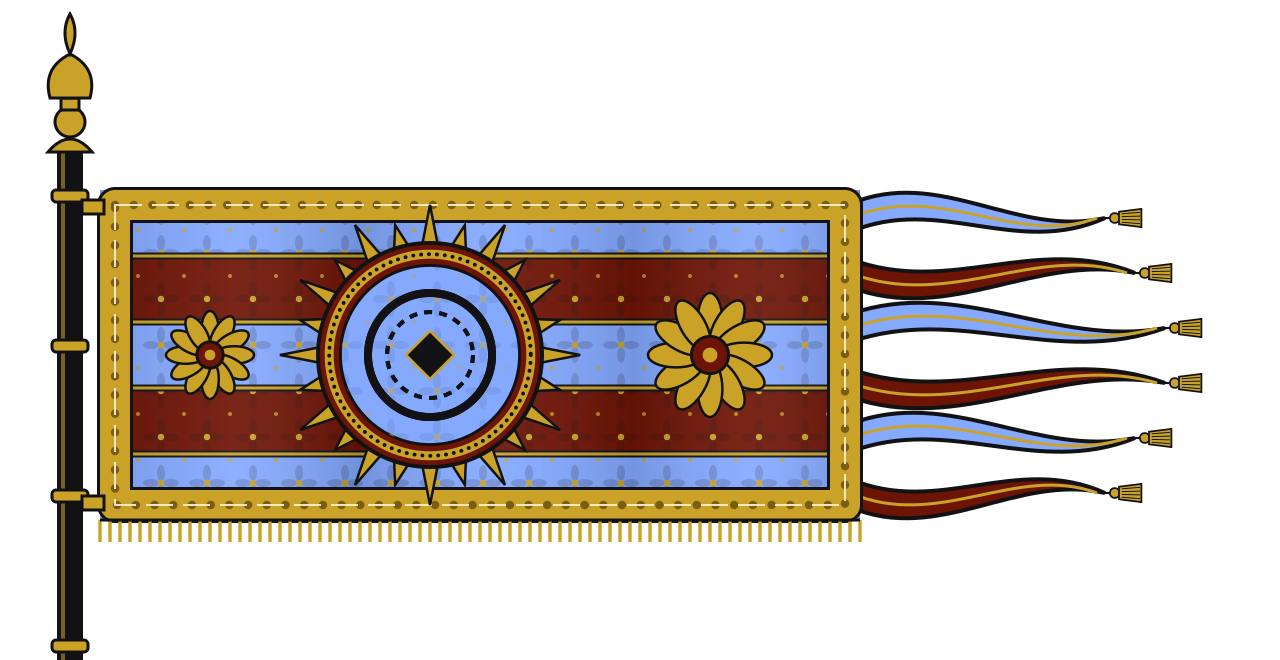
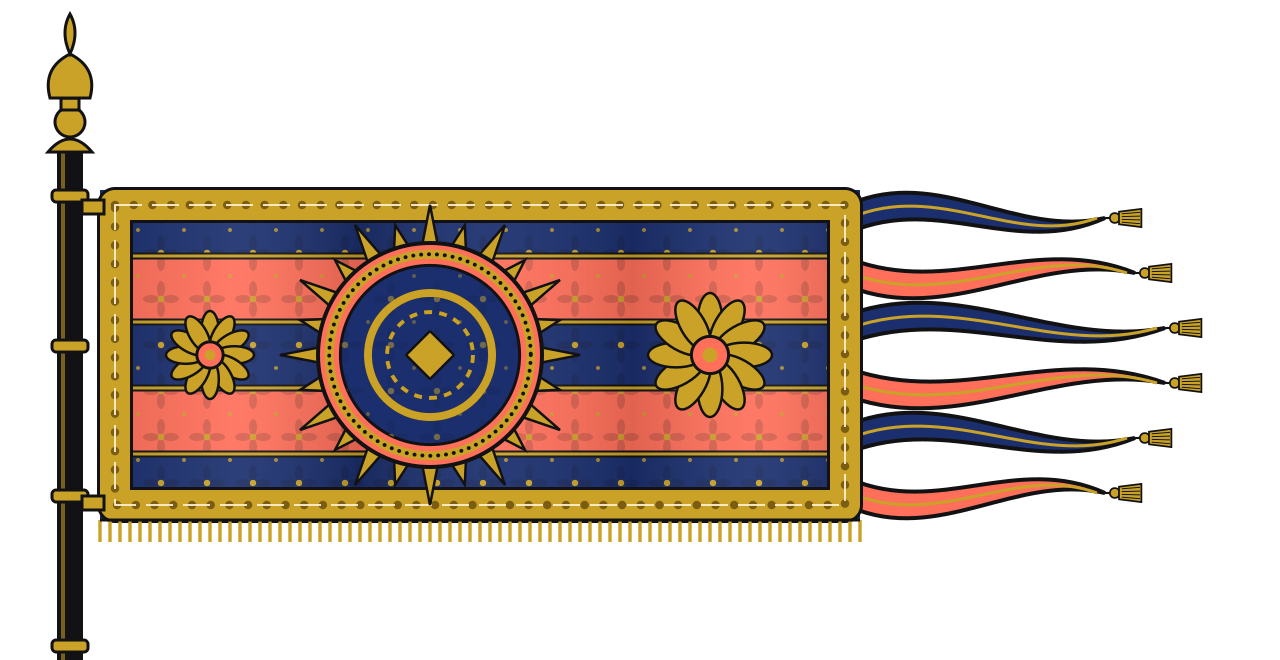
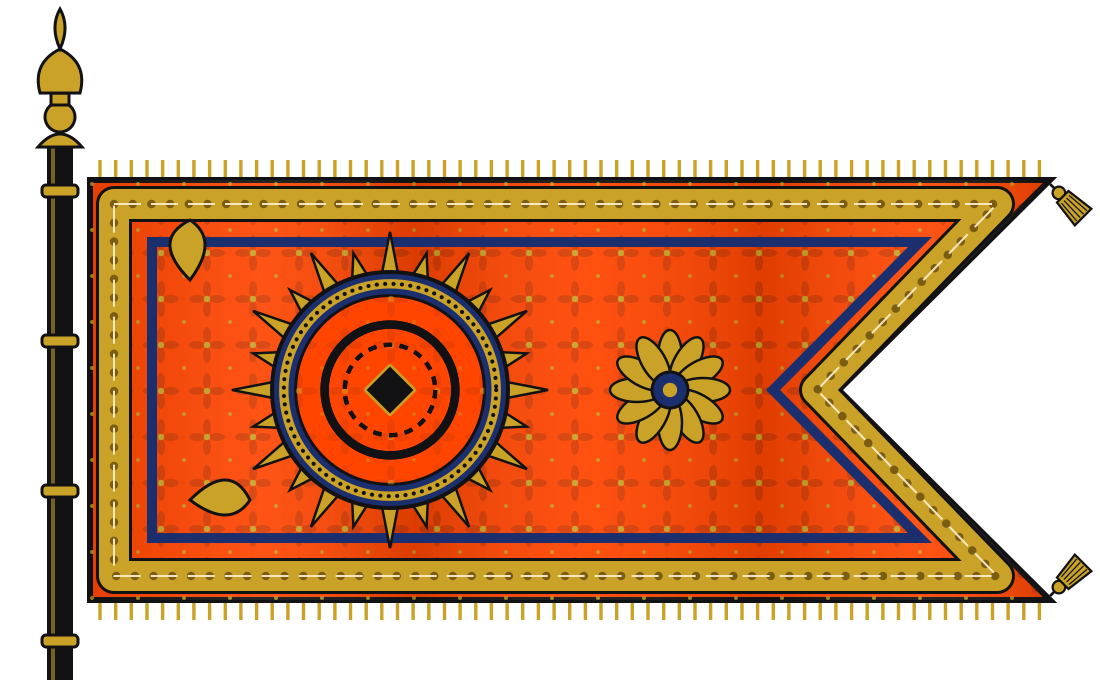
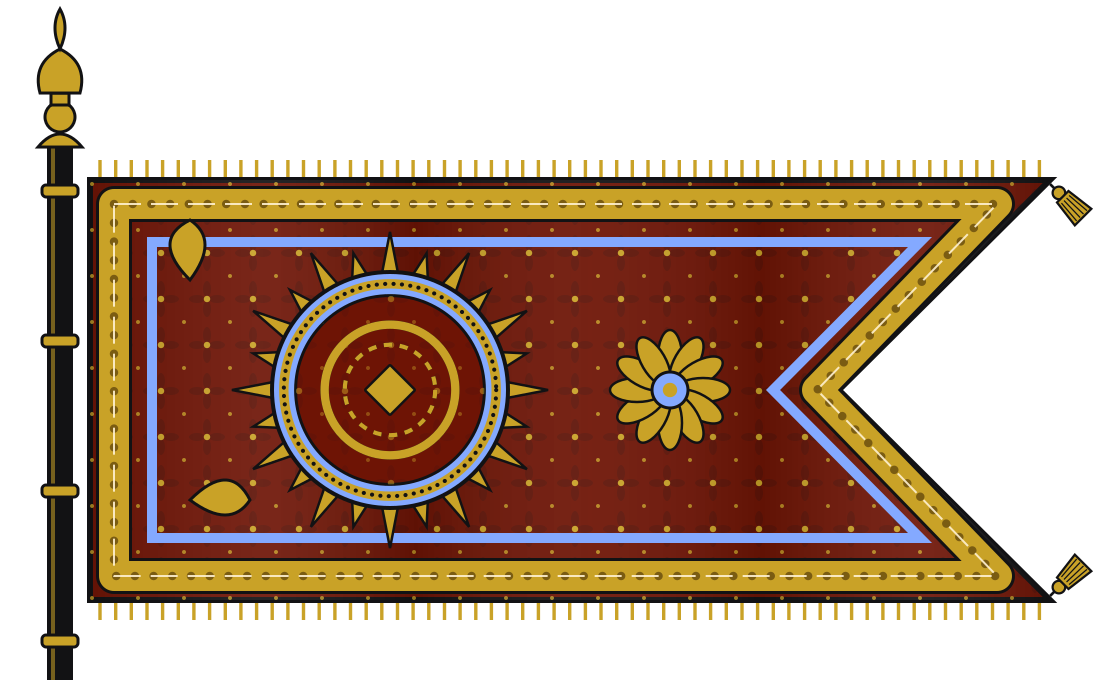
Historic banner
None recorded.
New flag types
| Accessory | For this clan | Basis |
|---|---|---|
| A9 Pota-dhvaja · ship and trade flag For ships, caravans and markets | Not yet designed for this clan | Design |
| A10 Utsava-patāka · festival flag Light, bright flag for fairs and festivals | Not yet designed for this clan | Design |
| A11 Shoka-dhvaja · mourning flag White cloth with the emblem outline in the clan's metal | Not yet designed for this clan | Design |
7. Regalia
| Accessory | For this clan | Basis |
|---|---|---|
| E1 Chhatra · house parasol The ceremonial umbrella | Not yet designed for this clan | Design |
| E2 Chamara · fly-whisks The pair of whisks beside the head of the house | Not yet designed for this clan | Design |
| E3 Danda · staff of office Staff or scepter | Not yet designed for this clan | Design |
| E4 Simhasana · seat The seat of the house, covered in clan cloth | Not yet designed for this clan | Design |
| E5 Khetaka · shield A round shield; the Changi and Dhanush are its flag forms | Not yet designed for this clan | Regional tradition |
| E6 Kula-ayudha · clan weapon The weapon the clan honours | Not yet found for this clan | Under research |
8. Worn
| Accessory | For this clan | Basis |
|---|---|---|
| F1 Kula-vastra · clan cloth The clan's woven pattern in its kit colours | Not yet designed for this clan | Design |
| F2 Kirti-vastra · honour cloth A cloth earned for a deed, not inherited | Not yet designed for this clan | Design |
| F3 Kula-mala · garland flower The flower or leaf the clan wears as a garland | Not yet found for this clan | Under research |
| F4 Chinha · house pin A metal badge with the pin emblem | Not yet designed for this clan | Design |
9. Records
| Accessory | For this clan | Basis |
|---|---|---|
| H1 Clan words A traditional line in the native script | · “Under research” No clan line in the clan's own words is in the fetched sources, and the native name is not printed in them[1]. Leads: the Vedic recensions and the Narayaneeyam (see books). | Documented |
| H2 Biruda · titles The house's title or titles | Thamprakkal (meaning emperor), the title of the senior male of Azhvanchery Mana; the Brahmandapuranam is said to give the title Netranarayanan (uncredited) | Documented |
| H3 Prashasti · praise genealogy The lineage as written at the head of a grant | Not yet found for this clan | Under research |
| H4 Vahi · clan register The book of the clan's births, marriages and deaths | Not yet found for this clan | Under research |
| H5 Rana-ghosha · war cry The clan's cry in battle or celebration | Not yet found for this clan | Under research |
10. VishwaVit · knower of the world
Game values are design choices for this project, not historical claims.
References
- Wikipedia, Nambudiri, read 2026-11-18, https://en.wikipedia.org/wiki/Nambudiri
- Joan P. Mencher, Nambudiri Brahman, Encyclopedia of World Cultures (via Encyclopedia.com), read 2026-11-18, encyclopedia.com
- Sun Staff, Namboothiri Brahmins, The Sampradaya Sun, 28 July 2012 (credits Wikipedia), read 2026-11-18, https://harekrsna.com/sun/features/07-12/features2531.htm
- Kesavan Veluthat, history article, namboothiri.com, read 2026-11-18, https://namboothiri.com/articles/history.htm
- Wikipedia, Azhvanchery Thamprakkal, read 2026-11-18, https://en.wikipedia.org/wiki/Azhvanchery_Thamprakkal
- Wikipedia, Parameshvara Nambudiri, read 18 Nov 2026, https://en.wikipedia.org/wiki/Parameshvara_Nambudiri
- Wikipedia, Kerala school of astronomy and mathematics, fetched 5 Nov 2026, link
- K. V. Sarma, K. Ramasubramanian, M. D. Srinivas, M. S. Sriram, Ganita-Yukti-Bhasa of Jyesthadeva, Vol. I (Hindustan Book Agency/Springer, 2008), excerpt read 10 Nov 2026, PDF
- athirathram.org, Vedic Traditions, read 2026-11-18, https://athirathram.org/verdic-traditions
- Wikipedia, Chennas Narayanan Namboodiripad, fetched 30 Oct 2026, link
- K. Ramasubramanian and M. S. Sriram, Tantrasangraha of Nilakantha Somayaji (Springer and Hindustan Book Agency, 2011), read 8 and 18 Nov 2026, PDF
- Wikipedia, Kriyakramakari, read 10 Oct 2026, link
- V. M. N. Nambudiripad, Namboothiri wits, article 13 (updated 18 Aug 2008), namboothiri.com, read 2026-11-18, https://namboothiri.com/articles/wits.htm
- MacTutor (St Andrews), Nilakantha Somayaji biography, read 10 Oct 2026, link
- William Logan, Malabar Manual (1887), Vol. 1 ch. 2 The People, web transcription at victoriainstitutions.com, read 2026-11-18, https://victoriainstitutions.com/malabar/11
- Wikipedia, Madhava of Sangamagrama, read 5 Nov 2026, link; Saṅgamagrāma Mādhava: An Updated Biography, arXiv 2408.12096, read 5 Nov 2026, link
- Dictionary of Scientific Biography, Paramesvara (MacTutor PDF), read 8 Nov 2026, PDF
- Wikipedia, Nilakantha Somayaji, read 19 Oct and 5 Nov 2026, link
- Wikipedia, Jyeṣṭhadeva, read 10 Nov 2026, link
- A S Maheswaran Nambudiripad, Hasthyaayurvedam, namboothiri.com article 20.7 (2001), read 2026-10-28, https://namboothiri.com/articles/hasthyaayurvedam.htm
- Ananta Journal, vol. 8 issue 3 (2022), article on Nilakantha's astronomy (OCR-garbled PDF), read 17 Nov 2026, PDF
- Sharada Srinivasan, Metal Mirror Marvel of Aranmula, Sahapedia, read 16 Nov 2026, sahapedia.org/metal-mirror-marvel-aranmula