The Munda are a Munda-speaking people of the Chota Nagpur plateau, mainly in Jharkhand and Odisha, and a Scheduled Tribe in India[1][2]. Their language, Mundari, belongs to the Munda subfamily of Austroasiatic and had about 1.6 million speakers at the 2011 census[3]. Their clans are totemic killi, and their supreme god is Singbonga, worshipped in sarna groves under a village priest, the pahan[1][4]. The Ulgulan movement of 1899–1900, led by Birsa Munda against rents and forest dues, is their best-known episode[2][5]. Their origins are debated: Munda languages are dated to the Odisha coast around 2000–1500 BCE, and a claimed Uttar Pradesh origin is disputed[1].
01Faith and deities
Chhinnamasta of Rajrappa, Jharkhand
The clan followed another faith. This goddess of its homeland is assigned for naming only.
| Deity or tradition | Place in the clan's life | Evidence |
|---|---|---|
| Singbonga | The sun, at the head of the pantheon; white goats and cocks are sacrificed (Russell); Banglapedia says other gods are propitiated with animals or fowls, against disease and for crops | [6][7] |
| Marang Buru | Mountain god of a prominent hill; animals are sacrificed for rain and against epidemic (Russell); the Pahan is the Munda priest | [6][8] |
| Desauli (Deswali) | Village presiding deity in the sarna, with his wife; a buffalo is given at the agricultural festival (Russell) | [4][6] |
| Jaher Buri | Village presiding deity (Khunti) | [4] |
| Chandi Bonga | Village presiding deity, with Hatu Bogkao (Khunti) | [4] |
| Ora Bongako | Ancestral spirits (Khunti) | [4] |
| Sarna Burhi | 'Woman of the Grove', goddess of sal groves, worshipped by the Munda, Kurukh and Oraon (Wikipedia) | [9] |
| Jahira Buru | Grove goddess the Munda also honour, with matted white hair and a staff (a secondary course blog) | [10] |
| Birsait (Birsa Munda's faith, from 1895) | Replaced Bonga worship with the single deity Singbonga; banned liquor and animal sacrifice; wore the sacred thread (janeu); blended animist belief with social reform | [11][12] |
| Dharti Aaba | The title of Birsa Munda, venerated by the Birsaits as messenger of God (GKToday; Vajiram & Ravi spell it Dharti Aba) | [11][12] |
| Sarna dharam | Described by Chief Minister Hemant Soren in 2020 as worship of nature, forests and mountains; no Munda practice is described | [13] |
02Temples
The Munda's own places of worship are the sarna groves of each village, where the Pahan worships (Khunti). No built Munda temple is in the extracts.
Built by the clan
Not recorded.
Given patronage or grants by the clan
| Temple | Deity | What the clan gave | When | Where |
|---|---|---|---|---|
| Anjana Devi temple, Anjan Dham | Anjana Devi | Munda and Baiga pahans are named as the priests | 2023 account | Anjan, Palkot block, Gumla district[14] |
03Languages and scripts
| Language or script | Kind | Under the clan | Evidence |
|---|---|---|---|
| Mundari living · Hoṛoko (𞓞𞓐𞓣𞓐𞓢𞓐) | Austroasiatic, Munda subfamily; close to Ho and Santali | Native language; additional official language of Jharkhand (2011) | [3][1] |
| Mundari Bani living · 𞓧𞓟𞓨𞓜𞓕𞓣𞓚 𞓗𞓕𞓨𞓚 | Script with 27 letters and 5 diacritics | Created by Rohidas Singh Nag (1934–2012) | [3][2] |
| Dialects | Hasada (𞓞𞓕𞓛𞓡𞓕𞓙), Naguri (𞓨𞓕𞓦𞓟𞓣𞓚), Tamaria (𞓝𞓕𞓧𞓕𞓪𞓚𞓕) or Latar (𞓒𞓕𞓝𞓕𞓫𞓣), Kera (𞓢𞓤𞓣𞓕𞓙) | Kera is a creole of Kurukh speakers | [3] |
| Other scripts | Mundari is also written in Odia, Devanagari, Bengali and Latin | In use | [3] |
| Other languages of the Munda | Panchpargania, Sadri, Odia, Bengali and Hindi | Spoken alongside Mundari | [1] |
04Books and literature
The works below are by or about the Munda, or in Mundari. The extracts record no patronage of books by Munda rulers.
Written during the clan's history
| Work | Author | Kind | When | Link to the clan |
|---|---|---|---|---|
| Encyclopaedia Mundarica | John-Baptist Hoffmann, with Van Emelen; Menas Orea helped | Encyclopaedia (15 volumes) | First published 1937 (TRI); c. 1924–1950 (Wikipedia Munda page); 1903–1978 (Wikipedia Mundari page) | [2][1][3] |
| Mundari Grammar | John-Baptist Hoffmann | Grammar | 1903–1905 | [3] |
| The Mundas and Their Country | Sarat Chandra Roy | Ethnography | 1912 (Calcutta: Kuntaline Press) | [15] |
| A Mundari Primer | Whitley | Primer | 1873 | [3] |
| Grammatik der Kolh-Sprache | Nottrott | Grammar | 1882 | [3] |
| Four gospels in Mundari | Not named | Translation | 1881 | [3] |
| Mundari Folk Tales | Mitra | Folk tales | 1956 | [3] |
| Adidharam (आदि धर्म) | Ram Dayal Munda and Ratan Singh Manki | Rituals and customs, in Mundari with Hindi translation | Not dated | [2] |
| The Musical Culture of the Munda Tribe | Sem Topno | Music | Not dated | [1] |
| The Religious History of Munda and Oraon Tribes | Diwakar Minz | Religion | 2017 | [1] |
| Cultural Study of Oraon and Munda Tribes | Niranjan Mahawar | Culture | 2019 | [1] |
| The Legend of Birsa Munda | Tuhin A. Sinha | Biography (English edition) | 2021 | [1] |
| The Life and Times of Jaipal Singh Munda | Santosh Kiro | Biography. Prabhat Prakashan, 184 pages (bookseller's listing; the book is not read) | 2018 | [1][16] |
| Mundari Bhasa Shiskha | Singh and Singh | Language textbook | 2017 | [3] |
| The Munda Languages | Anderson (ed.) | Academic volume | 2008 | [3] |
| Lo Bir Sendra | Not stated; ed. Rashmi Katyayan | Memoir | 2004 | [17] |
| Adivasidom | Edited by Ashwini Kumar Pankaj (Pyara Kerketta Foundation) | Not stated | 2017 | [17][18] |
| मरङ गोमके जयपाल सिंह मुंडा | Ashwini Kumar Pankaj | Book on Jaipal Singh Munda | 2015 | [17] |
Given patronage by the clan
Not recorded.
05Thinkers and scholars
| Name | Field | Era | Contribution |
|---|---|---|---|
| John-Baptist Hoffmann (1857–1928) | Jesuit; Mundari grammar and the Encyclopaedia | 1903 onward | First Mundari grammar (1903); Encyclopaedia Mundarica[2][3] |
| Menas Orea | Helped with the Encyclopaedia Mundarica | Not stated | [1] |
| Sarat Chandra Roy | Ethnographer | 1912 | The Mundas and Their Country (1912)[15]; on sindurdaan and turmeric in Munda marriage[1] |
| Rohidas Singh Nag (1934–2012) | Script | 20th century | Created the Mundari Bani script[2] |
| Ram Dayal Munda (1939–2011) | Languages and folklore | 20th century | Adidharam, with Ratan Singh Manki[2] |
| Haldar | Language | 1871 | An early study of Mundari, listed on the Mundari page[3] |
| Whitley | Language | 1873 | A Mundari Primer[3] |
| Nottrott | Language | 1882 | Grammatik der Kolh-Sprache[3] |
| Grierson | Linguistic survey | 1906 | Linguistic Survey of India[3] |
| Parkin | Linguist | 1993 | Holds that 'Munda' is of Sanskrit origin, not Austroasiatic[1] |
| R. R. Prasad | Scholar of the name | Not stated | 'Munda' means headman, an honorific given by Hindus that became a tribal name[2] |
| R. S. Sharma | Historian | 2005 | Munda terms in the Vedic texts (1500–500 BCE)[1] |
| Sidwell | Linguist | 2018 | Munda languages reached the Odisha coast about 2000–1500 BCE[1] |
| Peterson | Linguist | 2021 | The Upper Gangetic Munda claim has 'no linguistic or genetic basis'[1] |
| Barbara A. West | Historian | 2010 | Claims a Munda origin in Uttar Pradesh[1] |
Scholars' views on origin are given as stated; none is settled in the sources.
06Art and architecture
The extracts record stone monuments and drums; no painting, sculpture or textile of the Munda is documented.
Painting and wall art
Not recorded.
Sculpture and temple art
Not recorded.
Temple and building architecture
| Art form | What it is | Era | Evidence |
|---|---|---|---|
| Patthalgari stones | Stone erection tradition: inverted-U headstones inscribed with family trees; the types are Horadiri (family tree), Chalpadiri or Saasandiri (village boundary), Magodiri (for a social offender) and Ziddiri (placenta and navel burial of a newborn) | Not dated | [1][2] |
Weaving and textiles
Not recorded.
Clothing and jewellery
Not recorded.
Coins, pottery and crafts
Not recorded.
07History
Origins in the sources
The Khunti district culture page says historians believe the Munda came from Koal in the Vindhya range, though their origins are uncertain[4]. Sidwell (2018) dates Munda languages on the Odisha coast to about 2000–1500 BCE, after arrival from Southeast Asia; Barbara West (2010) claims a Munda origin in Uttar Pradesh, and Peterson (2021) says the Upper Gangetic Munda claim has 'no linguistic or genetic basis'[1]. R. S. Sharma (2005) finds Munda terms in the Vedic texts of 1500–500 BCE[1].
Russell's account, 1916
Russell and Hira Lal (1916) call the Munda 'oldest known inhabitants', as the author's view, and say they once spread over Bihar and the Ganges valley, by place names and tradition, and were driven to the hills by the Aryan advance[6].
The Chhotanagpur plateau in the sixth century BCE
A journal abstract on mandar makers dates the Munda presence on the Chhotanagpur plateau to about the sixth century BCE, citing Roy (1912) and Das (2013); the full title is not printed in the extract[19].
The Nagvansi kings and the Munda
The Nagvansi Rajas were said to descend from a snake-god legend. The Mundas trace their descent to the seven brothers who carried the child in a kawar, and the Rajas regard them as elder brothers[6]. The Atlas records that the Nagvanshi kings of Chotanagpur claimed Munda origins.
Khuntkatti land and rent
Mundas, as the original clearers, held khuntkatti lands at preferential rent; jagirdars and thikadars eroded these rights[5]. In the late 1800s the Mundas were forced to pay rents and work as bonded labourers for zamindars[1].
The Kol uprising, 1823–1833
Wikipedia, citing Ansari (2019), says some Manki Mundas revolted in the Kol uprising of 1823–1833; Thomas Wilkinson suppressed it[1].
Lawsuits and missions from 1858
From 1858 Christian tribal raiyats fought their claims through lawsuits (mulkai ladai, or sardari ladai), and the Lutheran, Anglican and Catholic missions were active among the Munda[5].
Birsa Munda, 1895
Birsa, the son of a sharecropper and educated in a mission school, was jailed for two years in 1895. That year he claimed a vision of god and proclaimed himself a prophet with healing powers[5]. His birth years differ by source: 1875 (Wikipedia) and 1874 (Banglapedia).
The Ulgulan, 1899–1900
The Ulgulan ('Great Tumult') aimed at a Munda Raj and independence south of Ranchi. On Christmas Eve 1899 arrows were shot and churches attacked across six police stations in Ranchi and Singhbhum. The rebels were defeated on 9 January 1900; Birsa was captured and died in jail. Of about 350 tried, three were hanged and 44 transported for life[5].
Reform and the sarna
The movement urged the Munda to give up superstition, animal sacrifice and intoxicants, to wear the sacred thread and to worship in the sarna. Its ideas mixed Hindu and Christian idioms[5].
Survey and tenancy law
The survey and settlement ran from 1902 to 1910. The Chhotanagpur Tenancy Act of 1908 recognised some khuntkatti rights and banned beth begari[5].
A copper-hoard proposal
Makkhan Lal proposed Munda authorship of the copper-hoard antennae swords, dating them to 3000–2000 BCE. Anil Kumar's paper on the copper hoards sets this beside other proposed dates, from V. A. Smith's c. 2000 BC to Gordon's c. 800 BC, and gives no C-14 date[20]. This is a proposal, not a documented Munda object.
Birsa's early life and the Birsait faith, 1875–1895
GKToday gives Birsa Munda's birth as 15 November 1875 at Ulihatu, Khunti; he was briefly baptised Birsa Daud at the German Mission school in Chaibasa[11]. Vajiram & Ravi name his mother as Karmi Hatu, say his education began at Salga, and say he had earlier converted to Christianity and left the German Mission School[12]. The Birsait sect was founded at Chalkad in 1895. Birsa was declared a messenger of God and venerated as Dharti Aaba; the Birsaits banned liquor and animal sacrifice, urged hygiene, wore the sacred thread (janeu), rejected missionary and colonial legal influence, and replaced Bonga worship with the single deity Singbonga[11]. Vajiram & Ravi describe the faith as blending animist belief with social reform[12].
The armed revolt begins, 24 December 1899
The armed revolt began on 24 December 1899 with attacks on police stations, revenue offices, churches and zamindari property at Khunti, Tamar, Sarwada, Ranchi and Bandgaon[11]. Vajiram & Ravi say the British had replaced Khuntkatti with zamindari, and describe guerrilla attacks and the idea of a 'Munda Raj'[12]. Gaya Munda led the military wing and Donka Munda the political wing; Sali Munda and Maki Munda also took part[11].
Dombari Hill, 9 January 1900
Forces under A. Forbes and H. C. Streatfeild fired on a gathering at Dombari Hill (Sail Rakab) on 9 January 1900, killing hundreds. Local tradition calls the hill Lered Da, the Hill of the Dead[11].
Birsa's capture and death, 1900
GKToday dates Birsa's capture to 3 February 1900, in the Jamkopai forest near Chakradharpur[11]. Vajiram & Ravi date it to March 1900[12]; the two dates conflict and the question is kept in the open questions. Both sources give his death in Ranchi Jail on 9 June 1900. GKToday gives his age as 24 and the official cause as cholera, with followers suspecting poisoning[11]; Vajiram & Ravi say the death came in 'mysterious circumstances'[12].
Birsa Munda in a North Bengal article (abstract)
The abstract of 'Understanding the Real and the Imagined: Birsa Munda 1870-1902', in Karatoya: North Bengal University Journal of History, vol. 15, pp. 44-55 (University of North Bengal repository; author and date not printed on the record), is paraphrased here. It says Birsa led the Munda rebellion on the Chotanagpur plateau; that outsider encroachment threatened tribal livelihood, culture and religion; that Birsa became a religious preacher claiming to represent God and began reforms in Munda society; that legends of supernatural powers strengthened his leadership; that he and his followers aimed at a 'Munda Raj'; and that the abstract suggests the myths were likely spread to win support[21]. The record does not use the word Ulgulan and gives no figures or citations. It is an abstract only, read as a secondary source; its title gives 1870 as the start year, which the open questions carry.
Earlier risings, 1789–1832
GKToday dates earlier Munda risings in Tamar to 1789, 1797, 1807, 1811 and 1819, and names Rudu and Konta for a rising in 1819–20. It dates the Kol Rebellion to 1831–32 and names Bindrai Manki and Singrai Manki as its leaders[11].
The Chotanagpur Tenancy Act, 1908
GKToday dates the Chotanagpur Tenancy Act to 11 November 1908. It recognised Khuntkatti rights, abolished beth-begari (unpaid labour), and in section 46 restricted transfers of tribal land to non-tribals[11]. Vajiram & Ravi say the Act barred such transfers and credit Birsa's advocacy as an influence on it[12]. GKToday says Father John Hoffmann facilitated the Act[11].
Jaipal Singh's education and career, 1918–1939
Jaipal Singh went to England in 1918 and to St John's College, Oxford in 1922, taking PPE in 1926; he was the first Indian Oxford Blue in hockey[18]. The Indian History Collective page says he studied at Oxford, with no years given[22]. The Constitution of India site says he left the ICS, worked for Burmah-Shell from 1928 to 1932, was at Achimota College, Gold Coast, from 1932 to 1936, and was vice-principal of Rajkumar College, Raipur, where it says he faced discrimination as a tribal; it gives his service in Bikaner from 1937 to 1939 as Revenue Commissioner, Colonisation Minister and Foreign Secretary[18]. Wikipedia gives Prince of Wales College, Achimota, as 1934, Rajkumar College, Raipur, as 1937 and the Bikaner state foreign secretaryship as 1938[17]; the Achimota dates conflict and are kept in the open questions. The Constitution of India site also says he led the Adivasi Labour Union in Jamshedpur[18].
Jaipal Singh Munda and the Adivasi Mahasabha, 1938–1946
Jaipal Singh Munda was born on 3 January 1903 at Takra-Hatudami, Pahan Toli village, Khunti, into a Munda family that had become Christian. He captained India's gold-medal hockey team at Amsterdam in 1928[17][18]. The Adivasi Mahasabha was formed in 1938 to seek a separate province from Bihar, covering the Santhal Parganas and Chotanagpur, and Jaipal Singh was elected its president in 1939[18][17]. At the Ramgarh Congress in 1940 he raised a separate Jharkhand state with Subhas Chandra Bose, who replied that it would affect the freedom struggle[17]. He lost the 1946 Khunti provincial seat to Congress's P. C. Mitra and was then elected to the Constituent Assembly by the Bihar Legislative Assembly[17]. The Constitution of India site says he was elected from Bihar in 1946[18]. He was called Marang Gomke, and a 2015 book title prints his name as 'मरङ गोमके जयपाल सिंह मुंडा'[17].
Constituent Assembly speeches, 1946–1947
Jaipal Singh spoke in the Constituent Assembly on 19 December 1946 about exploitation and dispossession and on 'equality of opportunity'. On 24 January 1947, in the Advisory Committee on Fundamental Rights, Minorities and Tribal and Excluded Areas, he said there was no tribal representation and no tribal woman member. On 27 August 1947 he asked for legislation and legislative reservation for Adivasis and urged the princely states to do likewise[18]. A speech line, 'the newcomers — most of you here are intruders', is quoted from CADIndia and Tribal Zone[17].
Biographies of Jaipal Singh Munda: listing and wiki
The bookseller's listing (Vedams) for Santosh Kiro, The Life and Times of Jaipal Singh Munda (Prabhat Prakashan, 2018, 184 pages), is a sales blurb; the book itself has not been read. The listing says that he was an M.A. in Economics at Oxford and a hockey Blue; that he gave up the Indian Civil Service to lead the Olympic team, which he captained to the 1928 Amsterdam gold (Dhyan Chand also on the team); that he was a Constituent Assembly member who helped shape the Fifth and Sixth Schedules; that he founded the Jharkhand Party; that he married into the family of W.C. Bonnerjee; that he presided over the Oxford Indian Majlis; and that he was principal of Rajkumar College, Raipur[16].
The Gateway House wiki page on Jaipal Singh (last modified 24 June 2010; a wiki and a weak source) gives 3 January 1903 to 20 March 1970, a Munda from Bihar known in Chotanagpur as 'Marang Gomke'. It says he formed the Adivasi Mahasabha in 1938, renamed it the Jharkhand Party after independence, and sought a separate homeland for central Indian adivasis[23].
The Jharkhand Party, 1949–1970
The Adivasi Mahasabha re-emerged as the Jharkhand Party in 1949–50[17]. Wikipedia's Jharkhand Party article gives its formation as 5 March 1949 in Ranchi by Jaipal Singh Munda, and its public launch as 1 January 1950 in Jamshedpur[24]. The party won 32 seats in the Bihar assembly in 1952 in the Election Commission of India figures that Wikipedia's Jharkhand Party article tabulates, and Wikipedia's Jaipal Singh article gives the same 32[24][17]. The same Jharkhand Party article's text gives 34 seats for 1952, and the Constitution of India site gives 33[24][18]; the conflict is kept in the open questions. Wikipedia gives 31 seats in 1957 and 20 in 1962[17]. In 1955 the party asked the States Reorganisation Commission for a separate state, and the request was rejected, as Braja Bihari Kumar is cited as saying[17]. In 1963 Jaipal Singh merged the party into Congress, and he contested Khunti in 1967 as a Congress candidate[17][18]. He died in New Delhi on 20 March 1970, aged 67[17][18].
The Jharkhand Mukti Morcha is formed, 1972–1973
Wikipedia's Jharkhand movement article says groups merged in 1972 to form the Jharkhand Mukti Morcha (JMM), and that A. K. Roy led the Marxist Co-ordination Committee that joined it[25]. Outlook dates the founding to 1973, on Birsa Munda's birthday, when the Shivaji Samaj, the Santhal group of Shibu Soren and the Marxist Coordination Committee of A. K. Roy came together; Shibu Soren was general secretary and Binod Bihari Mahato, a Kurmi leader of the Shivaji Samaj, was the first president[26]. The two dates conflict and the question is kept in the open questions. Wikipedia says Binod Bihari Mahato helped found the JMM and that Shibu Soren was its co-founder and long-time leader; it says the JMM drew tribal, working-class and OBC support, not only tribal[25].
Alliances, the AJSU and the Coordination Committee, 1980–1996
Outlook says the JMM allied with Congress in 1980, won 11 Bihar Assembly seats and its first Lok Sabha seat, and that the leftists left[26]. The All Jharkhand Students Union (AJSU) was founded in Jamshedpur on 22 June 1986, led by Surya Singh Besra, according to Wikipedia, which cites Khan (2024)[25]; Outlook says young JMM members formed the AJSU in 1986[26]. Wikipedia says the Jharkhand Coordination Committee tried to unite regional groups in the late 1980s; Outlook dates its formation to 1987, when the JMM pulled out[25][26]. Outlook says the JMM won one Lok Sabha seat in 1996 and none after[26].
Autonomy council and the 1997 resolution, 1995–1997
In 1995 the Jharkhand Area Autonomous Council was created, with limited autonomy over agriculture, rural health, public works and mineral regulation (Wikipedia, citing Kumar Mishra 2021)[25]. In 1997 the undivided Bihar Assembly passed a resolution favouring a separate state[25].
Jharkhand state, 2000
Jharkhand was carved out of Bihar in 2000[18]. Wikipedia gives the date as 15 November 2000, when Jharkhand was formed from 18 southern Bihar districts after the Bihar Reorganisation Act; the date is Birsa Munda's birth anniversary (citing Tigga 2025)[25]. Outlook says the BJP dominated the new state and that Babulal Marandi became its first chief minister[26].
The Sarna code, 2020
On 11 November 2020 the Jharkhand Assembly passed a government-backed resolution for a separate religion code for tribals, after a cabinet decision on 10 November. Chief Minister Hemant Soren said the Sarna dharam worships nature, forests and mountains. The census offers six religions, so a Sarna code would need a new census column if the Centre approved it. A tribe-as-religion column existed in the census from 1871 to 1951 and was later dropped[13]. The activist Sanjay Basu Mallik of the Jangal Bachao Andolan said 'Sarna' is not common to all nature-worshippers and that the code 'should be open to all'[13].
Outlook (Md Asghar Khan, 19 February 2026, a news report) says the Centre has not accepted the Sarna code: the proposal is still pending with the Government of India, and a new religion code would need the Registrar General of India and census changes. It reports no concrete initiative by the Centre in about five years. It also notes a 'Munda vs Oraon debate' over restarting the code, which a journalist says makes it risky for tribal unity, with no detail given[27].
08Journey and migrations
Movements the sources describe, from language arrival to colonial labour migration. Dates and claims are as each source gives them.
| When | From | To | Why | Evidence |
|---|---|---|---|---|
| c. 2000–1500 BCE (Sidwell 2018) | Southeast Asia | Odisha coast | Arrival of Munda languages (a linguistic claim) | [1] |
| About the sixth century BCE (journal abstract, citing Roy 1912 and Das 2013) | — | Chhotanagpur plateau | Munda presence on the plateau, as dated in the abstract | [19] |
| Before the Aryan advance (Russell 1916; the author's view) | Bihar and the Ganges valley, by place names and tradition | Hills of Chota Nagpur | Driven to the hills by the Aryan advance | [6] |
| Colonial era | Chota Nagpur | Assam tea gardens | Labour (Wikipedia) | [1] |
| About 200 years ago (Banglapedia, 2021 entry) | Ranchi and Chota Nagpur; some from the Rajmahal Hills | Sundarbans and northern Rajshahi, Bangladesh | To clear land for zamindars | [7] |
| 1921 census | Chota Nagpur | Duars tea estates, Jalpaiguri | Seasonal labour; 34,601 Mundas counted there | [7] |
| 2016 study | Sunderbans village | Elsewhere (not named) | Economic migration, especially of younger people | [1][2] |
09Seats and lands
| Place | Role | Where today |
|---|---|---|
| Chota Nagpur Plateau | Core homeland, south and east; Khunti is the main Munda area | Jharkhand: Ranchi, Khunti, Simdega, Paschim Singhbhum, Gumla, Purbi Singhbhum, Ramgarh[1][4] |
| Kolhan | Munda-Manki system; Russell calls Kolhan (near Chaibasa) the special home of the Larka Kols | Singhbhum, near Chaibasa[6] |
| Khuntkatti village lands | Land of the original clearers, at preferential rent (Banglapedia) | Chhotanagpur[5] |
| Sundargarh and Sambalpur | Odisha communities | Odisha[1] |
| Jalpaiguri, Paschim Medinipur and North 24 Parganas | West Bengal communities | West Bengal[1] |
| Sporadic settlements | Chhattisgarh, Bihar and Madhya Pradesh | Chhattisgarh, Bihar, Madhya Pradesh[1] |
| Mandla and Raigarh | Central Provinces Kol and Munda septs (Russell's 1916 view) | Madhya Pradesh and Chhattisgarh[6] |
| Assam tea valleys, Tripura and Mizoram | Settlement in the north-east; the Tripura group is also called Mura | Assam, Tripura, Mizoram[1] |
| Sundarbans and northern Rajshahi | Settlement in Bangladesh: Koyra and Dumuria (Khulna); Shyamnagar, Debhata and Tala (Satkhira); northern Rajshahi | Bangladesh[7] |
| Nepal | Settlement abroad; 2,350 at the 2011 census | Nepal[1] |
10Notable figures
| Name | Role | Era | Known from |
|---|---|---|---|
| Birsa Munda | Leader of the Ulgulan; son of a sharecropper; claimed prophetic powers | 1875–1900 (Wikipedia); 1874–1900 (Banglapedia) | [5][1] |
| Nagvansi ancestor legend | Snake-god in human form, ancestor of the Nagvansi Rajas, in the legend Russell records | Legend | [6] |
| Sushila Samad | Poet | 1906–1960 | [1] |
| Jaipal Singh Munda | Politician and hockey player | 1903–1970 | [1] |
| Rohidas Singh Nag | Created the Mundari Bani script | 1934–2012 | [2] |
| Ram Dayal Munda | Scholar of languages and folklore | 1939–2011 | [1][2] |
| Tulasi Munda | Social activist | b. 1947 | [1] |
| Kariya Munda | Politician | b. 1936 | [1] |
| Arjun Munda | Politician | b. 1968 | [1] |
| Amrit Lugun | Ambassador | b. 1962 | [1] |
| Anuj Lugun | Poet | b. 1986 | [1] |
| Dayamani Barla | Journalist | Not stated | [1] |
| Dulal Manki | Folk singer | Not stated | [1] |
| Prakash Munda | Cricketer | Not stated | [1] |
| Nikhil Barla; Munmun Lugun | Footballers | Not stated | [1] |
| Masira Surin; Manohar Topno | Hockey players | Not stated | [1] |
| Rajeev Topno | Named on the page; field not stated in the extract | b. 1974 | [1] |
| Nilkanth Singh Munda; Laxman Munda | Politicians | Not stated | [1] |
| Gaya Munda | Led the military wing of the Ulgulan | 1899–1900 | [11] |
| Donka Munda | Led the political wing of the Ulgulan | 1899–1900 | [11] |
| Sali Munda; Maki Munda | Took part in the Ulgulan | 1899–1900 | [11] |
| Karmi Hatu | Mother of Birsa Munda | Not stated | [12] |
| Bindrai Manki; Singrai Manki | Leaders of the Kol Rebellion | 1831–32 | [11] |
| Rudu; Konta | Named for a rising | 1819–20 | [11] |
11Allies, rivals and marriages
| People | Relationship | When |
|---|---|---|
| Santal | A branch of the Kol, Munda and Ho group (Russell); Santali is a related Munda-subfamily language | 1916 account |
| Ho | Kol, Munda and Ho form one great tribe group in Russell's 1916 entry | 1916 account |
| Bhumij | Probably a section of the Mundas ('Bhumij Munda'), where they intermarried (Russell) | 1916 account |
| Kharia | Once one people with the Mundas (Russell); Kharia-Munda sub-tribe (Banglapedia) | 1916; Bangladesh |
| Juang | Related (Wikipedia) | Not stated |
| Oraon | Oraon-Munda sub-tribe; the Mundas and Oraons are known by the general name Kol (Banglapedia) | Bangladesh |
| Asur | Asurs claim putative kinship with the Munda (Wikipedia) | Asur claim |
| Mahato | Closely related (Banglapedia); came to Bangladesh with the Mundas | Bangladesh |
| Mah Meri and Temuan (Malaysia) | Genetically close (Wikipedia) | Not stated |
| Mahishasur veneration | The Asur veneration of Mahishasur has spread to Munda groups in West Bengal (New Indian Express 2019, as cited by Wikipedia) | 2019 report |
| Deori priest role | The Deori priest role is also found among the Hos, Bhumij, Bhuyan, Sounti, Khonds and Chutia (Wikipedia) | Not stated |
| Tamadia | The name outsiders use for Munda in Kolhan (Wikipedia) | Not stated |
| Sadan | Munda music is similar to Sadan music (Wikipedia) | Not stated |
12Society and livelihood
Patrilineal, exogamous killi clans; tribal endogamy, a monogamy norm and bride price (Wikipedia). Patrilocal and patriarchal; marriages can last a week, with the Dali Takka gift to paternal guardians paid beforehand; widow remarriage is common (TRI Jharkhand). In Bangladesh, marriages are arranged by parents, are not within the same sect, and use sindur dan (Banglapedia).
Government and social order
| Institution or group | What it was | Evidence |
|---|---|---|
| Killi | Totemic clan; the name is cf. Sanskrit kula; members share a common forefather | [1][2] |
| Munda and Manki (Kolhan) | Village head (munda), informant (dakuwa), priest (pahan), assistant priest (pujhar), head of 15–20 villages (manki), tax collector (tahshildar) | [1] |
| Pahan | Village priest, adopted in the Chotanagpur division; worships in the sarna grove | [1][4] |
| Gitiora | Dormitory system, no longer practised (Khunti) | [4] |
| Montri and modol (Bangladesh) | A montri (minister) over the villages of an area; modols are village leaders | [7] |
| Marriage rites | Marriage begins with sagai and ends with bidai (Wikipedia); lota-pani is the engagement (TRI) | [1][2] |
| Cham utarna | Welfare rite for twins, performed by a pahan (TRI Jharkhand) | [2] |
| Funeral | The dead are anointed with scented oil and turmeric (TRI Jharkhand) | [2] |
Livelihood over time
| Era | Livelihood | Evidence |
|---|---|---|
| Early (as the sources describe) | Original clearers of forest land, holding khuntkatti village lands | [5] |
| Late 1800s | Forced to pay rents and work as bonded labourers for zamindars | [1] |
| Colonial era | Labour on the Assam tea gardens and as dhoolie bearers (Russell's 1916 account) | [6][1] |
| 1921 | Seasonal labour on the Duars tea estates (Jalpaiguri) | [7] |
| Today | Settled agriculturists with minor forest produce (Khunti); many in government jobs, especially Indian Railways | [4][1] |
| Today | Younger people migrate for work; a 2016 study of a Sunderbans village reports landlessness and migration | [1][2] |
| Bangladesh | Jungle clearers (bunos) and seasonal labourers | [7] |
13Sub-clans and related clans
Killi are the totemic clans, named in Wikipedia and the TRI Jharkhand page: Baa (fish), Baba (rice), Bodra, Balamchu (fish net), Barla, Bhengra (horse), Bhutkumar, Bhuswar (bird), Bukru (bird), Bulung (salt), Dungdung (fish), Gudia or Hans (swan), Hemrom or Hembram (tree), Herenz (bird), Horo (turtle), Hundar (hyena), Jojo (tamarind), Kauwa (crow), Kerketta (bird), Kula (tiger), Nil (bull), Mus (mouse), Nag (cobra), Oreya (bamboo basket), Pandu (cobra), Purty, Runda (wild cat), Sandil (a full moon in Wikipedia, a bird in TRI), Sanga (root), Surin, Soren or Soreng (bird), Tiru (bird), Tuti (grain), Topno (red ants) and Kongari (white crow). Glosses are as the extracts give them. Other sub-groups, septs and related peoples follow, as the extracts name them.
| Clan | Relation | Where | Size | In the Atlas | Evidence |
|---|---|---|---|---|---|
| Baa | Sub-clan | same name as ST-366: check | [1][2] | ||
| Baba | Sub-clan | same name as ST-367: check | [1][2] | ||
| Bodra | Sub-clan | new clan candidate | [1][2] | ||
| Balamchu | Sub-clan | new clan candidate | [1][2] | ||
| Barla | Sub-clan | new clan candidate | [1][2] | ||
| Bhengra | Sub-clan | new clan candidate | [1][2] | ||
| Bhutkumar | Sub-clan | new clan candidate | [1] | ||
| Bhuswar | Sub-clan | new clan candidate | [1] | ||
| Bukru | Sub-clan | new clan candidate | [1] | ||
| Bulung | Sub-clan | new clan candidate | [1][2] | ||
| Dungdung | Sub-clan | same name as ST-528: check | [1][2] | ||
| Gudia | Sub-clan | same name as ST-391: check | [1][2] | ||
| Hemrom | Sub-clan | new clan candidate | [1][2] | ||
| Herenz | Sub-clan | new clan candidate | [1][2] | ||
| Horo | Sub-clan | same name as ST-445: check | [1][2] | ||
| Hundar | Sub-clan | same name as ST-530: check | [1][2] | ||
| Jojo | Sub-clan | same name as ST-398: check | [1][2] | ||
| Kauwa | Sub-clan | same name as ST-419: check | [1][2] | ||
| Kerketta | Sub-clan | same name as ST-405: check | [1][2] | ||
| Kula | Sub-clan | new clan candidate | [1][2] | ||
| Nil | Sub-clan | new clan candidate | [1][2] | ||
| Mus | Sub-clan | same name as ST-475: check | [1][2] | ||
| Nag | Sub-clan | same name as ST-476: check | [1][2] | ||
| Oreya | Sub-clan | new clan candidate | [1][2] | ||
| Pandu | Sub-clan | new clan candidate | [1][2] | ||
| Purty | Sub-clan | new clan candidate | [1][2] | ||
| Runda | Sub-clan | new clan candidate | [1][2] | ||
| Sandil | Sub-clan | new clan candidate | [1][2] | ||
| Sanga | Sub-clan | same name as ST-552: check | [1][2] | ||
| Surin | Sub-clan | new clan candidate | [1][2] | ||
| Tiru | Sub-clan | new clan candidate | [1][2] | ||
| Tuti | Sub-clan | new clan candidate | [1][2] | ||
| Topno | Sub-clan | same name as ST-560: check | [1] | ||
| Kongari | Sub-clan | new clan candidate | [1][2] | ||
| Nagvansi | Dynasty from this clan | Chotanagpur; royal house, also written Nagabanshi Munda in the sheet | same name as ANC-216: check | [6][1] | |
| Bhuinhar | Sub-clan | Landholders; Munda aristocracy (Russell) | new clan candidate | [6][7] | |
| Kharia-Munda | Branch | Sub-tribe (Banglapedia) | same name as ST-407: check | [7] | |
| Mahili-Munda | Branch | Sub-tribe (Banglapedia) | new clan candidate | [7] | |
| Oraon-Munda | Branch | Sub-tribe (Banglapedia) | new clan candidate | [7] | |
| Manki-Munda | Branch | Sub-tribe (Banglapedia) | new clan candidate | [7] | |
| Khangar | Sub-clan | Risley's Munda sub-caste (Russell) | same name as ST-406: check | [6] | |
| Savar | Related people | Savar Mundas (Russell); Savar (ST-285) | ST-285 | [6] | |
| Mahali | Related people | Munda sub-caste (Russell); Mahli (ST-180) in the Atlas | ST-180 | [6] | |
| Kharia | Related people | Once one people with the Mundas (Russell) | ST-130 | [6][7] | |
| Bhumij | Related people | Probably a section of the Mundas (Russell) | about 400,000 (Russell, 1916) | ST-033 | [6] |
| Ho | Related people | One great tribe group with Kol and Munda (Russell) | ST-102 | [6][1] | |
| Santal | Branch | A branch of the Kol, Munda and Ho group (Russell) | 2,754,723 (Jharkhand, 2011)[28] | ST-280 | [6][29] |
| Juang | Related people | Related (Wikipedia) | ST-114 | [1] | |
| Kol | Related people | Kolarian family; Kols and Mundas in the Central Provinces (Russell) | ST-141 | [6][7] | |
| Korwa | Related people | Once one people with the Mundas (Russell) | ST-157 | [6] | |
| Korku | Related people | Once one people with the Mundas (Russell) | ST-156 | [6] | |
| Khairwar | Related people | Once one with the Mundas; call themselves Kols (Russell) | ST-127 | [6] | |
| Bharia | Related people | Call themselves Kols in the Central Provinces (Russell) | ST-024 | [6] | |
| Koli | Related people | Gujarat; possibly an offshoot (Russell) | new clan candidate | [6] | |
| Asur | Related people | Putative kinship claimed by the Asur | ST-012 | [30] | |
| Kharwar | Related people | Putative kinship claimed by the Asur | ST-131 | [30] | |
| Mahato | Related people | Closely related (Banglapedia) | SUB-121 | [7] | |
| Oraon | Related people | Oraon-Munda sub-tribe; known by the general name Kol (Banglapedia) | ST-241 | [7] | |
| Gond | Related people | A Raigarh Kol sept (Russell) | ST-088 | [6] | |
| Kawar | Related people | A Raigarh Kol sept (Russell) | ST-126 | [6] | |
| Binjhwar | Related people | A Mandla Kol sept (Russell) | ST-039 | [6] | |
| Mudas | Related people | Madhya Pradesh (TRI Jharkhand) | new clan candidate | [2] | |
| Mura | Branch | Tripura; the Tripura group is also called Mura (Wikipedia) | same name as ST-474: check | [1] | |
| Munda Lohara | Branch | Sub-group in the Atlas; Odisha Scheduled Tribe list | new clan candidate | [31] | |
| Munda Mahali | Branch | Sub-group in the Atlas; Odisha Scheduled Tribe list | new clan candidate | [31] | |
| Oriya Munda | Branch | Odisha Scheduled Tribe list | new clan candidate | [31] | |
| Patar | Branch | Sub-group in the Atlas | same name as ST-521: check | [1] | |
| Tamaria | Branch | Sub-group in the Atlas; also a Mundari dialect (Wikipedia) | new clan candidate | [3] | |
| Rautia | Sub-clan | Central Provinces (Russell) | same name as ST-488: check | [6] | |
| Rautele | Sub-clan | Central Provinces (Russell) | same name as ST-550: check | [6] | |
| Thakuria | Sub-clan | Central Provinces (Russell) | same name as ST-505: check | [6] | |
| Kagwaria | Sub-clan | Central Provinces (Russell) | same name as ST-422: check | [6] | |
| Desaha | Sub-clan | Central Provinces, Rewah (Russell) | same name as ST-381: check | [6] | |
| Bargaiyan | Sub-clan | Mandla (Russell) | same name as ST-372: check | [6] | |
| Kathotia | Sub-clan | Mandla (Russell) | same name as ST-404: check | [6] | |
| Katharia | Sub-clan | Mandla (Russell) | same name as ST-403: check | [6] | |
| Mudia | Sub-clan | Mandla (Russell); also Mudrundia | same name as ST-458: check | [6] | |
| Kumraya | Sub-clan | Mandla (Russell) | same name as ST-429: check | [6] | |
| Bhuwar | Sub-clan | Mandla (Russell) | same name as ST-374: check | [6] | |
| Nathunia | Sub-clan | Mandla (Russell) | same name as ST-479: check | [6] | |
| Karpatia | Sub-clan | Mandla (Russell) | same name as ST-401: check | [6] | |
| Bandi | Sub-clan | Raigarh (Russell) | new clan candidate | [6] | |
| Birjhia | Sub-clan | Raigarh (Russell) | same name as NE-018: check | [6] | |
| Sonwani | Sub-clan | Raigarh (Russell) | same name as ST-556: check | [6] | |
| Keriari | Sub-clan | Raigarh (Russell) | same name as ST-418: check | [6] | |
| Khunta | Sub-clan | Raigarh (Russell) | same name as ST-424: check | [6] | |
| Kapat | Sub-clan | Raigarh (Russell) | same name as ST-400: check | [6] |
Clans marked "new clan candidate" are not in the Atlas yet.
14Surnames
Surnames the extracts say Munda people use as family names (Wikipedia; TRI). No counts are sourced, so none is given.
| Surname | Clan or sub-clan | Where | People with this surname | Also used by other communities |
|---|---|---|---|---|
| Barla | Barla | not yet counted | Not checked | |
| Bhengra | Bhengra | not yet counted | Not checked | |
| Horo | Horo | not yet counted | Not checked | |
| Enem Horo | Horo | not yet counted | Not checked | |
| Kerketta | Kerketta | not yet counted | Not checked | |
| Lugun | Not stated (Wikipedia lists it as a surname) | not yet counted | Not checked | |
| Manki | Manki-Munda (sub-tribe) | not yet counted | Not checked | |
| Munda | The people's name | not yet counted | Not checked | |
| Nag | Nag | not yet counted | Not checked | |
| Surin | Surin (also Soren, Soreng) | not yet counted | Not checked | |
| Topno | Topno | not yet counted | Not checked | |
| Samad | Not stated (Wikipedia lists it as a clan name) | not yet counted | Not checked | |
| Hembram/Hemrom | Hemrom (also Hembram) | not yet counted | Yes | |
| Dungdung | Dungdung | not yet counted | Not checked | |
| Soren/Soreng | Surin (also Soren, Soreng) | not yet counted | Yes | |
| Purty | Purty | not yet counted | Not checked | |
| Tiru | Tiru | not yet counted | Not checked |
Counts are of everyone with the surname, from the cited source and year, not only members of this clan. A surname shared with other communities says nothing about any one person's origin.
15Songs and music
The Munda dance in every gathering, and the durang dance and the susun song are named in the extracts; Mage song rhythm resembles Nagpuri Fagua (Wikipedia). No texts are given in the extracts, so no excerpt is printed.
Instruments and styles
| Instrument or style | What it is | Evidence |
|---|---|---|
| Naqareh | The principal Munda instrument, a drum | [1][2] |
| Dumang (mandar) | The Munda name for the mandar drum | [19] |
| Madal | Drum used in Munda and Santal dances | [32] |
| Nagara | Drum used in Munda dances (also in Jhumair, Paiki and Santal) | [32] |
16Poems, lullabies and children's rhymes
No Munda poems, lullabies or rhymes appear in the extracts.
None recorded yet.
17Stories, legends and proverbs
Stories are told among the Munda of Russell's Kol, Munda and Ho entry, of the Nagvansi Rajas, and of the Birsa movement.
Stories and legends
| Story | What happens | Told by | Evidence |
|---|---|---|---|
| Sing-Bonga and the twelve pairs | The sun, Sing-Bonga, made a boy and a girl in a cave and taught them rice-beer; they had twelve sons and twelve daughters, and the pairs chose their food. The first pair, the Kols and the Bhumij, took bullock or buffalo flesh. | Kol, Munda and Ho (Russell's entry, 1916) | [6] |
| The Nagvansi snake ancestor legend | A snake-god in human form married a Brahman's daughter; their child was found under a cobra's hood by wood-cutters and carried in a banghy by seven elder brothers. The Mundas say they descend from those seven brothers, and the kawar is their sign-manual. | Nagvansi Rajas' tradition, as recorded by Russell (1916) | [6] |
| Mahishasur veneration | The veneration of Mahishasur, held by the Asurs, has spread to Munda groups in West Bengal. | New Indian Express (2019), as cited by Wikipedia | [30] |
| The herdsman at Anjan | A legend of a Lohra or Munda herdsman at Anjan, Gumla district; the extract gives no more detail. | Anjan Dham page (The Indian Tribal, 2023) | [14] |
| Birsa's vision, 1895 | Birsa claimed a vision of god in 1895 and prophesied an imminent deluge; he proclaimed himself a prophet with healing powers. | Banglapedia | [5] |
Proverbs and sayings
Not recorded.
18Festivals and fairs
| Festival or fair | When | Where | What happens |
|---|---|---|---|
| Sarhul (Sarjun-Baba in Bangladesh) | March–April (Khunti); Chaitra (Bangladesh) | Khunti, Jharkhand; Bangladesh | Sal flowers are brought to the sarna (Khunti); Sarhul or Sarjun-Baba is kept in Chaitra (Banglapedia)[4][7] |
| Mage Parab | Full moon of Paush | Villages | Honours the ancestors; Mage Susun dance[4][1] |
| Phagu | February–March | Villages | Communal hunt; coincides with Holi[4] |
| Karam | August–September | Villages | A karam sapling is planted; all-night dance; rice-beer[4] |
| Sohrai | October–November | Villages | Lamps; cattle sheds washed and sprinkled with rice-beer[4] |
| Baha parab | Not stated | Not stated | Named in the Wikipedia and TRI lists[1][2] |
| Dolpurnima | Full moon | Villages | Boys hunt at night[4] |
| Kadleta or Batauli | Asad | Bangladesh | Named in Banglapedia[7] |
| Nana or Jom-Nana | Aswin | Bangladesh | New-rice festival[7] |
| Kharia Puja or Magh Parab | Magh | Bangladesh | Named in Banglapedia[7] |
| Shyama or Kali puja; Ashadi puja; Bhadu puja; poush-parbon | Not stated | Bangladesh | Observed in Bangladesh (Banglapedia)[7] |
| Yatra | Not stated | Not stated | Open-air theatre recreation (Khunti)[4] |
19Food, dress and games
Food
| Item | What it is | Evidence |
|---|---|---|
| Food (Bangladesh Munda) | Crabs, mice and snails are named as dishes (Banglapedia) | [7] |
Dress
| Item | What it is | Evidence |
|---|---|---|
| Head-dress | A hair coil at the right side with brass or silver ornaments and feather plumes (Dalton, as given in Russell) | [6] |
| Tattooing (Mandla) | Women tattooed with a man or a man on horseback (Russell) | [6] |
Games and martial arts
Not recorded.
Tags: living still practised · revived brought back after a break · lost known only from records · research reported but not yet confirmed from a source. Songs and poems under copyright are listed by title only; restricted or sacred material is noted without its content.
20Status today
A living Scheduled Tribe in India (state and UT list dated 09-07-2024, Atlas), mainly in Jharkhand and Odisha, with communities in West Bengal, Bangladesh and Nepal; Mundari had about 1.6 million speakers at the 2011 census[1][3].
Recognised heritage
| What | Recognition | Evidence |
|---|---|---|
| Mundari as an additional official language of Jharkhand | Jharkhand Official Language (Amendment) Act, 2011 | [3] |
| Mundari Bani script | Growing in literature, education and computing (Wikipedia) | [3] |
| Sarhul, Mage, Karam, Sohrai and other festivals | Recorded on the Khunti district culture page | [4] |
| Janjatiya Gaurav Divas, 15 November | Observed on 15 November (GKToday; Vajiram & Ravi) | [11][12] |
| Stadiums and a games complex named for Jaipal Singh Munda | A Ranchi stadium in 2013 and another at IGNTU Amarkantak in 2019 (Wikipedia); a Ranchi games complex (Constitution of India site) | [17][18] |
| Separate religion code for Sarna | Resolution of the Jharkhand Assembly, 11 November 2020; not yet a census column in the extracts | [13] |
Not yet reviewed by the Munda community; no source in the pack records a community review.
21For children
The sun's children on the plateau
Far away on a high green plateau, in the land now called Jharkhand, live the Munda. Their language is called Mundari, and it has its own script, Mundari Bani. Each village has a sarna, a sacred grove, where the village priest, the pahan, worships. The people honour Singbonga, the sun, who is their greatest god. Every family belongs to a killi, a clan with its own totem, such as the tiger or the fish. In spring, at the Sarhul festival, sal flowers are carried to the sarna.
Written for this project
22Across the project
| Project | What carries this clan | Status |
|---|---|---|
| Atlas of the Janas | Districts and abroad sites are in the lands section; the footprint file is left to the host | |
| KulDevi and GrahDevi | KulDevi Chhinnamasta is assigned by the project and is not the Munda faith; the GrahDevi forms are | From the Atlas |
| Planet naming | Not sourced for this clan | |
| Renaming and waters | Not sourced for this clan |
23Open questions
- Munda songs, proverbs and rhymes in Mundari: Hoffmann's Encyclopaedia Mundarica and Roy (1912) need a full-text read; the NVLI record does not confirm the full text.
- The Madra Munda and Sutiambe Pahan legend of the Nagvansi founding Phani Mukut Rai.
- Coins, seals and inscriptions: none found in the extracts.
- Mahali and Mahli (ST-180): the Atlas lists Mahali as an alias; the Wikipedia West Bengal list gives both names separately.
- Odisha population: 558,691 (Odisha list) against 584,346 (Munda page); the year of the second figure is not stated.
- Birsa Munda's birth year: 1875 (Wikipedia) or 1874 (Banglapedia); the NBU article title gives the range 1870-1902, and its abstract gives no birth year[21].
- Sandil: a full moon in Wikipedia, a bird in the TRI list.
- Kaur (Tripura) in the Atlas overlaps the Kawar alias Kaur (ST-126); unverified.
- The Chala Pachcho and Jahira Buru material comes from an anonymous course blog; treat it as secondary.
- The Asur clan-name list is for Asur in general; check Birjia separately.
- Official ST order dates by state, and the People of India (AnSI) sub-group list, are not in the extracts.
- Munda sarna practice: Wikipedia's Sarnaism and Jaherthan pages were read, but both describe Santal and Bhumij practice and name no Munda practice; Sarna Dhorom as the Munda keep it is unsourced[34][35].
- Mission history of the Munda after the 1890s: the extracts give only Birsa's school and baptism and the 1858 lawsuits; no present-day religious breakdown is to be reported.
- Birsa's capture date CONFLICT: 3 February 1900 in the Jamkopai forest near Chakradharpur (GKToday) against March 1900 (Vajiram & Ravi). Both are cited in the history section[11][12].
- JMM founding year CONFLICT: 1972 (Wikipedia, Jharkhand movement; the Rao 2024 title it cites says 1973) against 1973 (Outlook, 29 Mar 2024)[25][26].
- Jaipal Singh's Achimota College dates CONFLICT: 1934 (Wikipedia, Prince of Wales College, Achimota) against 1932–36 (Constitution of India site)[17][18].
- Jaipal Singh's Rajkumar College post CONFLICT: principal (Kiro listing, Vedams)[16] against vice-principal (Constitution of India site)[18].
- Jharkhand Party seats in the 1952 Bihar assembly CONFLICT: 32 (Wikipedia Jharkhand Party table and Wikipedia Jaipal Singh article) against 34 (Wikipedia Jharkhand Party body text) and 33 (Constitution of India site)[24][17][18].
24Astitva
अस्तित्व · being, existence: everything by which the clan is known
No Munda coin, seal or inscription is in the extracts. The clan's own signs are the killi totems[1], the sarna grove[4], the patthalgari stones[2] and the kawar (banghy) sign-manual recorded by Russell[6]. Worn: a hair-coil head-dress with brass or silver ornaments and feather plumes (Dalton, as given in Russell)[6]. From the Atlas: the historically associated flag is the Sarna flag (red and white).
Every clan has every accessory, royal objects included. Each one says how it is known: Documented This clan's own object is recorded. · Regional tradition Recorded for the region or for peoples like this one, not for this clan. · Design Made for this project, with no historical claim. · Under research To be found for this clan from sources. Legends and titles are written in the clan's own script.
1. Seals and coins
| Accessory | For this clan | Basis |
|---|---|---|
| B1 Rajamudra · house seal Round seal with the clan emblem and a short legend in the clan's script | Not yet designed for this clan | Design |
| B2 Anguliya-mudra · signet ring Personal seal ring of the head of the house | Not yet designed for this clan | Design |
| B3 Chhapa · house stamp Ink or block stamp for letters, goods and cloth | Not yet designed for this clan | Design |
| B4 Tamrapatra · charter plate Copper-plate grant on a ring, closed with the house seal | Not yet designed for this clan | Design |
| B5 Shreni-mudra · guild or trade seal Seal for the clan's trade, craft or caravan | Not yet designed for this clan | Design |
| C1 Clan coin Emblem or deity on one side, a legend in the clan's script | Not yet designed for this clan | Design |
| C2 Coin die The die that strikes the coin | Not yet designed for this clan | Design |
2. Living symbols
| Accessory | For this clan | Basis |
|---|---|---|
| I1 Totem trio The tree, bird and animal the clan protects | Totems by killi: Horo (turtle), Hemrom (tree), Kula (tiger), Nag (cobra), Kauwa (crow), Mus (mouse), Jojo (tamarind) and others | Documented |
| I2 Kaval-maram · guardian tree The tree that stands at the clan's seat | The sarna sacred grove in each village, with sal trees; Sarna Burhi is goddess of the sal groves | Documented |
3. Stone and gate
| Accessory | For this clan | Basis |
|---|---|---|
| G1 Torana · gateway The built gate of the seat; the cloth Toran hangs in it | Not yet designed for this clan | Regional tradition |
| G2 Viragallu · hero stone Carved panel stone for a member who died defending the clan | Not yet designed for this clan | Regional tradition |
| G3 Kula-shila · clan stones Standing and table stones that remember the ancestors | Patthalgari family stones: horadiri (family-tree headstones) and ziddiri (for a newborn) | Documented |
| G4 Jayastambha · victory pillar A pillar raised for a victory | Not yet designed for this clan | Design |
| G5 Sima-shila · boundary stone Marks the clan's land, with a line in the native script | Chalpadiri or saasandiri: village-boundary stones | Documented |
4. Sounds
| Accessory | For this clan | Basis |
|---|---|---|
| D1 Pancha-mahashabda · five great sounds The right to five instruments | Not yet designed for this clan | Design |
| D2 Shankha · clan conch The clan's own named war conch | Not yet designed for this clan | Design |
| D3 Murasu · house drums Three drums: war, charity and justice | Not yet designed for this clan | Design |
5. Kit: colours, metals and emblems
The Atlas gives a drawn bow with a rising sun, for Birsa Munda's Ulgulan, as the flag image; this is project design, not a documented Munda symbol[5].
| Part of the kit | This clan |
|---|---|
| Field | Deep Cosmic Blue #9BB0FF |
| Accent | Deep Brick #7E2A1E |
| Emblem colour | Charcoal Black #121214 |
| Zari metal | Gold |
| Main emblem | A drawn bow with a rising sun |
| Second image | — |
| Night and day | Every visual accessory has two versions: by night the emblem on the dark field, by day the clan's field colour on cloth woven from its metal. |

6. Flags
Every clan has every flag type; the type says the occasion and the colours say the clan. The outlined card is the flag the Atlas assigns.


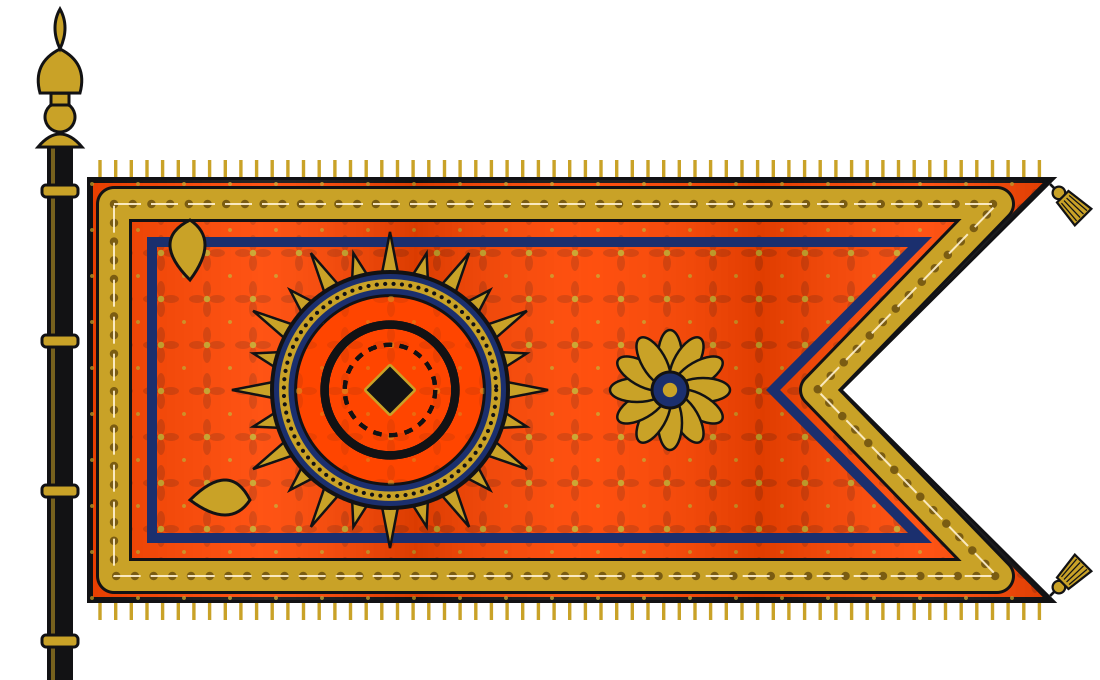





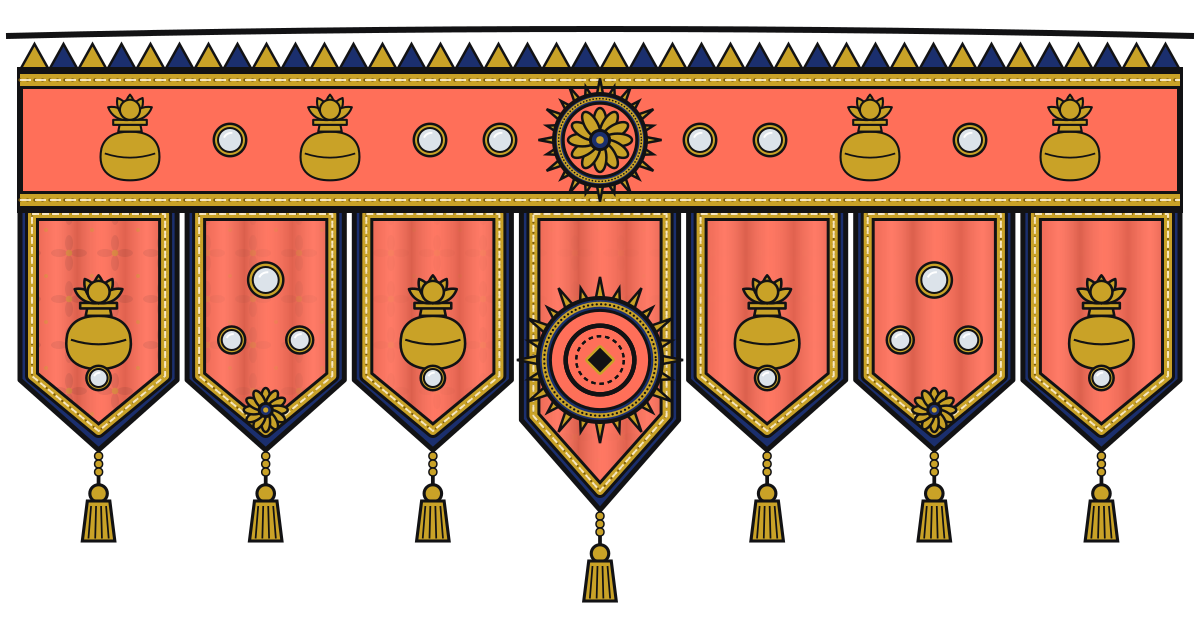
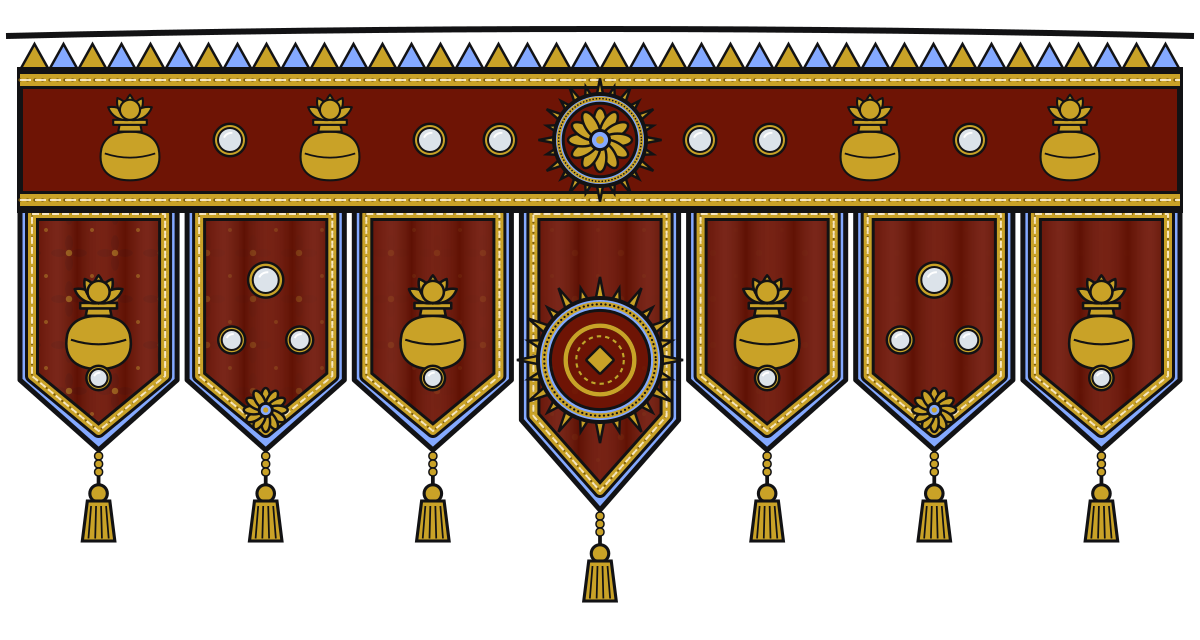

Historic banner
The Sarna flag (red and white) is used by many Adivasi Sarna followers in Jharkhand
New flag types
| Accessory | For this clan | Basis |
|---|---|---|
| A9 Pota-dhvaja · ship and trade flag For ships, caravans and markets | Not yet designed for this clan | Design |
| A10 Utsava-patāka · festival flag Light, bright flag for fairs and festivals | Not yet designed for this clan | Design |
| A11 Shoka-dhvaja · mourning flag White cloth with the emblem outline in the clan's metal | Not yet designed for this clan | Design |
7. Regalia
| Accessory | For this clan | Basis |
|---|---|---|
| E1 Chhatra · house parasol The ceremonial umbrella | Not yet designed for this clan | Design |
| E2 Chamara · fly-whisks The pair of whisks beside the head of the house | Not yet designed for this clan | Design |
| E3 Danda · staff of office Staff or scepter | Not yet designed for this clan | Design |
| E4 Simhasana · seat The seat of the house, covered in clan cloth | Not yet designed for this clan | Design |
| E5 Khetaka · shield A round shield; the Changi and Dhanush are its flag forms | Not yet designed for this clan | Regional tradition |
| E6 Kula-ayudha · clan weapon The weapon the clan honours | Proposed, not documented: Makkhan Lal's proposal that the copper-hoard antennae swords were Munda work, dated by him to 3000–2000 BCE | Under research |
8. Worn
| Accessory | For this clan | Basis |
|---|---|---|
| F1 Kula-vastra · clan cloth The clan's woven pattern in its kit colours | Not yet designed for this clan | Design |
| F2 Kirti-vastra · honour cloth A cloth earned for a deed, not inherited | Not yet designed for this clan | Design |
| F3 Kula-mala · garland flower The flower or leaf the clan wears as a garland | Not yet found for this clan | Under research |
| F4 Chinha · house pin A metal badge with the pin emblem | Not yet designed for this clan | Design |
9. Records
| Accessory | For this clan | Basis |
|---|---|---|
| H1 Clan words A traditional line in the native script | Sing-Bonga on high and the Panch on earth · “Oath as printed by Russell (1916), in English; the Mundari original is not in the extract” Russell and Hira Lal 1916, vol. 3, the Kol, Munda and Ho entry, oath of the Mandla panchayat (line 20461)[6] | Documented |
| H2 Biruda · titles The house's title or titles | Not yet found for this clan | Under research |
| H3 Prashasti · praise genealogy The lineage as written at the head of a grant | Not yet found for this clan | Under research |
| H4 Vahi · clan register The book of the clan's births, marriages and deaths | Not yet found for this clan | Under research |
| H5 Rana-ghosha · war cry The clan's cry in battle or celebration | Ulgulan war cry: 'Abua Raj Setarjana, Maharani Raj Tundujana' (GKToday); Vajiram & Ravi give 'Abua raj seter jana, maharani raj tundu jana' (Roman script only) | Documented |
10. VishwaVit · knower of the world
Game values are design choices for this project, not historical claims.
References
- Wikipedia, Munda people, read 2026-10-21, https://en.wikipedia.org/wiki/Munda_people
- Tribal Research Institute Jharkhand (Dr. Ramdayal Munda Tribal Welfare Research Institute), Munda, read 2026-10-21, https://trijharkhand.in/en/munda
- Wikipedia, Mundari language, read 2026-10-21, https://en.wikipedia.org/wiki/Mundari_language
- Khunti district (NIC), Culture and Heritage, read 2026-10-21, https://khunti.nic.in/?p=25137
- Sanjukta Das Gupta, Munda Rebellion, Banglapedia (revision 18 June 2021), read 2026-10-21, https://en.banglapedia.org/index.php/Munda_Rebellion
- R. V. Russell, The Tribes and Castes of the Central Provinces of India, vol. 3 (1916), Project Gutenberg #41424, read 2026-10-10, https://gutenberg.org/cache/epub/41424/pg41424-images.html
- Enamul Haq, Munda, Banglapedia (revision 18 June 2021), read 2026-10-21, https://en.banglapedia.org/index.php/Munda
- Wikipedia, Marang Buru, read 2026-10-10, https://en.wikipedia.org/wiki/Marang_Buru
- Sarna Burhi, Wikipedia (read 18 Oct 2026).
- Old Woman of the Forest: Chala Paccho, Jahira Buru, and more, Suppressed Histories (anonymous course blog; quotes "Tribes of Jharkhand" and Krishnamurthy and Bahadur, Ethnobotany of India, 2017) (read 18 Oct 2026). A secondary source.
- GKToday, Ulgulan and Munda Resistance, read 2026-10-29, https://www.gktoday.in/ulgulan-and-munda-resistance/
- Vajiram & Ravi, Birsa Munda, Role in Freedom Struggle, UPSC Notes, read 2026-10-29, https://vajiramandravi.com/upsc-exam/birsa-munda/
- Ishan Kukreti, Jharkhand Assembly passes resolution for separate identity code for tribals, Down To Earth, 11 Nov 2020, read 2026-10-29, https://www.downtoearth.org.in/governance/jharkhand-assembly-passes-resolution-for-separate-identity-code-for-tribals-74189
- Gumla, Jharkhand: Lord Hanuman's birthplace and the tribal lore and belief, The Indian Tribal, 10 May 2023 (Hindi; read 10 Oct 2026, KulDevi run 119).
- Sarat Chandra Roy, The Mundas and Their Country (Calcutta: Kuntaline Press, 1912), catalogue record, Indian Culture / Central Secretariat Library, read 2026-10-21, https://icvtesting.nvli.in/rarebooks/mundas-and-their-country
- Vedams, bookseller's listing of Santosh Kiro, The Life and Times of Jaipal Singh Munda (Prabhat Prakashan, 2018) (listing only, book not read), read 2026-11-18, https://vedamsbooks.com/books/the_life_and_times_of_jaipal_singh_munda
- Wikipedia, Jaipal Singh Munda, read 2026-10-29, https://en.wikipedia.org/wiki/Jaipal_Singh_Munda
- Constitution of India (constitutionofindia.net), Jaipal Singh, read 2026-10-29, https://www.constitutionofindia.net/members/jaipal-singh/
- Serials Publications journal abstract, Mandar makers of Chhotanagpur (journal paper; title not printed in extract), read 2026-10-10, https://serialsjournals.com/abstract/74102_1-ahok.pdf
- Anil Kumar, The Copper Hoards, Lucknow University, read 2026-10-10, PDF
- Karatoya: North Bengal University Journal of History vol. 15, "Understanding the Real and the Imagined: Birsa Munda 1870-1902", pp. 44-55, University of North Bengal repository record (abstract only), read 2026-11-18, https://ir.nbu.ac.in/handle/123456789/5105
- Indian History Collective, Jaipal Singh Munda, read 2026-11-05, https://indianhistorycollective.com/jaipal-singh-munda/
- Gateway House wiki, Jaipal Singh (page last modified 24 June 2010; a wiki, weak source), read 2026-11-18, https://gatewayhouse.in/wiki/index.php/Jaipal_Singh
- Wikipedia, Jharkhand Party, read 2026-11-05, https://en.wikipedia.org/wiki/Jharkhand_Party
- Wikipedia, Jharkhand movement, read 2026-11-05, https://en.wikipedia.org/wiki/Jharkhand_movement
- Outlook India, Jharkhand Mukti Morcha: From Fight For Statehood To Holding Power And Navigating Alliances, 29 Mar 2024 (updated 21 Feb 2025), read 2026-11-05, https://www.outlookindia.com/elections/timeline-jharkhand-mukti-morcha-jmm-fight-for-statehood-coming-to-power-and-navigating-alliances
- Md Asghar Khan, Sarna Dharma Code No Longer At Centre of Hemant Soren's Politics, Outlook, 19 Feb 2026, read 2026-11-18, https://www.outlookindia.com/national/sarna-dharma-code-no-longer-at-centre-of-hemant-sorens-politics
- Wikipedia, Tribes of Jharkhand, read 2026-10-20, https://en.wikipedia.org/wiki/Tribes_of_Jharkhand
- Wikipedia, Santal people, read 2026-10-10, https://en.wikipedia.org/wiki/Santal_people
- Wikipedia, Asur people, read 2026-10-20, https://en.wikipedia.org/wiki/Asur_people
- Wikipedia, List of Scheduled Tribes in Odisha, read 2026-10-20, https://en.wikipedia.org/wiki/List_of_Scheduled_Tribes_in_Odisha
- Wikipedia, Folk dances of Jharkhand, read 2026-10-10, https://en.wikipedia.org/wiki/Folk_dances_of_Jharkhand
- Wikipedia, List of Scheduled Tribes in West Bengal, read 2026-10-21, https://en.wikipedia.org/wiki/List_of_Scheduled_Tribes_in_West_Bengal
- Sarnaism, Wikipedia (read 26 Oct 2026, KulDevi run 281).
- Wikipedia, Jaherthan, read 2026-10-10, https://en.wikipedia.org/wiki/Jaherthan