The Mukha Dhora are a Scheduled Tribe of Andhra Pradesh and Odisha, listed as Mukha Dhora and Muka Dora in the state lists[1][2]. Thurston's 1909 survey describes them as agriculturists and petty traders who speak Telugu, with two divisions and exogamous septs named for trees and plants[3]. Their language, Mukha-Dora, is a Dravidian language spoken by about 30,000 people, most of whom also speak Telugu[4][5]. The extracts name no clan temple, book, song or festival of their own, and no native-script name in the language sources (Joshua Project prints a Devanagari form of the name[6]); no source ties them to the KulDevi Modakondamma[7].
01Faith and deities
The KulDevi is Modakondamma, basis homeland shrine. No extract ties the Mukha Dhora to her: the Endangered Alphabets entry names no family deity and does not mention her[7]. The main deity is the project KulDevi for that reason.
Modakondamma of Paderu, goddess of the Visakhapatnam Agency
The presiding goddess of the clan's homeland or capital: a link of place, not a recorded clan tie.
| Deity or tradition | Place in the clan's life | Evidence |
|---|---|---|
| Bododevata, Jakaradevata, Sankudevata, Nishanidevata and Ganga devata living | Five devatas that the Mukha Dora worship; the entry gives no detail of worship | [7] |
| The sun research | Revered by the Kora-vamsam division, as recorded in 1909 | [3] |
| The cobra research | Revered by the Naga-vamsam division, as recorded in 1909 | [3] |
02Temples
Under research. No temple of the Mukha Dhora is named in the extracts. No sacred grove or priest is named either.
Built by the clan
Not recorded.
Given patronage or grants by the clan
Not recorded.
03Languages and scripts
| Language or script | Kind | Under the clan | Evidence |
|---|---|---|---|
| Mukha-Dora living | Dravidian language (ISO 639-3 mmk) | About 30,000 speakers, 'perhaps not as L1' (Wikipedia, citing the 1991 census); the people's own language[4][5] | |
| Telugu living | Dravidian language; the primary language of most speakers | Thurston (1909) records Telugu speech and Telugu personal names; most Mukha-Dora speakers also speak Telugu[3][5] | |
| Mukha-Dora script research | Devised by Professor Prasanna Sree of Andhra University, shown only as an image | No sample text or native-script form in the extracts[5][4] | |
| Odia and other languages | Secondary languages in the Joshua Project listing (undated) | Odia 2,300, Kui 1,100, Assamese 900[6] |
04Books and literature
No book, written text or literature of the Mukha Dhora is in the extracts. The language sources listed for Mukha-Dora are linguistic works, not a literature[4].
Written during the clan's history
Not recorded.
Given patronage by the clan
Not recorded.
05Thinkers and scholars
| Name | Field | Era | Contribution |
|---|---|---|---|
| Sathupati Prasanna Sree (Professor Prasanna Sree, Andhra University) | Script design | Not dated | Devised the Mukha-Dora script, shown only as an image[5][4] |
| C. Hayavadana Rao | Authority quoted by Thurston | Quoted 1909 | Inclined to think the Muka Doras a caste distinct from the Konda Doras[3] |
Under research. Leads: Andhra University, where the script was devised; not checked.
06Art and architecture
Under research. No art, architecture, textiles, clothing or crafts of the Mukha Dhora are in the extracts.
Painting and wall art
Not recorded.
Sculpture and temple art
Not recorded.
Temple and building architecture
Not recorded.
Weaving and textiles
Not recorded.
Clothing and jewellery
Not recorded.
Coins, pottery and crafts
Not recorded.
07History
The 1891 and 1901 censuses
The Madras census of 1891 and 1901 returned Muka as a sub-division and a synonym of the Konda Dora. C. Hayavadana Rao, quoted by Thurston in 1909, inclined to think them a caste distinct from the Konda Doras[3].
The Vizagapatam gazetteer, 1907
W. Francis's Vizagapatam gazetteer calls them Múka Dora and says they "may perhaps be classed as a separate caste". It names the Pachipenta zamindar as one of them and gives no population[8].
Thurston's survey, 1909
Thurston records that they were traditionally regarded as a primitive hill tribe, though their customs show much low-country influence. He notes that most chiefs among the Konda Doras were Muka Doras, and that they recognise one Vantari Dora of Padmapuram as their head[3].
The Jeypore polity
The Atlas places the people under the Jeypore Rajas. No extract names a Mukha Dhora ruler or dynasty, and the Jeypore estate history does not name them[9].
08Journey and migrations
No migration of the Mukha Dhora is recorded in the extracts.
Not recorded.
09Seats and lands
| Place | Role | Where today |
|---|---|---|
| Tribal areas of Visakhapatnam, Srikakulam and East Godavari | Where Omniglot places the people | Andhra Pradesh[5] |
| Visakhapatnam and undivided Koraput | Homeland in the Atlas | Andhra Pradesh and Odisha |
| Pachipenta | Zamindar of this name, a Muka Dora, 1907 | Not stated in the extracts[8] |
| Padmapuram | Seat of the Vantari Dora recognised as their head, 1909 | Not stated in the extracts[3] |
| Jeypore estate | Polity over the people, per the Atlas | Joined Orissa Province in 1936[9] |
| Odisha | Listed in the Odisha Scheduled Tribe list; no district given | Odisha[2] |
10Notable figures
| Name | Role | Era | Known from |
|---|---|---|---|
| Vantari Dora of Padmapuram | Head that the people recognise (one of them) | Recorded 1909 | Known from[3] |
| The Pachipenta zamindar (not named) | A zamindar of the people | Recorded 1907 | Known from[8] |
11Allies, rivals and marriages
| People | Relationship | When |
|---|---|---|
| Konda Dhora (ST-149) | Most chiefs among the Konda Doras are Muka Doras; the censuses treated Muka as a sub-division and synonym of Konda Dora[3] | 1891, 1901 |
| Khond (ST-408) | Neighbours' terms for civilised Khonds include Konda Doralu and Muka Doralu; the gazetteer is unsure whether these are distinct castes or stages of Khond descent[8] | 1907 |
| Manna Dhora (ST-200) | A separate Scheduled Tribe entry in the Andhra Pradesh list; not merged with this codex[1] | 2023-24 |
| Reddi Dhora (ST-273) | A separate Scheduled Tribe entry in the Andhra Pradesh list. Endangered Alphabets gives Reddi and Reddi-Dora as other names of this people; the two are not merged here[1][7] | 2023-24 |
12Society and livelihood
Agriculturists and petty traders. A village council looks after community needs, and the people recognise one Vantari Dora of Padmapuram as their head[3][6].
Government and social order
| Institution or group | What it was | Evidence |
|---|---|---|
| Vantari Dora of Padmapuram | Recognised as the head of the people (1909) | [3] |
| Village council | Looks after community needs (Joshua Project's page, which compiles its sources) | [6] |
| Titles | Anna and Ayya as well as Dora (1909) | [3] |
Livelihood over time
| Era | Livelihood | Evidence |
|---|---|---|
| 1907 to 1909 | Agriculturists and petty traders; travel with pack bullocks at the rice harvest; irrigate with liquid manure, as the Kunnuvans of the Palni hills do[3][8] | [3] |
| Undated (present page) | Agriculture, and finding and selling forest produce | [6] |
13Sub-clans and related clans
Two divisions: Kora-vamsam, which reveres the sun, and Naga-vamsam, which reveres the cobra. Exogamous septs (intiperulu) named for plants: vemu (nim tree), chikkudi (Dolichos lablab), velanga (Feronia elephantum) and kakara (Momordica charantia)[3]. The Endangered Alphabets entry also names the clans Korra, Gammela, Kakara, Sugra and Kinchoyi[7].
| Clan | Relation | Where | Size | In the Atlas | Evidence |
|---|---|---|---|---|---|
| Kora-vamsam | Branch | new clan candidate | [3] | ||
| Naga-vamsam | Branch | new clan candidate | [3] | ||
| Vemu | Sub-clan | new clan candidate | [3] | ||
| Chikkudi | Sub-clan | new clan candidate | [3] | ||
| Velanga | Sub-clan | new clan candidate | [3] | ||
| Kakara | Sub-clan | new clan candidate | [3][7] | ||
| Korra | Sub-clan | new clan candidate | [7] | ||
| Gammela | Sub-clan | new clan candidate | [7] | ||
| Sugra | Sub-clan | new clan candidate | [7] | ||
| Kinchoyi | Sub-clan | new clan candidate | [7] | ||
| Konda Dhora | Related people | ST-149 | [3] | ||
| Manna Dhora | Related people | ST-200 | [1] | ||
| Reddi Dhora | Related people | ST-273 | [1] |
Clans marked "new clan candidate" are not in the Atlas yet.
14Surnames
No surname list is in the extracts. The titles Anna, Ayya and Dora are recorded; they are titles, not surnames[3].
Not recorded.
15Songs and music
No songs of the Mukha Dhora are in the extracts.
None recorded yet.
16Poems, lullabies and children's rhymes
None recorded yet.
17Stories, legends and proverbs
Stories and legends
Not recorded.
Proverbs and sayings
Not recorded.
18Festivals and fairs
| Festival or fair | When | Where | What happens |
|---|---|---|---|
| Ancestor feast | Not dated | Not stated | A feast in honour of their ancestors in general[8] |
19Food, dress and games
Food
Not recorded.
Dress
Not recorded.
Games and martial arts
Not recorded.
Tags: living still practised · revived brought back after a break · lost known only from records · research reported but not yet confirmed from a source. Songs and poems under copyright are listed by title only; restricted or sacred material is noted without its content.
20Status today
A Scheduled Tribe in Andhra Pradesh and Odisha. No 2011 census figure for the people is in the extracts; the population figures below are from other sources and years[5][6].
No community review of this page is recorded.
21For children
The Mukha Dhora
The Mukha Dhora are a people of the hills where Andhra Pradesh and Odisha meet. Most of them also speak Telugu, and some speak their own language, Mukha-Dora. The government lists them as a Scheduled Tribe in both states. Long ago, a writer recorded that they travelled with pack bullocks at the rice harvest. Their clans are split into septs named after plants, such as the nim tree. Two of their divisions honour the sun and the cobra. Much of their history is still being found.
22Across the project
| Project | What carries this clan | Status |
|---|---|---|
| Atlas of the Janas | The sheet's homeland is the Visakhapatnam Agency and undivided Koraput. No pin is given: the extracts name no seat. | Under research |
| KulDevi and GrahDevi | KulDevi Modakondamma, basis homeland shrine; family Saptamatrika (+Narasimhi); GrahDevi forms Brahmani, Maheshvari, Kaumari, Vaishnavi, Varahi, Indrani, Chamunda and Narasimhi (all). No source ties the people to them[7]. | Atlas |
| Planet naming | Under research: no planet name in the extracts. | |
| Renaming and waters | The sheet's second image is the Duduma falls on the Andhra–Odisha border. No extract gives a water or renaming fact. | Atlas |
23Open questions
- Native-script name: none sourced. Joshua Project prints a Devanagari form; the owner should decide whether it counts as a native-script name.
- Is Nukha Dora (SAJB 2023, Dumbriguda Mandal) the same people? The page does not say so[10].
- Present-day septs: Thurston (1909) and the Endangered Alphabets entry name different septs; only Kakara appears in both.
- Reddi and Reddi-Dora: the Endangered Alphabets entry gives them as other names; the Andhra list has Reddi Dhora as a separate entry (ST-273). Confirm before merging.
- Population: which year, and whether the 2001 figure of just over 40,000 counts people or speakers. No 2011 census figure found.
- Seat and pin: no village or seat is named. Pachipenta and Padmapuram are not located.
- Jeypore link: the Atlas says under the Jeypore Rajas; the estate history names no Mukha Dhora. The estate page gives two capital dates (1649 and 1758).
- KulDevi: no source ties the people to Modakondamma; the Endangered Alphabets entry names no family deity.
- Gazetteer pages 287 to 300 (Pachipenta, Jeypore) and the Malkanagiri Taluk article: not yet read.
- Legends, coins, seals, banners and war cries: none found in the extracts.
- Community review of this page: not yet done.
24Astitva
अस्तित्व · being, existence: everything by which the clan is known
Only the cobra and sun reverence of the two divisions, the plant septs and the titles are recorded for the clan[3].
Every clan has every accessory, royal objects included. Each one says how it is known: Documented This clan's own object is recorded. · Regional tradition Recorded for the region or for peoples like this one, not for this clan. · Design Made for this project, with no historical claim. · Under research To be found for this clan from sources. Legends and titles are written in the clan's own script.
1. Seals and coins
| Accessory | For this clan | Basis |
|---|---|---|
| B1 Rajamudra · house seal Round seal with the clan emblem and a short legend in the clan's script | Not yet designed for this clan | Design |
| B2 Anguliya-mudra · signet ring Personal seal ring of the head of the house | Not yet designed for this clan | Design |
| B3 Chhapa · house stamp Ink or block stamp for letters, goods and cloth | Not yet designed for this clan | Design |
| B4 Tamrapatra · charter plate Copper-plate grant on a ring, closed with the house seal | Not yet designed for this clan | Design |
| B5 Shreni-mudra · guild or trade seal Seal for the clan's trade, craft or caravan | Not yet designed for this clan | Design |
| C1 Clan coin Emblem or deity on one side, a legend in the clan's script | Not yet designed for this clan | Design |
| C2 Coin die The die that strikes the coin | Not yet designed for this clan | Design |
2. Living symbols
| Accessory | For this clan | Basis |
|---|---|---|
| I1 Totem trio The tree, bird and animal the clan protects | Cobra (Naga-vamsam division); nim tree (vemu sept) | Documented |
| I2 Kaval-maram · guardian tree The tree that stands at the clan's seat | Not yet found for this clan | Under research |
3. Stone and gate
| Accessory | For this clan | Basis |
|---|---|---|
| G1 Torana · gateway The built gate of the seat; the cloth Toran hangs in it | Not yet designed for this clan | Regional tradition |
| G2 Viragallu · hero stone Carved panel stone for a member who died defending the clan | Not yet designed for this clan | Regional tradition |
| G3 Kula-shila · clan stones Standing and table stones that remember the ancestors | Not yet designed for this clan | Design |
| G4 Jayastambha · victory pillar A pillar raised for a victory | Not yet designed for this clan | Design |
| G5 Sima-shila · boundary stone Marks the clan's land, with a line in the native script | Not yet designed for this clan | Design |
4. Sounds
| Accessory | For this clan | Basis |
|---|---|---|
| D1 Pancha-mahashabda · five great sounds The right to five instruments | Not yet designed for this clan | Design |
| D2 Shankha · clan conch The clan's own named war conch | Not yet designed for this clan | Design |
| D3 Murasu · house drums Three drums: war, charity and justice | Not yet designed for this clan | Design |
5. Kit: colours, metals and emblems
The extracts record the sun and the cobra as the reverence of the two divisions, and the plant septs as exogamous names; no seal, coin, banner or war cry is recorded for the clan[3].
| Part of the kit | This clan |
|---|---|
| Field | Deep Brick #7E2A1E |
| Accent | Deep Cosmic Blue #9BB0FF |
| Emblem colour | Metallic Gold #C9A227 |
| Zari metal | Gold |
| Main emblem | A hill |
| Second image | A waterfall |
| Night and day | Every visual accessory has two versions: by night the emblem on the dark field, by day the clan's field colour on cloth woven from its metal. |
6. Flags
Every clan has every flag type; the type says the occasion and the colours say the clan. The outlined card is the flag the Atlas assigns.
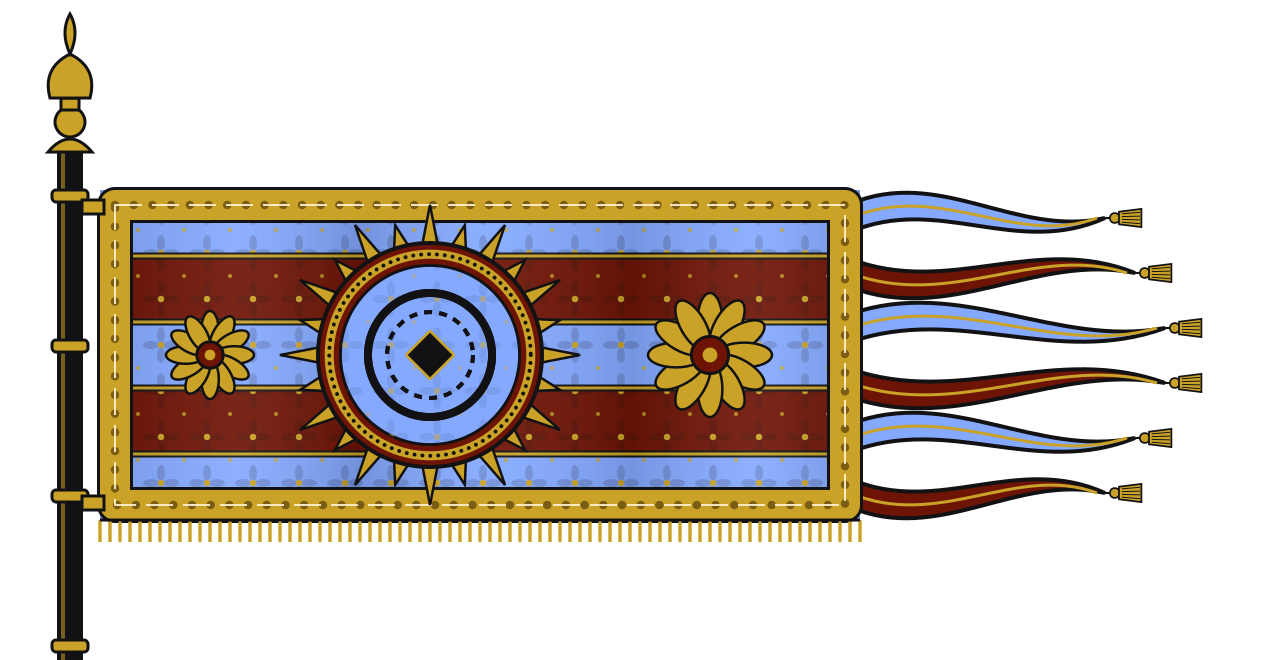
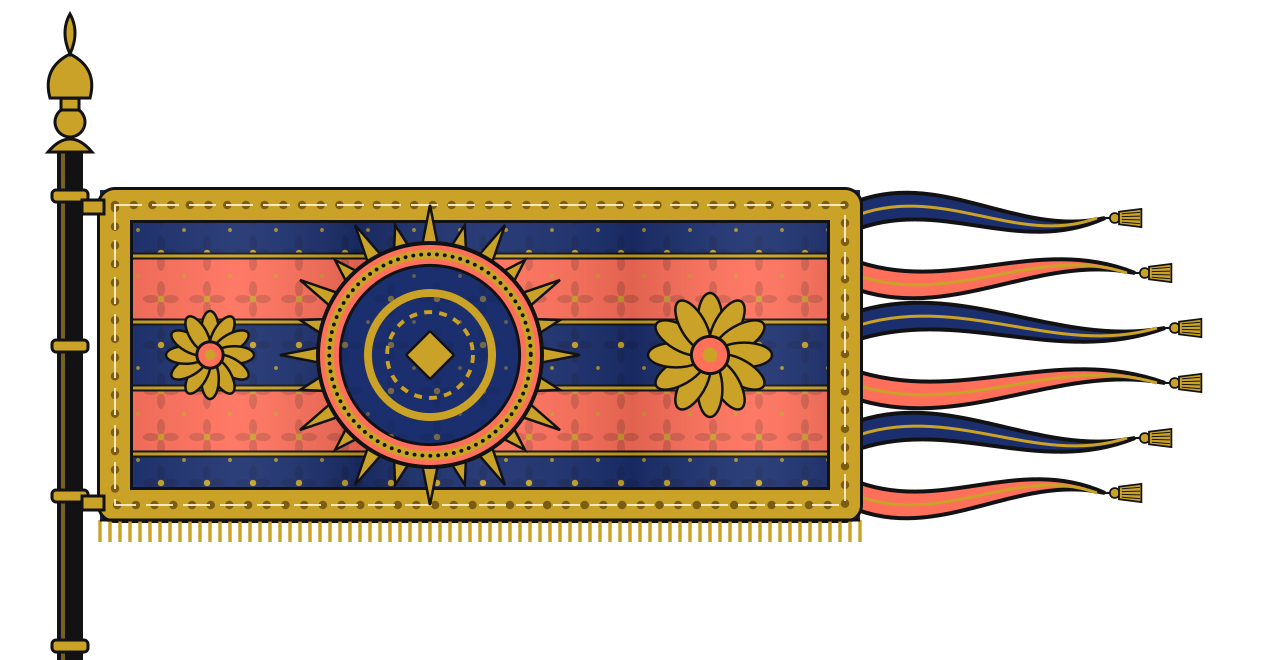
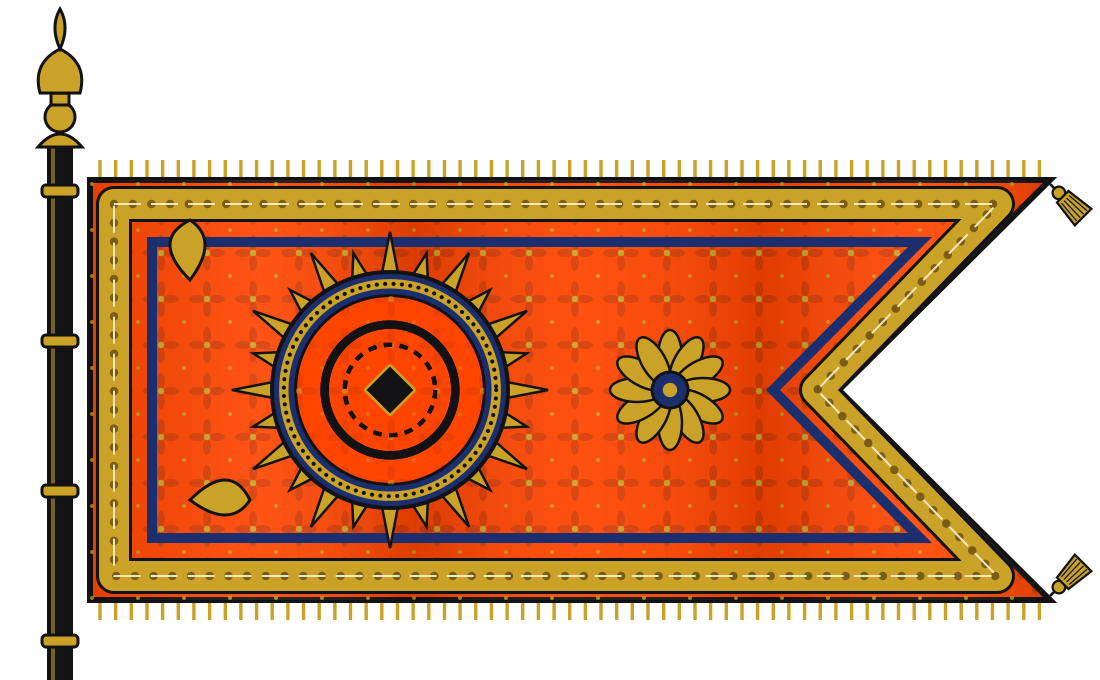
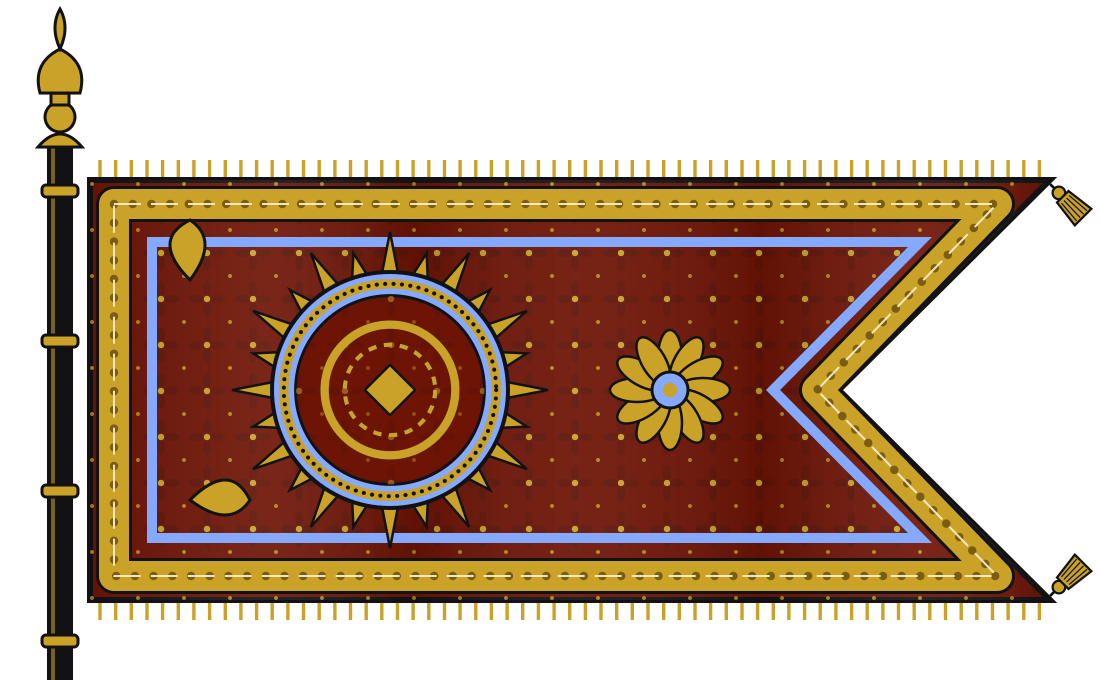
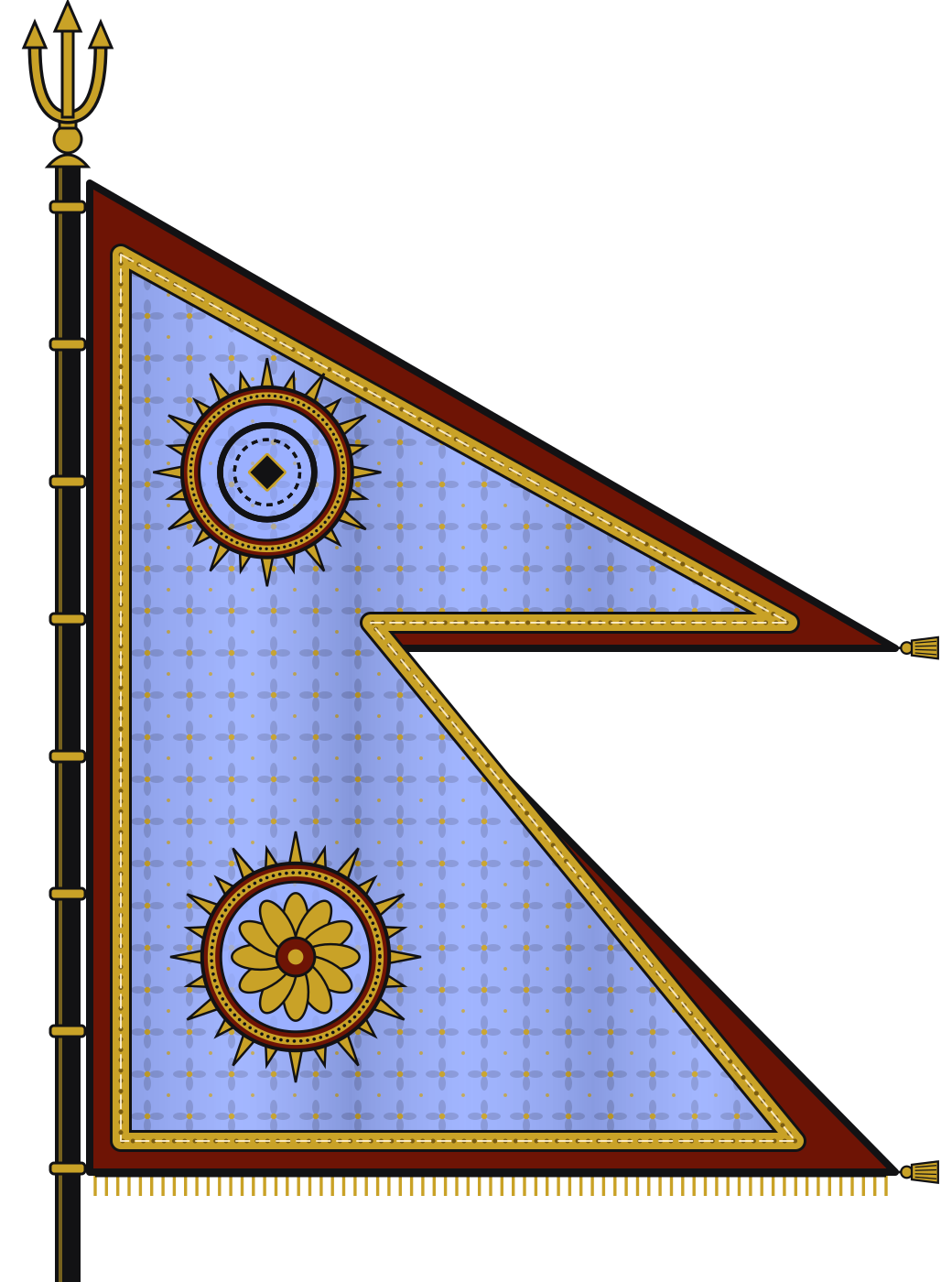
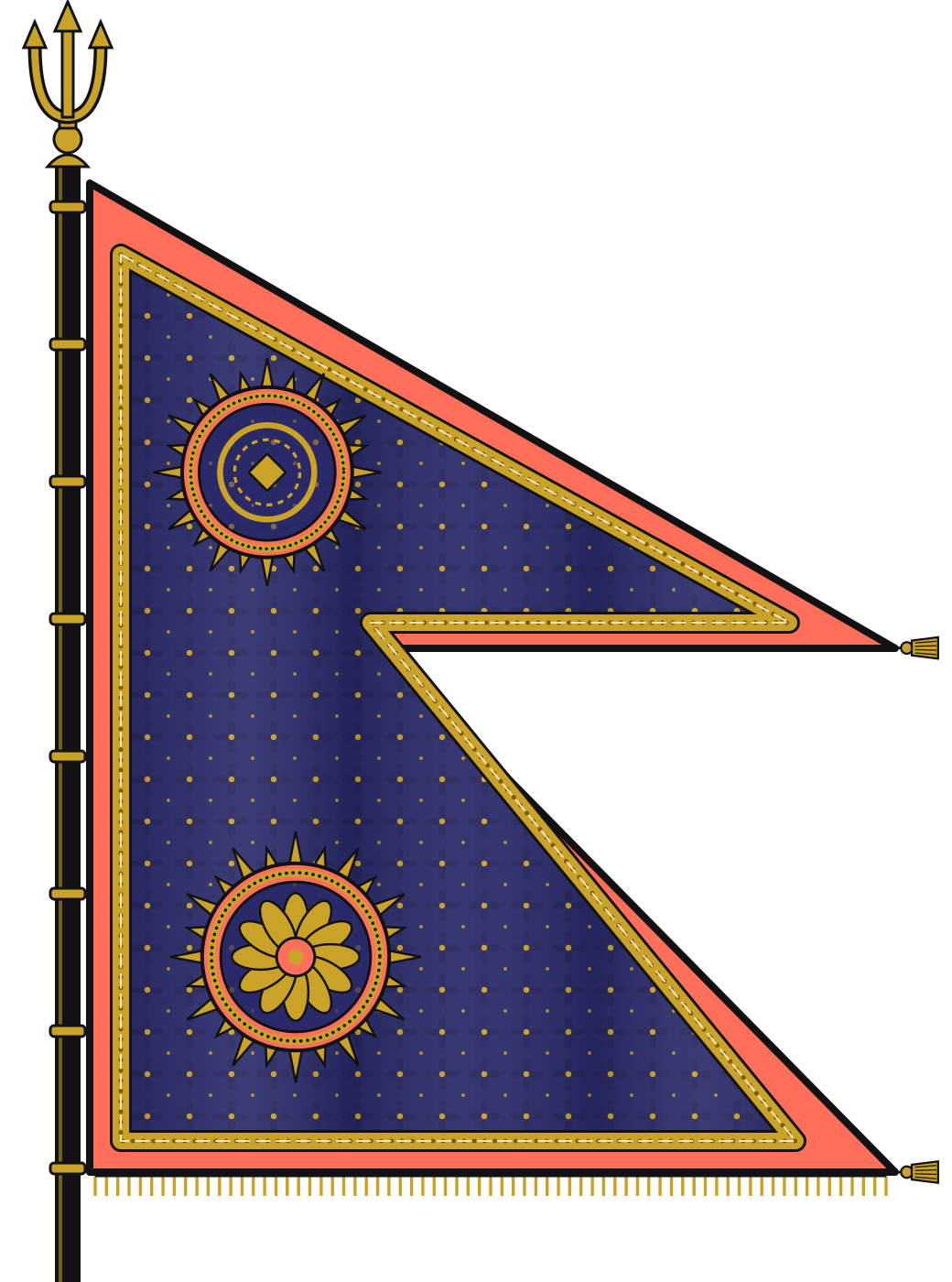
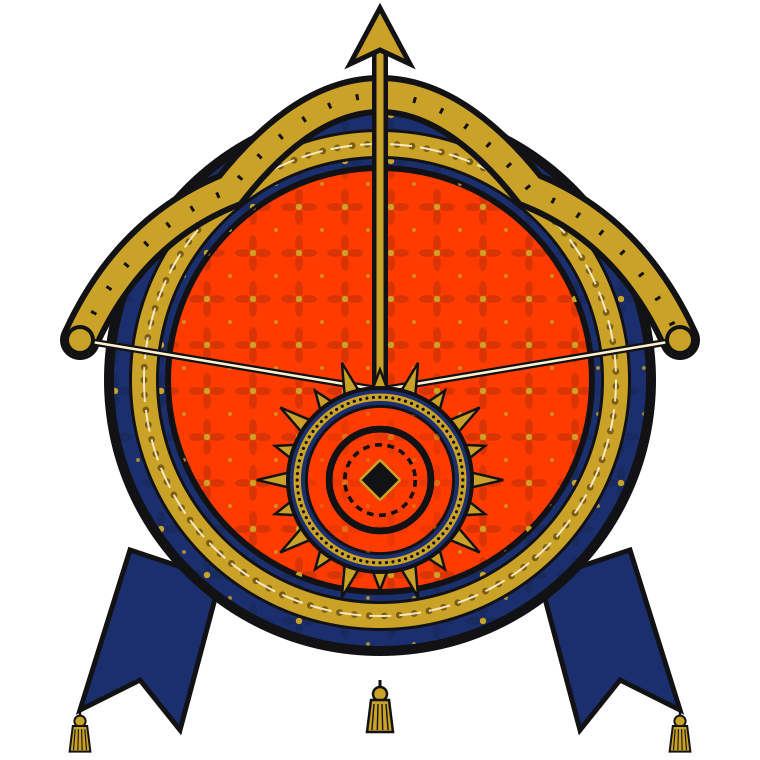
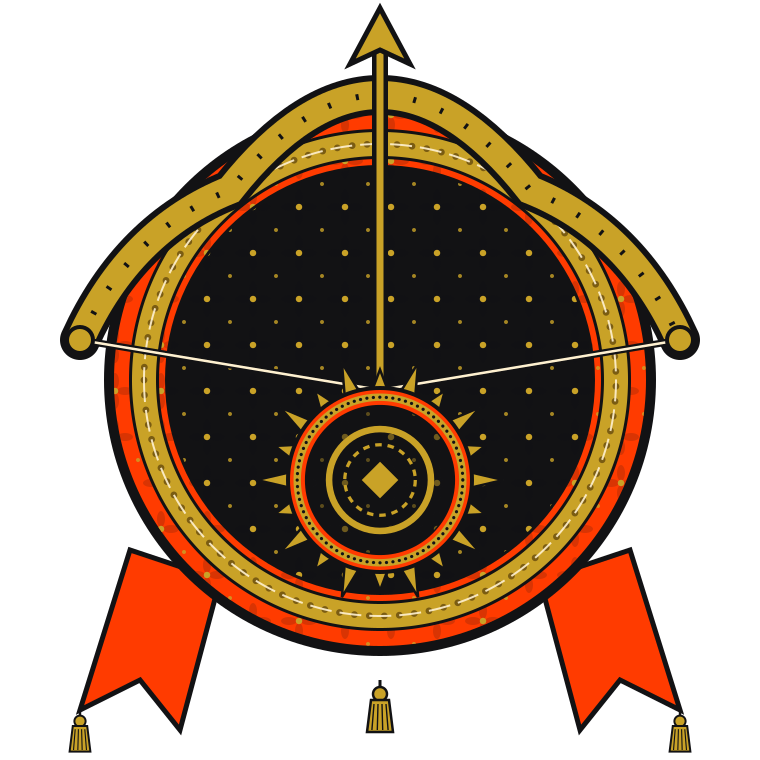
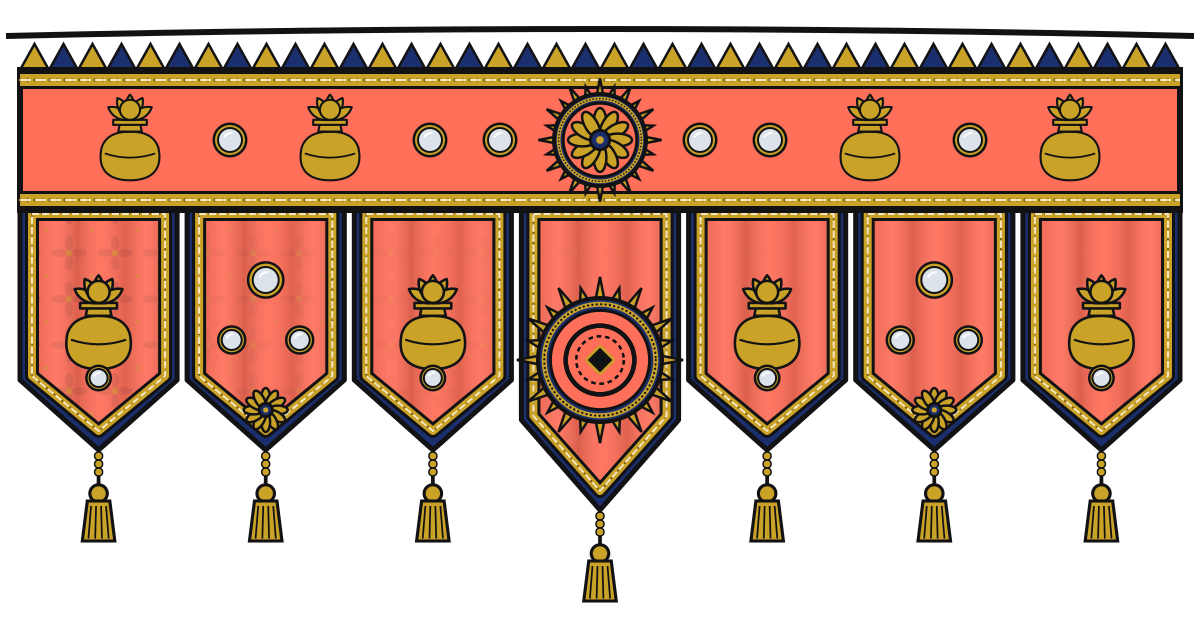
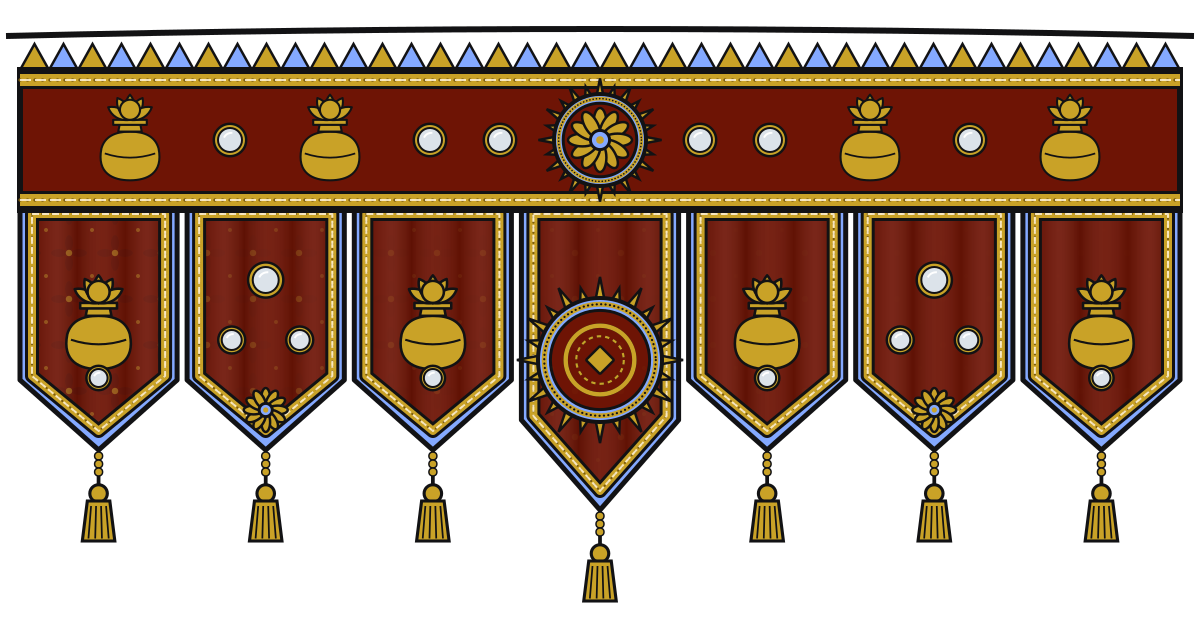
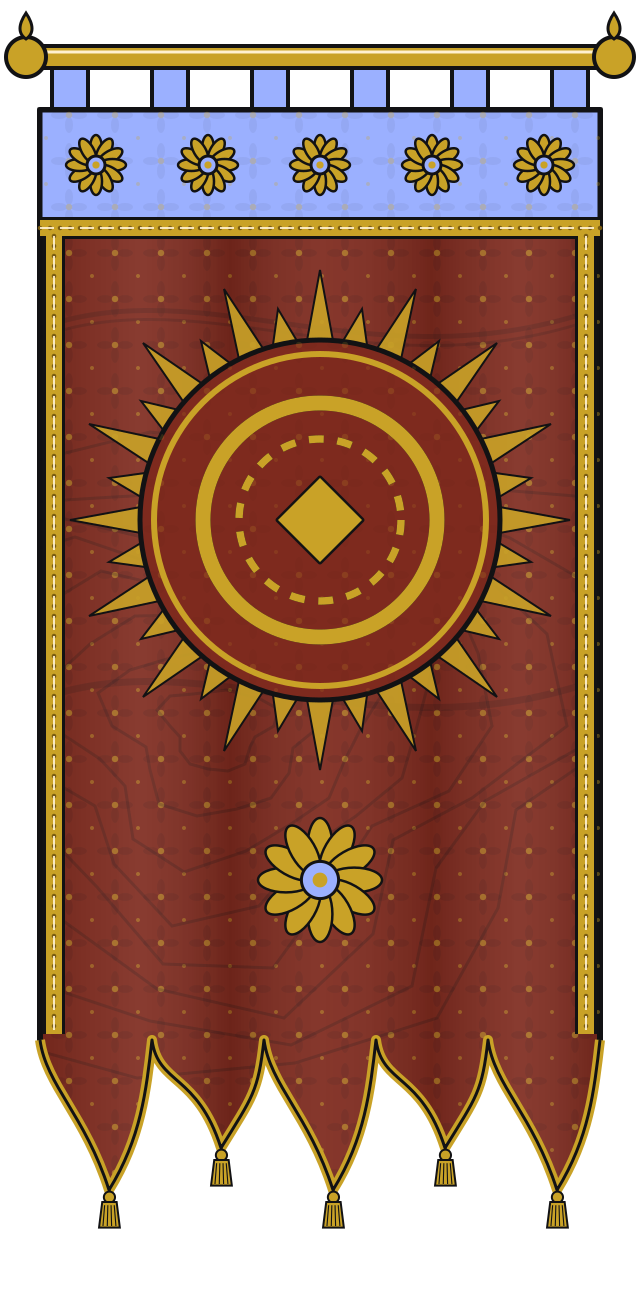
Historic banner
None known
New flag types
| Accessory | For this clan | Basis |
|---|---|---|
| A9 Pota-dhvaja · ship and trade flag For ships, caravans and markets | Not yet designed for this clan | Design |
| A10 Utsava-patāka · festival flag Light, bright flag for fairs and festivals | Not yet designed for this clan | Design |
| A11 Shoka-dhvaja · mourning flag White cloth with the emblem outline in the clan's metal | Not yet designed for this clan | Design |
7. Regalia
| Accessory | For this clan | Basis |
|---|---|---|
| E1 Chhatra · house parasol The ceremonial umbrella | Not yet designed for this clan | Design |
| E2 Chamara · fly-whisks The pair of whisks beside the head of the house | Not yet designed for this clan | Design |
| E3 Danda · staff of office Staff or scepter | Not yet designed for this clan | Design |
| E4 Simhasana · seat The seat of the house, covered in clan cloth | Not yet designed for this clan | Design |
| E5 Khetaka · shield A round shield; the Changi and Dhanush are its flag forms | Not yet designed for this clan | Regional tradition |
| E6 Kula-ayudha · clan weapon The weapon the clan honours | Not yet found for this clan | Under research |
8. Worn
| Accessory | For this clan | Basis |
|---|---|---|
| F1 Kula-vastra · clan cloth The clan's woven pattern in its kit colours | Not yet designed for this clan | Design |
| F2 Kirti-vastra · honour cloth A cloth earned for a deed, not inherited | Not yet designed for this clan | Design |
| F3 Kula-mala · garland flower The flower or leaf the clan wears as a garland | Not yet found for this clan | Under research |
| F4 Chinha · house pin A metal badge with the pin emblem | Not yet designed for this clan | Design |
9. Records
| Accessory | For this clan | Basis |
|---|---|---|
| H1 Clan words A traditional line in the native script | · “Clan names are given in the Latin spelling of the sources; no native-script word is in the extracts.” No line is quoted. Thurston (1909) gives personal names and titles only[3]. | Documented |
| H2 Biruda · titles The house's title or titles | Anna · Ayya · Dora (titles) | Documented |
| H3 Prashasti · praise genealogy The lineage as written at the head of a grant | Not yet found for this clan | Under research |
| H4 Vahi · clan register The book of the clan's births, marriages and deaths | Not yet found for this clan | Under research |
| H5 Rana-ghosha · war cry The clan's cry in battle or celebration | Not yet found for this clan | Under research |
10. VishwaVit · knower of the world
Game values are design choices for this project, not historical claims.
References
- State-wise ST list (annual report 2023-24), Andhra Pradesh Part I, read 2026-10-10, https://iiitl.ac.in/wp-content/uploads/2024/08/07014a84-st-list-as-per-annual-report_-2023-24.pdf
- Wikipedia, List of Scheduled Tribes in Odisha, read 2026-10-20, https://en.wikipedia.org/wiki/List_of_Scheduled_Tribes_in_Odisha
- Edgar Thurston and K. Rangachari, Castes and Tribes of Southern India, vol. 5 (Madras, 1909), Project Gutenberg eBook #42995, https://www.gutenberg.org/ebooks/42995
- Wikipedia, Mukha-Dora language, read 2026-11-06, https://en.wikipedia.org/wiki/Mukha-Dora_language
- Omniglot, Mukha Dora, read 2026-11-06, https://www.omniglot.com/writing/mukhadora.htm
- Joshua Project, Mukha Dhora in India, read 2026-11-06, https://www.joshuaproject.net/people_groups/17699/IN
- Mukha Dora, Endangered Alphabets (read 28 Oct 2026, KulDevi clan check).
- W. Francis, Vizagapatam (Madras District Gazetteers, 1907), ch. 3, Wikisource mirror (2022-09 snapshot), read 2026-11-06, https://kwx.liehendr.com/content/wikisource_en_all_maxi_2022-09/A/Vizagapatam/Chapter_3
- Wikipedia, Jeypore Estate, read 2026-10-31, https://en.wikipedia.org/wiki/Jeypore_Estate
- Padmaja V., Sekhar P. C., Mouli B. C., Padal S. B., Scholars Academic Journal of Biosciences 11(07), 2023, pp. 264-267, read 2026-11-06, https://saspublishers.com/article/16630