The Mizo call themselves Mi-zo; 'Kuki' is an outside term, Shakespear wrote in 1912[1]. Their language, Mizo (Duhlian tawng), is Tibeto-Burman and the lingua franca of Mizoram; the name Lushai came from the Duhlian, the first Mizo group the British met[2]. Oral tradition places their homeland at Chhinlung and traces a migration through the Kabaw Valley, the Chin Hills and the Lushai Hills, where Sailo chiefdoms dominated the villages before the British annexed the hills[3]. Each clan had its own Sakhua, the bachelors' hall was the Zawlbuk, and the Cheraw bamboo dance and Chapchar Kut festival are part of the living culture[4][5][6]. Mizoram became a state on 20 February 1987, after the Mizo National Front declared independence on 1 March 1966[3].
01Faith and deities
The Mizo's own supreme God. The article quotes: 'Pathian is considered the supreme God who created the world and all that there is in it'[4]. The Atlas's KulDevi (Tripura Sundari, 'Assigned (not their faith)') is shown below as a project assignment, not as this people's own goddess.
Goddess of Tripura
The clan followed another faith. This goddess of its homeland is assigned for naming only.
| Deity or tradition | Place in the clan's life | Evidence |
|---|---|---|
| Pathian | Supreme God and Creator; compared with the Tartar deity Nagitay[3]; also the Creator for all the clans[1] | [3] |
| Khuanu | Feminine deity, mother of nature and wife of Pathian (the article marks the pre-Christian animism centred on Pathian and Khuanu as needing a citation) | [4][6] |
| Vanchungnula | Goddess of rain and water, daughter of Pathian | [4] |
| Khuazingnu | Goddess who created the earth and brings rain; in the origin myth she repopulates the earth from the cave sealed by the Chhinglung rock | [4][6] |
| Khuavang | A powerful spirit, invoked for luck | [1] |
| Thlarau | Animism: spirits in natural objects; two souls, the Thlarau | [3] |
| Sakhua | Household guardian spirit; each clan had its own Sakhua; the Hauhnar clan of the Lusei supplied most sadawt priests | [4][1] |
| Lashi | Beings who control wild animals | [1] |
| Huai | Sickness demons | [1] |
| Mi-thi-khua | The village of the dead; those with merit pass on to Pial-ral | [1] |
| Pial-ral | Where those with merit pass after death | [1] |
| Dai-bawl and Khal | Sacrifice series to the demons of the hills and village sites | [1] |
| Kawhring | A spirit that possesses another's body | [1] |
| Ai | Propitiates the spirit of a killed animal or person | [1] |
02Temples
The extracts record no temple built or patronised by the Mizo. Solomon's Temple in Aizawl is listed as a later building only; the extracts do not say who built it[6].
Built by the clan
Not recorded.
Given patronage or grants by the clan
Not recorded.
Later temples in the clan's lands
| Temple | Deity | Built | Where |
|---|---|---|---|
| Solomon's Temple | Not stated in the extract | Begun 1996; opened December 2017 | Aizawl[6] |
03Languages and scripts
| Language or script | Kind | Under the clan | Evidence |
|---|---|---|---|
| Mizo (Duhlian tawng) living | Tibeto-Burman, Central Kuki-Chin; the lingua franca of Mizoram | The people's own language; over 1,000,000 native speakers (2011–2022); English is also official[2][3] | [2] |
| Latin script for Mizo living | Writing system | Mizo has been written in a Latin-based script since 1874; the current form follows the Hunterian system; a circumflex marks long vowels[2] | [2] |
| Duhlian | Alternate name of the language | The Duhlian were the first Mizo group the British met, hence the name Lushai[2] | [2] |
| Lushai | Colonial term | The article calls Lushai a colonial term[2] | [2] |
04Books and literature
The article calls Mizo literature 'thriving', written and oral[2]. The works below are listed in the extracts; those by outsiders are marked as such only by their dates.
Written during the clan's history
| Work | Author | Kind | When | Link to the clan |
|---|---|---|---|---|
| Dictionary of the Lushai Language | J. H. Lorrain | Dictionary | 1940 | [2] |
| Mizo chanchin | Lunghnema | Book (title as listed) | 1993 | [2] |
| Mizo Fiction | Zoramdinthara | Book (title as listed) | 2013 | [2] |
| The Lushei Kuki Clans | John Shakespear | Book (public domain) | 1912 | [1] |
| Monograph on Lushai Customs and Ceremonies | Perry | Monograph (cited) | 1928 | Cited in[7] |
| Lushai Chrysalis | A. G. McCall | Book (cited) | 1949 | Cited in[7] |
| Mizo Infiamna | Tribal Research Institute, Aizawl | Book (cited) | 1984 | Cited in[8] |
| Mizo Infiamna Dan Bu | Mizoram Wrestling Association | Rules (cited) | 2008 | Cited in[8] |
Given patronage by the clan
Not recorded.
05Thinkers and scholars
| Name | Field | Era | Contribution |
|---|---|---|---|
| Thomas Herbert Lewin | Script | 1874 | Made a Latin-based script for Mizo[2] |
| J. H. Lorrain | Dictionary and script | 1940 | Dictionary of the Lushai Language; with F. W. Savidge, the current script[2] |
| F. W. Savidge | Script | Not dated | Co-devised the current script with J. H. Lorrain[2] |
| Lalthangliana | Author cited on the script, drums and the Zawlbuk | 1975 to 2010 (works cited) | Cited for the script (2001), the drums (1975) and the Zawlbuk (2010)[2][3][5] |
| Hnamte and Khaute | Sports and law | Not dated | Preserving a Legacy: Mizo Indigenous Sports, Delhi Journal of Contemporary Law[7] |
| Ezrela Dalidia Fanai | Journalism on Mizo games | 2019 | EastMojo article on five Mizo indigenous games[9] |
| Strom | Cited on the Zawlbuk's decline | 1980 | Cited by Wikipedia for the arrival of Christianity as one cause[5] |
These are the writers the extracts name. Their works are listed only as far as the extracts show them.
06Art and architecture
Mizo art in the extracts is textile and basketry work, mostly by women, with the Zawlbuk as the one building named[3][5].
Painting and wall art
Not recorded.
Sculpture and temple art
Not recorded.
Temple and building architecture
| Art form | What it is | Era | Evidence |
|---|---|---|---|
| Zawlbuk (hall) | Largest house in the village centre, near the chief's residence; the floor ('buanzawl') was the wrestling arena and sleeping place; a central pole ('tlung') | Not dated in the extract | [5] |
Weaving and textiles
| Art form | What it is | Era | Evidence |
|---|---|---|---|
| Puan | Handloom cloth; the puan is the main product of handloom weaving | Not dated in the extract | [6] |
| Pawndum | Covers a husband's body after death | Not dated in the extract | [6] |
| Puanchei | Striped bridal puan | Not dated in the extract | [6] |
| Tawlhloh | Worn by warriors | Not dated in the extract | [6] |
| Hmaram and Ngotekherh | Named puan types; no description in the extract | Not dated in the extract | [6] |
| Thuam Chhawm | The puan brought to the groom's house after marriage | Not dated in the extract | [6] |
Clothing and jewellery
| Art form | What it is | Era | Evidence |
|---|---|---|---|
| Khumbeu | A cap, made mostly by women | Not dated in the extract | [3] |
Coins, pottery and crafts
| Art form | What it is | Era | Evidence |
|---|---|---|---|
| Tea tray, cane bag and brooms | Bamboo, cane and basketry, mostly women's work | Not dated in the extract | [3] |
07History
Origin and homeland (oral tradition)
Oral tradition places the homeland at Chhinlung. In the origin myth the goddess Khuazingnu repopulates the earth from a cave sealed by the Chhinglung rock, and the Ralte clan's noisy exit from it gave the expression 'Ralte bengchheng'[3][6].
Migration through the Kabaw Valley and the Chin Hills
The article's cited accounts trace the migration from Chhinlung through the Kabaw Valley (Khampat) and the Chindwin to the Chin Hills, about the 13th century, and then to the Lushai Hills in the early 14th century[3].
Sailo chiefdoms
Sailo chiefdoms (Selesih, Tualte, Aizawl and Zopui) dominated the Lushai villages[3]. Shakespear calls the Lushei the Sailo-led clan of the Thangur line, from Thang-ura in the early 18th century; the six lines are Rokum, Zadeng, Thangluah, Pallian, Rivung and Sailo[1].
Wars, raids and the British
Shakespear places a war of the North and the South at about three years from c. 1856, and records the occupation of Lungleh in 1889 with a Fanai rising[1]. The article records the Mary Winchester raid (1871) and the killing of Stewart (1888), and says the British annexed the Lushai Hills and that missions followed[3]. The list of Mizo clans gives one other date: in 1780 two chief brothers, Lalmanga and Ngaia, quarrelled[10].
The Zawlbuk ends
Wikipedia names the late-19th-century arrival of Christianity as one cause of the Zawlbuk's decline[5]. In 1926 Superintendent N.E. Parry ordered the villages to rebuild the Zawlbuk; the order failed. On 1 January 1938 Superintendent A.G. McCall ended it at a public meeting at Thakthing, Aizawl[5].
Famine, insurgency and statehood
The article records the Mautam famine of 1959 and an oral hla on the Thingpui Tam famine[3]. The Mizo National Front declared independence on 1 March 1966; the rambuai literature 'Troubled Land' recalls the insurgency of 1966 to 1986[3][6]. Statehood came on 20 February 1987[3].
08Journey and migrations
The stages below are the article's cited accounts, as Wikipedia gives them; the extracts give no firm dates for the early stages.
| When | From | To | Why | Evidence |
|---|---|---|---|---|
| Origin (oral tradition) | Not dated | Chhinlung | The homeland in oral tradition | [3] |
| Early route | Not dated | Gobi and north-east Tibet area, Yunnan and Burma | The route the article lists | [3] |
| Kabaw Valley | Not dated | Kabaw Valley (Khampat) and the Chindwin | Migration as the cited accounts give it | [3] |
| Chin Hills | About the 13th century | Chin Hills | Migration as the cited accounts give it | [3] |
| Lushai Hills | Early 14th century | Lushai Hills | Migration as the cited accounts give it | [3] |
09Seats and lands
| Place | Role | Where today |
|---|---|---|
| Chhinlung | Oral homeland | Not located in the extracts |
| Kabaw Valley (Khampat) | Stage of migration; Khampat is named in the migration account | Myanmar (Chin State, Kabaw Valley)[3] |
| Chin Hills | Stage of migration | Chin State, Myanmar[3] |
| Lushai Hills | Settled from the early 14th century; Sailo seats[3] | Mizoram (Aizawl and Lunglei districts)[11] |
| Selesih, Tualte, Aizawl and Zopui | Sailo chiefdoms | Aizawl is in Mizoram; the others are not located in the extracts[3] |
| Thakthing, Aizawl | Site of the 1938 meeting that ended the Zawlbuk | Aizawl, Mizoram[5] |
10Notable figures
| Name | Role | Era | Known from |
|---|---|---|---|
| Thang-ura legend | Founder of the Thangur line of the Lushei (in the doe serao tale) | Early 18th century (as Shakespear dates the line) | [1] |
| Zahmuaka | First Lusei chief | Not dated in the extract | [3] |
| Lallula | Founder of Zopui | Not dated in the extract | [3] |
| Lalsavunga | Founder of Aizawl | Not dated in the extract | [3] |
| Vanhnuailiana | Chief of Tualte | Not dated in the extract | [3] |
| Vuta, Lalpuithanga, Khalkam, Vana Pa | Named in the article's list of figures; no role given | Not dated in the extract | [3] |
| Pachhunga Hmar | Named in the article's list of figures; no role given | Not dated in the extract | [3] |
| Laldenga | Mizo National Front (MNF) | Independence declared 1 March 1966 | [3] |
| R. Vanlawma | Mizo Union (as the article names it) | Not dated in the extract | [3] |
11Allies, rivals and marriages
| People | Relationship | When |
|---|---|---|
| Chin | Close ties | Not dated[3] |
| Kuki | Close ties (article). Egerton (1880) calls the Lushai 'a tribe of the Kukis'; Shakespear says Kuki is an outside term | 1880 and not dated[3][12][1] |
| Naga | Close ties (the article writes 'Naga (Zo group)') | Not dated[3] |
| Burmese | Alliance in the Kabaw Valley | Not dated[3] |
| Kadu, Meitei and Shans | Conflicts | Not dated[3] |
| Naga | Described as ethnically related to the Mizo (Muzeum Most) | Not dated[13] |
12Society and livelihood
Mizo chiefdoms were governed by chiefs with councils, and their villages had named officials and institutions[3][1].
Government and social order
| Institution or group | What it was | Evidence |
|---|---|---|
| Chiefdoms and councils | Chiefdoms with councils (Upas)[3] | [3] |
| Officials | Tlangau, Puithiam and Thirdeng[3]; Shakespear names upa, tlangau (crier) and ramhual | [3][1] |
| Zawlbuk | Unmarried men's hall and guest house; the largest house in the village centre, near the chief's residence; men over 15 stayed there at night until they married; collective zu drinking and making[5][6] | [5] |
| Tlangvâl and vâl-upa | Residents of the Zawlbuk, led by a vâl-upa appointed by the chief and council | [5] |
| Boi | Refugees in the chief's house (Shakespear) | [1] |
| Palal and thian | Trustees of the bride-price (Shakespear) | [1] |
| Thangchhuah | Men who gave a series of village feasts and gained privileges, such as verandahs and windows (Shakespear) | [1] |
| Bawi | A bondage system[3] | [3] |
| Sial (gayal) | Barter in which the gayal served as currency[3] | [3] |
| Raiding and headhunting | Part of the older social life[3] | [3] |
Livelihood over time
| Era | Livelihood | Evidence |
|---|---|---|
| Described by Shakespear (1912) | Jhum cultivation, mainly rice; women weed, cook and make cloth; villages on ridges, with sites chosen by elders who slept there with a cock | [1] |
| Traditional, per the Insuknawr article | Rice was the main crop of shifting cultivation, and rice husking was mainly women's work | [8] |
| Described in the article | Semi-nomadic jhum cultivators | [3] |
| Textile and craft work | Handloom weaving (the puan is the main product); textiles, bamboo, cane and basketry, mostly women's work | [6][3] |
13Sub-clans and related clans
The article says 'as many as 17 clans' without listing them all[3]. The lists below give the Wikipedia list of Mizo clans in full: the six main clans, the minor (Awzia) clans, and the sub-clans of each, then the dynasties and the clans Shakespear names. Names with no master-sheet ID are new clan candidates. The Hindi GKToday list of Mizoram tribes also gives Mizo, Lushai, Ralte, Paite, Fanai and Sukte[14].
| Clan | Relation | Where | Size | In the Atlas | Evidence |
|---|---|---|---|---|---|
| Hmar | Sub-clan | Churachandpur (Manipur)[15] | 150,000 (claimed under the Mizo classification; no year)[3] | ST-101 | [10][16] |
| Lusei | Sub-clan | The Sailo-led clan[1]; the Mizo language is based on the Lusei dialect[2] | new clan candidate | [10][1] | |
| Ralte | Sub-clan | Aizawl (Lushai villages)[14] | ST-271 | [10][3] | |
| Fanai | Sub-clan | new clan candidate | [10][8] | ||
| Lai | Sub-clan | Lawngtlai (Pawi (Lai) Autonomous District Council)[11] | Pawi 51,406 (2011)[11] | ST-171 | [10][3] |
| Paite | Sub-clan | ST-245 | [10] | ||
| Chawngthu | Sub-clan | new clan candidate | [10] | ||
| Khawlring | Sub-clan | new clan candidate | [10] | ||
| Vangchhia | Sub-clan | new clan candidate | [10] | ||
| Chawhte | Sub-clan | new clan candidate | [10] | ||
| Ngente | Sub-clan | new clan candidate | [10] | ||
| Rawite | Sub-clan | new clan candidate | [10] | ||
| Khiangte | Sub-clan | new clan candidate | [10] | ||
| Paihte | Sub-clan | new clan candidate | [10] | ||
| Renthlei | Sub-clan | new clan candidate | [10] | ||
| Tlau | Sub-clan | new clan candidate | [10] | ||
| Falam Pawi | Sub-clan | new clan candidate | [10] | ||
| Pachuau | Sub-clan | Lusei sub-clan | new clan candidate | [10] | |
| Chhangte | Sub-clan | Lusei sub-clan | new clan candidate | [10] | |
| Chawngte | Sub-clan | Lusei sub-clan | new clan candidate | [10] | |
| Chuaungo | Sub-clan | Lusei sub-clan | new clan candidate | [10] | |
| Chuauhang | Sub-clan | Lusei sub-clan | new clan candidate | [10] | |
| Chhakchhuak | Sub-clan | Lusei sub-clan | new clan candidate | [10] | |
| Hauhnar | Sub-clan | Lusei sub-clan | new clan candidate | [10] | |
| Hrahsel | Sub-clan | Lusei sub-clan | new clan candidate | [10] | |
| Tochhawng | Sub-clan | Lusei sub-clan | new clan candidate | [10] | |
| Vanchhawng | Sub-clan | Lusei sub-clan | new clan candidate | [10] | |
| Chenkual | Sub-clan | Lusei sub-clan | new clan candidate | [10] | |
| Chawnglul | Sub-clan | Lusei sub-clan | new clan candidate | [10] | |
| Zadeng | Dynasty from this clan | Zahmuaka dynasty | new clan candidate | [10][1] | |
| Thangluaha | Dynasty from this clan | Zahmuaka dynasty | new clan candidate | [10][1] | |
| Palian | Dynasty from this clan | Zahmuaka dynasty | new clan candidate | [10][1] | |
| Rivung | Dynasty from this clan | Zahmuaka dynasty | new clan candidate | [10][1] | |
| Sailo | Dynasty from this clan | Zahmuaka dynasty | new clan candidate | [10][1] | |
| Rokhum | Dynasty from this clan | Zahmuaka dynasty | new clan candidate | [10][1] | |
| Thangura | Dynasty from this clan | The Thangur line, from Thang-ura | new clan candidate | [1][3] | |
| Khelte | Sub-clan | Ralte sub-clan | new clan candidate | [10] | |
| Siakeng | Sub-clan | Ralte sub-clan | new clan candidate | [10] | |
| Lelchhun | Sub-clan | Ralte sub-clan | new clan candidate | [10] | |
| Kawlni | Sub-clan | Ralte sub-clan | new clan candidate | [10] | |
| Thaai | Sub-clan | Fanai sub-clan | new clan candidate | [10] | |
| Pakhup | Sub-clan | Fanai sub-clan | new clan candidate | [10] | |
| Hniarthul | Sub-clan | Fanai sub-clan | new clan candidate | [10] | |
| Hniarcheng | Sub-clan | Fanai sub-clan | new clan candidate | [10] | |
| Torel | Sub-clan | Fanai sub-clan | new clan candidate | [10] | |
| Zarep | Sub-clan | Fanai sub-clan | new clan candidate | [10] | |
| Hrangtling | Sub-clan | Fanai sub-clan | new clan candidate | [10] | |
| Suakling | Sub-clan | Fanai sub-clan | new clan candidate | [10] | |
| Zakham | Sub-clan | Fanai sub-clan | new clan candidate | [10] | |
| Chhunchhir | Sub-clan | Fanai sub-clan | new clan candidate | [10] | |
| Khintin | Sub-clan | Fanai sub-clan | new clan candidate | [10] | |
| Nihliap | Sub-clan | Fanai sub-clan | new clan candidate | [10] | |
| Airawm | Sub-clan | Fanai sub-clan | new clan candidate | [10] | |
| Ruahngai | Sub-clan | Fanai sub-clan | new clan candidate | [10] | |
| Zahau | Sub-clan | Lai sub-clan | new clan candidate | [10] | |
| Hauhih | Sub-clan | Lai sub-clan | new clan candidate | [10] | |
| Hauchhum | Sub-clan | Lai sub-clan | new clan candidate | [10] | |
| Chhunthang | Sub-clan | Lai sub-clan | new clan candidate | [10] | |
| Thanhrang | Sub-clan | Lai sub-clan | new clan candidate | [10] | |
| Khalthang | Sub-clan | Lai sub-clan | new clan candidate | [10] | |
| Bawithang | Sub-clan | Lai sub-clan | new clan candidate | [10] | |
| Bawitlung | Sub-clan | Lai sub-clan | new clan candidate | [10] | |
| Khuangli | Sub-clan | Lai sub-clan | new clan candidate | [10] | |
| Sunthla | Sub-clan | Lai sub-clan | new clan candidate | [10] | |
| Thlantlang | Sub-clan | Lai sub-clan | new clan candidate | [10] | |
| Sailung | Sub-clan | Lai sub-clan | new clan candidate | [10] | |
| Chinzah | Sub-clan | Lai sub-clan | new clan candidate | [10] | |
| Zathang | Sub-clan | Lai sub-clan | new clan candidate | [10] | |
| Panchun | Sub-clan | Lai sub-clan | new clan candidate | [10] | |
| Khninboh | Sub-clan | Lai sub-clan | new clan candidate | [10] | |
| Aineh | Sub-clan | Lai sub-clan | new clan candidate | [10] | |
| Lawitlang-Hrangchal | Sub-clan | Hmar sub-clan | new clan candidate | [10] | |
| Zote | Sub-clan | Hmar sub-clan | new clan candidate | [10] | |
| Khawbung | Sub-clan | Hmar sub-clan | new clan candidate | [10] | |
| Ngurte | Sub-clan | Hmar sub-clan | new clan candidate | [10] | |
| Thiek | Sub-clan | Hmar sub-clan | new clan candidate | [10] | |
| Lungtau | Sub-clan | Hmar sub-clan | new clan candidate | [10] | |
| Leiri | Sub-clan | Hmar sub-clan | new clan candidate | [10] | |
| Banzang | Sub-clan | Hmar sub-clan | new clan candidate | [10] | |
| Pakhuang | Sub-clan | Hmar sub-clan | new clan candidate | [10] | |
| Darngawn | Sub-clan | Hmar sub-clan | new clan candidate | [10] | |
| Hmar-Lusei | Sub-clan | Hmar sub-clan | new clan candidate | [10] | |
| Thahdo | Sub-clan | Hmar sub-clan | new clan candidate | [10] | |
| Biate | Sub-clan | Hmar sub-clan; the sheet lists Biate as a Kuki sub-tribe | ST-037 | [10][1] | |
| Hrangkhawl | Sub-clan | Hmar sub-clan list | ST-105 | [10] | |
| Thado | Sub-clan | Paite sub-clan | new clan candidate | [10] | |
| Thaute | Sub-clan | Paite sub-clan | new clan candidate | [10] | |
| Thiazang | Sub-clan | Paite sub-clan | new clan candidate | [10] | |
| Loasau | Sub-clan | Paite sub-clan | new clan candidate | [10] | |
| Phaileng | Sub-clan | Paite sub-clan | new clan candidate | [10] | |
| Darbung | Sub-clan | Paite sub-clan | new clan candidate | [10] | |
| Dim | Sub-clan | Paite sub-clan | new clan candidate | [10] | |
| Dimlo | Sub-clan | Paite sub-clan | new clan candidate | [10] | |
| Vangteh | Sub-clan | Paite sub-clan | new clan candidate | [10] | |
| Zung | Sub-clan | Paite sub-clan | new clan candidate | [10] | |
| Phunnawm | Sub-clan | Paite sub-clan | new clan candidate | [10] | |
| Hangzo | Sub-clan | Paite sub-clan | new clan candidate | [10] | |
| Sukte | Sub-clan | Paite sub-clan; named by Shakespear | ST-299 | [10][1] | |
| Hualgno | Related people | new clan candidate | [1] | ||
| Hrangchul (Khawtlang) | Related people | new clan candidate | [1] | ||
| Chiru | Related people | ST-057 | [1] | ||
| Kom | Related people | ST-148 | [1] | ||
| Aimol | Related people | Chandel and Senapati (Manipur)[15] | ST-004 | [1] | |
| Vaiphei | Related people | ST-324 | [1] | ||
| Thlantlang | Related people | Also a Lai sub-clan in the list | new clan candidate | [1] | |
| Lakher (Mara) | Related people | Saiha (Mizoram)[11] | 42,855 (2011)[11] | ST-203 | [3][1] |
| Chakma | Related people | Kamalanagar (Chawngte), Chakma Autonomous District Council, Mizoram[11] | about 9.35% of Mizoram's tribal population (2011)[11] | ST-049 | [3][11] |
| Reang (Riang) | Related people | 165,103 (2001 Census, Tripura)[17] | ST-275 | [3] | |
| Kuki | Related people | Kuki is an outside term to the Mizo (Shakespear) | ST-162 | [3][12][1] | |
| Naga | Related people | The article writes 'Naga (Zo group)' among the close ties | ST-231 | [3] | |
| Chin | Related people | Myanmar; Indian groups prefer Zomi or Mizo[18] | new clan candidate | [3][18] |
Clans marked "new clan candidate" are not in the Atlas yet.
14Surnames
The article gives these chief-house and clan names. The extracts do not give bearer counts, so none are shown. Other surnames (Fanai, Renthlei, Paihte, Hmar, Lai, Ralte) are not yet checked against the Mizo name page.
| Surname | Clan or sub-clan | Where | People with this surname | Also used by other communities |
|---|---|---|---|---|
| Sailo | Sailo (dynasty) | not yet counted | Not checked | |
| Zadeng | Zadeng (dynasty) | not yet counted | Not checked | |
| Thangluaha | Thangluaha (dynasty) | not yet counted | Not checked | |
| Thangura | Thangura line | not yet counted | Not checked | |
| Paliana | Palian (dynasty) | not yet counted | Not checked | |
| Rivunga | Rivung (dynasty) | not yet counted | Not checked | |
| Rokhuma | Rokhum (dynasty) | not yet counted | Not checked | |
| Chawngthu | Chawngthu (minor clan) | not yet counted | Not checked | |
| Khiangte | Khiangte (minor clan) | not yet counted | Not checked | |
| Hauhnar | Hauhnar (Lusei sub-clan) | not yet counted | Not checked | |
| Chuaungo | Chuaungo (Lusei sub-clan) | not yet counted | Not checked | |
| Chauhang | Chuauhang (Lusei sub-clan), spelt Chauhang in the article | not yet counted | Not checked | |
| Ngente | Ngente (minor clan) | not yet counted | Not checked | |
| Punte | Named in the article's surname note; no sub-clan given | not yet counted | Not checked | |
| Parte | Named in the article's surname note; no sub-clan given | not yet counted | Not checked | |
| Pautu | Named in the article's surname note; no sub-clan given | not yet counted | Not checked | |
| Khawlring | Khawlring (minor clan) | not yet counted | Not checked | |
| Chenkuala | Chenkual (Lusei sub-clan), spelt Chenkuala in the article | not yet counted | Not checked |
Counts are of everyone with the surname, from the cited source and year, not only members of this clan. A surname shared with other communities says nothing about any one person's origin.
15Songs and music
The extracts name the kinds of Mizo song but give no song texts, so no excerpt is shown.
Instruments and styles
| Instrument or style | What it is | Evidence |
|---|---|---|
| Khuang | Drum (as the article glosses it) | [6] |
| Dar | Gong or cymbals (as the article glosses it) | [6] |
| Darkhuang | Named in the article; no description read | [6] |
| Zamluang or jamluang | Named in the article; no description read | [6] |
| Bamboo phenglawng | Named in the article; no description read | [6] |
| Tuium | Named in the article; no description read | [6] |
| Tawtawrawt | Named in the article; no description read | [6] |
16Poems, lullabies and children's rhymes
The extracts name Mizo verse forms, but give no full poem texts.
17Stories, legends and proverbs
The myths and tales below are as the cited sources retell them.
Stories and legends
| Story | What happens | Told by | Evidence |
|---|---|---|---|
| Khuazingnu and the cave | The goddess Khuazingnu repopulates the earth from a cave sealed by the Chhinglung rock | Origin myth, as Wikipedia gives it | [6] |
| Ralte bengchheng | The noisy exit of the Ralte clan from the cave gave the expression 'Ralte bengchheng' | Origin myth, as Wikipedia gives it | [6] |
| The doe serao | Hunters find a child suckling a doe serao; the child becomes Thang-ura | Thado tale, as Shakespear gives it (ch. I) | [1] |
| Chhuahlawma | His capture and adoption (a story the article names) | As the article gives it | [3] |
| Thanchhuma's ambush | An ambush (a story the article names) | As the article gives it | [3] |
| Mary Winchester raid (1871) | A raid the article records among its stories | As the article gives it | [3] |
| Stewart killing (1888) | A killing the article records among its stories | As the article gives it | [3] |
| The lost parchment | A parchment is devoured by a mad hound | Khiangte (2017), as the article gives it | [3] |
| Kungawrhi puk and Sibuta Lung | Folklore is tied to these places; the article gives no detail | Not stated | [6] |
Proverbs and sayings
Not recorded.
18Festivals and fairs
| Festival or fair | When | Where | What happens |
|---|---|---|---|
| Chapchar Kut | Not dated in the extract | Mizoram | Revived as a pre-missionary tradition; the chai song goes with its dance[6] |
| Mim Kut | September | Mizo (calendar) | The corn harvest festival[6] |
| Pawl Kut | January | Mizo (calendar) | Held before tree felling[6] |
| Khuangchawi | October (feast month) | Mizo (calendar) | The feast month of the calendar[6] |
| Kut festivals | Not dated in the extract | Mizo villages | Relate to the crops[1] |
| Buh-ai | Not dated in the extract | Mizo villages | Celebrates a good harvest[1] |
| Mi-thi-rawp-lam | Not dated in the extract | Mizo villages | A feast for the dead[1] |
| Christmas | Not dated in the extract | Mizoram | The main festival of the article's list[3] |
19Food, dress and games
Food
| Item | What it is | Evidence |
|---|---|---|
| Zu | Rice beer for festivals, marriages and village feasts[6] | [6] |
| Rice | The main crop of shifting cultivation[8] | [8] |
Dress
| Item | What it is | Evidence |
|---|---|---|
| Men's cloth | One cotton cloth about 7 by 5 feet | [1] |
| Chiefs' dress | Dark blue cloths with red lines, and king-crow tail-feather plumes at ceremonies | [1] |
| Women's dress | Dark-blue cloths and short white jackets | [1] |
| Ornaments | Brass hair pins, ivory or bamboo combs, cornelian earrings, prized amber necklaces, and tiger teeth as charms | [1] |
| Tattooing | Of Burmese origin, as the article gives it | [3] |
Games and martial arts
| Item | What it is | Evidence |
|---|---|---|
| Insuknawr (KR-029) | Two players hold a rod (suk) under the arm and push each other out of a circle; a round is won by pushing the opponent out; a tie-breaker runs until someone is pushed out. Played mainly in the Zawlbuk. Variants: Sukkhawh (throwing the suk like a javelin) and Insukherh (twisting). Mizoram State Sports Council declared it 'Mizo National Game' (no date) | [8][19][20] |
| Inbuan (KR-140) | Folk wrestling; the staple night activity from 1871 to 1940 | [7][21] |
| Chawilung | Lifting three stones of about 10 to 15, 20 to 30 and 50-plus kg at the Zawlbuk | [5] |
| Inarpathai (KR-035) | A cock-fight imitation: players hold arms and legs and push out of line; about 5 minutes | [9] |
| Inarpasual (KR-036) | A cock-fight imitation; a player loses by releasing the hold | [9] |
| Arpa Sual | Two players stand on one leg and push each other out of a circle | [22] |
| Khanchhuak atanga invuak thlak (KR-037) | Balancing on a pole with a padded club | [9] |
| Kawlkaih ralsia (KR-049) | Girls shoot creeper bean seeds 5 to 6 m, three shots each | [9] |
| Kalchhet kal | A bamboo relay | [9] |
| Inkabiwah | Seeds of Entada scandens (kawi) are flicked, thrown or rolled to hit the seeds in a line; children of both genders play | [23] |
| Pawnto | Evening outdoor games for children, with folksongs and lullabies | [7] |
| Ketaminu tlan and Inbawlvawm | Named only (EastMojo) | [9] |
Tags: living still practised · revived brought back after a break · lost known only from records · research reported but not yet confirmed from a source. Songs and poems under copyright are listed by title only; restricted or sacred material is noted without its content.
20Status today
The Mizo are a Scheduled Tribe in India (ST list dated 09-07-2024, Atlas) and a recognised small ethnic group in Bangladesh. The article gives over 1,400,000 Mizo (2011 to 2019 figures), of whom about one million are in India, most of them in Mizoram[3].
Recognised heritage
| What | Recognition | Evidence |
|---|---|---|
| Insuknawr | Cited in the National Sports Policy 2007 (Draft) as an Indian cultural inheritance (as the article credits yas.nic.in) | [8] |
| Mizo language | Official in Mizoram; UNESCO 'Vulnerable' (as the article gives it) | [2] |
Not yet reviewed by the Mizo community. The extracts record no community review.
21For children
Firewood for the Zawlbuk
Long ago, Mizo villages had a big house called the Zawlbuk. The unmarried young men slept there at night, and visitors could stay there too. Boys of about six to fifteen, called thingfawm, collected firewood for the Zawlbuk. At night the young men wrestled, sang folk songs and told stories. Some of them lifted three heavy stones, called chawilung, to test their strength. Over time the Zawlbuk closed, but the games are being brought back today through festivals and clubs.
Written for this project
22Across the project
| Project | What carries this clan | Status |
|---|---|---|
| Atlas of the Janas | No pin yet. Districts named in the extracts include Aizawl and Lunglei; a footprint file is still to be written | To do |
| KulDevi and GrahDevi | Tripura Sundari (Mahavidya family), assigned from the Atlas and not the Mizo's own faith. GrahDevi forms from the sheet | From the Atlas |
| Planet naming | Not yet checked against the Tier registers | To check |
| Renaming and waters | 'Lushai' is called a colonial term; the people call themselves Mi-zo[2][1] | From the sources |
| Ayudha Codex | Dao (AY-005): the Mizo are among the peoples tied to the dao, with no further detail. Dha (AY-014): Egerton says the Lushai swear oaths on the dao (p. 89)[26][27] | Linked |
| Khel Codex | Insuknawr (KR-029) and the Mizo games KR-035 to KR-049 and KR-140 in the sheet | Linked |
23Open questions
- Read the rest of Shakespear (1912), from character 100,000 of 607,895: clan totems, sacred trees, a war cry and song texts may be there (I1, I2 and H5 in Astitva).
- Read the rest of the Mizo people article (213,022 characters; only the first 100,000 read).
- The History of Mizoram page was blocked, and the British rule in the Lushai Hills and Sailo clan pages were not read; the colonial period is thin on this page.
- Joshua Project (people 20672) and the Mizo name page (surnames) are unread; the Lushai count and the surname counts are missing.
- The Durham thesis on Mizo songs and the Mizo proverbs pages are unread: song texts, lullabies and Mizo-script proverbs are missing.
- The Hmar claim of 150,000 under the Mizo classification is a community claim; no official count is in the extracts.
- The Atlas lists Ralte as a separate Manipur ST, while the article lists it as a main Mizo clan; the page keeps both and does not settle the question.
- Chapchar Kut's date and the Mizo Youth Festivals' role in its revival are not in the extracts.
- Whether king-crow plumes and amber necklaces count as clan regalia has no catalogue item; they are noted in the text only.
- Contradiction: the games entry says Insuknawr was played mainly in the Zawlbuk[8], and the history says the Zawlbuk was ended on 1 January 1938[5], but Hnamte and Khaute date Insuknawr to the 1940s and 1950s[7]; the page does not settle the date.
- Contradiction: Inbuan is given as the staple night activity from 1871 to 1940[7], while nightly wrestling in the Zawlbuk, the main activity there, ended with the hall in 1938[5]; the page keeps both and does not explain the gap.
24Astitva
अस्तित्व · being, existence: everything by which the clan is known
The extracts record the Mizo's own weapons, cloths, instruments and a chiefs' title; no seal or coin is recorded[1][12][6].
Every clan has every accessory, royal objects included. Each one says how it is known: Documented This clan's own object is recorded. · Regional tradition Recorded for the region or for peoples like this one, not for this clan. · Design Made for this project, with no historical claim. · Under research To be found for this clan from sources. Legends and titles are written in the clan's own script.
1. Seals and coins
| Accessory | For this clan | Basis |
|---|---|---|
| B1 Rajamudra · house seal Round seal with the clan emblem and a short legend in the clan's script | Not yet designed for this clan | Design |
| B2 Anguliya-mudra · signet ring Personal seal ring of the head of the house | Not yet designed for this clan | Design |
| B3 Chhapa · house stamp Ink or block stamp for letters, goods and cloth | Not yet designed for this clan | Design |
| B4 Tamrapatra · charter plate Copper-plate grant on a ring, closed with the house seal | Not yet designed for this clan | Design |
| B5 Shreni-mudra · guild or trade seal Seal for the clan's trade, craft or caravan | Not yet designed for this clan | Design |
| C1 Clan coin Emblem or deity on one side, a legend in the clan's script | Not yet designed for this clan | Design |
| C2 Coin die The die that strikes the coin | Not yet designed for this clan | Design |
2. Living symbols
| Accessory | For this clan | Basis |
|---|---|---|
| I1 Totem trio The tree, bird and animal the clan protects | Not yet found for this clan | Under research |
| I2 Kaval-maram · guardian tree The tree that stands at the clan's seat | Not yet found for this clan | Under research |
3. Stone and gate
| Accessory | For this clan | Basis |
|---|---|---|
| G1 Torana · gateway The built gate of the seat; the cloth Toran hangs in it | Not yet designed for this clan | Regional tradition |
| G2 Viragallu · hero stone Carved panel stone for a member who died defending the clan | Not yet designed for this clan | Regional tradition |
| G3 Kula-shila · clan stones Standing and table stones that remember the ancestors | Not yet designed for this clan | Design |
| G4 Jayastambha · victory pillar A pillar raised for a victory | Not yet designed for this clan | Design |
| G5 Sima-shila · boundary stone Marks the clan's land, with a line in the native script | Not yet designed for this clan | Design |
4. Sounds
| Accessory | For this clan | Basis |
|---|---|---|
| D1 Pancha-mahashabda · five great sounds The right to five instruments | Instruments the sources name for the Mizo: khuang (drum), dar (gong or cymbals), darkhuang, zamluang or jamluang, bamboo phenglawng, tuium and tawtawrawt. The sources name instruments but give no set of five great sounds Mizo culture (riteme mirror of Wikipedia)[6] | Documented |
| D2 Shankha · clan conch The clan's own named war conch | Not yet designed for this clan | Design |
| D3 Murasu · house drums Three drums: war, charity and justice | Not yet designed for this clan | Design |
5. Kit: colours, metals and emblems
The extracts give no documented emblem for the Mizo as a clan. The Atlas's main emblem is crossed bamboo poles, for the Cheraw bamboo dance; it is a design for the project, not a recorded arms[6].
| Part of the kit | This clan |
|---|---|
| Field | Royal Navy #1B2F6E |
| Accent | Warm Red-Orange #FF6F59 |
| Emblem colour | Metallic Gold #C9A227 |
| Zari metal | Gold |
| Main emblem | Crossed bamboo poles |
| Second image | — |
| Night and day | Every visual accessory has two versions: by night the emblem on the dark field, by day the clan's field colour on cloth woven from its metal. |
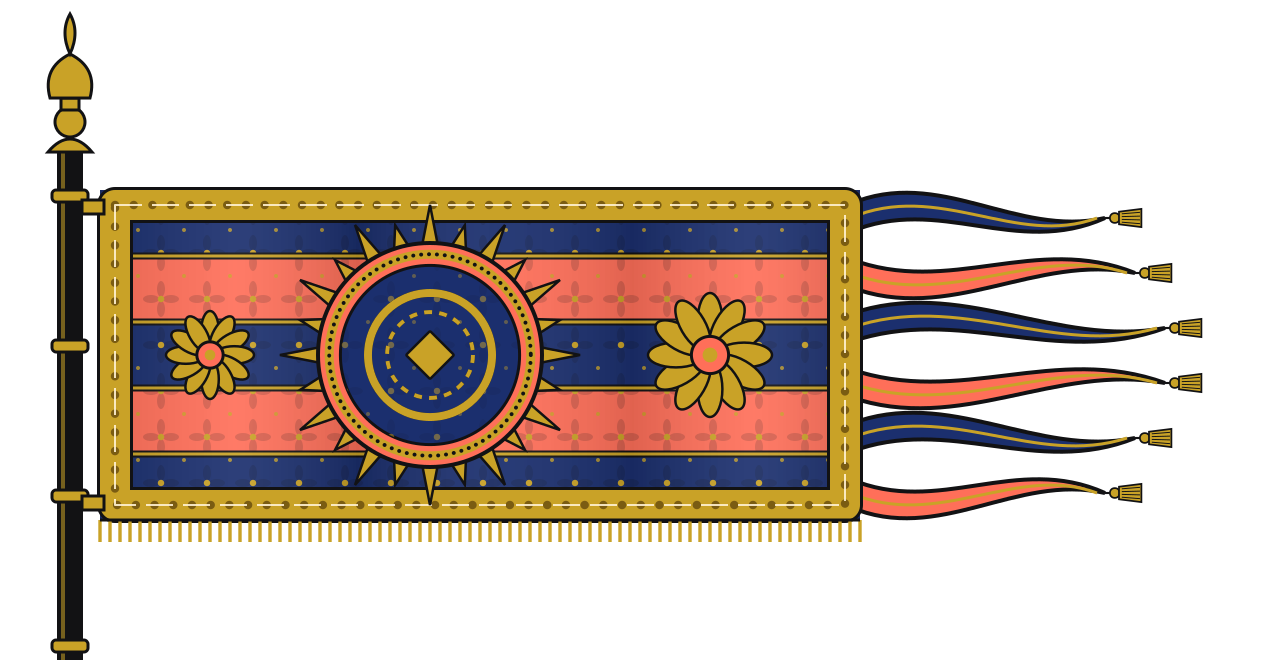
6. Flags
Every clan has every flag type; the type says the occasion and the colours say the clan. The outlined card is the flag the Atlas assigns.
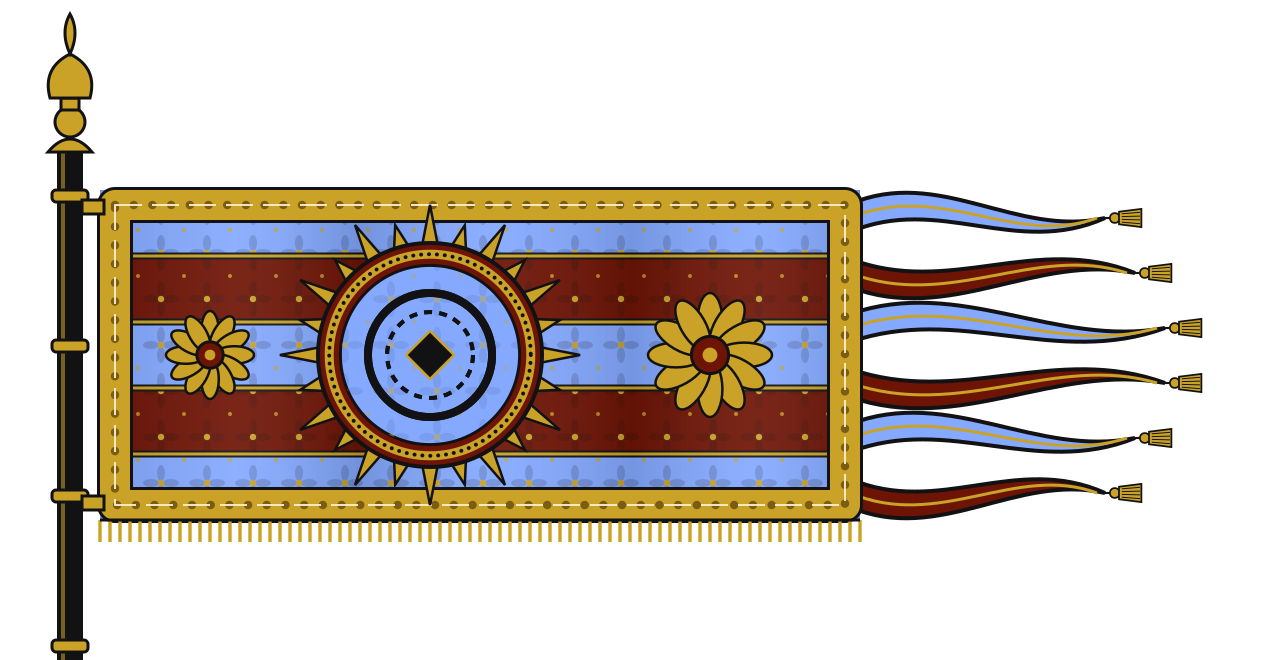
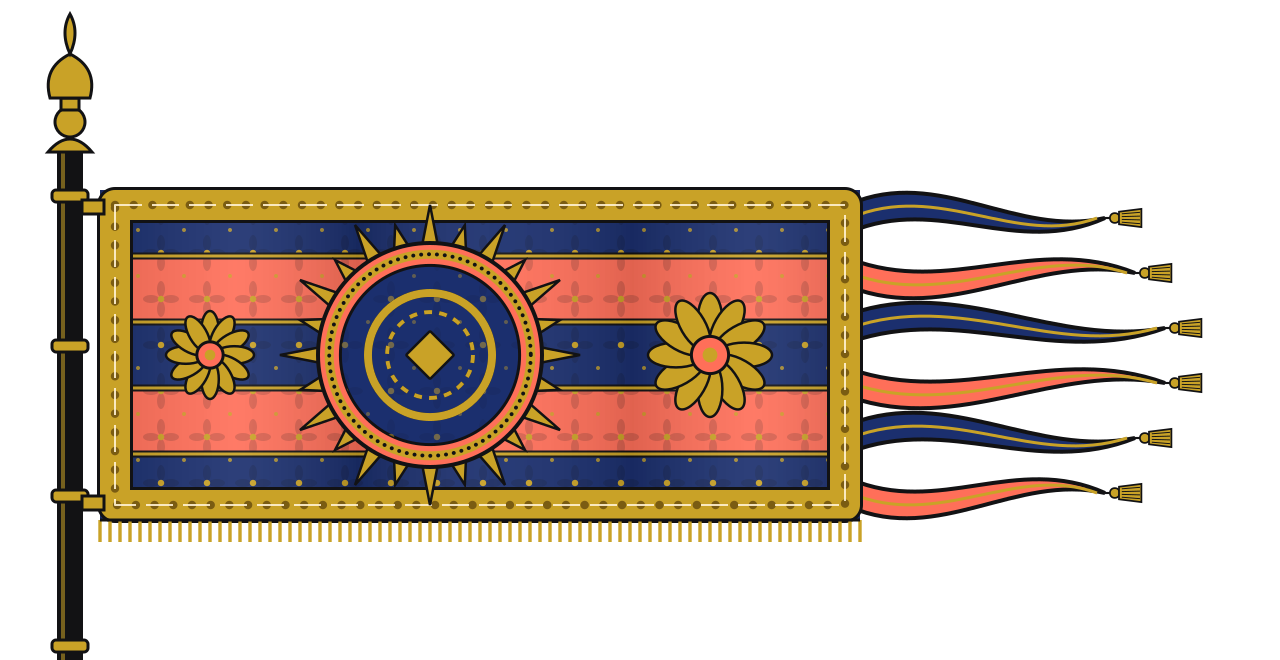
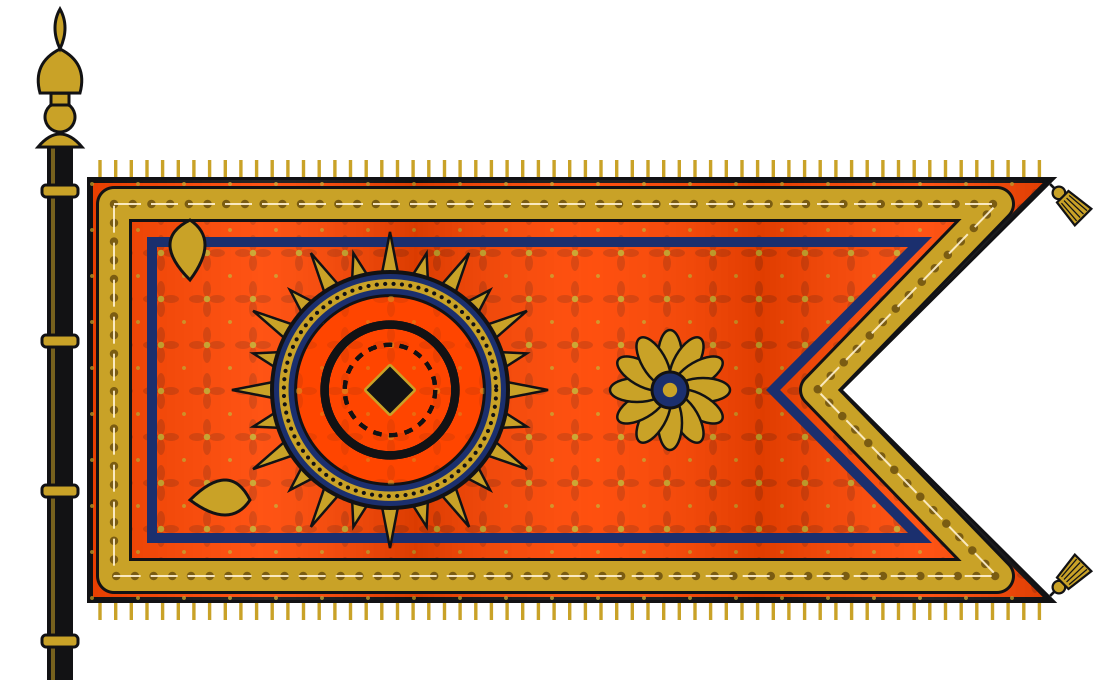
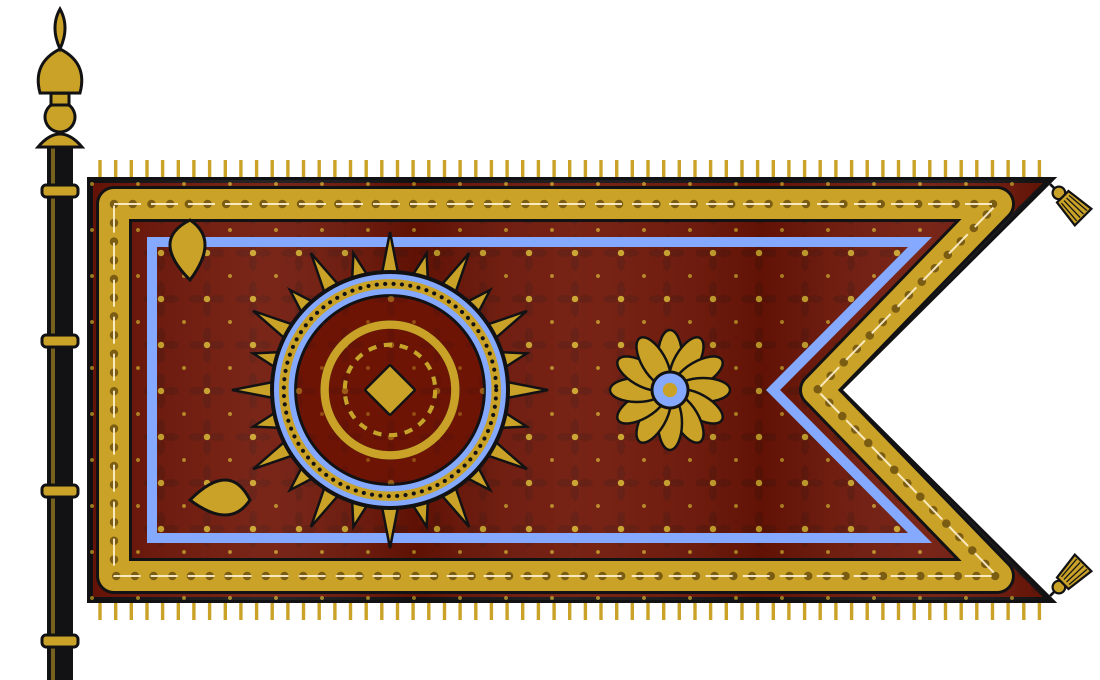
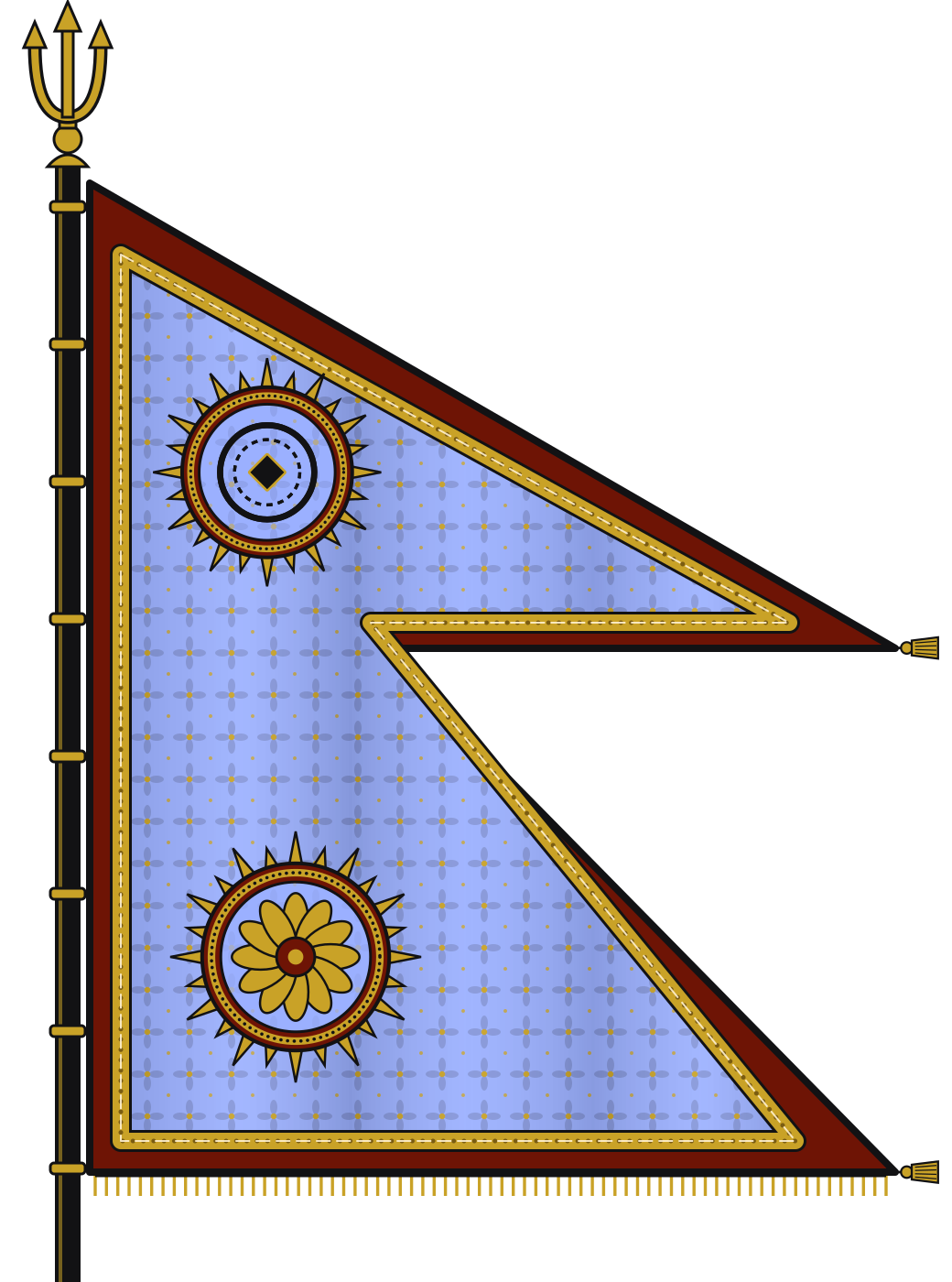
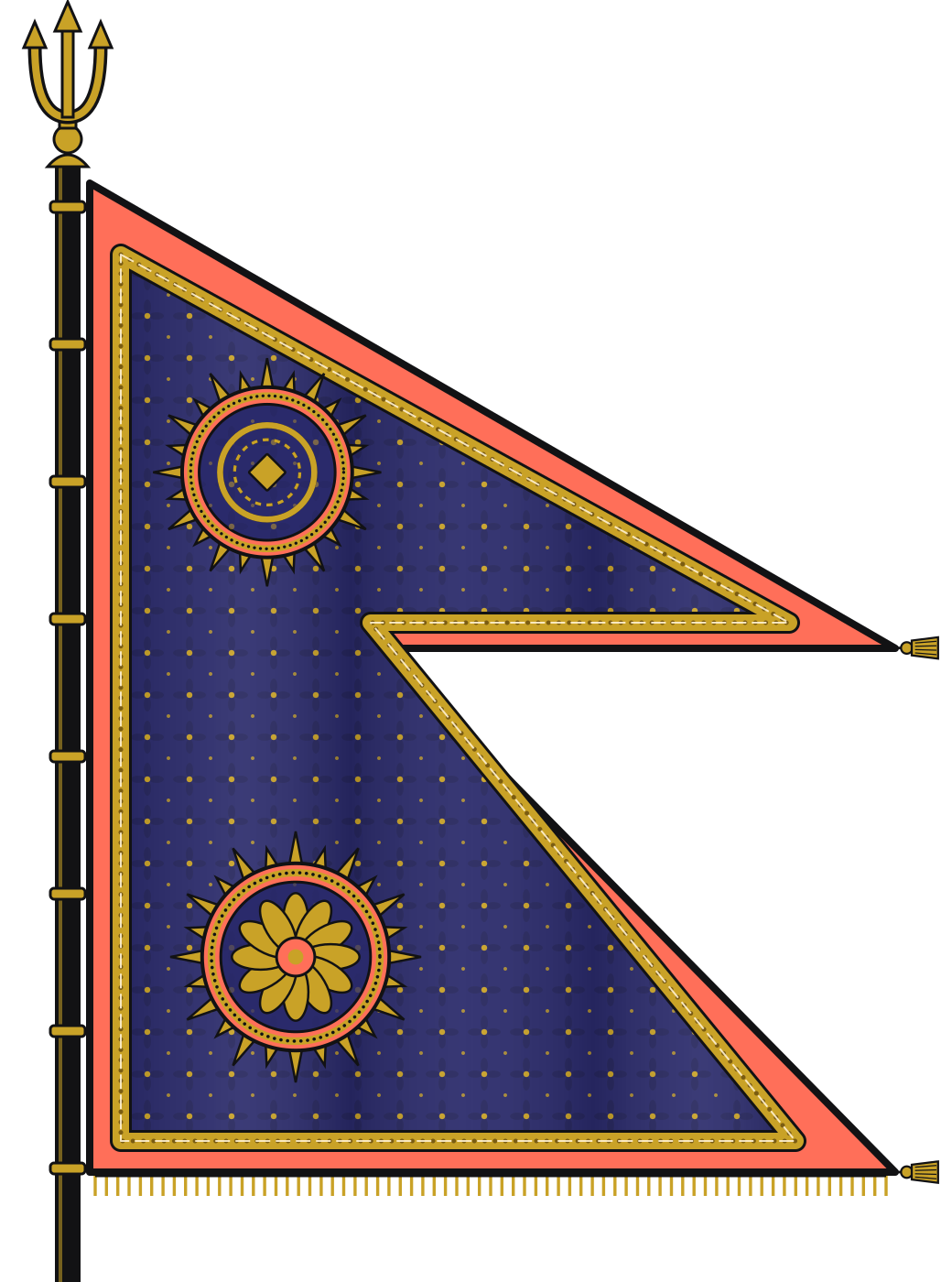

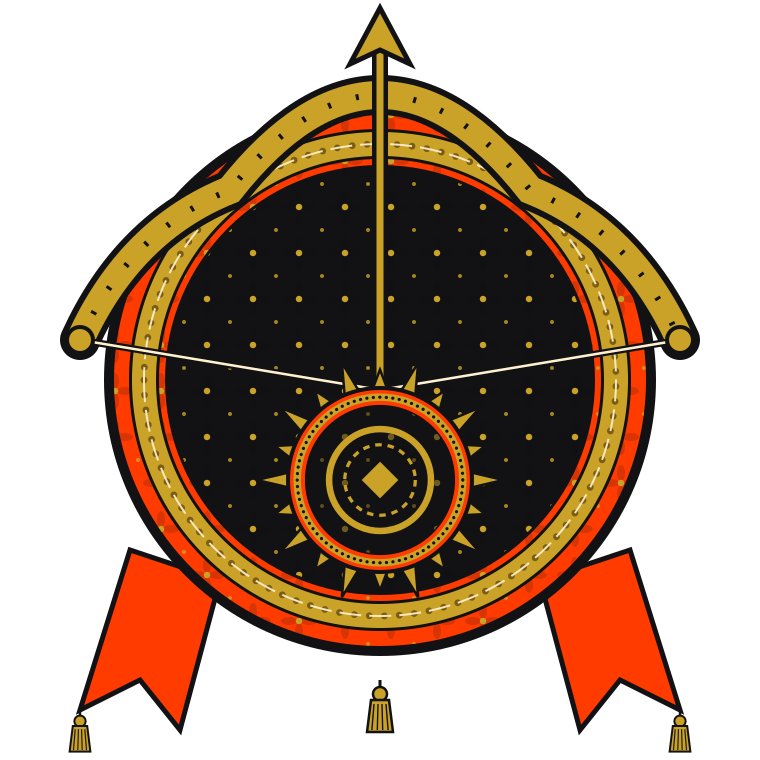
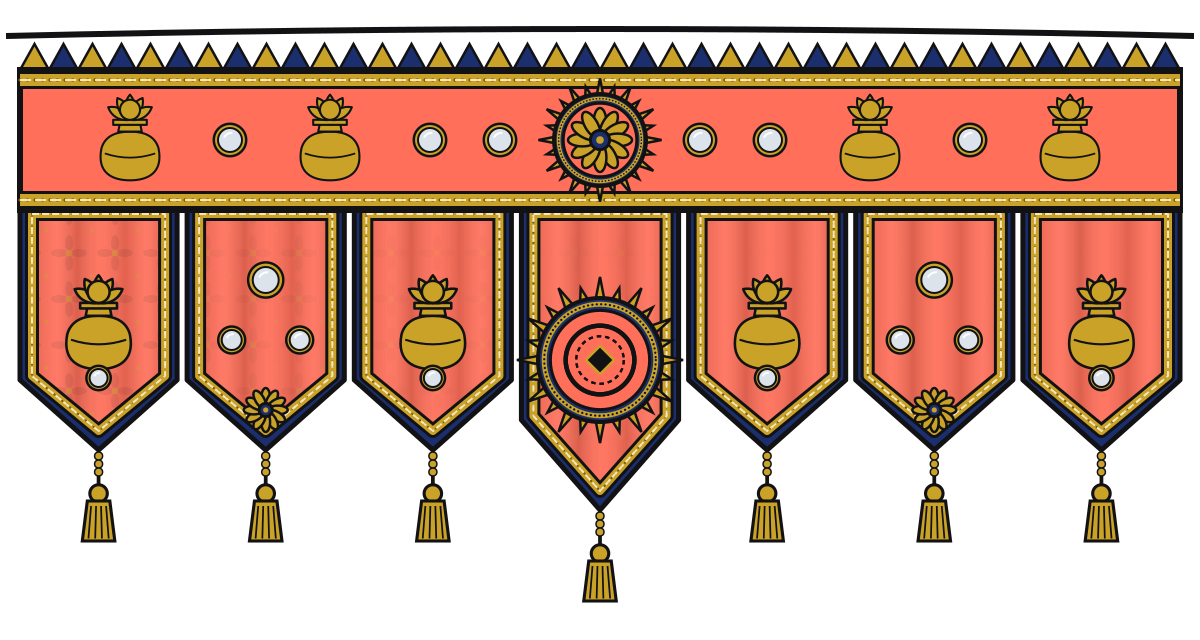
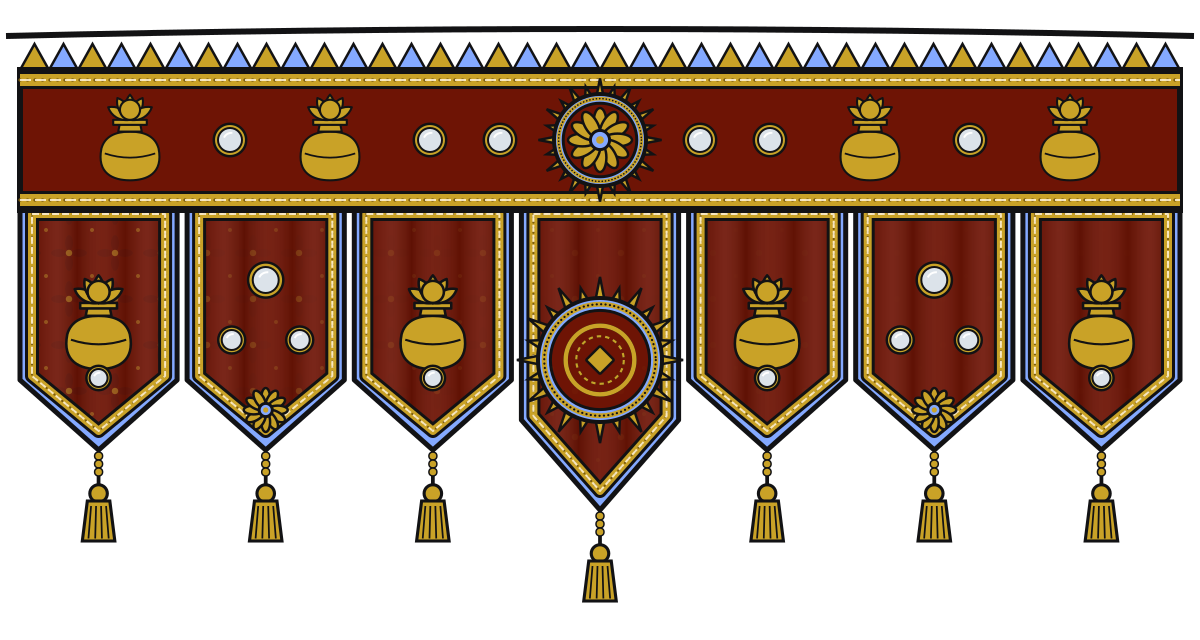
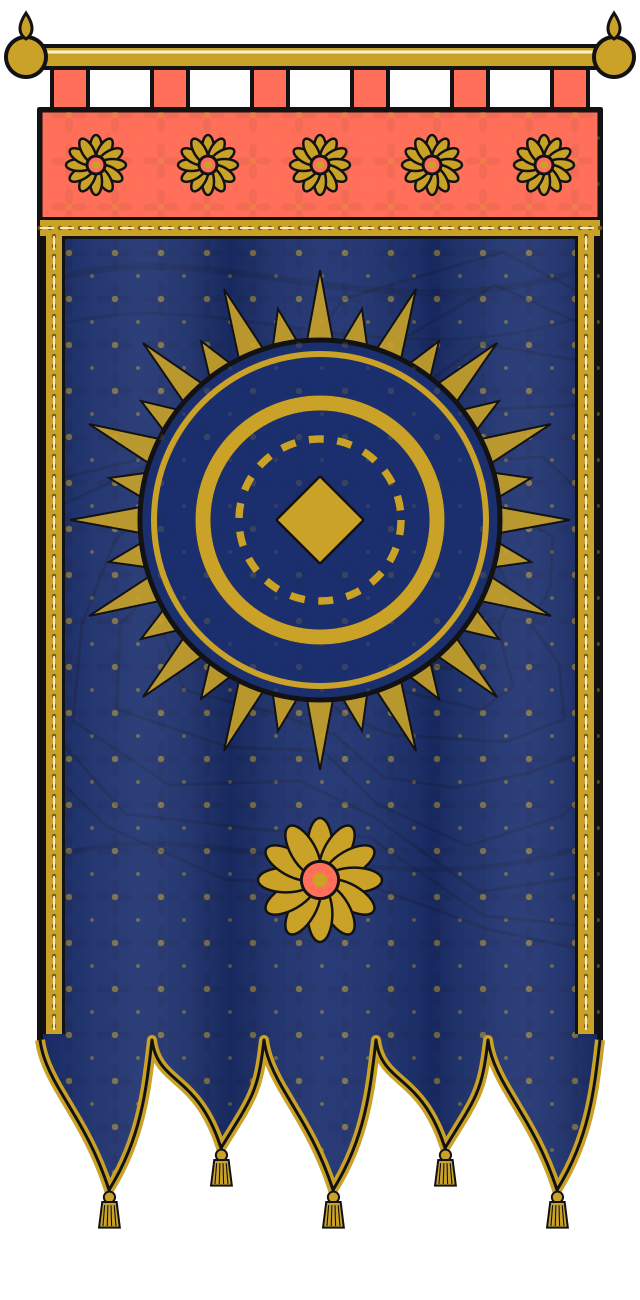
Historic banner
None known
New flag types
| Accessory | For this clan | Basis |
|---|---|---|
| A9 Pota-dhvaja · ship and trade flag For ships, caravans and markets | Not yet designed for this clan | Design |
| A10 Utsava-patāka · festival flag Light, bright flag for fairs and festivals | Not yet designed for this clan | Design |
| A11 Shoka-dhvaja · mourning flag White cloth with the emblem outline in the clan's metal | Not yet designed for this clan | Design |
7. Regalia
| Accessory | For this clan | Basis |
|---|---|---|
| E1 Chhatra · house parasol The ceremonial umbrella | Not yet designed for this clan | Design |
| E2 Chamara · fly-whisks The pair of whisks beside the head of the house | Not yet designed for this clan | Design |
| E3 Danda · staff of office Staff or scepter | Not yet designed for this clan | Design |
| E4 Simhasana · seat The seat of the house, covered in clan cloth | Not yet designed for this clan | Design |
| E5 Khetaka · shield A round shield; the Changi and Dhanush are its flag forms | Shield of gayal (Bos frontalis) hide; the horns make powder flasks, polished and sometimes inlaid with silver Egerton (1880): the Lushai use gayal skin for shields and gayal horns for powder flasks[12] | Documented |
| E6 Kula-ayudha · clan weapon The weapon the clan honours | Dao (kawlnam), the broad knife; the Lushai swear oaths on the dao | Documented |
8. Worn
| Accessory | For this clan | Basis |
|---|---|---|
| F1 Kula-vastra · clan cloth The clan's woven pattern in its kit colours | Puan, the woven cloth; the Pawndum covers a husband's body after death Puan types (Hmaram, Pawndum, Puanchei, Ngotekherh, Tawlhloh)[6] | Documented |
| F2 Kirti-vastra · honour cloth A cloth earned for a deed, not inherited | Tawlhloh, the puan worn by warriors (the source does not say it is earned by a deed) The puan worn by warriors[6] | Documented |
| F3 Kula-mala · garland flower The flower or leaf the clan wears as a garland | Not yet found for this clan | Under research |
| F4 Chinha · house pin A metal badge with the pin emblem | Not yet designed for this clan | Design |
9. Records
| Accessory | For this clan | Basis |
|---|---|---|
| H1 Clan words A traditional line in the native script | Mi zawng zawng hi zalena piang kan ni a, zahawmna leh dikna chanvoah intluk tlang vek kan ni. · “Mizo text of Article 1 of the Universal Declaration of Human Rights” Mizo sample of UDHR Article 1[2] | Design |
| H2 Biruda · titles The house's title or titles | Thangchhuah: the rank of a man who gave a series of village feasts and gained privileges, such as verandahs and windows Shakespear (1912)[1] | Documented |
| H3 Prashasti · praise genealogy The lineage as written at the head of a grant | Not yet found for this clan | Under research |
| H4 Vahi · clan register The book of the clan's births, marriages and deaths | Not yet found for this clan | Under research |
| H5 Rana-ghosha · war cry The clan's cry in battle or celebration | Not yet found for this clan | Under research |
10. VishwaVit · knower of the world
Game values are design choices for this project, not historical claims.
References
- John Shakespear, The Lushei Kuki Clans (London: Macmillan, 1912), Project Gutenberg #54160, read 2026-11-11 (first 100,000 of 607,895 characters, to ch. II), https://www.gutenberg.org/files/54160/54160-h/54160-h.htm
- Wikipedia, Mizo language, read 2026-11-11, https://en.wikipedia.org/wiki/Mizo_language
- Wikipedia, Mizo people, read 2026-11-11 (first 100,000 of 213,022 characters), https://en.wikipedia.org/wiki/Mizo_people
- Wikipedia, Sakhua, read 2026-10-28, https://en.wikipedia.org/wiki/Sakhua
- Wikipedia, Zawlbûk, read 2026-10-22, https://en.wikipedia.org/wiki/Zawlb%C3%BBk
- Wikipedia, Mizo culture (read on the wiki.riteme.site mirror, 2026-11-11), https://wiki.riteme.site/wiki/Mizo_culture
- Hnamte and Khaute, Preserving a Legacy: Mizo Indigenous Sports, Delhi Journal of Contemporary Law vol. VI, read 2026-10-22, https://djcl.lc2.du.ac.in/DJCL6/12 Irwin Lalmuanpuii Hnamte Mercy K. Khaute.pdf
- Wikipedia, Insuknawr, read 2026-10-22, https://en.wikipedia.org/wiki/Insuknawr
- Ezrela Dalidia Fanai, EastMojo, 5 Mizo indigenous games, 21 Sep 2019, read 2026-10-22, https://eastmojo.com/news/2019/09/21/5-mizo-indigenous-games-that-you-probably-didnt-know-about/
- Wikipedia, List of Mizo clans, read 2026-10-28, https://en.wikipedia.org/wiki/List_of_Mizo_clans
- Vajiram and Ravi, Tribes of Mizoram, read 2026-10-28, https://vajiramandravi.com/current-affairs/tribes-of-mizoram/
- Wilbraham Egerton, An Illustrated Handbook of Indian Arms (London: W. H. Allen, 1880), Google Books scan, text in data/sources/texts/books/egerton-1880-indian-arms.txt, archive.org
- Regional Museum and Gallery in Most, Dha, traditional weapon-tool (Jiri Slajsna, Exhibit of the Month 2/2023), read 2026-10-10, museum text.
- GKToday (Hindi), मिजोरम की जनजातियाँ, read 2026-10-28, gktoday.in/hindi
- Vajiram and Ravi, Tribes of Manipur, read 2026-10-27, https://vajiramandravi.com/current-affairs/tribes-of-manipur/ (coaching-site summary)
- Ministry of Tribal Affairs, State/UT-wise list of Scheduled Tribes (Constitution (ST) Order 1950 as amended; list dated 09-07-2024), via the Atlas entries ST-015 and ST-093.
- Vajiram and Ravi, Tribes of Tripura, read 2026-10-28, https://vajiramandravi.com/current-affairs/tribes-of-tripura/ (coaching-site summary)
- Wikipedia, Chin people, read in the Mizo clan sweep, https://en.wikipedia.org/wiki/Chin_people
- IndianetZone, Insuknawr, read 2026-10-22 (credited page in the Khel run), indianetzone.com
- The Indian Tribal, Insuknawr: the forgotten tribal sport of Mizoram making a comeback, 18 Sep 2025, read 2026-10-22, https://theindiantribal.com/2025/09/18/insuknawr-the-forgotten-tribal-sport-of-mizoram-making-a-comeback/
- Wikipedia, Wrestling in India, read in the Mizo clan sweep, https://en.wikipedia.org/wiki/Wrestling_in_India
- Indigenous games of Mizoram (read 9 Nov 2026, Codex drafting run, khel).
- Bharatiya Khel Program (IKS Division, Ministry of Education), Inkabiwah, Kolokpa, Kupusu, read 2026-11-04, https://bharatiyakhel.in/?p=9568
- Constitution (Scheduled Tribes) Order 1950, as amended up to 2024, Part XVII (Mizoram), read 2026-10-28, legitquest.com
- Wikipedia, List of Scheduled Tribes in Assam (population column as of 2012), read 2026-10-26, https://en.wikipedia.org/wiki/List_of_Scheduled_Tribes_in_Assam
- Ayudha Codex, record AY-005 (Dao), data/ayudha/dao.json, researched 2026-10-10 (from Dao (Naga sword), Wikipedia)
- Ayudha Codex, record AY-014 (Dha), data/ayudha/dha.json, researched 2026-10-10 (from Egerton 1880, p. 89)