The Meitei (also Manipuri or Meetei) are the people of the Imphal valley in Manipur, a land the royal chronicle calls Kangleipak[1]. Their chronicle, Cheitharol Kumbaba, claims to begin in 33 CE with Nongda Lairen Pakhangba, but its accurate detail starts with King Kiyamba in 1485 CE[2]. Seven Yek Salai clans were joined into the Meitei confederacy, and all seven trace their descent from Pakhangba in myth[3][4]. The Meitei language is one of India's 22 scheduled languages, and the Meitei Mayek script, replaced in the early 18th century by a Bengali-based alphabet, has been revived in recent decades[1].
01Faith and deities
From the Atlas: the KulDevi is Leimarel Sidabi (basis documented). No clan-specific deity for the Meitei as a whole is named in the pages read; traditionally every Meitei household worships Sanamahi and Leimarel Sidabi[5].
Household mother-goddess of Sanamahi faith[6]
A recorded tie between the clan and the goddess.
| Deity or tradition | Place in the clan's life | Evidence |
|---|---|---|
| Atingkok | Supreme Being, father of Nongshaba and Pakhangba | [7] |
| Leimarel Sidabi (ꯂꯩꯃꯔꯦꯜ ꯁꯤꯗꯕꯤ) | Principle goddess of earth, nature and household; mother of Pakhangba | [8][6][4] |
| Pakhangba (ꯄꯥꯈꯪꯕ) | Primordial dragon deity, "the one who knows his father"; the main cult centre is Pakhangba Temple, Kangla; the seven clans trace descent from him in myth | [4][3] |
| Sanamahi | Worshipped in the south-west corner of homes | [1] |
| Nongshaba | Dragon lion, son of Atingkok | [7] |
| Umang Lai and Lam Lai | Ancient gods of Lai Haraoba: Umang Lai (sylvan) and Lam Lai (tutelary) | [1][6] |
| Panthoibi | Most adored Meetei goddess, worshipped by the Heishnam family; a consort of God Nongpok Ningthou | [9][8] |
| Family goddesses | Named families worship their own goddesses, e.g. Phouoibi (goddess for paddy) by the Sharotkhaibam family | [8] |
| Ancestral deities (Apokpa) | Worshipped by particular clans (Yek Salai) and families (Yumnak or Saghei Lai) | [5][9] |
02Temples
The extracts name these temples; the page gives no builder or date for most. The Sylhet temple is the only one with a builder named (under King Gambhir Singh, no date given here).
Built by the clan
| Temple | Deity | Built by | When | Where |
|---|---|---|---|---|
| Pakhangba temple, Sylhet | Pakhangba | Under King Gambhir Singh | Not dated on the page | Sylhet, 24 m high (page's figure)[4] |
Given patronage or grants by the clan
| Temple | Deity | What the clan gave | When | Where |
|---|---|---|---|---|
| Pakhangba Temple, Kangla | Pakhangba | Main cult centre | Not dated | Kangla, Imphal[4] |
| Hiyangthang Lairembi Temple | Irai Leima (water goddess); Durga installed beside her | Re-modified under Garib Niwaz Pamheiba | Re-modified under Garib Niwaz; date not given | Place not given[10] |
| Sanamahi Temple | Lainingthou Sanamahi and Leimarel Sidabi | Offerings at Mera Chaorel Houba | Not dated | Imphal[6] |
| Sanamahi Kiyong Temple | Not stated | Named among the temples of traditional Meitei religion | Not dated | Not given[1] |
| Thangjing Temple | Not stated | Named among the temples of traditional Meitei religion | Not dated | Moirang[1] |
| Temple at Tadalel | Not stated | Named in the Pakhangba article; no detail | Not dated | Tadalel, Amarapura, Burma[4] |
Later temples in the clan's lands
| Temple | Deity | Built | Where | |
|---|---|---|---|---|
| Eleven temples (not named) | Idol worship | Ordered destroyed by Garib Nawaz | 1723 | Not given[11] |
03Languages and scripts
| Language or script | Kind | Under the clan | Evidence |
|---|---|---|---|
| Meitei language (Manipuri) living | Tibeto-Burman; one of India's 22 scheduled languages (Eighth Schedule, 1992) | The clan's own language; sole official language of the Manipur government | [1] |
| Meitei Mayek revived | Indigenous script; the Meitei script used for inscriptions | Replaced by a Bengali-based alphabet in the early 18th century; revived in recent decades (street signs, schools, newspapers, records) | [1][12] |
| Bengali-based alphabet | Script that replaced Meitei Mayek | Used from the early 18th century; inscriptions also appear in it | [1][12] |
04Books and literature
The Meitei written tradition is in the royal chronicle, the Puya texts and the works below. The extracts give titles and dates, not texts.
Written during the clan's history
| Work | Author | Kind | When | Link to the clan |
|---|---|---|---|---|
| Cheitharol Kumbaba (Royal Chronicle) | Royal court; later editors | Royal chronicle | Accurate detail from 1485 CE; claims to start in 33 CE | [2] |
| Loyumba Shinyen ꯂꯣꯌꯨꯝꯄ ꯁꯤꯟꯌꯦꯟ | Loiyumba (Loyumba) oversaw it | Constitutional text | Dated 1100 CE | [1] |
| Puya (Meitei texts) | Various Maichou (authors) | Scriptures or documents; more than 120 books | Not dated | [13] |
| Takhelgnamba | Not named | Chronicle of the wars of Pamheiba and the Raja of Tiparah (45 leaves) | Not dated | [11] |
| Samsokgnamba | Not named | Chronicle of the wars against Burma and Sumjok | Not dated | [11] |
| Langlol | Not named | Moral treatise with proverbs and maxims (10 leaves) | Not dated | [11] |
| Ningthaurol | Not named | Royal chronicles | Not dated | [11] |
| Singel Indu | Not named | Precursor epic | 1938 | [1] |
| Khamba Thoibi Sheireng ꯈꯝꯕ ꯊꯣꯏꯕꯤ ꯁꯩꯔꯦꯡ | Hijam Anganghal Singh | Epic of about 39,000 lines, called the national epic | 1940 | [1] |
Given patronage by the clan
Not recorded.
05Thinkers and scholars
| Name | Field | Era | Contribution |
|---|---|---|---|
| Hijam Anganghal Singh | Author | 1940 | Khamba Thoibi Sheireng, about 39,000 lines[1] |
| Suniti Kumar Chatterji | Commentary on literature | Not dated | Commented on the antiquity of Manipuri literature[1] |
| T. C. Hodson | Author of Meithei Literature | Read 1911 | Listed the Meitei books, the wars, the chronicles and the proverbs of Langlol[11] |
| Thongam Madhob Singh | Editor | c. 1940 | Bengali-script edition of Cheitharol Kumbaba[2] |
| L. Ibungohal Singh and N. Khelchandra Singh | Editors | 1967 | Edition of Cheitharol Kumbaba (Manipuri Sahitya Parishad)[2] |
| Parratt | Scholar of the chronicle | 2005 | The Court Chronicle of the Kings of Manipur (Routledge)[2] |
Names as the sources give them. The extracts give no biographies.
06Art and architecture
Films named on the people's page: Matamgi Manipur (1972), the first Manipuri film; Imagi Ningthem (1981); Paokhum Ama (1983); Ishanou (1990), shown at Cannes in 1991[1]. Manipuri classical dance (Jagoi, Raas Leela) is named there too.
Painting and wall art
Not recorded.
Sculpture and temple art
| Art form | What it is | Era | Evidence |
|---|---|---|---|
| Kangla Sha | Guardian dragon-lions of Kangla Palace, in pairs | Not dated | [7][1] |
Temple and building architecture
Not recorded.
Weaving and textiles
Not recorded.
Clothing and jewellery
Not recorded.
Coins, pottery and crafts
| Art form | What it is | Era | Evidence |
|---|---|---|---|
| Hiyang Hiren | Decorated race boat, often dragon-shaped | Not dated | [7] |
07History
Origins and the Ningthouja line
The royal chronicle, Cheitharol Kumbaba, claims to start in 33 CE and to cover 76 kings to 1955. Its accurate detail begins with King Kiyamba in 1485 CE; earlier events were reconstructed later, and Parratt and Gangmumei Kamei suspect that 33 CE was chosen by astrological calculation[2].
The chronicle traces the Ningthouja dynasty to Nongda Lairen Pakhangba (33–154 CE)[2]. The Mangang, also called Ningthouja, defeated the other clans and its king became the supreme ruler; the Mangang merged into the Ningthouja polity in the 7th century[3].
The chronicle records the gradual spread of the Meitei across Kangleipak and the absorption of other clans into a confederacy[1]. The Meitei name covered all seven clans by the 15th century[3].
Early records and inscriptions
The Manipuris are first mentioned in Shan chronicles of 777 CE[11].
Loiyumba (1074–1112 CE) oversaw the Loyumba Shinyen, dated 1100 CE. The people's page says it formalised a proto-constitution drafted in 429 CE by King Naophangba, and that its constitutional function ended with the Manipur State Constitution Act of 1947[1].
Four stone inscriptions were found in Chandel district from 1974. The oldest is from King Urakonthouba (6th century)[12].
Stone decrees of King Kiyamba (1467–1508) at Tarao Pal forbid animal theft and slave-taking, and name a village as the eastern guard. The Kabaw Valley was annexed with a Shan king, and the Ningthi Turel (Chindwin) became the eastern boundary[12].
The Puyas, written on indigenous paper with indigenous ink, record Khamlangba's search for iron; iron-bearing slag from the same study dates to about 400 CE[14].
Garib Niwaz and the temples
Pamheiba (Garib Niwaz) left a stone inscription near Tipaimukh in Pherzawl; it shows spears, bows, elephants, horses, the Arambai dart and the Nongmei Ashubi, and the page dates his camp there to 1734, in war with the Tripuris[12].
Garib Nawaz adopted Hinduism about 1720. In 1723 he ordered idol worship stopped and eleven temples destroyed[11].
Wars with Burma
The Meitei-Konbaung wars were fought in 1758–1759, and Burma occupied Manipur from 1819 to 1826[1].
Meitei horsemen formed the Cassay cavalry (ကသည်း) and artillery of the Burmese royal army, and Manipuri Brahmins (Bamons, Kathe Ponna) served the Burmese court[1]. After the wars, Alaungpaya resettled Meiteis in Sagaing and Amarapura[1].
Arts and arms; the British
The golden age of the martial arts came under King Khagemba (1597–1652 CE)[15].
After 1891 the British banned weapons and the martial arts[15].
08Journey and migrations
After the Meitei-Konbaung wars, Alaungpaya resettled Meiteis in Sagaing and Amarapura (Burma). The Meitei now live across the north-east and in Myanmar and Bangladesh. The page dates the wars of 1758–1759 and the occupation of 1819–1826; it does not date the other moves.
| When | From | To | Why | Evidence |
|---|---|---|---|---|
| After the wars of 1758–1759 | Imphal valley | Sagaing and Amarapura (Burma) | Resettled by Alaungpaya | [1] |
| Not dated | Imphal valley | Burmese royal army | Meitei horsemen formed the Cassay cavalry and artillery | [1] |
| Not dated | Imphal valley | Assam (Barak Valley), Tripura, Nagaland, Meghalaya, Mizoram, Arunachal Pradesh, Bangladesh (Sylhet Division), Myanmar | Diaspora; cause not stated on the page | [1] |
09Seats and lands
| Place | Role | Where today |
|---|---|---|
| Kangla, Imphal | Seat of the Mangang or Ningthouja line | Imphal, Manipur |
| Luwangsangbam Kangla | Seat of the Luwang clan | Not located in the extracts |
| Mayang Imphal | Seat of the Khuman clan | Named as Mayang Imphal; location not further given |
| Kongba | Capital of the Angom clan | Not located in the extracts |
| Moirang Kangla | Seat of the Moirang clan | Not located in the extracts |
| Wangching Sanggai Kangla | Seat of the Khaba-Nganba clan | Not located in the extracts |
| Wangoi Kangla | Seat of the Chenglei (Sarang Leishangthem) clan | Not located in the extracts |
| Loktak Lake | Lake of the Poubi Lai dragon story and of Khamba and Thoibi | Named in the stories; location not given |
| Tipaimukh, Vangaitang range | Pamheiba's stone inscription | Pherzawl |
| Kabaw Valley | Annexed in King Kiyamba's time with a Shan king | Not stated on the page |
| Sagaing and Amarapura | Places where Alaungpaya resettled Meiteis | Myanmar |
| Sylhet | Site of a 24 m Pakhangba temple built under King Gambhir Singh | Sylhet Division, Bangladesh |
10Notable figures
| Name | Role | Era | Known from |
|---|---|---|---|
| Nongda Lairen Pakhangba legend | First Ningthouja ruler in the chronicle | 33–154 CE (chronicle) | [2] |
| Loiyumba (Loyumba) | Oversaw the Loyumba Shinyen | 1074–1112 CE | [1] |
| Naophangba legend | Credited on the page with a proto-constitution drafted in 429 CE | 429 CE (page's date) | [1] |
| Urakonthouba | King; the oldest of four stones at Chandel | 6th century | [12] |
| Naothingkhong | King, worshipped as Naothingkhong Pakhangba | c. 5th century | [4] |
| Kiyamba | King; stone decrees at Tarao Pal; Kabaw Valley annexed | 1467–1508 | [12][2] |
| Khagemba | King; golden age of the martial arts | 1597–1652 CE | [15] |
| Garib Niwaz (Pamheiba) | King; adopted Hinduism about 1720; ordered idol worship stopped in 1723; stone at Tipaimukh | c. 1720–1734 (events cited) | [11][12] |
| Khamba and Thoibi legend | Lovers of Moirang in the sung tale; Thoibi regarded as a goddess | Not dated | [11] |
| Numit kappa legend | A slave who shot one of two suns | Not dated | [11] |
| Helloi Taret legend | Seven celestial sisters who play Woolaobi in courtyards of Umang Lai temples | Myth | [16] |
11Allies, rivals and marriages
| People | Relationship | When |
|---|---|---|
| Burmese royal army and court | Meitei horsemen (Cassay) and artillery served it; Manipuri Brahmins (Bamons) served the court | Not dated on the page |
| Burma (Konbaung) | Meitei-Konbaung wars; Burmese occupation of Manipur | 1758–1759; 1819–1826 |
| Alaungpaya | Resettled Meiteis in Sagaing and Amarapura after the wars | After 1758–1759 |
| Tripuris (Tiparah) | Pamheiba's war with the Raja of Tiparah, and his camp at Tipaimukh in war with the Tripuris | 1734 (stone); date of the war not given in the Takhelgnamba entry |
| Pong (upper Myanmar) | King Kiyamba met the king of Pong before the chronicle's accurate detail | 1485 |
12Society and livelihood
Descent runs through the Salai (clan) system, which is patrilineal. A yumnak is the family name; yumnaks formed in areas and later dispersed through migration[17]. The institutions the people's page names are listed with what the page gives about them.
Government and social order
| Institution or group | What it was | Evidence |
|---|---|---|
| Salai (clan) system | Patrilineal clan system; the seven Yek Salai clans are the named core | [17] |
| Yumnak | Family name used as a prefix to the name | [17] |
| Arambai Tenggol | Organisation named on the people's page; no detail given there | [1] |
| Meira Paibi | Organisation named on the people's page; no detail given there | [1] |
| Manipuri Sahitya Parishad | Literary body named on the page; its 1967 edition of Cheitharol Kumbaba was by L. Ibungohal Singh and N. Khelchandra Singh | [2][1] |
| European Manipuri Association | Founded in Sheffield on 23 September 2001 | [1] |
| Ima Keithel | Market in the heart of Imphal, established in the 16th century; its oldest section is the Leimarel Shidabi Ima, and it houses a shrine to Keithel Lairembi | [18] |
Livelihood over time
| Era | Livelihood | Evidence |
|---|---|---|
| Not dated | Women dominate the local markets | [1] |
| Not dated | Horsemen and artillery in the Burmese royal army (Cassay) | [1] |
13Sub-clans and related clans
The seven Yek Salai clans were assimilated into the Meitei confederacy[1]. Yumnaks are family names among the Meetei[17]. The page gives no sub-clan sizes, and the families listed below are named by the sources as families or as yumnak forms.
| Clan | Relation | Where | Size | In the Atlas | Evidence |
|---|---|---|---|---|---|
| Mangang (Ningthouja) ꯃꯉꯥꯡ / ꯅꯤꯡꯊꯧꯖꯥ | Dynasty from this clan | Imphal, Kangla | new clan candidate | [3] | |
| Luwang ꯂꯨꯋꯥꯡ | Sub-clan | Luwangsangbam Kangla | new clan candidate | [3] | |
| Khuman ꯈꯨꯃꯟ | Sub-clan | Mayang Imphal | new clan candidate | [3] | |
| Angom ꯑꯉꯣꯝ | Sub-clan | Kongba | new clan candidate | [3] | |
| Moirang ꯃꯣꯏꯂꯥꯡ / ꯃꯣꯏꯔꯥꯡ | Sub-clan | Moirang Kangla | new clan candidate | [3] | |
| Khaba-Nganba (Kha Nganpa) ꯈꯥ ꯉꯥꯟꯄ | Sub-clan | Wangching Sanggai Kangla | new clan candidate | [3] | |
| Sarang Leishangthem (Chenglei) | Sub-clan | Wangoi Kangla | new clan candidate | [3][19] | |
| Aribam | Related people | new clan candidate | [17] | ||
| Kshetrimayum | Related people | new clan candidate | [17] | ||
| Gurumayum | Related people | new clan candidate | [17] | ||
| Lairikyengpham | Related people | new clan candidate | [17] | ||
| Khaidem | Related people | new clan candidate | [17] | ||
| Narumbam | Related people | new clan candidate | [17] | ||
| Sougrakpam | Related people | new clan candidate | [17] | ||
| Heishnam | Related people | Atlas: Manipur, Assam, Tripura | NE-042 | [9] | |
| Sharotkhaibam family | Related people | new clan candidate | [8] | ||
| Thaopicham family | Related people | new clan candidate | [8] | ||
| Taibangjam family | Related people | new clan candidate | [8] | ||
| Ashangbam family | Related people | new clan candidate | [8] | ||
| Chingkhwam family | Related people | new clan candidate | [8] | ||
| Konthoujam family | Related people | new clan candidate | [8] | ||
| Arambam family | Related people | new clan candidate | [8] | ||
| Khuraijam family | Related people | new clan candidate | [8] | ||
| Ningthoujam family | Related people | new clan candidate | [8] | ||
| Shoubam family | Related people | new clan candidate | [8] | ||
| Meiyengbam family | Related people | new clan candidate | [8] | ||
| Heithou family | Related people | new clan candidate | [8] | ||
| Khongtekcham family | Related people | new clan candidate | [8] | ||
| Bamon (Manipuri Brahmin) ကသည်းပုဏ္ဏား | Related people | Manipur; served the Burmese court | new clan candidate | [1] | |
| Meitei Pangal | Related people | Manipur | about 239,836, 2011 census[1] | new clan candidate | [1] |
| Bamars | Related people | Myanmar | new clan candidate | [1] | |
| Chin | Related people | new clan candidate | [1] | ||
| Kachin (Singpho) | Related people | ST-294 | [1] | ||
| Tripuri | Related people | ST-319 | [1] | ||
| Nagas | Related people | ST-231 | [1] |
Clans marked "new clan candidate" are not in the Atlas yet.
14Surnames
Yumnaks are family names used as prefixes to the surname[19][17]. The two pages give different forms for women: the mirror says Chanu or Devi, and the Yumnak article says Chanu, then Leima after marriage (Ningol and Ongbi added). Males take a Salai or clan name, or Meitei or Meetei. None of the names below has a count, since none is sourced with a year.
| Surname | Clan or sub-clan | Where | People with this surname | Also used by other communities |
|---|---|---|---|---|
| Khaidem | Khaidem yumnak | not yet counted | Not checked | |
| Narumbam | Narumbam yumnak | not yet counted | Not checked | |
| Sougrakpam | Sougrakpam yumnak | not yet counted | Not checked | |
| Kshetrimayum | Kshetrimayum yumnak | not yet counted | Not checked | |
| Gurumayum | Gurumayum yumnak | not yet counted | Not checked | |
| Lairikyengpham | Lairikyengpham yumnak | not yet counted | Not checked | |
| Aribam | Aribam yumnak | not yet counted | Not checked | |
| Mangang | Salai name used as a clan or surname name | not yet counted | Not checked | |
| Luwang | Salai name used as a clan or surname name | not yet counted | Not checked | |
| Khuman | Salai name used as a clan or surname name | not yet counted | Not checked | |
| Angom | Salai name used as a clan or surname name | not yet counted | Not checked | |
| Moirang | Salai name used as a clan or surname name | not yet counted | Not checked | |
| Khaba-Nganba | Salai name used as a clan or surname name | not yet counted | Not checked | |
| Sarang Leishangthem | Salai name used as a clan or surname name | not yet counted | Not checked | |
| Heishnam | Heishnam family (NE-042) | Atlas: Manipur, Assam, Tripura | not yet counted | Not checked |
| Sharotkhaibam | Sharotkhaibam family | not yet counted | Not checked | |
| Thaopicham | Thaopicham family | not yet counted | Not checked | |
| Taibangjam | Taibangjam family | not yet counted | Not checked | |
| Ashangbam | Ashangbam family | not yet counted | Not checked | |
| Chingkhwam | Chingkhwam family | not yet counted | Not checked | |
| Konthoujam | Konthoujam family | not yet counted | Not checked | |
| Arambam | Arambam family | not yet counted | Not checked | |
| Khuraijam | Khuraijam family | not yet counted | Not checked | |
| Ningthoujam | Ningthoujam family | not yet counted | Not checked | |
| Shoubam | Shoubam family | not yet counted | Not checked | |
| Meiyengbam | Meiyengbam family | not yet counted | Not checked | |
| Heithou | Heithou family | not yet counted | Not checked | |
| Khongtekcham | Khongtekcham family | not yet counted | Not checked |
Counts are of everyone with the surname, from the cited source and year, not only members of this clan. A surname shared with other communities says nothing about any one person's origin.
15Songs and music
The sung traditions named in the extracts are the Pena folk ballads, the sung epic of Khamba and Thoibi, and the ritual songs of Lai Haraoba. The texts are not in the extracts, so only the titles are given.
Khamba Thoibi Sheireng
Written by Hijam Anganghal Singh, about 39,000 lines[1]. The tale of Khamba and Thoibi of Moirang is sung by the Logtak lake[11].
Singel Indu
Named as the precursor of Khamba Thoibi Sheireng[1].
Pena singing
Folk tales chanted in a high nasal crooning style by the iseisakpa (singer-maker)[11].
Lai Haraoba ritual songs living
Named on the page: Ahonglon, Yakeiba, Pakhangba Langyensei, Langmailon, Kumdamsei, Ougri, Khencho, Anoirol and Lairemma Paosa. Only the names are given here[20].
Ancient Meitei hymns
Named on the page: Sana Lamok (to Pakhangba), Apoklon, Mei, Nonglao Eesei, Louta Eesei and Phoukouron, which asks Phouoibi for a harvest. No verses are given[21].
Keiyen living
Song of the conflict between Pakhangba and Sanamahi, performed at Ke-kre-Chongba[4].
Instruments and styles
| Instrument or style | What it is | Evidence |
|---|---|---|
| Pena | Fiddle to which folk tales are chanted | [11] |
| Pena Saisak | Folk-ballad style in which Khamba Thoibi Sheireng is sung | [1] |
| Manipuri classical dance (Jagoi, Raas Leela) | Classical dance of the Meitei | [1] |
16Poems, lullabies and children's rhymes
The extracts give no verse, lullaby or rhyme in Meitei or in English. The Puya texts and the ritual songs are named only.
None recorded yet.
17Stories, legends and proverbs
Stories and legends
| Story | What happens | Told by | Evidence |
|---|---|---|---|
| Pakhangba and the seven wives legend | Pakhangba had seven wives, said to be the mothers of the seven Meitei clans | Meitei legend | [4] |
| Pakhangba and Sanamahi legend | A circumambulation contest between the two gods; the Keiyen song tells of their conflict | Meitei tradition | [4] |
| Poubi Lai legend | Tyrant dragon-serpent of the primitive Loktak Lake | Meitei myth | [7] |
| Taoroinai legend | Dragon-serpent of the cosmic ocean who brought the celestial egg (nonglum) to earth | Meitei myth | [7] |
| The deer-headed king of the Luwang boat legend | The king's head was installed on royal boats; the image was absorbed into the hiyang hiren | Not stated | [4] |
| Khamba and Thoibi | Tragic sung tale of Moirang by Logtak lake; Thoibi is regarded as a goddess | Sung tale of the Pena tradition | [11] |
| Numit kappa legend | A slave who shot one of two suns | Hodson's list of Meitei literature | [11] |
| Saint Dhananjoy | A tale of Saint Dhananjoy, which Hodson says is of foreign origin | Hodson's list of Meitei literature | [11] |
Proverbs and sayings
Not recorded.
18Festivals and fairs
| Festival or fair | When | Where | What happens |
|---|---|---|---|
| Lai Haraoba | No fixed date; set by the temple authorities for each deity, lasting from weeks to over a month | No venue named on the page | Ritual theatrical festival, the merry-making of the gods, dedicated to the Umang Lai tutelary deities[6][1] |
| Sajibu Cheiraoba | 1st lunar day of Sajibu | Sanamahi Kachin (as the page names it) | Sanamahi worshipped with seasonal fruits and vegetables[6] |
| Mera Chaorel Houba | Not dated on the page | Sanamahi Temple, Imphal | Devotees offer rice, fruits and vegetables to Lainingthou Sanamahi and Leimarel Sidabi[6] |
| Pakhangba Cheng Hongba | Annual | Sana Konung | Flowers offered to Nongshaba, Pakhangba and Yumjao Lairembi[4] |
| Ningol Chakouba | Not dated on the page | Manipur; also among the diaspora in Europe | Festival; no detail on the page[1] |
| Yaoshang | Not dated on the page | Not stated | Named on the page; no detail[1] |
| Pung Cholom | Not dated on the page | Not stated | Named on the page; no detail[1] |
| Lomjel and Hiang | Not dated | Not stated | Festivals named by Hodson[11] |
| Kurnabed and holy-thread ceremonies | Not dated | Not stated | Ear-piercing (Kurnabed) and holy-thread ceremonies named by Hodson[11] |
19Food, dress and games
Food
| Item | What it is | Evidence |
|---|---|---|
| Eromba | Dish named on the page | [1] |
| Singju | Dish named on the page | [1] |
| Kangsoi | Dish named on the page | [1] |
| Rice, vegetables and fish | Staple foods named on the page | [1] |
Dress
Not recorded.
Games and martial arts
| Item | What it is | Evidence |
|---|---|---|
| Woolaobi (ꯋꯨꯂꯥꯎꯕꯤ) | Outdoor game mainly played by females; Raiders say "woo" while they try to touch Defenders, and a touched Defender is out. The basic principles resemble kabaddi. | [16] |
| Khullokpi (ꯈꯨꯜꯂꯣꯛꯄꯤ) | Traditional children's game: small objects are tossed up from the back of the palm and caught, using pebbles, brick fragments or seeds | [16] |
| Phipul Haapi (ꯐꯤꯄꯨꯜ ꯍꯥꯄꯤ; Phibul Haabi ꯐꯤꯕꯨꯜ ꯍꯥꯕꯤ) | Children's game open to both sexes: one child is the horse and another the rider; a ball made from a pile of clothes is passed round. Now nearly extinct. | [16] |
| Marum Konbi (ꯃꯔꯨꯝ ꯀꯣꯟꯕꯤ) | Children dig small ditches and place round objects as "eggs", imitating incubation | [16] |
| Cheitek Kotpi (ꯆꯩꯇꯦꯛ ꯀꯣꯠꯄꯤ) | A bamboo stick flings soil or dust at another player, who is out when hit | [16] |
| Mukna Kangjei (ꯀꯥꯡꯖꯩ) | Named as from Lai Haraoba, King Khagemba (17th century), teams of seven | [16] |
| Sagol Kangjei (ꯁꯒꯣꯜ ꯀꯥꯡꯖꯩ) | Regular play from 1606 (page's date), named with King Kangba | [16] |
| Hiyang Tannaba | Boat race in November, linked to King Khunjaoba; 40 Hiroys per boat | [16] |
| Mukna | Meitei wrestling, performed at traditional festivals | [15] |
| Kang | Indoor game believed to have been played by the goddess Panthoibi | [16] |
| Arambai Hunba | Pony riding | [16] |
| Thang-ta | Armed martial art of the Meitei; Sarit Sarak (unarmed) and Cheibi (stick and shield) are also named | [15] |
Tags: living still practised · revived brought back after a break · lost known only from records · research reported but not yet confirmed from a source. Songs and poems under copyright are listed by title only; restricted or sacred material is noted without its content.
20Status today
The Meitei are a Tibeto-Burman-speaking people of the Imphal valley, with the largest numbers in Manipur and communities in neighbouring states, Myanmar and Bangladesh[1].
Recognised heritage
| What | Recognition | Evidence |
|---|---|---|
| Meitei language | Eighth Schedule of the Indian Constitution, 1992; sole official language of the Manipur government | [1] |
No community review is recorded for this page.
21For children
The seven wives of the young god
Long ago, in the Imphal valley, there was a young god called Pakhangba. His name means "the one who knows his father", and his mother was Leimarel Sidabi, the goddess of the earth. Pakhangba had seven wives, and the stories say they were the mothers of the seven clans of the Meitei people. Each clan has its own named sword. In the courtyards of the temples of the Umang Lai gods, seven sisters called Helloi Taret play a game called Woolaobi. The players call out "woo" as they run, and the game is a little like kabaddi.
Written for this project
22Across the project
| Project | What carries this clan | Status |
|---|---|---|
| Atlas of the Janas | Homeland: the Imphal valley, Manipur (Kangleipak); diaspora in Assam, Tripura, Myanmar and Bangladesh per the people's page | From the Atlas and the people's page |
| KulDevi and GrahDevi | KulDevi Leimarel Sidabi (documented); family Saptamatrika (+Narasimhi); GrahDevi forms Brahmani, Maheshvari, Kaumari, Vaishnavi, Varahi, Indrani, Chamunda, Narasimhi | From the Atlas |
| Planet naming | Not yet checked against the planet registers | To check |
| Renaming and waters | Loktak Lake (Poubi Lai story) and Logtak lake (Khamba and Thoibi) are named in the extracts | Named in sources |
23Open questions
- Who built the early temples (Pakhangba Temple, Kangla; Sanamahi Kiyong; Thangjing, Moirang), and when.
- Coins, seals and copper plates: none is in the extracts, and the inscriptions page lists none. Leads: the Meitei currency page (wiki.kidzsearch.com, listed but not fetched) and Senbi Kiyamba (listed, not fetched).
- A line of the people's own words: the only native text in the extracts is a title (Loyumba Shinyen). A translated line is needed before the clan words can be the people's own.
- Meitei Mayek proverbs and songs with verbatim public-domain text: Hodson, The Meitheis (1908, archive.org), is the lead.
- Dates and seats of the Luwang, Khuman, Angom, Moirang, Khaba-Nganba and Chenglei lines, which the confederacy page gives only as ranges of independence.
- The Ahom relations and the queen of Purandar Singha (listed in notes, but their pages are not among the extracts): fetch before adding.
- The Gambhir Singh date on the inscriptions page looks wrong, so no date for him is given here; the page's own figures need checking against Cheitharol Kumbaba.
- Surname counts, Meitei Mayek forms of the surnames, and sub-clan sizes.
- Community review of this page.
- Yumnaks: the Yumnak article gives them as family names[17], while the Wikipedia mirror on Manipuri surnames calls them sub-clans formed within the seven Yek Salai[19]. The two sources differ and the page does not settle it.
- Script dates: the Meitei Mayek script is said to have been replaced by a Bengali-based alphabet in the early 18th century[1], yet the 1734 Pamheiba stone is in Meitei script[12]; the extracts do not date the change.
24Astitva
अस्तित्व · being, existence: everything by which the clan is known
Recorded for the Meitei: the Ningthouja serpent totem with sangai antlers; the sangai linked to the Luwang clan; the named clan swords of the seven Yek Salai clans; the Kangla Sha dragon-lions at Kangla Palace; the Arambai dart on Pamheiba's stone; and King Kiyamba's stone decrees[12][7]. The extracts record no coin, seal or copper plate.
Every clan has every accessory, royal objects included. Each one says how it is known: Documented This clan's own object is recorded. · Regional tradition Recorded for the region or for peoples like this one, not for this clan. · Design Made for this project, with no historical claim. · Under research To be found for this clan from sources. Legends and titles are written in the clan's own script.
1. Seals and coins
| Accessory | For this clan | Basis |
|---|---|---|
| B1 Rajamudra · house seal Round seal with the clan emblem and a short legend in the clan's script | Not yet designed for this clan | Design |
| B2 Anguliya-mudra · signet ring Personal seal ring of the head of the house | Not yet designed for this clan | Design |
| B3 Chhapa · house stamp Ink or block stamp for letters, goods and cloth | Not yet designed for this clan | Design |
| B4 Tamrapatra · charter plate Copper-plate grant on a ring, closed with the house seal | Not yet designed for this clan | Design |
| B5 Shreni-mudra · guild or trade seal Seal for the clan's trade, craft or caravan | Not yet designed for this clan | Design |
| C1 Clan coin Emblem or deity on one side, a legend in the clan's script | Not yet designed for this clan | Design |
| C2 Coin die The die that strikes the coin | Not yet designed for this clan | Design |
2. Living symbols
| Accessory | For this clan | Basis |
|---|---|---|
| I1 Totem trio The tree, bird and animal the clan protects | Serpent with sangai antlers (Ningthouja); sangai deer (Luwang) Serpents are the totem of the Ningthouja clan, which avoids fish and plants resembling serpents; the sangai is linked to the Luwang clan[4] | Documented |
| I2 Kaval-maram · guardian tree The tree that stands at the clan's seat | Not yet found for this clan | Under research |
3. Stone and gate
| Accessory | For this clan | Basis |
|---|---|---|
| G1 Torana · gateway The built gate of the seat; the cloth Toran hangs in it | Not yet designed for this clan | Regional tradition |
| G2 Viragallu · hero stone Carved panel stone for a member who died defending the clan | Not yet designed for this clan | Regional tradition |
| G3 Kula-shila · clan stones Standing and table stones that remember the ancestors | Not yet designed for this clan | Design |
| G4 Jayastambha · victory pillar A pillar raised for a victory | Not yet designed for this clan | Design |
| G5 Sima-shila · boundary stone Marks the clan's land, with a line in the native script | Stone decrees of King Kiyamba at Tarao Pal name a village as the eastern guard; the Ningthi Turel (Chindwin) became the eastern boundary King Kiyamba (1467–1508)[12] | Documented |
4. Sounds
| Accessory | For this clan | Basis |
|---|---|---|
| D1 Pancha-mahashabda · five great sounds The right to five instruments | Not yet designed for this clan | Design |
| D2 Shankha · clan conch The clan's own named war conch | Not yet designed for this clan | Design |
| D3 Murasu · house drums Three drums: war, charity and justice | Not yet designed for this clan | Design |
5. Kit: colours, metals and emblems
The Ningthouja line's serpent totem is the best-recorded symbol: Pakhangba appears as a serpent with sangai antlers, and the Ningthouja avoid fish and plants that look like serpents[4]. Everything else in the kit is design made for the project.
| Part of the kit | This clan |
|---|---|
| Field | Intense Electric Blue #84A9FF |
| Accent | Deep Crimson Red #FF3B00 |
| Emblem colour | Charcoal Black #121214 |
| Zari metal | Gold |
| Main emblem | A polo stick and ball |
| Second image | A dancer |
| Night and day | Every visual accessory has two versions: by night the emblem on the dark field, by day the clan's field colour on cloth woven from its metal. |
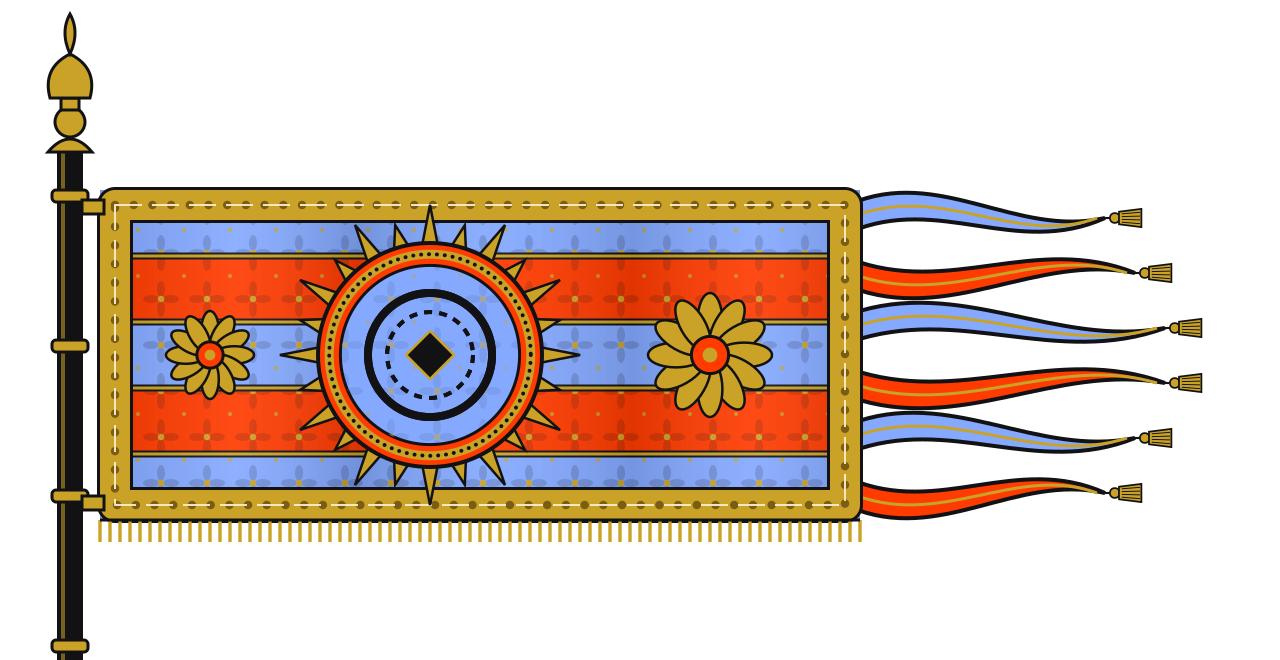
6. Flags
Every clan has every flag type; the type says the occasion and the colours say the clan. The outlined card is the flag the Atlas assigns.
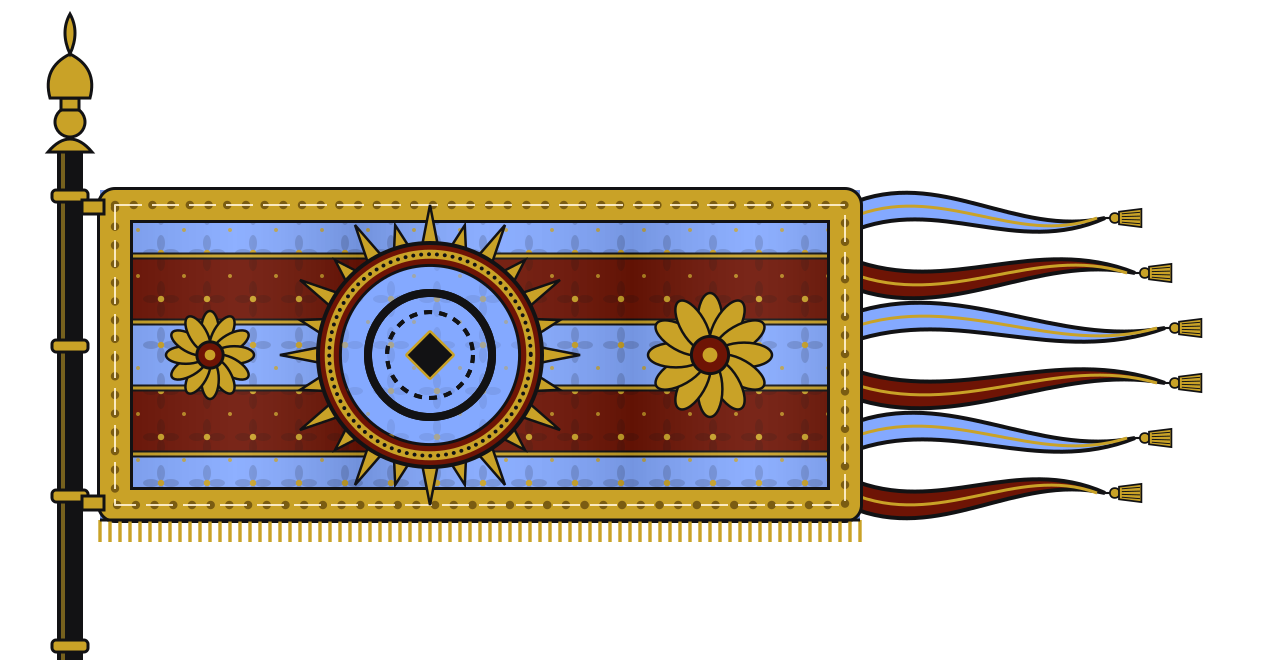
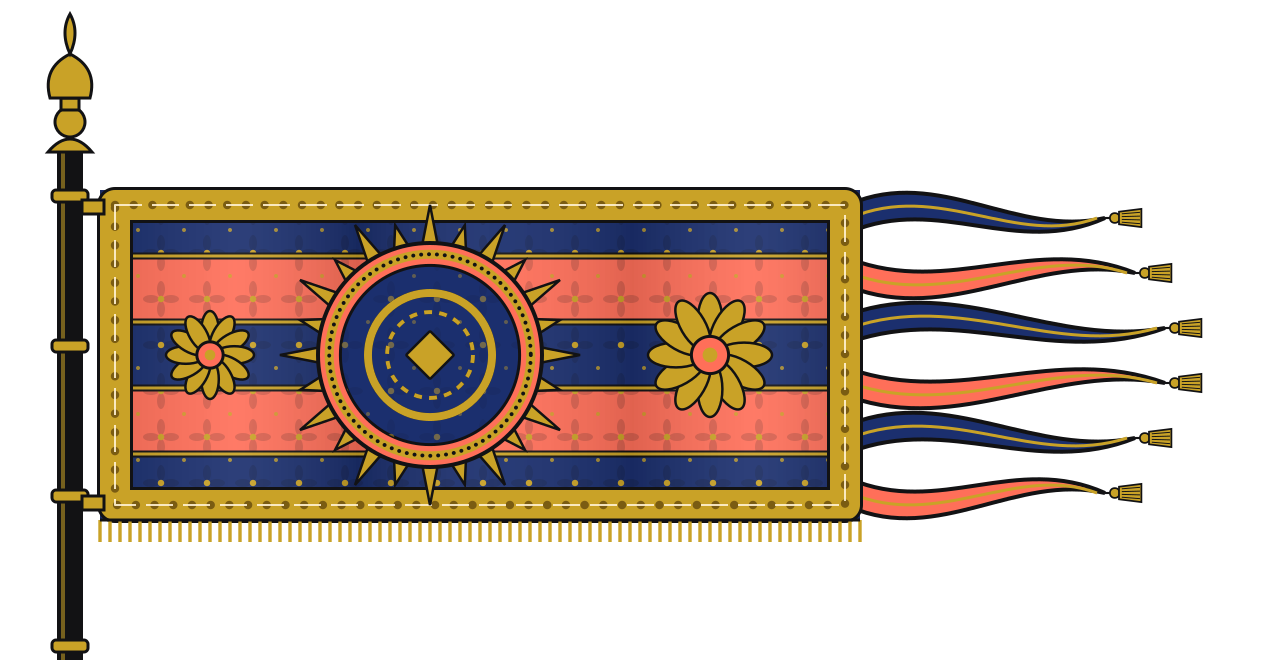
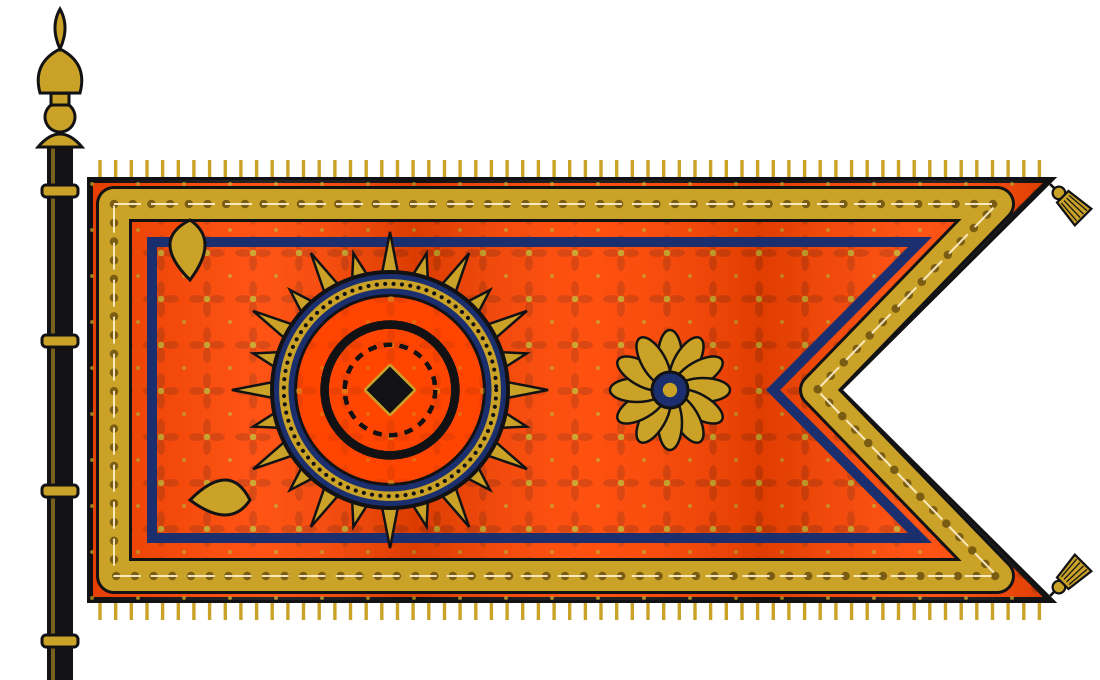
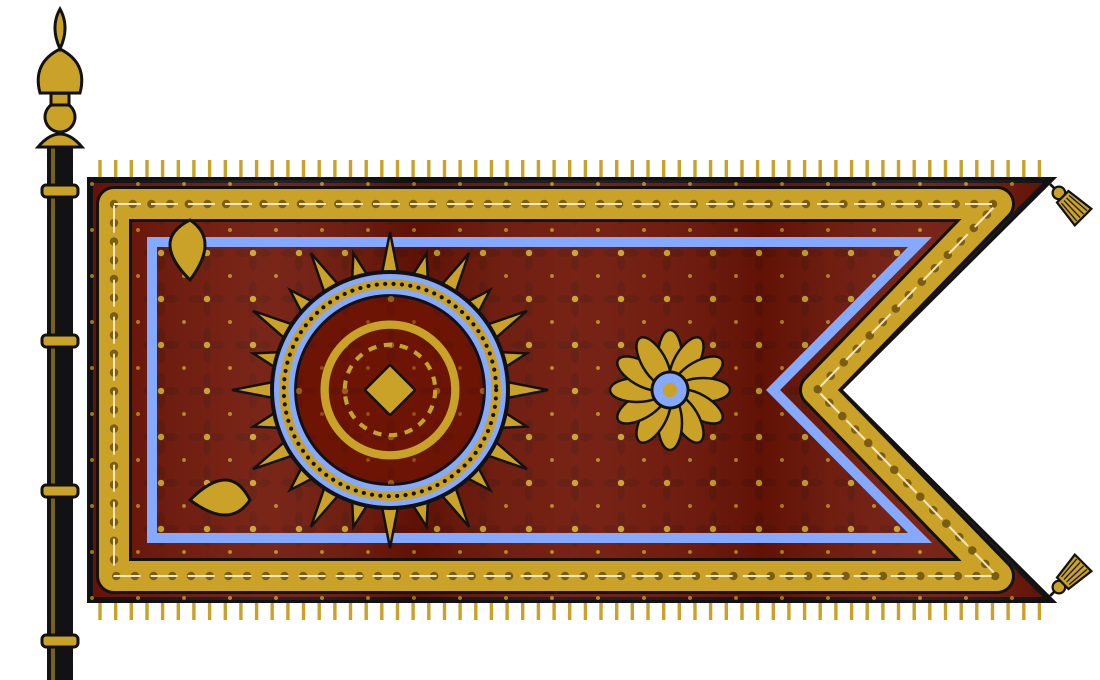
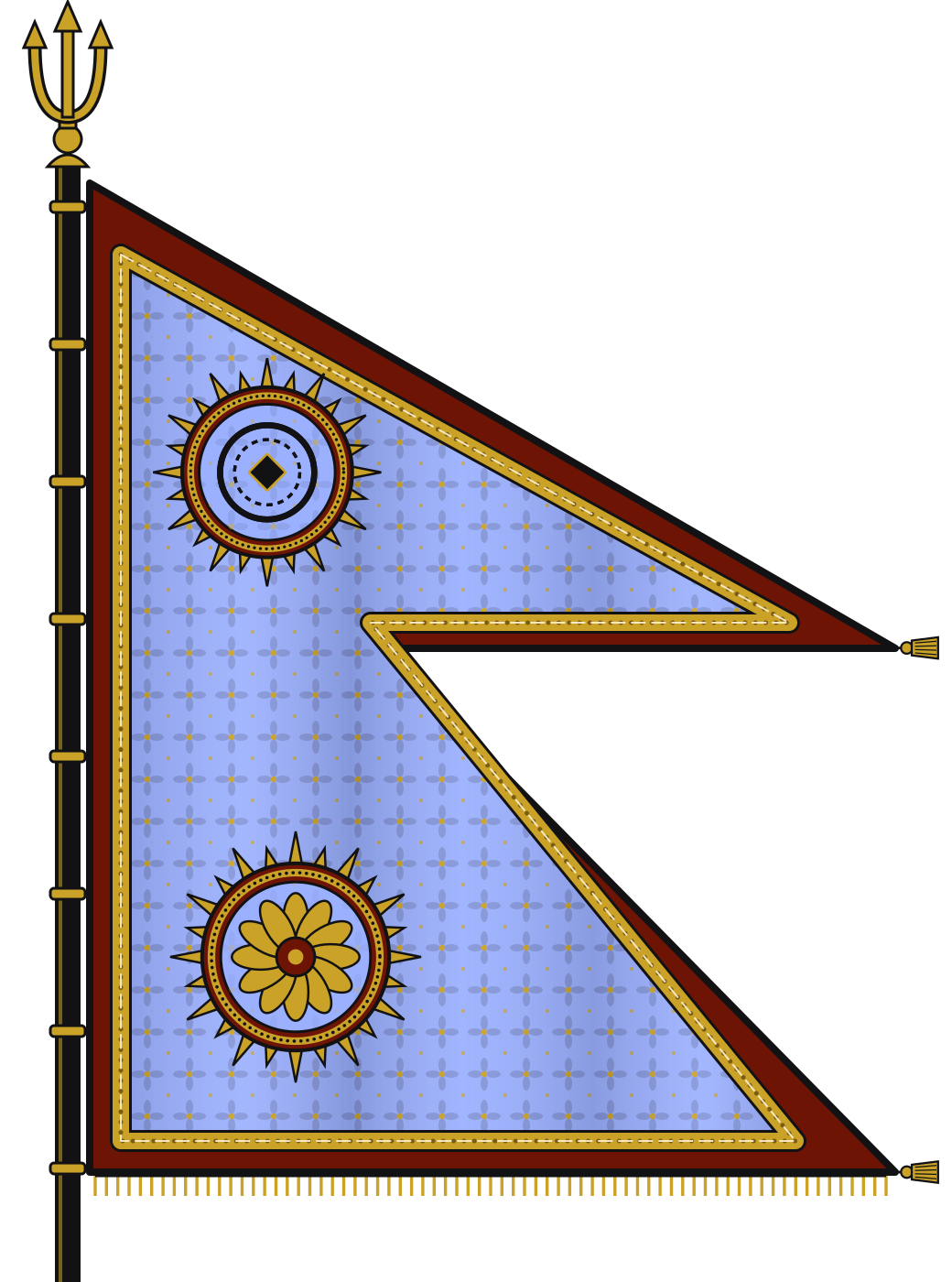
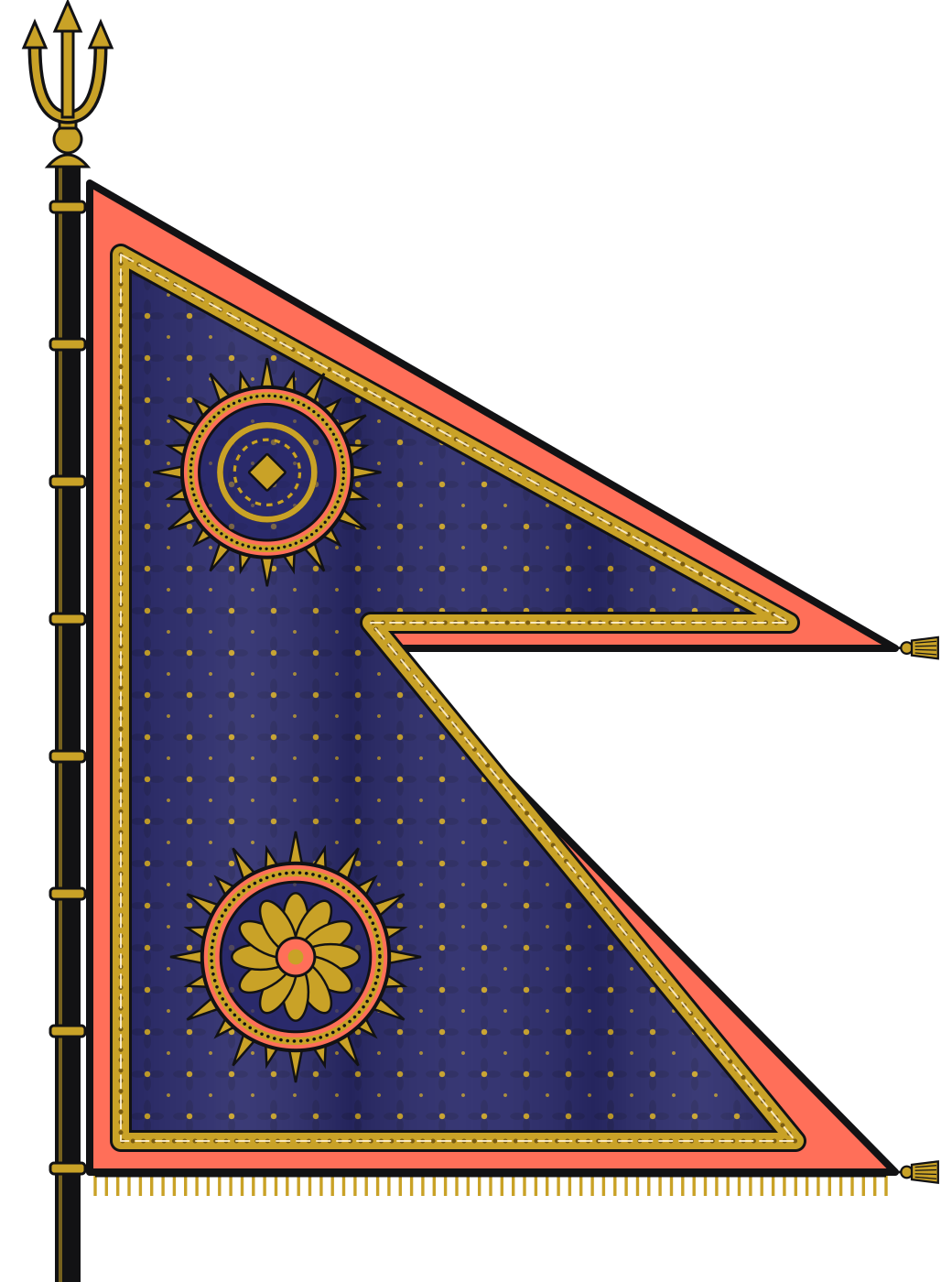

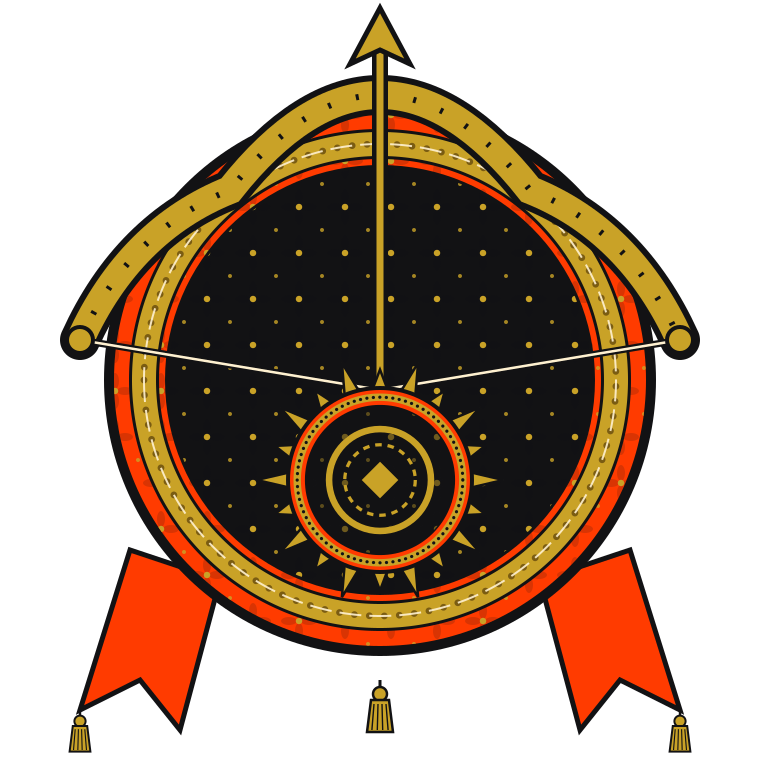
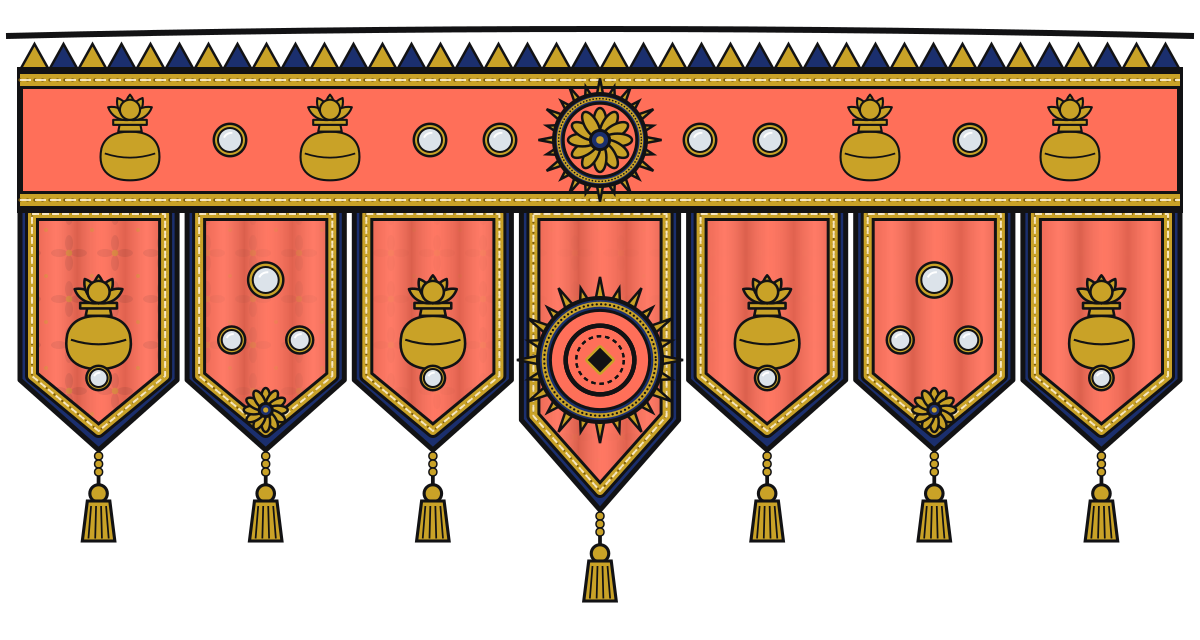
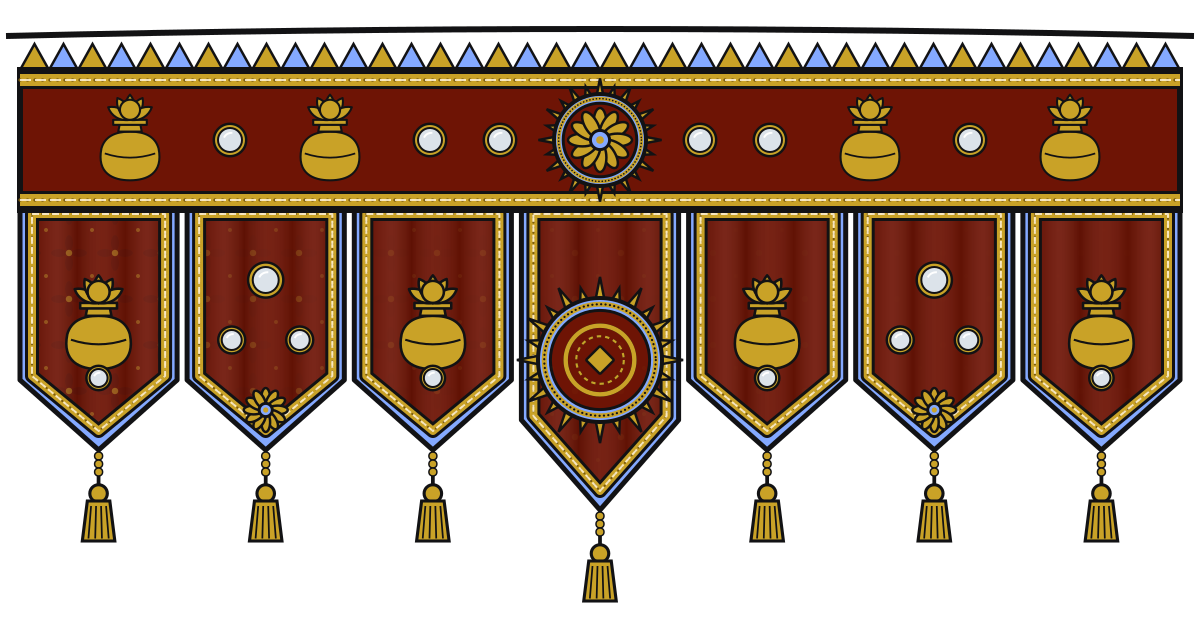

Historic banner
A seven-colour flag representing the seven Meitei clans (salai) is widely used as a Meitei flag
New flag types
| Accessory | For this clan | Basis |
|---|---|---|
| A9 Pota-dhvaja · ship and trade flag For ships, caravans and markets | Not yet designed for this clan | Design |
| A10 Utsava-patāka · festival flag Light, bright flag for fairs and festivals | Not yet designed for this clan | Design |
| A11 Shoka-dhvaja · mourning flag White cloth with the emblem outline in the clan's metal | Not yet designed for this clan | Design |
7. Regalia
| Accessory | For this clan | Basis |
|---|---|---|
| E1 Chhatra · house parasol The ceremonial umbrella | Not yet designed for this clan | Design |
| E2 Chamara · fly-whisks The pair of whisks beside the head of the house | Not yet designed for this clan | Design |
| E3 Danda · staff of office Staff or scepter | Not yet designed for this clan | Design |
| E4 Simhasana · seat The seat of the house, covered in clan cloth | Not yet designed for this clan | Design |
| E5 Khetaka · shield A round shield; the Changi and Dhanush are its flag forms | Not yet designed for this clan | Regional tradition |
| E6 Kula-ayudha · clan weapon The weapon the clan honours | Seven clan swords, one for each Yek Salai clan: Chak Thaang (Ningthouja), Tondumba (Luwang), Tonkakpa (Khuman), Pukak Thaang (Angom), Yenbaa Matok Saaba (Moirang), Laithaang Chinaaiba (Kha Nganpa), Khunthong Thaang (Sarang Leishangthem) ꯆꯛꯊꯥꯡ · ꯇꯣꯟꯗꯨꯝꯕ · ꯇꯣꯟꯀꯛꯄ · ꯄꯨꯀꯛ ꯊꯥꯡ · ꯌꯦꯟꯕꯥ ꯃꯇꯣꯛ ꯁꯥꯕ · ꯂꯥꯏꯊꯥꯡ ꯆꯤꯅꯥꯏꯕ · ꯈꯨꯟꯊꯣꯡ ꯊꯥꯡ The clan swords as the weapons page lists them, in the Meetei Mayek forms it prints[22] | Documented |
8. Worn
| Accessory | For this clan | Basis |
|---|---|---|
| F1 Kula-vastra · clan cloth The clan's woven pattern in its kit colours | Not yet designed for this clan | Design |
| F2 Kirti-vastra · honour cloth A cloth earned for a deed, not inherited | Not yet designed for this clan | Design |
| F3 Kula-mala · garland flower The flower or leaf the clan wears as a garland | Not yet found for this clan | Under research |
| F4 Chinha · house pin A metal badge with the pin emblem | Not yet designed for this clan | Design |
9. Records
| Accessory | For this clan | Basis |
|---|---|---|
| H1 Clan words A traditional line in the native script | ꯂꯣꯌꯨꯝꯄ ꯁꯤꯟꯌꯦꯟ · “Loyumba Shinyen (title as printed; no translation in the extracts)” Title of the people's constitutional text, dated 1100 CE by the people's page[1] | Documented |
| H2 Biruda · titles The house's title or titles | Not yet found for this clan | Under research |
| H3 Prashasti · praise genealogy The lineage as written at the head of a grant | Not yet found for this clan | Under research |
| H4 Vahi · clan register The book of the clan's births, marriages and deaths | Not yet found for this clan | Under research |
| H5 Rana-ghosha · war cry The clan's cry in battle or celebration | Not yet found for this clan | Under research |
10. VishwaVit · knower of the world
Game values are design choices for this project, not historical claims.
References
- Wikipedia, Meitei people, read 2026-11-08, https://en.wikipedia.org/wiki/Meitei_people
- Wikipedia, Cheitharol Kumbaba, read 2026-11-08, https://en.wikipedia.org/wiki/Cheitharol_Kumbaba
- Wikipedia, Meitei confederacy, read 2026-10-27, https://en.wikipedia.org/wiki/Meitei_confederacy
- Wikipedia, Pakhangba, read 2026-11-08, https://en.wikipedia.org/wiki/P%C4%81khangb%C4%81
- Sanamahism, Wikipedia (read 4 Nov 2026, KulDevi clan check).
- Meitei festivals, Wikipedia (read 31 Oct 2026, KulDevi run 374).
- Wikipedia, Meitei dragons, read 2026-11-08, https://en.wikipedia.org/wiki/Meitei_dragons
- Wikipedia, List of deities in Sanamahism, read 2026-10-22, https://en.wikipedia.org/wiki/List_of_deities_in_Sanamahism
- "Meitei deities", Wikipedia (English), read 10 October 2026.
- Simple Wikipedia, Temples of Meitei religion, read 2026-10-09, https://simple.wikipedia.com/wiki/Temples_of_Meitei_religion
- T. C. Hodson, Meithei Literature, Folk-Lore vol. 23 (1912; read to the Society 20 Dec 1911), via Wikisource mirror (2022-09), read 2026-11-08, https://kwx.liehendr.com/content/wikisource_en_all_maxi_2022-09/A/Folk-Lore/Volume_23/Meithei_Literature
- Wikipedia, Meitei inscriptions, read 2026-11-08, https://en.wikipedia.org/wiki/Meitei_inscriptions
- Wikipedia on IPFS mirror, Puya (Meitei texts), read 2026-11-08, https://ipfs.ssi.eecc.de/ipns/en.wikipedia-on-ipfs.org/wiki/Puya_(Meitei_texts)
- Antrocom 18(2), 2022, Lai thang: a product of the culmination of Meitei religion, technology and its environment, read 2026-11-06, antrocom.net
- Wikipedia, Meitei martial arts, read 2026-11-07, en.wikipedia.org
- Wikipedia, Meitei traditional games, read 2026-10-10, link
- Wikipedia, Yumnak, read 2026-11-08, https://en.wikipedia.org/wiki/Yumnak
- Morung Express, Ima Keithel: Manipur's empowerment struggle and identity, read 2026-10-31, https://morungexpress.com/ima-keithel-manipurs-empowerment-struggle-identity
- Wikipedia mirror (ipfs.aleph.im), Manipuri surnames, read 2026-11-08, https://ipfs.aleph.im/ipfs/QmXoypizjW3WknFiJnKLwHCnL72vedxjQkDDP1mXWo6uco/wiki/Manipuri_surnames.html
- Wikipedia, Meitei ritual songs, read 2026-11-02, https://en.wikipedia.org/wiki/Meitei_ritual_songs
- Wikipedia, Ancient Meitei hymns, read 2026-10-09, https://en.wikipedia.org/wiki/Ancient_Meitei_hymns
- Wikipedia, Meitei traditional weapons, read 2026-10-30, en.wikipedia.org