The Mauryas were the imperial dynasty of Magadha, ruling from Pataliputra c. 321–185 BCE[1]. Chandragupta took Magadha after the Nanda–Mauryan war, and Ashoka (c. 268–232 BCE) turned to Buddhism after the Kalinga war of 261 BCE[1][2]. His edicts run from Lumbini and Nigali Sagar in Nepal to Kandahar in Afghanistan[2]. The Sarnath lion capital became the State Emblem of India[1]. No source in the extracts shows a living community descended from the Mauryan kings; the caste claims that exist are disputed[3].
01Faith and deities
No deity of the Mauryan house is named in the extracts, and the Atlas gives no KulDevi (basis: Research). The rulers' faiths were Brahmanical (Chandragupta, per Megasthenes), Jain (later Chandragupta, by tradition), Buddhist (Ashoka) and Ajivika (Bindusara's guru; Dasharatha)[1][5]
No KulDevi has been found for this clan yet; it is on the research list.
| Deity or tradition | Place in the clan's life | Evidence |
|---|---|---|
| Brahmanical rites | Chandragupta's rites, as Megasthenes describes them | [1] |
| Jain tradition | A 12th-century Jain text has a Jain monk, "may be great-grandson" of Chandragupta, die by santhara at Shravana Belgola; partly legend | [1][5] |
| Buddhism | Ashoka took up Buddhism after the Kalinga war; his edicts name the Buddhas Shakyamuni, Konagamana and Kanakamuni | [2] |
| Ajivikas | Bindusara's guru Pingalavatsa; Dasharatha gave the Nagarjuni caves to the Ajivikas | [1][4] |
02Temples
The extracts show Buddhist and Ajivika shrines under the Mauryas; no Brahmanical temple built by the house is sourced.
Built by the clan
| Temple | Deity | Built by | When | Where |
|---|---|---|---|---|
| Sudama cave, Barabar Hills | Rock-cut cave (sect not named in the extracts) | Under research (inscribed with Ashoka's 12th regnal year) | Ashoka's reign | Barabar Caves[6] |
| Stupas at Sanchi and Sarnath | Buddhist stupa (not a temple) | Began as brick mounds under Ashoka, possibly | Ashoka's reign | Sanchi; Sarnath[6] |
Given patronage or grants by the clan
| Temple | Deity | What the clan gave | When | Where |
|---|---|---|---|---|
| Bodhimandala altar, Bodh Gaya | Buddhist | An altar on four pillars | Under research | Bodh Gaya[6] |
| Bairat temple | Buddhist (no deity named) | A rock edict (Minor Rock Edict 3) beside it lists Buddhist texts | Ashoka's reign | Bairat[2] |
| Lumbini | Buddha Shakyamuni, born here (pillar inscription) | A pillar; the village made tax-free | Ashoka's 20th–21st regnal year | Lumbini[2][7] |
| Nagarjuni caves | Ajivika | Caves given by Dasharatha | Dasharatha's reign (232–224 BCE) | Nagarjuni Hills[4] |
Later temples in the clan's lands
| Temple | Deity | Built | Where |
|---|---|---|---|
| Durakhi Devi temple, Kumhrar | Durukhi (double-faced) | Under research | Kumhrar[8] |
| Arogya Vihar, Kumhrar | Said to be headed by Dhanvantari | Under research | Kumhrar[8] |
03Languages and scripts
| Language or script | Kind | Under the clan | Evidence |
|---|---|---|---|
| Magadhi Prakrit lost | Vernacular of the empire; most edicts | The Mauryan court and edicts | [1][2] |
| Brahmi lost | Script (centre and east) | Edicts; deciphered by Prinsep in 1838; extinct c. 5th century CE | [1][2] |
| Kharoshthi lost | Script (north-west) | Edicts in Prakrit in the north-west; extinct c. 5th century CE | [2] |
| Greek | Language | Two edicts in Greek; Kandahar Greek | [1] |
| Aramaic | Language | Edict in Aramaic | [1] |
| Magahi living | Descendant of Magadhi Prakrit (with Maithili and Bhojpuri) | Spoken in the Magadha region today | [9] |
04Books and literature
The Mudrarakshasa, a play by Vishakhadatta (4th–8th century CE), is fictional and later. The Arthashastra and Megasthenes' Indica are named in the extracts; the Indica survives only in later quotations.
Written in the clan's lands during its era
| Work | Author | Kind | When | Link to the clan |
|---|---|---|---|---|
| Arthashastra | Attributed to Kautilya; now several authors | Statecraft (fifteen books) | Attributed to Kautilya; the surviving text is later (Olivelle's layers, 175–300 CE) | [10][11] |
| Edicts of Ashoka | Ashoka | Rock, pillar and cave inscriptions in Prakrit, Greek and Aramaic | 3rd century BCE | [2] |
| Indica (lost; quoted later) | Megasthenes | Greek account of India | c. 350–c. 290 BCE | [12][1] |
Given patronage by the clan
| Work | Author | What the clan gave | When | Evidence |
|---|---|---|---|---|
| Buddhist texts named in Minor Rock Edict 3 | Ashoka (edict) | A rock edict beside the Bairat temple lists texts: the Excellence of the Discipline, the Question of Upatissa, and an admonition to Rahula | Ashoka's reign | [2] |
05Thinkers and scholars
| Name | Field | Era | Contribution |
|---|---|---|---|
| Kautilya / Chanakya legend | Statecraft | 4th–3rd century BCE (infobox) | The Arthashastra is attributed to him; the identity is disputed[10] |
| Megasthenes | Greek writer on India | c. 350–c. 290 BCE | Indica, known from later quotations[1] |
| Pushyagupta | Provincial governor and builder | Under Chandragupta | Built the Sudarshana lake at Girinagara, per the Junagadh inscription[13] |
The Zawar zinc evidence is under Art and architecture, as a craft.
06Art and architecture
Mauryan art is known from pillars, caves, sculpture and coins; the pillars carry the edicts[6].
Painting and wall art
Not recorded.
Sculpture and temple art
| Art form | What it is | Era | Evidence |
|---|---|---|---|
| Lion capital, Sarnath | Four lions back to back on an abacus with four wheels and a lion, elephant, bull and horse; one block of polished sandstone, c. 250 BCE; in the Sarnath Museum | [14] | |
| Pillar capitals | Rampurva bull; Lauriya Nandangarh lion; Dhauli elephant (possibly local craftsmen); Pataliputra capital | [6] | |
| Popular figures | Besnagar female figure; Parkham male figure; terracotta mother-goddess figures | [6] |
Temple and building architecture
| Art form | What it is | Era | Evidence |
|---|---|---|---|
| Pataliputra palace and walls | Mostly timber; a hall of 80 pillars c. 7 m; wooden walls with 64 gates and 570 towers (Megasthenes) | [1][6] | |
| Kumhrar hall | Eight rows of ten pillars, 9.75 m tall (2.74 m below ground); probably an open-air hall with a wooden roof, outside the walls | [8] | |
| Barabar Caves | Rock-cut chaitya halls; the Lomas Rishi facade echoes wooden forms; Sudama cave inscribed with Ashoka's 12th regnal year | [6] |
Weaving and textiles
Not recorded.
Clothing and jewellery
Not recorded.
Coins, pottery and crafts
| Art form | What it is | Era | Evidence |
|---|---|---|---|
| Zinc oxide at Zawar research | Mauryan-era production, late 1st millennium BCE, with no retorts; the excavator says it is the only such site excavated (an obituary's assertion) | [15] | |
| Ringstones | About 70 known; a 2014 find in Thailand was the first outside the subcontinent | [6] |
07History
c. 321 BCE: Chandragupta takes Magadha
Chandragupta took Magadha c. 321–320 BCE, after the Nanda–Mauryan war dated c. 321 BCE (other accounts give 322–305)[1][5]. Greek sources call him Sandrokottos[1]. A legend has him meet Alexander and flee; the page calls it a legend, and the Helena marriage story unsupported[5].
A legend makes Chanakya his mentor, after Dhana Nanda insulted Chanakya; the narratives are legendary accounts dated 4th–11th century CE[10]. The Arthashastra is attributed to Kautilya, whom some identify with Chanakya; scholars now see several authors[10][11].
c. 303–301 BCE: Seleucus and the war elephants
Seleucus I fought Chandragupta in 303–302 BCE and a marriage alliance followed c. 302[1]. Seleucus ceded Gandhara, Paropamisadae and eastern Gedrosia, and possibly Arachosia and Aria, and received 500 war elephants (Ipsus, 301 BCE)[1].
Pliny gives the Mauryan army 9,000 elephants[5].
c. 298–232 BCE: Bindusara and Ashoka
Bindusara ruled 298–272 BCE; Greek sources call him Amitrochates, and his guru is named as Pingalavatsa, an Ajivika[1].
Ashoka (c. 268–232 BCE; accession also given as 269 or 273 BCE) commanded at Ujjain and Taxila before he ruled[1][2][4]. Remorse after the Kalinga war (261 BCE; 262–261 in other accounts), in his eighth regnal year, began a gradual conversion to Buddhism[1][2]. The Maski inscription, found in 1915, confirms that Devanampiya is Ashoka[2].
The Mahavamsa has missionaries sent in his 17th year to eight regions and to the country of the Yonas[2]. Missions went to Sri Lanka (Mahinda and Sanghamitta), West Asia, Greece and Southeast Asia, and tradition credits him with 84,000 stupas[1].
After 232 BCE: the succession and the end
The Hindi list on Bharatdiscovery gives Dasharatha 232–224 BCE, Samprati 224–215, Shalishuka 215–202, Devavarman 202–195, Shatadhanvan 195–187 and Brihadratha 187–185 BCE; it says Kashmir and Gandhara became independent after Ashoka[4].
Brihadratha was killed by Pushyamitra, the army commander, at a military parade, in 185 BCE (the Maurya page also gives 184 and 180)[1][4]. Tamil Sangam literature describes a Mauryan invasion, and the Hathigumpha's "Muriya Kala" is disputed[1]. Poem 175 of the Tamil Purananuru mentions the Mauryas; the anthology is dated 1st century BCE to 5th century CE[16].
Pataliputra and Kumhrar
The palace at Pataliputra was mostly timber, and Megasthenes describes the city ringed by a wooden wall with 64 gates and 570 towers[1][6]. The Kumhrar excavations, begun in 1913, found Mauryan-period remains dated 322–185 BCE and an 80-pillar hall[8].
08Journey and migrations
The empire grew from Magadha into the north-west, and its edicts were cut at places from Nepal to Kandahar.
| When | From | To | Why | Evidence |
|---|---|---|---|---|
| c. 321 BCE | — | Magadha | Chandragupta takes Magadha after the Nanda–Mauryan war | [1] |
| c. 303–301 BCE | Seleucid lands | Gandhara, Paropamisadae, Gedrosia | Treaty with Seleucus I; 500 war elephants | [1] |
| c. 261 BCE | — | Kalinga | Kalinga war; remorse, then turn to Buddhism | [1][2] |
| c. 268–232 BCE | — | Lumbini | Ashoka visits in his 20th or 21st regnal year; the village is made tax-free | [2] |
| c. 250 BCE | — | Sarnath | Lion capital erected, marking the Buddha's first sermon | [14] |
09Seats and lands
| Place | Role | Where today |
|---|---|---|
| Pataliputra (Patna) | Capital; timber palace; the 80-pillar hall is at Kumhrar, outside it | Bihar (Patna)[8] |
| Magadha | Core of the empire; Patna and Gaya districts | Bihar[9] |
| Tosali, Ujjain, Suvarnagiri, Taxila | Provincial seats under kumaras | Under research |
| Edict and pillar sites | Lumbini, Nigali Sagar, Maski, Gujarra, Kandahar, Taxila, Laghman, Sarnath, Sanchi, Sasaram, Yerragudi, Bairat, Ahraura, Bodh Gaya. The edicts are found across India, Bangladesh, Nepal, Afghanistan and Pakistan | Nepal (Nigali Sagar); Afghanistan (Kandahar); Karnataka (Maski); Madhya Pradesh (Gujarra)[2] |
10Notable figures
| Name | Role | Era | Known from |
|---|---|---|---|
| Chandragupta Maurya | Founder; took Magadha | c. 321–c. 297 BCE | [5][1] |
| Bindusara | King; Greek name Amitrochates | 298–272 BCE | [1] |
| Ashoka (Devanampiya Piyadasi) | King; edicts and Dhamma | c. 268–232 BCE | [2][1] |
| Dasharatha | King; gave the Nagarjuni caves to the Ajivikas | 232–224 BCE | [4] |
| Samprati | King in the successor list | 224–215 BCE | [4] |
| Brihadratha | Last king in the list; killed by Pushyamitra | 187–185 BCE | [1][4] |
| Pushyamitra (Shunga) | Army commander who killed Brihadratha | c. 185 BCE | [4][1] |
| Kunala | Named in the Puranas; in the Divyavadana as Dharmavivardhana (Hindi source) | Under research | [4] |
| Mahinda (महेन्द्र) and Sanghamitta (संघमित्रा) | Missionaries sent by Ashoka to Sri Lanka | Ashoka's reign | [4][1] |
| Rakkhita | Buddhist monk sent by Ashoka; reached the Banavasi region, per the Mahavamsa | Ashoka's reign | [17] |
| Tushaspha | Yavana king who added conduits to the Sudarshana lake under Ashoka | Ashoka's reign | [13] |
| Pushyagupta | Vaishya provincial governor who built the Sudarshana lake at Girinagara | Under Chandragupta | [13] |
| Chanakya (Kautilya, Vishnugupta) legend | Mentor in legend; the Arthashastra is attributed to him | 4th–3rd century BCE (infobox); legend dates later | [10] |
| Mura legend | Mother of Chandragupta, by legend; the page calls it unlikely | Legend | [5] |
| Megasthenes | Greek writer; Indica (lost, quoted later) | c. 350–c. 290 BCE | [12][1] |
| Seleucus I | Seleucid ruler; treaty with Chandragupta | 303–301 BCE | [1] |
| Bhadrabahu legend | Jain saint linked with Chandragupta's later life (Karnataka inscriptions) | Under research | [5] |
11Allies, rivals and marriages
| People | Relationship | When |
|---|---|---|
| Nandas | Rivals; Chandragupta's Nanda–Mauryan war | c. 321 BCE |
| Seleucid empire (Seleucus I) | War, then a treaty: territory ceded for 500 war elephants | 303–301 BCE |
| Yavanas (Greeks) | Rock Edict 13 names Antiochus II, Ptolemy II, Antigonus II, Magas and Alexander II of Epirus; the page questions whether the missions were received | Ashoka's reign |
| Kalingas | Conquered in the Kalinga war (261 BCE) | c. 261 BCE |
| Andhras | Named in Rock Edicts 2 and 13; Megasthenes places them second in military strength | Ashoka's reign |
| Cholas, Pandyas, Satiyaputras, Keralaputras | Peoples named in Rock Edicts 2 and 13 as beyond the empire | Ashoka's reign |
| Gandharas, Kambojas, Bhojas, Pitinikas, Nabhakas | Peoples named in Rock Edicts 2 and 13 | Ashoka's reign |
| Sinhalese (Sri Lanka) | Receive Ashoka's missions (Mahinda and Sanghamitta) | Ashoka's reign |
| Shungas | Pushyamitra Shunga killed Brihadratha, the last Maurya | 185 BCE |
| Ajivikas | Bindusara's guru Pingalavatsa; Dasharatha's gift of caves | 298–224 BCE |
12Society and livelihood
The empire was run from Pataliputra, with provincial seats under kumaras and a body of named officers.
Government and social order
| Institution or group | What it was | Evidence |
|---|---|---|
| Pataliputra council | Six boards of five officials in the city, per Megasthenes | [1][5] |
| Kumaras of the four provincial seats | Tosali, Ujjain, Suvarnagiri and Taxila | [1] |
| Gramika and Nagarika | Named officers; their duties are not given in the extract | [1] |
| Mahamatras for Dharma | Appointed in the 13th regnal year | [2] |
| Gajadhyaksha | The sixth of the Mauryan war boards, for elephants, under a Gajadhyaksha | [18] |
| Army (Megasthenes) | 600,000 infantry, 30,000 cavalry, 8,000 chariots, 9,000 elephants | [1] |
Livelihood over time
| Era | Livelihood | Evidence |
|---|---|---|
| Mauryan era | Irrigation: the Sudarshana lake at Girinagara, built under Chandragupta; irrigation taxes were collected (Thapar 2004, p. 187, via Wikipedia) | [19] |
| Arthashastra (date disputed) | Forest revenue from elephant forests; the Arthashastra's reward of 4.5 panas for the tusks of an elephant that died naturally | [20] |
| Ashoka's reign | Wells every eight kos, roadside trees and medical treatment for men and cattle (Rock Edict 2; Pillar Edict 7) | [2] |
13Sub-clans and related clans
The sources name the Mauryas' parent, successor and claimed relatives. None is documented as a sub-clan of the Mauryan house.
| Clan | Relation | Where | Size | In the Atlas | Evidence |
|---|---|---|---|---|---|
| Magadhas | Parent people | Magadha | ANC-075 | The Mauryas ruled Magadha as one of its dynasties[9] | |
| Nandas | Dynasty from this clan | Magadha | same name as ANC-179: check | Nanda rule c. 345–321 BCE, before the Mauryas[9] | |
| Shungas | Dynasty from this clan | Magadha | ANC-159 | Pushyamitra Shunga killed Brihadratha, the last Maurya[1] | |
| Moriyas | Related people | Uttar Pradesh, Bihar | ANC-082 | Claimed ancestors of Chandragupta Maurya, per the Atlas; no source in the extracts | |
| Koeri | Related people | Bihar; Nepal | same name as SUB-119: check | Descent to Ashoka claimed in the 2010s; not confirmed[3] | |
| Kushwaha | Related people | Uttar Pradesh, Bihar | same name as SUB-120: check | The Maurya surname is mainly used by the Kushwaha caste[21] | |
| Murao | Related people | Bihar | same name as SUB-123: check | Sub-caste of Koeri[3] | |
| Kachhvaha | Related people | same name as SUB-118: check | Related horticultural community named with Koeri[3] | ||
| Kachhi | Related people | same name as SUB-117: check | Related horticultural community named with Koeri[3] | ||
| Mahto | Related people | same name as SUB-121: check | Similar caste that increasingly intermarries (Patel 1997, via Koeri page)[3] | ||
| Saini | Related people | same name as SUB-126: check | Similar caste that increasingly intermarries (Patel 1997, via Koeri page)[3] | ||
| Shakyas | Related people | ANC-120 | Similar caste named with Koeri (Patel 1997)[3] |
Clans marked "new clan candidate" are not in the Atlas yet.
14Surnames
Surnames are listed without counts: the sources give no count with a year for any of them.
| Surname | Clan or sub-clan | Where | People with this surname | Also used by other communities |
|---|---|---|---|---|
| Maurya | Kushwaha caste | Uttar Pradesh and Bihar | not yet counted | Yes |
| Kushwaha | Kushwaha caste; Koeri names | Bihar and Uttar Pradesh | not yet counted | Yes |
| Koeri (Koiry, Koiri) | Koeri | Bihar; Nepal | not yet counted | Yes |
Counts are of everyone with the surname, from the cited source and year, not only members of this clan. A surname shared with other communities says nothing about any one person's origin.
15Songs and music
No Mauryan song, ballad or lullaby is in the extracts.
None recorded yet.
16Poems, lullabies and children's rhymes
None recorded yet.
17Stories, legends and proverbs
Stories and legends
| Story | What happens | Told by | Evidence |
|---|---|---|---|
| Mura and the peacock-tamer legend | Chandragupta's mother Mura gives the name Maurya; he is a peacock-tamer's son, related to the Nandas | Traditions; the page calls the Mura legend unlikely | [5] |
| Chanakya and Dhana Nanda legend | Dhana Nanda insults Chanakya; Kautilya is said to have found Chandragupta as a boy | Legendary accounts dated 4th–11th century CE | [10][5] |
| Chandragupta and Alexander legend | Chandragupta meets Alexander and flees (Justin, Plutarch); some say he met Dhana Nanda instead | Classical writers | [5] |
| Ashoka buys back Jambudvipa legend | Ashoka gives all Jambudvipa to the priests and buys it back three times; a lion pillar stands at Ni-li | Fa Hian, c. 400 CE | [2] |
| Ashoka's 84,000 stupas legend | Tradition 'believes' Ashoka built 84,000 stupas | Tradition | [1] |
Proverbs and sayings
Not recorded.
18Festivals and fairs
| Festival or fair | When | Where | What happens |
|---|---|---|---|
| Festival gatherings | Ashoka's reign | The empire | Rock Edict 1 forbids harmful festival gatherings and praises some as meritorious[2] |
19Food, dress and games
Food
Not recorded.
Dress
Not recorded.
Games and martial arts
Not recorded.
Tags: living still practised · revived brought back after a break · lost known only from records · research reported but not yet confirmed from a source. Songs and poems under copyright are listed by title only; restricted or sacred material is noted without its content.
20Status today
The Mauryan empire ended in 185 BCE[1]. No source in the extracts shows a living community descended from the Mauryan kings; the descent claims that exist are caste-body and political claims[3].
Who carries the name today
| Community | Link | Basis | Evidence |
|---|---|---|---|
| Koeri (Bihar caste community) | Disputed | Attempts to trace Koeri lineage to Ashoka were backed by the BJP and JD(U) in the 2010s; Ganga Prasad Gupta claimed descent from Kusha. No source in the extract confirms the claim[3] | |
| Kushwaha caste (Maurya surname users) | Under research | Descent is not established; the surname page says bearers may or may not be associated with the caste[21] |
Recognised heritage
| What | Recognition | Evidence |
|---|---|---|
| Lion Capital of Ashoka, Sarnath | State Emblem of India; the flag's central wheel is based on the abacus wheel (Constituent Assembly flag resolution, 11 December 1947) | [14][1] |
Not yet reviewed by a community. The Koeri and Kushwaha claims are set out here for the community's own review.
21For children
The king who said sorry
Long ago, a king named Ashoka ruled a very large land from the city of Pataliputra. After a great battle in Kalinga, he felt deep sorrow for the people who had been hurt. He chose kindness instead, and he had his words carved on tall stone pillars so that people could read them. One pillar stands at Lumbini, where the Buddha was born. Another pillar at Sarnath has four lions on its top. Today that lion carving is the State Emblem of India.
Written for this project
Riddle: Four lions stand back to back on top of a pillar at Sarnath. Who had kind words carved on the pillar they crown? (King Ashoka)
22Across the project
| Project | What carries this clan | Status |
|---|---|---|
| Atlas of the Janas | Pin at Pataliputra (ANC-157), era c. 321–185 BCE; area not yet drawn from the extracts | To check |
| KulDevi and GrahDevi | KulDevi blank in the Atlas (basis: Research); see Faith and learning | From the Atlas |
| Planet naming | Not yet checked against the Tier registers | To check |
| Renaming and waters | Sudarshana lake at Girinagara, built under Chandragupta (see the Saurashtras codex) | To check |
23Open questions
- Clan's own words: the extracts give edict lines only in English and transliteration. Find the Brahmi text of Pillar Edict 2 ('Dharma is good') and Rock Edict 13 for the words block; until then the words block is illustrative.
- Main deity: the Atlas's KulDevi is blank (basis: Research). Decide whether the main deity stays 'Under research' or the KulDevi is set.
- Caste of Chandragupta: the Buddhist texts and medieval inscriptions say Kshatriya; some scholars think commoner (Sharma, Tripathi); Justin hints at humble origin. Set out both sides when sourced.
- Peacock emblem: no fetched source confirms it as a Mauryan emblem.
- Second image in the Atlas repeats the Magadhas' 'historic banner' note (approver's note, 2026-10-10); the approver to decide.
- Modern states and countries: sourced are Nepal (Nigali Sagar, Lumbini), Afghanistan (Kandahar, Laghman), Karnataka (Maski) and Madhya Pradesh (Gujarra). Pakistan and Bangladesh are named only in the general statement on the edicts.
- Dates: Ashoka's accession (268, 269 or 273 BCE) and the end of the dynasty (185, 184 or 180 BCE) differ across sources; the page gives the range.
- Not yet read: Kalinga war casualty figures, the Sangam invasion detail, the causes of the decline (Thapar), the Mudrarakshasa, and the Chanakya Niti.
- Population of Mauryan descendants and any surname counts with a year: none in the extracts.
- Kautilya gotra (contradiction): the Arthashastra's author is named Kautilya, a gotra name[10]. The clans table listed it as a sub-clan of the Mauryas, but the clans intro says none is documented as one. The row was removed; the approver to decide whether it belongs anywhere.
- 80-pillar hall (contradiction): the Maurya page places a hall of 80 pillars, c. 7 m, inside the Pataliputra palace[1]. The Kumhrar page gives 8 rows of 10 pillars, 9.75 m tall, c. 350 m south of the palisades, 'probably a pleasure hall outside the walls, not a palace'[8]. Both are on the page (Pataliputra palace row, Kumhrar row); the approver to choose.
24Astitva
अस्तित्व · being, existence: everything by which the clan is known
The Mauryan coins, pillars and titles are the documented accessories; the coins were mostly silver punch-marked pieces[6].
Every clan has every accessory, royal objects included. Each one says how it is known: Documented This clan's own object is recorded. · Regional tradition Recorded for the region or for peoples like this one, not for this clan. · Design Made for this project, with no historical claim. · Under research To be found for this clan from sources. Legends and titles are written in the clan's own script.
1. Seals and coins
| Accessory | For this clan | Basis |
|---|---|---|
| B1 Rajamudra · house seal Round seal with the clan emblem and a short legend in the clan's script | Not yet designed for this clan | Design |
| B2 Anguliya-mudra · signet ring Personal seal ring of the head of the house | Not yet designed for this clan | Design |
| B3 Chhapa · house stamp Ink or block stamp for letters, goods and cloth | Not yet designed for this clan | Design |
| B4 Tamrapatra · charter plate Copper-plate grant on a ring, closed with the house seal | Not yet designed for this clan | Design |
| B5 Shreni-mudra · guild or trade seal Seal for the clan's trade, craft or caravan | Not yet designed for this clan | Design |
| C1 Clan coin Emblem or deity on one side, a legend in the clan's script | Imperial punch-marked coin, mostly silver: elephant, tree in a railing and mountain symbols | Documented |
| C2 Coin die The die that strikes the coin | Not yet designed for this clan | Design |
2. Living symbols
| Accessory | For this clan | Basis |
|---|---|---|
| I1 Totem trio The tree, bird and animal the clan protects | Tree in a railing · elephant (coin symbols). The peacock is in the Atlas only | Documented |
| I2 Kaval-maram · guardian tree The tree that stands at the clan's seat | Not yet found for this clan | Under research |
3. Stone and gate
| Accessory | For this clan | Basis |
|---|---|---|
| G1 Torana · gateway The built gate of the seat; the cloth Toran hangs in it | Pataliputra's wooden walls with 64 gates Megasthenes' account of the capital[1] | Documented |
| G2 Viragallu · hero stone Carved panel stone for a member who died defending the clan | Not yet designed for this clan | Regional tradition |
| G3 Kula-shila · clan stones Standing and table stones that remember the ancestors | Ashoka's pillars: the Sarnath lion capital (c. 250 BCE), the Rampurva bull and the Lauriya Nandangarh lion | Documented |
| G4 Jayastambha · victory pillar A pillar raised for a victory | Not yet designed for this clan | Design |
| G5 Sima-shila · boundary stone Marks the clan's land, with a line in the native script | Not yet designed for this clan | Design |
4. Sounds
| Accessory | For this clan | Basis |
|---|---|---|
| D1 Pancha-mahashabda · five great sounds The right to five instruments | Not yet designed for this clan | Design |
| D2 Shankha · clan conch The clan's own named war conch | Not yet designed for this clan | Design |
| D3 Murasu · house drums Three drums: war, charity and justice | Not yet designed for this clan | Design |
5. Kit: colours, metals and emblems
The best-documented Mauryan emblem is Ashoka's four-lion capital at Sarnath, which became India's State Emblem[14][1]. The peacock head in the Atlas is not confirmed by any fetched source.
| Part of the kit | This clan |
|---|---|
| Field | Warm Red-Orange #FF6F59 |
| Accent | Deep Cosmic Blue #9BB0FF |
| Emblem colour | Charcoal Black #121214 |
| Zari metal | Gold |
| Main emblem | A peacock head |
| Second image | A four-lion capital |
| Night and day | Every visual accessory has two versions: by night the emblem on the dark field, by day the clan's field colour on cloth woven from its metal. |
6. Flags
Every clan has every flag type; the type says the occasion and the colours say the clan. The outlined card is the flag the Atlas assigns.
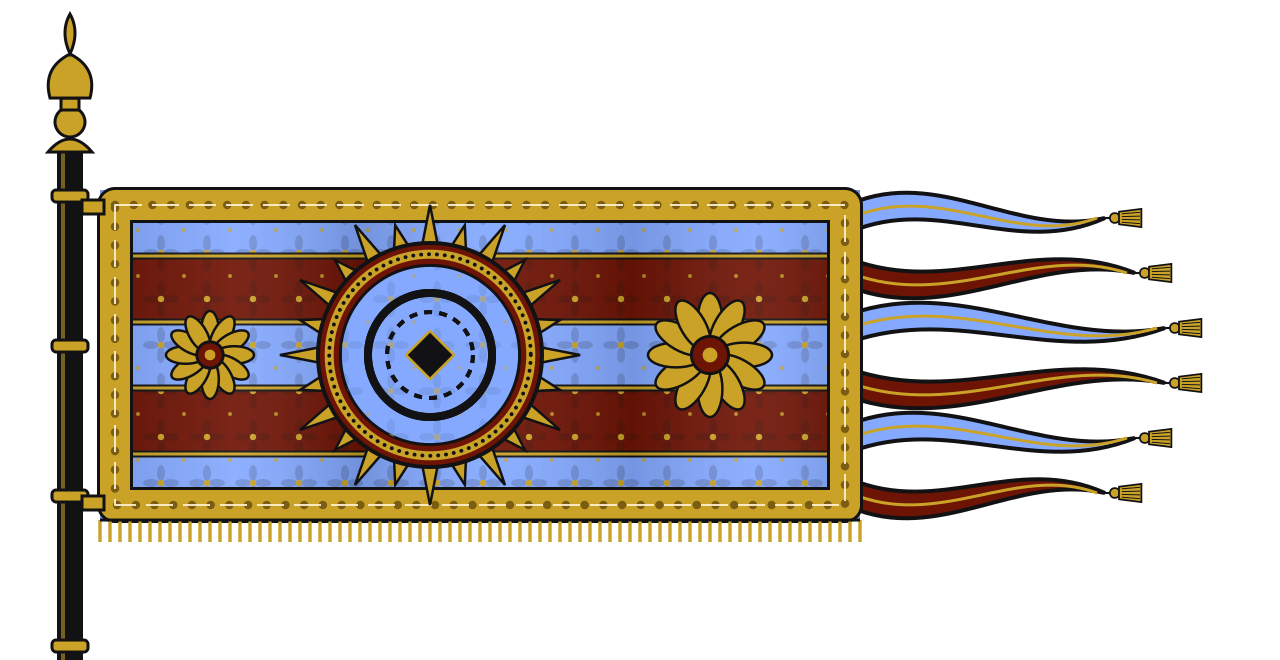
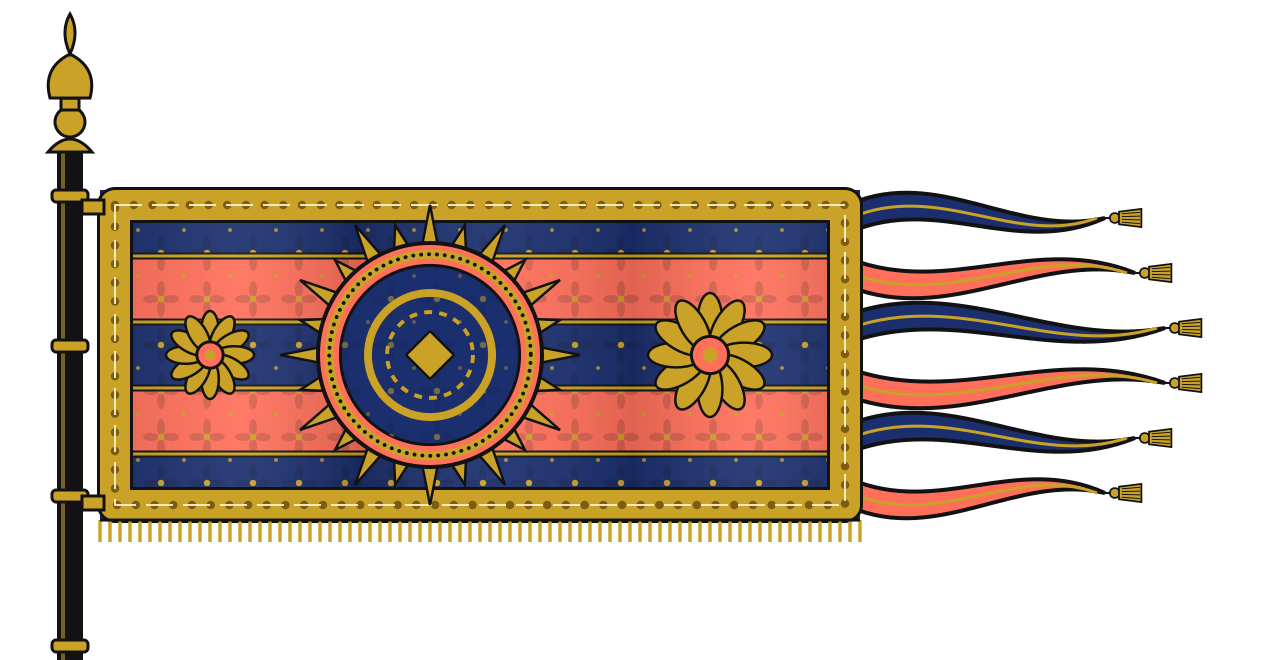
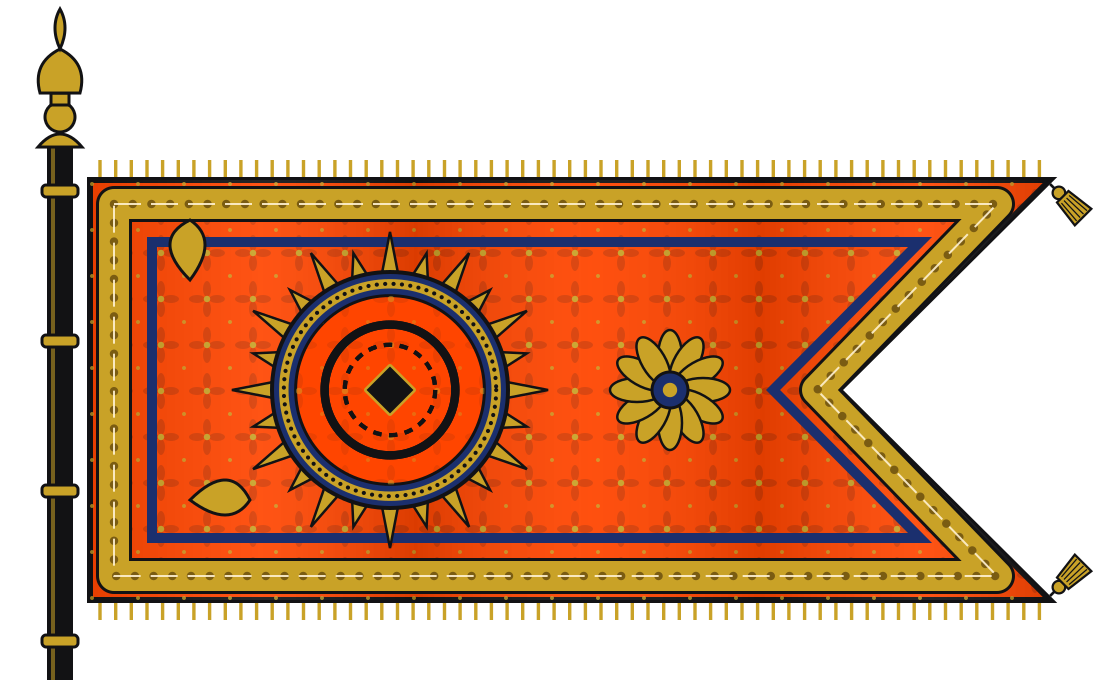
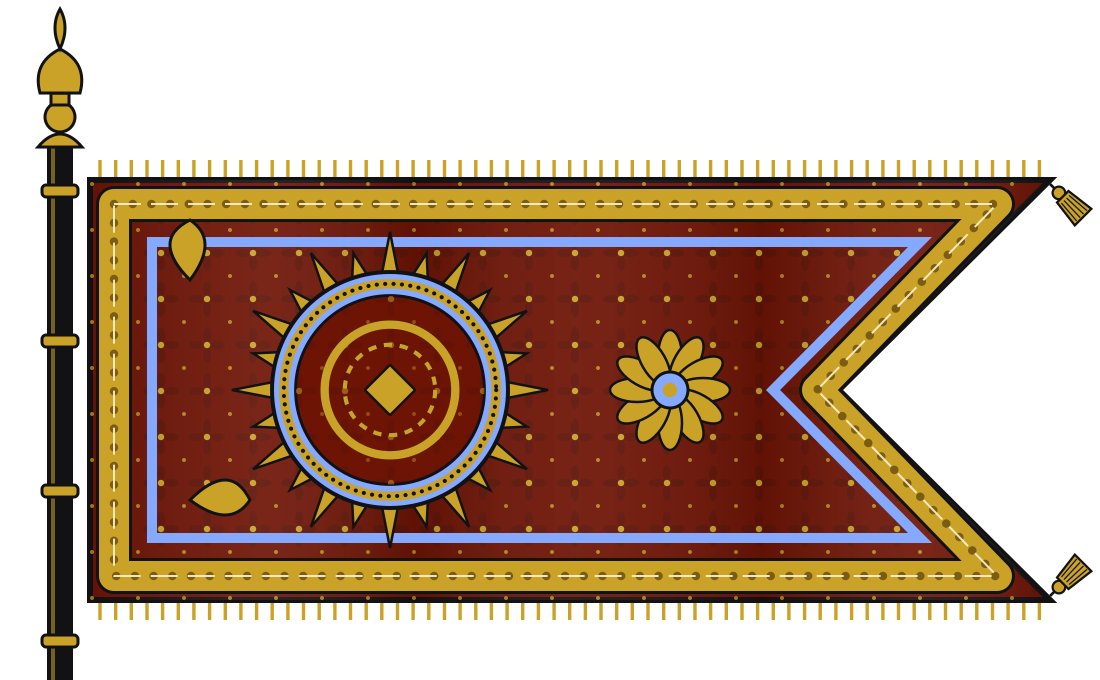
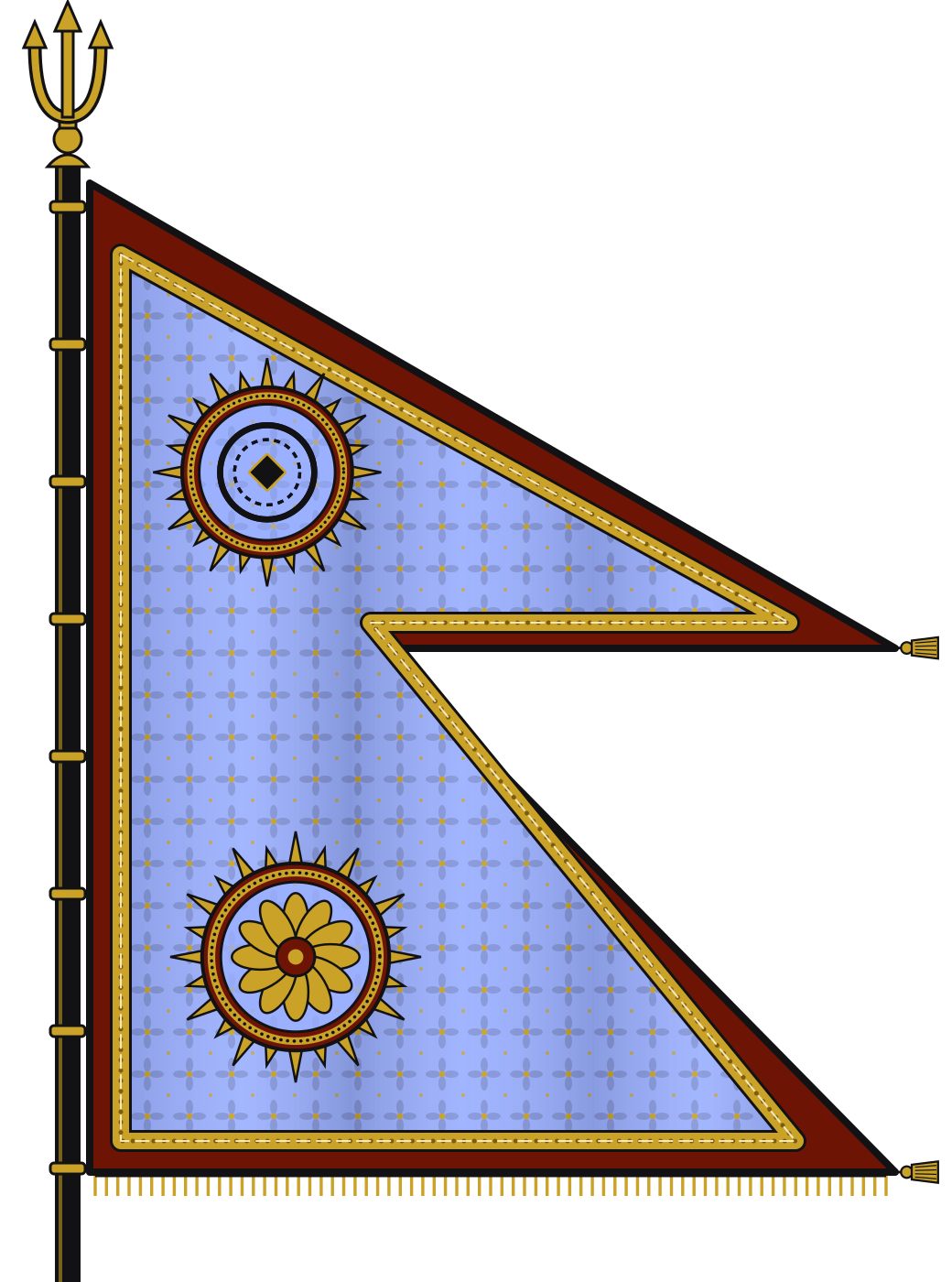
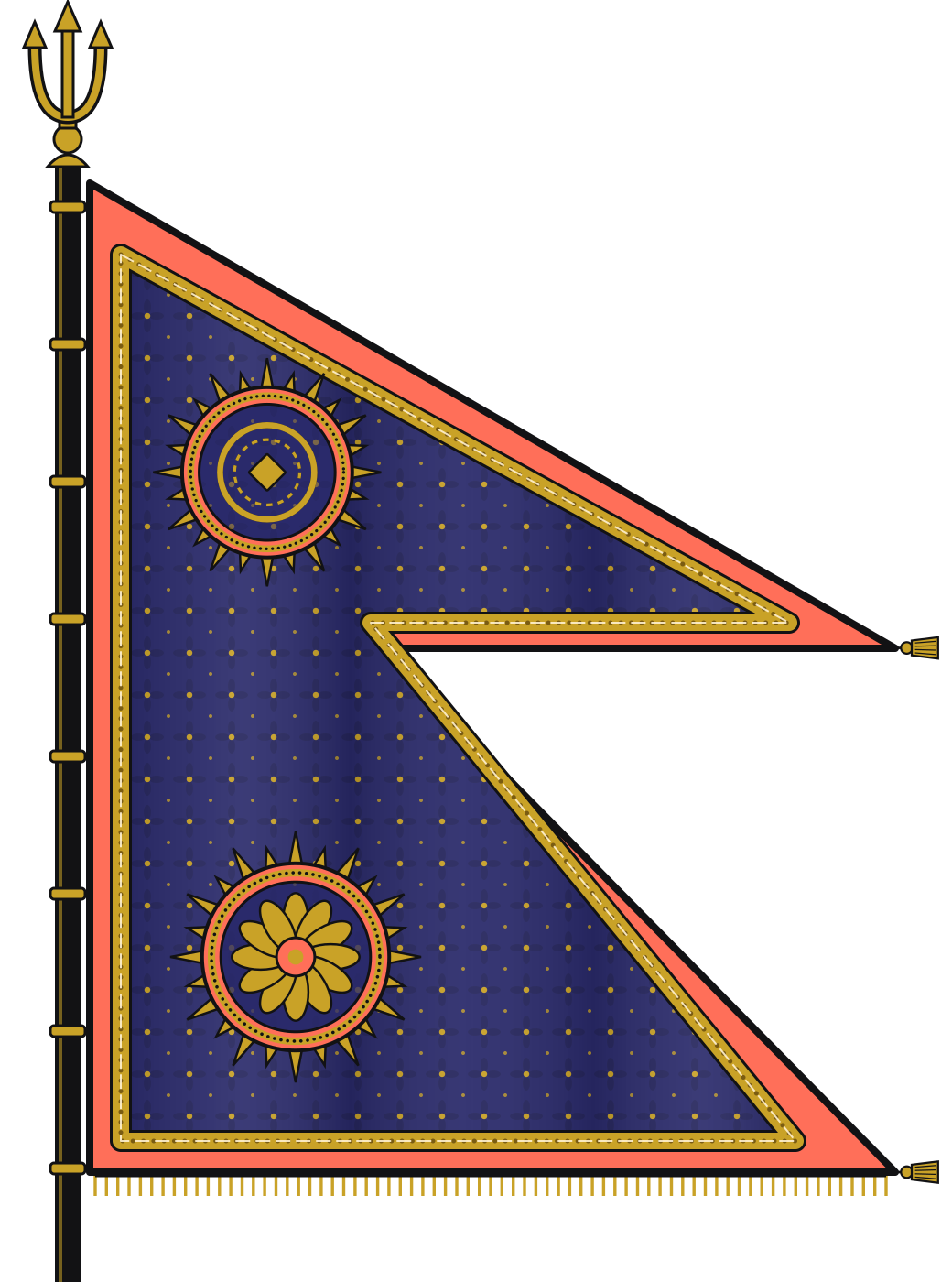
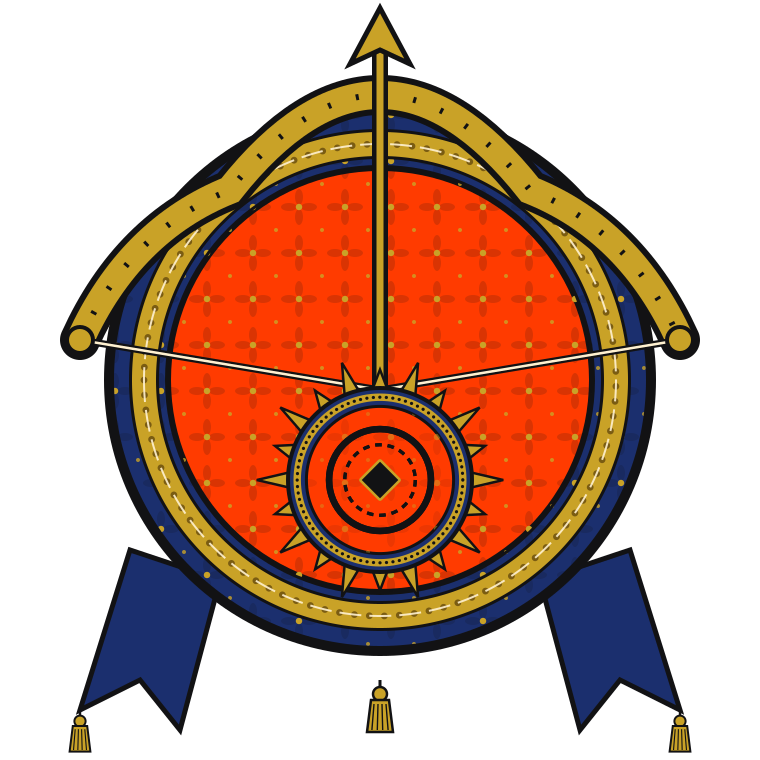
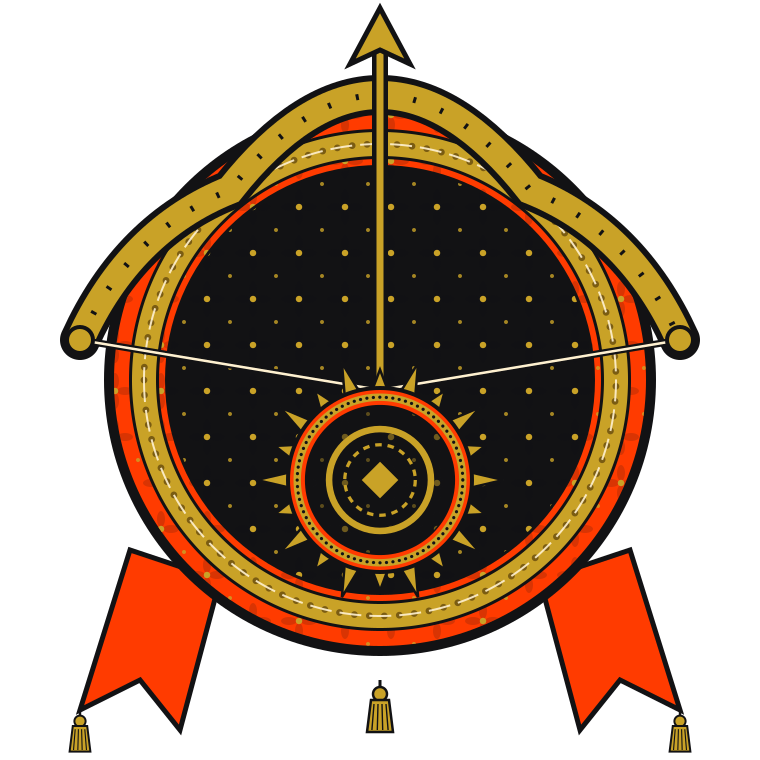
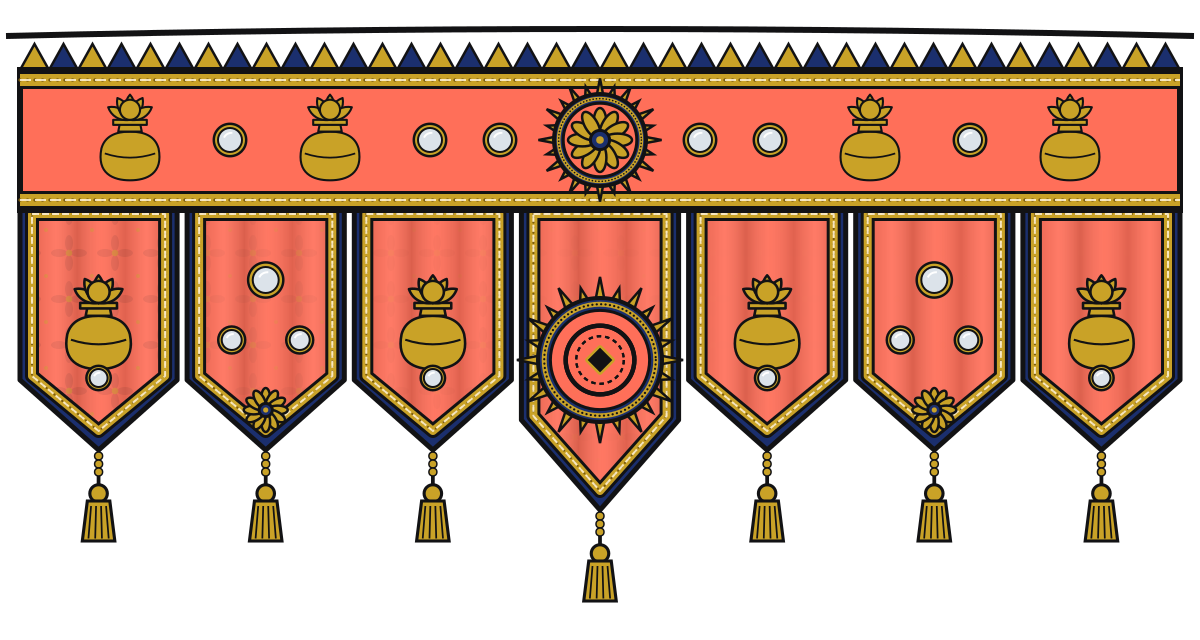
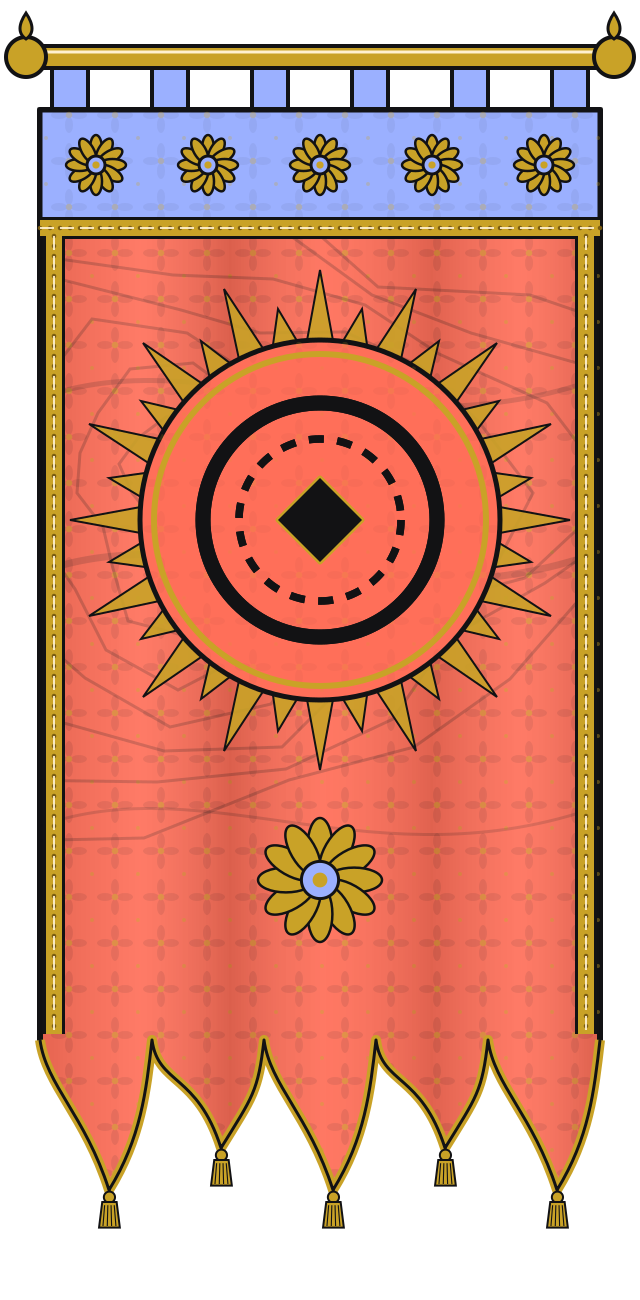
Historic banner
None recorded.
New flag types
| Accessory | For this clan | Basis |
|---|---|---|
| A9 Pota-dhvaja · ship and trade flag For ships, caravans and markets | Not yet designed for this clan | Design |
| A10 Utsava-patāka · festival flag Light, bright flag for fairs and festivals | Not yet designed for this clan | Design |
| A11 Shoka-dhvaja · mourning flag White cloth with the emblem outline in the clan's metal | Not yet designed for this clan | Design |
7. Regalia
| Accessory | For this clan | Basis |
|---|---|---|
| E1 Chhatra · house parasol The ceremonial umbrella | Not yet designed for this clan | Design |
| E2 Chamara · fly-whisks The pair of whisks beside the head of the house | Not yet designed for this clan | Design |
| E3 Danda · staff of office Staff or scepter | Not yet designed for this clan | Design |
| E4 Simhasana · seat The seat of the house, covered in clan cloth | Not yet designed for this clan | Design |
| E5 Khetaka · shield A round shield; the Changi and Dhanush are its flag forms | Not yet designed for this clan | Regional tradition |
| E6 Kula-ayudha · clan weapon The weapon the clan honours | Not yet found for this clan | Under research |
8. Worn
| Accessory | For this clan | Basis |
|---|---|---|
| F1 Kula-vastra · clan cloth The clan's woven pattern in its kit colours | Not yet designed for this clan | Design |
| F2 Kirti-vastra · honour cloth A cloth earned for a deed, not inherited | Not yet designed for this clan | Design |
| F3 Kula-mala · garland flower The flower or leaf the clan wears as a garland | Not yet found for this clan | Under research |
| F4 Chinha · house pin A metal badge with the pin emblem | Not yet designed for this clan | Design |
9. Records
| Accessory | For this clan | Basis |
|---|---|---|
| H1 Clan words A traditional line in the native script | मौर्य साम्राज्य · “Maurya Samrajya (the Maurya empire)” | Design |
| H2 Biruda · titles The house's title or titles | Devanampiya (Beloved of the Gods) and Devanampiya Piyadasi, as titles in the edicts Titles as the edicts give them; the Brahmi form is not in the extracts[2] | Documented |
| H3 Prashasti · praise genealogy The lineage as written at the head of a grant | Not yet found for this clan | Under research |
| H4 Vahi · clan register The book of the clan's births, marriages and deaths | Not yet found for this clan | Under research |
| H5 Rana-ghosha · war cry The clan's cry in battle or celebration | Not yet found for this clan | Under research |
10. VishwaVit · knower of the world
Game values are design choices for this project, not historical claims.
References
- Maurya Empire (Wikipedia, read 2026-10-08), drawing on Megasthenes' Indica (in later quotations), Ashoka's edicts, R. Thapar, H. Kulke and D. Rothermund, and T. R. Trautmann.
- Edicts of Ashoka (Wikipedia, read 2026-10-10), citing Hultzsch, Dhammika, Thapar, Olivelle and others.
- Koeri (Wikipedia, read 2026-10-10), citing Jaffrelot, Pinch and others.
- मौर्य साम्राज्य (Bharatdiscovery, read 2026-10-10)
- World History Encyclopedia, "Chandragupta Maurya" (Avantika Lal), read 2026-10-10, link
- Mauryan art (Wikipedia, read 2026-10-10), citing R. Thapar and others.
- Lumbini pillar inscription (Wikipedia, read 2026-10-10)
- Kumhrar (Wikipedia, read 2026-10-10), citing Altekar and Mishra (1959), Waddell (1892).
- Magadha (Wikipedia, read 2026-10-08), citing J. Bronkhorst, Greater Magadha (2007), M. Witzel (1987, 1995), H. C. Raychaudhuri (1953), R. C. Majumdar (1977), J. Keay, India: A History (2011) and K. T. S. Sarao (2003).
- Chanakya (Wikipedia, read 2026-10-10), citing Trautmann, Olivelle.
- World History Encyclopedia, 'Arthashastra', read 2026-10-10, link
- Megasthenes, Indica (preserved in Arrian, Indica 8) — Pandaia and its queen.
- Junagadh rock inscription of Rudradaman (Wikipedia, read 2026-10-09), citing F. Kielhorn (Epigraphia Indica VIII), R. Salomon, Indian Epigraphy (1998) and D. K. Chakrabarti (1999).
- Lion Capital of Ashoka (Wikipedia, read 2026-10-08), citing F. O. Oertel, “Excavations at Sarnath” (1908), D. R. Sahni's catalogue (1914), J. Marshall (1922), J. Irwin (1973) and F. Asher.
- P. T. Craddock, obituary of L. K. Gurjar, Indian Journal of History of Science 57 (2022) 348–351, read 2026-10-10, link
- Wikipedia, Purananuru, read 2026-10-10, https://en.wikipedia.org/wiki/Purananuru
- Wikipedia, War elephant, read 2026-10-10, https://en.wikipedia.org/wiki/War_elephant
- Wikipedia, "Sudarshana Lake", read 2026-10-10, link (cites Britannica, Thapar 2004, Singh 2008/2016, Mitra 2005, Randhawa, Mahajan, Jayaswal 2001, Davis 2024)
- Kautilya, Arthashastra Book II (web transcription), franpritchett.com, read 2026-10-10, https://franpritchett.com/00litlinks/kautilya/book02.htm
- Maurya (surname) (Wikipedia, read 2026-10-10), citing K. S. Singh, Communities, Segments, Synonyms, Surnames and Titles (Anthropological Survey of India, 1996).
- Reserve Bank of India, Ancient India coinage page, read 2026-10-10, link