The Maitrakas were a dynasty that ruled the Kingdom of Valabhi from Vallabhi, in Saurashtra and Gujarat, from about 475 to 776 CE[1][2]. Their founder, Bhatarka, was a Gupta military governor who became independent as the Gupta empire declined[2][3]. Most of the kings were Shaiva, and the kingdom patronised Buddhist and Jain foundations; Vallabhi University was compared with Nalanda[1][3][4]. Arab raids began in 677 CE, and the sources date the end of the dynasty variously between 776 and c. 783[5][3].
01Faith and deities
No KulDevi has been found for this clan yet; it is on the research list.
| Deity or tradition | Place in the clan's life | Evidence |
|---|---|---|
| Vishnu (Paramabhagavata) | Dhruvasena I was a Vaishnava and a Paramabhagavata | [1][3] |
| Surya, the sun | Dharapatta a sun worshipper; Shiladitya I patron of sun temples | [5][3] |
| Buddhism | Dhruvasena I was liberal to Buddhism; Dharasena IV patron of viharas; Buddhist scholars at Vallabhi | [3][4] |
| Jainism | Dhruvasena I patron of the Jain council at Vallabhi; Shantinatha temple at Vallabhi (c. 601) | [3] |
| Brahmanas | Grants to Brahmanas (Dharasena IV; Dhruvasena I at Vadnagar) | [3][5] |
| Khodiyar | A goddess the Wikipedia article links to the 8th-century decline; not a KulDevi in the sources | [1] |
02Temples
Over a hundred temples of the period are known, mostly on the west coast of Saurashtra[1]. The sources do not confirm which of them the dynasty built, except where a builder is named.
Built by the clan
| Temple | Deity | Built by | When | Where |
|---|---|---|---|---|
| Dudda-vihara, Vallabhi | Buddhist vihara | Dhruvasena I for his niece Dudda (Live History India); Princess Dudda (Kingdom of Valabhi) | Not dated | Vallabhi[5][3] |
Given patronage or grants by the clan
| Temple | Deity | What the clan gave | When | Where |
|---|---|---|---|---|
| Buddhist viharas, Vadnagar | Buddhist | Grants to Brahmanas there (Dhruvasena I) | Not dated | Vadnagar[5] |
| Gop temple | Sun temple (Live History India's claim: earliest surviving Sun temple in India) | Patron not stated | Not dated | Gop; cited with Kasar, Dhrasanvel and Sonkansari (Ghumli)[5] |
| Shantinatha temple, Vallabhi | Jain (Shantinatha) | Patron not stated | c. 601 CE | Vallabhi[3] |
03Languages and scripts
| Language or script | Kind | Under the clan | Evidence |
|---|---|---|---|
| Sanskrit | Listed among the kingdom's languages | Named with Prakrit and Sauraseni Apabhramsa as the languages of the kingdom | [3] |
| Prakrit | Literary language | Guhasena wrote poetry in it | [3][5] |
| Sauraseni Apabhramsa | Literary language | Language of the kingdom; Guhasena wrote poetry in it | [3][5] |
| Brahmi script | Writing on the coins | Debased Brahmi legend on the Maitraka silver coins | [3] |
04Books and literature
The dynasty ended in the 8th century. The works below were written, taught or patronised in its lands or at its court, according to the sources.
Written in the clan's lands during its era
| Work | Author | Kind | When | Link to the clan |
|---|---|---|---|---|
| Kalpa Sutra | Not named in the sources | Jain scripture | Scholars believe it was written in Dhruvasena I's reign | [5][3] |
| Svetambara Agamas (written down) | Svetambara monks | Jain canon | Under Maitraka rule, at Vallabhi; dating disputed (the Kalpasutra gives 980 or 993 years after Mahavira) | [6] |
| Dharasanasara | Devasena | Work named in the kingdom's books | Not dated | [3] |
| Bhattikavya | Bhatti | Sanskrit poem (kavya) | Probably under Dharasena IV | [3][1] |
| Shatrunjaya Mahatmya | Not named in the sources | Jain text named in the kingdom's books | Not dated | [3] |
Given patronage by the clan
| Work | Author | What the clan gave | When | Evidence |
|---|---|---|---|---|
| Jain council at Vallabhi | Svetambara monks | Patronage of Dhruvasena I (Campbell 1896) | Not dated | [3][6] |
| Buddhist scholarship at Vallabhi | Gunamati, Sthiramati and others | Patronage and a university | 6th to mid-7th century (sources differ) | [4][5][1] |
05Thinkers and scholars
| Name | Field | Era | Contribution |
|---|---|---|---|
| Gunamati | Buddhist scholar (Yogacara) | Mid-7th century (Wikipedia); 6th century (Live History India) | Pandita of Vallabhi University; refuted Madhava of Magadha[4][5][1] |
| Sthiramati | Buddhist monk and commentator | Mid-7th century (Wikipedia); 6th century (Live History India) | Taught at Vallabhi, reportedly earlier at Nalanda; commentaries on the Kashyapaparivarta and on Vasubandhu's Yogacara and Abhidharma works; named in a grant of Dharasena II and by Hiuen Tsang[5][3][1] |
| Bhatti | Court poet | Court of Dharasena IV | Bhattikavya, which illustrates Panini's rules through the Ramayana[3][7][1] |
| Hiuen Tsang | Chinese pilgrim and scholar | 640 CE | Visited Vallabhi; praised Śilāditya I; recorded more than 6,000 monks[3][4][1] |
| I-tsing (Yijing) | Chinese pilgrim | 7th century (670 CE, per the Pudgalavada article); 8th century (Live History India) | Found Vallabhi on par with Nalanda[5][4][8] |
| Devasena | Author | Not dated | Dharasanasara, named in the kingdom's books[3] |
Dates for the scholars differ between sources, as shown. The university taught Brahmanical sciences beside Buddhist doctrine (see Society).
06Art and architecture
What survives is mostly stone: temples, carvings and coins. The extracts name few objects by date.
Painting and wall art
Not recorded.
Sculpture and temple art
| Art form | What it is | Era | Evidence |
|---|---|---|---|
| Buddha statues from Gujarat and Sarnath | Cited in Live History India's art section, with a few statues surviving at Vallabhi | Not dated | [5][3] |
Temple and building architecture
| Art form | What it is | Era | Evidence |
|---|---|---|---|
| Saurashtra style | Austere temples in a Gupta tradition (Uparkot and Khambhalida caves); the source says they were important to the origin of the Nagara shikhara; the style vanished by the 10th century | Gupta tradition to 10th century | [3] |
| Gop, Kasar, Dhrasanvel, Sonkansari (Ghumli) | Extant temples with Buddhist motifs and Gandharan styles (Live History India) | Not dated | [5] |
Weaving and textiles
Not recorded.
Clothing and jewellery
Not recorded.
Coins, pottery and crafts
Not recorded.
07History
Bhatarka and the Gupta frontier, c. 475 CE
Bhatarka, a Gupta military governor of Saurashtra, made himself independent about 475 CE[1]. Britannica calls him a general who founded the dynasty as the Gupta empire declined, with Valabhi (modern Vala) as capital[2]. The early Maitraka kings were loosely feudatory to the Guptas but in fact independent[2]. The capital moved from Girinagar (Girnar) to Vallabhi; the sources give no date for the move[3].
Dharasena I to Dronasimha, c. 493–519
Dharasena I was a senapati, c. 493–499, and married Chandralekha, daughter of the Vakataka Harisena[5][3]. Dronasimha, c. 499–519, took the title Maharaja; Wikipedia calls him the third ruler to do so[3][1]. His copperplate is dated 183 of the Valabhi Era, which is 502 CE[3].
The Eran pillar of Bhanugupta, 510 CE, records a battle with the 'Maittras' in which Goparaja died[3].
Dhruvasena I, c. 519–549
Dhruvasena I ruled under the overlordship of Yashodharman of Malwa[3]. Live History India says he brought all Saurashtra under his rule by defeating the Garulakas of Dwarka[5]. Wikipedia gives his territory as running from Dwarka to Valabhi, and north to Vadnagar[3]. His copperplate is dated 535 CE[3].
Guhasena and Dharasena II, c. 553–595
Dharapatta, c. 549–553, was a sun worshipper[3][5]. Guhasena, c. 553–569, dropped Magadha allegiance and took the title Maharajadhiraja; Live History India says he fought the Maukharis, as the Jaunpur inscription of Ishvaravarman records[3][5].
Dharasena II, c. 569–595 (Kingdom of Valabhi), lost to Ishanavarman of the Maukharis and became a vassal with the title Samanta, according to Live History India, which gives his reign as 569–590[5].
Shiladitya I, c. 590–615
Shiladitya I Dharmaditya, c. 590–615, expanded the kingdom from Malwa to the Kutch coast[3]. Britannica says he made the kingdom very influential, extending its rule into Malwa and Rajasthan[2]. Live History India calls him Shaiva and a sun worshipper[5].
Harsha, the Chalukyas and the mid-7th century
Kharagraha I, c. 615–621, issued the Virdi copperplate of 616 CE[3]. Dharasena III, 621–627, aided the Chalukyas against Harshavardhana[5]. Dhruvasena II Baladitya, c. 627–641, married a daughter of Harshavardhana, per Hiuen Tsang[3].
Wikipedia says the kingdom came under Harsha's rule in the mid-7th century but kept local autonomy and regained independence after his death[1]. Britannica says the Maitrakas suffered defeats at the hands of the Chalukyas of the Deccan and Harsha of Kannauj, and revived after Harsha's death[2]. Dharasena IV, c. 641–650, subdued Lata and took the titles Paramabhattaraka Maharajadhiraja Parameshvara Chakravartin[3][1].
Arab raids and the end, 677–776
Arabs under Ismail attacked Ghogha in 677 CE and were repulsed[5]. Junaid invaded in 735–736, in the reign of Siladitya IV; the Navsari inscription of 738 records his repulse by Avanijanashraya Pulakesin, per Live History India[3][5]. A naval attack of 759 CE was defeated by the Saindhavas allied with the Maitrakas[3].
Arabs invaded Saurashtra in 776 CE, took Barada and withdrew after an epidemic[3]. The dynasty ended in 776 according to the Wikipedia infobox, or c. 783 according to its text; governors of Girinagar and Vamanasthali became independent after Vallabhi fell[3]. Britannica says Arabs established in Sindh in 712 killed the last king, Shiladitya VI, and razed the capital about 780[2]. Live History India gives Shiladitya VI's reign as 762–776, and says legends blame the Arabs for Vallabhi's fall but that 'history is silent'[5].
08Journey and migrations
The seat moved from Girnar to Vallabhi, and two Chinese pilgrims recorded the kingdom's learning.
| When | From | To | Why | Evidence |
|---|---|---|---|---|
| Not dated | Girinagar (Girnar) | Vallabhi | The capital moved (Sinha 2016) | [3] |
| 640 CE | — | Vallabhi | Visit of Xuanzang, who praised Śilāditya I and recorded more than 6,000 monks and about 100 monasteries | [3][4][1] |
| 7th century | — | Vallabhi | Visit of I-tsing (Yijing), who found Vallabhi on par with Nalanda; the Pudgalavada article dates his Gujarat visit to 670 CE | [1][5][8] |
09Seats and lands
| Place | Role | Where today |
|---|---|---|
| Vallabhi | Capital; seat of Vallabhi University | Near Bhavnagar, at the head of Bhavnagar Creek, Bhavnagar district, Gujarat[5][4] |
| Girinagar (Girnar) | Earlier capital | Girnar, Saurashtra[3] |
| Saurashtra (Kathiawar) | All of it under Dhruvasena I, per Live History India | Gujarat[2][5] |
| Virdi | Copperplate of Kharagraha I (616 CE), with Ujjain named as a victory camp | Near Dhola, Bhavnagar district[5] |
| Ujjain and Malwa | In Kharagraha I's territory (616 CE); Shiladitya I extended the rule into Malwa | Malwa region[3][1][2] |
| Ghogha, Somnath, Dwarka, Porbandar | Ports of the kingdom | Saurashtra coast[5] |
| Barada | Arab raid of 776 CE | Identified by some with a Barada in Nakhatrana Taluka, Kutch[5] |
| Vadnagar | Buddhist viharas; grants to Brahmanas | North Gujarat[5][3] |
10Notable figures
| Name | Role | Era | Known from |
|---|---|---|---|
| Bhaṭārka | Gupta general; founder of the dynasty | c. 475–493 | [1][5] |
| Dharasena I | Senapati; married the Vakataka Harisena's daughter Chandralekha | c. 493–499 | [3][5] |
| Droṇasiṁha | Third ruler to call himself Maharaja | c. 499–519 | [3][1] |
| Dhruvasena I | Paramabhagavata (Vaishnava); patron of the Jain council at Vallabhi (Campbell 1896) | c. 519–549 | [3][5] |
| Dharapaṭṭa | Sun worshipper, per his grandson's copperplate grants | c. 549–553 | [5][3] |
| Guhasena | Took the title Maharajadhiraja; composed poetry in Sanskrit, Prakrit, Saurseni and Apabhramsa | c. 553–569 | [3][5] |
| Dharasena II | Became a vassal of the Maukharis (Samanta title) by Live History India's account | c. 569–595 | [3][5] |
| Śilāditya I Dharmāditya | Expanded the kingdom to Malwa and the Kutch coast; patron of sun temples and Buddhists | c. 590–615 | [3][2] |
| Kharagraha I | Issued the Virdi copperplate | c. 615–621 | [3][5] |
| Dhruvasena II Baladitya | Married a daughter of Harshavardhana | c. 627–641 | [3] |
| Dharasena IV | Subdued Lata; patron of viharas and Brahmanas; took the Chakravartin titles; court poet Bhatti | c. 641–650 | [1][3] |
| Śilāditya VI | Last known ruler (Live History India); the Charans connect themselves with him (their claim) | 762–776 | [5][1] |
| Dudda | Princess (niece of Dhruvasena I, per Live History India) for whom the Dudda-vihara was built | Not dated | [5][3] |
11Allies, rivals and marriages
| People | Relationship | When |
|---|---|---|
| Guptas | Early kings loosely feudatory to them (Britannica); Bhatarka was a Gupta general[2][3] | From c. 475 |
| Garulakas of Dwarka | Vaishnava; defeated by Dhruvasena I; accepted the overlordship of Valabhi[3][5] | c. 519–549 |
| Maukharis | Fought in Guhasena's reign (Jaunpur inscription); Ishanavarman defeated Dharasena II[5][3] | c. 553–590 |
| Vakatakas | Marriage: Dharasena I married Chandralekha, daughter of Harisena[5] | c. 493–499 |
| Harsha (Harshavardhana) of Kannauj | Ruled over the kingdom, which kept local autonomy; a daughter of Harsha married Dhruvasena II[1][3] | Mid-7th century |
| Chalukyas | Defeated the Maitrakas (Britannica); took Khetaka (Kheda) under Shiladitya IV; Navsari inscription of 738[2][5] | 7th–8th century |
| Saindhavas | Eastern vassals, later allies; defeated the Arab naval attack of 759 with the Maitrakas[5] | 759 and after (Agukka I, 770–790) |
| Umayyad Arabs | Raiders: Ghogha (677), Junaid (735–736), naval attack (759), Barada (776)[3][5] | 677–776 |
| Western Kshatrapas | Coin style and the Mahakshatrapa title that the Maitraka coins follow[5] | Not dated |
12Society and livelihood
The grants describe the dynasty as born of a war-like tribe[1]. The kingdom taught several subjects at Vallabhi, and its kings gave to Buddhist and Jain foundations.
Government and social order
| Institution or group | What it was | Evidence |
|---|---|---|
| Vallabhi University | Taught Brahmanical sciences alongside Buddhist doctrine; graduates were employed by kings; kings and wealthy citizens funded it, and Maitraka kings gave grants for running it and for libraries | [4][5] |
| Social order in the grants | Maitrakas were Kshatriyas and Gahlots Brahmanas, according to the inscriptions (Virji 1955) | [3] |
| Administration | Divisions called vishaya (headed by a Rashtrapati or Amatya) and villages called grama (headed by a Gramakuta) | [3] |
| Religious patronage | Funded Buddhist viharas and Jain activity, including a Jain council at Vallabhi | [1] |
Livelihood over time
| Era | Livelihood | Evidence |
|---|---|---|
| c. 475–776 CE | Ports at Ghogha, Somnath, Dwarka and Porbandar; a rich, deeply monetized economy (Live History India) | [5] |
| 7th to mid-8th century | Foreign coins found at Mandvi: Greek, Byzantine and Umayyad (Live History India) | [5] |
13Sub-clans and related clans
No sub-clan, branch or gotra of the Maitrakas is named in the extracts. These are related peoples and families the sources name. The Mitra dynasty of Mathura is a suggested origin, not a settled one: Virji concluded lunar-race Kshatriyas, possibly from the Mitra dynasty of Mathura, and scholars differ.
| Clan | Relation | Where | Size | In the Atlas | Evidence |
|---|---|---|---|---|---|
| Mitra dynasty of Mathura | Dynasty from this clan | Mathura (suggested origin, disputed) | ANC-211 | [1] | |
| Gahlots | Related people | Named in the grants as Brahmanas (Virji 1955) | SUB-168 | [3] | |
| Saindhavas | Related people | Eastern vassals of the Maitrakas, later allies against the Arabs | ANC-225 | [5][3] | |
| Garulakas | Related people | Dwarka | ANC-204 | [3][5] | |
| Maukharis | Related people | Kannauj (named as the seat of Ishanavarman and Ishvaravarman) | ANC-158 | [3][5] | |
| Chalukyas | Related people | Deccan; Navsari | ANC-190 | [2][5] | |
| Gurjaras | Related people | Lata (named as Gurjaras of Lata in the relations list) | ANC-038 | [3] | |
| Pratiharas | Related people | Named in the relations list | ANC-224 | [3] | |
| Chavdas | Related people | Panchasar and Jayasekhara named in the relations list | SUB-171 | [3] | |
| Charans | Related people | Claim to connect with Śilāditya VI (Wikipedia) | ST-347 | [1] |
Clans marked "new clan candidate" are not in the Atlas yet.
14Surnames
No surname is recorded for the dynasty in the extracts.
Not recorded.
15Songs and music
No song or music of the Maitrakas is recorded in the extracts.
None recorded yet.
16Poems, lullabies and children's rhymes
Guhasena composed in Sanskrit, Prakrit, Saurseni and Apabhramsa (Live History India); no verse is quoted in the sources.
None recorded yet.
17Stories, legends and proverbs
Stories and legends
| Story | What happens | Told by | Evidence |
|---|---|---|---|
| A Brahmana's son and the university | A Brahmana prefers to send his son to Vallabhi rather than Nalanda or Banaras | Somadeva, Kathasaritsagara (11th century) | [5][4] |
| The Jain canon at Vallabhi | Tradition says the Svetambara canon was written down at Vallabhi, under the Maitrakas | Jain tradition | [2][6] |
Proverbs and sayings
Not recorded.
18Festivals and fairs
Not recorded.
19Food, dress and games
Food
Not recorded.
Dress
Not recorded.
Games and martial arts
Not recorded.
Tags: living still practised · revived brought back after a break · lost known only from records · research reported but not yet confirmed from a source. Songs and poems under copyright are listed by title only; restricted or sacred material is noted without its content.
20Status today
The dynasty ended in the 8th century. The sources name no present-day clan as descended from the dynasty; the Charans claim a connection with the last ruler (see below)[1].
Who carries the name today
| Community | Link | Basis | Evidence |
|---|---|---|---|
| Charans (ST-347) | Community tradition | [1] |
Recognised heritage
| What | Recognition | Evidence |
|---|---|---|
| Vallabhi site | Survives as brickbat-dotted hillocks with a few statues, copperplates and coins; the 1979–80 excavations by the M S University of Baroda are unpublished (Live History India) | [5] |
| Vallabhi University | The Union government considered a proposal to revive the university in September 2017 (Times of India, via Wikipedia) | [4] |
| Temples of the period | Recognition not stated in the sources | [1] |
Not yet reviewed by a community. The Charans' claim is theirs, not a community review of this page.
21For children
The trident on the coin
Long ago, in the land of Saurashtra in western India, a general named Bhatarka served the Gupta empire. When the Gupta empire grew weak, about 475 CE, Bhatarka became his own master. His family, the Maitrakas, ruled from a city called Vallabhi. Their kings were mostly devotees of Shiva, and their coins show a trident, Shiva's weapon. The kings also gave gifts to Buddhist monks and Jain teachers. A famous university at Vallabhi taught many subjects, and a Chinese traveller, Xuanzang, visited it in 640 CE. The dynasty ended in the 8th century, and the sources do not agree on the exact year.
22Across the project
| Project | What carries this clan | Status |
|---|---|---|
| Atlas of the Janas | Pin coordinates for Vallabhi are not in the sources read | To check |
| KulDevi and GrahDevi | No KulDevi in the Atlas (Research) | Research |
| Planet naming | Not checked against the Tier registers | To check |
| Renaming and waters | No place or water name drawn from the Maitrakas yet | — |
23Open questions
- KulDevi: the Atlas says Research. Is there a goddess of the Maitraka families in a source (Khodiyar is linked to the decline, not to a KulDevi)?
- End of the dynasty: 776 (Wikipedia infobox), c. 783 (Wikipedia text), c. 780 (Britannica), and the last king's reign as 762–776 (Live History India). Settle with a primary source.
- Britannica says the Arabs established in Sindh in 712 killed Shiladitya VI; Live History India gives him as ruling 762–776. Check.
- Dates of Dharasena II (569–595 in Kingdom of Valabhi; 569–590 in Live History India) and of the scholars Gunamati and Sthiramati (mid-7th century in Wikipedia; 6th century in Live History India).
- Dudda-vihara: built by Dhruvasena I for his niece Dudda, or by Princess Dudda? The sources differ.
- Mitra dynasty of Mathura as origin: Virji's suggestion; scholars differ. Set out both sides.
- The Charans' claim to connect with Shiladitya VI appears only in the Wikipedia Maitraka article among the extracts read. Source it or keep it as a claim.
- Native-script forms of the name, the titles and the coin legend (Brahmi) are not in the sources read. The clan words are given in transliteration only.
- Coin weight and composition: the Numisquare page needs a login. Read it when possible.
- Seal, totem, war cry, guardian tree, shield and clan weapon: no source read gives them. The war-axe (parashu) appears on later coins; the sources do not say the clan honoured it.
- Songs, festivals and proverbs: none in the extracts. Leads: the Deccan Herald piece on remote sensing of Valabhi (fetch failed), the wisdomlib essay, and the jainqq scans of Indian Antiquary vol. 39 and vol. 8 (search hits, not read).
- I-tsing's visit: 7th century (670 CE, Pudgalavada article) against 8th century (Live History India). Settle with a primary source.
- The Arab role in the end: Britannica says Arabs established in Sindh killed the last king, Shiladitya VI, and razed the capital about 780; Wikipedia's Maitraka article says no historical source confirms the end; Live History India says 'history is silent'.
24Astitva
अस्तित्व · being, existence: everything by which the clan is known
The dynasty's silver drachms, its copperplate grants and its titles are documented. The coins show a royal head facing right and a trident on the reverse[3][9].
Every clan has every accessory, royal objects included. Each one says how it is known: Documented This clan's own object is recorded. · Regional tradition Recorded for the region or for peoples like this one, not for this clan. · Design Made for this project, with no historical claim. · Under research To be found for this clan from sources. Legends and titles are written in the clan's own script.
1. Seals and coins
| Accessory | For this clan | Basis |
|---|---|---|
| B1 Rajamudra · house seal Round seal with the clan emblem and a short legend in the clan's script | Not yet designed for this clan | Design |
| B2 Anguliya-mudra · signet ring Personal seal ring of the head of the house | Not yet designed for this clan | Design |
| B3 Chhapa · house stamp Ink or block stamp for letters, goods and cloth | Not yet designed for this clan | Design |
| B4 Tamrapatra · charter plate Copper-plate grant on a ring, closed with the house seal | Copper-plate grants: Dronasimha, 502 CE; Dhruvasena I, 535 CE; Kharagraha I (Virdi), 616 CE; Godhra, 760 CE. Dronasimha's grant is dated 183 of the Valabhi Era (502 CE). Copperplates listed in the Kingdom of Valabhi article[3] | Documented |
| B5 Shreni-mudra · guild or trade seal Seal for the clan's trade, craft or caravan | Not yet designed for this clan | Design |
| C1 Clan coin Emblem or deity on one side, a legend in the clan's script | Silver drachm: a royal head or bust facing right, in Ksatrapa style (Wikipedia) or Indo-Sasanian style (Numisquare); reverse: a trident (trishula), often with a war-axe (parashu) | Documented |
| C2 Coin die The die that strikes the coin | Not yet designed for this clan | Design |
2. Living symbols
| Accessory | For this clan | Basis |
|---|---|---|
| I1 Totem trio The tree, bird and animal the clan protects | Not yet found for this clan | Under research |
| I2 Kaval-maram · guardian tree The tree that stands at the clan's seat | Not yet found for this clan | Under research |
3. Stone and gate
| Accessory | For this clan | Basis |
|---|---|---|
| G1 Torana · gateway The built gate of the seat; the cloth Toran hangs in it | Not yet designed for this clan | Regional tradition |
| G2 Viragallu · hero stone Carved panel stone for a member who died defending the clan | Not yet designed for this clan | Regional tradition |
| G3 Kula-shila · clan stones Standing and table stones that remember the ancestors | Not yet designed for this clan | Design |
| G4 Jayastambha · victory pillar A pillar raised for a victory | Not yet designed for this clan | Design |
| G5 Sima-shila · boundary stone Marks the clan's land, with a line in the native script | Not yet designed for this clan | Design |
4. Sounds
| Accessory | For this clan | Basis |
|---|---|---|
| D1 Pancha-mahashabda · five great sounds The right to five instruments | Not yet designed for this clan | Design |
| D2 Shankha · clan conch The clan's own named war conch | Not yet designed for this clan | Design |
| D3 Murasu · house drums Three drums: war, charity and justice | Not yet designed for this clan | Design |
5. Kit: colours, metals and emblems
The main emblem is the trident on the reverse of the dynasty's silver drachms, a Shaiva sign[1].
| Part of the kit | This clan |
|---|---|
| Field | Deep Brick #7E2A1E |
| Accent | Deep Cosmic Blue #9BB0FF |
| Emblem colour | Metallic Gold #C9A227 |
| Zari metal | Gold |
| Main emblem | A trident (trishula) |
| Second image | — |
| Night and day | Every visual accessory has two versions: by night the emblem on the dark field, by day the clan's field colour on cloth woven from its metal. |
6. Flags
Every clan has every flag type; the type says the occasion and the colours say the clan. The outlined card is the flag the Atlas assigns.
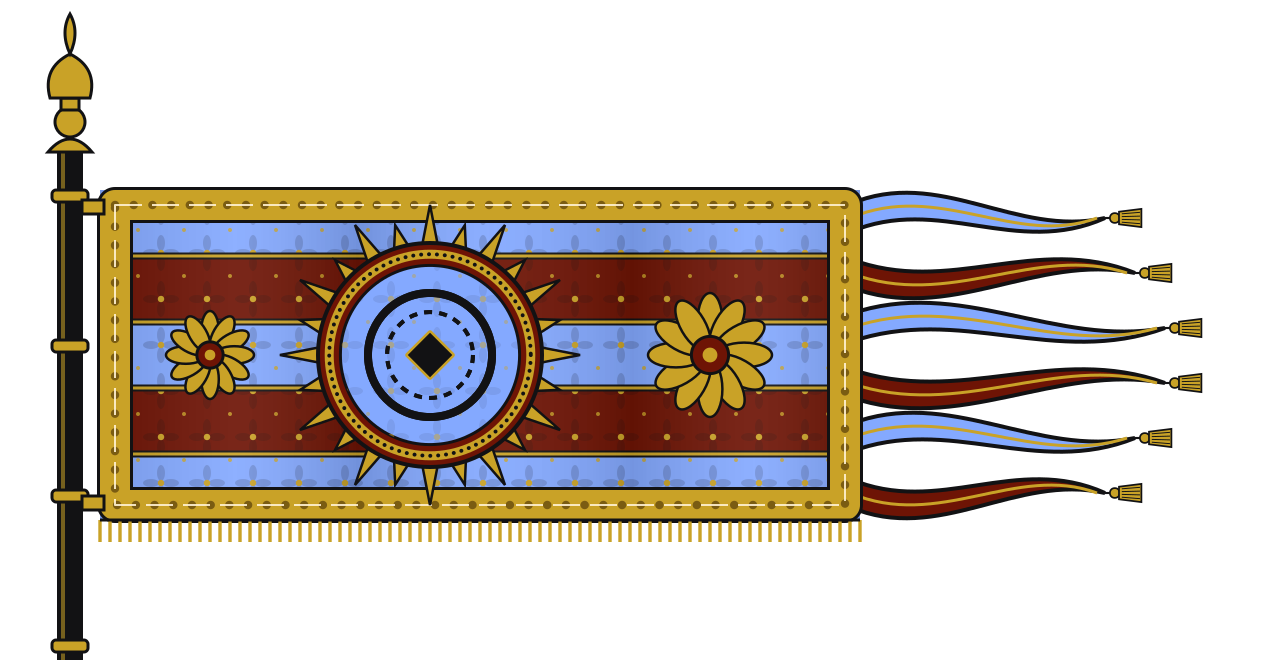
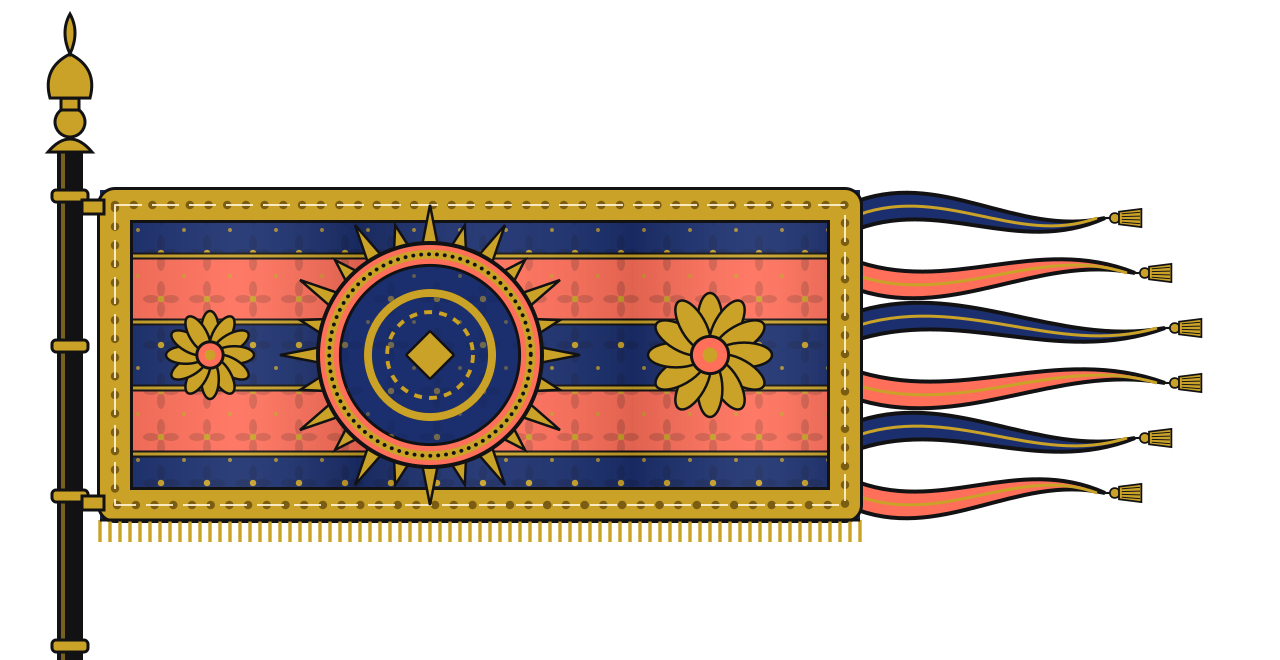
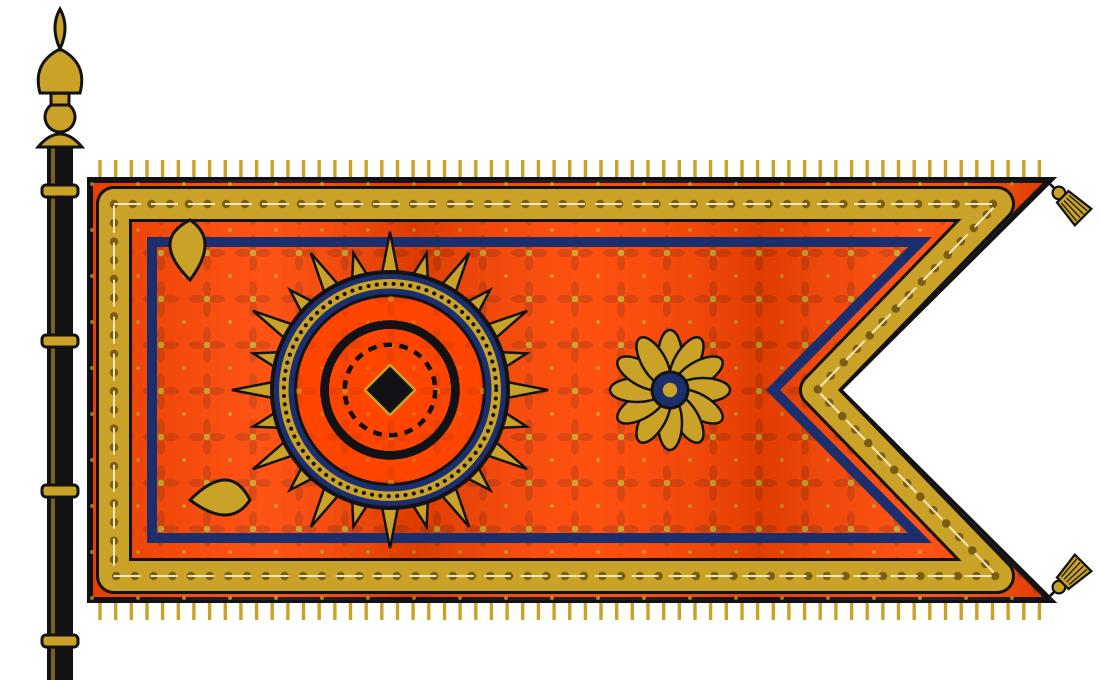
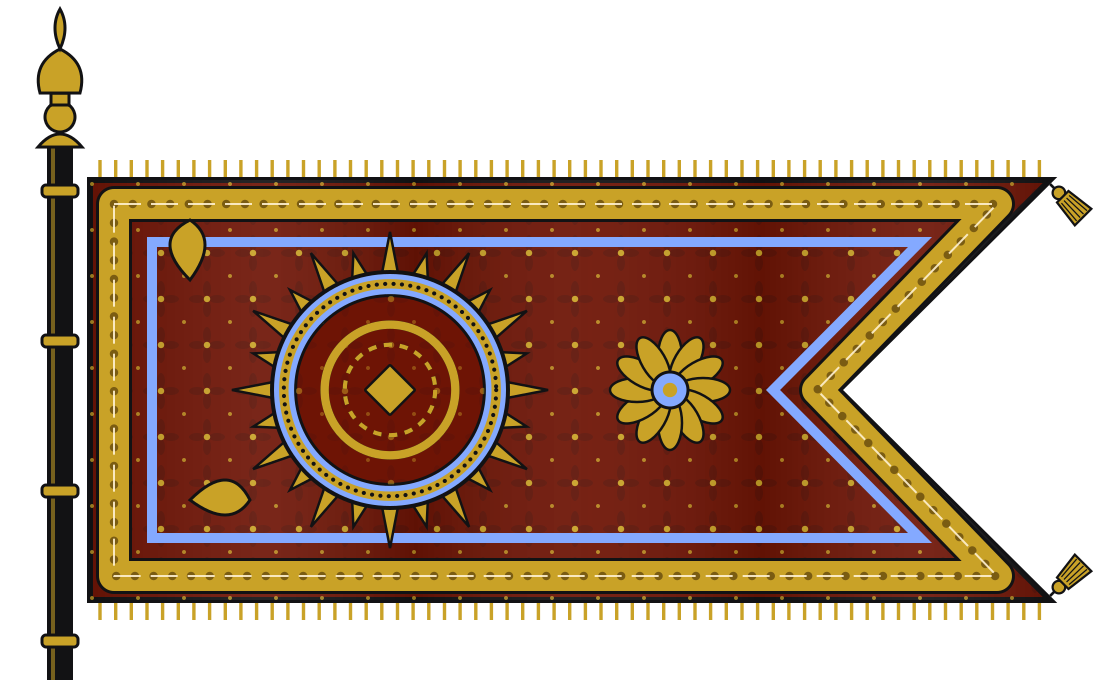
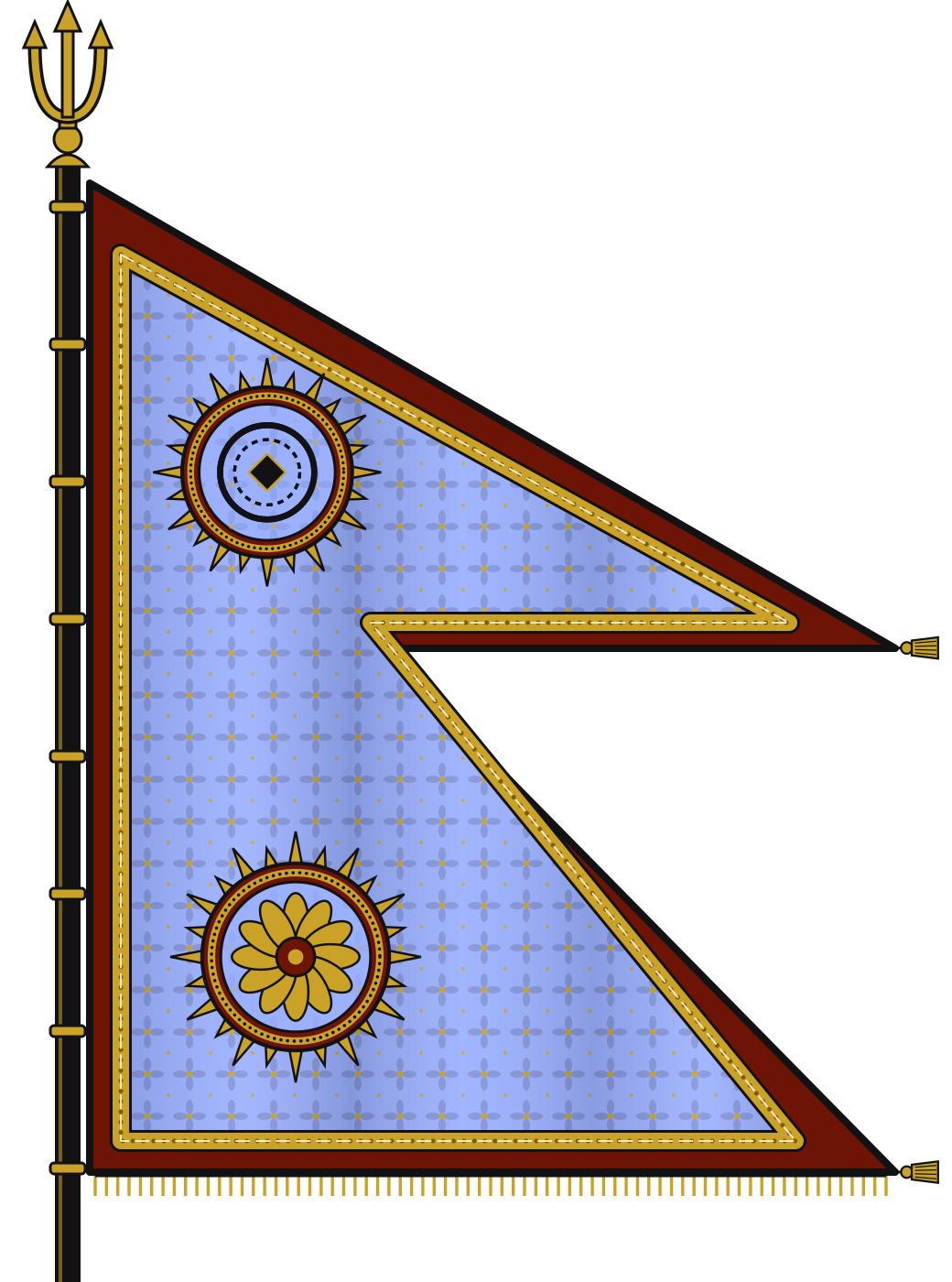
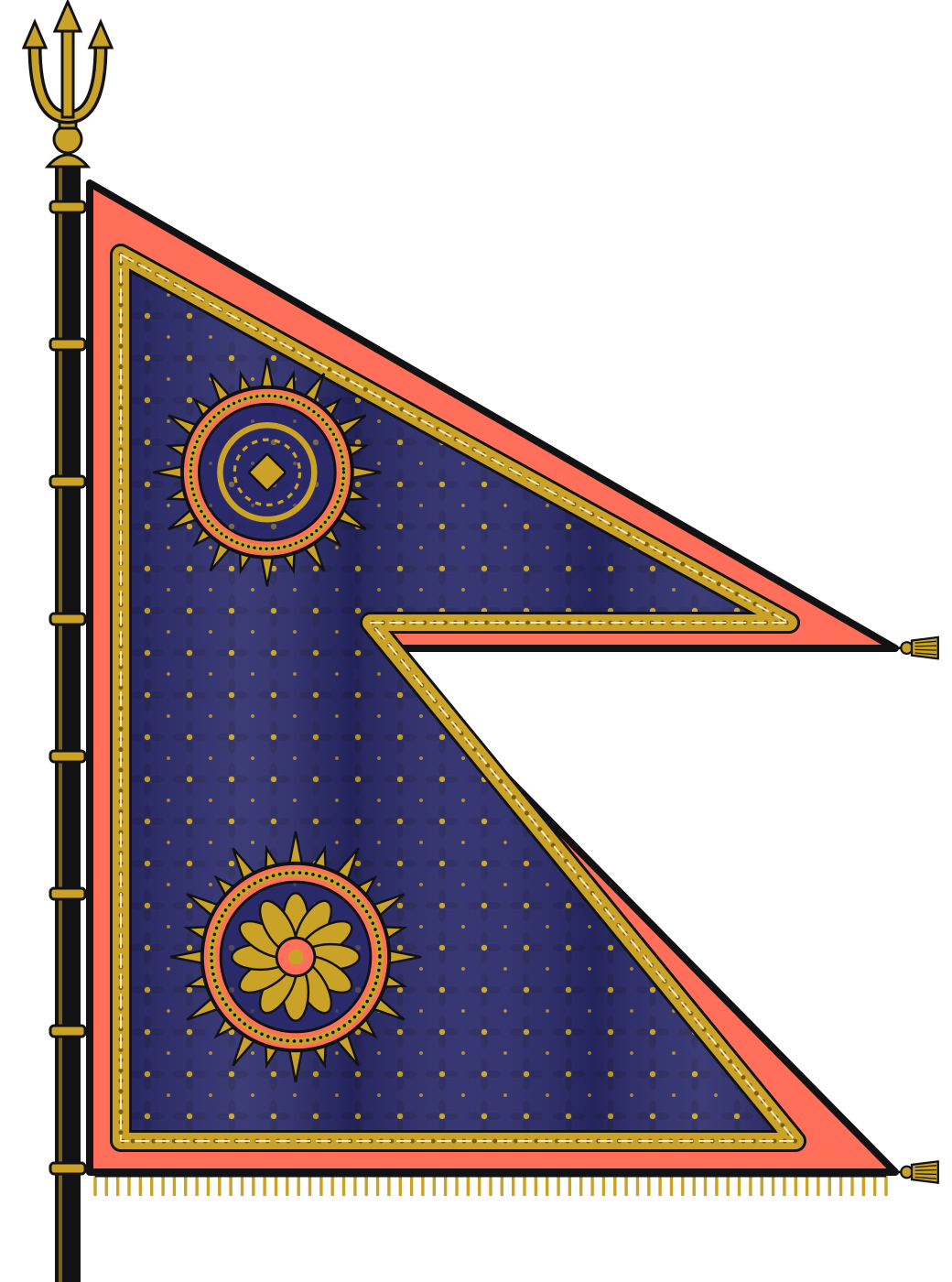

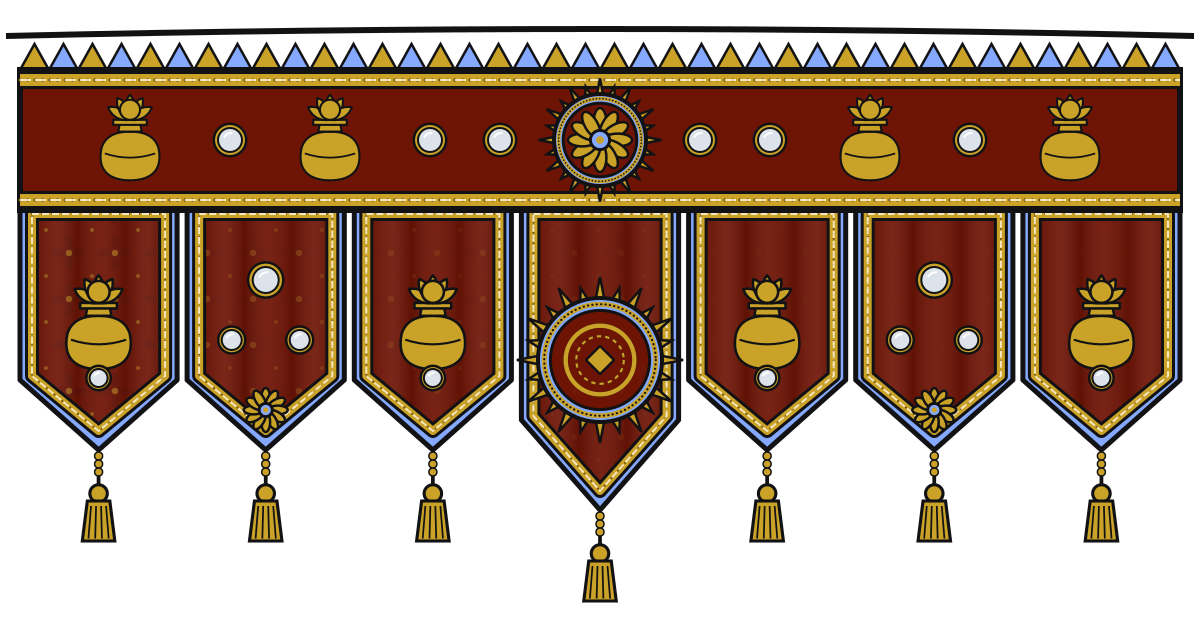

Historic banner
None recorded.
New flag types
| Accessory | For this clan | Basis |
|---|---|---|
| A9 Pota-dhvaja · ship and trade flag For ships, caravans and markets | Not yet designed for this clan | Design |
| A10 Utsava-patāka · festival flag Light, bright flag for fairs and festivals | Not yet designed for this clan | Design |
| A11 Shoka-dhvaja · mourning flag White cloth with the emblem outline in the clan's metal | Not yet designed for this clan | Design |
7. Regalia
| Accessory | For this clan | Basis |
|---|---|---|
| E1 Chhatra · house parasol The ceremonial umbrella | Not yet designed for this clan | Design |
| E2 Chamara · fly-whisks The pair of whisks beside the head of the house | Not yet designed for this clan | Design |
| E3 Danda · staff of office Staff or scepter | Not yet designed for this clan | Design |
| E4 Simhasana · seat The seat of the house, covered in clan cloth | Not yet designed for this clan | Design |
| E5 Khetaka · shield A round shield; the Changi and Dhanush are its flag forms | Not yet designed for this clan | Regional tradition |
| E6 Kula-ayudha · clan weapon The weapon the clan honours | Not yet found for this clan | Under research |
8. Worn
| Accessory | For this clan | Basis |
|---|---|---|
| F1 Kula-vastra · clan cloth The clan's woven pattern in its kit colours | Not yet designed for this clan | Design |
| F2 Kirti-vastra · honour cloth A cloth earned for a deed, not inherited | Not yet designed for this clan | Design |
| F3 Kula-mala · garland flower The flower or leaf the clan wears as a garland | Not yet found for this clan | Under research |
| F4 Chinha · house pin A metal badge with the pin emblem | Not yet designed for this clan | Design |
9. Records
| Accessory | For this clan | Basis |
|---|---|---|
| H1 Clan words A traditional line in the native script | Rajno Mahakshatrapasa Bhatarakasa Mahesara-Sri Bhattarakasa · “Coin legend, in transliteration only; the sources give no translation” Brahmi legend on the coins, debased, as transliterated by Virji (1955)[3] | Documented |
| H2 Biruda · titles The house's title or titles | Titles: Senapati; Maharaja; Maharajadhiraja; Samanta; Mahasamanta; Paramamaheshwara; Dharmaditya; Baladitya (Kingdom of Valabhi). Mahakshatrapa on the coin legend. Paramabhattaraka Maharajadhiraja Parameshvara Chakravartin (Dharasena IV)[3][1] Titles of the house and its kings. Live History India says the coins proclaim Mahakshatrapas, following the Western Kshatrapas[5] | Documented |
| H3 Prashasti · praise genealogy The lineage as written at the head of a grant | Not yet found for this clan | Under research |
| H4 Vahi · clan register The book of the clan's births, marriages and deaths | Not yet found for this clan | Under research |
| H5 Rana-ghosha · war cry The clan's cry in battle or celebration | Not yet found for this clan | Under research |
10. VishwaVit · knower of the world
Game values are design choices for this project, not historical claims.
References
- Maitraka dynasty (Wikipedia, read 2026-10-10, https://en.wikipedia.org/wiki/Maitraka_dynasty)
- Encyclopaedia Britannica, Maitraka dynasty, read 2026-11-09, https://www.britannica.com/topic/Maitraka-dynasty
- Wikipedia, Kingdom of Valabhi, read 2026-10-23, https://en.wikipedia.org/wiki/Kingdom_of_Valabhi
- Wikipedia, Valabhi University, read 2026-11-09, https://en.wikipedia.org/wiki/Valabhi_University
- Live History India, The Maitrakas: The Learned Rulers of Saurashtra (5th to 8th CE), read 2026-11-09, https://livehistoryindia.com/story/people/the-maitrakas
- Wikipedia, Jain councils, read 2026-11-09, https://en.wikipedia.org/wiki/Jain_councils
- Wikipedia, Pāṇini, read 2026-10-31, https://en.wikipedia.org/wiki/P%C4%81%E1%B9%87ini
- Wikipedia, Pudgalavada, read 2026-11-01, https://en.wikipedia.org/wiki/Pudgalavada
- Numisquare, Maitraka drachm 470-788 catalogue entry, read 2026-11-09, https://www.numisquare.com/drachm-470-788-1757445750.html?lang=en