Magadha was a kingdom on the eastern Ganga plain, one of the sixteen great realms (Mahajanapadas) of the Buddha's time[1][2]. Its heartland lay south of the Ganga and east of the Son, in today's Patna and Gaya districts of Bihar[2]. The Atharvaveda names the Magadhas among peoples outside the Vedic heartland, and scholars describe a “Greater Magadha” whose culture rejected Vedic ritual and where Jainism, Buddhism and the Ajivikas arose[2]. From Rajagriha and later Pataliputra, the Haryanka, Shaishunaga, Nanda and Maurya kings absorbed their neighbours, and Magadha became the core of the first empires of the subcontinent[2][3].
01Faith and deities
Mangala Gauri of Gaya, Shakti Peetha of Magadha[5]
The presiding goddess of the clan's homeland or capital: a link of place, not a recorded clan tie.
| Deity or tradition | Place in the clan's life | Evidence |
|---|---|---|
| Mangala Gauri (KulDevi) | Gauri on Mangalagauri hill, Gaya; named in the Padma, Vayu, Agni, Devi Bhagavata and Markandeya Puranas | [5] |
| The Buddha and the Dhamma | The Buddha lived much of his life in Magadha, was enlightened at Bodh Gaya, and the first council met at Rajagriha | [2] |
| Mahavira and the Jinas | Mahavira spent many rainy seasons at Rajgir; Munisuvrata, the 20th Tirthankara, is held to be born there; the Nandas were mostly Jain | [6][2] |
| Ajivikas | A shramana order of Greater Magadha; its teacher Makkhali Gosala | [2][7] |
| Nagas | The Maniyar Math at Rajgir, 5th century CE, is read as a Naga shrine or a Shiva temple | [6] |
| Brahmakund living | Sacred hot springs at Rajgir where seven springs meet | [6] |
02Temples
Few shrines built by the Magadhan kings survive; most standing temples are later.
Built by the clan
Not recorded.
Given patronage or grants by the clan
| Temple | Deity | What the clan gave | When | Where |
|---|---|---|---|---|
| Venuvana (Bamboo Grove) | The Buddha and the Sangha | Given by Bimbisara as a monastery | 6th–5th century BCE | Rajgir[6] |
Later temples in the clan's lands
| Temple | Deity | Built | Where | |
|---|---|---|---|---|
| Mahabodhi Temple living | The Buddha | UNESCO World Heritage Site | Bodh Gaya[2] | |
| Nalanda Mahavihara | Buddhist monastery and university | UNESCO World Heritage Site | Nalanda[2] | |
| Maniyar Math | Naga or Shiva | 5th century CE | Rajgir[6] | |
| Mangala Gauri Temple living | Gauri (Shakti Peetha) | Credited to Maadho Giri (Dandi Swami) | c. 1300 CE or 15th century (sources differ) | Gaya[5] |
| Naulakha Jain temple living | Jinas | Built by Vaccaraja and Devaraja | 14th century CE | Rajgir[6] |
| Vishwa Shanti Stupa living | The Buddha | Nichidatsu Fujii (Nipponzan Myohoji) | 1969 | Ratnagiri, Rajgir[6] |
03Languages and scripts
| Language or script | Kind | Under the clan | Evidence |
|---|---|---|---|
| Magadhi Prakrit lost | Eastern Middle Indo-Aryan; a dramatic Prakrit | Speech of the realm | [2][3] |
| Ardhamagadhi Prakrit | Middle Indo-Aryan | Used in the realm | [2] |
| Pali | Middle Indo-Aryan; called “Magadhi” by Theravada commentaries, with eastern Magadhisms | Language of the Theravada canon | [2] |
| Sanskrit | Old Indo-Aryan | Used in the realm | [2] |
| Brahmi | Script | Ashoka's inscriptions, 3rd century BCE | [8] |
| Magahi living | Eastern Indo-Aryan, descended from Magadhi Prakrit; Devanagari, formerly Kaithi | Spoken in the old heartland today | [9] |
04Books and literature
Magadha left no royal chronicle of its own; its history comes from Buddhist, Jain and Puranic texts, many composed or compiled later.
Written in the clan's lands during its era
| Work | Author | Kind | When | Link to the clan |
|---|---|---|---|---|
| Atharvaveda 5.22 | Vedic | Hymn naming the Magadhas among outsiders | c. 1200–900 BCE | [2] |
| Pali Canon | Buddhist tradition | Suttas set in Rajagriha and its kings | [2] | |
| Jain Agamas (Uttaradhyayana, Kalpa Sutra) | Jain tradition | Bimbisara as Mahavira's follower; Mahavira's rainy seasons at Rajgir | Kalpa Sutra c. 3rd century BCE | [3][6] |
| Dohakosha | Saraha and Kanha | Mystic verse showing the shape of Magadhi | [9] | |
| Edicts of Ashoka | Ashoka | Edicts on rock and pillars across the subcontinent; mostly in Prakrit, two in Greek, and one in Greek and Aramaic at Kandahar | 3rd century BCE | [10] |
| Indica | Megasthenes | Greek account of Chandragupta's India and Pataliputra; survives only in later quotations | [10] | |
| Arthashastra later | Several authors (once credited to Kautilya) | Treatise on statecraft, now dated to the early centuries CE and so not a reliable guide to Mauryan times | Early centuries CE | [10] |
| Mudrarakshasa later | Gupta-era play | Fictional telling of Chanakya and Chandragupta | Gupta period | [10] |
Given patronage by the clan
| Work | Author | What the clan gave | When | Evidence |
|---|---|---|---|---|
| First Buddhist council | The Sangha | Held at Rajagriha after the Buddha's death | 5th century BCE | [2] |
05Thinkers and scholars
| Name | Field | Era | Contribution |
|---|---|---|---|
| The Buddha | Religion and philosophy | 5th century BCE | Taught much of his life in Magadha; enlightened at Bodh Gaya[2] |
| Mahavira | Religion and philosophy | 5th century BCE | 24th Tirthankara; long stays at Rajgir and Nalanda[2][6] |
| Makkhali Gosala | Ajivika teacher | 5th century BCE | Leader of the Ajivikas, one of Greater Magadha's shramana orders[7][2] |
| Saraha later | Mystic poet | Dohakosha[9] | |
| Maitripada later | Buddhist Mahasiddha | 11th century CE | Linked with Vikramashila[2] |
| Chanakya legend | Statecraft | 4th century BCE | Legendary minister to Chandragupta; the Arthashastra once credited to him (as Kautilya) is now dated later[10] |
| Megasthenes | Greek ethnographer | c. 350–290 BCE | Envoy at Pataliputra; the Indica[10] |
06Art and architecture
Painting and wall art
| Art form | What it is | Era | Evidence |
|---|---|---|---|
| Kohbar and Sohrai painting living | Wall paintings for weddings (Kohbar) and for Sohrai; the Sohrai-Kohbar painting of north Jharkhand got a GI tag in 2020 | [11] |
Sculpture and temple art
| Art form | What it is | Era | Evidence |
|---|---|---|---|
| Lion Capital of Ashoka, Sarnath living | Four lions back to back over four wheels and a lion, elephant, bull and horse, carved from one block of polished sandstone, c. 250 BCE; excavated 1904–1905, now in the Sarnath Museum; the State Emblem of India | [12][10] |
Temple and building architecture
| Art form | What it is | Era | Evidence |
|---|---|---|---|
| Cyclopean wall of Rajagriha | Dry-stone wall about 50 km long on the hilltops, older parts c. 6th century BCE | [6] | |
| Pippala stone house | Stone structure with 11 small cells on Vaibhara hill, later used by monks | [6] | |
| Son Bhandar caves later | Rock-cut caves, c. 3rd–4th century CE, with Jain figures; like the Barabar and Nagarjuni caves | [6] | |
| Pataliputra | Megasthenes describes wooden walls with 64 gates and 570 towers, and a mostly timber palace with a hall of 80 pillars | [10] | |
| Ashoka's pillars | More than 40 pillars and edicts across the subcontinent, in polished stone | [10] |
Weaving and textiles
Not recorded.
Clothing and jewellery
Not recorded.
Coins, pottery and crafts
| Art form | What it is | Era | Evidence |
|---|---|---|---|
| Sujani embroidery living | From Bhusura village, Arwal district, early 18th century; first made for newborns' pillows and sheets; GI tag 2006 | [11] | |
| Tikuli art living | Patna art named after the bindi (tikuli); once on mirrors, now on cloth and canvas | [11] | |
| Khatwa embroidery living | Patna appliqué on tents, saris and bedsheets | [11] |
07History
Outside the Vedic heartland (before c. 600 BCE)
The Atharvaveda (5.22, c. 1200–900 BCE) lists the Magadhas with the Angas, Gandharis and Mujavats as peoples beyond the Kuru-Panchala world of Vedic ritual[2]. Some scholars equate the Kikatas of the Rigveda (3.53.14), whose ruler was Pramaganda, with the Magadhas; Witzel (1995) calls that identification misplaced[2].
The Puranas name the Brihadrathas as Magadha's first dynasty, and the Mahabharata makes King Brihadratha the founder of Girivraja (Rajagriha); historians treat this line as legendary legend[2][6]. The Haryanka page lists a Pradyota dynasty before the Haryankas[3].
Haryankas: Bimbisara and Ajatashatru (6th–5th century BCE)
Bimbisara founded the Haryanka line; the Sri Lankan Mahavamsa gives him 544–492 BCE and Ajatashatru 492–460 BCE, but historians disagree, and a short chronology (Sarao 2003) places Bimbisara c. 457–405 BCE[3][2]. Both kings were contemporaries of the Buddha and Mahavira[2].
Bimbisara and Ajatashatru conquered Anga and the Vajjika League ruled by the Licchavis, bringing most of Bihar and Bengal under Magadha[2][3]. Bimbisara married Kosala Devi, sister of Pasenadi of Kosala, and Chellana; when Ajatashatru seized the throne the two realms went to war, and peace was sealed by his marriage to Pasenadi's daughter Vajira[3][13]. Later Ajatashatru defeated and killed Vidudabha of Kosala and absorbed the kingdom[14].
Some sources say Ajatashatru imprisoned his father and caused his death; this is disputed[3][6]. His son Udayin moved the capital from Rajagriha to Pataliputra, by modern Patna[3].
Avanti's king Chanda Pradyota (Pradyota Mahasena; 546–523 BCE in K. C. Jain's chronology) was at first on good terms with Bimbisara, who sent his physician Jivaka to treat him; Jain records say Pradyota once attacked Magadha and was beaten back by Bimbisara's son Abhaya legend. When Ajatashatru moved against the Vajjika League, Pradyota planned an attack on Rajagriha, and Ajatashatru fortified his capital[15]. Magadha conquered Avanti in the late 5th century BCE[15].
Bimbisara and Pukkusati of Gandhara (6th–5th century BCE)
legend Pukkusati, king of Gandhara with its capital at Takkasila, was Bimbisara's friend[16]. Buddhist texts date him to the 6th or 5th century BCE, written centuries later, and Wikipedia notes that no historical facts about him are known for certain[17][18]. DPPN says the two kings made friendly missions and exchanged goods and valuables[16][19]. The Ancient Buddhist Texts retelling says Bimbisara asked Takkasila merchants about their king, learned that he kept the ten kingly duties and was of his own age, and proposed friendship[20].
legend The gifts differ by source. In the Ancient Buddhist Texts retelling, which is based on MN 140 and its commentary, Pukkusati sent eight pieces of five-coloured muslin in sandalwood cases sealed in gum-lac balls. Bimbisara opened them in public, had them appraised, gave four to the Buddha and kept four. He sent back the Buddha-jewel as a letter on gold sheet in nested caskets[20]. DPPN, citing MA.ii.979ff, says Bimbisara wished to send ‘a gift of particular value’ (not named) and sent a letter; it does not name the muslin[19][16].
The letter reported the appearance in the world of the Buddha, the Dhamma and the Sangha[16]. The retelling gives its words: it opens ‘There has arisen in this world the master, who is the Worthy One’, lists the Buddha's epithets, describes the ten pāramī, the Dhamma and the Sangha, urges Pukkusāti to renounce if he can, and mentions ānāpānassati. It does not credit the letter to a specific text[20]. Buddhist sources say Pukkusati then renounced the throne and became a monk[18].
legend The journey has two legs in the sources, and they join. DPPN says that, having read the letter, Pukkusati decided to follow the Buddha, ordained, left his kingdom and travelled to Sāvatthi[19][16][21]. Its full entry gives 192 leagues to Savatthi, where he passed the gates of Jetavana without asking; then 45 more leagues to Rājagaha, where he learned that the Buddha had been at Savatthi, and lodged at the potter Bhaggava's[21]. The retelling has him reach the rūpāvacāra jhāna, cut his hair with a sword and leave in two dyed robes with an earthen bowl. It says he passed Jetavana without knowing it and reached Rājagaha after sunset, 45 leagues beyond Sāvatthī, where he lodged in a potter's small hut. The Buddha came there, shared the hut and taught the MN 140 summary. In MN 140 itself the Buddha arrives at Rājagaha, and Savatthi appears only as where Pukkusati says the Buddha lives[22][23]. Pukkusāti became an Anāgāmī, and after he was gored by a deranged cow while seeking rags, he was reborn in Aviha and became an Arahat. Bimbisāra cremated the body and enshrined the bones in a cetiya[20].
Bimbisara married Kṣemā, daughter of the king of Madra, who was a vassal of Pukkusati[17]. Buddhist narratives credit Pukkusati with a war against Pradyota of Avanti, which Pradyota lost[15][18].
Shaishunagas and Nandas (5th–4th century BCE)
Chronicles say the minister Shishunaga overthrew the last Haryanka king and founded the Shaishunaga dynasty, first ruling from Rajagriha[3][6]. Keay (2011) describes court intrigues and murders until Mahapadma Nanda took the throne; Jain texts say Udayin was assassinated and the ministers chose Nanda[3].
Mahapadma Nanda conquered much of north India, and the Nandas (c. 345–321 BCE) were mostly Jain[2].
Mauryas at Pataliputra (c. 321–185 BCE)
Chandragupta Maurya, whom Greek writers called Sandrokottos, overthrew the Nandas about 321 BCE (dates from 322 to 305 BCE are proposed) and ruled from Pataliputra[10]. Indian legend makes the Brahmin Chanakya his guide, driven by an insult from Dhana Nanda legend[10]. After the Seleucid–Mauryan war (303–302 BCE) a marriage alliance gave Chandragupta Gandhara, the Paropamisadae and eastern Gedrosia, and Seleucus I received 500 war elephants[10].
Bindusara (298–272 BCE), the Greeks' Amitrochates, followed the Ajivikas[10]. Ashoka (c. 268–232 BCE) had commanded at Ujjain and Taxila; after the Kalinga war of about 261 BCE, in which his Rock Edict XIII counts 150,000 deported and 100,000 killed, he turned to dharma and Buddhism[10][24]. He helped convene the third Buddhist council near Pataliputra and sent missions to Sri Lanka under Mahinda and Sanghamitta[10]. His inscriptions are the earliest datable use of the Brahmi script, and his edicts name the Tamil kingdoms beyond his empire[8][25].
The empire was run from its Magadhan core and four provinces under princes, with capitals at Tosali, Ujjain, Suvarnagiri and Taxila; the spoken language was Magadhi Prakrit, the language of most of Ashoka's edicts[10]. Under weak successors the provinces drifted away, and the last emperor, Brihadratha, was killed by his general Pushyamitra Shunga at a military parade (c. 185 BCE; 184 and 180 BCE are also given)[10].
After the Mauryas (185 BCE onwards)
The Shungas (c. 185–73 BCE) and Kanvas (c. 73–28 BCE) followed the Mauryas[2]. In the 2nd or 1st century BCE Kharavela of Kalinga attacked Gorathagiri in the Barabar hills and threatened Rajagriha, and in his twelfth year subdued Bahasatimita of Magadha and brought home the Kalinga Jina image that a Nanda king had carried off; the Hathigumpha inscription that tells this is partly illegible and its readings are disputed[26].
Magadha later formed the core of the Gupta empire (c. 240–579 CE) later. The Later Guptas ruled Magadha and part of Malwa, the Maukharis ruled first from Gaya and then from Kannauj, and from the 11th to the 13th century Buddhist kings called Pithipatis styled themselves “Lords of Magadha”[2]. In the Gupta and Pala periods Rajgir was the seat of a district within the Magadha province later[6].
08Journey and migrations
Magadha's story is less a migration than an expansion: a small hill-girt kingdom south of the Ganga that moved its capital to the river and spread over its neighbours.
| When | From | To | Why | Evidence |
|---|---|---|---|---|
| c. 6th–5th century BCE | Rajagriha (Patna and Gaya districts) | Anga and the Vajjika League | Conquest by Bimbisara and Ajatashatru, bringing in most of Bihar and Bengal | [2] |
| c. 6th–5th century BCE | Takkasila (Gandhara) | Savatthi | Pukkusati leaves his palace and travels 192 leagues; he passes Jetavana without asking | [21][16][17][18] |
| c. 6th–5th century BCE | Savatthi | Rajagriha | A further 45 leagues; he lodges at the potter Bhaggava's, and the Buddha comes from Savatthi to meet him | [21][22][17][18] |
| 5th century BCE | Magadha | Kosala | Ajatashatru defeated Vidudabha and absorbed Kosala | [14] |
| Reign of Udayin | Rajagriha (Rajgir) | Pataliputra (Patna) | The capital moved to the Ganga | [3] |
| c. 4th–3rd century BCE | Pataliputra | Most of north India, then the Maurya empire | Conquests of the Nandas and Mauryas | [2] |
| 6th century CE later | Gaya | Kannauj | The Maukhari house moved west | [2] |
09Seats and lands
| Place | Role | Where today |
|---|---|---|
| Girivraja / Rajagriha | First capital, ringed by five hills and a cyclopean wall of about 50 km on the hilltops | Rajgir, Nalanda district, Bihar[6] |
| Pataliputra | Capital from Udayin's reign; capital of the Nanda and Maurya empires | Patna, Bihar[3][2] |
| The heartland | Bounded by the Ganga (north), the Son (west), Champa (east) and spurs of the Vindhyas (south) | Patna and Gaya districts, Bihar[2] |
| Bodh Gaya | Where the Buddha attained enlightenment; Mahabodhi Temple | Gaya district, Bihar[2] |
| Nalanda | Great Buddhist monastery later | Nalanda district, Bihar[2] |
| Gaya | Mangala Gauri hill shrine; first seat of the Maukharis | Gaya, Bihar[5][2] |
10Notable figures
| Name | Role | Era | Known from |
|---|---|---|---|
| Jarasandha legend | King of Magadha in the Mahabharata, killed by Bhima | Epic | Mahabharata; Jarasandha Akhara at Rajgir[6] |
| Bimbisara (Shrenika) | Founder of the Haryanka line; gave the Venuvana to the Buddha | 6th–5th century BCE | Pali Canon and Jain Agamas[3][6] |
| Ajatashatru (Kunika) | Conquered the Vajjika League and absorbed Kosala | 5th century BCE | [3][14] |
| Udayin (Udayabhadra) | Moved the capital to Pataliputra | 5th century BCE | [3] |
| Shishunaga | Minister who founded the Shaishunaga dynasty | Late 5th century BCE | [3] |
| Mahapadma Nanda | Founder of the Nanda dynasty; conquered much of north India | 4th century BCE | [2] |
| Chandragupta Maurya | Overthrew the Nandas; founded the Maurya empire; Sandrokottos to the Greeks | c. 321 BCE | [2][10] |
| Jivaka | Physician to Bimbisara, sent to care for the Buddha's Sangha; said to have studied medicine at Taxila[27] | 5th century BCE | Sutta Nipata, via[3] |
| Sariputra and Maudgalyayana | The Buddha's two chief disciples, from Magadha | 5th century BCE | [2] |
| Mahakasyapa | Principal disciple of the Buddha, born at Mahatittha | 5th century BCE | [2] |
| Indrabhuti Gautama | Mahavira's chief disciple, from Gorbara village | 5th century BCE | [2] |
| Chanakya legend | Minister who guided Chandragupta in Indian legend; his historical role is disputed | 4th century BCE | Legend; Mudrarakshasa later[10] |
| Bindusara (Amitrochates) | Second Maurya emperor; patron of the Ajivikas | 298–272 BCE | [10] |
| Ashoka | Maurya emperor; conquered Kalinga, then turned to dharma and Buddhism; author of the edicts | c. 268–232 BCE | Edicts[10][24] |
| Megasthenes | Seleucid ambassador at Chandragupta's court; wrote the Indica | c. 350–290 BCE | [10] |
| Brihadratha | Last Maurya emperor, killed by Pushyamitra Shunga | c. 185 BCE | [10] |
| Pushyamitra Shunga | General who killed Brihadratha and founded the Shunga dynasty | c. 185 BCE | [10][2] |
11Allies, rivals and marriages
| People | Relationship | When |
|---|---|---|
| Kosalas (ANC-059) | Marriages (Kosala Devi to Bimbisara; Vajira to Ajatashatru), war over the throne, then conquest | 5th century BCE[13][14] |
| Licchavis and the Vajjika League (ANC-072, ANC-140) | Conquered by Ajatashatru; Bimbisara's queen Chellana is named in the same sources | 5th century BCE[3] |
| Angas (ANC-009) | Fellow outsiders in the Atharvaveda; later conquered by Magadha | Vedic period; 6th–5th century BCE[2] |
| Gandharas and Mujavats | Listed with the Magadhas in Atharvaveda 5.22 as peoples outside the Vedic sphere | c. 1200–900 BCE[2] |
| Kurus and Panchalas | The Vedic heartland that looked on Magadha as foreign | Vedic period[2] |
| Kalingas (ANC-045) | Conquered by Ashoka in the Kalinga war (c. 261 BCE); Kharavela of Kalinga later raided Magadha and took back the Kalinga Jina; the Mahameghavahanas are also listed among later rulers of Magadha (uncertain) | 3rd–1st century BCE[24][26][2] |
| Avantis (ANC-016) | Chanda Pradyota's friendship with Bimbisara, then rivalry with Ajatashatru; Avanti conquered by Magadha | 6th–5th century BCE[15] |
| Yavanas (ANC-154): the Seleucids | War of 303–302 BCE ended in a marriage alliance; Seleucus ceded Gandhara and gained 500 elephants; Megasthenes and Deimachus came as envoys; Ashoka's edicts name five Hellenistic kings | 4th–3rd century BCE[10] |
| Gandharas (ANC-035) | Pukkusati, king of Gandhara, was Bimbisara's friend; the two kingdoms had friendly missions and exchanged goods, and Bimbisara's letter on the Buddha led Pukkusati to ordain (DPPN); Buddhist sources say he renounced the throne | c. 6th–5th century BCE[16][17] |
| Madras (ANC-074) | Kṣemā, daughter of the king of Madra, married Bimbisara; Madra was then a vassal of Pukkusati | Buddha's time[17] |
12Society and livelihood
Magadha was a monarchy with a growing bureaucracy, set in a region whose religious culture differed from the Vedic west.
Government and social order
| Institution or group | What it was | Evidence |
|---|---|---|
| King and mahamatras | High officials with executive, judicial and military duties | [3] |
| Gramakas | Village headmen who led village assemblies | [3] |
| Kshatriyas above Brahmins | In Bronkhorst's Greater Magadha, the warrior order ranked above priests and Vedic authority was not accepted; Wynne (2011) agrees this culture dominated the eastern plain | [2] |
| Shramana orders | Wandering ascetics: Jains, Buddhists, Ajivikas and others | [2] |
| Guilds later | A seal of the blacksmiths' and carpenters' guild, perhaps 5th century CE, was found at Rajgir | [6] |
Livelihood over time
| Era | Livelihood | Evidence |
|---|---|---|
| c. 700–200 BCE | Northern Black Polished Ware culture of the Ganga plain | [28][2] |
| From c. 500 BCE | Second Urbanisation: cities, trade and coinage (panas) | [2] |
| Today (Rajgir) | Tourism and farming | [6] |
13Sub-clans and related clans
Magadha was ruled by a long run of dynasties; the sources also tie it to older and later peoples.
| Clan | Relation | Where | Size | In the Atlas | Evidence |
|---|---|---|---|---|---|
| Brihadrathas बृहद्रथ | Dynasty from this clan | Girivraja | same name as ANC-251: check | First dynasty in the Puranas; legendary legend[2] | |
| Pradyotas प्रद्योत | Dynasty from this clan | Avanti (Ujjain) | same name as ANC-156: check | Listed before the Haryankas[3]; they ruled Avanti, and their place in the Puranic list of Magadha's kings is held to be an error[15] | |
| Haryankas हर्यङ्क | Dynasty from this clan | Rajagriha, Pataliputra | same name as ANC-255: check | c. 544–413 BCE (Mahavamsa)[3] | |
| Shaishunagas शैशुनाग | Dynasty from this clan | Rajagriha | same name as ANC-265: check | c. 413–345 BCE[2] | |
| Nandas नन्द | Dynasty from this clan | Pataliputra | same name as ANC-179: check | c. 345–321 BCE[2] | |
| Mauryas मौर्य | Dynasty from this clan | Pataliputra | same name as ANC-157: check | c. 321–185 BCE[2][10] | |
| Shungas शुङ्ग | Dynasty from this clan | Magadha | same name as ANC-159: check | c. 185–73 BCE[2] | |
| Kanvas कण्व | Dynasty from this clan | Magadha | same name as ANC-256: check | c. 73–28 BCE[2] | |
| Guptas गुप्त | Dynasty from this clan | Magadha | same name as ANC-169: check | c. 240–579 CE later[2] | |
| Later Guptas | Dynasty from this clan | Magadha and part of Malwa | same name as ANC-178: check | 6th–8th century CE; no proven link to the imperial Guptas[2] | |
| Maukharis मौखरि | Dynasty from this clan | Gaya, then Kannauj | same name as ANC-158: check | Earliest Maukhari record a 3rd-century BCE clay seal from Gaya[2] | |
| Pithipatis | Dynasty from this clan | Parts of Magadha | same name as ANC-260: check | Buddhist kings, 11th–13th century, styled Magadhadhipati[2] | |
| Kikatas कीकट | Related people | Eastern plain (disputed) | ANC-054 | Equated with the Magadhas by some; disputed by Witzel[2] | |
| Magahis मगही | Related people | South Bihar, north Jharkhand | same name as SUB-104: check | The Magahi-speaking people of the Magadha region[9] | |
| Gandharas | Related people | Takkasila (Taxila), Gandhara | ANC-035 | Pukkusati's kingdom; friend of Bimbisara[16][18] | |
| Madras | Related people | Madra | ANC-074 | Kṣemā, Bimbisara's wife, was the daughter of the king of Madra, a vassal of Pukkusati[17] | |
| Kekayas | Related people | Under Gandhara | ANC-051 | Under Gandhara's suzerainty in Pukkusati's time[17] | |
| Ushinaras | Related people | Under Gandhara | ANC-134 | Under Gandhara's suzerainty in Pukkusati's time[17][18] | |
| Shivas | Related people | Under Gandhara | ANC-123 | Under Gandhara's suzerainty in Pukkusati's time[17] | |
| Arjunayanas | Related people | Punjab | ANC-011 | Named as the Pandava tribe of the Punjab, with whom Gandhara went to war[17][18] | |
| Mujavants | Related people | Not given in the sources | ANC-083 | Named with the Gandharis, Angeyas and Magadhis in the Atharvaveda fever hymn[18] | |
| Angeyas | Related people | Not given in the sources | same name as ANC-200: check | Named with the Gandharis, Mujavants and Magadhis in the Atharvaveda fever hymn[18] |
Clans marked "new clan candidate" are not in the Atlas yet.
14Surnames
Not recorded.
15Songs and music
No song of the ancient Magadhas survives; the Magahi region keeps many folk-song kinds, listed here by name only.
Chhath geet living
Songs of Chhath, the region's most important festival[11]
Samdaun (bidai geet) living
Farewell songs[11]
Jhumar living
Named among Magahi folk-song kinds[11]
Jatsaar living
Named among Magahi folk-song kinds[11]
Ropani-pavariha geet living
Named among Magahi folk-song kinds[11]
Jharni geet living
Sung by Muslims during Muharram[11]
16Poems, lullabies and children's rhymes
17Stories, legends and proverbs
Stories and legends
| Story | What happens | Told by | Evidence |
|---|---|---|---|
| Jarasandha and Bhima legend | The king of Magadha whose body rejoined when cut apart, until Bhima split him in two; the Jarasandha Akhara at Rajgir is shown as the wrestling ground | Mahabharata; local tradition | [6] |
| Vasu's city legend | The Ramayana says Girivraja was founded by Vasu, a son of Brahma, and calls it Vasumati | Ramayana | [6] |
| Bimbisara's treasure legend | Folk tales say King Shrenika hid his treasure behind a sealed wall in the Son Bhandar caves | Folk tradition at Rajgir | [6] |
| Healing springs living | The hot springs of Rajgir are said to heal illness | Local belief | [6] |
| Chanakya and Dhana Nanda legend | Legend says the Brahmin Chanakya, insulted at the Nanda court, raised Chandragupta to overthrow the Nandas | Indian legend; Mudrarakshasa later | [10] |
| The ballad of Lorik living | Lorikayan, a long ballad sung by Magahi folk singers and bards, varying between tellings | Oral tradition | [11] |
| The song of Gopichandra living | Ballad sung by bards of the region | Oral tradition | [11] |
Proverbs and sayings
Not recorded.
18Festivals and fairs
| Festival or fair | When | Where | What happens |
|---|---|---|---|
| Rajgir Mahotsav living | Yearly | Rajgir | Festival of the old capital[6] |
| Purushottam Maas Mela living | Purushottam Maas | Rajgir | Fair[6] |
| Makar Sankranti Mela living | Makar Sankranti | Rajgir | Fair[6] |
| Navaratri living | Navaratri | Mangala Gauri temple, Gaya | Worship of the goddess[5] |
| Chhath living | Also kept as Chaiti Chhath | Magadh region | The most important festival of the Magahi people[11] |
| Sohrai living | Day after Deepavali | Magadh region | Houses decorated with Sohrai paintings[11] |
| Fagua living | Holi | Magadh region | Kept as the Magadhi new year[11] |
| Jitiya living | Magadh region | Listed among Magahi festivals[11] |
19Food, dress and games
Food
Not recorded.
Dress
Not recorded.
Games and martial arts
Not recorded.
Tags: living still practised · revived brought back after a break · lost known only from records · research reported but not yet confirmed from a source. Songs and poems under copyright are listed by title only; restricted or sacred material is noted without its content.
20Status today
The kingdom of Magadha ended long ago; its heartland is south Bihar, round Patna, Gaya, Nalanda and Rajgir[2][6]. Its speech lives on as Magahi, spoken by about 12.7 million people (Census 2011)[9]. Bodh Gaya and Nalanda are World Heritage Sites[2]. No community has a documented descent from the Magadhan kings.
Who carries the name today
| Community | Link | Basis | Evidence |
|---|---|---|---|
| Magahis (not in the Atlas) | Magahi-speaking people of south Bihar and north Jharkhand | Under research | Named after and living in the Magadha region; a regional and linguistic link, not a documented descent[9] |
Recognised heritage
| What | Recognition | Evidence |
|---|---|---|
| Mahabodhi Temple, Bodh Gaya | UNESCO World Heritage Site | [2] |
| Nalanda Mahavihara | UNESCO World Heritage Site | [2] |
| Lion Capital of Ashoka, Sarnath | State Emblem of India: proposed by Nehru in July 1947 and accepted in December 1947; its wheel is the centre of the national flag | [10][12] |
Not yet reviewed by the community.
21For children
The king's bamboo grove
Long ago, a king named Bimbisara ruled Magadha from a city ringed by five green hills. A stone wall ran along the hilltops to keep the city safe. One day a quiet teacher came to the city. People called him the Buddha. The king liked his calm words and gave him a grove of bamboo, called Venuvana, where he and his monks could rest. You can still visit Rajgir today, see the old wall, and bathe your hands in its warm springs.
Written for this project
Riddle: I was a city of kings in a ring of hills; then the king moved to the river and I grew quiet. What was my old name? (Rajagriha (Rajgir))
22Across the project
| Project | What carries this clan | Status |
|---|---|---|
| Atlas of the Janas | Pin between Rajagriha and Pataliputra (ANC-075), era c. 700–185 BCE; area drawn from the Codex | Live |
| KulDevi and GrahDevi | Mangala Gauri of Gaya, Shakti Peetha (homeland shrine) | From the Atlas[5] |
| Planet naming | Not yet checked against the Tier registers | To check |
| Renaming and waters | Son, Ganga and the Panchane are candidates; not yet checked against the renaming register | To check |
23Open questions
- Which chronology to show for the Haryankas: the Mahavamsa's long one or Sarao's short one? Weigh with Singh (2016) and Bechert (1995).
- Surnames: does any count with year link a surname to Magadh, the Mauryas or the Nandas?
- Primary texts (Atharvaveda 5.22, Rigveda 3.53.14, Mahavamsa) should be cited from editions, not via an encyclopedia.
- Magahi song texts with clear rights (sohar, Chhath geet) and food, dress and games of the region are still to be sourced.
- Pukkusati of Gandhara: the commentary (MA.ii.979ff, by Buddhaghosa) is not yet read; the DPPN and the Ancient Buddhist Texts retelling summarise it. Lead: the commentary text itself.
- Angeyas (Atharvaveda fever hymn, with the Gandharis, Mujavants and Magadhis): not yet tied to the Angas (ANC-009) in any source.
24Astitva
अस्तित्व · being, existence: everything by which the clan is known
Every clan has every accessory, royal objects included. Each one says how it is known: Documented This clan's own object is recorded. · Regional tradition Recorded for the region or for peoples like this one, not for this clan. · Design Made for this project, with no historical claim. · Under research To be found for this clan from sources. Legends and titles are written in the clan's own script.
1. Seals and coins
| Accessory | For this clan | Basis |
|---|---|---|
| B1 Rajamudra · house seal Round seal with the clan emblem and a short legend in the clan's script | Not yet designed for this clan | Design |
| B2 Anguliya-mudra · signet ring Personal seal ring of the head of the house | Not yet designed for this clan | Design |
| B3 Chhapa · house stamp Ink or block stamp for letters, goods and cloth | Not yet designed for this clan | Design |
| B4 Tamrapatra · charter plate Copper-plate grant on a ring, closed with the house seal | Not yet designed for this clan | Design |
| B5 Shreni-mudra · guild or trade seal Seal for the clan's trade, craft or caravan | Not yet designed for this clan | Design |
| C1 Clan coin Emblem or deity on one side, a legend in the clan's script | Not yet designed for this clan | Design |
| C2 Coin die The die that strikes the coin | Not yet designed for this clan | Design |
2. Living symbols
| Accessory | For this clan | Basis |
|---|---|---|
| I1 Totem trio The tree, bird and animal the clan protects | Not yet found for this clan | Under research |
| I2 Kaval-maram · guardian tree The tree that stands at the clan's seat | Not yet found for this clan | Under research |
3. Stone and gate
| Accessory | For this clan | Basis |
|---|---|---|
| G1 Torana · gateway The built gate of the seat; the cloth Toran hangs in it | Not yet designed for this clan | Regional tradition |
| G2 Viragallu · hero stone Carved panel stone for a member who died defending the clan | Not yet designed for this clan | Regional tradition |
| G3 Kula-shila · clan stones Standing and table stones that remember the ancestors | Not yet designed for this clan | Design |
| G4 Jayastambha · victory pillar A pillar raised for a victory | Not yet designed for this clan | Design |
| G5 Sima-shila · boundary stone Marks the clan's land, with a line in the native script | Not yet designed for this clan | Design |
4. Sounds
| Accessory | For this clan | Basis |
|---|---|---|
| D1 Pancha-mahashabda · five great sounds The right to five instruments | Not yet designed for this clan | Design |
| D2 Shankha · clan conch The clan's own named war conch | Not yet designed for this clan | Design |
| D3 Murasu · house drums Three drums: war, charity and justice | Not yet designed for this clan | Design |
5. Kit: colours, metals and emblems
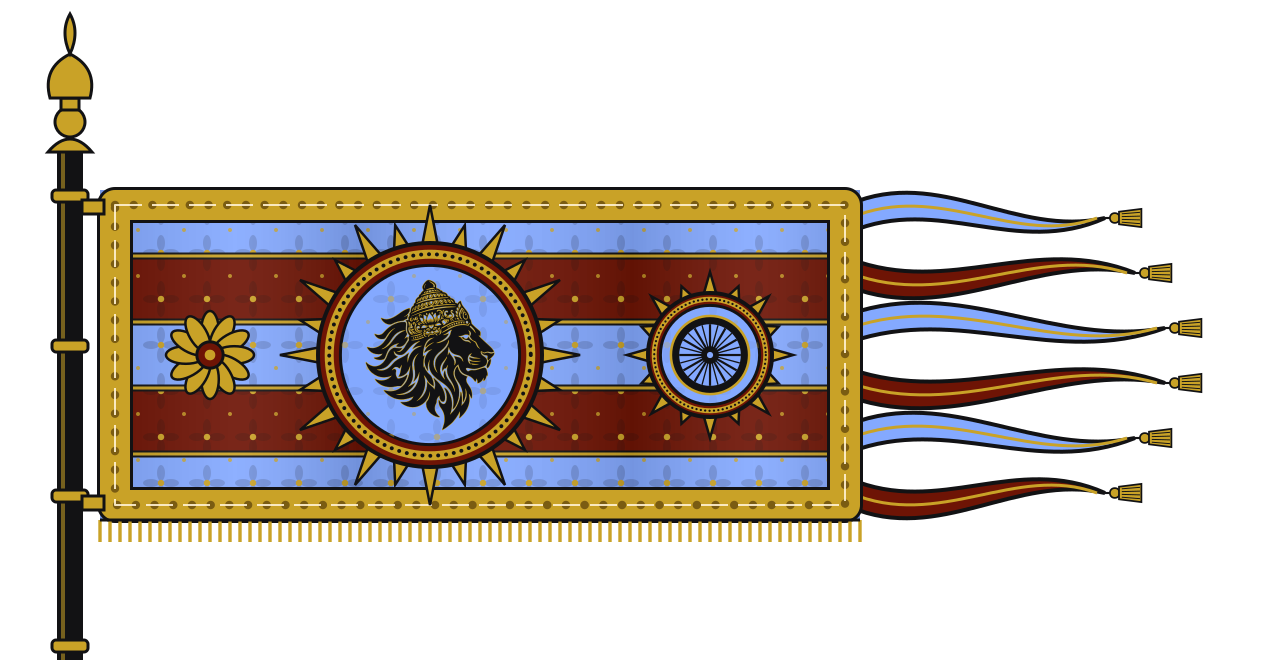
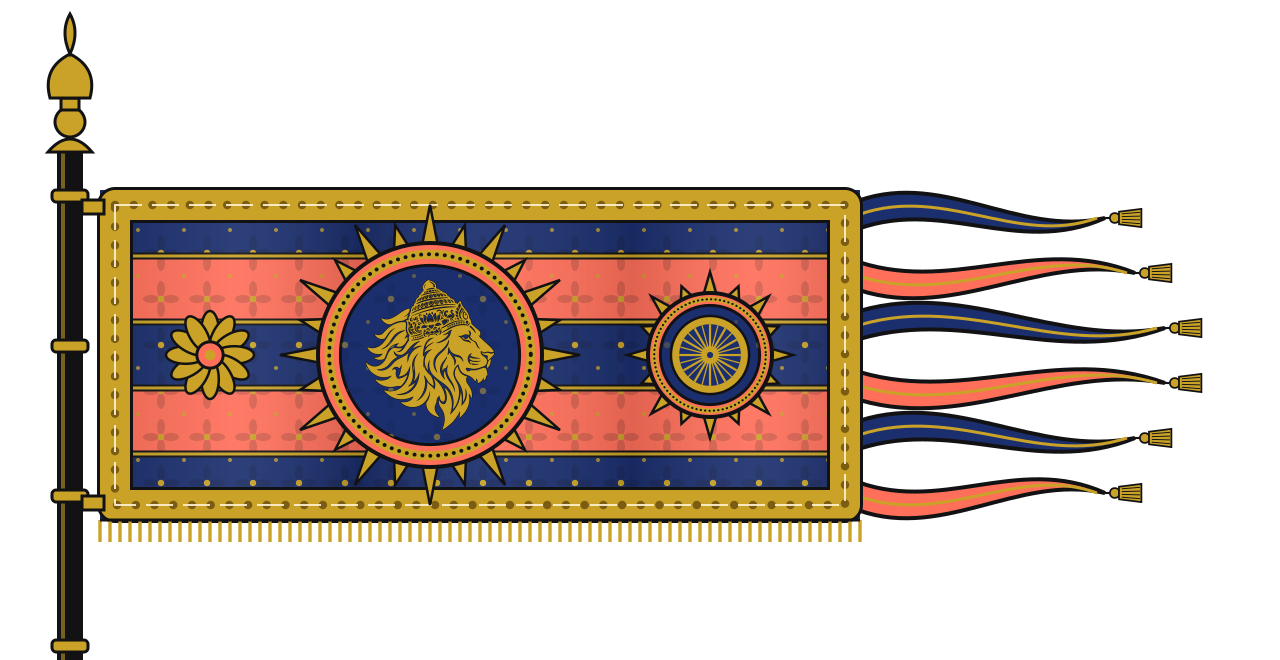
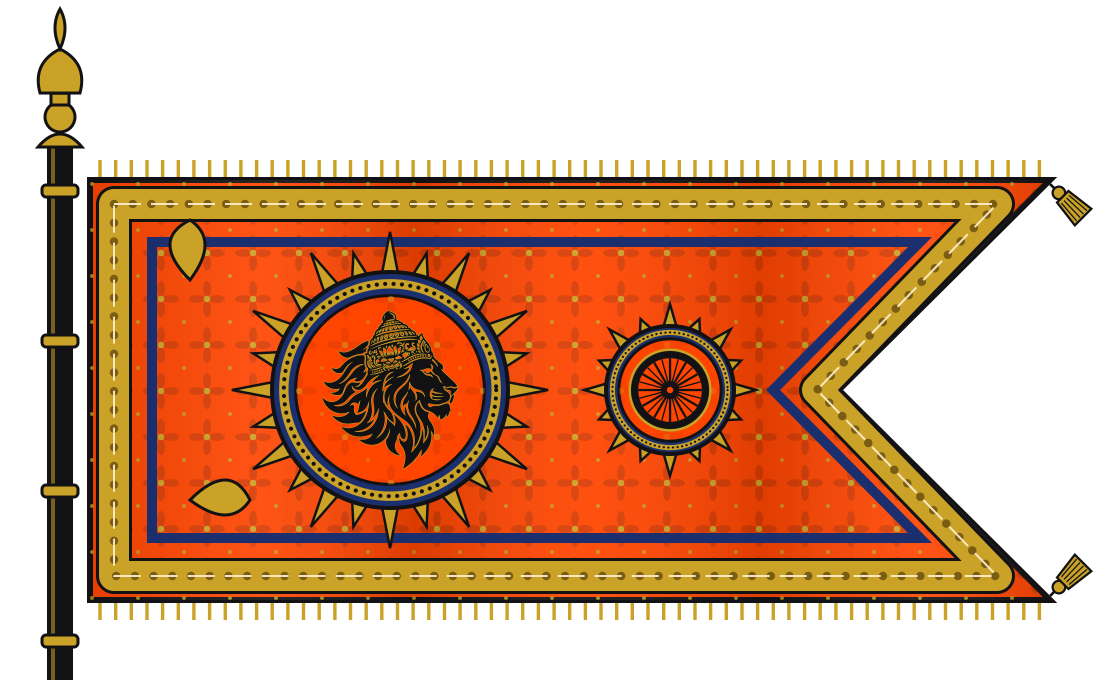
The Atlas gives the Magadhas a crowned lion and a wheel, recalling the lion capital of the Maurya empire that grew out of Magadha. The flag is a Vaijayanti, the banner of victory, for the realm that conquered its neighbours.
| Part of the kit | This clan |
|---|---|
| Field | Royal Navy #1B2F6E |
| Accent | Warm Red-Orange #FF6F59 |
| Emblem colour | Metallic Gold #C9A227 |
| Zari metal | Gold |
| Main emblem | A crowned lion |
| Second image | A wheel |
| Night and day | Every visual accessory has two versions: by night the emblem on the dark field, by day the clan's field colour on cloth woven from its metal. |
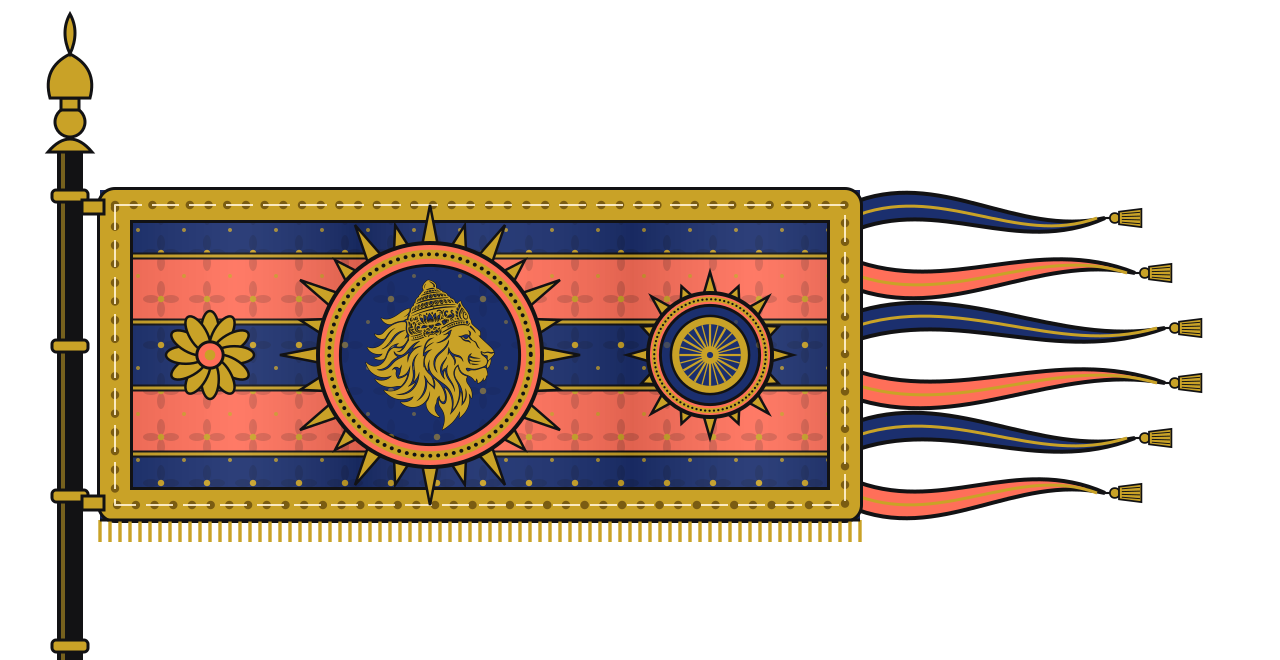
6. Flags
Every clan has every flag type; the type says the occasion and the colours say the clan. The outlined card is the flag the Atlas assigns.
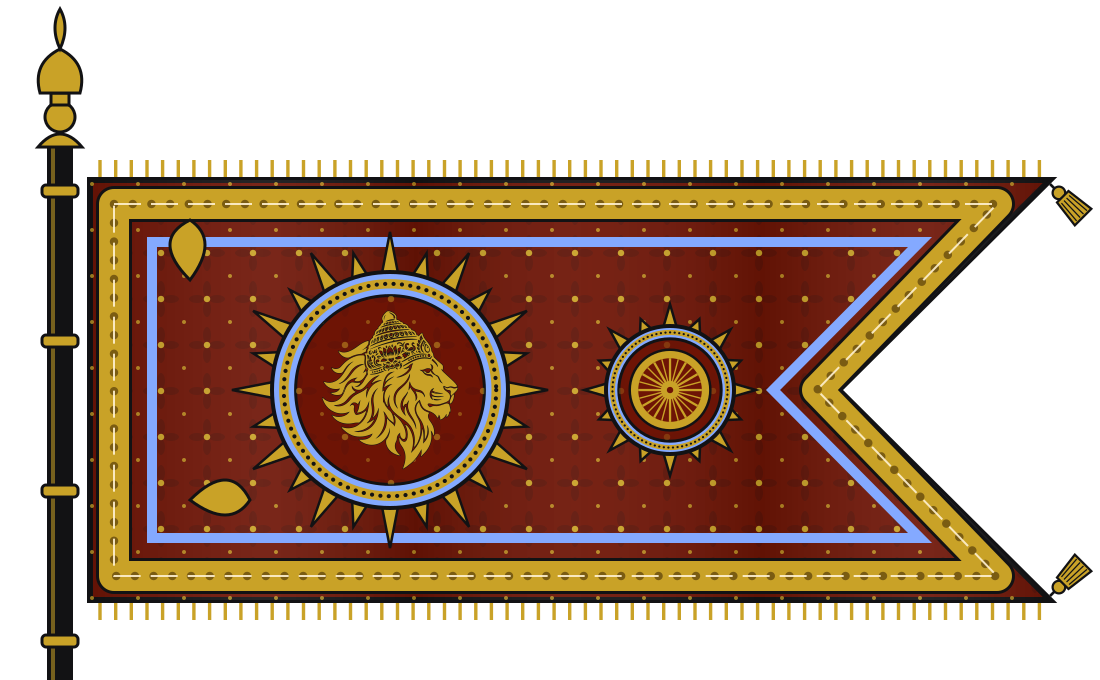
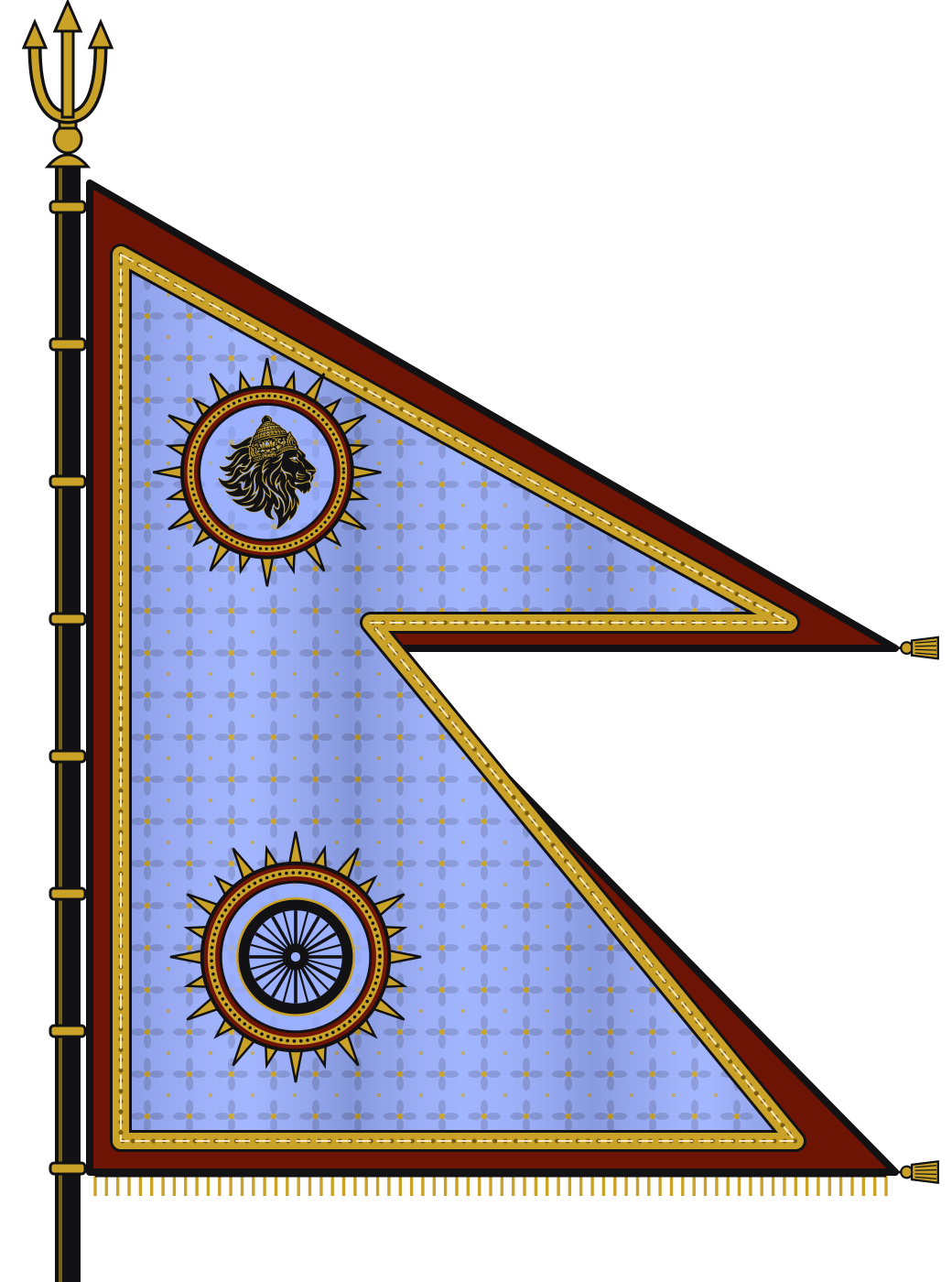
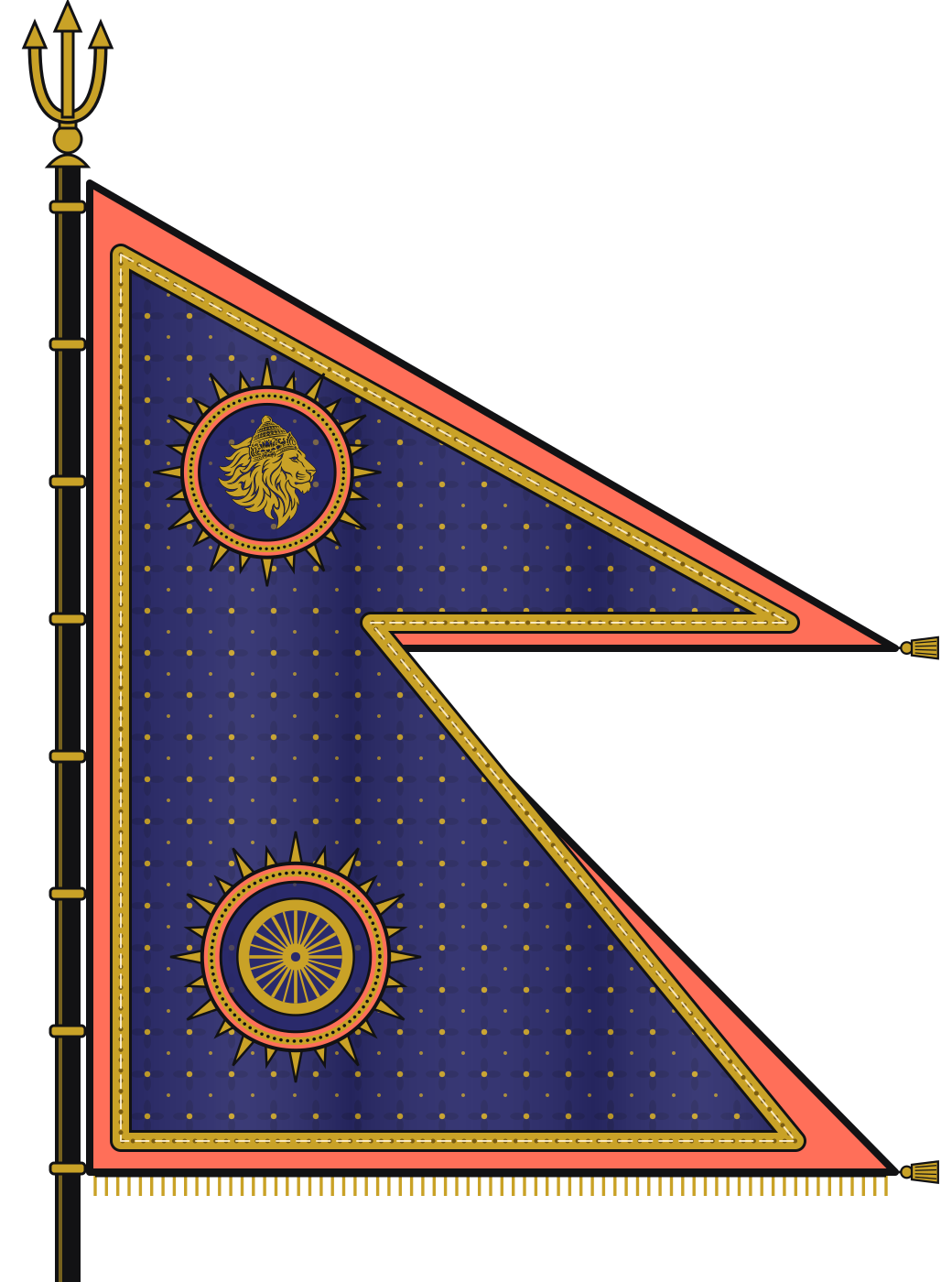



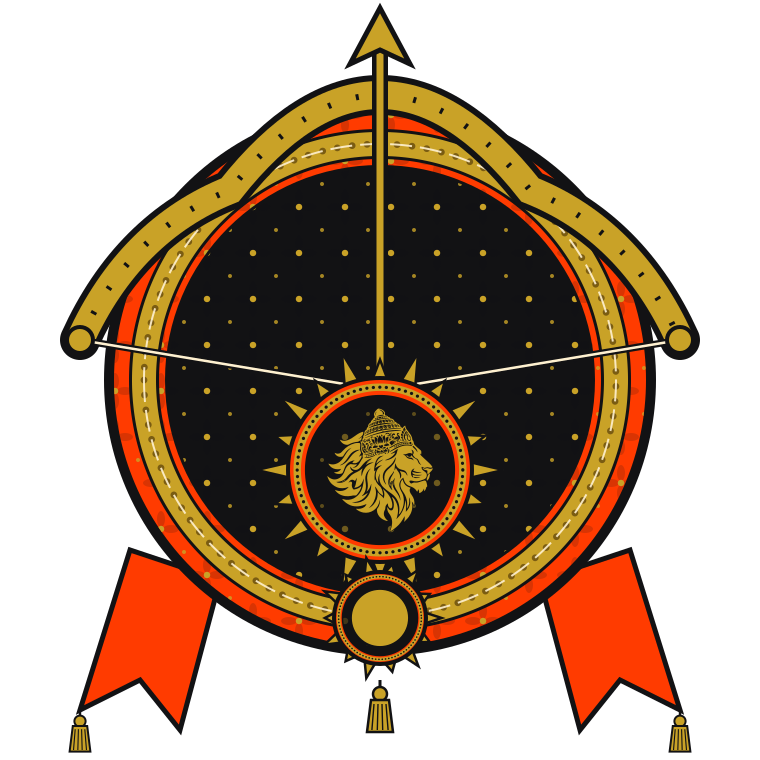
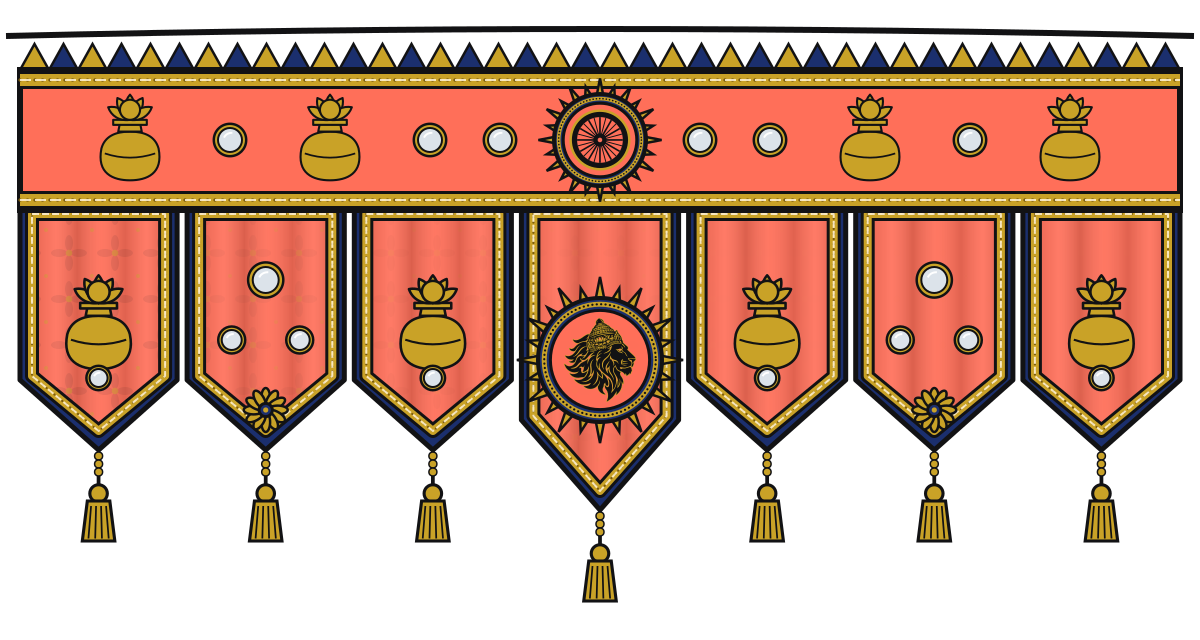
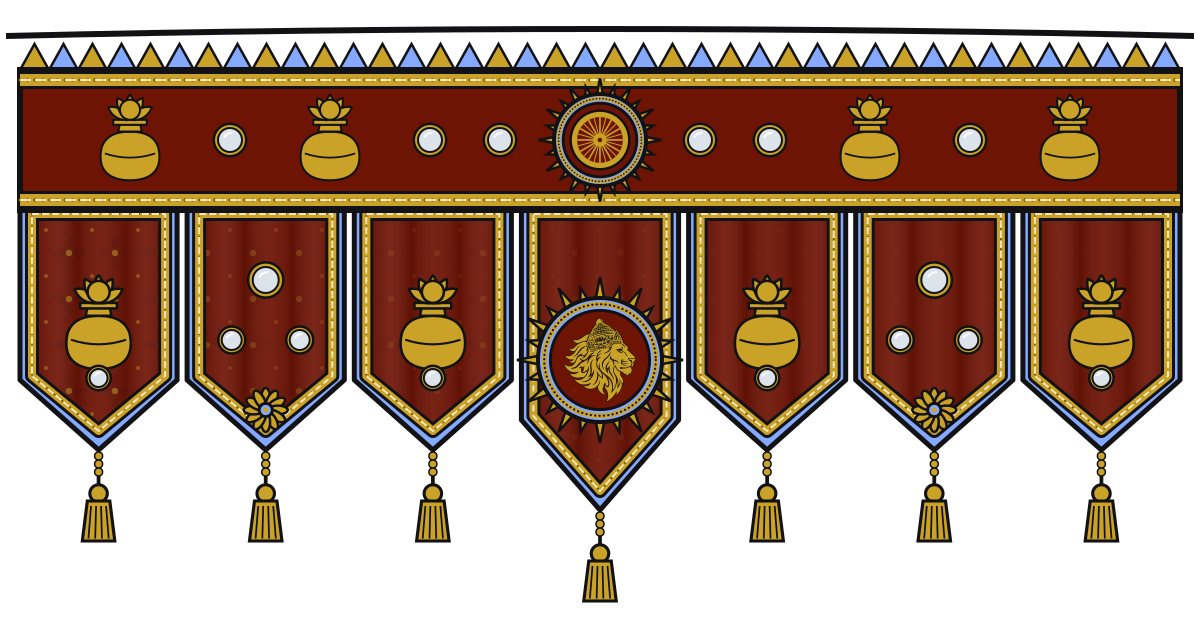

Historic banner
The Mauryan lion capital of Ashoka (Magadha) is India's national emblem today
New flag types
| Accessory | For this clan | Basis |
|---|---|---|
| A9 Pota-dhvaja · ship and trade flag For ships, caravans and markets | Not yet designed for this clan | Design |
| A10 Utsava-patāka · festival flag Light, bright flag for fairs and festivals | Not yet designed for this clan | Design |
| A11 Shoka-dhvaja · mourning flag White cloth with the emblem outline in the clan's metal | Not yet designed for this clan | Design |
7. Regalia
| Accessory | For this clan | Basis |
|---|---|---|
| E1 Chhatra · house parasol The ceremonial umbrella | Not yet designed for this clan | Design |
| E2 Chamara · fly-whisks The pair of whisks beside the head of the house | Not yet designed for this clan | Design |
| E3 Danda · staff of office Staff or scepter | Not yet designed for this clan | Design |
| E4 Simhasana · seat The seat of the house, covered in clan cloth | Not yet designed for this clan | Design |
| E5 Khetaka · shield A round shield; the Changi and Dhanush are its flag forms | Not yet designed for this clan | Regional tradition |
| E6 Kula-ayudha · clan weapon The weapon the clan honours | Not yet found for this clan | Under research |
8. Worn
| Accessory | For this clan | Basis |
|---|---|---|
| F1 Kula-vastra · clan cloth The clan's woven pattern in its kit colours | Not yet designed for this clan | Design |
| F2 Kirti-vastra · honour cloth A cloth earned for a deed, not inherited | Not yet designed for this clan | Design |
| F3 Kula-mala · garland flower The flower or leaf the clan wears as a garland | Not yet found for this clan | Under research |
| F4 Chinha · house pin A metal badge with the pin emblem | Not yet designed for this clan | Design |
9. Records
| Accessory | For this clan | Basis |
|---|---|---|
| H1 Clan words A traditional line in the native script | न हि वेरेन वेरानि सम्मन्तीध कुदाचनं · “Never here is hatred calmed by hatred” | Design |
| H2 Biruda · titles The house's title or titles | Not yet found for this clan | Under research |
| H3 Prashasti · praise genealogy The lineage as written at the head of a grant | Not yet found for this clan | Under research |
| H4 Vahi · clan register The book of the clan's births, marriages and deaths | Not yet found for this clan | Under research |
| H5 Rana-ghosha · war cry The clan's cry in battle or celebration | Not yet found for this clan | Under research |
10. VishwaVit · knower of the world
Game values are design choices for this project, not historical claims.
References
- Anguttara Nikaya — the list of sixteen Mahajanapadas.
- Magadha (Wikipedia, read 2026-10-08), citing J. Bronkhorst, Greater Magadha (2007), M. Witzel (1987, 1995), H. C. Raychaudhuri (1953), R. C. Majumdar (1977), J. Keay, India: A History (2011) and K. T. S. Sarao (2003).
- Haryanka dynasty (Wikipedia, read 2026-10-08), citing U. Singh, A History of Ancient and Early Medieval India (2016), the Mahavamsa, and N. Shah, Jainism: The World of Conquerors (2004).
- Dhammapada (Pali Canon, Khuddaka Nikaya), verse 5 — “na hi verena verāni sammantīdha kudācanaṃ”.
- Mangla Gauri Temple (Wikipedia, read 2026-10-08) — Shakti Peetha on Mangalagauri hill, Gaya; Puranic mentions.
- Rajgir (Wikipedia, read 2026-10-08), citing B. C. Law, Rajagriha in Ancient Literature (1938), K. Ray (2001) and Census 2011 — sites, walls, temples, legends and fairs.
- Bhagavati Sutra — birth of Makkhali Gosala at Saravana near Shravasti; Makkhali Gosala.
- Brahmi script — earliest datable use in Ashoka's inscriptions (3rd century BCE).
- Magahi language (Wikipedia, read 2026-10-08), citing Census of India 2011, S. Verma (2001, 2003) and S. K. Verma, Magahi Folklore and Folk Tales (2008).
- Maurya Empire (Wikipedia, read 2026-10-08), drawing on Megasthenes' Indica (in later quotations), Ashoka's edicts, R. Thapar, H. Kulke and D. Rothermund, and T. R. Trautmann.
- Magahis (Wikipedia, read 2026-10-08): folk-song genres, ballads, festivals and crafts of the Magadh region.
- Lion Capital of Ashoka (Wikipedia, read 2026-10-08), citing F. O. Oertel, “Excavations at Sarnath” (1908), D. R. Sahni's catalogue (1914), J. Marshall (1922), J. Irwin (1973) and F. Asher.
- Samyutta Nikaya, Kosala Samyutta (SN 3) — King Pasenadi, his sacrifice (Yañña Sutta, SN 3.9) and the wars with Ajatashatru (SN 3.14–15).
- Kosala (Wikipedia, read 2026-10-07), citing G. Samuel, The Origins of Yoga and Tantra (2010) and R. Thapar, The Past Before Us (2013).
- Pradyota dynasty (Wikipedia, read 2026-10-08), citing K. C. Jain (1972, 1974), V. A. Smith (1957), H. C. Raychaudhuri (1953) and P. D. Gune (1920).
- G. P. Malalasekera, Dictionary of Pali Proper Names, Pukkusati/Gandhara (Association for Insight Meditation copy, updated 8 Oct 2020), read 2026-10-10, https://aimwell.org/DPPN/gandhara.html
- Wikipedia, Pushkarasarin, read 2026-10-10, https://en.wikipedia.org/wiki/Pushkarasarin (citing Raychaudhuri 1953, Lamotte 1988, Karttunen 1989)
- Wikipedia, Gandhāra (kingdom), read 2026-10-10, https://en.wikipedia.org/wiki/Gandh%C4%81ra_(kingdom) (citing Raychaudhuri 1953, Macdonell and Keith 1912, Karttunen 1989, Young CAH, Higham 2014)
- G. P. Malalasekera, Dictionary of Pali Proper Names, Gandhara entry (palikanon.com copy), read 2026-10-10, https://palikanon.com/namen/g/gandhaara.htm
- Ancient Buddhist Texts, Great Chronicles of Buddhas, ch. 36 ‘King Pukkusati and Others’ (based on MN 140 and its commentary), read 2026-10-10, https://ancient-buddhist-texts.net/English-Texts/Great-Chronicles/36.htm
- G. P. Malalasekera, Dictionary of Pali Proper Names, Pukkusati (Association for Insight Meditation copy), read 2026-10-22, https://aimwell.org/DPPN/pukkusati.html
- Majjhima Nikaya 140 Dhatuvibhanga Sutta, trans. Bhikkhu Sujato (a-buddha-ujja.hu copy), read 2026-10-22, https://a-buddha-ujja.hu/mn-140/en/sujato
- Majjhima Nikaya 140 Dhatuvibhanga Sutta (Pali with English, Buddha's Word copy), read 2026-10-10, https://dhamma.gift/bw/mn/mn140.html (translator not named)
- Kalinga War (Wikipedia, read 2026-10-08), citing Ashoka's Rock Edict XIII, R. P. Mohapatra, Military History of Orissa (1986) and D. K. Chakrabarti (2010).
- Ashoka, Rock Edict II — the Pandyas beyond the empire.
- Kharavela (Wikipedia, read 2026-10-08) — the Hathigumpha inscription year by year, citing K. P. Jayaswal, R. D. Banerji, D. C. Sircar, N. K. Sahu and S. Chattopadhyaya.
- Taxila (Wikipedia, read 2026-10-09), citing J. Marshall, Taxila (1951) and A Guide to Taxila (1960), A. Cunningham (1871), R. K. Mookerji (1951), H. Scharfe (2002), R. Thapar (1997) and U. Singh (2008).
- Northern Black Polished Ware — c. 700–200 BCE; sites include Shravasti and Ayodhya.