The Lodha are a Scheduled Tribe and PVTG living mainly in Paschim Medinipur and Jhargram in West Bengal, and in Mayurbhanj and Cuttack in Odisha[1][2][3]. The 2011 Scheduled Tribe lists give 108,707 for the West Bengal row, which also carries Kharia, and 9,785 for Odisha[4][5]. Under British rule the community was branded a criminal tribe, a label the Government of India abolished in 1952[6][7]. The main deity named in the sources is Barham Mata, worshipped on Chatrya Sankranti and 1 Magh in the open under a large old tree, with clan totems such as the tiger, tortoise and fish[7].
01Faith and deities
Main deity named by Mandal and Sengupta (2013), also called Vanadevi, with a lion as vehicle[7]
Kichakeswari of Khiching, Mayurbhanj royal goddess
The presiding goddess of the clan's homeland or capital: a link of place, not a recorded clan tie.
| Deity or tradition | Place in the clan's life | Evidence |
|---|---|---|
| Barham Mata (Vanadevi) | Main deity; open-air shrine under a large old tree; a lion as vehicle | [7] |
| Sitala | Widely worshipped | [7] |
| Clan deities and totems | Tiger, tortoise, Gangetic dolphin (susuk), sal fish, sol fish, pomfret (chanda machh), makar, moon and chirka aloo | [7] |
| Shiva and Chandi | Deities whose ire is believed to cause suffering, as Deb reports Bhakta's book | [8] |
| Rama and Krishna | Feature in the cultural imagination through Vaishnavism, as Deb reports Bhakta's book | [8] |
| Kichakeswari | KulDevi and homeland shrine: Kichakeswari of Khiching, Mayurbhanj royal goddess (from the Atlas, not a web source) | From the Atlas |
02Temples
Barham Mata's shrine is in the open under a large old tree[7]. Who built it and when is under research. No other Lodha temple is in the extracts.
Built by the clan
Not recorded.
Given patronage or grants by the clan
Not recorded.
03Languages and scripts
| Language or script | Kind | Under the clan | Evidence |
|---|---|---|---|
| Bengali living | Language | Most Lodha speak Bengali or Odia; no distinct mother tongue (census) | [1] |
| Odia living | Language | Listed in the Wikipedia infobox; Lodhas typically speak Bengali or Odia (census) | [1] |
| Sadri | Language | Listed in the Wikipedia infobox; no detail in the extracts | [1] |
| Lodhi | Language | Listed in the Wikipedia infobox; no detail in the extracts | [1] |
| Kharia | Language | Listed in the Wikipedia infobox | [1] |
| Munda languages | Language family | Lodha language family | From the Atlas |
04Books and literature
Deb's review calls Bhakta's 2024 book possibly one of the first extensive auto-ethnographic studies by a Lodha Sabar author[8].
Written during the clan's history
| Work | Author | Kind | When | Link to the clan |
|---|---|---|---|---|
| The Lodhas of West Bengal: A Socio-Economic Study | Prabodh Kumar Bhowmick | Socio-economic study | 1963 | [1] |
| Rehabilitation of a Denotified Community | Prabodh Kumar Bhowmick | Article | 1981 | [1] |
| Particularly Vulnerable Tribal Groups of India | Kolay and Khatua | Book | 2024 | [1] |
| 'Lodha' (photo handbook) | Ota and Sahoo | Photo handbook | 2010 | [1] |
| Paschim Banger Sanskriti I | Ghosh | Bengali book | 1976 | [1] |
| Tribal Tribune | Guha | Journal | 2014 | [1] |
| South Asian Anthropologist | Panda and Guha | Journal | 2013 | [1] |
| Society, Culture and Indigenous Worldview of Lodha Sabar People | Prahlad Kumar Bhakta | Ethnography (translated from Bengali) | 2024 | [8] |
| Contemporary Livelihood Scenario of Lodha Tribal Community in Paschim Medinipur District | Bhanu Kumar Mandal and Subhankar Sengupta | Journal article | 2013 | [7] |
| Ph.D. thesis on the information needs of the Lodha (Savara) | Supriya Mallik | Ph.D. thesis | 2019 | [6] |
Given patronage by the clan
Not recorded.
05Thinkers and scholars
| Name | Field | Era | Contribution |
|---|---|---|---|
| Prabodh Kumar Bhowmick | Calcutta University | 1963, 1981 | Studies of the Lodhas; Wikipedia calls them 'one of the most important studies'[1] |
| Proggya Ghatak | Tribal identity | 2011 | Tribal identity among the Savara and the Lodha[1] |
| Abhijit Guha and Santanu Panda | Development | Not dated | Work on the development of the Lodha[1] |
| L. P. Vidyarthi | Under research | 1978 | Named by Wikipedia; work not in the extracts[1] |
| Supriya Mallik | Information needs | 2019 | Ph.D. thesis on the information needs of the Lodha of Paschim Medinipur[6] |
| Prahlad Kumar Bhakta | Ethnography | 2024 | Society, culture and worldview of the Lodha Sabar[8] |
| Bhanu Kumar Mandal and Subhankar Sengupta | Livelihood | 2013 | Livelihood scenario of the Lodha in Paschim Medinipur[7] |
Vidyasagar University's Department of Anthropology studied Lodha development in Medinipur (Wikipedia).
06Art and architecture
No Lodha painting, sculpture or textile is in the extracts. Deb's review says Bhakta's book has a chapter on dwellings, implements, ceremonial objects and women's roles in performances, with no detail given[8].
Painting and wall art
Not recorded.
Sculpture and temple art
Not recorded.
Temple and building architecture
Not recorded.
Weaving and textiles
Not recorded.
Clothing and jewellery
Not recorded.
Coins, pottery and crafts
| Art form | What it is | Era | Evidence |
|---|---|---|---|
| Shal-leaf plates | Shal leaves collected for plates and for bidi (traditional work) | Traditional work, per Mandal and Sengupta | [7] |
| Snake charming | Practised as traditional work | Traditional work, per Mandal and Sengupta | [7] |
07History
Origins as recorded
The 1901 census report records migration of Lodhas, possibly from modern Madhya Pradesh[7]. No earlier origin is given in the extracts.
Wikipedia gives the name 'Lodha' as meaning 'piece of flesh', traced to their ancestor; the page credits no source[1].
Jangal Mahal and British rule
The Mandal and Sengupta paper dates the Jangal Mahal struggle to the mid-18th century[7]. Wikipedia says the British oppressed forest-dependent peoples of the Jungle Mahals, that revolts were 'ruthlessly suppressed', and that Lodhas were deprived of their livelihood and branded a criminal tribe; the page argues they should be called 'uprooted rebels' (no source credited)[1].
Deb's review of Bhakta's book says resistance to British rule led to the 'Criminal Tribes' label, and that the Sabar community is part of the Denotified Tribes[8]. Mallik's preface also describes the Lodha as designated a 'Criminal Tribe' under British rule[6].
After 1952
The Government of India abolished the 'Criminal Tribe' label in 1952[7]. The same paper records a 1961 clash between Lodhas and Mahatos, and between Lodhas and Santals[7].
Rehabilitation centres in undivided Midnapur were at Dholkat Pukuria, Daharpur, Kukai and Dhansol[7].
Counts since 1901
Census counts as Wikipedia prints them (West Bengal / Odisha): 1901 8,173 / no figure; 1911 7,403 / no figure; 1931 11,001; 1941 11,641; 1951 8,346; 1961 40,898 / 2,370; 1971 45,906 / 3,891; 1981 53,718 / 5,100; 1991 68,095 / 7,458; 2001 84,966 / 8,905; 2011 108,707 / 9,785[1].
08Journey and migrations
The only movement the extracts record is the 1901 census's note of migration from possibly modern Madhya Pradesh[7].
| When | From | To | Why | Evidence |
|---|---|---|---|---|
| Recorded in the 1901 census report | Possibly modern Madhya Pradesh | Not given in the extracts | Not given in the extracts | [7] |
09Seats and lands
| Place | Role | Where today |
|---|---|---|
| Paschim Medinipur | Main Lodha district: 469 Lodha-dominated villages in 20 blocks[7]; 51,772 Lodhas in 2011[1] | West Bengal |
| Jhargram | Named with Paschim Medinipur as the main concentration[2][1] | West Bengal |
| Mayurbhanj | Suliapada and Morada blocks of Baripada sub-division[1]; 5,523 Lodhas in 2011 (footnote)[1] | Odisha |
| Cuttack | Listed as a Lodha district in the KISS handbook[3] | Odisha |
10Notable figures
| Name | Role | Era | Known from |
|---|---|---|---|
| Chuni Kotal | First Lodha woman graduate; fought the colonial stigma. Deb's review of Bhakta's book names a Chuni Kotal of the Sabar community | Under research (no date in the extracts) | From the Atlas;[8] |
11Allies, rivals and marriages
| People | Relationship | When |
|---|---|---|
| Savar (Sabar, Shabar) | Honorific forms of the Lodha name[1]; Lodha-Shabar and Kheria-Shabar are separate endogamous groups with different customs[9] | Not dated |
| Kharia | Counted in the West Bengal row with Lodha ('Lodha, Kharia, Kharia'); Wikipedia says the count includes Kharia, which is not separately recognised as ST in West Bengal[1][4] | 2011 list |
| Munda | Listed as a related group in the Wikipedia infobox[1]; Lodha language family is Munda | Not dated |
| Santal | Take part with Lodha in the Shikar Utsav hunts[10]; Deb's review reports hostility from Santhal and non-tribal communities, with growing support from progressive Santhals[8] | 2025 (hunts) |
| Oraon | Take part with Lodha in the Shikar Utsav hunts[10] | 2025 |
| Bhumij | Met in fieldwork in Paschim Medinipur, Jhargram and Bankura with the Lodha and Savara[6] | Thesis, 2019 |
| Asura | Possibly the same people as the Lodha, according to Sarat Chandra Roy (cited in the Panchakot paper)[9] | Not dated |
| Savara | Mallik's thesis uses 'Savara' for the Lodha; the Atlas lists Savara (ST-286) as Saora. The link is open (see open questions)[6] | — |
12Society and livelihood
The community is male-dominated, with the father as head of the household, and a priest called Dehri or Dihri serves it[7].
Government and social order
| Institution or group | What it was | Evidence |
|---|---|---|
| Dehri or Dihri | Priest of the community[7] | [7] |
| Titles used as clan names | Clan names in the Clans section; Wikipedia says the titles are credited to Ghosh (1976)[1] | [1] |
| Lodha Sabar Kalyan Samity | A community organisation named in the Mandal and Sengupta paper[7] | [7] |
Livelihood over time
| Era | Livelihood | Evidence |
|---|---|---|
| Pre-colonial | Self-sufficiency on forest products[7] | [7] |
| Colonial period | Colonial policy alienated forest land, and forest livelihoods were lost[7][1] | [7] |
| Traditional work | Collecting Shal leaves for plates and bidi; trapping lizards and snakes; snake charming[7] | [7] |
| Lodha Sabar, per Deb's review | Hunting, foraging, sericulture and seasonal work; household borrowing cycles[8] | [8] |
13Sub-clans and related clans
The sources name these clan titles of the Lodha. Mandal and Sengupta list eight clans in their table, though the paper says nine[7]. Wikipedia gives titles credited to Ghosh (1976) that match most of these (Bhokta for Bhakta), adds Sardar and omits Arhi[1].
| Clan | Relation | Where | Size | In the Atlas | Evidence |
|---|---|---|---|---|---|
| Bhakta (Bhukta) | Sub-clan | Clan in the Mandal and Sengupta table; Wikipedia gives the title as Bhokta; also used by Sabars (Wikipedia) | new clan candidate | [7][1] | |
| Mallik (Mallick) | Sub-clan | Clan in the Mandal and Sengupta table; a title in Wikipedia; also used by Sabars (Wikipedia) | new clan candidate | [7][1] | |
| Kotal | Sub-clan | Clan in the Mandal and Sengupta table; a title in Wikipedia; also used by Sabars (Wikipedia). The Atlas also has a Kotal row, ST-533, as the gotra of the Hill Kharia; not linked here | same name as ST-533: check | [7][1] | |
| Digar | Sub-clan | Clan in the Mandal and Sengupta table; a title in Wikipedia; also used by Sabars | new clan candidate | [7][1] | |
| Nayek (Layek) | Sub-clan | Clan in the Mandal and Sengupta table; a title in Wikipedia; also used by Sabars | new clan candidate | [7][1] | |
| Bhunia (Bhunya) | Sub-clan | Clan in the Mandal and Sengupta table; a title in Wikipedia; also used by Sabars | new clan candidate | [7][1] | |
| Dandapat (Bag) | Sub-clan | Clan in the Mandal and Sengupta table; a title in Wikipedia; also used by Sabars | new clan candidate | [7][1] | |
| Arhi (Ahri) | Sub-clan | Clan in the Mandal and Sengupta table only | new clan candidate | [7] | |
| Sardar | Sub-clan | A title in Wikipedia (credited to Ghosh 1976); not in the Mandal and Sengupta table | new clan candidate | [1] | |
| Savar (Sabar) | Related people | Honorific forms of the Lodha name; separate endogamous groups Lodha-Shabar and Kheria-Shabar (Panchakot) | ST-285 | [9][1] | |
| Kharia (Kheria) | Related people | Counted with Lodha in the West Bengal row; Panchakot treats Kharia as a separate group | ST-130 | [1][4] | |
| Munda | Related people | Related group in the Wikipedia infobox | ST-229 | [1] |
Clans marked "new clan candidate" are not in the Atlas yet.
14Surnames
The surnames in the extracts are the same titles. No bearer count is sourced, so none is given.
| Surname | Clan or sub-clan | Where | People with this surname | Also used by other communities |
|---|---|---|---|---|
| Bhakta | Bhakta (Bhukta) | Mandal and Sengupta clan table; Wikipedia gives Bhokta | not yet counted | Yes |
| Mallik | Mallik (Mallick) | Mandal and Sengupta clan table; Wikipedia gives Mallick | not yet counted | Yes |
| Kotal | Kotal | Mandal and Sengupta clan table; Wikipedia title | not yet counted | Yes |
| Digar | Digar | Mandal and Sengupta clan table; Wikipedia title | not yet counted | Yes |
| Nayek | Nayek (Layek) | Mandal and Sengupta clan table; Wikipedia title | not yet counted | Yes |
| Bhunia | Bhunia (Bhunya) | Mandal and Sengupta clan table; Wikipedia gives Bhunya | not yet counted | Yes |
| Dandapat | Dandapat (Bag) | Mandal and Sengupta clan table; Wikipedia title | not yet counted | Yes |
| Arhi | Arhi (Ahri) | Mandal and Sengupta clan table only | not yet counted | No |
| Sardar | Sardar | Wikipedia title | not yet counted | Yes |
Counts are of everyone with the surname, from the cited source and year, not only members of this clan. A surname shared with other communities says nothing about any one person's origin.
15Songs and music
The extracts name no Lodha song by title. Deb's review says a chapter of Bhakta's 2024 book covers secular songs and Vaishnavite religious songs of love, loss and longing, with no lyrics given[8].
Secular and Vaishnavite songs (a chapter of Bhakta's book)
16Poems, lullabies and children's rhymes
None recorded yet.
17Stories, legends and proverbs
Stories and legends
Not recorded.
Proverbs and sayings
Not recorded.
18Festivals and fairs
| Festival or fair | When | Where | What happens |
|---|---|---|---|
| Barham Mata worship living | Chatrya Sankranti and 1 Magh | Her open-air shrine under a large old tree | Clay toys of tigers, elephants and horses are offered[7] |
| Shikar Utsav (hunting festivals) living | January to June; about 50 a year (Meghna Banerjee) | The hunting festivals of the region | Lodha take part with Santal, Oraon and Sabar. The hunts face court orders and a 1972 wildlife law[10] |
19Food, dress and games
Food
Not recorded.
Dress
Not recorded.
Games and martial arts
Not recorded.
Tags: living still practised · revived brought back after a break · lost known only from records · research reported but not yet confirmed from a source. Songs and poems under copyright are listed by title only; restricted or sacred material is noted without its content.
20Status today
A living Scheduled Tribe and PVTG of West Bengal and Odisha, with 108,707 in the West Bengal row and 9,785 in Odisha in 2011, mainly in Paschim Medinipur and Jhargram (West Bengal) and in Mayurbhanj (Odisha)[4][5].
Not yet reviewed by the community.
21For children
The Lodha of the forest edge
The Lodha live mainly in Paschim Medinipur and Jhargram in West Bengal, and in Mayurbhanj and Cuttack in Odisha. They are a Scheduled Tribe, and the government also calls them a particularly vulnerable group. For a long time they lived on what the forest gave them. They collect Shal leaves to make plates. Their main deity is Barham Mata, and her shrine stands in the open under a large old tree. On Chatrya Sankranti, people offer her clay toys of tigers, elephants and horses.
22Across the project
| Project | What carries this clan | Status |
|---|---|---|
| Atlas of the Janas | Homeland areas to pin: Paschim Medinipur and Mayurbhanj (pin not yet set) | To set |
| KulDevi and GrahDevi | Kichakeswari of Khiching, Mayurbhanj royal goddess | From the Atlas |
| Planet naming | Under research | — |
| Renaming and waters | Under research | — |
23Open questions
- The Bengali name form is not in any cached extract; add a cited source before printing a native-script name.
- The Odisha list has a separate row, 'Shabar (Lodha)', with 516,402 (Wikipedia), and the OSTM page treats Shabar-Lodha as one tribe. How this row relates to the Lodha row (9,785) is open.
- The West Bengal row 'Lodha, Kharia, Kharia' (108,707) includes Kharia (Wikipedia). A Lodha-only figure for West Bengal is under research.
- The Atlas gives the alias 'Kheria (West Bengal)'; Panchakot treats Kharia as a separate group. Which is right for the West Bengal Lodha is open.
- Mallik's 2019 thesis calls the Lodha 'Savara'; the Atlas lists Savara (ST-286) as Saora, a different people. The link is open.
- Mandal and Sengupta say nine clans but their table lists eight; Sardar comes from Wikipedia only. Clan sizes are not sourced.
- The Kotal title is also the gotra of the Hill Kharia in the Atlas (ST-533). The link is not made here.
- Chuni Kotal: the Atlas calls her a Lodha; Deb's review of Bhakta's book calls a Chuni Kotal Sabar. Which community she belongs to is open.
- Pre-colonial history, inscriptions and the Madhya Pradesh origin (1901 census) are not confirmed by a second source. Risley (1915) is a lead, not yet fetched.
- Who built Barham Mata's shrine and when is under research.
- No line of the Lodha's own words is in the extracts, so the clan words are open. A cited line is needed.
- Astitva: no coin, seal, instrument, war cry or record book is documented for the Lodha in the extracts. Leads: Bhakta (2024), Ghosh (1976), Ota and Sahoo (2010).
- The Lodha's own songs, poems, rhymes and tales are not in the extracts. The kids' rhyme is not written, because no cited traditional rhyme exists.
- Community review of this page is still needed.
- PVTG status: the page calls the Lodha still a PVTG[1], but the Odisha State Tribal Museum page on Shabar-Lodha does not list that group among the PVTGs[11]. Whether the PVTG status covers the Odisha row is open.
- Ho (Odisha) population: the Wikipedia list gives 806,008[5], the KISS handbook 80,608[3]. Both figures sit in the spillover; which is right is open.
24Astitva
अस्तित्व · being, existence: everything by which the clan is known
Mandal and Sengupta (2013) record the Lodha's totem-linked clan deities and the open tree-shrine of Barham Mata[7]. Wikipedia credits a list of titles to Ghosh (1976)[1].
Every clan has every accessory, royal objects included. Each one says how it is known: Documented This clan's own object is recorded. · Regional tradition Recorded for the region or for peoples like this one, not for this clan. · Design Made for this project, with no historical claim. · Under research To be found for this clan from sources. Legends and titles are written in the clan's own script.
1. Seals and coins
| Accessory | For this clan | Basis |
|---|---|---|
| B1 Rajamudra · house seal Round seal with the clan emblem and a short legend in the clan's script | Not yet designed for this clan | Design |
| B2 Anguliya-mudra · signet ring Personal seal ring of the head of the house | Not yet designed for this clan | Design |
| B3 Chhapa · house stamp Ink or block stamp for letters, goods and cloth | Not yet designed for this clan | Design |
| B4 Tamrapatra · charter plate Copper-plate grant on a ring, closed with the house seal | Not yet designed for this clan | Design |
| B5 Shreni-mudra · guild or trade seal Seal for the clan's trade, craft or caravan | Not yet designed for this clan | Design |
| C1 Clan coin Emblem or deity on one side, a legend in the clan's script | Not yet designed for this clan | Design |
| C2 Coin die The die that strikes the coin | Not yet designed for this clan | Design |
2. Living symbols
| Accessory | For this clan | Basis |
|---|---|---|
| I1 Totem trio The tree, bird and animal the clan protects | Tiger, tortoise, Gangetic dolphin, sal fish, sol fish, pomfret, makar and moon: clan deities and totems | Documented |
| I2 Kaval-maram · guardian tree The tree that stands at the clan's seat | Barham Mata's shrine, in the open under a large old tree | Documented |
3. Stone and gate
| Accessory | For this clan | Basis |
|---|---|---|
| G1 Torana · gateway The built gate of the seat; the cloth Toran hangs in it | Not yet designed for this clan | Regional tradition |
| G2 Viragallu · hero stone Carved panel stone for a member who died defending the clan | Not yet designed for this clan | Regional tradition |
| G3 Kula-shila · clan stones Standing and table stones that remember the ancestors | Not yet designed for this clan | Design |
| G4 Jayastambha · victory pillar A pillar raised for a victory | Not yet designed for this clan | Design |
| G5 Sima-shila · boundary stone Marks the clan's land, with a line in the native script | Not yet designed for this clan | Design |
4. Sounds
| Accessory | For this clan | Basis |
|---|---|---|
| D1 Pancha-mahashabda · five great sounds The right to five instruments | Not yet designed for this clan | Design |
| D2 Shankha · clan conch The clan's own named war conch | Not yet designed for this clan | Design |
| D3 Murasu · house drums Three drums: war, charity and justice | Not yet designed for this clan | Design |
5. Kit: colours, metals and emblems
The Lodha's main emblem (a broken chain) and second image (a book) are design choices, not recorded symbols. The recorded symbols are the totems and the tree-shrine under Living symbols.
| Part of the kit | This clan |
|---|---|
| Field | Deep Brick #7E2A1E |
| Accent | Intense Electric Blue #84A9FF |
| Emblem colour | Metallic Gold #C9A227 |
| Zari metal | Gold |
| Main emblem | A broken chain |
| Second image | A book |
| Night and day | Every visual accessory has two versions: by night the emblem on the dark field, by day the clan's field colour on cloth woven from its metal. |
6. Flags
Every clan has every flag type; the type says the occasion and the colours say the clan. The outlined card is the flag the Atlas assigns.
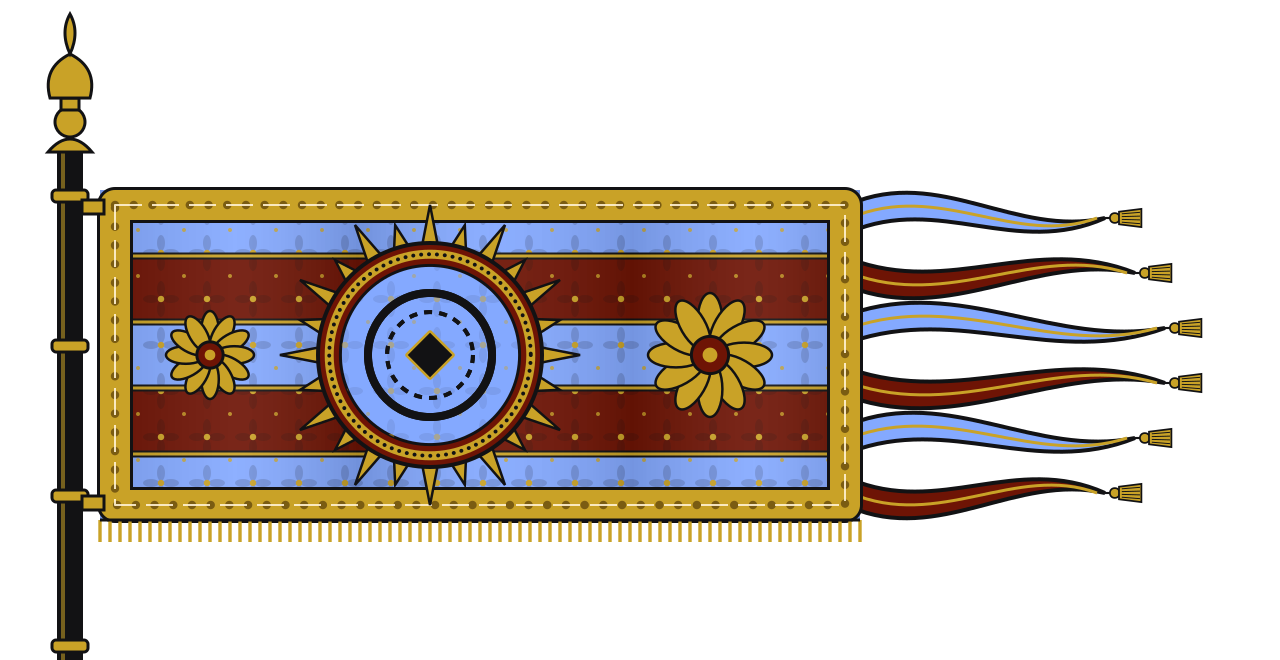
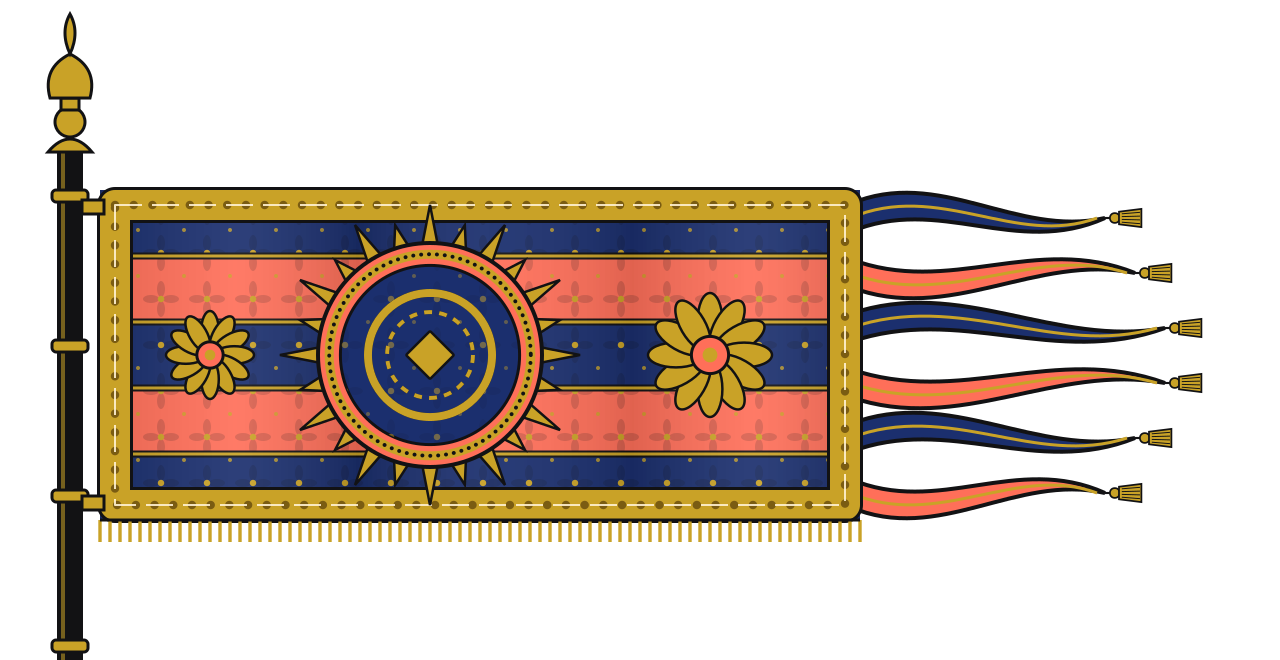
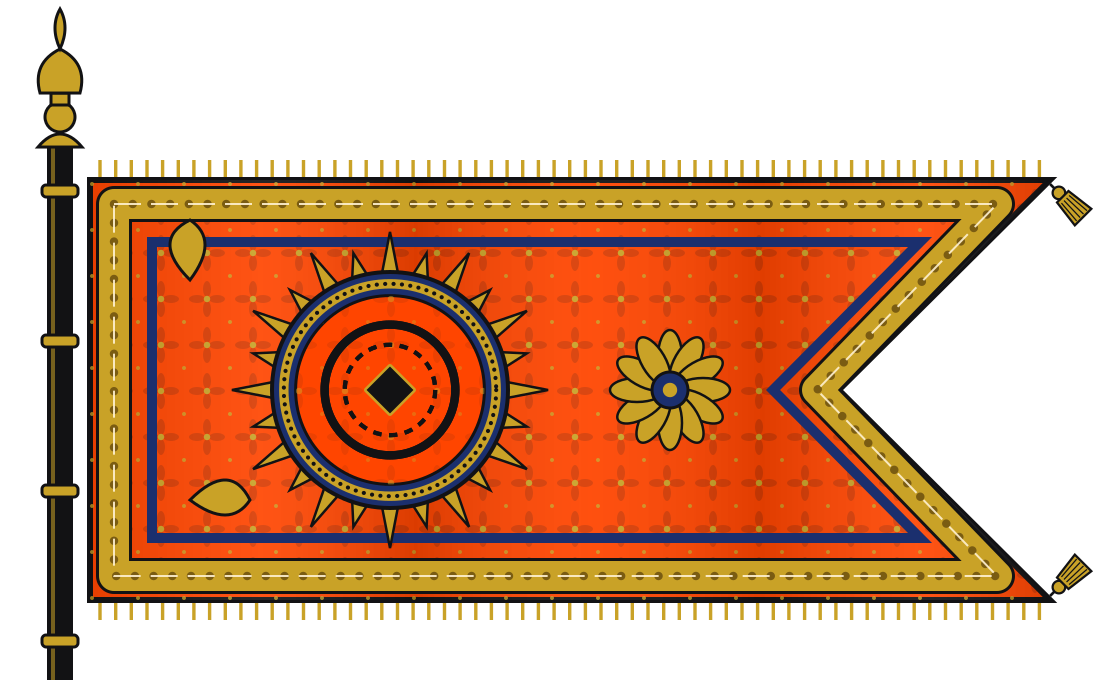
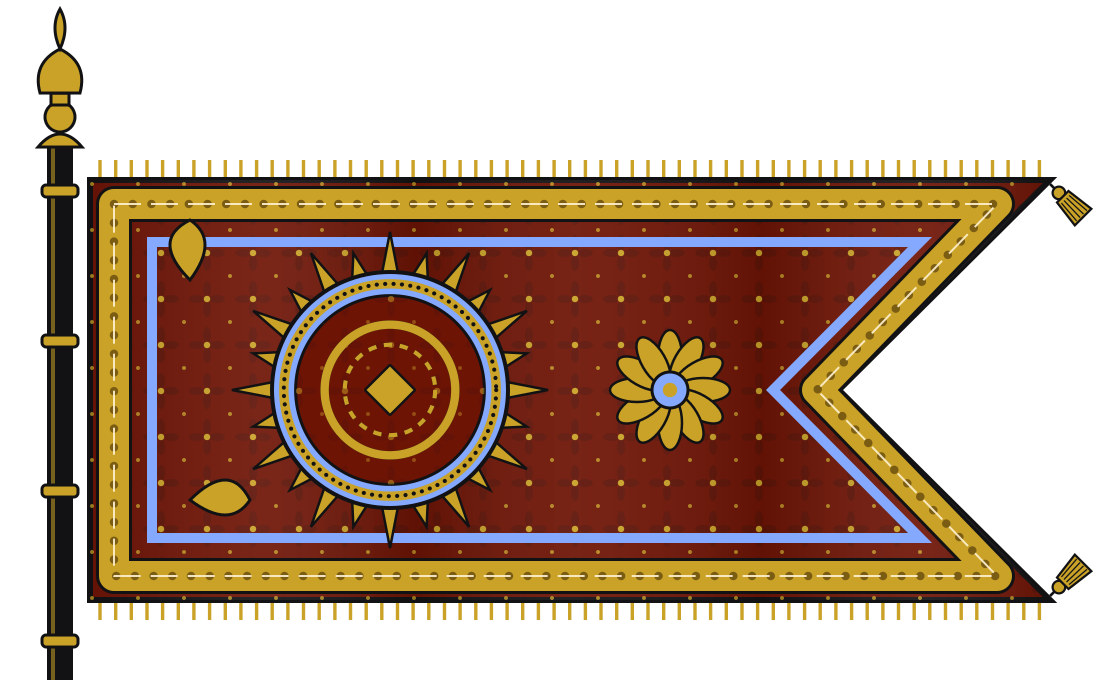
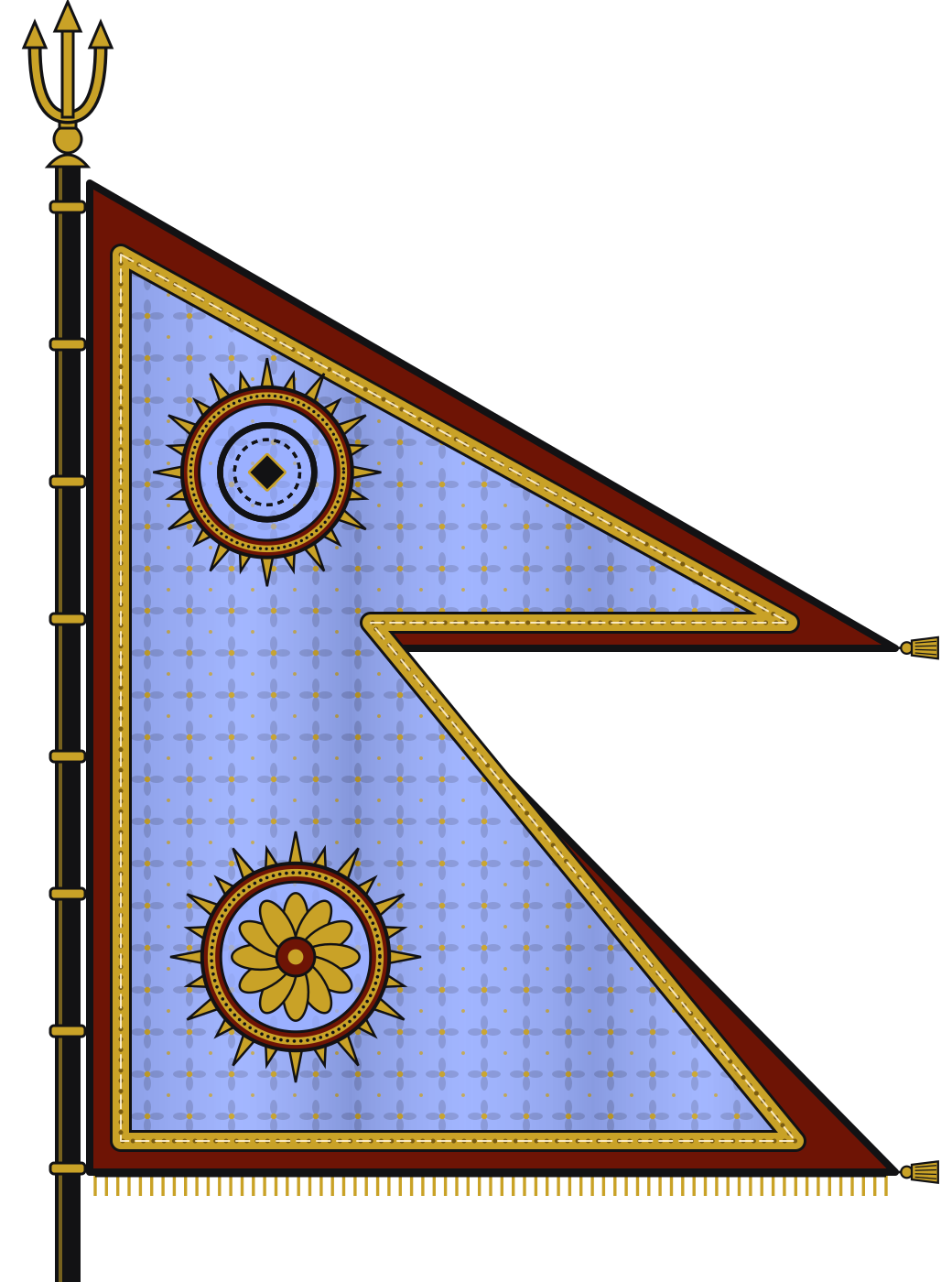
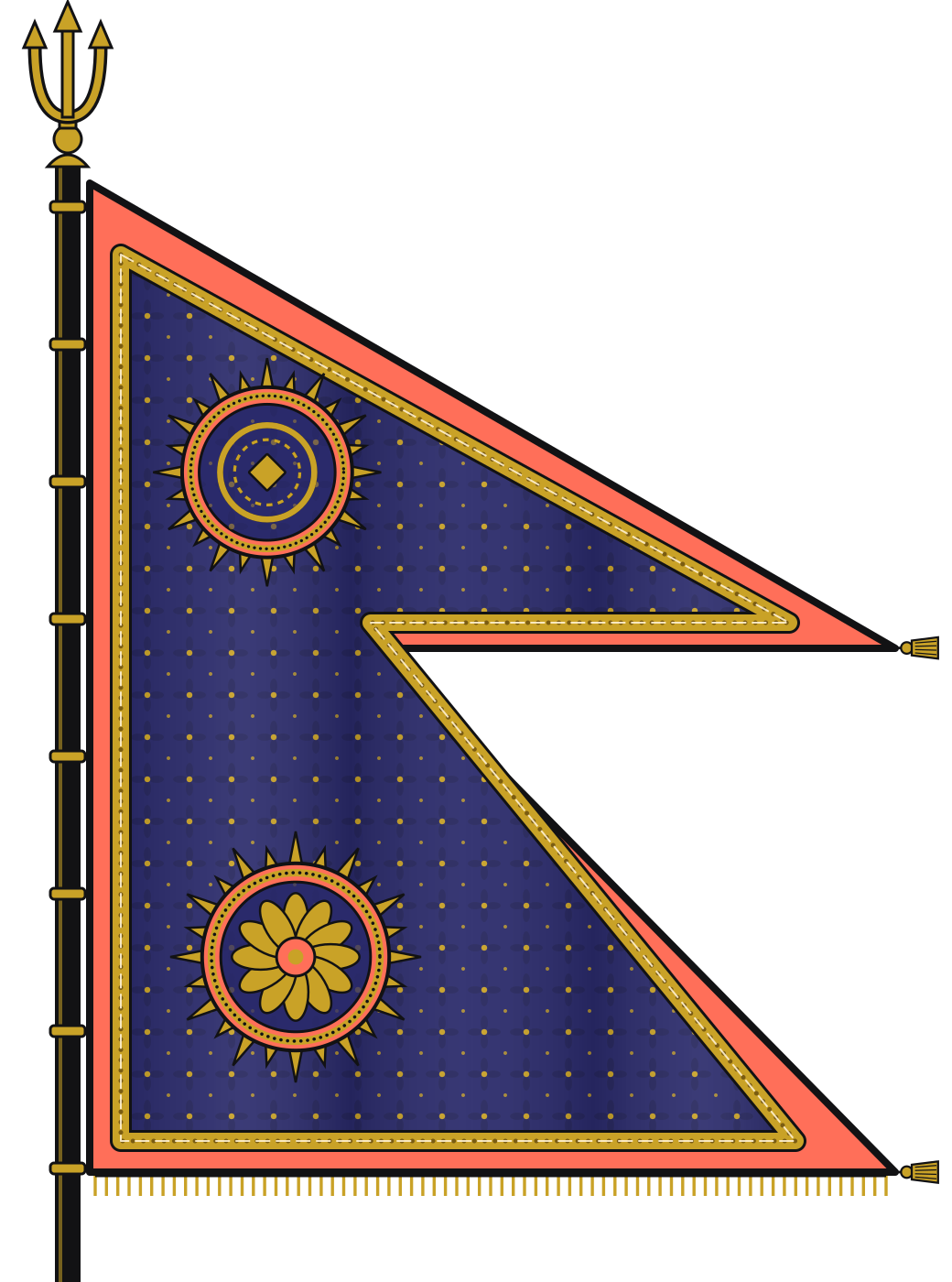

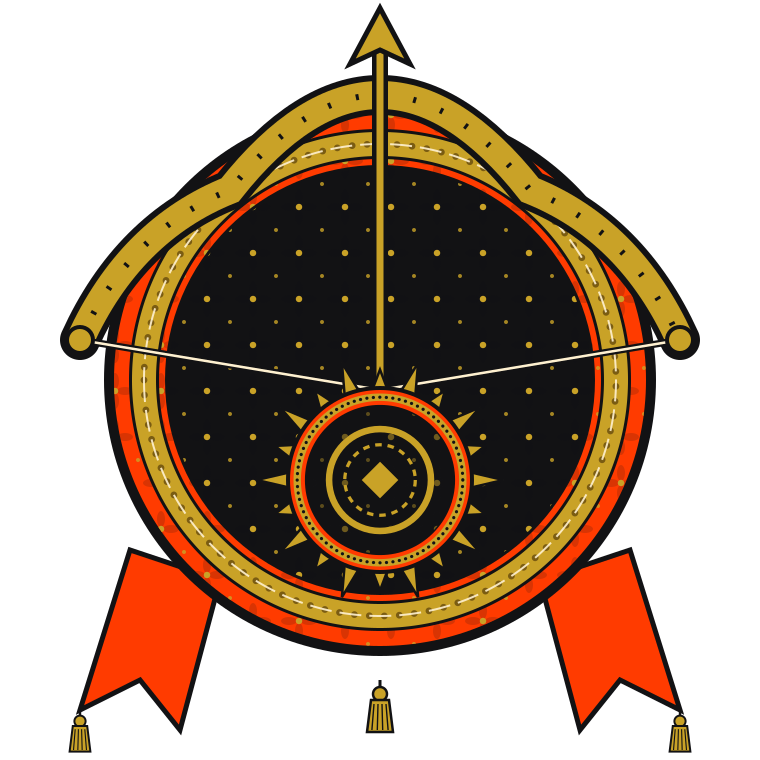
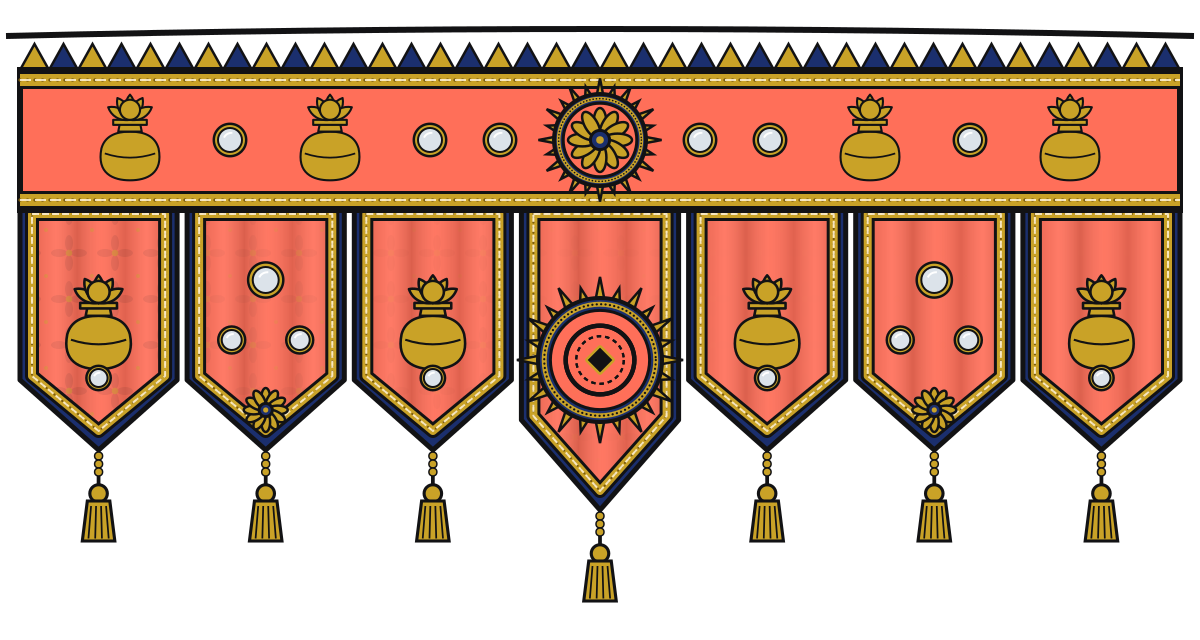
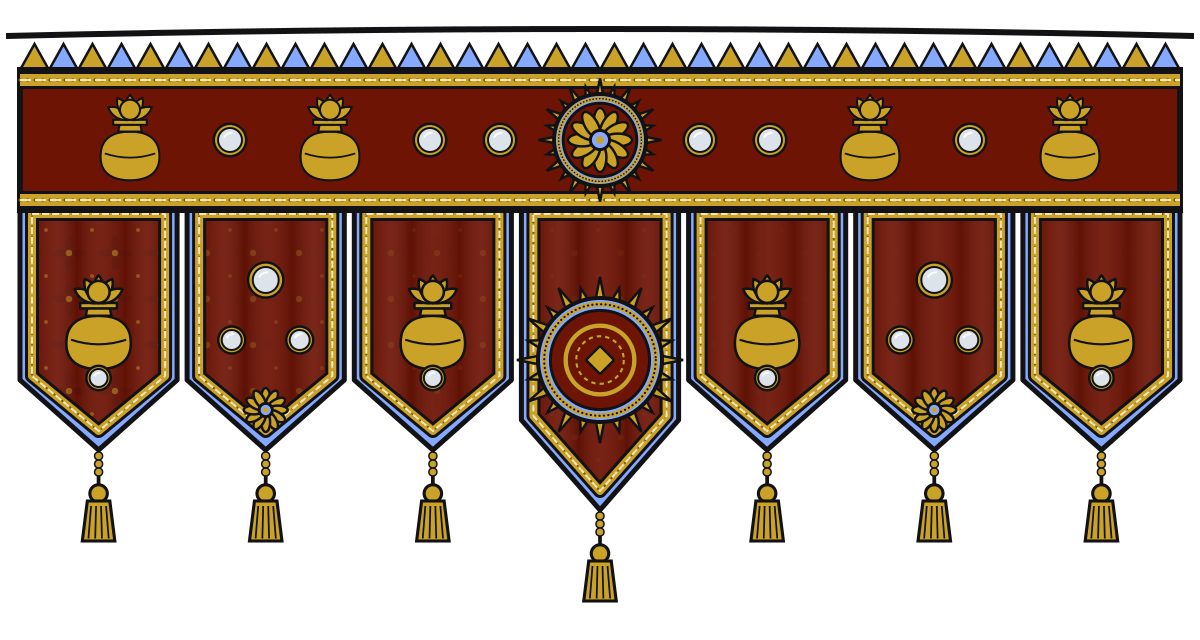

Historic banner
None known
New flag types
| Accessory | For this clan | Basis |
|---|---|---|
| A9 Pota-dhvaja · ship and trade flag For ships, caravans and markets | Not yet designed for this clan | Design |
| A10 Utsava-patāka · festival flag Light, bright flag for fairs and festivals | Not yet designed for this clan | Design |
| A11 Shoka-dhvaja · mourning flag White cloth with the emblem outline in the clan's metal | Not yet designed for this clan | Design |
7. Regalia
| Accessory | For this clan | Basis |
|---|---|---|
| E1 Chhatra · house parasol The ceremonial umbrella | Not yet designed for this clan | Design |
| E2 Chamara · fly-whisks The pair of whisks beside the head of the house | Not yet designed for this clan | Design |
| E3 Danda · staff of office Staff or scepter | Not yet designed for this clan | Design |
| E4 Simhasana · seat The seat of the house, covered in clan cloth | Not yet designed for this clan | Design |
| E5 Khetaka · shield A round shield; the Changi and Dhanush are its flag forms | Not yet designed for this clan | Regional tradition |
| E6 Kula-ayudha · clan weapon The weapon the clan honours | Spears, bows, catapults, axes, sticks and snares used by hunters in the festival hunts (general, not Lodha-only) | Regional tradition |
8. Worn
| Accessory | For this clan | Basis |
|---|---|---|
| F1 Kula-vastra · clan cloth The clan's woven pattern in its kit colours | Not yet designed for this clan | Design |
| F2 Kirti-vastra · honour cloth A cloth earned for a deed, not inherited | Not yet designed for this clan | Design |
| F3 Kula-mala · garland flower The flower or leaf the clan wears as a garland | Not yet found for this clan | Under research |
| F4 Chinha · house pin A metal badge with the pin emblem | Not yet designed for this clan | Design |
9. Records
| Accessory | For this clan | Basis |
|---|---|---|
| H1 Clan words A traditional line in the native script | · “” Under research: no line of the Lodha's own words is in the extracts, and no cited line is linked to this people yet (see open questions). | Design |
| H2 Biruda · titles The house's title or titles | Titles: Nayek, Mallick, Digar, Sardar, Bhokta, Kotal, Dandapat, Bhunya (credited to Ghosh 1976) | Documented |
| H3 Prashasti · praise genealogy The lineage as written at the head of a grant | Not yet found for this clan | Under research |
| H4 Vahi · clan register The book of the clan's births, marriages and deaths | Not yet found for this clan | Under research |
| H5 Rana-ghosha · war cry The clan's cry in battle or celebration | Not yet found for this clan | Under research |
10. VishwaVit · knower of the world
Game values are design choices for this project, not historical claims.
References
- Wikipedia, Lodha people, read 2026-10-26, https://en.wikipedia.org/wiki/Lodha_people
- Vajiram and Ravi, Tribes of West Bengal, read 2026-10-21, https://vajiramandravi.com/current-affairs/tribes-of-west-bengal/
- Sushree Mohanty, Indigenous Colours of Odisha: Handbook on 62 Tribes (KISS), read 2026-10-20, link
- Wikipedia, List of Scheduled Tribes in West Bengal, read 2026-10-21, https://en.wikipedia.org/wiki/List_of_Scheduled_Tribes_in_West_Bengal
- Wikipedia, List of Scheduled Tribes in Odisha, read 2026-10-20, https://en.wikipedia.org/wiki/List_of_Scheduled_Tribes_in_Odisha
- Supriya Mallik, Ph.D. thesis preface on the Lodha (Savara) of Paschim Medinipur, Vidyasagar University, Nov 2019, read 2026-10-26, https://ir.vidyasagar.ac.in/jspui/bitstream/123456789/5449/5/05_Preface.pdf
- Bhanu Kumar Mandal and Subhankar Sengupta, Contemporary Livelihood Scenario of Lodha Tribal Community in Paschim Medinipur District, West Bengal, Panchakot Says 4(1), May 2013, read 2026-10-26, https://journal.panchakotmv.ac.in/published/paper_full_text/133481668873415.pdf
- Nilanjana Deb, review of P. K. Bhakta, Society, Culture and Indigenous Worldview of Lodha Sabar People, Journal of the Department of English (Jadavpur University) vol. 19, 2026, read 2026-10-26, https://ir.vidyasagar.ac.in/jspui/bitstream/123456789/7873/1/11%20Book%20Review.pdf
- Panchakot Mahavidyalaya journal, paper on the Shabar of Purulia (full text PDF), read 2026-10-22, https://journal.panchakotmv.ac.in/published/paper_full_text/969401668329252.pdf
- Nabarun Guha, Efforts to end ritualistic hunting results in reduced kills, Mongabay India, 7 May 2025, read 2026-10-10, link
- Odisha State Tribal Museum, Shabar-Lodha, read 2026-10-22, https://ostm.in/tribes_of_odisha/shabar-lodha/