The Lepcha, who call themselves Rong or Rongkup, are a Tibeto-Burman people living in Sikkim, Darjeeling and Kalimpong, with communities in Nepal and Bhutan[1]. Their own account places the first people in Mayel Lyang, a valley near Kanchenjunga, and they hold no migration tradition, though scholars have proposed routes from Cambodia or Tibet[2][3][1]. Their mother-creator Itbu-mu shaped the world and humans[3], and Mun and Bongthing priests still perform the rites[4]. The Constitution (Sikkim) Scheduled Tribe Order of 1978 listed the Lepchas as a Scheduled Tribe[4].
01Faith and deities
The Atlas's KulDevi, documented as the Lepcha creator mother-goddess[5][4][6]. The Tribal Research Institute names Nozyongnyu the chief goddess[4], and the Salesian study names the creator as a god, Etboo-Deboorum[2]. The Itbumoo rank is therefore the sheet's choice, with that dispute noted.
Creator mother-goddess of the Lepcha
A recorded tie between the clan and the goddess.
| Deity or tradition | Place in the clan's life | Evidence |
|---|---|---|
| Nozyongnyu | Chief goddess (Tribal Research Institute) | [4] |
| Narok Rum | God of Lepcha music | [4][2] |
| Satap Rum | God of hailstorms; winter prayers against storms in January | [4] |
| Ethbu Rum | Worshipped at Tendong | [4] |
| Khangchendzonga (Kongchen Kongchlo, Kanchenjunga) | Guardian deity; offerings at the Chyu Rum Faat; regarded as the elder brother | [7][6][4] |
| Fudongthing and Nazong Nyu | First man and first woman; Nazong Nyu is the guardian deity | [6][2] |
| Mayel Kyong and seven immortal couples | Paradise; honoured at the Sakyoo Rum Faat | [4] |
| Sha So Ro K Rok; Zo nyo kung | Protects minor domestic animals; grandmother of rice | [6] |
| Lee Rum | House god, honoured at the Lee Rum Faat | [4] |
| Mung spirits | Cruel spirits born of a goddess's neglected children; honoured with offerings; Sor moong causes miscarriages | [2][6][3] |
| Guru Rimpoche | Honoured at monastery festivals twice a month | [3] |
02Temples
No temple built by the Lepcha is recorded in the extracts. Domang Monastery, founded by Yongdzin Jinpa Gyatso, is named by Sahapedia, but the extract does not say which people built or used it[6].
Built by the clan
Not recorded.
Given patronage or grants by the clan
| Temple | Deity | What the clan gave | When | Where |
|---|---|---|---|---|
| Village gompas | Buddhist; Guru Rimpoche and Kanchenjunga | Monastery festivals twice a month, for up to 36 hours | First monasteries toward the end of the 17th century | Most villages[3] |
03Languages and scripts
| Language or script | Kind | Under the clan | Evidence |
|---|---|---|---|
| Lepcha (Rong, Róng) living | Tibeto-Burman; self-name Rong; Nepali named as the everyday language | Official in Sikkim under the Sikkim Official Language Act, 1977[3][4] | |
| Róng (Lepcha) script living | Abugida derived from Tibetan; letters ᰀ (ka), ᰂ (kha), ᰃ (ga), ᰅ (nga); child script Limbu | [8][1] | |
| Rong Aaring (Divine Language); Rong Aming and Rong Chyoming | Named as the language and its two scripts, described as symbolically male and female | [9] | |
| Lepcha language teaching living | No West Bengal government school teaches Lepcha; about 40 night schools | [9] |
04Books and literature
Lepcha-language grammars, dictionaries and song books have been published since 1876. The sources name Lepcha authors for several.
Written during the clan's history
| Work | Author | Kind | When | Link to the clan |
|---|---|---|---|---|
| First Lepcha grammar | G. B. Mainwaring | Grammar | 1876 | [4] |
| First Lepcha–English dictionary | G. B. Mainwaring | Dictionary | 1898 | [4] |
| Rongg Arok Chhukalbo | Not named | First reader | 1961 | [4] |
| First Lepcha–Hindi–English dictionary | D. C. Luksom | Dictionary | 1983 | [4] |
| Mayel Lyang (magazine, title as printed; 'Renjyong mutanchi Ringmom Kurmom') | Not named | Magazine | 1978 | [4] |
| Rong Dungit Vom | Sonam Tshering Lepcha | Book | 1977 | [4] |
| Kayu Rong Vom Chhyo | Hildamit Lepcha | Songbook | 1986 | [4] |
| Lepcha Language Book | Launched at the Tendong festival | Language book | 2017 | [10] |
| A Grammar of Lepcha | Plaisier | Grammar | 2007 | [1] |
| Lepcha: My Vanishing Tribe | Foning | Study | 1987 | [1] |
| Himalayan Lepchas | Thakur | Study | 1988 | [1][3] |
| The Lepchas: Culture and Religion of a Himalayan People, Part 1 | Halfdan Siiger | Study | 1967 | [6] |
| Legends of the Lepchas | Doma | Legends | 2023 | [1] |
| The Lepcha Script, Acta Orientalia 24, pp. 107–122 | Haarh | Article | Vol. 24 (year not given) | [8] |
| Achuley | Quarterly magazine | Magazine | Not dated | [9] |
Given patronage by the clan
Not recorded.
05Thinkers and scholars
| Name | Field | Era | Contribution |
|---|---|---|---|
| Halfdan Siiger | Culture and religion (his 1967 book) | Fieldwork at Tingvong, Dzongu, late 1940s | The Lepchas, Part 1 (1967)[6] |
| G. B. Mainwaring | Language | 1876 and 1898 | First Lepcha grammar (1876) and dictionary (1898)[4] |
| D. C. Luksom | Language | 1983 | First Lepcha–Hindi–English dictionary[4] |
| Plaisier | Language | 2007 | A Grammar of Lepcha (2007)[1] |
| Thikúng Munsulóng | Script | Not dated | Possibly credited with developing the script[1] |
| K. P. Tamsang, B. C. Roy, R. K. Sprig, L. S. Tamsang, A. K. Fonning, Patrick Sada | Scholars named in Sāhitya (2025) | Modern | Named as scholars; the extract does not describe their work[9] |
| Hooker, Hunter, Risley, Nebesky | Origin theories | 1854 to 1965 | Origins of the people cited by the Tribal Research Institute[4] |
Lodrick (Worldmark, Gale) is the encyclopedia entry used on this page[3].
06Art and architecture
Weaving, basketry, dance and stilt-house building are the living arts named in the sources. No painting, sculpture or temple art is recorded. Dances named on Wikipedia, without description: Zo-Mal-Lok, Chu-Faat, Tendong Lo Rum Faat and Kinchum-Chu-Bomsa[1].
Painting and wall art
Not recorded.
Sculpture and temple art
Not recorded.
Temple and building architecture
| Art form | What it is | Era | Evidence |
|---|---|---|---|
| Stilt houses (li) | Log-and-bamboo houses on stilts, built without nails | Undated | [1] |
Weaving and textiles
| Art form | What it is | Era | Evidence |
|---|---|---|---|
| Weaving | Woven cloth; no clan pattern is named in the extracts | Undated | [1] |
Clothing and jewellery
Not recorded.
Coins, pottery and crafts
| Art form | What it is | Era | Evidence |
|---|---|---|---|
| Basketry | Basket-making | Undated | [1] |
07History
Mayel Lyang and the origin myth
The Lepcha origin account places the first people at Ne Mayel Kyong, near Kanchenjunga; the Salesian College study has the first humans sent to the Mayel Lyang valley[3][2].
Sahapedia describes Mayel Lyang as a 'hidden paradise' or 'land blessed by God', and uses the term beyul[6].
Guru Rinpoche and the concealed texts
Sahapedia dates Guru Rinpoche to the 8th century and says he concealed a terma (a hidden text) in this land[6].
Buddhism and the Chogyal kings, 17th century
Sikkim was subject to Tibet before the 17th century, and three Red Hat lamas converted the people to Buddhism; most villages now have a gompa, the first monasteries dating toward the end of the 17th century[3].
The Tribal Research Institute says Buddhist conversion was prioritised under the Chogyal regime in the 17th century[4]. The Atlas records the Bhutia (Tibetan-origin) rulers' blood-brotherhood with the Lepchas at Kabi Longstok (Atlas, Bhutia row; no source key).
Bhutias, Nepalese and British
Lodrick records that the Bhutias moved in from Tibet from the 14th century, and that the Lepcha lands were dominated successively by Bhutias, Nepalese and British[3].
The script
The Róng script is credited to a Namgyal prince, Chakdor Namgyal (18th century), and alternatively to a scholar, Thikung Men Salong (17th century)[8]. Wikipedia gives its development as 17th to 18th century, under the third Chogyal[1].
Sikkim and India, 1950 to 1978
Lodrick gives an Indian protectorate from 1950 and Sikkim's entry as the 22nd state in 1975, after a plebiscite[3]. The Constitution (Sikkim) Scheduled Tribe Order of 1978 listed the Lepchas[4].
The Teesta dams, 2007
Sahapedia records early-2000s plans for 27 dams on the Teesta, four of which were scrapped, and a 2007 protest by the body it calls ACT, with a 915-day relay hunger strike; Lepcha, Bhutia and Buddhist communities resisted together[6].
Lodrick also names the Tista hydroelectric project and the ACT hunger strike[3].
08Journey and migrations
No migration is recorded in the Lepcha tradition; the moves below are the origin account and the scholarly theories.
| When | From | To | Why | Evidence |
|---|---|---|---|---|
| Origin myth | Ne Mayel Kyong, near Kanchenjunga | Mayel Lyang valley | The first humans are sent to Mayel Lyang after creation | [2][3] |
| Scholarly theory | Cambodia and Tibet (as the theories give them) | The Himalaya, by the Ayeyarwady, Chindwin, the Patkoi range and southern Bhutan | Proposed by West (2009) and Plaisier (2007); the Lepcha themselves consider themselves autochthonous | [1] |
| Scholarly theory | Mongolia or Tibet | Not stated | Scholars trace the people to Mongolia or Tibet; the origin myth gives no migration | [3] |
09Seats and lands
| Place | Role | Where today |
|---|---|---|
| Mayel Lyang | Homeland, 'hidden paradise'; land of the first humans beside Kanchenjunga | Sikkim[6][4] |
| Dzongu | Lepcha reserve, North Sikkim | North Sikkim[6][7] |
| Tingvong | Village with the sacred rock kam li | Dzongu, North Sikkim[6] |
| Tendong | Mountain, 'Upraised Horn', 8,660 ft; site of the Tendong Lho Rum Faat pilgrimage | Near Damthan, South Sikkim[10] |
| Khangchendzonga National Park | Sacred mountain and guardian peak; UNESCO mixed site from 2016 | Sikkim[6] |
| Teesta (Rongnyu, Rongyoong) | River, with Lepcha names; Dikchu also named | Sikkim[6] |
| Darjeeling and Kalimpong | Lepcha settlement; the Damsangmu community; about 80% in Kalimpong and 20% near Darjeeling | West Bengal (Kurseong, Mirik too)[1][9] |
| Ilam, Panchthar, Taplejung | Lepcha of Nepal; the Ilammu community is at Ilam | Nepal[1] |
| Samtse, Chukha | Lepcha of Bhutan; the Promu community | Bhutan[1] |
| Dhalai district | Lepcha settlement, mostly in Dhalai (105 persons, year not stated) | Tripura[11] |
10Notable figures
| Name | Role | Era | Known from |
|---|---|---|---|
| It-Bumoo (Itbu-moo, Itbu-mu) | Mother-creator; shaped the world and humans | Myth | [5][3] |
| Fudongthing (Fodongthing) legend | First man, made from snow | Myth | [3][2] |
| Nazong Nyu (Nazaongnyoo) legend | First woman, made from the marrow of Fudongthing; companion-sister and guardian deity | Myth | [3][6] |
| Pano Gaeboo Achyok research | Pano (king) said to have united the people, with a kingdom from Bhutan in the east to Ilam in the west; a press citation, flagged on Wikipedia as needing a better source | Not dated; 20 December is his day | [1] |
| Chakdor Namgyal (King Chador in Lodrick) | Namgyal prince credited with devising the Róng script | 18th century, as credited | [8][3] |
| Thikung Men Salong | Scholar alternatively credited with the script | 17th century, as credited | [8] |
| Thikúng Munsulóng | Possibly a Lepcha scholar credited with developing the script (Plaisier 2007) | Not dated | [1] |
| Dawa, Tenzing, Gyatso and Tseten Lepcha | Named as protest figures in the ACT action against the Teesta dams | 2007 action | [6] |
| Sonam Tshering Lepcha | Named at the Lepcha Museum, Kalimpong; author of Rong Dungit Vom (1977) | Modern | [10][4] |
11Allies, rivals and marriages
| People | Relationship | When |
|---|---|---|
| Bhutia | Tibetan-origin neighbours; the Bhutias moved in from Tibet from the 14th century; blood-brotherhood at Kabi Longstok | From the 14th century[3] |
| Nepalese | Dominated the Lepcha lands in turn (Lodrick); Nepali is the everyday language | Not dated[3] |
| British | Dominated the Lepcha lands in turn (Lodrick) | Not dated[3] |
| Limbu, Lhop and other Sino-Tibetan peoples | Related groups listed by Wikipedia | Not dated[1] |
| Kiratas | Linked people in the Atlas | Ancient |
| Bhutia and Buddhist communities | Joined the Lepcha in resisting the Teesta dams | 2007[6] |
12Society and livelihood
Marriage was arranged by families. The groom's maternal uncle approached the bride's maternal uncle with a khada and one rupee; a lama checked the horoscopes; boys married at about 16 and girls at about 14[1][3]. Clans are patrilineal, and marriage within the clan is not banned[3]. The Bongthing is the high priest of the people's rites[10].
Government and social order
| Institution or group | What it was | Evidence |
|---|---|---|
| Mun | Shamans, male or female, who enter trance; the rites of the Mun religion | [5] |
| Bongthing | Male shamans (Salesian study) said to precede the Mun; high priest; hereditary, open after training | [5][2] |
| Padem | Hereditary junior priesthood with the right to offer sacrifice | [5] |
| Lamas (yook-mun) | Buddhist lamas; monastery festivals twice a month | [3] |
| Village gompa | Most villages have one | [3] |
| Death rites | Cremation for lamas and nuns, burial facing north, the sanglion ritual; cremation is not fully accepted, as it is believed to end the lineage | [3][4] |
| Lepcha Museum, Kalimpong | Museum where Sonam Tshering Lepcha is named | [10] |
| Mayel Lyang Lepcha Development Board | A West Bengal board; self-supported teaching of Lepcha since 2025 | [9] |
| Night schools | About 40 night schools | [9] |
| Achuley | Quarterly magazine | [9] |
| ACT | The body the sources name as ACT (not expanded), which led the 2007 protest against the Teesta dams | [6] |
Livelihood over time
| Era | Livelihood | Evidence |
|---|---|---|
| Undated | Rice as the staple; millet drink chi (chhaang); oranges, rice and cardamom named | [1] |
| Undated | Weaving and basketry | [1] |
| Recorded 2025 | Nature worshippers in forested villages; plant-based medicine knowledge | [9] |
13Sub-clans and related clans
The Lepcha divide into putsho (lineages). Each reveres its own sacred lake and peak (da and cu), from which it takes its name; clan deities are named after mountain peaks or rivers[1][4][5]. The four communities are listed as branches.
| Clan | Relation | Where | Size | In the Atlas | Evidence |
|---|---|---|---|---|---|
| Namchumu | Sub-clan | new clan candidate | [1] | ||
| Simikmu | Sub-clan | new clan candidate | [1] | ||
| Fonyung Rumsongmu | Sub-clan | new clan candidate | [1] | ||
| Barphungputso | Sub-clan | new clan candidate | [1] | ||
| Rongong | Sub-clan | new clan candidate | [1] | ||
| Karthakmu | Sub-clan | new clan candidate | [1] | ||
| Sungutmu | Sub-clan | new clan candidate | [1] | ||
| Zurabu | Sub-clan | new clan candidate | Named on the Wikipedia page without a citation | ||
| Phipon | Sub-clan | new clan candidate | Named on the Wikipedia page without a citation | ||
| Brimu | Sub-clan | new clan candidate | Named on the Wikipedia page without a citation | ||
| Lickchingmu | Sub-clan | new clan candidate | Named on the Wikipedia page without a citation | ||
| Sadamoo | Sub-clan | new clan candidate | Named on the Wikipedia page without a citation | ||
| Kabomoo | Sub-clan | new clan candidate | Named on the Wikipedia page without a citation | ||
| Molomoo | Sub-clan | new clan candidate | Named on the Wikipedia page without a citation | ||
| Lingdamoo | Sub-clan | new clan candidate | Named on the Wikipedia page without a citation | ||
| Renjongmu | Branch | Sikkim | new clan candidate | [1] | |
| Damsangmu | Branch | Kalimpong, Kurseong, Mirik | new clan candidate | [1] | |
| Ilammu | Branch | Ilam, Nepal | new clan candidate | [1] | |
| Promu | Branch | Samtse, Chukha, Bhutan | new clan candidate | [1] | |
| Lhop | Related people | SUB-051 | [1] | ||
| Limbu | Related people | ST-176 | [1] | ||
| Bhutia | Related people | ST-035 | [1] | ||
| Kiratas | Related people | ANC-056 | Atlas (linked peoples) |
Clans marked "new clan candidate" are not in the Atlas yet.
14Surnames
No surname is given in the extracts.
Not recorded.
15Songs and music
No song text is given in any extract, so no lyric is quoted. The sources name Lepcha song genres and titles; the Encyclopedia gives the general pattern: songs called vam, with popular love songs and marriage, agriculture and war songs[3].
Numkyo Bree
Jo Maal
Naamaal Naambun Naamsung
Apraya Vom
Reyon Ong Beyop
Lenchyo Vom
Beeknak Vom
Ong Chyok Vom
Byok Teoit Vom
Jo Dyang Vom
Chyaapmong Fo Vom
Tungbaong Fat Khalen Apraya Vom
Bri Munlaom Aprya Vom
Amar Aprya Vom
Takna Lyang
Mao-Mae
Fyen Alaok
Rangnyoo Rangeet
Kunchoong Pat tachat
Lenchhyo Ashyaot
Varto-Amoo Rum go ma boo gum
Amoo Kasa sa
Pano Gaeboo Achyok
Sam Phyet Athen
Ka Sa Sakchin
Poodam Bunu
Instruments and styles
| Instrument or style | What it is | Evidence |
|---|---|---|
| Sanga | Drum | [1] |
| Tungbuk (Tung Buk) | Named in the Sāhitya article and on Wikipedia, where the same list includes a four-string bowed lute | [9][1] |
| Yangjey, fungal, yarka | Named as instruments; the extract gives no description | [1] |
| Pongtong Palit, Tungdar, Po Potek, Suthsang, Bom Puthit | Named as instruments in the 2025 article; no description | [9] |
| Flute and drums | General instruments of the people | [4] |
16Poems, lullabies and children's rhymes
No poem, lullaby or rhyme is recorded in the extracts.
None recorded yet.
17Stories, legends and proverbs
Stories and legends
| Story | What happens | Told by | Evidence |
|---|---|---|---|
| Itbu-mu and the first humans | Itbu-mu shapes the world and the humans; she is cast out of Ne Mayel Kyong after an incestuous union; on the third day a fairy writes each newborn's future on its forehead | Lodrick (Worldmark) | [3] |
| The first pair | Fudongthing is made from snow and Nazong Nyu from his marrow | Not stated | [3][6] |
| Children of the Snowy Peaks | A creation tale named by Sahapedia; the page gives no text | Not stated | [6] |
| The origin of the kam li rock | An origin myth belongs to the sacred rock kam li at Tingvong | Not stated | [6] |
| Tendong and the flood | Ancestors climb Tendong Hill to survive a great deluge; the festival also honours Teesta-Rangeet folklore | Not stated | [12][4] |
| The stairway at Daramdin | Ancestors try to build a stairway to heaven at Daramdin and survive 40 days and 40 nights of flood on Tendong | Not stated | [10] |
| The Tiger and the Toad | Folk tale, Suthong Tkruk (title only; no summary in the extract) | Not stated | [9] |
| The Tale of an Orphan | Folk tale, Ryot Kup Sung (title only) | Not stated | [9] |
| The Tale of a Ghost | Folk tale, Rolong Mung An Kundung Put (title only) | Not stated | [9] |
Proverbs and sayings
Not recorded.
18Festivals and fairs
| Festival or fair | When | Where | What happens |
|---|---|---|---|
| Tendong Lho Rum Faat (Tendong Lho Rumfaat) | 8 August; a state holiday in Sikkim | Mount Tendong, Namchi and Daramdin, Sikkim | Pilgrimage; masked dancers and singers; models of Mount Tendong on house facades; a prayer led by a Bongthing[12][4][10] |
| Namsoong | New Year, December to January; a week (Tribal Research Institute); the Sāhitya article gives a New Year festival in December | Not stated | New Year festival[4][9] |
| Satap Rum Faat | January | Not stated | Winter prayers against storms, to the hailstorm god Satap Rum[4] |
| Tungrong Rum Faat | January | Tendong | Named in the Sāhitya article; no detail[9] |
| Chyu Rum Faat | November (Sāhitya) | Kanchenjunga | Offerings to Kanchenjunga[4][9] |
| Lyang Rum Faat | April–May (Sāhitya) | Not stated | Named; no detail[4][9] |
| Muk Zyuk Ding Rum Faat | February–March (Sāhitya) | Not stated | Prayer for sprouting grass[4][9] |
| Sakyoo Rum Faat | November (Sāhitya) | Not stated | Honours Mayel Kyong and the seven immortal couples[4][9] |
| Lee Rum Faat | Not stated | Household | Rite for the house god[4] |
| Cherim | Twice a year | Not stated | Ceremony[3] |
| Monastery festivals | Twice a month | Monasteries | For Guru Rimpoche and Kanchenjunga, up to 36 hours[3] |
| Boom koor | Three days | Not stated | Three-day festival[3] |
| Gaeboo Achyok celebrations day | 20 December | Not stated | Celebrates Pano Gaeboo Achyok[1] |
19Food, dress and games
Food
| Item | What it is | Evidence |
|---|---|---|
| Chi (chhaang) | Millet drink | [1][4] |
| Dishes named by Tribal Research Institute | Suejom, Buk Mut, Tok Tok, Khu Zom, Sukyor Syer, Ponyu Zom, Khudee, Sorong Bee, Mong-noungthuk; not described | [4] |
| Dishes named on Wikipedia | Ponguzom, su zom, ihukpa, sorongbeetuluk; not described | [1] |
Dress
| Item | What it is | Evidence |
|---|---|---|
| Dumvun (dumdyam, gādā) | Women's dress | [1] |
| Thakraw | Men's cloth | [1] |
| Thyaktuk | Cap | [1] |
| Dumpra, Tago, Tomoo | Dress items named, not described | [4] |
| Alyak, Naykong, Akager | Jewellery named, not described | [4] |
| Papri, Samoak | Hats; Samoak is split from cane | [4] |
Games and martial arts
Not recorded.
Tags: living still practised · revived brought back after a break · lost known only from records · research reported but not yet confirmed from a source. Songs and poems under copyright are listed by title only; restricted or sacred material is noted without its content.
20Status today
The Lepcha (Rong) are a living people of the Eastern Himalaya, listed as a Scheduled Tribe in India and as an Adivasi Janajati in Nepal (both; the Nepal list is given no date); Wikipedia classes the Nepal Lepcha as Mountain or Hill Janajati[1]. Their language is official in Sikkim[4].
Who carries the name today
| Community | Link | Basis | Evidence |
|---|---|---|---|
| Renjongmu (Sikkim) | Documented | [1] | |
| Damsangmu (Kalimpong, Kurseong, Mirik) | Documented | [1] | |
| Ilammu (Ilam, Nepal) | Documented | [1] | |
| Promu (Samtse, Chukha, Bhutan) | Documented | [1] |
Recognised heritage
| What | Recognition | Evidence |
|---|---|---|
| Khangchendzonga National Park | UNESCO mixed site from 2016, with the guardian peak | [6] |
| Tendong Lho Rumfaat | State holiday in Sikkim, 8 August | [12] |
| Lepcha (Rong) language | Official language of Sikkim under the Sikkim Official Language Act, 1977 | [4] |
| Róng script | In Unicode 5.1 (April 2008), block U+1C00–U+1C4F | [8] |
No community review of this page is recorded yet.
21For children
The first man from snow
Long ago, Itbu-mu, the Mother Creator, shaped the world and its people. The first man was Fudongthing, made from snow. The first woman, Nazong Nyu, was made from his marrow. They were sent to the hidden valley of Mayel Lyang, a land blessed by God. The great mountain became their guardian. To this day the Lepcha make offerings to the mountain at their festivals.
Written for this project
Riddle: What did Itbu-mu make the first man from? (From snow.)
22Across the project
| Project | What carries this clan | Status |
|---|---|---|
| Atlas of the Janas | Mayel Lyang homeland by Kanchenjunga, Sikkim; no pin set yet | To check |
| KulDevi and GrahDevi | Itbumoo, of the Saptamatrika family (+ Narasimhi); planets take Brahmani to Narasimhi forms | From the Atlas |
| Planet naming | Star and planets not yet checked | To check |
| Renaming and waters | The Teesta is called Rongnyu or Rongyoong in Lepcha[6] | Live |
23Open questions
- Who is the Lepcha creator: Itbu-mu, as Mun-religion and Sikkim sources give, or Etboo-Deboorum, as the Salesian study gives?
- Is Pano Gaeboo Achyok supported by a source better than the press citation on Wikipedia?
- The Chogyal-Lepcha blood-brotherhood treaty (Thekong Tek or Lho Mon Tsong Sum) has no source yet.
- Which deity or peak does each putsho revere? The sources give the principle, not the list.
- Which name is correct for the script's origin: Chakdor Namgyal (18th century) or Thikung Men Salong (17th century)?
- Migration theories (Cambodia, Tibet, Mongolia) against the Lepcha no-migration tradition: which account do the scholars accept?
- Population counts differ: 76,871 (India, 2011), 42,909 (Sikkim, 2011), an undated 75,000 estimate, and a claim of 85,000 in western Bhutan. Which figure is current?
- Festival months differ between the Sāhitya article and the Tribal Research Institute.
- The Lepcha in Tripura (105) have no year; the Lepcha population of Nepal and Bhutan needs a current count.
- Lepcha-authored songs, lullabies, rhymes and proverbs have not been found in the extracts: the Stocks, Mainwaring, Digital Himalaya and Plaisier leads are unread.
- Totems and guardian trees are not named in any extract.
- Bongthing and Mun: the Salesian study has the Bongthing male and the Mun female[2], while Lodrick gives 'mun priests and bonthing female priests'[3]. Which is right?
- Nepal's status: the Atlas says Adivasi Janajati (NFDIN list, no date given), while Wikipedia says Nepal classes the Lepcha as Mountain or Hill Janajati[1].
- Ruler or none: the info row says 'Dynasty: None', but the page names Pano Gaeboo Achyok as a king over a kingdom from Bhutan to Ilam, undated and from a press citation[1].
- The self-name: Rongkup means 'children of the Róng'[7], or 'children of God' in the Tribal Research Institute's and the Salesian study's reading[4][2]. The words line gives both.
24Astitva
अस्तित्व · being, existence: everything by which the clan is known
The sources document a sacred peak and lake for each putsho (da and cu), the guardian peak Kanchenjunga, and the sacred rock kam li at Tingvong[1][6]. No coin, seal, totem, war cry or title is recorded for the Lepcha.
Every clan has every accessory, royal objects included. Each one says how it is known: Documented This clan's own object is recorded. · Regional tradition Recorded for the region or for peoples like this one, not for this clan. · Design Made for this project, with no historical claim. · Under research To be found for this clan from sources. Legends and titles are written in the clan's own script.
1. Seals and coins
| Accessory | For this clan | Basis |
|---|---|---|
| B1 Rajamudra · house seal Round seal with the clan emblem and a short legend in the clan's script | Not yet designed for this clan | Design |
| B2 Anguliya-mudra · signet ring Personal seal ring of the head of the house | Not yet designed for this clan | Design |
| B3 Chhapa · house stamp Ink or block stamp for letters, goods and cloth | Not yet designed for this clan | Design |
| B4 Tamrapatra · charter plate Copper-plate grant on a ring, closed with the house seal | Not yet designed for this clan | Design |
| B5 Shreni-mudra · guild or trade seal Seal for the clan's trade, craft or caravan | Not yet designed for this clan | Design |
| C1 Clan coin Emblem or deity on one side, a legend in the clan's script | Not yet designed for this clan | Design |
| C2 Coin die The die that strikes the coin | Not yet designed for this clan | Design |
2. Living symbols
| Accessory | For this clan | Basis |
|---|---|---|
| I1 Totem trio The tree, bird and animal the clan protects | Not yet found for this clan | Under research |
| I2 Kaval-maram · guardian tree The tree that stands at the clan's seat | Not yet found for this clan | Under research |
3. Stone and gate
| Accessory | For this clan | Basis |
|---|---|---|
| G1 Torana · gateway The built gate of the seat; the cloth Toran hangs in it | Not yet designed for this clan | Regional tradition |
| G2 Viragallu · hero stone Carved panel stone for a member who died defending the clan | Not yet designed for this clan | Regional tradition |
| G3 Kula-shila · clan stones Standing and table stones that remember the ancestors | Kam li, the sacred rock at Tingvong (Dzongu), with an origin myth | Documented |
| G4 Jayastambha · victory pillar A pillar raised for a victory | Not yet designed for this clan | Design |
| G5 Sima-shila · boundary stone Marks the clan's land, with a line in the native script | Not yet designed for this clan | Design |
4. Sounds
| Accessory | For this clan | Basis |
|---|---|---|
| D1 Pancha-mahashabda · five great sounds The right to five instruments | Not yet designed for this clan | Design |
| D2 Shankha · clan conch The clan's own named war conch | Not yet designed for this clan | Design |
| D3 Murasu · house drums Three drums: war, charity and justice | Not yet designed for this clan | Design |
5. Kit: colours, metals and emblems
The main emblem in the Atlas is Mount Kanchenjunga, with a forest; the sources name no totem, clan symbol or guardian tree, and say the Lepcha tie their existence to the land[6].
| Part of the kit | This clan |
|---|---|
| Field | Deep Brick #7E2A1E |
| Accent | Deep Cosmic Blue #9BB0FF |
| Emblem colour | Metallic Gold #C9A227 |
| Zari metal | Gold |
| Main emblem | Mount Kanchenjunga |
| Second image | A forest |
| Night and day | Every visual accessory has two versions: by night the emblem on the dark field, by day the clan's field colour on cloth woven from its metal. |
6. Flags
Every clan has every flag type; the type says the occasion and the colours say the clan. The outlined card is the flag the Atlas assigns.
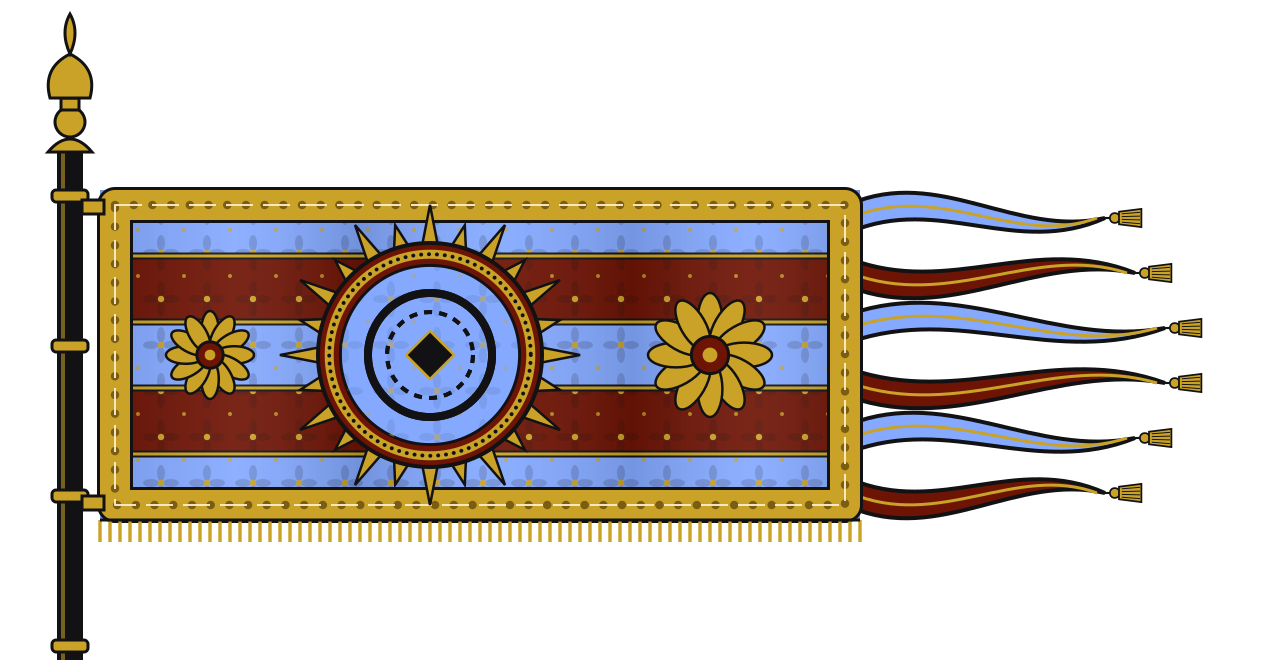
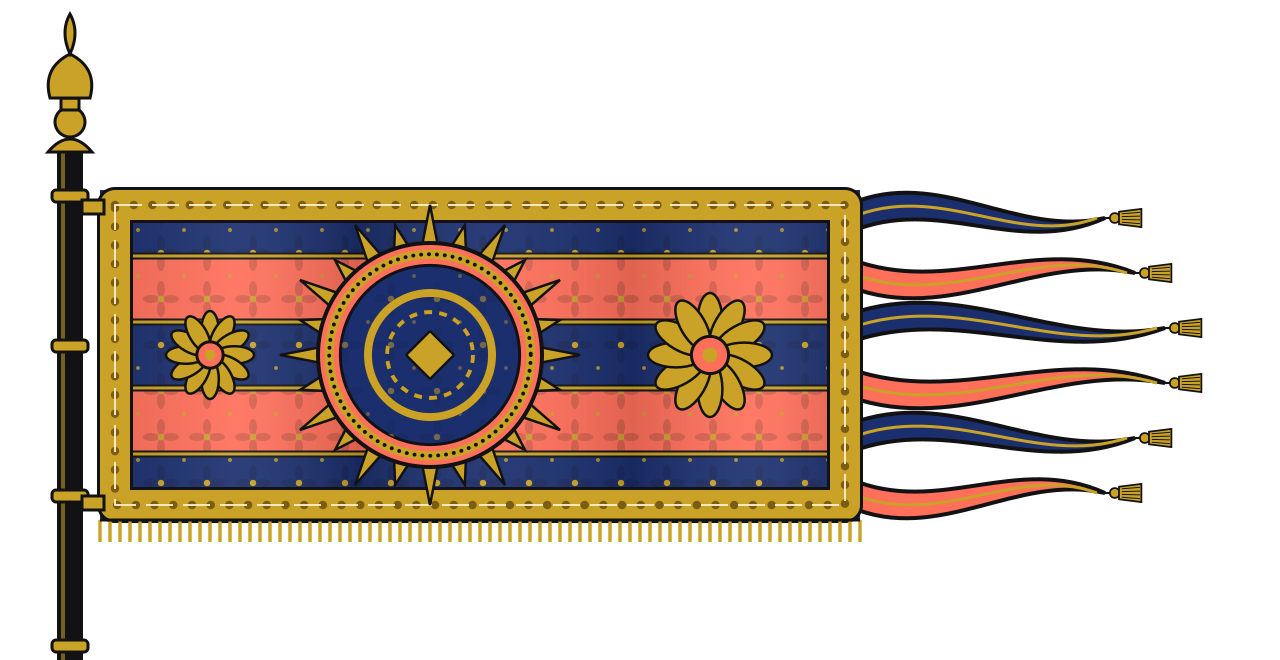
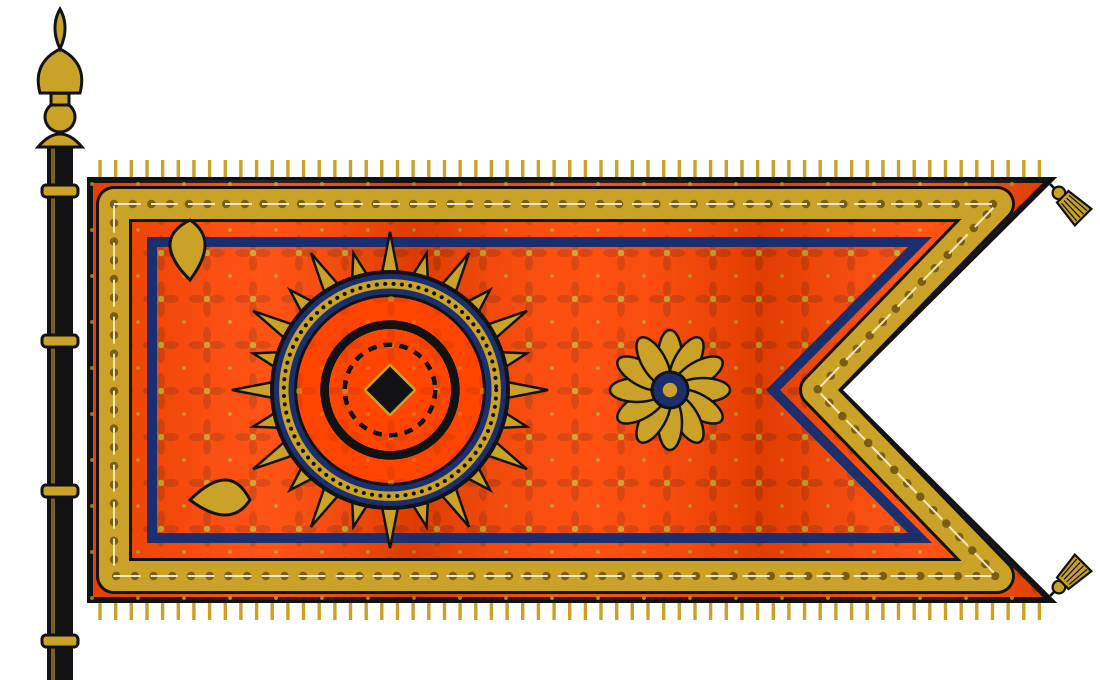
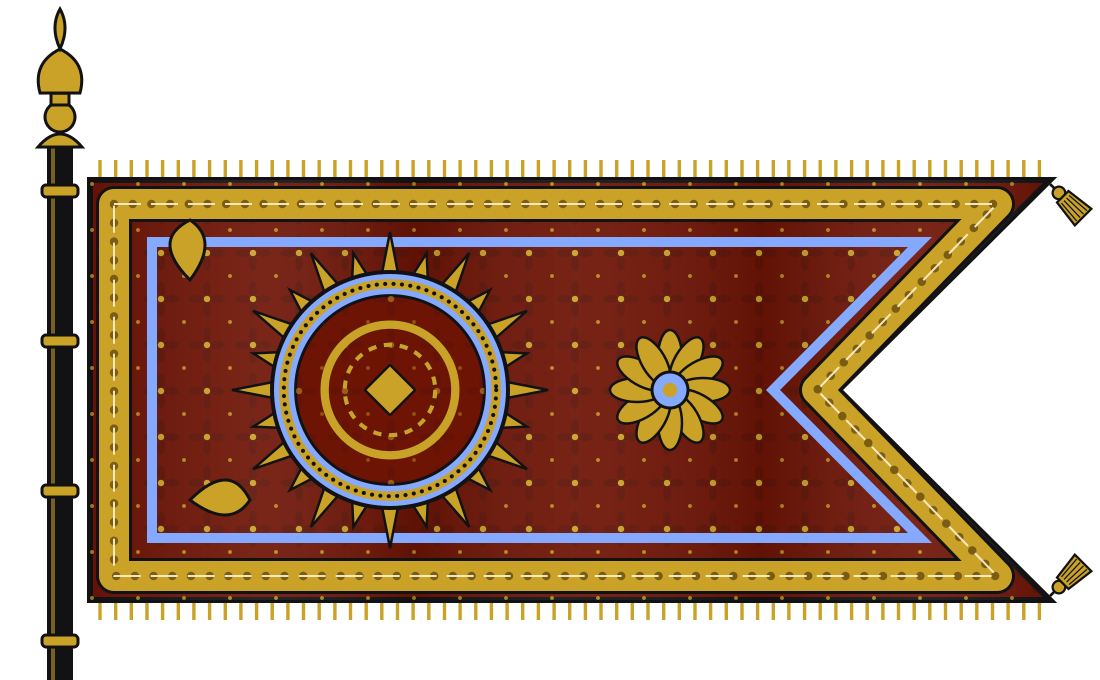
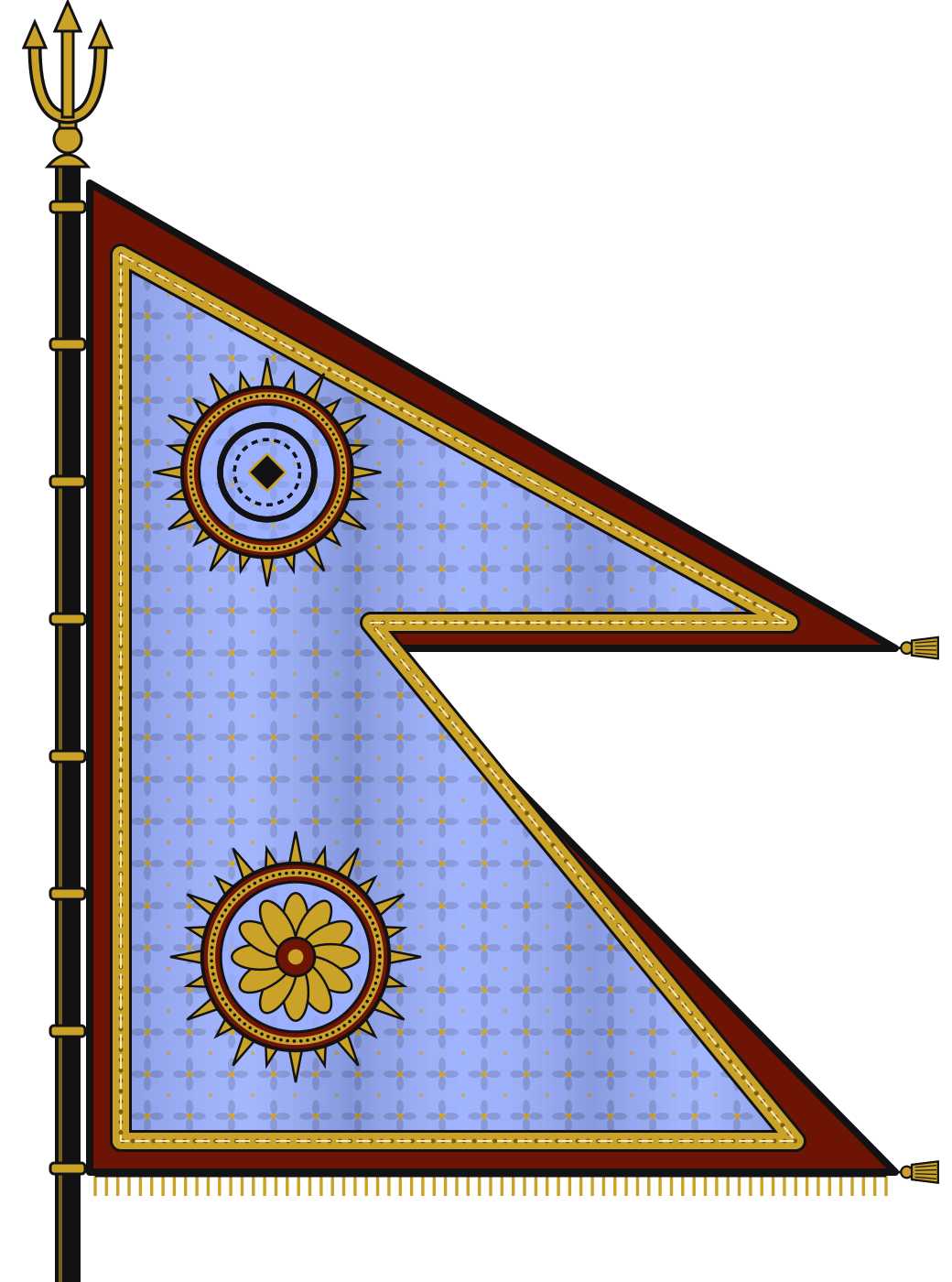
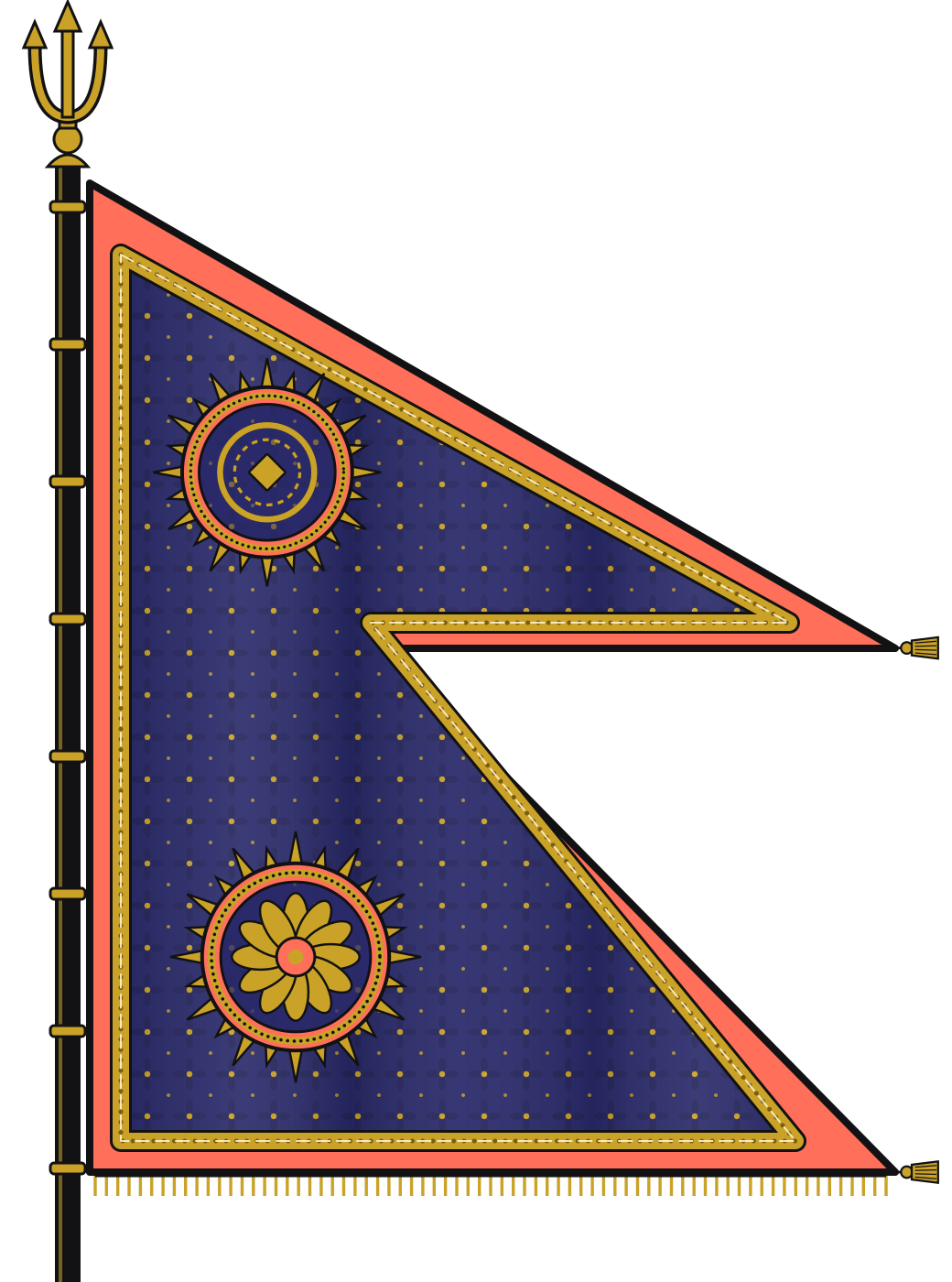

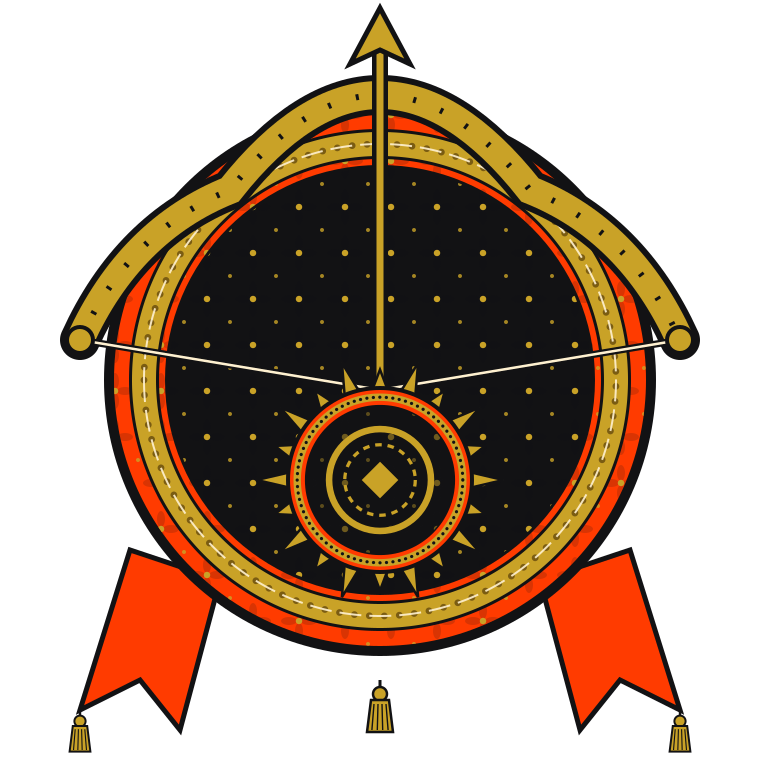
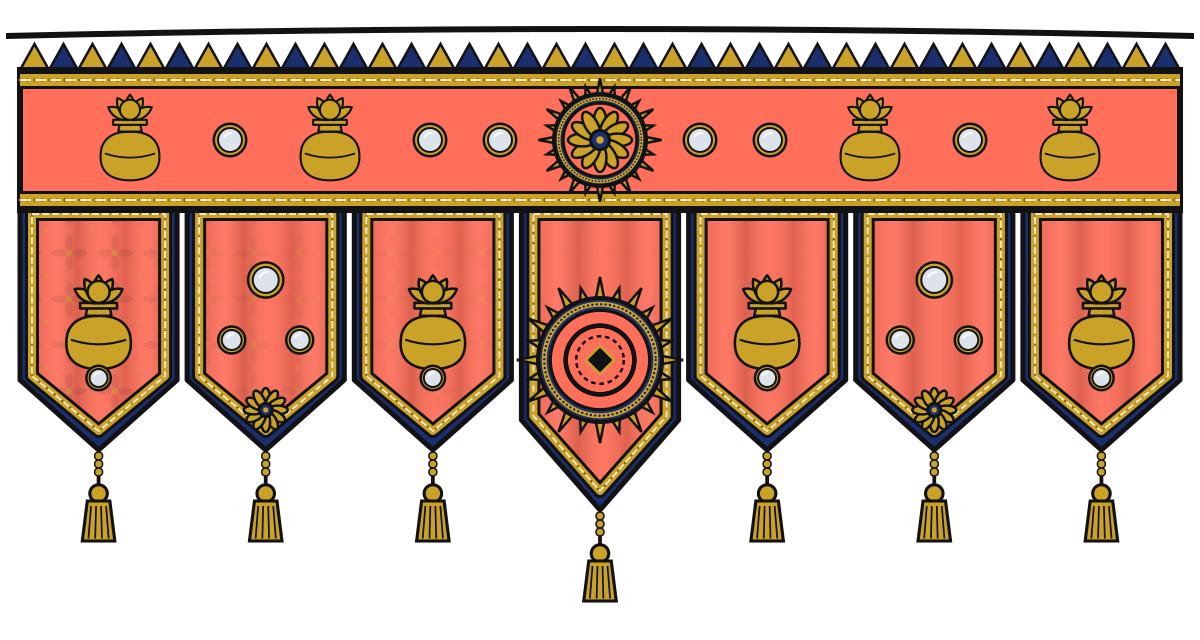
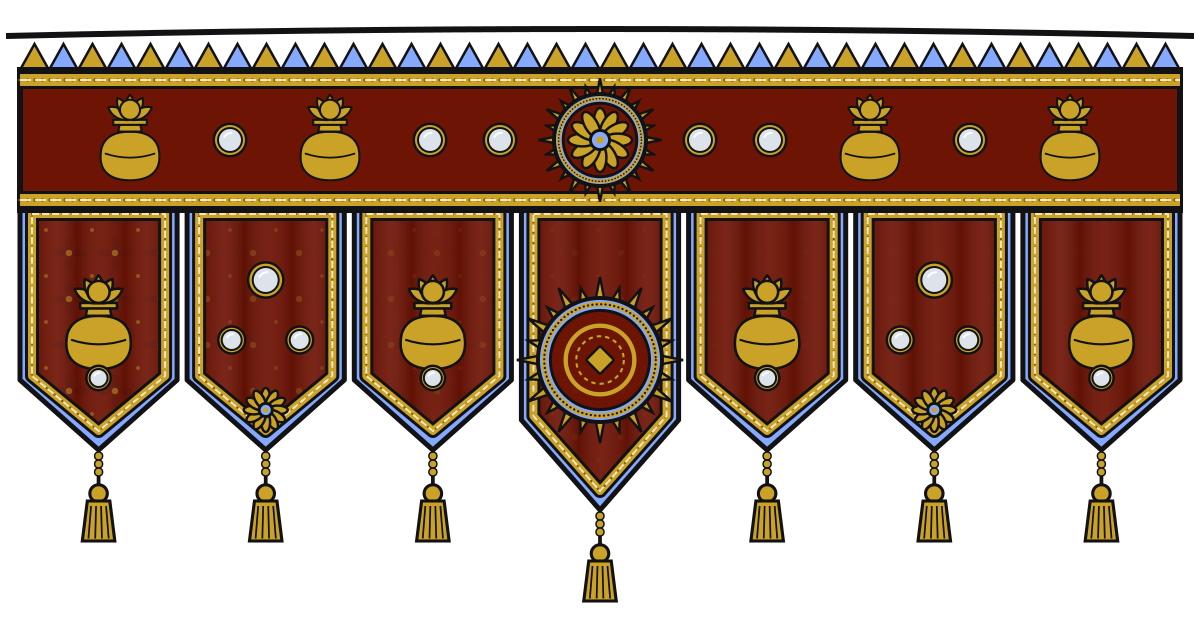

Historic banner
None known
New flag types
| Accessory | For this clan | Basis |
|---|---|---|
| A9 Pota-dhvaja · ship and trade flag For ships, caravans and markets | Not yet designed for this clan | Design |
| A10 Utsava-patāka · festival flag Light, bright flag for fairs and festivals | Not yet designed for this clan | Design |
| A11 Shoka-dhvaja · mourning flag White cloth with the emblem outline in the clan's metal | Not yet designed for this clan | Design |
7. Regalia
| Accessory | For this clan | Basis |
|---|---|---|
| E1 Chhatra · house parasol The ceremonial umbrella | Not yet designed for this clan | Design |
| E2 Chamara · fly-whisks The pair of whisks beside the head of the house | Not yet designed for this clan | Design |
| E3 Danda · staff of office Staff or scepter | Not yet designed for this clan | Design |
| E4 Simhasana · seat The seat of the house, covered in clan cloth | Not yet designed for this clan | Design |
| E5 Khetaka · shield A round shield; the Changi and Dhanush are its flag forms | Not yet designed for this clan | Regional tradition |
| E6 Kula-ayudha · clan weapon The weapon the clan honours | Not yet found for this clan | Under research |
8. Worn
| Accessory | For this clan | Basis |
|---|---|---|
| F1 Kula-vastra · clan cloth The clan's woven pattern in its kit colours | Not yet designed for this clan | Design |
| F2 Kirti-vastra · honour cloth A cloth earned for a deed, not inherited | Not yet designed for this clan | Design |
| F3 Kula-mala · garland flower The flower or leaf the clan wears as a garland | Not yet found for this clan | Under research |
| F4 Chinha · house pin A metal badge with the pin emblem | Not yet designed for this clan | Design |
9. Records
| Accessory | For this clan | Basis |
|---|---|---|
| H1 Clan words A traditional line in the native script | ᰕᰫ་ᰊᰪᰰ་ᰆᰧᰶ ᰛᰩᰵ་ᰀᰪᰱ ᰛᰪᰮ་ᰀᰪᰱ · “Mútuncí Róngkup Rumkup: beloved children of the Róng and of God” Lepcha-script line and its gloss[1] | Documented |
| H2 Biruda · titles The house's title or titles | Not yet found for this clan | Under research |
| H3 Prashasti · praise genealogy The lineage as written at the head of a grant | Not yet found for this clan | Under research |
| H4 Vahi · clan register The book of the clan's births, marriages and deaths | Not yet found for this clan | Under research |
| H5 Rana-ghosha · war cry The clan's cry in battle or celebration | Not yet found for this clan | Under research |
10. VishwaVit · knower of the world
Game values are design choices for this project, not historical claims.
References
- Wikipedia, Lepcha people, read 2026-11-21, https://en.wikipedia.org/wiki/Lepcha_people
- The Philosophy of the Lepcha Religion: A Critical Study, Salesian College publications (2023), read 11 Oct 2026.
- D. O. Lodrick, Lepchas, Worldmark Encyclopedia of Cultures and Daily Life (Gale) via Encyclopedia.com, read 2026-11-21, link
- Tribal Research Institute, Sikkim, Lepcha tribe, read 2026-11-21, https://trisikkim.org/tribes/lepcha-tribe/
- Mun (religion), Wikipedia (read 11 Oct 2026).
- "Custodians of a Not-so-Hidden Land", Sahapedia (read 26 Oct 2026, KulDevi run 278).
- Vajiram and Ravi, Tribes of Sikkim, read 2026-10-29, https://vajiramandravi.com/current-affairs/tribes-of-sikkim/
- Wikipedia, Lepcha script, read 2026-11-21, https://en.wikipedia.org/wiki/Lepcha_script
- Tshering and Lepcha, article in Sāhitya vol. 13 (Dec 2025), CLAI, read 2026-11-21, PDF
- Peaceful Societies (UNCG), Lepcha festival preserves cultural heritage, 17 Aug 2017, read 2026-11-21, link
- Vajiram and Ravi, Tribes of Tripura, read 2026-10-28, https://vajiramandravi.com/current-affairs/tribes-of-tripura/
- Wikipedia, Tendong Lho Rumfaat, read 2026-11-21, https://en.wikipedia.org/wiki/Tendong_Lho_Rumfaat