The Lambadi are a community of pastoralists and caravan carriers whose tanda hamlets moved grain and salt by ox, cart and camel for armies and markets[1][2]. Their own language, Gor Boli, is Indo-Aryan and has no script of its own; it is written in Devanagari, Telugu, Kannada or Tamil[3][1]. The name Banjara is dated to the 14th century by one author and is set out with the community's own claims of much older origin[2]. Sant Sevalal Maharaj (1739–1806) is their most important saint[1][4]. The Atlas lists them as a Scheduled Tribe in five states (state list dated 09-07-2024), and a 2025 Supreme Court petition challenges the Telangana listing[5].
01Faith and deities
The sheet's KulDevi. The sources name Jagadamba as honoured by the community, with Sevalal a devotee of hers[4][1]; no single chief deity is named for the whole community. Thurston (1909), quoting the Mysore Census Report of 1891, names Krishna as the principal object of worship of Mysore Lambanis[7]; that is one region's record of 1891, so the sheet's KulDevi stays the main deity.
Banjara goddess of Pohradevi, a form of Tulja Bhavani
A recorded tie between the clan and the goddess.
| Deity or tradition | Place in the clan's life | Evidence |
|---|---|---|
| Jagadamba | Honoured by the community; pink or red flag for her at spiritual sites[4] | [4][1] |
| Balaji | Worshipped; linked to Venkateswara[2] | [2][1] |
| Bhavani | Worshipped at Vijayadashami, then Ayudha Puja (citing Bi Cheenia Naik, 1998, in the Wikipedia article)[2] | [2] |
| Renuka Mata of Mahur | Worshipped[1] | [1] |
| Hanuman | Worshipped[1] | [1] |
| Tuljabhavani and Mariyamma | Worshipped by the southern Banjara[1] | [1] |
| Seven goddesses with vehicles | Tulaja or Shitala (smallpox; tiger), Maryama (lion), Mataral (elephant), Kankali (buffalo or bull), Hanglaj (horse), Chimar or Chimad (horse), Shyamki (palanquin)[6] | [6] |
| Yama | Linked to the Big Dipper cot at Dapora and Phulumari[6] | [6] |
| Shivaling | Worshipped at Chinchkhed[6] | [6] |
| Sevalal Maharaj | Guru of the Gor Banjara; samadhi at Pohradevi[4] | [4] |
| Jetalal Maharaj | Second saint, named with Sevalal[6] | [6] |
| Guru Nanak | Held in respect[2] | [2] |
| Ancestors | Worshipped as a group twice a year, in gratitude[6] | [6] |
| Banjari Devi | Shrine in the forest: a heap of stones topped with a vermilion-smeared stone, on which passers-by cast a stone. At home a pack-saddle is raised in the room and worshipped before caravans set out[8] | [8] |
| Siva Bhaia (Siva Rathor) | Recorded among the deities: loved by Mari Mata; buried at Pohur in Berar, where a temple was built and kinsmen serve as priests; the most sacred oath is taken with a hand on a son's head and a cow's tail[8] | [8] |
| Mithu Bhukia | Recorded among the deities: an old freebooter, with lamp omens and a hut with a white flag[8] | [8] |
| Hatadiya bullock | Worshipped; decorated, it leads the convoy[8] | [8] |
| Sarasvati | Worshipped by the Dharis, one of the four Berar divisions[8] | [8] |
| Krishna | Principal object of worship of Lambanis in Mysore, per the Mysore Census Report of 1891 as quoted by Thurston (1909)[7] | [7] |
| Bana Sankari | Goddess of forests, also worshipped by Mysore Lambanis (Mysore Census Report 1891, as quoted by Thurston)[7] | [7] |
| Kankali, Maremma and Hingla Bhavani | Goddesses of the Telangana Lambadas, with Tulja Bhavani (TICI, citing Ramaswamy and Bhukya)[9] | [9] |
02Temples
No temple built by the clan is named as built by it in the extracts. Russell names a temple at Pohur, Berar, over Siva Bhaia's burial, served by kinsmen, but not who built it[8]. Who built the Pohradevi temple and the hamlet shrines is not stated.
Built by the clan
Not recorded.
Given patronage or grants by the clan
| Temple | Deity | What the clan gave | When | Where |
|---|---|---|---|---|
| Temple over Siva Bhaia's burial, Pohur | Siva Bhaia | Kinsmen serve as priests; builder not named | Not dated (Russell dates the event to 1874) | Pohur, Berar[8] |
Later temples in the clan's lands
| Temple | Deity | Built | Where | |
|---|---|---|---|---|
| Sri Sevalal Guru temples | Sevalal | Hamlets | Not dated | Nearly every Banjara, Gor or Lambadi hamlet has one[4] |
| Jagdamba Mata temple, Pohradevi | Jagdamba Mata | Not stated | Not dated | A Shakti temple, "the holy place of Banjara community" (Wikipedia)[10]; "Every year lakhs of devotees come here" (The Hitavada, 2024)[11] |
03Languages and scripts
| Language or script | Kind | Under the clan | Evidence |
|---|---|---|---|
| Gor Boli (Lambadi) living | Indo-Aryan language | The community's own tongue; 4,857,819 native speakers (2011 census abstract) | [3] |
| Devanagari | Script used for Gor Boli | Used in Maharashtra | [3] |
| Telugu script | Script used for Gor Boli | Used in Telangana and Andhra Pradesh | [3] |
| Kannada script | Script used for Gor Boli | Used in Karnataka | [3] |
| Tamil script | Script used for Gor Boli | Used in Tamil Nadu | [3] |
| Dialect groups | Four groups, coded MH, KK, AP and TS | Gor Boli, per TRI Jharkhand | [1] |
04Books and literature
Works by and on the Banjara named in the extracts. Several are cited by title only; the native-script titles are as printed in the cited articles.
Written during the clan's history
| Work | Author | Kind | When | Link to the clan |
|---|---|---|---|---|
| Subjugated Nomads: The Lambadas Under the Rule of the Nizams | Bhukya | Book | 2010 | [2] |
| Ethnography of a Denotified Tribe: The Laman Banjara | Burman | Book | 2010 | [2] |
| Merchant Communities in Precolonial India | Habib | Book | 1990 | [2] |
| Lamani Economy and Society in Change | Halbar | Book | 1986 | [2] |
| The Banjara | Deogaonkar | Book | 1992 | [2] |
| The Banjara | Paul and Jinoop | Book | 2021 | [2] |
| The Art and Literature of Banjara Lambanis | Dhansing B. Naik | Book | 2000 | [3] |
| The Grammar of Lamani | Trail | Book | 1968 | [3] |
| गवारिया(बंजारा) समाज का इतिहास (history of the Gavariya (Banjara) community) | Author not stated in the extract | Book | Not stated | [2] |
| బంజారా చరిత్ర (సంస్కృతి-ప్రగతి) (Banjara history: culture and progress) | Author not stated in the extract | Book | Not stated | [2] |
Given patronage by the clan
Not recorded.
05Thinkers and scholars
| Name | Field | Era | Contribution |
|---|---|---|---|
| Sant Sevalal Maharaj | Social and religious reformer | 1739–1806 | Opposed personality cults and rituals; his burial site is a popular destination[4] |
| Halbar | Scholar of the Lamani economy | 1986 | Lamani Economy and Society in Change; says Dandin's 6th-century reference seems to be to them[2] |
| Habib | Historian of precolonial merchants | 1990 | Merchant Communities in Precolonial India; reads the Banjara as merchants (vanij, banik)[2][1] |
| Burman | Ethnographer | 2010 | Ethnography of a Denotified Tribe: The Laman Banjara[2] |
| Naik, Dhansing B. | Art and literature | 2000 | The Art and Literature of Banjara Lambanis[3] |
| Vahia, Halkare, Menon and Calamur | Study of sky lore | 2014 | Astronomy of two Indian tribes: Banjaras and Kolams[6] |
Other scholars named in the extracts (Bhukya, Naik 1983 and 1996, Trail 1968) are listed under books.
06Art and architecture
Banjara art is embroidery, mirror work, dance, music, rangoli and tattooing[2]. The embroidery is the best documented part.
Painting and wall art
| Art form | What it is | Era | Evidence |
|---|---|---|---|
| Choko rangoli | Drawn at worship by both sexes | Not dated | [12] |
Sculpture and temple art
Not recorded.
Temple and building architecture
| Art form | What it is | Era | Evidence |
|---|---|---|---|
| Banjara Virasat Museum, Pohradevi | Museum with a 150-foot Sevadhwaj, an equestrian statue and thirteen galleries | Not dated | [4] |
Weaving and textiles
| Art form | What it is | Era | Evidence |
|---|---|---|---|
| Lepo embroidery | Pieced cloth with mirrors, glass beads, cowrie shells and coins[13][12][2] | Not dated | [13] |
| Sandur Lambani embroidery | Made at Sanduru near Hampi, Bellary district; GI tag (The Hindu, 2010, as cited in Wikipedia)[2] | Not dated | [2] |
Clothing and jewellery
Not recorded.
Coins, pottery and crafts
| Art form | What it is | Era | Evidence |
|---|---|---|---|
| Mirror-work products | Bags, belts, batwas or purses, yokes, borders, salwar kameez, skirts, blouses, pillows, cushions, quilts and bedspreads[13] | Not dated | [13] |
07History
Names and origin claims
The people call themselves Gor; the recorded self-name is "Gor manus"[6]. Other names in use are Lambadi, Lambani, Lamani, Banjara and Gour Boli[1], and Sugali[5].
Origin claims differ and none is settled. Vahia et al. record two: a defeated Rajput origin in Rajasthan around 1200 AD, after Prithviraj Chauhan, and a Harappan-period (c. 2000 BC) trading tribe with snake worship[6]. The Chinchkhed record in that study calls them the "Pani" tribe of Vedic literature, not Rajputs, and says Rajputs allegedly converted after Rana Pratap's defeat in 1597[6]. A blog says they came into Rajasthan from the Gor province of Afghanistan; it is a commercial source and is treated as secondary[12]. The TRI Jharkhand institute says the origins may be Mewar[1], and Halbar suggests a possible origin in north-central India[2].
The name. Motiraj Rathod dates the name Banjara to about the 14th century; Burman records a Laman claim of 3,000 years[2]. Barani and Shaikh Nasiruddin appear to record them under Alauddin Khalji, as Habib (1990) reads them, and Dandin in the 6th century seems to refer to them (Halbar 1986)[2]. Habib says the name itself appears only from the 16th century[2].
Caravans for the Mughal and Deccan armies
Their caravans carried salt, grain, cotton and forest produce, and supplied armies[1]. The Atlas describes them as ox-caravan carriers who supplied Mughal and Deccan armies. Jahangir described them, in the early 17th century, as a fixed class with large ox herds[2][1].
The Rajput-descent story they tell says that under Mughal rule their ancestors retreated to the forests and vowed to return when foreign influence left (Halbar 1986)[2].
Wellington's army and the colonial record, 1790s–1871
Wellington used them as carriers against the Maratha Confederacy in the late 1790s (Satya 1997)[2][1]. Thurston praised their trustworthiness as carriers[2].
The 1830s brought a reputation for roadside robbery (Sinha 2008), and Balfour wrote on them in 1843[2][1]. The sources date the Criminal Tribes Act to 1871; the community was later denotified (Halbar 1986)[2][1].
Organisation, 1968
The All India Banjara Seva Sangh recorded 27 synonyms and 17 subgroups in 1968[2][1]. The subgroups are not named in the extracts.
Sant Sevalal Maharaj, 1739–1806
Sant Sevalal Maharaj was born on 15 February 1739 at Surgondankoppa, Davanagere district, Karnataka, and died on 4 December 1806, aged 67, at Ruhigarh, Yavatmal district, Maharashtra[4]. The Wikipedia article notes that colonial administrators placed him in the 19th century, and gives his original name as Siva Rathor[2].
Scheduled Tribe listing in Telangana, 1950–2002
The 1950 ST Order for Hyderabad State named nine communities; Lambadas, Sugalis and Banjaras were not among them[5]. Hyderabad Notification No. 10 of 30 May 1954 listed Lambadas and Banjaras as Backward Classes[5].
The 1956 orders limited Sugali (Lambadi) ST status to the Andhra region, excluding Hyderabad, Mahboobnagar, Adilabad, Nizamabad, Medak, Karimnagar, Warangal, Khammam and Nalgonda[5]. The 1976 Amendment Act removed the area restriction, and the 2002 amendment added Banjaras; Entry 29 now reads "Sugalis, Lambadis, Banjaras"[5].
Russell and Hira Lal on the name and descent, 1916
Russell and Hira Lal derive the name most probably from Sanskrit banijya kara, merchant. They set aside Elliot's claim of antiquity, from the Dasa Kumara Charita, as disproved by Cowell. Crooke's first mention in Muslim history, they note, is Sikandar's attack on Dholpur in AD 1504[8].
The account says the Banjara came to the Deccan with Aurangzeb's forces, and that they belong "rather to the Deccan than to northern India"[8]. Russell argues for descent from the Charans or Bhats of Rajputana, citing Cumberlege's Berar monograph, Tod and Mackenzie[8].
Tod recorded a Murlah Charan tanda of 4,000 bullocks. Mackenzie names five brethren, Rathor, Turi, Panwar, Chauhan and Jadon, and four sons of Bhika Rathor: Mersi, Multasi, Dheda and Khamdar. Irvine describes droves of 5,000 bullocks, with camps in a square of grain bags, which were never injured by either army[8].
Telangana: census and commissions, 1901–1976
The DTE article, citing the Telangana government's affidavit, says that the census reports from 1901 to 1951 under the Nizam recorded Lambadas and Banjaras as nomadic tribes, and that their exclusion from the 1949–50 draft Order was linked to the Criminal Tribes Act, 1871, repealed in 1952. After 1956 ST recognition was confined to the Andhra and Rayalaseema areas; the Dhebar Commission (1961), the Lokur Committee (1965) and the Joint Parliamentary Committee (1967–69) flagged anomalies[14].
TICI dates the notification of Telangana Lambadas as STs to 1977, and says they have been enumerated as STs since the 1981 census[9]. The DTE article dates the amendment that added them to 1976[14].
08Journey and migrations
Pastoralists and traders, they moved by boat, cart, camel, ox, donkey and horse in tanda caravans led by an elected headman (muqaddam, nayak or naik)[2][1]. One caravan is recorded with 190,000 beasts[2].
| When | From | To | Why | Evidence |
|---|---|---|---|---|
| Earlier, as claimed | Gor province of Afghanistan (claim) | Rajasthan, then Uttar Pradesh, Maharashtra, Karnataka, Haryana and Andhra Pradesh | Migration story in a commercial blog; secondary | [12] |
| Late 1790s | — | Wellington's army, as carriers | Against the Maratha Confederacy | [2] |
| About a century before the 2014 study | Caravan trade | Settled tandas (villages) | Railways and roads ended carrier work | [6][2] |
09Seats and lands
| Place | Role | Where today |
|---|---|---|
| Marwar and Rajasthan | Early home in the sources; Gor Boli is said to mix Rajasthani and Gujarati[2][6] | Rajasthan |
| Mewar | Origin possibly here, per the TRI Jharkhand institute[1] | Rajasthan |
| Deccan tandas | Caravan and hamlet base, per the Atlas and TRI[1] | Andhra Pradesh, Telangana, Karnataka, Maharashtra |
| Karnataka (banijagaru) | Recorded name for this area in Wikipedia[2] | Karnataka |
| Sanduru, near Hampi | Home of Sandur Lambani embroidery (Bellary district)[12][2] | Karnataka |
| Surgondankoppa | Birthplace of Sevalal, 1739[4] | Davanagere district, Karnataka |
| Pohradevi (Poharadevi) | Sevalal's samadhi beside a Jagadamba temple; Banjara Virasat Museum[4] | Washim district, Maharashtra |
| Phulumari | Pilgrimage centre of about 10,000 people; sub-clans recorded here[6] | Washim district, Maharashtra |
| Ruhigarh | Where Sevalal died, 1806[4] | Yavatmal district, Maharashtra |
| Kasola (Sevalal Tanda) | Tanda of about 900 houses and 3,755 cows (date of count not given)[6] | Not stated in the source |
| Dapora | Settlement recorded at about 8,000 people; Yama and Big Dipper lore are linked to it[6] | Not stated in the source |
| Pohur, Berar | Burial place of Siva Bhaia, with a temple and kinsmen as priests (Russell)[8] | Berar (1916 name) |
| Balod, Drug District | The Kukurra Mandhi, five miles from Balod, marks the dog in the Banjara and Bania story (Russell)[8] | Central Provinces (1916 name) |
| Kukurra Math, Mandla | A similar dog memorial (Russell)[8] | Mandla |
| Nanded, Latur, Dharashiv, Parbhani, Solapur, Satara | Strong presence (Outlook, 2025); no population figures given[15] | Maharashtra |
| Telangana districts | Mainly nine districts; sparse in Guntur, Krishna, West Godavari and Nellore[9] | Telangana; Andhra Pradesh |
| Karnataka list entry, code 017 | Top-three-by-population districts the Wikipedia page lists for this entry: Bagalkote, Ballari, Bidar, Vijayapura, Chikkamagaluru, Chitradurga, Davanagere, Gadag, Haveri, Kalaburagi, Koppal, Raichur, Shivamogga and Yadgir (spellings normalised to the state list)[16] | Karnataka |
| Odisha districts | Sonepur, Baragarh, Nowrangapur, Nuapada and Bolangir, as the KISS handbook prints them[17] | Odisha |
10Notable figures
| Name | Role | Era | Known from |
|---|---|---|---|
| Sant Sevalal Maharaj | Guru and most important saint of the Banjara; his original name is given as Siva Rathor | 1739–1806 | [4][2] |
| Jetalal Maharaj | Second saint, named with Sevalal | Not dated | [6] |
| Bheema Naik and Dharmani Yadi | Parents of Sevalal | Sevalal's lifetime | [4] |
| Ramrao Maharaj | Successor of Sevalal, per the Wikipedia infobox | Not dated | [4] |
| Motiraj Rathod | Author cited on the name Banjara; dates it to c. 14th century | Not dated | [2] |
| Siva Bhaia | Named Siva Rathor in Russell's text, a figure among the deities; buried at Pohur in Berar, where a temple was built. Russell does not mention Sevalal here; the Wikipedia article gives Sevalal's original name as Siva Rathor, and the extract does not say the two are the same person | Event "of our own times (1874)", per Russell | [8] |
| Mithu Bhukia | An old freebooter recorded among the deities, with lamp omens and a hut with a white flag | Not dated | [8] |
11Allies, rivals and marriages
| People | Relationship | When |
|---|---|---|
| Wellington's army | Employed Banjara carriers against the Maratha Confederacy | Late 1790s |
| Mughal and Deccan armies | Supplied with grain and carriers | Mughal period (not dated more closely) |
| Kolams | Studied with the Banjara in one sky-lore paper[6] | 2014 study |
| Bhopa, Domba, Kalbelia | Called "gypsies of India" together with the Banjara (Pullaiah et al. 2016)[2] | 2016 study |
| Dadhi and Gajugonia singers | Singers who sing to the sarangi[2][1] | Not dated |
| Bania caste | Shares a Sanskrit root with Banjara (Habib 1990)[2] | Not dated |
| Labana, Multani, Mukeri | Salt, grain and wood carriers named beside the Banjara[2] | Not dated |
| Koyas, Gonds, Chenchus, Kolams, Thotis | Named by petitioners in the 2025 Telangana case as recognised since 1950 (the petitioners' claim)[5] | 1950 list |
| Berar Wanjari Kunbis | Disclaim the connection with the Banjara (Russell)[8] | 1916 account |
| Adivasi groups in Maharashtra | Oppose the Banjara demand for ST status. Gadchiroli tribals protested on 15 October; Dr Sanjay Dabhade of the Adivasi Adhikar Manch says the Banjaras were historically salt and grain traders, not forest dwellers[15] | October 2025 |
| Telangana Adivasi groups | Seek the de-scheduling of the Lambadas. The DTE article, an opinion piece, attributes this to competition over reservation benefits[14] | 2025 |
12Society and livelihood
The community is patrilineal and endogamous, with exogamous clans[1]. Marriage is arranged by the boy's father at about 18, after a betrothal called sagai[2]. The traditional bride price is eleven rupees and four bullocks, or one bullock and three cattle[2]. Widow remarriage and divorce need the consent of the Gor panchayat[2]. Weddings are held in April and May[2]. Dowry is rising, per TRI Jharkhand[1]. Russell and Hira Lal (1916) record bride prices of Rs 200 to 1,000 in Nimar and Rs 40 with four young bullocks in Yeotmal, and a groom who served a month in his bride's father's house. A widow was normally taken by her husband's brother, with compensation of Rs 75 plus Rs 5 for the Naik (Berar)[8]. TICI says each tanda was historically under a hereditary Naik, and that the people are divided into jatis and gotras, endogamous within the jati and exogamous between gotras (citing Hassan, 1920)[9].
Government and social order
| Institution or group | What it was | Evidence |
|---|---|---|
| Tanda | Hamlet or camp group of families, led by an elected headman (muqaddam, nayak or naik) | [2][1] |
| Gor panchayat | Council that settles disputes, sets the bride price and consents to divorce and widow remarriage | [2][1] |
| Naik or Nayak | Headman title | [2] |
| Outsiders and adoptees | Outsiders are admitted only as married women; children taken in as Jangar servants became Banjara after seven generations[8] | [8] |
| Wedding (1916 account) | Held in the rains; a tent serves as the shed; two pestles, or a pack-saddle with grain bags, are used; the priest chases the bride[8] | [8] |
| Death | The mother is unclean for five days; the unmarried dead and those who died of smallpox are buried, others burned; mourning lasts three days[8] | [8] |
| Houses | Unlucky to live under a tiled roof; beams must not cross[8] | [8] |
Livelihood over time
| Era | Livelihood | Evidence |
|---|---|---|
| Ancient, as claimed | Pastoral nomads; warriors (Rajput claim) | [3] |
| Medieval | Traders and grain carriers | [3] |
| Mughal and Deccan period | Carriers and grain suppliers to armies | [1] |
| Late 1790s | Carriers for Wellington against the Maratha Confederacy | [2] |
| Modern | Grain transport; semi-nomadic salt carriage | [3] |
| By 1866 | Railways and roads forced them toward agriculture (Forsyth, cited by Russell)[8] | [8] |
| 1916 account | Make hempen twine and sacking; grow tilli; live in kuris attached to villages[8] | [8] |
| Today | Many settled as agriculturists; settled groups also keep cattle and poultry | [3][12] |
13Sub-clans and related clans
The sources name sub-clans recorded at Phulumari, subgroups from Mastana and Papiha (1992), the Ramawat lineage of Sevalal, and related carrier and singer peoples. None is given a size. Russell and Hira Lal (1916) name Charan, Mathuria, Labhana and Dhari divisions in Berar, with Charan clans, minor subcastes and their divisions. TICI, citing Hassan (1920) and Naik (2000), names the Rathods, Vadityas and the Gor, Mathura, Dhadi, Sanar, Navi and Charan sub-groups.
| Clan | Relation | Where | Size | In the Atlas | Evidence |
|---|---|---|---|---|---|
| Khola | Sub-clan | Recorded at Phulumari (Washim) | new clan candidate | [6] | |
| Ransot | Sub-clan | Recorded at Phulumari (Washim) | new clan candidate | [6] | |
| Bhojawat | Sub-clan | Recorded at Phulumari (Washim) | ST-345 | [6] | |
| Khetawat | Sub-clan | Recorded at Phulumari (Washim) | new clan candidate | [6] | |
| Mood | Sub-clan | Recorded at Phulumari (Washim) | new clan candidate | [6] | |
| Lambaras | Branch | Subgroup | new clan candidate | [6] | |
| Lambadas | Branch | Subgroup | new clan candidate | [6] | |
| Lambana | Branch | Subgroup | ST-351 | [6] | |
| Ramawat | Branch | Lineage of Sevalal's family | new clan candidate | [4] | |
| Rajputs | Related people | Rajasthan (claimed origin) | new clan candidate | [6] | |
| Dadhi | Related people | Not stated | same name as ST-379: check | [2][1] | |
| Gajugonia | Related people | Not stated | same name as ST-390: check | [2][1] | |
| Bhopa | Related people | Not stated | same name as SUB-145: check | [2] | |
| Kalbelia | Related people | Not stated | same name as NE-022: check | [2] | |
| Domba | Related people | Not stated | ST-072 | [2] | |
| Gawaria गवारिया | Related people | Not stated | same name as NE-026: check | [2] | |
| Labana | Related people | Salt carriers | same name as ST-416: check | [2] | |
| Multani | Related people | Grain carriers | new clan candidate | [2] | |
| Mukeri | Related people | Wood carriers | same name as ST-472: check | [2] | |
| Bania | Related people | Shares a Sanskrit root (Habib) | same name as SUB-131: check | [2] | |
| Charan | Branch | Most numerous of the four Berar divisions (Russell); also a sub-group in TICI | same name as ST-436: check | [8][9] | |
| Rathor | Sub-clan | Charan clan (Russell, citing Mackenzie) | same name as ST-487: check | [8] | |
| Bhurkia | Sub-clan | Subsept of the Rathor; its divisions are Mersi, Multasi, Dheda and Khamdar (Russell) | same name as ST-375: check | [8] | |
| Mersi | Branch | Named as one of the four sons of Bhika Rathor (Mackenzie, cited by Russell) | new clan candidate | [8] | |
| Multasi | Branch | Named as one of the four sons of Bhika Rathor (Mackenzie, cited by Russell) | new clan candidate | [8] | |
| Dheda | Branch | Named as one of the four sons of Bhika Rathor (Mackenzie, cited by Russell) | new clan candidate | [8] | |
| Khamdar | Branch | Named as one of the four sons of Bhika Rathor (Mackenzie, cited by Russell) | new clan candidate | [8] | |
| Panwar | Sub-clan | Charan clan (Russell) | same name as ST-517: check | [8] | |
| Chauhan | Sub-clan | Charan clan (Russell) | same name as SUB-109: check | [8] | |
| Puri | Sub-clan | Charan clan (Russell) | same name as ST-484: check | [8] | |
| Jadon | Sub-clan | Charan clan; also called Burthia (Russell) | same name as ST-397: check | [8] | |
| Mathuria | Branch | Berar division; abstain from meat and liquor and wear the sacred thread (Russell) | same name as ST-454: check | [8] | |
| Labhana | Branch | Berar division, said to descend from Mota and Mola (Russell); compare Labana above | same name as ST-534: check | [8] | |
| Dhari | Branch | Berar division of bards, Muslim, who worship Sarasvati (Russell) | same name as ST-439: check | [8] | |
| Turkia | Branch | Minor subcaste with 36 septs (Russell) | same name as ST-510: check | [8] | |
| Chanda | Branch | Minor subcaste; divisions Bhusarjin, Ladjin, Saojin and Kanhejin (Russell) | new clan candidate | [8] | |
| Bhusarjin | Branch | Division of the Chanda (Russell) | new clan candidate | [8] | |
| Ladjin | Branch | Division of the Chanda (Russell) | new clan candidate | [8] | |
| Saojin | Branch | Division of the Chanda (Russell) | new clan candidate | [8] | |
| Kanhejin | Branch | Division of the Chanda (Russell) | new clan candidate | [8] | |
| Sambalpur Thuria | Branch | Minor subcaste; divisions Bandesia, Atharadesia, Navadesia and Chhadesia (Russell) | same name as ST-551: check | [8] | |
| Bandesia | Branch | Division of the Sambalpur Thuria (Russell) | new clan candidate | [8] | |
| Atharadesia | Branch | Division of the Sambalpur Thuria (Russell) | new clan candidate | [8] | |
| Navadesia | Branch | Division of the Sambalpur Thuria (Russell) | new clan candidate | [8] | |
| Chhadesia | Branch | Division of the Sambalpur Thuria (Russell) | new clan candidate | [8] | |
| Guar | Branch | Minor Banjara group named by Russell | new clan candidate | [8] | |
| Guguria | Branch | Minor Banjara group named by Russell | new clan candidate | [8] | |
| Bahrup | Branch | Minor Banjara group named by Russell (as "Bahrup Banjaras") | new clan candidate | [8] | |
| Rathod | Sub-clan | Charan Banjara clan, with the Vadityas or Badityas (Hassan, 1920, as cited by TICI) | same name as ST-486: check | [9] | |
| Vadityas | Sub-clan | Also Badityas; Charan Banjara clan (Hassan, 1920, as cited by TICI) | same name as ST-513: check | [9] | |
| Gor | Branch | Sub-group (Naik, 2000, as cited by TICI) | new clan candidate | [9] | |
| Mathura | Branch | Sub-group (Naik, 2000, as cited by TICI) | same name as ST-432: check | [9] | |
| Dhadi | Branch | Sub-group (Naik, 2000, as cited by TICI) | new clan candidate | [9] | |
| Sanar | Branch | Sub-group (Naik, 2000, as cited by TICI) | new clan candidate | [9] | |
| Navi | Branch | Sub-group (Naik, 2000, as cited by TICI) | new clan candidate | [9] |
Clans marked "new clan candidate" are not in the Atlas yet.
14Surnames
Surnames the sources name are Rathod, the most frequent, with Chavan, Chauhan, Pawar and Jadhav[6], and Rathor, from Sevalal's original name[2]. Naik and Nayak are headman titles, not surnames.
| Surname | Clan or sub-clan | Where | People with this surname | Also used by other communities |
|---|---|---|---|---|
| Rathod | Charan Banjara clan (Hassan, 1920, as cited by TICI) | not yet counted | Not checked | |
| Rathor | Charan clan (Russell) | not yet counted | Not checked | |
| Chavan | Not stated | not yet counted | Not checked | |
| Chauhan | Charan clan (Russell) | not yet counted | Not checked | |
| Pawar | Not stated | not yet counted | Not checked | |
| Jadhav | Not stated | not yet counted | Not checked |
Counts are of everyone with the surname, from the cited source and year, not only members of this clan. A surname shared with other communities says nothing about any one person's origin.
15Songs and music
Women do most of the singing and dancing. Men sing devotional songs, and the Dadhi and Gajugonia singers sing to the sarangi[2][1]. The extracts give no song titles with lyrics, so no excerpt is quoted.
Song on the rise of the morning star
Grain-loading song
Folk songs praising Sevalal living
Men's devotional songs living
Instruments and styles
| Instrument or style | What it is | Evidence |
|---|---|---|
| Sarangi | Played by the Dadhi and Gajugonia singers[2][1] | [2][1] |
| Ghoomar and Chari | Dances; the Fire dance is also named[2][1] | [2][1] |
16Poems, lullabies and children's rhymes
The extracts name no poems, lullabies or rhymes by title. Folk art is said to include lyrical and narrative songs, proverbs and riddles[12], without examples.
None recorded yet.
17Stories, legends and proverbs
Stories and legends
| Story | What happens | Told by | Evidence |
|---|---|---|---|
| Descent from Luv | Claimed descent from Luv, son of Rama (a claim, as recorded) | Not stated | [6] |
| The forest vow | Under Mughal rule the ancestors retreated to the forests and vowed to return when foreign influence left | Recorded by Halbar (1986) | [2] |
| Dead souls and Jamkhat | Dead souls walk the Milky Way; Jamkhat (the Big Dipper) is a death bed with three mourners; if Jamkhat sinks, the world ends | Kasola, as recorded | [6] |
| The Chinchkhed record | Says the people are the "Pani" tribe of Vedic literature, not Rajputs | Chinchkhed record, as cited | [6] |
| Omens of the sky | A male fox (Salya) is a good omen and a female (Sali) a bad one; comets (Seshar Tara) and meteors (Tara tutgo) are omens; the evening star Subtara is a good omen | Not stated | [6] |
| Gangaur sprouts | Sprouts that grow thick and high are a good sign | Not stated | [2] |
| The dog and the Bania | A Banjara pledged his dog to a Bania. The dog found the stolen goods and carried back a letter of repayment, but its master killed it before reading the letter. The Kukurra Mandhi, five miles from Balod in Drug District, marks the dog; a similar one is at Kukurra Math, Mandla[8] | Russell and Hira Lal (1916) | [8] |
Proverbs and sayings
| Saying | Meaning | Evidence |
|---|---|---|
| Saying, English only, as Russell gives it | "Death in a foreign land is to be preferred..." The extract gives only the opening words, and no native-script form[8] | [8] |
18Festivals and fairs
| Festival or fair | When | Where | What happens |
|---|---|---|---|
| Teej | August (Shravana) | Not stated | Unmarried girls sow seed in bowls for nine days (TRI) or eight days, with the goddess merged into the soil on the ninth (Vahia et al.)[1][6] |
| Gangaur, Gamoli and Sinjara | August | Marwar | Girls pray for a groom[2] |
| Sheetala Bhavani | June or July | Not stated | Cattle protection[2] |
| Pola | July | Not stated | Cows are decorated[6] |
| Akhadi | New moon in July | Not stated | A goat is sacrificed[6] |
| Navratra | October | Not stated | Goat sacrifice[6] |
| Ghar Ghar Er Pooja | Not dated | Southern Banjara homes | Animal sacrifice, night-long worship and a family feast[1] |
| Diwali | Not dated in the sources | Not stated | Ancestor feast; cow-dung mounds; wheat planted[6] |
| Holi | Late March | Not stated | Marriage season runs from Chaita to Ashad after Holi[6] |
| Vijayadashami and Ayudha Puja | Not dated | Not stated | Bhavani is worshipped at Vijayadashami, then Ayudha Puja; Dasera is also named[2][6] |
| Sevalal Jayanti | Not stated | Not stated | A Government Jayanti celebration cited to PIB India[4] |
19Food, dress and games
Food
| Item | What it is | Evidence |
|---|---|---|
| Meat and drink | They eat meat and drink; the Mathurias abstain[8] | [8] |
| Water | They drink only spring or well water (Dubois, cited by Russell)[8] | [8] |
Dress
| Item | What it is | Evidence |
|---|---|---|
| Women | Ghagra or phetiya skirt, kanchali blouse and a waist apron; dress largely red, with glass, beads and sea-shells[12][1] | [12][1] |
| Men | White dhoti, red turban, earrings and rings; silver kanadoro waist strings, largely abandoned[2] | [2] |
| Tattoos | On the forehead, arms, cheeks and chin from marriageable age; believed protective and a mark of beauty and purity[12] | [12] |
| Ornaments | Heavy anklets, large nose-rings, braided hair ornaments and necklaces[12] | [12] |
| Women's dress, as Russell records it | A skirt and shoulder-cloth; a curved anklet, the wankri, marks marriage; skirts with cowrie borders; breast-cloths embroidered with glass; bead strings on horsehair; ivory, lac or horn bangles; a khair-wood chunda stick in the hair of a married woman[8] | [8] |
| Labhana girls | At ten, a girl is given two bundles of nut, cowries and rice on her dupatta[8] | [8] |
| Hair and head | An Anthi plait with cowries; bell-shaped silver head ornaments[8] | [8] |
| Men's ornaments and war dress | A coral necklace; a mirror and comb in the head-cloth; on the war-path, a nim twig in the turban[8] | [8] |
Games and martial arts
Not recorded.
Tags: living still practised · revived brought back after a break · lost known only from records · research reported but not yet confirmed from a source. Songs and poems under copyright are listed by title only; restricted or sacred material is noted without its content.
20Status today
The Lambadi are a living community, listed as a Scheduled Tribe in five states according to the Atlas[5]. Many are settled as agriculturists[3]. A 2025 Supreme Court petition challenges the Telangana listing[5].
Recognised heritage
| What | Recognition | Evidence |
|---|---|---|
| Sant Sevalal Maharaj's samadhi at Pohradevi | A popular destination[2][4] | [4] |
| Banjara Virasat Museum, Pohradevi | Museum with a 150-foot Sevadhwaj and equestrian statue[4] | [4] |
| Sandur Lambani embroidery | GI tag (The Hindu, 2010, as cited in Wikipedia)[2] | [2] |
| Sevalal Jayanti | The first Government Jayanti celebration is cited to PIB India[4] | [4] |
| Lambadi primary textbooks, Telangana | Two introduced in 2022 (The Hindu, as cited in Wikipedia)[2] | [2] |
Not yet reviewed by the community. No community review of this page is recorded in the sources.
21For children
The caravan people
Long ago, the Lambadi families travelled with their oxen, carts and donkeys across the Deccan. They carried salt, grain and cotton to the towns and to the armies of kings. Each travelling group was called a tanda, and a headman called a naik led it. The women sew mirrors, glass beads and shells onto their clothes. Their most important saint is Sant Sevalal Maharaj, who was born in 1739 and lived to 67. Many people still visit his resting place at Pohradevi. Today the Lambadi speak their own language, Gor Boli, which has no script of its own, so it is written in Devanagari, Telugu or other scripts.
22Across the project
| Project | What carries this clan | Status |
|---|---|---|
| Atlas of the Janas | Under research; the places in the extracts (Pohradevi, Phulumari, Sanduru, Ruhigarh) are not yet pinned | Under research |
| KulDevi and GrahDevi | Jagadamba is the sheet's KulDevi | From the Atlas |
| Planet naming | The sky lore in Vahia et al. (2014) is not yet checked against the planet-naming method | To check |
| Renaming and waters | No place or water name drawn from the Lambadi yet | Under research |
23Open questions
- The full list of exogamous clans and the 17 subgroups counted in 1968. Russell (1916) names divisions and minor groups; the 1968 list is not in the extracts.
- A native-script form of the clan's own name beyond the Devanagari Banjara, and a native-script form of the greeting "Jai Seva- Be Seva".
- Which temples the community built. Russell names a temple at Pohur over Siva Bhaia's burial, served by kinsmen, without saying who built it; no temple is named as built by the community.
- Who built the samadhi and the Jagadamba temple at Pohradevi.
- The Gor Boli proverbs, rhymes and song lyrics, with the community's consent to publish any excerpt. Russell's one saying is in English and is cut short in the extract.
- Outcome of the 2025 Supreme Court petition on the Telangana listing.
- The coordinates of the Phulumari and Pohradevi sub-clan sites, before the review drafts can pin them.
- Whether other communities share the surnames Rathod, Chavan, Chauhan, Pawar and Jadhav, and counts for each.
- Population: 5 million plus (Vahia et al. 2014, no census basis given)[6] against an unofficial 4 crore with no year[1]. The page gives both without reconciling them.
- Scheduled Tribe states: five states in the Atlas (state list dated 09-07-2024) against three states in the 2008 National Commission report, as cited in Wikipedia (ST in AP, Telangana and Odisha)[2]. The dates differ, so both stand as dated.
- Karnataka list entry 017: the list date is not in the cited extract, so no official status is stated for Karnataka on this page. The 2011 figure and the districts are from the same table[16].
- Weddings: the society section gives April and May[2][1], while the 1916 account gives the rains[8]. Both stand as printed.
- Siva Rathor: Wikipedia gives it as Sevalal's original name[2][4], and Russell gives it as the name of Siva Bhaia[8]. The page does not say whether these are one person.
- Thurston (1909): the Krishna and Bana Sankari entries are attributed here to the Mysore census of 1891. The clan sweep file files the Krishna quote under Andhra Pradesh[7]. No Thurston extract for the Lambadi entry is in the cache, so the region is unconfirmed.
24Astitva
अस्तित्व · being, existence: everything by which the clan is known
Documented: the women's lepo embroidery of mirrors, beads, coins and shells[13][12], and the headman's title Naik or Nayak[2]. The Jagadamba (pink or red) and Sevalal (white) flags at spiritual sites[4] and the 150-foot Sevadhwaj at Pohradevi[4] are documented, but the catalogue has no slot for them. Russell and Hira Lal (1916) add a decorated Hatadiya bullock, which leads the convoy, and a pack-saddle worshipped at home before caravans set out; the catalogue has no slot for the pack-saddle[8].
Every clan has every accessory, royal objects included. Each one says how it is known: Documented This clan's own object is recorded. · Regional tradition Recorded for the region or for peoples like this one, not for this clan. · Design Made for this project, with no historical claim. · Under research To be found for this clan from sources. Legends and titles are written in the clan's own script.
1. Seals and coins
| Accessory | For this clan | Basis |
|---|---|---|
| B1 Rajamudra · house seal Round seal with the clan emblem and a short legend in the clan's script | Not yet designed for this clan | Design |
| B2 Anguliya-mudra · signet ring Personal seal ring of the head of the house | Not yet designed for this clan | Design |
| B3 Chhapa · house stamp Ink or block stamp for letters, goods and cloth | Not yet designed for this clan | Design |
| B4 Tamrapatra · charter plate Copper-plate grant on a ring, closed with the house seal | Not yet designed for this clan | Design |
| B5 Shreni-mudra · guild or trade seal Seal for the clan's trade, craft or caravan | Not yet designed for this clan | Design |
| C1 Clan coin Emblem or deity on one side, a legend in the clan's script | Not yet designed for this clan | Design |
| C2 Coin die The die that strikes the coin | Not yet designed for this clan | Design |
2. Living symbols
| Accessory | For this clan | Basis |
|---|---|---|
| I1 Totem trio The tree, bird and animal the clan protects | Animal: the Hatadiya bullock, worshipped and decorated, that leads the convoy (Russell). The tree and the bird are not named in the extracts. | Documented |
| I2 Kaval-maram · guardian tree The tree that stands at the clan's seat | Not yet found for this clan | Under research |
3. Stone and gate
| Accessory | For this clan | Basis |
|---|---|---|
| G1 Torana · gateway The built gate of the seat; the cloth Toran hangs in it | Not yet designed for this clan | Regional tradition |
| G2 Viragallu · hero stone Carved panel stone for a member who died defending the clan | Not yet designed for this clan | Regional tradition |
| G3 Kula-shila · clan stones Standing and table stones that remember the ancestors | Not yet designed for this clan | Design |
| G4 Jayastambha · victory pillar A pillar raised for a victory | Not yet designed for this clan | Design |
| G5 Sima-shila · boundary stone Marks the clan's land, with a line in the native script | Not yet designed for this clan | Design |
4. Sounds
| Accessory | For this clan | Basis |
|---|---|---|
| D1 Pancha-mahashabda · five great sounds The right to five instruments | Not yet designed for this clan | Design |
| D2 Shankha · clan conch The clan's own named war conch | Not yet designed for this clan | Design |
| D3 Murasu · house drums Three drums: war, charity and justice | Not yet designed for this clan | Design |
5. Kit: colours, metals and emblems
Mirror-work embroidery is documented as the community's craft[13], and caravan carrying is documented[2]. The sheet's emblem and flag forms are design ideas made for the project and are labelled as such.
| Part of the kit | This clan |
|---|---|
| Field | Deep Brick #7E2A1E |
| Accent | Intense Electric Blue #84A9FF |
| Emblem colour | Metallic Gold #C9A227 |
| Zari metal | Gold |
| Main emblem | A mirror-work pattern |
| Second image | An ox caravan |
| Night and day | Every visual accessory has two versions: by night the emblem on the dark field, by day the clan's field colour on cloth woven from its metal. |

6. Flags
Every clan has every flag type; the type says the occasion and the colours say the clan. The outlined card is the flag the Atlas assigns.
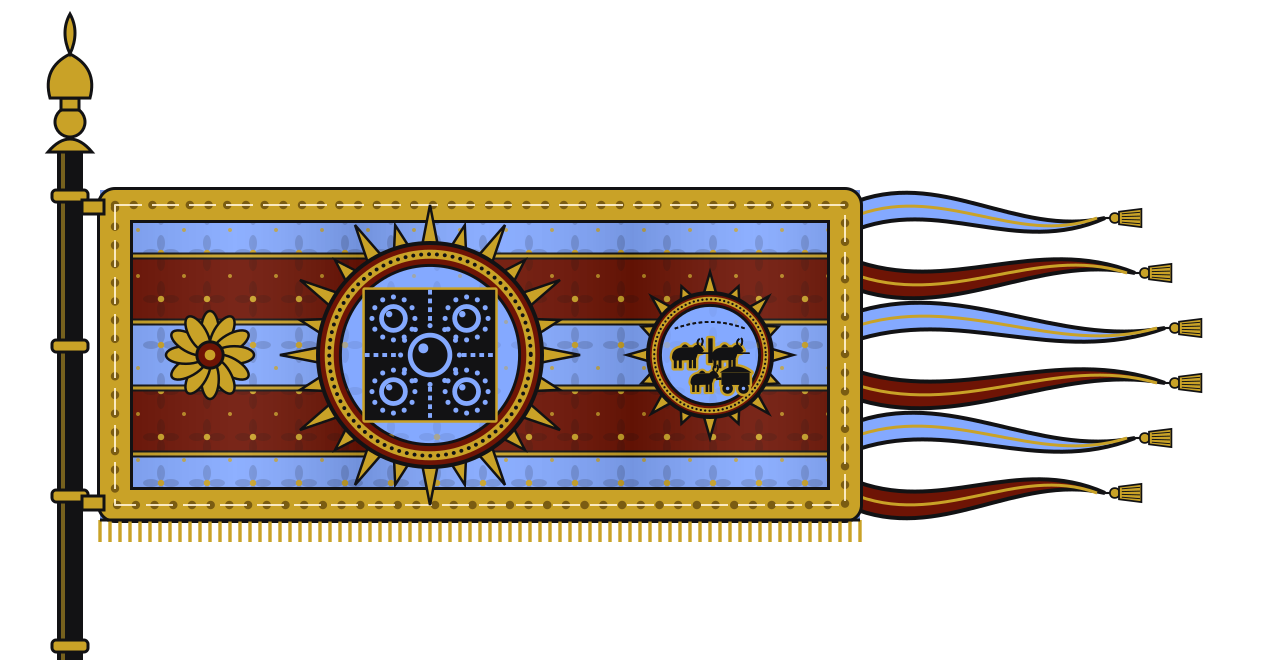
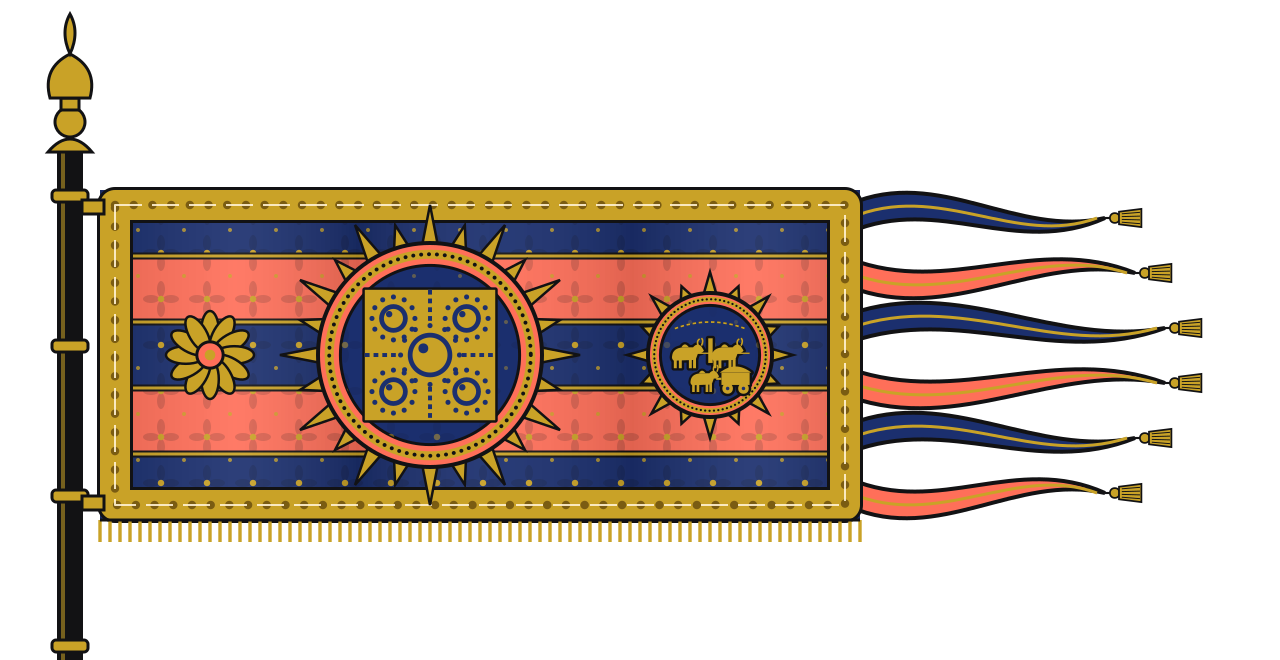
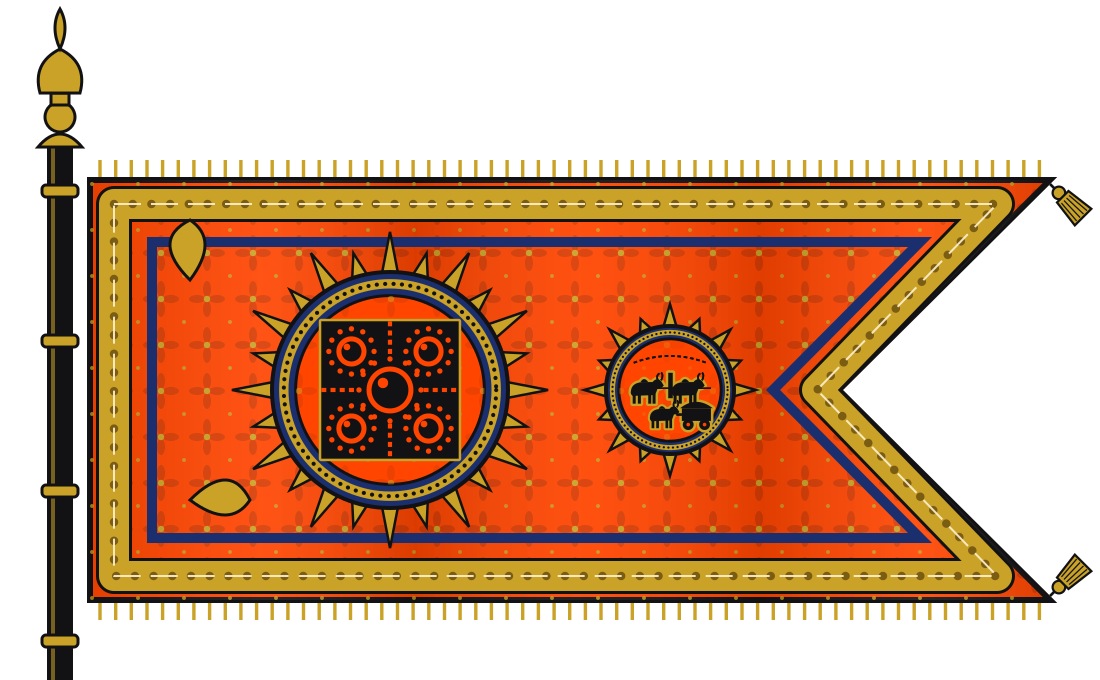
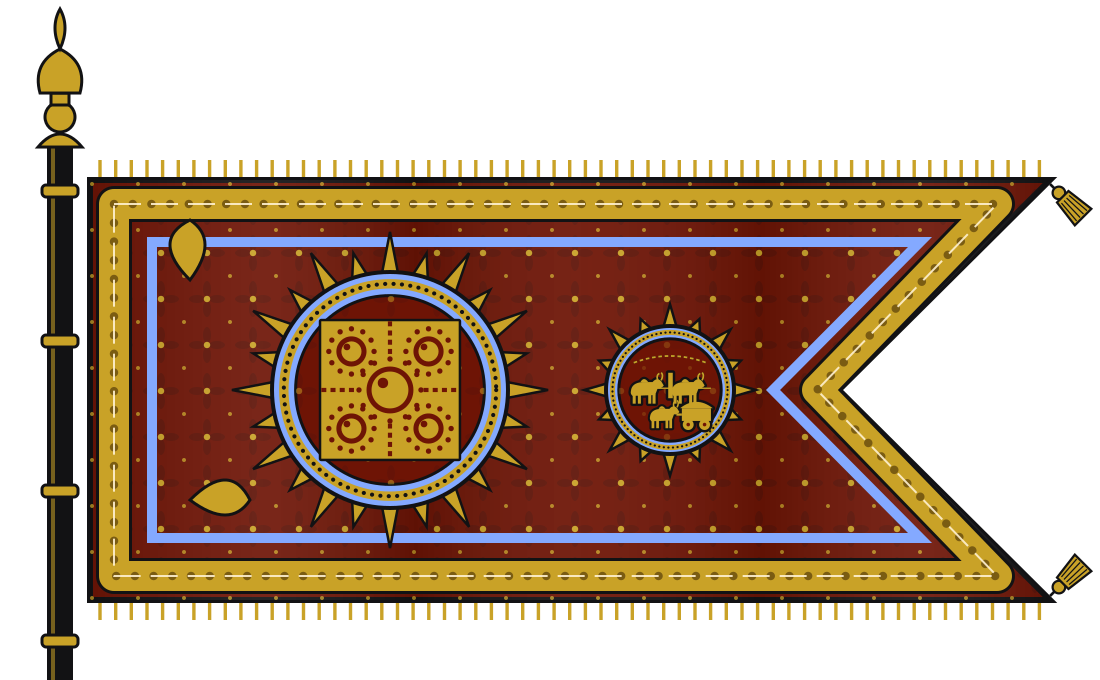

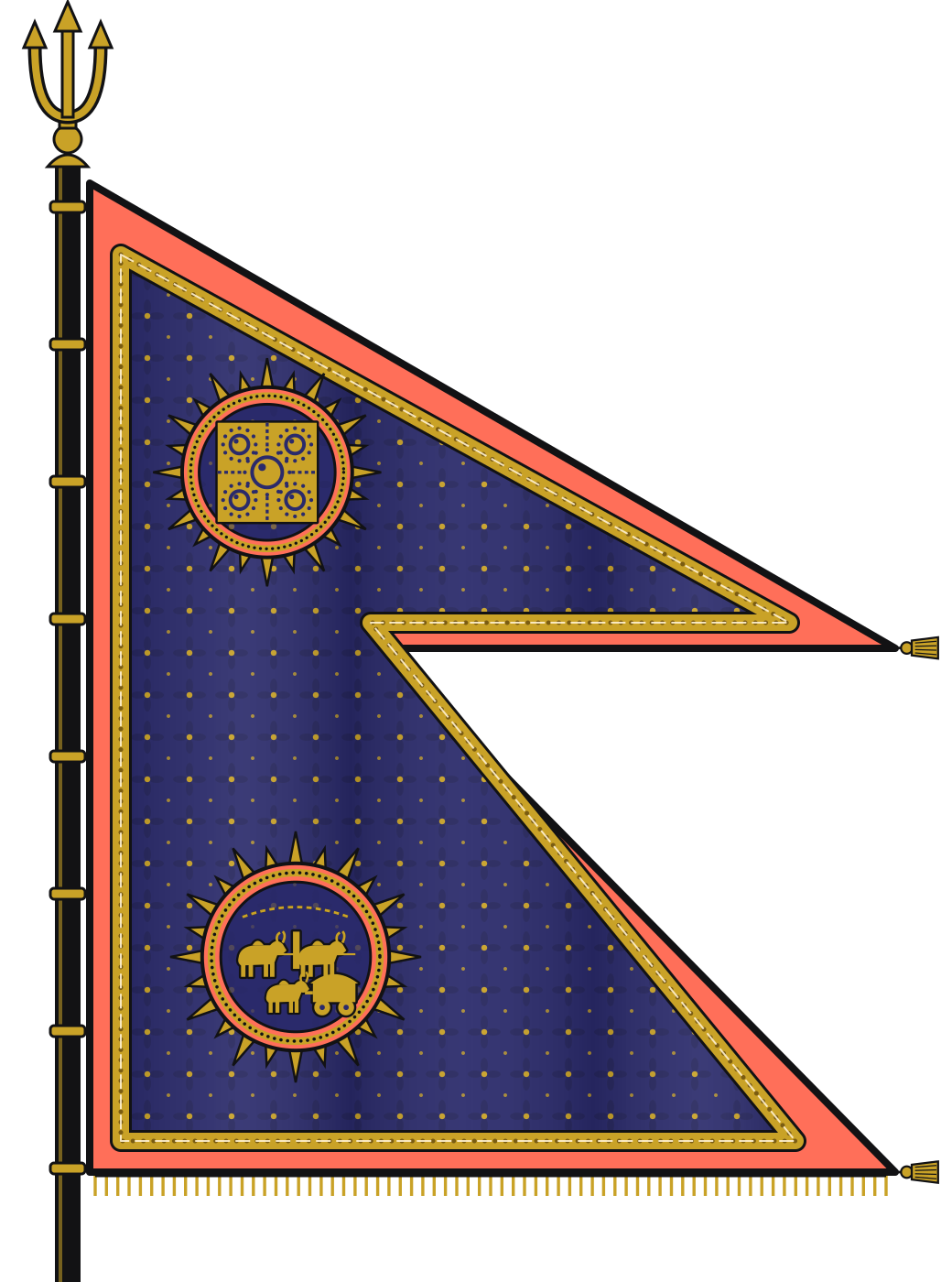




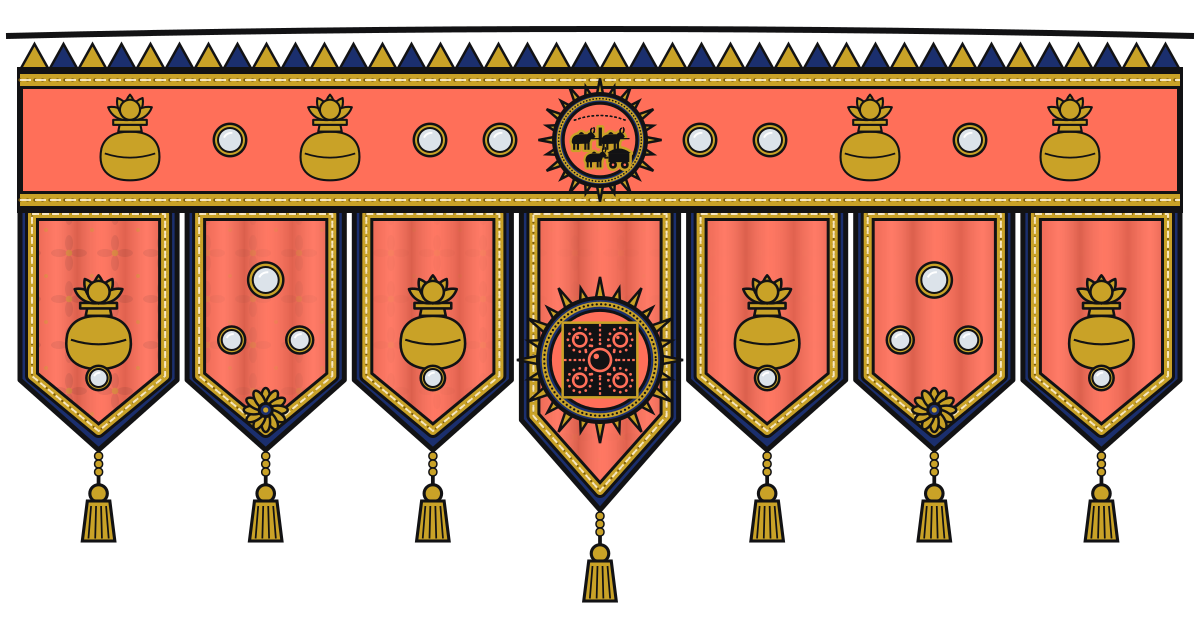
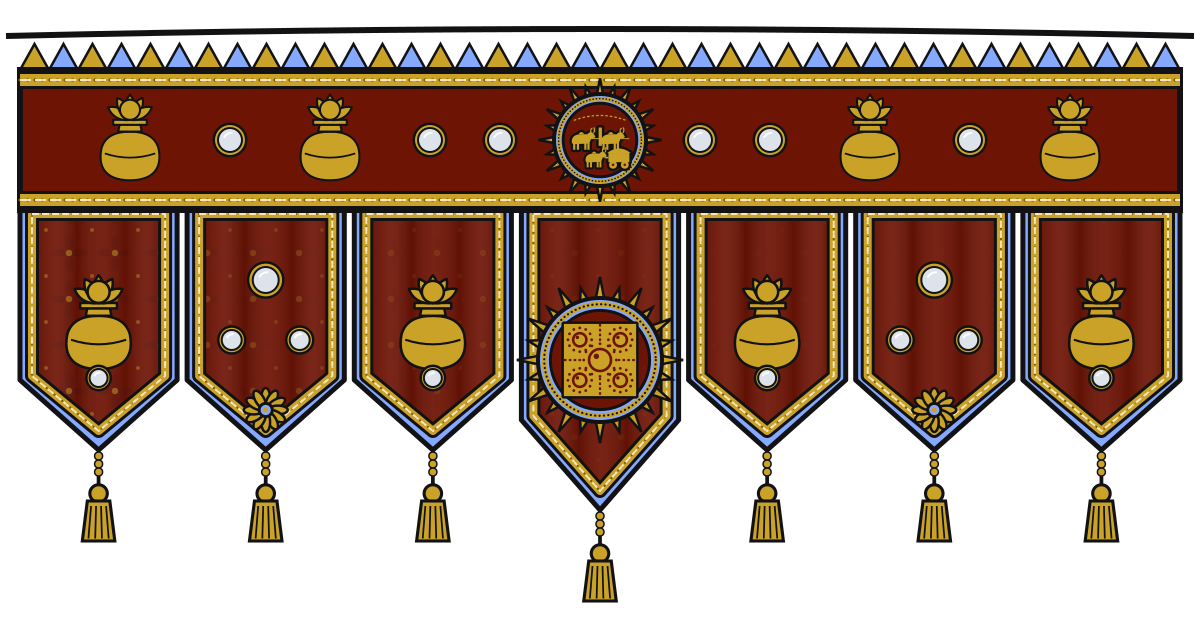

Historic banner
None known
New flag types
| Accessory | For this clan | Basis |
|---|---|---|
| A9 Pota-dhvaja · ship and trade flag For ships, caravans and markets | Not yet designed for this clan | Design |
| A10 Utsava-patāka · festival flag Light, bright flag for fairs and festivals | Not yet designed for this clan | Design |
| A11 Shoka-dhvaja · mourning flag White cloth with the emblem outline in the clan's metal | Not yet designed for this clan | Design |
7. Regalia
| Accessory | For this clan | Basis |
|---|---|---|
| E1 Chhatra · house parasol The ceremonial umbrella | Not yet designed for this clan | Design |
| E2 Chamara · fly-whisks The pair of whisks beside the head of the house | Not yet designed for this clan | Design |
| E3 Danda · staff of office Staff or scepter | Not yet designed for this clan | Design |
| E4 Simhasana · seat The seat of the house, covered in clan cloth | Not yet designed for this clan | Design |
| E5 Khetaka · shield A round shield; the Changi and Dhanush are its flag forms | Not yet designed for this clan | Regional tradition |
| E6 Kula-ayudha · clan weapon The weapon the clan honours | Not yet found for this clan | Under research |
8. Worn
| Accessory | For this clan | Basis |
|---|---|---|
| F1 Kula-vastra · clan cloth The clan's woven pattern in its kit colours | Lepo embroidery: mirror, bead, coin and shell work on the community's clothes and cloth | Documented |
| F2 Kirti-vastra · honour cloth A cloth earned for a deed, not inherited | Not yet designed for this clan | Design |
| F3 Kula-mala · garland flower The flower or leaf the clan wears as a garland | Not yet found for this clan | Under research |
| F4 Chinha · house pin A metal badge with the pin emblem | Not yet designed for this clan | Design |
9. Records
| Accessory | For this clan | Basis |
|---|---|---|
| H1 Clan words A traditional line in the native script | Jai Seva- Be Seva · “Greeting as recorded by Vahia et al.; the source gives no translation and no native-script form” Greeting recorded by Vahia et al. (2014)[6] | Documented |
| H2 Biruda · titles The house's title or titles | Naik or Nayak, the headman's title; the tanda is led by an elected muqaddam, nayak or naik | Documented |
| H3 Prashasti · praise genealogy The lineage as written at the head of a grant | Not yet found for this clan | Under research |
| H4 Vahi · clan register The book of the clan's births, marriages and deaths | Not yet found for this clan | Under research |
| H5 Rana-ghosha · war cry The clan's cry in battle or celebration | Not yet found for this clan | Under research |
10. VishwaVit · knower of the world
Game values are design choices for this project, not historical claims.
References
- Dr. Ramdayal Munda Tribal Welfare Research Institute, Jharkhand, Banjara, read 2026-10-10, https://www.trijharkhand.in/en/banjara
- Wikipedia, Banjara people, read 2026-10-10, https://en.wikipedia.org/wiki/Banjara_people
- Wikipedia, Lambadi language (Wayback snapshot 30 April 2022), read 2026-10-10, https://webcf.waybackmachine.org/web/20220430082449/https://en.wikipedia.org/wiki/Lambadi_language
- Wikipedia, Sevalal Maharaj, read 2026-10-10, https://en.wikipedia.org/wiki/Sevalal_Maharaj
- Verdictum, Tellam Venkata Rao v Union of India (report, 26 July 2025), read 2026-10-10, https://www.verdictum.in/court-updates/supreme-court/tellam-venkata-rao-v-union-of-india-lambadas-sugalis-banjaras-scheduled-tribe-telangana-1586192
- Vahia, Halkare, Menon, Calamur, Astronomy of two Indian tribes: Banjaras and Kolams, arXiv 1406.3044, read 2026-10-10, https://arxiv.org/pdf/1406.3044
- Edgar Thurston and K. Rangachari, Castes and Tribes of Southern India, vol. 4 (Madras, 1909), Project Gutenberg eBook #42994, https://www.gutenberg.org/ebooks/42994
- R. V. Russell and Hira Lal, The Tribes and Castes of the Central Provinces of India, vol. 2 (London, 1916), Project Gutenberg eBook #22010, https://www.gutenberg.org/ebooks/22010
- Cultural Changes and Marginalisation of Lambada Community in Telangana, India, TICI Journals, read 2026-10-22, https://www.ticijournals.org/cultural-changes-and-marginalisation-of-lambada-community-in-telangana-india/
- Wikipedia, Poharadevi, read 11 Oct 2026, https://en.wikipedia.org/wiki/Poharadevi
- The Hitavada, PM Modi to inaugurate Banjara Virasat at Pohradevi on Oct 5, 4 Oct 2024, read 2026-10-11, https://thehitavada.com/Encyc/2024/10/4/PM-Modi-to-inaugurate-Banjara-Virasat-at-Pohradevi-on-Oct-5.html
- Evolve Back, The Lambanis (blog, 20 Nov 2017), read 2026-10-10, https://www.evolveback.com/blogs/the-lambanis.html
- Global InCH, Banjara tribal embroidery mirror work, read 2026-10-10, https://globalinch.org/craft/banjara-tribal-embroidery-mirror-work/
- Down To Earth, Can the decades-old constitutional dispute over Lambadas' Scheduled Tribe status in Telangana be resolved? (opinion), read 2026-10-22, https://www.downtoearth.org.in/governance/can-the-decades-old-constitutional-dispute-over-lambadas-scheduled-tribe-status-in-telangana-be-resolved
- Priyanka Tupe, Outlook India, Maharashtra Reservation Row: Banjaras Seek ST Status, Adivasis Oppose, 17 Oct 2025, read 2026-10-22, https://www.outlookindia.com/national/maharashtra-reservation-row-banjaras-seek-st-status-adivasis-oppose
- Wikipedia, Scheduled castes in Karnataka, read 2026-10-10, https://en.wikipedia.org/wiki/Scheduled_castes_in_Karnataka
- Sushree Mohanty, Indigenous Colours of Odisha: Handbook on 62 Tribes (KISS), read 2026-10-20, https://kissnew.kiss.ac.in/wp-content/uploads/2026/05/Indigenous-Colours-of-Odisha-Handbook-on-62-Tribes-Sushree-Mohanty.pdf
- Wikipedia, List of Scheduled Tribes in Odisha, read 2026-10-20, https://en.wikipedia.org/wiki/List_of_Scheduled_Tribes_in_Odisha
- Wikipedia, Tribes of Jharkhand, read 2026-10-20, https://en.wikipedia.org/wiki/Tribes_of_Jharkhand
- Wikipedia, Lambadi (language), read 2026-10-22, https://en.wikipedia.org/wiki/Lambadi