The Kushanas (Bactrian ΚΟϷΑΝΟ Koshano; Chinese 貴霜 Guìshuāng) were one of five aristocratic Yuezhi tribes in Chinese sources, and under Kujula Kadphises they took over the other four[1][2]. From about 30 CE they formed an empire across Bactria, Gandhara and the Gangetic plain, with Purushapura (Peshawar) and Mathura as capitals[1][3]. Kanishka I (c. 127–150 CE) patronised Buddhism without becoming a Buddhist himself, and his Rabatak inscription says his kingship came from the goddess Nana[3][4]. The empire split from about 225 CE, and the last Kushan rule ended about 375 CE, though sources give different dates[1][5]. Later Gurjar and Gujjar writers claim Kushan descent; the page sets these out as claims, not as documented descent[6].
01Faith and deities
The Kushan dynasty's own Rabatak inscription says Kanishka obtained his kingship from Nana and all the gods[4]. The Atlas gives no KulDevi (basis: Research), so Nana is shown only as the goddess the inscription names, not as a family deity.
No KulDevi has been found for this clan yet; it is on the research list.
| Deity or tradition | Place in the clan's life | Evidence |
|---|---|---|
| Oesho (Οηϸο) | Long linked to Shiva; two Huvishka copper coins carry a 'Ganesa' legend; after Huvishka only Ardoxsho and Oesho remain on coins | [1][7] |
| Ardoxsho (Αρδοχþο) | Iranian goddess on the coins; Ashi Vanghuhi in Avestan | [1][7] |
| Mithra (Μιθρο) | Iranian god on the coins; Kushan coins mix Greek, Iranian, Indic and Sumero-Elamite gods | [3][7] |
| Helios (ΗΛΙΟΣ) | Sun god on Kanishka's coins; a Helios benediction type | [3][1] |
| Shakamano Boddo (Ϸακαμανο Βοδδο) | Buddha on the coins, with Boddo and Metrago Boddo among the Buddhist names on the coins | [1][3] |
| Amitabha | Statue at Govindo-Nagar dated to the 28th year of Huvishka | [1] |
02Temples
Few Kushan temples are named in the extracts. The Surkh Kotal temple and the Kanishka stupa are the best-attested buildings.
Built by the clan
| Temple | Deity | Built by | When | Where |
|---|---|---|---|---|
| Surkh Kotal temple | Not named in the extract | Builder not stated; the Greek architect Palamedes is named | Not dated in the extract | Surkh Kotal, Afghanistan[1] |
| Nana sanctuary at Rabatak | Nana | Shafar, Karalrang, by royal command of Kanishka | Kanishka's reign | Rabatak, Baghlan Province[4] |
| Kanishka stupa | Buddhist stupa | Named for Kanishka | Not dated in the extract; base about 87 m, excavated 1908–09 | Purushapura (Peshawar)[3] |
| Kanishkapur | Buddhist stupa base | Named for Kanishka | Not dated in the extract | Kanispora, Kashmir[3] |
Given patronage or grants by the clan
| Temple | Deity | What the clan gave | When | Where |
|---|---|---|---|---|
| Bodh Gaya | Buddha | Gold offerings under the Enlightenment Throne | Huvishka's reign | Bodh Gaya[1] |
| Stupas and monasteries named in the empire page | Buddhist | Named among Kushan-era religious sites; the gift is not stated | Kushan era | Manikiala, Sanchi, Sarnath, Kosambi[1] |
03Languages and scripts
| Language or script | Kind | Under the clan | Evidence |
|---|---|---|---|
| Bactrian (Greek-derived script) lost | Eastern Iranian; native name αριαο ('Iranian') | Official language from c. 127 CE, replacing Greek as lingua franca; Kanishka calls it the 'Aryan' language[8][4] | [8] |
| Greek lost | Administrative language, then the coin script | Greek legends on coins; Gorpiaios (Γορπιαίος) is a Macedonian month in Kushan inscriptions | [1][9] |
| Gandhari Prakrit (Kharosthi) lost | Middle Indo-Aryan Prakrit; official in the Kushan empire | Written in Kharosthi; in official use under the Kushans | [10][11] |
| Brahmi and Sanskrit | Scripts and language of the Mathura inscriptions | Brahmi Ku-ṣā-ṇa at Mathura; hybrid Sanskrit and Brahmi; Pali legends on early coins | [1] |
| Tocharian research | Language link disputed | Kanishka's native language is probably Tocharian (Falk 2001), but the link to the Yuezhi is disputed | [3][2] |
04Books and literature
The Kushan period is documented by inscriptions, Chinese histories and Buddhist texts from the empire.
Written in the clan's lands during its era
| Work | Author | Kind | When | Link to the clan |
|---|---|---|---|---|
| Rabatak inscription | Kanishka I | Royal inscription in Bactrian | 2nd century CE | [4] |
| Book of Han | Not named in the extract | Chinese dynastic history | Han period | [2] |
| Book of the Later Han | Not named in the extract | Chinese dynastic history; Ban Yong's report | Later Han; report c. 125 CE | [1] |
| Allahabad pillar | Not named in the extract | Inscription naming garbled Kushan titles | Samudragupta's time | [1] |
| Śrīdharmapiṭakanidānasūtra | Not named in the extract | Buddhist sutra; conquest of Pataliputra | Chinese translation 472 CE | [3] |
| Kalpanamanditika | Kumaralata | Text that says Kanishka conquered Khotan | Not dated in the extract | [5] |
| Rajatarangini | Kalhana | Kashmiri chronicle; names Kanishka, Jhushka and Hushka | 1151 CE | [11][5] |
Given patronage by the clan
| Work | Author | What the clan gave | When | Evidence |
|---|---|---|---|---|
| Jñānaprasthāna | Katyayaniputra's Ashtagrantha, rewritten at a Kashmir synod (tradition) | Sarvastivada school patronised by Kanishka | c. 158–176 CE (synod under Kanishka II) | [12] |
| Mahavibhasa (T1545) | Katyayaniputra (credited with the later compilation) | Kanishka's patronage is said to have made it the orthodoxy of Kashmiri Sarvastivada | c. 150 CE (Potter 1998); date uncertain | [13][14] |
05Thinkers and scholars
| Name | Field | Era | Contribution |
|---|---|---|---|
| Vasumitra | Buddhist scholar | Kanishka's time (Kanishka page) or Kanishka II (Sarvastivada page) | Named as a leader of the Fourth Council in Kashmir[3] |
| Ashvaghosha | Buddhist writer | Kanishka's time | Named as an adviser to Kanishka and as a leader of the Fourth Council[3] |
| Lokaksema | Translator | c. 178 CE | First to translate Mahayana texts into Chinese[3] |
| Katyayaniputra | Abhidharma author (credited) | Date uncertain | Credited with the later compilation of the Mahavibhasa[14] |
The Kashmir council is placed under Kanishka by the Kanishka page and under Kanishka II by the Sarvastivada page. The Manjusrimulakalpa credits Kanishka with Prajnaparamita doctrines, per Reginald Ray (1999)[14].
06Art and architecture
What survives is mostly stone and coins: Gandhara and Mathura sculpture, dated statues, a casket and gold coins.
Painting and wall art
Not recorded.
Sculpture and temple art
| Art form | What it is | Era | Evidence |
|---|---|---|---|
| Kanishka statue | Long coat, boots, mace and sword | Mathura Museum | [1] |
| Dated Bodhisattvas | Kosambi (Year 2), Sarnath Bala Bodhisattva (Year 3), Kimbell (Year 4, AD 131) | Kosambi; Sarnath; Kimbell Museum | [3] |
| Mamane Dheri Buddha | Dated Year 89 | Mamane Dheri | [1] |
| Free-standing Buddhas | Mathura school of standing Buddha statues | Mathura | [1] |
Temple and building architecture
| Art form | What it is | Era | Evidence |
|---|---|---|---|
| Surkh Kotal temple | Temple and fortress; Greek architect Palamedes | Surkh Kotal | [1] |
| Kanishka stupa | Stupa base about 87 m, excavated 1908–09 | Purushapura (Peshawar) | [3] |
| Sirsukh | City founded by Kanishka | Taxila | [15] |
Weaving and textiles
Not recorded.
Clothing and jewellery
| Art form | What it is | Era | Evidence |
|---|---|---|---|
| Tunic, belt and trousers | Dress of Kushan devotees shown in Gandhara sculpture | Gandhara | [1] |
Coins, pottery and crafts
| Art form | What it is | Era | Evidence |
|---|---|---|---|
| Kanishka gold dinar | Gold coin of about 8 g with the king at an altar, deities and Bactrian legends | Kushan mints | [3][7] |
07History
The Yuezhi before the Kushans (c. 176–128 BCE)
Chinese histories place the Yuezhi as nomadic pastoralists in western Gansu; the Xiongnu defeated them c. 176 BCE, and they split into Greater and Lesser Yuezhi in 165 BCE[2].
The Wusun forced the Greater Yuezhi out of the Ili valley in 132 BCE, and Zhang Qian reached them in Bactria in 128 BCE[2]. Bharatkosh gives a different route, through Chitral and Swat, and says the Yuezhi were called Tukhar[5].
Greco-Bactria and Gandhara (c. 135 BCE – 75 CE)
The Yuezhi reached Greco-Bactria c. 135 BCE, and the Kushan Empire page gives the date as 135 BCE; the Indo-Greek page gives c. 130 BCE for the migrations that ended Greco-Bactria[1][16].
Bharatkosh says Kujul Kadphises unified five principalities c. 25 BCE, took Kabul and Kandahar from the Indo-Greeks and defeated the Pahlavas[5]. The Gandhara page lists Kujula Kadphises under the Kushans at c. 75 CE[11].
Vima Kadphises and Kanishka I (c. 90–150 CE)
Vima Takto (c. 90–113) and Vima Kadphises (c. 113–127) ruled before Kanishka; Vima Kadphises is called the first great emperor and was Shaivite[1].
Kanishka I (c. 127–150) started an era from 127 CE, made Purushapura a capital beside Mathura and built a great tower there[3][11]. His Rabatak inscription lists Saketa, Kausambi, Pataliputra and Sri-Campa, and Sindh, as part of his claims[4].
Kanishka's Buddhism and the councils
The Kanishka page says he patronised Buddhism but never converted, and that he supported the Gandhara and Mathura schools of art[3].
The Buddhist tradition places a council in Kashmir under Kanishka, led by Vasumitra and Ashvaghosha[3]. The Sarvastivada page places the Kashmir synod under Kanishka II, so the two pages disagree on which king[12].
Ban Chao and the Han frontier (84–90 CE)
A Kushan army of 70,000 was defeated by Ban Chao near Khotan; the Kanishka page dates this to 90 CE, and the Kushan Empire page gives AD 84–86 for the alliance and AD 86/90 for the defeat[3][1].
Decline and the Little Kushans (c. 225–375 CE)
After Vasudeva I (c. 190–230), the empire split c. 225 CE; Sasanian-installed Kushanshahs ruled from c. 240, and Vasudeva II (c. 270–300) was a Little Kushan at Taxila[1][11].
Kidara (c. 360) and the Hephthalites overwhelmed the last Kushan kingdoms; Samudragupta subjugated the remnants, and Kushan rule ended c. 375 CE[1].
08Journey and migrations
The Yuezhi moved west out of Gansu, and the Kushans later moved into Gandhara and the Gangetic plain.
| When | From | To | Why | Evidence |
|---|---|---|---|---|
| c. 176 BCE | Gansu | Westward | Pushed west by the Xiongnu | [2] |
| c. 132 BCE | Ili valley | Sogdia and northern Bactria | Forced out of the Ili by the Wusun | [2] |
| c. 135–130 BCE | Greco-Bactria | Bactria | Took the Greco-Bactrian lands (dates differ by source) | [1][16] |
| c. 75 CE | Kabul and Kandahar | Gandhara | Kujula Kadphises (date from the Gandhara page) | [11] |
| c. 127–150 CE | Gandhara | Mathura and the Gangetic plain | Kanishka I made Mathura a second capital | [3] |
| c. 375 CE | Kushan lands | Kidarite and Hephthalite rule | The last Kushan kingdoms were overrun | [1] |
09Seats and lands
| Place | Role | Where today |
|---|---|---|
| Purushapura (Peshawar) | Capital; Kanishka's great tower[11] and the Kanishka stupa[3] | Peshawar, Pakistan |
| Mathura | Second capital; Kanishka statue and free-standing Buddhas[3][1] | Uttar Pradesh |
| Kapisa (Pushkalavati) | First capital (1st c. BCE); summer capital near Bagram[1] | Bagram, Afghanistan |
| Taxila | Little Kushan capital; Sirsukh founded by Kanishka[1][15] | Taxila, Pakistan |
| Surkh Kotal | Temple and fortress; the Greek architect Palamedes is named[1] | Afghanistan |
| Rabatak | Where the Rabatak inscription was found[4] | Baghlan Province, Afghanistan |
| Khalchayan | Palace reliefs of the Kushan period[1] | Uzbekistan |
| Kashgar | A Kushan-installed king, Chenpan, ruled here (AD 114–120)[1] | Xinjiang, China |
10Notable figures
| Name | Role | Era | Known from |
|---|---|---|---|
| Kujula Kadphises | Unifier and founder; Chinese Qiujiuque | c. 50–90 CE (dates differ: infobox 25–85; coinage page 30–80) | [1][7][2] |
| Heraios | First to call himself Kushan on coins; skull deformation | c. 1–30 CE | [1] |
| Vima Takto | Ruler; Chinese 閻膏珍 Yangaozhen | c. 90–113 CE | [1] |
| Vima Kadphises | First great emperor; Shaivite; Mathura statue inscription | c. 113–127 CE | [1] |
| Kanishka I | The Great; Rabatak inscription; era from 127 CE | c. 127–150 CE | [4][3] |
| Huvishka | Consolidated Mathura; gold offerings at Bodh Gaya | c. 151–190 CE | [1] |
| Vasudeva I | Last Great Kushan; Chinese 波調 Bodiao | c. 190–230 CE | [1][2] |
| Vasudeva II | Shaivite; Little Kushan at Taxila | c. 270–300 CE | [1] |
| Kipunada | Last Kushan ruler named | c. 335–350 CE | [1] |
| Sadaṣkaṇa | Son of Kujula, named in the Odirajas inscription; apparently never ruled | Not dated in the extract | [1] |
| Agesilas (Agisalaos on the Kanishka page) | Greek artist who signed the Kanishka casket; superintendent of works | AD 127 | [9][3] |
| Lokaksema | Kushan Buddhist missionary at Luoyang; first to translate Mahayana texts into Chinese | c. 178 CE | [1][3] |
| Chenpan | Kushan-installed king of Kashgar; a hostage at the Han court | AD 114–120 | [1] |
| Palamedes | Greek architect named for the Surkh Kotal temple | Not dated in the extract | [1] |
| Shafar, Karalrang | Lord of the border land who made a Nana sanctuary by royal command | Kanishka's reign | [4] |
| Rupiamma | Great Satrap named in the Pauni inscription | Not dated in the extract | [1] |
11Allies, rivals and marriages
| People | Relationship | When |
|---|---|---|
| Han China | Tribute to the Han; a princess request was refused; Buddhist missionaries went east[1] | Tribute 89–106 CE; 158–159 CE |
| Rome | Embassies; Roman glassware at Kapisa; a Bactrian embassy to Hadrian[1] | 2nd century CE |
| Sasanian Persia | Shapur I claims territory to Purushapura; Sasanian-installed Kushanshahs[1][11] | 3rd–4th century CE |
| Xiongnu | Rivals who drove the Yuezhi west[2] | c. 176 BCE |
| Wusun | Neighbours; the Yuezhi defeated the Wusun in 173 BCE[2] | 173 BCE; 132 BCE |
| Indo-Greeks | Kabul and Kandahar taken from them; Greek legends were used on Kushan coins[5][9] | 1st century BCE – 1st century CE |
| Yaudheyas | Took Gangetic territory c. 270[1]; the Atlas says they threw out the Kushanas | c. 270 CE |
| Kidarites and Hephthalites | Overwhelmed the last Kushan kingdoms; Kidarites claimed Kushan heritage on coins[1] | c. 360 CE |
| Gupta Empire | Samudragupta subjugated Kushan remnants and adopted Kushan weights and designs[7][1] | c. 350–375 CE |
| Gandharans and Kushan Gandhara | Kushan rule in Gandhara; the Gandhari language was official[10][11] | c. 75–230 CE |
12Society and livelihood
The Kushan court was a Hellenised elite that kept Greek cults and skull deformation[1].
Government and social order
| Institution or group | What it was | Evidence |
|---|---|---|
| Yuezhi confederation (翖侯 xīhóu lords) | Five aristocratic tribes; Guishuang took over the other four | [2][1] |
| Kshatrapa governance | Introduced by the Kushans | [1] |
| Hellenised elite | Greek administration and Greek cults at court | [1] |
| Pax Kushana | A period of peace the page dates to about 200 years | [1] |
| Merchant families | Dedicated statues (Kushan Empire page) | [1] |
| Horse archers | The Yuezhi fought as horse archers | [2] |
Livelihood over time
| Era | Livelihood | Evidence |
|---|---|---|
| Yuezhi, before the Kushan rise | Pastoral economy of nomadic herders | [2] |
| c. 30–375 CE | Silk Road trade: the Gandhara-to-China road was under Kushan control for a century; sea trade from the Indus to Rome | [1] |
| c. 30–375 CE | Coinage in gold, bronze and copper across North India and Central Asia; circular ingots used as money | [7][1] |
13Sub-clans and related clans
The Yuezhi confederation came first; the Kushans were one of its five Greater Yuezhi tribes, and the other four are listed as related. Descent claims by Gurjar and Gujjar writers are marked as claims.
| Clan | Relation | Where | Size | In the Atlas | Evidence |
|---|---|---|---|---|---|
| Yuezhi 月氏 | Parent people | Western Gansu, then the Ili valley and Bactria (Chinese sources) | same name as ANC-239: check | [2] | |
| Little Kushans (Eastern Kushans) | Branch | Punjab; capital Taxila | same name as ANC-198: check | [1] | |
| Kushano-Sasanians (Kushanshas) KΟÞANΟ ÞAΟ | Dynasty from this clan | Sogdiana, Bactria and Gandhara, installed by the Sasanians | same name as ANC-197: check | [1][11] | |
| Lesser Yuezhi 小月氏 | Related people | Southern mountains (Qilian); mixed with the Qiang | same name as ANC-193: check | [2] | |
| Xiumi 休密 | Related people | Bactria (one of the five Greater Yuezhi xīhóu) | same name as ANC-238: check | [2] | |
| Shuangmi 雙靡 | Related people | Bactria (one of the five Greater Yuezhi xīhóu) | same name as ANC-241: check | [2] | |
| Xidun 肸頓 | Related people | Bactria (one of the five Greater Yuezhi xīhóu) | same name as ANC-236: check | [2] | |
| Dumi 都密 | Related people | Bactria (one of the five Greater Yuezhi xīhóu) | same name as ANC-202: check | [2] | |
| Tusharas (Tukhara, Tokharoi) | Related people | Linked to the Yuezhi and Kushans (Strabo; Sanskrit usage) | new clan candidate | [2][5] | |
| Shakas | Parent people | Bharatkosh says the Kushan dynasty is said to emerge as a branch of the Shakas | ANC-119 | [5] | |
| Kidarites | Related people | Claimed Kushan heritage on their coins | ANC-177 | [1] | |
| Gurjar community | Related people | Claimed by Gurjar writers as a major gotra (Kushan); not a documented descent | ANC-038 | [6] | |
| Gujjar | Related people | Jammu and Kashmir, Himachal, Ladakh | ST-093 | [6] | |
| Kasana | Related people | Regional name in Punjab and Kashmir; claimed Kushan gotra | new clan candidate | [6] | |
| Kusane Gujjar | Related people | Named by Ahmed (2016, p. 51) as linked to Kushan coin legends (claim) | new clan candidate | [6] | |
| Checchi | Related people | Van Gujjar group (Pathways 2000) | new clan candidate | [6] | |
| Hun (Gurjar sub-caste) | Related people | Kushan and Hun sub-castes among Gurjars (Warikoo and Som 2000) | new clan candidate | [6] |
Clans marked "new clan candidate" are not in the Atlas yet.
14Surnames
Only Kushan, Kushana and Kasana are named as family names in the extracts.
| Surname | Clan or sub-clan | Where | People with this surname | Also used by other communities |
|---|---|---|---|---|
| Kushan | Kushanas (ANC-070) | Not stated in the extracts | not yet counted | Not checked |
| Kushana | Kushanas (ANC-070) | Not stated in the extracts | not yet counted | Not checked |
| Kasana | Kasana Gujjars (claimed Kushan gotra) | Punjab and Kashmir (regional name) | not yet counted | Not checked |
Counts are of everyone with the surname, from the cited source and year, not only members of this clan. A surname shared with other communities says nothing about any one person's origin.
15Songs and music
No song or sung tradition of the Kushanas is sourced.
None recorded yet.
16Poems, lullabies and children's rhymes
None recorded yet.
17Stories, legends and proverbs
Stories and legends
| Story | What happens | Told by | Evidence |
|---|---|---|---|
| The Buddha's prophecy of Kanishka | The Buddha foretold Kanishka 400 years after his death | Vinaya and Khotanese Dunhuang scroll | [3] |
| The white hare at the stupa | A white hare vanished at the Kanishka stupa site | Xuanzang | [3] |
| The king of Pahlava | A Pahlava king repented after an arhat showed him hell | Sutra account | [3] |
| Kanishka, Jhushka and Hushka in Kashmir | Three kings who ruled Kashmir and founded a city | Kalhana's Rajatarangini | [5] |
Proverbs and sayings
Not recorded.
18Festivals and fairs
Not recorded.
19Food, dress and games
Food
Not recorded.
Dress
| Item | What it is | Evidence |
|---|---|---|
| Tunic, belt and trousers | Dress of Kushan devotees shown in Gandhara | [1] |
| Long coat, boots, mace and sword | Kanishka's statue in the Mathura Museum | [1] |
Games and martial arts
| Item | What it is | Evidence |
|---|---|---|
| Chess claim research | A 2007 comment by Gerhard Josten claims the Kushans invented chess; the comment gives no evidence, so the claim is not used as fact | [17] |
Tags: living still practised · revived brought back after a break · lost known only from records · research reported but not yet confirmed from a source. Songs and poems under copyright are listed by title only; restricted or sacred material is noted without its content.
20Status today
No Kushan state survives. The name lives on in the Kushana and Kasana surnames and in Gurjar and Gujjar claims of descent[6].
Who carries the name today
| Community | Link | Basis | Evidence |
|---|---|---|---|
| Gurjar community (ANC-038) | Community tradition | [6] | |
| Kasana Gujjars (Gujjar, ST-093) | Community tradition | [6] | |
| Kushan kings identified as Gujjars (Vasudevan 2013, ASI) | Under research | [6] |
Recognised heritage
| What | Recognition | Evidence |
|---|---|---|
| Kanishka statue, Mathura Museum | On display in Mathura | [1] |
| Rabatak inscription | On display at the reopened Afghan National Museum, Kabul | [4] |
| Kanishka casket | Peshawar Museum; copy in the British Museum | [3] |
| Taxila, with Sirsukh | UNESCO World Heritage Site (1980, criteria iii and vi) | [15] |
| Kanishka stupa, Purushapura | Base about 87 m; excavated 1908–09 | [3] |
Not yet reviewed by a community. The descent claims come from community-centred books and are set out as claims.
21For children
Kanishka and the goddess Nana
Long ago, the Yuezhi people came from the east, from the borders of China in Gansu. Their family became the Kushans, and they took over Bactria and Gandhara. Their great king Kanishka built a tower at Purushapura, which is Peshawar today. He made Mathura a second capital. On a Bactrian inscription, he said that his kingship came from the goddess Nana. He supported the Buddha's teaching, but he never became a Buddhist himself. Today you can see his statue in Mathura and his casket in Peshawar.
22Across the project
| Project | What carries this clan | Status |
|---|---|---|
| Atlas of the Janas | Places named in the extracts: Purushapura, Mathura, Taxila, Kapisa, Bactria; no footprint or pin yet | To check |
| KulDevi and GrahDevi | No KulDevi in the Atlas (basis: Research); the main deity is Nana from the Rabatak inscription | From the Atlas |
| Planet naming | Not checked against the Tier registers | To check |
| Renaming and waters | No place or water name drawn from the Kushanas yet | — |
23Open questions
- When did the Kushan dynasty start and end? Sources give c. 30 CE to c. 375 CE (Atlas and Kushan Empire page), c. 30 to c. 225 CE (Bharatkosh), and a Kushanshah rule from c. 230 to c. 440 (Gandhara page).
- Which king held the Kashmir council? The Kanishka page says Kanishka; the Sarvastivada page says Kanishka II.
- Was Rabatak's genealogy Kujula, Vima Taktu, Vima Kadphises? Mukherjee reads Saddashkana as the grandfather, and this is disputed.
- Was the Kanishka era from 127 CE (Falk 2001) or 78 CE, the older dating? The Kanishka page says the older dating is abandoned.
- Where did the Yuezhi come from? Indo-European, Tocharian and Saka origins are all proposed; the Tocharian link is disputed.
- Do Kasana, Checchi and Van Gujjar groups descend from the Kushans? The sources are community-centred claims; Ahmed (2016) and Vasudevan (2013) are not checked.
- Is the Rabatak word read as Gujjar ('Gusur' in K.K. Publications 2022) a valid reading? Only 'some scholars' are cited.
- Does the Ban Chao battle fall in 86 or 90 CE? The sources differ.
- Who signed the Kanishka casket: Agesilas (Legacy of the Indo-Greeks) or Agisalaos (Kanishka page)?
- Which god did the Surkh Kotal temple serve? The extract names only the architect.
- Are the Lodha of the Van Gujjars and the Lodha in the Atlas (ST-177) the same community?
- Surnames: how many people bear Kushan, Kushana or Kasana? No count is sourced.
- Food, dress, songs, festivals and proverbs of present-day Kasana or Kushana groups are not sourced.
- The camel caravan, the Vaijayanti and the tamgha flag are design choices in the Atlas; no source ties a camel caravan to the Kushanas.
- Where was the Rabatak inscription found? The Rabatak page gives a 1993 find near Surkh Kotal, and also says it was found at Rabatak, Baghlan Province, and that it was in a storehouse at Pul-i Khumri in 2000.
- Is Kapisa the same as Pushkalavati? The Kushan Empire page gives Kapisa/Pushkalavati; the Gandhara page places Kapisi at Bagram and Pushkalavati at Charsadda.
- When did Kanishka II reign? The Kushan Empire page gives c. 230–247; the Sarvastivada page places the Kashmir synod under Kanishka II in c. 158–176.
24Astitva
अस्तित्व · being, existence: everything by which the clan is known
The Kushan coins, titles and statues are the documented accessories; the totem, sacred tree and war cry are not found[7][1].
Every clan has every accessory, royal objects included. Each one says how it is known: Documented This clan's own object is recorded. · Regional tradition Recorded for the region or for peoples like this one, not for this clan. · Design Made for this project, with no historical claim. · Under research To be found for this clan from sources. Legends and titles are written in the clan's own script.
1. Seals and coins
| Accessory | For this clan | Basis |
|---|---|---|
| B1 Rajamudra · house seal Round seal with the clan emblem and a short legend in the clan's script | Not yet designed for this clan | Design |
| B2 Anguliya-mudra · signet ring Personal seal ring of the head of the house | Not yet designed for this clan | Design |
| B3 Chhapa · house stamp Ink or block stamp for letters, goods and cloth | Not yet designed for this clan | Design |
| B4 Tamrapatra · charter plate Copper-plate grant on a ring, closed with the house seal | Not yet designed for this clan | Design |
| B5 Shreni-mudra · guild or trade seal Seal for the clan's trade, craft or caravan | Not yet designed for this clan | Design |
| C1 Clan coin Emblem or deity on one side, a legend in the clan's script | Kanishka's gold dinar: the king at an altar or standing, with Greek and Iranian deities and a Bactrian legend ϷΑΟΝΑΝΟϷΑΟ ΚΑΝΗϷΚΙ ΚΟϷΑΝΟ Shaonanoshao Kanishki Koshano · “Shah of Shahs, Kanishka the Kushan” | Documented |
| C2 Coin die The die that strikes the coin | Not yet designed for this clan | Design |
2. Living symbols
| Accessory | For this clan | Basis |
|---|---|---|
| I1 Totem trio The tree, bird and animal the clan protects | Not yet found for this clan | Under research |
| I2 Kaval-maram · guardian tree The tree that stands at the clan's seat | Not yet found for this clan | Under research |
3. Stone and gate
| Accessory | For this clan | Basis |
|---|---|---|
| G1 Torana · gateway The built gate of the seat; the cloth Toran hangs in it | Not yet designed for this clan | Regional tradition |
| G2 Viragallu · hero stone Carved panel stone for a member who died defending the clan | Not yet designed for this clan | Regional tradition |
| G3 Kula-shila · clan stones Standing and table stones that remember the ancestors | Not yet designed for this clan | Design |
| G4 Jayastambha · victory pillar A pillar raised for a victory | Not yet designed for this clan | Design |
| G5 Sima-shila · boundary stone Marks the clan's land, with a line in the native script | Not yet designed for this clan | Design |
4. Sounds
| Accessory | For this clan | Basis |
|---|---|---|
| D1 Pancha-mahashabda · five great sounds The right to five instruments | Not yet designed for this clan | Design |
| D2 Shankha · clan conch The clan's own named war conch | Not yet designed for this clan | Design |
| D3 Murasu · house drums Three drums: war, charity and justice | Not yet designed for this clan | Design |
5. Kit: colours, metals and emblems
The documented symbol is the Kushan tamgha, the monogram on Kanishka's coins[1]. The Atlas takes a camel caravan with a tamgha mark as the emblem, for Silk Road trade, and a Vaijayanti (imperial standard) as the flag type; these are design choices.
| Part of the kit | This clan |
|---|---|
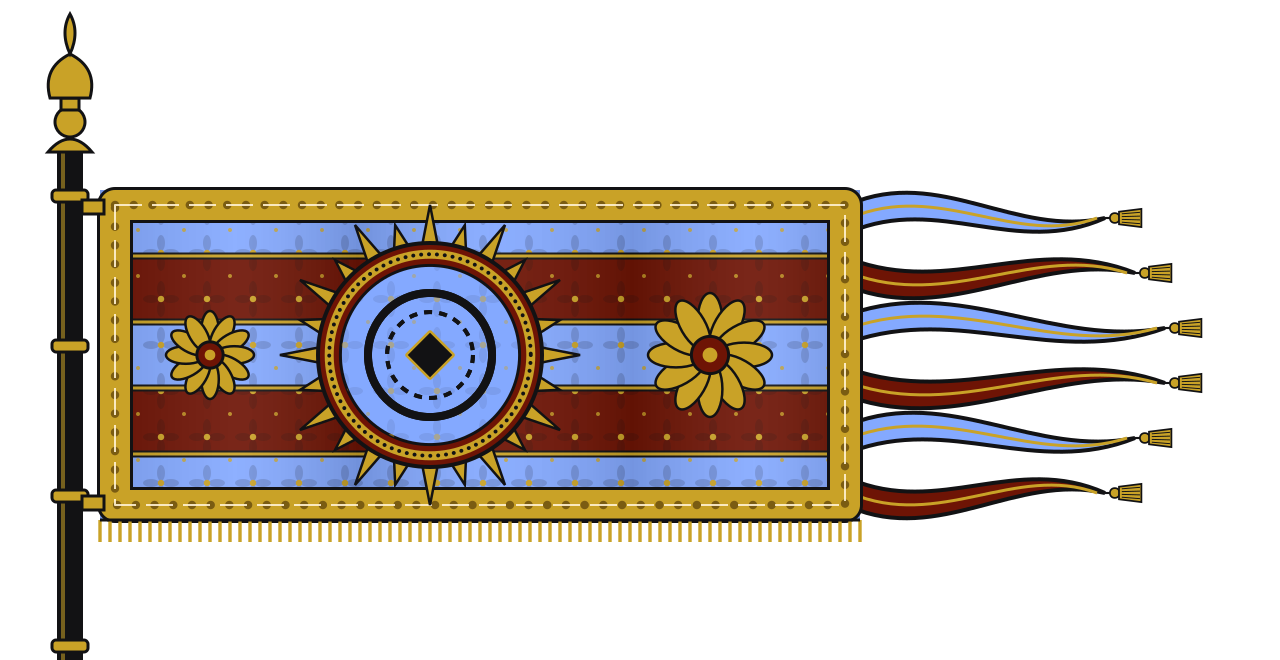
| Field | Intense Electric Blue #84A9FF |
| Accent | Maroon #6E1405 |
| Emblem colour | Charcoal Black #121214 |
| Zari metal | Gold |
| Main emblem | A camel caravan |
| Second image | A Kushan tamgha mark |
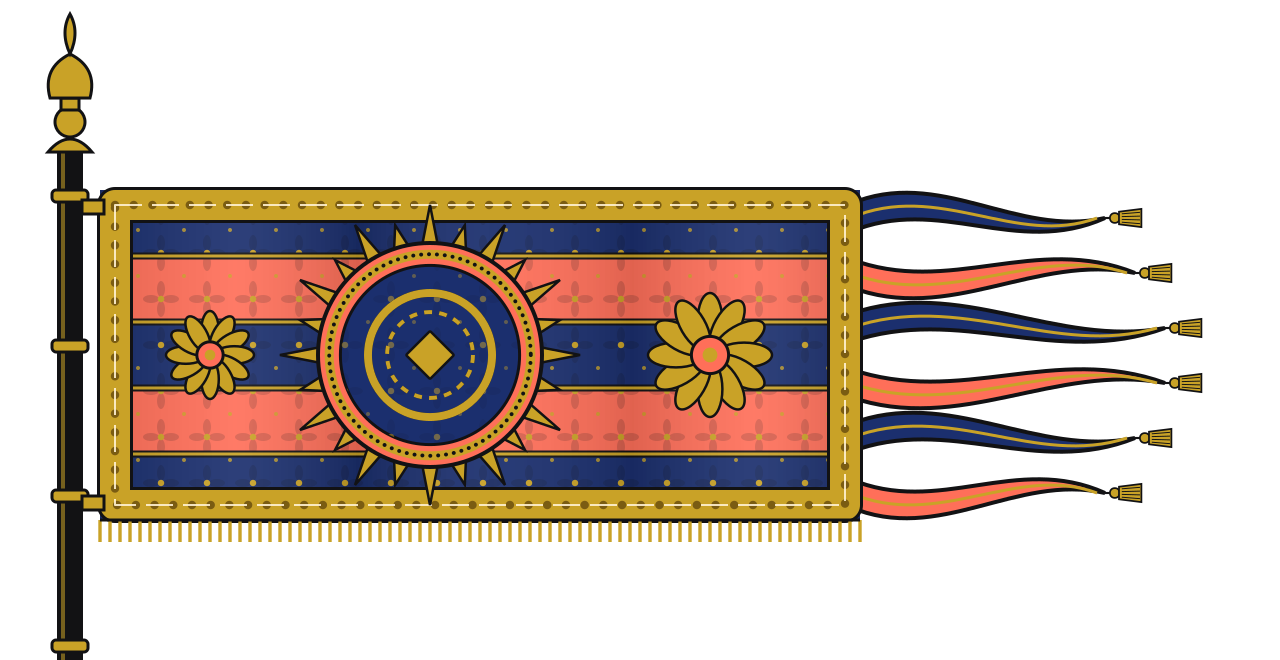
| Night and day | Every visual accessory has two versions: by night the emblem on the dark field, by day the clan's field colour on cloth woven from its metal. |
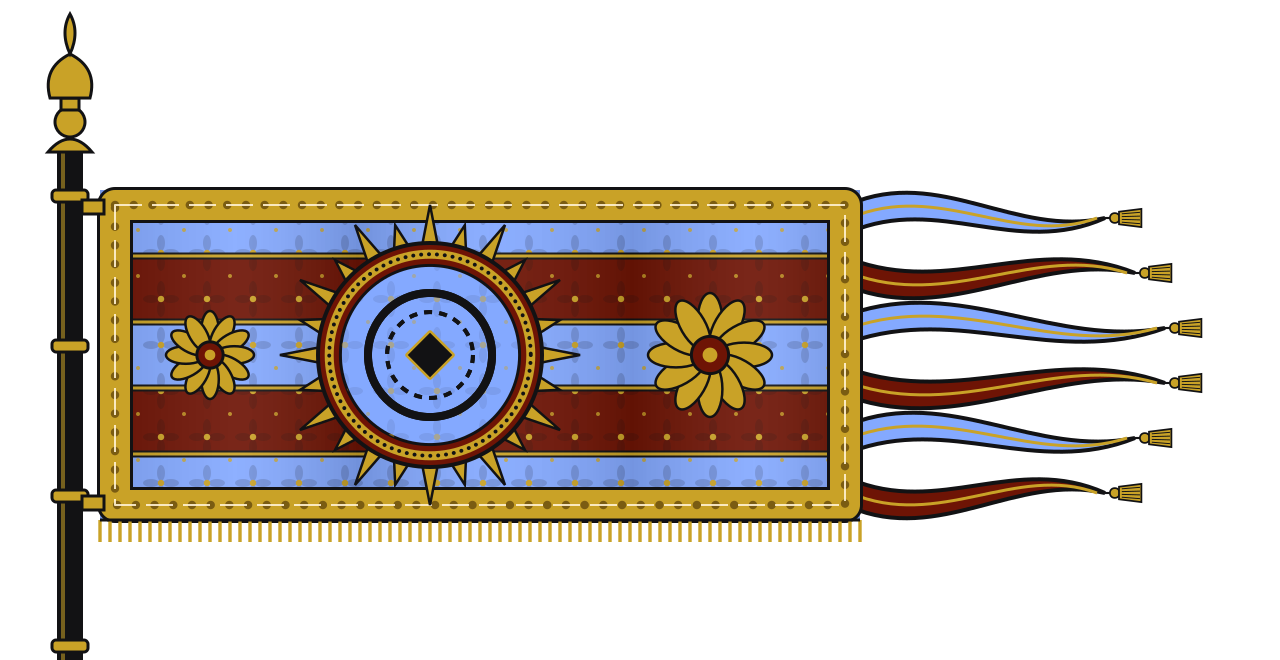
6. Flags
Every clan has every flag type; the type says the occasion and the colours say the clan. The outlined card is the flag the Atlas assigns.
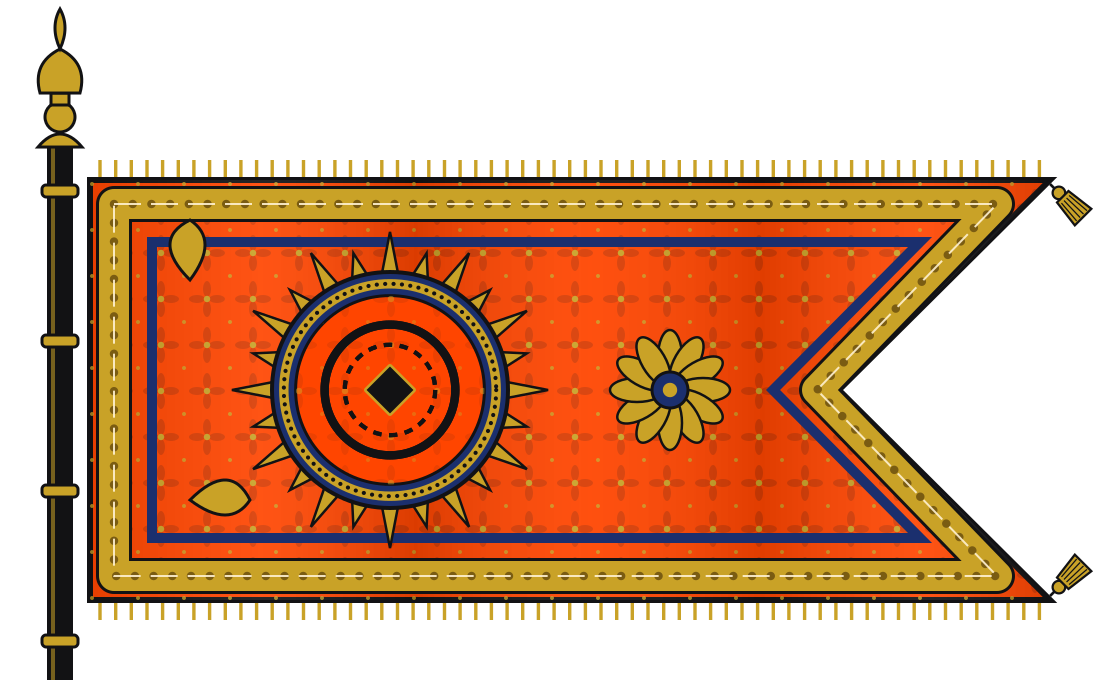
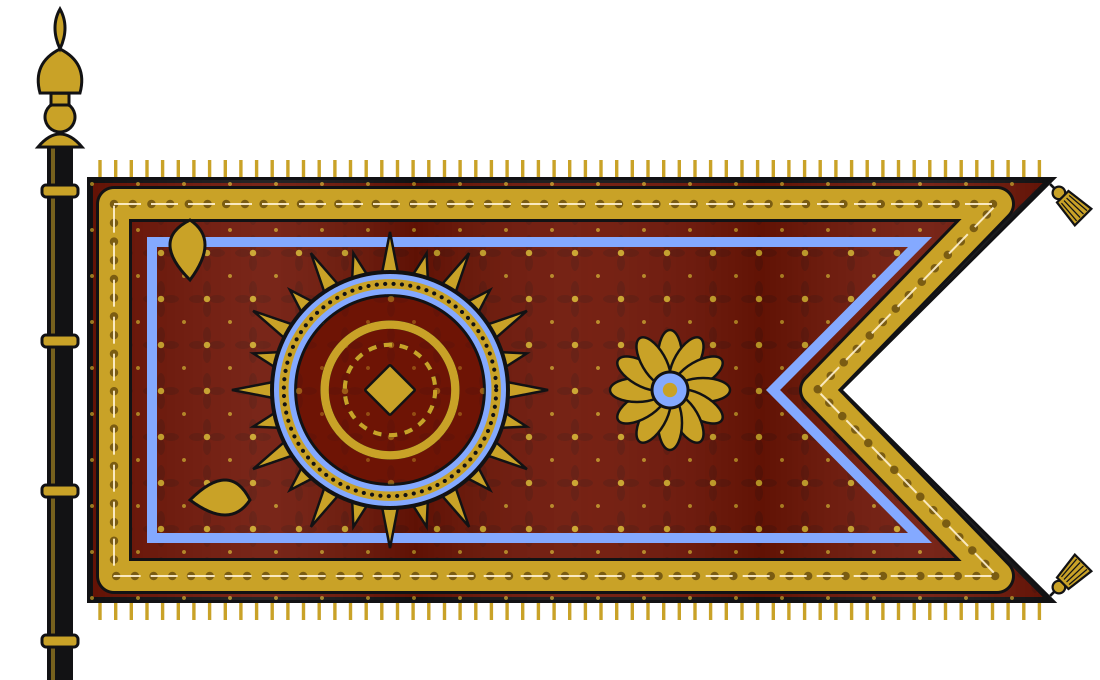
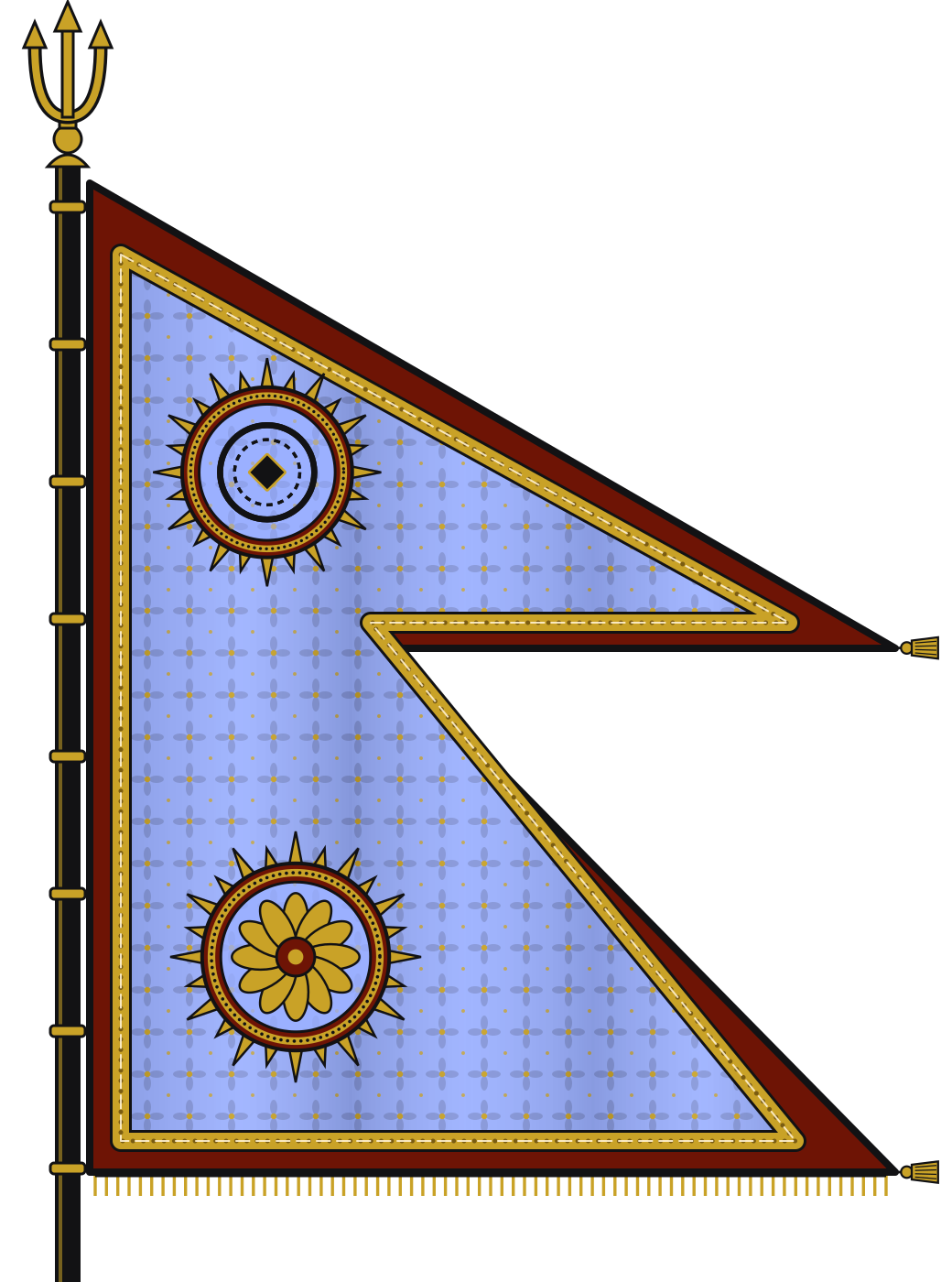
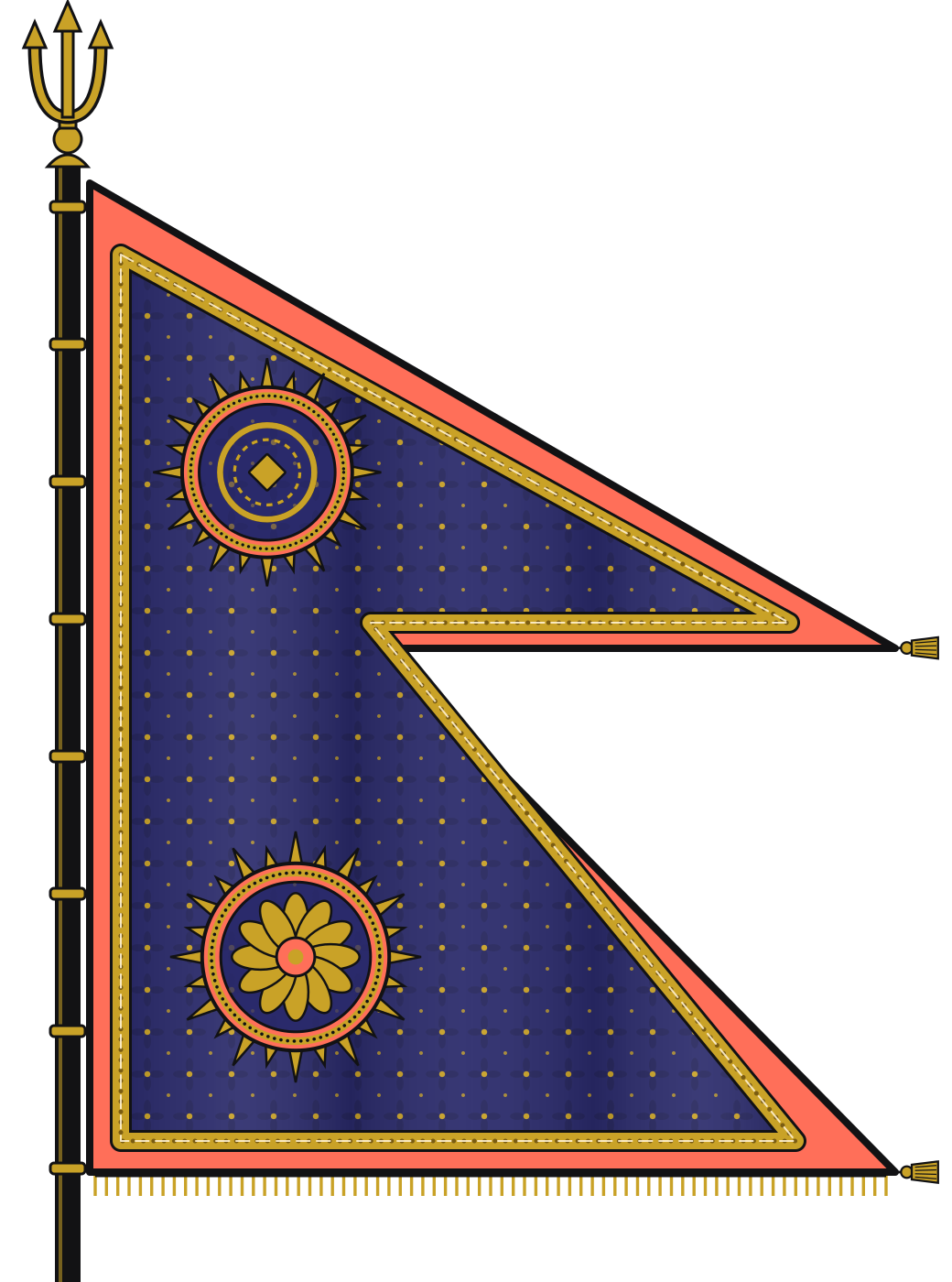

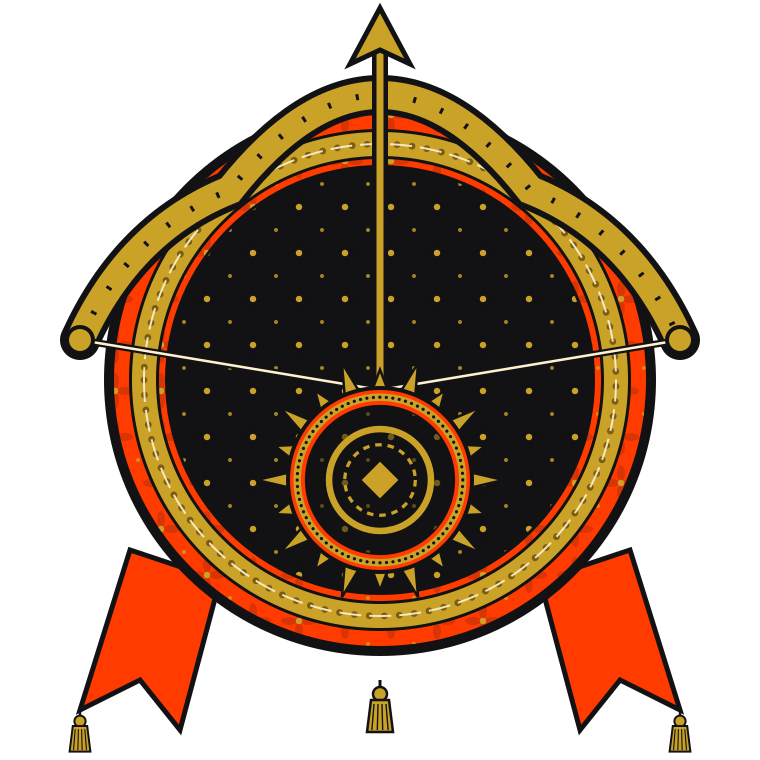
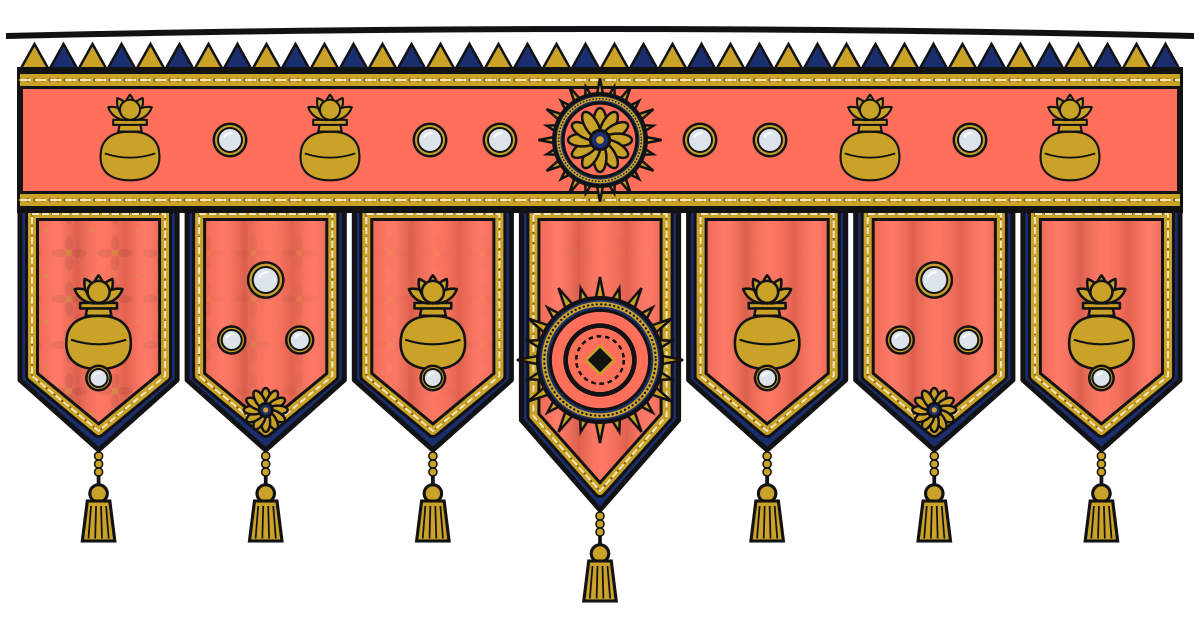
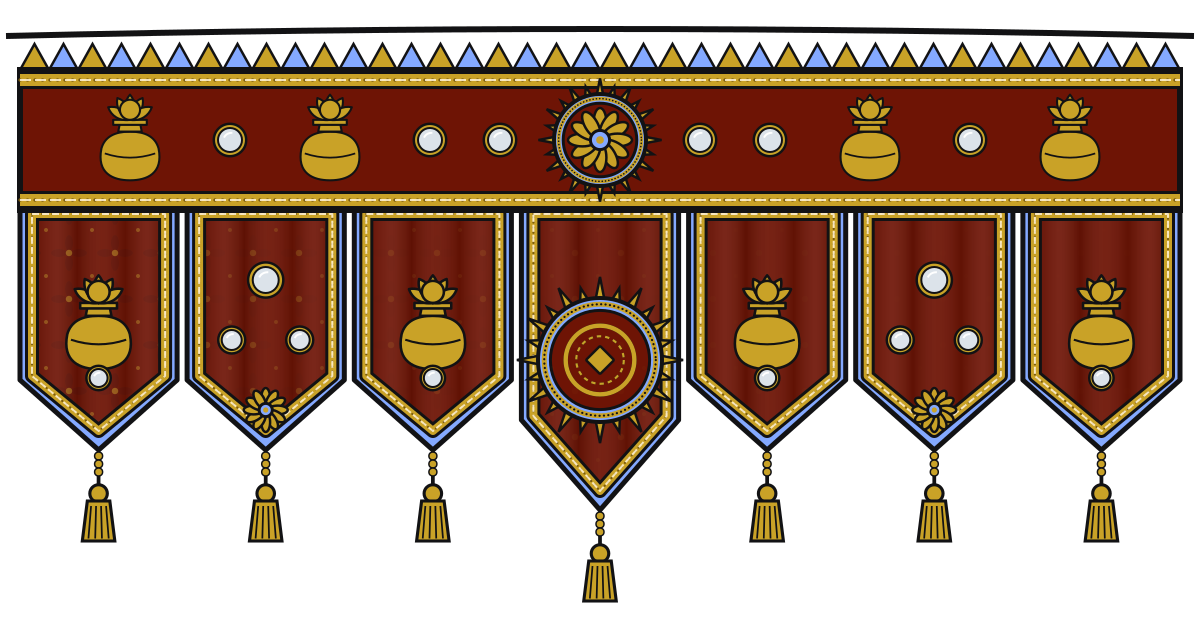

Historic banner
Kushan coins carry the dynastic tamgha symbol
New flag types
| Accessory | For this clan | Basis |
|---|---|---|
| A9 Pota-dhvaja · ship and trade flag For ships, caravans and markets | Not yet designed for this clan | Design |
| A10 Utsava-patāka · festival flag Light, bright flag for fairs and festivals | Not yet designed for this clan | Design |
| A11 Shoka-dhvaja · mourning flag White cloth with the emblem outline in the clan's metal | Not yet designed for this clan | Design |
7. Regalia
| Accessory | For this clan | Basis |
|---|---|---|
| E1 Chhatra · house parasol The ceremonial umbrella | Not yet designed for this clan | Design |
| E2 Chamara · fly-whisks The pair of whisks beside the head of the house | Not yet designed for this clan | Design |
| E3 Danda · staff of office Staff or scepter | Not yet designed for this clan | Design |
| E4 Simhasana · seat The seat of the house, covered in clan cloth | Not yet designed for this clan | Design |
| E5 Khetaka · shield A round shield; the Changi and Dhanush are its flag forms | Not yet designed for this clan | Regional tradition |
| E6 Kula-ayudha · clan weapon The weapon the clan honours | Mace and sword carried by Kanishka's statue at Mathura | Documented |
8. Worn
| Accessory | For this clan | Basis |
|---|---|---|
| F1 Kula-vastra · clan cloth The clan's woven pattern in its kit colours | Long coat and boots on Kanishka's statue; tunic, belt and trousers on devotees' figures in Gandhara | Documented |
| F2 Kirti-vastra · honour cloth A cloth earned for a deed, not inherited | Not yet designed for this clan | Design |
| F3 Kula-mala · garland flower The flower or leaf the clan wears as a garland | Not yet found for this clan | Under research |
| F4 Chinha · house pin A metal badge with the pin emblem | Not yet designed for this clan | Design |
9. Records
| Accessory | For this clan | Basis |
|---|---|---|
| H1 Clan words A traditional line in the native script | ΚΟϷΑΝΟ · “Koshano” The dynastic name on Kushan coins[1] | Documented |
| H2 Biruda · titles The house's title or titles | King of kings; Devaputra (son of God) and Shaonanoshao (Shah of Shahs) on coins and statues ΒΑΣΙΛΕΥΣ ΒΑΣΙΛΕΩΝ ΚΑΝΗϷΚΟΥ Basileus basileōn Kanishkou · “King of kings, Kanishka” | Documented |
| H3 Prashasti · praise genealogy The lineage as written at the head of a grant | The Rabatak genealogy: Kujula Kadphises, Vima Taktu, Vima Kadphises, then Kanishka; the descent is disputed | Documented |
| H4 Vahi · clan register The book of the clan's births, marriages and deaths | Not yet found for this clan | Under research |
| H5 Rana-ghosha · war cry The clan's cry in battle or celebration | Not yet found for this clan | Under research |
10. VishwaVit · knower of the world
Game values are design choices for this project, not historical claims.
References
- Wikipedia, Kushan Empire, read 2026-10-19, https://en.wikipedia.org/wiki/Kushan_Empire
- Wikipedia, Yuezhi, read 2026-10-19, https://en.wikipedia.org/wiki/Yuezhi
- Wikipedia, Kanishka, read 2026-10-19, https://en.wikipedia.org/wiki/Kanishka
- Wikipedia, Rabatak inscription, read 2026-10-19, https://en.wikipedia.org/wiki/Rabatak_inscription
- Bharatkosh (bharatdiscovery.org), कुषाण वंश, read 2026-10-19, https://bharatdiscovery.org/india/कुषाण_वंश
- Bharatpedia, Kushan (clan), read 2026-10-19, https://en.bharatpedia.org/wiki/Kushan_(clan)
- Wikipedia, Kushan coinage, read 2026-10-19, https://en.wikipedia.org/wiki/Kushan_coinage
- Wikipedia, Bactrian language, read 2026-10-19, https://en.wikipedia.org/wiki/Bactrian_language
- Wikipedia, Legacy of the Indo-Greeks, read 2026-10-18, https://en.wikipedia.org/wiki/Legacy_of_the_Indo-Greeks
- Gandhari language (Wikipedia, read 2026-10-09), citing R. Salomon (1998, 2007, 2008), Salomon, Allchin and Barnard, Ancient Buddhist Scrolls from Gandhara (1999), T. Burrow (1936) and C. Masica (1993).
- Gandhara (Wikipedia, snapshot of 24 May 2022, read 2026-10-09), citing Macdonell and Keith (1912), Al-Biruni (tr. Sachau 1910), Watters (1904), Salomon (1998), Neelis (2010), Behrendt (2007), Srinivasan (2008), Blurton (1993), Upinder Singh (2017) and Narasimhan et al. (2019).
- Wikipedia, Sarvastivada, read 18 Oct 2026, https://en.wikipedia.org/wiki/Sarvastivada
- Wikipedia, Vaibhashika, read 18 Oct 2026, link
- Wikipedia, Abhidharma Mahavibhasa Sastra, read 18 Oct 2026, link
- Taxila (Wikipedia, read 2026-10-09), citing J. Marshall, Taxila (1951) and A Guide to Taxila (1960), A. Cunningham (1871), R. K. Mookerji (1951), H. Scharfe (2002), R. Thapar (1997) and U. Singh (2008).
- Wikipedia, Indo-Greek Kingdom, read 2026-10-18, https://en.wikipedia.org/wiki/Indo-Greek_Kingdom
- Varnam, Chess originated in Kannauj? (12 Mar 2007, with comments), read 2026-10-10, https://www.varnam.org/?p=1212