The Kshaharatas were the first of two families of Western Kshatrapas, known from coin legends and inscriptions in western India[1][2]. Their named rulers are Abhiraka, Bhumaka and Nahapana; Nahapana's inscriptions are dated to years 41 to 46[3]. Nahapana's reign is dated 24–70, 66–71 or 119–124 CE by different sources, and the sources do not agree on the order of Abhiraka and Bhumaka[3][4]. The Satavahana king Gautamiputra Satakarni struck his own mark over Nahapana's silver drachms, and his Nashik inscription says he uprooted the Kshaharata family[5]. Donor records at Nasik and Karla show gifts to Buddhist monks, Brahmanas and ascetics[6][2].
01Faith and deities
The Atlas gives no KulDevi for this clan (KulDevi basis: Research), and the extracts name no clan deity.
No KulDevi has been found for this clan yet; it is on the research list.
| Deity or tradition | Place in the clan's life | Evidence |
|---|---|---|
| Buddhism (monasteries, caves, chaitya) | Donor faith: Nahapana's Karla gift; Ushavadata's Cave 10 for the Samgha; a monastery commissioned by Nahapana | [2][7][4] |
| Brahmanas and Devas | Gifts recorded at Karla (Nahapana) and in Ushavadata's charities: 16 villages to deities and Brahmanas | [2][6] |
| Jain tradition | Nahapana is recorded as becoming a Jain monk, Bhutabali, in the Avasyaka Niryukti and later texts | [3] |
| Vedic religion | Ushavadata is said to have followed the Vedic religion (Divatia 1993, as cited on his page) | [6] |
02Temples
Donor records only; the extracts do not give a clan temple.
Built by the clan
| Temple | Deity | Built by | When | Where |
|---|---|---|---|---|
| Buddhist monastery (not named) | Buddhist | Nahapana (commissioned) | Not dated | [4] |
Given patronage or grants by the clan
| Temple | Deity | What the clan gave | When | Where |
|---|---|---|---|---|
| Karla Great Chaitya | Buddhist chaitya | Nahapana's donative record: gifts to Brahmanas, Devas and ascetics 'without any distinction of sect or origin' | 120 CE | [2] |
| Nasik Cave 10 (Nahapana Vihara) | Buddhist; given to the Samgha | Ushavadata's gift of the cave, with cloth money and food money for monks | Year 42 | [6][7] |
| Manmodi (Junnar), Cave 7 | Not stated | Inscription of Nahapana's year 46 naming the king and minister Ayama | Year 46 | [3] |
03Languages and scripts
| Language or script | Kind | Under the clan | Evidence |
|---|---|---|---|
| Prakrit (Maharashtri) | Language of the inscriptions | Nasik, Karla and Junnar records | [2] |
| Sanskrit | Eulogy at the head of Ushavadata's Nashik inscription | Western Satraps' court (Rudradaman) | [6][2] |
| Brahmi | Script of coin and cave legends | Nahapana and Bhumaka coins; Nashik | [8][3][6] |
| Kharoshthi lost | Script of the early coin legends; the Western Satraps page says it was dropped from Chashtana on (see open) | Bhumaka and Nahapana coins | [2] |
| Greek lost | Script of the blundered coin obverse legends | Nahapana and Abhiraka coins | [3][4][1] |
04Books and literature
No text by a Kshaharata is named in the extracts. Under research: the scholarly works cited on the Nahapana page (Rapson 1908; Cribb 2013; Upinder Singh 2008) and the Nashik Cave inscriptions edition (Bhandarkar 1876, as cited on the Gautamiputra page) are the leads.
Written in the clan's lands during its era
Not recorded.
Given patronage by the clan
Not recorded.
05Thinkers and scholars
Not recorded.
Under research: no thinker of the clan is named in the extracts. The modern scholars cited on the pages are sources, not thinkers of the clan.
06Art and architecture
The clan's surviving art is mostly on its coins (see Astitva). No painting, textile or clothing is sourced.
Painting and wall art
Not recorded.
Sculpture and temple art
| Art form | What it is | Era | Evidence |
|---|---|---|---|
| Lion on a pillar capital | Shown on Bhumaka's reverse (lion with a dharmachakra); Nahapana's coins show an Ashokan-style lion capital | [8][2] |
Temple and building architecture
| Art form | What it is | Era | Evidence |
|---|---|---|---|
| Karla Great Chaitya | Chaitya hall dedicated 120 CE; Nahapana's donative record is there | [2] | |
| Nasik Pandavleni Cave 10 | Cave with a chaitya and an inscription by Dakshamitra | [2][6] |
Weaving and textiles
Not recorded.
Clothing and jewellery
Not recorded.
Coins, pottery and crafts
Not recorded.
07History
Abhiraka and Bhumaka (dates in conflict)
Abhiraka is a Kshaharata ruler named on copper coins; his coins are found mostly in Gujarat, and the page dates him to c. 35 CE in the infobox and to 'c. late 1st century BCE' in the text[4].
Bhumaka's coins name him as Kshaharata satrap and carry Kharoshthi and Brahmi legends; one of Nahapana's coins names Bhumaka as Nahapana's father[8].
The succession is in conflict. The Abhiraka page's infobox puts Bhumaka after Abhiraka, but its own note (Senior 1999b, p.135) says Bhumaka overstruck Abhiraka's copper, which would put Bhumaka first; the Bhumaka page places Abhiraka before him[4][8]. Not resolved here.
Nahapana
Nahapana, son of Bhumaka, was a satrap on the coins before he took the title Mahakshatrapa[3][2].
CoinIndia says he expanded at the Satavahanas' expense and that his Junnar-type coins copy Satavahana prototypes[1].
His inscriptions are dated years 41 to 46. The Manmodi (Junnar) inscription of year 46 reads 'Raño jmahākhatapasa sāminahapānasa' and names his minister Ayama of the Vatsa gotra[3].
Nahapana's reign is dated 24–70, 66–71 or 119–124 CE by different sources[3][2].
Ushavadata and the Nashik caves
Ushavadata (Rishabhadatta), son of Dinika, was Nahapana's viceroy over the southern Saka territories, including Nasik, Karle and Junnar, and his son-in-law; he married Dakshamitra, Nahapana's daughter[6].
In the year 42, in the month Vesakha, he gave Nasik Cave 10, the 'Nahapana Vihara', to the Samgha, with 3,000 kahapanas as cloth money and food money for monks of any sect and origin[6][7][3].
His Nashik inscription opens with a Sanskrit eulogy and calls him a Shaka; it names him 'the Kshaharata Kshatrapa'[6][7].
The end of Nahapana's line
Gautamiputra Satakarni re-struck Nahapana's silver drachms with his own Ujjain symbol and three-arched hill; the Jogalthambi hoard at Nashik holds such coins[5][3].
His Pandavleni Cave 3 inscription claims that he uprooted the Khakharata family of Nahapana[5].
The date of the defeat is given as c. 124 CE (Dhavalikar), after 71 CE (Fynes) or 78 CE (Bhandare)[5]. The succession on the Nahapana page goes on to Chashtana of the Kardamaka line[3][9].
The Taxila copper plate
The State Bank of Pakistan museum cites the Taxila copper plate of 6 CE for the Kshaharatas and says it has a Kshaharata term[10][2].
The Abhiraka page dates the same plate to year 78 of Maues and names Liaka Kusulaka and his son Patika Kusulaka (Senior 2006, p.136)[4]. The two dates are not reconciled; see open.
08Journey and migrations
Movement is inferred from coins and inscriptions; the extracts give few dated moves.
| When | From | To | Why | Evidence |
|---|---|---|---|---|
| Not dated | North (not named) | Southward, to Gujarat (later coins) | Not stated; the page cites Senior 1999a | [4] |
| Under Nahapana, not dated | Nasik, Karle and Junnar (Ushavadata's base) | North, against the Malayas (Malavas) | To rescue the Uttamabhadras (Senart 1906, pp.78–79) | [6] |
09Seats and lands
| Place | Role | Where today |
|---|---|---|
| Bharuch (Barygaza) | Export harbour; Nahapana ruled Barygaza, named in the Periplus[11] | Western India |
| Minnagara | Metropolis of Syrastrene in the Periplus; listed capital[2] | Western India |
| Govardhana (Nasik) | Two weavers' guilds given 2,000 and 1,000 kahapanas by Ushavadata[7] | Nasik (as named in the extracts) |
| Nasik and Pandavleni | Caves 3 and 10: Gautamiputra's prashasti and Ushavadata's gift[5][6] | Nashik |
| Junnar and Manmodi | Nahapana's year-46 inscription and Manmodi Cave 7[3] | Junnar |
| Karla (Valuraka) | Karla Great Chaitya, dedicated 120 CE, with Nahapana's donative record[2] | Karla (as named in the extracts) |
| Sopara (Shurparaka) | A place named on the Ushavadata page[6] | Western India |
| Dashapura (Mandasor) | A place named on the Ushavadata page[6] | Mandasor (as named in the extracts) |
| Prabhasa | Eight wives given to Brahmanas at the Prabhasa tirtha[6][3] | Prabhasa (as named in the extracts) |
| Gujarat, Kutch and Saurashtra | Where Abhiraka's copper coins are mostly found; single finds in Afghanistan and Mleiha, UAE[4] | Gujarat; Afghanistan; Mleiha, UAE |
| Sind, Gujarat, Rajasthan, Maharashtra | The kingdom covered parts of these areas (CoinIndia)[1] | Pakistan (Sind), India |
10Notable figures
| Name | Role | Era | Known from |
|---|---|---|---|
| Abhiraka | Kshaharata ruler; copper coins | c. 35 CE (infobox) or late 1st century BCE (text) | [4] |
| Bhumaka 𑀪𑀽𑀫𑀓 · 𐨧𐨂𐨨𐨐 | Kshaharata ruler; father of Nahapana on a Nahapana coin | Early 1st century CE (Bhumaka page lead, which also gives early 2nd century; see open) | [8] |
| Nahapana | Kshaharata ruler; satrap, then Mahakshatrapa; tradition of a Jain monk, Bhutabali | Dated 24–70, 66–71 or 119–124 CE | [3][2] |
| Ushavadata (Rishabhadatta) | Viceroy and son-in-law of Nahapana; donor of Nasik Cave 10 | Nashik inscription, year 42 | [6][7] |
| Dakshamitra (Dakhamitra) | Nahapana's daughter and Ushavadata's wife; her inscription is in Cave 10 | Not dated | [6][7] |
| Ayama | Minister of Vatsa gotra named in Nahapana's Manmodi inscription | Year 46, Junnar | [3] |
| Higaraka (Higataka) | Named as a Kshaharata ruler | Not dated | [4] |
| Hospises | Named as a Kshaharata ruler | Not dated | [4] |
| Hastadatta | Named as a Kshaharata ruler | Not dated | [4] |
| Yapirajaya | Named with the Kshaharatas; Senior (2006, p.22) finds no firm evidence that he was one | Not dated | [4] |
| Liaka Kusulaka and Patika Kusulaka | Named on the Taxila plate; Buddhist monastery patrons on the Abhiraka page | Year 78 of Maues (plate, Senior 2006, p.136) | [4] |
11Allies, rivals and marriages
| People | Relationship | When |
|---|---|---|
| Bhumaka | Father of Nahapana, per Nahapana's coin[8] | Early 1st century CE |
| Nahapana and Chashtana | Chashtana succeeds Nahapana on the Nahapana page; Chashtana founded the Kardamaka line of the Western Satraps[3][9] | c. 78–130 CE (Chashtana page) |
| Gautamiputra Satakarni (Satavahana) | Overstruck Nahapana's drachms; his Pandavleni Cave 3 inscription claims he uprooted the Kshaharata family[5] | c. 124 CE (Dhavalikar); other dates given |
| Dinika | Father of Ushavadata[6] | Not dated |
| Dakshamitra | Nahapana's daughter; wife of Ushavadata[6] | Not dated |
| Sakas, Yavanas, Pahlavas | Named with the Kshaharatas as the peoples Gautamiputra's prashasti says he destroyed; Nahapana's family is given as Saka-Pahlava by other sources[5][3] | c. 150 CE (Pandavleni Cave 3, Gautamiputra page); year 19 of Pulumavi |
| Abhiras | Jhanjh (2020, as cited) proposes that Abhiraka was an Abhira king who defeated the Kshaharatas; the page notes this ignores similar legends on Hospises and Higaraka coins[4] | Abhiraka's time |
12Society and livelihood
The extracts show a donor society: a ruling house, a viceroy, Buddhist monks, weavers' guilds and gifts to Brahmanas.
Government and social order
| Institution or group | What it was | Evidence |
|---|---|---|
| Viceroy of the southern Saka territories | Ushavadata held this post under Nahapana, covering Nasik, Karle and Junnar | [6] |
| Sangha (Buddhist monks) | Recipients of Cave 10 and of cloth money: twenty monks who keep the vassa in the cave | [7] |
| Weavers' guilds at Govardhana | Two guilds were given 2,000 and 1,000 kahapanas, invested at a monthly rate | [7] |
| Brahmanas and Devas | Karla record of Nahapana: gifts to Brahmanas and Devas; the page says 100,000 Brahmanas were fed yearly | [2][3] |
| Ascetics at Valuraka | The village of Karajika was set aside for ascetics at Valuraka (Karla) | [3] |
Livelihood over time
| Era | Livelihood | Evidence |
|---|---|---|
| Not dated | Trade through the port of Barygaza (Bharuch), which Nahapana ruled; the Periplus lists wine, copper, silk and ivory in trade with Rome | [2][11] |
13Sub-clans and related clans
Peoples and houses the extracts name in relation to the Kshaharatas. No sub-clan of the Kshaharatas is named.
| Clan | Relation | Where | Size | In the Atlas | Evidence |
|---|---|---|---|---|---|
| Western Satraps | Parent people | Malwa, Gujarat, Konkan, Nasik, Ujjain (Western Satraps page) | ANC-185 | [2] | |
| Kardamaka (Bhadramukha) | Related people | Ujjain (Chashtana page) | same name as ANC-191: check | [9] | |
| Abhiras | Related people | ANC-001 | [4] | ||
| Shakas | Related people | ANC-119 | [6] | ||
| Pahlavas | Related people | ANC-092 | [3] | ||
| Yavanas | Related people | ANC-154 | [5] | ||
| Satavahana | Related people | ANC-183 | [5] |
Clans marked "new clan candidate" are not in the Atlas yet.
14Surnames
Not recorded.
15Songs and music
No song of the Kshaharatas is sourced in the extracts, so none is listed.
None recorded yet.
16Poems, lullabies and children's rhymes
No poem or lullaby is sourced for this clan. The children's rhyme in For children is original.
None recorded yet.
17Stories, legends and proverbs
Stories and legends
| Story | What happens | Told by | Evidence |
|---|---|---|---|
| Nahapana becomes a monk legend | The king gives up rule and becomes the Jain monk Bhutabali | Avasyaka Niryukti, Curnisutra and Sridhara's Srutavatara (as cited on the Nahapana page) | [3] |
Proverbs and sayings
Not recorded.
18Festivals and fairs
Not recorded.
19Food, dress and games
Food
Not recorded.
Dress
Not recorded.
Games and martial arts
Not recorded.
Tags: living still practised · revived brought back after a break · lost known only from records · research reported but not yet confirmed from a source. Songs and poems under copyright are listed by title only; restricted or sacred material is noted without its content.
20Status today
The Western Satraps page gives the modern states of the dynasty as India and Pakistan[2]; no present-day community of the Kshaharatas is named in the extracts.
Community review: none. No present-day community is named in the extracts.
21For children
A coin with an arrow
Long ago, in western India, a royal family called the Kshaharatas ruled. Their king Nahapana had silver coins. On each coin was a king's head on one side, and an arrow and a thunderbolt on the other. The coins had writing in Greek, Kharoshthi and Brahmi. Nahapana ruled Barygaza, a port named in an old sailors' guide. Later, a Satavahana king named Gautamiputra Satakarni struck his own mark over Nahapana's silver coins. His writing on a cave wall at Nashik says he uprooted Nahapana's family.
Written for this project
22Across the project
| Project | What carries this clan | Status |
|---|---|---|
| Atlas of the Janas | Western India: Bharuch (Barygaza), Nasik, Karla, Junnar, Sopara, Mandasor (sources) | No pins or footprints set yet |
| KulDevi and GrahDevi | The Atlas gives no KulDevi (basis: Research) | Under research |
| Planet naming | Not in the extracts | Under research |
| Renaming and waters | Ushavadata's gold for a holy site on the Barnasa river; the Prabhasa tirtha (Ushavadata page) | Sourced, not reviewed |
23Open questions
- CONFLICT, not resolved: the order of Abhiraka and Bhumaka. The Abhiraka page's succession table and the Bhumaka page put Abhiraka first, but the Abhiraka page's note (Senior 1999b, p.135) says Bhumaka overstruck Abhiraka's copper. Abhiraka's date is also given as c. 35 CE (infobox) and as c. late 1st century BCE (text).
- Nahapana's dates: 24–70, 66–71 or 119–124 CE by different sources. The defeat by Gautamiputra is dated c. 124 CE (Dhavalikar), after 71 CE (Fynes) or 78 CE (Bhandare). The end year of the house is open.
- Taxila copper plate: 6 CE (SBP museum) and year 78 of Maues (Senior 2006, p.136, on the Abhiraka page). The SBP's Kshaharata reading is its own claim; check the plate's edition.
- Nahapana's Kharoshthi legend: the extract gives only the glyphs 𐨣𐨱𐨤𐨣 beside a Latin transliteration. Check the coin plate before printing the glyphs.
- Native-script name of the clan: none in the extracts (Brahmi and Kharoshthi forms of Kshaharata are given only in Latin). The native name is left blank.
- Main deity: no KulDevi in the Atlas (basis: Research) and no clan deity in the extracts.
- Kin rulers Yapirajaya, Higaraka, Hospises, Hastadatta, Liaka Kusulaka and Patika Kusulaka: whether they belong to the Kshaharata house is not established.
- Abhiras: Jhanjh's proposal (Abhiraka an Abhira king) is contested; the page notes that similar legends appear on Hospises and Higaraka coins.
- Vatsa gotra: whether Ayama's gotra is the Vatsas people (ANC-144) is not established.
- Surnames: none sourced. Present-day population and descendants: none sourced.
- Uttamabhadras, rescued from the Malavas by Ushavadata: date and region are not given.
- Bhumaka's date: the Bhumaka page lead gives early 1st century CE, and the same lead also gives early 2nd-century Indo-Scythian. The page uses 1st century; not resolved.
- Bhumaka's coin sides: CoinIndia gives the Bhumaka copper reverse as thunderbolt and spear; the Bhumaka page gives the reverse as a pillar capital with a lion and dharmachakra. The lion row in Sculpture follows the Bhumaka page.
- Kharoshthi after Chashtana: the Western Satraps page says Kharoshthi was dropped from Chashtana on; the Chashtana page says a Kharosthi legend 'Chatḥaṇasa' sometimes follows his reverse.
- Nahapana's year dates: the Western Satraps page reckons years 41 to 46 as 58 to 63 CE; the Nahapana page gives 119 to 124 CE for the same years if they are in the Shaka era. Not reconciled.
24Astitva
अस्तित्व · being, existence: everything by which the clan is known
The Kshaharatas are known from their coins: silver drachms of Nahapana, copper units of Abhiraka and Bhumaka, and lead and potin units of Nahapana[1][11].
Every clan has every accessory, royal objects included. Each one says how it is known: Documented This clan's own object is recorded. · Regional tradition Recorded for the region or for peoples like this one, not for this clan. · Design Made for this project, with no historical claim. · Under research To be found for this clan from sources. Legends and titles are written in the clan's own script.
1. Seals and coins
| Accessory | For this clan | Basis |
|---|---|---|
| B1 Rajamudra · house seal Round seal with the clan emblem and a short legend in the clan's script | Not yet designed for this clan | Design |
| B2 Anguliya-mudra · signet ring Personal seal ring of the head of the house | Not yet designed for this clan | Design |
| B3 Chhapa · house stamp Ink or block stamp for letters, goods and cloth | Not yet designed for this clan | Design |
| B4 Tamrapatra · charter plate Copper-plate grant on a ring, closed with the house seal | Not yet designed for this clan | Design |
| B5 Shreni-mudra · guild or trade seal Seal for the clan's trade, craft or caravan | Not yet designed for this clan | Design |
| C1 Clan coin Emblem or deity on one side, a legend in the clan's script | Silver drachm of Nahapana: king's bust with a blundered Greek legend ΡΑΝΝΙΩ ΞΑΗΑΡΑΤΑϹ ΝΑΗΑΠΑΝΑϹ on the obverse; arrow and thunderbolt on the reverse. Abhiraka's copper units show a winged Nike and a lion with a dharmachakra; Bhumaka's copper units a lion with a dharmachakra. 𐨣𐨱𐨤𐨣 Rano Chaharatasa Nahapanasa · “Translation not given in the extracts” | Documented |
| C2 Coin die The die that strikes the coin | Not yet designed for this clan | Design |
2. Living symbols
| Accessory | For this clan | Basis |
|---|---|---|
| I1 Totem trio The tree, bird and animal the clan protects | Not yet found for this clan | Under research |
| I2 Kaval-maram · guardian tree The tree that stands at the clan's seat | Not yet found for this clan | Under research |
3. Stone and gate
| Accessory | For this clan | Basis |
|---|---|---|
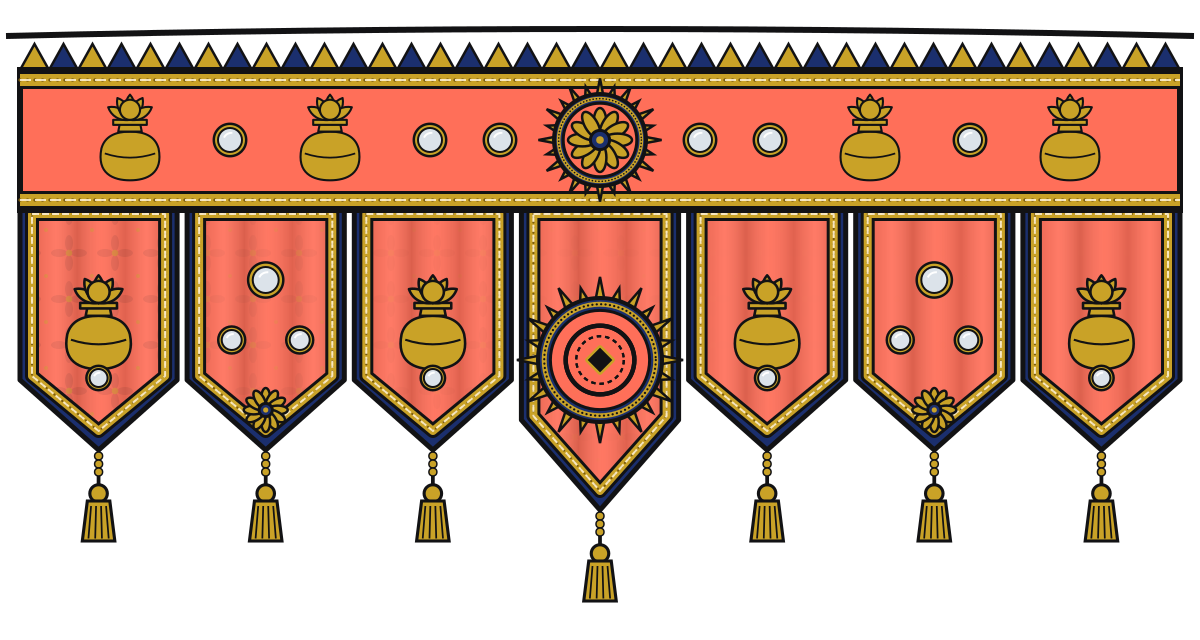
| G1 Torana · gateway The built gate of the seat; the cloth Toran hangs in it | Not yet designed for this clan | Regional tradition |
| G2 Viragallu · hero stone Carved panel stone for a member who died defending the clan | Not yet designed for this clan | Regional tradition |
| G3 Kula-shila · clan stones Standing and table stones that remember the ancestors | Not yet designed for this clan | Design |
| G4 Jayastambha · victory pillar A pillar raised for a victory | Not yet designed for this clan | Design |
| G5 Sima-shila · boundary stone Marks the clan's land, with a line in the native script | Not yet designed for this clan | Design |
4. Sounds
| Accessory | For this clan | Basis |
|---|---|---|
| D1 Pancha-mahashabda · five great sounds The right to five instruments | Not yet designed for this clan | Design |
| D2 Shankha · clan conch The clan's own named war conch | Not yet designed for this clan | Design |
| D3 Murasu · house drums Three drums: war, charity and justice | Not yet designed for this clan | Design |
5. Kit: colours, metals and emblems
The Atlas takes Nahapana's silver coin as the clan's main emblem, with its Greek-letter legend[3]. No second emblem is set.
| Part of the kit | This clan |
|---|---|
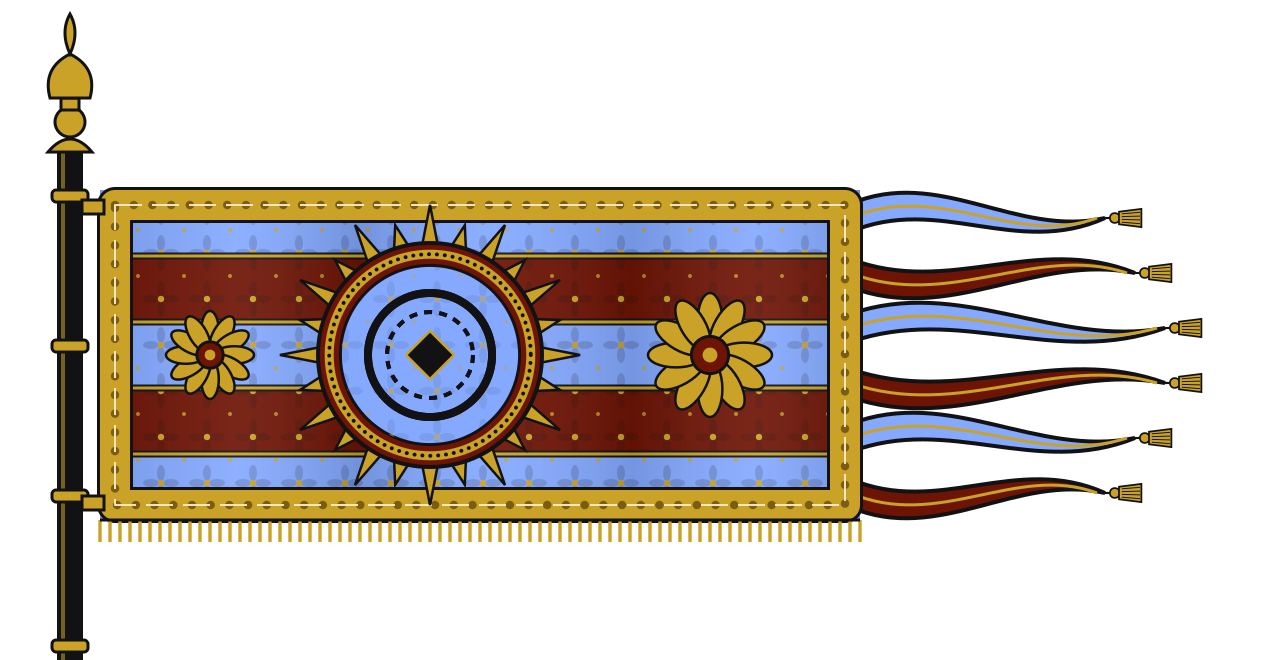
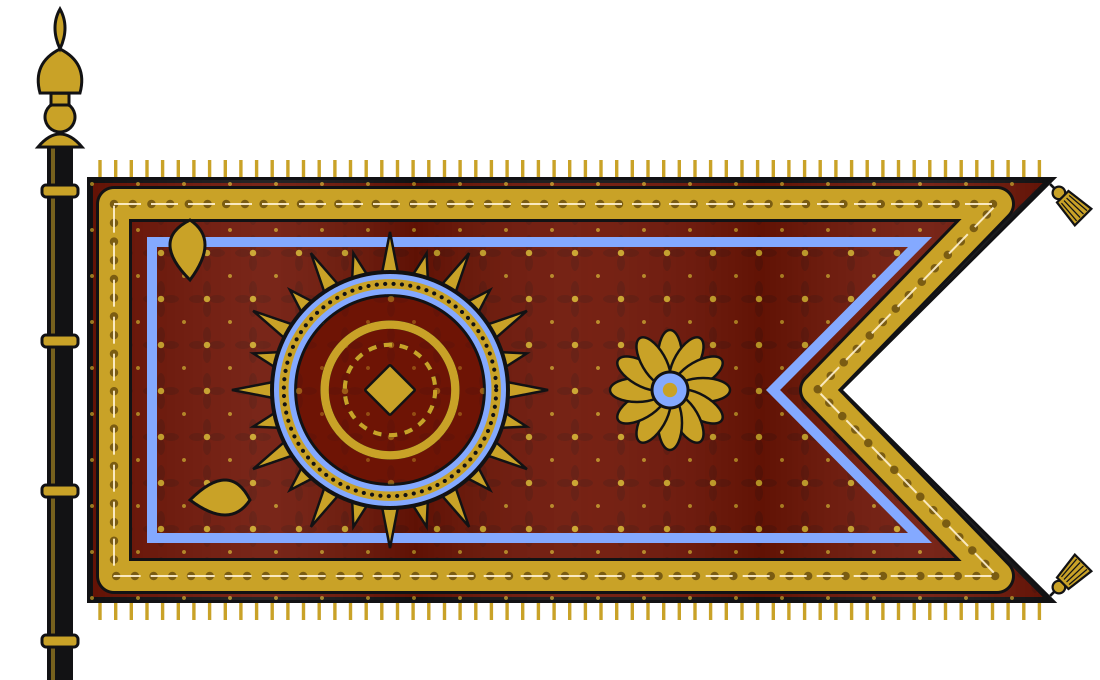
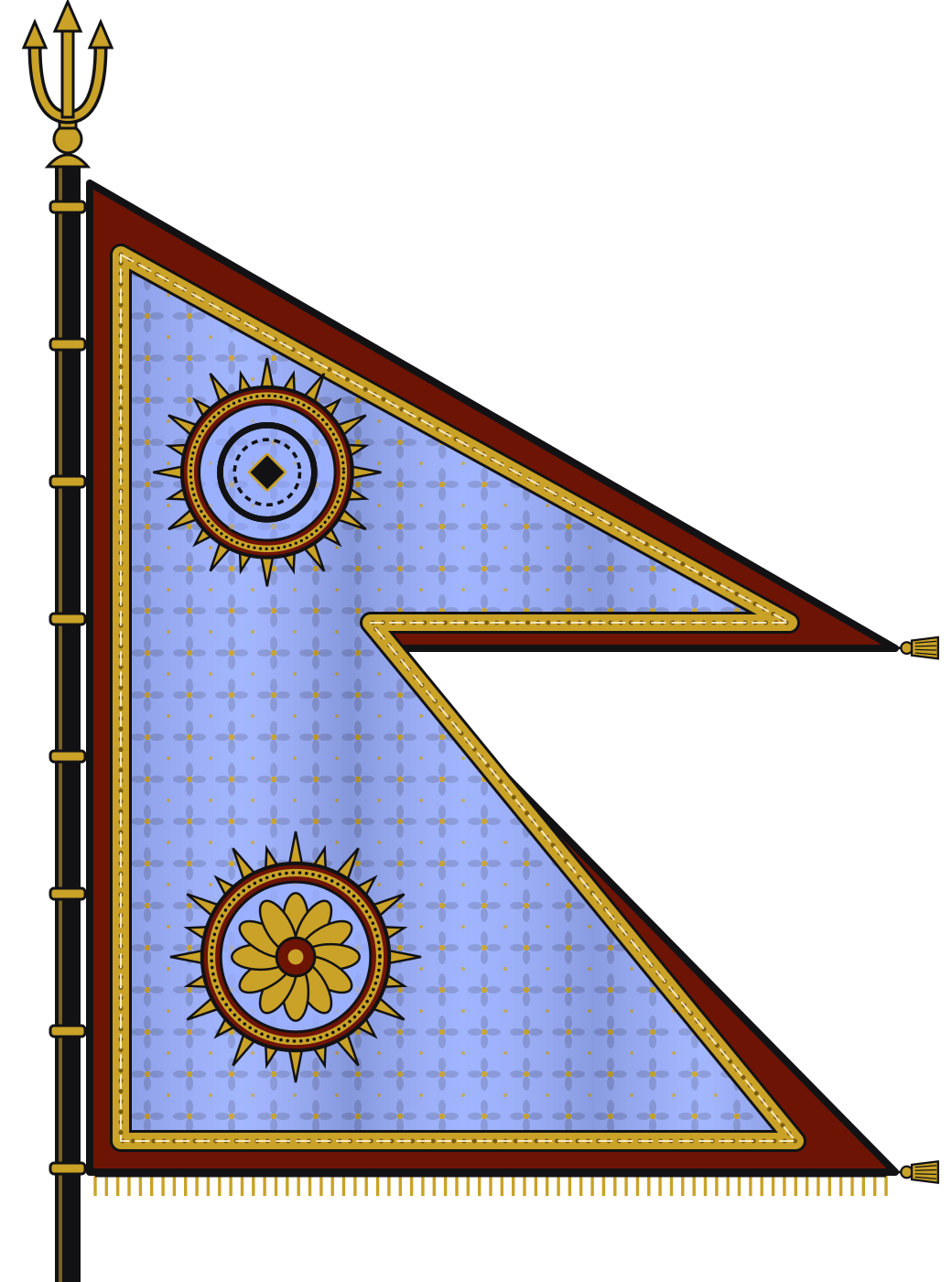
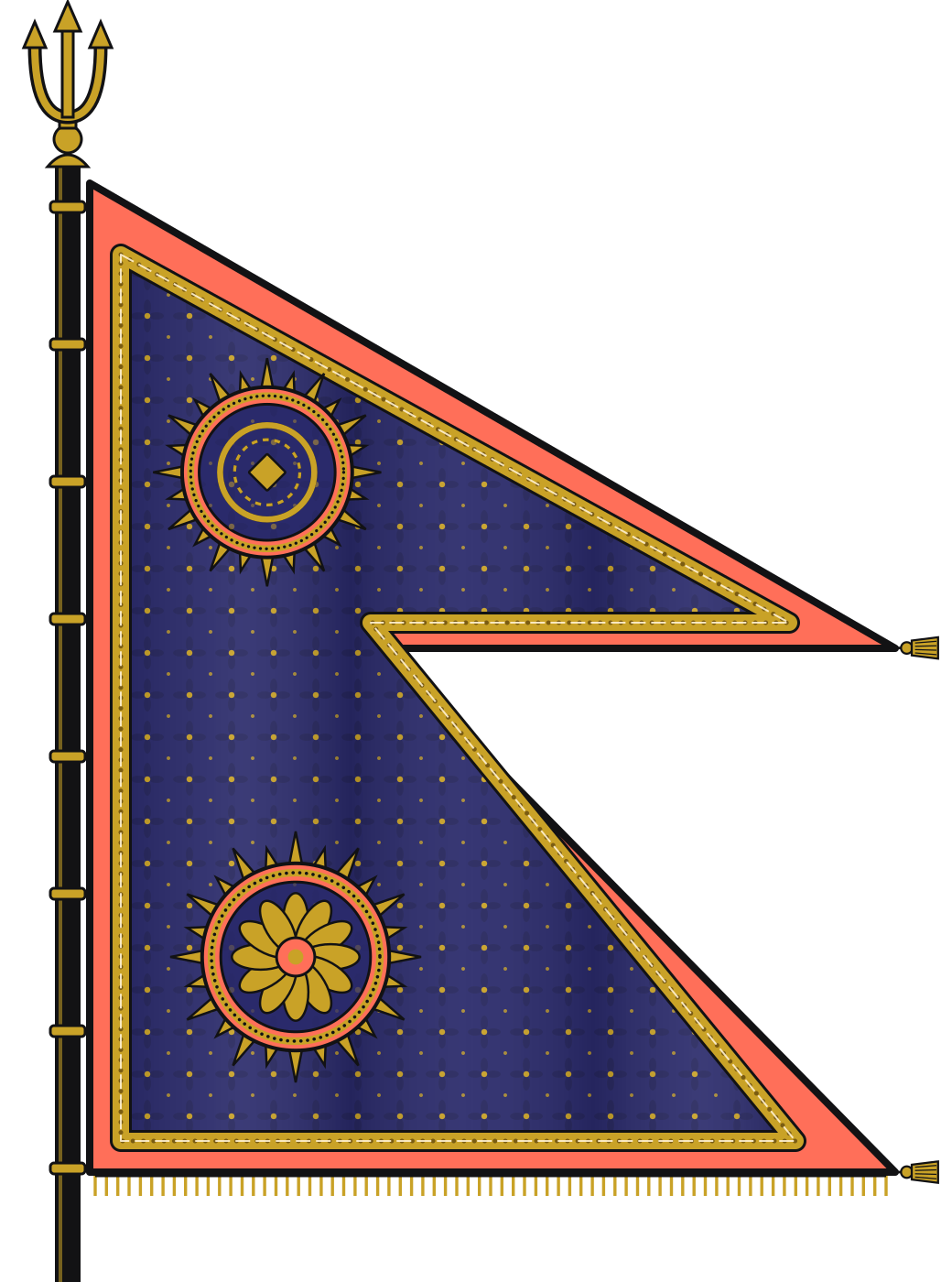
| Field | Deep Brick #7E2A1E |
| Accent | Intense Electric Blue #84A9FF |
| Emblem colour | Metallic Gold #C9A227 |
| Zari metal | Gold |
| Main emblem | A silver coin with a Greek-letter legend |
| Second image | — |
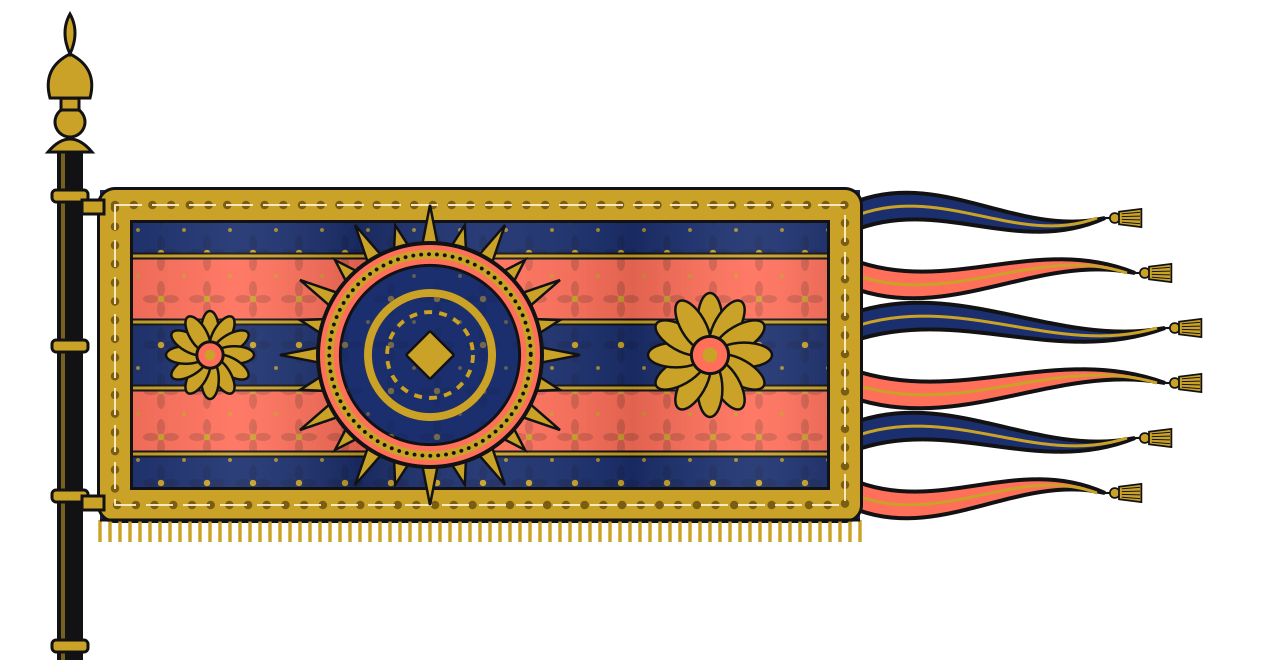
| Night and day | Every visual accessory has two versions: by night the emblem on the dark field, by day the clan's field colour on cloth woven from its metal. |
6. Flags
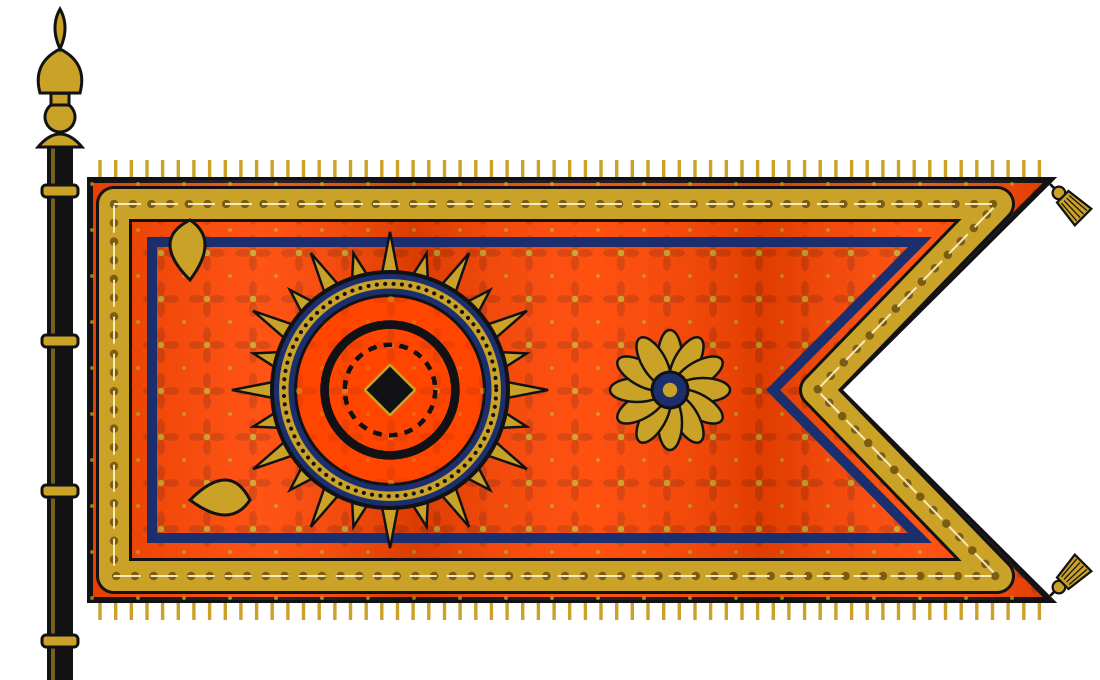
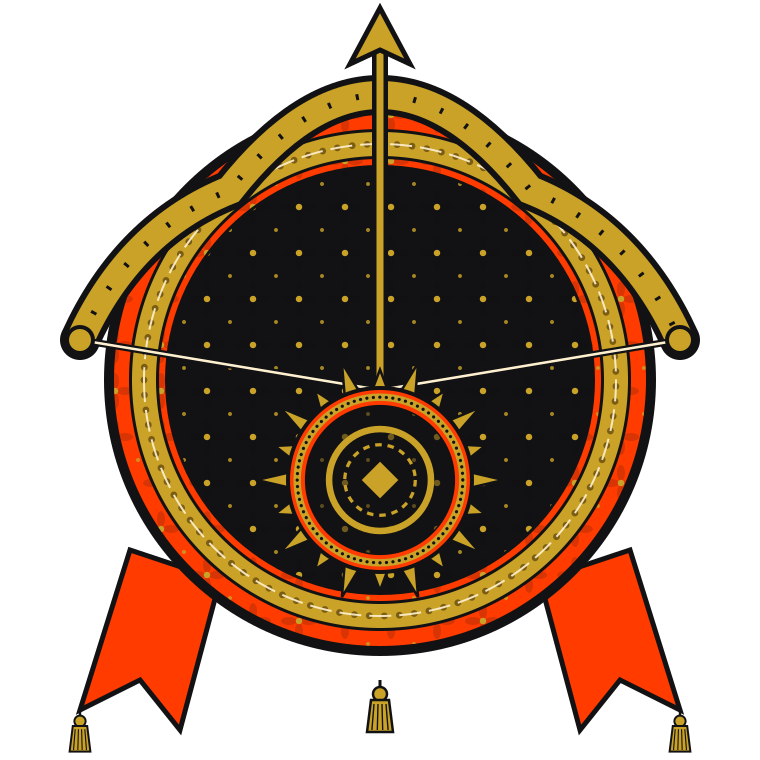
Every clan has every flag type; the type says the occasion and the colours say the clan. The outlined card is the flag the Atlas assigns.


Historic banner
None recorded.
New flag types
| Accessory | For this clan | Basis |
|---|---|---|
| A9 Pota-dhvaja · ship and trade flag For ships, caravans and markets | Not yet designed for this clan | Design |
| A10 Utsava-patāka · festival flag Light, bright flag for fairs and festivals | Not yet designed for this clan | Design |
| A11 Shoka-dhvaja · mourning flag White cloth with the emblem outline in the clan's metal | Not yet designed for this clan | Design |
7. Regalia
| Accessory | For this clan | Basis |
|---|---|---|
| E1 Chhatra · house parasol The ceremonial umbrella | Not yet designed for this clan | Design |
| E2 Chamara · fly-whisks The pair of whisks beside the head of the house | Not yet designed for this clan | Design |
| E3 Danda · staff of office Staff or scepter | Not yet designed for this clan | Design |
| E4 Simhasana · seat The seat of the house, covered in clan cloth | Not yet designed for this clan | Design |
| E5 Khetaka · shield A round shield; the Changi and Dhanush are its flag forms | Not yet designed for this clan | Regional tradition |
| E6 Kula-ayudha · clan weapon The weapon the clan honours | Not yet found for this clan | Under research |
8. Worn
| Accessory | For this clan | Basis |
|---|---|---|
| F1 Kula-vastra · clan cloth The clan's woven pattern in its kit colours | Not yet designed for this clan | Design |
| F2 Kirti-vastra · honour cloth A cloth earned for a deed, not inherited | Not yet designed for this clan | Design |
| F3 Kula-mala · garland flower The flower or leaf the clan wears as a garland | Not yet found for this clan | Under research |
| F4 Chinha · house pin A metal badge with the pin emblem | Not yet designed for this clan | Design |
9. Records
| Accessory | For this clan | Basis |
|---|---|---|
| H1 Clan words A traditional line in the native script | 𐨣𐨱𐨤𐨣 · “Rano Chaharatasa Nahapanasa (Wikipedia's transliteration, printed beside the Kharoshthi glyphs)” Kharoshthi legend on Nahapana's silver drachm[3] | Documented |
| H2 Biruda · titles The house's title or titles | Titles on the coins: Kshatrapa, Mahakshatrapa, Svami, Raja (Rano)[3][2] Titles as read from the coin legends of Nahapana | Documented |
| H3 Prashasti · praise genealogy The lineage as written at the head of a grant | Lineage at the head of Ushavadata's Nashik grant: son of Dinika, son-in-law of king Nahapana, the Kshaharata Kshatrapa | Documented |
| H4 Vahi · clan register The book of the clan's births, marriages and deaths | Not yet found for this clan | Under research |
| H5 Rana-ghosha · war cry The clan's cry in battle or celebration | Not yet found for this clan | Under research |
10. VishwaVit · knower of the world
Game values are design choices for this project, not historical claims.
References
- CoinIndia, Kshaharatas gallery, read 2026-10-21, https://www.coinindia.com/galleries-kshaharatas.html
- Western Satraps (Wikipedia, read 2026-10-09), citing E. J. Rapson, R. Salomon (1998), U. Singh (2008), D. C. Sircar and J. Cribb (2013).
- Wikipedia, Nahapana, read 2026-10-19, https://en.wikipedia.org/wiki/Nahapana
- Wikipedia, Abhiraka, read 2026-10-21, https://en.wikipedia.org/wiki/Abhiraka
- Wikipedia, "Gautamiputra Satakarni", read 10 Oct 2026, https://en.wikipedia.org/wiki/Gautamiputra_Satakarni
- Wikipedia, Ushavadata, read 2026-10-19, https://en.wikipedia.org/wiki/Ushavadata
- E. Senart, Nasik inscriptions, Epigraphia Indica vol. 8 (1905-06), read 2026-10-21 at The Indian Analyst, https://whatisindia.com/inscriptions/epigraphica_indica/vol8_1905-1906/senart24.html
- Wikipedia, Bhumaka, read 2026-10-21, https://en.wikipedia.org/wiki/Bhumaka
- Wikipedia, Chashtana, read 2026-10-20, https://en.wikipedia.org/wiki/Chashtana
- State Bank of Pakistan Museum, Western Kshatrapes, read 2026-10-20, https://www.sbp.org.pk/museum/western-kshatrapes
- CSMVS, Networks of the Past, Silver drachm of Nahapana (acc. 6024), read 2026-10-21, https://networksofthepast.csmvs.in/?p=1850