The Koya are a Dravidian-speaking people of the Godavari valley and Malkangiri in Odisha, listed as a Scheduled Tribe[1][2]. They call themselves Koitur or Koithur, and their language, Koya, belongs to the Gondi-Kui group[3][4]. Their best-known rite is the Medaram Jatara to the goddesses Sammakka and Saralamma, where the rituals are performed entirely by Koya priests[5][6]. The 2011 Census counted 779,854 Koya[1].
01Faith and deities
Koya heroine-goddess of the Medaram jatara[5]
A recorded tie between the clan and the goddess.
| Deity or tradition | Place in the clan's life | Evidence |
|---|---|---|
| Sammakka and Saralamma | Heroine-goddesses of the Medaram Jatara; Saralamma is Sammakka's daughter; Koya priests perform the rites | [5][6] |
| Pagididda Raju and Govinda Raju | Koya chiefs in the tradition, Sammakka's husband and his brother; their poles stand beside the goddesses' at the jatara | [5] |
| Jampanna | Sammakka's son; the Jampanna stream, a Godavari tributary, is said to have turned red with his blood (folklore) | [5] |
| Muthyalamma and Bhima | Named in the Koya pantheon; Muthyalamma is a village goddess tied to palm trees | [3] |
| Bhudevi | The earth goddess, honoured at the Kolupu festival with animal sacrifices | [3] |
| Four guardian deities of the four directions | Named in the pantheon | [3] |
| Nissani Munda, Jhankara Devata, Donga Devta, Mahpuru, Duma Devta | Odisha Koya deities: village deity, earth goddess, forest god, supreme god and the dead ancestors | [7] |
| Maa Dulari Devi | Named as the village deity of the Koya by the KISS handbook (a different account from Patra's) | [8] |
| 142 Ilavelpulu | Family deities, worshipped as ancestral protectors; documented in the 2026 book | [9] |
| Dhoolraj | Worshipped by the Paderu Gatta of the Racha Koya | [3] |
02Temples
The extracts name a Sammakka Sarakka Temple at Medaram (its first chairman was appointed in 1968) but do not say who built it, so no temple is recorded as built by the Koya. The sacred sites of the jatara are listed as the clan's own places.
Built by the clan
Not recorded.
Given patronage or grants by the clan
| Temple | Deity | What the clan gave | When | Where |
|---|---|---|---|---|
| Medaram jatara shrine | Sammakka and Saralamma | The Koya priests' rites: the Vadde is the eldest male of the Sadeboina family, and no Brahmin priests take part | Magha, every two years | Medaram, Tadvai mandal, Mulugu district[6][5] |
| Chilakalagutta | Sammakka's casket | Kept here between festivals; the place where Sammakka found as a newborn and retreated (tradition) | Between festivals | Medaram area[5] |
| Kannepalli | Saralamma's casket | Source of Saralamma's casket (tradition) | Not dated | Medaram area[5] |
03Languages and scripts
| Language or script | Kind | Under the clan | Evidence |
|---|---|---|---|
| Koya (Koitur, Koyi) living | Dravidian, Gondi-Kui branch; close to Gondi, strongly influenced by Telugu | All Koya | [4][3][10] |
| Telugu | Many plains villagers are literate in Telugu; most Koya are bilingual with Telugu or Gondi | Koya in Andhra Pradesh and Telangana | [10][3] |
| Scripts for Koya | Telugu, Odia, Devanagari and Latin are listed for Koya; Patra says Koya has no alphabet of its own and its textbooks use Odia script | Koya | [4][7] |
| Script by Sathupati Prasanna Sree research | A unique script developed for Koya, not described in the extracts | Koya | [4] |
04Books and literature
The Koya have no literature of their own, apart from two books of the Bible translated by 19th-century missionaries and printed in Telugu characters[10]. ETV Bharat reported in April 2026 a 500-page book on the Koya's history, traditions and family deities, title not given[9]. Koya-language textbooks are used in 50 primary schools in Andhra Pradesh[4].
Written during the clan's history
Not recorded.
Given patronage by the clan
Not recorded.
05Thinkers and scholars
| Name | Field | Era | Contribution |
|---|---|---|---|
| Sathupati Prasanna Sree | Script maker | Not dated | A unique script for Koya[4] |
| Debashis Patra | Author, socio-cultural study | 2016 | The Koyas: A Socio-Cultural Study, Odisha Review[7] |
| Devanpalli Srikanth Kumar | Ethno-linguist, University of Mysore | 2020 | Culture and ethno-linguistic aspects of the Koya; the author found no ethno-linguistic work[11] |
| G. Shekhar | Ethnographer | 2025 | Ethnographic study of the Koya and the gattu-gotra system (abstract only)[12] |
| Sushree Mohanty | Author, KISS handbook | 2026 | Indigenous Colours of Odisha: Handbook on 62 Tribes[8] |
The 2026 Koya book was compiled by community elders, scholars and priests over a year; its authors are not named in the extract[9].
06Art and architecture
The art tied to the Koya is the Dalu cloth, on which each clan's lineage is depicted, and the bison-horn dance at marriages.
Painting and wall art
Not recorded.
Sculpture and temple art
Not recorded.
Temple and building architecture
Not recorded.
Weaving and textiles
| Art form | What it is | Era | Evidence |
|---|---|---|---|
| Dalu cloth | Traditional cotton cloth on which each clan's lineage and history is depicted | Traditional; described in the 2026 book | [9] |
Clothing and jewellery
| Art form | What it is | Era | Evidence |
|---|---|---|---|
| Bison horns | Koya men wear bison horns, in the Dhemsa context the Odisha Review describes | Not dated | [13] |
Coins, pottery and crafts
| Art form | What it is | Era | Evidence |
|---|---|---|---|
| Bamboo furniture, fencing mats, dust pans and baskets | The work of settled Koya artisans | Today | [1] |
07History
Origins, as one account has it
Patra (Odisha Review, 2016) writes that archaeological studies credit the Koya's migration from the Koi and Gondwana regions of Bastar district in Chhattisgarh, and that the Koya of Malkangiri say their roots there go back to ancient times[7]. This is a claim in a secondary essay, not a dated record; the studies are not named in the extract.
Soldiers and palegars (before 1909)
Wikipedia credits Thurston with describing the Koya as former armed soldiers serving local palegars, who practised podu (slash-and-burn) cultivation[1]. eTribal Tribune says the Koya were driven into inaccessible highlands, and that travellers depicted them as treacherous savages[3].
The Medaram tradition (13th century, disputed)
In the Koya tradition, Koya hunters found a newborn girl in the forest, who was named Sammakka and married the chief Pagididda Raju[14][5]. In a conflict after a drought, Sammakka and Saralamma fought an army, Saralamma died, and Sammakka retreated to Chilakalagutta[5][14]. The Atlas links the conflict to the Kakatiya army in the 13th century.
The state museum at Medaram says there is no proof that a war took place, and its curator dates the jatara to the reign of Prataparudra in the 13th century. The article calls the fair both '500 years old' and '1,000 years old'[5]. The date and the war are disputed; the tradition is the Koya's own account.
The Marathas, the Nizam and the British (18th to 19th century)
The Marathas invaded in the 18th century and, with the Gonds, subverted the Koya[3]. The Nizam handed the Bhadrachalam taluk to the British, which was then divided into divisions of 225 Koya villages each[3]. eTribal Tribune also gives the last great plundering as a Rohilla raid near Parnasala in 1859; no source for it is given in the extract[3].
The state, the Medaram fair and the backwaters (20th and 21st century)
In 1998 the state government declared the Medaram fair an official festival and built a motorable road, where bullock carts had been used before[5].
The Polavaram project threatens, according to news reports cited on Wikipedia, the displacement of 170,275 Koya and over 276 villages in Bhadrachalam and Palwancha divisions[1]. In 2021 Koya of the Chintoor agency reported that the Bhumi Panduga, held at the start of farm work, was the last time they would celebrate it in their ancestral villages, as the backwater submerges them and rehabilitation colonies are expected[15].
08Journey and migrations
The sources record few movements, and most are undated: a claimed migration from Bastar, a retreat into the highlands, and the displacement the Polavaram backwater threatens.
| When | From | To | Why | Evidence |
|---|---|---|---|---|
| Not dated | Bastar (Koi and Gondwana regions, Chhattisgarh) | Malkangiri, Odisha | Migration claimed by Patra (2016), citing archaeological studies | [7] |
| Not dated | Not stated | Inaccessible highlands | Driven there, per eTribal Tribune's account; not a dated record | [3] |
| 2021 (expected) | Ancestral villages near Polavaram, Chintoor agency | Rehabilitation colonies | The Godavari backwater from the Polavaram project | [15] |
09Seats and lands
| Place | Role | Where today |
|---|---|---|
| Bhadrachalam (Khammam; now Bhadradri Kothagudem) | Taluk and ITDA seat; Koya-populated | Telangana[4][1] |
| Malkangiri | The dominant tribe of the district | Malkangiri district, Odisha[1][7] |
| Medaram, Tadvai mandal | Site of the Sammakka–Saralamma Jatara; Chilakalagutta (Sammakka's place), Kannepalli (Saralamma's casket), Poonugondla (Pagididda Raju), Kondai (Govinda Raju) | Mulugu district, Telangana[5] |
| Chintoor (Chinturu) mandal | 89 Koya villages (eTribal Tribune, retrieved 2006); Bhumi Panduga | East Godavari, Andhra Pradesh[3][15] |
| Rampachodavaram and Kotaramachandrapuram | ITDAs in the Koya-speaking area | East and West Godavari, Andhra Pradesh[4] |
| Sukma and Bijapur | Far south Bastar, Koya-populated | Chhattisgarh[1] |
| Khammam, Warangal, Karimnagar and Alluri Sitharama Raju district | Koya areas; sparse in old Adilabad and Karimnagar | Telangana and Andhra Pradesh[1][3] |
| Parts of Bastar and Koraput | Named as Koya areas | Chhattisgarh and Odisha[3] |
| Koya-populated mandals | 18 mandals are listed on Wikipedia, among them Bhadrachalam, Cherla, Manuguru and Palimela | Telangana and Andhra Pradesh[1] |
| Maharashtra | 388 Koya, Bhine Koya and Rajkoya (2011, state figure) | Maharashtra[16] |
10Notable figures
| Name | Role | Era | Known from |
|---|---|---|---|
| Sammakka legend | Heroine-goddess; the Koya chief's wife in the tradition | 13th century (tradition, disputed) | [14][5] |
| Saralamma legend | Sammakka's daughter; heroine-goddess of the jatara | 13th century (tradition) | [5] |
| Pagididda Raju legend | Koya chief; Sammakka's husband | 13th century (tradition) | [5] |
| Govinda Raju legend | Pagididda Raju's brother; Saralamma's husband | 13th century (tradition) | [5][14] |
| Jampanna legend | Sammakka's son | 13th century (tradition) | [14] |
| Meda Raju legend | Koya chief who adopted Sammakka as a child | 13th century (tradition) | [5] |
| Sathupati Prasanna Sree | Developed a unique script for Koya | Not dated | [4] |
| Kiran Kumar Kaka | Main priest (Vadde) of the Saralamma gadde at Medaram | Not dated | [5] |
| Tellam Venkata Rao | Named as a petitioner in the 2025 Supreme Court case on the Scheduled Tribe listing of Sugalis, Lambadis and Banjaras; also named as a Koya leader | 2025 | [17][1] |
| Seethakka | Minister who was to release the 2026 Koya book at Bhadrachalam | 2026 | [9] |
| Other named leaders | Jare Adinarayana, Tellam Balaraju, Kunja Bojji, Koram Kanakaiah, Bade Nagajyothi, Gummadi Narsaiah, Sunnam Rajaiah, Mecha Nageswara Rao, Podem Veeraiah, Payam Venkateswarlu, Babu Rao Mediyam; roles and dates are not given | Not dated | [1] |
11Allies, rivals and marriages
| People | Relationship | When |
|---|---|---|
| Gonds (ST-088) | EveryCulture calls the Koya a subdivision of the Gond tribes; the Koya language is in the Gondi-Kui group; Russell (1916) lists Koya Gonds among the Gond subdivisions | Not dated[10][18] |
| Bison-horn Maria Gonds of Bastar | Most closely related group, per EveryCulture | Not dated[10] |
| Dorla | A mixed Gondi-Koya group; the Chhattisgarh figure of 46,978 is attributed to them in the text | Census 2001[1] |
| Kondh (ST-152) | Kondhs call themselves Kui, identical with Koi or Koya (Madras Census 1891, as printed by Thurston) | 1891[19] |
| Tagara Poroja | Thurston calls them a section of the Koyas; the Porja entry lists them among Porja sections | 1909[20] |
| Telugu | The Koya language blends with Telugu; most Koya are bilingual in Gondi or Telugu | Not dated[10][3] |
| Marathas | Invaded and subverted the Koya with the Gonds | 18th century[3] |
| Kakatiyas | The Medaram tradition's opponents; the museum sees no proof of the war | 13th century, disputed[5] |
| Nizam and the British | The Nizam handed the Bhadrachalam taluk to the British | Not dated[3] |
12Society and livelihood
The Koya are patrilineal and patrilocal ('Kutum'); each person is born into a phratry and clan, which cannot be changed[3]. Clan endogamy is forbidden and monogamy is the rule[7]. Marriage comes after maturity, with no infant marriage, and the bride's maternal uncle decides; cross-cousin marriage is permitted and common[1]. Marriage types are arranged (Maga Vibha), by love (Udulia, now common), by capture (Jhika Vibha) and for widows or divorcees (Paisamundi), with a bride price (Kanya Jhola) and no dowry[7]. Marriage by love, elopement, capture, service and negotiation is also described[11].
Government and social order
| Institution or group | What it was | Evidence |
|---|---|---|
| Village headman (Pedda or Peda) | The village head; Patra calls the office Peda | [3][7] |
| Panchayat | Pina pedda, Vepari and Pujari; weak against exploitation | [3] |
| Samithi Poyee | Heads the judicial system of a cluster of villages | [3] |
| Mutha | A village-cluster unit | [3] |
| Pottu Vyavasayam | Joint cultivation | [3] |
| Totemistic sects (velpu) | Phratries have totemistic sects; marriage within the same sect is forbidden | [3] |
| Chief priest (Disari) and female priest (Gurumai) | Disari is the chief priest; Gurumai conducts the delivery rituals | [7] |
| Youth dormitories (Dhangada basa for boys, Dhangadi for girls) | Dormitories for youth in Odisha | [7] |
| Gattus | Seven clans, detailed for five; about 100 surnames each | [9] |
| Gattu-gotra system | The kinship system described in Shekhar's 2025 study (abstract only) | [12] |
| Funerals | Grain, liquor, clothes, money and a cow's tail are offered; pregnant women and children under five months are buried, others cremated | [3] |
Livelihood over time
| Era | Livelihood | Evidence |
|---|---|---|
| Credited to Thurston by Wikipedia | Former armed soldiers serving local palegars; podu (slash-and-burn) cultivation | [1] |
| c. 2006 (eTribal Tribune) | Above 55 per cent of families practise podu; restricted podu, deforestation and migration weakened autonomy | [3] |
| Today (AP Tribal Welfare Dept, cited by Wikipedia) | Settled cultivators and artisans: bamboo furniture, fencing mats, dust pans and baskets | [1] |
| Today (The Hindu, 2012, cited by Wikipedia) | Landless families depend on wage labour; malnutrition and anaemia reported | [1] |
| Today (ETV Bharat, 2026) | Many Godavari Adivasi communities, the Koya among them, share customs and livelihoods, including fishing | [9] |
13Sub-clans and related clans
The sheet, the Census lists and the Odisha list name these sub-groups and divisions. Each one not in the Atlas is a new clan candidate; sizes are given only where a source gives a figure.
| Clan | Relation | Where | Size | In the Atlas | Evidence |
|---|---|---|---|---|---|
| Doli Koya | Sub-clan | Sub-group named by the sheet and Wikipedia | new clan candidate | [1] | |
| Gutta Koya (Gotti Koya) | Sub-clan | Named by Journals of India (2021) and the Wikipedia list; Gotti Koya displacement cited by The Hindu | new clan candidate | [15][1] | |
| Kammara Koya | Sub-clan | Endogamous; blacksmiths (eTribal Tribune) | new clan candidate | [3] | |
| Musara Koya | Sub-clan | Named by the sheet, Wikipedia and Journals of India | new clan candidate | [1][15] | |
| Oddi Koya | Sub-clan | Named by the sheet and Wikipedia | new clan candidate | [1] | |
| Pattidi Koya | Sub-clan | Named by the sheet and Wikipedia | new clan candidate | [1] | |
| Rasha Koya | Sub-clan | Named by the sheet and Wikipedia | new clan candidate | [1] | |
| Lingadhari Koya | Sub-clan | Endogamous (eTribal Tribune spells it Lingadari Koya) | new clan candidate | [3] | |
| Kottu Koya | Sub-clan | Named by the sheet and Wikipedia | new clan candidate | [1] | |
| Bhine Koya | Sub-clan | Maharashtra; one 2011 row with Koya and Rajkoya | new clan candidate | [16] | |
| Rajkoya | Sub-clan | Maharashtra (2011 row); Raja Koya in the Wikipedia subgroup list | new clan candidate | [16][1] | |
| Gumba Koya | Sub-clan | Odisha list row 'Koya (Gumba Koya, Koitur Koya, Kamar Koya, Musara Koya)' | new clan candidate | [21] | |
| Kamar Koya | Sub-clan | Same Odisha list row as Gumba Koya | new clan candidate | [21] | |
| Racha Koya | Sub-clan | Endogamous; village administrators; the Paderu Gatta of the Racha worship Dhoolraj | new clan candidate | [3] | |
| Arithi Koya | Sub-clan | Endogamous; bards and oral custodians of the mythology | new clan candidate | [3] | |
| Gattera division | Sub-clan | One of three divisions of the Koya of Malkangiri (Patra 2016) | new clan candidate | [7] | |
| Metatara division | Sub-clan | One of three divisions of the Koya of Malkangiri (Patra 2016) | new clan candidate | [7] | |
| Gamminar division | Sub-clan | One of three divisions of the Koya of Malkangiri (Patra 2016) | new clan candidate | [7] | |
| Sadeboina family | Branch | Priestly family of the Medaram jatara; the Vadde is its eldest male | new clan candidate | [5] | |
| Tagara Poroja | Sub-clan | Thurston (1909): a section of the Koyas, speaking Koya or Telugu; the Porja codex lists it among Porja sections | new clan candidate | [20] | |
| Dorla | Related people | Mixed Gondi-Koya group; Chhattisgarh | 46,978, Chhattisgarh, Census 2001 (figure as the Wikipedia text prints it)[1] | new clan candidate | [1] |
| Gond | Related people | EveryCulture calls the Koya a subdivision of the Gonds; the Koya language is in the Gondi-Kui group | ST-088 | [10][1] | |
| Bison-horn Maria Gonds | Related people | Bastar; most closely related group per EveryCulture | new clan candidate | [10] | |
| Kondh | Related people | Kondhs call themselves Kui, identical with Koi or Koya (Madras Census 1891) | ST-152 | [19] |
Clans marked "new clan candidate" are not in the Atlas yet.
14Surnames
The Koya of Odisha use five surnames named by Patra (2016). The Medaram priestly family is the Sadeboina. ETV Bharat's 2026 book says nearly 750 surnames belong to the Koya's five detailed gattus, but lists none.
| Surname | Clan or sub-clan | Where | People with this surname | Also used by other communities |
|---|---|---|---|---|
| Madkami | Koya of Odisha | Odisha | not yet counted | Not checked |
| Podiami | Koya of Odisha | Odisha | not yet counted | Not checked |
| Madhi | Koya of Odisha | Odisha | not yet counted | Not checked |
| Kawasi | Koya of Odisha | Odisha | not yet counted | Not checked |
| Sodi | Koya of Odisha | Odisha | not yet counted | Not checked |
| Sadeboina | Sadeboina family (Koya) | Medaram, Telangana | not yet counted | Not checked |
Counts are of everyone with the surname, from the cited source and year, not only members of this clan. A surname shared with other communities says nothing about any one person's origin.
15Songs and music
The Koya have oral songs on history, creation, epics and romance, handed down by word of mouth. The extracts give no lyrics and no song titles[7].
None recorded yet.
Instruments and styles
| Instrument or style | What it is | Evidence |
|---|---|---|
| Dhola, tamaka, Dungdunga and mahuri | Instruments named for Koya music and the Dhemsa dance (Patra 2016) | [7] |
| Akkum | Instrument played in the Medaram procession | [5] |
| Dhemsa | Group dance in Koraput, in which men and women link fingers; Patra names the Dhemsa dance | [13][7] |
16Poems, lullabies and children's rhymes
None recorded yet.
17Stories, legends and proverbs
Stories and legends
| Story | What happens | Told by | Evidence |
|---|---|---|---|
| Life from water | Life comes from water; moss, toads, fish and saints arise from the friction of seas; God, last of the fourteen seas' creations, first made the Tuniki and Regu fruits | Koya tradition, as recorded by P. V. Sathya Mohan | [3] |
| Sammakka and the tiger legend | Koya hunters find a newborn girl playing with a tiger in the Dandakaranya forest; the leader adopts her, names her Sammakka, and she marries Pagididda Raju; after she vanishes into the forest, the Koya find a red box of vermilion and bangles with a tigress mark | Koya tradition | [14][5] |
Proverbs and sayings
Not recorded.
18Festivals and fairs
| Festival or fair | When | Where | What happens |
|---|---|---|---|
| Medaram Sammakka–Saralamma Jatara | Magha (February); held every two years; in 2024 it ran 21 to 24 February | Medaram, Tadvai mandal, Mulugu district, Telangana | Four days: Saralamma and Pagididda Raju on the first, Sammakka from Chilakalagutta on the second, the peak on the third, and the Tallula Vanapravesham on the fourth; jaggery (bangaram) is offered; goats and chickens are sacrificed per vow[5][6] |
| Bhumi Panduga | At the start of farm work; each village sets its dates | Chintoor agency, East Godavari | A three-day hunt in the nearby forest; the catch is shared among the hamlet families at an evening feast[15] |
| Kothala Panduga | Not dated | Koya (named in the 2026 book) | Named only; no details in the extract[9] |
| Kolupu | November | Koya villages | Honours Bhudevi, the earth goddess, with animal sacrifices[3] |
| Vijja Pandum | Not dated | Koya villages | Festival of seeds, with group hunting[3] |
| Dinalu | The eleventh day after a death | Koya villages | The spirit is believed to reside in an earthen pot called Aanakunda[3] |
| Gujjadis gatherings | Not dated | Koya villages | Gatherings with palm juice; the term is not explained[3] |
| Chaiti Parava | March to April (Chaitra) | Odisha | Community hunting, Bento Shikar[7] |
| Push Parav, Magha Parav, Bali Yatra | Not dated | Odisha | Listed as Koya festivals; no details in the extract[7] |
| Bison-horn dance at marriages | At Koya marriage ceremonies | Koya | A special feature of Koya marriage ceremonies[3] |
19Food, dress and games
Food
| Item | What it is | Evidence |
|---|---|---|
| Staples (Andhra Pradesh) | Jowar, ragi, bajra, tubers, roots and green leaves | [1] |
| Staples (Odisha) | Rice, with millets, maize, pulses and roots | [7] |
| Liquors | Mahuli, landa, handia and salap (Odisha); mohuva (Ippa Sara) at social and religious occasions | [7][3] |
Dress
| Item | What it is | Evidence |
|---|---|---|
| Bison horns | Worn by Koya men, in the Dhemsa context the Odisha Review describes | [13] |
| Bells and belts | Worn by the Vadde, the priest, at the Medaram jatara | [5] |
Games and martial arts
Not recorded.
Tags: living still practised · revived brought back after a break · lost known only from records · research reported but not yet confirmed from a source. Songs and poems under copyright are listed by title only; restricted or sacred material is noted without its content.
20Status today
The Koya are a living Scheduled Tribe in several states, counted at 779,854 in the 2011 Census[1]. Their central practice is the Medaram Jatara; the Polavaram project threatens their land, according to news reports cited on Wikipedia[1].
Recognised heritage
| What | Recognition | Evidence |
|---|---|---|
| Medaram Jatara | Declared an official festival by the state government in 1998 (The South First) | [5] |
| Medaram Jatara | Called one of Asia's biggest tribal festivals; Wikipedia gives about 1.3 crore pilgrims, no year | [5][6] |
| Tribal museum, Medaram | A government tribal museum at Medaram (The South First) | [5] |
| ITDA museum, Bhadrachalam | Developed in 2025 to show Koya and other Scheduled Tribes' culture | [4] |
| The 2026 Koya book | A 500-page book on history, traditions and family deities, to be released at the ITDA in Bhadrachalam | [9] |
This page has not yet been reviewed by Koya community organisations. The 2026 book, compiled with community elders and priests, is the community's own record; its text is not checked here.
21For children
The girl with the tiger
Long ago, in the Dandakaranya forest, Koya hunters found a little girl playing with a tiger. The leader took her in and named her Sammakka. When she grew up, she married the Koya chief Pagididda Raju, and they had a daughter named Saralamma. Today, Koya priests lead a great fair in their honour at Medaram. People bring jaggery, which they call bangaram, as an offering. The fair is held every two years, in the month of Magha.
Written for this project
Riddle: Every two years I come in the month of Magha, a fair in the forest with priests and jaggery. What am I? (The Medaram Jatara)
22Across the project
| Project | What carries this clan | Status |
|---|---|---|
| Atlas of the Janas | Homeland: the Godavari valley (Bhadrachalam) and Malkangiri; no footprint drawn yet | To check |
| KulDevi and GrahDevi | KulDevi: Sammakka, family Saptamatrika (+Narasimhi). GrahDevi forms: Brahmani, Maheshvari, Kaumari, Vaishnavi, Varahi, Indrani, Chamunda, Narasimhi | From the Atlas |
| Planet naming | Planet names are not in the extracts; the GrahDevi forms are listed above | To check |
| Renaming and waters | The Godavari backwater from Polavaram is in the history. No place renamed for the Koya is in the extracts | — |
23Open questions
- The Koya's own name in Telugu, Odia or Devanagari script is not in the extracts; find it from a Koya or Telugu source. The clan words above are the Medaram fair's Telugu title and are labelled illustrative.
- No Koya line or saying in native script is sourced. Find a self-name line, a proverb or a song text, with the community's consent to publish.
- The seven gattus, their names, and the surnames for the five detailed gattus are not in the extracts. Leads: ETV Bharat's 2026 book, Shekhar (2025).
- The village deity differs by source: Patra (2016) gives Nissani Munda; the KISS handbook gives Maa Dulari Devi. Check which applies in which area.
- The 2022 bill on the Scheduled Tribes order (entry 16, Gond) lists 'Koya' and 'Koitar' among its names (PRS India). Check which state's list it applies to and whether it changes the Koya's status.
- The Rohilla plunder of 1859 is given by eTribal Tribune with no source in the extract. Find a primary source or drop it.
- The Medaram dating (13th century, 500 or 1,000 years) and the war are disputed. Find an epigraphic or Kakatiya-era source.
- The Drishti IAS piece on the Koya and the sacred mahua flowers was not fetched; it may give a garland flower for F3.
- Totems per gattu, coins, seals, titles and a war cry: none found for this living people. Lead: Mohapatra (1992) on the Koya, cited by Patra.
- Community review: no Koya organisation has reviewed this page.
- Contradiction, Karimnagar: the Koya-areas row lists Karimnagar as a Koya area[3] (parts of Karimnagar) while the same row says the Koya are sparse there[1]. Settle the row before it prints.
- Contradiction, Odisha population: 147,137 for 2011[21] against 142,137 in the Wikipedia infobox[1]. Patra (2016) gives over two lakh Koya in Malkangiri district alone[7], more than the state list's figure for all of Odisha. Check the figure before it prints.
- Contradiction, state festival date: The South First gives 1998[5], used on this page; Madras Courier gives 1999 for the Andhra Pradesh government's declaration[14]. Check which date to print.
- Contradiction, self-name: Koitur or Koithur[3][1] against Koyiee[7]. Decide which self-name leads the page.
24Astitva
अस्तित्व · being, existence: everything by which the clan is known
The Koya have one documented kit item in the extracts: the Dalu cloth, on which each clan's lineage is depicted[9]. The other accessories are not found for this people and are listed with their default basis.
Every clan has every accessory, royal objects included. Each one says how it is known: Documented This clan's own object is recorded. · Regional tradition Recorded for the region or for peoples like this one, not for this clan. · Design Made for this project, with no historical claim. · Under research To be found for this clan from sources. Legends and titles are written in the clan's own script.
1. Seals and coins
| Accessory | For this clan | Basis |
|---|---|---|
| B1 Rajamudra · house seal Round seal with the clan emblem and a short legend in the clan's script | Not yet designed for this clan | Design |
| B2 Anguliya-mudra · signet ring Personal seal ring of the head of the house | Not yet designed for this clan | Design |
| B3 Chhapa · house stamp Ink or block stamp for letters, goods and cloth | Not yet designed for this clan | Design |
| B4 Tamrapatra · charter plate Copper-plate grant on a ring, closed with the house seal | Not yet designed for this clan | Design |
| B5 Shreni-mudra · guild or trade seal Seal for the clan's trade, craft or caravan | Not yet designed for this clan | Design |
| C1 Clan coin Emblem or deity on one side, a legend in the clan's script | Not yet designed for this clan | Design |
| C2 Coin die The die that strikes the coin | Not yet designed for this clan | Design |
2. Living symbols
| Accessory | For this clan | Basis |
|---|---|---|
| I1 Totem trio The tree, bird and animal the clan protects | Not yet found for this clan | Under research |
| I2 Kaval-maram · guardian tree The tree that stands at the clan's seat | Not yet found for this clan | Under research |
3. Stone and gate
| Accessory | For this clan | Basis |
|---|---|---|
| G1 Torana · gateway The built gate of the seat; the cloth Toran hangs in it | Not yet designed for this clan | Regional tradition |
| G2 Viragallu · hero stone Carved panel stone for a member who died defending the clan | Not yet designed for this clan | Regional tradition |
| G3 Kula-shila · clan stones Standing and table stones that remember the ancestors | Not yet designed for this clan | Design |
| G4 Jayastambha · victory pillar A pillar raised for a victory | Not yet designed for this clan | Design |
| G5 Sima-shila · boundary stone Marks the clan's land, with a line in the native script | Not yet designed for this clan | Design |
4. Sounds
| Accessory | For this clan | Basis |
|---|---|---|
| D1 Pancha-mahashabda · five great sounds The right to five instruments | Not yet designed for this clan | Design |
| D2 Shankha · clan conch The clan's own named war conch | Not yet designed for this clan | Design |
| D3 Murasu · house drums Three drums: war, charity and justice | Not yet designed for this clan | Design |
5. Kit: colours, metals and emblems
The Atlas gives the Koya a main emblem of a bison-horn headdress with a crowd around a sacred pole, for the bison-horn dance and the Medaram Jatara; the bison horns are recorded in the Odisha Review[13]. The emblem is a design idea on the sheet, not a documented symbol.
| Part of the kit | This clan |
|---|---|
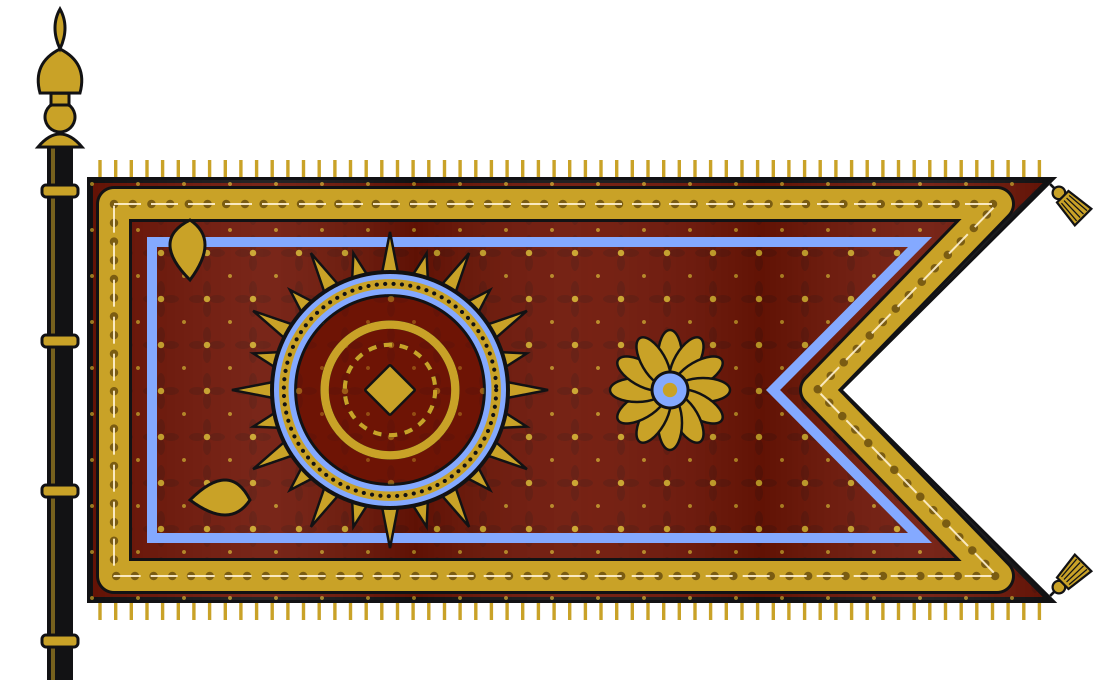
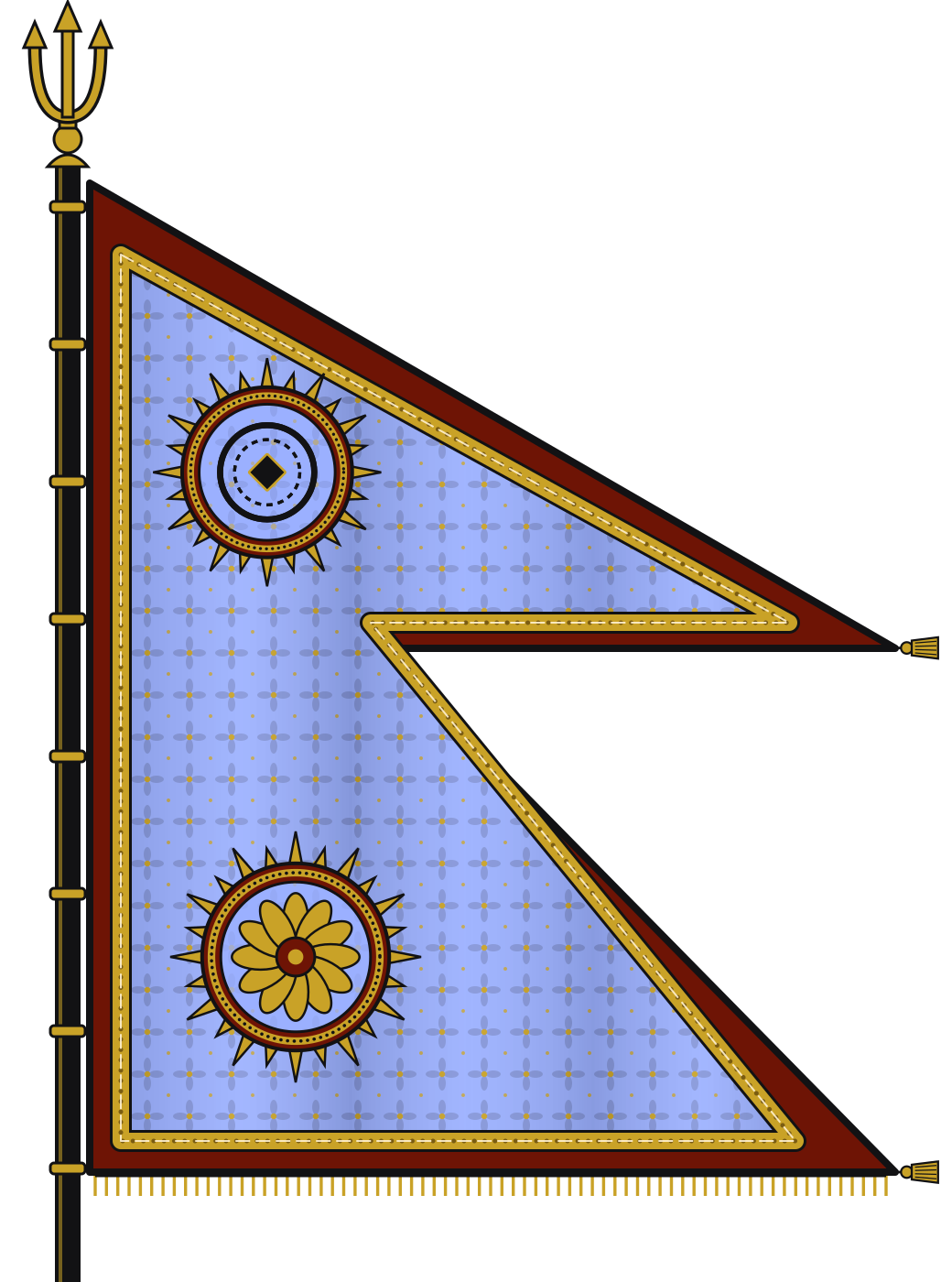
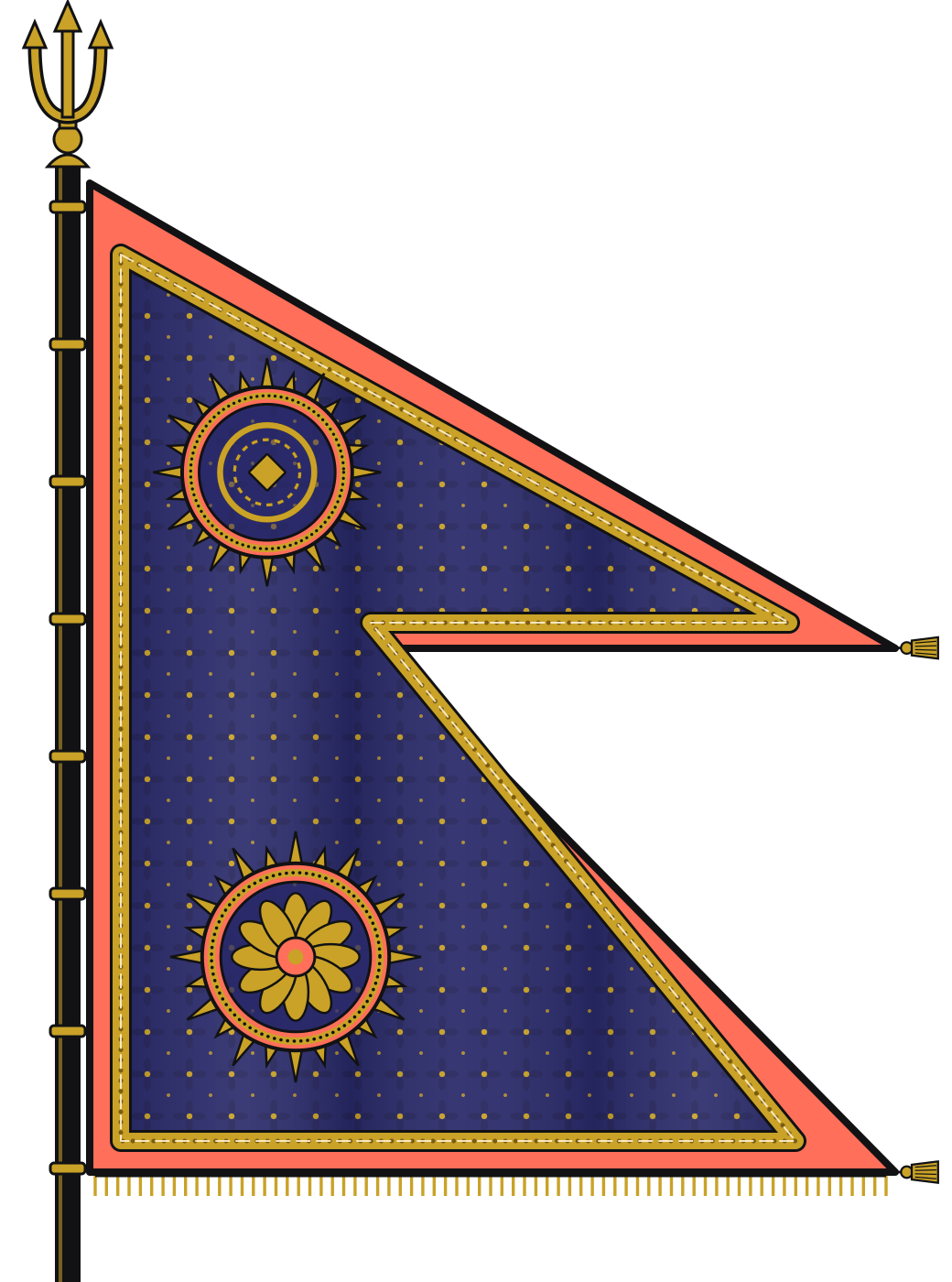
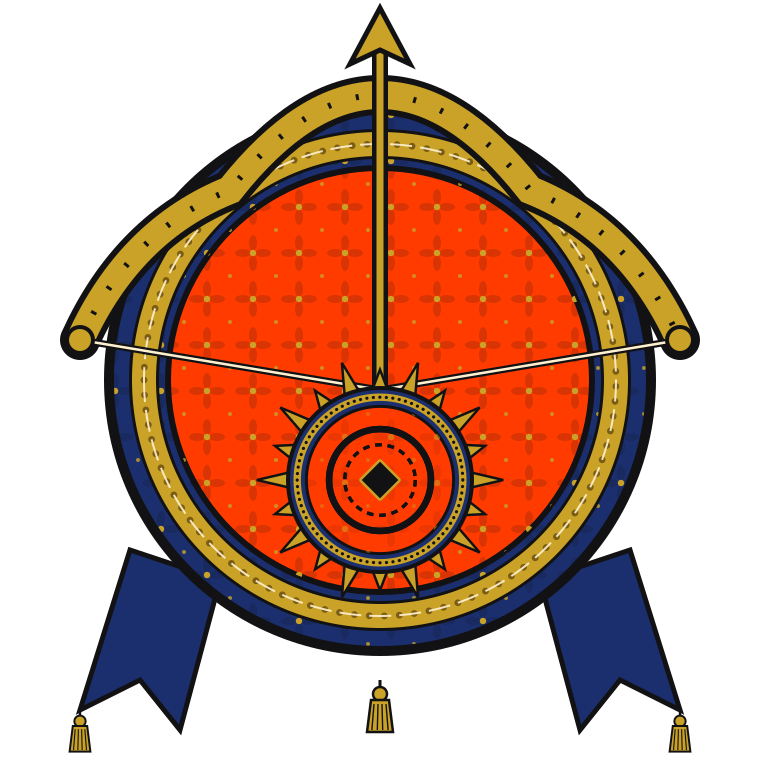
| Field | Deep Cosmic Blue #9BB0FF |
| Accent | Fiery Vermilion #FF4500 |
| Emblem colour | Charcoal Black #121214 |
| Zari metal | Gold |
| Main emblem | A bison-horn headdress |
| Second image | A crowd around a sacred pole |
| Night and day | Every visual accessory has two versions: by night the emblem on the dark field, by day the clan's field colour on cloth woven from its metal. |
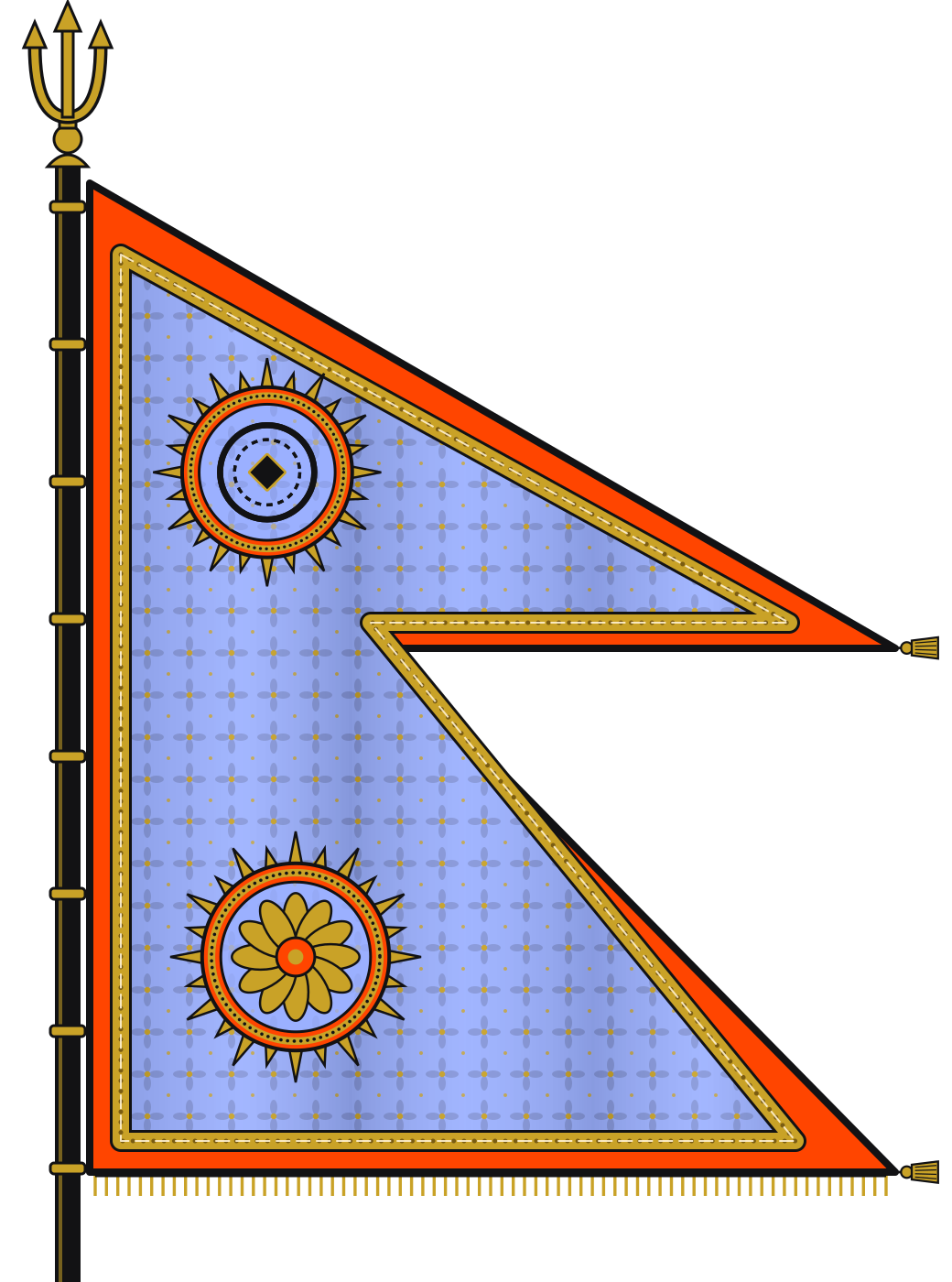
6. Flags
Every clan has every flag type; the type says the occasion and the colours say the clan. The outlined card is the flag the Atlas assigns.
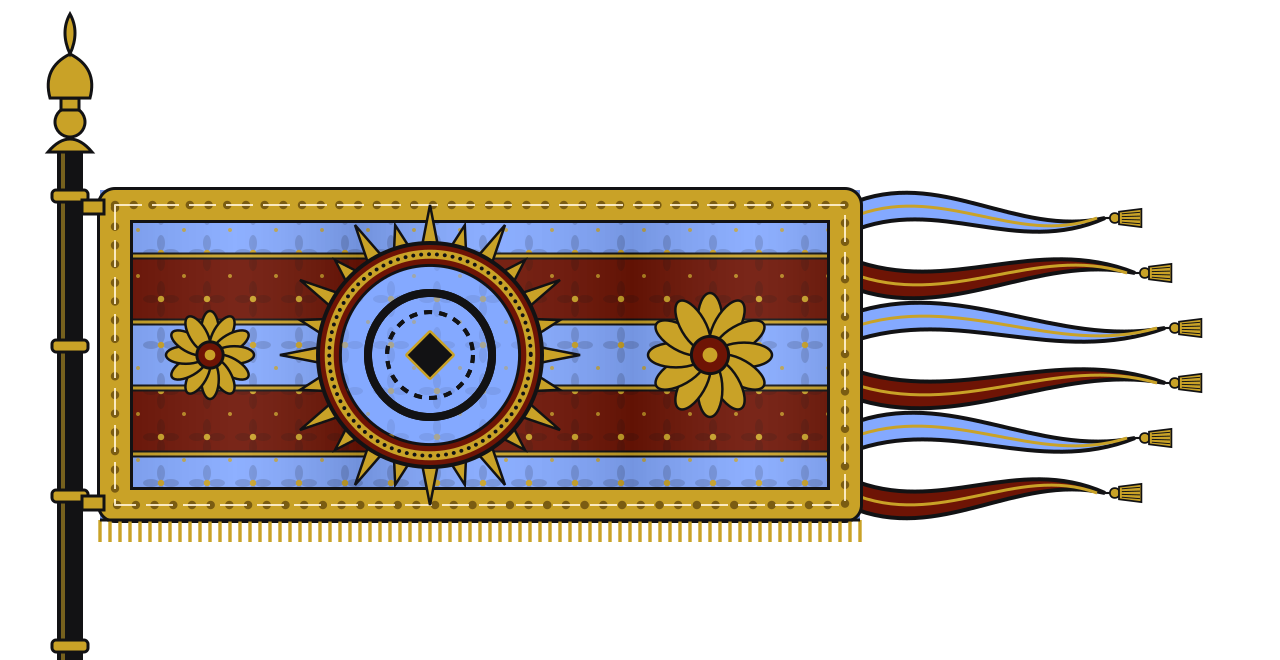
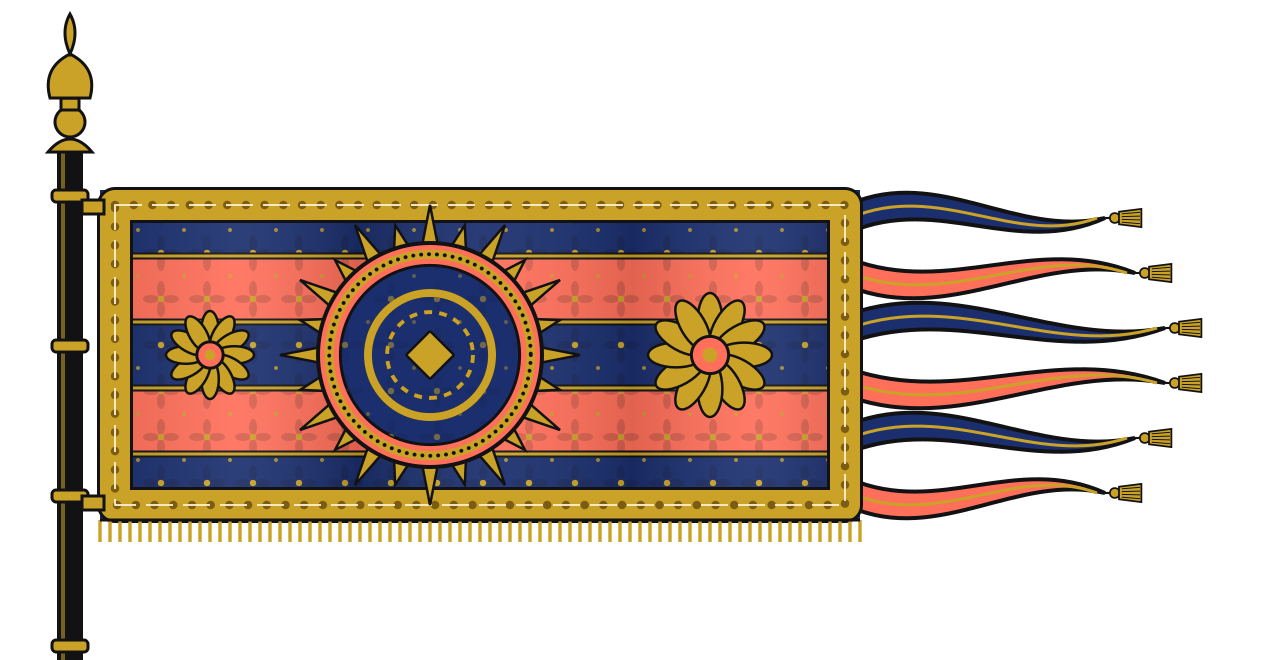
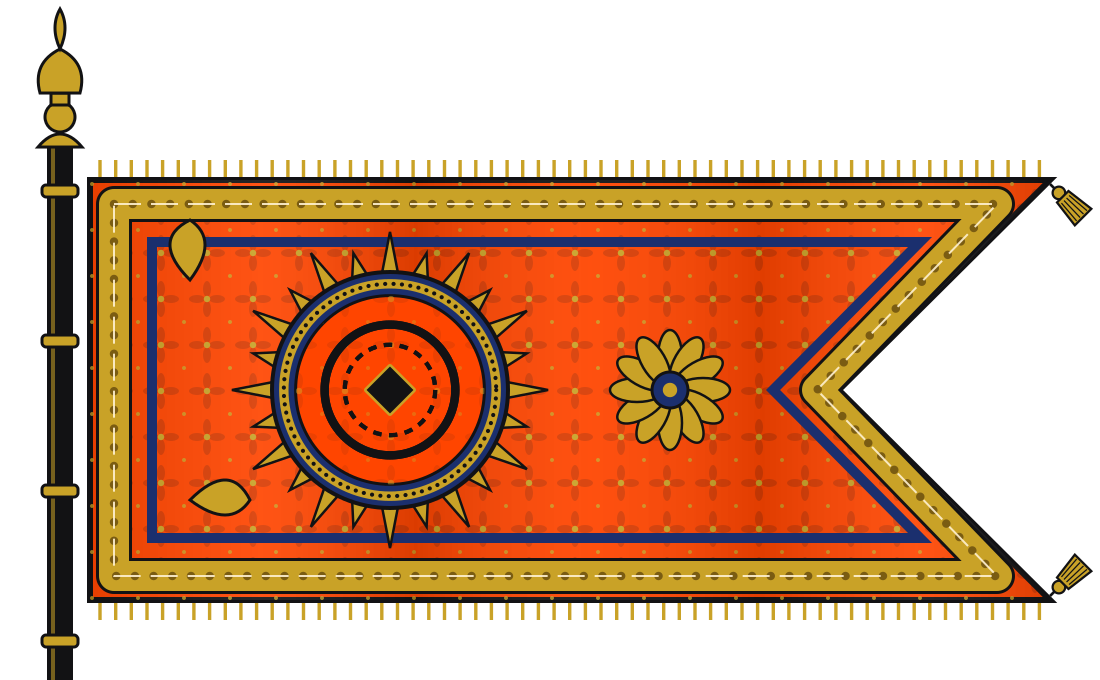
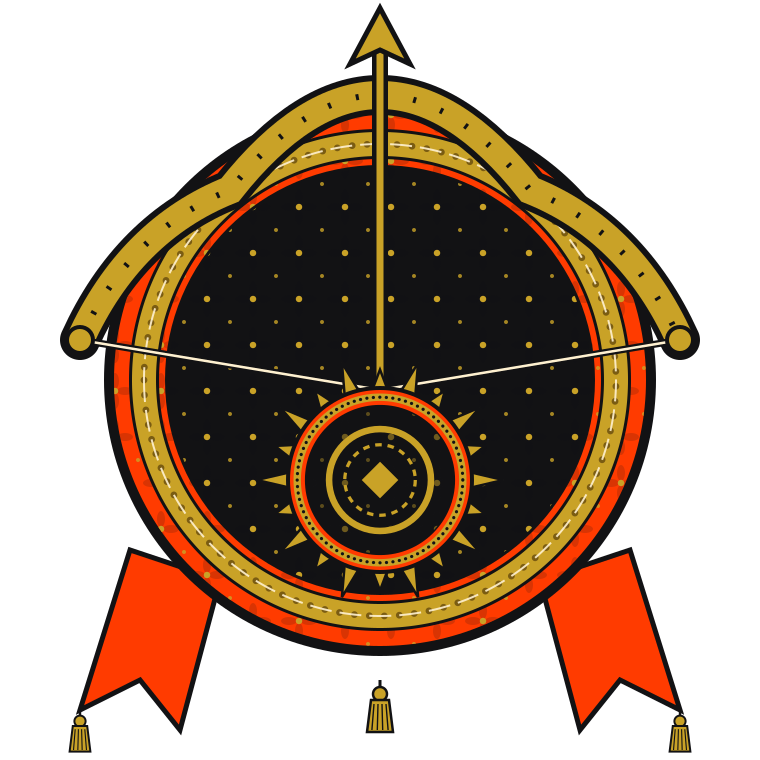
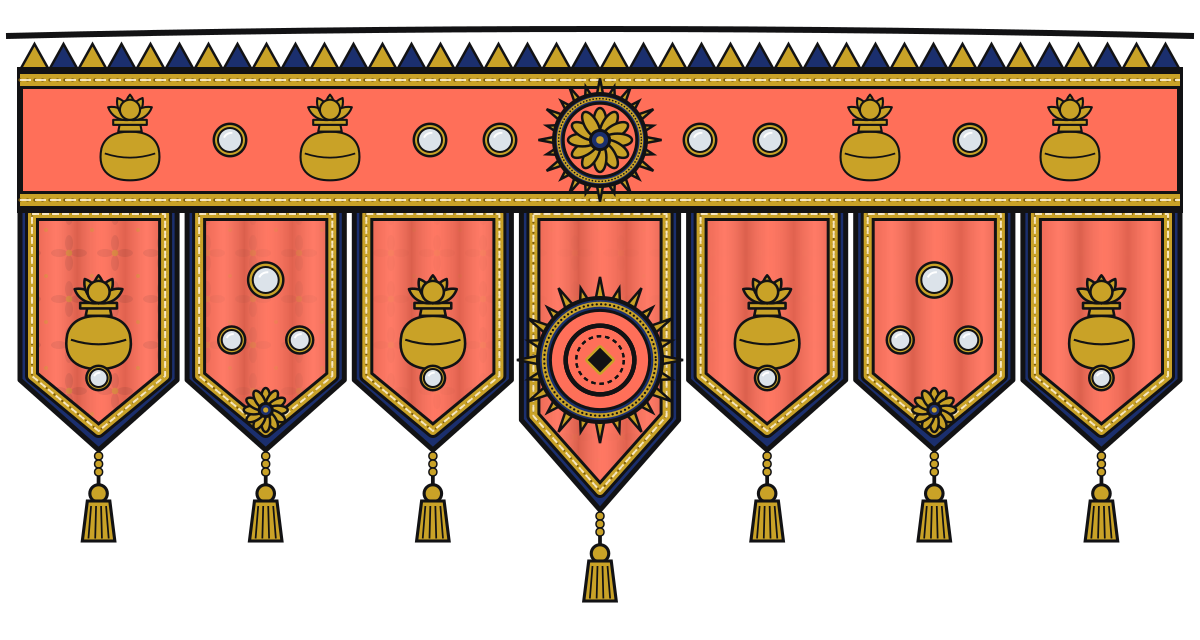
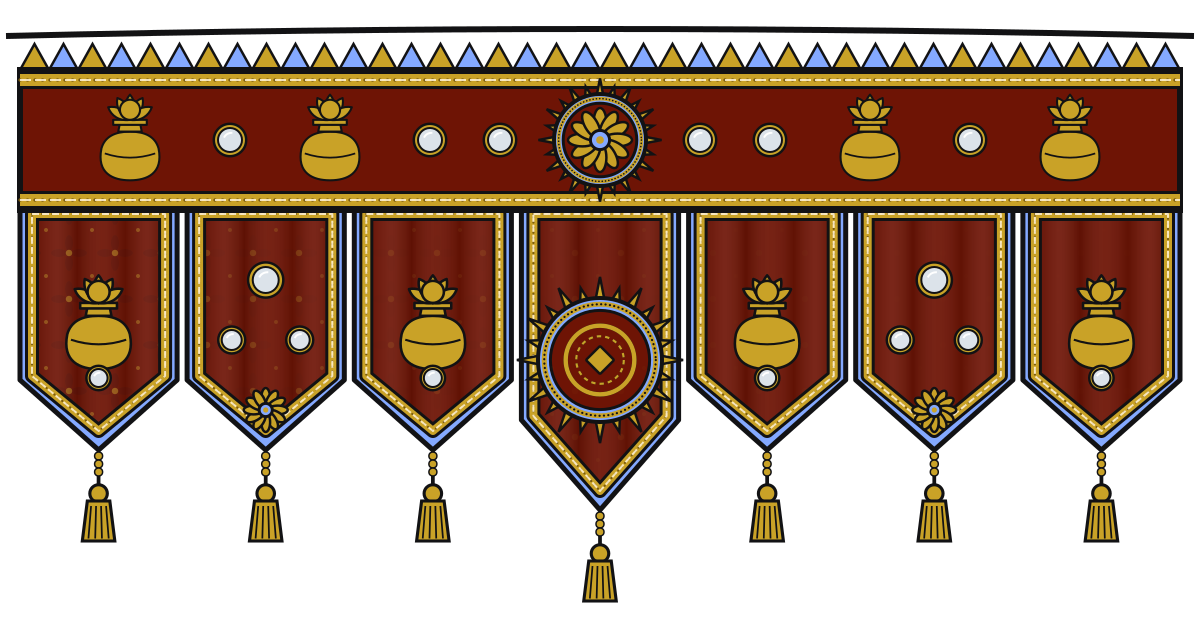
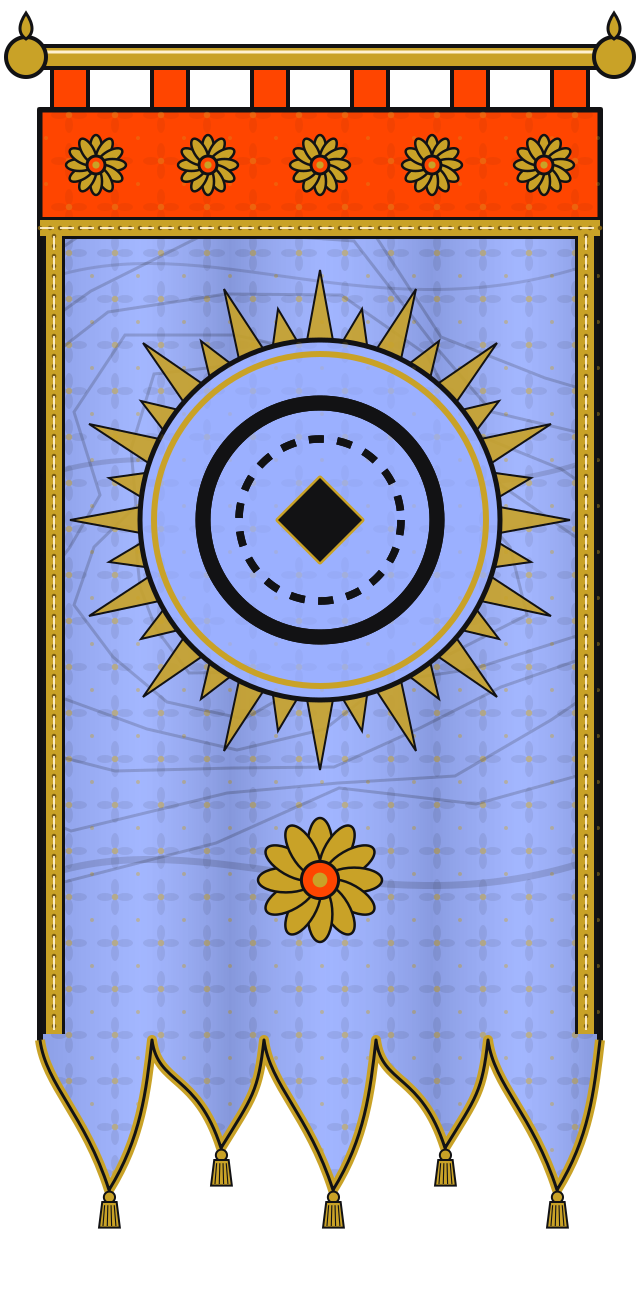
Historic banner
None known
New flag types
| Accessory | For this clan | Basis |
|---|---|---|
| A9 Pota-dhvaja · ship and trade flag For ships, caravans and markets | Not yet designed for this clan | Design |
| A10 Utsava-patāka · festival flag Light, bright flag for fairs and festivals | Not yet designed for this clan | Design |
| A11 Shoka-dhvaja · mourning flag White cloth with the emblem outline in the clan's metal | Not yet designed for this clan | Design |
7. Regalia
| Accessory | For this clan | Basis |
|---|---|---|
| E1 Chhatra · house parasol The ceremonial umbrella | Not yet designed for this clan | Design |
| E2 Chamara · fly-whisks The pair of whisks beside the head of the house | Not yet designed for this clan | Design |
| E3 Danda · staff of office Staff or scepter | Not yet designed for this clan | Design |
| E4 Simhasana · seat The seat of the house, covered in clan cloth | Not yet designed for this clan | Design |
| E5 Khetaka · shield A round shield; the Changi and Dhanush are its flag forms | Not yet designed for this clan | Regional tradition |
| E6 Kula-ayudha · clan weapon The weapon the clan honours | Not yet found for this clan | Under research |
8. Worn
| Accessory | For this clan | Basis |
|---|---|---|
| F1 Kula-vastra · clan cloth The clan's woven pattern in its kit colours | Dalu cloth: each clan's lineage and history depicted on traditional cotton fabric ETV Bharat, 10 April 2026, on the 500-page book[9] | Documented |
| F2 Kirti-vastra · honour cloth A cloth earned for a deed, not inherited | Not yet designed for this clan | Design |
| F3 Kula-mala · garland flower The flower or leaf the clan wears as a garland | Not yet found for this clan | Under research |
| F4 Chinha · house pin A metal badge with the pin emblem | Not yet designed for this clan | Design |
9. Records
| Accessory | For this clan | Basis |
|---|---|---|
| H1 Clan words A traditional line in the native script | సమ్మక్క సారలమ్మ జాతర · “Sammakka Saralamma Jatara: the Telugu title of the Medaram fair, run by Koya priests. Not the Koya's own line.” Wikipedia, Sammakka Saralamma Jatara[6] | Design |
| H2 Biruda · titles The house's title or titles | Not yet found for this clan | Under research |
| H3 Prashasti · praise genealogy The lineage as written at the head of a grant | Not yet found for this clan | Under research |
| H4 Vahi · clan register The book of the clan's births, marriages and deaths | Not yet found for this clan | Under research |
| H5 Rana-ghosha · war cry The clan's cry in battle or celebration | Not yet found for this clan | Under research |
10. VishwaVit · knower of the world
Game values are design choices for this project, not historical claims.
References
- Wikipedia, Koya (tribe), read 2026-10-10, https://en.wikipedia.org/wiki/Koya_(tribe)
- Ministry of Tribal Affairs, State/UT-wise list of Scheduled Tribes (Constitution (ST) Order 1950 as amended; list dated 9 July 2024), as recorded on the project Atlas, ST-160
- P. V. Sathya Mohan, The Koya (e-Tribal Tribune, from The Peoples of The World Foundation, retrieved 2006), read 2026-10-26, https://www.etribaltribune.com/index.php/volume-2/mv2i10/the-koya
- Wikipedia, Koya language, read 2026-10-26, https://en.wikipedia.org/wiki/Koya_language
- Medaram Jatara: an ode to the odyssey of tribal deities' valour and sacrifice, The South First (read 10 Oct 2026, KulDevi run 41).
- Wikipedia, Sammakka Saralamma Jatara, read 2026-10-10, https://en.wikipedia.org/wiki/Sammakka_Saralamma_Jatara
- Debashis Patra, The Koyas: A Socio-Cultural Study, Odisha Review, May-June 2016, read 2026-10-26, https://magazines.odisha.gov.in/Orissareview/2016/May-June/engpdf/84-87.pdf
- Sushree Mohanty, Indigenous Colours of Odisha: Handbook on 62 Tribes (KISS), read 2026-10-20, link
- ETV Bharat English Team, 'Five Gotras, 750 Surnames': Landmark Book Chronicles Koya Community's Heritage, 10 April 2026, read 2026-10-26, link
- Gale Group / Advameg, Koya - Orientation (everyculture.com), read 2026-10-26, https://www.everyculture.com/South-Asia/Koya-Orientation.html
- Devanpalli Srikanth Kumar, Culture and Ethno-linguistic Aspects of Koyas, GLOCAL CALA 2020 (SOAS), read 2026-10-26, https://glocal.soas.ac.uk/cala2020-20/
- G. Shekhar, An Ethnographic Investigation into the Koya Tribe and the Gattu-Gotra System, EPRA IJMR vol 11 issue 9, 27 Sep 2025 (abstract), https://eprajournals.com/IJMR/article/17675
- Odisha Review, Cultural Life of the Tribals of the Koraput Region, April 2016, read 2026-10-25, https://magazines.odisha.gov.in/Orissareview/2016/April/engpdf/78-82.pdf
- A tiger, a tribal deity, a state festival, Madras Courier (read 10 Oct 2026, KulDevi run 41).
- Journals of India, Bhumi Panduga by Koyas, 12 July 2021, read 2026-10-26, https://journalsofindia.com/bhumi-panduga-by-koyas/
- dhammabharat.com, List of Scheduled Tribes in Maharashtra and Population of each Tribe (2011 Census), read 2026-10-10, https://dhammabharat.com/?p=13656
- Verdictum, Tellam Venkata Rao v Union of India (report, 26 July 2025), read 2026-10-10, https://www.verdictum.in/court-updates/supreme-court/tellam-venkata-rao-v-union-of-india-lambadas-sugalis-banjaras-scheduled-tribe-telangana-1586192
- R. V. Russell, The Tribes and Castes of the Central Provinces of India, vol. 3 (1916), Project Gutenberg #41424, read 2026-10-10, https://gutenberg.org/cache/epub/41424/pg41424-images.html
- Edgar Thurston and K. Rangachari, Castes and Tribes of Southern India, vol. 3 (Madras, 1909), Project Gutenberg eBook #42993, https://www.gutenberg.org/ebooks/42993
- Edgar Thurston and K. Rangachari, Castes and Tribes of Southern India, vol. 6 (Madras, 1909), Project Gutenberg eBook #42996, https://www.gutenberg.org/ebooks/42996
- Wikipedia, List of Scheduled Tribes in Odisha, read 2026-10-20, https://en.wikipedia.org/wiki/List_of_Scheduled_Tribes_in_Odisha
- State-wise ST list (annual report 2023-24), Andhra Pradesh Part I, read 2026-10-10, https://iiitl.ac.in/wp-content/uploads/2024/08/07014a84-st-list-as-per-annual-report_-2023-24.pdf