The Kotia are a Scheduled Tribe listed in Odisha, with 7,232 counted there in 2011, and in Andhra Pradesh[1][2]. The Atlas gives their homeland as the Koraput–Visakhapatnam border[3]. Their speech, Kotia or Adivasi Odia, is an Indo-Aryan language closely linked to Odia[4]. The place name Kotia also labels a gram panchayat of border villages that Odisha and Andhra Pradesh both claim, and the sources do not say that its villagers are the Kotia people[5][6]. The sources give no clan origin, migration, sub-clan structure, songs or festivals for the Kotia.
01Faith and deities
Majhighariani of Rayagada, goddess of the Koraput hills[3]
The presiding goddess of the clan's homeland or capital: a link of place, not a recorded clan tie.
| Deity or tradition | Place in the clan's life | Evidence |
|---|---|---|
| Saptamatrika (with Narasimhi) | KulDevi family, as the Atlas gives it (from the Atlas, not a sourced clan practice) | [3] |
02Temples
No temple built or patronised by the Kotia is in the pack. Counterview reports that Odisha's Collector tried to install a makeshift Jagannath temple in Nereduvalasa, a village on the disputed border; that is a dispute event in a village, not a temple of the clan[6].
Built by the clan
Not recorded.
Given patronage or grants by the clan
Not recorded.
03Languages and scripts
| Language or script | Kind | Under the clan | Evidence |
|---|---|---|---|
| Kotia (Adivasi Odia, Kotia Odia, Kotiya, Tribal Odia) living | Indo-Aryan language closely linked to Odia; Ethnologue code ort | Speakers mainly in Visakhapatnam district, Andhra Pradesh; 41,591 in the 1991 census[4] | |
| Desia (Desiya, Kotia, Adivasi Odia, Koraputia) living | A variety of Odia, in the Odia script; lingua franca among ethnic groups of the area | Wikipedia lists Kotia among its names; about 230,000 native speakers in 2011, for Desia as a whole, not the Kotia alone[7] | |
| Kotia script (devised by Prof. Prasanna Sree) research | A script devised for Kotia; the Kotia language is written in the Telugu script, per Omniglot | Listed by Omniglot with Bagatha, Dhurwa, Gadaba, Gondi and others; no sample on the page[4] | |
| Bible translation living | Parts of the Bible have been translated into Kotia | Omniglot[4] |
04Books and literature
No Kotia book, text or manuscript is in the pack. Omniglot notes parts of the Bible translated into Kotia (see Languages)[4].
Written during the clan's history
Not recorded.
Given patronage by the clan
Not recorded.
05Thinkers and scholars
| Name | Field | Era | Contribution |
|---|---|---|---|
| Prof. Prasanna Sree | Kotia script (credited by Omniglot) | Not stated | Devised the Kotia script; Omniglot credits Andhra University[4] |
Only one scholar is named for the Kotia, and only as the devisor of the script.
06Art and architecture
Nothing about Kotia art, painting, carving or dress is in the pack.
Painting and wall art
Not recorded.
Sculpture and temple art
Not recorded.
Temple and building architecture
Not recorded.
Weaving and textiles
Not recorded.
Clothing and jewellery
Not recorded.
Coins, pottery and crafts
Not recorded.
07History
Scope of this section
This section is the history of the Kotia gram panchayat, a disputed group of border villages, as Compass and Counterview tell it. The sources give no history of the Kotia people themselves.
Before 1936: the Jeypore Estate
Before 1936 the villages of the Kotia gram panchayat were part of the Jeypore Estate, according to Compass and to Odisha's claim as Counterview reports it[5][6]. The Atlas also records the Kotia as subjects of the Jeypore kingdom[3].
1920 to 1943: the Andhra claim
Andhra Pradesh's claim rests on British-era notifications of 1920, 1923 and 1927, which moved 115 villages from Pottangi taluk to Salur taluk. A 1927 notification set up the Salur Agency, amended in 1928[6]. The Gilby Report of 1943 mapped the Madras-Orissa boundary and placed the disputed villages in Andhra Pradesh[6].
1936: the transfer to Odisha
A 1936 gazette, as Odisha's claim is given, transferred parts of Vizagapatnam district, including some Jeypore Estate villages, to the new Odisha Province[6]. Compass says the gram panchayat has been in Odisha since 1936[5].
1953 to 2006: the courts
Andhra Pradesh claimed the gram panchayat in 1953[5]. Odisha filed Original Suit No. 10 of 1968 in the Supreme Court; the Court declined to rule under Article 131, imposed status quo and left the matter to Parliament[6]. Compass dates the Odisha case to the 1980s and gives 21 villages, and says that in 2006 the Supreme Court held state boundary disputes outside its jurisdiction[5].
2021 to 2024: elections and celebrations
In 2021 Odisha tried to block gram panchayat elections; 223 villagers in Nereduvalasa voted in Andhra Pradesh's ZPTC and MPTC constituencies. On 15 August 2021 Odisha deployed 200 armed police and volunteers to block Andhra Pradesh's celebrations in Pattu-Chennuru[6]. In May 2024 residents were to vote in both states for the Lok Sabha polls[5]. Rao sums up the position as 'governed by none, claimed by all'; the article records no resolution[6].
08Journey and migrations
The sources give no migration or origin story for the Kotia.
Not recorded.
09Seats and lands
| Place | Role | Where today |
|---|---|---|
| Kotia plateau | Homeland as the Atlas gives it: hill farmers on the Koraput–Visakhapatnam border | Koraput and Visakhapatnam border[3] |
| Kotia gram panchayat (border villages, a place) | Disputed between Odisha and Andhra Pradesh; 28 villages above 3,000 ft in the Eastern Ghats, per Counterview | Between Salur Mandal (Vizianagaram district) and Pottangi block (Koraput district)[6] |
| Visakhapatnam district | Where most Kotia speakers live, per Omniglot | Andhra Pradesh[4] |
| Koraput, Malkangiri, Kalahandi, Kandhamal | Districts where the KISS handbook places the Kotia | Odisha[9] |
10Notable figures
Not recorded.
11Allies, rivals and marriages
Not recorded.
12Society and livelihood
The Kotia are a Scheduled Tribe in the Odisha and Andhra Pradesh lists[3][1][2]. Omniglot gives 41,591 speakers in the 1991 census, with about 18% literate[4]. The sources give no council, marriage rule or clan structure for the Kotia.
Government and social order
Not recorded.
Livelihood over time
| Era | Livelihood | Evidence |
|---|---|---|
| Living community | Hill farming; the popular identifier is hill farmers of the Kotia plateau | [3] |
13Sub-clans and related clans
The Atlas lists six sub-groups for the Kotia: Bentho Oriya, Bartika, Dulia, Holva, Sanrona and Sidhopaiko[3]. Holva has its own master row (ST-104). The sources give no sub-clan, gotra or exogamous division for the Kotia.
| Clan | Relation | Where | Size | In the Atlas | Evidence |
|---|---|---|---|---|---|
| Holva | Sub-clan | Odisha, Koraput plateau (Atlas ST-104) | 28,149, Odisha, 2011[1] | ST-104 | [3][1] |
| Bentho Oriya | Sub-clan | new clan candidate | [3] | ||
| Bartika | Sub-clan | new clan candidate | [3] | ||
| Dulia | Sub-clan | new clan candidate | [3] | ||
| Sanrona | Sub-clan | new clan candidate | [3] | ||
| Sidhopaiko | Sub-clan | new clan candidate | [3] |
Clans marked "new clan candidate" are not in the Atlas yet.
14Surnames
No surname of the Kotia is given in the sources.
Not recorded.
15Songs and music
No Kotia song is in the pack.
None recorded yet.
16Poems, lullabies and children's rhymes
None recorded yet.
17Stories, legends and proverbs
Stories and legends
Not recorded.
Proverbs and sayings
Not recorded.
18Festivals and fairs
Not recorded.
19Food, dress and games
Food
Not recorded.
Dress
Not recorded.
Games and martial arts
Not recorded.
Tags: living still practised · revived brought back after a break · lost known only from records · research reported but not yet confirmed from a source. Songs and poems under copyright are listed by title only; restricted or sacred material is noted without its content.
20Status today
The Kotia are a Scheduled Tribe in the Odisha and Andhra Pradesh lists, with 7,232 counted in Odisha in 2011[1]. Their homeland, as the Atlas gives it, is the Koraput–Visakhapatnam border[3]. The gram panchayat villages that bear the name Kotia are disputed between the two states[5][6].
Not yet reviewed by the Kotia community. No community body or review is in the pack.
21For children
The hills on the border
The Kotia are a Scheduled Tribe of Odisha and Andhra Pradesh. Their language is close to Odia. The Atlas gives their homeland as the border between Koraput and Visakhapatnam. The sheet calls them hill farmers. A group of villages on that border is also called Kotia. Odisha and Andhra Pradesh both claim those villages, and the Supreme Court left the question to Parliament.
22Across the project
| Project | What carries this clan | Status |
|---|---|---|
| Atlas of the Janas | Homeland: the Koraput–Visakhapatnam border. The disputed Kotia gram panchayat villages lie on the Andhra-Odisha border (Counterview). No footprint drawn yet | To check |
| KulDevi and GrahDevi | KulDevi: Majhighariani. GrahDevi forms: Brahmani, Maheshvari, Kaumari, Vaishnavi, Varahi, Indrani, Chamunda, Narasimhi | From the Atlas |
| Planet naming | Planet names are not in the pack | To check |
| Renaming and waters | No water place or renaming for the Kotia is in the pack | To check |
23Open questions
- Native-script name: none in the pack, and the Atlas leaves it blank. Omniglot prints no sample. Find the name and a sample in the Kotia or Odia script.
- Script conflict: Omniglot says the Kotia language is written in the Telugu script[4]; Wikipedia gives Desia, which it lists under the name Kotia, in the Odia script[7]. Check whether Kotia and Desia are one speech.
- Dispute dates conflict: Counterview says Odisha filed Original Suit No. 10 of 1968[6]; Compass says Odisha filed a Supreme Court case in the 1980s over 21 villages[5]. Check the court record.
- Who lives in the boundary villages: Counterview calls them the Kandi tribal community[6]; the pack does not link them to the Kotia, so this codex keeps the villages as a place.
- Sub-groups: Bentho Oriya, Bartika, Dulia, Sanrona and Sidhopaiko are named only in the Atlas. Find their origin and whether they are separate peoples.
- Origin, migration and the Jeypore-era role of the Kotia are not in the pack beyond the sheet's 'subjects of the Jeypore kingdom'.
- Deity: no clan deity is named in the pack for the Kotia. The KulDevi Majhighariani is the master-sheet goddess.
- Surnames, septs, marriage rules and village councils for the Kotia are not in the pack.
- Songs, proverbs, festivals, food and dress are not in the pack. The general Odisha pages in the pack are not about the Kotia.
24Astitva
अस्तित्व · being, existence: everything by which the clan is known
No seal, coin, title, war cry, totem or other accessory of the Kotia is in the sources. The Kotia script devised by Prof. Prasanna Sree is a script, not an accessory[4].
Every clan has every accessory, royal objects included. Each one says how it is known: Documented This clan's own object is recorded. · Regional tradition Recorded for the region or for peoples like this one, not for this clan. · Design Made for this project, with no historical claim. · Under research To be found for this clan from sources. Legends and titles are written in the clan's own script.
1. Seals and coins
| Accessory | For this clan | Basis |
|---|---|---|
| B1 Rajamudra · house seal Round seal with the clan emblem and a short legend in the clan's script | Not yet designed for this clan | Design |
| B2 Anguliya-mudra · signet ring Personal seal ring of the head of the house | Not yet designed for this clan | Design |
| B3 Chhapa · house stamp Ink or block stamp for letters, goods and cloth | Not yet designed for this clan | Design |
| B4 Tamrapatra · charter plate Copper-plate grant on a ring, closed with the house seal | Not yet designed for this clan | Design |
| B5 Shreni-mudra · guild or trade seal Seal for the clan's trade, craft or caravan | Not yet designed for this clan | Design |
| C1 Clan coin Emblem or deity on one side, a legend in the clan's script | Not yet designed for this clan | Design |
| C2 Coin die The die that strikes the coin | Not yet designed for this clan | Design |
2. Living symbols
| Accessory | For this clan | Basis |
|---|---|---|
| I1 Totem trio The tree, bird and animal the clan protects | Not yet found for this clan | Under research |
| I2 Kaval-maram · guardian tree The tree that stands at the clan's seat | Not yet found for this clan | Under research |
3. Stone and gate
| Accessory | For this clan | Basis |
|---|---|---|
| G1 Torana · gateway The built gate of the seat; the cloth Toran hangs in it | Not yet designed for this clan | Regional tradition |
| G2 Viragallu · hero stone Carved panel stone for a member who died defending the clan | Not yet designed for this clan | Regional tradition |
| G3 Kula-shila · clan stones Standing and table stones that remember the ancestors | Not yet designed for this clan | Design |
| G4 Jayastambha · victory pillar A pillar raised for a victory | Not yet designed for this clan | Design |
| G5 Sima-shila · boundary stone Marks the clan's land, with a line in the native script | Not yet designed for this clan | Design |
4. Sounds
| Accessory | For this clan | Basis |
|---|---|---|
| D1 Pancha-mahashabda · five great sounds The right to five instruments | Not yet designed for this clan | Design |
| D2 Shankha · clan conch The clan's own named war conch | Not yet designed for this clan | Design |
| D3 Murasu · house drums Three drums: war, charity and justice | Not yet designed for this clan | Design |
5. Kit: colours, metals and emblems
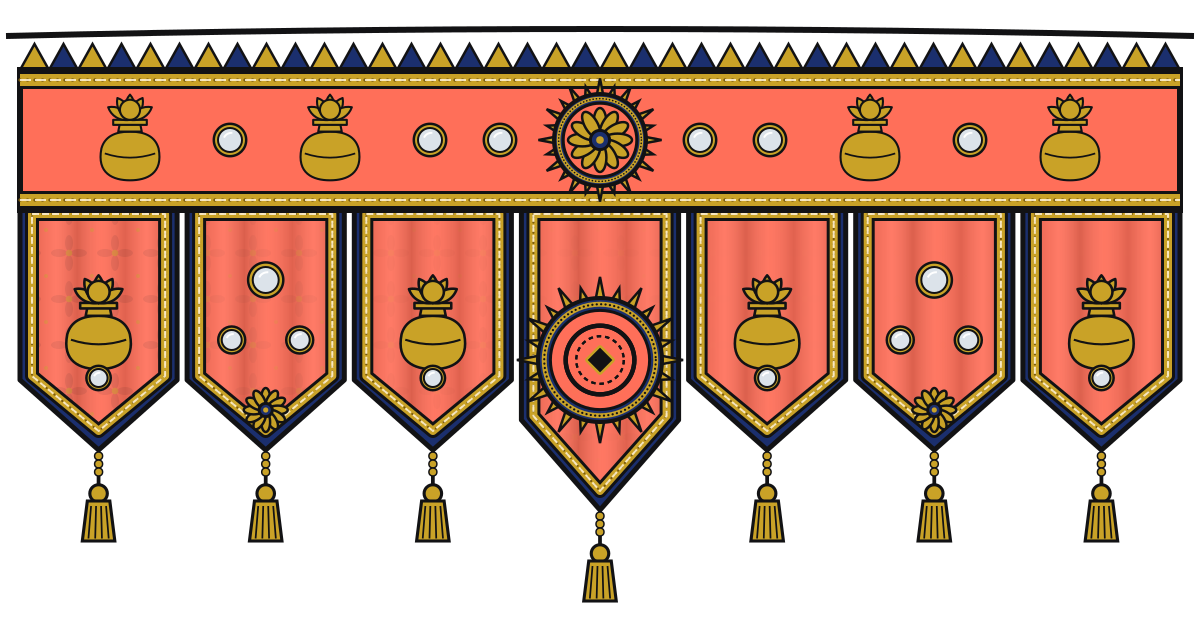
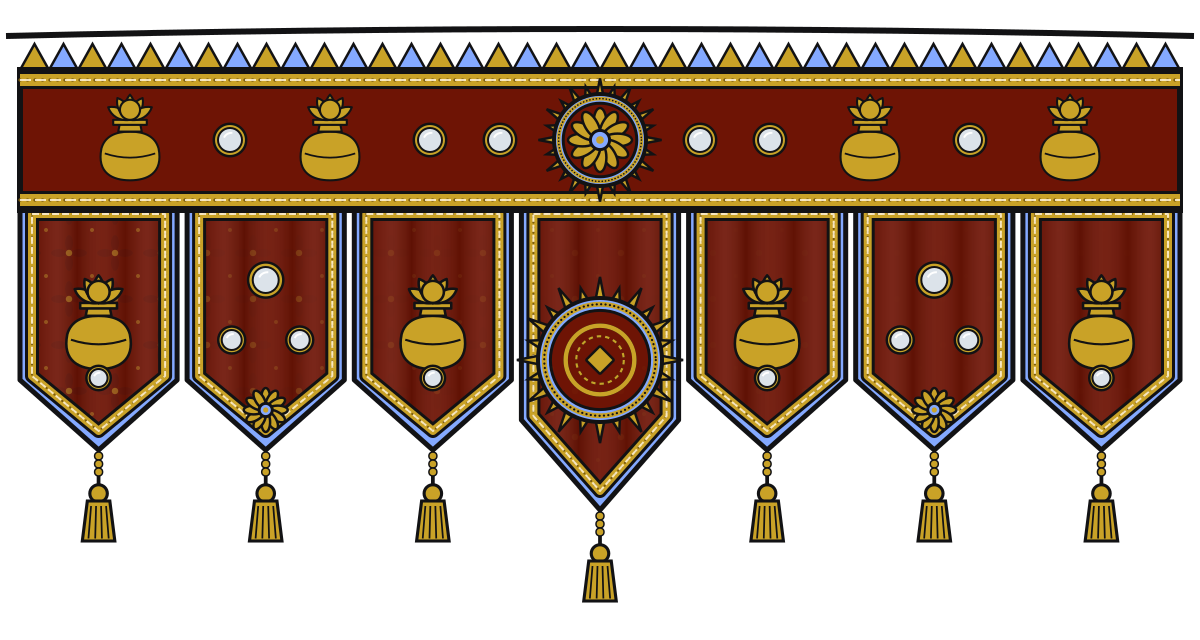
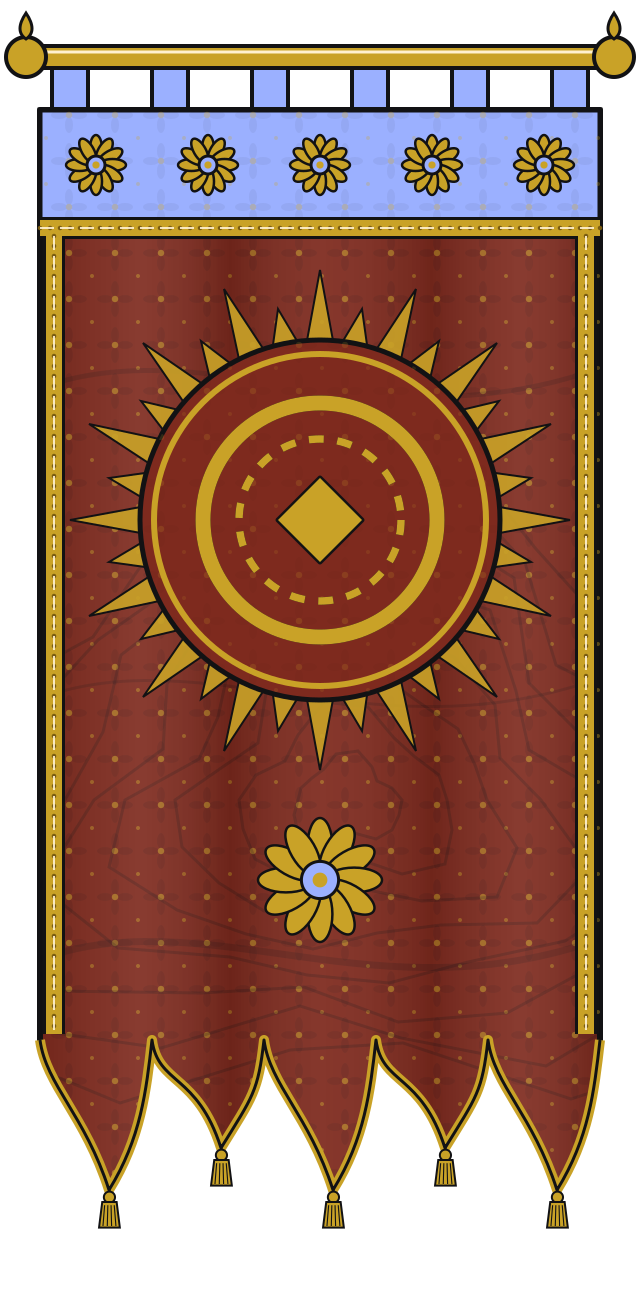
The flag and banner come from the Atlas: the main emblem is a plateau field (for hill farming), the second image a turmeric plant, and the flag a Changi (sun crest)[3]. The Atlas gives no historic banner ('None known'), and the sources record no Kotia symbol, so these are design ideas, not documented symbols.
| Part of the kit | This clan |
|---|---|
| Field | Deep Brick #7E2A1E |
| Accent | Deep Cosmic Blue #9BB0FF |
| Emblem colour | Metallic Gold #C9A227 |
| Zari metal | Gold |
| Main emblem | A plateau field |
| Second image | A turmeric plant |
| Night and day | Every visual accessory has two versions: by night the emblem on the dark field, by day the clan's field colour on cloth woven from its metal. |
6. Flags
Every clan has every flag type; the type says the occasion and the colours say the clan. The outlined card is the flag the Atlas assigns.
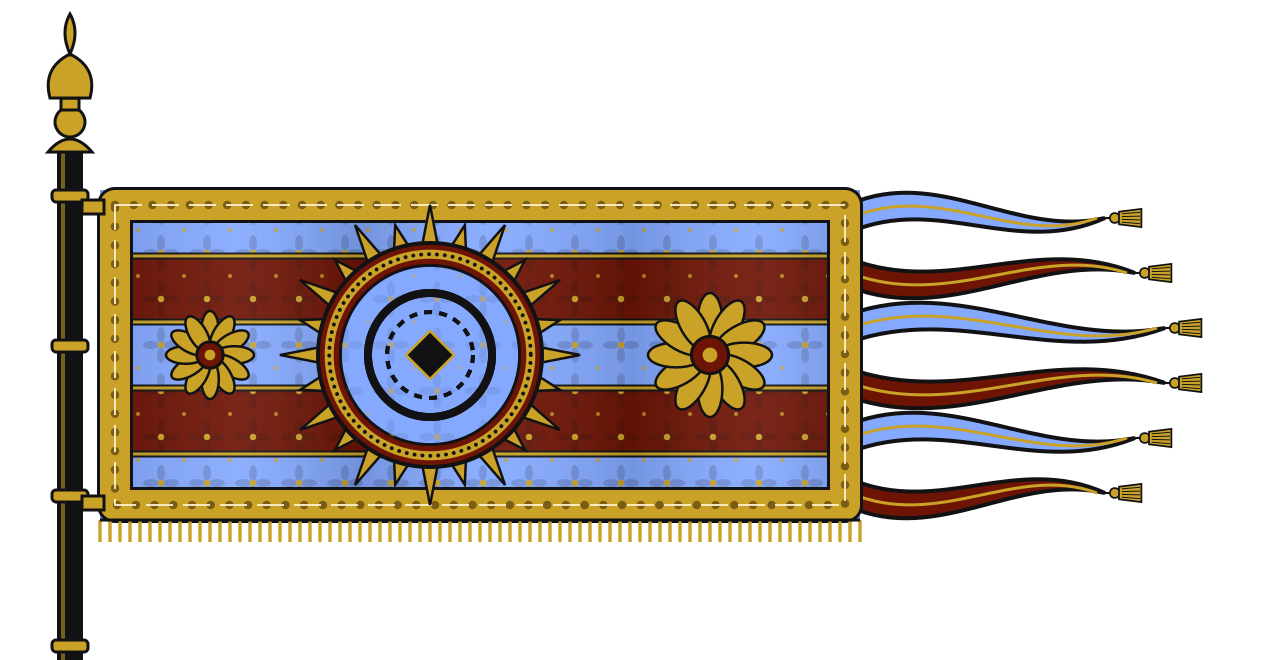
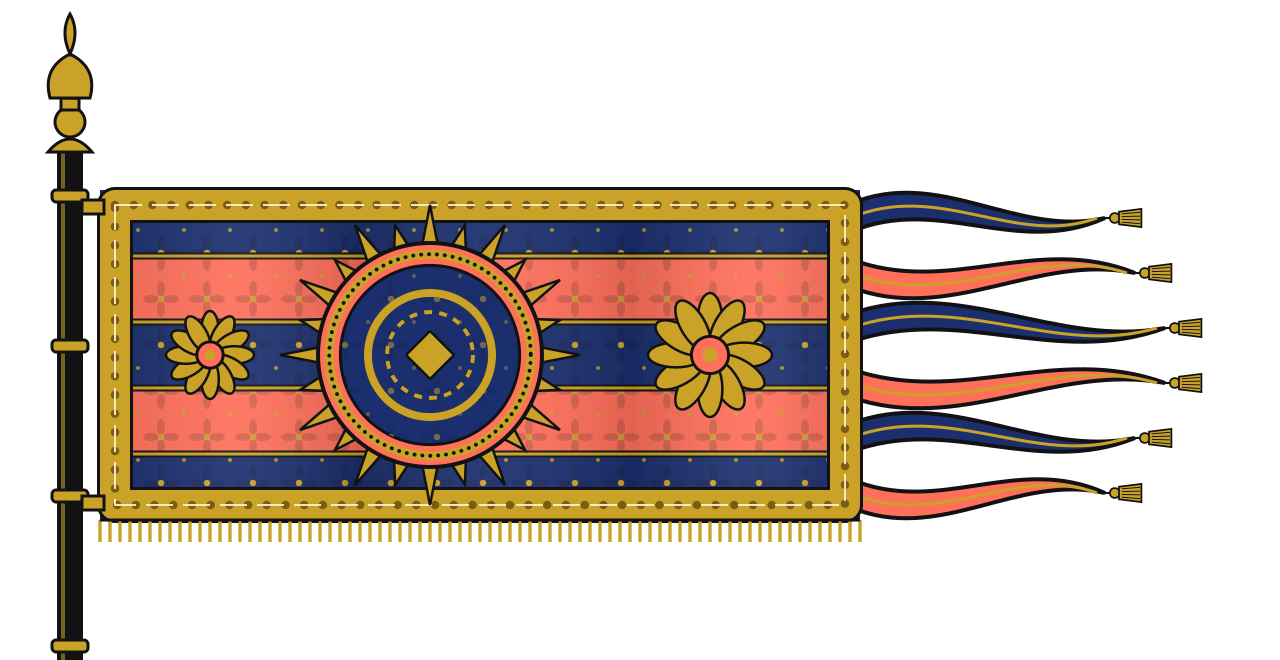
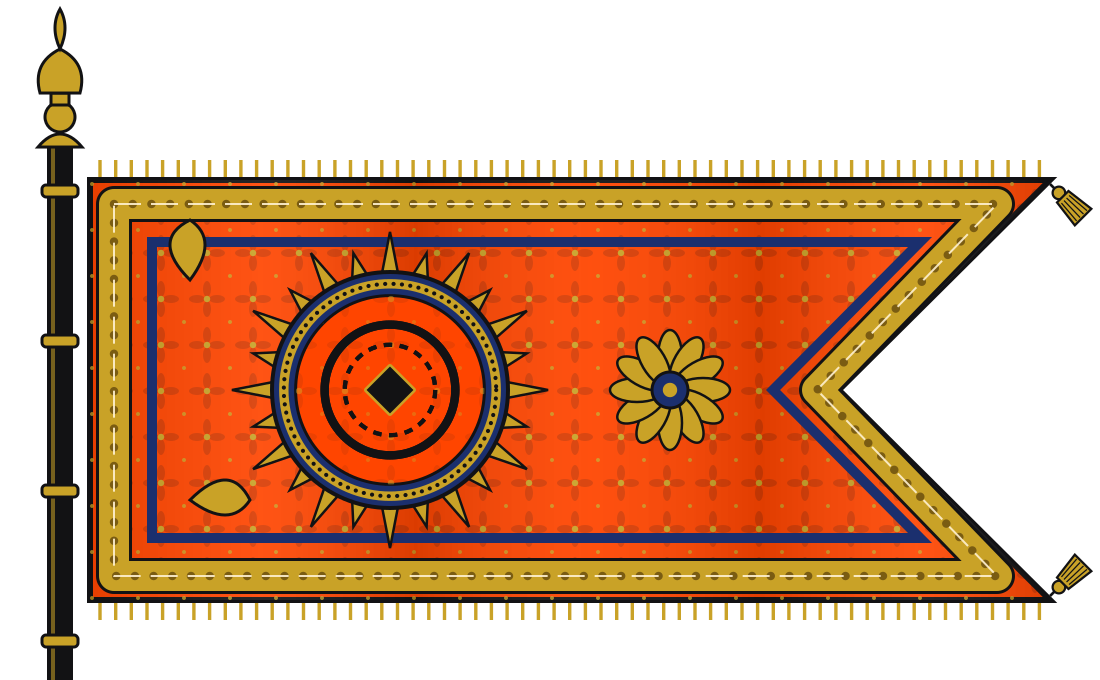
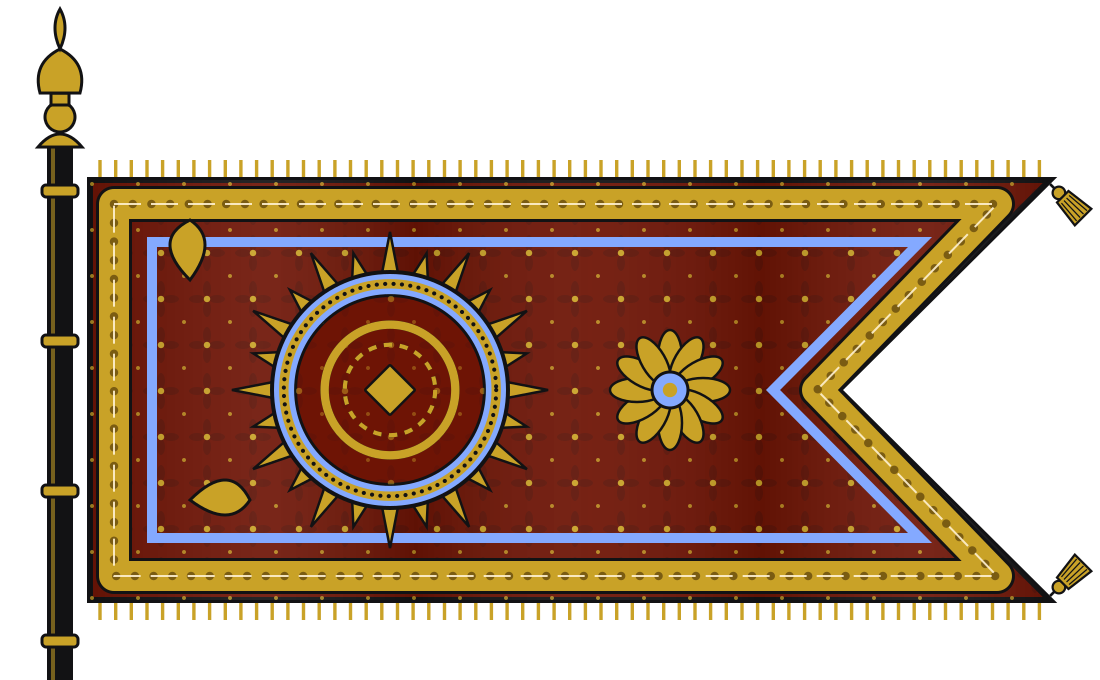
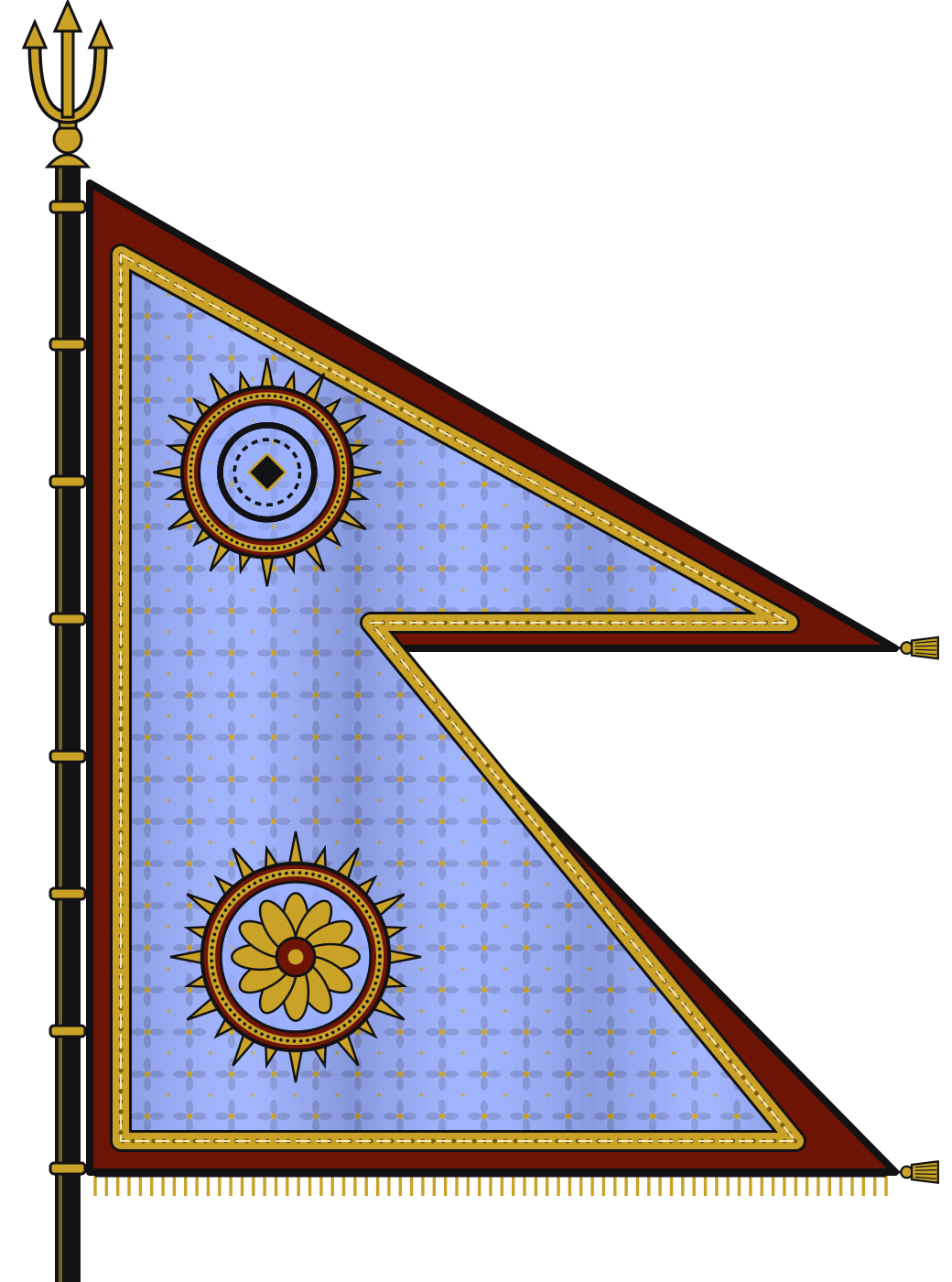
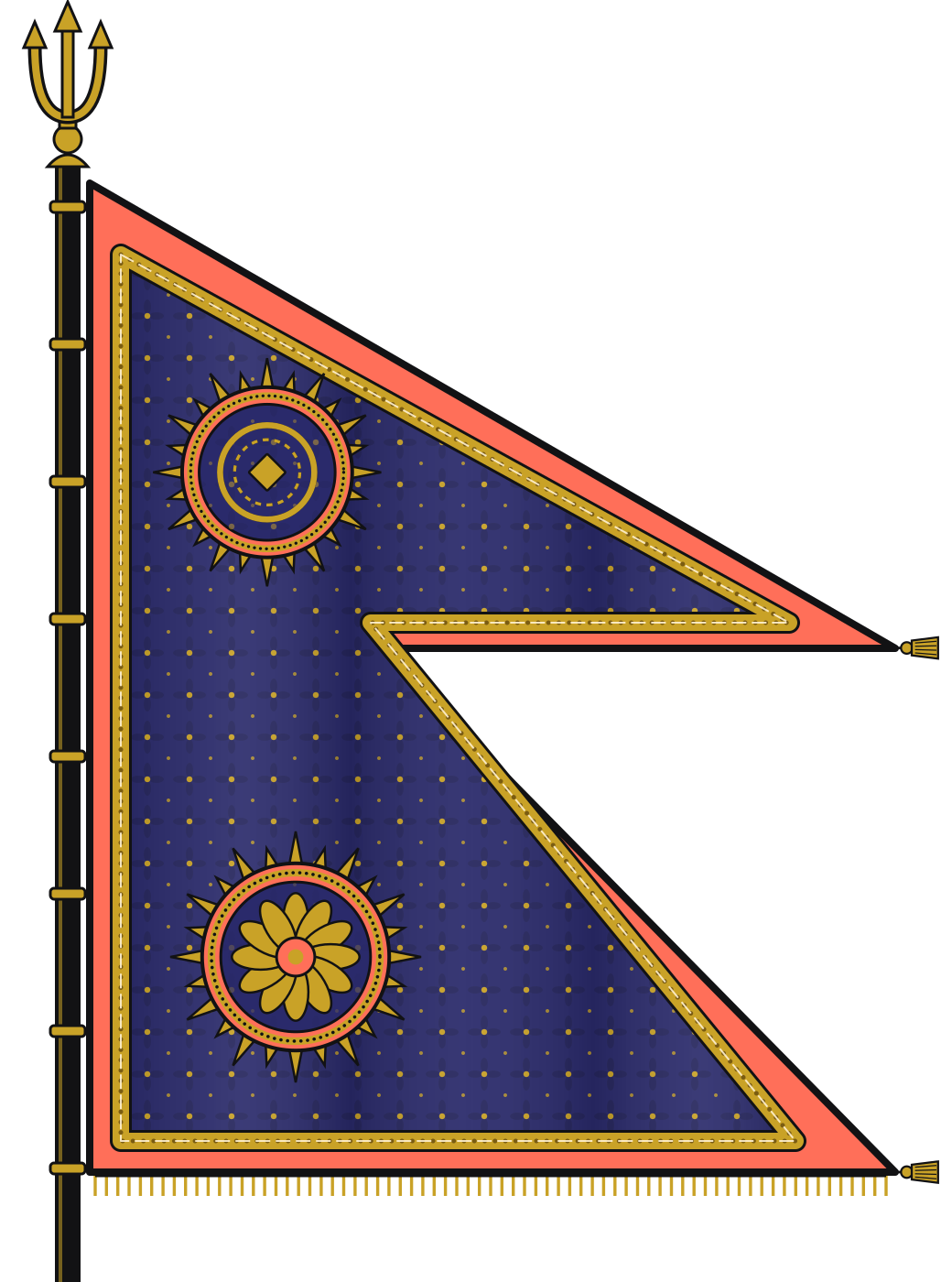
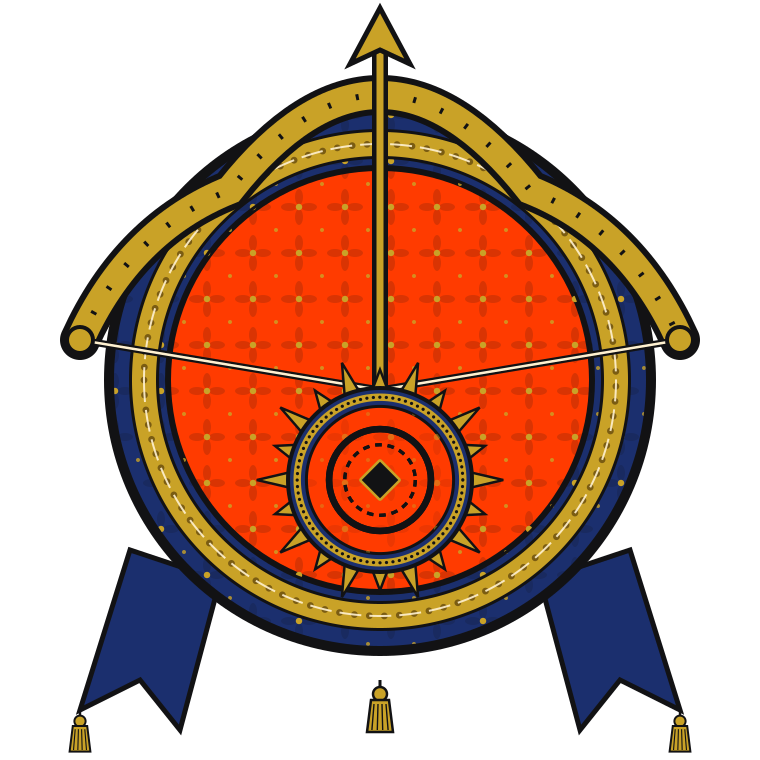
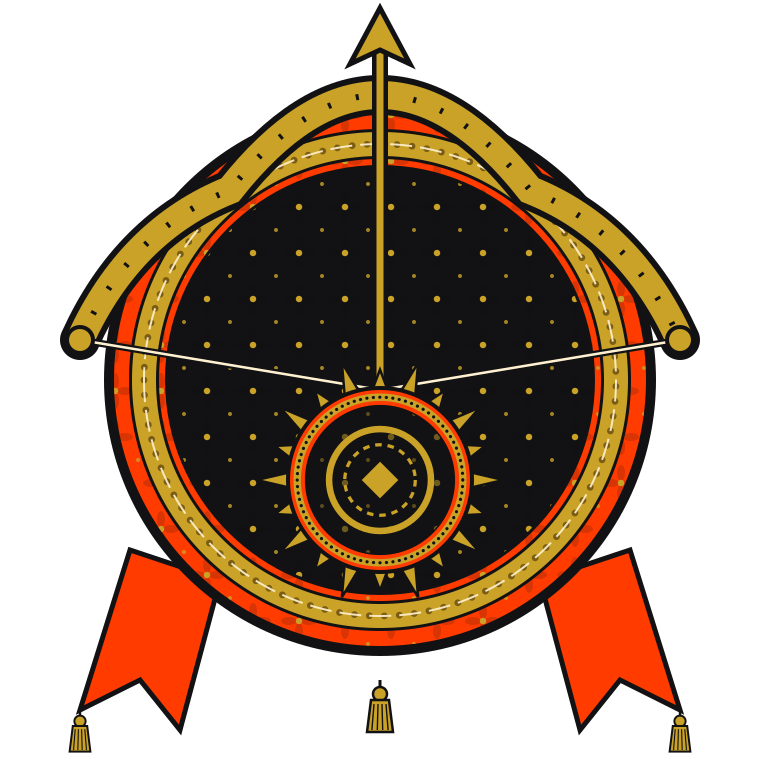
Historic banner
None known
New flag types
| Accessory | For this clan | Basis |
|---|---|---|
| A9 Pota-dhvaja · ship and trade flag For ships, caravans and markets | Not yet designed for this clan | Design |
| A10 Utsava-patāka · festival flag Light, bright flag for fairs and festivals | Not yet designed for this clan | Design |
| A11 Shoka-dhvaja · mourning flag White cloth with the emblem outline in the clan's metal | Not yet designed for this clan | Design |
7. Regalia
| Accessory | For this clan | Basis |
|---|---|---|
| E1 Chhatra · house parasol The ceremonial umbrella | Not yet designed for this clan | Design |
| E2 Chamara · fly-whisks The pair of whisks beside the head of the house | Not yet designed for this clan | Design |
| E3 Danda · staff of office Staff or scepter | Not yet designed for this clan | Design |
| E4 Simhasana · seat The seat of the house, covered in clan cloth | Not yet designed for this clan | Design |
| E5 Khetaka · shield A round shield; the Changi and Dhanush are its flag forms | Not yet designed for this clan | Regional tradition |
| E6 Kula-ayudha · clan weapon The weapon the clan honours | Not yet found for this clan | Under research |
8. Worn
| Accessory | For this clan | Basis |
|---|---|---|
| F1 Kula-vastra · clan cloth The clan's woven pattern in its kit colours | Not yet designed for this clan | Design |
| F2 Kirti-vastra · honour cloth A cloth earned for a deed, not inherited | Not yet designed for this clan | Design |
| F3 Kula-mala · garland flower The flower or leaf the clan wears as a garland | Not yet found for this clan | Under research |
| F4 Chinha · house pin A metal badge with the pin emblem | Not yet designed for this clan | Design |
9. Records
| Accessory | For this clan | Basis |
|---|---|---|
| H1 Clan words A traditional line in the native script | · “Under research” | Documented |
| H2 Biruda · titles The house's title or titles | Not yet found for this clan | Under research |
| H3 Prashasti · praise genealogy The lineage as written at the head of a grant | Not yet found for this clan | Under research |
| H4 Vahi · clan register The book of the clan's births, marriages and deaths | Not yet found for this clan | Under research |
| H5 Rana-ghosha · war cry The clan's cry in battle or celebration | Not yet found for this clan | Under research |
10. VishwaVit · knower of the world
Game values are design choices for this project, not historical claims.
References
- Wikipedia, List of Scheduled Tribes in Odisha, read 2026-10-20, https://en.wikipedia.org/wiki/List_of_Scheduled_Tribes_in_Odisha
- State-wise ST list (annual report 2023-24), Andhra Pradesh Part I, read 2026-10-10, https://iiitl.ac.in/wp-content/uploads/2024/08/07014a84-st-list-as-per-annual-report_-2023-24.pdf
- Project Atlas, row ST-159 Kotia: 'Also known as / sub-groups', 'Official status / recognition' (Ministry of Tribal Affairs, State/UT-wise list of Scheduled Tribes, list dated 09-07-2024), 'Homeland / region', 'Popular identifier', 'Signature strength', 'KulDevi (clan goddess)' (Majhighariani, basis: homeland shrine), and the flag and banner fields
- Omniglot, Kotia (Adivasi Odia), page modified 23.04.21, read 2026-11-01, https://www.omniglot.com/writing/kotia.htm
- Rau's IAS Study Circle, "Kotia: A tribal gram panchayat", Compass, 14 May 2024, read 2026-11-01, https://compass.rauias.com/current-affairs/kotia-tribal-gram-panchayat/
- Dr. Palla Trinadha Rao, "Kotia's forgotten people", Counterview, 22 July 2025 (opinion blog), read 2026-11-01, https://www.counterview.net/2025/07/kotias-forgotten-people-andhra-odisha.html
- Wikipedia, Desia language, read 2026-10-28, https://en.wikipedia.org/wiki/Desia_language
- Koraput district website, "Major Tribes of Koraput", read 2026-10-24, re-read 2026-10-26 and 2026-10-29, https://koraput.odisha.gov.in/en/more/tribal-communities
- Sushree Mohanty, Indigenous Colours of Odisha: Handbook on 62 Tribes (KISS), read 2026-10-20, link