The Korku are a Munda-speaking people of the Satpura hills on the Madhya Pradesh and Maharashtra border, in the Melghat, Betul and Khandwa areas[1][2][3][4]. Their own tradition makes Mula and Mulai, with the surname Pothre, their ancestors, and the sun and moon are their principal deities[5]. Russell and Hira Lal recorded them in 1916 as a Munda or Kolarian tribe akin to the Korwas, and described bands of Koli or Korku freebooters who harried the Berar lowlands from Satpura hill forts[5]. The 2011 census prints 1,104,519 Korku in total, and 727,133 speakers of the Korku language[4][2].
01Faith and deities
No KulDevi has been found for this clan yet; it is on the research list.
| Deity or tradition | Place in the clan's life | Evidence |
|---|---|---|
| Sun and moon (Gomaj) | Principal deities. The head of the family offers a white she-goat and a white fowl to the sun every third year; in ceremonies the face is turned east[5] | [5] |
| Mahadeo (Shiva) | Origin tales; in the clan-origin legend (Wikipedia); Mahadeo's shrine at Pachmarhi[5][4] | [5][4] |
| Dongar Deo, the hill god | Village deity worshipped at Dasahra with coconuts, limes, dates, vermilion and a goat[5] | [5] |
| Mutua Deo | Village deity of the stone heap; pig sacrifice. The Bhumka offers fowl's blood at the stone heap at marriage[5] | [5] |
| Mata, smallpox goddess | Coconuts and sweetmeats, no animal sacrifice[5] | [5] |
| Bagh Deo, the tiger god | Propitiated by the Bhumka, who keeps tigers out[5] | [5] |
| Bhimsen | A giant made by Parvati in the grain tale; Mula worships him like Rawan[5] | [5] |
| Mahabissum, the pig | The pig Buddu, from the tank Daldal, is worshipped to this day as Mahabissum[5] | [5] |
| मटका देव | Listed with Dongar Deo among the main deities[6] | [6] |
| Jaitubaba | Local deity: an unmarried Korku man revered for philosophical talks. A temple was built in his memory about 12 years before 2018[1] | [1] |
| Ganesha and Maruti | Small shrines outside the village (Indie Journal) | [1] |
02Temples
No temple built by the Korku is recorded in these sources. Pachmarhi's Mahadeo shrine has a hereditary Korku guardian (Russell)[5]. A temple to Jaitubaba was built in his memory about 12 years before 2018; its builders are not named[1]. Small Ganesha and Maruti shrines stand outside the villages[1].
Built by the clan
Not recorded.
Given patronage or grants by the clan
Not recorded.
03Languages and scripts
| Language or script | Kind | Under the clan | Evidence |
|---|---|---|---|
| Korku (Kurku) living | Munda language of the Austroasiatic family; 727,133 speakers in the 2011 census | The clan's own speech; Hindi and Marathi are also spoken[2][4] | [2] |
| Korku in Devanagari | Script: the Balbodh style of Devanagari (Sebeok 1971; Anderson 2015, as cited) | Written in Devanagari[2] | [2] |
| Western and Eastern dialects | Zide (2008): Western (Korku) with Melghat, Betul-Narmadapuram and Lahi; Eastern (Muwasi, Mowasi, Mawasi, Kurku) in Chhindwara | Dialects of the language[2] | [2] |
| Hindi and Marathi | Also spoken; in 1916 the Korku language was in decay, with Hindi and Marathi terms and few Gondi words (Russell). Marathi is the school medium in Melghat (Indie Journal, 2018) | Alongside Korku[5][1] | [5][1] |
| Korku script research | A script in development by Hrishikesh Sopan Khilare, a psychology scholar (Indie Journal, 2018) | In development[1] | [1] |
04Books and literature
The works below are by outside scholars and collectors on the Korku, listed by date as the sources give them.
Written during the clan's history
| Work | Author | Kind | When | Link to the clan |
|---|---|---|---|---|
| Grammatical note and vocabulary of the Kor-ku | R. N. Cust | Grammar and vocabulary (JRAS) | 1884 | [2] |
| The Tribes and Castes of the Central Provinces of India, vol. 3 (Korku entry) | R. V. Russell and Hira Lal | Ethnography | 1916 | [5] |
| Grammar of Korku | Drake | Grammar, printed at the Baptist Mission Press, Calcutta (Russell) | Not dated in the source | [5] |
| The Korkus of the Vindhya Hills | Stephen Fuchs | Ethnography: name origin, Korku Panchayat, festivals | 1988 | [4] |
| The Korku tribals (clans, subsects, legends) | S. G. Deogaonkar | Ethnography | 1990 | [4] |
| Korku Language: Grammar, Texts, and Vocabulary | K. S. Nagaraja | Grammar, texts and vocabulary (ILCAA, Tokyo) | 1999 | [2] |
| Thirty Korku Dancing Songs | Stephen Fuchs | Songs collected, Asian Folklore Studies; title only | 2000 | [2] |
| Totemic Tradition and Identity of Korku Tribe | Mahendra Kumar Jaiswal and Vivek Kumar | Anthropology article, Indian Journal of Research in Anthropology | 2024 | [7] |
| Wooden Memorials of Madhya Pradesh | K. L. Kamat | Essay on carved memorials (no date printed) | Not dated | [8] |
| Korku (encyclopedia entry) | Kimble and LeSHON | Encyclopedia of World Cultures (Gale) | Not dated | [9] |
| Works on Korku language by Zide, Anderson and Sidwell (titles not in the extract) | Zide (1960, 1963, 2008); Anderson (2007, 2015, 2017); Sidwell (2014) | Language studies | 1960 to 2017, as cited | [2] |
Given patronage by the clan
Not recorded.
05Thinkers and scholars
| Name | Field | Era | Contribution |
|---|---|---|---|
| R. V. Russell and Hira Lal | Ethnography | 1916 | Korku entry, vol. 3 of The Tribes and Castes of the Central Provinces[5] |
| Stephen Fuchs | Anthropology and folklore | 1988, 2000 | The Korkus of the Vindhya Hills; Thirty Korku Dancing Songs[4][2] |
| S. G. Deogaonkar | Ethnography | 1990 | Clans, subsects and legends of the Korku[4] |
| K. S. Nagaraja | Linguistics | 1999 | Korku grammar, texts and vocabulary[2] |
| Cust and Drake | Linguistics | 1884; not dated | Korku grammar and vocabulary[2][5] |
| Mahendra Kumar Jaiswal and Vivek Kumar | Anthropology | 2024 | Totemic tradition and identity of the Korku[7] |
| K. L. Kamat | Carved memorials | Not dated | Wooden memorials of Madhya Pradesh[8] |
| Hrishikesh Sopan Khilare | Psychology scholar developing a Korku script | 2018 | Work on a Korku script, as reported[1] |
Dates are as the sources cite them.
06Art and architecture
Surviving Korku art in the sources is carved wooden memorials and carved pillars. Painting is totem design on house walls and in homes.
Painting and wall art
| Art form | What it is | Era | Evidence |
|---|---|---|---|
| Totem designs on house walls and in homes living | Graffiti-style totem designs on house walls; totemic images shown in homes on holidays (Jaiswal and Kumar 2024) | Recorded 2024 | [7] |
Sculpture and temple art
| Art form | What it is | Era | Evidence |
|---|---|---|---|
| Wooden memorial stakes (Munda, Gatha) | Spindle-shaped sal or teak planks, spiked to stand in the ground, with the sun and moon at the top and carved figures: a dead man riding a horse with sword and gun, servants with umbrellas, offerings of combs and coins. The Korku memorials are the most abundant in the state (Kamat). Russell describes the Munda stake for the Sedoli rites. Drishti also says that Korku erect memorial pillars called 'Munda' for their ancestors (generic description, no source named). | Not dated; Kamat prints no date | [8][5][10] |
| Sidoli-Mandas | Clan emblems carved on pillars (Jaiswal and Kumar 2024) | Not dated | [7] |
Temple and building architecture
| Art form | What it is | Era | Evidence |
|---|---|---|---|
| Village huts | Small groups of grass-and-wood huts with an elevated storage stage (Wikipedia); two long rows of wood-and-bamboo huts with a fireplace in front, each with one rectangular windowless room (Encyclopedia.com) | Not dated | [4][9] |
Weaving and textiles
Not recorded.
Clothing and jewellery
Not recorded.
Coins, pottery and crafts
| Art form | What it is | Era | Evidence |
|---|---|---|---|
| Tattoo of clan symbols living | Women tattoo clan symbols on their hands (Jaiswal and Kumar 2024) | Recorded 2024 | [7] |
07History
Name and first records
The name कोरकू is glossed by Russell as 'men' or 'tribesmen': koru is man and ku a plural ending[5]. Bharat Discovery gives the Dravidian root कोरक, meaning edge, and an alternative meaning मानव, human[6]. Wikipedia derives it from Koro, person, with -ku, the animate plural[2].
The 1901 Census identified the Korku with the Korwas. In 1911 nearly ninety per cent of the Korku in the Central Provinces returned Korku as their speech[5].
Their own account of origin (not dated)
In Russell's account the Korku were born from the soil. Rawan, demon king of Ceylon, asked Mahadeo to people the empty Vindhya and Satpura ranges. Mahadeo sent the crow Kageshwar to a red-earth ant-hill, where images of a man and a woman were trampled by Indra's two fiery horses; Mahadeo made a dog that kept the horses off. The pair were named Mula and Mulai, with the surname Pothre, and are the ancestors of the Korku[5].
Mahadeo also made plants for them: mahul, for fibre for aprons and head-coverings; wild plantain; mahua; chironji; sewan; and kullu. The pig Buddu, who asked for worship, is worshipped to this day as Mahabissum[5].
Mowasi bands and the Tankha
Mowasi, one of the largest subdivisions and sometimes the name of the whole people, is commonly derived as 'the troubled country'. Bands of Koli or Korku freebooters, often led by dispossessed Rajput chieftains, harried the Berar lowlands from Satpura hill forts and took from the Marathas payments called 'Tankha Mowasi'. Russell notes that Mr. Hislop derived the name from the mahua tree[5].
Wikipedia and Deogaonkar (1990) record the same raiding, and ties with Rajput chieftains who collected tribute from the Vidarbha lowlands[4].
The undated Amraoti gazetteer (published before 1929) ranks the Mowasi highest among the Korku subcastes, and links that rank to the armed robbery its members formerly practised (par.127, paraphrased)[11].
A tale of Rajput descent
A second story, told to claim Rajput ancestry, has the forefathers living in Dharanagar (Dhar), chasing a sambhar stag to the Mahadeo hills at Pachmarhi, where a hermit who was Mahadeo fed them all from a handful of rice and told them to settle and worship him. Russell says the tale has no historical value; Bhoyars and Panwars tell similar tales[5].
Hunters, cultivators and the Melghat
Wikipedia and Deogaonkar (1990) believe the first Korku were hunter-gatherers in the Satpura forests on both sides of the Tapti[4]. In 1916 Russell recorded that they had formerly been hunters and shifting cultivators, a way of life then forbidden, and that some had colonised the upper Tapti valley in Nimar to grow wheat[5].
The Melghat was part of the Central Provinces and Berar until the 1956 reorganisation. It was declared a Tiger Reserve in 1973, teak cutting was later banned, and the PESA Act of 1996 protects forest rights[1]. Wikipedia says the reserve was one of the first nine notified under Project Tiger in 1973, though another passage gives 1974; the Melghat Wildlife Sanctuary was declared in 1985[12].
The Melghat in the undated gazetteer (published before 1929)
The Amraoti gazetteer (undated edition, published before 1929) describes the Melghat as a hill tract inhabited by few people, described as aborigines. The Melghat taluk had 36,670 people, 22 to the square mile, and its population fell 21.7 per cent in 1891 to 1901, largely through famine and emigration (par.103-104)[11].
The gazetteer records Meadows Taylor praising the loyalty of the Melghat Rajas in 1857, in repelling emissaries of the mutineers (par.99). The extract does not say whether the Rajas were Korku[11].
The same gazetteer records that an 1874 attempt from Ellichpur to evangelise the Korku failed; that the Korku and Central India Hill Mission was founded in 1889; and that a government survey of the Melghat and its inhabitants was made about 1860 by Mulheran (par.119)[11].
Relocation from the Melghat core, early 2000s onward
These facts concern Melghat villagers. The sources do not say which communities the relocated villagers belonged to, except that Down To Earth names the Gawli community of Churni and Vairath[13].
Three villages inside the sanctuary, Churni, Pastalai and Vairath, were to be relocated under a May 2007 Maharashtra government resolution that sought the relocation of over 87 villages in critical areas of sanctuaries. Down To Earth says that three other villages had been relocated in 2000, when residents faced a fodder crisis, and that the relocation had stalled for a long time over the net present value (NPV) payment for diverting forest land[13].
Sanjay Ingle of the People's Rural Education Movement says villagers were forced to sign; a reserve official says consent was obtained. NGOs say the package gives no house-for-house or land-for-land, that landless families should get one hectare, and that the Vairath plots lie in a river[13].
Land Conflict Watch lists Bori, Kund and Koha as relocated in 2001, and Vairat, Churni and Dhargad as relocated from 2003 and completed in 2012. Its 2016 report counted about 19 core villages still awaiting rehabilitation. In 2017, 1,200 tribal people from eight villages who had been relocated about five years earlier returned and occupied forest for 36 hours; in January 2019, 20 people were arrested after a protest[14].
Offers under the 2010 MoEF guidelines were INR 10 lakh per eligible family, or 2 hectares of farmland plus house support. In June 2020 the District Level Committee recognised the individual claims of 76 people in Semadoh and granted community forest and fishing rights over more than 3,000 hectares. Land Conflict Watch cites Fanari (2019), who counts 1,360 families displaced after 2008, and lists the conflict as ongoing; it reports many claims rejected[14].
08Journey and migrations
The sources give no dated migration. Russell records the Mowasi raids and the colonisation of the upper Tapti valley, neither dated[5].
| When | From | To | Why | Evidence |
|---|---|---|---|---|
| Not dated | Not stated | Upper Tapti valley, Nimar | Some Korku colonised the valley and grew wheat by 1916 (Russell) | [5] |
| Not dated | Satpura hill forts | Berar lowlands | Raids; payments taken from the Marathas were called Tankha Mowasi | [5] |
09Seats and lands
| Place | Role | Where today |
|---|---|---|
| Satpura hills | Home hills; Korku occupy most of the central Satpuras (Fuchs 1988, as cited by Encyclopedia.com)[9] | Madhya Pradesh and Maharashtra border[1] |
| Melghat | Forest tract; Korku are about 90 per cent of its population (Indie Journal, 2018), while Wikipedia gives about 80 per cent of the inhabitants of its 61 villages (see open questions). Russell calls the Kalibhit and Melghat forests the Mowas[1][12][5] | Amravati district, Maharashtra; Melghat Tiger Reserve, 2,768 km2 per Wikipedia or 2,029 km2 per Land Conflict Watch[1][12][14] |
| Betul, Chhindwara, Khandwa, Hoshangabad and Nimar | Districts where Korku were recorded in 1916 (Russell); Khandwa is named as a Korku district, and Burhanpur as a Korku area[5][4][3] | Madhya Pradesh |
| Pachmarhi (Mahadeo hills) | Shrine of Mahadeo, whose hereditary guardian is a Korku zamindar (Russell); Bondoya live in the Jitgarh and Pachmarhi hills[5][4] | Pachmarhi, Madhya Pradesh |
| Bhainsdehi tahsil | Where potato and coffee cultivation were pioneered (Wikipedia) | Betul district, Madhya Pradesh[4] |
| Upper Tapti valley | Some Korku colonised it and grew wheat (Russell, 1916) | Nimar[5] |
| Berar plain | About 30,000 Korku in 1916, as recorded; raids on the Berar lowlands from the Satpura forts[5] | Berar, as recorded in 1916 |
| Narmada and Tapti banks | Korku live along the Narmada and Tapti rivers (Bharat Discovery) | Betul, Chhindwara, Khandwa and Khargone districts[6] |
| Bairagad and Bod | Melghat villages (Indie Journal) | Dharni taluka, Amravati district[1] |
| Amravati and Akola | Found mainly in Amravati and Akola districts (Vajiram and Ravi; low reliability) | Maharashtra[15] |
10Notable figures
| Name | Role | Era | Known from |
|---|---|---|---|
| Mula and Mulai legend | Ancestral pair with the surname Pothre, in the people's own tradition | Origin tradition, not dated | [5] |
| Jaitubaba | Local Korku deity: an unmarried Korku man revered for philosophical talks; a temple was built in his memory | Temple about 12 years before 2018 | [1] |
| Raja Bhabhut Singh | Tribal leader of the 1857 revolt, who used knowledge of the Satpura forests for guerrilla attacks on the British; close to Tatya Tope; executed in 1860 (Drishti). Drishti does not say he was Korku; it says his legacy survives through Korku folk traditions. Pachmarhi Wildlife Sanctuary was renamed in his honour by the Madhya Pradesh government (Drishti, page dated 09 Jun 2025) | 1857 to 1860; sanctuary renamed 2025 | [10] |
| Sonsingh Kasdekar | Young Korku man named in Indie Journal (2018) | 2018 | [1] |
11Allies, rivals and marriages
| People | Relationship | When |
|---|---|---|
| Korwa | Akin; identified with the Korku in the 1901 Census; Dalton thought the Korku a branch of the Korwas[5] | 1901 Census; 1916 account |
| Kol | Related stock; the Korku language is like that of the Kols of Chota Nagpur[5] | As recorded, 1916 |
| Munda, Kharia, Khairwar | Once one people with the Korku (Russell, Kol, Munda, Ho entry); Grierson: Kharia dialect has some similarity to Korku[5] | Not dated |
| Gond | Gonds take food from the Korku, and the Korku eat with Kolis, not Gonds[5] | As recorded, 1916 |
| Mang and Basor | Take food from the Korku[5] | As recorded, 1916 |
| Koli | Korku eat with Kolis; Koli of Bombay perhaps another offshoot of the Kol/Munda tribe[5] | As recorded, 1916 |
| Bhoyar and Panwar | Tell Dharanagar stories similar to the Korku's[5] | As recorded, 1916 |
| Nihali | Historically lived in special quarters of Korku villages[2]. The undated Amraoti gazetteer (published before 1929) says that the Korku who first came to Berar found the Nihals in possession of the Melghat hills[11] | Historical; gazetteer undated, published before 1929 |
12Society and livelihood
Village life and government as the sources describe it: the Korku Panchayat, the priests, the household and marriage (Russell, 1916; Wikipedia; Encyclopedia.com; Indie Journal).
Government and social order
| Institution or group | What it was | Evidence |
|---|---|---|
| Korku Panchayat | Patel (chief), Padihar (priest), Kotwar (chowkidar) and a Panch of ten to twelve elders; decides at festivals, marriages and disputes[4] | [4] |
| Parihar | Inspired mouthpiece of the deity, a prophet consulted on special occasions[5] | [5] |
| Bhumka | Village priest who keeps tigers out; hereditary, or chosen by lot with a rolling measure before Mutua Deo. Also serves Hindu villages[5] | [5] |
| Joint household and inheritance | Ideal household a joint family, managed by the women. Property passes to the children when the father shows an animal and declares it theirs; the eldest resident son inherits; daughters do not; a widow takes an equal share if she does not remarry[9] | [9] |
| Women | Women hold considerable power; elder women paint the interior walls of houses[1] | [1] |
| Raj Korku claim | Raj Korkus claim high status, which Brahmins are said to accept[4] (a claim by the Raj Korku subdivision) | [4] |
| Marriage, 1916 | No marriage within the sept or between first cousins. The match is arranged (bali-dudna); the father first refuses, and visits go on for six months to two years. The dowry (daij), reckoned with seeds on plates, averaged about Rs. 60. The groom takes his rites at a ber tree with the sun and moon invoked as ultimate ancestors; there is no priest. Service marriage for five to twelve years; girls wed at 10 to 16, boys at about 20; polygamy; widow marriage and divorce by proclamation to the panchayat[5] | [5] |
| Dowry reversed (2018) | The groom's family pays a fixed sum to the bride's father, set by the village panchayat: Rs. 10,000 in Bod; about Rs. 15,000 in an opposed love marriage[1] | [1] |
| Funeral (Sedoli) | The dead are buried with the head to the south; thorns are set against hyenas; stones go over the grave. Pitar Miloni, then Sedoli, between four months and fifteen years after death, each sept with its place. A Munda stake of teak or salai, carved with sun, moon, spider, ear and the dead man on horseback, is planted at the burial place[5] | [5] |
| Marriage now | Marriage only outside one's gotra; the former Jambhu-Dhikar sibling taboo has largely faded[4] | [4] |
| Bridegroom service and worship | The undated Amraoti gazetteer (published before 1929) describes bridegroom service, called lamjhana, along with sun-and-moon worship and memorial posts[11] | [11] |
Livelihood over time
| Era | Livelihood | Evidence |
|---|---|---|
| Era | Hunters and shifting cultivators, a way of life since forbidden (Russell, 1916); some owned large zamindari estates in Hoshangabad and Chhindwara; sought as farm servants[5] | [5] |
| Hunter-gatherers | Hunter-gatherers in the Satpura forests (Deogaonkar 1990, as cited)[4] | [4] |
| Now | Hunting and tubers: शिकार और कंदमूल (Bharat Discovery). Cattle rearing and forest produce; cotton, tur and soybean; daily-wage labour; 'Gavalan Gaaicha Pradesh' (region of cows), the Melghat's old name[6][1] | [6][1] |
| Now | Potato and coffee cultivation pioneered in Bhainsdehi tahsil (Wikipedia); seasonal agricultural wages[4] | [4] |
| Melghat inhabitants now | Income from labour, rainy-season farming and forest produce such as mahuali, tendu leaves and musali. These are the Melghat's inhabitants as a whole, not the Korku alone[12] | [12] |
13Sub-clans and related clans
Russell (1916) names four subcastes, Mowasi, Bawaria, Ruma and Bondoya, and 36 exogamous septs, most named for plants and animals. Later sources give other counts and spellings: Wikipedia lists 16 clans reported in the Melghat, and Jaiswal and Kumar (2024) give 36 clans and totems (Patil 1993). Every name the sources give is listed below, with its meaning where the source gives one.
| Clan | Relation | Where | Size | In the Atlas | Evidence |
|---|---|---|---|---|---|
| Mawasi मवासी | Branch | Also: Mowasi, Mouasi. Largest subdivision and of highest rank; married within the subcaste (Russell 1916). Eastern dialect in Chhindwara (Wikipedia). From the Atlas: Satna and Chhattisgarh | 1,09,180, 2011 census, MP ST list row 'Mawasi'[3] | ST-212 | [5][2][6] |
| Bawaria | Branch | Bhanwargarh tract of Betul (Russell 1916); Narmadapuram, Chhindwara, Betul and Panchmarhi (Jaiswal and Kumar 2024) | new clan candidate | [5][7] | |
| Ruma रूमा | Branch | Also: Roma Thakur. Basim and Gangra, Amraoti (Russell 1916); Amravati district (Wikipedia; Jaiswal and Kumar 2024) | new clan candidate | [5][4][7][6] | |
| Bopchi बंडोया | Branch | Also: Bondoya, Bondeya, Bhovadaya, Bhopa. Jitgarh and Pachmarhi (Russell 1916); a few hundred at Wardha, where the name is corrupted to Bopchi and held as a distinct caste (Russell 1916); Narmadapuram, Chhindwara, Betul and Panchmarhi (Jaiswal and Kumar 2024) | new clan candidate | [5][4][7][6][16] | |
| Potharia पथरिया कोरकू | Branch | Also: Pathariya Korku. Russell 1916: formerly one of the two divisions with Raj-Korku; Bharat Discovery: the poorer of two classes; Encyclopedia.com: one of two rough divisions | new clan candidate | [5][9][6] | |
| Raj Korku राय कोरकू | Branch | Also: Rai Korku, Deshi Korku. Russell 1916: landowners, once called Raj-Korku; Bharat Discovery: Rai Korku, the wealthy class; Encyclopedia.com: Sanskritized Deshi Korkus | new clan candidate | [5][6][9][4] | |
| Goyara | Branch | A Melghat variant in place of Bondoya (Wikipedia) | new clan candidate | [4] | |
| Akhandi | Sub-clan | Also: Akandi. Hoshangabad, 'benighted one' (Crosthwaite in Russell 1916); totem: main house pillar (Jaiswal and Kumar 2024) | new clan candidate | [5][7] | |
| Atkul | Sub-clan | Hid in a gorge (Russell 1916) | new clan candidate | [5] | |
| Bhuri Rana | Sub-clan | Behind a dove's nest (Russell 1916) | new clan candidate | [5] | |
| Dewda | Sub-clan | Rice plant (Russell 1916) | new clan candidate | [5] | |
| Jambu | Sub-clan | Also: Jambhu, Jaambu. Jamun tree (Russell 1916; Wikipedia); blackberry (Jaiswal and Kumar 2024). Members do not eat the fruit (Jaiswal and Kumar 2024) | new clan candidate | [5][4][7] | |
| Kasda | Sub-clan | Also: Kasada, Kaasda. River bed, also 'slime' (Russell 1916); soil (Wikipedia; Jaiswal and Kumar 2024) | new clan candidate | [5][4][7] | |
| Takhar | Sub-clan | Also: Taakher, Takher. Cucumber plant (Russell 1916; Jaiswal and Kumar 2024); members eat cucumbers rather than harm the plant (Jaiswal and Kumar 2024) | new clan candidate | [5][7] | |
| Sakom | Sub-clan | Also: Sakum. Teak tree (Russell 1916); leaf (Wikipedia); sagaun (teak) or betel leaf (Jaiswal and Kumar 2024) | new clan candidate | [5][4][7] | |
| Banku | Sub-clan | Forest-dweller (Russell 1916) | new clan candidate | [5] | |
| Bhoyar | Sub-clan | Also: Bhurswa. Named as a Korku sept (Russell 1916); Bhoyars tell similar Dharanagar stories (Russell 1916) | new clan candidate | [5] | |
| Basam | Sub-clan | Also: Baoria. God of beehives (Russell 1916) | new clan candidate | [5] | |
| Marskola | Sub-clan | Field flooded by rain (Russell 1916) | new clan candidate | [5] | |
| Killibhasam | Sub-clan | Sept name only; no meaning given (Russell 1916) | new clan candidate | [5] | |
| Lobo | Sub-clan | Cloth, or to leak; a member throws away food if the word is said while eating (Russell 1916); tree (Jaiswal and Kumar 2024) | new clan candidate | [5][7] | |
| Tandil | Sub-clan | Rat (Crosthwaite in Russell 1916, Hoshangabad) | new clan candidate | [5] | |
| Chuthar | Sub-clan | Also: Chuthur. Flying black-bug (Crosthwaite in Russell 1916, Hoshangabad); woodpecker-like bird (Jaiswal and Kumar 2024) | new clan candidate | [5][7] | |
| Bethe | Sub-clan | Also: Soso. Bilwa tree (Wikipedia); bhilwa tree (Jaiswal and Kumar 2024) | new clan candidate | [4][7] | |
| Jhaara | Sub-clan | Also: Jhaada. Grass (Jaiswal and Kumar 2024) | new clan candidate | [7] | |
| Kalam | Sub-clan | Tree (Jaiswal and Kumar 2024) | new clan candidate | [7] | |
| Kajlia | Sub-clan | Tree (Jaiswal and Kumar 2024) | new clan candidate | [7] | |
| Maausi | Sub-clan | Also: Mawasi sept. Water from clouds and thunder (Jaiswal and Kumar 2024); water (Wikipedia) | new clan candidate | [7][4] | |
| Dhikar | Sub-clan | Tree (Wikipedia); river fish (Jaiswal and Kumar 2024) | new clan candidate | [4][7] | |
| Selu | Sub-clan | Also: Shilu. Tree (Wikipedia); soft tree (Jaiswal and Kumar 2024) | new clan candidate | [4][7] | |
| Tota | Sub-clan | Maize (Wikipedia); barley, corn or jondra stalks (Jaiswal and Kumar 2024) | new clan candidate | [4][7] | |
| Chilhati | Sub-clan | Also: Chilaati. Creeper, Caesalpinia separia (Wikipedia); thorny tree (Jaiswal and Kumar 2024) | new clan candidate | [4][7] | |
| Korilua | Sub-clan | Tree (Wikipedia) | new clan candidate | [4] | |
| Chathwa | Sub-clan | Wooden ladle (Wikipedia) | new clan candidate | [4] | |
| Mara | Sub-clan | Also: Morerana. Peacock (Wikipedia; Jaiswal and Kumar 2024). A peacock protects a Korku from a snake in the group's myth (Jaiswal and Kumar 2024). | same name as ST-203: check | [4][7] | |
| Darshima | Sub-clan | Ficus (Jaiswal and Kumar 2024) | new clan candidate | [7] | |
| Bhusum | Sub-clan | Grass (Wikipedia); bosai tree (Jaiswal and Kumar 2024) | new clan candidate | [4][7] | |
| Bhusaria | Sub-clan | Vine (Jaiswal and Kumar 2024) | new clan candidate | [7] | |
| Kolya | Sub-clan | Koyalari vegetable tree (Jaiswal and Kumar 2024) | new clan candidate | [7] | |
| Khera | Sub-clan | Strong tree (Jaiswal and Kumar 2024) | new clan candidate | [7] | |
| Changri | Sub-clan | Forest grass (Jaiswal and Kumar 2024) | new clan candidate | [7] | |
| Chekhrej | Sub-clan | Tree (Jaiswal and Kumar 2024) | new clan candidate | [7] | |
| Dhaapdi | Sub-clan | Riverbank (Jaiswal and Kumar 2024) | new clan candidate | [7] | |
| Taangdi | Sub-clan | Net or trap (Jaiswal and Kumar 2024) | new clan candidate | [7] | |
| Dhaangdi | Sub-clan | Riverbank grass (Jaiswal and Kumar 2024) | new clan candidate | [7] | |
| Usraanva | Sub-clan | Hard soil (Jaiswal and Kumar 2024) | new clan candidate | [7] | |
| Sutaar | Sub-clan | Listed in the 2024 paper; no meaning given | new clan candidate | [7] | |
| Silmya | Sub-clan | Flat washing stone (Jaiswal and Kumar 2024) | new clan candidate | [7] | |
| Bachhan | Sub-clan | Bull (Jaiswal and Kumar 2024) | new clan candidate | [7] | |
| Kasandi | Sub-clan | Earthen pot (Jaiswal and Kumar 2024) | new clan candidate | [7] | |
| Kansal | Sub-clan | Brass (Jaiswal and Kumar 2024) | new clan candidate | [7] | |
| Pendra | Sub-clan | Forest tree (Jaiswal and Kumar 2024) | new clan candidate | [7] | |
| Silaari | Sub-clan | Tree (Jaiswal and Kumar 2024) | new clan candidate | [7] | |
| Attakom | Sub-clan | Egg (Jaiswal and Kumar 2024) | new clan candidate | [7] | |
| Kandra | Sub-clan | Origin clan in the myth; gotra or totem (Jaiswal and Kumar 2024) | new clan candidate | [7] | |
| Jamunkar | Sub-clan | Also named in the 2024 paper; no meaning given | new clan candidate | [7] | |
| Semalkar | Sub-clan | Also named in the 2024 paper; no meaning given | new clan candidate | [7] | |
| Thakur | Related people | Also: gotra. Thakur gotra noted in some places (Wikipedia). Thakur appears among the surnames of Taakher (Jaiswal and Kumar 2024). | new clan candidate | [4][7] | |
| Korwa | Related people | Akin to the Korku; a Kolarian tribe of Chota Nagpur (Russell 1916) | ST-157 | [5] | |
| Kol | Related people | Related stock; the Korku language is like that of the Kols (Russell 1916) | ST-141 | [5] | |
| Munda | Related people | Once one people with the Korku (Russell 1916, Kol, Munda, Ho entry) | ST-229 | [5] | |
| Kharia | Related people | Once one people with the Korku; Grierson: some similarity of dialect (Russell 1916) | ST-130 | [5] | |
| Khairwar | Related people | Once one people with the Korku (Russell 1916) | ST-127 | [5] | |
| Gond | Related people | Take food from the Korku; the Korku eat with Kolis, not Gonds (Russell 1916); Korku language isolated among Gondi communities (Wikipedia) | ST-088 | [5][2] | |
| Mang | Related people | Take food from the Korku (Russell 1916) | SUB-162 | [5] | |
| Basor | Related people | Take food from the Korku (Russell 1916) | new clan candidate | [5] | |
| Koli | Related people | Korku eat with Kolis (Russell 1916); Koli of Bombay and of Gujarat perhaps offshoots of the Kol/Munda tribe (Russell 1916). Which Koli group is meant is not stated | new clan candidate | [5] | |
| Nihali | Related people | Historically lived in special quarters of Korku villages (Wikipedia) | new clan candidate | [2] | |
| Bhoyar | Related people | Named as a Korku sept (Russell 1916); Bhoyars tell similar Dharanagar stories (Russell 1916) | new clan candidate | [5] | |
| Panwar | Related people | Tell similar Dharanagar stories (Russell 1916). | same name as ST-517: check | [5] |
Clans marked "new clan candidate" are not in the Atlas yet.
14Surnames
Surnames as Jaiswal and Kumar (2024) print them against each totem sept, from a table they cite to the Magical Melghat Tourist Manual (2018). They are listed as the source gives them; none is counted, and none is checked for other communities. Russell (1916) gives the ancestral surname Pothre.
| Surname | Clan or sub-clan | Where | People with this surname | Also used by other communities |
|---|---|---|---|---|
| Akhandi | Akhandi (main house pillar) | not yet counted | Not checked | |
| Akhande | Akhandi (main house pillar) | not yet counted | Not checked | |
| Lokhande | Akhandi (main house pillar) | not yet counted | Not checked | |
| Soso | Bethe/Soso (bhilwa tree) | not yet counted | Not checked | |
| Bhilwa | Bethe/Soso (bhilwa tree) | not yet counted | Not checked | |
| Bethe | Bethe/Soso (bhilwa tree) | not yet counted | Not checked | |
| Baraskar | Bethe/Soso (bhilwa tree) | not yet counted | Not checked | |
| Bethekar | Bethe/Soso (bhilwa tree) | not yet counted | Not checked | |
| Belsare | Bethe/Soso (bhilwa tree) | not yet counted | Not checked | |
| Bhilawekar | Bethe/Soso (bhilwa tree) | not yet counted | Not checked | |
| Kasa | Kaasda (soil) | not yet counted | Not checked | |
| Kasekar | Kaasda (soil) | not yet counted | Not checked | |
| Kaasda | Kaasda (soil) | not yet counted | Not checked | |
| Kaasdekar | Kaasda (soil) | not yet counted | Not checked | |
| Attakom | Attakom (egg) | not yet counted | Not checked | |
| Sakom | Sakom (sagaun/teak or betel leaf) | not yet counted | Not checked | |
| Sakomkar | Sakom (sagaun/teak or betel leaf) | not yet counted | Not checked | |
| Paankar | Sakom (sagaun/teak or betel leaf) | not yet counted | Not checked | |
| Paanse | Sakom (sagaun/teak or betel leaf) | not yet counted | Not checked | |
| Paalvi | Sakom (sagaun/teak or betel leaf) | not yet counted | Not checked | |
| Sakome | Sakom (sagaun/teak or betel leaf) | not yet counted | Not checked | |
| Sawalkar | Sakom (sagaun/teak or betel leaf) | not yet counted | Not checked | |
| Jhaadekar | Jhaara/Jhaada (grass) | not yet counted | Not checked | |
| Jhaarekar | Jhaara/Jhaada (grass) | not yet counted | Not checked | |
| Jhaawarkar | Jhaara/Jhaada (grass) | not yet counted | Not checked | |
| Jaawarkar | Jhaara/Jhaada (grass) | not yet counted | Not checked | |
| Kalme | Kalam (tree) | not yet counted | Not checked | |
| Kalam | Kalam (tree) | not yet counted | Not checked | |
| Kalamkar | Kalam (tree) | not yet counted | Not checked | |
| Kaajle | Kajlia (tree) | not yet counted | Not checked | |
| Kajelkar | Kajlia (tree) | not yet counted | Not checked | |
| Kaajlia | Kajlia (tree) | not yet counted | Not checked | |
| Chutur | Chuthur (woodpecker-like bird) | not yet counted | Not checked | |
| Chuture | Chuthur (woodpecker-like bird) | not yet counted | Not checked | |
| Chaturkar | Chuthur (woodpecker-like bird) | not yet counted | Not checked | |
| Jaambe | Jaambu (blackberry) | not yet counted | Not checked | |
| Jaamunkar | Jaambu (blackberry) | not yet counted | Not checked | |
| Jaambekar | Jaambu (blackberry) | not yet counted | Not checked | |
| Mausik | Maausi (water from clouds and thunder) | not yet counted | Not checked | |
| Mawaskar | Maausi (water from clouds and thunder) | not yet counted | Not checked | |
| Mawase | Maausi (water from clouds and thunder) | not yet counted | Not checked | |
| Maawsi | Maausi (water from clouds and thunder) | not yet counted | Not checked | |
| Taakher | Taakher (cucumber) | not yet counted | Not checked | |
| Thaakre | Taakher (cucumber) | not yet counted | Not checked | |
| Thakur | Taakher (cucumber) | not yet counted | Not checked | |
| Selu | Shilu (soft tree) | not yet counted | Not checked | |
| Shelokar | Shilu (soft tree) | not yet counted | Not checked | |
| Saalve | Shilu (soft tree) | not yet counted | Not checked | |
| Silawekar | Shilu (soft tree) | not yet counted | Not checked | |
| Selukar | Shilu (soft tree) | not yet counted | Not checked | |
| Selekar | Shilu (soft tree) | not yet counted | Not checked | |
| Tote | Tota (barley, corn, jondra stalks) | not yet counted | Not checked | |
| Dhote | Tota (barley, corn, jondra stalks) | not yet counted | Not checked | |
| Dhande | Tota (barley, corn, jondra stalks) | not yet counted | Not checked | |
| Tandil | Tota (barley, corn, jondra stalks) | not yet counted | Not checked | |
| Taandil | Tota (barley, corn, jondra stalks) | not yet counted | Not checked | |
| Taandilkar | Tota (barley, corn, jondra stalks) | not yet counted | Not checked | |
| Dhikar | Dhikar (river fish) | not yet counted | Not checked | |
| Dahikar | Dhikar (river fish) | not yet counted | Not checked | |
| Dhikaare | Dhikar (river fish) | not yet counted | Not checked | |
| Dikaar | Dhikar (river fish) | not yet counted | Not checked | |
| Raane | Dhikar (river fish) | not yet counted | Not checked | |
| Dhigaar | Dhikar (river fish) | not yet counted | Not checked | |
| Patorkar | Dhikar (river fish) | not yet counted | Not checked | |
| Daarsimbe | Darshima (ficus) | not yet counted | Not checked | |
| Bhusum | Bhusum (bosai tree) | not yet counted | Not checked | |
| Bhusumkar | Bhusum (bosai tree) | not yet counted | Not checked | |
| Bhaaskar | Bhusum (bosai tree) | not yet counted | Not checked | |
| Bhusaria | Bhusaria (vine) | not yet counted | Not checked | |
| Mara | Morerana/Mara (peacock) | not yet counted | Not checked | |
| More | Morerana/Mara (peacock) | not yet counted | Not checked | |
| Morerana | Morerana/Mara (peacock) | not yet counted | Not checked | |
| Kolya | Kolya (koyalari vegetable tree) | not yet counted | Not checked | |
| Kheria | Khera (strong tree) | not yet counted | Not checked | |
| Chogri | Changri (forest grass) | not yet counted | Not checked | |
| Changre | Changri (forest grass) | not yet counted | Not checked | |
| Changri | Changri (forest grass) | not yet counted | Not checked | |
| Chekhrej | Chekhrej (tree) | not yet counted | Not checked | |
| Lobo | Lobo (tree) | not yet counted | Not checked | |
| Chobolobo | Lobo (tree) | not yet counted | Not checked | |
| Liwaskar | Lobo (tree) | not yet counted | Not checked | |
| Dhaapdi | Dhaapdi (riverbank) | not yet counted | Not checked | |
| Taangdi | Taangdi (net or trap) | not yet counted | Not checked | |
| Dhaangdi | Dhaangdi (riverbank grass) | not yet counted | Not checked | |
| Chillate | Chilaati (thorny tree) | not yet counted | Not checked | |
| Chilatre | Chilaati (thorny tree) | not yet counted | Not checked | |
| Chilhaare | Chilaati (thorny tree) | not yet counted | Not checked | |
| Silaati | Chilaati (thorny tree) | not yet counted | Not checked | |
| Usraanva | Usraanva (hard soil) | not yet counted | Not checked | |
| Sutar | Sutaar | not yet counted | Not checked | |
| Sootar | Sutaar | not yet counted | Not checked | |
| Sutaar | Sutaar | not yet counted | Not checked | |
| Siliya | Silmya (flat washing stone) | not yet counted | Not checked | |
| Paathorkar | Silmya (flat washing stone) | not yet counted | Not checked | |
| Patorkar | Silmya (flat washing stone) | not yet counted | Not checked | |
| Bachhania | Bachhan (bull) | not yet counted | Not checked | |
| Kasandi | Kasandi (earthen pot) | not yet counted | Not checked | |
| Kansal | Kansal (brass) | not yet counted | Not checked | |
| Pendra | Pendra (forest tree) | not yet counted | Not checked | |
| Silaari | Silaari (tree) | not yet counted | Not checked | |
| Pothre | Mula and Mulai (ancestral pair) | Ancestral surname in the people's own account (Russell 1916) | not yet counted | Not checked |
| Kasdekar | Indie Journal (2018) names Sonsingh Kasdekar, a young Korku man[1]; not mapped to a sept there | not yet counted | Not checked |
Counts are of everyone with the surname, from the cited source and year, not only members of this clan. A surname shared with other communities says nothing about any one person's origin.
15Songs and music
No Korku song text is quoted here. The sources name one published collection and a dance; none gives a song that is public domain, so no lyric is quoted.
Thirty Korku Dancing Songs
Instruments and styles
| Instrument or style | What it is | Evidence |
|---|---|---|
| Bamboo flute | A small bamboo flute carried behind the ear like a pen; played when drunk or when propitiating Bagh Deo (Nimar, Forsyth, in Russell[5]) | [5] |
| Thapti dance (कोरकू थापटी नृत्य) | A dance performed on special occasions; named on Bharat Discovery, not described[6] | [6] |
16Poems, lullabies and children's rhymes
The sources give no Korku poem, lullaby or children's rhyme text.
None recorded yet.
17Stories, legends and proverbs
Stories and legends
| Story | What happens | Told by | Evidence |
|---|---|---|---|
| Mula and Mulai legend | Born from the soil at Mahadeo's command, the pair are the ancestors of the Korku; Mahadeo makes plants for them | Korku tradition, as Russell recorded it[5] | |
| Grain and the pig Mahabissum legend | Grain comes from the Mang Japre; Parvati's giant Bhimsen eats the defiled offering and destroys Japre's house; the pig Buddu becomes Mahabissum | Korku tradition[5] | |
| Dharanagar and the hermit | The forefathers, living in Dharanagar (Dhar), chase a sambhar stag to the Mahadeo hills; a hermit who was Mahadeo feeds them all with rice | Korku tradition, told to claim Rajput ancestry; Bhoyars and Panwars tell similar tales[5] | |
| Shiva as a lion legend | Shiva takes the form of a lion and frightens the first Korku into the forest; the object each hid in becomes the name of a clan | Deogaonkar (1990), as cited on Wikipedia[4] | |
| The storm and the hiding children legend | Children hid in soil, trees, leaves and grass; the hiding things became the totems | Jaiswal and Kumar (2024)[7] | |
| Mahadev as a tiger legend | Mahadev appears as a tiger; each sept names its hiding place (Jambu, Jhara, Sakom, Pani), and he sets the gotras and says to marry outside the gotra | Jaiswal and Kumar (2024)[7] | |
| Origin from Ravan or Mahadev legend | Ravan, king of Lanka, came, found no people, and was grieved; at his call Shiva appeared and created the Korku | Korku tradition, as Bharat Discovery reports it[6] | |
| Kolia, the story of a jackal | A folktale; the text and its glosses are published, but the story is not in the extract | Published with interlinear glosses, Wikipedia[2] |
Proverbs and sayings
Not recorded.
18Festivals and fairs
| Festival or fair | When | Where | What happens |
|---|---|---|---|
| Hari and Jitori | A month-long planting campaign | Not stated | Festivals marking the planting campaign[4] |
| Dasahra, the worship of Dongar Deo | At Dasahra | Village hill shrine | Coconuts, limes, dates, vermilion and a goat are offered[5] |
| Thapti dance | On special occasions | Not stated | Named on Bharat Discovery, not described[6] |
| Holidays and totem images | Holidays | In homes | Totemic images are displayed in homes on holidays[7] |
19Food, dress and games
Food
| Item | What it is | Evidence |
|---|---|---|
| Staple grains | Jowar bread, or rice with pulse (Encyclopedia.com). In the dry season gram, jowar, pulses, millet and wheat; in the monsoon rice, maize and soybeans[9][4] | [9][4] |
| Mahua liquor | Mahua liquor in almost every household (Wikipedia) | [4] |
| Rat | A rat is especially favoured (चूहा विशेष प्रिय) (Bharat Discovery) | [6] |
| Hunting | Hunting by log traps, matchlock, bow and arrow, and fish dams (Russell, 1916). Tiger fat and tongue are used as medicine (Russell) | [5] |
Dress
| Item | What it is | Evidence |
|---|---|---|
| Men | Loincloth and turban; a brass chain in the turban with flint and steel and a gourd of cotton; a large brass ring in one ear (Russell) | [5] |
| Women | White sari, bead necklaces, and brass and iron arm and leg rings (Russell) | [5] |
Games and martial arts
Not recorded.
Tags: living still practised · revived brought back after a break · lost known only from records · research reported but not yet confirmed from a source. Songs and poems under copyright are listed by title only; restricted or sacred material is noted without its content.
20Status today
The Korku are a living Scheduled Tribe in Madhya Pradesh and Maharashtra[3][17], counted at 1,104,519 in the 2011 census across both states[4].
Who carries the name today
Recognised heritage
| What | Recognition | Evidence |
|---|---|---|
| Carved wooden memorials (Gatha) | Described by Kamat as the most abundant in Madhya Pradesh; no date printed[8] | [8] |
| Korku Panchayat | Village council that decides at festivals, marriages and disputes[4] | [4] |
| Thapti dance | Named on Bharat Discovery; not described[6] | [6] |
Not yet reviewed by the Korku community. No community review is recorded in the sources.
21For children
Mula and Mulai
Long ago, the Korku say, the Vindhya and Satpura hills were empty. The demon king Rawan asked Mahadeo to fill them with people. Mahadeo sent a crow to a red-earth ant-hill, where images of a man and a woman were trampled by Indra's fiery horses; Mahadeo made a dog to keep the horses away. The pair were named Mula and Mulai, and they became the ancestors of the Korku. Mahadeo also made plants for them, such as mahua and chironji.
22Across the project
| Project | What carries this clan | Status |
|---|---|---|
| Atlas of the Janas | Homeland from the Atlas: Melghat (Maharashtra), Betul and Khandwa. The pin is not yet placed from the sources | To check |
| KulDevi and GrahDevi | None known. The sun and moon are the main deities (Russell) | From the Atlas |
| Planet naming | Under research | — |
| Renaming and waters | Narmada and Tapti banks (Bharat Discovery); the Tapi river in Melghat (Indie Journal) | Recorded |
23Open questions
- Mawasi: the sheet gives it a separate row (ST-212), and the MP list prints 'Mawasi' separately (1,09,180). Russell and Bharat Discovery treat the Mowasi as a Korku subdivision and sub-dialect. Which is right?
- Census figures: the MP ST row 'Korku, etc.' prints 7,30,847, and Wikipedia's state totals are 840,027 (MP) and 264,492 (Maharashtra), with a total of 1,104,519. Cited as printed; the difference is not explained.
- Septs: Russell, Wikipedia (16 clans in the Melghat) and Jaiswal and Kumar (36 clans) do not agree on the names or meanings. Surnames come from a table that cites a 2018 tourist manual.
- Koli: Russell names Kolis without saying which Koli group the Korku eat with (the Kol article gives the Koli of Gujarat and of Bombay as possible Kol offshoots).
- Songs, proverbs and poems: no public-domain text was found. The CIIL Sanchika record on Korku sanskar songs, the Omniglot and Endangered Languages pages were not read.
- Accessories: no coin, seal, plate, title, prashasti, war cry, clan cloth or garland flower is recorded in the sources. The clan's own line (words) is its name's meaning, not a saying.
- Community review: the page has not been reviewed by the Korku community.
- The Jaitubaba temple's builders, and the dates of the Dharanagar and origin tales, are not in the sources.
- Leads not read: rfppl second PDF (55-62-ijra-1721641052.pdf); the People of India entry; a Tribal Research Institute source; the Hitavada and Caravan 'The Far Valley' items on the Pachmarhi renaming, and an Editorji headline on a Korku Shraddha Sthal in Pachmarhi (search results only, not fetched).
- Mata: Russell's smallpox goddess Mata and the Bharat Discovery entry मटका देव (listed with Dongar Deo among the main deities) may be the same deity; the sources do not say.
- Maausi and Marskola: Russell gives 'field flooded by rain' for Marskola or Mawasi; Jaiswal and Kumar give Maausi as water from clouds and thunder. Whether these are one sept is not stated.
- Melghat Korku share: Wikipedia gives the Korku as about 80 per cent of the inhabitants of the Melghat's 61 villages; Indie Journal (2018) gives about 90 per cent of the Melghat population. Both are recorded in Lands; the sources do not explain the difference.
- Melghat area: Wikipedia gives 2,768 km2 for the Melghat Tiger Reserve; Land Conflict Watch gives 2,029 km2. Both are recorded in Lands.
- Tiger reserve year: Wikipedia says in one passage that the reserve was notified in 1973 and in another that it was 1974; Indie Journal says 1973.
- Relocation dates: Down To Earth (2007) says three villages were relocated in 2000; Land Conflict Watch dates the relocation of Bori, Kund and Koha to 2001. Both are recorded in History; the sources do not say whether these are the same villages.
- Relocation communities: the relocation sources do not name the Korku. Down To Earth names the Gawli community of Churni and Vairath; whether the other relocated villagers were Korku is not stated.
- Melghat Rajas: the gazetteer praises their loyalty in 1857 but does not say whether they were Korku.
- Gazetteer speakers: the undated Amraoti gazetteer (published before 1929) prints 27,748 Korku speakers against a tribal strength of 27,051 (par.115). The reason for the difference is not explained.
24Astitva
अस्तित्व · being, existence: everything by which the clan is known
Korku identity is carried in totem septs, carved wooden memorials and the sun and moon[5][7][8]. No coin, seal, plate, title, prashasti, war cry or garland flower is recorded for the Korku in these sources.
Every clan has every accessory, royal objects included. Each one says how it is known: Documented This clan's own object is recorded. · Regional tradition Recorded for the region or for peoples like this one, not for this clan. · Design Made for this project, with no historical claim. · Under research To be found for this clan from sources. Legends and titles are written in the clan's own script.
1. Seals and coins
| Accessory | For this clan | Basis |
|---|---|---|
| B1 Rajamudra · house seal Round seal with the clan emblem and a short legend in the clan's script | Not yet designed for this clan | Design |
| B2 Anguliya-mudra · signet ring Personal seal ring of the head of the house | Not yet designed for this clan | Design |
| B3 Chhapa · house stamp Ink or block stamp for letters, goods and cloth | Not yet designed for this clan | Design |
| B4 Tamrapatra · charter plate Copper-plate grant on a ring, closed with the house seal | Not yet designed for this clan | Design |
| B5 Shreni-mudra · guild or trade seal Seal for the clan's trade, craft or caravan | Not yet designed for this clan | Design |
| C1 Clan coin Emblem or deity on one side, a legend in the clan's script | Not yet designed for this clan | Design |
| C2 Coin die The die that strikes the coin | Not yet designed for this clan | Design |
2. Living symbols
| Accessory | For this clan | Basis |
|---|---|---|
| I1 Totem trio The tree, bird and animal the clan protects | By sept: bilwa tree (Bethe), jamun (Jambu), peacock (Mara), river fish (Dhikar). A peacock protects the Korku from a snake in the group's myth | Documented |
| I2 Kaval-maram · guardian tree The tree that stands at the clan's seat | Not yet found for this clan | Under research |
3. Stone and gate
| Accessory | For this clan | Basis |
|---|---|---|
| G1 Torana · gateway The built gate of the seat; the cloth Toran hangs in it | Not yet designed for this clan | Regional tradition |
| G2 Viragallu · hero stone Carved panel stone for a member who died defending the clan | Not yet designed for this clan | Regional tradition |
| G3 Kula-shila · clan stones Standing and table stones that remember the ancestors | Carved wooden memorial stakes: sun, moon, spider, ear and a rider on horseback; Sidoli-Mandas carved pillars with clan emblems | Documented |
| G4 Jayastambha · victory pillar A pillar raised for a victory | Not yet designed for this clan | Design |
| G5 Sima-shila · boundary stone Marks the clan's land, with a line in the native script | Not yet designed for this clan | Design |
4. Sounds
| Accessory | For this clan | Basis |
|---|---|---|
| D1 Pancha-mahashabda · five great sounds The right to five instruments | Not yet designed for this clan | Design |
| D2 Shankha · clan conch The clan's own named war conch | Not yet designed for this clan | Design |
| D3 Murasu · house drums Three drums: war, charity and justice | Not yet designed for this clan | Design |
5. Kit: colours, metals and emblems
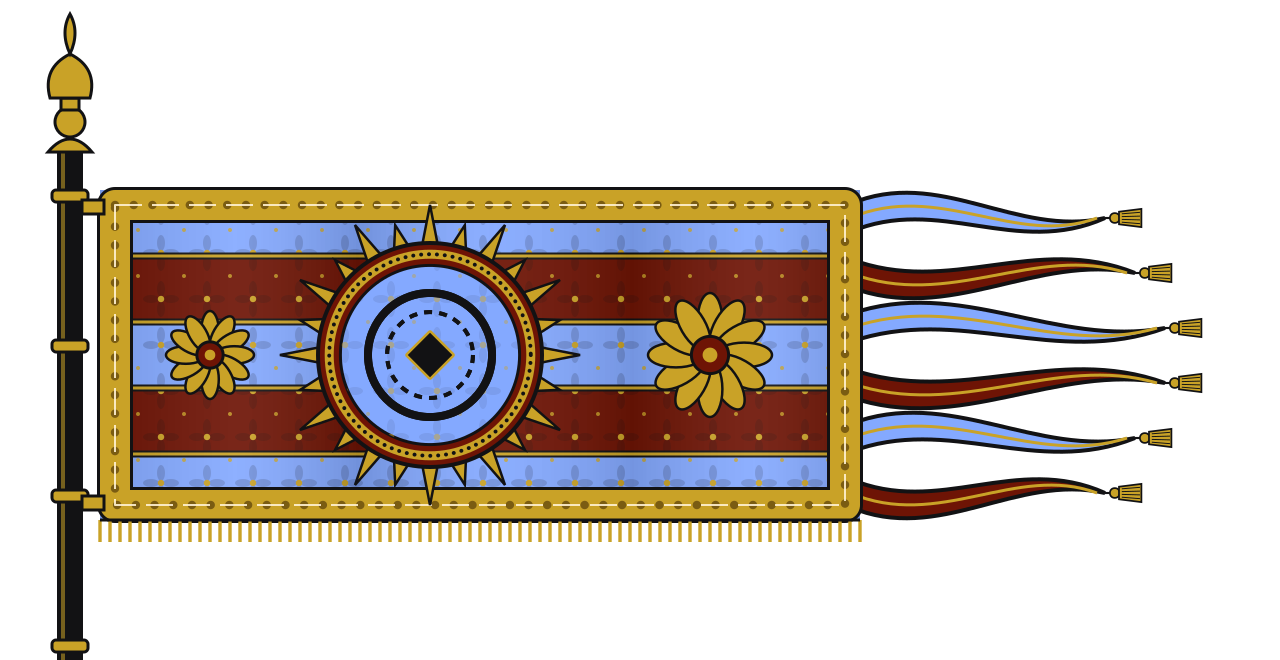
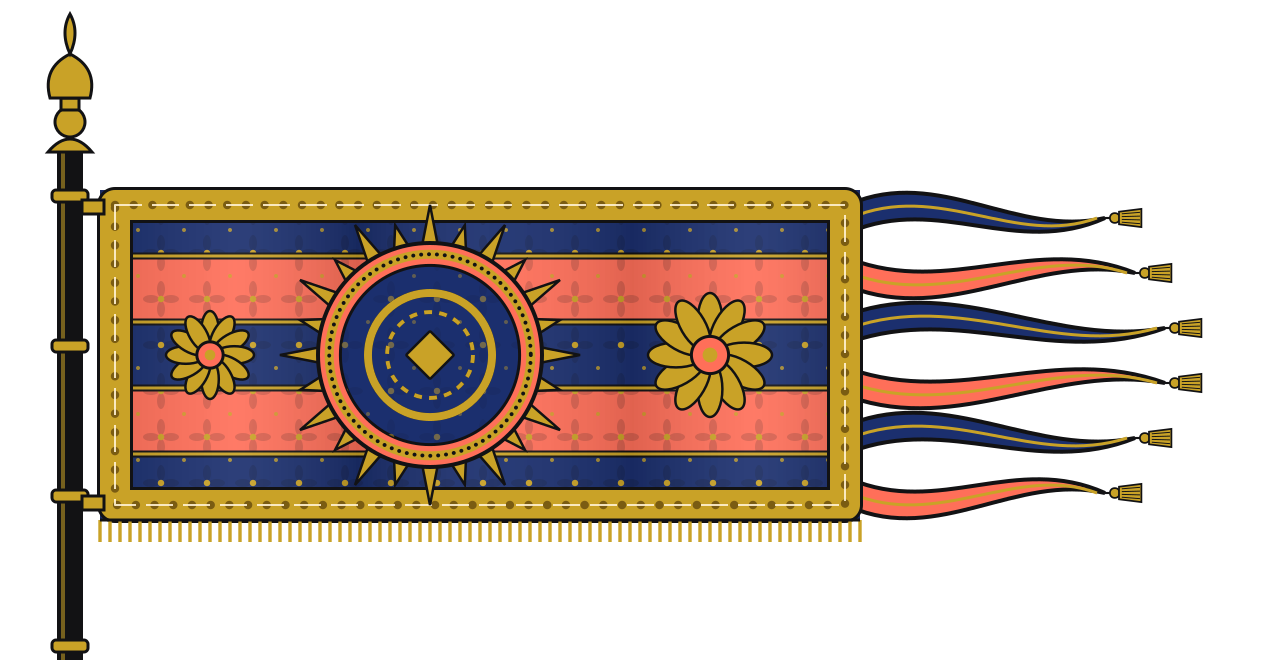
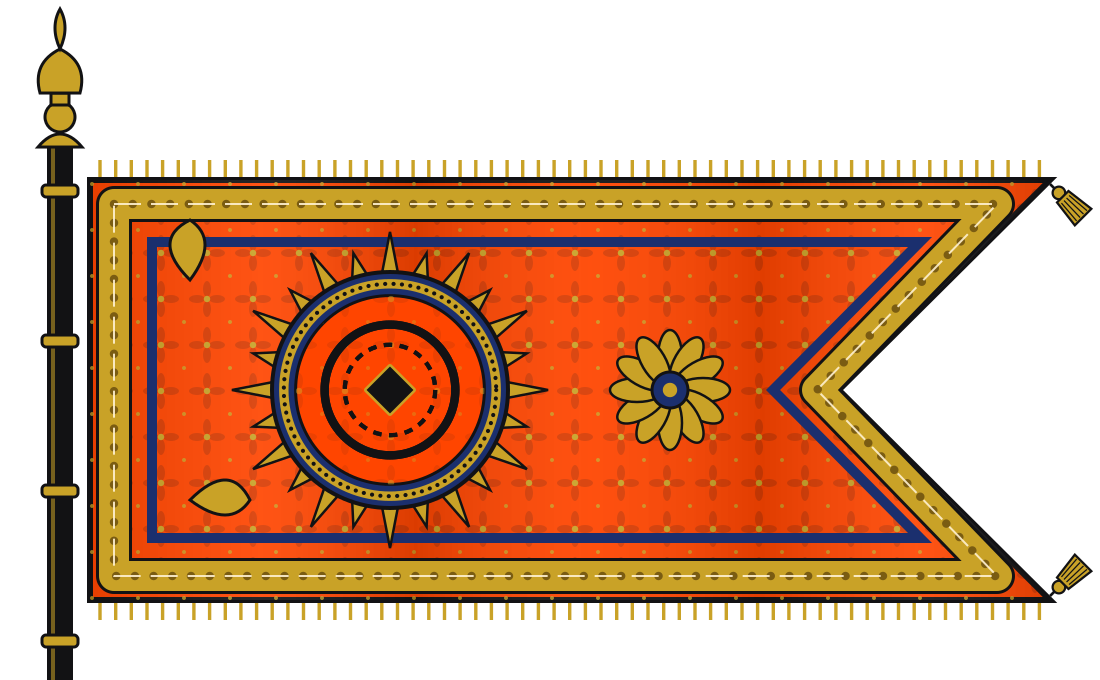
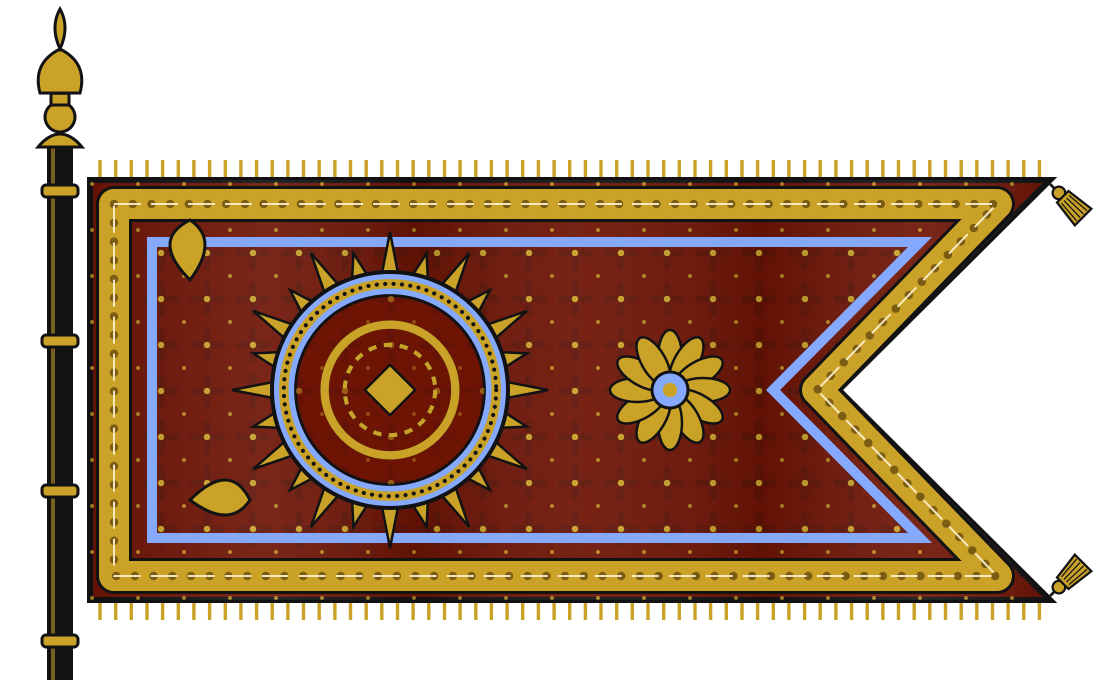
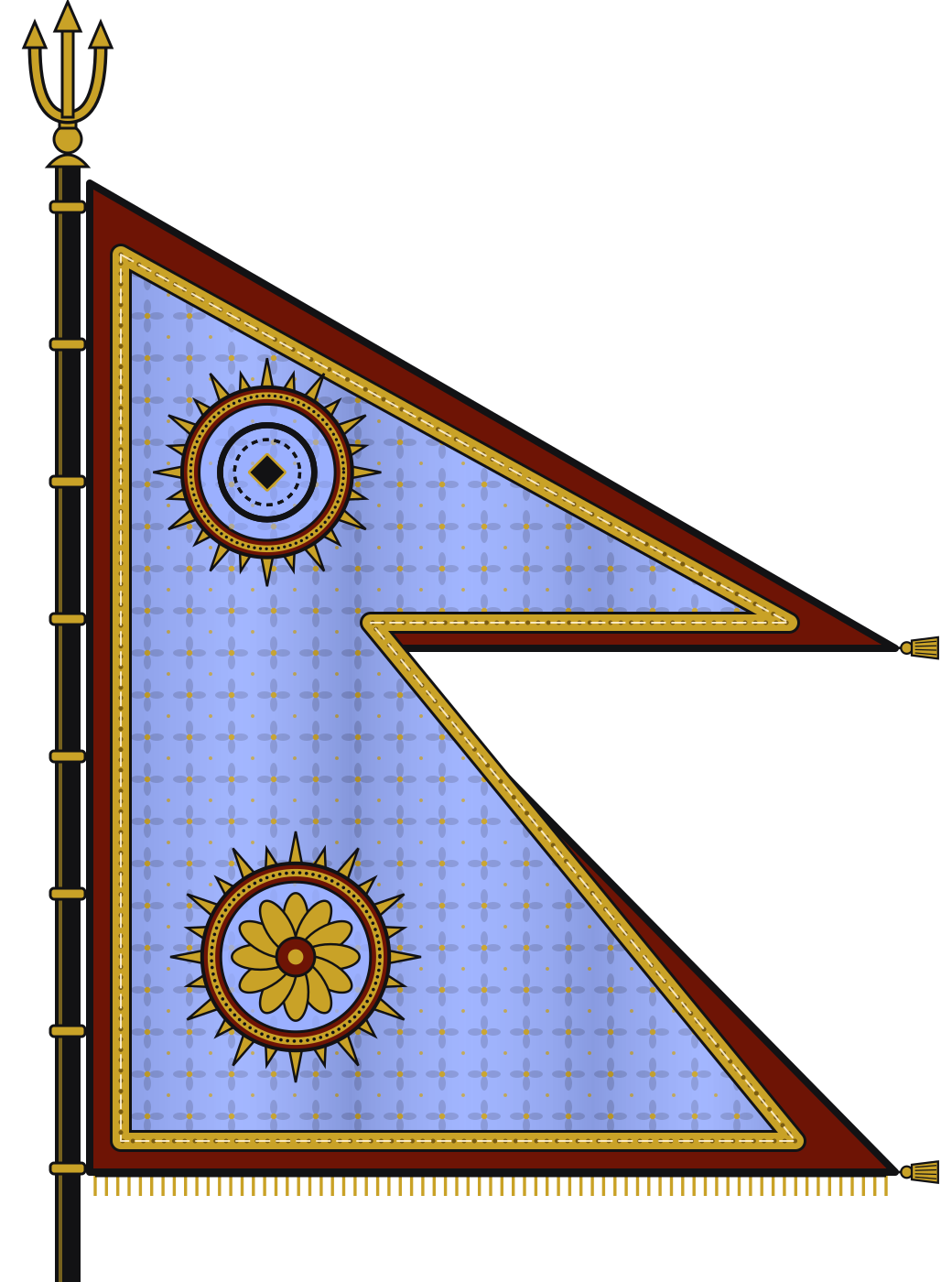
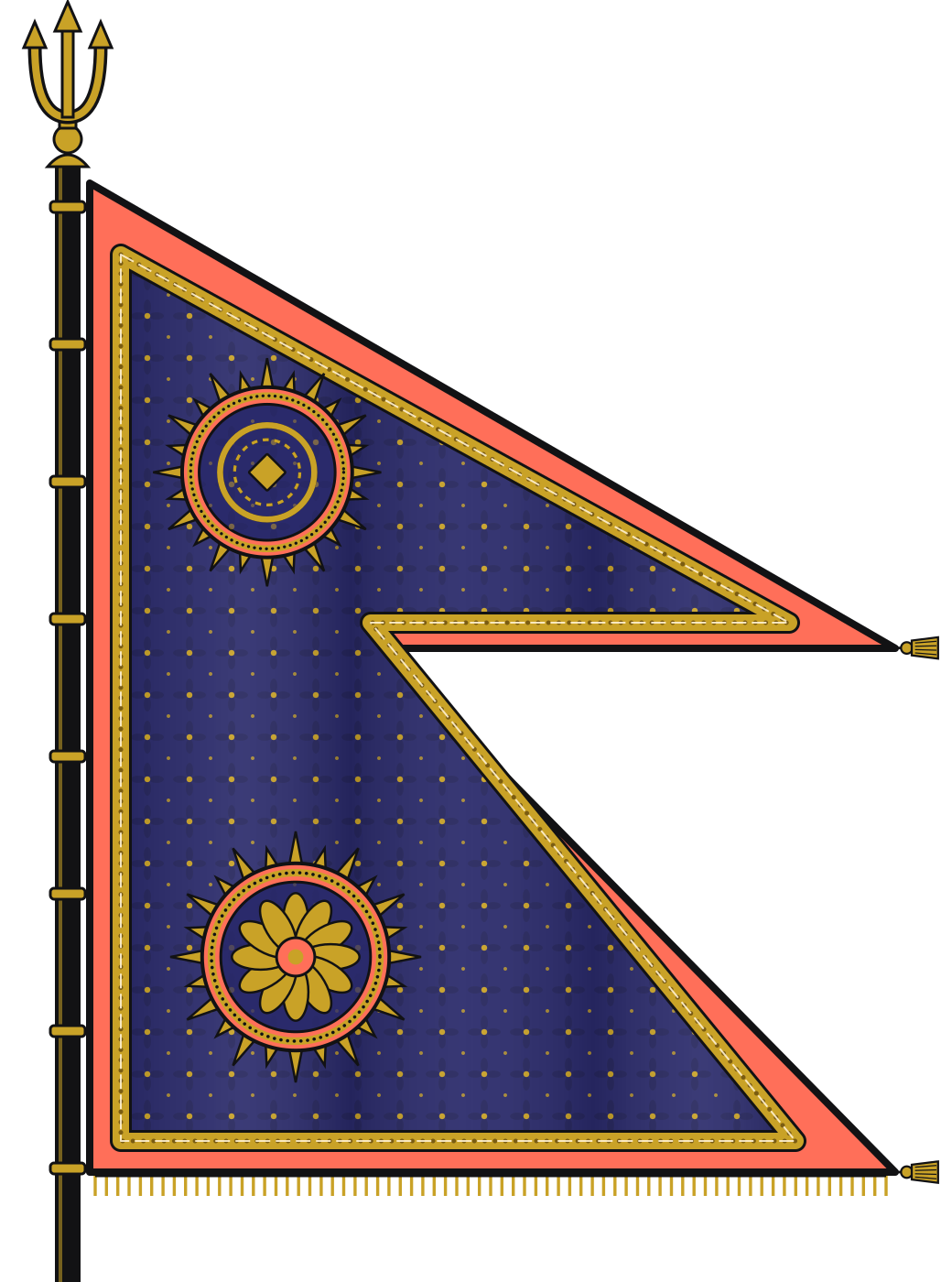
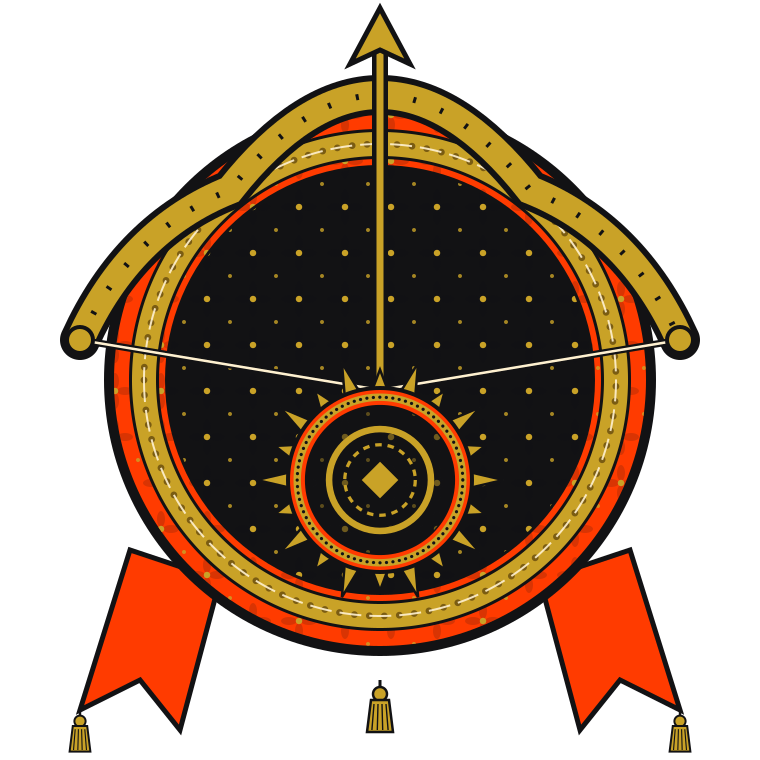
No Korku coat of arms or flag is documented in these sources. The tiger flag and banner on this page come from the Atlas as project design. The sources record totem and memorial symbols instead; see Astitva.
| Part of the kit | This clan |
|---|---|
| Field | Deep Brick #7E2A1E |
| Accent | Intense Electric Blue #84A9FF |
| Emblem colour | Metallic Gold #C9A227 |
| Zari metal | Gold |
| Main emblem | A tiger |
| Second image | — |
| Night and day | Every visual accessory has two versions: by night the emblem on the dark field, by day the clan's field colour on cloth woven from its metal. |
6. Flags
Every clan has every flag type; the type says the occasion and the colours say the clan. The outlined card is the flag the Atlas assigns.

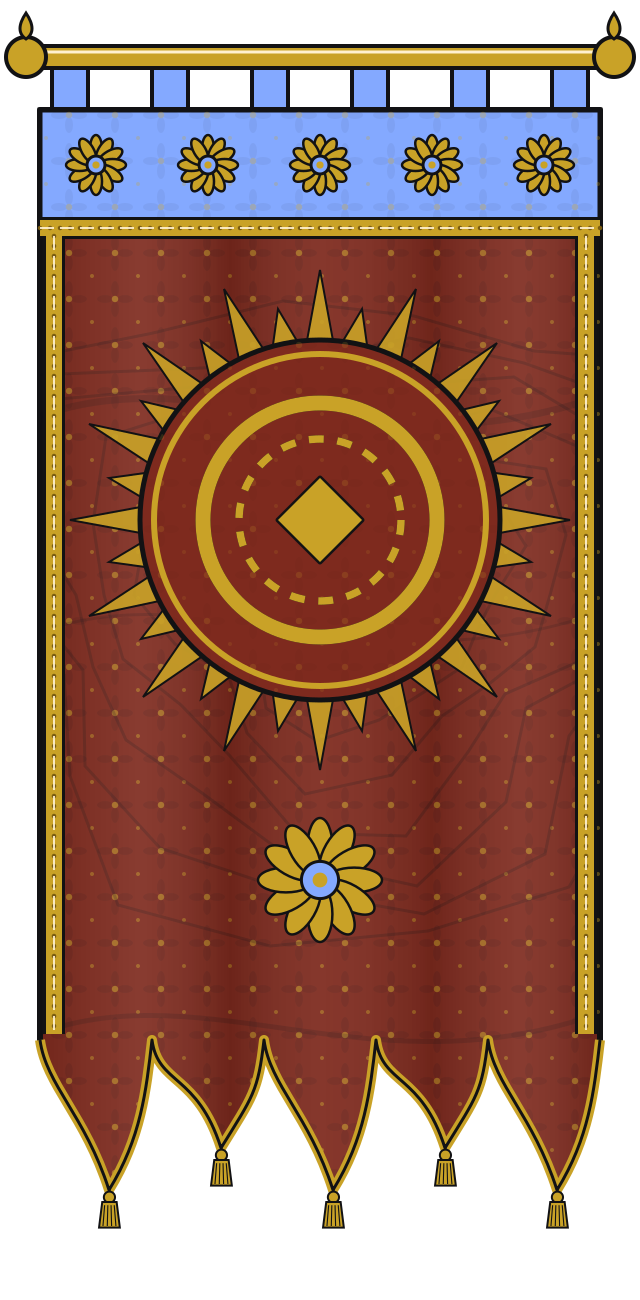
Historic banner
None known
New flag types
| Accessory | For this clan | Basis |
|---|---|---|
| A9 Pota-dhvaja · ship and trade flag For ships, caravans and markets | Not yet designed for this clan | Design |
| A10 Utsava-patāka · festival flag Light, bright flag for fairs and festivals | Not yet designed for this clan | Design |
| A11 Shoka-dhvaja · mourning flag White cloth with the emblem outline in the clan's metal | Not yet designed for this clan | Design |
7. Regalia
| Accessory | For this clan | Basis |
|---|---|---|
| E1 Chhatra · house parasol The ceremonial umbrella | Not yet designed for this clan | Design |
| E2 Chamara · fly-whisks The pair of whisks beside the head of the house | Not yet designed for this clan | Design |
| E3 Danda · staff of office Staff or scepter | Not yet designed for this clan | Design |
| E4 Simhasana · seat The seat of the house, covered in clan cloth | Not yet designed for this clan | Design |
| E5 Khetaka · shield A round shield; the Changi and Dhanush are its flag forms | Not yet designed for this clan | Regional tradition |
| E6 Kula-ayudha · clan weapon The weapon the clan honours | Not yet found for this clan | Under research |
8. Worn
| Accessory | For this clan | Basis |
|---|---|---|
| F1 Kula-vastra · clan cloth The clan's woven pattern in its kit colours | Not yet designed for this clan | Design |
| F2 Kirti-vastra · honour cloth A cloth earned for a deed, not inherited | Not yet designed for this clan | Design |
| F3 Kula-mala · garland flower The flower or leaf the clan wears as a garland | Not yet found for this clan | Under research |
| F4 Chinha · house pin A metal badge with the pin emblem | Not yet designed for this clan | Design |
9. Records
| Accessory | For this clan | Basis |
|---|---|---|
| H1 Clan words A traditional line in the native script | कोरकू · “Men, tribesmen: koru is man and ku a plural ending (Russell 1916)” | Documented |
| H2 Biruda · titles The house's title or titles | Not yet found for this clan | Under research |
| H3 Prashasti · praise genealogy The lineage as written at the head of a grant | Not yet found for this clan | Under research |
| H4 Vahi · clan register The book of the clan's births, marriages and deaths | Not yet found for this clan | Under research |
| H5 Rana-ghosha · war cry The clan's cry in battle or celebration | Not yet found for this clan | Under research |
10. VishwaVit · knower of the world
Game values are design choices for this project, not historical claims.
References
- Rushikesh Gawade, The free men of the Satpuras, Indie Journal, 27 Dec 2018, read 2026-11-03, https://indiejournal.in/article/the-free-men-of-the-satpuras
- Wikipedia, Korku language, read 2026-11-03, https://en.wikipedia.org/wiki/Korku_language
- Wikipedia, Tribals in Madhya Pradesh, read 2026-10-19, https://en.wikipedia.org/wiki/Tribals_in_Madhya_Pradesh
- Wikipedia, Korku people, read 2026-11-03, https://en.wikipedia.org/wiki/Korku_people
- R. V. Russell and Hira Lal, The Tribes and Castes of the Central Provinces of India, vol. 3 (London, 1916), Project Gutenberg eBook #41424, KORKU article, read 2026-11-03 from local text, https://www.gutenberg.org/ebooks/41424. Other Russell entries cited for other peoples: Kol, Munda, Ho; Kharia; Korwa (same book, read from local text).
- Bharat Discovery (भारतकोश), कोरकू जनजाति, read 2026-11-03, https://bharatdiscovery.org/india/कोरकू_जनजाति
- Mahendra Kumar Jaiswal and Vivek Kumar, Totemic Tradition and Identity of Korku Tribe: An Anthropological Perspective, Indian Journal of Research in Anthropology 10(1): 55-62 (2024), read 2026-11-03, https://rfppl.co.in/subscription/upload_pdf/55-62-ijra-1721021596.pdf
- K. L. Kamat, Wooden Memorials of Madhya Pradesh, Kamat's Potpourri, read 2026-11-03, https://kamat.com/kalranga/artifact/memorials/8.htm
- Kimble and LeSHON, Korku, Encyclopedia of World Cultures (Gale) via Encyclopedia.com, read 2026-11-03, https://www.encyclopedia.com/humanities/encyclopedias-almanacs-transcripts-and-maps/korku
- Drishti IAS, Raja Bhabhut Singh, 09 Jun 2025, read 2026-11-08, https://www.drishtiias.com/state-pcs-current-affairs/raja-bhabhut-singh
- Central Provinces District Gazetteers, Amraoti District (undated edition, public domain), Internet Archive OCR, read 2026-11-08, https://archive.org/stream/in.ernet.dli.2015.14276/2015.14276.Central-Provinces-District-Gazetteers-Amraoti-District_djvu.txt
- Wikipedia, Melghat, read 2026-11-08, https://en.wikipedia.org/wiki/Melghat
- Down To Earth, Tension over relocation at Melghat sanctuary, 15 Jul 2007, read 2026-11-08, https://www.downtoearth.org.in/environment/tension-over-relocation-at-melghat-sanctuary-6229
- Land Conflict Watch, Villagers displaced from Melghat Tiger Reserve demand return of their land, read 2026-11-08, https://www.landconflictwatch.org/conflicts/villagers-displaced-from-melghat-tiger-reserve-demand-return-of-their-land
- Vajiram and Ravi, Tribes of Maharashtra (exam-prep site; low reliability, fetch extract), read 2026-10-10, https://vajiramandravi.com/current-affairs/tribes-of-maharashtra/
- GKToday (Hindi), Madhya Pradesh ki janjatiyan (tribes of Madhya Pradesh), read 2026-10-19, https://www.gktoday.in/hindi/%e0%a4%ae%e0%a4%a7%e0%a5%8d%e0%a4%af-%e0%a4%aa%e0%a5%8d%e0%a4%b0%e0%a4%a6%e0%a5%87%e0%a4%b6-%e0%a4%95%e0%a5%80-%e0%a4%9c%e0%a4%a8%e0%a4%9c%e0%a4%be%e0%a4%a4%e0%a4%bf%e0%a4%af%e0%a4%be%e0%a4%81/
- dhammabharat.com, List of Scheduled Tribes in Maharashtra and Population of each Tribe (2011 Census), read 2026-10-10, https://dhammabharat.com/?p=13656