The Kora are a Scheduled Tribe found in West Bengal, Odisha, Jharkhand and Bihar, with 263,178 people counted in the 2011 census[1]. Their name may come from Mundari 'koda', meaning earthworks, and they are known as diggers of earth, ponds and tanks[1][2]. Minz and Hansda (2010), cited by Wikipedia, speculate that they are an offshoot of the Munda; their language, Koda, is a Munda language that is endangered[1][3]. A small community in Bangladesh, 20 families and 94 people, keeps Karma Puja and other rites[2].
01Faith and deities
No chief deity of the Kora is named in the extracts, so the main deity is the project KulDevi from the Atlas: Chhinnamasta of Rajrappa, Jharkhand (Mahavidya).
Chhinnamasta of Rajrappa, Jharkhand
The presiding goddess of the clan's homeland or capital: a link of place, not a recorded clan tie.
| Deity or tradition | Place in the clan's life | Evidence |
|---|---|---|
| Bishahari | Worshipped without idols (Bangladesh) | [2] |
| Got Puja | Worshipped without idols (Bangladesh) | [2] |
| Lurik | A chained being said to cause earthquakes unless appeased (Bangladesh) | [2] |
| Ancestral worship, totems and taboos | Covered by Ahmed et al. 2020 (abstract only; full text not read) | [5] |
| Animist beliefs | Recorded alongside other beliefs (Minz and Hansda 2010, as cited by Wikipedia) | [1] |
02Temples
Under research: the extracts name no temple built by, patronised by or later associated with the Kora. The Chhinnamasta shrine at Rajrappa is the KulDevi, not a temple the extracts link to the Kora.
Built by the clan
Not recorded.
Given patronage or grants by the clan
Not recorded.
03Languages and scripts
| Language or script | Kind | Under the clan | Evidence |
|---|---|---|---|
| Koda (কোড়া) living | Munda language (Austroasiatic), endangered | About 47,268 native speakers (2011 census); younger Kora shift to Bengali[3][4] | |
| Nag Chiki | Script for Koda, created 2012 by Dinesh Mudi | Koda is normally written in Bengali script[4]; Wikipedia lists Nag Chiki, Bengali-Assamese, Devanagari and Roman[3] | |
| Bengali | Language most Kora now speak in West Bengal and Jharkhand | Few still speak Koda[1] | |
| Odia | Language of the Kora in Odisha | [1] | |
| Khotta | Spoken by the Kora in Bangladesh; oral, no script | Most also speak Bangla[2] |
04Books and literature
Modern works on Koda and the Kora. No early text is in the extracts.
Written during the clan's history
| Work | Author | Kind | When | Link to the clan |
|---|---|---|---|---|
| Religious Beliefs and Practices Among The Kora Tribes Of West Bengal | Nizamuddin Ahmed, Biswajit Goswami, Swami Tattwasarananda | Journal article, ANWESA vol. 12 (abstract only) | 2020 | [5] |
| Thesis on the phonology and morphology of Koda | Shamim | PhD thesis, CUNY | 2021 | [3] |
| Effect of Bangla on Koda verbs | Lahiri | Study, as cited | 2020 | [3] |
| Survey report 2010-006 | Kim et al. | SIL Electronic Survey Report | 2010 | [3] |
Given patronage by the clan
Not recorded.
05Thinkers and scholars
| Name | Field | Era | Contribution |
|---|---|---|---|
| Dinesh Mudi | Linguist | 2012 | Created the Nag Chiki script for Koda[4] |
| Shamim | Linguistics (phonology and morphology) | 2021 | PhD thesis on Koda, CUNY[3] |
| Lahiri | Linguistics | 2020 | Study of the effect of Bangla on Koda verbs[3] |
| Nizamuddin Ahmed, Biswajit Goswami, Swami Tattwasarananda | Ethnography of religion | 2020 | Religious beliefs and practices of the Kora (abstract read)[5] |
Mehta (2004) and Minz and Hansda (2010) are cited by Wikipedia; their full works were not read.
06Art and architecture
Under research: the extracts name no painting, sculpture, architecture, textile or craft of the Kora.
Painting and wall art
Not recorded.
Sculpture and temple art
Not recorded.
Temple and building architecture
Not recorded.
Weaving and textiles
Not recorded.
Clothing and jewellery
Not recorded.
Coins, pottery and crafts
Not recorded.
07History
Name and earthworks
The Kora are also called Kuda, Kura, Kaora, Dhangar, Dhanger, Khaira and Khayra[1]. The name may come from Mundari 'Koda' for earthworks (Mehta 2004, as cited by Wikipedia)[1]. Jogen Kora, a Mahato said to be 95, is quoted as saying that Kora means to dig the earth[2].
A possible Munda link
Minz and Hansda (2010, p. 141), as cited by Wikipedia, speculate that the Kora are an offshoot of the Munda tribe[1]. Koda is a Munda language closely related to Kol (Kim et al. 2010, as cited by Wikipedia)[3].
Colonial record
Risley (1894) classed the Kora as a 'Hinduised' caste[1].
Claimed descents
The Odisha Kora claim Suryavansi descent, and the Santhal Parganas Kora claim Nagwanshi descent (SCSTRTI; Mehta 2004, as cited by Wikipedia). These are community claims; the extracts do not confirm them[1].
Ghughudanga, 1960s
In the 1960s the Kora at Ghughudanga, Bangladesh, had three hamlets of 50 to 60 families and more than 30 acres; most of that land is now lost[2].
1971 Liberation War
Thopal Kora, Kina Kora and Satan Kora fought in the Liberation War of 1971. None has an official certificate[2].
08Journey and migrations
The Kora came to northern Bangladesh from Jharkhand, mainly through railway work in the British period[2].
| When | From | To | Why | Evidence |
|---|---|---|---|---|
| British period | Jharkhand | Northern Bangladesh | Railway work: cutting hills and digging earth | [2] |
09Seats and lands
| Place | Role | Where today |
|---|---|---|
| West Bengal | 2011 census: 159,404[1] | Mainly Paschim Medinipur and Bankura[3]; also Bankura, Birbhum, Purulia, Paschim Medinipur, Hooghly and Bardhaman[6] |
| Odisha | 2011 census: 54,408[1] | Anugul, Balasore and Keonjhar, as the KISS handbook prints them[7] |
| Jharkhand | 2011 census: 32,786[1] | Now concentrated in Dumka, Godda, Pakur, Sahibganj and Hazaribagh[2] |
| Bihar | 2011 census: 16,580[1] | No district is named in the extracts |
| Bangladesh | 20 families, 94 people, today[2] | Jhinai Kuri village, Haljai mouza, Biral upazila, Dinajpur (16 families), and Kharipara, Ghughudanga (4 families)[2]. Wikipedia (Koda) and Omniglot place Koda-speaking villages in Rajshahi Division[3][4]; the Kora Wikipedia page marks that Rajshahi claim 'failed verification'[1] |
10Notable figures
| Name | Role | Era | Known from |
|---|---|---|---|
| Jogen Kora | Mahato, quoted on the meaning of 'Kora' | Age said to be 95 | [2] |
| Thopal Kora | Fought in the Liberation War (Bangladesh) | 1971 | [2] |
| Kina Kora | Fought in the Liberation War (Bangladesh) | 1971 | [2] |
| Satan Kora | Fought in the Liberation War (Bangladesh) | 1971 | [2] |
| Dinesh Mudi | Koda linguist from West Bengal; created the Nag Chiki script for Koda | 2012 | [4] |
| Gita Kora | First Kora woman to pass secondary school (Bangladesh) | 2025 | [2] |
11Allies, rivals and marriages
| People | Relationship | When |
|---|---|---|
| Munda | Speculated parent people (offshoot) | Not dated |
| Kol | Closely related language (Koda) | 2010 study |
| Nagwanshi | Descent claimed by the Santhal Parganas Kora | Not dated |
| Suryavansi | Descent claimed by the Odisha Kora | Not dated |
12Society and livelihood
Family life: mostly nuclear, patrilineal and patrilocal; marriage within a gotra is prohibited. Polygyny is permitted but most marriages are monogamous; negotiated marriage is most common; cross-cousin marriage, junior levirate, sororate, elopement and capture are also allowed; divorce and remarriage are permitted; cash bride price (SCSTRTI, as cited by Wikipedia)[1].
Government and social order
| Institution or group | What it was | Evidence |
|---|---|---|
| Village council (panchayat) | Headed by the Majhi, assisted by the Parmanik (India) | [1] |
| Village council (Bangladesh) | Three members led by the Mahato, assisted by the Gorat and Paramani; formerly a Pande chief over several villages | [2] |
| Mahan | Healer who treats with mantras and herbs (Bangladesh) | [2] |
| Death rites | Natural deaths are cremated and unnatural deaths buried (Minz and Hansda 2010, as cited by Wikipedia). In Bangladesh the head faces north, the Mahato leads the rites, and Telkher purifies | [1][2] |
| Marriage (Bangladesh) | Matchmaker called Egua; dowry forbidden; rites Lagan Bandha, Tel Hardi, Marowa, Badar, Simret Hote and Khanda; divorce (patpani) by tearing mango leaves | [2] |
| Marriage age | About 1900: infant marriage in most West Bengal Kora families; adult marriage among the Chota Nagpur Kora; Bankura was in between | [1] |
| Houses | Mud houses without windows, since windows invite evil spirits (Bangladesh) | [2] |
Livelihood over time
| Era | Livelihood | Evidence |
|---|---|---|
| Traditional | Earthworks: cutting soil and digging tanks | [1] |
| Later | Catechu-making, which partly explains the names Khaira and Khayra | [1] |
| British period | Railway work, cutting hills and digging earth (Bangladesh) | [2] |
| Today | Most now farm | [1] |
13Sub-clans and related clans
Divided into endogamous groups; the Wikipedia page names the Odisha Kora and the Santhal Parganas Kora as the groups claiming descents (SCSTRTI, as cited)[1]. Exogamous gotras (septs), each split into patriarchal lineages: eleven named, the source adding 'etc.'[1]. Bangladesh: eleven peris originally[2]. Dhan, Chiru and Kori are also names of other entries in the Atlas (ST-384, ST-057, NE-031); they are not linked because the extracts do not say they are the same people.
| Clan | Relation | Where | Size | In the Atlas | Evidence |
|---|---|---|---|---|---|
| Odisha Kora | Branch | Odisha | new clan candidate | [1] | |
| Santhal Parganas Kora | Branch | Santhal Parganas | new clan candidate | [1] | |
| Kaich | Sub-clan | same name as ST-545: check | [1] | ||
| Mankad | Sub-clan | same name as ST-536: check | [1] | ||
| Khapur | Sub-clan | same name as ST-531: check | [1] | ||
| Dhan | Sub-clan | same name as ST-384: check | [1] | ||
| Nun | Sub-clan | same name as ST-542: check | [1] | ||
| Adower | Sub-clan | same name as ST-562: check | [1] | ||
| Nag | Sub-clan | same name as ST-476: check | [1] | ||
| Maghi | Sub-clan | same name as ST-535: check | [1] | ||
| Prodhan | Sub-clan | same name as ST-544: check | [1] | ||
| Bagha | Sub-clan | same name as ST-561: check | [1] | ||
| Bahera | Sub-clan | same name as ST-524: check | [1] | ||
| Chhager | Sub-clan | Bangladesh | new clan candidate | [2] | |
| Hardi | Sub-clan | Bangladesh | new clan candidate | [2] | |
| Sandoar | Sub-clan | Bangladesh | new clan candidate | [2] | |
| Chiru | Sub-clan | Bangladesh | same name as ST-057: check | [2] | |
| Tamgiria | Sub-clan | Bangladesh | new clan candidate | [2] | |
| Kachdi | Sub-clan | Bangladesh | new clan candidate | [2] | |
| Kori | Sub-clan | Bangladesh | same name as NE-031: check | [2] | |
| Nagru | Sub-clan | Bangladesh | new clan candidate | [2] | |
| Shuer | Sub-clan | Bangladesh | new clan candidate | [2] | |
| Krisar | Sub-clan | Bangladesh | new clan candidate | [2] | |
| Tirki | Sub-clan | Bangladesh | same name as ST-559: check | [2] | |
| Munda | Related people | Speculated origin | ST-229 | [1] | |
| Kol | Related people | Closely related language | ST-141 | [3] | |
| Nagwanshi | Dynasty from this clan | Claimed by the Santhal Parganas Kora | same name as ST-540: check | [1] | |
| Suryavansi | Dynasty from this clan | Claimed by the Odisha Kora | new clan candidate | [1] |
Clans marked "new clan candidate" are not in the Atlas yet.
14Surnames
Only two surnames are attested in the extracts; no surname list was found.
| Surname | Clan or sub-clan | Where | People with this surname | Also used by other communities |
|---|---|---|---|---|
| Kora | Kora | Bangladesh (individuals bear the family name Kora)[2] | not yet counted | Not checked |
| Mudi | Kora | West Bengal (Dinesh Mudi, Koda linguist)[4]; Mudi is also listed as a name of the Koda language[3] | not yet counted | Not checked |
Counts are of everyone with the surname, from the cited source and year, not only members of this clan. A surname shared with other communities says nothing about any one person's origin.
15Songs and music
None recorded yet.
16Poems, lullabies and children's rhymes
None recorded yet.
17Stories, legends and proverbs
Stories and legends
| Story | What happens | Told by | Evidence |
|---|---|---|---|
| Eclipse tale | A Dosad deity pursues the sun and moon over unpaid rice | Bangladesh Kora, as recorded by TBS | [2] |
Proverbs and sayings
Not recorded.
18Festivals and fairs
| Festival or fair | When | Where | What happens |
|---|---|---|---|
| Karma Puja living | Bhadra full moon | Bangladesh Kora | Unmarried youth cut a Khil Kadam branch, which is installed with sacrifice, dance, hariya and milk poured over it, then immersed; a black gram fast[2] |
| Eclipse fasting | During eclipses | Bangladesh Kora | Fast and pray[2] |
| Bishahari and Got Puja | Not dated in the extracts | Bangladesh Kora | Observed without idols[2] |
19Food, dress and games
Food
| Item | What it is | Evidence |
|---|---|---|
| Rice | Staple (Bangladesh Kora) | [2] |
| Snails, rats, crabs and turtles | Also eaten (Bangladesh Kora) | [2] |
| Hariya | Drink essential to the rites (Bangladesh Kora) | [2] |
Dress
| Item | What it is | Evidence |
|---|---|---|
| Penchi | Garment women once wore (Bangladesh Kora) | [2] |
Games and martial arts
Not recorded.
Tags: living still practised · revived brought back after a break · lost known only from records · research reported but not yet confirmed from a source. Songs and poems under copyright are listed by title only; restricted or sacred material is noted without its content.
20Status today
A Scheduled Tribe in India, and a community of 20 families and 94 people in Bangladesh[2][1].
Who carries the name today
| Community | Link | Basis | Evidence |
|---|---|---|---|
| Kora of Bangladesh (ST-154) | Documented | [2] |
Recognised heritage
| What | Recognition | Evidence |
|---|---|---|
| Kora Pathshala | School started 13 March 2022 by Bhabna Society, Bangladesh | [2] |
| Nag Chiki script | Created for Koda in 2012 by Dinesh Mudi | [4] |
Community review: not reviewed by the community; no review is recorded in the extracts.
21For children
The Kora, who dig the earth
Long ago, the Kora were known as people who dig the earth. Some say their name means 'to dig the earth'. They cut soil and dig tanks, which are ponds. Today Kora families live in West Bengal, Odisha, Jharkhand and Bihar. Many Kora now speak Bengali, and a few still speak Koda, a language of the Munda family. Kora families who went to Bangladesh once worked on the railways, cutting hills and digging earth.
22Across the project
| Project | What carries this clan | Status |
|---|---|---|
| Atlas of the Janas | Under research: no Atlas entry or place name is in the extracts. | |
| KulDevi and GrahDevi | KulDevi Chhinnamasta of Rajrappa (Mahavidya family). GrahDevi forms in the Atlas: Kali, Tara, Shodashi, Bhuvaneshvari, Bhairavi, Chhinnamasta, Dhumavati, Bagalamukhi, Matangi, Kamala. | Atlas |
| Planet naming | Under research: the extracts give no planet name for the Kora. | |
| Renaming and waters | The name may come from Mundari 'Koda', for earthworks (Mehta 2004, as cited by Wikipedia)[1]; traditional work is cutting soil and digging tanks[1]. | [1] |
23Open questions
- Contradiction, Bangladesh language: TBS[2] says the Bangladesh Kora speak Khotta and places Kora villages in Dinajpur; Wikipedia Koda[3] and Omniglot[4] place Koda-speaking villages in Rajshahi Division. Unresolved.
- Wikipedia Kora[1] marks its Rajshahi (Bangladesh) claim 'failed verification' (citing SIL 2010); no extract confirms that claim for the Kora.
- Ahmed et al. 2020 full text: totems, taboos, life-cycle and communal rites.
- Are the Bangladesh peris related to the Indian gotras? Dhan (ST-384), Chiru (ST-057) and Kori (NE-031) are other sheet entries and are not linked.
- Chief deity of the Indian Kora: none is named in the extracts.
- Festivals of the Indian Kora (Karam, Sohrai were searched, not confirmed).
- Counts of bearers for the surnames Kora and Mudi.
- Anadi Koda article (search title only): does it concern the Kora?
- Kora districts in Bihar.
- Clan words: no saying of the Kora is in the extracts; the name in Bengali script stands in.
- Full texts not read: Mehta 2004, Minz and Hansda 2010, SCSTRTI profile, Risley 1894.
- Contradiction, dynasty: the info table (Dynasty row) said none is recorded, while the relations table lists Suryavansi (Odisha Kora claim) and Nagwanshi (Santhal Parganas Kora claim) as dynasties[1]. The info row now says claimed, not confirmed.
24Astitva
अस्तित्व · being, existence: everything by which the clan is known
No seal, coin, title, war cry or symbol of the Kora is recorded in the extracts. The earthwork link is in[1].
Every clan has every accessory, royal objects included. Each one says how it is known: Documented This clan's own object is recorded. · Regional tradition Recorded for the region or for peoples like this one, not for this clan. · Design Made for this project, with no historical claim. · Under research To be found for this clan from sources. Legends and titles are written in the clan's own script.
1. Seals and coins
| Accessory | For this clan | Basis |
|---|---|---|
| B1 Rajamudra · house seal Round seal with the clan emblem and a short legend in the clan's script | Not yet designed for this clan | Design |
| B2 Anguliya-mudra · signet ring Personal seal ring of the head of the house | Not yet designed for this clan | Design |
| B3 Chhapa · house stamp Ink or block stamp for letters, goods and cloth | Not yet designed for this clan | Design |
| B4 Tamrapatra · charter plate Copper-plate grant on a ring, closed with the house seal | Not yet designed for this clan | Design |
| B5 Shreni-mudra · guild or trade seal Seal for the clan's trade, craft or caravan | Not yet designed for this clan | Design |
| C1 Clan coin Emblem or deity on one side, a legend in the clan's script | Not yet designed for this clan | Design |
| C2 Coin die The die that strikes the coin | Not yet designed for this clan | Design |
2. Living symbols
| Accessory | For this clan | Basis |
|---|---|---|
| I1 Totem trio The tree, bird and animal the clan protects | Not yet found for this clan | Under research |
| I2 Kaval-maram · guardian tree The tree that stands at the clan's seat | Not yet found for this clan | Under research |
3. Stone and gate
| Accessory | For this clan | Basis |
|---|---|---|
| G1 Torana · gateway The built gate of the seat; the cloth Toran hangs in it | Not yet designed for this clan | Regional tradition |
| G2 Viragallu · hero stone Carved panel stone for a member who died defending the clan | Not yet designed for this clan | Regional tradition |
| G3 Kula-shila · clan stones Standing and table stones that remember the ancestors | Not yet designed for this clan | Design |
| G4 Jayastambha · victory pillar A pillar raised for a victory | Not yet designed for this clan | Design |
| G5 Sima-shila · boundary stone Marks the clan's land, with a line in the native script | Not yet designed for this clan | Design |
4. Sounds
| Accessory | For this clan | Basis |
|---|---|---|
| D1 Pancha-mahashabda · five great sounds The right to five instruments | Not yet designed for this clan | Design |
| D2 Shankha · clan conch The clan's own named war conch | Not yet designed for this clan | Design |
| D3 Murasu · house drums Three drums: war, charity and justice | Not yet designed for this clan | Design |
5. Kit: colours, metals and emblems
The emblem in the Atlas is a spade beside a pond. It is a project design, not a recorded arms.
| Part of the kit | This clan |
|---|---|
| Field | Deep Brick #7E2A1E |
| Accent | Deep Cosmic Blue #9BB0FF |
| Emblem colour | Metallic Gold #C9A227 |
| Zari metal | Gold |
| Main emblem | A spade beside a pond |
| Second image | — |
| Night and day | Every visual accessory has two versions: by night the emblem on the dark field, by day the clan's field colour on cloth woven from its metal. |
6. Flags
Every clan has every flag type; the type says the occasion and the colours say the clan. The outlined card is the flag the Atlas assigns.
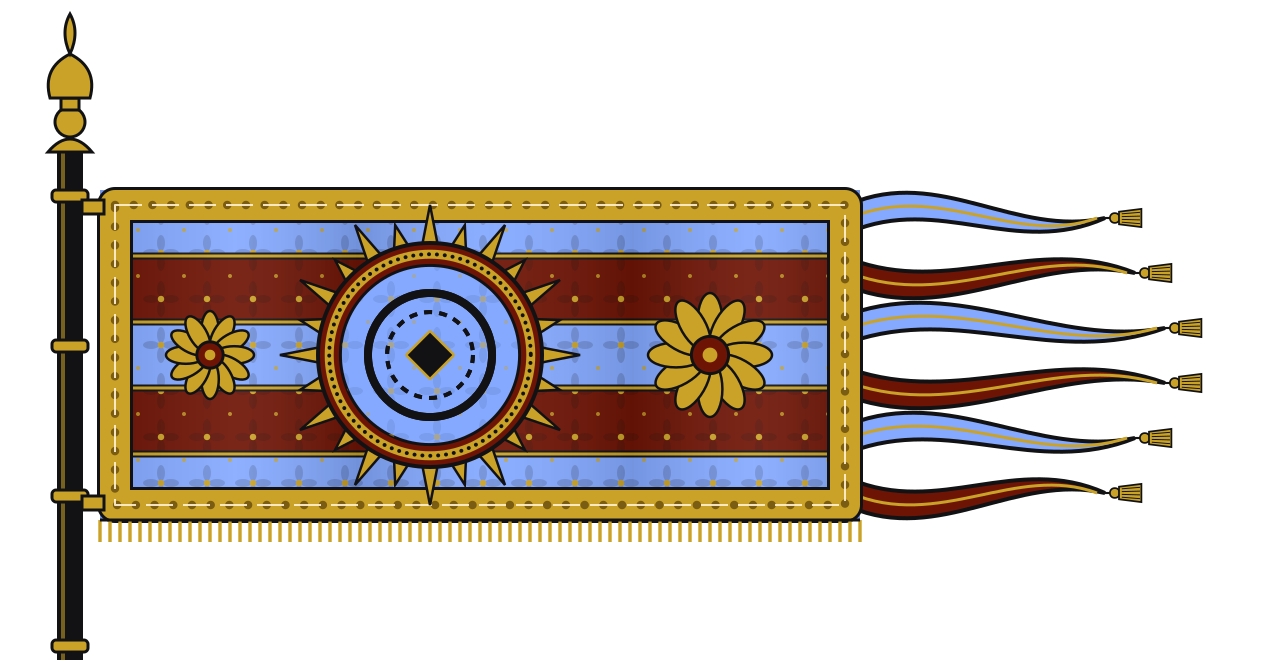
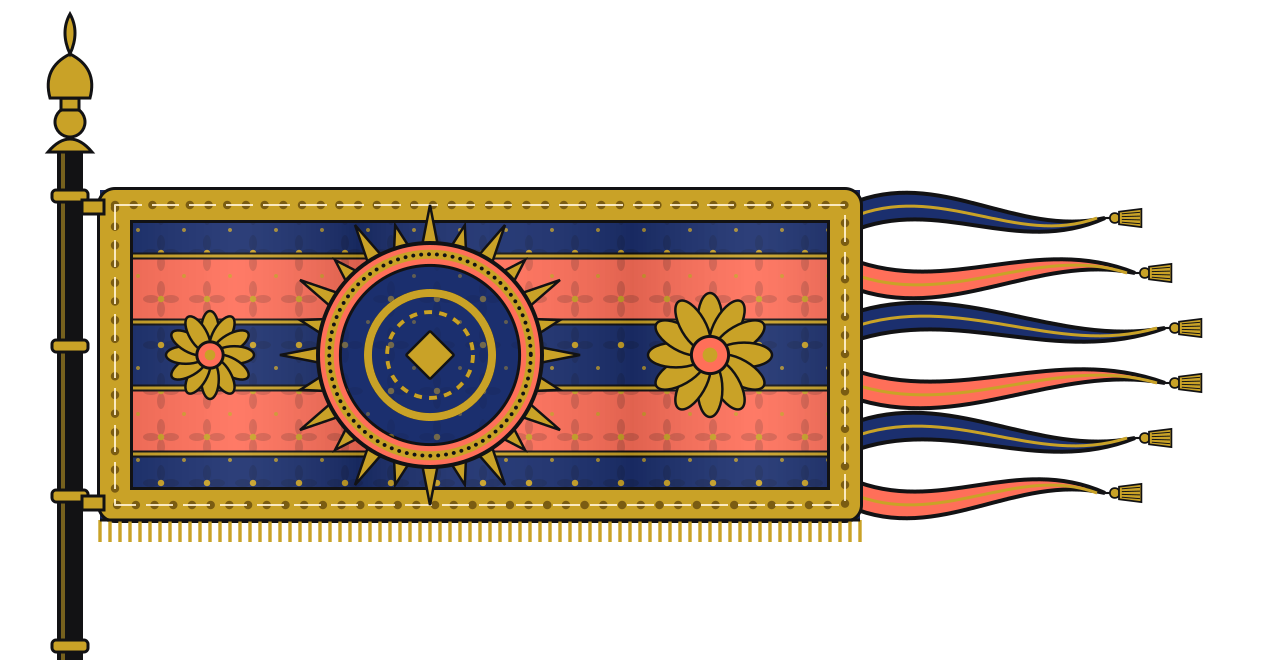
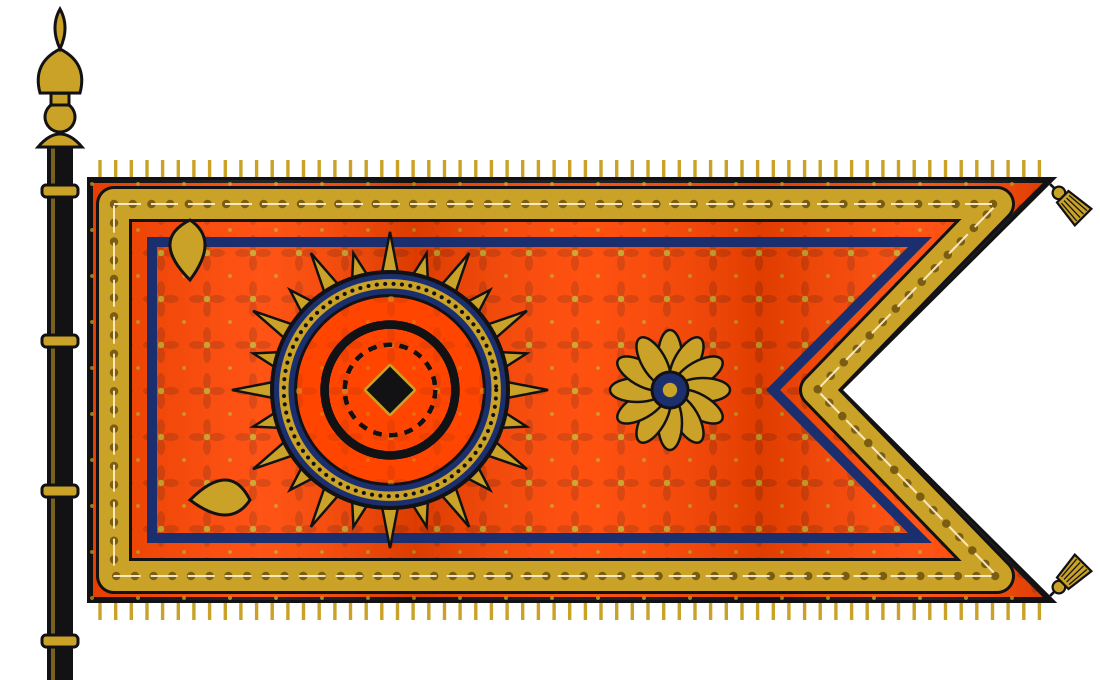
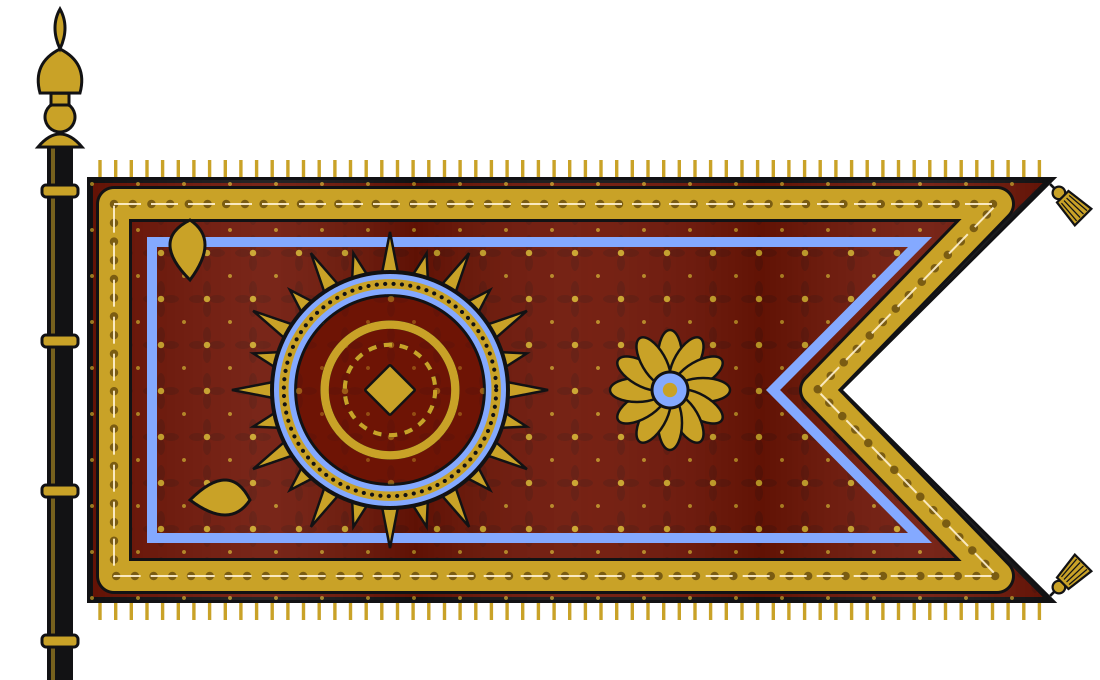
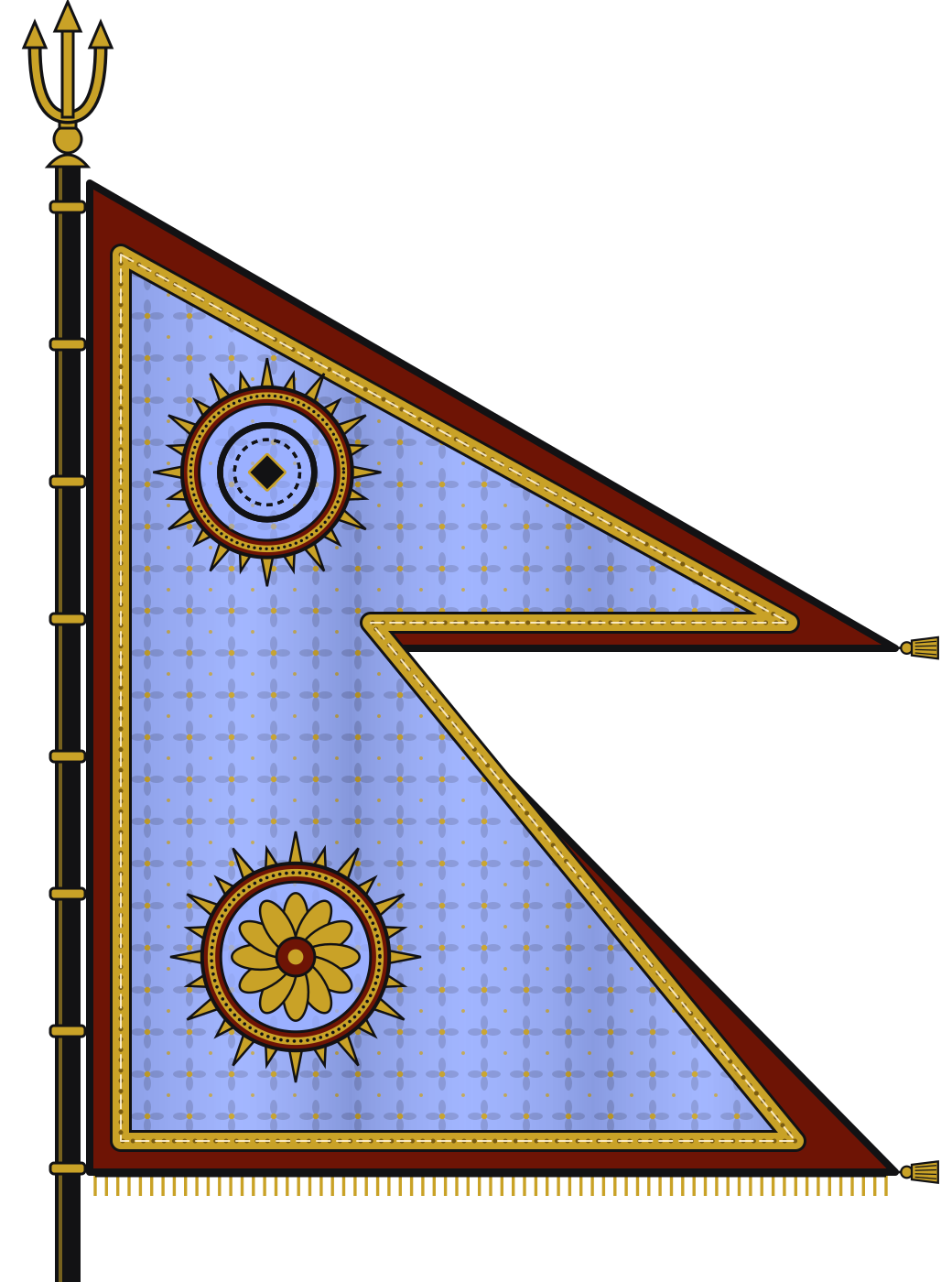
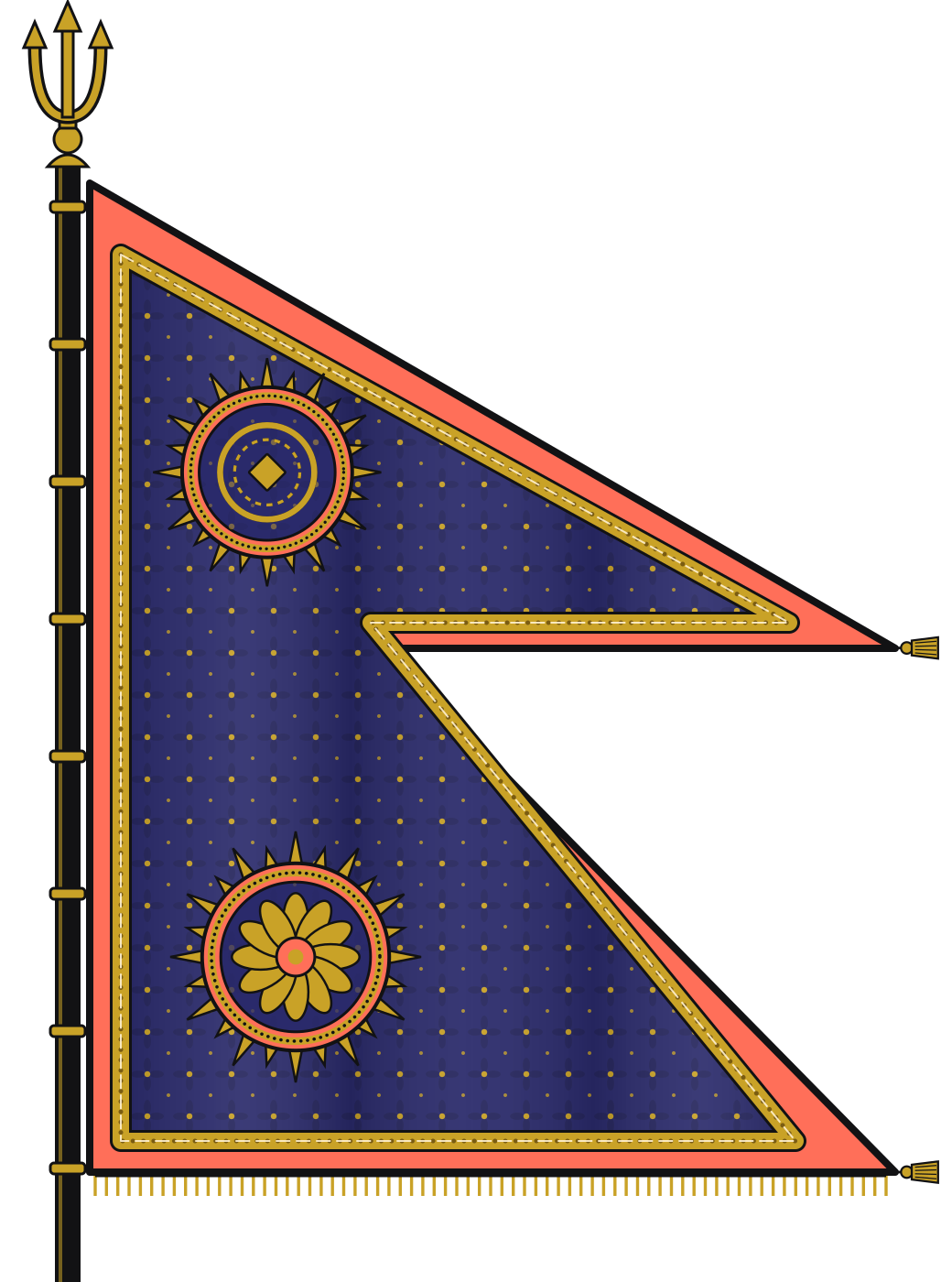
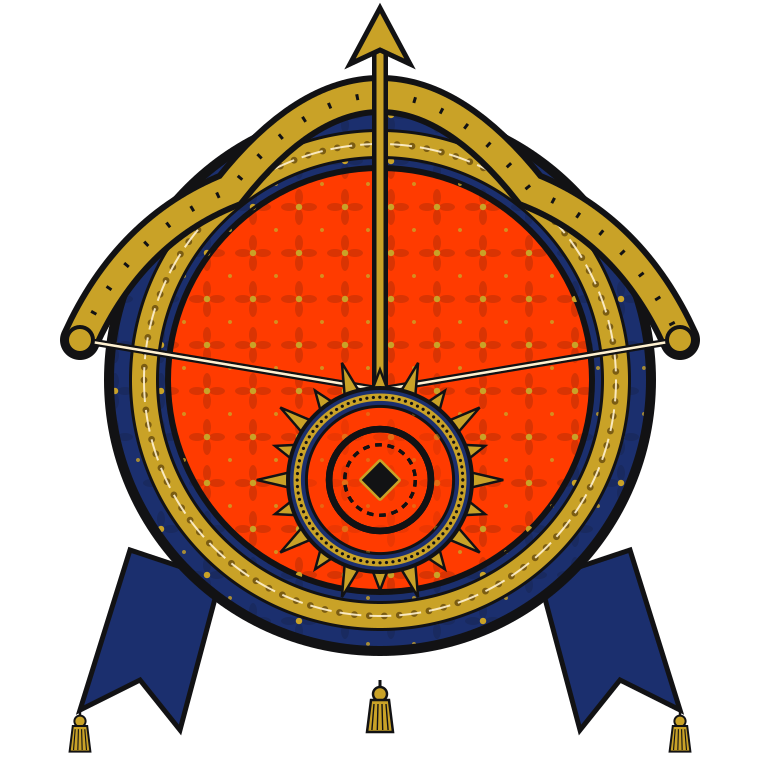
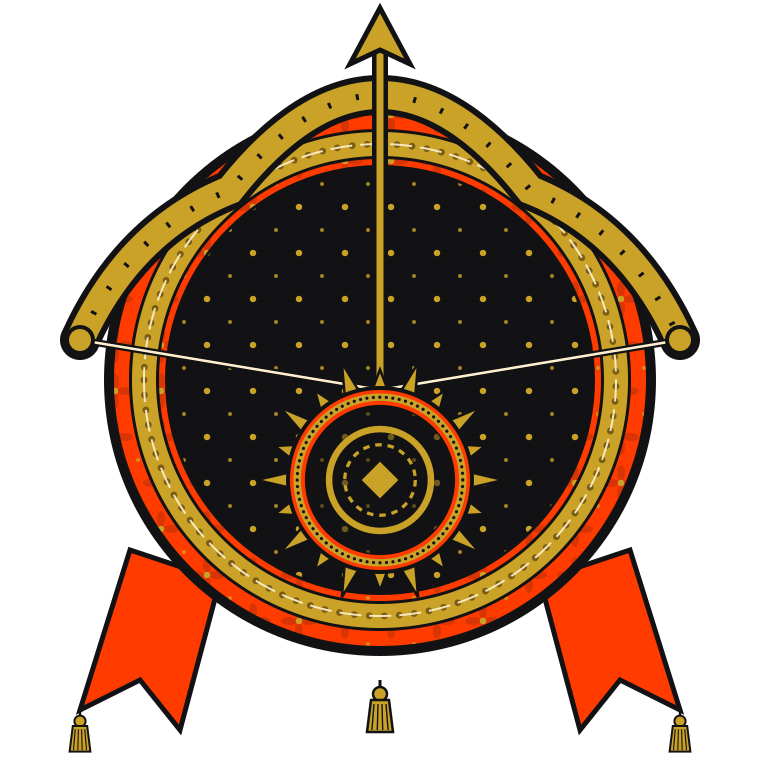
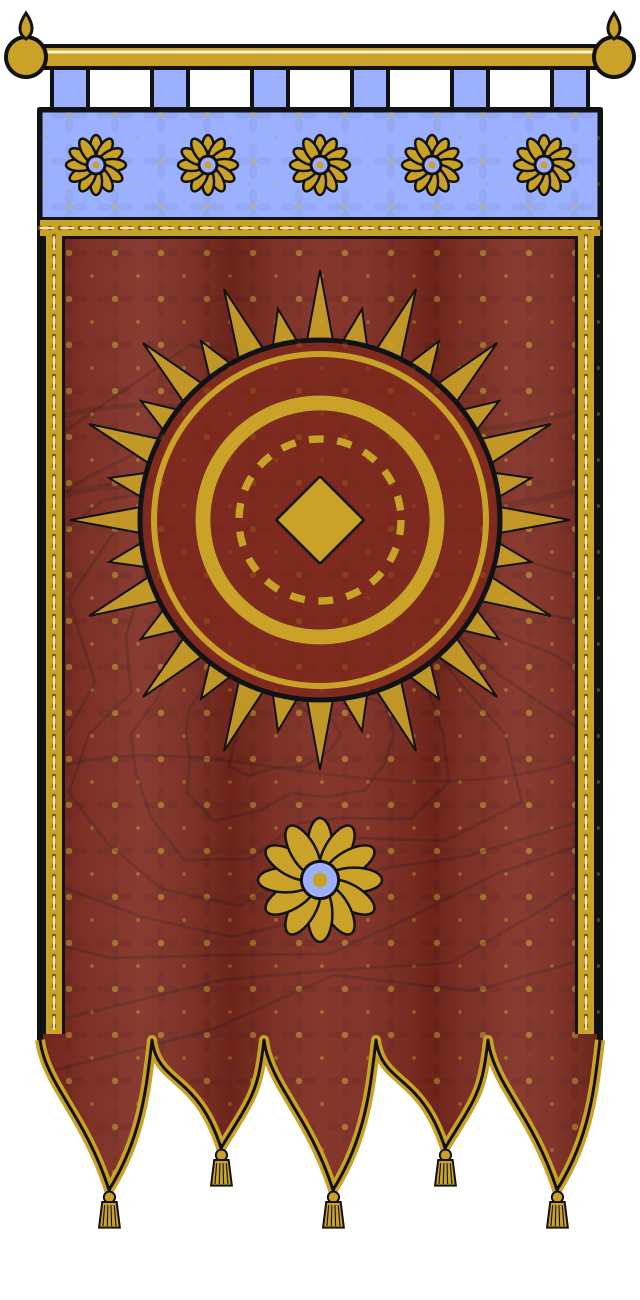
Historic banner
None known
New flag types
| Accessory | For this clan | Basis |
|---|---|---|
| A9 Pota-dhvaja · ship and trade flag For ships, caravans and markets | Not yet designed for this clan | Design |
| A10 Utsava-patāka · festival flag Light, bright flag for fairs and festivals | Not yet designed for this clan | Design |
| A11 Shoka-dhvaja · mourning flag White cloth with the emblem outline in the clan's metal | Not yet designed for this clan | Design |
7. Regalia
| Accessory | For this clan | Basis |
|---|---|---|
| E1 Chhatra · house parasol The ceremonial umbrella | Not yet designed for this clan | Design |
| E2 Chamara · fly-whisks The pair of whisks beside the head of the house | Not yet designed for this clan | Design |
| E3 Danda · staff of office Staff or scepter | Not yet designed for this clan | Design |
| E4 Simhasana · seat The seat of the house, covered in clan cloth | Not yet designed for this clan | Design |
| E5 Khetaka · shield A round shield; the Changi and Dhanush are its flag forms | Not yet designed for this clan | Regional tradition |
| E6 Kula-ayudha · clan weapon The weapon the clan honours | Not yet found for this clan | Under research |
8. Worn
| Accessory | For this clan | Basis |
|---|---|---|
| F1 Kula-vastra · clan cloth The clan's woven pattern in its kit colours | Not yet designed for this clan | Design |
| F2 Kirti-vastra · honour cloth A cloth earned for a deed, not inherited | Not yet designed for this clan | Design |
| F3 Kula-mala · garland flower The flower or leaf the clan wears as a garland | Not yet found for this clan | Under research |
| F4 Chinha · house pin A metal badge with the pin emblem | Not yet designed for this clan | Design |
9. Records
| Accessory | For this clan | Basis |
|---|---|---|
| H1 Clan words A traditional line in the native script | কোড়া · “Koda (Omniglot also lists the name as Koɖa)” The people's own name in Bengali script, as Omniglot prints it[4]. No saying of the Kora is in the extracts. | Documented |
| H2 Biruda · titles The house's title or titles | Not yet found for this clan | Under research |
| H3 Prashasti · praise genealogy The lineage as written at the head of a grant | Not yet found for this clan | Under research |
| H4 Vahi · clan register The book of the clan's births, marriages and deaths | Not yet found for this clan | Under research |
| H5 Rana-ghosha · war cry The clan's cry in battle or celebration | Not yet found for this clan | Under research |
10. VishwaVit · knower of the world
Game values are design choices for this project, not historical claims.
References
- Wikipedia, Kora (tribe), read 2026-10-24, https://en.wikipedia.org/wiki/Kora_(tribe)
- The Business Standard (tbsnews.net), The last of the Koras, read 2026-10-24, https://www.tbsnews.net/node/1367051
- Wikipedia, Koda language, read 2026-10-24, https://en.wikipedia.org/wiki/Koda_language
- Omniglot, Koda (কোড়া), page dated 29.08.24, read 2026-10-24, https://omniglot.com/writing/koda.htm
- Nizamuddin Ahmed, Biswajit Goswami and Swami Tattwasarananda, Religious Beliefs and Practices Among The Kora Tribes Of West Bengal, ANWESA vol. 12, 2020 (abstract only), read 2026-10-24, https://zenodo.org/records/18497828
- Vajiram and Ravi, Tribes of West Bengal, read 2026-10-21, https://vajiramandravi.com/current-affairs/tribes-of-west-bengal/
- Sushree Mohanty, Indigenous Colours of Odisha: Handbook on 62 Tribes (KISS), read 2026-10-20, link