The Kondh, known to others as Kandha, are a Scheduled Tribe of Odisha and neighbouring states (state-wise list dated 09-07-2024, Atlas) who speak Kui, a South-Central Dravidian language[1][2]. Their name Khond is traced to Telugu konda, 'hill'[3][4]. Russell records their chief god as the earth deity Dharni Deota, formerly a goddess called Tari Pennu or Bera Pennu, and human sacrifice (Meriah) was made to her until the last recorded case in 1852[5][3]. Niyam Raja is worshipped as the supreme god of the Niyamgiri jungle, where the 1997 to 2014 mining dispute ended with clearance refused in January 2014[6]. The Odisha list counts 1,627,486 Khond in Odisha in 2011[7].
01Faith and deities
Russell (1916) gives the chief of the eighty-four gods as the earth god Dharni Deota, formerly the goddess Tari Pennu or Bera Pennu[5]. The Odia study names Darnipenu as the central object of worship[8]. The Atlas's KulDevi is also Dharani Penu (basis: Documented).
Kondh earth goddess[5]
A recorded tie between the clan and the goddess.
| Deity or tradition | Place in the clan's life | Evidence |
|---|---|---|
| Tari Pennu or Bera Pennu | The earth goddess, to whom sacrifices were offered; later male as Dharni Deota | [3][5] |
| Dharni Deota | Chief of the eighty-four gods, the earth god, represented by a rectangular wooden peg driven into the ground | [5] |
| Eighty-four gods | Every hill and valley has its deity; the Khond name for a god is Pennu | [5] |
| Bhatbarsi Deota | God of hunting, a conglomerate stone with granules at its feet; bows and arrows are worshipped before a hunt | [5] |
| Thadha Pennoo | The earth, to whom the Maliahs of Goomsur sacrificed annually (1837 report) | [3] |
| Loha Pennu (the Iron God) | The right arm was offered to him in the Khond tradition | [5] |
| Boora Panoo, Tadapanoo and Dasapanoo | Gods of the origin legend, with the Janni's rites | [3] |
| Jara Pennu and the Linga Devata | Deities named in Thurston's account | [3] |
| Jakara and the Hindu gods | Civilised Khonds worship all degrees of deities, from their tribal Jakara to the orthodox Hindu gods | [3] |
| Bura Pennu, the sun deity | Kali and Durga adopted (Encyclopedia.com) | [9] |
| Niyam Raja | Supreme god of the Niyamgiri jungle; village shrines honour the gods of village, farm and forest and their leader | [6] |
| Forest God Niyamgiri and Kudalinga | The Forest God created land, plants, streams, gods and people; Kudalinga is the earth goddess, whose shrine stands at the village centre | [10] |
| Darnipenu (Dharitri Mata) | The earth as a living divine power; Mother Earth in the Odia study | [8] |
| Thakur Deo or Thakurani Mai | Named by Russell as the Chhattisgarh parallel; the extract gives no further detail | [5] |
02Temples
No named temple is in the extracts. The shrines are open-air: the earth god's wooden peg and the Bhatbarsi stone (Russell 1916); the earth goddess's shrine at the village centre (Selvedge, Kudalinga); and Niyam Raja shrines with triangular designs (Dangaria page). Dates and builders are not given.
Built by the clan
Not recorded.
Given patronage or grants by the clan
Not recorded.
03Languages and scripts
| Language or script | Kind | Under the clan | Evidence |
|---|---|---|---|
| Kui living | South-Central Dravidian language (Konda-Kui group); ISO uki | The clan's own language; spoken by Khonds, Dal and Sitha Kandha | [1][2] |
| Odia script living | Writing system named for Kui | Kui is listed as written in the Odia script, with Odia Braille | [1] |
| Unwritten Kui research | Conflicting reports | Russell (1916) says the language has no written character; the Dangaria page (Tatpati 2016) says it is spoken but not written | [5][6] |
| Kui Gaari research | Proposed script (Unicode proposal, 2024, Biswajit Mandal) | Listed among the writing systems; use not stated | [1] |
| Kui numerals | Base-twelve counting: rondi (1), rindi (2), munji (3), nalgi (4), singi (5), sajgi (6), odgi (7), ata (8), noha (9), dasa (10), egara (11), bara (12) | Kondh numeration is duodecimal (Thurston) | [1][3] |
| Kuvi | Name given by OSTM with Kui as the language | Kui and Kuvi are the native languages | [4] |
| Telugu | Russell: Kui is closer to Telugu than to Gondi | Language relation | [5] |
| Odia | Language of the wider society | Kandha Gauda speak Kui within the group and Odia with the wider society | [11] |
04Books and literature
Kui grammars date from 1902 to 1928. The extracts name no Kui literary work of the clan's own; the Kui-language books listed here are European works on the language.
Written during the clan's history
| Work | Author | Kind | When | Link to the clan |
|---|---|---|---|---|
| An Introduction to the Grammar of the Kui or Kandh Language | Letchmajee | Grammar (2nd edition) | 1902 | [1] |
| A Grammar of the Kui language | Friend-Pereira | Grammar | 1909 | [1] |
| A grammar of the Kui language | Winfield | Grammar (Bibliotheca Indica) | 1928 | [1] |
| Totemism among the Khonds | Friend-Pereira | Article (Journal of the Asiatic Society of Bengal) | Not dated in the extract | [3] |
| Fables, Dialogues and History of Joseph in the Kui or Kondh language | Frye | Translation | Not dated in the extract | [3] |
| Report on the Khonds of Ganjam and Cuttack | Macpherson | Official report | 1863 | [5] |
| Wild Tribes of Khondistan | Campbell | Book | Not dated in the extract | [5] |
| The Tribes and Castes of the Central Provinces of India | Russell and Hira Lal | Ethnography (Khond entry) | 1916 | [5] |
| Castes and Tribes of Southern India | Thurston and Rangachari | Ethnography (Kondh entry) | 1909 | [3] |
Given patronage by the clan
Not recorded.
05Thinkers and scholars
| Name | Field | Era | Contribution |
|---|---|---|---|
| Macpherson | Report author | 1863 | Report on the Khonds of Ganjam and Cuttack, cited by Russell[5] |
| Letchmajee | Kui grammar | 1902 | Introduction to the Grammar of the Kui or Kandh Language[1] |
| Friend-Pereira | Kui grammar and totemism | 1909 | Kui grammar; Totemism among the Khonds; translated a Kondh song[1][3] |
| Winfield | Kui grammar | 1928 | A grammar of the Kui language[1] |
| Robert H. Winthrop | Anthropologist | Not dated | Wrote on the Dongria clan system[6] |
| A. B. Jayaram Moodaliar | Recorder of the origin legend | Quoted 1909 | Recorded the origin legend, as Thurston quotes him[3] |
| Sahil Kumar Nayak and Dr. Suchitra Mohanty | Odia-language study | 2026 | Study of the Darnipenu Puja of the Kui Adivasis of Kandhamal[8] |
Only the abstract of the 2026 Odia study was read; the full text is not in the extracts.
06Art and architecture
No painting or sculpture of the Kondh is in the extracts. The documented textile is the Dongria kapdaganda shawl; the sacred objects are pegs and stones.
Painting and wall art
Not recorded.
Sculpture and temple art
Not recorded.
Temple and building architecture
| Art form | What it is | Era | Evidence |
|---|---|---|---|
| Houses | Mud, stone and bamboo houses (Dongria) | Present, 2023 | [10] |
Weaving and textiles
| Art form | What it is | Era | Evidence |
|---|---|---|---|
| Kapdaganda shawl living | Hand-embroidered shawl of the Dongria Kondh women: ground cloth of raw unbleached cotton with red and yellow borders; long needle, running, satin and blanket stitches; motifs are triangles for the Niyamgiri hills, a triangle with a central parting for Kudalinga, round kanka motifs for the goddess's eyes and slanting lines for cultivated land; colours red, maroon, yellow and green; a shawl can take a month or more | Only a few women still embroider; GI tag supported, still being documented (2023) | [10] |
Clothing and jewellery
Not recorded.
Coins, pottery and crafts
| Art form | What it is | Era | Evidence |
|---|---|---|---|
| Pit-loom weaving of the ground cloth | Dalit Dom weavers of Jhigdi village traditionally weave the ground cloth for the kapdaganda | By 2023 one Dom weaver was named as remaining | [10] |
07History
Early records, 1837–1852
The 1837 report of the Maliahs of Goomsur, as Thurston quotes it, says they sacrificed annually to Thadha Pennoo, the earth, under an effigy of a bird meant as a peacock[3].
The last recorded Meriah sacrifice in the Ganjam Maliahs was in 1852, after which a buffalo was substituted. At the 1901 census 25 descendants of rescued victims returned themselves as Meriah[3].
The Kondhan tract, Kalahandi and the 1846 revolt
Russell calls the tract of the Kui-speaking tribe the Kondhan, in the Uriya-speaking country of Sambalpur, Patna and Kalahandi, and records that they call themselves Kuiloka or Kuienju[5].
Kandhamal takes its name from the tribe, which revolted against the British in 1846; the Ghumsur uprising ran from 1753 to 1856[2].
At the accession of the Kalahandi Raja, the Raja sat on the lap of a Khond, the Patnaji, and he married a Khond girl. Many zamindari estates of Kalahandi and Sonpur were held by the tribe[5].
A rising in Kalahandi in 1882 was against Kolta settlers. Its signals were a knotted string, a bent arrow, a mahua branch and an axe oath[5].
Numbers, emigration and Madras, 1891–1916
Grierson, as Thurston quotes him, gives 627,388 Kandhs in the 1891 census[3].
Russell gives about 168,000 Khonds once in the Central Provinces, and about 10,000 by 1916, mainly in the Khariar zamindari[5].
Fawcett (1902) recorded that Khonds had begun emigrating to the Assam tea gardens, about 3,000 in all. An order under the 1901 Assam Labour and Emigration Act prohibited it[3].
In 1906 Kondhs were brought to Madras to perform before the Prince and Princess of Wales[3].
The Niyamgiri mining dispute, 1997–2014
In 1997 Sterlite Industries, of the Vedanta group, proposed a refinery at Lanjigarh and bauxite mining on Niyamgiri. The refinery opened in 2006[6].
The Government of India put mining on hold in 2010. In 2013 the Supreme Court ordered consultation under the Forest Rights Act 2006. In January 2014 the Ministry of Environment refused clearance, and the Odisha government's attempt to restart mining was unsuccessful[6].
Under research
The Ghumsur chiefdom history is not dated in the extracts, and Chakra Bisoi is not covered. Leads, none of them in the pack cache: Odisha Review (August 2016) on the Ghumsar resistance; Odisha Review (January 2020) on Chakra Bisoi; historyofodisha.in on the Kandha rising under Chakra Bisoi.
08Journey and migrations
The extracts give one tradition of origin and one documented labour movement. The wider movements of the people are under research.
| When | From | To | Why | Evidence |
|---|---|---|---|---|
| Legendary, not dated | Jorasingi in Boad | Mahasingi, Kurtilli Barakhumma, Bodogodo, Balliguda and Pussangia (lineage of Mandia Patro, legend) | Ancestor brought and given authority over the hill settlements | [3] |
| c. 1902 | Khond country (not named in the extract) | Assam tea gardens | Labour emigration, about 3,000 (Fawcett, quoted by Thurston); later prohibited | [3] |
09Seats and lands
| Place | Role | Where today |
|---|---|---|
| The Kondhan tract | The tribe's own name for their tract, in the Uriya-speaking country of Sambalpur, Patna and Kalahandi[5] | Named by Russell; today's districts not stated in that passage |
| Goomsur and the Ganjam Maliahs | Sacrifice to Thadha Pennoo (1837); last recorded Meriah sacrifice in 1852[3] | Ganjam area, as Thurston names it |
| Kandhamal | Kandhamal about 55% Khond[2] | Kandhamal district, Odisha |
| Niyamgiri hills | Dongria Kondh homeland; the range is about 250 sq km and holds Niyam Dongar, 1,306 m[6] | Rayagada and Kalahandi districts[6] |
| Kalahandi | Khond zamindaris and the 1882 rising[5] | Kalahandi district[6] |
| Khariar zamindari | Where most of the Khonds left in the Central Provinces were in 1916[5] | Khariar, as Russell names it |
| Gunupur and Vizagapatam hills | Hill (Kuttiya) Khonds in Gunupur; Dongria and Desya Khonds in Vizagapatam[3] | Gunupur and Vizagapatam, as Thurston names them |
10Notable figures
| Name | Role | Era | Known from |
|---|---|---|---|
| Mandia Patro legend | Ancestor brought from Jorasingi in Boad and given authority over the hill settlements | Legendary | Tradition recorded in[3] |
| Karaboodi and Tharthaboodi legend | Two women in the origin legend; ragi, maize, dhal and rice are said to have sprung up after Karaboodi was buried | Legendary | [3] |
| Patnaji | Eldest of a Khond family at Gugsai Patna; the Kalahandi Raja sat on his lap at accession | Before 1916 | [5] |
| Macpherson (Mokodella Sahib in a Kondh song) | Named in a Kondh song as the one who destroyed the lairs of tigers and bears and taught wisdom; author of the 1863 report on the Khonds | 1863 report (Russell); the song does not date his coming | [5][3] |
| Campbell (Kiabon Sahib in a Kondh song) | Named in the opening of a Kondh song: the country was in darkness at his coming | Not dated in the song | [3] |
11Allies, rivals and marriages
| People | Relationship | When |
|---|---|---|
| Kalahandi Raj | The Raja sat on the lap of a Khond at accession and married a Khond girl; Khonds held many Kalahandi and Sonpur estates[5] | At accession, not dated |
| Kolta settlers | Target of the 1882 rising in Kalahandi[5] | 1882 |
| Dom weavers | Traditionally weave the ground cloth for the kapdaganda; one weaver still remaining in 2023[10] | Traditional; 2023 |
| Kandha Gauda | Herd cattle for Kondh households under a yearly arrangement; considered a subsection of Kandh[11] | Colonial census grouped them with Kondh; ST in Odisha after independence |
| Gonds, Binjhwars and Gaurs | Russell says the Khond tribe may admit them[5] | 1916 |
| Telugu people | Call the Kondh Kotuvandlu; the name Khond comes from Telugu konda, 'hill'[3] | 1909 |
| Konda Dora and Konda Kapu | Named with the Kondh in Vizagapatam[3] | 1909 |
| Koya | Madras census 1891 returned the Kui as identical with Koi or Koya[3] | 1891 |
12Society and livelihood
Governance by the kutumba system among the Dongria Kondh. Women hold equal standing in widow remarriage and property[6]. Chiefly titles, the janni priest and youth dormitories appear in the sources below.
Government and social order
| Institution or group | What it was | Evidence |
|---|---|---|
| Kuda Kutumba and Nayu Kutumba | Clan-level and settlement-level councils of the Dongria Kondh | [6] |
| Punjas: jani, pujari, bismajhi and mandal | Functionaries; the matha mandal manages clan affairs for a cluster of villages | [6] |
| Janni | Priest; recites at the buffalo sacrifice in the 1909 record and performs the rites | [3] |
| Chiefly titles: Patro, Molik (Moliko), Bissoyi, Dolabehara | Headmen of muttahs and settlements (Thurston) | [3] |
| Dhangirisala, youth dormitory | Girls learn embroidery there (Dongria, 2023); youth dormitories are listed on the Dangaria page | [10][6] |
| Girls' hut (dhangadi basa) | A girls' hut noted by W. Francis, as Thurston quotes him | [3] |
| Mahaprasad Songatho | Sworn friendship made by sharing mahaprasad (Thurston) | [3] |
| Kondh oath | Sworn on a basket of blood-sucker lizard, tiger-skin bit, peacock feather, white-ant hill earth, rice with fowl's blood, and a lit lamp (Stevenson, via Thurston) | [3] |
| Oaths on leopard skin | Leopard regarded as sacred in the northern Maliahs; oaths taken on leopard skin | [3] |
| Jati Mahasabha (Kandha Gauda) | Caste council headed by a Bisoi | [11] |
| Zamindari estates | Many Kalahandi and Sonpur estates held by Khonds (Russell) | [5] |
Livelihood over time
| Era | Livelihood | Evidence |
|---|---|---|
| Dongria, today | Horticulture, shifting cultivation (podu), hunting and gathering; haat market; known for turmeric | [6][4][10] |
| Desia, today | Settled agriculture in the plains | [4] |
| Kutia, today | Shifting agriculturalists | [4] |
| 1909 | Turmeric the most valuable crop; kumeri (shifting cultivation), especially among the Kutia Khonds | [3] |
| 1916 | Kandhanas grow turmeric; Pakhia eat buffalo; Gauria are graziers | [5] |
| c. 1902 | Labour emigration to the Assam tea gardens, about 3,000 | [3] |
| Kandha Gauda | Herding cattle for Kondh households under a bartani arrangement | [11] |
13Sub-clans and related clans
Sub-clans, divisions, septs, totemic sub-septs and related peoples the extracts name. Russell (1916) gives the divisions and septs below; Thurston (1909) reports that the Khonds of Vizagapatam had no subdivisions except the totemistic septs. The Dongria have about 36 clans, each with a customary territory, the padar[6]. Names listed by OSTM as alternative names of the people, not described as separate groups: Buda or Bura Kandha, Dungaria Kondh, Muli Kondh, Malua Kondh, Pengo Kandha and Raja Kondh. The Odisha list gives Nanguli Kandha as a name of the Khond[4][7].
| Clan | Relation | Where | Size | In the Atlas | Evidence |
|---|---|---|---|---|---|
| Dongria Kondh | Sub-clan | Niyamgiri hills, Rayagada and Kalahandi districts | 8,848, 2011 (Dangaria Kandha page)[6] | new clan candidate | [6][4][3] |
| Desia Kondh | Sub-clan | Plains; Desya Khonds around the Nimgiris (Thurston); settled agriculture (OSTM) | new clan candidate | [4][3] | |
| Kutia Kondh | Sub-clan | Hills; Kuttiya (hill) Khonds in Gunupur (Thurston); PVTG (OSTM) | new clan candidate | [4][3] | |
| Raj Khond | Sub-clan | Landed division, the highest (Russell) | new clan candidate | [5] | |
| Dal Khond (Adi Kandh, Balusudia) | Sub-clan | Village priests (Russell) | new clan candidate | [5] | |
| Kandhana | Sub-clan | Grow turmeric (Russell) | new clan candidate | [5] | |
| Pakhia | Sub-clan | Eat por buffalo, as Russell prints it | new clan candidate | [5] | |
| Gauria | Sub-clan | Graziers (Russell) | new clan candidate | [5] | |
| Nagla | Sub-clan | Glossed 'naked' by Russell | new clan candidate | [5] | |
| Utar or Satbhuiyan | Sub-clan | A degraded group (Russell) | new clan candidate | [5] | |
| Linepada Khond | Sub-clan | Named in Thurston's account of the Linepada Khonds; area not stated | new clan candidate | [3] | |
| Tupa | Sub-clan | Sept round Teplagarh, Patna (Russell) | new clan candidate | [5] | |
| Loa | Sub-clan | Sept of Sindhekala (Russell) | new clan candidate | [5] | |
| Borga | Sub-clan | Sept of Bangomunda (Russell) | new clan candidate | [5] | |
| Bachha (calf) sub-sept | Sub-clan | Totemic sub-sept (Russell) | new clan candidate | [5] | |
| Chhatra (umbrella) sub-sept | Sub-clan | Totemic sub-sept (Russell) | new clan candidate | [5] | |
| Hikoka (horse) sub-sept | Sub-clan | Totemic sub-sept (Russell) | new clan candidate | [5] | |
| Kelka (kingfisher) sub-sept | Sub-clan | Totemic sub-sept (Russell) | new clan candidate | [5] | |
| Konjaka (monkey) sub-sept | Sub-clan | Totemic sub-sept (Russell) | new clan candidate | [5] | |
| Mandinga (earthen pot) sub-sept | Sub-clan | Totemic sub-sept (Russell) | new clan candidate | [5] | |
| Kadam group | Sub-clan | Will not stand under the kadam tree (Russell) | new clan candidate | [5] | |
| Narsingha sept | Sub-clan | Will not kill a tiger (Russell) | new clan candidate | [5] | |
| Patro family (Maliahs) | Sub-clan | Ganjam Maliahs; totem nola bompsa, the wood-pigeon (Thurston) | new clan candidate | [3] | |
| Pea-fowl family (Maliahs) | Sub-clan | Maliahs; pea-fowl totem, progenitor of a famous family (Thurston) | new clan candidate | [3] | |
| Kandha Gauda | Branch | Kandhamal, Nayagarh, Sundargarh, Bolangir, Malkangiri, Sambalpur, Koraput and Nawarangpur, Odisha | 26,403, 2011 (Odisha list)[7] | new clan candidate | [11][7] |
| Pradhan (Kandha Gauda lineage) | Sub-clan | Exogamous lineage group of the Kandha Gauda | new clan candidate | [11] | |
| Behera (Kandha Gauda lineage) | Sub-clan | Exogamous lineage group of the Kandha Gauda | new clan candidate | [11] | |
| Nayak (Kandha Gauda lineage) | Sub-clan | Exogamous lineage group of the Kandha Gauda | new clan candidate | [11] | |
| Boi (Kandha Gauda lineage) | Sub-clan | Exogamous lineage group of the Kandha Gauda | new clan candidate | [11] | |
| Khond | Related people | Kandhamal (about 55% Khond), Rayagada, Koraput, Balangir and Boudh[2] | 1,743,406, 2011 census, all-India (Khond page)[2] | ST-408 | [2][7] |
| Konda Dora (Kondadora) | Related people | Vizagapatam (Thurston); Odisha list | 20,802, 2011 (Odisha list)[7] | ST-149 | [3][7] |
| Konda Kapu | Related people | Vizagapatam (Thurston) | ST-150 | [3] | |
| Kondareddi (Konda Reddy) | Related people | Odisha list text | No population given in the Odisha list[7] | ST-151 | [7] |
| Mukha Dhora (Muka Dora) | Related people | Odisha list text | No population given in the Odisha list[7] | ST-228 | [7] |
| Sitha Kandha | Related people | Associated ethnic group with the Kui language | new clan candidate | [1] | |
| Dom (weavers) | Related people | Jhigdi village, Dalit Dom weavers of the ground cloth | new clan candidate | [10] | |
| Kolta settlers | Related people | Kalahandi, 1882 rising (Russell) | new clan candidate | [5] | |
| Gond | Related people | Russell: the tribe may admit Gonds | ST-088 | [5] | |
| Binjhwar | Related people | Russell: the tribe may admit Binjhwars | ST-039 | [5] | |
| Gaur | Related people | Russell: the tribe may admit Gaurs | new clan candidate | [5] |
Clans marked "new clan candidate" are not in the Atlas yet.
14Surnames
The extracts name no surname as such for the Kondh. The Dongria clan's surname comes from the eldest male of its most powerful family[6].
Not recorded.
15Songs and music
Three songs or song-practices are described in the extracts. Two are recorded in English translation in 1909; one is described without its words.
Janni's stanza at the buffalo sacrifice
Oh! come, male slave; come, female slave. What do you say? What do you call out for?
Song on Campbell and Macpherson
At the time of the great Kiabon (Campbell) Sahib's coming, the country was in darkness; it was enveloped in mist.
Praise song of Niyamgiri (untitled in the extract) living
Instruments and styles
| Instrument or style | What it is | Evidence |
|---|---|---|
| Dhol-mahuri drums | Drums played at the Darnipenu Puja, a Kui community ritual in Kandhamal | [8] |
16Poems, lullabies and children's rhymes
No poem, lullaby or children's rhyme of the Kondh is in the extracts.
None recorded yet.
17Stories, legends and proverbs
Stories and legends
| Story | What happens | Told by | Evidence |
|---|---|---|---|
| Origin of the earth and its crops legend | Two women, Karaboodi and Tharthaboodi, and their sons Kasarodi and Singarodi; blood on wet earth dries it; Karaboodi's body is buried, and ragi, maize, dhal and rice spring up; the god Boora Panoo is named; a boy was sacrificed and later a buffalo | A. B. Jayaram Moodaliar, quoted by Thurston (1909) | [3] |
| Mandia Patro's lineage legend | Four Kondhs (Kasi, Mendora, Bolti and Bolo) bring the ancestor Mandia Patro from Jorasingi in Boad and give him authority over the hill settlements | Tradition, as recorded by Thurston (1909) | [3] |
| The Forest God's creation | The Forest God created land, plants, streams, gods and people | Dongria tradition (2023 article) | [10] |
Proverbs and sayings
| Saying | Meaning | Evidence |
|---|---|---|
| Kandh ghare Domna Mantri (Odia, as Russell prints it; the native script is not in the extract) | 'In a Kandh house the Dom is Prime Minister', Russell's translation; the extract gives no further explanation | [5] |
18Festivals and fairs
| Festival or fair | When | Where | What happens |
|---|---|---|---|
| Semi Jatra | Tenth day of the waning moon of Aghan | Not located in the extract | Roasting of new beans; an offering to the earth god (recorded 1916)[5] |
| Mahul Jatra | Tenth day of the waning moon of Chait | Not located in the extract | Mahua flowers (recorded 1916)[5] |
| Chawal Dhuba (Dasahra) | Tenth day of the waning moon of Kunwar | Not located in the extract | New rice (recorded 1916)[5] |
| Darnipenu Puja | Not dated in the abstract | Kandhamal district, among the Kui | Worship of Darnipenu, also Dharitri Mata; the terms jhankar and jani; Darni Aba mantra chanting; dhol-mahuri drums; mahua liquor[8] |
| Rituals honouring the Forest God | Not dated | Niyamgiri hills, Dongria | Kapdaganda shawls worn; women sometimes sing praises of Niyamgiri while embroidering[10] |
| Jathra | Not dated | Kondh villages | A Kondh will not leave the village during the jathra, lest the god Pennu visit his wrath[3] |
| Gotha Puja | Not dated | Kandha Gauda, Odisha | Honours Badi Debata with a Kendu stick; functionaries Jani, Dehuri and Guru[11] |
| Baral Devi | Not dated | Kandha Gauda, Odisha | Worshipped communally[11] |
19Food, dress and games
Food
| Item | What it is | Evidence |
|---|---|---|
| Crops | Turmeric the most valuable crop; kumeri (shifting cultivation), especially among the Kutia Khonds (1909) | [3] |
| Origin-legend crops | Ragi, maize, dhal and rice in the origin legend | [3] |
| Drink | Sago palm (solopo) liquor and mohwa (1909) | [3] |
| Hunting | Bow and arrows worshipped before the hunt (1916) | [5] |
Dress
| Item | What it is | Evidence |
|---|---|---|
| Men | Short loincloth, bow, arrows and axe (Dongria, 2023) | [10] |
| Women | Unstitched cotton cloth called ganda (Dongria, 2023) | [10] |
| Hair and hair ornaments | Long hair in men and women (OSTM); sickle-shaped katuri in hair; hairpins of sambar bone and porcupine quills; hair knot with jay, crane or stork and peacock feathers (1909) | [4][10][3] |
| Nose rings | Two for men and three for women (Dongria, 2023) | [10] |
| Tattoos | Figures of trees, flowers, fishes, crocodiles, lizards and scorpions (1916) | [5] |
| Kutia women | White bead necklaces and brass bracelets, as W. Francis describes them (quoted by Thurston) | [3] |
| War dress | Leather cuirass, red cloak, bison horns and peacock feathers (1909) | [3] |
Games and martial arts
Not recorded.
Tags: living still practised · revived brought back after a break · lost known only from records · research reported but not yet confirmed from a source. Songs and poems under copyright are listed by title only; restricted or sacred material is noted without its content.
20Status today
The Kondh are a Scheduled Tribe of Odisha and neighbouring states (state-wise list dated 09-07-2024, Atlas), with the Dongria and Kutia Kondh listed as PVTGs. The Odisha list counts 1,627,486 in 2011[7][4].
Who carries the name today
| Community | Link | Basis | Evidence |
|---|---|---|---|
| Dongria Kondh (no sheet ID) | Documented | [6] | |
| Desia Kondh (no sheet ID) | Documented | [4] | |
| Kutia Kondh (no sheet ID) | Documented | [4] | |
| Kandha Gauda (no sheet ID) | Documented | [11] |
Recognised heritage
| What | Recognition | Evidence |
|---|---|---|
| Kapdaganda shawl (Dongria Kondh women's embroidery) | GI tag supported; still being documented (2023) | [10] |
| Niyamgiri hills | Supreme Court (2013) ordered consultation under the Forest Rights Act 2006; clearance refused in January 2014 | [6] |
| Dongria and Kutia Kondh | Listed as PVTGs | [4] |
| Tribes of Odisha: Kandha | Profile in the Odisha State Tribal Museum (SCSTRTI) | [4] |
No community review of this page is recorded in the extracts. Review status to be confirmed.
21For children
The Forest God's hill
The Kondh people live in the hills of Odisha and nearby states. Their name comes from a word that means hill. The Dongria Kondh say that a Forest God made the land, the plants, the streams, the gods and the people. Their earth goddess, Kudalinga, has a shrine in the middle of the village. Girls learn to embroider in the youth dormitory. They make a red and yellow shawl called the kapdaganda, and one shawl can take a month or more. The Niyamgiri hill is sacred to them, and in 2013 the Supreme Court ordered that the Forest Rights Act consultation take place.[10][3][6]
22Across the project
| Project | What carries this clan | Status |
|---|---|---|
| Atlas of the Janas | Kandhamal, the Niyamgiri hills (Rayagada and Kalahandi), the Ganjam Maliahs, Khariar and Gunupur are the places named in the extracts | Coordinates not in the extracts; to check |
| KulDevi and GrahDevi | KulDevi Dharani Penu (basis: Documented) with the Saptamatrika family; GrahDevi forms Brahmani, Maheshvari, Kaumari, Vaishnavi, Varahi, Indrani, Chamunda and Narasimhi | From the Atlas |
| Planet naming | Planet names are not in the extracts; the GrahDevi list is the Atlas's | To check |
| Renaming and waters | Kandhamal takes its name from the tribe[2]; the Dongria call themselves Jharnia, 'protector of streams'[6] | Cited |
23Open questions
- Is Kondh (ST-152) the same people as Khond (ST-408)? The Odisha list gives one row, Khond (Kond, Kandha, Nanguli Kandha), while the Atlas keeps two.
- The all-India Kondh population is not in the extracts. The Khond page's 1,743,406 is for the Khond, and the Odisha row is 1,627,486.
- The pack notes give 26,403 as the Odisha figure for Kondh. That is the Kandha Gauda row; the Khond row is 1,627,486.
- Native forms: no Odia name for the Kondh people is in the extracts or the Atlas. The Odia for Kandha (କନ୍ଧ) appears only inside Kandhamal (କନ୍ଧମାଳର) in the Zenodo title; the Kandh saying has no Odia script in the extract; no Odia song text is in the extracts. The header native name is left to the Latin self-names.
- Whether Kui was ever written: Russell (1916) says no written character; Wikipedia says the Odia script; the Dangaria page (Tatpati 2016) says spoken but not written.
- Ghumsur and Chakra Bisoi: the dated chiefdom history is not in the extracts. Leads: Odisha Review (August 2016); Odisha Review (January 2020); historyofodisha.in.
- The KISS handbook (Mohanty, Indigenous Colours of Odisha) appears in the pack notes for the Dongria consort Kotyuewali Penu and for the districts, but its text is not in the pack cache and is not used here.
- The Madhya Pradesh figure of 109 in the sweep notes, and the Odisha Review (2016) claim on six Koraput tribes, are not in the pack cache and are not used here.
- The Zenodo papers are abstracts only. The Odia full texts, Kui folk instruments (20177139), the Singa dance (20343634) and tribal music (20032355) are not read.
- Unfetched leads from the pack: the Survival International Dongria page; the Kuvi language page; the Wikisource Thurston Kondh page; the ResearchGate Dongria profile; the Wikipedia Parenga page; the SCSTRTI Kutia Khond page; the Boudh district page.
- Surnames: none is attested as such in the extracts. Whether the Kandha Gauda lineages and the chiefly titles are surnames is open.
- Coins, seals, inscriptions and a Kondh heraldic motto: none found in the extracts. A war cry, a garland flower, a guardian tree and a conch are not sourced.
- Coordinates for the map pin are not in the extracts.
- Community review of this page is not recorded.
- No children's rhyme or riddle is sourced; the kids section has a story only.
- Earth goddess: named as Dharni Penu or Dharni Deota (Russell 1916[5]; the Odia study[8]), as Tari Pennu or Bera Pennu (Frazer quoted by Thurston 1909[3]), and as Kudalinga in the 2023 Selvedge article[10]. The kids story and the faith section give different names; the extracts do not reconcile them.
24Astitva
अस्तित्व · being, existence: everything by which the clan is known
Nothing in the extracts names a Kondh coin, seal or inscription, and no heraldic motto. The documented accessories are the totems of the sub-septs and the families, the bow worshipped before the hunt, the Dongria shawl and the chiefly titles[5][3][10].
Every clan has every accessory, royal objects included. Each one says how it is known: Documented This clan's own object is recorded. · Regional tradition Recorded for the region or for peoples like this one, not for this clan. · Design Made for this project, with no historical claim. · Under research To be found for this clan from sources. Legends and titles are written in the clan's own script.
1. Seals and coins
| Accessory | For this clan | Basis |
|---|---|---|
| B1 Rajamudra · house seal Round seal with the clan emblem and a short legend in the clan's script | Not yet designed for this clan | Design |
| B2 Anguliya-mudra · signet ring Personal seal ring of the head of the house | Not yet designed for this clan | Design |
| B3 Chhapa · house stamp Ink or block stamp for letters, goods and cloth | Not yet designed for this clan | Design |
| B4 Tamrapatra · charter plate Copper-plate grant on a ring, closed with the house seal | Not yet designed for this clan | Design |
| B5 Shreni-mudra · guild or trade seal Seal for the clan's trade, craft or caravan | Not yet designed for this clan | Design |
| C1 Clan coin Emblem or deity on one side, a legend in the clan's script | Not yet designed for this clan | Design |
| C2 Coin die The die that strikes the coin | Not yet designed for this clan | Design |
2. Living symbols
| Accessory | For this clan | Basis |
|---|---|---|
| I1 Totem trio The tree, bird and animal the clan protects | Tree: kadam (the Kadam group will not stand under it) · bird: kelka kingfisher, or nola bompsa wood-pigeon (a Patro family) · animal: tiger (the Narsingha sept will not kill one) | Documented |
| I2 Kaval-maram · guardian tree The tree that stands at the clan's seat | Not yet found for this clan | Under research |
3. Stone and gate
| Accessory | For this clan | Basis |
|---|---|---|
| G1 Torana · gateway The built gate of the seat; the cloth Toran hangs in it | Not yet designed for this clan | Regional tradition |
| G2 Viragallu · hero stone Carved panel stone for a member who died defending the clan | Not yet designed for this clan | Regional tradition |
| G3 Kula-shila · clan stones Standing and table stones that remember the ancestors | Not yet designed for this clan | Design |
| G4 Jayastambha · victory pillar A pillar raised for a victory | Not yet designed for this clan | Design |
| G5 Sima-shila · boundary stone Marks the clan's land, with a line in the native script | Not yet designed for this clan | Design |
4. Sounds
| Accessory | For this clan | Basis |
|---|---|---|
| D1 Pancha-mahashabda · five great sounds The right to five instruments | Not yet designed for this clan | Design |
| D2 Shankha · clan conch The clan's own named war conch | Not yet designed for this clan | Design |
| D3 Murasu · house drums Three drums: war, charity and justice | Not yet designed for this clan | Design |
5. Kit: colours, metals and emblems
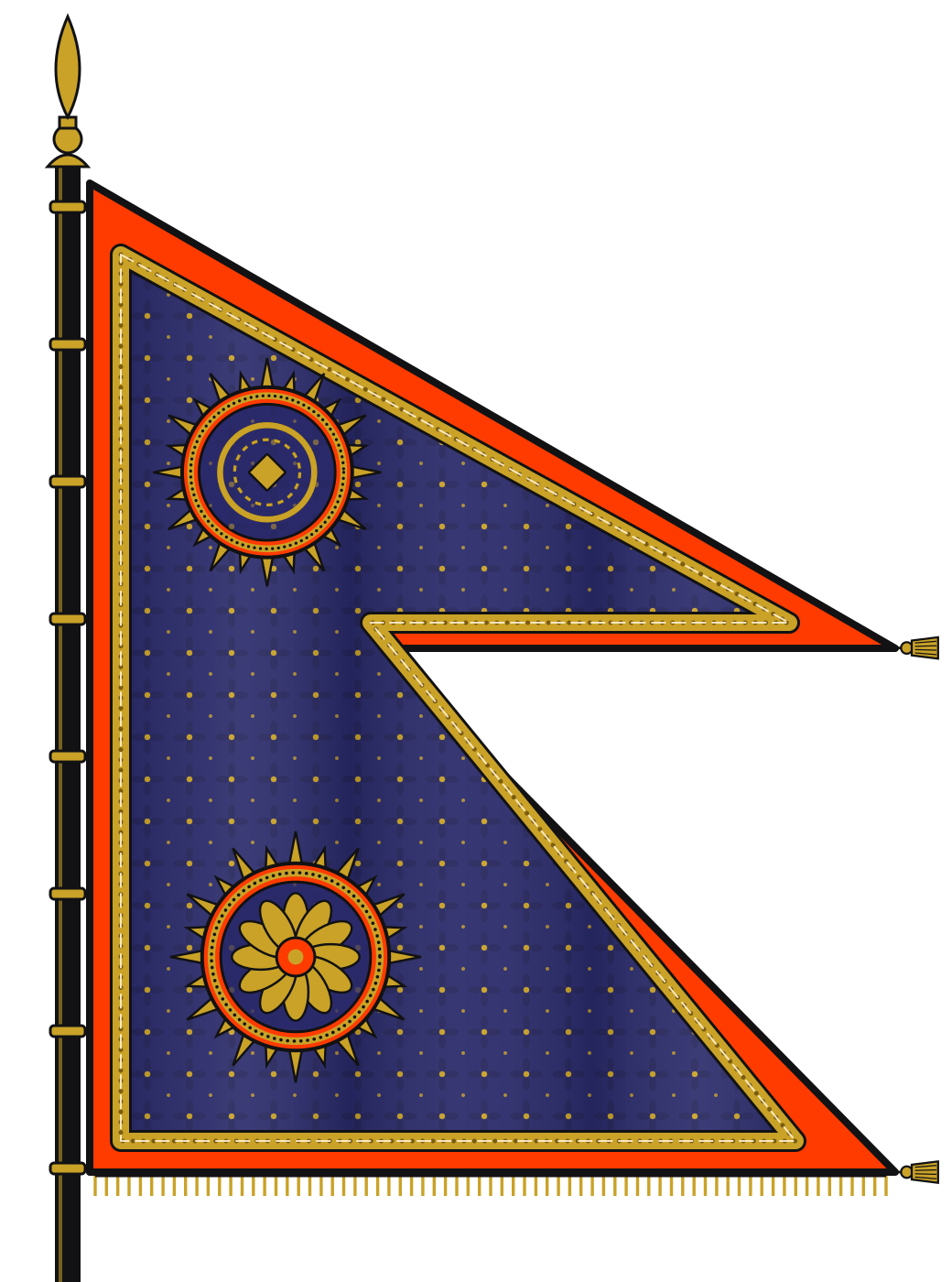
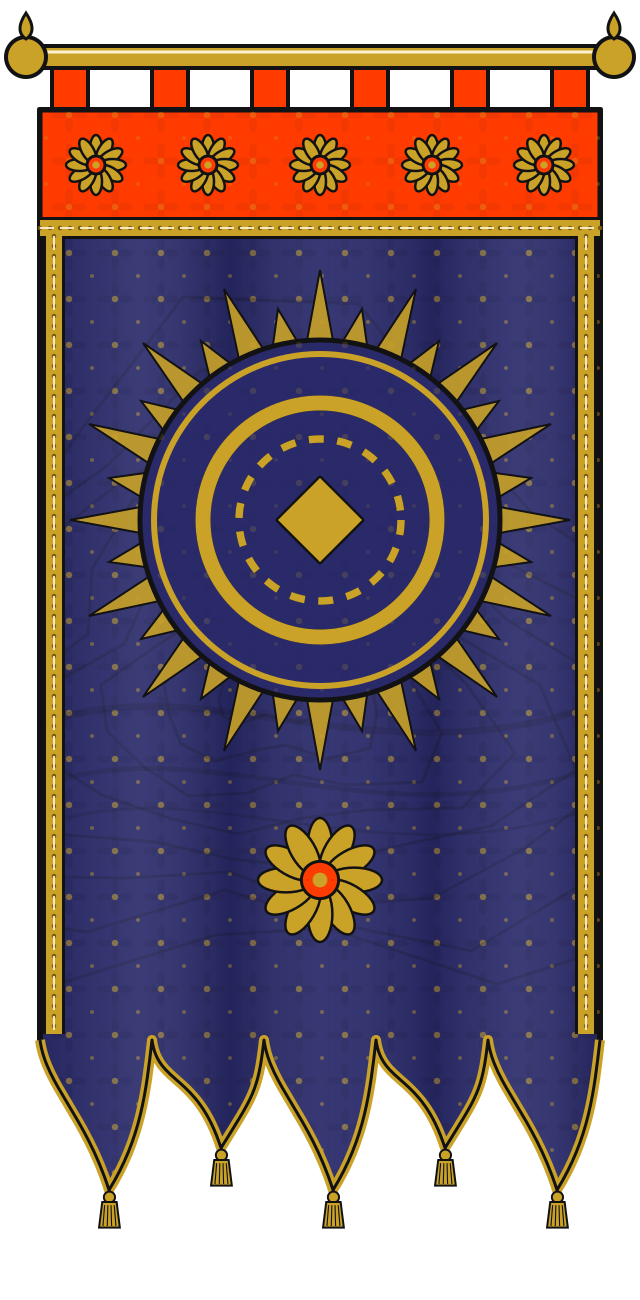
The Kondh have no documented arms or flag in the extracts. The sub-sept totems and the Dongria shawl motifs are the nearest documented symbols[5][10]. The emblem and banner on this page are placeholders.
| Part of the kit | This clan |
|---|---|
| Field | Deep Indigo #2A2A6B |
| Accent | Deep Crimson Red #FF3B00 |
| Emblem colour | Metallic Gold #C9A227 |
| Zari metal | Gold |
| Main emblem | A sacred mountain |
| Second image | A leaf |
| Night and day | Every visual accessory has two versions: by night the emblem on the dark field, by day the clan's field colour on cloth woven from its metal. |
6. Flags
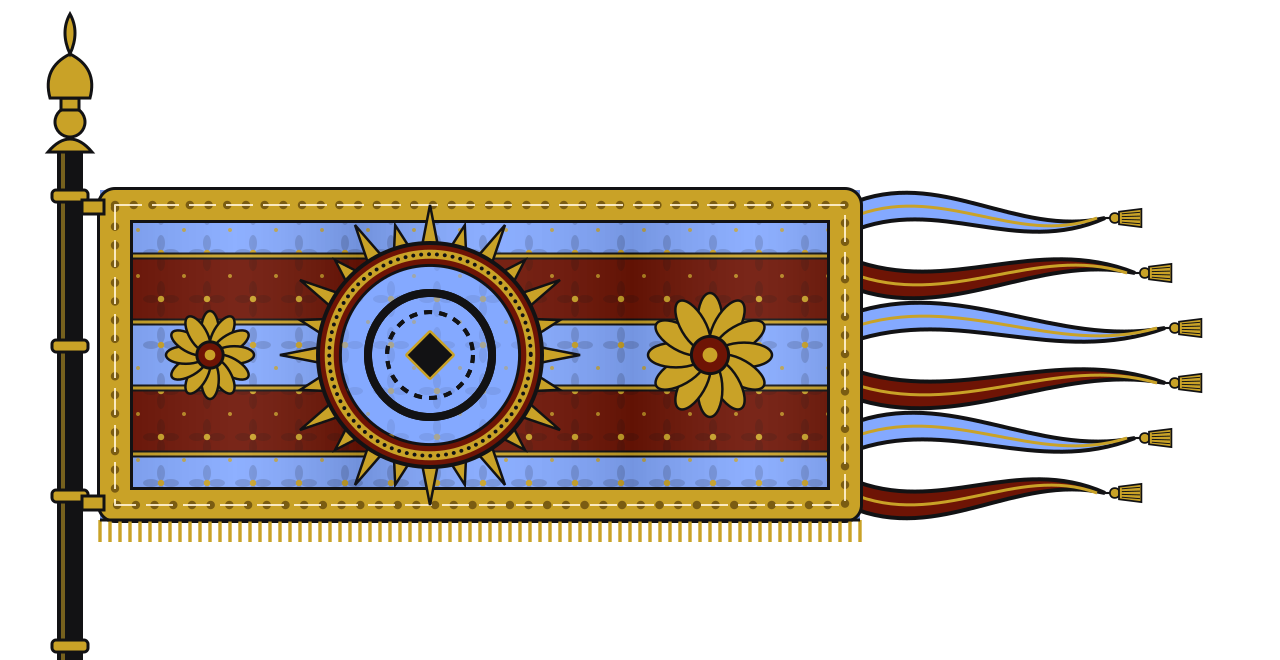
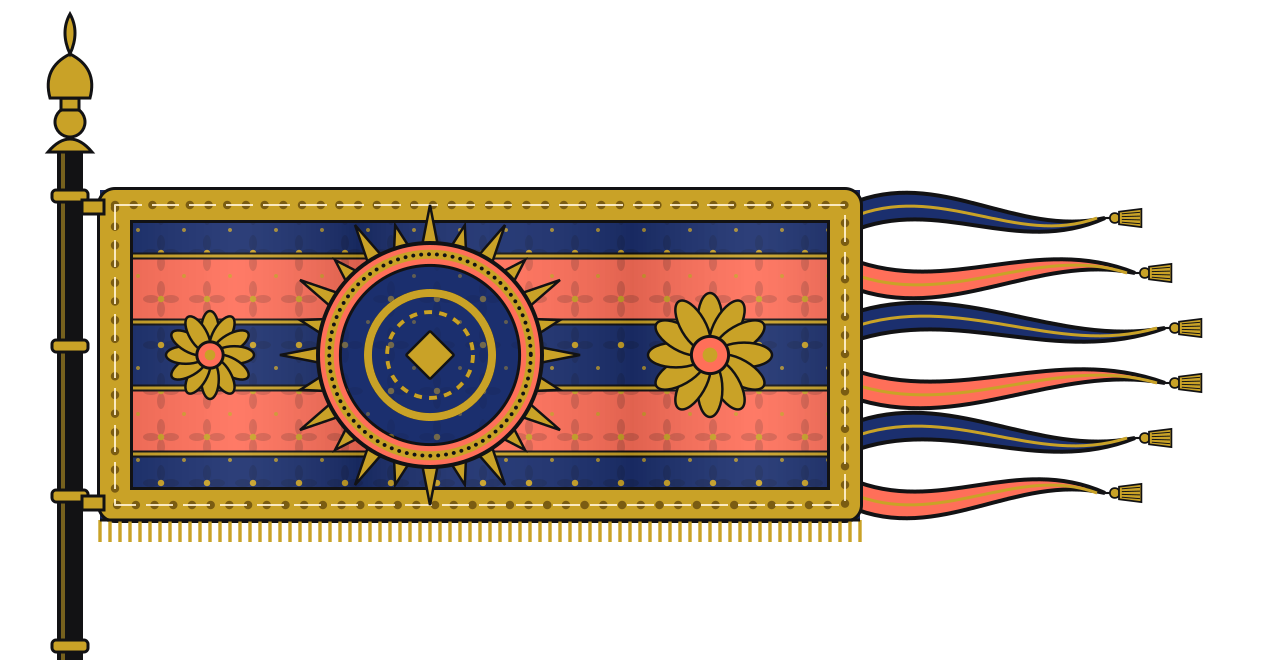
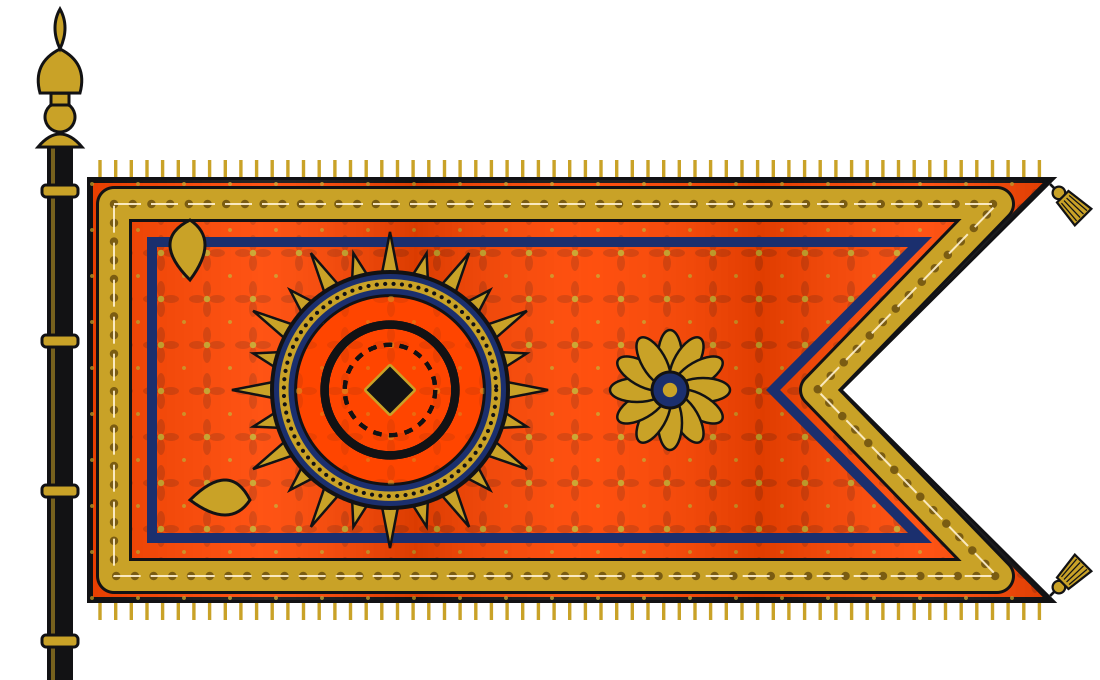
Every clan has every flag type; the type says the occasion and the colours say the clan. The outlined card is the flag the Atlas assigns.
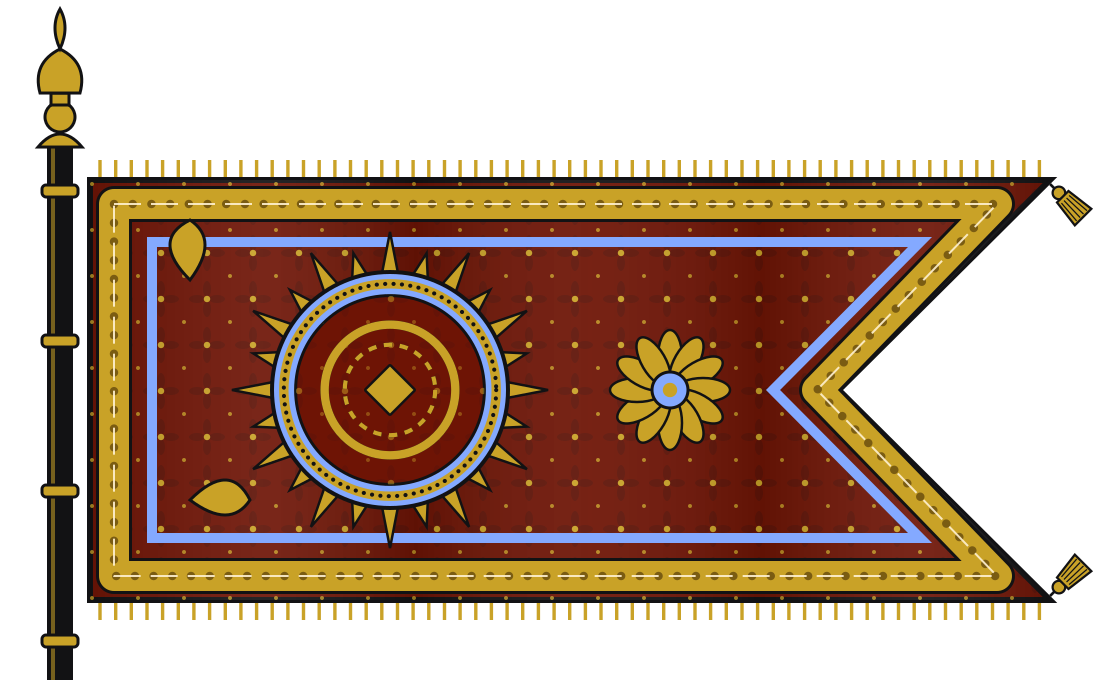

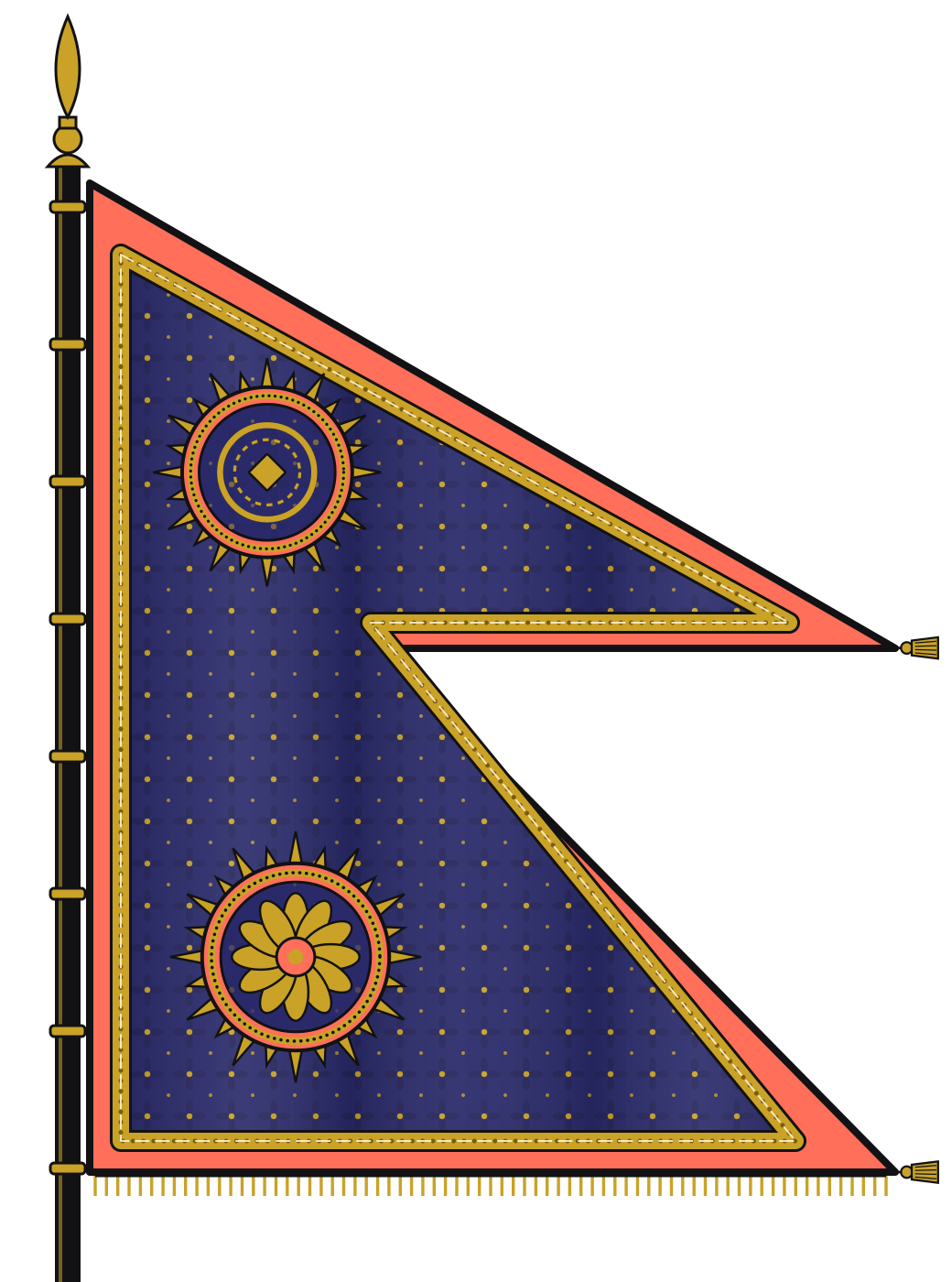

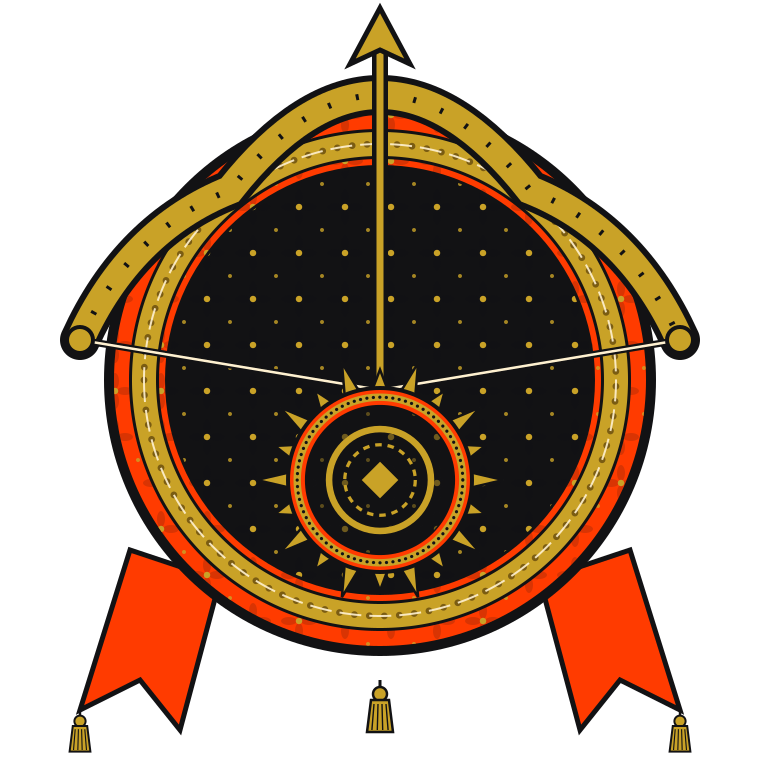
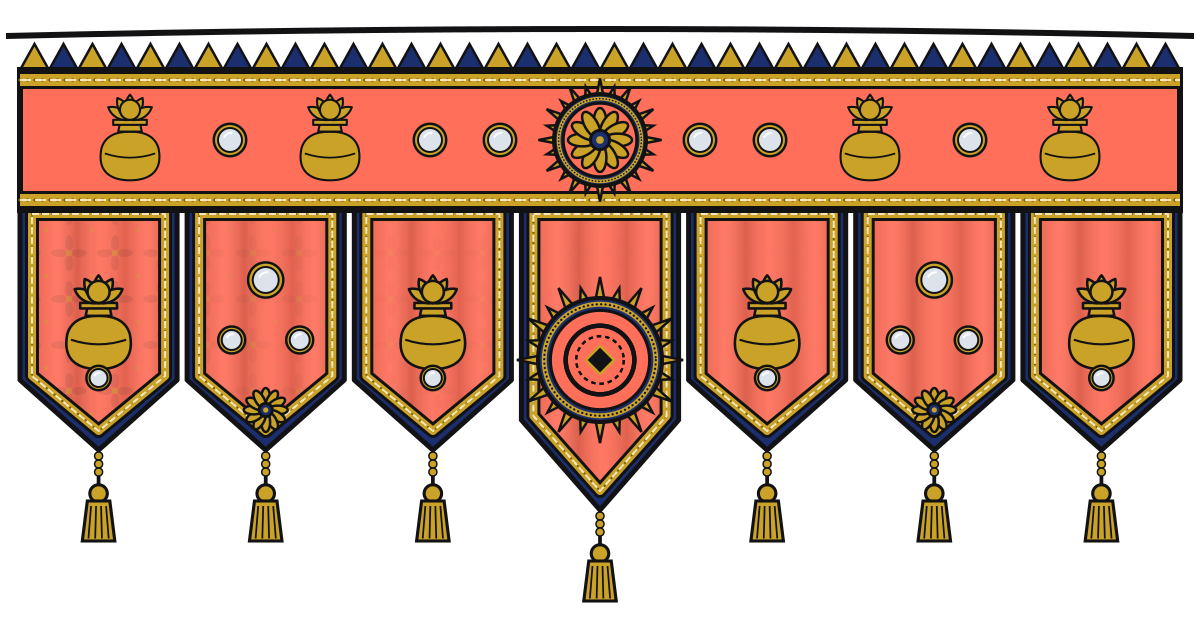
Historic banner
None known
New flag types
| Accessory | For this clan | Basis |
|---|---|---|
| A9 Pota-dhvaja · ship and trade flag For ships, caravans and markets | Not yet designed for this clan | Design |
| A10 Utsava-patāka · festival flag Light, bright flag for fairs and festivals | Not yet designed for this clan | Design |
| A11 Shoka-dhvaja · mourning flag White cloth with the emblem outline in the clan's metal | Not yet designed for this clan | Design |
7. Regalia
| Accessory | For this clan | Basis |
|---|---|---|
| E1 Chhatra · house parasol The ceremonial umbrella | Not yet designed for this clan | Design |
| E2 Chamara · fly-whisks The pair of whisks beside the head of the house | Not yet designed for this clan | Design |
| E3 Danda · staff of office Staff or scepter | Not yet designed for this clan | Design |
| E4 Simhasana · seat The seat of the house, covered in clan cloth | Not yet designed for this clan | Design |
| E5 Khetaka · shield A round shield; the Changi and Dhanush are its flag forms | Not yet designed for this clan | Regional tradition |
| E6 Kula-ayudha · clan weapon The weapon the clan honours | Bow and arrows, worshipped before the hunt Bow and arrows are worshipped before a hunt, as Russell records[5] | Documented |
8. Worn
| Accessory | For this clan | Basis |
|---|---|---|
| F1 Kula-vastra · clan cloth The clan's woven pattern in its kit colours | Kapdaganda shawl of the Dongria Kondh women: red and yellow borders; motifs for the Niyamgiri hills and the goddess's eyes | Documented |
| F2 Kirti-vastra · honour cloth A cloth earned for a deed, not inherited | Not yet designed for this clan | Design |
| F3 Kula-mala · garland flower The flower or leaf the clan wears as a garland | Not yet found for this clan | Under research |
| F4 Chinha · house pin A metal badge with the pin emblem | Not yet designed for this clan | Design |
9. Records
| Accessory | For this clan | Basis |
|---|---|---|
| H1 Clan words A traditional line in the native script | ପ୍ରକୃତିର ନୈସର୍ଗିକ ଆରାଧନା: କନ୍ଧମାଳର କୁଇ ଆଦିବାସୀଙ୍କ ଦାର୍ନିପେନୁ ପୂଜା · “Natural worship: an exploration and study of the Darnipenu Puja of the Kui Adivasis of Kandhamal (English rendering of the title by the codex team; the extract gives no translation)” Title of a 2026 Odia-language study of the Darnipenu Puja[8]. No saying of the clan in native script is in the extracts. | Design |
| H2 Biruda · titles The house's title or titles | Chiefly titles: Patro, Molik, Bissoyi, Dolabehara Headmen of muttahs and settlements, in Thurston's account[3] | Documented |
| H3 Prashasti · praise genealogy The lineage as written at the head of a grant | Not yet found for this clan | Under research |
| H4 Vahi · clan register The book of the clan's births, marriages and deaths | Not yet found for this clan | Under research |
| H5 Rana-ghosha · war cry The clan's cry in battle or celebration | Not yet found for this clan | Under research |
10. VishwaVit · knower of the world
Game values are design choices for this project, not historical claims.
References
- Wikipedia, Kui language (India), read 2026-10-25, https://en.wikipedia.org/wiki/Kui_language_(India)
- Wikipedia, Khond people, read 2026-10-22 and 2026-10-25, https://en.wikipedia.org/wiki/Khond_people
- Edgar Thurston and K. Rangachari, Castes and Tribes of Southern India, vol. 3 (Madras, 1909), Project Gutenberg eBook #42993, https://www.gutenberg.org/ebooks/42993
- Odisha State Tribal Museum (SCSTRTI), Tribes of Odisha: Kandha, read 2026-10-25, https://ostm.in/tribes_of_odisha/kandha/
- R. V. Russell, The Tribes and Castes of the Central Provinces of India, vol. 3 (1916), Project Gutenberg #41424, read 2026-10-10, https://gutenberg.org/cache/epub/41424/pg41424-images.html
- Wikipedia, Dangaria Kandha, read 2026-10-25, https://en.wikipedia.org/wiki/Dangaria_Kandha
- Wikipedia, List of Scheduled Tribes in Odisha, read 2026-10-20, https://en.wikipedia.org/wiki/List_of_Scheduled_Tribes_in_Odisha
- Sahil Kumar Nayak and Dr. Suchitra Mohanty, Darnipenu Puja of the Kui adivasis of Kandhamal (Odia), Indian Journal of Modern Research and Reviews 4(3), 30 March 2026, read 2026-10-25, https://zenodo.org/records/19330335
- Konds, Encyclopedia.com, read 2026-10-21, link
- Brinda Gill, The Kapdaganda Shawl (interview with Pankaja Sethi), Selvedge Magazine, 22 May 2023, read 2026-10-25, https://www.selvedge.org/blogs/selvedge/the-kapdaganda-shawl
- Wikipedia, Kandha Gauda, read 2026-10-25, https://en.wikipedia.org/wiki/Kandha_Gauda
- dhammabharat.com, List of Scheduled Tribes in Maharashtra and Population of each Tribe (2011 Census), read 2026-10-10, https://dhammabharat.com/?p=13656