The Konda Reddi are a hill people of the Papi hills on both sides of the Godavari gorge in the Eastern Ghats[1][2]. Their mother tongue is Telugu, spoken with a distinctive accent[1][3]. They are recognised as a Primitive Tribal Group, now a Particularly Vulnerable Tribal Group, and as a Scheduled Tribe in Andhra Pradesh (2023-24 annual report list) and Telangana (Wikipedia list, list date not given)[3][4][5]. Their livelihood rests on shifting cultivation and on bamboo, and bamboo shoots are a staple[2][1].
01Faith and deities
Modakondamma of Paderu, goddess of the Visakhapatnam Agency[7]
The presiding goddess of the clan's homeland or capital: a link of place, not a recorded clan tie.
| Deity or tradition | Place in the clan's life | Evidence |
|---|---|---|
| Pothuraju | Local village deity of the village | [1] |
| Gangalamma | Streams are worshipped as the village goddess; a festival for rain | [1] |
| Adavi devata and adavi thalli | The forest, revered as god and mother, and feared as the place of demons | [1] |
| Land as mother goddess | Gives grain; a pig, sheep or fowl is offered to the land at the Bhoomi pandaga | [1] |
| Konda devata (hill deities) | Reached only by shamans, in dreams or trance | [1] |
| Local and household deities | Folk Hinduism with local and household deities, as the 2025 article describes it | [2] |
| Modakondamma (KulDevi) | Listed in the Atlas as KulDevi, basis 'Homeland shrine'. The Deccan Chronicle reports a festival at Paderu that names no community; the Wikipedia article names no Modakondamma. Only the sheet ties the people to her. | Atlas;[7][8] |
02Temples
No temple built or patronised by the Konda Reddi is named in the extracts. A photo caption in the blog reads 'pothu raju temple', but gives no place, builder or date.
Built by the clan
Not recorded.
Given patronage or grants by the clan
Not recorded.
03Languages and scripts
| Language or script | Kind | Under the clan | Evidence |
|---|---|---|---|
| Telugu living | Language of the people; Dravidian, a Telugu dialect | Mother tongue, with a distinctive accent; they normally speak Telugu with outsiders (The Hindu, via Wikipedia) | [1][3][8] |
04Books and literature
No book by or about the Konda Reddi is sourced in the extracts. Haimendorf's Tribes of India and Thurston's Castes and Tribes of Southern India are leads, not yet read.
Written during the clan's history
Not recorded.
Given patronage by the clan
Not recorded.
05Thinkers and scholars
Not recorded.
Haimendorf (1945) is cited in the 2010 blog for a Neolithic remark. His book is a lead and has not been read.
06Art and architecture
The extracts record only crafts. No painting, sculpture, architecture or textiles are sourced.
Painting and wall art
Not recorded.
Sculpture and temple art
Not recorded.
Temple and building architecture
Not recorded.
Weaving and textiles
Not recorded.
Clothing and jewellery
Not recorded.
Coins, pottery and crafts
| Art form | What it is | Era | Evidence |
|---|---|---|---|
| Bamboo articles, bottle-gourd and seed utensils, basketry | Eco-friendly household articles of bamboo, bottle gourd and seed; basket-making (Drishti 2019) | Present (2019 article) | [3] |
07History
A hill people of the Godavari gorge
The blog places the Konda Reddi in the Papi hills on both sides of the Godavari gorge, at about 800 feet, in three zones: hill, riverside and lower agency[1]. The 2025 article places them in the Papikonda hill range[2].
Origin claim and early remarks
The blog reports that the people claim origin through the Pandava brothers[1]. It also cites Haimendorf (1945) for placing them at a Neolithic stage[1]. The Haimendorf text itself has not been read.
Isolation and the first outside trade
Hill villages were reached on foot and riverside villages by country boat and steamboat, with roads mainly in recent decades; the villages were isolated before the 1980s[1]. Motorboats reached riverside settlements in the late 1920s[1]. Paper-mill agents began extracting bamboo about ten years before 2010[1]. Literacy rose from 7.75% in 1981 to 34.18% in 2001 (cited by the blog)[1].
Recognition as a PVTG
The 2019 article records the Konda Reddi as a Primitive Tribal Group, now a Particularly Vulnerable Tribal Group, and among the most backward tribal groups of Andhra Pradesh and Telangana[3].
08Journey and migrations
The extracts describe where the people live and how they travelled to them, not a migration.
Not recorded.
09Seats and lands
| Place | Role | Where today |
|---|---|---|
| Papi hills, Godavari gorge | Homeland hills on both sides of the gorge, in the Eastern Ghats | West and East Godavari, Khammam, Visakhapatnam and Warangal districts[1] |
| Papikonda hill range | Hill range the 2025 article places them in | Andhra Pradesh[2] |
| Khammam district | Main settlement area | Telangana; smaller numbers in Alluri Sitharama Raju and Eluru[8] |
| Buttayagudem, Polavaram, Velerupadu and Kukkunur mandals | High hills of the West Godavari agency, where Sakshi Post says most of the area's Konda Reddy live | West Godavari, Andhra Pradesh[6] |
| Godavari riverside villages | Settlements reached by country boat and steamboat | East and West Godavari[1] |
| Konda Veduru bamboo stands | Bamboo the 2025 article calls Green Gold; the article does not say the people work these stands | Godavari valley; the species range runs through Andhra Pradesh, Telangana, Odisha and Chhattisgarh[2] |
10Notable figures
Not recorded.
11Allies, rivals and marriages
| People | Relationship | When |
|---|---|---|
| Koya (ST-160) | Neighbours considered socially lower; no commensality, though raw food from Koya is accepted[1] | Present day, as the blog describes it |
| Reddy (Hindu caste) | Not related: Wikipedia says the Konda Reddi are entirely unrelated to the caste of the same name (page credits Tribes of India, UC Press)[8] | Not applicable |
12Society and livelihood
The blog describes a patrilineal and patrilocal people with strict community endogamy. The 2025 article describes a Kula Panchayat governed by hereditary headmen.
Government and social order
| Institution or group | What it was | Evidence |
|---|---|---|
| Kula Panchayat | Governance by a Kula Panchayat with hereditary headmen (Drishti 2025, from The Hindu) | [2] |
| Pedda kapu and kula pedda | Community offices that coexist with the statutory panchayat (blog) | [1] |
| Marriage | Strict community endogamy; cross-cousin marriage common, parallel-cousin marriage prohibited; sororate and levirate accepted; occasional polygyny; bride-price (oli) now often replaced by dowry; divorce after headman mediation (blog) | [1] |
| Wedding | Five days: a 'First Night' ritual on day three and a village feast on day four; elders pour water on the couple's heads; the groom ties a black bead string on the bride, and the mangalsutra is recent; the Pathanalu ritual has the bride hidden and the groom's family search for her (Sakshi Post, 2021) | [6] |
| Consent in marriage | In the 1980s a man could take a woman by holding her hand and declaring the marriage publicly; now her willingness is considered (Sakshi Post, 2021) | [6] |
| Birth, puberty and death | Home delivery with a dhayi and about ten days' confinement; first menarche in a samartha gudise hut, with purification on the 7th or 9th day; a spirit is fed on the ninth day after death (blog) | [1] |
| Names | Male names take the suffix 'Reddi' (blog) | [1] |
Livelihood over time
| Era | Livelihood | Evidence |
|---|---|---|
| Traditional | Shifting cultivation (podu), with some settled agriculture and horticulture (Drishti 2019) | [3] |
| About ten years before 2010 | Bamboo extracted for paper-mill agents (blog) | [1] |
| 2010 | Podu cultivation declining (blog) | [1] |
| 2019 | Non-timber forest produce and basket-making supplement the livelihood (Drishti 2019) | [3] |
| 2021 | Podu sagu, bamboo products, honey, acacia gum and gooseberries sold at local markets (Sakshi Post) | [6] |
| 2025 | Konda Veduru bamboo, called Green Gold; bamboo shoots are a staple that women traditionally harvest; livelihood relies on shifting cultivation (Drishti 2025, from The Hindu) | [2] |
13Sub-clans and related clans
The blog names two gotrams (clans), three divisions, and ten intiperlu (exogamous names tied to patrilineal clans). Two related peoples are named in other extracts.
| Clan | Relation | Where | Size | In the Atlas | Evidence |
|---|---|---|---|---|---|
| Ganga (gotram) | Sub-clan | Most frequently observed gotram (blog) | new clan candidate | [1] | |
| Pasupuleti (gotram) | Sub-clan | Second most frequently observed gotram (blog) | new clan candidate | [1] | |
| Pandava Reddi | Branch | A separate endogamous division; claims superiority (blog) | new clan candidate | [1] | |
| Raja Reddi | Branch | A separate endogamous division (blog) | new clan candidate | [1] | |
| Suryavamsa Reddi | Branch | A separate endogamous division (blog) | new clan candidate | [1] | |
| Chintala | Sub-clan | Intiperlu, exogamous, tied to a patrilineal clan (blog) | new clan candidate | [1] | |
| Ketchala | Sub-clan | Intiperlu (blog); spelled Ketchela in Sakshi Post | new clan candidate | [1][6] | |
| Sankuru | Sub-clan | Intiperlu (blog) | new clan candidate | [1] | |
| Kulla | Sub-clan | Intiperlu (blog) | new clan candidate | [1] | |
| Vetla | Sub-clan | Intiperlu (blog) | new clan candidate | [1] | |
| Kondla | Sub-clan | Intiperlu (blog) | new clan candidate | [1] | |
| Valla | Sub-clan | Intiperlu (blog) | new clan candidate | [1] | |
| Araganta | Sub-clan | Intiperlu (blog) | new clan candidate | [1] | |
| Kopala | Sub-clan | Intiperlu (blog) | new clan candidate | [1] | |
| Pamileti | Sub-clan | Intiperlu (blog) | new clan candidate | [1] | |
| Koya | Related people | Along the Godavari in East and West Godavari; Telangana: Bhadradri Kothagudem and Mulugu | ST-160 | [9][10] | |
| Konda Kapu | Related people | Listed beside Konda Reddi in the Tamil Nadu list (Other Tribes) | ST-150 | [11] |
Clans marked "new clan candidate" are not in the Atlas yet.
14Surnames
The blog calls the ten intiperlu exogamous names tied to patrilineal clans. The extracts give no counts and do not say whether other communities use these names. Sakshi Post (2021) quotes two speakers as Ketchela Bullireddy and Ketchela Padma; the article does not call Ketchela a clan.
| Surname | Clan or sub-clan | Where | People with this surname | Also used by other communities |
|---|---|---|---|---|
| Chintala | Intiperlu | Not stated | not yet counted | Not checked |
| Ketchala | Intiperlu | Spelled Ketchela in Sakshi Post (Regulapadu, Buttayagudem) | not yet counted | Not checked |
| Sankuru | Intiperlu | Not stated | not yet counted | Not checked |
| Kulla | Intiperlu | Not stated | not yet counted | Not checked |
| Vetla | Intiperlu | Not stated | not yet counted | Not checked |
| Kondla | Intiperlu | Not stated | not yet counted | Not checked |
| Valla | Intiperlu | Not stated | not yet counted | Not checked |
| Araganta | Intiperlu | Not stated | not yet counted | Not checked |
| Kopala | Intiperlu | Not stated | not yet counted | Not checked |
| Pamileti | Intiperlu | Not stated | not yet counted | Not checked |
Counts are of everyone with the surname, from the cited source and year, not only members of this clan. A surname shared with other communities says nothing about any one person's origin.
15Songs and music
No song of the Konda Reddi is sourced in the extracts.
None recorded yet.
16Poems, lullabies and children's rhymes
No poem, lullaby or children's rhyme of the Konda Reddi is sourced in the extracts.
None recorded yet.
17Stories, legends and proverbs
Stories and legends
| Story | What happens | Told by | Evidence |
|---|---|---|---|
| Pandava descent legend | The people claim origin through the Pandava brothers | Community claim, as the blog reports it | [1] |
Proverbs and sayings
Not recorded.
18Festivals and fairs
| Festival or fair | When | Where | What happens |
|---|---|---|---|
| Bhoomi pandaga | About every three years, after the harvest | Not stated | A pig, sheep or fowl is offered to the land[1] |
| Mamidi pandaga | Ugadi | Not stated | Mangoes are eaten only after it[1] |
| Sama kotha pandaga | August | Not stated | Start of eating leafy greens, gongura and thota kura[1] |
| Gangalamma festival | Not stated | Not stated | Festival for rain[1] |
| Harvest worship of the village goddess | At the harvest, especially while reaping | West Godavari agency area | Worship of the village goddess[6] |
| Sankranthi, Dasara and Sri Rama Navami | Calendar dates | Not stated | Also observed, as the blog lists them[1] |
19Food, dress and games
Food
| Item | What it is | Evidence |
|---|---|---|
| Bamboo shoots | A staple; women traditionally harvest them | [2] |
| Mangoes | Eaten only after the Mamidi pandaga at Ugadi | [1] |
| Leafy greens (gongura, thota kura) | Eaten after the Sama kotha pandaga in August | [1] |
Dress
Not recorded.
Games and martial arts
Not recorded.
Tags: living still practised · revived brought back after a break · lost known only from records · research reported but not yet confirmed from a source. Songs and poems under copyright are listed by title only; restricted or sacred material is noted without its content.
20Status today
A Scheduled Tribe and a Particularly Vulnerable Tribal Group of the Godavari hills, mostly in Andhra Pradesh and Telangana[3][4][1].
Recognised heritage
| What | Recognition | Evidence |
|---|---|---|
| Konda Reddi, a PVTG | Recognised as a Primitive Tribal Group, now a Particularly Vulnerable Tribal Group (Drishti 2019) | [3] |
No community review is recorded for this page.
21For children
The bamboo grove
The Konda Reddi live in the hills beside the Godavari river, where there is a lot of bamboo. Their families grow food by moving from one patch of hill to another, which is called shifting cultivation. They make useful things from bamboo, bottle gourd and seeds. Bamboo shoots are a food that women gather. Each village has its own village god to look after it. The forest is their mother and the streams are their goddess. They wait to eat mangoes until the Mamidi festival at Ugadi is over.
22Across the project
| Project | What carries this clan | Status |
|---|---|---|
| Atlas of the Janas | Homeland: the Papi hills and the Godavari gorge. No pin is set yet. | To check |
| KulDevi and GrahDevi | KulDevi Modakondamma, family Saptamatrika (+Narasimhi), basis 'Homeland shrine'; GrahDevi forms Brahmani, Maheshvari, Kaumari, Vaishnavi, Varahi, Indrani, Chamunda, Narasimhi | From the Atlas |
| Planet naming | Not yet checked against the Tier registers | To check |
| Renaming and waters | The Godavari and its gorge are named in the sources; no water name is yet drawn from the Konda Reddi | — |
23Open questions
- Odisha status: the Wikipedia Odisha list names the Konda Reddi, and the Atlas lists Odisha. The Wikipedia article on Konda Reddis says they are not listed in Odisha. Read the Ministry's list for Odisha before setting the status.
- Modakondamma as KulDevi: only the Atlas ('Homeland shrine') and a Deccan Chronicle report of a festival at Paderu name her, and the report names no community. The Wikipedia article names no Modakondamma. Find a source that ties the people to her.
- Hill Reddis: the Andhra Pradesh list gives it as a separate entry from Kondareddis, and the Atlas lists it as another name. Check whether it is the same people.
- Population: 83,096 (Census 2001, cited by the blog) and 432 (1991, Wikipedia, citation needed) differ widely. Find the census tables.
- Pothuraju temple: the blog's caption gives no place, builder or date.
- Songs, proverbs, rhymes and native-script forms of the names are not in the extracts. Read the Wikipedia Mango Dance source (webindia123.com) and look for Telugu-language sources.
- The Pandava origin is a claim reported by the blog. Find the community's own account.
- Totems, sacred trees, war cry, garland flower and instruments are not found.
- The ten intiperlu and the two gotrams have no source beyond the blog. Thurston's volume on the Godavari hill people has not been read.
- Ketchala (blog) and Ketchela (Sakshi Post) are the same name in two spellings. Confirm.
- Haimendorf (1945) is cited only through the blog. Read his text.
- Contradiction, shifting cultivation: the blog says podu cultivation is declining by 2010[1]; the 2025 article says the livelihood relies on shifting cultivation[2]. Both are reported; the current position is not settled.
- Contradiction, main area: Wikipedia says the Konda Reddis live mainly in Khammam district[8]; the blog says about 95% are in East Godavari, West Godavari and Khammam, with no split given[1]. Check the census tables.
24Astitva
अस्तित्व · being, existence: everything by which the clan is known
No seal, coin, totem, war cry or instrument of the Konda Reddi is recorded in the extracts. The one documented item is the office titles pedda kapu and kula pedda.
Every clan has every accessory, royal objects included. Each one says how it is known: Documented This clan's own object is recorded. · Regional tradition Recorded for the region or for peoples like this one, not for this clan. · Design Made for this project, with no historical claim. · Under research To be found for this clan from sources. Legends and titles are written in the clan's own script.
1. Seals and coins
| Accessory | For this clan | Basis |
|---|---|---|
| B1 Rajamudra · house seal Round seal with the clan emblem and a short legend in the clan's script | Not yet designed for this clan | Design |
| B2 Anguliya-mudra · signet ring Personal seal ring of the head of the house | Not yet designed for this clan | Design |
| B3 Chhapa · house stamp Ink or block stamp for letters, goods and cloth | Not yet designed for this clan | Design |
| B4 Tamrapatra · charter plate Copper-plate grant on a ring, closed with the house seal | Not yet designed for this clan | Design |
| B5 Shreni-mudra · guild or trade seal Seal for the clan's trade, craft or caravan | Not yet designed for this clan | Design |
| C1 Clan coin Emblem or deity on one side, a legend in the clan's script | Not yet designed for this clan | Design |
| C2 Coin die The die that strikes the coin | Not yet designed for this clan | Design |
2. Living symbols
| Accessory | For this clan | Basis |
|---|---|---|
| I1 Totem trio The tree, bird and animal the clan protects | Not yet found for this clan | Under research |
| I2 Kaval-maram · guardian tree The tree that stands at the clan's seat | Not yet found for this clan | Under research |
3. Stone and gate
| Accessory | For this clan | Basis |
|---|---|---|
| G1 Torana · gateway The built gate of the seat; the cloth Toran hangs in it | Not yet designed for this clan | Regional tradition |
| G2 Viragallu · hero stone Carved panel stone for a member who died defending the clan | Not yet designed for this clan | Regional tradition |
| G3 Kula-shila · clan stones Standing and table stones that remember the ancestors | Not yet designed for this clan | Design |
| G4 Jayastambha · victory pillar A pillar raised for a victory | Not yet designed for this clan | Design |
| G5 Sima-shila · boundary stone Marks the clan's land, with a line in the native script | Not yet designed for this clan | Design |
4. Sounds
| Accessory | For this clan | Basis |
|---|---|---|
| D1 Pancha-mahashabda · five great sounds The right to five instruments | Not yet designed for this clan | Design |
| D2 Shankha · clan conch The clan's own named war conch | Not yet designed for this clan | Design |
| D3 Murasu · house drums Three drums: war, charity and justice | Not yet designed for this clan | Design |
5. Kit: colours, metals and emblems
No documented emblem is recorded for the Konda Reddi in the extracts. The Atlas's design idea is a bamboo grove in a gorge, for bamboo craft; it is a design, not a documented symbol.
| Part of the kit | This clan |
|---|---|
| Field | Warm Red-Orange #FF6F59 |
| Accent | Intense Electric Blue #84A9FF |
| Emblem colour | Charcoal Black #121214 |
| Zari metal | Gold |
| Main emblem | A bamboo grove in a gorge |
| Second image | — |
| Night and day | Every visual accessory has two versions: by night the emblem on the dark field, by day the clan's field colour on cloth woven from its metal. |
6. Flags
Every clan has every flag type; the type says the occasion and the colours say the clan. The outlined card is the flag the Atlas assigns.
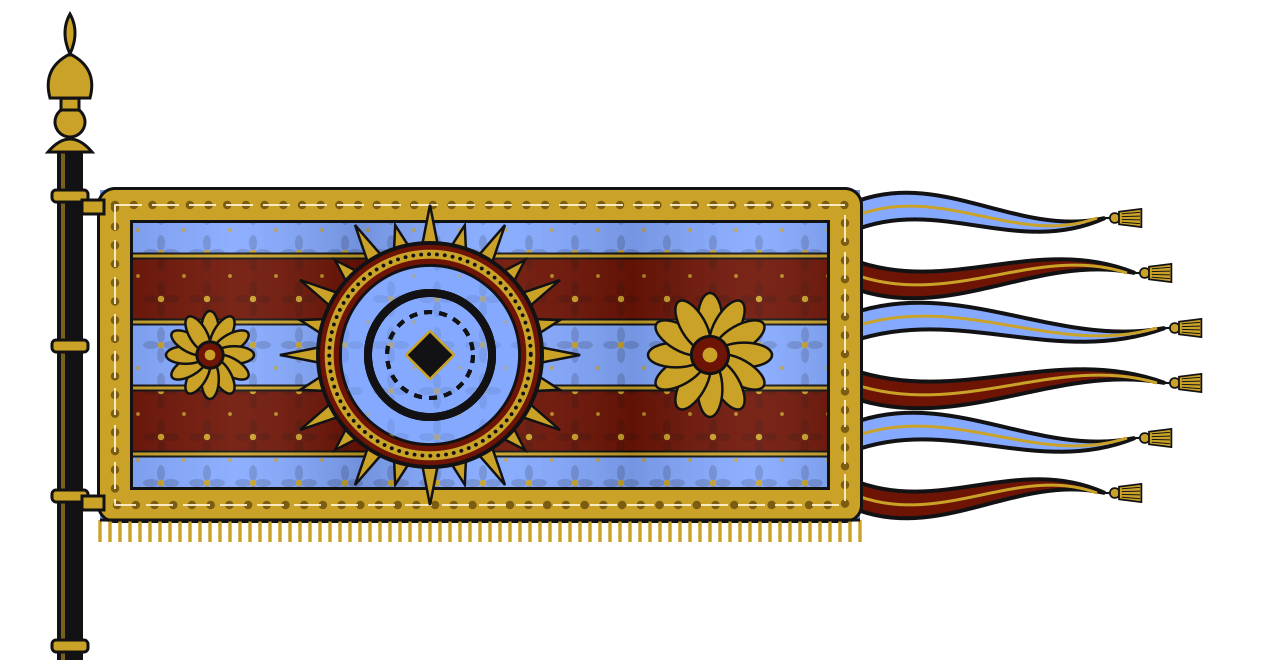
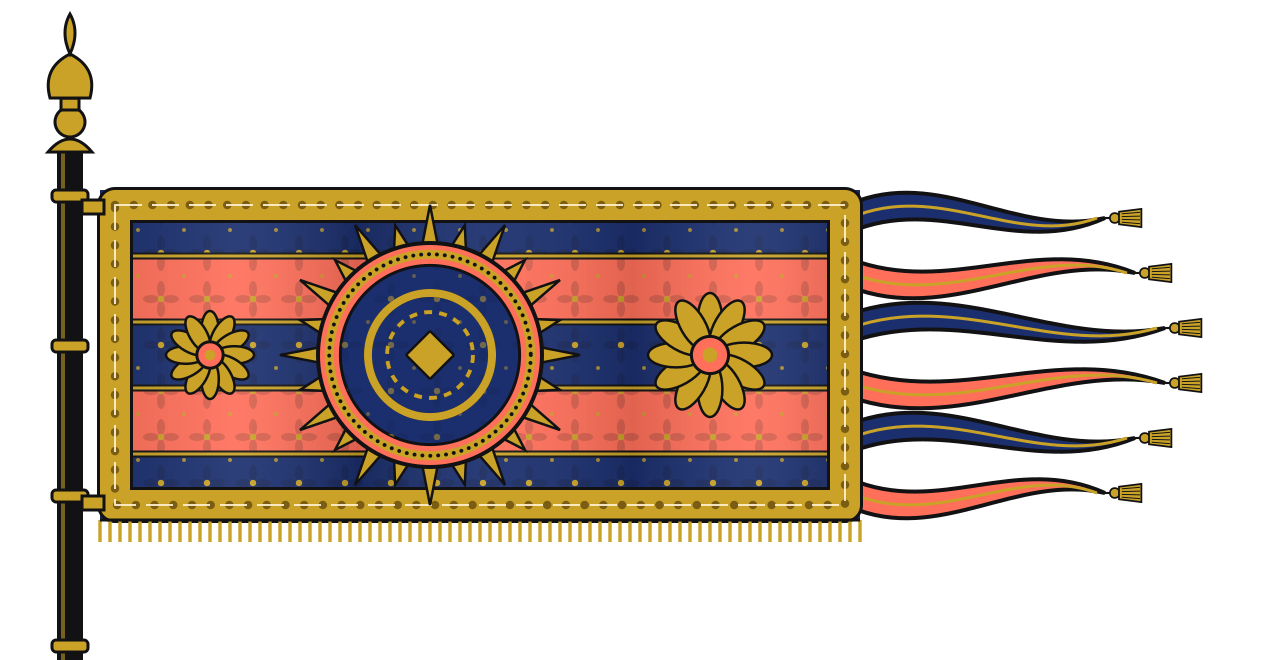
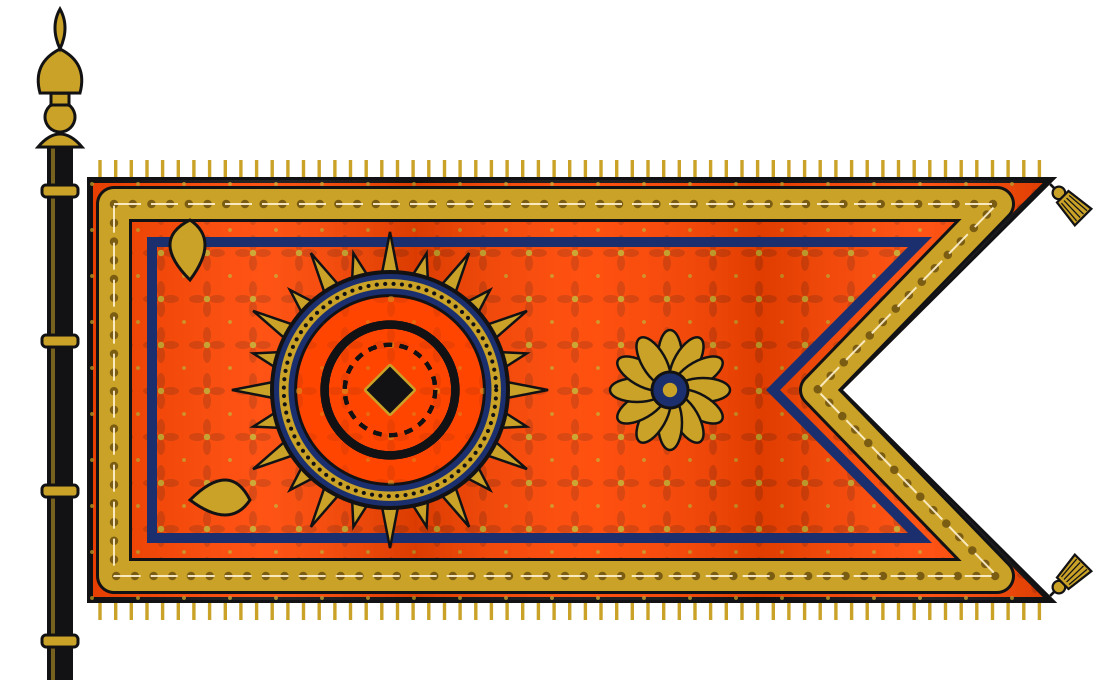
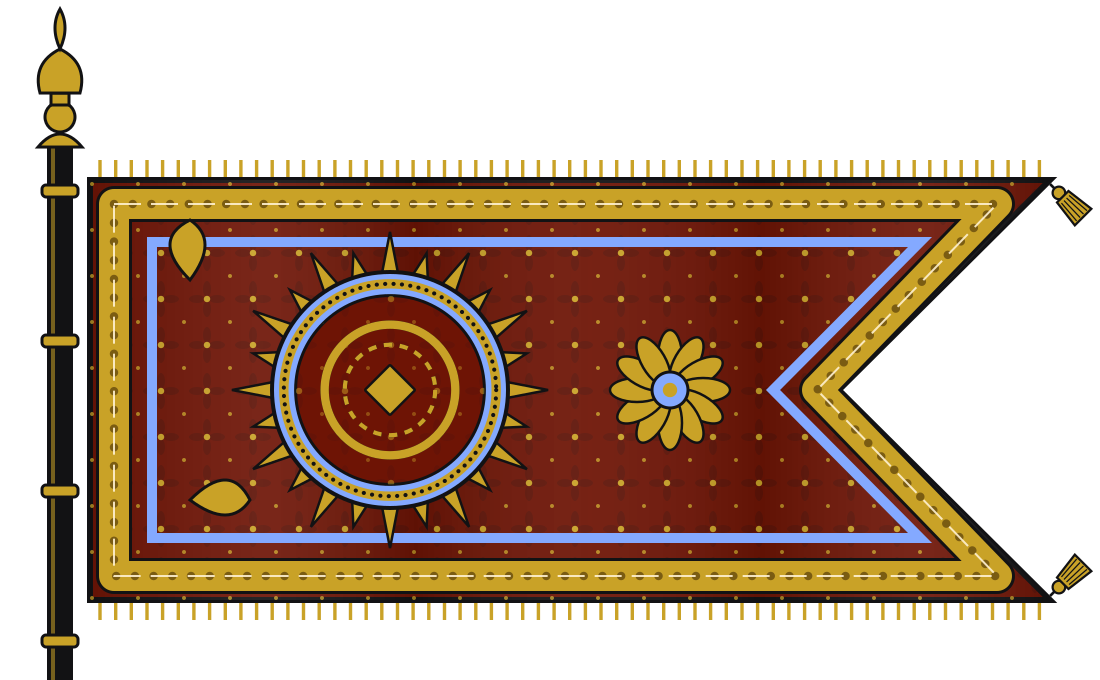


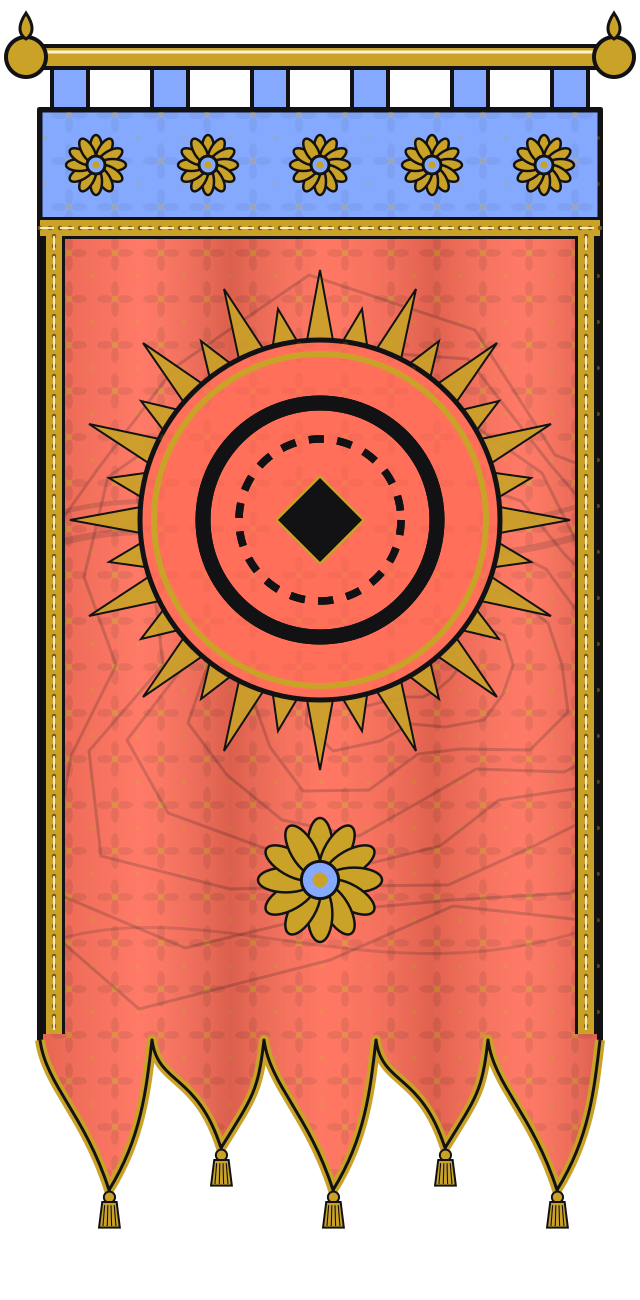
Historic banner
None known
New flag types
| Accessory | For this clan | Basis |
|---|---|---|
| A9 Pota-dhvaja · ship and trade flag For ships, caravans and markets | Not yet designed for this clan | Design |
| A10 Utsava-patāka · festival flag Light, bright flag for fairs and festivals | Not yet designed for this clan | Design |
| A11 Shoka-dhvaja · mourning flag White cloth with the emblem outline in the clan's metal | Not yet designed for this clan | Design |
7. Regalia
| Accessory | For this clan | Basis |
|---|---|---|
| E1 Chhatra · house parasol The ceremonial umbrella | Not yet designed for this clan | Design |
| E2 Chamara · fly-whisks The pair of whisks beside the head of the house | Not yet designed for this clan | Design |
| E3 Danda · staff of office Staff or scepter | Not yet designed for this clan | Design |
| E4 Simhasana · seat The seat of the house, covered in clan cloth | Not yet designed for this clan | Design |
| E5 Khetaka · shield A round shield; the Changi and Dhanush are its flag forms | Not yet designed for this clan | Regional tradition |
| E6 Kula-ayudha · clan weapon The weapon the clan honours | Not yet found for this clan | Under research |
8. Worn
| Accessory | For this clan | Basis |
|---|---|---|
| F1 Kula-vastra · clan cloth The clan's woven pattern in its kit colours | Not yet designed for this clan | Design |
| F2 Kirti-vastra · honour cloth A cloth earned for a deed, not inherited | Not yet designed for this clan | Design |
| F3 Kula-mala · garland flower The flower or leaf the clan wears as a garland | Not yet found for this clan | Under research |
| F4 Chinha · house pin A metal badge with the pin emblem | Not yet designed for this clan | Design |
9. Records
| Accessory | For this clan | Basis |
|---|---|---|
| H1 Clan words A traditional line in the native script | The local village gods are our tribe's deities. · “Given in English in the source; no native-script form was found.” Ketchela Padma, Regulapadu (Buttayagudem), as reported in Sakshi Post, 5 May 2021[6] | Documented |
| H2 Biruda · titles The house's title or titles | Offices of pedda kapu and kula pedda, held alongside the statutory panchayat | Documented |
| H3 Prashasti · praise genealogy The lineage as written at the head of a grant | Not yet found for this clan | Under research |
| H4 Vahi · clan register The book of the clan's births, marriages and deaths | Not yet found for this clan | Under research |
| H5 Rana-ghosha · war cry The clan's cry in battle or celebration | Not yet found for this clan | Under research |
10. VishwaVit · knower of the world
Game values are design choices for this project, not historical claims.
References
- Ethnography of Konda Reddi, anthropology-india blog, 2010 (read 28 Oct 2026, KulDevi clan check).
- Drishti IAS (from The Hindu), Konda Veduru Bamboo in the Godavari Valley, 17 Feb 2025, read 2026-11-06, https://www.drishtiias.com/daily-updates/daily-news-analysis/konda-veduru-bamboo-in-the-godavari-valley/print_manually
- Drishti IAS, Konda Reddy Tribe, daily news analysis, 24 Dec 2019, read 2026-11-06, https://www.drishtiias.com/daily-updates/daily-news-analysis/konda-reddy-tribe/print_manually
- State-wise ST list (annual report 2023-24), Andhra Pradesh Part I, read 2026-10-10, https://iiitl.ac.in/wp-content/uploads/2024/08/07014a84-st-list-as-per-annual-report_-2023-24.pdf
- Wikipedia, List of Scheduled Tribes (Telangana block), read 2026-10-10, https://en.wikipedia.org/wiki/List_of_Scheduled_Tribes
- Sakshi Post, AP: Unique Rituals Followed During Konda Reddy Tribal Weddings, 5 May 2021, read 2026-11-06, https://www.sakshipost.com/news/andhrapradesh/ap-unique-rituals-followed-during-konda-reddy-tribal-weddings-134762
- Deccan Chronicle, "Modakondamma jatara begins amid grandeur in Paderu", read 2026-10-28, https://www.deccanchronicle.com/southern-states/andhra-pradesh/modakondamma-jatara-begins-amid-grandeur-in-paderu-1878266
- Konda Reddis, Wikipedia (read 28 Oct 2026, KulDevi clan check).
- Vajiram and Ravi, Tribes of Andhra Pradesh, read 2026-10-10, https://vajiramandravi.com/current-affairs/tribes-of-andhra-pradesh/
- Vajiram and Ravi, Tribes of Telangana, read 2026-10-10, https://vajiramandravi.com/current-affairs/tribes-of-telangana/
- Vajiram and Ravi, Tribes of Tamil Nadu, read 2026-10-10, https://vajiramandravi.com/current-affairs/tribes-of-tamil-nadu/
- Tamil Nadu Dr. Ambedkar Law University, Annexure I (lists of ST, SC, MBC, DNC, BC and BC Muslims of Tamil Nadu), read 2026-10-10, https://tndalu.ac.in/pdf-3/AnnexuresI.pdf
- Ministry of Tribal Affairs, State/UT-wise list of Scheduled Tribes, list dated 09-07-2024 (from sheet; not fetched)
- Wikipedia, List of Scheduled Tribes in Odisha, read 2026-10-20, https://en.wikipedia.org/wiki/List_of_Scheduled_Tribes_in_Odisha