The Konda Dora are a Scheduled Tribe of Odisha, counted at 20,802 in the 2011 census[1]. Their name joins konda, meaning hill, and dora, meaning headman or chieftain[2]. The community calls itself Pandava Doras or Pandava Rajas and believes it descends from the Pandavas of the Mahabharata; this is the community's own tradition, not a documented descent[2]. Their language, Konda-Dora or Kubi, is Dravidian and close to Kui[2], and most speakers are fluent in Telugu or Odia[3]. Thurston (1909) describes them as a caste of hill cultivators found chiefly in Vizagapatam, neighbours of the Parja[4].
01Faith and deities
The 1901 census recorded the Konda Doras as worshipping a goddess called Talupulamma, alongside the Pandavas[4]. The extracts do not say she is the chief deity; the Atlas gives no KulDevi for this row (basis: Research).
No KulDevi has been found for this clan yet; it is on the research list.
| Deity or tradition | Place in the clan's life | Evidence |
|---|---|---|
| The Pandavas | Worshipped, and claimed as the community's ancestors | [4][2] |
| Talupulamma | Goddess worshipped, recorded in the 1901 census | [4] |
| Jakara devata | Among the festivals with sacrifices of the Konda Dora, named by the Vizianagaram ITDA list | [5] |
02Temples
No temple is recorded for the Konda Dora in the extracts.
Built by the clan
Not recorded.
Given patronage or grants by the clan
Not recorded.
03Languages and scripts
| Language or script | Kind | Under the clan | Evidence |
|---|---|---|---|
| Konda-Dora (Kubi) living | Dravidian; close to Kui; borrowings from Odia and Telugu | About 28,000 speakers (Endangered Alphabets); 61,000 (2011 census, as Wikipedia prints it)[2][3] | |
| Telugu | Mother tongue returned by most Konda Doras in the 1891 census; most Konda-Dora in Andhra Pradesh are fluent in Telugu | [4][3] | |
| Odia | Most Konda-Dora in Odisha are fluent in Odia | [3] | |
| Konda-Dora script research | Devised by Prasanna Sree; spread unclear; script shown as an image only | [2][3] |
04Books and literature
The extracts record no Konda Dora book or written literature.
Written during the clan's history
Not recorded.
Given patronage by the clan
Not recorded.
05Thinkers and scholars
| Name | Field | Era | Contribution |
|---|---|---|---|
| Prasanna Sree (Sathupati Prasanna Sree) | Linguist; devised the Konda-Dora script | Not stated | The script (Endangered Alphabets; Omniglot; Wikipedia)[2][6][3] |
06Art and architecture
No art, architecture or craft is recorded for the Konda Dora in the extracts.
Painting and wall art
Not recorded.
Sculpture and temple art
Not recorded.
Temple and building architecture
Not recorded.
Weaving and textiles
Not recorded.
Clothing and jewellery
Not recorded.
Coins, pottery and crafts
Not recorded.
07History
Name and self-image
The name joins konda, hill, and dora, headman or chieftain[2]. The Odisha State Tribal Museum gives the same sense: in Telugu, konda means hill and dora means leader[7].
The community calls itself Pandava Doras or Pandava Rajas and believes it descends from the Pandavas[2]. Drishti IAS notes the same claim[8]. No source in the extracts dates it.
1900: the Korravanivalasa rising
In 1900 at Korravanivalasa in Vizagapatam, a Konda Dora named Korra Mallayya claimed inspiration, said he was a re-incarnation of one of the Pandavas, and said his infant son was the god Krishna, who would drive out the English. The followers used bamboos as guns. Two constables were killed on 1 May; police rushed the camp on 7 May, and eleven rioters were killed. Sixty were tried; three, including the Swami, were tried for murder; the Swami died in jail and two were hanged[4].
The 1909 record
Thurston and Rangachari describe the Konda Doras as a caste of hill cultivators found chiefly in Vizagapatam[4]. Durgi Patro, head of a mutta, told G. F. Paddison that the Konda Doras and the Khonds are identical[4]. The 1891 census returned most Konda Doras with Telugu as their mother tongue[4].
08Journey and migrations
The extracts give no dated migration for the Konda Dora.
Not recorded.
09Seats and lands
| Place | Role | Where today |
|---|---|---|
| South-eastern edge of the 3,000-feet plateau | The Konda Doras, 81,000 in the gazetteer's count, live here as hill people ("lords of the hills") | Vizagapatam, 1907[9] |
| Koraput, Malkangiri, Rayagada, Kalahandi | Odisha districts where the Scheduled Tribe is listed | Odisha[10][7] |
| Visakhapatnam, Vizianagaram, Srikakulam, East Godavari | Agency Area named by the Endangered Alphabets Project | Andhra Pradesh[2] |
| Saluru, Pachipenta and Makkuva mandals | Konda Dora mostly on the plains, Telugu-speaking, in agriculture and fishing | Parvathipuram Manyam district, Andhra Pradesh[11][12] |
10Notable figures
| Name | Role | Era | Known from |
|---|---|---|---|
| Korra Mallayya | Konda Dora who claimed inspiration in the 1900 rising; said he was a re-incarnation of one of the Pandavas | 1900 | [4] |
| Durgi Patro | Head of a mutta; told G. F. Paddison that Konda Doras and Khonds are identical | Recorded 1909 | [4] |
11Allies, rivals and marriages
| People | Relationship | When |
|---|---|---|
| Porja (Parja) ST-261 | Neighbours of the Parja along the eastern ghats; language akin to Parja and Khond[4][13] | 1909 |
| Khond (Kondh) ST-152 | The 1901 census called Konda Doras a section of the Khonds; the extracts do not settle whether they are the same people[4] | 1891–1901 |
| Mukha Dhora ST-228 | Census 1891 and 1901 returned Muka as a sub-division and synonym of Konda Dora; one authority thinks them distinct[14] | 1891–1909 |
| Jatapu ST-111 | The gazetteer names Konda Doralu among the civilised Khonds; whether they are distinct castes is left unresolved[15] | 1907 |
| Bagata (Bhakta) ST-013 | Bhaktha landlords call the Konda Doras Konda Kapus; Konda Dora cultivators work under them[4] | 1909 |
| Gadaba ST-076 and Kotia ST-159 | Named with Konda Dora among the predominant tribes of Visakha agency[16] | 2019 note |
12Society and livelihood
Hill cultivators in two divisions, Pedda on the plateau and Chinna in the lowland, who dine together and intermarry[9].
Government and social order
| Institution or group | What it was | Evidence |
|---|---|---|
| Pedda and Chinna Kondalu | Two divisions; dine together and intermarry | [9] |
| Totemistic septs | Pedda Kondalu regulate marriage by the tiger, cobra and tortoise septs; Chinna adopted Telugu intiperulu septs | [4][9] |
| Marriage forms | Chinna: menarikam, marriage with the maternal uncle's daughter or the sister's daughter; Pedda: eduru menarikam, named by the gazetteer with no rule given. Chinna pay voli of four rupees and a female cloth; Pedda pay a bride-price of five rupees and give three feasts, each with a pig | [9][4] |
| Mates and divorce | Mates by capture, elopement, negotiation or service; levirate customary; polygyny practised; divorce permitted | [2] |
| Widows | Widow remarriage allowed; a Pedda younger brother may marry an elder brother's widow; a Chinna man remarrying a divorcee pays the first husband 24 rupees | [4] |
| Naming | Pedda children named after the weekday of birth, e.g. Bhudra (Wednesday), Sukra (Friday) | [4] |
| Death | Both divisions burn their dead; Pedda kill a pig on the third day with a feast; Chinna observe a chinna rozu (little day) | [4][9] |
| Titles | Chinna under Bhaktha landlords bear Anna or Ayya, otherwise Dora; Pedda usually have no title | [4] |
| Disputes | A traditional panchayat led by the headman, the guruvakadu, decides disputes; the decision is final | [2] |
Livelihood over time
| Era | Livelihood | Evidence |
|---|---|---|
| Recorded 1909 | Hill cultivation; Chinna men work as bearers and government employees | [4] |
| Odisha State Tribal Museum (undated) | Pedda: settled and slash-and-burn cultivators of paddy and millets, seasonal vegetables; Chinna: labourers, peons, bearers, factory workers | [7] |
| Endangered Alphabets Project (undated) | Traditionally shifting cultivators moving to settled cultivation; collect and sell non-timber forest products | [2] |
13Sub-clans and related clans
Divisions, septs and related peoples named in the extracts. The clan names the Endangered Alphabets Project prints are shown as printed; they are not located or sourced as surnames.
| Clan | Relation | Where | Size | In the Atlas | Evidence |
|---|---|---|---|---|---|
| Pedda Kondalu | Sub-clan | The plateau division; big (pedda); keeps totemistic septs; settled and slash-and-burn cultivators[7] | new clan candidate | [9][4] | |
| Chinna Kondalu | Sub-clan | The lowland division; little (chinna); adopted Telugu intiperulu septs; more Telugu-influenced[7] | new clan candidate | [9][4] | |
| Naga (cobra sept) | Sub-clan | Totem sept of the Pedda Kondalu: cobra | new clan candidate | [4][9] | |
| Bhag (tiger sept) | Sub-clan | Totem sept of the Pedda Kondalu: tiger | new clan candidate | [4][9] | |
| Kochchimo (tortoise sept) | Sub-clan | Totem sept of the Pedda Kondalu: tortoise | new clan candidate | [4][9] | |
| Korra | Sub-clan | Clan name as printed by the Endangered Alphabets Project; division not stated | new clan candidate | [2] | |
| Killo | Sub-clan | Clan name as printed by the Endangered Alphabets Project; division not stated | new clan candidate | [2] | |
| Swabi | Sub-clan | Clan name as printed by the Endangered Alphabets Project; division not stated | new clan candidate | [2] | |
| Ontalu | Sub-clan | Clan name as printed by the Endangered Alphabets Project; division not stated | new clan candidate | [2] | |
| Kimud | Sub-clan | Clan name as printed by the Endangered Alphabets Project; division not stated | new clan candidate | [2] | |
| Pangi | Sub-clan | Clan name as printed by the Endangered Alphabets Project; division not stated | new clan candidate | [2] | |
| Paralek | Sub-clan | Clan name as printed by the Endangered Alphabets Project; division not stated | new clan candidate | [2] | |
| Mandelek | Sub-clan | Clan name as printed by the Endangered Alphabets Project; division not stated | new clan candidate | [2] | |
| Bidaka | Sub-clan | Clan name as printed by the Endangered Alphabets Project; division not stated | new clan candidate | [2] | |
| Somelunger | Sub-clan | Clan name as printed by the Endangered Alphabets Project; division not stated | new clan candidate | [2] | |
| Surrek | Sub-clan | Clan name as printed by the Endangered Alphabets Project; division not stated | new clan candidate | [2] | |
| Goolurigune | Sub-clan | Clan name as printed by the Endangered Alphabets Project; division not stated | new clan candidate | [2] | |
| Oljukula | Sub-clan | Clan name as printed by the Endangered Alphabets Project; division not stated | new clan candidate | [2] | |
| Mukha Dhora | Related people | Census 1891 and 1901: a sub-division and synonym of Konda Dora; one authority thinks it distinct | ST-228 | [14] | |
| Konda Kapu | Related people | Another name for the Konda Doras (Thurston; gazetteer); a separate entry in the Andhra Pradesh list | ST-150 | [4][9][17] | |
| Kondh | Related people | The 1901 census called Konda Doras a section of the Khonds; identity not settled | ST-152 | [4] | |
| Jatapu | Related people | Palkonda hills; usually classed as a separate caste (gazetteer) | ST-111 | [15] | |
| Porja | Related people | Neighbours along the eastern ghats; language akin to Parja (Thurston) | ST-261 | [4][13] | |
| Bagata | Related people | Bhaktha landlords call Konda Doras Konda Kapus (Thurston); the sheet lists Bhakta as a Bagata alias | ST-013 | [4] | |
| Gadaba | Related people | Named with Konda Dora among the predominant tribes of Visakha agency | ST-076 | [16] | |
| Kotia | Related people | Named with Konda Dora among the predominant tribes of Visakha agency | ST-159 | [16] |
Clans marked "new clan candidate" are not in the Atlas yet.
14Surnames
No surname use is sourced for the Konda Dora. The Endangered Alphabets Project prints its names as clans and does not call them surnames.
Not recorded.
15Songs and music
No song is named in the extracts. The instruments the Endangered Alphabets Project lists are below.
None recorded yet.
Instruments and styles
| Instrument or style | What it is | Evidence |
|---|---|---|
| Tudum | Instrument listed among the Konda Dora's | [2] |
| Dappu | Instrument listed among the Konda Dora's | [2] |
| Kiridi | Instrument listed among the Konda Dora's | [2] |
| Pirodi | Instrument listed among the Konda Dora's | [2] |
16Poems, lullabies and children's rhymes
None recorded yet.
17Stories, legends and proverbs
Stories and legends
| Story | What happens | Told by | Evidence |
|---|---|---|---|
| Pandava descent (community tradition) | The community believes it descends from the Pandavas of the Mahabharata; recorded, not dated | The community (claimed) | [2] |
Proverbs and sayings
Not recorded.
18Festivals and fairs
| Festival or fair | When | Where | What happens |
|---|---|---|---|
| Dimsa dance at the Vetting festival and at marriages | Not dated | Not stated | Dimsa dance is performed at the Vetting festival and at marriages[2] |
| Pilli Pandaga | February, three days | Vizianagaram district | A festival with a sacrifice; the goddess is not named[5] |
| Jakara devata and Kandipandaga | Not dated | Vizianagaram district | Festivals with sacrifices named for the Konda Dora[5] |
19Food, dress and games
Food
| Item | What it is | Evidence |
|---|---|---|
| Beef and pork | Eaten, as the Endangered Alphabets Project prints it | [2] |
| Pork, mutton and liquor | Eaten and drunk, per the 1901 census account | [4] |
Dress
| Item | What it is | Evidence |
|---|---|---|
| Glass bangles and beads | Worn by the Chinna women | [4] |
Games and martial arts
Not recorded.
Tags: living still practised · revived brought back after a break · lost known only from records · research reported but not yet confirmed from a source. Songs and poems under copyright are listed by title only; restricted or sacred material is noted without its content.
20Status today
A living Scheduled Tribe of Odisha, with speakers also in Andhra Pradesh; the Odisha figure is 20,802 at the 2011 census[1][10].
Who carries the name today
| Community | Link | Basis | Evidence |
|---|---|---|---|
| Konda Dora (ST-565) | Documented | [1] |
Recognised heritage
| What | Recognition | Evidence |
|---|---|---|
| Scheduled Tribe, Odisha | One of the 62 Scheduled Tribes of Odisha; not a PVTG[7] | [7] |
| Konda-Dora script | Devised by Prasanna Sree; spread unclear[3] | [2] |
| Dimsa dance | Performed at the Vetting festival and at marriages[2] | [2] |
Not reviewed by the community: the extracts record no community review.
21For children
The Hill and the Headman
Konda means hill, and dora means headman. The Konda Dora people live in the hills of Odisha and Andhra Pradesh. Pedda families farm paddy and millets, on settled fields or by slash-and-burn. Their people are split into two groups, the Pedda Kondalu of the plateau and the Chinna Kondalu of the lowlands, and the two groups share meals. The people say they come from the Pandavas of the great Mahabharata story. They speak their own Konda-Dora language, and many also speak Telugu or Odia. At festivals and weddings they dance the Dimsa dance.
Written for this project
22Across the project
| Project | What carries this clan | Status |
|---|---|---|
| Atlas of the Janas | Pin at Koraput, the first of the four Odisha districts the handbook lists (hand-placed in the Atlas; approximate) | Under the sheet's note |
| KulDevi and GrahDevi | The Atlas gives no KulDevi (basis: Research). Talupulamma is recorded for the 1901 census (section 01) | Research |
| Planet naming | Under research: no planet or GrahDevi link is in the extracts | Under research |
| Renaming and waters | Under research: no renaming or river link is in the extracts | Under research |
23Open questions
- Assam: the Endangered Alphabets Project lists Assam among the states; no other extract confirms it, and the sheet says Odisha only.
- Oja: Thurston names the Ojas among the names of the Konda Doras; not checked against other sources.
- Konda-Dora native script: no native-script name, saying, song or legend is printed in any extract; the script's spread is unclear.
- The words line: no line of the community's own words is in the extracts; the self-name Pandava Doras is used instead and is not a classical quote.
- Where the Endangered Alphabets clan names (Korra, Killo, Swabi and others) sit among the divisions and septs.
- The 1901 census account says the Konda Doras call themselves Hindus; what the community itself says about its faith today is not recorded here.
- Vetting festival: place and date.
- Whether Mukha Dhora (Muka Dora) is distinct from Konda Dora (Thurston's two views).
- Population by division (Pedda and Chinna) and by state, with a dated source.
- Contradiction, deity: the infobox row 'Goddess named' gives Talupulamma from the 1901 census[4]; the deities note says the extracts do not say she is the chief deity. Row relabelled; no chief deity is claimed.
- Contradiction, Poroja: the Porja note says Konda Doras are not a Poroja division[13][4], but the Poroja section list in the same Thurston entry names 'Khondi/Kondi' among its seven sections[13]. Whether that section is the Konda Dora is not settled.
- Speaker count: 28,000 (Endangered Alphabets, undated)[2] against 61,000 (2011 census, as Wikipedia prints it)[3]. Both are shown; not reconciled.
- Population scope: 81,000 Konda Doras or Konda Kapus in the 1907 gazetteer[9] against 20,802 Odisha Scheduled Tribe, 2011[1]. The two cover different areas and dates; not reconciled.
24Astitva
अस्तित्व · being, existence: everything by which the clan is known
The extracts record a totem trio and titles for the Konda Dora. No seal, coin, boundary stone, weapon or inscription is recorded in the extracts.
Every clan has every accessory, royal objects included. Each one says how it is known: Documented This clan's own object is recorded. · Regional tradition Recorded for the region or for peoples like this one, not for this clan. · Design Made for this project, with no historical claim. · Under research To be found for this clan from sources. Legends and titles are written in the clan's own script.
1. Seals and coins
| Accessory | For this clan | Basis |
|---|---|---|
| B1 Rajamudra · house seal Round seal with the clan emblem and a short legend in the clan's script | Not yet designed for this clan | Design |
| B2 Anguliya-mudra · signet ring Personal seal ring of the head of the house | Not yet designed for this clan | Design |
| B3 Chhapa · house stamp Ink or block stamp for letters, goods and cloth | Not yet designed for this clan | Design |
| B4 Tamrapatra · charter plate Copper-plate grant on a ring, closed with the house seal | Not yet designed for this clan | Design |
| B5 Shreni-mudra · guild or trade seal Seal for the clan's trade, craft or caravan | Not yet designed for this clan | Design |
| C1 Clan coin Emblem or deity on one side, a legend in the clan's script | Not yet designed for this clan | Design |
| C2 Coin die The die that strikes the coin | Not yet designed for this clan | Design |
2. Living symbols
| Accessory | For this clan | Basis |
|---|---|---|
| I1 Totem trio The tree, bird and animal the clan protects | Tiger · cobra · tortoise (totem septs of the Pedda Kondalu) | Documented |
| I2 Kaval-maram · guardian tree The tree that stands at the clan's seat | Not yet found for this clan | Under research |
3. Stone and gate
| Accessory | For this clan | Basis |
|---|---|---|
| G1 Torana · gateway The built gate of the seat; the cloth Toran hangs in it | Not yet designed for this clan | Regional tradition |
| G2 Viragallu · hero stone Carved panel stone for a member who died defending the clan | Not yet designed for this clan | Regional tradition |
| G3 Kula-shila · clan stones Standing and table stones that remember the ancestors | Not yet designed for this clan | Design |
| G4 Jayastambha · victory pillar A pillar raised for a victory | Not yet designed for this clan | Design |
| G5 Sima-shila · boundary stone Marks the clan's land, with a line in the native script | Not yet designed for this clan | Design |
4. Sounds
| Accessory | For this clan | Basis |
|---|---|---|
| D1 Pancha-mahashabda · five great sounds The right to five instruments | Not yet designed for this clan | Design |
| D2 Shankha · clan conch The clan's own named war conch | Not yet designed for this clan | Design |
| D3 Murasu · house drums Three drums: war, charity and justice | Not yet designed for this clan | Design |
5. Kit: colours, metals and emblems
No emblem of the Konda Dora is recorded in the extracts. The Atlas's terraced hillside is a design choice, based on the hill cultivation Thurston describes[4].
| Part of the kit | This clan |
|---|---|
| Field | Warm Red-Orange #FF6F59 |
| Accent | Intense Electric Blue #84A9FF |
| Emblem colour | Charcoal Black #121214 |
| Zari metal | Gold |
| Main emblem | A terraced hillside (design choice) |
| Second image | — |
| Night and day | Every visual accessory has two versions: by night the emblem on the dark field, by day the clan's field colour on cloth woven from its metal. |
6. Flags
Every clan has every flag type; the type says the occasion and the colours say the clan. The outlined card is the flag the Atlas assigns.
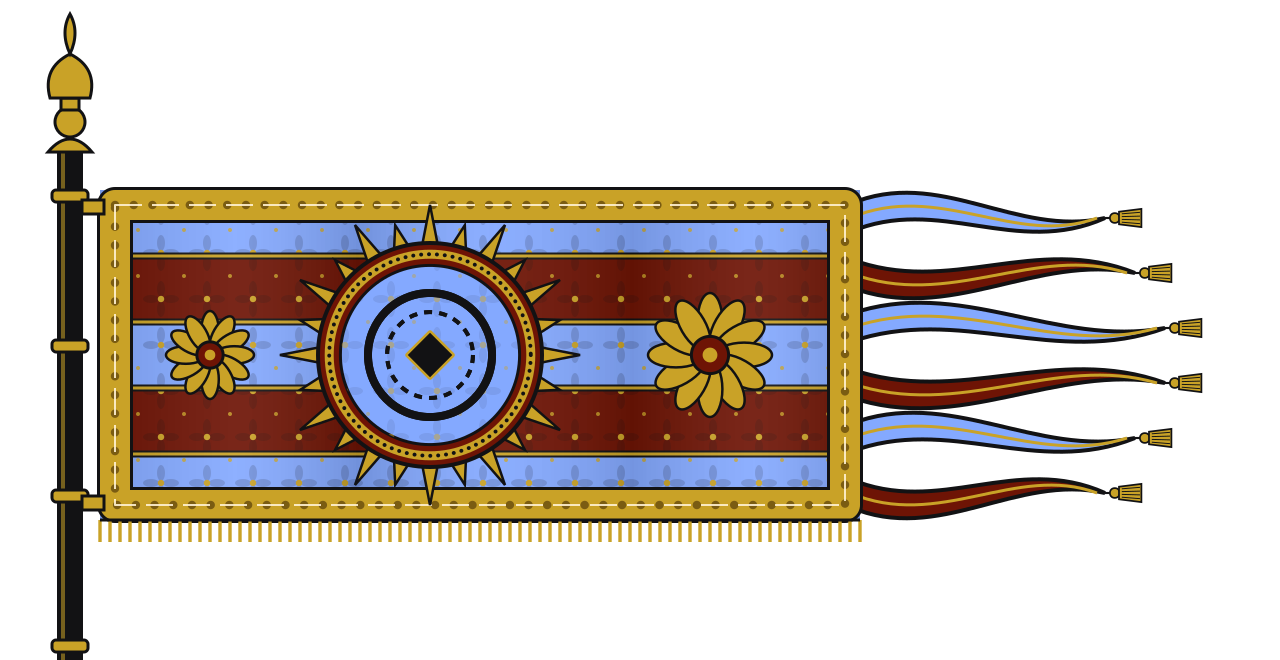
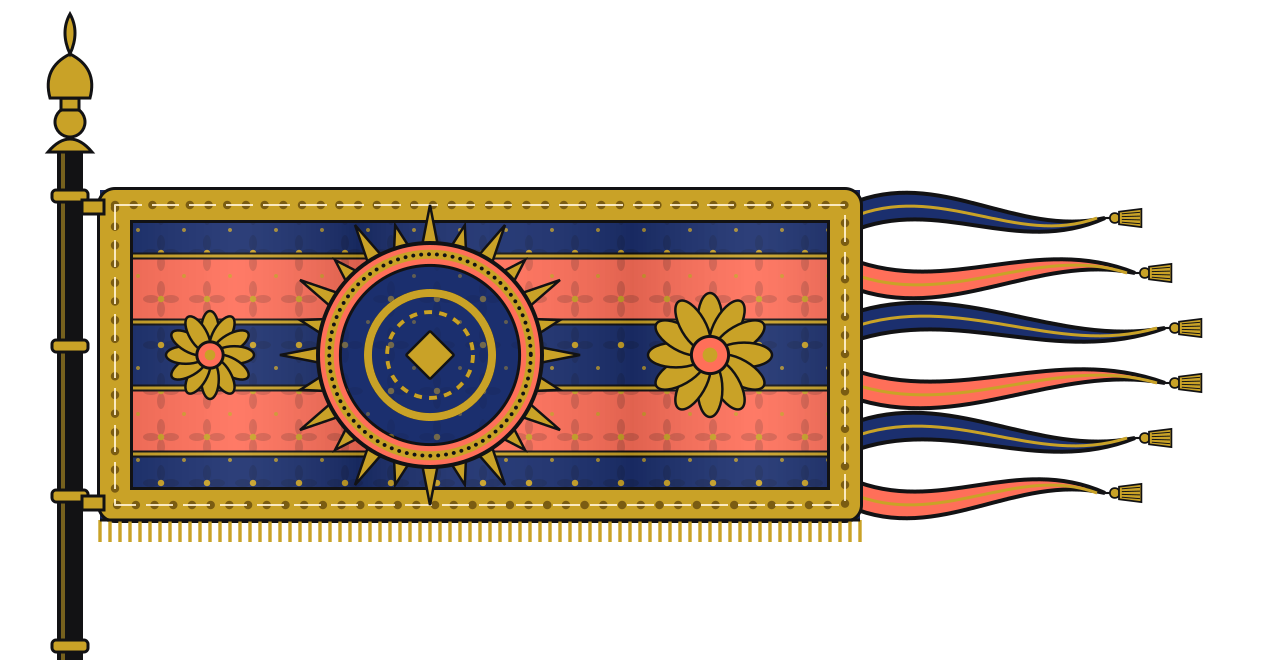
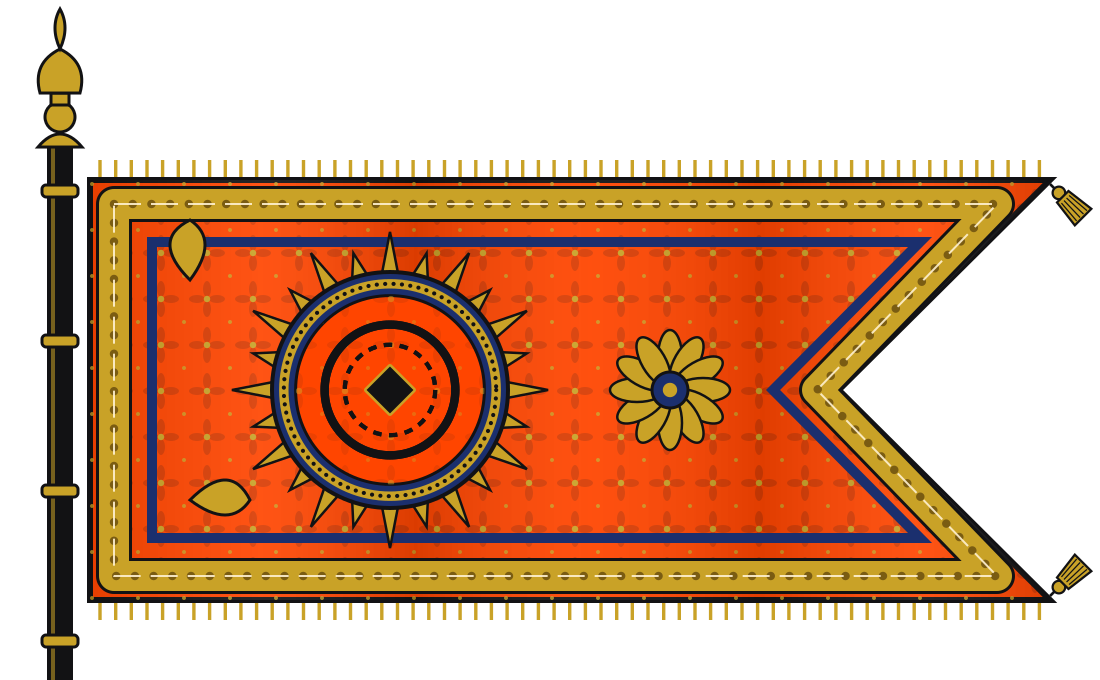
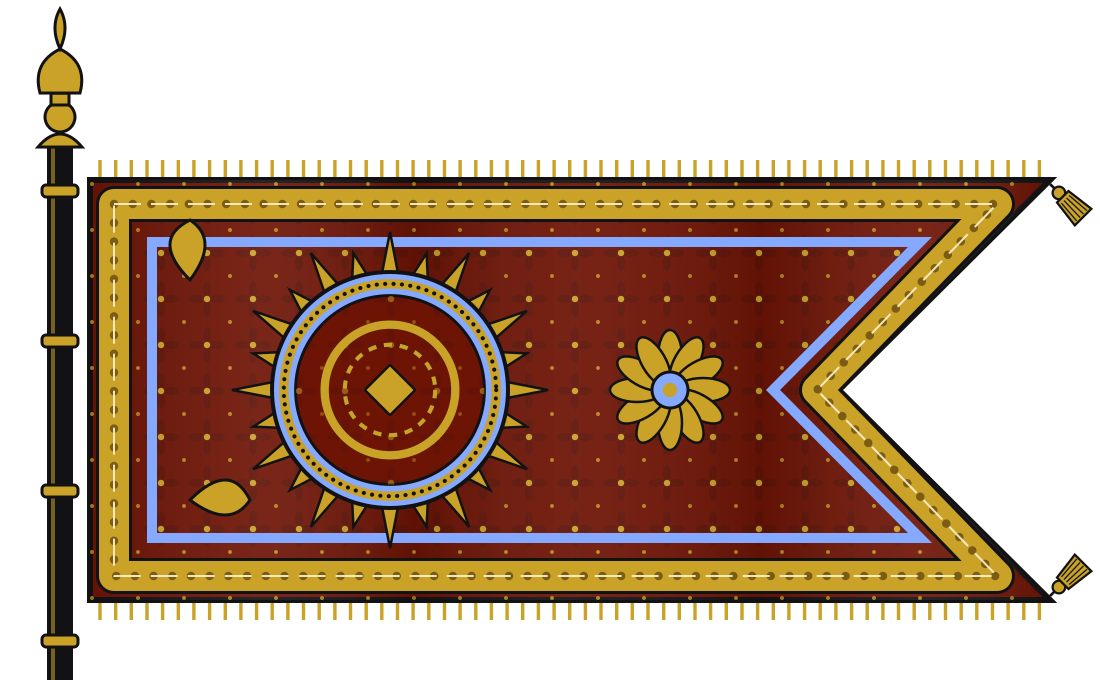


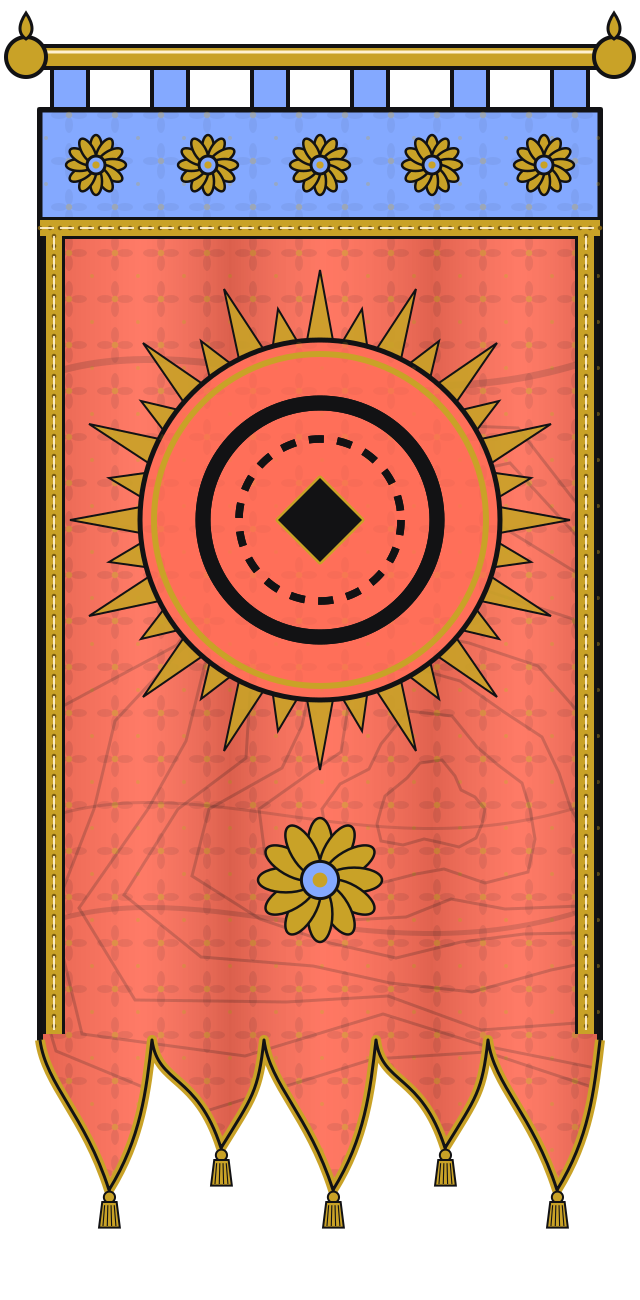
Historic banner
None recorded.
New flag types
| Accessory | For this clan | Basis |
|---|---|---|
| A9 Pota-dhvaja · ship and trade flag For ships, caravans and markets | Not yet designed for this clan | Design |
| A10 Utsava-patāka · festival flag Light, bright flag for fairs and festivals | Not yet designed for this clan | Design |
| A11 Shoka-dhvaja · mourning flag White cloth with the emblem outline in the clan's metal | Not yet designed for this clan | Design |
7. Regalia
| Accessory | For this clan | Basis |
|---|---|---|
| E1 Chhatra · house parasol The ceremonial umbrella | Not yet designed for this clan | Design |
| E2 Chamara · fly-whisks The pair of whisks beside the head of the house | Not yet designed for this clan | Design |
| E3 Danda · staff of office Staff or scepter | Not yet designed for this clan | Design |
| E4 Simhasana · seat The seat of the house, covered in clan cloth | Not yet designed for this clan | Design |
| E5 Khetaka · shield A round shield; the Changi and Dhanush are its flag forms | Not yet designed for this clan | Regional tradition |
| E6 Kula-ayudha · clan weapon The weapon the clan honours | Not yet found for this clan | Under research |
8. Worn
| Accessory | For this clan | Basis |
|---|---|---|
| F1 Kula-vastra · clan cloth The clan's woven pattern in its kit colours | Not yet designed for this clan | Design |
| F2 Kirti-vastra · honour cloth A cloth earned for a deed, not inherited | Not yet designed for this clan | Design |
| F3 Kula-mala · garland flower The flower or leaf the clan wears as a garland | Not yet found for this clan | Under research |
| F4 Chinha · house pin A metal badge with the pin emblem | Not yet designed for this clan | Design |
9. Records
| Accessory | For this clan | Basis |
|---|---|---|
| H1 Clan words A traditional line in the native script | Pandava Doras · “The community's self-name as printed by the Endangered Alphabets Project (also Pandava Rajas); not a line of its own words” | Documented |
| H2 Biruda · titles The house's title or titles | Anna or Ayya (Chinna Kondalu under Bhaktha landlords); Dora otherwise; 'Pandavakulam' returned as a title at the 1901 census | Documented |
| H3 Prashasti · praise genealogy The lineage as written at the head of a grant | Not yet found for this clan | Under research |
| H4 Vahi · clan register The book of the clan's births, marriages and deaths | Not yet found for this clan | Under research |
| H5 Rana-ghosha · war cry The clan's cry in battle or celebration | Not yet found for this clan | Under research |
10. VishwaVit · knower of the world
Game values are design choices for this project, not historical claims.
References
- Wikipedia, List of Scheduled Tribes in Odisha, read 2026-10-20, https://en.wikipedia.org/wiki/List_of_Scheduled_Tribes_in_Odisha
- Endangered Alphabets Project, Konda-Dora (Dr. Prasanna Sree), read 2026-11-02, https://www.endangeredalphabets.net/alphabets/konda-dora/
- Wikipedia, Konda language (Dravidian), read 2026-11-02, https://en.wikipedia.org/wiki/Konda_language_(Dravidian)
- Edgar Thurston and K. Rangachari, Castes and Tribes of Southern India, vol. 3 (Madras, 1909), Project Gutenberg eBook #42993, https://www.gutenberg.org/ebooks/42993
- ITDA tribes, Vizianagaram district website, Andhra Pradesh (read 29 Oct 2026, KulDevi run 347).
- Omniglot, Konda-Dora language and alphabet, read 2026-11-02, https://www.omniglot.com/writing/konda.htm
- Odisha State Tribal Museum, Tribes of Odisha: Kondadora, read 2026-11-14, https://ostm.in/?p=5462
- Drishti IAS, Porja, Bagata and Konda Dora Tribes, read 2026-10-21, https://www.drishtiias.com/daily-updates/daily-news-analysis/porja-bagata-and-konda-dora-tribes/print_manually
- W. Francis, Vizagapatam (Madras District Gazetteers, 1907), page 100 of the Wikisource transcription (Page:Vizagapatam.djvu), read 2026-11-01, https://kwx.liehendr.com/content/wikisource_en_all_maxi_2022-09/A/Page%3AVizagapatam.djvu/100
- Sushree Mohanty, Indigenous Colours of Odisha: Handbook on 62 Tribes (KISS), read 2026-10-20, https://kissnew.kiss.ac.in/wp-content/uploads/2026/05/Indigenous-Colours-of-Odisha-Handbook-on-62-Tribes-Sushree-Mohanty.pdf
- Parvathipuram Manyam district website, Tribes, read 2026-10-31, https://parvathipurammanyam.ap.gov.in/tribes/
- Vajiram and Ravi, Tribes of Andhra Pradesh, read 2026-10-10, https://vajiramandravi.com/current-affairs/tribes-of-andhra-pradesh/
- Edgar Thurston and K. Rangachari, Castes and Tribes of Southern India, vol. 6 (Madras, 1909), Project Gutenberg eBook #42996, https://www.gutenberg.org/ebooks/42996
- Edgar Thurston and K. Rangachari, Castes and Tribes of Southern India, vol. 5 (Madras, 1909), Project Gutenberg eBook #42995, https://www.gutenberg.org/ebooks/42995
- Vizagapatam District Gazetteer, page 114, Wikisource mirror (read 31 Oct 2026, codex team run 114).
- P. Durga Rao, Ethnographic Note on Porjas of Andhra Pradesh, History Research Journal 5(6), 2019, read 2026-11-02, https://thinkindiaquarterly.org/index.php/hrj/article/download/12608/7926/
- State-wise ST list (annual report 2023-24), Andhra Pradesh Part I, read 2026-10-10, https://iiitl.ac.in/wp-content/uploads/2024/08/07014a84-st-list-as-per-annual-report_-2023-24.pdf