The Kolam, also called Kolawar and Mannervarlu in state lists, are a Dravidian-speaking Scheduled Tribe, listed as a PVTG in Maharashtra[1] and Telangana[2]. Their language, Kolami, is written in Devanagari and Telugu script and had 128,451 native speakers in the 2011 census[3]. Encyclopaedia and exam pages say that around the 12th century the Kolam served as priests for the Gonds[4][5]. Russell and Hira Lal recorded them in 1916 as a tribe mainly in Wun taluk, Yeotmal, akin to the Gonds in Hislop's account[6]. The Atlas gives Jangubai as their KulDevi, and the Jangubai cave shrine is a pilgrim site for Kolams and Gonds[7].
01Faith and deities
The Wikipedia infobox calls him the Kolams' tribal deity (no source credited there)[8]. The Atlas's KulDevi is Jangubai, kept in the rows below.
Jangubai of Kerameri, Adilabad, mother-goddess of Kolam and Gond clans[9]
A recorded tie between the clan and the goddess.
| Deity or tradition | Place in the clan's life | Evidence |
|---|---|---|
| Jangubai (Jangu Bai) | Mother-goddess of the Jangubai cave shrine; Kolams are named among the tribes who visit it; KulDevi in the Atlas (Saptamatrika family, with Narasimhi) | [7] |
| Sita | Principal deity in Mackenzie's account as recorded in 1916; honoured with first-fruits at harvest | [6] |
| Devi | Village guardian, propitiated with goats and fowls; two stones set up in the village centre when the village was founded | [6] |
| Yethmasurpen (god of soul) | Worshipped by Adivasis of the Gussadi-Dandari hamlets, which include Gond and Kolam Adivasis; puja at Padmalpuri Kako on the Godavari | [10] |
| Renuka, Jaitur, Maroti, Bhairum, SanSurayak, Jelayak | Listed by IndiaNetzone with animism, nature and ancestor worship alongside Hinduism; a weak source, not checked | [4] |
| Village goddess and Chavdi | The village goddess is installed before the Chavdi at the centre of the pod (hamlet) | [4] |
| Ancestors | Worshipped on a Monday in Poush (December); no betrothal or marriage in Poush | [6] |
02Temples
No temple built or endowed by Kolams is recorded in the extracts. The Jangubai cave shrine in Kota-Parandoli, Kerameri mandal, is a pilgrim site that Kolams visit with Gonds and Pardhans (Drishti, citing The Hindu; Sphoorthi). Russell (1916) records that Kolams are not impure to Hindus and may enter Hindu temples.
Built by the clan
Not recorded.
Given patronage or grants by the clan
Not recorded.
03Languages and scripts
| Language or script | Kind | Under the clan | Evidence |
|---|---|---|---|
| Kolami living | Dravidian; Central Dravidian, Kolami-Naiki group (ISO kfb, Northwestern Kolami) | The Kolam's own language; 128,451 speakers in the 2011 census, 54% of 239,583 Kolam | [3] |
| Kolami writing living | Devanagari and Telugu script | Samples printed in Devanagari on Wikipedia: १ ऒक्कॊद् (okkod), २ इन्दिङ् (indiṅ), १० पदि (padi), १०० नूऱ् (nūṟ), १००० सहस्रम् (Sahasram) | [3] |
| Kolami sentences | Samples as printed | आन् (ān) “I”; वद्दुन् (vaddun) “I am coming”; वरॆन् (varen) “I am not going”; a name question and answer in Devanagari (इन्नॆ पिदिर् तानॆद् ? and अन्नॆ पिदिर् रामन्द्), with no translation of the question in the extract | [3] |
| Marathi, Telugu, Hindi, Gondi and Lambada dialects living | Languages used alongside Kolami | Kolams switch among these in daily life; Kolami “athey” is dog, and the same sound in Hindi means “they come” | [11] |
| Kolami, at risk research | Report on endangered languages | Described as at risk of dying out (PARI, 14 June 2024) | [12] |
04Books and literature
No Kolam-authored book is recorded. The works below are cited on Wikipedia's Kolam people and Kolami pages; their titles and details are not checked here.
Written during the clan's history
| Work | Author | Kind | When | Link to the clan |
|---|---|---|---|---|
| The Kolam Tribals | Deogaonkar and Baxi | Ethnography | 2003 | [8] |
| Primitive Tribes in Contemporary India | Chaudhuri and Chaudhuri | Survey | 2005 | [8] |
| People of India: Maharashtra | K. S. Singh | Anthropological survey | 2004 | [8] |
| Tribal Health And Medicines | Kalla and Joshi | Health study | 2004 | [8] |
| Kolami studies | Emeneau (1955, 1961); Krishnamurti (2003) | Language studies (titles not in the extract) | 1955–2003 | [3] |
Given patronage by the clan
Not recorded.
05Thinkers and scholars
| Name | Field | Era | Contribution |
|---|---|---|---|
| G. A. Grierson | Linguistics | As quoted in Russell 1916 | Kolami a minor dialect near Canarese, Tamil and Telugu, close to Gondi; may be remnants of an old Dravidian tribe[6] |
| Emeneau | Linguistics | 1955, 1961 | Kolami studies; titles not in the extract[3] |
| Krishnamurti | Linguistics | 2003 | Kolami study; title not in the extract[3] |
| Atram Motiram | Researcher, quoted in 2025 | 2025 | Multilingualism is a key survival tool for trade and government services[11] |
The 1916 survey's authors reserve their view of the claim that all Kolams could once read and write (Mackenzie, cited by Russell)[6].
06Art and architecture
The extracts record bamboo and wooden craft, not painting, sculpture or woven art.
Painting and wall art
Not recorded.
Sculpture and temple art
Not recorded.
Temple and building architecture
Not recorded.
Weaving and textiles
Not recorded.
Clothing and jewellery
Not recorded.
Coins, pottery and crafts
| Art form | What it is | Era | Evidence |
|---|---|---|---|
| Bamboo craft | Mats, baskets and hand-painted artefacts | Present (2025) | [11] |
| Wooden crafts | Listed among occupations | Present | [4] |
07History
Gond priests, around the 12th century (encyclopaedia claim)
Encyclopaedia and exam pages say that around the 12th century the Kolam served as priests for the Gonds and represented some of their important gods[4][5]. No primary source for this is in the extracts, and Russell's 1916 Kolam entry does not mention it[6].
Michael Yorke's fieldwork in Asifabad and Lakshetipet taluks (date not confirmed in the extract) says that Gonds have no priestly caste. For rituals to deities outside their clan cult they commonly call in Kolams, and a Kolam often acts as priest for a Gond without formal payment or patronage, out of respect for Kolams as more traditional and closer to nature[13]. The part of Yorke read does not mention the 12th century and gives no date for this practice, so it cannot confirm the earlier claim.
Gond Rajas of Chanda
The Atlas places the Kolam under the Gond Rajas of Chanda as their historical polity. A Modern Asian Studies article on the Gond Rajas, 1818-1948, cites a list of Chanda rulers from Smith's 1869 Chanda settlement report that includes Ram Sing (1142) and Surja Bullal Singh (1207); the article gives no calendar era for these dates and does not mention Kolams[14]. No inscription or record of Kolams under that rule is in the extracts.
As recorded in 1916
Russell and Hira Lal describe the Kolam as a Dravidian tribe mainly in Wun taluk, Yeotmal, about 25,000 in all, with about 23,000 in Wun and the rest in the Wardha and Hyderabad tracts. Hislop held them to be akin to the Gonds; they do not intermarry with common Gonds but attend each other's weddings and eat from each other's hand[6].
Settlements in the 1916 account
Hislop placed the Kolams along the Kandi Konda or Pindi Hills south of the Wardha river, on the table-land east and north of Manikgad south to Dantanpalli, and on the west bank of the Pranhita[6].
Money and shifting cultivation
IndiaNetzone says that change began in the first decades of the 20th century with the money economy, and that shifting cultivation spread from the 1940s[4]. Vajiram adds that the Kolam formerly practised shifting cultivation on hill slopes and adopted much of the Gond way of life[5].
Claimed literacy
Mackenzie, cited by Russell, claims that all Kolams could once read and write; the authors of the 1916 survey reserve judgement on this[6].
Listing in the ST Order, amended to 2024
The 2024 consolidated Order lists "Kolam, Kolawar" in Andhra Pradesh Part I, serial 12, with a footnote that the entry was substituted by section 4 and the Second Schedule of Act 10 of 2003. The same page lists "Kolam" in Madhya Pradesh (Part VIII, serial 26) and Chhattisgarh (Part XX, serial 25). The page has no separate Telangana part, does not give the 1950 wording, and does not say when Kolams were first listed[15].
In a 2025 Supreme Court matter, six petitioners, including the MLA Tellam Venkata Rao, challenged the ST listing of Sugalis, Lambadis and Banjaras in Telangana. They name Kolams among the tribes recognised since 1950. That is the petitioners' claim, not a finding, and the court had not ruled when the report was published[16]. The same report describes the 1950 order for Hyderabad State as listing nine communities, without naming them in the extract.
08Journey and migrations
The extracts give no migration story. They place the Kolam in the forest hills of Yavatmal, Wardha and Adilabad and along the Pranhita and Penganga rivers.
Not recorded.
09Seats and lands
| Place | Role | Where today |
|---|---|---|
| Yavatmal and Wun taluk | Main Kolam area in 1916 (Russell) | Yavatmal, Chandrapur and Nanded districts of Maharashtra[8]; Wardha also named[1] |
| Adilabad and the Telangana hamlets | Forest hamlets; bamboo craft; farming | Adilabad (erstwhile)[11] |
| Kerameri mandal and the Jangubai hills | Pilgrim cave at Maharajguda hamlet, Kota-Parandoli | Komaram Bheem Asifabad district, Telangana[17][18] |
| Pranhita and Penganga banks | Riverside settlement (Hislop, 1916; farming along the Penganga) | Penganga bordering Maharashtra[11] |
| Madhya Pradesh and Chhattisgarh | States where Kolam is a Scheduled Tribe | Madhya Pradesh ST row 'Kolam', 224 (2011 census)[19] |
10Notable figures
Not recorded.
11Allies, rivals and marriages
| People | Relationship | When |
|---|---|---|
| Gond (ST-088) | Akin in Hislop's account; no intermarriage with common Gonds, but they attend each other's weddings; Kolams priests at Gond shrines (encyclopaedia); in fieldwork (date not confirmed) Gonds call Kolams for rituals to deities outside their clan cult (Yorke) | c. 12th century (encyclopaedia); 1916; fieldwork, date not confirmed |
| Naiki (Naik Gond) | Near-same dialect to the Kolami of Chanda; the Naik headman's title may link them (Hira Lal, Russell) | 1916 |
| Naikpod | Yorke groups Gonds, Kolams and Naikpods as basically equivalent cultivating groups, with Gonds dominant (Adilabad fieldwork) | Fieldwork, date not confirmed |
| Kolas of the Kolamallai hills | Hira Lal suggests a link, akin to the Todas (Russell); the Kol is ST-141, not established | 1916 |
| Toda (ST-317) | Kolami shares features with the Toda dialect of the Nilgiris (Wikipedia) | Linguistic note, undated |
| Kunbi | Dress and marriage like Kunbis (Russell) | 1916 |
| Maratha castes | Family names resemble Maratha castes (Russell) | 1916 |
| Mahar and Mang | Held lower by Kolams (Russell) | 1916 |
| Banjara (Lambadi, ST-173) | Studied in the same sky-lore paper as the Kolam (Vahia et al.) | — |
| Pardhan (ST-251) | Also visit the Jangubai shrine (Sphoorthi, Drishti) | 2019–2021 |
12Society and livelihood
The Kolam are endogamous and clan-exogamous (Wikipedia; IndiaNetzone). Village affairs run through a panchayat, a Naik headman and a chauri meeting-house.
Government and social order
| Institution or group | What it was | Evidence |
|---|---|---|
| Pod | Hamlet or village, with the Chavdi at its centre | [8][4] |
| Panchayat | Village council that settles disputes; courts mainly when the other party is not Kolam; the posts Naik, Mahajan, Karbhari, Ghatya and Tarma are for men only | [8] |
| Village family chiefs' council | Chosen for five-year terms | [4] |
| Naik | Headman who formerly distributed land and held jurisdiction with the panchayat; sacrifices at the village-closing rite (1916) | [6] |
| Chauri | Meeting-house at the end of the road; pipes and fire kept there; smoking only there (1916) | [6] |
| Joint families | Formerly organised in joint families responsible for farming (Singh 2004, via Wikipedia) | [8] |
| Clan exogamy | No marriage within the same clan | [5][20] |
| Burial grounds | Separate burial grounds | [4] |
| Kin terms | Bhasa (husband's elder brother), mama (husband's father), appa (husband's mother), dhobak (husband's grandfather), dhoi (husband's grandmother), sanjine (son-in-law), aap (wife's mother); cross-cousin marriage permitted (Singh 2004, via Wikipedia) | [8] |
| Marriage | Arranged, monogamous and dowry-free; capture marriage sometimes allowed but usually prearranged; marriageable at 18 to 20 (Wikipedia). In 1916 a wife could be captured when the father could not find a mate (Russell) | [8][6] |
| Divorce | The couple hold a dry stick over a liquor pot before the panchayat, call each other brother and sister, and break the stick (1916) | [6] |
| Inheritance | Sons inherit equally, else daughters (1916) | [6] |
Livelihood over time
| Era | Livelihood | Evidence |
|---|---|---|
| Recorded 1916 | Cultivators and labourers; good knowledge of trees, shrubs and herbs | [6] |
| Early 20th century | Change began with the money economy; shifting cultivation from the 1940s (IndiaNetzone) | [4] |
| Recent | Occupations: agriculture, forest work, hunting, wooden crafts, labour, animal husbandry and gathering; staple jowar (IndiaNetzone) | [4] |
| Today | Mainly farmers and forest workers (Vajiram 2025) | [5] |
| Today | Bamboo mats, baskets and painted artefacts; subsistence farming along the Penganga; children learn tree-climbing, stream swimming and honey harvesting (Deccan Chronicle 2025) | [11] |
| Today | Cotton farming in Yavatmal (PARI, 2024) | [12] |
| Today | A pilot bamboo plantation project in Adilabad aims to restore traditional livelihoods (Vajiram 2025) | [5] |
13Sub-clans and related clans
Twelve exogamous clans (pedi) are listed by Wikipedia, citing Singh (2004). Four divisions (Chal, Pach, Saha and Sat Deve) and further clan names come from IndiaNetzone, Vajiram (2025) and IAS GYAN. Russell (1916) records about fifty sept names in Marathi form, of which only Tekam was found among Gonds.
| Clan | Relation | Where | Size | In the Atlas | Evidence |
|---|---|---|---|---|---|
| Tekam | Sub-clan | Shared with Gonds (Russell 1916) | ST-502 | [6] | |
| Kodapa | Sub-clan | new clan candidate | [8] | ||
| Athram | Sub-clan | new clan candidate | [8] | ||
| Godhankar | Sub-clan | new clan candidate | [8] | ||
| Wathora | Sub-clan | new clan candidate | [8] | ||
| Shivle | Sub-clan | new clan candidate | [8] | ||
| Parsinekul | Sub-clan | new clan candidate | [8] | ||
| Ghotkar | Sub-clan | new clan candidate | [8] | ||
| Paraskar | Sub-clan | new clan candidate | [8] | ||
| Ravikul | Sub-clan | new clan candidate | [8] | ||
| Mautkar | Sub-clan | new clan candidate | [8] | ||
| Shootkar | Sub-clan | new clan candidate | [8] | ||
| Chal Deve | Sub-clan | new clan candidate | [5][20] | ||
| Pach Deve | Sub-clan | new clan candidate | [5][20] | ||
| Saha Deve | Sub-clan | new clan candidate | [5][20] | ||
| Sat Deve | Sub-clan | new clan candidate | [5][20] | ||
| Bhurchi | Sub-clan | new clan candidate | [4] | ||
| Lakhu | Sub-clan | new clan candidate | [4] | ||
| Vadang | Sub-clan | new clan candidate | [4] | ||
| Aanzi | Sub-clan | new clan candidate | [4] | ||
| Konde | Sub-clan | new clan candidate | [4] | ||
| Shilekar | Sub-clan | new clan candidate | [4] | ||
| Kodape | Sub-clan | new clan candidate | [4] | ||
| Bode | Sub-clan | new clan candidate | [4] | ||
| Rampure | Sub-clan | new clan candidate | [4] | ||
| Gond | Related people | Adilabad and Yavatmal | ST-088 | [1][2] | |
| Naiki (Naik Gond) | Related people | Chanda | new clan candidate | [6] | |
| Kolas of the Kolamallai hills | Related people | Kolamallai hills | new clan candidate | [6] | |
| Toda | Related people | Nilgiris | ST-317 | [3] | |
| Kunbi | Related people | NE-025 | [6] | ||
| Maratha castes | Related people | SUB-163 | [6] | ||
| Mahar | Related people | SUB-159 | [6] | ||
| Mang | Related people | SUB-162 | [6] | ||
| Lambadi (Banjara) | Related people | ST-173 | [21] | ||
| Pardhan | Related people | ST-251 | [22] |
Clans marked "new clan candidate" are not in the Atlas yet.
14Surnames
Clan names are used as surnames (IndiaNetzone; Vajiram 2025; IAS GYAN). Russell (1916) notes that family names resemble Maratha castes and that the sept names are in Marathi form whose meaning the tribe does not know[6].
| Surname | Clan or sub-clan | Where | People with this surname | Also used by other communities |
|---|---|---|---|---|
| Tekam | Tekam | Gonds use the same name (Russell 1916) | not yet counted | Yes |
| Kodapa | Kodapa | not yet counted | Not checked | |
| Athram | Athram | not yet counted | Not checked | |
| Godhankar | Godhankar | not yet counted | Not checked | |
| Wathora | Wathora | not yet counted | Not checked | |
| Shivle | Shivle | not yet counted | Not checked | |
| Parsinekul | Parsinekul | not yet counted | Not checked | |
| Ghotkar | Ghotkar | not yet counted | Not checked | |
| Paraskar | Paraskar | not yet counted | Not checked | |
| Ravikul | Ravikul | not yet counted | Not checked | |
| Mautkar | Mautkar | not yet counted | Not checked | |
| Shootkar | Shootkar | not yet counted | Not checked | |
| Chal Deve | Chal Deve | not yet counted | Not checked | |
| Pach Deve | Pach Deve | not yet counted | Not checked | |
| Saha Deve | Saha Deve | not yet counted | Not checked | |
| Sat Deve | Sat Deve | not yet counted | Not checked | |
| Bhurchi | Bhurchi | not yet counted | Not checked | |
| Lakhu | Lakhu | not yet counted | Not checked | |
| Vadang | Vadang | not yet counted | Not checked | |
| Aanzi | Aanzi | not yet counted | Not checked | |
| Konde | Konde | not yet counted | Not checked | |
| Shilekar | Shilekar | not yet counted | Not checked | |
| Kodape | Kodape | not yet counted | Not checked | |
| Bode | Bode | not yet counted | Not checked | |
| Rampure | Rampure | not yet counted | Not checked |
Counts are of everyone with the surname, from the cited source and year, not only members of this clan. A surname shared with other communities says nothing about any one person's origin.
15Songs and music
No song text is in the extracts. Mackenzie, cited by Russell (1916), says the songs and ballads were borrowed from the Marathas, and that women grinding corn sang Marathi songs[6].
None recorded yet.
Instruments and styles
| Instrument or style | What it is | Evidence |
|---|---|---|
| Tapate | Drum (1916) | [6] |
| Wass | Bamboo flute; the name comes from Sanskrit waunsh (1916) | [6] |
| Dappu, Ghumela, Dhol, Vetti, Karra, Pepri, Thudum | Placed before the deity at the Gussadi-Dandari festival of Gond and Kolam Adivasis | [10] |
| Sannayi, Kaliko, Tudum | Used at the opening rite of the Jangu Bai Jatara | [9] |
16Poems, lullabies and children's rhymes
No poem, lullaby or rhyme of the Kolam is in the extracts.
None recorded yet.
17Stories, legends and proverbs
Stories and legends
| Story | What happens | Told by | Evidence |
|---|---|---|---|
| Pandava descent | Some Kolams consider themselves descendants of the Pandavas; a community belief | Kolams (community belief) | [4] |
| Gussadi-Dandari origin legend | The festival is said to have come from the Gond saint Pahandi Kupar Lingo, as told by a village head of Chichdhari, Adilabad | Village head, Chichdhari (quoted in news) | [10] |
Proverbs and sayings
Not recorded.
18Festivals and fairs
| Festival or fair | When | Where | What happens |
|---|---|---|---|
| Gussadi-Dandari | October to November, about Deepavali; about two weeks | Adilabad hamlets; believed to have started in Mancherial district | Marks the end of the harvest; Gond and Kolam Adivasis take part; men dance before women and elders speak at the end; closes with the Kolabodi puja at the mahua (Ippa) tree[10] |
| Jangu Bai Jatara | Month of Pushya, after Sankranti; about one month (begun 16 January 2021; 22 December 2025 per Telangana360) | Maharajguda hamlet, Kota-Parandoli, Kerameri mandal | Festival of Raj Gonds and Kolams; lamp lighting, holy dip in the Toplakasa tank, hens and sheep offered to village goddesses, wish-stone lifting[9][22] |
| Chait implement worship | Last day of Chait (April) | Villages | Implements worshipped with turmeric and vermilion; in May juari stumps are burnt and the ashes offered (1916)[6] |
| Poush ancestor rite | A Monday in Poush (December) | Villages | Ancestors worshipped; no betrothal or marriage in Poush (1916)[6] |
| Bandi village-closing rite | Not dated | Village boundaries | Four bandi stones at the boundary points, with fowl buried under each; the Naik sacrifices a goat and fowls to Sita; a salt line (bandesh) is drawn and the village closed (1916)[6] |
| Festival and ritual list | Not dated | Not stated | Kargul, Dussehra, Nag Panchami, Akharpakha, Atari, Pola, Fulzadni, Holi, Diwali, Aaichi, Pettadiyam and Metti-Diyam; rituals Matya or Churaghali, Bai-Baki, Sati, Jaitur Pooja, Waghai Pooja, Chait, Mohdombari, Bhimayak, Korod and Morang Dev pooja (names only)[4] |
19Food, dress and games
Food
| Item | What it is | Evidence |
|---|---|---|
| Staple | Jowar (IndiaNetzone) | [4] |
| Meat (as recorded in 1916) | Eat the flesh of rats, tigers, snakes and squirrels, but not dogs, donkeys or jackals (Russell) | [6] |
Dress
| Item | What it is | Evidence |
|---|---|---|
| Men | Shirts, dhotis, a shoulder cloth (shela), turbans and caps; silver Kardoda waist strap and kada wrist bangle | [4] |
| Women | Didki, lugda, choli and saree; silver sakli saree ornaments, sikke masrya and mukkeram | [4] |
| Married women | Mangalsutra and bangles | [8] |
| Gussadi topi | Men's peacock-feather cap (maal bora) worn at the Gussadi-Dandari festival | [10] |
| Dress as recorded in 1916 | Dress like the Kunbis; never wear shoes | [6] |
| Tattoos | Tattooing is popular, and some engrave clan totems; no totem is named | [4] |
Games and martial arts
Not recorded.
Tags: living still practised · revived brought back after a break · lost known only from records · research reported but not yet confirmed from a source. Songs and poems under copyright are listed by title only; restricted or sacred material is noted without its content.
20Status today
The Kolam are a Scheduled Tribe, with 239,583 people in the 2011 census, most of them in Maharashtra and Telangana[8].
Who carries the name today
| Community | Link | Basis | Evidence |
|---|---|---|---|
| Pandavas (claimed by some Kolams) | Community tradition | [4] |
Recognised heritage
| What | Recognition | Evidence |
|---|---|---|
| Jangu Bai Jatara | Month-long festival of Raj Gonds and Kolams in Pushya (Telangana Today, 2021) | [9] |
| Jangubai cave temple | Pilgrimage site for aboriginal tribes on the Maharashtra-Telangana border (The Hindu, via Drishti, 2019) | [7] |
| Bamboo craft | A pilot bamboo plantation project in Adilabad (Vajiram, 2025) | [5] |
| PVTG villages | 390 PVTG villages identified, not split by tribe, in four Telangana districts; the government drive extends health, education, roads, water and power (IAS GYAN) | [20] |
No community review of this page is recorded. The sources are encyclopaedia, news, exam-prep and academic pages, and the 1916 survey.
21For children
The bamboo hills
Far in the hills of Adilabad and Yavatmal live the Kolam people. Their forests are full of bamboo, and they weave it into mats and baskets. Many of them farm the land and work in the forest. Their children learn to climb trees, swim in the streams and gather honey. The Kolam speak their own language, Kolami, and many also speak Telugu, Marathi and Gondi. Every year, during the Jangu Bai fair, people walk to a cave on a cliff, and some go barefoot. The Kolam are a Scheduled Tribe of India, and their story is still being told.
22Across the project
| Project | What carries this clan | Status |
|---|---|---|
| Atlas of the Janas | Homeland in Adilabad and Yavatmal | From the Atlas |
| KulDevi and GrahDevi | KulDevi Jangubai, Saptamatrika family with Narasimhi; GrahDevi forms Brahmani, Maheshvari, Kaumari, Vaishnavi, Varahi, Indrani, Chamunda and Narasimhi | From the Atlas |
| Planet naming | No planet or star name for the Kolam in the extracts | — |
| Renaming and waters | Rivers named in the sources: Pranhita (Hislop, 1916), Penganga (Deccan Chronicle, 2025), Godavari (The News Minute, 2020) | Cited above |
23Open questions
- A native-script name for the Kolam (Devanagari or Telugu) is not in the extracts; the native line is left empty.
- The Kolam part of arXiv 1406.3044 is not in the cache beyond the note on the five gods; read the paper's Kolam section.
- Kodape (IndiaNetzone) and Kodapa (Wikipedia) may be one clan under two spellings.
- Are the Kolas of the Kolamallai hills (Russell) the Kol (ST-141)?
- The full sept list (People of India, Singh 2004) is not in the cache; the twelve clans come from Wikipedia.
- The 12th-century priesthood for the Gonds rests on encyclopaedia and exam pages; a primary source is needed. Yorke's undated fieldwork describes the practice but does not date it.
- No Kolam songs, lullabies, rhymes, proverbs or folk texts are in the extracts.
- The Odisha SEBC (OBC) list, item 77, names a Kolam: check whether it is the same people.
- The 2025 petitioners claim Kolams were recognised since 1950. The 1950 ST Order text and the Telangana ST list entry with its date are not in the cache; the 2024 consolidated Order has no Telangana part, and the nine-community 1950 Hyderabad list is not named.
- The IAS GYAN note gives 390 PVTG villages without a tribe split; a Kolam count is needed.
- IndiaNetzone says some Kolams engrave clan totems; none is named.
- The region 'Central' on the sub-clan drafts is inherited from the Kolam, not from a source; the reviewer should confirm it.
- Contradiction: the main deity is Bhimayyak (Wikipedia infobox,[8]), but the 1916 account gives Sita as the principal deity (Mackenzie, via[6]); the deities section keeps both with their sources.
24Astitva
अस्तित्व · being, existence: everything by which the clan is known
The extracts record no seal, coin, war cry or totem name for the Kolam. The headman's title (Naik), his stick, the village boundary stones and the stones for Devi are recorded in 1916[6].
Every clan has every accessory, royal objects included. Each one says how it is known: Documented This clan's own object is recorded. · Regional tradition Recorded for the region or for peoples like this one, not for this clan. · Design Made for this project, with no historical claim. · Under research To be found for this clan from sources. Legends and titles are written in the clan's own script.
1. Seals and coins
| Accessory | For this clan | Basis |
|---|---|---|
| B1 Rajamudra · house seal Round seal with the clan emblem and a short legend in the clan's script | Not yet designed for this clan | Design |
| B2 Anguliya-mudra · signet ring Personal seal ring of the head of the house | Not yet designed for this clan | Design |
| B3 Chhapa · house stamp Ink or block stamp for letters, goods and cloth | Not yet designed for this clan | Design |
| B4 Tamrapatra · charter plate Copper-plate grant on a ring, closed with the house seal | Not yet designed for this clan | Design |
| B5 Shreni-mudra · guild or trade seal Seal for the clan's trade, craft or caravan | Not yet designed for this clan | Design |
| C1 Clan coin Emblem or deity on one side, a legend in the clan's script | Not yet designed for this clan | Design |
| C2 Coin die The die that strikes the coin | Not yet designed for this clan | Design |
2. Living symbols
| Accessory | For this clan | Basis |
|---|---|---|
| I1 Totem trio The tree, bird and animal the clan protects | Not named in the extracts; IndiaNetzone says some Kolams tattoo or engrave clan totems | Under research |
| I2 Kaval-maram · guardian tree The tree that stands at the clan's seat | Not yet found for this clan | Under research |
3. Stone and gate
| Accessory | For this clan | Basis |
|---|---|---|
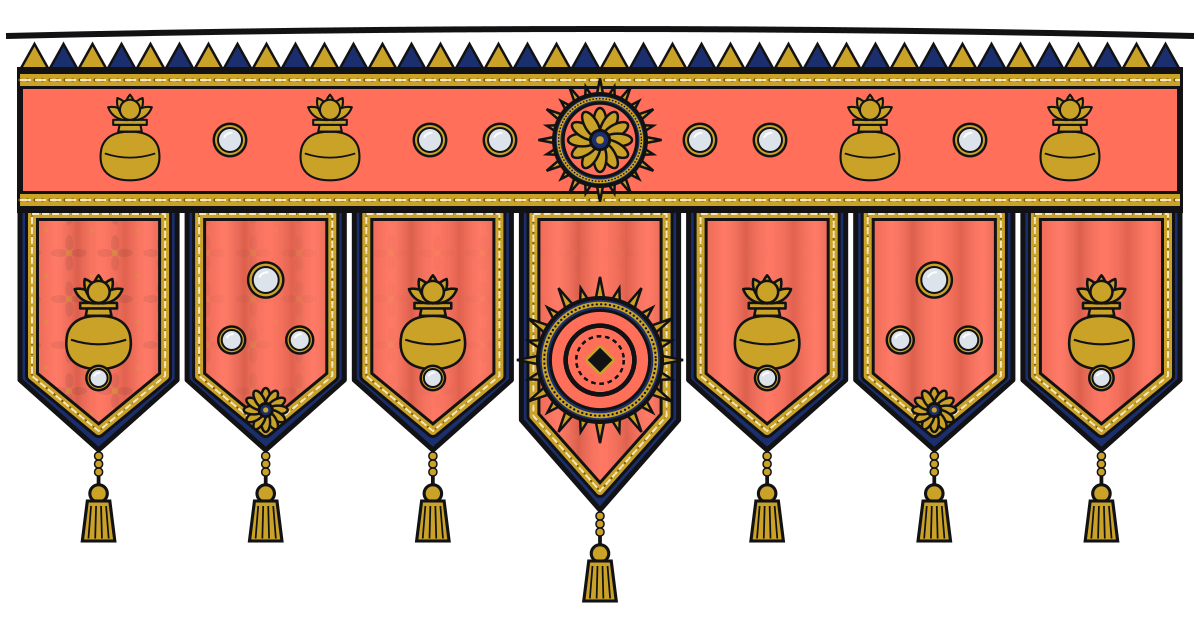
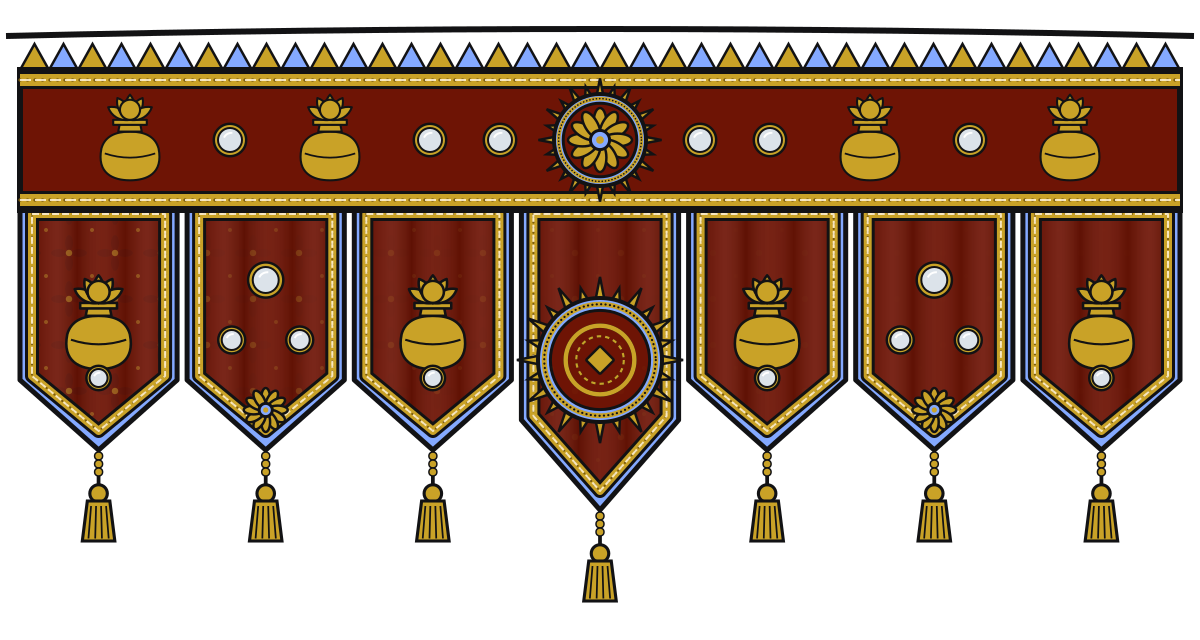
| G1 Torana · gateway The built gate of the seat; the cloth Toran hangs in it | Not yet designed for this clan | Regional tradition |
| G2 Viragallu · hero stone Carved panel stone for a member who died defending the clan | Not yet designed for this clan | Regional tradition |
| G3 Kula-shila · clan stones Standing and table stones that remember the ancestors | Two stones for the village goddess Devi, set up in the village centre when the village was founded | Documented |
| G4 Jayastambha · victory pillar A pillar raised for a victory | Not yet designed for this clan | Design |
| G5 Sima-shila · boundary stone Marks the clan's land, with a line in the native script | Four bandi stones at the boundary points, with fowl buried under each; a salt line (bandesh) is drawn; the Naik's stick bars the one open path and the village is closed | Documented |
4. Sounds
| Accessory | For this clan | Basis |
|---|---|---|
| D1 Pancha-mahashabda · five great sounds The right to five instruments | Not yet designed for this clan | Design |
| D2 Shankha · clan conch The clan's own named war conch | Not yet designed for this clan | Design |
| D3 Murasu · house drums Three drums: war, charity and justice | Not yet designed for this clan | Design |
5. Kit: colours, metals and emblems
The Kolam have no recorded arms (Atlas: historically associated flag or emblem, none known). The master-sheet emblem, a bamboo basket with a shrine lamp, is a project design. Its two sources are the bamboo craft[11] and the Kolam's priestly service at Gond shrines[5].
| Part of the kit | This clan |
|---|---|
| Field | Deep Cosmic Blue #9BB0FF |
| Accent | Warm Red-Orange #FF6F59 |
| Emblem colour | Charcoal Black #121214 |
| Zari metal | Gold |
| Main emblem | A bamboo basket |
| Second image | A shrine lamp |
| Night and day | Every visual accessory has two versions: by night the emblem on the dark field, by day the clan's field colour on cloth woven from its metal. |
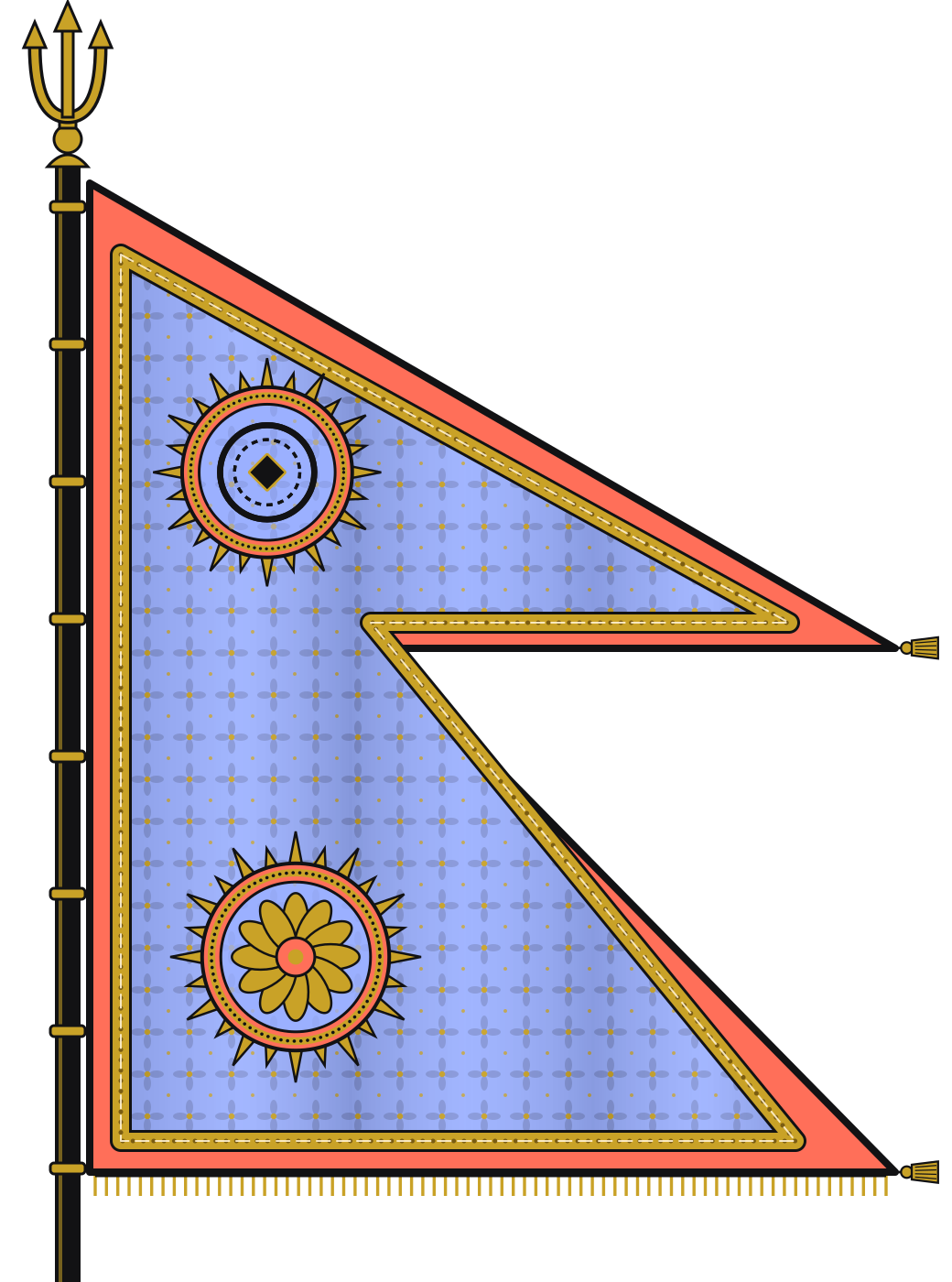
6. Flags
Every clan has every flag type; the type says the occasion and the colours say the clan. The outlined card is the flag the Atlas assigns.
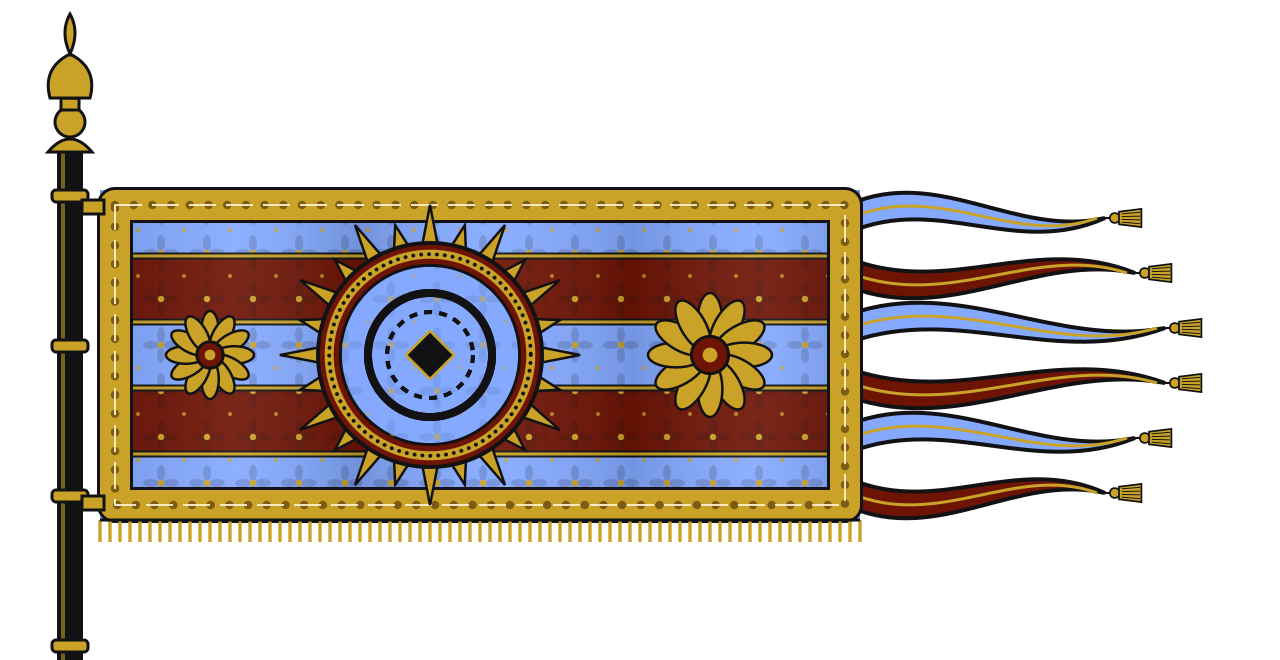
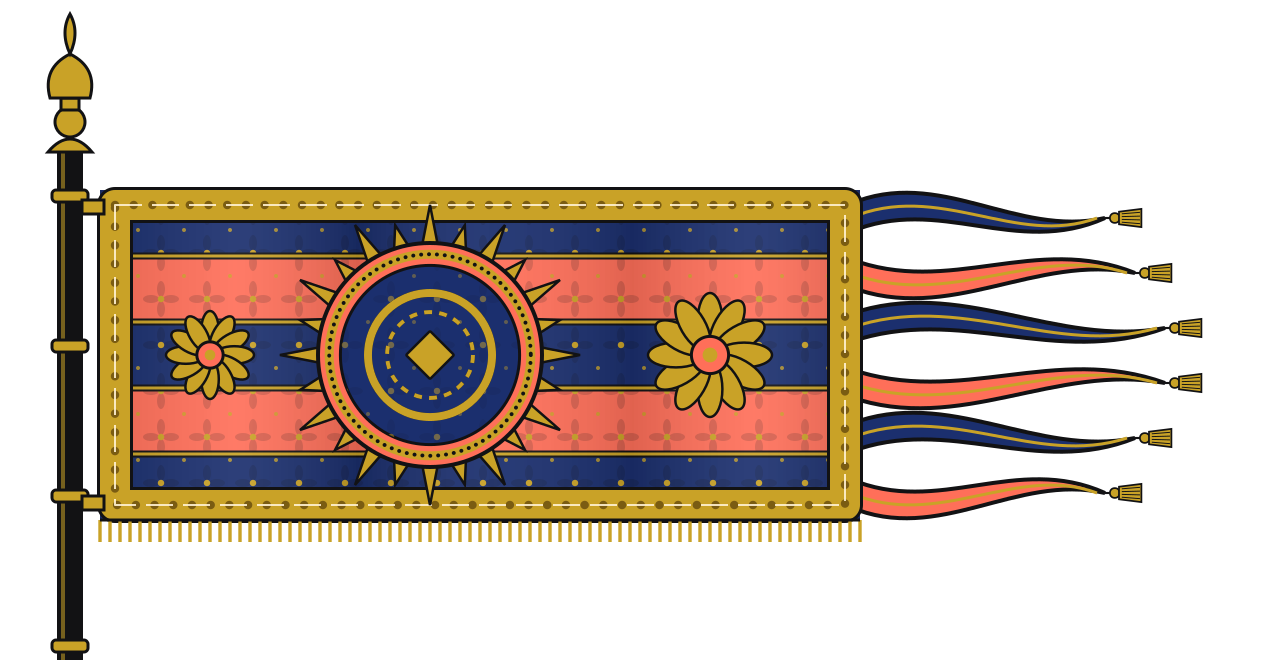
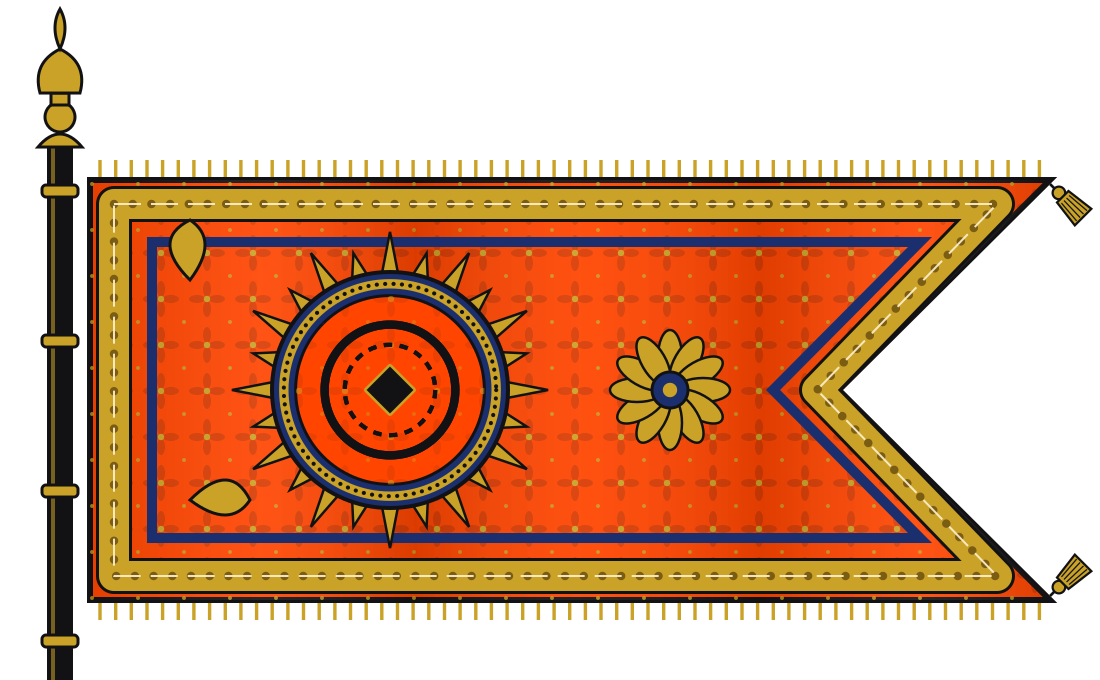
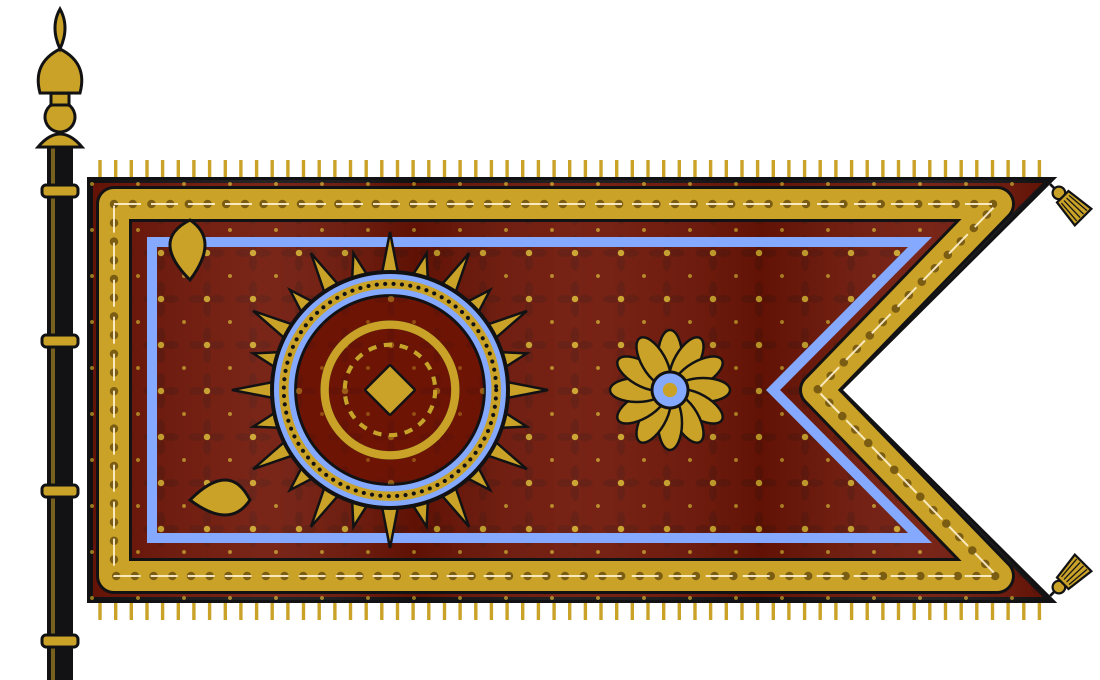
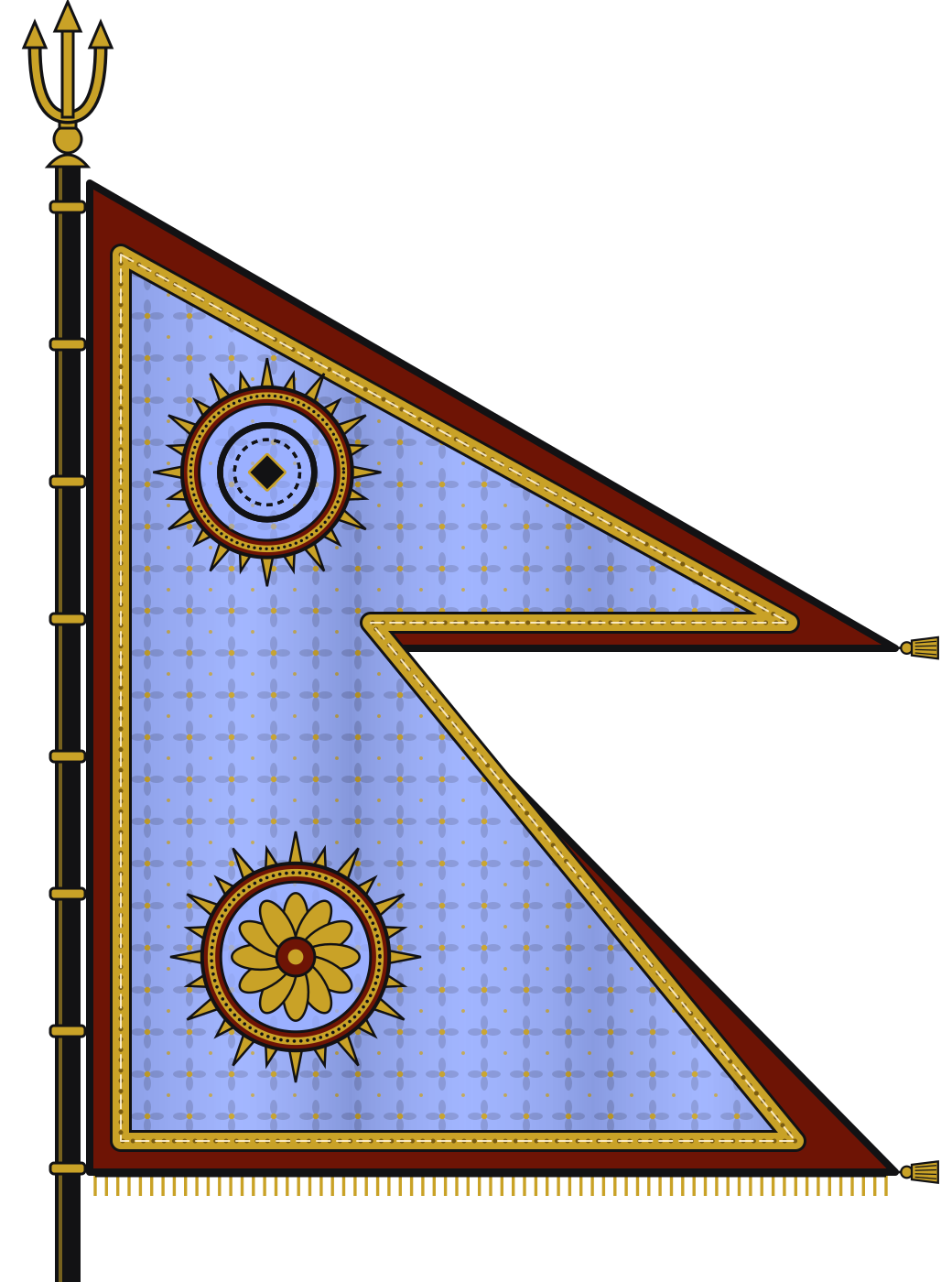
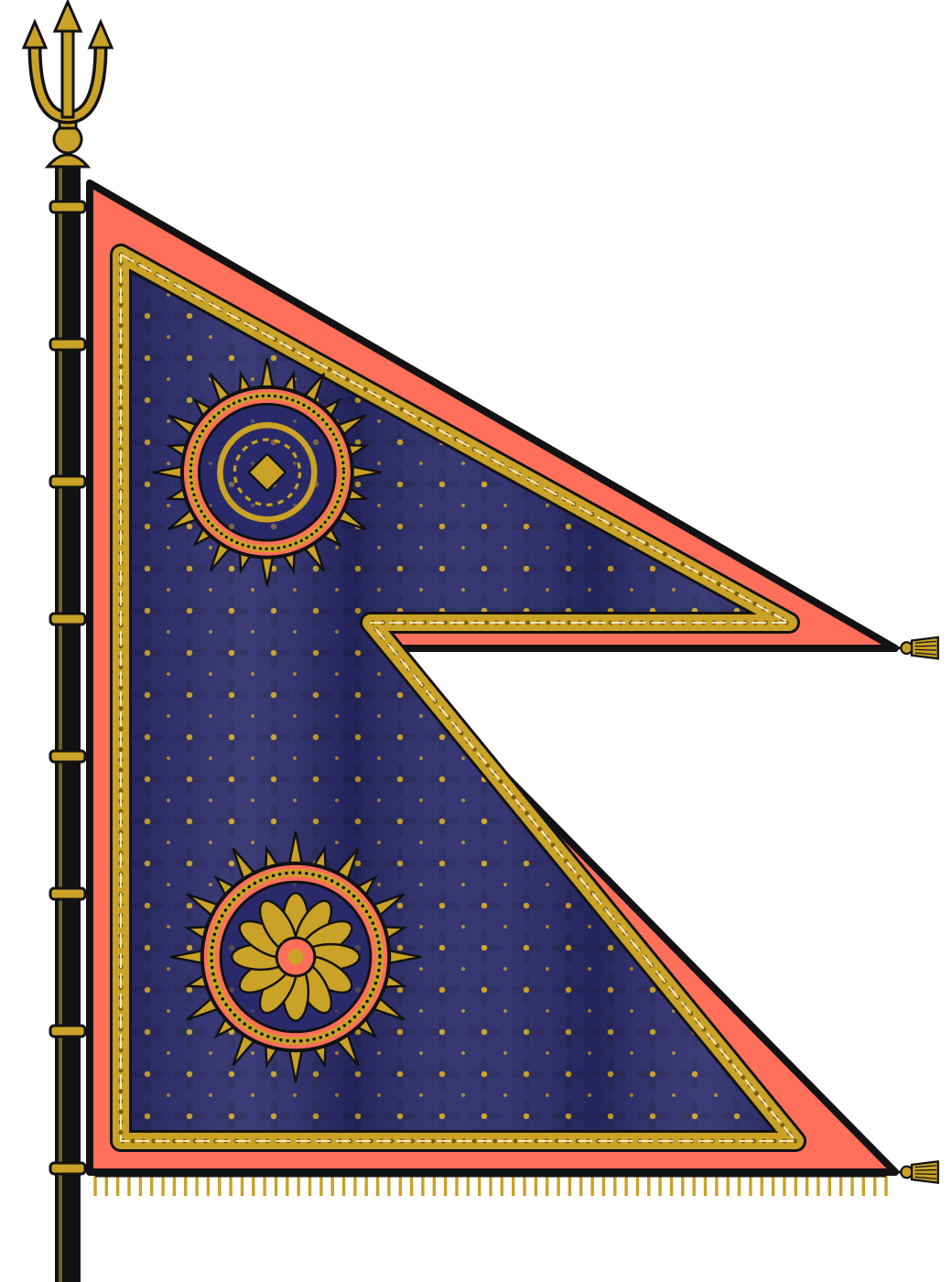

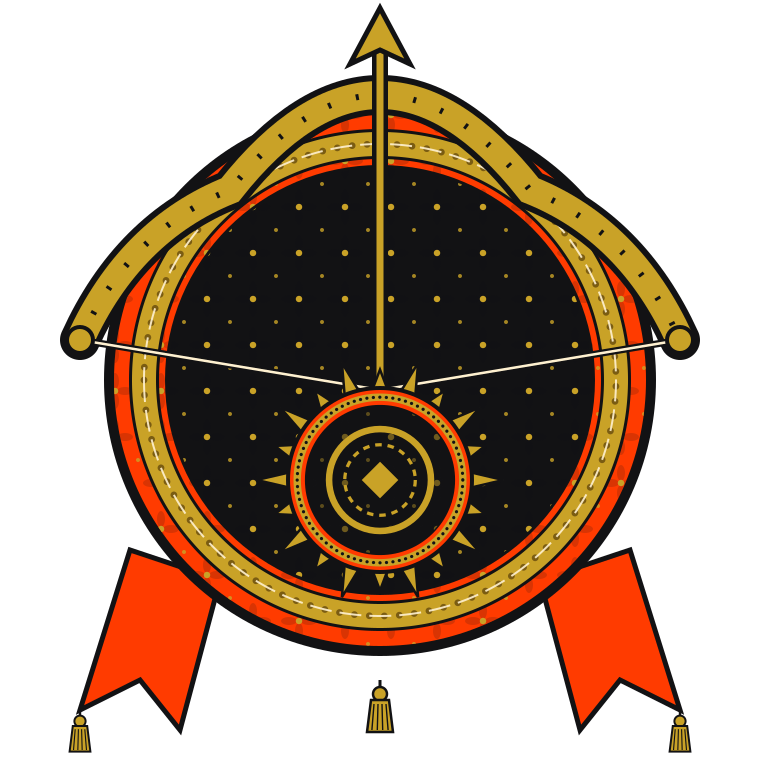

Historic banner
None known
New flag types
| Accessory | For this clan | Basis |
|---|---|---|
| A9 Pota-dhvaja · ship and trade flag For ships, caravans and markets | Not yet designed for this clan | Design |
| A10 Utsava-patāka · festival flag Light, bright flag for fairs and festivals | Not yet designed for this clan | Design |
| A11 Shoka-dhvaja · mourning flag White cloth with the emblem outline in the clan's metal | Not yet designed for this clan | Design |
7. Regalia
| Accessory | For this clan | Basis |
|---|---|---|
| E1 Chhatra · house parasol The ceremonial umbrella | Not yet designed for this clan | Design |
| E2 Chamara · fly-whisks The pair of whisks beside the head of the house | Not yet designed for this clan | Design |
| E3 Danda · staff of office Staff or scepter | The Naik's stick, laid across the one open path in the village-closing rite | Documented |
| E4 Simhasana · seat The seat of the house, covered in clan cloth | Not yet designed for this clan | Design |
| E5 Khetaka · shield A round shield; the Changi and Dhanush are its flag forms | Not yet designed for this clan | Regional tradition |
| E6 Kula-ayudha · clan weapon The weapon the clan honours | Not yet found for this clan | Under research |
8. Worn
| Accessory | For this clan | Basis |
|---|---|---|
| F1 Kula-vastra · clan cloth The clan's woven pattern in its kit colours | Not yet designed for this clan | Design |
| F2 Kirti-vastra · honour cloth A cloth earned for a deed, not inherited | Not yet designed for this clan | Design |
| F3 Kula-mala · garland flower The flower or leaf the clan wears as a garland | Not yet found for this clan | Under research |
| F4 Chinha · house pin A metal badge with the pin emblem | Not yet designed for this clan | Design |
9. Records
| Accessory | For this clan | Basis |
|---|---|---|
| H1 Clan words A traditional line in the native script | वद्दुन् · “vaddun: “I am coming” (Kolami sample as printed)” Kolami sample on the Wikipedia Kolami page[3] | Design |
| H2 Biruda · titles The house's title or titles | Naik, the headman's title; panchayat posts Mahajan, Karbhari, Ghatya and Tarma | Documented |
| H3 Prashasti · praise genealogy The lineage as written at the head of a grant | Not yet found for this clan | Under research |
| H4 Vahi · clan register The book of the clan's births, marriages and deaths | Not yet found for this clan | Under research |
| H5 Rana-ghosha · war cry The clan's cry in battle or celebration | Not yet found for this clan | Under research |
10. VishwaVit · knower of the world
Game values are design choices for this project, not historical claims.
References
- Vajiram and Ravi, Tribes of Maharashtra (exam-prep site), read 2026-10-10, https://vajiramandravi.com/current-affairs/tribes-of-maharashtra/
- Vajiram and Ravi, Tribes of Telangana, read 2026-10-10, https://vajiramandravi.com/current-affairs/tribes-of-telangana/
- Wikipedia, Kolami language, read 2026-11-06, https://en.wikipedia.org/wiki/Kolami
- IndiaNetzone, Kolam Tribe, read 2026-11-06, https://www.indianetzone.com/kolam_tribe
- Vajiram and Ravi, Kolam Tribes, 18 Oct 2025, read 2026-11-06, https://vajiramandravi.com/current-affairs/kolam-tribes/
- R. V. Russell, The Tribes and Castes of the Central Provinces of India, vol. 3 (1916), Project Gutenberg #41424, read 2026-10-10, https://gutenberg.org/cache/epub/41424/pg41424-images.html
- "Jangubai Cave Temple and Kaplai Caves", Drishti IAS daily news analysis (citing The Hindu), 14 December 2019.
- Wikipedia, Kolam people, read 2026-10-10, https://en.wikipedia.org/wiki/Kolam_people
- Adivasis gear up for Jangu Bai jatara, Telangana Today, 23 January 2021 (read 29 Oct 2026, KulDevi run 351).
- The News Minute, Adivasi hamlets in Adilabad celebrate Gussadi Dandari, 17 Nov 2020, read 2026-11-06, https://www.thenewsminute.com/article/pics-adivasi-tribal-hamlets-adilabad-celebrate-gussadi-dandari-festival-137794
- Pillalamarri Srinivas, Telangana's Kolams turn multilingual to make ends meet, Deccan Chronicle, 19 April 2025, read 2026-11-06, https://www.deccanchronicle.com/southern-states/telangana/telanganas-kolams-turn-multilingual-to-make-ends-meet-1873878
- PARI (Ritu Sharma, Sanviti Iyer, Priti David), The Kolami-speakers of Yavatmal, 14 Jun 2024, via South Asia Commons, read 2026-11-06, https://southasiacommons.net/artifacts/12516581/the-kolami-speakers-of-yavatmal/view
- Michael Yorke, The Situation of the Gonds of Asifabad and Lakshetipet Taluks, Adilabad District, read 2026-11-20, PDF
- Modern Asian Studies, Subordination of the Sovereigns: Colonialism and the Gond Rajas in Central India, 1818–1948, read 2026-11-20, link
- Constitution (Scheduled Tribes) Order, 1950 (amended up to 2024), Legitquest, read 2026-11-20, link
- Verdictum, Tellam Venkata Rao v Union of India (report, 26 July 2025), read 2026-10-10, https://www.verdictum.in/court-updates/supreme-court/tellam-venkata-rao-v-union-of-india-lambadas-sugalis-banjaras-scheduled-tribe-telangana-1586192
- "Jangubai Temple pilgrimage", Telangana360, read 10 October 2026.
- "Kerameri mandal", Wikipedia (English), read 10 October 2026.
- Wikipedia, Tribals in Madhya Pradesh, read 2026-10-19, https://en.wikipedia.org/wiki/Tribals_in_Madhya_Pradesh
- IAS GYAN, Kolam tribe, read 2026-11-06, https://iasgyan.in/daily-current-affairs/kolam-tribe-42
- Vahia, Halkare, Menon, Calamur, Astronomy of two Indian tribes: Banjaras and Kolams, arXiv 1406.3044, read 2026-10-10, https://arxiv.org/pdf/1406.3044
- Sri Jangu Bai pilgrimage, Indian Temples Magazine via Sphoorthi Theatre blog, Feb–Mar 2021, drawing on Haimendorf (read 29 Oct 2026, KulDevi run 351).
- State-wise ST list (annual report 2023-24), Andhra Pradesh Part I, read 2026-10-10, https://iiitl.ac.in/wp-content/uploads/2024/08/07014a84-st-list-as-per-annual-report_-2023-24.pdf
- Wikipedia, List of Scheduled Tribes, read 2026-10-10, https://en.wikipedia.org/wiki/List_of_Scheduled_Tribes
- dhammabharat.com, List of Scheduled Tribes in Maharashtra and Population of each Tribe (2011 Census), read 2026-10-10, https://dhammabharat.com/?p=13656