The Kols are a Scheduled Tribe (list dated 9 July 2024); the Atlas lists them in Bihar, Chhattisgarh, Jharkhand, Madhya Pradesh, Maharashtra and Odisha. Russell (1916) calls Kol, Munda and Ho one great tribe of Chota Nagpur, and says the word Kol is probably the Santali har, a man[1]. The 1831-32 Kol uprising on the Chota Nagpur plateau, which the British called the Kol mutiny, is the episode of the people's history that the extracts describe in most detail[2]. Russell counted about 85,000 Kols and Mundas in the Central Provinces in 1911, and recorded exogamous septs and a panchayat headed by a Gaontia in Mandla[1]. Today the Kols are recorded as a Scheduled Tribe in Madhya Pradesh (2011 list)[3] and in Jharkhand, Odisha and Maharashtra (2011 lists)[4][5][6], and most are described as landless or dependent on forest produce[7].
01Faith and deities
Russell (1916) gives the Kol legend of origin: Sing-Bonga, the Sun, made a boy and a girl in a cave[1]. Russell lists white goats and cocks with him. The Atlas's KulDevi is Sharda Maa; see the row below.
Sharda of Maihar, Baghelkhand
The presiding goddess of the clan's homeland or capital: a link of place, not a recorded clan tie.
| Deity or tradition | Place in the clan's life | Evidence |
|---|---|---|
| Marang Buru | Mountain god, linked with rain (Russell) | [1] |
| Deswali | The village god, in the Sarna (Russell) | [1] |
| Devi | Jubbulpore Kols carry her iron tridents and sow wheat baskets in her name twice a year, with possession (Russell) | [1] |
| Thuiya, Bhuiya, Dharti Mata, Thakur Deo, Bhainsa Sur | Named in an invocation: Mother Earth, Thakur Deo the corn-god, and Bhainsasur the buffalo demon (Russell) | [1] |
| Bagheshwar Deo | The tiger-god, revered by the Kathotia sept (Mandla) | [1] |
| Dulha Deo | A chicken is offered to him by the Mudia sept (Mandla) | [1] |
| Sahara Mata | Named as the ancestor of the Kols, 'mother of the Kol' (Vajiram, secondary; GKToday). Claimed, not documented in an extract | [9][8] |
| Ram and Sita | Deep devotion to Lord Ram and Goddess Sita, as the Anahad Foundation reports of the Chitrakoot singers | [10] |
| Shabri Mata | Her birth anniversary (Jayanti) is celebrated with a Kol gathering at Satna (Vajiram, citing PIB) | [9] |
| Sharda Maa (KulDevi) | Homeland shrine: Sharda of Maihar, Baghelkhand. No extract names this goddess for the Kols | From the Atlas |
02Temples
No temple built or patronised by the Kols is named in the extracts. The Mahamaya Temple of Gumla was built by a Nagvanshi king and was destroyed by rebels in the 1831-32 uprising[2]. Under research: Kol shrines; Russell names sacred groves and village gods, not temples.
Built by the clan
Not recorded.
Given patronage or grants by the clan
Not recorded.
03Languages and scripts
| Language or script | Kind | Under the clan | Evidence |
|---|---|---|---|
| Baghelkhandi (Kol speech) living | Dialect | The Kols' own speech in Baghelkhand | [11][7] |
| Hindi, in Devanagari living | Language and script | Kols now use Hindi in Devanagari; Central Provinces Kols speak local Hindi vernaculars | [12][1] |
| Ancestral Munda-family speech | Older language, largely given up. Russell: Mundari was kept by about 1000 people | Everyculture: 64,465 speakers in 1961, of whom 10,267 (15.93%) were bilingual | [12][1] |
| Kol, har, hor | Name of the people | Russell: Kol is probably the Santali har, a man; Everyculture: possibly from Mundari ko ('they') or horo, hara, har, ho, koro ('men') | [1][12] |
04Books and literature
No Kol-language book is named in the extracts. Writings about the Kols that the extracts cite: Russell and Hira Lal, vol. 3 (1916)[1]; Jha (1958), The Kol Risings of Chotanagpur 1831-1833, as cited by Wikipedia[11]; Dwivedi and Singh (1984), on the Kols of Rewa division[13].
Written during the clan's history
Not recorded.
Given patronage by the clan
Not recorded.
05Thinkers and scholars
| Name | Field | Era | Contribution |
|---|---|---|---|
| Dalton | As cited (Wikipedia) | 1867 | Used 'Kol' for non-Aryan Kolarian and Dravidian tribals[11] |
| R. V. Russell and Hira Lal | Ethnographers | 1916 | Tribes and Castes of the Central Provinces, vol. 3[1] |
| Jha | Historian (as cited) | 1958 | The Kol Risings of Chotanagpur 1831-1833[11] |
The extracts name no Kol thinker of the community. Under research: writing by Kol authors.
06Art and architecture
No painting, sculpture, architecture or craft is recorded for the Kols in the extracts. Under research.
Painting and wall art
Not recorded.
Sculpture and temple art
Not recorded.
Temple and building architecture
Not recorded.
Weaving and textiles
Not recorded.
Clothing and jewellery
Not recorded.
Coins, pottery and crafts
Not recorded.
07History
Names and early claims
Russell (1916) calls Kol, Munda and Ho 'great tribe of Chota Nagpur', and says Kols, Mundas and Hos together numbered about a million persons in 1911[1].
Wikipedia says the British called the Mundas, Santhal, Ho and Bhumijs 'Kols', crediting Jha (1958)[11]. Dalton (1867) used 'Kol' for non-Aryan Kolarian and Dravidian tribals, and Balfour (1862) notes the term once spelled 'Kole'[11].
The same page says the term Kola appears in the Rigveda, with no source credited, and that the Markandeya Purana describes an Aryan princess defeated by a tribe called Kola, a passage the page marks 'citation needed'. These are claims in one encyclopaedia, not findings, and are set out here for that reason[11].
The 1831-32 uprising
The Kol uprising, which the British called the 'Kol mutiny', took place on the Chota Nagpur plateau in 1831-32. Wikipedia says it was triggered by economic exploitation under the East India Company's land tenure system; the page marks that claim 'citation needed'[2]. Jha (1958), as cited there, says it began with the plundering and burning of the farms of two Sikh thikedars[2].
On 14 February 1832, Wilkinson killed Bhagat Singh, a Munda leader, his seven sons and about 150 followers at Sillagaon. Dasai Manki was captured in 1836 at Porahat with the help of some Hos. Katey Sardar and Bindrai Manki were arrested at a dinner and taken to Kolkata in chains[2].
The rebels destroyed the Mahamaya Temple, which the Nagvanshi king Gajghat Rai had built in Gumla district (newsncr 2021, as cited by Wikipedia). British historiography called the rising 'banditry'[2]. Leaders named are Budhu Bhagat, Joa Bhagat and Jhindrai Manki (Jha 1958); Sunil Sen credits Budhu Bhagat with a bow-and-arrow guerrilla campaign[2].
Vajiram and Ravi, an exam-preparation site (secondary), gives the revolt as 1831 and adds Madara Mahato as a leader, without a citation[9].
Chota Nagpur, Kolhan and the British
Russell says the Kolhan near Chaibasa is the special home of the Larka Kols[1]. Everyculture (Gale, 2008) says the British called the Ho and Munda 'Larka' (fighting) Kols; both led the 1831-32 insurrection. Afterwards, 'Kol' was replaced in Chota Nagpur ethnography by Ho and Munda[12].
Central India
Everyculture says earlier sources put 'Kolhan' west of the Chittor Hills in Rajasthan[12].
08Journey and migrations
The extracts give one dated move and several undated ones. None gives a route in detail.
| When | From | To | Why | Evidence |
|---|---|---|---|---|
| About five centuries ago | Chota Nagpur | Current areas: Jharkhand, West Bengal, Bihar, Assam, Uttar Pradesh and Madhya Pradesh | Not given | [7] |
| Not dated | Not given | Nagpur district, Maharashtra | Migrant labour | [12] |
| Not dated | Not given | Assam tea gardens | Labour (Russell) | [1] |
| Not dated | Not given | Chitrakoot district, Uttar Pradesh | The community's own self-name is Chitrakoot vaasis, inhabitants of Chitrakoot | [10] |
09Seats and lands
| Place | Role | Where today |
|---|---|---|
| Chota Nagpur plateau | Home of the 1831-32 uprising, centred on Ranchi district and Singhbhum | Jharkhand[2] |
| Kolhan, near Chaibasa | The special home of the Larka Kols (Russell) | Singhbhum, Jharkhand[1] |
| Rewa and Baghelkhand | The Kol speak the Baghelkhandi dialect; the ST list names Rewa as their district | Madhya Pradesh[11][3] |
| Mandla, Raigarh, Jubbulpore | Septs recorded by Russell; about 52,000 of the 85,000 Kols and Mundas of the Central Provinces lived in Jubbulpore in 1911 | Central Provinces, 1916[1] |
| Chitrakoot district | The community of Anahad's wedding-song singers; Sarhat village and Markundi | Uttar Pradesh[10] |
| Keonjhar, Mayurbhanj, Balesore | Odisha districts for the Kol, as the KISS handbook prints them | Odisha[14] |
| Concentration today | 23 districts of Madhya Pradesh and nine adjoining districts of Uttar Pradesh | MP and UP[12] |
10Notable figures
| Name | Role | Era | Known from |
|---|---|---|---|
| Budhu Bhagat | Leader of the 1831-32 uprising; bow-and-arrow guerrilla campaign (Sunil Sen, via Wikipedia) | 1831-32 | [2] |
| Joa Bhagat | Leader of the 1831-32 uprising | 1831-32 | [2] |
| Jhindrai Manki | Leader of the 1831-32 uprising; a Manki chief under Nagvanshi overlordship | 1831-32 | [2] |
| Madara Mahato | Named as a leader, without citation | 1831 | [9] |
| Bhagat Singh | Munda leader killed at Sillagaon with seven sons and about 150 followers | 14 Feb 1832 | [2] |
| Dasai Manki | Captured at Porahat with the help of some Hos | 1836 | [2] |
| Captain Thomas Wilkinson | British Political Agent of the Kolhan Government Estate; Wikipedia records him as the killer of Bhagat Singh | 1832 (Sillagaon) | [15][2] |
| Buti Bai | Teacher, activist, singer and playwright of Sarhat village; served on the Zilla Gram Panchayat; works with a Kol women's association | Present tense (Anahad) | [10] |
| Sukhram | Sings kirtans and bhajans to Ram and Sita; plays Vishwamitra in Ram-Leela nautankis | Present tense (Anahad) | [10] |
| Shyama Devi | Trains folk singers at Akhil Bhartiya Samaj Sewa Sansthan, about 36 students | Present tense (Anahad) | [10] |
11Allies, rivals and marriages
| People | Relationship | When |
|---|---|---|
| Mundas and Hos | Russell: Kol, Munda and Ho are one great tribe; the British called Ho and Munda 'Larka' Kols, and both led the 1831-32 rising | 1831-32; 1916 account |
| Santals | Russell: the Santals are related stock | 1916 account |
| Bhumij | Russell: related stock; Wikipedia: named 'Kol' by the British with the Mundas, Santhal and Ho | 1916; 1831-32 |
| Khairwars, Korwas, Korkus, Kharias | Russell: related stock; the Khairwars, Savars and Bharias call themselves Kols in some places | Undated |
| Oraons | Listed among groups who participated in, or were affected by, the 1831-32 uprising (Wikipedia) | 1831-32 |
| Chero and Kharwar | Listed among groups who participated in, or were affected by, the 1831-32 uprising (Wikipedia) | 1831-32 |
| Nagvanshi Rajas | Overlords of the Mankis (Wikipedia); their king built the Mahamaya Temple, which rebels destroyed in 1831-32 | Before 1831-32 |
| Koli of Gujarat | Russell: perhaps an offshoot of the Kols | Undated |
| Gonds | Russell: Kols in the Central Provinces dance the Karma dance of the Gonds | 1916 |
12Society and livelihood
Russell (1916) describes the Mandla Kols as organised in exogamous septs under a panchayat headed by a Gaontia. The Raigarh customs in his account are set out below as he gives them.
Government and social order
| Institution or group | What it was | Evidence |
|---|---|---|
| Sept | Exogamous totemic group; a sept does not marry within itself (Mandla) | [1] |
| Panchayat (Mandla) | Headed by the Gaontia, always of the Bargaiya sept; the oath is 'Sing-Bonga on high and the Panch on earth' | [1] |
| Marriage (Raigarh) | Russell (Raigarh): weddings in Aghan, Magh and Phagun, with vermilion on the bride's forehead; a widow there marries her husband's younger brother | [1] |
| Bride-price | Rs. 10-8 (Russell) | [1] |
| Women's association | A Kol women's association in Chitrakoot district, which Buti Bai works with | [10] |
Livelihood over time
| Era | Livelihood | Evidence |
|---|---|---|
| Records to 1916 | Dhoolie bearers, Assam tea-garden labour and masons (Russell) | [1] |
| Records | Mostly forest-dependent (Wikipedia) | [11] |
| Today (per TRI Jharkhand) | Most are landless and depend on forest produce | [7] |
| Historically (Chitrakoot) | In acute poverty, and owned no clothes (Buti Bai, per Anahad) | [10] |
| Now (Chitrakoot) | Homes and farm work (Buti Bai, per Anahad) | [10] |
| Migrant | Small numbers in Nagpur district, Maharashtra, as migrant labourers | [12] |
13Sub-clans and related clans
Russell (1916) lists the Mandla and Raigarh septs and the Central Provinces subcastes; Wikipedia and TRI Jharkhand give exogamous clan lists that overlap with them. Names are as Russell spells them.
| Clan | Relation | Where | Size | In the Atlas | Evidence |
|---|---|---|---|---|---|
| Bargaiyan | Sub-clan | Mandla (the Gaontia's sept) | same name as ST-372: check | [1] | |
| Kathotia | Sub-clan | Mandla | same name as ST-404: check | [1] | |
| Katharia | Sub-clan | Mandla | same name as ST-403: check | [1] | |
| Mudia (Mudrundia) | Sub-clan | Mandla | new clan candidate | [1] | |
| Kumraya | Sub-clan | Mandla | same name as ST-429: check | [1] | |
| Bhuwar | Sub-clan | Mandla | same name as ST-374: check | [1] | |
| Nathunia | Sub-clan | Mandla | same name as ST-479: check | [1] | |
| Karpatia | Sub-clan | Mandla | same name as ST-401: check | [1] | |
| Binjhwar | Related people | Mandla | ST-039 | [1] | |
| Bandi | Sub-clan | Raigarh | new clan candidate | [1] | |
| Kawar | Related people | Raigarh | ST-126 | [1] | |
| Gond | Related people | Raigarh | ST-088 | [1] | |
| Dhanuhar | Sub-clan | Raigarh | same name as ST-526: check | [1] | |
| Birjhia | Sub-clan | Raigarh | same name as NE-018: check | [1] | |
| Sonwani | Sub-clan | Raigarh | same name as ST-556: check | [1] | |
| Keriari | Sub-clan | Raigarh | same name as ST-418: check | [1] | |
| Khunta | Sub-clan | Raigarh | same name as ST-424: check | [1] | |
| Kapat | Sub-clan | Raigarh | same name as ST-400: check | [1] | |
| Rautia | Sub-clan | Central Provinces | same name as ST-488: check | [1][11][7] | |
| Rautele (Rautel) | Sub-clan | Central Provinces; hypergamous with Rautia (Russell) | new clan candidate | [1][11] | |
| Thakuria | Sub-clan | Central Provinces; Rajput fathers and Kol mothers (Russell) | same name as ST-505: check | [1][7] | |
| Kagwaria | Sub-clan | Central Provinces | same name as ST-422: check | [1] | |
| Desaha | Sub-clan | Rewah (Russell) | same name as ST-381: check | [1] | |
| Monasi | Sub-clan | Exogamous clan listed by Wikipedia and TRI Jharkhand | new clan candidate | [11][7] | |
| Gauthiya Rojaboria (Rojaboria) | Sub-clan | Exogamous clan listed by Wikipedia and TRI Jharkhand | new clan candidate | [11][7] | |
| Barawire | Sub-clan | Exogamous clan listed by TRI Jharkhand | new clan candidate | [7] | |
| Kol-teli | Sub-clan | Exogamous clan listed by Wikipedia | new clan candidate | [11] | |
| Bhil | Related people | Exogamous clan listed by Wikipedia and TRI Jharkhand | ST-027 | [11][7] | |
| Chero | Related people | Exogamous clan; in the 1831-32 uprising | ST-055 | [11][2] | |
| Kharwar | Related people | In the 1831-32 uprising (Wikipedia) | ST-131 | [2] | |
| Munda | Related people | Chota Nagpur; in the 1831-32 uprising | ST-229 | [1][2] | |
| Oraon | Related people | Chota Nagpur; in the 1831-32 uprising | ST-241 | [1][2] | |
| Ho | Related people | Singhbhum, the Larka Kols (Russell) | ST-102 | [1][2] | |
| Bhumij | Related people | Chota Nagpur; related stock (Russell) | ST-033 | [1][2] | |
| Santal | Related people | Related stock (Russell) | ST-280 | [1] | |
| Khairwar | Related people | Related stock (Russell); call themselves Kols in some places | ST-127 | [1] | |
| Korwa | Related people | Related stock (Russell) | ST-157 | [1] | |
| Korku | Related people | Related stock (Russell) | ST-156 | [1] | |
| Kharia | Related people | A Munda subcaste (Russell) | ST-130 | [1] | |
| Savar | Related people | Call themselves Kols in some places (Russell) | ST-285 | [1] | |
| Bharia | Related people | Call themselves Kols in some places (Russell) | ST-024 | [1] | |
| Bhuiya | Related people | Named in the Kol invocation (Russell) | ST-031 | [1] | |
| Kolah Lohara | Related people | Scheduled Tribe in Odisha | 9,558 (2011) | ST-142 | [5] |
| Koli (Gujarat) | Related people | Gujarat; perhaps an offshoot of the Kols (Russell) | new clan candidate | [1] | |
| Brahmin | Related people | Listed as an exogamous clan by TRI Jharkhand; not checked | new clan candidate | [7] | |
| Rajput | Related people | Listed as an exogamous clan by TRI Jharkhand; not checked | new clan candidate | [7] | |
| Manki | Related people | Chiefs under Nagvanshi overlordship; leaders of the 1831-32 uprising | new clan candidate | [2] | |
| Nagvanshi | Dynasty from this clan | Chota Nagpur kings; overlords of the Mankis | same name as ANC-215: check | [2][1] |
Clans marked "new clan candidate" are not in the Atlas yet.
14Surnames
No surname is recorded for the Kols in the extracts. Wikipedia names no surnames, only the clan names above. Clan names are not counted here as surnames.
Not recorded.
15Songs and music
Anahad Foundation records three Kol wedding songs of Chitrakoot district, by title only; no lyrics are given, so none is quoted here. The wedding songs were sung all night, and Buti Bai says ancestors sang them to endure the cold.
Instruments and styles
| Instrument or style | What it is | Evidence |
|---|---|---|
| Harmonium, dholak and jhika | The instruments of the Anahad wedding songs, with rustic tunes in the local dialect | [10] |
| Ram-Leela nautanki | Sukhram plays Vishwamitra in Ram-Leela nautankis | [10] |
| Kirtan and bhajan | Sung to Ram and Sita (Sukhram) | [10] |
| Seasonal dances | Russell: dancing accompanies every gathering, and the seasonal dances mime sowing and reaping | [1] |
16Poems, lullabies and children's rhymes
No Kol poem, lullaby, play rhyme or riddle text is in the extracts.
None recorded yet.
17Stories, legends and proverbs
Stories and legends
| Story | What happens | Told by | Evidence |
|---|---|---|---|
| The Sun and the twelve pairs (Sing-Bonga legend) | Sing-Bonga makes a boy and a girl in a cave and teaches them rice-beer; they have twelve sons and twelve daughters, who choose food in pairs. The first pair choose the flesh of bullocks and buffaloes, and the Kols and Bhumij descend from them (Russell's record) | The Kols, as Russell records it | [1] |
| Sahara Mata (कोल की माँ) | The Kols believe they descend from Sahara Mata, a Savara of epic fame, called 'mother of the Kol' (Vajiram, secondary; GKToday) | Community belief, as reported | [9][8] |
Proverbs and sayings
Not recorded.
18Festivals and fairs
| Festival or fair | When | Where | What happens |
|---|---|---|---|
| Jawara | Twice a year: before winter-crop sowing and after its harvest | Not given | An ancient Kol agricultural festival with some Hindu features; its name comes from juari (millet)[9][8] |
| Shabri Mata Janm Jayanti | The birth anniversary of Shabri Mata (date not given) | Satna, Madhya Pradesh | The 'Kol Janjati Mahakumbh' was addressed there by Amit Shah, according to Vajiram, citing a PIB release[9] |
| Devi's wheat baskets | Sown twice a year | Jubbulpore Kols (1916) | Wheat is sown in baskets in Devi's name, with iron tridents carried and possession[1] |
19Food, dress and games
Food
| Item | What it is | Evidence |
|---|---|---|
| Rice-beer | The Kol legend says Sing-Bonga taught the first pair to make it (Russell) | [1] |
Dress
| Item | What it is | Evidence |
|---|---|---|
| Mandla women's tattoos | Tattooed with a man or a man on horseback; men are never tattooed (Russell) | [1] |
Games and martial arts
Not recorded.
Tags: living still practised · revived brought back after a break · lost known only from records · research reported but not yet confirmed from a source. Songs and poems under copyright are listed by title only; restricted or sacred material is noted without its content.
20Status today
The Kols are a living Scheduled Tribe (list dated 9 July 2024). The 2011 Madhya Pradesh list gives 11,67,694 Kols, and the Wikipedia figures of about a million in Madhya Pradesh and five lakh in Uttar Pradesh are uncited[3][11].
Who carries the name today
| Community | Link | Basis | Evidence |
|---|---|---|---|
| Thakuria (sub-clan of Kol) | Documented | [1] | |
| Santal (ST-280) | Community tradition | [1] | |
| Bhumij (ST-033) | Community tradition | [1] |
Recognised heritage
| What | Recognition | Evidence |
|---|---|---|
| Kol uprising, 1831-32 | Recorded in British records as the 'Kol mutiny'; the Atlas's popular identifier (Wikipedia) | [2] |
| Kol Janjati Mahakumbh, Satna | Addressed there by Amit Shah on Shabri Mata Janm Jayanti, according to Vajiram, citing PIB | [9] |
| Tribal freedom fighters museum (plan) | GKToday (2 March 2023) reports a plan for a museum on tribal freedom fighters, with the Kol at its centre; a plan, not a recognition | [8] |
Not reviewed by the community. The community's own voice in the extracts is Buti Bai, as reported by Anahad.
21For children
The Sun and the twelve pairs
Long ago, the Kols say, the Sun, whom they call Sing-Bonga, made a boy and a girl and put them in a cave. He taught them how to make rice-beer. They had twelve sons and twelve daughters. The children chose their food in pairs, each pair choosing one kind. The first pair chose the flesh of bullocks and buffaloes, and from them the Kols and the Bhumij are said to come.
22Across the project
| Project | What carries this clan | Status |
|---|---|---|
| Atlas of the Janas | Seat not fixed; the extracts name Chota Nagpur, Kolhan (Singhbhum), Rewa and Jubbulpore | To check |
| KulDevi and GrahDevi | Sharda Maa of Maihar (Baghelkhand) and the sheet's GrahDevi forms; no extract names them for the Kols | From the Atlas |
| Planet naming | Not researched for the Kols | To check |
| Renaming and waters | Kolhan (Singhbhum) is the region near Chaibasa that Russell calls the special home of the Larka Kols; no water name drawn from the Kols yet | — |
23Open questions
- TRI Jharkhand calls the Kol a Scheduled Caste; the Atlas and the 2011 Odisha and Jharkhand lists say Scheduled Tribe. The page follows the sheet; check against the current central list.
- Ancestry claims: the Rigveda and Markandeya Purana passages (Wikipedia, uncited or 'citation needed'); Sahara Mata as the ancestor (Vajiram and GKToday, secondary). Each needs a primary source before it is stated as fact.
- Are the Kols of Chitrakoot (Anahad) and the Kols of Rewa and Baghelkhand one people or two?
- GKToday (2023) gives the Kol as 11.67% of Madhya Pradesh's population. It is not used: the figure is not checked against the 2011 census row of 11,67,694.
- The Uttar Pradesh figure of about five lakh (Wikipedia, TRI Jharkhand) is uncited; the 2011 Uttar Pradesh figure is not in the extracts.
- Crooke vol. 1 (public domain, Gutenberg 74620), the Eldoc Kols of Rewa paper (full text), and Sahapedia's Karma PDF are not yet read.
- Brahmin and Rajput are listed by TRI Jharkhand among Kol exogamous clans; they are kept on the clan list and not checked.
- The Kol uprising dates conflict across the secondary sources (for example, Vajiram's dates for Wilkinson's rules and appointment). Check against Jha (1958).
- Population: Wikipedia gives about one million Kols in Madhya Pradesh, marked 'citation needed'[11]; the 2011 Madhya Pradesh list gives 11,67,694[3]. Not reconciled.
- Language figures: Russell gives about 1000 keeping Mundari[1]; Everyculture gives 64,465 speakers of the older language in 1961[12]. They may measure different things; not reconciled.
24Astitva
अस्तित्व · being, existence: everything by which the clan is known
The extracts document totems, a weapon, an office and a title for the Kols (Russell, 1916). No seal, coin, inscription, gate or hero stone is recorded for the Kols[1].
Every clan has every accessory, royal objects included. Each one says how it is known: Documented This clan's own object is recorded. · Regional tradition Recorded for the region or for peoples like this one, not for this clan. · Design Made for this project, with no historical claim. · Under research To be found for this clan from sources. Legends and titles are written in the clan's own script.
1. Seals and coins
| Accessory | For this clan | Basis |
|---|---|---|
| B1 Rajamudra · house seal Round seal with the clan emblem and a short legend in the clan's script | Not yet designed for this clan | Design |
| B2 Anguliya-mudra · signet ring Personal seal ring of the head of the house | Not yet designed for this clan | Design |
| B3 Chhapa · house stamp Ink or block stamp for letters, goods and cloth | Not yet designed for this clan | Design |
| B4 Tamrapatra · charter plate Copper-plate grant on a ring, closed with the house seal | Not yet designed for this clan | Design |
| B5 Shreni-mudra · guild or trade seal Seal for the clan's trade, craft or caravan | Not yet designed for this clan | Design |
| C1 Clan coin Emblem or deity on one side, a legend in the clan's script | Not yet designed for this clan | Design |
| C2 Coin die The die that strikes the coin | Not yet designed for this clan | Design |
2. Living symbols
| Accessory | For this clan | Basis |
|---|---|---|
| I1 Totem trio The tree, bird and animal the clan protects | Tree: banyan (Bargaiyan sept). Animal: tiger, revered by the Kathotia sept. No bird recorded | Documented |
| I2 Kaval-maram · guardian tree The tree that stands at the clan's seat | Not yet found for this clan | Under research |
3. Stone and gate
| Accessory | For this clan | Basis |
|---|---|---|
| G1 Torana · gateway The built gate of the seat; the cloth Toran hangs in it | Not yet designed for this clan | Regional tradition |
| G2 Viragallu · hero stone Carved panel stone for a member who died defending the clan | Not yet designed for this clan | Regional tradition |
| G3 Kula-shila · clan stones Standing and table stones that remember the ancestors | No Kol stone recorded. Hos placed stone slabs and megaliths over graves (Russell) | Regional tradition |
| G4 Jayastambha · victory pillar A pillar raised for a victory | Not yet designed for this clan | Design |
| G5 Sima-shila · boundary stone Marks the clan's land, with a line in the native script | Not yet designed for this clan | Design |
4. Sounds
| Accessory | For this clan | Basis |
|---|---|---|
| D1 Pancha-mahashabda · five great sounds The right to five instruments | Not yet designed for this clan | Design |
| D2 Shankha · clan conch The clan's own named war conch | Not yet designed for this clan | Design |
| D3 Murasu · house drums Three drums: war, charity and justice | Not yet designed for this clan | Design |
5. Kit: colours, metals and emblems
The Atlas gives the Kol a design emblem: a bow with a broken chain, for the 1831-32 uprising. The symbols the extracts document for this clan are the totems of the Mandla septs (Russell, 1916): a banyan, a tiger revered by the Kathotia, and white and brown kumhra gourds[1].
| Part of the kit | This clan |
|---|---|
| Field | Charcoal Black #121214 |
| Accent | Deep Cosmic Blue #9BB0FF |
| Emblem colour | Metallic Gold #C9A227 |
| Zari metal | Gold |
| Main emblem | A bow with a broken chain |
| Second image | — |
| Night and day | Every visual accessory has two versions: by night the emblem on the dark field, by day the clan's field colour on cloth woven from its metal. |

6. Flags
Every clan has every flag type; the type says the occasion and the colours say the clan. The outlined card is the flag the Atlas assigns.
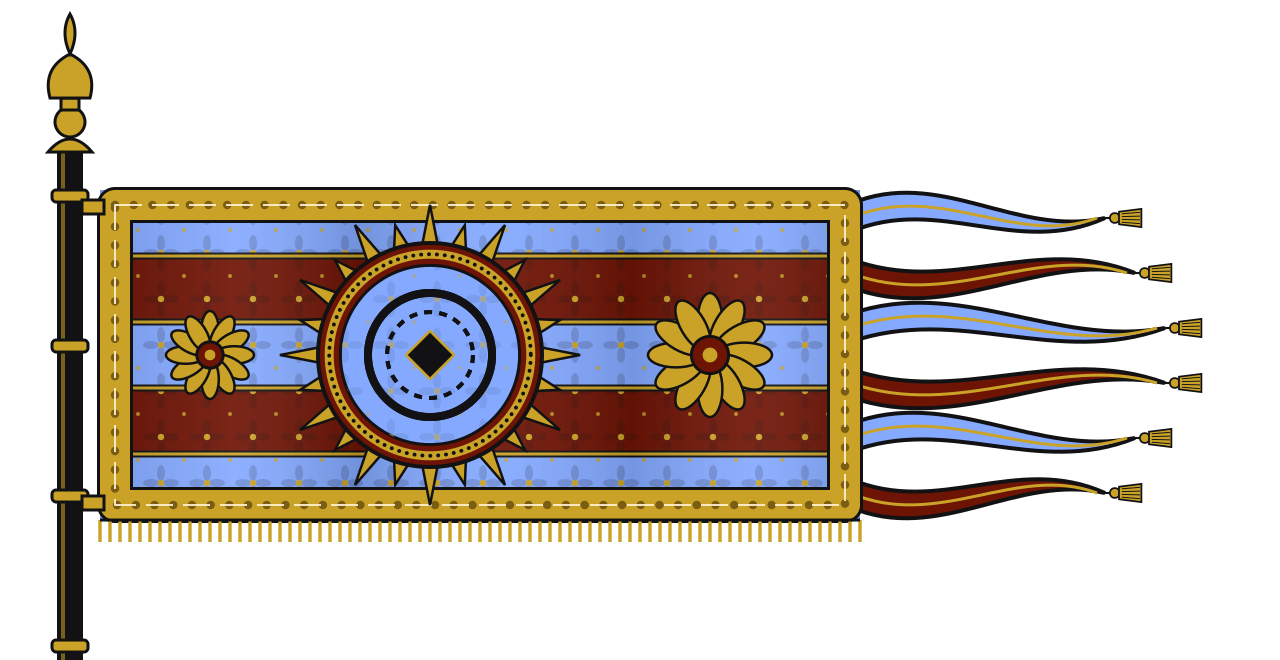
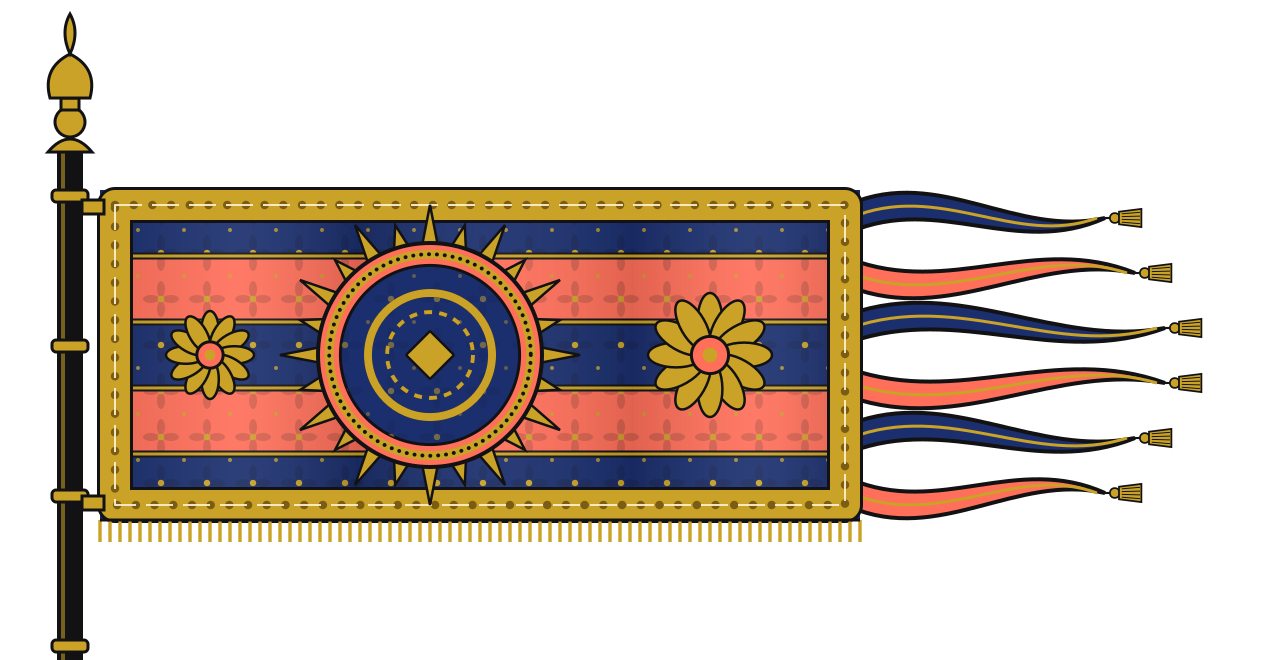
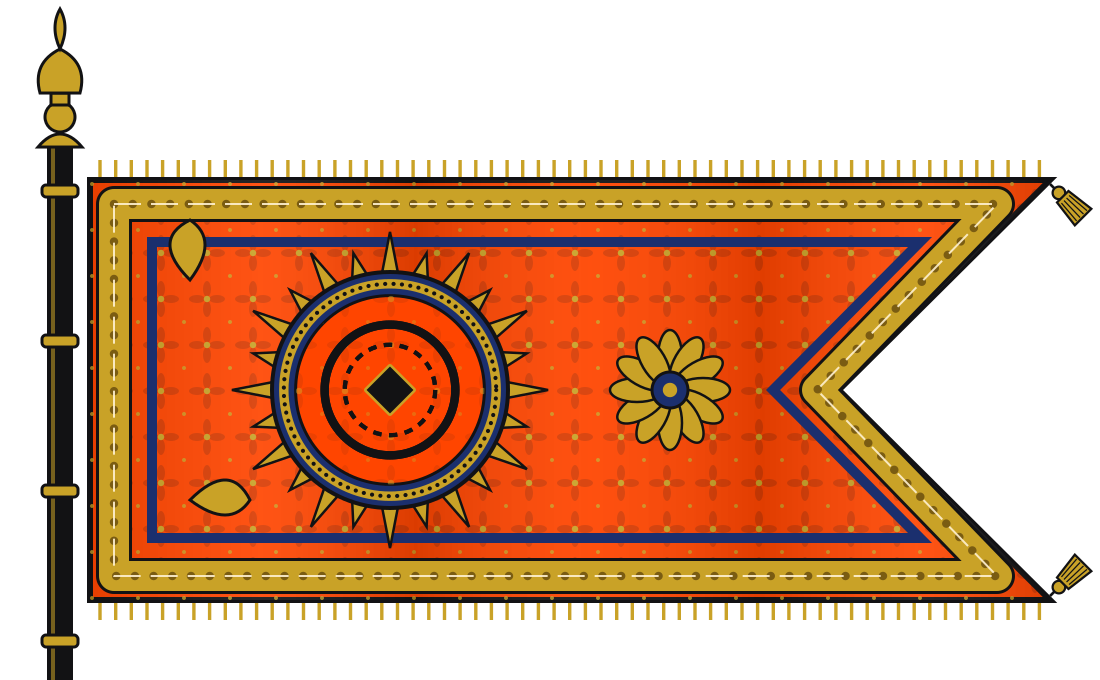
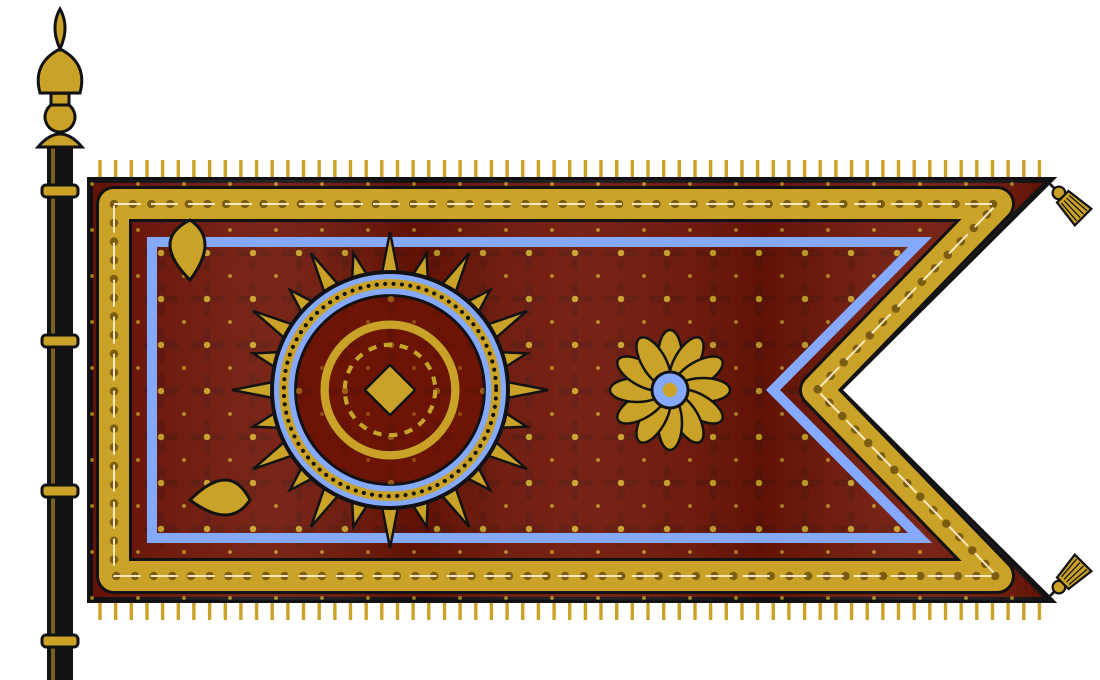
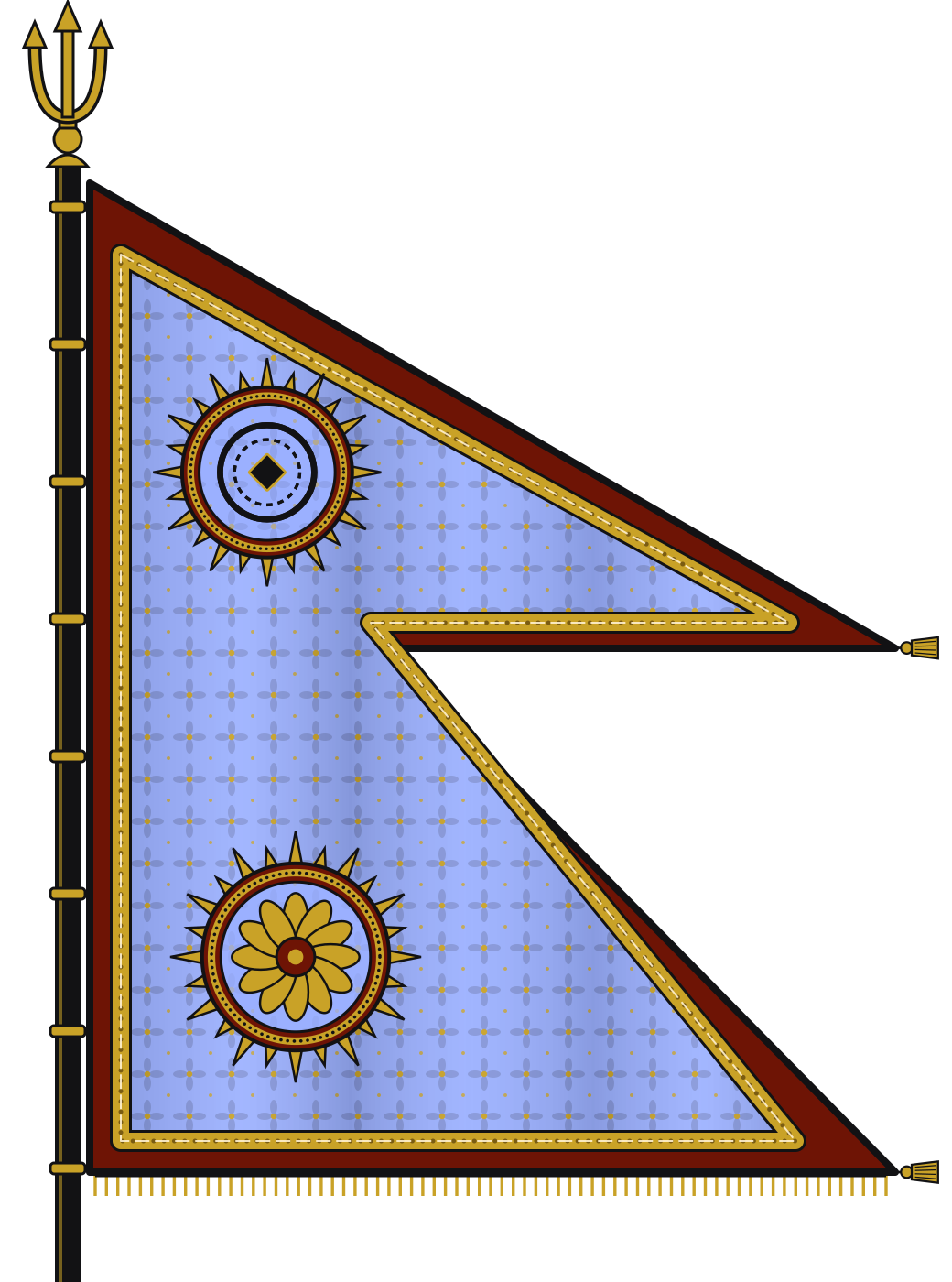
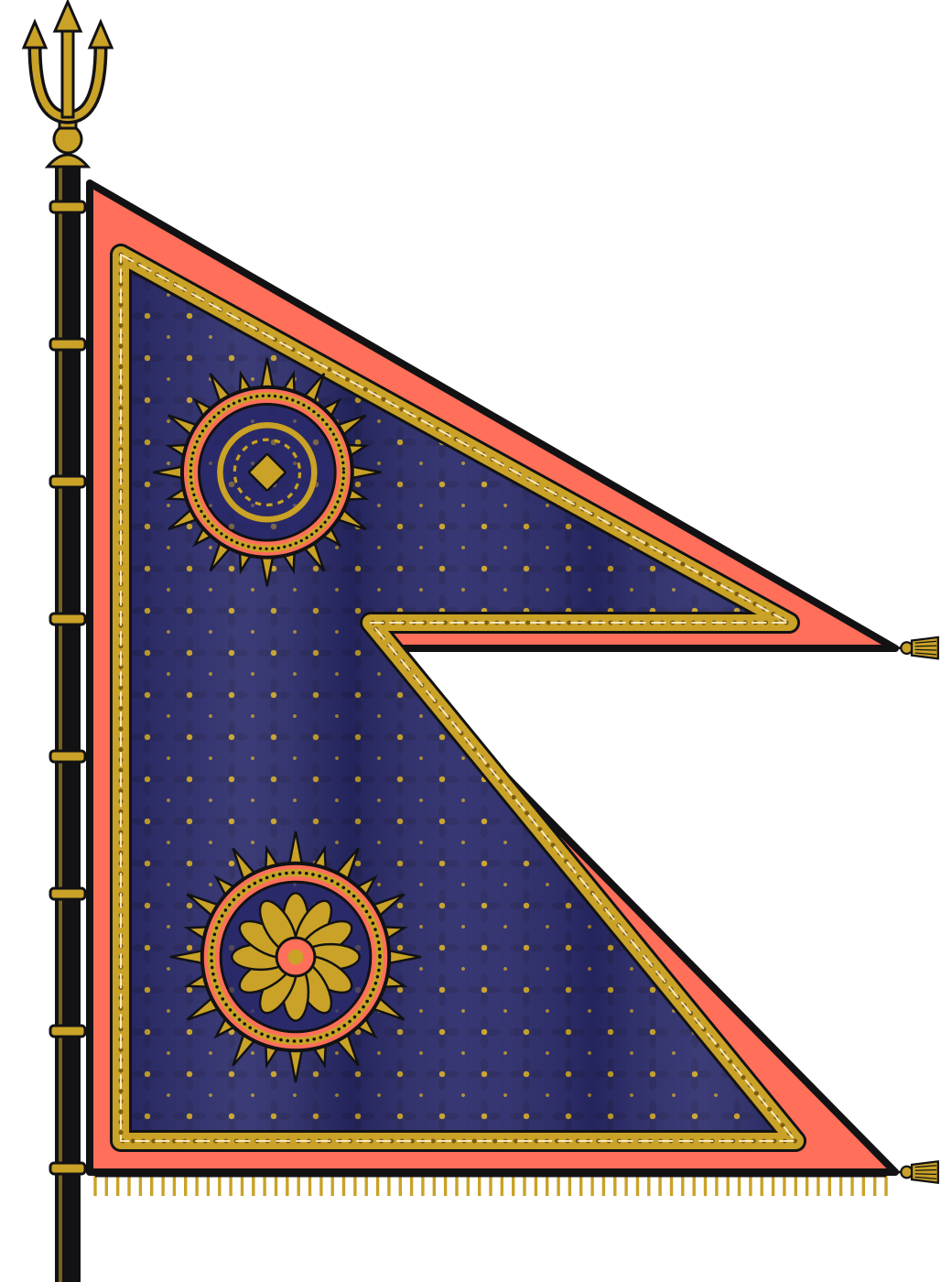

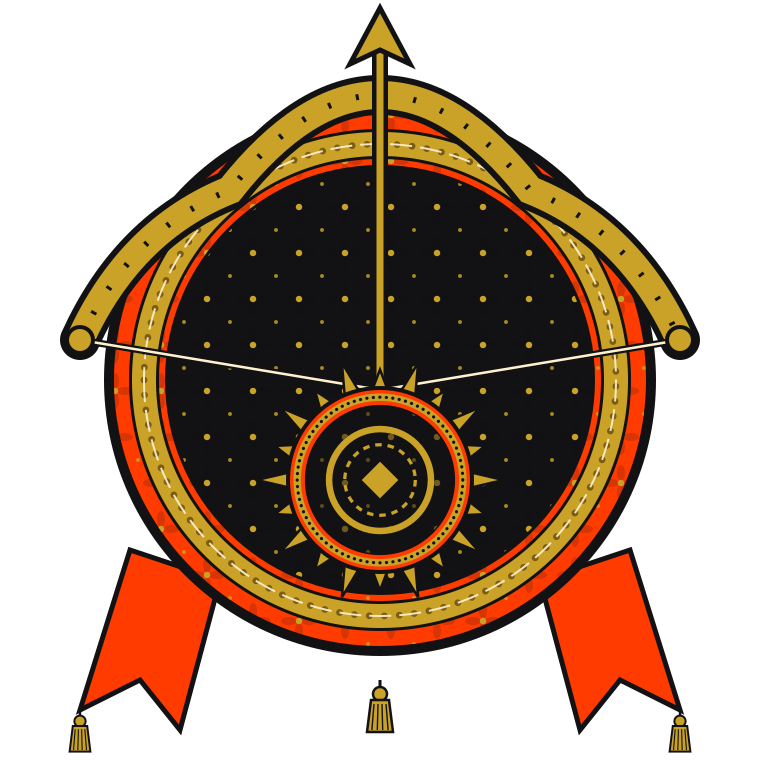
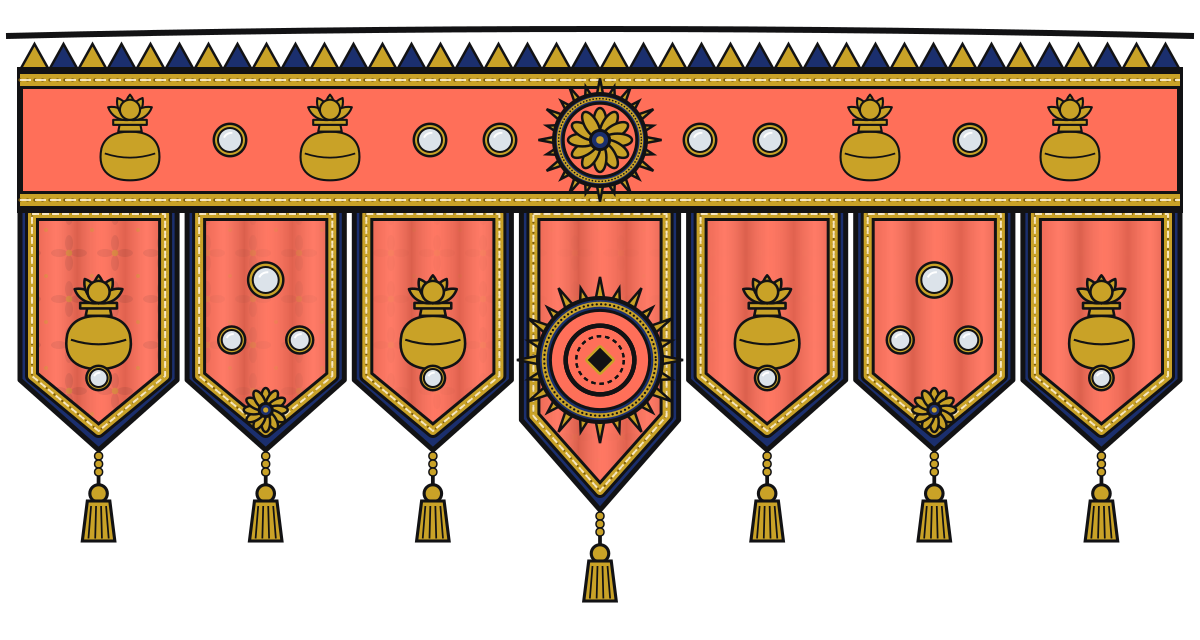
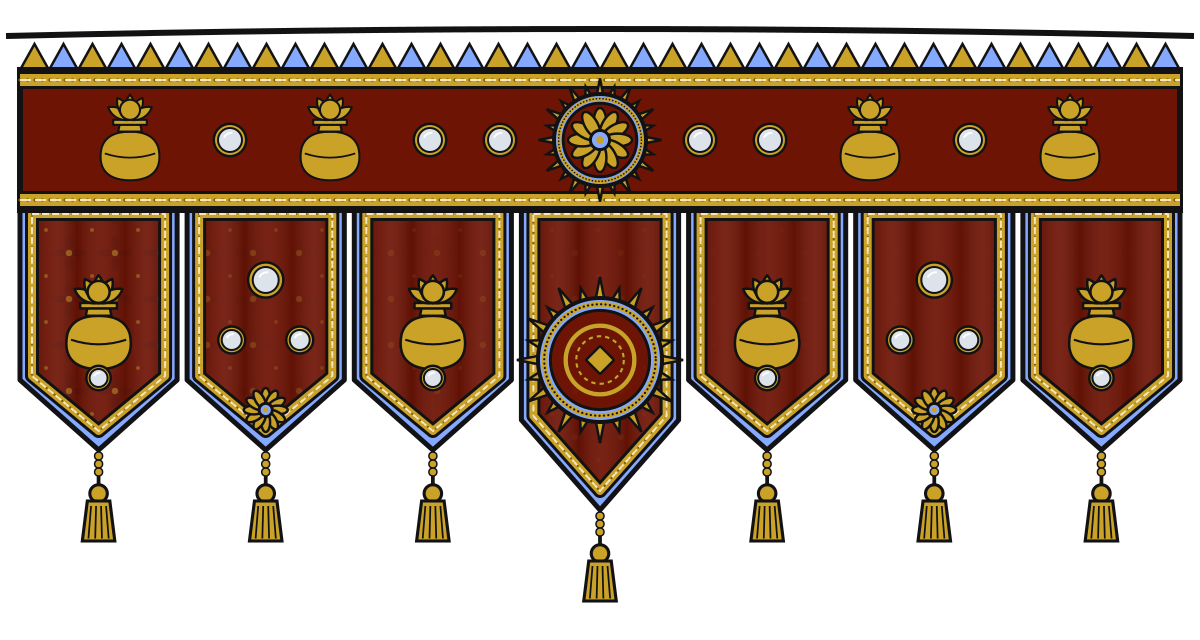

Historic banner
None known
New flag types
| Accessory | For this clan | Basis |
|---|---|---|
| A9 Pota-dhvaja · ship and trade flag For ships, caravans and markets | Not yet designed for this clan | Design |
| A10 Utsava-patāka · festival flag Light, bright flag for fairs and festivals | Not yet designed for this clan | Design |
| A11 Shoka-dhvaja · mourning flag White cloth with the emblem outline in the clan's metal | Not yet designed for this clan | Design |
7. Regalia
| Accessory | For this clan | Basis |
|---|---|---|
| E1 Chhatra · house parasol The ceremonial umbrella | Not yet designed for this clan | Design |
| E2 Chamara · fly-whisks The pair of whisks beside the head of the house | Not yet designed for this clan | Design |
| E3 Danda · staff of office Staff or scepter | Not yet designed for this clan | Design |
| E4 Simhasana · seat The seat of the house, covered in clan cloth | Not yet designed for this clan | Design |
| E5 Khetaka · shield A round shield; the Changi and Dhanush are its flag forms | Not yet designed for this clan | Regional tradition |
| E6 Kula-ayudha · clan weapon The weapon the clan honours | Iron tridents carried in the worship of Devi by Jubbulpore Kols | Documented |
8. Worn
| Accessory | For this clan | Basis |
|---|---|---|
| F1 Kula-vastra · clan cloth The clan's woven pattern in its kit colours | Not yet designed for this clan | Design |
| F2 Kirti-vastra · honour cloth A cloth earned for a deed, not inherited | Not yet designed for this clan | Design |
| F3 Kula-mala · garland flower The flower or leaf the clan wears as a garland | Not yet found for this clan | Under research |
| F4 Chinha · house pin A metal badge with the pin emblem | Not yet designed for this clan | Design |
9. Records
| Accessory | For this clan | Basis |
|---|---|---|
| H1 Clan words A traditional line in the native script | कोल की माँ · “Kol ki maan: the mother of the Kol” GKToday Hindi, Kol community (2 March 2023), which calls Sahara Mata 'कोल की माँ'[8] | Design |
| H2 Biruda · titles The house's title or titles | Gaontia, the head of the Mandla panchayat, always of the Bargaiya sept. Munda is the Kol term for a village headman | Documented |
| H3 Prashasti · praise genealogy The lineage as written at the head of a grant | Not yet found for this clan | Under research |
| H4 Vahi · clan register The book of the clan's births, marriages and deaths | Not yet found for this clan | Under research |
| H5 Rana-ghosha · war cry The clan's cry in battle or celebration | Not yet found for this clan | Under research |
10. VishwaVit · knower of the world
Game values are design choices for this project, not historical claims.
References
- R. V. Russell, The Tribes and Castes of the Central Provinces of India, vol. 3 (1916), Project Gutenberg #41424, read 2026-10-10, https://gutenberg.org/cache/epub/41424/pg41424-images.html
- Wikipedia, Kol uprising, read 2026-10-22, https://en.wikipedia.org/wiki/Kol_uprising
- Wikipedia, Tribals in Madhya Pradesh, read 2026-10-19, https://en.wikipedia.org/wiki/Tribals_in_Madhya_Pradesh
- Wikipedia, Tribes of Jharkhand, read 2026-10-20, https://en.wikipedia.org/wiki/Tribes_of_Jharkhand
- Wikipedia, List of Scheduled Tribes in Odisha, read 2026-10-20, https://en.wikipedia.org/wiki/List_of_Scheduled_Tribes_in_Odisha
- dhammabharat.com, List of Scheduled Tribes in Maharashtra and Population of each Tribe (2011 Census), read 2026-10-10, https://dhammabharat.com/?p=13656
- Dr. Ramdayal Munda Tribal Welfare Research Institute, Jharkhand, Kol, read 2026-10-22, https://trijharkhand.in/en/kol
- GKToday Hindi, Kol community: main points, 2 March 2023, read 2026-10-22, link
- Vajiram and Ravi, Kol Tribe (exam-prep site, secondary), read 2026-10-22, https://vajiramandravi.com/current-affairs/kol-tribe/
- Anahad Foundation, The Wedding Songs of the Kol Adivasis, read 2026-10-22, https://anahad.ngo/?p=16054
- Wikipedia, Kol people, read 2026-10-22, https://en.wikipedia.org/wiki/Kol_people
- Encyclopedia of World Cultures (Gale, 2008) via everyculture.com, Kol: Orientation, read 2026-10-22, https://www.everyculture.com/South-Asia/Kol-Orientation.html
- S. N. Dwivedi and H. Singh, Ethnobotany of Kols of Rewa division, Madhya Pradesh (1984), Proc. National Seminar Environment EPCO 2, pp. 37-44, record read 2026-10-22, https://indianmedicine.eldoc.ub.rug.nl/36349/
- Sushree Mohanty, Indigenous Colours of Odisha: Handbook on 62 Tribes (KISS), read 2026-10-20, link
- Vajiram and Ravi, Kolhan's Manki-Munda Governance System (exam-prep site, secondary), read 2026-10-22, link